Ezekiel 33:32

Hebrew (Westminster Leningrad Codex) Ezekiel 33:32 appears in the Hebrew Old Testament. The text above is from the Westminster Leningrad Codex. Each word links to its Strong’s number, a concise gloss, and parsing drawn from the Open Scriptures Hebrew Bible morphology. Click any word for its full Brown-Driver-Briggs (BDB) entry.
Download image
Cite this verse

Ezekiel 33:32 (World English Bible). Public Domain. Lemma interlinear Bible study tool, https://lemma.gebible.app/v/ezekiel/33/32.

Show BibTeX & RIS
BibTeX
RIS
English Translation
Behold, you are to them as a very lovely song of one who has a pleasant voice, and can play well on an instrument; for they hear your words, but they don't do them.
World English Bible · Public Domain
Download a study sheet

One document with this verse’s original text, its word-by-word gloss line, the meaning frame, cross-references with their text, attributed commentary, and full source and license credits — printable, and it pastes into notes with its structure intact.

This verse Autodidact and up

Study sheet (.html) Plain text (.txt)

A passage Seminary Student

Up to 50 verses in one chapter. A passage sheet keeps up to 6 commentary sources and 12 cross-references per verse, in the order this page ranks them, and says so on the sheet whenever that leaves anything out. Ask for a single verse and you get the Autodidact verse sheet above.

Everything on this page stays free to read, with no account — the sheet is a download of what is already on screen, not access to it.

Want to remove ads? Support Godless Engineer
Compare translations 3

The same verse in 3 English versions, stacked beneath the original-language interlinear above. Click any original word for its lexicon entry.

Each is an independent rendering of the whole verse — the interlinear is not word-aligned to these translations.

Highlighted words mark where these versions differ — a whole-verse word diff, not a word-by-word alignment.

  • World English Bible Public Domain
    Behold, you are to them as a very lovely song of one who has a pleasant voice, and can play well on an instrument; for they hear your words, but they don't do them.
  • King James Version Public Domain
    And, lo, thou art unto them as a very lovely song of one that hath a pleasant voice, and can play well on an instrument: for they hear thy words, but they do them not.
  • unfoldingWord Literal Text CC BY-SA 4.0
    For you are like a lovely song to them, a beautiful sound that is well played on a stringed instrument, so they will listen to your words, but none of them will obey them.

unfoldingWord Literal Text — © unfoldingWord, licensed CC BY-SA 4.0. Word-aligned USFM3 via Door43 (git.door43.org/unfoldingWord/en_ult).

Versions to compare (up to 4)

3 of 4 selected

Show all 18 translations

Every available English version of this verse, each an independent rendering of the whole verse.

  • World English Bible Public Domain
    Behold, you are to them as a very lovely song of one who has a pleasant voice, and can play well on an instrument; for they hear your words, but they don't do them.
  • Berean Standard Bible Public Domain
    Indeed, you are to them like a singer of love songs with a beautiful voice, who skillfully plays an instrument. They hear your words but do not put them into practice.
  • Majority Standard Bible Public Domain
    Indeed, you are to them like a singer of love songs with a beautiful voice, who skillfully plays an instrument. They hear your words but do not put them into practice.
  • King James Version Public Domain
    And, lo, thou art unto them as a very lovely song of one that hath a pleasant voice, and can play well on an instrument: for they hear thy words, but they do them not.
  • American Standard Version (1901) Public Domain
    And, lo, thou art unto them as a very lovely song of one that hath a pleasant voice, and can play well on an instrument; for they hear thy words, but they do them not.
  • Revised Version (1885) Public Domain
    And, lo, thou art unto them as a very lovely song of one that hath a pleasant voice, and can play well on an instrument: for they hear thy words, but they do them not.
  • Geneva Bible (1599) Public Domain
    And loe, thou art vnto them, as a iesting song of one that hath a pleasant voyce, and can sing well: for they heare thy woordes, but they doe them not.
  • Douay-Rheims (1899) Public Domain
    And thou art to them as a musical song which is sung with a sweet and agreeable voice: and they hear thy words, and do them not.
  • Young's Literal Translation Public Domain
    And lo, thou `art' to them as a singer of doting loves, A pleasant voice, and playing well on an instrument, And they have heard thy words, and they are not doing them.
  • Literal Standard Version CC BY-SA 4.0
    And behold, you [are] as a singer of unhealthy loves to them, || A beautiful voice, and playing well on an instrument, || And they have heard your words, and they are not doing them.
  • Unlocked Literal Bible CC BY-SA 4.0
    For you are like a lovely song to them, a beautiful sound that is well played on a stringed instrument, so they will listen to your words, but none of them will obey them.
  • unfoldingWord Literal Text CC BY-SA 4.0
    For you are like a lovely song to them, a beautiful sound that is well played on a stringed instrument, so they will listen to your words, but none of them will obey them.
  • Darby Bible Public Domain
    And behold, thou art unto them as a lovely song, a pleasant voice, and one that playeth well on an instrument; and they hear thy words, but they do them not.
  • World Messianic Bible Public Domain
    Behold, you are to them as a very lovely song of one who has a pleasant voice, and can play well on an instrument; for they hear your words, but they don’t do them.
  • Webster's Bible Public Domain
    And lo, thou art to them as a very lovely song of one that hath a pleasant voice, and can play well on an instrument: for they hear thy words, but they do not perform them.
  • Free Bible Version CC BY-SA 4.0
    In fact, to them you're just someone who sings love songs with a lovely voice and who is a fine musician. They listen to the message you share, but they don't do anything about it.
  • Bible in Basic English Public Domain
    And truly you are to them like a love song by one who has a very pleasing voice and is an expert player on an instrument: for they give ear to your words but do them not.
  • JPS Tanakh (1917) Public Domain
    and, lo, thou art unto them as a love song of one that hath a pleasant voice, and can play well on an instrument; so they hear thy words, but they do them not —

Literal Standard Version (2020), Covenant Press — licensed CC BY-SA 4.0. Text via the HelloAO Bible API (eBible.org). Unlocked Literal Bible (unfoldingWord) — licensed CC BY-SA 4.0. Text via the HelloAO Bible API (eBible.org). unfoldingWord Literal Text — © unfoldingWord, licensed CC BY-SA 4.0. Word-aligned USFM3 via Door43 (git.door43.org/unfoldingWord/en_ult). Free Bible Version, Dr. Jonathan Gallagher — licensed CC BY-SA 4.0. Text via the HelloAO Bible API (eBible.org).

Word by word

More ways to search: Search by grammar → Find every occurrence → Compare this word →

Practice this passage: Drill this verse → Learn its vocabulary →

עֲגָבִ֔ים
ʻegeb
H5690
“sensuous love”
Noun, Common, Masculine, Plural, Absolute
Part of Speech
Noun
Type
Common
Gender
Masculine
Number
Plural
State
Absolute
Full BDB Definition

Origin: from H5689

TWOT: 1559a

(sensuous) love
  1. וְהִנְּךָ֤ hên H2005 “and · behold · you” Conjunction + Particle, Interjection + Suffix, Personal, 2nd Person, Masculine, Singular
  2. כְּשִׁ֣יר shîyr H7892 “like/as · song of” Preposition + Noun, Common, Both, Singular, Construct
  3. יְפֵ֥ה yâpheh H3303 “beautiful of” Adjective, Adjective, Masculine, Singular, Construct
  4. ק֖וֹל qôwl H6963 “voice” Noun, Common, Masculine, Singular, Absolute
  5. וּמֵטִ֣ב ṭôwb H2895 “and · being good” Conjunction + Verb, Hiphil, Participle Active, Masculine, Singular, Absolute
  6. נַגֵּ֑ן nâgan H5059 “to play stringed instrument” Verb, Piel, Infinitive Construct
  7. וְשָֽׁמְעוּ֙ shâmaʻ H8085 “and · to hear” Conjunction + Verb, Qal, Sequential Perfect, 3rd Person, Common, Plural
  8. אֶת ʼêth H853 “-” Particle, Direct Object
  9. דְּבָרֶ֔יךָ dâbâr H1697 “words · your” Noun, Common, Masculine, Plural, Construct + Suffix, Personal, 2nd Person, Masculine, Singular
  10. וְעֹשִׂ֥ים ʻâsâh H6213 “and · doing” Conjunction + Verb, Qal, Participle Active, Masculine, Plural, Absolute
  11. אֵינָ֖ם ʼayin H369 “nothing · them” Particle, Negative + Suffix, Personal, 3rd Person, Masculine, Plural
  12. אוֹתָֽם ʼêth H853 “- · them” Particle, Direct Object + Suffix, Personal, 3rd Person, Masculine, Plural

About this verse

These counts appear in no published source. They are computed here, from the morphology-tagged text and Lemma’s own curated glosses. What Lemma adds →

14
words
12
distinct lemmas
Prophets
section

Notable vocabulary

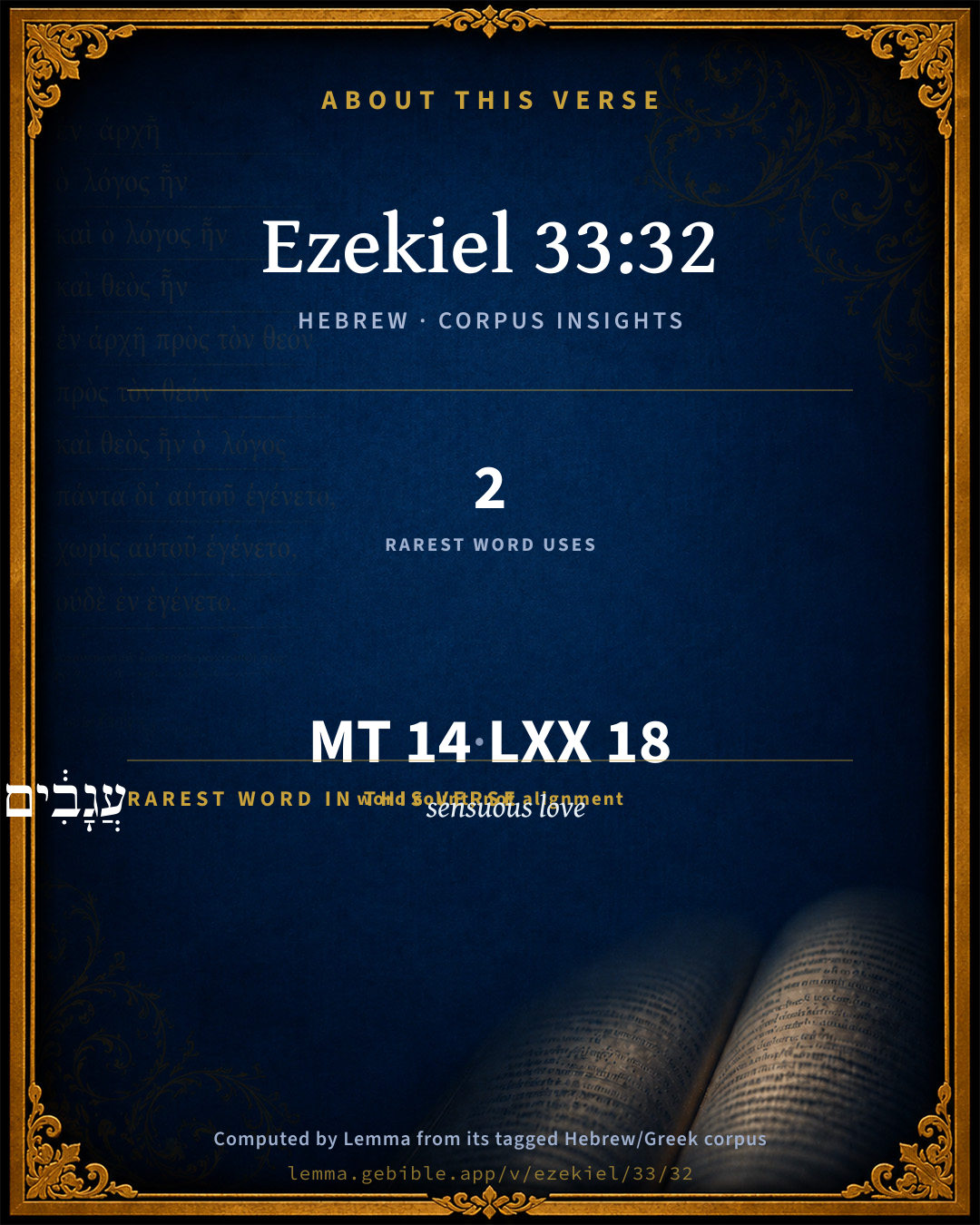
The rarest word here is עֲגָבִ֔ים sensuous love H5690 — appearing just 2 times in the whole Hebrew Bible.

Shared distinctive vocabulary

עֲגָבִ֔ים sensuous love H5690 occurs in 2 verses of the Hebrew Bible. Also found in:

Grammatical profile

  • 4 verbs
  • 4 nouns
  • 1 adjective
  • 1 preposition
  • 4 particles

Verb forms

  • וּמֵטִ֣ב Hiphil · Participle Active
  • נַגֵּ֑ן Piel · Infinitive Construct
  • וְשָֽׁמְעוּ֙ Qal · Sequential Perfect
  • וְעֹשִׂ֥ים Qal · Participle Active

Hebrew & Septuagint length

In English translation the verse runs 34 words from the Hebrew and 25 from the Septuagint (LXX English) — closely comparable.

A rough comparison of the two English renderings, which tokenize alike — not a word-level alignment.

Word counts can differ between the Hebrew and the Greek without any difference in meaning — e.g. the Hebrew direct-object marker אֵת has no separate Greek word, and Greek often adds the article ὁ.

In the original languages it is 14 Hebrew tokens and 18 Greek tokens — but the two are counted differently (Hebrew bundles its prefixes and suffixes into one token; the Greek is in lemma form), so that isn’t a like-for-like length.

Cross-references

3

Topical passages linked to Ezekiel 33:32 in the Treasury of Scripture Knowledge — connected by theme and wording, ordered by reader-vote popularity; previews shown in the World English Bible.

  • Mark 6:20 for Herod feared John, knowing that he was a righteous and holy man, and kept him safe. When he heard him, he did many things, and he heard him gladly.
  • Mark 4:16–17 These in like manner are those who are sown on the rocky places, who, when they have heard the word, immediately receive it with joy.
  • John 5:35 He was the burning and shining lamp, and you were willing to rejoice for a while in his light.

Cross-references courtesy of OpenBible.info (CC BY 4.0).

Hebrew and Greek witnesses Masoretic Hebrew ↔ Greek Septuagint

The same verse in the two great witnesses to the Old Testament, shown verse-for-verse.

These are two independent witnesses, not word-aligned to each other, and the Septuagint is shown in lemma (dictionary) form.

Hebrew Ezekiel 33:32 Masoretic · Westminster Leningrad Codex

וְהִנְּךָ֤ לָהֶם֙ כְּשִׁ֣יר עֲגָבִ֔ים יְפֵ֥ה ק֖וֹל וּמֵטִ֣ב נַגֵּ֑ן וְשָֽׁמְעוּ֙ אֶת דְּבָרֶ֔יךָ וְעֹשִׂ֥ים אֵינָ֖ם אוֹתָֽם

Behold, you are to them as a very lovely song of one who has a pleasant voice, and can play well on an instrument; for they hear your words, but they don't do them.

World English Bible · Public Domain

Greek LXX Ezekiel 33:32 Septuagint · lemma form

καί γίγνομαι αὐτός ὡς φωνή ψαλτήριον ἡδύφωνος εὐάρμοστος καί ἀκούω σύ ὁ ῥῆμα καί οὐ μή ποιέω αὐτός

And you are to them as a sound of a sweet, well-tuned lute, and they will hear your words, but they will not do them.

LXX2012 (modern English Septuagint) · Public Domain

Hebrew: Westminster Leningrad Codex (CC BY 4.0). Greek: Septuagint (public domain); English from LXX2012 (modern English Septuagint) (Public Domain). How the Septuagint differs from the Hebrew →

Targum (Aramaic paraphrase)

1

The Targum is the ancient Jewish Aramaic paraphrase of the Hebrew Scriptures — an interpretive translation, not the Hebrew text itself. Onkelos (literal) and Pseudo-Jonathan (expansive) render the Torah, and Jonathan the Prophets. Coverage is partial: where no permissively-licensed English translation exists for a verse, only the Aramaic is shown. This is verse-level text, not a word-by-word alignment to the Hebrew.

  1. Targum Jonathan Prophets (Joshua–Malachi)
    וְהָא אַתְּ לְהוֹן כִּזְמַר אֲבּוּבִין דִבְּסִים קָלֵיהּ וּמוֹטַב לְנַגָנָא וְשָׁמְעִין יַת פִּתְגָמָךְ וּלְמֶעְבַּדְהוֹן לֵית אִינוּן צָבָן:

    (no public-domain English translation for this verse)

    Targum Jonathan — Aramaic: “Mikraot Gedolot” (public domain). English: “Sefaria Community Translation” (CC0 1.0 (public-domain dedication)); “London "Chaldee Paraphrase," 1871” (public domain). Text via Sefaria.

Commentary

Notes on Ezekiel 33:32 from classic Christian and Jewish commentators (each source and its license shown beneath its notes). The classic Christian expositions comment on the surrounding passage and are grouped to its opening verse, so a note may address several verses; the Jewish commentaries on the Tanakh (Rashi and others) are per-verse, so they appear only where the commentator wrote on this verse.

Lemma curates 59 commentaries, every one of them public domain or Creative Commons licensed, each selected and text-cleaned for this edition rather than reprinted as found. About our sources →

Trapp's Complete Commentary

John Trapp

Eze 33:32 And, lo, thou [art] unto them as a very lovely song of one that hath a pleasant voice, and can play well on an instrument: for they hear thy words, but they do them not.

Ver. 32. As a very lovely song.] Or, A love song. {a} The word leaves no more impression upon carnal men’s consciences than a sweet lesson upon the lute in the ear when it is ended, for then both the vocal and instrumental sweetness dissolve into the air and vanish into nothing. Happy was Augustine, who, coming to Ambrose to have his ears tickled, had his heart touched.

{a} Canticum amatorium. - Vatab.

John Trapp, A Commentary or Exposition upon All the Books of the Old and New Testament (1647–1656) — public domain. Text from a community e-Sword module.

The Biblical Illustrator

Joseph S. Exell

Eze_33:32

Thou art unto them as a very lovely song.

Ezekiel

These words are spoken of the prophet Ezekiel; he is as the lovely song, as the pleasant voice, as the instrument of music, all this even to the worldly mind; yet we might have thought otherwise; so full is he of woe, of the wrath of God; and how dark and obscure are his visions! It might then at first sight appear inconsistent with tiffs that the prophet Ezekiel should in style be considered so engaging, that even to those to whom he was sent with heavy tidings he should be as one that had a pleasant voice; in like manner, that although the roll which is given him is written within and without, with lamentations and mourning and woe, yet it should be in the mouth of the prophet, that is, to the natural man, as honey for sweetness. Yet this is in accordance with much we find in Scripture; for instance, what could be more sternly severe and full of reproof than St. Stephens speech at his death? But on that occasion, looking steadfastly on him, they saw his face as it had been the face of an angel. Thus God arrested their minds till His martyr should speak to them all his burden of sad admonition. Again, such types and figures have a life such as no mere words of themselves can have, they clothe themselves with form and spirit, and continue. Thus the images of Ezekiel not only speak of themselves in the place where they are found; but they come up again and are of frequent occurrence in the Apocalypse, as if still waiting for their fulfilment. Thus, indeed, much that is in Ezekiel is also in St. John; things which already have been in some sense fulfilled; but even now are fulfilling themselves, and yet to be more largely and worthily fulfilled. The vision of the four living creatures, for instance, in Ezekiel, is found again in St. John; it is still before us; still new; we know much of what it means, but we have much more yet to learn. The glory of the Lord coming from the East; His voice like the noise of many waters; the earth shining with His glory; these and many such things in Ezekiel are reproduced in St. John. In both the angels of judgment are represented as waiting till the children of God are sealed with His mark upon their forehead. Gog and Magog with their armies are both, alike in Ezekiel and in St. John, as about to come forth in the times of the end. The assembling of the fowls to the great sacrifice is in both. And especially that subject of many chapters in Ezekiel, the measuring of the Temple and the vision of the Holy City, is marked in both as yet to be. Now, I have said that one effect of types and similitudes such as these is, that they may not die away and be forgotten; thus if we look to those subjects of Holy Writ which arrest at this day most attention in the world, we shall find it is such figurative prophecies. Such are some reasons for the symbolic language of Ezekiel; it is a language suited for all times and countries, that never grows out of date or loses its power. Add to which it may be naturally accounted for by the character and circumstances of the prophet, and the heavy tidings he had to bear. Strong feeling does always naturally express itself in figures and similitudes; it gives vent to itself in burning words that take form and are full of life. Thus as a plant which when crushed gives forth its sweetness, as from the grape trodden under foot is the Wine of God; and from the corn thrashed and ground is the Bread of Life: so was Ezekiel stricken of God that he might speak the more powerfully in the likeness of Christ. And oh, the blessedness of that suffering, the inestimable value of that affliction which gives us power to speak the words of God! And well did he need visions and words of power, for nothing else would reach the hearts of those to whom he was sent. For these reasons the prophecies of Ezekiel, like our Lords own miracles and parables, present things more to the eye than to the ear; for thus they more powerfully reach the mind. Hence the whole style and character of Ezekiel; where another prophet persuades, Ezekiel sees a sign or symbol and leaves that to speak. He is set as a watchman to watch for the morning, and descries its light from afar, while fires as of Mount Sinai blend with the milder radiance of Pentecost. He is the Prophet of Christs second coming no less than of His first. As in the Day of Judgment, amidst sights and signs the most sublime and terrible, will be manifested wonderful depths of Gods wisdom, the reach of His Providences, and the scales of eternal justice; so throughout this prophet, amidst visions and imagery, great, striking, and awful, there occur full and clear enunciations of Gods mercy and truth, the rising of His temple, the sublime and wonderful but most beautiful order of His ways on earth, bearing onward the throne of the Incarnate Son of God. St. Jerome says that he was used when young to go on the Lords day into the caves at Rome where the Apostles and Martyrs were buried; and there, in silence and darkness amid the chambers of the dead, to meditate on the visions of Ezekiel; and that thus he learned to approach them with awe and reverence, not with idle curiosity, and so in some measure to understand them; seeing light, he says as in the dubious obscure, and exclaiming, I have found Him whom my soul loveth, I will hold Him fast and will not let Him go. Thus, in the cloudy and dark day, in the times of affliction, we may understand him better than now we do. One word more of caution; a holy bishop, who has written largely on Ezekiel, the great St. Gregory, has applied it to the examination and correction of our own heart, and building up the soul in righteousness. Thus we know that the temple of God of which so much is said in Ezekiel is in one sense our own soul. Happy he who mourns for all pollutions and abominations that have been there, who puts out from thence all idols, and makes it fit for the indwelling of God. Blessed is he who keeps his heart tender and low to understand His prophets, whether the plaintive voice amidst the ruins of Israel or the dark harp by the waters of Babylon. (Isaac Williams, B. D.)

The songs our lives sing

I. Our lives sing various songs.

1. Some lives are set to wailing music, the lives that are far away from God, and separated by the great gulf of sin from all things good and holy. When the measure of such a song falls on our spiritual ears we are depressed and feel like weeping.

2. There are other life songs set to joyful music. They are sent to brighten up the earth, and, like the flowers, to make it more beautiful. These songs are the lives of those who love the beauties of the world, climb above its mists, and revel in the sunlight. They look on the bright side of life, feeling that it is better to laugh than to cry, to pluck the rose and leave untouched the thorn.

3. There are other songs given forth by lives that are fired with a sublime purpose to make the world better, and to lift it to a loftier plane of living. Such lives are set to stately music that broadens and deepens the hearts of those who hear.

4. But the sweetest song that ever fell on mortal ears is one that flowed out from Calvary two thousand years ago, and sounded down the ages to bless the fallen race, a song that rose to heaven, and angels climbed the everlasting hills to hear. Now and then a human life, a song from God, catches the metre of Jesus Christ, and when its music is heard hearts soften, nerves thrill, and teardrops fall.

II. We hear, but often do not heed, these life songs. In the days when the heart song of Ezekiel sounded out there were many who heard, and yet they heeded not. When the heart song of Jesus Christ sounded out there were many sordid souls who heeded not the music. God says to all such today, as to those who heard Ezekiel, that if they hear and fail to be benefited their blood shall not be required at the hands of the singer, but shall be on their own heads.

III. Inferences.

1. Our life songs always seem feeble to ourselves. When we are nearest to Christ there is deeper music in the heart than can be uttered by the lips or the life.

2. We must first learn to sing lifes songs here if we expect to sing them yonder. In the sight of God our lives upon this earth must be like the limping songs of childhood, but up yonder we shall be prima donnas and master singers in the choir of the skies. (Homiletic Review.)

Ezekiels popularity

Ezekiel had by this time become a successful preacher. He had not always been such; on the contrary, he had been for a long time disbelieved and disliked. Now, however, he had come to be highly regarded, partly on account of the singularity of his preaching, partly on account of the striking and unexpected fulfilment of his prophecies. He was the great sensation of the day; men thought it the proper thing to go and hear him, to listen with rapt attention to the impetuous torrent of his words, and, when they went away, to discuss his message in the gates or on the housetops. Yet was the alteration but a sensible one, the reformation only superficial; and in the text the Lord exposes the hollowness of it all. I need not say how exactly this state of things is reproduced in the case of every popular preacher. Men whose lives are cruel or impure, whose hearts are covetous, whose thoughts are bitter, crowd to hear the preacher of the day, because his words are sweet, because his eloquence is full of melody, because they feel themselves for the moment fascinated, captivated, carried out of, lifted above, themselves. And then they talk about getting good, not because they have the slightest practical intention to reform, but because they have had pleasurable emotions, and their religious feelings have been gently excited by the skilful touch of the preacher. In our own Church eloquence is so rarely heard that we are in little danger of such delusion. Ezekiel in his popularity is a type not only of all lesser preachers, but emphatically of Him who is the great Prophet and Preacher of the world, the Master of all ages, the Incarnate Word of God. A very lovely song it is which the Saviour sings; no poet, no prophet, no bard ever sung or ever dreamed, or even ever strove (and striving, failed) to express anything half so sweet, so full, so soul-subduing as the Gospel of the Grace of God. And He that sings it hath indeed a pleasant voice, for sweeter is the voice of Christ than the voice of any angel or archangel, or of any of the heavenly choirs--grander it is in itself, and sweeter far is it to us, because it is a Brothers voice, and we can feel the sympathy, we can understand the finest, softest shades of meaning which are woven through its melody. And so it is true of the people now, as of old, that they hear Him gladly; if anyone will speak feelingly, if anyone can speak eloquently of the love of Jesus for sinners, they will crowd to hear him, they will listen with satisfaction and go away pleased,--but they will not do His words. Men love to hear the Saviours gracious invitation, Come unto Me, all ye that labour and are heavy laden, and I will give you rest, but they will not come to Him in the practical ways which He has pointed out. They love, above all things, to listen to the melodies of that last holy and tender discourse with His own, recorded in the Gospel of St. John, but they will not follow His practical counsels to such as wish to be His own. There is nothing more gladly heard by the sick and dying than that passage which begins, Let not your heart be troubled, neither let it be afraid; there is nothing, alas! more persistently forgotten, even by the dying than the fact that these things were spoken only to those who had continued with Christ in His temptations, who had showed that they loved Him by keeping His commandments: they hear His words, then, eagerly, but they do them not. (R. Winterbotham, M. A.)

On the slender influence of mere taste and sensibility in matters of religion

You easily understand how a taste for music is one thing, and a real submission to the influence of religion is another--how the ear may be regaled by the melody of sound, and the heart may utterly refuse the proper impression of the sense that is conveyed by it. Have you ever heard any tell, and with complacency too, how powerfully his devotion was awakened by an act of attendance on the oratorio--how his heart, melted and subdued by the influence of harmony, did homage to all the religion of which it was the vehicle; how he was so moved and overborne as to shed the tears of contrition, and to be agitated by the terrors of judgment, and to receive an awe upon his spirit of the greatness and the majesty of God; and that, wrought up to the lofty pitch of eternity, he could look down upon the world, and by the glance of one commanding survey pronounce upon the littleness and the vanity of all its concerns? It is indeed very possible that all this might thrill upon the ears of the man, and circulate a succession of solemn and affecting images around his fancy--and yet that essential principle of his nature, upon which the practical influence of Christianity turns, might have met with no reaching and no subduing efficacy whatever to arouse it. Amid all that illusion which such momentary visitations of seriousness and of sentiment throw around the character of man, let us never lose sight of the test, that by their fruits ye shall know them. The faithful application of this test would put to flight a host of delusions. It may be carried round amongst all those phenomena of human character where there is the exhibition of something associated with religion, but which is not religion itself. Religion has its accompaniments; and in these there may be a something to soothe and to fascinate, even in the absence of the appropriate influences of religion. The deep and tender impression of a family bereavement is not religion. The love of established decencies is not religion. The charm of all that sentimentalism which is associated with many of its solemn and affecting services is not religion. They may form the distinct folds of its accustomed drapery; but they do not, any or all of them put together, make up the substance of the thing itself. We call for fruit, and demand the permanency of a religious influence on the habits and the history. How many who take a flattering unction to their souls, when they think of their amiable feelings and their becoming observations, with whom this severe touchstone would, like the head of Medusa, put to flight all their complacency! The afflictive dispensation is forgotten--and he on whom it was laid is practically as indifferent to God and to eternity as before. The Sabbath services come to a close, and they are followed by the same routine of weekday worldliness as before. The instances may be multiplied without number. A man may have a taste for eloquence, and eloquence, the most touching or sublime, may lift her pleading voice on the side of religion. A man may love to have his understanding stimulated by the ingenuities or the resistless urgencies of an argument; and argument the most profound and the most overbearing may put forth all the might of a constraining vehemence in behalf of religion. A man may feel the rejoicings of a conscious elevation, when some ideal scene of magnificence is laid before him; and where are these scenes so readily to be met with as when led to expatiate in thought over the track of eternity, or to survey the wonders of creation, or to look to the magnitude of those great and universal interests which lie within the compass of religion? We will venture to say that as much delight may emanate from the pulpit on an arrested audience beneath it as ever emanated from the boards of a theatre--ay, and with as total a disjunction of mind too, in the one case as in the other, from the essence or the habit of religion. We recur to the test. We make our appeal to experience; and we put it to you all, whether your finding upon the subject do not agree with our saying about it, that a man may weep and admire, and have many of his faculties put upon the stretch of their most intense gratification--his judgment established, and his fancy enlivened, and his feelings overpowered, and his hearing charmed as by the accents of heavenly persuasion, and all within him feasted by the rich and varied luxuries of an intellectual banquet! We want you to see clearly the distinction between these two attributes of the human character. They are, in truth, as different the one from the other as a taste for the grand and the graceful in scenery differs from the appetite of hunger; and the one may both exist and have a most intense operation within the bosom of that very individual who entirely disowns and is entirely disgusted with the other. The mere majesty of Gods power and greatness, when offered to your notice, lays hold of one of the faculties within you. The holiness of God, with His righteous claim of legislation, lays hold of another of these faculties. The difference between them is so great that the one may be engrossed and interested to the full, while the other remains untouched and in a state of entire dormancy. Now, it is no matter what it be that ministers delight to the former of these two faculties; if the latter be not arrested and put on its proper exercise, you are making no approximation whatever to the right habit and character of religion. The religion of taste is one thing. The religion of conscience is another. We recur to the test: What is the plain and practical doing which ought to issue from the whole of our argument? If one lesson come more clearly or more authoritatively out of it than another, it is the supremacy of the Bible. If fitted to impress one movement rather than another, it is that movement of docility, in virtue of which man, with the feeling that he has all to learn, places himself in the attitude of a little child, before the book of the unsearchable God, who has deigned to break His silence, and to transmit even to our age of the world a faithful record of His own communication. What progress, then, are you making in this movement? Are you, or are you not, like newborn babes, desiring the sincere milk of the word, that you may grow thereby? With the modesty of true science, which is here at one with the humblest and most penitentiary feeling which Christianity can awaken, are you bending an eye of earnestness on the Bible, and appropriating its informations, and moulding your every conviction to its doctrines and its testimonies? (T. Chalmers, D. D.)

A very lovely song

This is a very lovely verse, but a very solemn and awful sentiment is attached to it.

I. A description of the Gospel message. The subject of our preaching is the Word of God. And oh, what a sweet, sweet song is that blessed word! Take--

1. The history and stories of the Bible. Begin with the creation of the world. It is told in brief, all details are omitted, but the grand outline is perfect, and scientific investigation is only filling up the details; and when all the details are filled up, the grand old story will be found firm as a rock.

2. The life stories of Bible heroes, the romance of our early progenitors, the population of the world, the fall, the deluge, the touches of human nature, and the goodness and sins of man, all brought out in the vivid pictures of realism.

3. The story of our Saviours birth, His early days, His mighty manhood, broken by the wail of agony at His cruel death. Then swell the notes to the sky, and a jubilant strain tells of victory over sin and death and the grave. The song goes on in recitative till comes the final crash of the concluding chorus.

II. A description of the effect which this song produces.

1. It is listened to. The most obdurate and hardened will gaze at a lovely landscape. Beauty hath a charm; it is the most powerful of all human influence. Is it any wonder, then, that the world is attracted by the beauty of the Gospel message?

2. It is criticised. The human mind will criticise everything great. Now, there is nothing so great as the Gospel, and nothing has provoked so much criticism and controversy. Its history, its poetry, its truths, its message, its plan of salvation have all been the objects of unnumbered attacks.

3. It is approved. Not indeed by everyone, but by the generality. Reason, common sense, sound judgment, intellectual attainments, all must concur in approving its excellence. The wants and necessities of our own minds, the cravings of our souls, bring the truths it proclaims into harmony with human nature.

III. A description of the way in which it is generally received.

1. It is a sweet song, and nothing more. They hear thy words and do them not. How sad this picture of the world, and yet how true! Under the preaching of the Gospel you have often said, Almost thou persuadest me to be a Christian. But what are you the better now? Nothing at all. The echoes of the song died away in the distance, you went to your daily toil, and the whole thing was forgotten.

2. The reason is plainly stated. You have heard, but you have not been doing. Salvation is a work just like any other work; it does not come of itself. Fancy a man who wanted to make a fortune listening to the life of Stevenson, and settling down to sleep. He would only die in the workhouse. Fancy a young man who desired to become a statesman, like Disraeli or Gladstone, spending his time in riot and dissipation; he would end where he began. And fancy an immortal soul, hearing the sound of the Gospel and the invitations of God, passing life in callousness and neglect.

3. A few words of inquiry as to why is this.

(1) It is for want of understanding. At the performance of a grand oratorio there are very few who have sufficient musical knowledge to understand the details of the composers work. So among the larger part of our congregations, the Gospel has no meaning beyond its pleasant sound.

(2) It is because of the hardness of the heart. The sound of the music, the voice of persuasion, the earnestness of invitation, fall on hearts as dead and seared as the rocky mountains of the desert. Not a seed can enter, for there is no soil to receive it.

(3) It is from love of the world. There are two forces which are ever acting on the soul--one would draw men to heaven, the other to earth. The generality of mankind are found between the two. Whichever predominates will determine the mans destiny.

IV. A suggestion as to the remedy to be applied.

1. Awakening. Remember that pleasant as the Gospel is to bear, it is something more than a song. It is a power; it is the voice of God; it is the destiny of your soul; it is your heaven or your hell.

2. Labour. Lay hold of eternal life; get rid of the deadly idea that religion is something merely to amuse or employ your time. (J. J. S. Bird.)

.

The Biblical Illustrator, edited by Joseph S. Exell (c. 1880s–1900s) — public domain. Text from a community e-Sword module.

Geneva Bible (1599)

Geneva Bible translators

Or, pleasant, and love song.

Geneva Bible (1599) marginal notes — public domain. Text via Bolls.life.

Jamieson, Fausset & Brown

Robert Jamieson, A. R. Fausset & David Brown

very lovely song--literally, a "song of loves": a lover's song. They praise thy eloquence, but care not for the subject of it as a real and personal thing; just as many do in the modern church [JEROME].

play well on an instrument--Hebrew singers accompanied the "voice" with the harp.

Jamieson, Fausset & Brown — Commentary Critical and Explanatory on the Whole Bible (1871) — public domain (CC PDM 1.0). Text via the HelloAO Bible API.

Adam Clarke's Commentary

Verse 32. As a very lovely song] They admired the fine voice and correct delivery of the prophet; this was their religion, and this is the whole of the religion of thousands to the present day; for never were itching ears so multiplied as now.

Adam Clarke's Commentary on the Bible (1810–1826) — public domain. Text from a community e-Sword/MySword module.

The Cambridge Bible for Schools and Colleges

gen. ed. J. J. S. Perowne

32. lovely song of one] lit. a lovely song; one that hath. The comparison “like a lovely song” is as usual inexact; “like” merely indicates the circumstances—as when there is a lovely song. The prophet is compared to the singer as A. V.

The Cambridge Bible for Schools and Colleges (gen. ed. J. J. S. Perowne; Cambridge University Press, 1878–1918) — public domain. Text from a community e-Sword module.

Haydock's Catholic Bible Commentary

CHAPTER XXXIII.

George Leo Haydock (1774–1849), Haydock's Catholic Family Bible and Commentary, 1859 edition — public domain. Excludes Psalms (Douay-Rheims chapter numbering differs from Protestant) and Deuterocanonical books (Catholic canon only).

Matthew Poole's English Annotations

These Jews esteem and regard thee and what thou sayest, as men regard a skilful musician, who to a well-tuned instrument hath sung the praises of virtue or of virtuous men; it pleaseth their ear, but it doth not frame their hearts and life to virtue. They loved him for his eloquent lamentation, and reproof of their enemies, and for foretelling that they should fall, and saying nothing against them and their sins for these three years past; but when he exhorts them to duty, or dissuades from sin, they will hear, not do.

Matthew Poole's English Annotations on the Holy Bible (1683–1685) — public domain. Text from a community e-Sword/MySword module.

The Pulpit Commentary

A very lovely song; literally, a song of love, an erotic idyll, the word being the same as in Ver. 31. Yet this was the meaning of the large gathering. They came to hear the prophet, as they would to hear a hired singer at a banquet, like those of Amo_6:5. The prophet"s words passed over them and left no lasting impression. All that they sought was the momentary tickling of the sense. The words receive a special significance from Psa_137:3. The Jewish exiles were famous among their conquerors for the minstrel"s art. The nobler singers refused to "sing the songs of Zion in a strange land;" others, it may be, were not so scrupulous. Had the prophet seen his people gather to listen to such a singer? Were they better occupied when they were listening to his message from Jehovah.

The Pulpit Commentary (1880–1919), ed. H.D.M. Spence-Jones & Joseph S. Exell — public domain. Text from a community e-Sword module.

unfoldingWord translationNotes

Door43 World Missions Community

General Information:

Yahweh continues speaking to Ezekiel about the people of Israel.

you are like a lovely song to them

Here "you" refers to Ezekiel, and here he represents the message he speaks. This compares Ezekiel's message to a lovely song, which means the people enjoy listening to him, but they do not think his message is important enough to obey. AT: "they think that your words are like a lovely song" (See: Metonymy and Simile)

a lovely song

Possible meanings are 1) "a beautiful song" or 2) "a love song" or "a song about love."

that is well played on a stringed instrument

This can be stated in active form. AT: "that someone plays very well on a stringed instrument" (See: Active or Passive)

stringed instrument

something that has strings and people use to make music

when all of this happens

The word "this" refers to all of the things that had God said would happen and that Ezekiel told the people about.

behold!

The word "behold" here adds emphasis to what follows. AT: "indeed!"

that a prophet has been among them

"that I really sent you as a prophet to them"

translationWords

obey

prophet

unfoldingWord translationNotes — © Distant Shores Media and the Door43 World Missions Community, licensed CC BY-SA 4.0. Source: git.door43.org/Door43/en_tn.

Rashi

Rabbi Shlomo Yitzchaki (Rashi)

And you are to them as a song on the flute And you are to them as a song on the flute.

Rashi on the Tanakh — English translations: “The Judaica Press complete Tanach with Rashi, translated by A. J. Rosenberg” (CC BY 4.0); “Pentateuch with Rashi's commentary by M. Rosenbaum and A.M. Silbermann, 1929-1934” (public domain); “The Metsudah Tanach series, Lakewood, N.J” (CC BY 4.0); and “The Book of Joshua, Metsudah Publications, 1997” (CC BY 4.0). Text via Sefaria.

Lesson kit

Teaching starters — assembled from the data on this page, not authored interpretation. Every prompt links to the verse data it draws on. Edit before teaching.

Ezekiel, in the Prophets, opens this verse with 14 words (12 distinct Hebrew lemmas). Its most distinctive word is ʻegeb (“sensuous love”). A historical commentator’s framing appears above. Read the whole chapter for the surrounding context.

Discussion questions

  1. How does “sensuous love” (ʻegeb) shape what this verse is saying?
  2. Ezekiel 33:31 shares the word «sensuous love» with this verse. How do the two illuminate each other?
  3. The translations on this page render this verse differently — a whole-verse word diff, not a word-by-word alignment. What might account for the different wordings?
  4. The verb «וּמֵטִ֣ב» is Hiphil Participle Active. How does its form color the action?
  5. Reading how Trapp's Complete Commentary and The Biblical Illustrator read this verse, where do the two commentators agree and where do they part?

Things to notice

Reading settings

Reading text

Shown beneath each verse's original-language words.

Old Testament
Old Testament edition

Read the OT as the Masoretic Hebrew (MT) or the Greek Septuagint (LXX).

English shown for the Greek Septuagint (in the Hebrew ↔ Greek comparison).

Comparing translations? Open the Compare panel on any verse page to stack up to four side by side.