
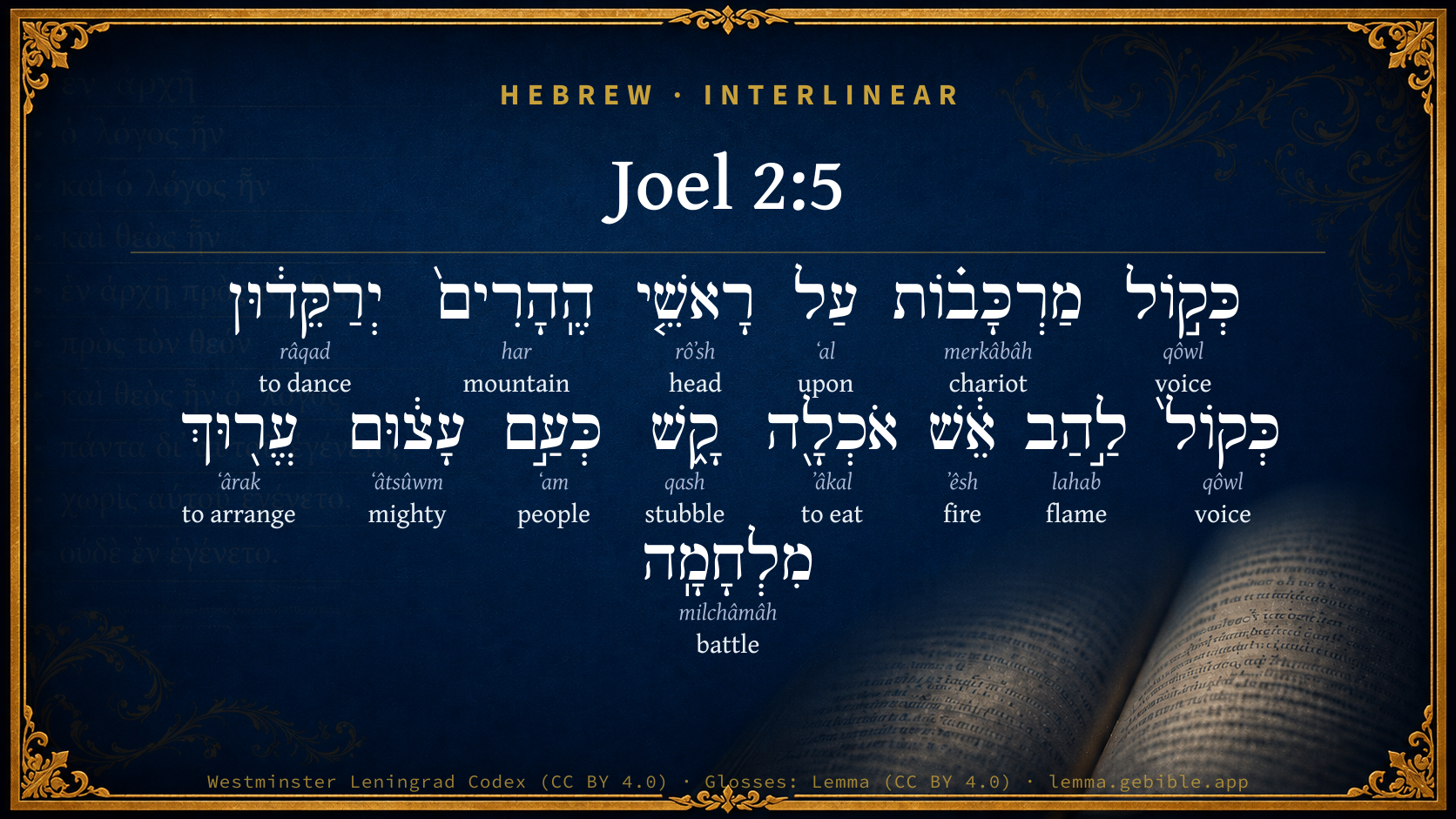
Joel 2:5

Hebrew (Westminster Leningrad Codex) Joel 2:5 appears in the Hebrew Old Testament. The text above is from the Westminster Leningrad Codex. Each word links to its Strong’s number, a concise gloss, and parsing drawn from the Open Scriptures Hebrew Bible morphology. Click any word for its full Brown-Driver-Briggs (BDB) entry.
Download image
Cite this verse

Joel 2:5 (World English Bible). Public Domain. Lemma interlinear Bible study tool, https://lemma.gebible.app/v/joel/2/5.

Show BibTeX & RIS
BibTeX
RIS
English Translation
Like the noise of chariots on the tops of the mountains do they leap, Like the noise of a flame of fire that devours the stubble, As a strong people set in battle array.
World English Bible · Public Domain
Download a study sheet

One document with this verse’s original text, its word-by-word gloss line, the meaning frame, cross-references with their text, attributed commentary, and full source and license credits — printable, and it pastes into notes with its structure intact.

This verse Autodidact and up

Study sheet (.html) Plain text (.txt)

A passage Seminary Student

Up to 50 verses in one chapter. A passage sheet keeps up to 6 commentary sources and 12 cross-references per verse, in the order this page ranks them, and says so on the sheet whenever that leaves anything out. Ask for a single verse and you get the Autodidact verse sheet above.

Everything on this page stays free to read, with no account — the sheet is a download of what is already on screen, not access to it.

Want to remove ads? Support Godless Engineer
Compare translations 3

The same verse in 3 English versions, stacked beneath the original-language interlinear above. Click any original word for its lexicon entry.

Each is an independent rendering of the whole verse — the interlinear is not word-aligned to these translations.

Highlighted words mark where these versions differ — a whole-verse word diff, not a word-by-word alignment.

  • World English Bible Public Domain
    Like the noise of chariots on the tops of the mountains do they leap, Like the noise of a flame of fire that devours the stubble, As a strong people set in battle array.
  • King James Version Public Domain
    Like the noise of chariots on the tops of mountains shall they leap, like the noise of a flame of fire that devoureth the stubble, as a strong people set in battle array.
  • unfoldingWord Literal Text CC BY-SA 4.0
    Like the sound of chariots, they leap on the tops of the hills; like the sound of a flame of fire devouring stubble, like a mighty people arrayed war.

unfoldingWord Literal Text — © unfoldingWord, licensed CC BY-SA 4.0. Word-aligned USFM3 via Door43 (git.door43.org/unfoldingWord/en_ult).

Versions to compare (up to 4)

3 of 4 selected

Show all 18 translations

Every available English version of this verse, each an independent rendering of the whole verse.

  • World English Bible Public Domain
    Like the noise of chariots on the tops of the mountains do they leap, Like the noise of a flame of fire that devours the stubble, As a strong people set in battle array.
  • Berean Standard Bible Public Domain
    With a sound like that of chariots they bound over the mountaintops, like the crackling of fire consuming stubble, like a mighty army deployed for battle.
  • Majority Standard Bible Public Domain
    With a sound like that of chariots they bound over the mountaintops, like the crackling of fire consuming stubble, like a mighty army deployed for battle.
  • King James Version Public Domain
    Like the noise of chariots on the tops of mountains shall they leap, like the noise of a flame of fire that devoureth the stubble, as a strong people set in battle array.
  • American Standard Version (1901) Public Domain
    Like the noise of chariots on the tops of the mountains do they leap, like the noise of a flame of fire that devoureth the stubble, as a strong people set in battle array.
  • Revised Version (1885) Public Domain
    Like the noise of chariots on the tops of the mountains do they leap, like the noise of a flame of fire that devoureth the stubble, as a strong people set in battle array.
  • Geneva Bible (1599) Public Domain
    Like the noyse of charrets in the toppes of the mountaines shall they leape, like the noyse of a flame of fire that deuoureth the stubble, and as a mightie people prepared to the battel.
  • Douay-Rheims (1899) Public Domain
    They shall leap like the noise of chariots upon the tops of mountains, like the noise of a flame of fire devouring the stubble, as a strong people prepared to battle.
  • Young's Literal Translation Public Domain
    As the noise of chariots, on the tops of the mountains they skip, As the noise of a flame of fire devouring stubble, As a mighty people set in array for battle.
  • Literal Standard Version CC BY-SA 4.0
    As the noise of chariots, they skip on the tops of the mountains, || As the noise of a flame of fire devouring stubble, || As a mighty people set in array for battle.
  • Unlocked Literal Bible CC BY-SA 4.0
    They jump with a noise like that of chariots on the tops of the mountains, like the noise of fiery flames that devour the stubble, like a mighty army ready for battle.
  • unfoldingWord Literal Text CC BY-SA 4.0
    Like the sound of chariots, they leap on the tops of the hills; like the sound of a flame of fire devouring stubble, like a mighty people arrayed war.
  • Darby Bible Public Domain
    Like the noise of chariots, on the tops of the mountains, they leap; like the noise of a flame of fire that devoureth the stubble, as a strong people set in battle array.
  • World Messianic Bible Public Domain
    Like the noise of chariots on the tops of the mountains, they leap, like the noise of a flame of fire that devours the stubble, like a strong people set in battle array.
  • Webster's Bible Public Domain
    Like the noise of chariots on the tops of mountains shall they leap, like the noise of a flame of fire that devoureth the stubble, as a strong people set in battle array.
  • Free Bible Version CC BY-SA 4.0
    Listen to the sound: they are like rumbling chariots leaping over the mountain tops, they are like crackling flames burning stubble, they are like a mighty army marching in formation into battle.
  • Bible in Basic English Public Domain
    Like the sound of war-carriages they go jumping on the tops of the mountains; like the noise of a flame of fire burning up the grain-stems, like a strong people lined up for the fight.
  • JPS Tanakh (1917) Public Domain
    Like the noise of chariots, on the tops of the mountains do they leap, like the noise of a flame of fire that devoureth the stubble, as a mighty people set in battle array.

Literal Standard Version (2020), Covenant Press — licensed CC BY-SA 4.0. Text via the HelloAO Bible API (eBible.org). Unlocked Literal Bible (unfoldingWord) — licensed CC BY-SA 4.0. Text via the HelloAO Bible API (eBible.org). unfoldingWord Literal Text — © unfoldingWord, licensed CC BY-SA 4.0. Word-aligned USFM3 via Door43 (git.door43.org/unfoldingWord/en_ult). Free Bible Version, Dr. Jonathan Gallagher — licensed CC BY-SA 4.0. Text via the HelloAO Bible API (eBible.org).

Word by word

More ways to search: Search by grammar → Find every occurrence → Compare this word →

Practice this passage: Drill this verse → Learn its vocabulary →

יְרַקֵּד֔וּן
râqad
H7540
“to dance”
Verb, Piel, Imperfect, 3rd Person, Masculine, Plural + Suffix, n
Part of Speech
Verb
Stem
Piel
Form
Imperfect
Person
3rd Person
Gender
Masculine
Number
Plural
Full BDB Definition

Origin: a primitive root

TWOT: 2214

to skip about - (Qal) to skip about - (Piel) to dance, leap - (Hiphil) to make to skip
  1. כְּק֣וֹל qôwl H6963 “like/as · voice of” Preposition + Noun, Common, Masculine, Singular, Construct
  2. מַרְכָּב֗וֹת merkâbâh H4818 “chariots” Noun, Common, Feminine, Plural, Absolute
  3. עַל ʻal H5921 “upon” Preposition
  4. רָאשֵׁ֤י rôʼsh H7218 “heads of” Noun, Common, Masculine, Plural, Construct
  5. הֶֽהָרִים֙ har H2022 “the · mountains” Particle, Definite Article + Noun, Common, Masculine, Plural, Absolute
  6. כְּקוֹל֙ qôwl H6963 “like/as · voice of” Preposition + Noun, Common, Masculine, Singular, Construct
  7. לַ֣הַב lahab H3851 “flame of” Noun, Common, Masculine, Singular, Construct
  8. אֵ֔שׁ ʼêsh H784 “fire” Noun, Common, Both, Singular, Absolute
  9. אֹכְלָ֖ה ʼâkal H398 “eating” Verb, Qal, Participle Active, Feminine, Singular, Absolute
  10. קָ֑שׁ qash H7179 “stubble” Noun, Common, Masculine, Singular, Absolute
  11. כְּעַ֣ם ʻam H5971 “like/as · people” Preposition + Noun, Common, Masculine, Singular, Absolute
  12. עָצ֔וּם ʻâtsûwm H6099 “mighty” Adjective, Adjective, Masculine, Singular, Absolute
  13. עֱר֖וּךְ ʻârak H6186 “arranged” Verb, Qal, Participle Passive, Masculine, Singular, Construct
  14. מִלְחָמָֽה milchâmâh H4421 “battle” Noun, Common, Feminine, Singular, Absolute

About this verse

These counts appear in no published source. They are computed here, from the morphology-tagged text and Lemma’s own curated glosses. What Lemma adds →

15
words
14
distinct lemmas
Prophets
section

Notable vocabulary

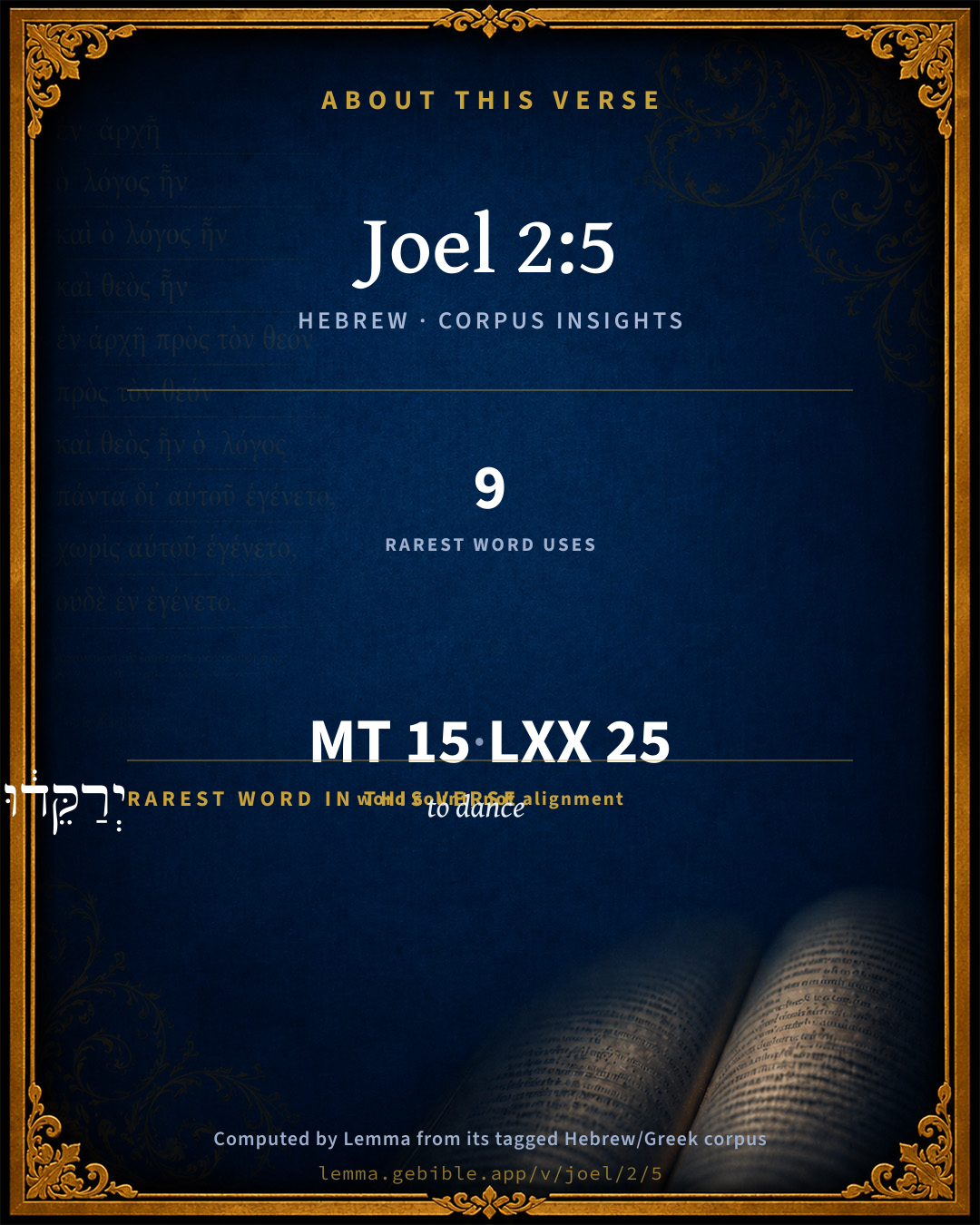
The rarest word here is יְרַקֵּד֔וּן to dance H7540 — appearing just 9 times in the whole Hebrew Bible.

Shared distinctive vocabulary

יְרַקֵּד֔וּן to dance H7540 occurs in 9 verses of the Hebrew Bible. Also found in:

Grammatical profile

  • 3 verbs
  • 10 nouns
  • 1 adjective
  • 1 preposition

Verb forms

  • יְרַקֵּד֔וּן Piel · Imperfect
  • אֹכְלָ֖ה Qal · Participle Active
  • עֱר֖וּךְ Qal · Participle Passive

Repetition

A word recurs within this verse — often emphatic in Hebrew:

  • כְּק֣וֹל voice H6963 ×2

Hebrew & Septuagint length

In English translation the verse runs 34 words from the Hebrew and 37 from the Septuagint (LXX English) — closely comparable.

A rough comparison of the two English renderings, which tokenize alike — not a word-level alignment.

Word counts can differ between the Hebrew and the Greek without any difference in meaning — e.g. the Hebrew direct-object marker אֵת has no separate Greek word, and Greek often adds the article ὁ.

In the original languages it is 15 Hebrew tokens and 25 Greek tokens — but the two are counted differently (Hebrew bundles its prefixes and suffixes into one token; the Greek is in lemma form), so that isn’t a like-for-like length.

Cross-references

6

Topical passages linked to Joel 2:5 in the Treasury of Scripture Knowledge — connected by theme and wording, ordered by reader-vote popularity; previews shown in the World English Bible.

  • Revelation 9:9 They had breastplates, like breastplates of iron. The sound of their wings was like the sound of chariots, or of many horses rushing to war.
  • Isaiah 5:24 Therefore as the tongue of fire devours the stubble, And as the dry grass sinks down in the flame, So their root shall be as rottenness, And their blossom shall go up as dust; Because they have rejected the law of Yahweh of Hosts, And despised the word of the Holy One of Israel.
  • Isaiah 30:30 Yahweh will cause his glorious voice to be heard, and will show the lighting down of his arm, with the indignation of [his] anger, and the flame of a devouring fire, with a blast, and tempest, and hailstones.
  • Nahum 2:3–4 The shield of his mighty men is made red. The valiant men are in scarlet. The chariots flash with steel in the day of his preparation, and the pine spears are brandished.
  • Matthew 3:12 His winnowing fork is in his hand, and he will thoroughly cleanse his threshing floor. He will gather his wheat into the barn, but the chaff he will burn up with unquenchable fire."
  • Nahum 3:2–3 The noise of the whip, the noise of the rattling of wheels, prancing horses, and bounding chariots,

Cross-references courtesy of OpenBible.info (CC BY 4.0).

Hebrew and Greek witnesses Masoretic Hebrew ↔ Greek Septuagint

The same verse in the two great witnesses to the Old Testament, shown verse-for-verse.

These are two independent witnesses, not word-aligned to each other, and the Septuagint is shown in lemma (dictionary) form.

Hebrew Joel 2:5 Masoretic · Westminster Leningrad Codex

כְּק֣וֹל מַרְכָּב֗וֹת עַל רָאשֵׁ֤י הֶֽהָרִים֙ יְרַקֵּד֔וּן כְּקוֹל֙ לַ֣הַב אֵ֔שׁ אֹכְלָ֖ה קָ֑שׁ כְּעַ֣ם עָצ֔וּם עֱר֖וּךְ מִלְחָמָֽה

Like the noise of chariots on the tops of the mountains do they leap, Like the noise of a flame of fire that devours the stubble, As a strong people set in battle array.

World English Bible · Public Domain

Greek LXX Joel 2:5 Septuagint · lemma form

ὡς φωνή ἅρμα ἐπί ὁ κορυφή ὁ ὄρος ἐκἅλλομαι καί ὡς φωνή φλόξ πῦρ καταἐσθίω καλάμη καί ὡς λαός πολύς καί ἰσχυρός παρατάσσω εἰς πόλεμος

As the sound of chariots on the tops of mountains shall they leap, and as the sound of a flame of fire devouring stubble, and as a numerous and strong people setting themselves in array for battle.

LXX2012 (modern English Septuagint) · Public Domain

Hebrew: Westminster Leningrad Codex (CC BY 4.0). Greek: Septuagint (public domain); English from LXX2012 (modern English Septuagint) (Public Domain). How the Septuagint differs from the Hebrew →

Targum (Aramaic paraphrase)

1

The Targum is the ancient Jewish Aramaic paraphrase of the Hebrew Scriptures — an interpretive translation, not the Hebrew text itself. Onkelos (literal) and Pseudo-Jonathan (expansive) render the Torah, and Jonathan the Prophets. Coverage is partial: where no permissively-licensed English translation exists for a verse, only the Aramaic is shown. This is verse-level text, not a word-by-word alignment to the Hebrew.

  1. Targum Jonathan Prophets (Joshua–Malachi)
    כְּקַל רְתִיכַיָא עַל רֵישֵׁי טוּרַיָא מְקַפְּצִין כְּקַל שַׁלְהוֹבִית אֶשְׁתָּא דִמְשֵׁיצְיָא כְּקַשָׁא יְבֵישָׁא כְּעַמָא תַקִיפָא דְיָדַע סִידְרֵי קְרָבָא:

    (no public-domain English translation for this verse)

    Targum Jonathan — Aramaic: “Mikraot Gedolot” (public domain). English: “Sefaria Community Translation” (CC0 1.0 (public-domain dedication)); “London "Chaldee Paraphrase," 1871” (public domain). Text via Sefaria.

Commentary

Notes on Joel 2:5 from classic Christian and Jewish commentators (each source and its license shown beneath its notes). The classic Christian expositions comment on the surrounding passage and are grouped to its opening verse, so a note may address several verses; the Jewish commentaries on the Tanakh (Rashi and others) are per-verse, so they appear only where the commentator wrote on this verse.

Lemma curates 59 commentaries, every one of them public domain or Creative Commons licensed, each selected and text-cleaned for this edition rather than reprinted as found. About our sources →

Trapp's Complete Commentary

John Trapp

Joe 2:5 Like the noise of chariots on the tops of mountains shall they leap, like the noise of a flame of fire that devoureth the stubble, as a strong people set in battle array.

Ver. 5. Like the noise of chariots on the tops of mountains] Not only on the tops of standing grain, as other locusts, which therehence also have their name Aκριδες, but as the hurry of chariots in stony places, Rev 9:9. For in that book of the Revelation, the penman borrows all the elegancies and flowers of the Old Testament, thereby to set out the story of the New in succeeding ages; as here hence the Popish priests are fitly called locusts for their numerosity and voracity, Rev 9:3. They are also likened unto horses, Joe 2:7, fed and fierce to run, and rush into the battle not without noise. "Like the noise of a flame of fire that devoureth the stubble," Ecc 7:6; or the rattling of "the jumping chariot wheels," Nah 3:2.

As a strong people set in battle array] In a bloody fight between Amurath, the third King of Turkey, and Lazarus, despot of Servia, many thousands fell on both sides. The brightness of the armour and weapons was as it had been the lightning the multitude of lances and other horsemen’s staves shadowed the light of the sun. Arrows and darts fell so fast that a man would have thought they had poured down from heaven. The noise of the instruments of war, with the neighing of horses and outcries of men, was so terrible and great, that the wild beasts in the mountains stood astonished therewith, and the Turkish histories, to express the terror of the day, vainly say that the angels in heaven, amazed with that hideous noise, for that time forgot the heavenly hymns, wherewith they always glorify God.

John Trapp, A Commentary or Exposition upon All the Books of the Old and New Testament (1647–1656) — public domain. Text from a community e-Sword module.

Jamieson, Fausset & Brown

Robert Jamieson, A. R. Fausset & David Brown

Like the noise of chariots--referring to the loud sound caused by their wings in motion, or else the movement of their hind legs.

on the tops of mountains--MAURER connects this with "they," that is, the locusts, which first occupy the higher places, and thence descend to the lower places. It may refer (as in English Version) to "chariots," which make most noise in crossing over rugged heights.

Jamieson, Fausset & Brown — Commentary Critical and Explanatory on the Whole Bible (1871) — public domain (CC PDM 1.0). Text via the HelloAO Bible API.

Adam Clarke's Commentary

Verse 5. Like the noise of chariots] Bochart also remarks: - "The locusts fly with a great noise, so as to be heard six miles off, and while they are eating the fruits of the earth, the sound of them is like that of a flame driven by the wind." - Ibid., p. 478.

Adam Clarke's Commentary on the Bible (1810–1826) — public domain. Text from a community e-Sword/MySword module.

John Calvin's Commentaries

Like the sound of chariots. They expound מרכבות merecabut, chariots, though the Hebrews rather think them to be harnesses or saddles as we call them; but yet I prefer to view them as chariots; for what the Prophet says, that they shall leap on the tops of mountains like the sound of chariots, would not be suitably applied to the trappings of horses. They then shall leap on tops of mountains — but how? as chariots, that is, they shall come with great force, or make a great and terrible noise. And he speaks of the tops of mountains for there we know the noise is greater when there is any commotion. The Prophet, therefore, does in every way amplify God’s vengeance, that he might awaken the Jews, who by their indifference had too long provoked the Lord’s wrath.

Like the sound, he says, of the flame of fire, or of a fiery flame, devouring the stubble. He compares the Assyrians to a flame, which consumes all things; and he compares the Jews to stubble, though they thought themselves fortified by many forces and strongholds.

John Calvin's Commentaries (1540-1563) — public domain. Text from the Calvin Translation Society English edition (1840s-50s) via the Christian Classics Ethereal Library (ccel.org). Calvin's coverage is partial (roughly two-thirds of the Bible); uncommented books and verses are honest gaps, never fabricated. The 19th-century editor's footnotes and remarks are omitted so the notes are faithfully Calvin's own voice.

The Cambridge Bible for Schools and Colleges

gen. ed. J. J. S. Perowne

5. Like the noise of chariots, &c.] Cf. Rev_9:9, “And the sound of their wings was as the sound of chariots, of many horses rushing to war.” The remarkable noise made by a flight of locusts is noticed by many travellers. “Within a hundred paces, I heard the rushing noise occasioned by the flight of so many millions of insects. When I was in the midst of them, it was as loud as the dashing of waters occasioned by the mill-wheel.” “While passing over our heads, their sound was as of a great cataract.” “In flying they make a rushing, rustling noise, as when a strong wind blows through trees.” Cf. below, p. 87 (No. 1), 89 (No. 4), 90 (No. 7).

like the noise of a flame of fire that devoureth the stubble] Here the reference is to the sound made by the insects while feeding. Cyril long ago compared the noise of locusts browsing to that of a wind φλόγα διαῤῥιπίζοντος (ap. Boch. Hieroz. 3:309); and C. V. Riley, the eminent American entomologist, speaks of it as resembling “the crackling of a prairie-fire” (Riverside Nat. Hist. 2., p. 197). “The sound of their feeding, when in swarms, is as the rushing of flames driven by the wind” (Newman, Hist. of Insects, Joe_2:1, cited in the Speaker’s Comm.).

as a strong people set in battle array] cf. Joe_2:2. They prepare for the attack like a mighty nation, seized to a man with martial ardour, and arrayed in order for the fray.

The Cambridge Bible for Schools and Colleges (gen. ed. J. J. S. Perowne; Cambridge University Press, 1878–1918) — public domain. Text from a community e-Sword module.

John Gill's Exposition

Like the noise of chariots on the tops of that mountains shall they leap,.... The motion of the locusts is leaping from place to place; for which the locusts have legs peculiarly made, their hindermost being the longest; wherefore Pliny (i) observes, that insects which have their hindermost legs long leap locusts; to which agrees the Scripture description of them: "which have legs above their feet, to leap withal upon the earth; even those of them ye may eat; the locust after his kind", Lev 11:21; which words, as Dr. Shaw (k), observes, may bear this construction: "which have knees upon" or "above their hinder legs, to leap withal upon the earth"; and he observes, that the "locust", has the two hindermost of its legs or feet much stronger, larger, and longer, than any of the foremost; in them the knee, or the articulation of the leg and thigh, is distinguished by a remarkable bending or curvature, whereby it is able, whenever prepared to jump, to spring and raise itself with great force and activity; and this fitly resembles the jumping of chariots on mountains and hills, which are uneven, and usually have stones lie scattered about, which, with the chains and irons about chariots, cause a great rattling; and the noise of locusts is compared to the noise of these, which is represented as very great; some say it is to be heard six miles off, as Remigius on the place; and Pliny says (l), they make such a noise with their wings when they fly, that they are thought to be other winged fowls; see Rev 9:9. Chariots were made use of in war, and the Chaldeans are said to have chariots which should come like a whirlwind, Jer 4:13;

like the noise of a flame of fire that devoureth the stubble; as they are before compared to fire, and a flame of fire that devoured all things as easily as the fire devours stubble, so here to the crackling noise of it; see Ecc 7:6;

as a strong people set in battle array: that is, as the noise of a mighty army prepared for battle, just going to make the onset, when they lift up their voices aloud, and give a terrible shout; for this clause, as the other two, refer to the noise made by the locusts in their march; an emblem of the terribleness of the Chaldeans in theirs, who were heard before they were seen.

(i) Nat. Hist. l. 11. c. 48. (k) Travels, p. 420. Ed. 2. (l) Nat. Hist. l. 11. c. 29.

John Gill's Exposition of the Whole Bible (1746–1763) — public domain (CC PDM 1.0). Text via the HelloAO Bible API.

Albert Barnes' Notes on the Bible

Like the noise of chariots on the tops of the mountains shall they leap - The amazing noise of the flight of locusts is likened by those who have heard them, to all sorts of deep sharp rushing sounds. One says , “their noise may be heard six miles off.” Others , “within a hundred paces I heard the rushing noise occasioned by the flight of so many million of insects. When I was in the midst of them, it was as loud as the dashing of the waters occasioned by the mill-wheel.” : “While passing over our heads, their sound was as of a great cataract.” : “We heard a noise as of the rushing of a great wind at a distance.” : “In flying they make a rushing rustling noise, as when a strong wind blows through trees.” : “They cause a noise, like the rushing of a torrent.” To add another vivid description , “When a swarm is advancing, it seems as though brown clouds were rising from the horizon, which, as they approach, spread more and more. They cast a veil over the sun and a shadow on the earth. Soon you see little dots, and observe a whizzing and life. Nearer yet, the sun is darkened; you hear a roaring and rushing like gushing water. On a sudden you find yourself surrounded with locusts.”

Like the noise of a flame of fire that devoureth the stubble - The sharp noise caused by these myriads of insects, while feeding, has also been noticed. : “You hear afar the noise which they make in browsing on the herbs and trees, as of an army which is foraging without restraint.” : “When they alight upon the ground to feed, the plains are all covered, and they make a murmuring noise as they eat, when in two hours they devour all close to the ground.” : “The noise which they make in devouring, ever announces their approach at some distance.” : “They say, that not without a noise is their descent on the fields effected, and that there is a certain sharp sound, as they chew the grain as when the wind strongly fanneth a flame.”

Their noise, Joel says, is like the “noise of chariots.” Whence John says Rev 9:9, the sound of their wings was as the sound of many horses rushing to battle. Their sound should be like the sound of war-chariots, hounding in their speed; but their inroad should be, where chariots could not go and man’s foot could rarely reach, “on the tops of the mountains” . A mountain range is, next to the sea, the strongest natural protection. Mountains have been a limit to the mightiest powers. The Caucasus of old held in the Persian power; on the one side, all was enslaved, on the other, all was fearlessly free . Of late it enabled a few mountaineers to hold at bay the power of Russia. The pass of Thermopylae, until betrayed, enabled a handful of men to check the invasion of nearly two million.

The mountain-ridges of Spain were, from times before our Lord, the last home and rallying-place of the conquered or the birth-place of deliverance . God had assigned to His people a spot, central hereafter for the conversion of the world, yet where, meantime, they lay enveloped and sheltered “amid the mountains” which “His Right Hand purchased” Psa 78:54. The Syrians owned that “their God” was “the God of the hills” 1Ki 20:23; and the people confessed, “as the hills are round about Jerusalem, so the Lord is round about His people” Psa 125:2. Their protection was a symbol of His. But His protection withdrawn, nothing should be a hindrance to those whom He should send as a scourge. The prophet combines purposely things incompatible, the terrible heavy bounding of the scythed chariot, and the light speed with which these countless hosts should in their flight bound over the tops of the mountains, where God had made no path for man. Countless in number, boundless in might, are the instruments of God. The strongest national defenses give no security. Where then is safety, save in fleeing from God displeased to God appeased?

Albert Barnes' Notes on the Bible (1834–1885) — public domain. Text from a community e-Sword/MySword module.

Haydock's Catholic Bible Commentary

Mountains. "The beat their wings so loudly, that they may be taken for other birds." (Pliny, [Natural History?] xi. 29.) --- They are much larger in hot climates, (chap. i. 6.; Haydock) and may be heard at the distance of two miles, (Bochart) darkening the air for the space of four leagues. Yet this description is poetical, and perhaps an allegory is nowhere better kept up.

George Leo Haydock (1774–1849), Haydock's Catholic Family Bible and Commentary, 1859 edition — public domain. Excludes Psalms (Douay-Rheims chapter numbering differs from Protestant) and Deuterocanonical books (Catholic canon only).

Matthew Poole's English Annotations

Like the noise of chariots on the tops of mountains shall they leap; such warlike chariots on resounding mountains do, with their rapid motions, and shaking their irons about them, make a great and dreadful noise; so should these locusts in their flight; by which they shall terrify the people before they come to them, for the noise of them may be heard, say some, at six miles’ distance.

Like the noise of a flame of fire that devoureth the stubble; which does with continued crackling burn what is under the flame, and threaten speedy and inevitable ruin to what is before it; all shall be endangered by it, as if surrounded with flaming fire.

As a strong people; so Joe 2:2.

Set in battle array; prepared to assault and destroy: in pursuance of this metaphor, see Joe 2:7-11.

Matthew Poole's English Annotations on the Holy Bible (1683–1685) — public domain. Text from a community e-Sword/MySword module.

The Pulpit Commentary

The first clause may be understood

(1) according to the Authorized Version, whereby the leaping is attributed to the locusts, or

(2) asper may be understood after chariots, and then the leaping is predicated of the chariots. The last clause of the same verse is capable of three constructions, namely

(1) "They shall leap (yeraqqedim being supplied) as a strong people set in battle array;" or

(2) "The noise (qol understood) shall be as the noise of a strong people set in battle array;" or

(3) "They are as a strong people set in battle array." Kimchi interprets according to (2), "As a strong people that is set in array to fight with the people who is opposed to them, who make a great noise and shouting in order to strike terror into their enemies." Like the noise of a flame of fire that devoureth the stubble. This was the noise made by them, not when they were properly in motion, but when alighting on a district they devoured every green thing in plant, or shrub, or tree the noise, in fact, which they made when feeding. It resembled the crackling of flame ever a field of grain or stubble set on fire. Such was the noise they made when marching, and such the noise they made when foraging the one was like the rattling of a chariot, the other the crackling of fire. Cyril notices this peculiarity as follows: "They say that their alighting in the fields is effected not without noise; but that a certain shrill noise is produced by their teeth, while they chew into pieces the prostrate grain, as of wind scattering flame." Thus Thomson also says, "The noise made in marching and foraging was like that of a heavy shower on a distant forest." As a strong people set in battle array. Their progress is thus described: "Their steady though swift advance and regular order resembled an army well equipped and in battle array on its line of march." Cyril says of them, "By reason of their innumerable multitude, not easy to be encountered, but rather very dangerous to be met with." Again he says, "They are an irresistible thing, and altogether invincible by men." Here again the prophet"s description is confirmed by the observation of intelligent eye-witnesses. Referring to Solomon"s statement, "The locusts have no king, yet go they forth all of them by bands," Dr. Thomson says, "Nothing in their habits is more striking than the pertinacity with which they all pursue the same line of march, like a disciplined army. As they have no king, they must be influenced by some common instinct."

The Pulpit Commentary (1880–1919), ed. H.D.M. Spence-Jones & Joseph S. Exell — public domain. Text from a community e-Sword module.

Rashi

Rabbi Shlomo Yitzchaki (Rashi)

like the sound of a flame—A flame, consuming stubble, makes noise.

arrayed for battle Heb. עֱרוּךְ. Since it is in the construct state, it is vowelized with a “hataf segol.”

Rashi on the Tanakh — English translations: “The Judaica Press complete Tanach with Rashi, translated by A. J. Rosenberg” (CC BY 4.0); “Pentateuch with Rashi's commentary by M. Rosenbaum and A.M. Silbermann, 1929-1934” (public domain); “The Metsudah Tanach series, Lakewood, N.J” (CC BY 4.0); and “The Book of Joshua, Metsudah Publications, 1997” (CC BY 4.0). Text via Sefaria.

Lesson kit

Teaching starters — assembled from the data on this page, not authored interpretation. Every prompt links to the verse data it draws on. Edit before teaching.

Joel, in the Prophets, opens this verse with 15 words (14 distinct Hebrew lemmas). Its most distinctive word is râqad (“to dance”). A historical commentator’s framing appears above. Read the whole chapter for the surrounding context.

Discussion questions

  1. The word râqad carries the sense “to dance.” How does it shape the verse?
  2. How does 1 Chronicles 15:29, which shares the word «to dance», read alongside this verse?
  3. What does the repetition of “voice” (2× in this one verse) do in this verse?
  4. These translations render this verse differently; the difference is in the English rendering, not the original. What questions does that raise?
  5. «יְרַקֵּד֔וּן» is a Piel Imperfect verb. How does that grammatical form shape the action described?
  6. Compare how Trapp's Complete Commentary and Jamieson, Fausset & Brown read this verse. Where do they agree or differ?

Things to notice

Reading settings

Reading text

Shown beneath each verse's original-language words.

Old Testament
Old Testament edition

Read the OT as the Masoretic Hebrew (MT) or the Greek Septuagint (LXX).

English shown for the Greek Septuagint (in the Hebrew ↔ Greek comparison).

Comparing translations? Open the Compare panel on any verse page to stack up to four side by side.