Ezekiel 33:5

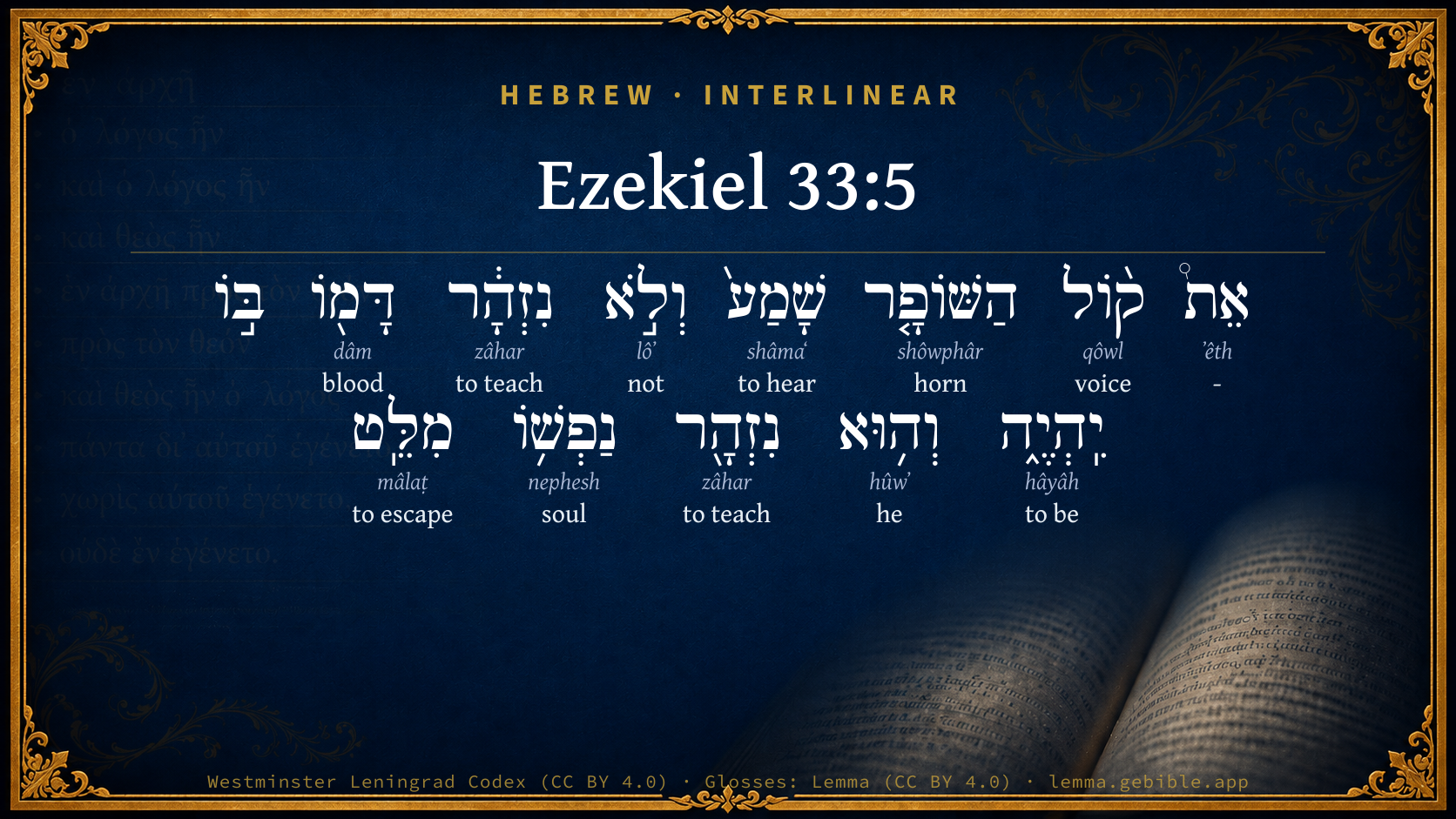
Hebrew (Westminster Leningrad Codex) Ezekiel 33:5 appears in the Hebrew Old Testament. The text above is from the Westminster Leningrad Codex. Each word links to its Strong’s number, a concise gloss, and parsing drawn from the Open Scriptures Hebrew Bible morphology. Click any word for its full Brown-Driver-Briggs (BDB) entry.
Download image
Cite this verse

Ezekiel 33:5 (World English Bible). Public Domain. Lemma interlinear Bible study tool, https://lemma.gebible.app/v/ezekiel/33/5.

Show BibTeX & RIS
BibTeX
RIS
English Translation
He heard the sound of the trumpet, and didn't take warning; his blood shall be on him; whereas if he had taken warning, he would have delivered his soul.
World English Bible · Public Domain
Download a study sheet

One document with this verse’s original text, its word-by-word gloss line, the meaning frame, cross-references with their text, attributed commentary, and full source and license credits — printable, and it pastes into notes with its structure intact.

This verse Autodidact and up

Study sheet (.html) Plain text (.txt)

A passage Seminary Student

Up to 50 verses in one chapter. A passage sheet keeps up to 6 commentary sources and 12 cross-references per verse, in the order this page ranks them, and says so on the sheet whenever that leaves anything out. Ask for a single verse and you get the Autodidact verse sheet above.

Everything on this page stays free to read, with no account — the sheet is a download of what is already on screen, not access to it.

Want to remove ads? Support Godless Engineer
Compare translations 3

The same verse in 3 English versions, stacked beneath the original-language interlinear above. Click any original word for its lexicon entry.

Each is an independent rendering of the whole verse — the interlinear is not word-aligned to these translations.

Highlighted words mark where these versions differ — a whole-verse word diff, not a word-by-word alignment.

  • World English Bible Public Domain
    He heard the sound of the trumpet, and didn't take warning; his blood shall be on him; whereas if he had taken warning, he would have delivered his soul.
  • King James Version Public Domain
    He heard the sound of the trumpet, and took not warning; his blood shall be upon him. But he that taketh warning shall deliver his soul.
  • unfoldingWord Literal Text CC BY-SA 4.0
    If someone hears the sound of the horn and pays no attention, his blood is on him; but if he pays attention, he will save his own life.

unfoldingWord Literal Text — © unfoldingWord, licensed CC BY-SA 4.0. Word-aligned USFM3 via Door43 (git.door43.org/unfoldingWord/en_ult).

Versions to compare (up to 4)

3 of 4 selected

Show all 18 translations

Every available English version of this verse, each an independent rendering of the whole verse.

  • World English Bible Public Domain
    He heard the sound of the trumpet, and didn't take warning; his blood shall be on him; whereas if he had taken warning, he would have delivered his soul.
  • Berean Standard Bible Public Domain
    Since he heard the sound of the horn but failed to heed the warning, his blood will be on his own head. If he had heeded the warning, he would have saved his life.
  • Majority Standard Bible Public Domain
    Since he heard the sound of the horn but failed to heed the warning, his blood will be on his own head. If he had heeded the warning, he would have saved his life.
  • King James Version Public Domain
    He heard the sound of the trumpet, and took not warning; his blood shall be upon him. But he that taketh warning shall deliver his soul.
  • American Standard Version (1901) Public Domain
    He heard the sound of the trumpet, and took not warning; his blood shall be upon him; whereas if he had taken warning, he would have delivered his soul.
  • Revised Version (1885) Public Domain
    He heard the sound of the trumpet, and took not warning; his blood shall be upon him: whereas if he had taken warning he should have delivered his soul.
  • Geneva Bible (1599) Public Domain
    For he heard the sound of the trumpet, and woulde not bee admonished: therefore his blood shall be vpon him: but he that receiueth warning, shall saue his life.
  • Douay-Rheims (1899) Public Domain
    He heard the sound of the trumpet and did not look to himself, his blood shall be upon him: but if he look to himself, he shall save his life.
  • Young's Literal Translation Public Domain
    The voice of the trumpet he heard, And he hath not taken warning, his blood is on him, And he who took warning his soul hath delivered.
  • Literal Standard Version CC BY-SA 4.0
    The voice of the horn he heard, || And he has not taken warning, his blood is on him, || And he who took warning has delivered his soul.
  • Unlocked Literal Bible CC BY-SA 4.0
    If someone hears the sound of the horn and pays no attention, his blood is on him; but if he pays attention, he will save his own life.
  • unfoldingWord Literal Text CC BY-SA 4.0
    If someone hears the sound of the horn and pays no attention, his blood is on him; but if he pays attention, he will save his own life.
  • Darby Bible Public Domain
    He heard the sound of the trumpet, and took not warning; his blood is upon him: whereas had he taken warning, he would have delivered his soul.
  • World Messianic Bible Public Domain
    He heard the sound of the shofar and didn’t take warning. His blood will be on him; whereas if he had heeded the warning, he would have delivered his soul.
  • Webster's Bible Public Domain
    He heard the sound of the trumpet, and took not warning; his blood shall be upon him. But he that taketh warning shall deliver his soul.
  • Free Bible Version CC BY-SA 4.0
    Since you heard the trumpet but didn't pay attention to the warning, then you will be responsible for your own death. If you had paid attention to the warning, you could have saved your life.
  • Bible in Basic English Public Domain
    On hearing the sound of the horn, he did not take note; his blood will be on him; for if he had taken note his life would have been safe.
  • JPS Tanakh (1917) Public Domain
    he heard the sound of the horn, and took not warning, his blood shall be upon him; whereas if he had taken warning, he would have delivered his soul.

Literal Standard Version (2020), Covenant Press — licensed CC BY-SA 4.0. Text via the HelloAO Bible API (eBible.org). Unlocked Literal Bible (unfoldingWord) — licensed CC BY-SA 4.0. Text via the HelloAO Bible API (eBible.org). unfoldingWord Literal Text — © unfoldingWord, licensed CC BY-SA 4.0. Word-aligned USFM3 via Door43 (git.door43.org/unfoldingWord/en_ult). Free Bible Version, Dr. Jonathan Gallagher — licensed CC BY-SA 4.0. Text via the HelloAO Bible API (eBible.org).

Word by word

More ways to search: Search by grammar → Find every occurrence → Compare this word →

Practice this passage: Drill this verse → Learn its vocabulary →

נִזְהָ֔ר
zâhar
H2094
“to teach”
Verb, Niphal, Perfect, 3rd Person, Masculine, Singular
Part of Speech
Verb
Stem
Niphal
Form
Perfect
Person
3rd Person
Gender
Masculine
Number
Singular
Full BDB Definition

Origin: a primitive root

TWOT: 531 , 532

to admonish, warn, teach, shine, send out light, be light, be shining - (Niphal) to be taught, be admonished - (Hiphil) - to teach, warn - to shine, send out light (figuratively)
  1. אֵת֩ ʼêth H853 “-” Particle, Direct Object
  2. ק֨וֹל qôwl H6963 “voice of” Noun, Common, Masculine, Singular, Construct
  3. הַשּׁוֹפָ֤ר shôwphâr H7782 “the · horn” Particle, Definite Article + Noun, Common, Masculine, Singular, Absolute
  4. שָׁמַע֙ shâmaʻ H8085 “to hear” Verb, Qal, Perfect, 3rd Person, Masculine, Singular
  5. וְלֹ֣א lôʼ H3808 “and · not” Conjunction + Particle, Negative
  6. דָּמ֖וֹ dâm H1818 “blood · his” Noun, Common, Masculine, Singular, Construct + Suffix, Personal, 3rd Person, Masculine, Singular
  7. יִֽהְיֶ֑ה hâyâh H1961 “to be” Verb, Qal, Imperfect, 3rd Person, Masculine, Singular
  8. וְה֥וּא hûwʼ H1931 “and · he” Conjunction + Pronoun, Personal, 3rd Person, Masculine, Singular
  9. נִזְהָ֖ר zâhar H2094 “teaching” Verb, Niphal, Participle Active, Masculine, Singular, Absolute
  10. נַפְשׁ֥וֹ nephesh H5315 “soul · his” Noun, Common, Both, Singular, Construct + Suffix, Personal, 3rd Person, Masculine, Singular
  11. מִלֵּֽט mâlaṭ H4422 “to escape” Verb, Piel, Perfect, 3rd Person, Masculine, Singular

About this verse

These counts appear in no published source. They are computed here, from the morphology-tagged text and Lemma’s own curated glosses. What Lemma adds →

13
words
11
distinct lemmas
Prophets
section

Notable vocabulary

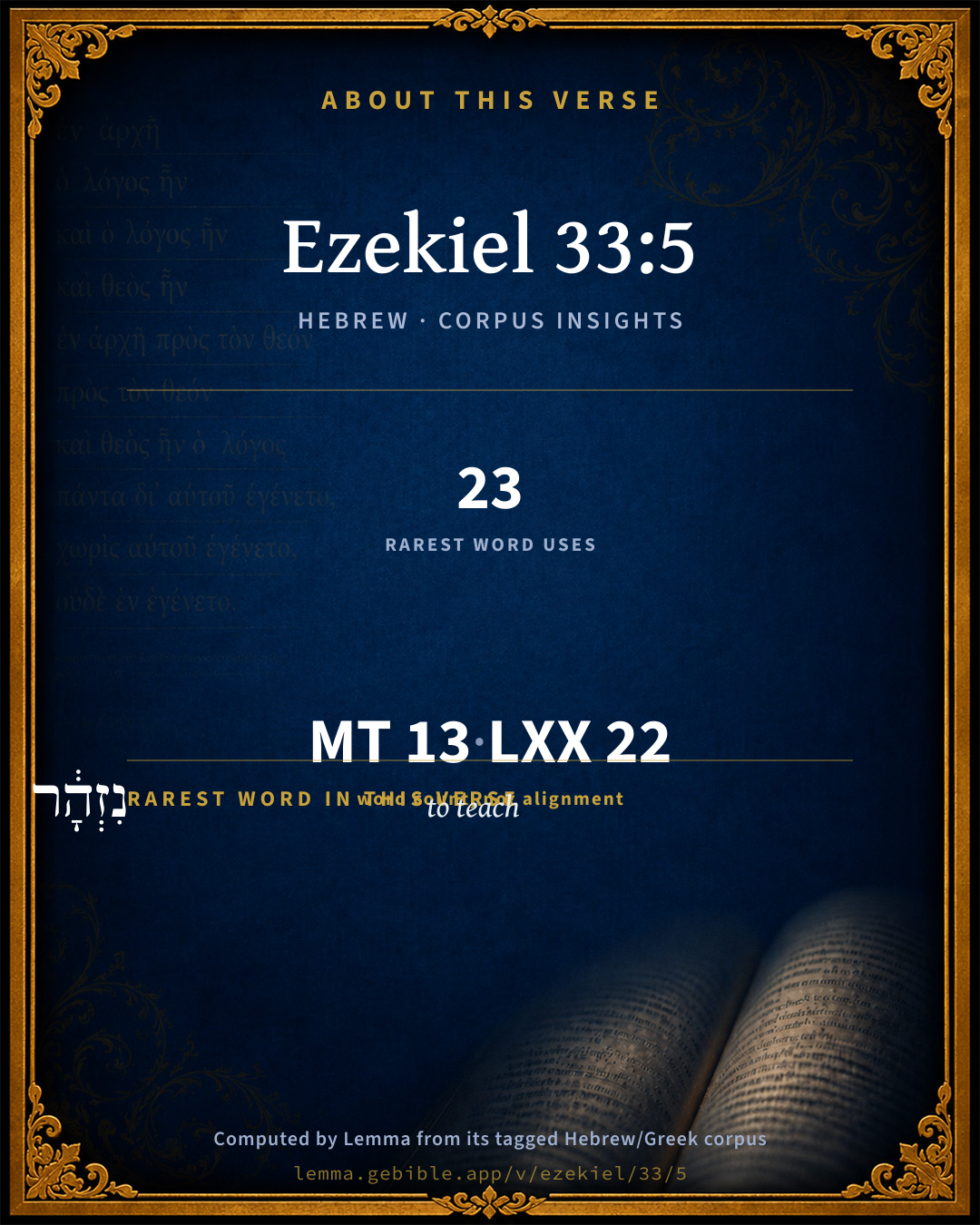
The rarest word here is נִזְהָ֔ר to teach H2094 — appearing just 23 times in the whole Hebrew Bible.

Shared distinctive vocabulary

נִזְהָ֔ר to teach H2094 occurs in 19 verses of the Hebrew Bible. Also found in:

Grammatical profile

  • 5 verbs
  • 4 nouns
  • 1 pronoun
  • 1 preposition
  • 2 particles

Verb forms

  • שָׁמַע֙ Qal · Perfect
  • נִזְהָ֔ר Niphal · Perfect
  • יִֽהְיֶ֑ה Qal · Imperfect
  • נִזְהָ֖ר Niphal · Participle Active
  • מִלֵּֽט Piel · Perfect

Repetition

A word recurs within this verse — often emphatic in Hebrew:

  • נִזְהָ֔ר to teach H2094 ×2

Hebrew & Septuagint length

In English translation the verse runs 29 words from the Hebrew and 29 from the Septuagint (LXX English) — the same length.

A rough comparison of the two English renderings, which tokenize alike — not a word-level alignment.

Word counts can differ between the Hebrew and the Greek without any difference in meaning — e.g. the Hebrew direct-object marker אֵת has no separate Greek word, and Greek often adds the article ὁ.

In the original languages it is 13 Hebrew tokens and 22 Greek tokens — but the two are counted differently (Hebrew bundles its prefixes and suffixes into one token; the Greek is in lemma form), so that isn’t a like-for-like length.

Cross-references

8

Topical passages linked to Ezekiel 33:5 in the Treasury of Scripture Knowledge — connected by theme and wording, ordered by reader-vote popularity; previews shown in the World English Bible.

  • Exodus 9:19–21 Now therefore command that all of your cattle and all that you have in the field be brought into shelter. Every man and animal that is found in the field, and isn't brought home, the hail shall come down on them, and they shall die."'"
  • Hebrews 11:7 By faith, Noah, being warned about things not yet seen, moved with godly fear, prepared an ark for the saving of his house, through which he condemned the world, and became heir of the righteousness which is according to faith.
  • John 8:39 They answered him, "Our father is Abraham." Jesus said to them, "If you were Abraham's children, you would do the works of Abraham.
  • 2 Kings 6:10 The king of Israel sent to the place which the man of God told him and warned him of; and he saved himself there, not once nor twice.
  • Isaiah 51:2 Look to Abraham your father, and to Sarah who bore you; for when he was but one I called him, and I blessed him, and made him many.
  • Acts 2:37–41 Now when they heard this, they were cut to the heart, and said to Peter and the rest of the apostles, "Brothers, what shall we do?"
  • Hebrews 2:1–3 Therefore we ought to pay greater attention to the things that were heard, lest perhaps we drift away.
  • Psalms 95:7 For he is our God. We are the people of his pasture, And the sheep in his care. Today, oh that you would hear his voice!

Cross-references courtesy of OpenBible.info (CC BY 4.0).

Hebrew and Greek witnesses Masoretic Hebrew ↔ Greek Septuagint

The same verse in the two great witnesses to the Old Testament, shown verse-for-verse.

These are two independent witnesses, not word-aligned to each other, and the Septuagint is shown in lemma (dictionary) form.

Hebrew Ezekiel 33:5 Masoretic · Westminster Leningrad Codex

אֵת֩ ק֨וֹל הַשּׁוֹפָ֤ר שָׁמַע֙ וְלֹ֣א נִזְהָ֔ר דָּמ֖וֹ בּ֣וֹ יִֽהְיֶ֑ה וְה֥וּא נִזְהָ֖ר נַפְשׁ֥וֹ מִלֵּֽט

He heard the sound of the trumpet, and didn't take warning; his blood shall be on him; whereas if he had taken warning, he would have delivered his soul.

World English Bible · Public Domain

Greek LXX Ezekiel 33:5 Septuagint · lemma form

ὅτι ὁ φωνή ὁ σάλπιγξ ἀκούω οὐ φυλάσσω ὁ αἷμα αὐτός ἐπί αὐτός εἰμί καί οὗτος ὅτι φυλάσσω ὁ ψυχή αὐτός ἐκαἱρέω

Because he heard the sound of the trumpet, and took no heed, his blood shall be upon him: but the other, because he took heed, has delivered his soul.

LXX2012 (modern English Septuagint) · Public Domain

Hebrew: Westminster Leningrad Codex (CC BY 4.0). Greek: Septuagint (public domain); English from LXX2012 (modern English Septuagint) (Public Domain). How the Septuagint differs from the Hebrew →

Targum (Aramaic paraphrase)

1

The Targum is the ancient Jewish Aramaic paraphrase of the Hebrew Scriptures — an interpretive translation, not the Hebrew text itself. Onkelos (literal) and Pseudo-Jonathan (expansive) render the Torah, and Jonathan the Prophets. Coverage is partial: where no permissively-licensed English translation exists for a verse, only the Aramaic is shown. This is verse-level text, not a word-by-word alignment to the Hebrew.

  1. Targum Jonathan Prophets (Joshua–Malachi)
    יַת קַל שׁוֹפָרֵיהּ שְׁמַע וְלָא אִזְדְהַר חוֹבַת קָטוֹלֵי בֵּיהּ תְּהֵי וְהוּא אִזְדְהַר נַפְשֵׁיהּ שֵׁיזֵיב:

    (no public-domain English translation for this verse)

    Targum Jonathan — Aramaic: “Mikraot Gedolot” (public domain). English: “Sefaria Community Translation” (CC0 1.0 (public-domain dedication)); “London "Chaldee Paraphrase," 1871” (public domain). Text via Sefaria.

Commentary

Notes on Ezekiel 33:5 from classic Christian and Jewish commentators (each source and its license shown beneath its notes). The classic Christian expositions comment on the surrounding passage and are grouped to its opening verse, so a note may address several verses; the Jewish commentaries on the Tanakh (Rashi and others) are per-verse, so they appear only where the commentator wrote on this verse.

Lemma curates 59 commentaries, every one of them public domain or Creative Commons licensed, each selected and text-cleaned for this edition rather than reprinted as found. About our sources →

Trapp's Complete Commentary

John Trapp

Eze 33:5 He heard the sound of the trumpet, and took not warning; his blood shall be upon him. But he that taketh warning shall deliver his soul.

Ver. 5. But he that taketh warning.] Foresight is the best means of prevention.

John Trapp, A Commentary or Exposition upon All the Books of the Old and New Testament (1647–1656) — public domain. Text from a community e-Sword module.

Tyndale Open Study Notes

Tyndale Open Resources

33:5-9 Ezekiel’s message encouraged the people of Israel even now to repent so that they might live and not die. The Lord had said that he would bring an army against their country, and this was evidently what was now happening. Ezekiel had been faithful to his calling as a watchman; no one who had heard his prophecy thus far could say that he did not warn the people of the coming judgment. However, the people had not heeded the warning; without a change of heart they would die in their sins.

Tyndale Open Study Notes — © Tyndale Open Resources, licensed CC BY-SA 4.0. Text via the HelloAO Bible API.

John Gill's Exposition

He heard the sound of the trumpet,.... The alarm of the enemy being at hand, and so was inexcusable:

and took not warning; which that gave him:

his blood shall be upon him; the fault shall be imputed to himself, and not another; and he must bear it himself, and answer for it, and not the watchman:

but he that taketh warning shall deliver his soul; who, hearing the sound of the trumpet, prepares for his own defence, and provides for his safety, he shall save his life, and not fall into the enemies' hands.

John Gill's Exposition of the Whole Bible (1746–1763) — public domain (CC PDM 1.0). Text via the HelloAO Bible API.

Matthew Poole's English Annotations

He heard, as well as others who escaped, and he might have delivered himself, as they did who took warning. He is the only cause of his own death.

Shall deliver his soul; shall save his life, preserve his own person.

Matthew Poole's English Annotations on the Holy Bible (1683–1685) — public domain. Text from a community e-Sword/MySword module.

unfoldingWord translationNotes

Door43 World Missions Community

General Information:

Yahweh continues giving Ezekiel his message to the Israelites.

his blood is on him

Here "blood" represents a person's death. The phrase "on him" is an idiom that means that person is considered responsible. AT: "it will be his own fault that he dies"

save his own life

"will keep himself from dying"

the sword as it is coming

The word "sword" refers to an enemy army. AT: "the enemy army as it is coming" (See: Metonymy)

with the result that the people are not warned

This can be stated in active form. AT: "and he does not warn the people" (See: Active or Passive)

the sword comes and takes anyone's life

Here "sword" represents an enemy army. AT: "the enemy army comes and kills anyone" (See: Metonymy)

that person dies in his own sin

"that person dies because of his own sin"

I will require his blood from the watchman

Here "blood" represents a person's death. The phrase "I will require his blood from" is an idiom that means to consider someone responsible. AT: "I will consider that person's death to be the fault of the watchman" (See: Metonymy and Idiom)

translationWords

blood

save

sword

sin

unfoldingWord translationNotes — © Distant Shores Media and the Door43 World Missions Community, licensed CC BY-SA 4.0. Source: git.door43.org/Door43/en_tn.

Rashi

Rabbi Shlomo Yitzchaki (Rashi)

for had he taken heed, he would have saved his life Had he taken heed, he would have escaped.

Rashi on the Tanakh — English translations: “The Judaica Press complete Tanach with Rashi, translated by A. J. Rosenberg” (CC BY 4.0); “Pentateuch with Rashi's commentary by M. Rosenbaum and A.M. Silbermann, 1929-1934” (public domain); “The Metsudah Tanach series, Lakewood, N.J” (CC BY 4.0); and “The Book of Joshua, Metsudah Publications, 1997” (CC BY 4.0). Text via Sefaria.

Lesson kit

Teaching starters — assembled from the data on this page, not authored interpretation. Every prompt links to the verse data it draws on. Edit before teaching.

Ezekiel, in the Prophets, opens this verse with 13 words (11 distinct Hebrew lemmas). Its most distinctive word is zâhar (“to teach”). A historical commentator’s framing appears above. Read the whole chapter for the surrounding context.

Discussion questions

  1. The word zâhar carries the sense “to teach.” How does it shape the verse?
  2. Exodus 18:20 shares the word «to teach» with this verse. How do the two illuminate each other?
  3. “to teach” occurs 2× in this one verse. What is the effect of the repetition?
  4. These translations render this verse differently. What is at stake in choosing one wording over another?
  5. The verb «שָׁמַע֙» is Qal Perfect. How does its form color the action?
  6. Reading how Trapp's Complete Commentary and Tyndale Open Study Notes read this verse, where do the two commentators agree and where do they part?

Things to notice

Reading settings

Reading text

Shown beneath each verse's original-language words.

Old Testament
Old Testament edition

Read the OT as the Masoretic Hebrew (MT) or the Greek Septuagint (LXX).

English shown for the Greek Septuagint (in the Hebrew ↔ Greek comparison).

Comparing translations? Open the Compare panel on any verse page to stack up to four side by side.