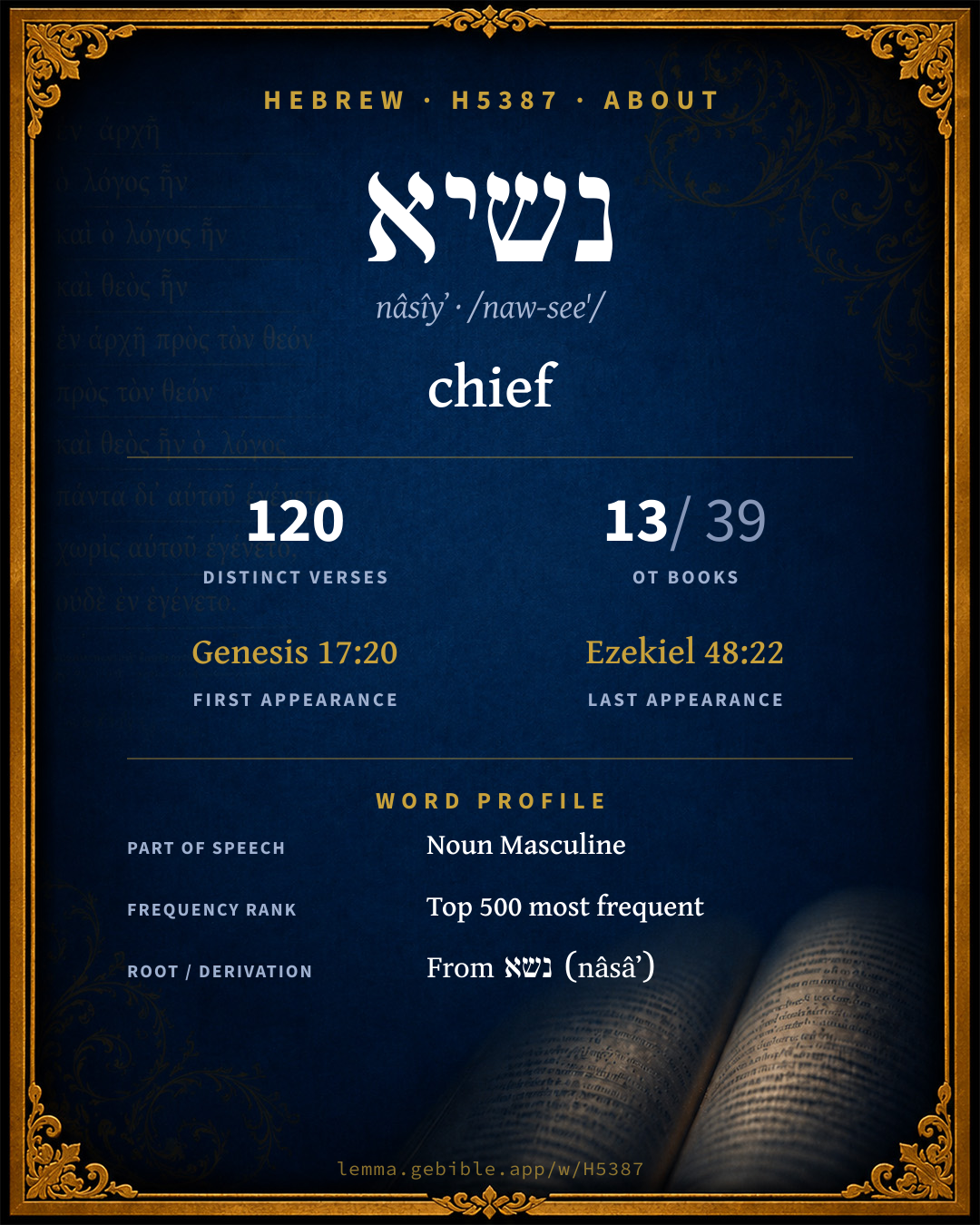
נָשִׂיא
chief
also: one lifted up, prince, captain, leader fuller range ↓
Full lexicon entry — Brown-Driver-Briggs (BDB)
From Brown-Driver-Briggs (BDB)
Where this word appears
See every Absolute-state word in the Hebrew Bible →
Grammar key — what these labels mean
Part of speech
- Noun
- A naming word — a person, place, thing, or idea.
Noun type
- Common
- A common noun — a general class of person, place, or thing (“king,” “city,” “water”), not a specific name.
State
- Absolute
- The independent form of a noun, not bound to a following word.
- Construct
- A noun bound to a following noun in a possessive / “of” relationship (the construct chain).
Gender
- Masculine
- Grammatically masculine.
Number
- Singular
- One.
- Plural
- More than one (in Hebrew, generally three or more).
41 distinct verses where H5387 appears in the Construct state, across 8 books. Filtered view — show all forms. Click any verse to open its interlinear word-by-word view. Verse text shown in the World English Bible for context — . Each verse’s Hebrew form is shown with its reference; the English is not keyword-highlighted, since the data carries no word-level English alignment. Use “Compare translations” on any verse to read it across multiple English versions. This concordance covers the Hebrew Bible; Septuagint (Greek Old Testament) occurrences are not indexed here.
Genesis 2 verses
- Genesis 23:6 נְשִׂ֨יא n c ms cs "Hear us, my lord. You are a prince of God among us. In the choice of our tombs bury your dead. None of us will withhold from you his tomb, but that you may bury your dead."
- Genesis 34:2 נְשִׂ֣יא n c ms cs Shechem the son of Hamor the Hivite, the prince of the land, saw her. He took her, lay with her, and humbled her.
Exodus 1 verse
Numbers 18 verses
- Numbers 1:16 נְשִׂיאֵ֖י n c mp cs These are those who were called of the congregation, the princes of the tribes of their fathers; they were the heads of the thousands of Israel.
- Numbers 1:44 וּ/נְשִׂיאֵ֣י conj + n c mp cs These are those who were numbered, whom Moses and Aaron numbered, and the princes of Israel, being twelve men: they were each one for his fathers' house.
- Numbers 3:24 וּ/נְשִׂ֥יא conj + n c ms cs The prince of the fathers' house of the Gershonites shall be Eliasaph the son of Lael.
- Numbers 3:30 וּ/נְשִׂ֥יא conj + n c ms cs The prince of the fathers' house of the families of the Kohathites shall be Elizaphan the son of Uzziel.
- Numbers 3:32 וּ/נְשִׂיא֙ נְשִׂיאֵ֣י conj + n c ms cs n c mp cs Eleazar the son of Aaron the priest shall be prince of the princes of the Levites, with the oversight of those who keep the charge of the sanctuary.
- Numbers 3:35 וּ/נְשִׂ֤יא conj + n c ms cs The prince of the fathers' house of the families of Merari was Zuriel the son of Abihail. They shall encamp on the north side of the tabernacle.
- Numbers 4:34 וּ/נְשִׂיאֵ֥י conj + n c mp cs Moses and Aaron and the princes of the congregation numbered the sons of the Kohathites by their families, and by their fathers' houses,
- Numbers 4:46 וּ/נְשִׂיאֵ֥י conj + n c mp cs All those who were numbered of the Levites, whom Moses and Aaron and the princes of Israel numbered, by their families, and by their fathers' houses,
- Numbers 7:2 נְשִׂיאֵ֣י נְשִׂיאֵ֣י n c mp cs n c mp cs that the princes of Israel, the heads of their fathers' houses, offered. These were the princes of the tribes. These are they who were over those who were numbered:
- Numbers 7:18 נְשִׂ֖יא n c ms cs On the second day Nethanel the son of Zuar, prince of Issachar, gave his offering.
- Numbers 7:84 נְשִׂיאֵ֣י n c mp cs This was the dedication of the altar, on the day when it was anointed, by the princes of Israel: twelve silver platters, twelve silver bowls, twelve golden ladles;
- Numbers 16:2 נְשִׂיאֵ֥י n c mp cs and they rose up before Moses, with certain of the children of Israel, two hundred fifty princes of the congregation, called to the assembly, men of renown;
- Numbers 17:2 נְשִֽׂיאֵ/הֶם֙ n c mp cs + sfx pers 3mp Speak to the children of Israel, and take of them rods, one for each fathers' house, of all their princes according to their fathers' houses, twelve rods: write you every man's name on his rod.
- Numbers 17:6 נְשִֽׂיאֵי/הֶ֡ם לְ/נָשִׂ֨יא לְ/נָשִׂ֤יא n c mp cs + sfx pers 3mp prep + n c ms prep + n c ms Moses spoke to the children of Israel; and all their princes gave him rods, for each prince one, according to their fathers' houses, even twelve rods: and the rod of Aaron was among their rods.
- Numbers 25:14 נְשִׂ֥יא n c ms cs Now the name of the man of Israel that was slain, who was slain with the Midianite woman, was Zimri, the son of Salu, a prince of a fathers' house among the Simeonites.
- Numbers 25:18 נְשִׂ֤יא n c ms cs for they vex you with their wiles, with which they have deceived you in the matter of Peor, and in the matter of Cozbi, the daughter of the prince of Midian, their sister, who was slain on the day of the plague in the matter of Peor.
- Numbers 31:13 נְשִׂיאֵ֥י n c mp cs Moses, and Eleazar the priest, and all the princes of the congregation, went forth to meet them outside of the camp.
- Numbers 32:2 נְשִׂיאֵ֥י n c mp cs the children of Gad and the children of Reuben came and spoke to Moses, and to Eleazar the priest, and to the princes of the congregation, saying,
Joshua 4 verses
- Joshua 9:15 נְשִׂיאֵ֖י n c mp cs Joshua made peace with them, and made a covenant with them, to let them live: and the princes of the congregation swore to them.
- Joshua 9:18 נְשִׂיאֵ֣י הַ/נְּשִׂיאִֽים n c mp cs ptcl def.art + n c mp The children of Israel didn't strike them, because the princes of the congregation had sworn to them by Yahweh, the God of Israel. All the congregation murmured against the princes.
- Joshua 13:21 נְשִׂיאֵ֣י n c mp cs and all the cities of the plain, and all the kingdom of Sihon king of the Amorites, who reigned in Heshbon, whom Moses struck with the chiefs of Midian, Evi, and Rekem, and Zur, and Hur, and Reba, the princes of Sihon, who lived in the land.
- Joshua 22:30 וּ/נְשִׂיאֵ֨י conj + n c mp cs When Phinehas the priest, and the princes of the congregation, even the heads of the thousands of Israel that were with him, heard the words that the children of Reuben and the children of Gad and the children of Manasseh spoke, it pleased them well.
1 Kings 1 verse
1 Chronicles 1 verse
2 Chronicles 1 verse
Ezekiel 13 verses
- Ezekiel 19:1 נְשִׂיאֵ֖י n c mp cs Moreover, take up a lamentation for the princes of Israel,
- Ezekiel 21:12 נְשִׂיאֵ֣י n c mp cs Cry and wail, son of man; for it is on my people, it is on all the princes of Israel: they are delivered over to the sword with my people; strike therefore on your thigh.
- Ezekiel 21:25 נְשִׂ֖יא n c ms cs You, deadly wounded wicked one, the prince of Israel, whose day is come, in the time of the iniquity of the end,
- Ezekiel 22:6 נְשִׂיאֵ֣י n c mp cs Behold, the princes of Israel, everyone according to his power, have been in you to shed blood.
- Ezekiel 26:16 נְשִׂיאֵ֣י n c mp cs Then all the princes of the sea shall come down from their thrones, and lay aside their robes, and strip off their embroidered garments: they shall clothe themselves with trembling; they shall sit on the ground, and shall tremble every moment, and be astonished at you.
- Ezekiel 27:21 נְשִׂיאֵ֣י n c mp cs Arabia, and all the princes of Kedar, they were the merchants of your hand; in lambs, and rams, and goats, in these were they your merchants.
- Ezekiel 32:29 נְשִׂיאֶ֔י/הָ n c mp cs + sfx pers 3fs There is Edom, her kings and all her princes, who in their might are laid with those who are slain by the sword: they shall lie with the uncircumcised, and with those who go down to the pit.
- Ezekiel 38:2 נְשִׂ֕יא n c ms cs Son of man, set your face toward Gog, of the land of Magog, the prince of Rosh, Meshech, and Tubal, and prophesy against him,
- Ezekiel 38:3 נְשִׂ֕יא n c ms cs and say, Thus says the Lord Yahweh: Behold, I am against you, Gog, prince of Rosh, Meshech, and Tubal:
- Ezekiel 39:1 נְשִׂ֕יא n c ms cs You, son of man, prophesy against Gog, and say, Thus says the Lord Yahweh: Behold, I am against you, Gog, prince of Rosh, Meshech, and Tubal:
- Ezekiel 39:18 נְשִׂיאֵ֥י n c mp cs You shall eat the flesh of the mighty, and drink the blood of the princes of the earth, of rams, of lambs, and of goats, of bulls, all of them fatlings of Bashan.
- Ezekiel 45:8 נְשִׂיאַ/י֙ n c mp cs + sfx pers 1cs In the land it shall be to him for a possession in Israel: and my princes shall no more oppress my people; but they shall give the land to the house of Israel according to their tribes.
- Ezekiel 45:9 נְשִׂיאֵ֣י n c mp cs Thus says the Lord Yahweh: Let it suffice you, princes of Israel: remove violence and spoil, and execute justice and righteousness; dispossessing my people, says the Lord Yahweh.
About this entry
At a glance — auto-summarized from this page’s data, not written by a person. Every figure links to its source below. This summary describes the numbers; it doesn’t interpret them.
The Hebrew noun נשיא centers on the idea of “chief.” Older and newer Bibles part ways — “prince” in the King James Version, “leader” (Berean Standard Bible) in modern versions. See the renderings breakdown. It appears 120 verses across 13 books of the Hebrew Bible, among its common vocabulary. The word gravitates to Numbers (46%), then Ezekiel and Joshua. Beyond “chief” it also covers “one lifted up”, “prince”, and “captain” — see its full sense range. For the data behind this summary, explore the sense tree and the renderings breakdown below.
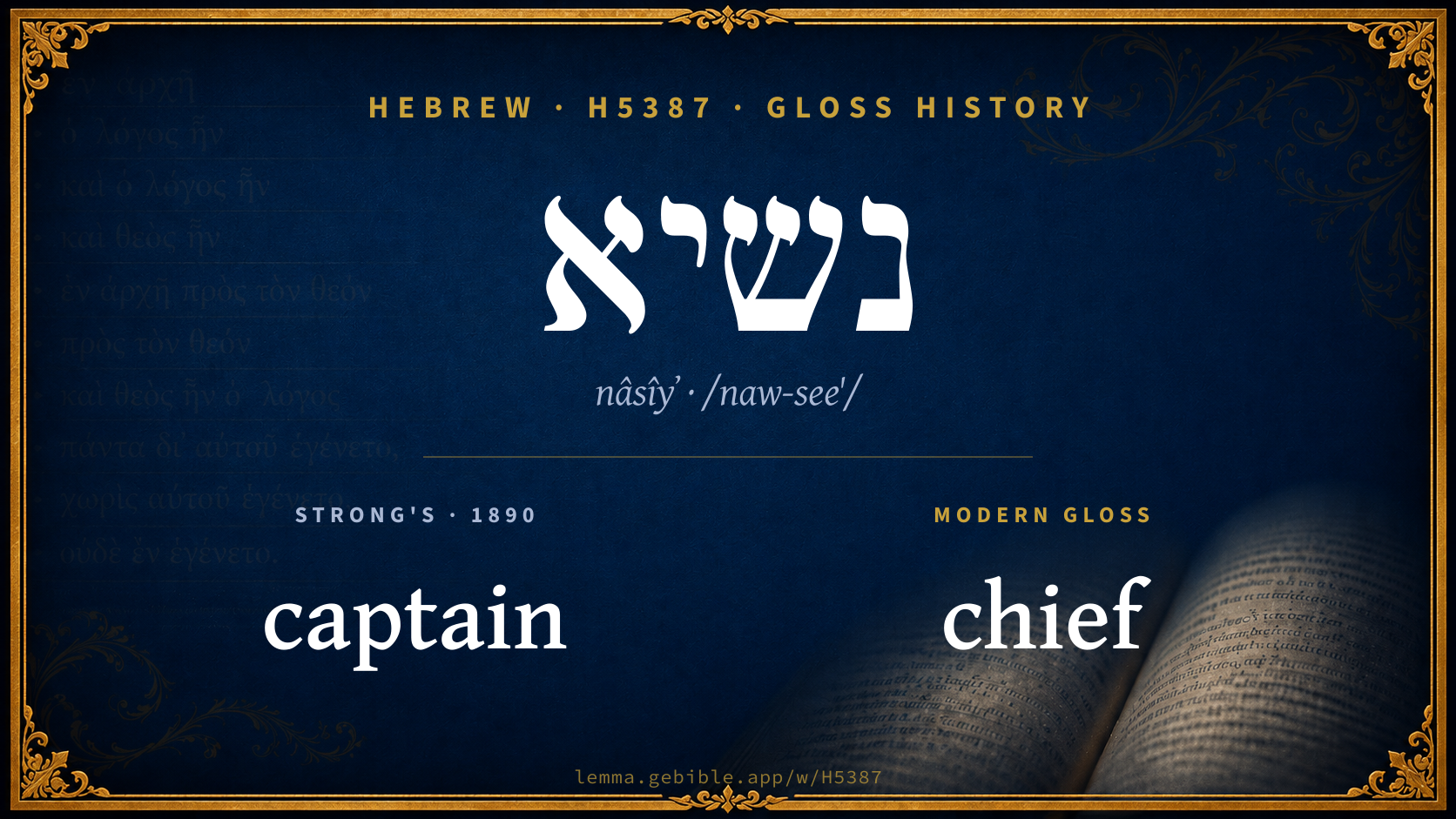
Gloss history
Strong's 1890 vs modern scholarship
About this word
Strong's H5387 catalogs a Hebrew word from the Hebrew Old Testament.
These counts are not copied from any lexicon or concordance. They are computed here, from the morphology-tagged Hebrew Old Testament. What Lemma adds →
- 120
- distinct verses
- The word appears in 120 distinct verses.
- 13 / 39
- OT books
- The word appears in 13 of 39 Old Testament books.
- #332
- by frequency
- Top 500 most frequent Hebrew words (rank 332 of 8,640 Hebrew words by occurrence).
View all 120 occurrences in the concordance →
By section of the Old Testament
By traditional corpus
Conventional, traditional groupings — biblical authorship is debated, so this is a traditional corpus grouping, not an authorship claim. Each share is this word’s portion of its verses in that division of the Hebrew canon. Each figure is a share of the word’s 120 distinct verses.
- Torah (Pentateuch) 64 verses · 53%
- Prophets (Nevi'im) 47 verses · 39%
- Writings (Ketuvim) 9 verses · 8%
How translations render this word
Counts come from each version’s own published word-to-Strong’s tagging or interlinear alignment — an approximate guide to how each version renders this word, not a word-level alignment the data otherwise carries. Because each total is that version’s own tagged count, the per-version totals vary from one another and need not match the appearance or distinct-verse counts above. These counts may also differ from a printed concordance because Lemma counts each distinctly tagged rendering and does not collapse phrase taggings into a single head-word total. This is a fixed set of word-tagged versions (KJV, ASV, BSB, ULT) and does not change with the reading translation you choose elsewhere. Each version’s license is shown beside its name below (and on Sources).
BDB lists this Strong’s number as 2 distinct words (homographs). Each count above pools all of them and is not split by sense — see the Senses section below. A low-frequency rendering may belong to a different one of those words, not the primary meaning.
- King James Version†: Prince 43×, Princes 26×, Captain 9×
- American Standard Version†: Prince 54×, Princes 29×, All the princes 4×
- Berean Standard Bible†: Leader 42×, Leaders 28×, Prince 22×
- unfoldingWord Literal Text†: Leader 42×, Leaders 21×, Prince 19×
King James Version Public Domain
Renders H5387 across 130† tagged occurrences — most commonly:
Plus 30 renderings that appear only once — usually multi-word phrases or single function words the recovered tagging swept in, not distinct renderings. Not rendered by a distinct English word in 2 further occurrences.
American Standard Version Public Domain
Renders H5387 across 127† tagged occurrences — most commonly:
Plus 31 renderings that appear only once — usually multi-word phrases or single function words the recovered tagging swept in, not distinct renderings.
Berean Standard Bible Public Domain
Renders H5387 across 126† tagged occurrences — most commonly:
Plus 17 renderings that appear only once — usually multi-word phrases or single function words the recovered tagging swept in, not distinct renderings. Not rendered by a distinct English word in 8 further occurrences.
unfoldingWord Literal Text CC BY-SA 4.0
Renders H5387 across 137† tagged occurrences — most commonly:
Plus other, less common renderings. Plus 9 renderings that appear only once — usually multi-word phrases or single function words the recovered tagging swept in, not distinct renderings.
12 senses and sub-senses in the full BDB
What do BDB’s symbols mean?
BDB uses these scholarly abbreviations:
| Symbol | Meaning |
|---|---|
| 𝔊 | the Septuagint (the ancient Greek translation, LXX) |
| 𝔙 | the Vulgate (the Latin translation) |
| 𝔖 | the Syriac version (the Peshitta) |
| 𝔗 | the Targum (the Aramaic translation) |
| ψ | the Psalms |
| √ | root (the underlying root or stem) |
| ‖ | parallel passage (a synonymous or contrasted parallel) |
| † | the dagger: every passage where the word occurs is cited |
The 12 senses and sub-senses the full Brown-Driver-Briggs lexicon distinguishes for this word, in lexicon order (not ranked by frequency), with BDB’s own verbatim wording and sub-sense lettering. Shown in Hebrew script with BDB’s own scholarly abbreviations. The condensed entry is in the Lexicon Entry tab. See also the Forms in the corpus table below.
נשיא I one lifted up, i.e. a chief prince
- 1. נ׳ בְּעַמְּךָ of any chief man, Ex 22:27 (E; human ruler, over ag. אֱלֹהִים). e.g. Exodus 22:27
- 2. of Solom. 1 K 11:34. Elsewhere only Ez P Chr:— e.g. 1 Kings 11:34
- 3. of Abr. Gn 23:6, of Ishmaelites 17:20; 25:16, of Hittites Gn 34:2. e.g. Genesis 23:6
- 4. rulers of the congregation, נְשִׂיאֵי הָעֵדָה Ex 16:22 Jos 9:15, 18; 22:30, הַנּ׳ בָּעֵדָה 34:31, cf. 35:27 Lv 4:22 Jos 9:18b, 19, 21(×2); 17:4; 22:14(×3), 32 (all P); especially e.g. Ezekiel 16:22
- 5. tribal chiefs and representatives, according to the religious organization of P, Nu 1:16, 44 2:3 + 57 times Nu (especially chaps. 2, 7, 34; note נְשִׂיא נְשִׂיאֵי הַלִּוֵי 3:32); cf. 1 Ch 2:10; 4:38; 5:6; 7:40 2 Ch 1:2; also 1 K 8:1 (prob. gloss, om. 𝔊 Benz), 2 Ch 5:2. e.g. Numbers 1:16
- 6. in Ezek.:
- a. of Zedekiah (for מֶלָךְ; v. BöhmerSK 1900, 112 ff.), 7:27; 12:10, 12; 21:30, + 19:1 (read sg. 𝔊 Ew Hi Co Berthol Toy). e.g. Ezekiel 7:27
- b. chief men of Judah 21:17; 22:6; 45:8, 9. e.g. Ezekiel 21:17
- c. future Davidic kg. 34:24; 37:25, cf. 44:3(×2) + 16 times Ez 45, 46, 48. e.g. Ezekiel 34:24
- d. foreign princes 26:16; 27:21; 30:13; 32:29; 38:2, 3; 39:1, 18. e.g. Ezekiel 26:16
- 7. leader of exiles returning under Cyrus, according to Ezr 1:8. e.g. Ezra 1:8
- 8. non-Isr. chiefs in P: Gn 34:2 Nu 25:18 Jos 13:21. e.g. Genesis 34:2
נשיא II [m.] rising mist, vapour (Arabic نَشْءٌ, نَشِىٌٔ )
Senses from the full Brown-Driver-Briggs lexicon (Brown, Driver, Briggs; Oxford 1906 — public domain), digitized via Sefaria, supplemented by the OpenScriptures HebrewLexicon (CC BY 4.0). Full attribution on Sources.
Word origin
I. n.m. one lifted up, i.e. a chief prince;—abs. נ׳ Ez 22:27 +; cstr. נְשִׂיא Gn 23:6 +; pl. נְשִׂיאִים Jos 22:32 +, נְשִׂאִים Ex 34:31 + 7 times, נְשִׂיאִם Gn 17:20 + 3 times, נְשִׂאִם Ex 35:27; cstr. נְשִׂיאֵי Ex 16:22 +; sf. נְשִׂיאַי Ez 45:8, נְשִׂיאֶיהָ Ez 32:29, נְשִׂיאֵיהֶם Nu 17:21, נְשִׂיאֵהֶם v 17, etc.—mostly in Isr.:
II. n.[m.] rising mist, vapour (Arabic نَشْءٌ, نَشِىٌٔ );—only pl. נְשִׂאִים vapours, forming clouds, and portending rain, Je 10:13 = 51:16, ψ 135:7, נְשִׂיאִים Pr 25:14.
— Brown-Driver-Briggs (Oxford 1906, public domain), digitized via Sefaria, supplemented by the OpenScriptures HebrewLexicon (CC BY 4.0). See Sources.
Derived from נשא (nâsâʼ) (H5375) — to lift.
Jastrow Dictionary
A second Hebrew/Aramaic lexicon for comparison, covering Aramaic and post-biblical (Talmudic, Targumic, Midrashic) usage that the biblical-Hebrew BDB does not. Matched by lemma rather than by Strong’s number, so a lemma may carry more than one Jastrow headword (shown separately below), and the entries cover usage well beyond the Bible.
נַשְׁיָא
- m. ch. = h. נָשֶׁה. Targ. Gen. XXXII, 33 גידא דנ׳.—Ḥull. 97ᵇ גידא נ׳, v. גִּידָא
נָשִׂיא
- 1. prince, chief, ruler, officer. Num. R. s. 1 לנ׳ שנכנס וכ׳ like unto a chief that entered a country. Ib. שלא מנה נ׳ לשבט וכ׳ he appointed no prince for the tribe of Levi. [Ib. נשיא שבטים, read נְשִׂיאֵי]. Hor. II, 6; a. v. fr.—Pl. נְשִׂיאִים. Num. R. s. 12 למה נזדרזו הנ׳ וכ׳ why were the princes so anxious to be the first &c.? Num. R. s. 3; a. v. fr.—Esp. Nasi, the chief of the Great Sanhedrin in Jerusalem and of its successor in Palestinian places (v. אָב). Taan. II, 1. Pes. 66ᵃ מינוהו נ׳ עליהם they elected him as their Nasi; a. fr.—R. Judah the Nasi, v. רַבִּי.—Pl. as ab. Ḥag. II, 2; a. e.
- 2. pl. as ab. clouds. Kidd. 32ᵇ להק"בה … מעלה נ׳ וכ׳ the Lord causes the wind to blow and brings up clouds and lets rain come down &c.
A Dictionary of the Targumim, the Talmud Babli and Yerushalmi, and the Midrashic Literature (Marcus Jastrow; London, Luzac, 1903) — Public Domain. Digitized via Sefaria. Digitized via Sefaria. Full attribution on Sources.
Forms in the corpus
The 67 distinct written forms H5387 takes in the Hebrew Bible, most frequent first — each parse links to that state’s occurrences in the concordance. Hebrew forms include their vowel points and cantillation, so a single lemma takes many written forms.
The 60 most common forms are shown; 7 rarer forms follow in the full concordance.
Same root — word family
Other BDB entries built from the same root as H5387, grouped by Strong’s listed origin. These share a root / origin per the lexicon — not necessarily a shared meaning. Each links to that word’s own entry.
Derives from
Shares the same root
- משא massâʼ H4853 burden
- משא massôʼ H4856 partiality
- משאה massâʼâh H4858 uplifting
- משאת masʼêth H4864 burden
- מתנשא mithnassêʼ H4984 to exalt oneself
- נשא nᵉsâʼ H5376 to lift
- נשאת nissêʼth H5379 portion
- נשואה nᵉsûwʼâh H5385 load
- שאת sᵉʼêth H7613 exaltation
- שוא sôwʼ H7721 rising
Proper names from this root
People and places named from this root — a name, not an additional meaning of the word.
Compare all same-root words → Showing 4 of 13 — not the complete family. 1 of the same-root words is a proper name (a person or place). They share a root, not necessarily a meaning.
Septuagint verse parallels
This word appears in 120 verses that also exist in the Greek Old Testament (Septuagint), out of the 120 Hebrew verses it occurs in. You can read those verses in Greek by switching the Old Testament edition to the Septuagint.
Read these verses in the Septuagint
- Genesis 17:20
- Exodus 16:22
- Leviticus 4:22
- Numbers 1:16
- Joshua 9:15
- 1 Kings 8:1
- 1 Chronicles 2:10
- 2 Chronicles 1:2
- Ezra 1:8
- Psalms 135:7
- Proverbs 25:14
- Jeremiah 10:13
This is a verse-level parallel only — the same verses exist in both the Hebrew and Greek Old Testaments. No word-level Hebrew↔Greek correspondence is claimed: the data carries no such alignment, so no Greek word is shown as this Hebrew word’s translation. Coverage is not total — the Septuagint omits the deuterocanon and renumbers the Psalms, so some Hebrew verses have no direct Greek parallel.