
Numbers 16:2

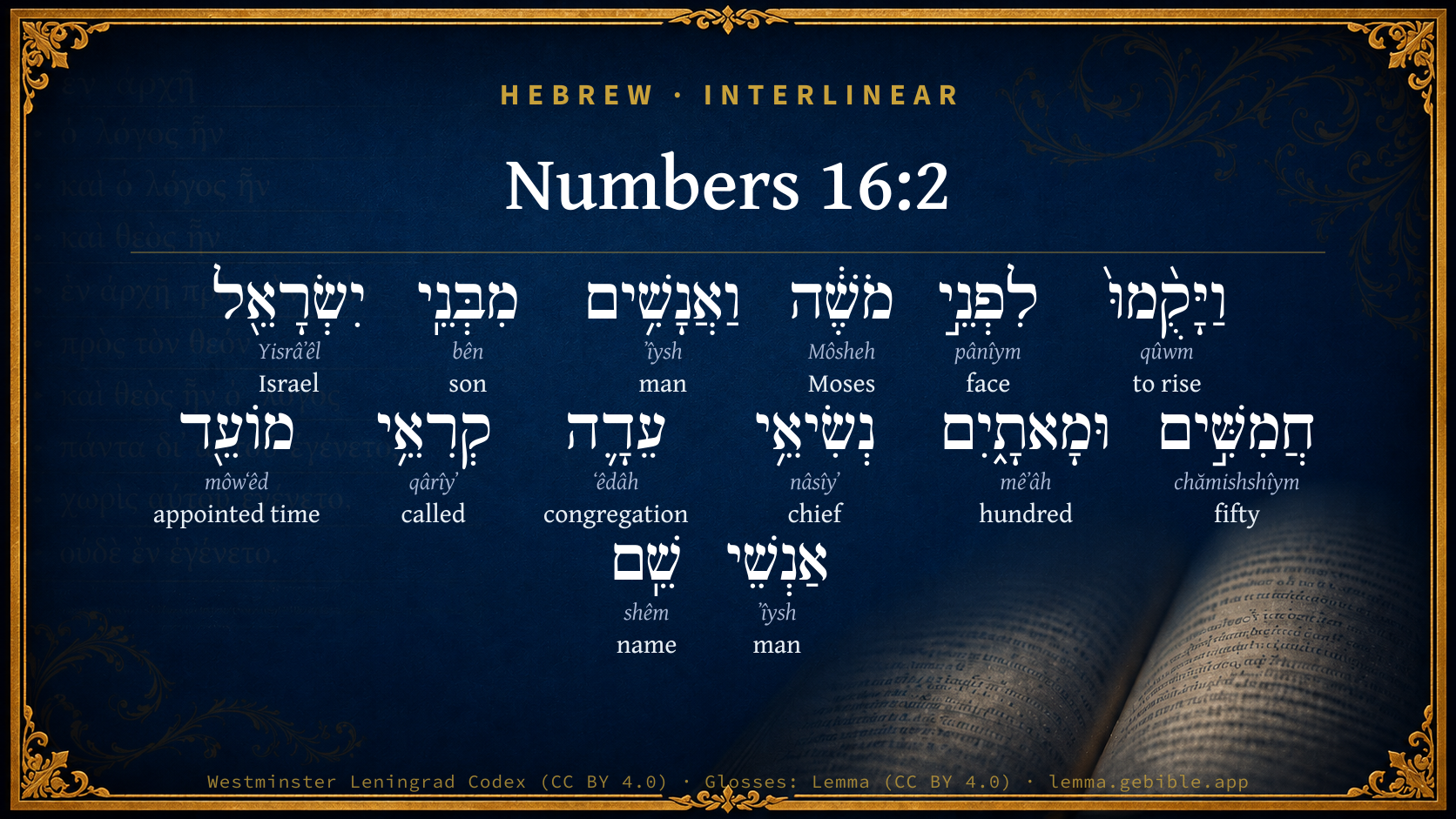
Hebrew (Westminster Leningrad Codex) Numbers 16:2 appears in the Hebrew Old Testament. The text above is from the Westminster Leningrad Codex. Each word links to its Strong’s number, a concise gloss, and parsing drawn from the Open Scriptures Hebrew Bible morphology. Click any word for its full Brown-Driver-Briggs (BDB) entry.
Download image
Cite this verse

Numbers 16:2 (World English Bible). Public Domain. Lemma interlinear Bible study tool, https://lemma.gebible.app/v/numbers/16/2.

Show BibTeX & RIS
BibTeX
RIS
English Translation
and they rose up before Moses, with certain of the children of Israel, two hundred fifty princes of the congregation, called to the assembly, men of renown;
World English Bible · Public Domain
Download a study sheet

One document with this verse’s original text, its word-by-word gloss line, the meaning frame, cross-references with their text, attributed commentary, and full source and license credits — printable, and it pastes into notes with its structure intact.

This verse Autodidact and up

Study sheet (.html) Plain text (.txt)

A passage Seminary Student

Up to 50 verses in one chapter. A passage sheet keeps up to 6 commentary sources and 12 cross-references per verse, in the order this page ranks them, and says so on the sheet whenever that leaves anything out. Ask for a single verse and you get the Autodidact verse sheet above.

Everything on this page stays free to read, with no account — the sheet is a download of what is already on screen, not access to it.

Want to remove ads? Support Godless Engineer
Compare translations 3

The same verse in 3 English versions, stacked beneath the original-language interlinear above. Click any original word for its lexicon entry.

Each is an independent rendering of the whole verse — the interlinear is not word-aligned to these translations.

Highlighted words mark where these versions differ — a whole-verse word diff, not a word-by-word alignment.

  • World English Bible Public Domain
    and they rose up before Moses, with certain of the children of Israel, two hundred fifty princes of the congregation, called to the assembly, men of renown;
  • King James Version Public Domain
    And they rose up before Moses, with certain of the children of Israel, two hundred and fifty princes of the assembly, famous in the congregation, men of renown:
  • unfoldingWord Literal Text CC BY-SA 4.0
    and they rose to the face of Moses, and 250 men from the sons of Israel, leaders of the congregation, called ones of meeting, men of name,

unfoldingWord Literal Text — © unfoldingWord, licensed CC BY-SA 4.0. Word-aligned USFM3 via Door43 (git.door43.org/unfoldingWord/en_ult).

Versions to compare (up to 4)

3 of 4 selected

Show all 18 translations

Every available English version of this verse, each an independent rendering of the whole verse.

  • World English Bible Public Domain
    and they rose up before Moses, with certain of the children of Israel, two hundred fifty princes of the congregation, called to the assembly, men of renown;
  • Berean Standard Bible Public Domain
    a rebellion against Moses, along with 250 men of Israel renowned as leaders of the congregation and representatives in the assembly.
  • Majority Standard Bible Public Domain
    a rebellion against Moses, along with 250 men of Israel renowned as leaders of the congregation and representatives in the assembly.
  • King James Version Public Domain
    And they rose up before Moses, with certain of the children of Israel, two hundred and fifty princes of the assembly, famous in the congregation, men of renown:
  • American Standard Version (1901) Public Domain
    and they rose up before Moses, with certain of the children of Israel, two hundred and fifty princes of the congregation, called to the assembly, men of renown;
  • Revised Version (1885) Public Domain
    and they rose up before Moses, with certain of the children of Israel, two hundred and fifty princes of the congregation, called to the assembly, men of renown:
  • Geneva Bible (1599) Public Domain
    And they rose vp against Moses, with certaine of the children of Israel, two hundreth and fiftie captaines of the assemblie, famous in the Congregation, and men of renoume,
  • Douay-Rheims (1899) Public Domain
    Rose lap against Moses, and with them two hundred and fifty others of the children of Israel, leading men of the synagogue, and who in the time of assembly were called by name.
  • Young's Literal Translation Public Domain
    and they rise up before Moses, with men of the sons of Israel, two hundred and fifty, princes of the company, called of the convention, men of name,
  • Literal Standard Version CC BY-SA 4.0
    and they rise up before Moses with men of the sons of Israel, two hundred and fifty princes of the congregation, called of the convention, men of renown,
  • Unlocked Literal Bible CC BY-SA 4.0
    They rose up against Moses, along with other men from the people of Israel, two hundred and fifty leaders of the community who were well-known members in the community.
  • unfoldingWord Literal Text CC BY-SA 4.0
    and they rose to the face of Moses, and 250 men from the sons of Israel, leaders of the congregation, called ones of meeting, men of name,
  • Darby Bible Public Domain
    and they rose up against Moses, with two hundred and fifty men of the children of Israel, princes of the assembly, summoned to the council, men of renown;
  • World Messianic Bible Public Domain
    They rose up before Moses, with some of the children of Israel, two hundred fifty princes of the congregation, called to the assembly, men of renown.
  • Webster's Bible Public Domain
    And they rose up before Moses, with certain of the children of Israel, two hundred and fifty princes of the assembly, famous in the congregation, men of renown:
  • Free Bible Version CC BY-SA 4.0
    They rebelled against Moses, and were joined by 250 well-respected Israelite leaders and members of the assembly.
  • Bible in Basic English Public Domain
    And came before Moses, with certain of the children of Israel, two hundred and fifty chiefs of the people, men of good name who had a place in the meeting of the people.
  • JPS Tanakh (1917) Public Domain
    and they rose up in face of Moses, with certain of the children of Israel, two hundred and fifty men; they were princes of the congregation, the elect men of the assembly, men of renown;

Literal Standard Version (2020), Covenant Press — licensed CC BY-SA 4.0. Text via the HelloAO Bible API (eBible.org). Unlocked Literal Bible (unfoldingWord) — licensed CC BY-SA 4.0. Text via the HelloAO Bible API (eBible.org). unfoldingWord Literal Text — © unfoldingWord, licensed CC BY-SA 4.0. Word-aligned USFM3 via Door43 (git.door43.org/unfoldingWord/en_ult). Free Bible Version, Dr. Jonathan Gallagher — licensed CC BY-SA 4.0. Text via the HelloAO Bible API (eBible.org).

Word by word

More ways to search: Search by grammar → Find every occurrence → Compare this word →

Practice this passage: Drill this verse → Learn its vocabulary →

קְרִאֵ֥י
qârîyʼ
H7148
“called of”
Adjective, Adjective, Masculine, Plural, Construct
Part of Speech
Adjective
Type
Adjective
Gender
Masculine
Number
Plural
State
Construct
Full BDB Definition

Origin: from H7121

TWOT: 2063b

called, summoned, called one
  1. וַיָּקֻ֨מוּ֙ qûwm H6965 “and · to rise” Conjunction + Verb, Qal, Sequential Imperfect, 3rd Person, Masculine, Plural
  2. לִפְנֵ֣י pânîym H6440 “to/for · face(s) of” Preposition + Noun, Common, Both, Plural, Construct
  3. מֹשֶׁ֔ה Môsheh H4872 “Moses” Noun, Proper
  4. וַאֲנָשִׁ֥ים ʼîysh H376 “and · men” Conjunction + Noun, Common, Masculine, Plural, Absolute
  5. מִבְּנֵֽי bên H1121 “from · sons of” Preposition + Noun, Common, Masculine, Plural, Construct
  6. יִשְׂרָאֵ֖ל Yisrâʼêl H3478 “Israel” Noun, Proper
  7. חֲמִשִּׁ֣ים chămishshîym H2572 “fifty” Adjective, Cardinal number, Both, Plural, Absolute
  8. וּמָאתָ֑יִם mêʼâh H3967 “and · hundred” Conjunction + Adjective, Cardinal number, Both, Dual, Absolute
  9. נְשִׂיאֵ֥י nâsîyʼ H5387 “chiefs of” Noun, Common, Masculine, Plural, Construct
  10. עֵדָ֛ה ʻêdâh H5712 “congregation” Noun, Common, Feminine, Singular, Absolute
  11. מוֹעֵ֖ד môwʻêd H4150 “appointed time” Noun, Common, Masculine, Singular, Absolute
  12. אַנְשֵׁי ʼîysh H376 “men of” Noun, Common, Masculine, Plural, Construct
  13. שֵֽׁם shêm H8034 “name” Noun, Common, Masculine, Singular, Absolute

About this verse

These counts appear in no published source. They are computed here, from the morphology-tagged text and Lemma’s own curated glosses. What Lemma adds →

14
words
13
distinct lemmas
Pentateuch
section

Notable vocabulary

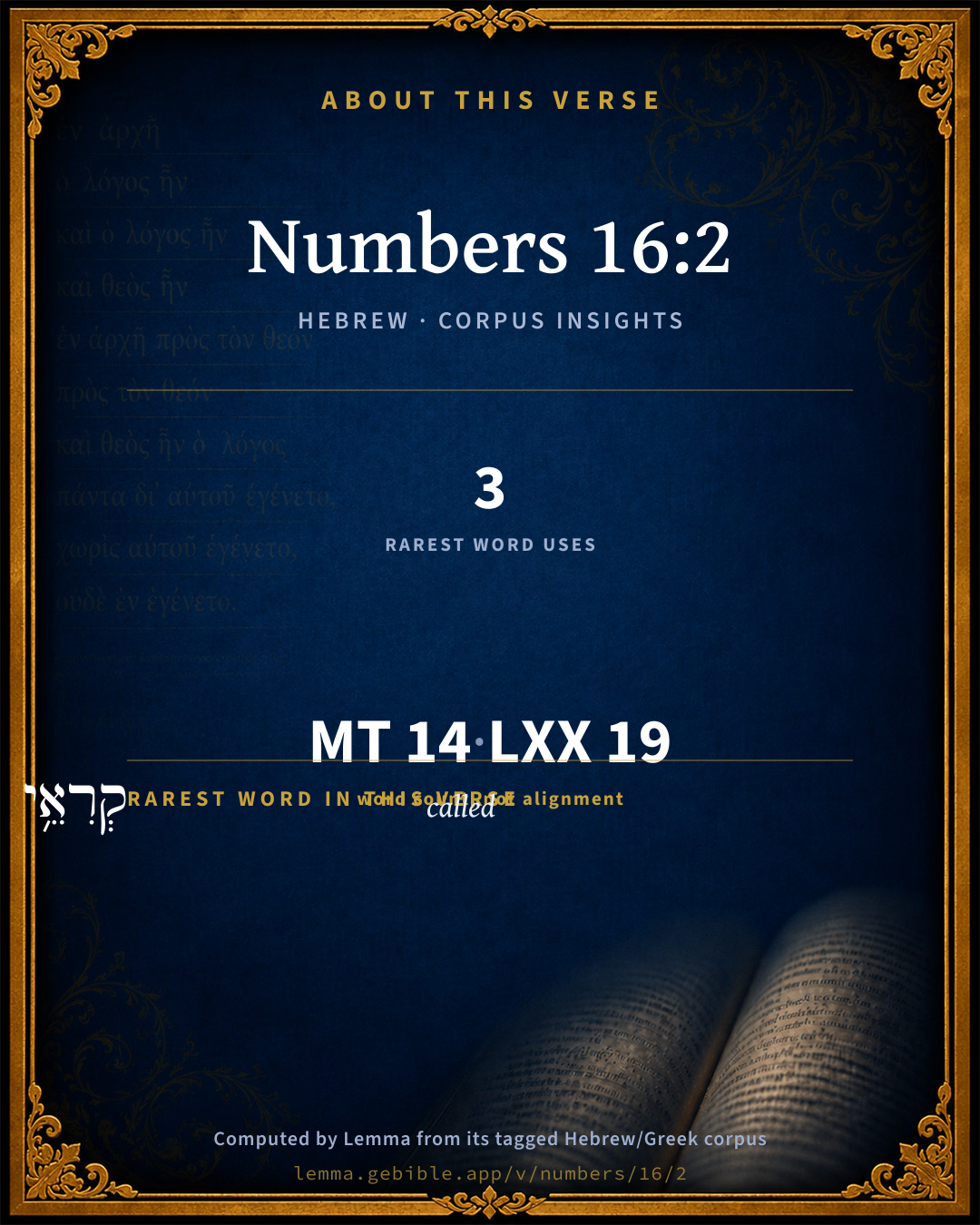
The rarest word here is קְרִאֵ֥י called H7148 — appearing just 3 times in the whole Hebrew Bible.

Shared distinctive vocabulary

קְרִאֵ֥י called H7148 occurs in 3 verses of the Hebrew Bible. Also found in:

Grammatical profile

  • 1 verb
  • 10 nouns
  • 3 adjectives

Verb forms

  • וַיָּקֻ֨מוּ֙ Qal · Sequential Imperfect

Repetition

A word recurs within this verse — often emphatic in Hebrew:

  • וַאֲנָשִׁ֥ים man H376 ×2

Hebrew & Septuagint length

In English translation the verse runs 27 words from the Hebrew and 26 from the Septuagint (LXX English) — closely comparable.

A rough comparison of the two English renderings, which tokenize alike — not a word-level alignment.

Word counts can differ between the Hebrew and the Greek without any difference in meaning — e.g. the Hebrew direct-object marker אֵת has no separate Greek word, and Greek often adds the article ὁ.

In the original languages it is 14 Hebrew tokens and 19 Greek tokens — but the two are counted differently (Hebrew bundles its prefixes and suffixes into one token; the Greek is in lemma form), so that isn’t a like-for-like length.

Cross-references

6

Topical passages linked to Numbers 16:2 in the Treasury of Scripture Knowledge — connected by theme and wording, ordered by reader-vote popularity; previews shown in the World English Bible.

  • Numbers 26:9 The sons of Eliab: Nemuel, and Dathan, and Abiram. These are that Dathan and Abiram, who were called of the congregation, who strove against Moses and against Aaron in the company of Korah, when they strove against Yahweh,
  • Ezekiel 23:10 These uncovered her nakedness; they took her sons and her daughters; and her they killed with the sword: and she became a byword among women; for they executed judgments on her.
  • Genesis 6:4 The Nephilim were in the earth in those days, and also after that, when God's sons came to men's daughters. They bore children to them: the same were the mighty men who were of old, men of renown.
  • Numbers 1:16 These are those who were called of the congregation, the princes of the tribes of their fathers; they were the heads of the thousands of Israel.
  • 1 Chronicles 5:24 These were the heads of their fathers' houses: even Epher, and Ishi, and Eliel, and Azriel, and Jeremiah, and Hodaviah, and Jahdiel, mighty men of valor, famous men, heads of their fathers' houses.
  • 1 Chronicles 12:30 Of the children of Ephraim twenty thousand eight hundred, mighty men of valor, famous men in their fathers' houses.

Cross-references courtesy of OpenBible.info (CC BY 4.0).

Hebrew and Greek witnesses Masoretic Hebrew ↔ Greek Septuagint

The same verse in the two great witnesses to the Old Testament, shown verse-for-verse.

These are two independent witnesses, not word-aligned to each other, and the Septuagint is shown in lemma (dictionary) form.

Hebrew Numbers 16:2 Masoretic · Westminster Leningrad Codex

וַיָּקֻ֨מוּ֙ לִפְנֵ֣י מֹשֶׁ֔ה וַאֲנָשִׁ֥ים מִבְּנֵֽי יִשְׂרָאֵ֖ל חֲמִשִּׁ֣ים וּמָאתָ֑יִם נְשִׂיאֵ֥י עֵדָ֛ה קְרִאֵ֥י מוֹעֵ֖ד אַנְשֵׁי שֵֽׁם

and they rose up before Moses, with certain of the children of Israel, two hundred fifty princes of the congregation, called to the assembly, men of renown;

World English Bible · Public Domain

Greek LXX Numbers 16:2 Septuagint · lemma form

καί ἀναἵστημι ἔναντι μωυσῆς καί ἀνήρ ὁ υἱός ἰσραήλ πεντήκοντα καί διακόσιοι ἀρχηγός συναγωγή σύγκλητος βουλή καί ἀνήρ ὀνομαστός

and rose up before Moses, and two hundred and fifty men of the sons of Israel, chiefs of the assembly, chosen councillors, and men of renown.

LXX2012 (modern English Septuagint) · Public Domain

On this verse, The Cambridge Bible for Schools and Colleges discusses the Septuagint’s reading. Read the note in Commentary ↓

Hebrew: Westminster Leningrad Codex (CC BY 4.0). Greek: Septuagint (public domain); English from LXX2012 (modern English Septuagint) (Public Domain). How the Septuagint differs from the Hebrew →

Targum (Aramaic paraphrase)

2

The Targum is the ancient Jewish Aramaic paraphrase of the Hebrew Scriptures — an interpretive translation, not the Hebrew text itself. Onkelos (literal) and Pseudo-Jonathan (expansive) render the Torah, and Jonathan the Prophets. Coverage is partial: where no permissively-licensed English translation exists for a verse, only the Aramaic is shown. This is verse-level text, not a word-by-word alignment to the Hebrew.

  1. Targum Onkelos Torah (Genesis–Deuteronomy)
    וְקָמוּ לְאַפֵּי משֶׁה וְגֻבְרַיָא מִבְּנֵי יִשְׂרָאֵל מָאתָן וְחַמְשִׁין רַבְרְבֵי כְנִשְׁתָּא מְעַרְעֵי זְמַן אֱנָשִׁין דִשְׁמָא

    (no public-domain English translation for this verse)

    Targum Onkelos — Aramaic: “Onkelos Genesis” (public domain); “Onkelos Exodus” (public domain); “Onkelos Leviticus” (public domain); “Onkelos Numbers” (public domain); “Onkelos Deuteronomy” (public domain). English: “Sefaria Community Translation” (CC0 1.0 (public-domain dedication)); “J.W. Etheridge. The Targums of Onkelos and Jonathan Ben Uzziel on the Pentateuch. London: Longmans, Green, 1862” (public domain). Text via Sefaria.

  2. Targum Pseudo-Jonathan Torah (Genesis–Deuteronomy)
    וְקָמוּ בְּחוּצְפָּא וְאוֹרוּ הִילְכְתָא בְּאַנְפּוֹי דְמשֶׁה עַל עֵיסַק תִּיכְלָא משֶׁה אָמַר אֲנָא שְׁמָעִית מִן פּוּם קוּדְשָׁא יְהֵא שְׁמֵיהּ מְבָרַךְ דְצִיצִיַית יְהוֹן מִן חִיוַור וְחוּטָא חַד דְתִיכְלָא יְהֵי בֵּיהּ קרַח וְחַבְרוֹי עָבָדוּ גוּלְיַין וְצִיצְיַיתְהוֹן כּוּלְהוֹן דְתִיכְלָא מַה דְלָא פַקֵיד יְיָ וּמְסַעֲדִין לְהוֹן גוּבְרַיָא מִבְּנֵי יִשְרָאֵל מָאתָן וְחַמְשִׁין אֲמַרְכְּלֵי כְּנִישְׁתָּא מְעַרְעֵי זְמַן לְמֵיטַל וּלְמֵישְׁרֵי מְפַרְשִׁין בִּשְׁמָהָן

    and rose up boldly, and in the face of Mosheh appointed a (different) observance in the matter of the hyacinth. Mosheh had said, I have heard from the mouth of the Holy One, whose Name be Blessed, that the fringes are to be of white, with one filament of hyacinth; O but Korach and his companions made garments with their fringes altogether of hyacinth, which the Lord had not commanded; and two hundred and fifty men of the sons of Israel, who had been made leaders of the congregation at the time when the journeys and encampments were appointed, by expression of their names, supported him.

    Targum Pseudo-Jonathan — Aramaic: “Targum Jonathan on Genesis” (public domain); “Targum Jonathan on Exodus” (public domain); “Targum Jonathan on Leviticus” (public domain); “Targum Jonathan on Numbers” (public domain); “Targum Jonathan on Deuteronomy” (public domain). English: “The Targum of Jonathan ben Uzziel, trans. J. W. Etheridge, London, 1862” (public domain). Text via Sefaria.

Commentary

Notes on Numbers 16:2 from classic Christian and Jewish commentators (each source and its license shown beneath its notes). The classic Christian expositions comment on the surrounding passage and are grouped to its opening verse, so a note may address several verses; the Jewish commentaries on the Tanakh (Rashi and others) are per-verse, so they appear only where the commentator wrote on this verse.

Lemma curates 59 commentaries, every one of them public domain or Creative Commons licensed, each selected and text-cleaned for this edition rather than reprinted as found. About our sources →

Trapp's Complete Commentary

John Trapp

Num 16:2 And they rose up before Moses, with certain of the children of Israel, two hundred and fifty princes of the assembly, famous in the congregation, men of renown:

Ver. 2. Princes of the assembly.] A very dangerous conspiracy: for as in a beast the body follows the head, so in that bellua multorum capitum, the multitude. Great men are the looking glasses of the country, according to which most men dress themselves: their sins do as seldom go unattended as their persons: height of place ever adds two wings to sin, example and scandal, whereby it soars higher, and flies much further.

John Trapp, A Commentary or Exposition upon All the Books of the Old and New Testament (1647–1656) — public domain. Text from a community e-Sword module.

Geneva Bible (1599)

Geneva Bible translators

Or, before Moses.

Geneva Bible (1599) marginal notes — public domain. Text via Bolls.life.

Ellicott's Commentary for English Readers

(2) And they rose up . . . —i.e., in rebellion.

Two hundred and fifty princes . . . —It has been inferred from Num_27:3, where it is stated that Zelophehad, the Manassite, did not take part in the rebellion, that these princes, or chief men of the congregation, belonged to the other tribes of Israel as well as that of Levi. They are called Korah’s company because he was their leader, and it is probable from Num_16:8 that a large number of them belonged to the tribe of Levi.

A Bible Commentary for English Readers, edited by Charles John Ellicott (1878–1897) — public domain. Text from a community e-Sword module.

The Cambridge Bible for Schools and Colleges

gen. ed. J. J. S. Perowne

2. called to the assembly] Selected from the congregation to meet in assembly. LXX. σύνκλητοι βουλῆς explains that they met to give counsel.

The Cambridge Bible for Schools and Colleges (gen. ed. J. J. S. Perowne; Cambridge University Press, 1878–1918) — public domain. Text from a community e-Sword module.

John Gill's Exposition

And they rose up before Moses,.... To his face, openly and publicly, in a bold and audacious manner; with impudence, as the Targum of Jonathan:

with certain of the children of Israel; some out of the several tribes, but perhaps chiefly of the tribe of Reuben, as Jarchi:

two hundred and fifty princes of the assembly; or "congregation" (i), who were princes in the several tribes to which they belonged, heads of houses and families of their fathers, rulers of thousands, hundreds, &c.

famous in the congregation; or "called" (k) to the tabernacle of the congregation; who, when the great men among the people were gathered together to consult about any affair, were called, as Ben Melech observes:

men of renown, or "of name" (l); in high esteem among the people for their birth and rank, their wealth and riches, wisdom and prudence; and were so before they came out of Egypt, as Aben Ezra remarks; so that the persons concerned in this rebellion were not the mob and dregs of the people, but men of the greatest figure and fame, and therefore was likely to be of bad consequence.

(i) "congregationis", Pagninus. (k) "vocati", Montanus, Drusius. (l) "viri nominis", Montanus, Drusius.

John Gill's Exposition of the Whole Bible (1746–1763) — public domain (CC PDM 1.0). Text via the HelloAO Bible API.

Albert Barnes' Notes on the Bible

The “princes” appear to have belonged to the other tribes (compare Num 27:3).

Albert Barnes' Notes on the Bible (1834–1885) — public domain. Text from a community e-Sword/MySword module.

Haydock's Catholic Bible Commentary

Rose up. The crime of these men, which was punished in so remarkable a manner, was that of schism, and of rebellion against the authority established by God in the Church; and their pretending to the priesthood without being lawfully called and sent: the same is the case of all modern sectaries. (Challoner) --- Let them dread a similar punishment; not only the authors of such wicked pretensions, but those also who consent to them, Romans i. 32. For we find that Core and all his adherents were buried in hell; (ver. 33,) and those likewise who complained that their punishment was too severe, fell victims to the raging fire, ver. 49. With what earnestness ought we not therefore, to contend for the faith once delivered to the saints! (Jude 3.) For if those be so severely punished who rise up in opposition to lawful superiors, either in church or state, what swift destruction do they not bring upon their own heads who deny God, who bought them, and make him a liar, by calling in question his most sacred truths? (2 Peter ii. 1.) (Haydock) --- Core and his companions impugned not the law directly, but resisted Moses and Aaron. (St. Ignatius of Antioch, ep. ad Magnes.) They believed in the same God; yet, because they took upon themselves to sacrifice, they were forthwith punished by God, and their unlawful sacrifices could do them no service. (St. Cyprian, ep. i. 6.) Thus we are warned to keep in the true Church, and to obey those who are set over us; and never, for any temporal consideration whatever, to encourage, by our presence, the sermons or meetings of heretics, or of schismatics, lest we perish with them, ver. 26. (Worthington) --- Assembly. Hebrew, "famous in the assembly, men of name," and distinction, senators. It seems Hom left the rest of the conspirators, as he is mentioned no more. The princes of Ruben were desirous of obtaining the temporal power only. But the Levites aspired at that sacred pre-eminence, which had been given by God to Aaron and his sons. (Calmet)

George Leo Haydock (1774–1849), Haydock's Catholic Family Bible and Commentary, 1859 edition — public domain. Excludes Psalms (Douay-Rheims chapter numbering differs from Protestant) and Deuterocanonical books (Catholic canon only).

Matthew Poole's English Annotations

They, i.e. Korah, Dathan, and Abiram, last mentioned.

Rose up, i.e. conspired together, and put their seditious design in execution.

Before Moses; not privily and obscurely, but openly and boldly, not fearing nor regarding the presence of Moses, who was an eye-witness of their conspiracy.

Famous, for place and birth.

Matthew Poole's English Annotations on the Holy Bible (1683–1685) — public domain. Text from a community e-Sword/MySword module.

Whedon's Commentary on the Bible

Daniel D. Whedon

2. Two hundred and fifty princes — The formidable nature of this revolt may be inferred from the great number of princes implicated therein. These must have had adherents enough among the common people to have constituted a majority. If these leaders had not been summarily overthrown the whole camp would have been swept into this wicked revolution.

Before Moses — They organized a meeting before his eyes.

Princes — Heads of the tribes, or of large divisions.

Famous — Men of name. See chap. Num_1:16, notes. The movement assumed very large proportions, and evinced widespread disaffection through jealousy and disappointed ambition.

Daniel D. Whedon (gen. ed.), Commentary on the Old and New Testaments (1874–1909) — public domain. Text from a community e-Sword module.

The Pulpit Commentary

And they rose up before Moses. It is suggested that the Reubenites were aggrieved because their father had been deprived of his birthright in favour of Judah, and that Korah was aggrieved because the Uzzielites had been preferred in the person of Elizaphan to the Izharites. (Num_3:30) These accusations have nothing whatever in the narrative to support them, and are suspicious because they are so easy and so sure to be made in such cases. In all ecclesiastical history the true reformer, as well as the heretic and the demagogue, has always been charged with being actuated by motives of disappointed ambition. Without these gratuitous suppositions there was quite enough to excite the anger and opposition of such discontented and insubordinate minds as are to be found in every community. With certain of the children of Israel. These were gathered front the tribes at large, as implied in the statement that Zelophehad a Manassite was not amongst them. (Num_27:8) Famous in the congregation. Literally, "called men of the congregation." Septuagint, sugklhtoi boulhv , representatives of the host in the great council. (cf. Num_1:16 Num_26:9)

The Pulpit Commentary (1880–1919), ed. H.D.M. Spence-Jones & Joseph S. Exell — public domain. Text from a community e-Sword module.

John Wesley's Explanatory Notes

Rose up - That is, conspired together, and put their design in execution. Before Moses - Not obscurely, but openly and boldly, not fearing nor regarding the presence of Moses.

John Wesley, Explanatory Notes Upon the Whole Bible (1754–1765) — public domain. Text via the GEBible commentary corpus.

Lesson kit

Teaching starters — assembled from the data on this page, not authored interpretation. Every prompt links to the verse data it draws on. Edit before teaching.

Numbers, in the Pentateuch, opens this verse with 14 words (13 distinct Hebrew lemmas). Its most distinctive word is qârîyʼ (“called”). A historical commentator’s framing appears above. Read the whole chapter for the surrounding context.

Discussion questions

  1. How does “called” (qârîyʼ) shape what this verse is saying?
  2. How does Numbers 1:16, which shares the word «called», read alongside this verse?
  3. What does the repetition of “man” (2× in this one verse) do in this verse?
  4. The translations on this page render this verse differently — a whole-verse word diff, not a word-by-word alignment. What might account for the different wordings?
  5. «וַיָּקֻ֨מוּ֙» is a Qal Sequential Imperfect verb. How does that grammatical form shape the action described?
  6. Compare how Trapp's Complete Commentary and Geneva Bible (1599) read this verse. Where do they agree or differ?

Things to notice

Reading settings

Reading text

Shown beneath each verse's original-language words.

Old Testament
Old Testament edition

Read the OT as the Masoretic Hebrew (MT) or the Greek Septuagint (LXX).

English shown for the Greek Septuagint (in the Hebrew ↔ Greek comparison).

Comparing translations? Open the Compare panel on any verse page to stack up to four side by side.