
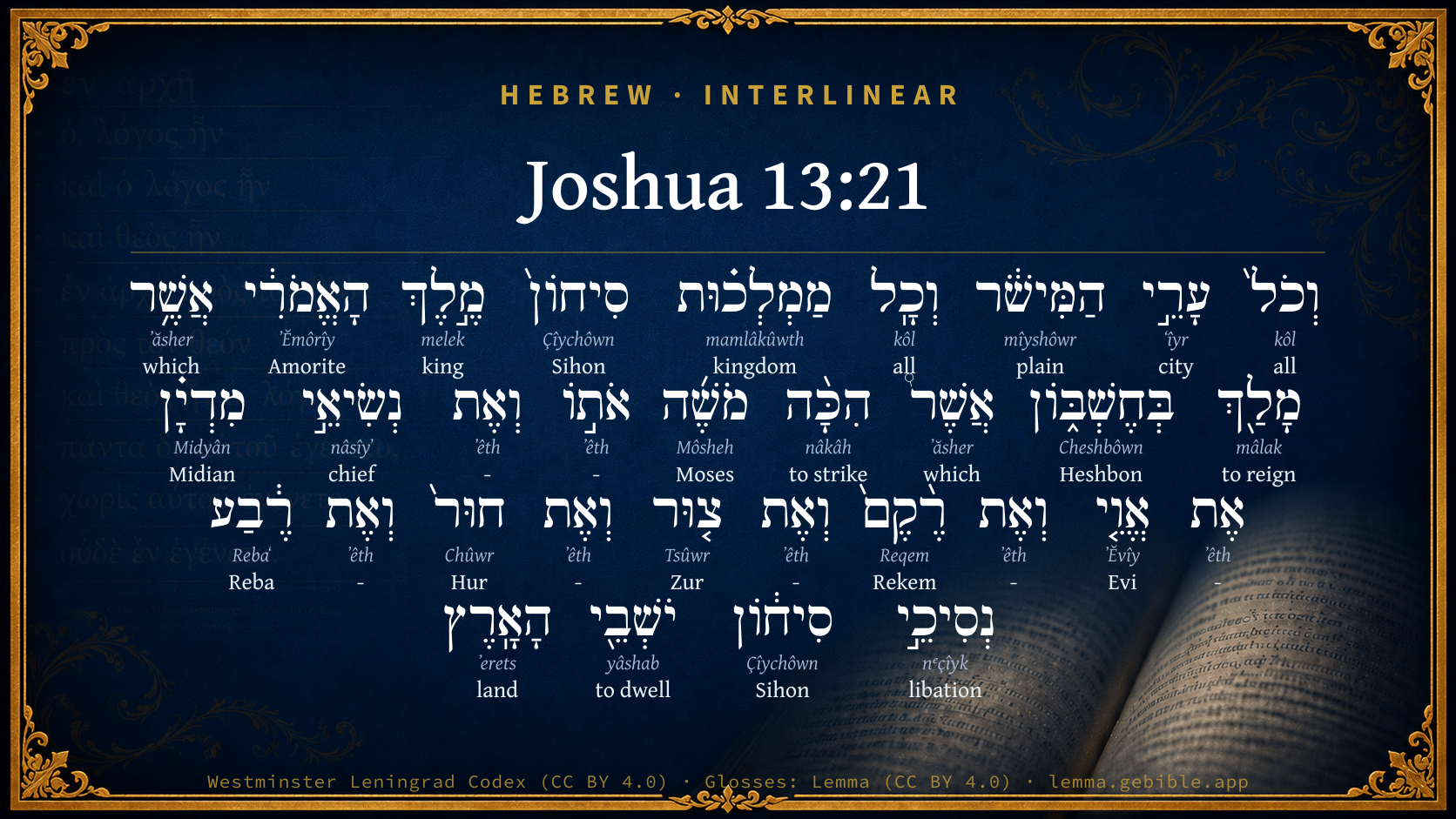
Joshua 13:21

Hebrew (Westminster Leningrad Codex) Joshua 13:21 appears in the Hebrew Old Testament. The text above is from the Westminster Leningrad Codex. Each word links to its Strong’s number, a concise gloss, and parsing drawn from the Open Scriptures Hebrew Bible morphology. Click any word for its full Brown-Driver-Briggs (BDB) entry.
Download image
Cite this verse

Joshua 13:21 (World English Bible). Public Domain. Lemma interlinear Bible study tool, https://lemma.gebible.app/v/joshua/13/21.

Show BibTeX & RIS
BibTeX
RIS
English Translation
and all the cities of the plain, and all the kingdom of Sihon king of the Amorites, who reigned in Heshbon, whom Moses struck with the chiefs of Midian, Evi, and Rekem, and Zur, and Hur, and Reba, the princes of Sihon, who lived in the land.
World English Bible · Public Domain
Download a study sheet

One document with this verse’s original text, its word-by-word gloss line, the meaning frame, cross-references with their text, attributed commentary, and full source and license credits — printable, and it pastes into notes with its structure intact.

This verse Autodidact and up

Study sheet (.html) Plain text (.txt)

A passage Seminary Student

Up to 50 verses in one chapter. A passage sheet keeps up to 6 commentary sources and 12 cross-references per verse, in the order this page ranks them, and says so on the sheet whenever that leaves anything out. Ask for a single verse and you get the Autodidact verse sheet above.

Everything on this page stays free to read, with no account — the sheet is a download of what is already on screen, not access to it.

Want to remove ads? Support Godless Engineer
Compare translations 3

The same verse in 3 English versions, stacked beneath the original-language interlinear above. Click any original word for its lexicon entry.

Each is an independent rendering of the whole verse — the interlinear is not word-aligned to these translations.

Highlighted words mark where these versions differ — a whole-verse word diff, not a word-by-word alignment.

  • World English Bible Public Domain
    and all the cities of the plain, and all the kingdom of Sihon king of the Amorites, who reigned in Heshbon, whom Moses struck with the chiefs of Midian, Evi, and Rekem, and Zur, and Hur, and Reba, the princes of Sihon, who lived in the land.
  • King James Version Public Domain
    And all the cities of the plain, and all the kingdom of Sihon king of the Amorites, which reigned in Heshbon, whom Moses smote with the princes of Midian, Evi, and Rekem, and Zur, and Hur, and Reba, which were dukes of Sihon, dwelling in the country.
  • unfoldingWord Literal Text CC BY-SA 4.0
    and all of the cities of the plateau, and all of the kingdom of Sihon, the king of the Amorite, who had reigned in Heshbon, whom Moses struck, him and the leaders of Midian: Evi and Rekem and Zur and Hur and Reba, the princes of Sihon, the dwellers of the land.

unfoldingWord Literal Text — © unfoldingWord, licensed CC BY-SA 4.0. Word-aligned USFM3 via Door43 (git.door43.org/unfoldingWord/en_ult).

Versions to compare (up to 4)

3 of 4 selected

Show all 18 translations

Every available English version of this verse, each an independent rendering of the whole verse.

  • World English Bible Public Domain
    and all the cities of the plain, and all the kingdom of Sihon king of the Amorites, who reigned in Heshbon, whom Moses struck with the chiefs of Midian, Evi, and Rekem, and Zur, and Hur, and Reba, the princes of Sihon, who lived in the land.
  • Berean Standard Bible Public Domain
    all the cities of the plateau and all the kingdom of Sihon king of the Amorites, who reigned in Heshbon until Moses killed him and the chiefs of Midian (Evi, Rekem, Zur, Hur, and Reba), the princes of Sihon who lived in the land.
  • Majority Standard Bible Public Domain
    all the cities of the plateau and all the kingdom of Sihon king of the Amorites, who reigned in Heshbon until Moses killed him and the chiefs of Midian (Evi, Rekem, Zur, Hur, and Reba), the princes of Sihon who lived in the land.
  • King James Version Public Domain
    And all the cities of the plain, and all the kingdom of Sihon king of the Amorites, which reigned in Heshbon, whom Moses smote with the princes of Midian, Evi, and Rekem, and Zur, and Hur, and Reba, which were dukes of Sihon, dwelling in the country.
  • American Standard Version (1901) Public Domain
    and all the cities of the plain, and all the kingdom of Sihon king of the Amorites, who reigned in Heshbon, whom Moses smote with the chiefs of Midian, Evi, and Rekem, and Zur, and Hur, and Reba, the princes of Sihon, that dwelt in the land.
  • Revised Version (1885) Public Domain
    and all the cities of the plain, and all the kingdom of Sihon king of the Amorites, which reigned in Heshbon, whom Moses smote with the chiefs of Midian, Evi, and Rekem, and Zur, and Hur, and Reba, the princes of Sihon, that dwelt in the land.
  • Geneva Bible (1599) Public Domain
    And all the cities of the plaine: and all the kingdome of Sihon King of the Amorites, which reigned in Heshbon, whome Moses smote with the Princes of Midian, Eui, and Rekem, and Zur, and Hur, and Reba, the dukes of Sihon, dwelling in the countrey.
  • Douay-Rheims (1899) Public Domain
    And all the cities of the plain, and all the kingdoms of Sehon king of the Amorrhites, that reigned in Hesebon, whom Moses slew with the princes of Madian: Hevi, and Recem, and Sur and Hur, and Rebe, dukes of Sehon inhabitants of the land.
  • Young's Literal Translation Public Domain
    and all the cities of the plain, and all the kingdom of Sihon king of the Amorite, who reigned in Heshbon, whom Moses smote, with the princes of Midian, Evi, and Rekem, and Zur, and Hur, and Reba, princes of Sihon, inhabitants of the land.
  • Literal Standard Version CC BY-SA 4.0
    and all the cities of the plain, and all the kingdom of Sihon king of the Amorite, who reigned in Heshbon, whom Moses struck, with the princes of Midian, Evi, and Rekem, and Zur, and Hur, and Reba, princes of Sihon, inhabitants of the land.
  • Unlocked Literal Bible CC BY-SA 4.0
    all the cities of the plateau, and all the kingdom of Sihon king of the Amorites, who had reigned in Heshbon, whom Moses had defeated together with the leaders of Midian, Evi, Rekem, Zur, Hur and Reba, the princes of Sihon, who had lived in the land.
  • unfoldingWord Literal Text CC BY-SA 4.0
    and all of the cities of the plateau, and all of the kingdom of Sihon, the king of the Amorite, who had reigned in Heshbon, whom Moses struck, him and the leaders of Midian: Evi and Rekem and Zur and Hur and Reba, the princes of Sihon, the dwellers of the land.
  • Darby Bible Public Domain
    all the cities of the plateau, and the whole kingdom of Sihon the king of the Amorites, who reigned at Heshbon, whom Moses smote, him and the princes of Midian, Evi, and Rekem, and Zur, and Hur, and Reba, the chiefs of Sihon dwelling in the land.
  • World Messianic Bible Public Domain
    all the cities of the plain, and all the kingdom of Sihon king of the Amorites, who reigned in Heshbon, whom Moses struck with the chiefs of Midian, Evi, Rekem, Zur, Hur, and Reba, the princes of Sihon, who lived in the land.
  • Webster's Bible Public Domain
    And all the cities of the plain, and all the kingdom of Sihon king of the Amorites, who reigned in Heshbon, whom Moses smote with the princes of Midian, Evi, and Rekem, and Zur, and Hur, and Reba, dukes of Sihon, dwelling in the country.
  • Free Bible Version CC BY-SA 4.0
    all the towns of the plateau and all the kingdom of Sihon, the Amorite king, who ruled in Heshbon. He was defeated by Moses, as well as the Midianite leaders Evi, Rekem, Zur, Hur, and Reba, princes who lived in the kingdom and who were allied to Sihon.
  • Bible in Basic English Public Domain
    And all the towns of the table-land, and all the kingdom of Sihon, king of the Amorites, who was ruling in Heshbon, whom Moses overcame, together with the chiefs of Midian, Evi, and Rekem, and Zur, and Hur, and Reba, the chiefs of Sihon, who were living in the land.
  • JPS Tanakh (1917) Public Domain
    and all the cities of the table-land, and all the kingdom of Sihon king of the Amorites, who reigned in Heshbon, whom Moses smote with the chiefs of Midian, Evi, and Rekem, and Zur, and Hur, and Reba, the princes of Sihon, that dwelt in the land.

Literal Standard Version (2020), Covenant Press — licensed CC BY-SA 4.0. Text via the HelloAO Bible API (eBible.org). Unlocked Literal Bible (unfoldingWord) — licensed CC BY-SA 4.0. Text via the HelloAO Bible API (eBible.org). unfoldingWord Literal Text — © unfoldingWord, licensed CC BY-SA 4.0. Word-aligned USFM3 via Door43 (git.door43.org/unfoldingWord/en_ult). Free Bible Version, Dr. Jonathan Gallagher — licensed CC BY-SA 4.0. Text via the HelloAO Bible API (eBible.org).

Word by word

More ways to search: Search by grammar → Find every occurrence → Compare this word →

Practice this passage: Drill this verse → Learn its vocabulary →

אֱוִ֤י
ʼĔvîy
H189
“Evi”
Noun, Proper
Part of Speech
Noun
Type
Proper
Full BDB Definition

Origin: probably from H183

TWOT: None

Evi = "my desire" - one of five chiefs of Midian
  1. וְכֹל֙ kôl H3605 “and · all of” Conjunction + Noun, Common, Masculine, Singular, Construct
  2. עָרֵ֣י ʻîyr H5892 “cities of” Noun, Common, Feminine, Plural, Construct
  3. הַמִּישֹׁ֔ר mîyshôwr H4334 “the · plain” Particle, Definite Article + Noun, Common, Masculine, Singular, Absolute
  4. וְכָֽל kôl H3605 “and · all of” Conjunction + Noun, Common, Masculine, Singular, Construct
  5. מַמְלְכ֗וּת mamlâkûwth H4468 “kingdom of” Noun, Common, Feminine, Singular, Construct
  6. סִיחוֹן֙ Çîychôwn H5511 “Sihon” Noun, Proper
  7. מֶ֣לֶךְ melek H4428 “king of” Noun, Common, Masculine, Singular, Construct
  8. הָאֱמֹרִ֔י ʼĔmôrîy H567 “the · Amorite” Particle, Definite Article + Noun, Gentilic, Masculine, Singular, Absolute
  9. אֲשֶׁ֥ר ʼăsher H834 “which” Particle, Relative
  10. מָלַ֖ךְ mâlak H4427 “to reign” Verb, Qal, Perfect, 3rd Person, Masculine, Singular
  11. בְּחֶשְׁבּ֑וֹן Cheshbôwn H2809 “in/at · Heshbon” Preposition + Noun, Proper
  12. אֲשֶׁר֩ ʼăsher H834 “which” Particle, Relative
  13. הִכָּ֨ה nâkâh H5221 “to strike” Verb, Hiphil, Perfect, 3rd Person, Masculine, Singular
  14. מֹשֶׁ֜ה Môsheh H4872 “Moses” Noun, Proper
  15. אֹת֣וֹ ʼêth H853 “- · him” Particle, Direct Object + Suffix, Personal, 3rd Person, Masculine, Singular
  16. וְאֶת ʼêth H853 “and · -” Conjunction + Particle, Direct Object
  17. נְשִׂיאֵ֣י nâsîyʼ H5387 “chiefs of” Noun, Common, Masculine, Plural, Construct
  18. מִדְיָ֗ן Midyân H4080 “Midian” Noun, Proper
  19. אֶת ʼêth H853 “-” Particle, Direct Object
  20. וְאֶת ʼêth H853 “and · -” Conjunction + Particle, Direct Object
  21. רֶ֨קֶם֙ Reqem H7552 “Rekem” Noun, Proper
  22. וְאֶת ʼêth H853 “and · -” Conjunction + Particle, Direct Object
  23. צ֤וּר Tsûwr H6698 “Zur” Noun, Proper
  24. וְאֶת ʼêth H853 “and · -” Conjunction + Particle, Direct Object
  25. חוּר֙ Chûwr H2354 “Hur” Noun, Proper
  26. וְאֶת ʼêth H853 “and · -” Conjunction + Particle, Direct Object
  27. רֶ֔בַע Rebaʻ H7254 “Reba” Noun, Proper
  28. נְסִיכֵ֣י nᵉçîyk H5257 “princes of” Noun, Common, Masculine, Plural, Construct
  29. סִיח֔וֹן Çîychôwn H5511 “Sihon” Noun, Proper
  30. יֹשְׁבֵ֖י yâshab H3427 “dwelling” Verb, Qal, Participle Active, Masculine, Plural, Construct
  31. הָאָֽרֶץ ʼerets H776 “the · land” Particle, Definite Article + Noun, Common, Both, Singular, Absolute

About this verse

These counts appear in no published source. They are computed here, from the morphology-tagged text and Lemma’s own curated glosses. What Lemma adds →

32
words
23
distinct lemmas
Historical
section

Notable vocabulary

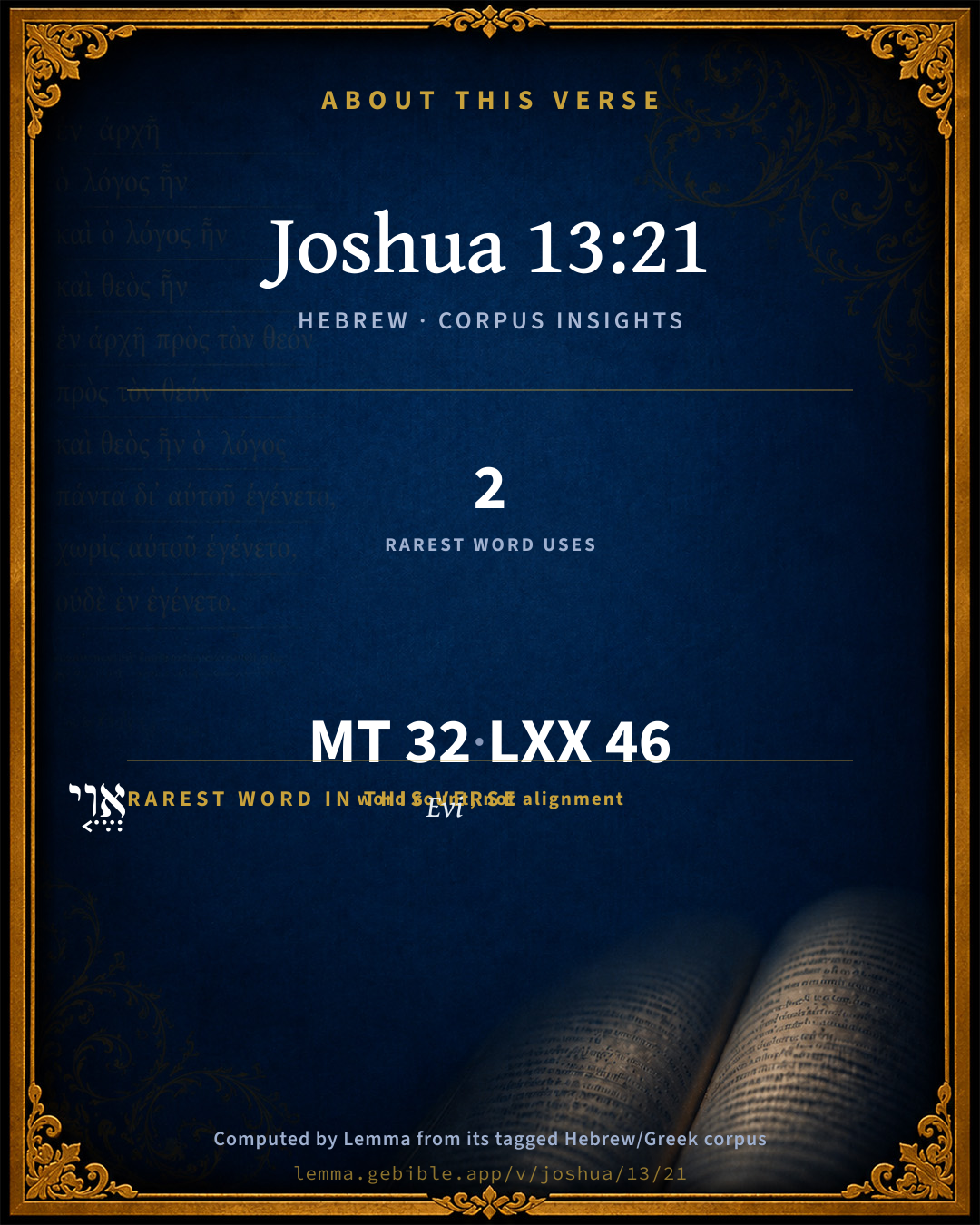
The rarest word here is אֱוִ֤י Evi H189 — appearing just 2 times in the whole Hebrew Bible.

Shared distinctive vocabulary

אֱוִ֤י Evi H189 occurs in 2 verses of the Hebrew Bible. Also found in:

Grammatical profile

  • 3 verbs
  • 20 nouns
  • 9 particles

Verb forms

  • מָלַ֖ךְ Qal · Perfect
  • הִכָּ֨ה Hiphil · Perfect
  • יֹשְׁבֵ֖י Qal · Participle Active

Repetition

Words recur within this verse — often emphatic in Hebrew:

  • וְכֹל֙ all H3605 ×2
  • סִיחוֹן֙ Sihon H5511 ×2
  • אֲשֶׁ֥ר which H834 ×2

Hebrew & Septuagint length

In English translation the verse runs 47 words from the Hebrew and 47 from the Septuagint (LXX English) — the same length.

A rough comparison of the two English renderings, which tokenize alike — not a word-level alignment.

Word counts can differ between the Hebrew and the Greek without any difference in meaning — e.g. the Hebrew direct-object marker אֵת has no separate Greek word, and Greek often adds the article ὁ.

In the original languages it is 32 Hebrew tokens and 46 Greek tokens — but the two are counted differently (Hebrew bundles its prefixes and suffixes into one token; the Greek is in lemma form), so that isn’t a like-for-like length.

Cross-references

4

Topical passages linked to Joshua 13:21 in the Treasury of Scripture Knowledge — connected by theme and wording, ordered by reader-vote popularity; previews shown in the World English Bible.

  • Numbers 31:8 They killed the kings of Midian with the rest of their slain: Evi, and Rekem, and Zur, and Hur, and Reba, the five kings of Midian: Balaam also the son of Beor they killed with the sword.
  • Deuteronomy 3:10 all the cities of the plain, and all Gilead, and all Bashan, to Salecah and Edrei, cities of the kingdom of Og in Bashan.
  • Numbers 21:24–35 Israel struck him with the edge of the sword, and possessed his land from the Arnon to the Jabbok, even to the children of Ammon; for the border of the children of Ammon was strong.
  • Deuteronomy 2:30–36 But Sihon king of Heshbon would not let us pass by him; for Yahweh your God hardened his spirit, and made his heart obstinate, that he might deliver him into your hand, as at this day.

Cross-references courtesy of OpenBible.info (CC BY 4.0).

Hebrew and Greek witnesses Masoretic Hebrew ↔ Greek Septuagint

The same verse in the two great witnesses to the Old Testament, shown verse-for-verse.

These are two independent witnesses, not word-aligned to each other, and the Septuagint is shown in lemma (dictionary) form.

Hebrew Joshua 13:21 Masoretic · Westminster Leningrad Codex

וְכֹל֙ עָרֵ֣י הַמִּישֹׁ֔ר וְכָֽל מַמְלְכ֗וּת סִיחוֹן֙ מֶ֣לֶךְ הָאֱמֹרִ֔י אֲשֶׁ֥ר מָלַ֖ךְ בְּחֶשְׁבּ֑וֹן אֲשֶׁר֩ הִכָּ֨ה מֹשֶׁ֜ה אֹת֣וֹ וְאֶת נְשִׂיאֵ֣י מִדְיָ֗ן אֶת אֱוִ֤י וְאֶת רֶ֨קֶם֙ וְאֶת צ֤וּר וְאֶת חוּר֙ וְאֶת רֶ֔בַע נְסִיכֵ֣י סִיח֔וֹן יֹשְׁבֵ֖י הָאָֽרֶץ

and all the cities of the plain, and all the kingdom of Sihon king of the Amorites, who reigned in Heshbon, whom Moses struck with the chiefs of Midian, Evi, and Rekem, and Zur, and Hur, and Reba, the princes of Sihon, who lived in the land.

World English Bible · Public Domain

Greek LXX Joshua 13:21 Septuagint · lemma form

καί πᾶς ὁ πόλις ὁ μισωρ καί πᾶς ὁ βασιλεία ὁ σηων βασιλεύς ὁ ἀμορραῖος ὅς πατάσσω μωυσῆς αὐτός καί ὁ ἡγέομαι μαδιαμ καί ὁ ευι καί ὁ ροκομ καί ὁ σουρ καί ὁ ουρ καί ὁ ροβε ἄρχων παρά σηων καί ὁ καταοἰκέω ὁ γῆ

and all the cities of Misor, and all the kingdom of Seon king of the Amorites, whom Moses struck, even him and the princes of Madian, and Evi, and Roboc, and Sur, and Ur, and Robe prince of the spoils of Sion, and the inhabitants of Sion.

LXX2012 (modern English Septuagint) · Public Domain

Hebrew: Westminster Leningrad Codex (CC BY 4.0). Greek: Septuagint (public domain); English from LXX2012 (modern English Septuagint) (Public Domain). How the Septuagint differs from the Hebrew →

Targum (Aramaic paraphrase)

1

The Targum is the ancient Jewish Aramaic paraphrase of the Hebrew Scriptures — an interpretive translation, not the Hebrew text itself. Onkelos (literal) and Pseudo-Jonathan (expansive) render the Torah, and Jonathan the Prophets. Coverage is partial: where no permissively-licensed English translation exists for a verse, only the Aramaic is shown. This is verse-level text, not a word-by-word alignment to the Hebrew.

  1. Targum Jonathan Prophets (Joshua–Malachi)
    וְכָל קִרְוֵי מֵישְׁרָא וְכָל מַלְכְּוַת סִיחוֹן מַלְכָּא דֶאֱמוֹרָאָה דִמְלַךְ בְּחֶשְׁבּוֹן דִמְחָא מֹשֶׁה יָתֵיהּ וְיַת רַבְרְבֵי מִדְיָן יַת אֱוִי וְיַת רֶקֶם וְיַת צוּר וְיַת חוּר וְיַת רֶבַע רַבְרְבֵי סִיחוֹן יַתְבֵי אַרְעָא:

    (no public-domain English translation for this verse)

    Targum Jonathan — Aramaic: “Mikraot Gedolot” (public domain). English: “Sefaria Community Translation” (CC0 1.0 (public-domain dedication)); “London "Chaldee Paraphrase," 1871” (public domain). Text via Sefaria.

Commentary

Notes on Joshua 13:21 from classic Christian and Jewish commentators (each source and its license shown beneath its notes). The classic Christian expositions comment on the surrounding passage and are grouped to its opening verse, so a note may address several verses; the Jewish commentaries on the Tanakh (Rashi and others) are per-verse, so they appear only where the commentator wrote on this verse.

Lemma curates 59 commentaries, every one of them public domain or Creative Commons licensed, each selected and text-cleaned for this edition rather than reprinted as found. About our sources →

Trapp's Complete Commentary

John Trapp

Jos 13:21 And all the cities of the plain, and all the kingdom of Sihon king of the Amorites, which reigned in Heshbon, whom Moses smote with the princes of Midian, Evi, and Rekem, and Zur, and Hur, and Reba, [which were] dukes of Sihon, dwelling in the country.

Ver. 21. Dukes of Sihon.] His vassals; and after his death they made themselves kings, but were shortly after slain by the sword of Israel. {Num 31:8}

John Trapp, A Commentary or Exposition upon All the Books of the Old and New Testament (1647–1656) — public domain. Text from a community e-Sword module.

Joseph Benson's Commentary

Jos 13:21. Cities of the plain — Opposed to the cities of the mountain or the valley. All the kingdom of Sihon — A great part of it; in which sense we read of all Judea, and all the region round about Jordan, Mat 3:5; and all Galilee, Mat 4:23. Whom Moses smote — Not in the same time or battle, as appears by comparing Num 21:23-24, with Num 31:8, but in the same manner. Dukes of Sihon — But how could they be so, when they were kings of Midian? Num 31:8. There were divers petty kings in those parts, who were subject to other kings, and such these were, but are here called dukes or princes of Sihon, because they were subject and tributaries to him, and therefore did one way or other assist Sihon in this war, though they were not killed at this time.

Joseph Benson's Commentary on the Old and New Testaments (1811–1818) — public domain. Text from a community e-Sword module.

Tyndale Open Study Notes

Tyndale Open Resources

13:21 The leaders of Midian were apparently kings (Num 31:8) or sheiks of small city-states south of Sihon’s kingdom. The nomadic Midianites depended mostly on sheep and goats for their livelihood.

Tyndale Open Study Notes — © Tyndale Open Resources, licensed CC BY-SA 4.0. Text via the HelloAO Bible API.

Adam Clarke's Commentary

Verse 21. The princes of Midian] See the history of this war, Nu 31:1, c. and from that place this and the following verse seem to be borrowed, for the introduction of the death of Balaam here seems quite irrelevant.

Adam Clarke's Commentary on the Bible (1810–1826) — public domain. Text from a community e-Sword/MySword module.

Ellicott's Commentary for English Readers

(21) The princes of Midian . . . which were dukes of Sinon, dwelling in the country.—

The conquest of the Midianites is recorded in Numbers 31. The orders given were, “Avenge the Lord of Midian” (Jos_13:3); “avenge the children of Israel of the Midianites” (Jos_13:2), because they tempted Israel to idolatry and uncleanness. But this verse in Joshua supplies us with a further reason for hostilities between Midian and Israel. The Midianites were “dukes of Sihon,” and a part of his government. Through them he appears to have exercised his dominion over the conquered territory which he had taken from Moab. This land Israel had now, in turn, taken from him. But in order to its complete subjugation, the removal of Sihon’s dukes, the princes or kings of Midian, was also necessary. This was brought about in the manner described in Numbers 22-25, , 31. The relation between Midian and Moab which is implied, but not explained in Numbers, is explained by the apparently casual remark in this place. It is another example of undesigned agreement between Joshua and the Pentateuch. Of the same kind is the allusion to Balaam, as (Jos_13:22) the soothsayer, or diviner. In Numbers we do not read of anything but prophecy and counsel as coming from Balaam’s lips; but it is abundantly evident, from hints scattered through the story, that he was a sooth-sayer, or diviner, as well as a prophet. The elders of Moab and Midian went to him with the reward of divination in their hands (Num_22:7); “Neither is there any divination against Israel” (Num_23:23) the word in each of these places is radically connected with the epithet applied to Balaam here. (Comp. Num_24:1 : “He went not, as at other times, to seek for enchantments”—where a different word is employed.) He is thus shown to have been an unscrupulous man, who, if he could not obtain the knowledge that he desired from above, would not hesitate to seek it from below, that he might secure his base gain.

A Bible Commentary for English Readers, edited by Charles John Ellicott (1878–1897) — public domain. Text from a community e-Sword module.

The Cambridge Bible for Schools and Colleges

gen. ed. J. J. S. Perowne

21. all the cities] = “all the other cities of the table-land, and all the kingdom of Sihon, as far as it extended over the plain.”

with the princes of Midian] They are also mentioned, and in the same order, in Num_31:8.

which were dukes of Sihon] “dukys of Sion,” Wyclif, from the Vulgate “duces” = vassals of Sihon, and princes. “The word stands only in the plural, and is always used, as would seem, of native, although dependent and subjugated, princes, and not of installed, ordinary officials.” Gesenius. From the appellation here used, “vassals of Sihon,” we may clearly infer that that king, who had taken from the Moabites the greatest part of their territory, had also made them tributary. From this subjection they were delivered by the defeat of Sihon, and then fearing that they would receive from the Israelites the same treatment as the Amorites, they immediately conspired to destroy the Israelites, and thus brought destruction upon themselves. See Keil.

The Cambridge Bible for Schools and Colleges (gen. ed. J. J. S. Perowne; Cambridge University Press, 1878–1918) — public domain. Text from a community e-Sword module.

John Gill's Exposition

Balaam also, the son of Beor the soothsayer, did the children of Israel slay with the sword,.... At the same time that the princes of Midian were slain, and which is also observed; see Gill on Num 31:8. Kimchi supposes that he returned to Midian, on hearing that the counsel he gave to them, to ensnare Israel with their daughters, had taken effect, in order to receive his wages, and so received his righteous doom and just reward; it is commonly said by the Jews (m), that he was slain by Phinehas:

among them that were slain by them; among the above princes, and the common soldiers, of which there was a great slaughter; even all the males of Midian were slain, Num 31:7.

(m) T. Bab. Sanhedrin, fol. 106. 2. Kimchi in loc.

John Gill's Exposition of the Whole Bible (1746–1763) — public domain (CC PDM 1.0). Text via the HelloAO Bible API.

Haydock's Catholic Bible Commentary

The princes of Madian. It appears from hence that these were subjects of king Sehon: they are said to have been slain with him, that is, about the same time, but not in the same battle. (Challoner) --- After the death of their sovereign, they looked upon themselves as independent. They had reigned before as viceroys of Sehon, being natives of the country, and not come from some other part, like the Amorrhites. (Calmet)

George Leo Haydock (1774–1849), Haydock's Catholic Family Bible and Commentary, 1859 edition — public domain. Excludes Psalms (Douay-Rheims chapter numbering differs from Protestant) and Deuterocanonical books (Catholic canon only).

Matthew Poole's English Annotations

The cities of the plain; opposed to the foregoing cities of the mountain of the valley.

All the kingdom of Sihon; a synecdochical expression, for a great part of it; in which sense we read of all Judea, and all the region round about Jordan, Mat 3:5, and all Galilee, Mat 4:23, and many others. Or, which all were the kingdoms of Sihon, i.e. belonged to his kingdom. The Hebrew conjunction and is oft put for the relative particle which, as Jdg 2:21; Pro 19:1; Ecc 6:12.

With the princes of Midian; not in the same time or battle, as appears by comparing Num 21:23,24, with Num 31:8, but in the same manner. And they are here mentioned, partly because they were slain not long after, and upon the same occasion, even their enmity against Israel; and partly because of their relation and subjection to Sihon, as it here follows.

Dukes of Sihon.

Quest. How could they be so, when they were kings of Midian? Num 31:8.

Answ. There were divers petty kings in those parts, which were subject to greater kings; and such these were, but are here called dukes or princes of Sihon, because they were subject and tributaries to him, and therefore did one way or other assist Sihon in this war, though they were not killed at this time. It is probable, that when Sihon destroyed those Moabites which dwelt in these parts, he frighted the rest of them, and with them their neighbours and confederates the Midianites, into some kind of homage or tribute, which they were willing to pay to him.

Dwelling in, the country, Heb. inhabiting that land, namely,

Midian, last mentioned; whereby he signifies, that though they were subject to Sihon, yet they did not dwell in his land, but in another.

Matthew Poole's English Annotations on the Holy Bible (1683–1685) — public domain. Text from a community e-Sword/MySword module.

Whedon's Commentary on the Bible

Daniel D. Whedon

21. All the cities of the plain — That is, all the other mirror cities of the southern plain which had not been particularly described.

All the kingdom of Sihon — These words must not be taken as the entire extent of the territory belonging to Sihon, but must be qualified by the statement of Jos_13:27, that the northern part of his kingdom, which extended even to the Sea of Chinnereth, was allotted to Gad. The words are therefore to be understood of the southern part of his territory, which, lying south of Mount Gilead, and including by far the larger part of the kingdom, with its capital and most important cities, might easily have been called all the kingdom.

Dukes of Sihon — For their defeat by Moses see Num_31:1-12. These dukes were sheiks of the neighbouring towns, tributary to and dependent upon Sihon.

Daniel D. Whedon (gen. ed.), Commentary on the Old and New Testaments (1874–1909) — public domain. Text from a community e-Sword module.

The Pulpit Commentary

Cities of the plain. "Mishor" once more. See above, ver. 9, not as in Genesis 19, where the word is Ciccar. These, therefore, were not Sodom and its neighbours, but cities of the Amorites. Such touches as this, which display the minute acquaintance of our author with his subject, are almost of a necessity lost in a translation. But where our version has "plain," the original has Mishor when the uplands of Gilead and Bashan are meant, Arabah when the writer is speaking of the Wadys in the neighbourhood of the Dead Sea, Shephelah when he refers to the lowlands of Western palestine, bordering on the Mediterranean, Bik"ah when he speaks of the great valley of Coele Syria, Ciccar when he speaks of the territory due north of Jordan. With the princes of Midian. The word here used, aycin signifies exalted persons, persons of rank, as we should say. It would seem to imply rather civil functions than the more absolute authority which the word rc also rendered "prince" in Hebrew, carries with it. With this passage compare Num_31:8. The Hebrew has no "with," so that the difficulty some have found in the passage need not have arisen. It is nowhere said that Moses smote the "princes of Midian" together with Sihon. All that is stated is that they, as well as Sihon, were smitten, as the history in Numbers tells us they were. Dukes of Sihon. According to Gesenius, Rosenmiiller, and others, the word here translated "dukes" is derived from to pour out, means "anointed." See Psa_4:6, where it is translated "set." But Keil rejects this interpretation, and says that the word never signifies to anoint. It is always used, he says, of foreign princes. But he has overlooked Mic_5:4 (Hebrews). See Knobel, who explains it of drink offerings, and regards these "dukes" as men pledged by a solemn treaty to be Sihon"s allies, though not vassals. Kimchi thinks that Sihon, before his reverses at the hand of Israel, had held some authority in Midian, and these were his prefects, or under-kings. The term is applied to Zebah and Zalmunna in Psa_83:12 (in the Hebrew).

The fate of Balaam.

I WHEN SPIRITUAL GIFTS ARE USED FOR UNSPIRITUAL PURPOSES THEY LOSE THEIR SPIRITUAL VALUE. In the Book of Numbers Balaam appears as a prophet inspired by God. In the Book of Joshua he is only named as a common soothsayer. All spiritual gifts, of insight, of power, of sympathy, are worthy only so long as they are well used. As they become degraded by evil uses they lose their Divine character and become mere talents of cleverness and ability.

II THE ABUSE OF SPIRITUAL GIFTS FOR PERSONAL GAIN IS A SIN WHICH CANNOT GO UNPUNISHED. Balaam had sold his prophetic powers for money, consenting to use them on the side of evil and falsehood. Now his sin has found him out. He who receives great gifts incurs great responsibility. No spiritual power is bestowed for merely selfish uses. The greater the talents we abuse, the greater will be the judgment we shall invoke.

III THE POSSESSION OF SPIRITUAL GIFTS IS NO GROUND FOR THE ASSURANCE OF PERSONAL SALVATION. Balaam had great gifts, yet he suffered the fate of the heathen. Our privileges are no proof of a Divine favour which will overlook our sins. Salvation comes not from the gifts of the Spirit, but from the grace of God in Christ. The least gifted has as good ground for salvation as the most highly endowed. Pulpit power, the "gift of prayer," theological insight, and religious susceptibilities may all be found in a Christless life, and if so they will be of no avail as grounds of merit in the day of judgment.

IV THE KNOWLEDGE OF THE TRUTH ONLY INCREASES THE GUILT OF THOSE WHO WILL NOT FOLLOW IT. Balaam knew the true God and the way of right. But not living according to his knowledge, his guilt was aggravated, and his doom certain. It is worse than useless to know Christian truth unless we obey it. (Jam_1:22-24) The faith in Christ which secures to us salvation is net the bare intellectual belief in the doctrines of redemption, (Jam_2:19) but submissive trust and loyal obedience to Christ as both Lord and Saviour. W.F.A. (Mar_2:14)

The Pulpit Commentary (1880–1919), ed. H.D.M. Spence-Jones & Joseph S. Exell — public domain. Text from a community e-Sword module.

John Wesley's Explanatory Notes

Cities of the plain - Opposed to the cities of the mountain of the valley. All the kingdom of Sihon - A great part of it; in which sense we read of all Judea, and all the region round about Jordan, Matt. iii, 5, and all Galilee, Matt. iv, 23. Whom Moses smote - Not in the same time or battle, as appears by comparing Num. xxi, 23, 24, with Num. xxxi, 8, but in the same manner. And they are here mentioned, partly because they were slain not long after, and upon the same occasion, even their enmity against Israel; and partly because of their relation and subjection to Sihon. Dukes of Sihon - But how could they be so, when they were kings of Midian? Num. xxxi, 8. There were divers petty kings in those parts, who were subject to greater kings; and such these were, but are here called dukes or princes of Sihon, because they were subject and tributaries to him, and therefore did one way or other assist Sihon in this war, though they were not killed at this time. It is probable, that when Sihon destroyed those Moabites which dwelt in these parts, he frighted the rest of them, and with them their neighbours and confederates, the Midianites, into some kind of homage, which they were willing to pay him. Dwelling in the country - Hebrew. inhabiting that land, namely Midian, last mentioned; whereby he signifies, that tho' they were subject to Sihon, yet they did not dwell in his land, but in another.

John Wesley, Explanatory Notes Upon the Whole Bible (1754–1765) — public domain. Text via the GEBible commentary corpus.

Lesson kit

Teaching starters — assembled from the data on this page, not authored interpretation. Every prompt links to the verse data it draws on. Edit before teaching.

Joshua, in the Historical, opens this verse with 32 words (23 distinct Hebrew lemmas). Its most distinctive word is ʼĔvîy (“Evi”). A historical commentator’s framing appears above. Read the whole chapter for the surrounding context.

Discussion questions

  1. What does “Evi” (ʼĔvîy) contribute to the verse as a whole?
  2. How does Numbers 31:8, which shares the word «Evi», read alongside this verse?
  3. What does the repetition of “all” (2× in this one verse) do in this verse?
  4. The translations on this page render this verse differently — a whole-verse word diff, not a word-by-word alignment. What might account for the different wordings?
  5. «מָלַ֖ךְ» is a Qal Perfect verb. How does that grammatical form shape the action described?
  6. Compare how Trapp's Complete Commentary and Joseph Benson's Commentary read this verse. Where do they agree or differ?

Things to notice

Reading settings

Reading text

Shown beneath each verse's original-language words.

Old Testament
Old Testament edition

Read the OT as the Masoretic Hebrew (MT) or the Greek Septuagint (LXX).

English shown for the Greek Septuagint (in the Hebrew ↔ Greek comparison).

Comparing translations? Open the Compare panel on any verse page to stack up to four side by side.