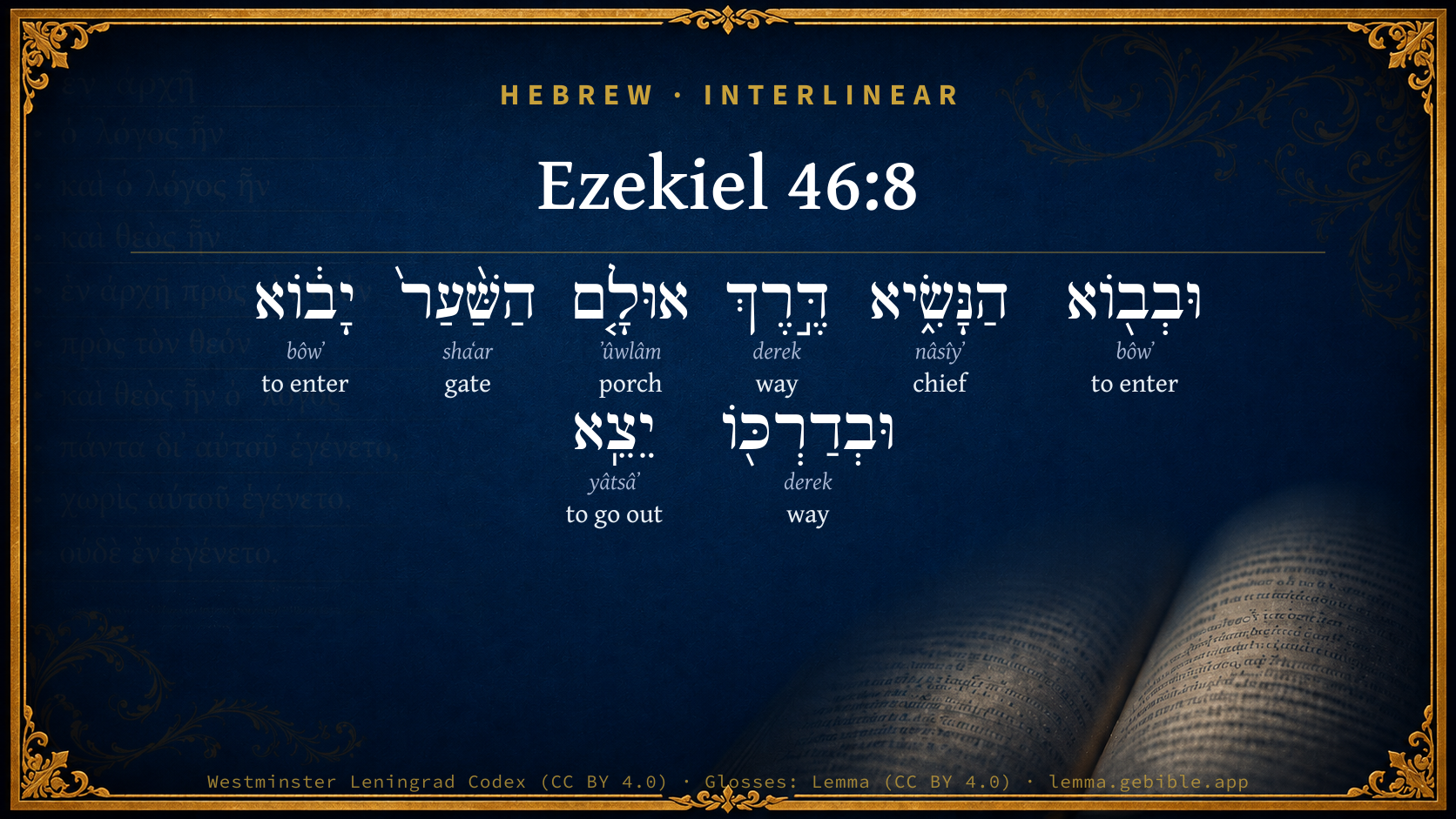
Ezekiel 46:8

Hebrew (Westminster Leningrad Codex) Ezekiel 46:8 appears in the Hebrew Old Testament. The text above is from the Westminster Leningrad Codex. Each word links to its Strong’s number, a concise gloss, and parsing drawn from the Open Scriptures Hebrew Bible morphology. Click any word for its full Brown-Driver-Briggs (BDB) entry.
Download image
Cite this verse

Ezekiel 46:8 (World English Bible). Public Domain. Lemma interlinear Bible study tool, https://lemma.gebible.app/v/ezekiel/46/8.

Show BibTeX & RIS
BibTeX
RIS
English Translation
When the prince shall enter, he shall go in by the way of the porch of the gate, and he shall go forth by the way of it.
World English Bible · Public Domain
Download a study sheet

One document with this verse’s original text, its word-by-word gloss line, the meaning frame, cross-references with their text, attributed commentary, and full source and license credits — printable, and it pastes into notes with its structure intact.

This verse Autodidact and up

Study sheet (.html) Plain text (.txt)

A passage Seminary Student

Up to 50 verses in one chapter. A passage sheet keeps up to 6 commentary sources and 12 cross-references per verse, in the order this page ranks them, and says so on the sheet whenever that leaves anything out. Ask for a single verse and you get the Autodidact verse sheet above.

Everything on this page stays free to read, with no account — the sheet is a download of what is already on screen, not access to it.

Want to remove ads? Support Godless Engineer
Compare translations 3

The same verse in 3 English versions, stacked beneath the original-language interlinear above. Click any original word for its lexicon entry.

Each is an independent rendering of the whole verse — the interlinear is not word-aligned to these translations.

Highlighted words mark where these versions differ — a whole-verse word diff, not a word-by-word alignment.

  • World English Bible Public Domain
    When the prince shall enter, he shall go in by the way of the porch of the gate, and he shall go forth by the way of it.
  • King James Version Public Domain
    And when the prince shall enter, he shall go in by the way of the porch of that gate, and he shall go forth by the way thereof.
  • unfoldingWord Literal Text CC BY-SA 4.0
    When the prince enters by the way of the gate and its portico, he must leave by the same way.

unfoldingWord Literal Text — © unfoldingWord, licensed CC BY-SA 4.0. Word-aligned USFM3 via Door43 (git.door43.org/unfoldingWord/en_ult).

Versions to compare (up to 4)

3 of 4 selected

Show all 18 translations

Every available English version of this verse, each an independent rendering of the whole verse.

  • World English Bible Public Domain
    When the prince shall enter, he shall go in by the way of the porch of the gate, and he shall go forth by the way of it.
  • Berean Standard Bible Public Domain
    When the prince enters, he shall go in through the portico of the gateway, and he shall go out the same way.
  • Majority Standard Bible Public Domain
    When the prince enters, he shall go in through the portico of the gateway, and he shall go out the same way.
  • King James Version Public Domain
    And when the prince shall enter, he shall go in by the way of the porch of that gate, and he shall go forth by the way thereof.
  • American Standard Version (1901) Public Domain
    And when the prince shall enter, he shall go in by the way of the porch of the gate, and he shall go forth by the way thereof.
  • Revised Version (1885) Public Domain
    And when the prince shall enter, he shall go in by the way of the porch of the gate, and he shall go forth by the way thereof.
  • Geneva Bible (1599) Public Domain
    And when the prince shall enter, hee shall goe in by the way of the porche of that gate, and hee shall go foorth by the way thereof.
  • Douay-Rheims (1899) Public Domain
    And when the prince is to go in, let him go in by the way of the porch of the gate, and let him go out the same way.
  • Young's Literal Translation Public Domain
    `And in the coming in of the prince, the way of the porch of the gate he cometh in, and by its way he goeth out.
  • Literal Standard Version CC BY-SA 4.0
    And in the coming in of the prince, he comes in the way of the porch of the gate, and by its way he goes out.
  • Unlocked Literal Bible CC BY-SA 4.0
    When the prince enters by the way of the gate and its portico, he must leave by the same way.
  • unfoldingWord Literal Text CC BY-SA 4.0
    When the prince enters by the way of the gate and its portico, he must leave by the same way.
  • Darby Bible Public Domain
    And when the prince cometh in, he shall come in by the way of the porch of the gate, and he shall go out by the way thereof.
  • World Messianic Bible Public Domain
    When the prince enters, he shall go in by the way of the porch of the gate, and he shall go out by its way.
  • Webster's Bible Public Domain
    And when the prince shall enter, he shall go in by the way of the porch of that gate, and he shall go forth by the way of it.
  • Free Bible Version CC BY-SA 4.0
    When the prince enters, he is to come in through the gateway porch, and leave the same way.
  • Bible in Basic English Public Domain
    And when the ruler comes in, he is to go in through the covered way of the doorway, and he is to go out by the same way.
  • JPS Tanakh (1917) Public Domain
    And when the prince shall enter, he shall go in by the way of the porch of the gate, and he shall go forth by the way thereof.

Literal Standard Version (2020), Covenant Press — licensed CC BY-SA 4.0. Text via the HelloAO Bible API (eBible.org). Unlocked Literal Bible (unfoldingWord) — licensed CC BY-SA 4.0. Text via the HelloAO Bible API (eBible.org). unfoldingWord Literal Text — © unfoldingWord, licensed CC BY-SA 4.0. Word-aligned USFM3 via Door43 (git.door43.org/unfoldingWord/en_ult). Free Bible Version, Dr. Jonathan Gallagher — licensed CC BY-SA 4.0. Text via the HelloAO Bible API (eBible.org).

Word by word

More ways to search: Search by grammar → Find every occurrence → Compare this word →

Practice this passage: Drill this verse → Learn its vocabulary →

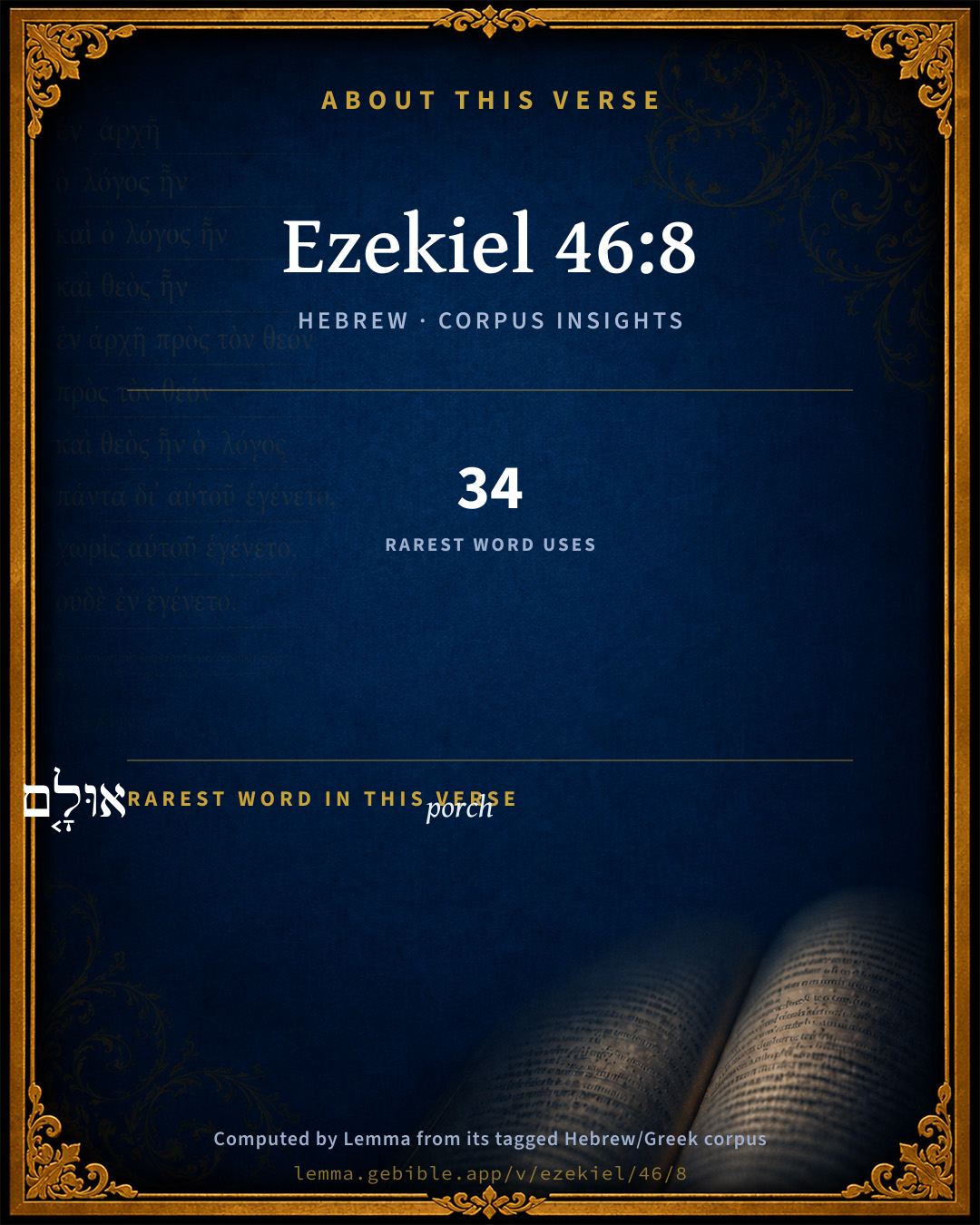
About this verse

These counts appear in no published source. They are computed here, from the morphology-tagged text and Lemma’s own curated glosses. What Lemma adds →

8
words
6
distinct lemmas
Prophets
section

Shared distinctive vocabulary

אוּלָ֤ם porch H197 occurs in 29 verses of the Hebrew Bible. Also found in:

Grammatical profile

  • 3 verbs
  • 5 nouns

Verb forms

  • וּבְב֖וֹא Qal · Infinitive Construct
  • יָב֔וֹא Qal · Imperfect
  • יֵצֵֽא Qal · Imperfect

Repetition

Words recur within this verse — often emphatic in Hebrew:

  • וּבְב֖וֹא to enter H935 ×2
  • דֶּ֣רֶךְ way H1870 ×2

Hebrew & Septuagint length

In English translation the verse runs 28 words from the Hebrew and 30 from the Septuagint (LXX English) — closely comparable.

A rough comparison of the two English renderings, which tokenize alike — not a word-level alignment.

Word counts can differ between the Hebrew and the Greek without any difference in meaning — e.g. the Hebrew direct-object marker אֵת has no separate Greek word, and Greek often adds the article ὁ.

Cross-references

3

Topical passages linked to Ezekiel 46:8 in the Treasury of Scripture Knowledge — connected by theme and wording, ordered by reader-vote popularity; previews shown in the World English Bible.

  • Ezekiel 46:2 The prince shall enter by the way of the porch of the gate outside, and shall stand by the post of the gate; and the priests shall prepare his burnt-offering and his peace-offerings, and he shall worship at the threshold of the gate: then he shall go forth; but the gate shall not be shut until the evening.
  • Ezekiel 44:1–3 Then he brought me back by the way of the outer gate of the sanctuary, which looks toward the east; and it was shut.
  • Colossians 1:18 He is the head of the body, the assembly, who is the beginning, the firstborn from the dead; that in all things he might have the preeminence.

Cross-references courtesy of OpenBible.info (CC BY 4.0).

Hebrew and Greek witnesses Masoretic Hebrew ↔ Greek Septuagint

The same verse in the two great witnesses to the Old Testament, shown verse-for-verse.

These are two independent witnesses, not word-aligned to each other, and the Septuagint is shown in lemma (dictionary) form.

Hebrew Ezekiel 46:8 Masoretic · Westminster Leningrad Codex

וּבְב֖וֹא הַנָּשִׂ֑יא דֶּ֣רֶךְ אוּלָ֤ם הַשַּׁ֨עַר֙ יָב֔וֹא וּבְדַרְכּ֖וֹ יֵצֵֽא

When the prince shall enter, he shall go in by the way of the porch of the gate, and he shall go forth by the way of it.

World English Bible · Public Domain

Greek LXX Ezekiel 46:8 Septuagint · lemma form

καί ἐν ὁ εἰςπορεύομαι ὁ ἀποἡγέομαι κατά ὁ ὁδός ὁ αιλαμ ὁ πύλη εἰςἔρχομαι καί κατά ὁ ὁδός ὁ πύλη ἐκἔρχομαι

And when the prince goes in, he shall go in by the way of the porch of the gate, and he shall go forth by the way of the gate.

LXX2012 (modern English Septuagint) · Public Domain

Hebrew: Westminster Leningrad Codex (CC BY 4.0). Greek: Septuagint (public domain); English from LXX2012 (modern English Septuagint) (Public Domain). How the Septuagint differs from the Hebrew →

Targum (Aramaic paraphrase)

1

The Targum is the ancient Jewish Aramaic paraphrase of the Hebrew Scriptures — an interpretive translation, not the Hebrew text itself. Onkelos (literal) and Pseudo-Jonathan (expansive) render the Torah, and Jonathan the Prophets. Coverage is partial: where no permissively-licensed English translation exists for a verse, only the Aramaic is shown. This is verse-level text, not a word-by-word alignment to the Hebrew.

  1. Targum Jonathan Prophets (Joshua–Malachi)
    וּבְמֵיעַל רַבָּא בְּאוֹרַח אוּלַמָא דְתַרְעָא יֵעוֹל וּבְאוֹרְחֵיהּ יִפּוֹק:

    (no public-domain English translation for this verse)

    Targum Jonathan — Aramaic: “Mikraot Gedolot” (public domain). English: “Sefaria Community Translation” (CC0 1.0 (public-domain dedication)); “London "Chaldee Paraphrase," 1871” (public domain). Text via Sefaria.

Commentary

Notes on Ezekiel 46:8 from classic Christian and Jewish commentators (each source and its license shown beneath its notes). The classic Christian expositions comment on the surrounding passage and are grouped to its opening verse, so a note may address several verses; the Jewish commentaries on the Tanakh (Rashi and others) are per-verse, so they appear only where the commentator wrote on this verse.

Lemma curates 59 commentaries, every one of them public domain or Creative Commons licensed, each selected and text-cleaned for this edition rather than reprinted as found. About our sources →

Trapp's Complete Commentary

John Trapp

Eze 46:8 And when the prince shall enter, he shall go in by the way of the porch of [that] gate, and he shall go forth by the way thereof.

Ver. 8. He shall go in by the way of the porch.] This was the prince’s privilege, that, as likewise the priests, he might go in and go out at the same east gate. It is fit that the word and sword should hold together, and that magistrates and ministers should be singular in holiness.

John Trapp, A Commentary or Exposition upon All the Books of the Old and New Testament (1647–1656) — public domain. Text from a community e-Sword module.

Joseph Benson's Commentary

Eze 46:8-10. He shall go in by the porch of that gate — To go in at the eastern gate was the privilege of the prince and the priests only; the people were to enter in by the north or south gates, as is mentioned in the following verse. He that entereth in by the way of the north gate, shall go out by the way of the south, &c. — These words imply the reason why the people were not to come in at the east gate, because, there being no passage or thoroughfare out of the temple westward, if they had entered in at the east gate, they must have returned back the same way they came in, which would have occasioned a vast throng and hinderance, considering the multitude that came to the temple. And perhaps this order was also designed to take away any superstitious distinction between the several gates of the temple, by commanding that every one should go out the opposite way to that by which he came in, whether it were toward the north or south. And the prince in the midst of them — The prince shall pay the same attendance upon God’s worship with the people, since all men are equal in the sight of God.

Joseph Benson's Commentary on the Old and New Testaments (1811–1818) — public domain. Text from a community e-Sword module.

Whedon's Commentary on the Bible

Daniel D. Whedon

8-10. Even the way by which the prince and people shall enter and depart from the sacrificial gateway has a religious significance the full import of which we cannot now catch. (See note Eze_46:4-7.) To suppose that this regulation was merely to avoid a throng is to go contrary to the analogy of similar regulations in all other ancient rituals. The ordinary text (Eze_46:10) seems to declare that the prince and people should enter and leave the place of sacrifice at the same time — which would compel the prince to meet the entire throng as he attempted to leave by the same gate at which he had entered the temple (Eze_46:8). Perhaps the Syriac is correct in reading, as quoted by Davidson, “But the prince in their midst, by the gate at which he came in shall he go out.” The fact of the inner gate being left open after the prince had completed his acts of worship (Eze_46:2) would suggest the probability that other worshipers (“the people”) were to pass by the sacred doorway and look upon the sacrifices after the prince had left the temple. It seems improbable that the prince and the people should have been put upon such an equality as the A.V. would indicate, and especially improbable that the prince should have been compelled by the law to beat against the crowd when he attempted to leave the sacred place (Eze_46:8; Eze_46:10, A.V.).

Daniel D. Whedon (gen. ed.), Commentary on the Old and New Testaments (1874–1909) — public domain. Text from a community e-Sword module.

The Cambridge Bible for Schools and Colleges

gen. ed. J. J. S. Perowne

8, 9. The gates by which prince and people shall come in and go out. The prince shall come in by way of the porch of the gate, and shall go out the same way, i.e. probably the porch of the inner east gate, and he shall go back as he entered, without passing into the inner court. The people shall not go out by the gate at which they came in, but by the opposite gate—those entering by the N. gate shall leave by the S. and conversely.

the solemn feasts] appointed seasons.

The Cambridge Bible for Schools and Colleges (gen. ed. J. J. S. Perowne; Cambridge University Press, 1878–1918) — public domain. Text from a community e-Sword module.

John Gill's Exposition

But when the people of the land shall come before the Lord in the solemn feasts,.... To worship the Lord, to pray and praise; to honour the Lord, and keep the solemn feast of love, the Lord's supper:

he that entereth in by the way of the north gate to worship shall go out by the way of the south gate; and he that entereth in by the way of the south gate shall go forth by the way of the north gate; that so such as were coming in, and going out, might not meet, and stop and hinder one another in going out and coming in: no mention is made of entering in by the east gate, which was only for the prince, Eze 44:1, and there was no entering in, or going out, on the west:

he shall not return by the way of the gate he came in, but shall go forth over against it; signifying, that those that come to the house of God to worship, and join in communion with the saints, should not return to their former ways and practices; to their former rites, customs, and ceremonies in religion, used by them; and to their former principles and errors in doctrines; and to their former sinful courses of life; but go straight on and thorough stitch with it in their profession of Christ and his Gospel, and in the practice of spiritual and evangelic worship; see Luk 9:62.

John Gill's Exposition of the Whole Bible (1746–1763) — public domain (CC PDM 1.0). Text via the HelloAO Bible API.

Albert Barnes' Notes on the Bible

That gate - The eastern gate of the inner court. See Eze 46:2.

Albert Barnes' Notes on the Bible (1834–1885) — public domain. Text from a community e-Sword/MySword module.

Matthew Poole's English Annotations

Shall enter into the gate of the court next the temple to offer his sacrifice.

Go in by the way of the porch; go to the threshold, the inward threshold of the east gate, that opens into the court of the temple.

Go forth by the way thereof; none of the people might do so, only the prince and the priests might go out the same way they came in.

Matthew Poole's English Annotations on the Holy Bible (1683–1685) — public domain. Text from a community e-Sword/MySword module.

The Pulpit Commentary

Verse 8 begins an ordinance relative to the mode of conducting worship at the appointed festivals (ver. 9; comp. Eze_36:38 Eze_45:17; Lev_23:2; Hos_12:9) by indicating first how the prince should enter and depart from the temple. According to Kliefoth and Keil, the prince"s entrance and departure should be by the way of the porch of the outer, according to Hengstenberg, Smend, and Currey, of the inner, east gate (see on ver. 2).

The Pulpit Commentary (1880–1919), ed. H.D.M. Spence-Jones & Joseph S. Exell — public domain. Text from a community e-Sword module.

Rashi

Rabbi Shlomo Yitzchaki (Rashi)

And whenever the prince goes in on the New Moon and on the Sabbath of Creation, when Israel is not commanded to appear at the Temple, and he comes in to prostrate himself.

he shall go in by way of the vestibule of the gate, and by the same way shall he go out Through the very same gate he shall go out, and he is not commanded to make the Court a short-cut. But on the festivals, concerning which it is stated (Deut. 16:16): “shall all your males appear,” he is required to make it a short-cut like the rest of the people. That is what is written (verse 10): “goes in among them when they go in, and when they go out, they [the prince and people together] go out.”

Rashi on the Tanakh — English translations: “The Judaica Press complete Tanach with Rashi, translated by A. J. Rosenberg” (CC BY 4.0); “Pentateuch with Rashi's commentary by M. Rosenbaum and A.M. Silbermann, 1929-1934” (public domain); “The Metsudah Tanach series, Lakewood, N.J” (CC BY 4.0); and “The Book of Joshua, Metsudah Publications, 1997” (CC BY 4.0). Text via Sefaria.

Lesson kit

Teaching starters — assembled from the data on this page, not authored interpretation. Every prompt links to the verse data it draws on. Edit before teaching.

Ezekiel, in the Prophets, opens this verse with 8 words (6 distinct Hebrew lemmas). Its most distinctive word is ʼûwlâm (“porch”). A historical commentator’s framing appears above. Read the whole chapter for the surrounding context.

Discussion questions

  1. The word ʼûwlâm carries the sense “porch.” How does it shape the verse?
  2. How does 1 Kings 6:3, which shares the word «porch», read alongside this verse?
  3. What does the repetition of “to enter” (2× in this one verse) do in this verse?
  4. These translations render this verse differently; the difference is in the English rendering, not the original. What questions does that raise?
  5. «וּבְב֖וֹא» is a Qal Infinitive Construct verb. How does that grammatical form shape the action described?
  6. Compare how Trapp's Complete Commentary and Joseph Benson's Commentary read this verse. Where do they agree or differ?

Things to notice

Reading settings

Reading text

Shown beneath each verse's original-language words.

Old Testament
Old Testament edition

Read the OT as the Masoretic Hebrew (MT) or the Greek Septuagint (LXX).

English shown for the Greek Septuagint (in the Hebrew ↔ Greek comparison).

Comparing translations? Open the Compare panel on any verse page to stack up to four side by side.