
Joshua 9:18

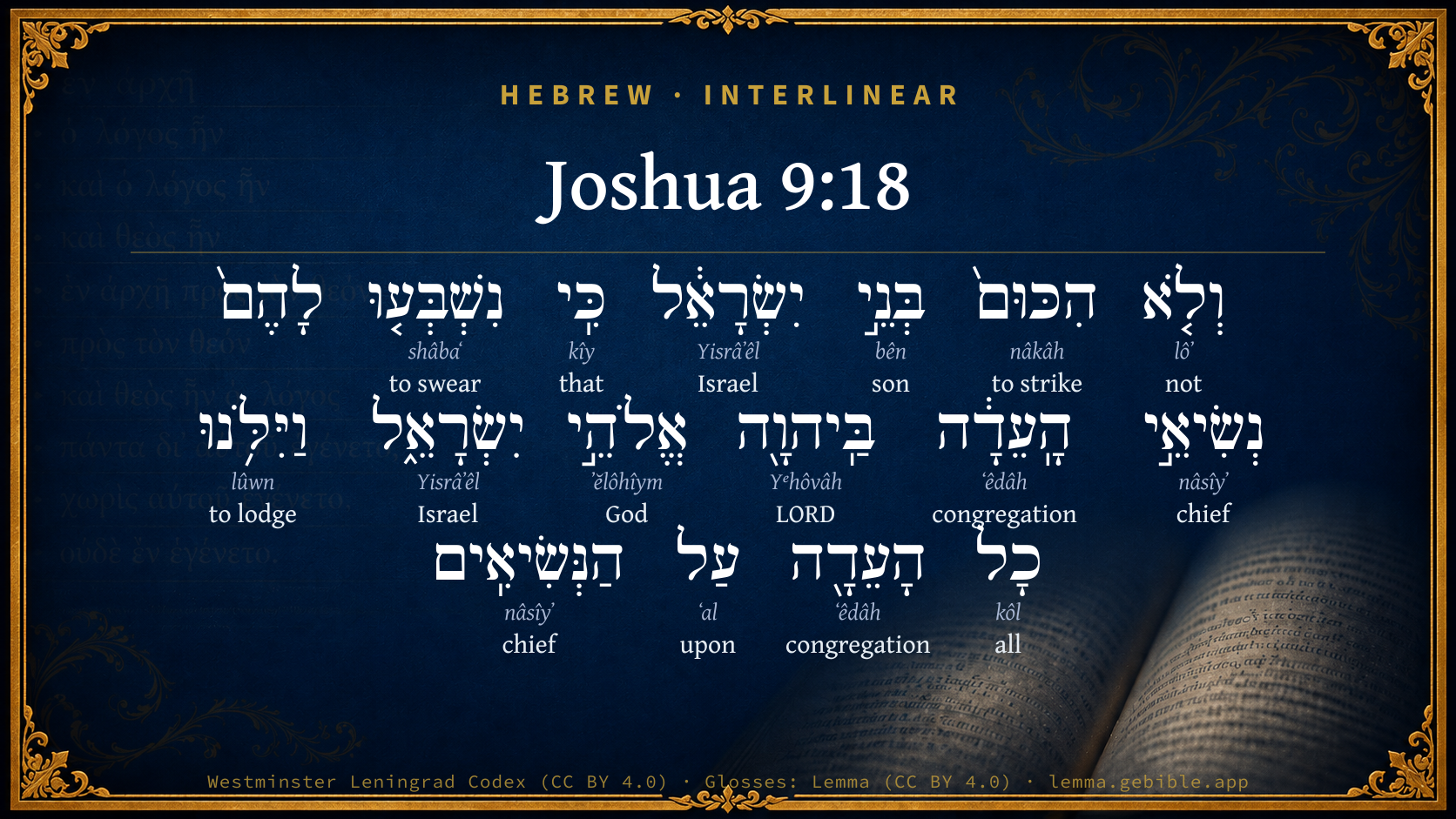
Hebrew (Westminster Leningrad Codex) Joshua 9:18 appears in the Hebrew Old Testament. The text above is from the Westminster Leningrad Codex. Each word links to its Strong’s number, a concise gloss, and parsing drawn from the Open Scriptures Hebrew Bible morphology. Click any word for its full Brown-Driver-Briggs (BDB) entry.
Download image
Cite this verse

Joshua 9:18 (World English Bible). Public Domain. Lemma interlinear Bible study tool, https://lemma.gebible.app/v/joshua/9/18.

Show BibTeX & RIS
BibTeX
RIS
English Translation
The children of Israel didn't strike them, because the princes of the congregation had sworn to them by Yahweh, the God of Israel. All the congregation murmured against the princes.
World English Bible · Public Domain
Download a study sheet

One document with this verse’s original text, its word-by-word gloss line, the meaning frame, cross-references with their text, attributed commentary, and full source and license credits — printable, and it pastes into notes with its structure intact.

This verse Autodidact and up

Study sheet (.html) Plain text (.txt)

A passage Seminary Student

Up to 50 verses in one chapter. A passage sheet keeps up to 6 commentary sources and 12 cross-references per verse, in the order this page ranks them, and says so on the sheet whenever that leaves anything out. Ask for a single verse and you get the Autodidact verse sheet above.

Everything on this page stays free to read, with no account — the sheet is a download of what is already on screen, not access to it.

Want to remove ads? Support Godless Engineer
Compare translations 3

The same verse in 3 English versions, stacked beneath the original-language interlinear above. Click any original word for its lexicon entry.

Each is an independent rendering of the whole verse — the interlinear is not word-aligned to these translations.

Highlighted words mark where these versions differ — a whole-verse word diff, not a word-by-word alignment.

  • World English Bible Public Domain
    The children of Israel didn't strike them, because the princes of the congregation had sworn to them by Yahweh, the God of Israel. All the congregation murmured against the princes.
  • King James Version Public Domain
    And the children of Israel smote them not, because the princes of the congregation had sworn unto them by the LORD God of Israel. And all the congregation murmured against the princes.
  • unfoldingWord Literal Text CC BY-SA 4.0
    And the sons of Israel did not strike them, because the leaders of the congregation had sworn to them by Yahweh, the God of Israel. And all of the congregation murmured against the leaders.

unfoldingWord Literal Text — © unfoldingWord, licensed CC BY-SA 4.0. Word-aligned USFM3 via Door43 (git.door43.org/unfoldingWord/en_ult).

Versions to compare (up to 4)

3 of 4 selected

Show all 18 translations

Every available English version of this verse, each an independent rendering of the whole verse.

  • World English Bible Public Domain
    The children of Israel didn't strike them, because the princes of the congregation had sworn to them by Yahweh, the God of Israel. All the congregation murmured against the princes.
  • Berean Standard Bible Public Domain
    But the Israelites did not attack them, because the leaders of the congregation had sworn an oath to them by the LORD, the God of Israel. And the whole congregation grumbled against the leaders.
  • Majority Standard Bible Public Domain
    But the Israelites did not attack them, because the leaders of the congregation had sworn an oath to them by the LORD, the God of Israel. And the whole congregation grumbled against the leaders.
  • King James Version Public Domain
    And the children of Israel smote them not, because the princes of the congregation had sworn unto them by the LORD God of Israel. And all the congregation murmured against the princes.
  • American Standard Version (1901) Public Domain
    And the children of Israel smote them not, because the princes of the congregation had sworn unto them by Jehovah, the God of Israel. And all the congregation murmured against the princes.
  • Revised Version (1885) Public Domain
    And the children of Israel smote them not, because the princes of the congregation had sworn unto them by the LORD, the God of Israel. And all the congregation murmured against the princes.
  • Geneva Bible (1599) Public Domain
    And the children of Israel slewe them not, because the Princes of the Congregation had sworne vnto them by the Lord God of Israel: wherefore all the Congregation murmured against the Princes.
  • Douay-Rheims (1899) Public Domain
    And they slew them not, because the princes of the multitude had sworn in the name of the Lord the God of Israel. Then all the common people murmured against the princes.
  • Young's Literal Translation Public Domain
    and the sons of Israel have not smitten them, for sworn to them have the princes of the company by Jehovah God of Israel, and all the company murmur against the princes.
  • Literal Standard Version CC BY-SA 4.0
    and the sons of Israel have not struck them, for the princes of the congregation have sworn to them by YHWH, God of Israel, and all the congregation murmur against the princes.
  • Unlocked Literal Bible CC BY-SA 4.0
    The people of Israel did not attack them because their leaders had taken an oath about them before Yahweh, the God of Israel. All the Israelites were grumbling against their leaders.
  • unfoldingWord Literal Text CC BY-SA 4.0
    And the sons of Israel did not strike them, because the leaders of the congregation had sworn to them by Yahweh, the God of Israel. And all of the congregation murmured against the leaders.
  • Darby Bible Public Domain
    And the children of Israel did not smite them, because the princes of the assembly had sworn unto them by Jehovah the God of Israel. Then all the assembly murmured against the princes.
  • World Messianic Bible Public Domain
    The children of Israel didn’t strike them, because the princes of the congregation had sworn to them by the LORD, the God of Israel. All the congregation murmured against the princes.
  • Webster's Bible Public Domain
    And the children of Israel smote them not, because the princes of the congregation had sworn to them by the LORD God of Israel. And all the congregation murmured against the princes.
  • Free Bible Version CC BY-SA 4.0
    But the Israelites did not attack them because of the treaty sworn by the leaders of the assembly in the name of the Lord, the God of Israel. At this all the Israelites protested against the leaders.
  • Bible in Basic English Public Domain
    And the children of Israel did not put them to death, because the chiefs of the people had taken an oath to them by the Lord, the God of Israel. And all the people made an outcry against the chiefs.
  • JPS Tanakh (1917) Public Domain
    And the children of Israel smote them not, because the princes of the congregation had sworn unto them by the LORD, the God of Israel. And all the congregation murmured against the princes.

Literal Standard Version (2020), Covenant Press — licensed CC BY-SA 4.0. Text via the HelloAO Bible API (eBible.org). Unlocked Literal Bible (unfoldingWord) — licensed CC BY-SA 4.0. Text via the HelloAO Bible API (eBible.org). unfoldingWord Literal Text — © unfoldingWord, licensed CC BY-SA 4.0. Word-aligned USFM3 via Door43 (git.door43.org/unfoldingWord/en_ult). Free Bible Version, Dr. Jonathan Gallagher — licensed CC BY-SA 4.0. Text via the HelloAO Bible API (eBible.org).

Word by word

More ways to search: Search by grammar → Find every occurrence → Compare this word →

Practice this passage: Drill this verse → Learn its vocabulary →

וַיִּלֹּ֥נוּ
lûwn
H3885
“and · to lodge”
Conjunction + Verb, Niphal, Sequential Imperfect, 3rd Person, Masculine, Plural
Part of Speech
Conjunction + Verb
Stem
Niphal
Form
Sequential Imperfect
Person
3rd Person
Gender
Masculine
Number
Plural
Full BDB Definition

Origin: a primitive root

TWOT: 1096 , 1097

to lodge, stop over, pass the night, abide - (Qal) - to lodge, pass the night - to abide, remain (figuratively) - (Hiphil) to cause to rest or lodge - (Hithpalpel) to dwell, abide - to grumble, complain, murmur - (Niphal) to grumble - (Hiphil) to complain, cause to grumble
  1. וְלֹ֤א lôʼ H3808 “and · not” Conjunction + Particle, Negative
  2. הִכּוּם֙ nâkâh H5221 “to strike · them” Verb, Hiphil, Perfect, 3rd Person, Common, Plural + Suffix, Personal, 3rd Person, Masculine, Plural
  3. בְּנֵ֣י bên H1121 “sons of” Noun, Common, Masculine, Plural, Construct
  4. יִשְׂרָאֵ֔ל Yisrâʼêl H3478 “Israel” Noun, Proper
  5. כִּֽי kîy H3588 “that” Conjunction
  6. נִשְׁבְּע֤וּ shâbaʻ H7650 “to swear” Verb, Niphal, Perfect, 3rd Person, Common, Plural
  7. נְשִׂיאֵ֣י nâsîyʼ H5387 “chiefs of” Noun, Common, Masculine, Plural, Construct
  8. הָֽעֵדָ֔ה ʻêdâh H5712 “the · congregation” Particle, Definite Article + Noun, Common, Feminine, Singular, Absolute
  9. בַּֽיהוָ֖ה Yᵉhôvâh H3068 “in/at · LORD” Preposition + Noun, Proper
  10. אֱלֹהֵ֣י ʼĕlôhîym H430 “God(s) of” Noun, Common, Masculine, Plural, Construct
  11. יִשְׂרָאֵ֑ל Yisrâʼêl H3478 “Israel” Noun, Proper
  12. כָל kôl H3605 “all of” Noun, Common, Masculine, Singular, Construct
  13. הָעֵדָ֖ה ʻêdâh H5712 “the · congregation” Particle, Definite Article + Noun, Common, Feminine, Singular, Absolute
  14. עַל ʻal H5921 “upon” Preposition
  15. הַנְּשִׂיאִֽים nâsîyʼ H5387 “the · chiefs” Particle, Definite Article + Noun, Common, Masculine, Plural, Absolute

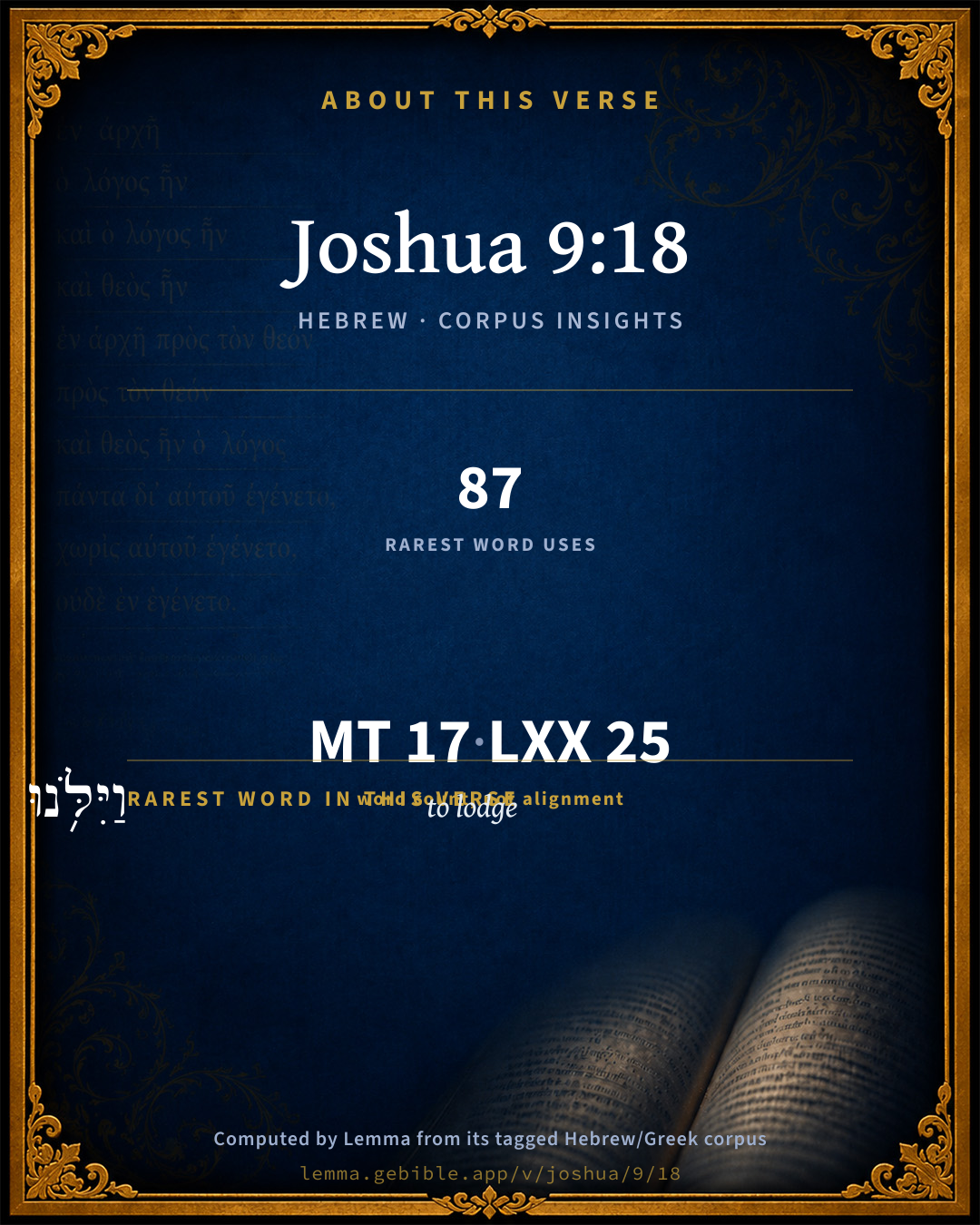
About this verse

These counts appear in no published source. They are computed here, from the morphology-tagged text and Lemma’s own curated glosses. What Lemma adds →

17
words
13
distinct lemmas
Historical
section

Grammatical profile

  • 3 verbs
  • 10 nouns
  • 2 prepositions
  • 1 conjunction
  • 1 particle

Verb forms

  • הִכּוּם֙ Hiphil · Perfect
  • נִשְׁבְּע֤וּ Niphal · Perfect
  • וַיִּלֹּ֥נוּ Niphal · Sequential Imperfect

Repetition

Words recur within this verse — often emphatic in Hebrew:

  • יִשְׂרָאֵ֔ל Israel H3478 ×2
  • נְשִׂיאֵ֣י chief H5387 ×2
  • הָֽעֵדָ֔ה congregation H5712 ×2

Hebrew & Septuagint length

In English translation the verse runs 30 words from the Hebrew and 30 from the Septuagint (LXX English) — the same length.

A rough comparison of the two English renderings, which tokenize alike — not a word-level alignment.

Word counts can differ between the Hebrew and the Greek without any difference in meaning — e.g. the Hebrew direct-object marker אֵת has no separate Greek word, and Greek often adds the article ὁ.

In the original languages it is 17 Hebrew tokens and 25 Greek tokens — but the two are counted differently (Hebrew bundles its prefixes and suffixes into one token; the Greek is in lemma form), so that isn’t a like-for-like length.

Cross-references

5

Topical passages linked to Joshua 9:18 in the Treasury of Scripture Knowledge — connected by theme and wording, ordered by reader-vote popularity; previews shown in the World English Bible.

  • Psalms 15:4 In whose eyes a vile man is despised, But who honors those who fear Yahweh; He who keeps an oath even when it hurts, and doesn't change;
  • 2 Samuel 21:7 But the king spared Mephibosheth, the son of Jonathan the son of Saul, because of Yahweh's oath that was between them, between David and Jonathan the son of Saul.
  • Ecclesiastes 5:2 Don't be rash with your mouth, and don't let your heart be hasty to utter anything before God; for God is in heaven, and you on earth. Therefore let your words be few.
  • Ecclesiastes 5:6 Don't allow your mouth to lead you into sin. Don't protest before the messenger that this was a mistake. Why should God be angry at your voice, and destroy the work of your hands?
  • Ecclesiastes 9:2 All things come alike to all. There is one event to the righteous and to the wicked; to the good, to the clean, to the unclean, to him who sacrifices, and to him who doesn't sacrifice. As is the good, so is the sinner; he who takes an oath, as he who fears an oath.

Cross-references courtesy of OpenBible.info (CC BY 4.0).

Hebrew and Greek witnesses Masoretic Hebrew ↔ Greek Septuagint

The same verse in the two great witnesses to the Old Testament, shown verse-for-verse.

These are two independent witnesses, not word-aligned to each other, and the Septuagint is shown in lemma (dictionary) form.

Hebrew Joshua 9:18 Masoretic · Westminster Leningrad Codex

וְלֹ֤א הִכּוּם֙ בְּנֵ֣י יִשְׂרָאֵ֔ל כִּֽי נִשְׁבְּע֤וּ לָהֶם֙ נְשִׂיאֵ֣י הָֽעֵדָ֔ה בַּֽיהוָ֖ה אֱלֹהֵ֣י יִשְׂרָאֵ֑ל וַיִּלֹּ֥נוּ כָל הָעֵדָ֖ה עַל הַנְּשִׂיאִֽים

The children of Israel didn't strike them, because the princes of the congregation had sworn to them by Yahweh, the God of Israel. All the congregation murmured against the princes.

World English Bible · Public Domain

Greek LXX Joshua 9:18 Septuagint · lemma form

καί οὐ μάχομαι αὐτός ὁ υἱός ἰσραήλ ὅτι ὄμνυμι αὐτός πᾶς ὁ ἄρχων κύριος ὁ θεός ἰσραήλ καί διαγογγύζω πᾶς ὁ συναγωγή ἐπί ὁ ἄρχων

And the children of Israel fought not with them, because all the princes swore to them by the Lord God of Israel; and all the congregation murmured at the princes.

LXX2012 (modern English Septuagint) · Public Domain

Hebrew: Westminster Leningrad Codex (CC BY 4.0). Greek: Septuagint (public domain); English from LXX2012 (modern English Septuagint) (Public Domain). How the Septuagint differs from the Hebrew →

Targum (Aramaic paraphrase)

1

The Targum is the ancient Jewish Aramaic paraphrase of the Hebrew Scriptures — an interpretive translation, not the Hebrew text itself. Onkelos (literal) and Pseudo-Jonathan (expansive) render the Torah, and Jonathan the Prophets. Coverage is partial: where no permissively-licensed English translation exists for a verse, only the Aramaic is shown. This is verse-level text, not a word-by-word alignment to the Hebrew.

  1. Targum Jonathan Prophets (Joshua–Malachi)
    וְלָא מְחוֹנוּן בְּנֵי יִשְׂרָאֵל אֲרֵי קַיְימוּ לְהוֹן רַבְרְבֵי כְנִשְׁתָּא בְּמֵימְרָא דַייָ אֱלָהָא דְיִשְׂרָאֵל וְאִתְרַעֲמוּ כָּל כְּנִשְׁתָּא עַל רַבְרְבַיָא:

    (no public-domain English translation for this verse)

    Targum Jonathan — Aramaic: “Mikraot Gedolot” (public domain). English: “Sefaria Community Translation” (CC0 1.0 (public-domain dedication)); “London "Chaldee Paraphrase," 1871” (public domain). Text via Sefaria.

Commentary

Notes on Joshua 9:18 from classic Christian and Jewish commentators (each source and its license shown beneath its notes). The classic Christian expositions comment on the surrounding passage and are grouped to its opening verse, so a note may address several verses; the Jewish commentaries on the Tanakh (Rashi and others) are per-verse, so they appear only where the commentator wrote on this verse.

Lemma curates 59 commentaries, every one of them public domain or Creative Commons licensed, each selected and text-cleaned for this edition rather than reprinted as found. About our sources →

Trapp's Complete Commentary

John Trapp

Jos 9:18 And the children of Israel smote them not, because the princes of the congregation had sworn unto them by the LORD God of Israel. And all the congregation murmured against the princes.

Ver. 18. Smote them not.] But yet bore them on their backs, as we say, and murmured against the princes who were gulled by the Gibeonites, and the people by that means beguiled of the spoil of those great cities.

Because the princes … had sworn unto them.] ορκος quasi ερκος; an oath is a hedge which must not be lept over for the avoiding of a piece of fouler way. If the Gibeonites had been slain after an oath given for their security, the banks of blasphemy would have been broken down in those heathens that had heard of it.

John Trapp, A Commentary or Exposition upon All the Books of the Old and New Testament (1647–1656) — public domain. Text from a community e-Sword module.

Joseph Benson's Commentary

Jos 9:18. All the congregation murmured against the princes — Both from that proneness which is in people to censure the actions of their rulers, and from the desire of the spoil of these cities.

Joseph Benson's Commentary on the Old and New Testaments (1811–1818) — public domain. Text from a community e-Sword module.

Tyndale Open Study Notes

Tyndale Open Resources

9:18-21 Israel was not entitled to break this treaty even though the Gibeonites deceived the Israelites into making it. Breaking a covenant sworn by an oath in the presence of the Lord would have made light of God’s name and honor (cp. Gen 27:30-38).

Tyndale Open Study Notes — © Tyndale Open Resources, licensed CC BY-SA 4.0. Text via the HelloAO Bible API.

Geneva Bible (1599)

Geneva Bible translators

Fearing lest for their fault the plague of God should have light upon them all.

Geneva Bible (1599) marginal notes — public domain. Text via Bolls.life.

Jamieson, Fausset & Brown

Robert Jamieson, A. R. Fausset & David Brown

the children of Israel smote them not--The moral character of the Gibeonites' stratagem was bad. The princes of the congregation did not vindicate either the expediency or the lawfulness of the connection they had formed; but they felt the solemn obligations of their oath; and, although the popular clamor was loud against them, caused either by disappointment at losing the spoils of Gibeon, or by displeasure at the apparent breach of the divine commandment, they determined to adhere to their pledge, "because they had sworn by the Lord God of Israel." The Israelitish princes acted conscientiously; they felt themselves bound by their solemn promise; but to prevent the disastrous consequences of their imprudent haste, they resolved to degrade the Gibeonites to a servile condition as a means of preventing their people from being ensnared into idolatry, and thus acted up, as they thought, to the true spirit and end of the law.

Jamieson, Fausset & Brown — Commentary Critical and Explanatory on the Whole Bible (1871) — public domain (CC PDM 1.0). Text via the HelloAO Bible API.

Adam Clarke's Commentary

Verse 18. All the congregation murmured] Merely because they were deprived of the spoils of the Gibeonites. They had now got under the full influence of a predatory spirit; God saw their proneness to this, and therefore, at particular times, totally interdicted the spoils of conquered cities, as in the case of Jericho.

Adam Clarke's Commentary on the Bible (1810–1826) — public domain. Text from a community e-Sword/MySword module.

The Cambridge Bible for Schools and Colleges

gen. ed. J. J. S. Perowne

18. had sworn unto them] The remembrance of the league was kept up through the whole course of the subsequent history. A terrible trial befell the nation because Saul had massacred certain of the Gibeonites (2Sa_21:1-2; 1Sa_22:18-19), and David remained faithful to the vow which Joshua had made.

The Cambridge Bible for Schools and Colleges (gen. ed. J. J. S. Perowne; Cambridge University Press, 1878–1918) — public domain. Text from a community e-Sword module.

John Gill's Exposition

And the children of Israel smote them not,.... The inhabitants of the four cities, when they came to them, though they found it to be a true report that was brought them of their being neighbours, and that they were imposed upon by them:

because the princes of the congregation had sworn unto them by the Lord God of Israel; by the Word of the Lord God of Israel, as the Targum, and therefore they restrained the people from smiting and plundering them; for it was not the oath of the princes the people so much regarded, or had such an influence on them as to abstain from seizing on them, but the princes, by reason of their oath, would not suffer them to touch them:

and all the congregation murmured against the princes; not only for taking such an oath, but chiefly because they restrained them from smiting the Gibeonites, and taking their substance for a prey; their eager desire of revenge, and of seizing their goods, and inhabiting their cities, raised a murmur in them against the princes. This is to be understood not of the whole body of the people at Gilgal, but of all that party that was sent to Gibeon, and of the princes that went with them.

John Gill's Exposition of the Whole Bible (1746–1763) — public domain (CC PDM 1.0). Text via the HelloAO Bible API.

Haydock's Catholic Bible Commentary

Israel. This is one reason why their lives were spared. But we have seen that they could not, with justice, have treated them as enemies, on their submitting to the conditions required, even if they had not engaged themselves by oath. The Gabaonites knew with what respect oaths were then kept by the Hebrews, even when they might have some specious pretext for dispensing themselves from their obligation. "People had not yet begun to neglect God, as they do in the present age; nor did they allow themselves the liberty of interpreting an oath, and accommodating the laws to their own humour, but they rather regulated their morals by their prescription." Nondum hæc quæ nunc tenet sæculum, negligentia Dei venerat, &c. (Livy iii.)

George Leo Haydock (1774–1849), Haydock's Catholic Family Bible and Commentary, 1859 edition — public domain. Excludes Psalms (Douay-Rheims chapter numbering differs from Protestant) and Deuterocanonical books (Catholic canon only).

Matthew Poole's English Annotations

Partly, from that proneness which is in people to censure the actions of their rulers; partly, because they might think the princes by their rashness had brought them into a snare, that they could neither kill them for fear of the oath, nor spare them for fear of God’s command to the contrary; and partly, for their desire of the possession and spoil of these cities, of which they thought themselves hereby deprived.

Matthew Poole's English Annotations on the Holy Bible (1683–1685) — public domain. Text from a community e-Sword/MySword module.

Whedon's Commentary on the Bible

Daniel D. Whedon

18. The congregation murmured — This entire land had been promised to them for an inheritance. A part of that long-promised inheritance, to which they had for many years looked forward with hope, was now suddenly snatched from them as they were just entering on its possession. The manner in which this had been done aggravated their disappointment, and increased their indignation against the princes who had permitted themselves to be so duped, and the Hebrew people to be cheated out of its divine legacy. Another reason for their murmuring was the imprudence of the chiefs of Israel in entering into a treaty like this without consulting Jehovah.

Daniel D. Whedon (gen. ed.), Commentary on the Old and New Testaments (1874–1909) — public domain. Text from a community e-Sword module.

The Pulpit Commentary

And the children of Israel smote them not. There is great difference of opinion among the commentators as to whether this oath were binding off the Israelites or not. This difference is to be found among Roman Catholics as well as Protestants, and Cornelius a Lapide gives the ingenious and subtle arguments used on both sides by the Jesuit commentators. Many contend that as it was obtained by fraud, and especially by a representation that the Gibeonites did not belong to the tribes which Joshua was specially commanded to destroy, (see Deu_20:10-18, with which compare the passages cited in note on ver. 7) it was null and void, ab initio. But the Israelites had sworn by the sacred name of Jehovah to spare the Gibeonites. It would have been to degrade that sacred name, and possibly (ver. 20) to bring trouble on themselves, to break that oath under any pretence whatever. If they had been deceived the fault was their own. The Jehovah by whom they swore had provided them with a ready mode of detecting such deceit, had they chosen to use it. Calvin, though he thinks the princes of the congregation were unnecessarily scrupulous, remarks on the superiority of Israelitish to Roman morals. It would have been easy enough for the congregation to argue, as the Romans did after the disaster at the Candine Forks, that the agreement was of no effect, because it was not made with the whole people. Cicero, however, had no sympathy with such morality. He writes ("De Officiis," 1:13), "Atque etiam si quid singuli temporibus adducti, hosti promiserunt, est in eo ipso tides conservanda." And not a few instances of similar perfidy since the promulgation of Christianity may lead us to the conclusion that the example of Israel trader Joshua is not yet superfluous. As instances of such perfidy, we may adduce the battle of Varna, in 1444, in which Ladislaus, king of Hungary, was induced by the exhortations of Cardinal Julian to break the truce he bad entered into with Amurath, sultan of the Turks. It is said in this case that Amurath, in his distress, invoked Jesus Christ to punish the perfidy of His disciples. Be that as it may, a signal defeat fitly rewarded their disregard of truth. Later instances may be drawn from the conflict between Spain and the Netherlands in the latter part of the sixteenth century, in which the Spaniards frequently and wantonly, in the supposed interests of religion, violated the articles of capitulation formally entered into with the insurgents. These breakers of their plighted word also found that "wrath was upon them;" that God would not prosper the arms of those who, professedly for His sake, were false to their solemn obligations. Both the princes, in the narrative before us, in withstanding the wrath of the congregation, and the congregation in yielding to their representations, present a spectacle of moral principle which few nations have surpassed. Cornelius a Lapide, after giving the opinions of others, as we have seen, and remarking on the opinion here followed as "probabilior," sums up in the following noble and manly words: "Disce hic quam sancte fides, praesertim jurata, sit servanda hosti, etiam impio et infideli. Fide enim sublata, evertitur omnis hominum contractus et societas, quae fidei quasi basi innititur, ut homines jam non homines, sed leones, tygrides, et ferae esse videantur." Would that his Church had always acted upon these insatiable principles of justice and morality! In after years a terrible famine visited the Israelites as a chastisement for the infringement of this agreement. (see 2Sa_21:1-9) Murmured. Literally, were stubborn.

Vers. 18, 19. An oath observed.

Recapitulate the chief circumstances: The embassage from Gibeon. Described in chap. 10. as "a great city," and "all the men thereof mighty." Not because they were inferior to the other inhabitants of the land did they seek to make a compromise with Israel. The surprise of the Israelites on discovering the nearness of Gibeon. "Those old shoes had easily held to carry them back to their home.

I THE ANGER AND WISH OF THE PEOPLE arose from

1. Their mortification at being outwitted. Pride had been honoured by the arrival of such an apparently distant deputation. The evidences were incontestable. All the stronger would be the consequent revulsion when the trickery was discovered. Each man thinks himself as wise as his neighbor, and cannot endure to be triumphed over in any transaction. If we did not rate ourselves so highly, we should not be troubled with such pangs of shame.

2. The natural hatred of deception. One of the proofs of the existence of a moral sense, and therefore of the moral constitution and government of the world, is found in the condemnation universally pronounced upon underhanded dealing. Commerce and intercourse must cease where no bond of good faith is observed. The Gibeonites perjured themselves by words and deeds. The fiercest reproofs of our Lord were administered to the hypocritical scribes and Pharisees. He called them "whited sepulchres;" they "made clean the outside of the cup and platter, but within were full of extortion and excess.

3. A mingled remembrance of God"s commandment and their own desire for plunder. The craft of the Gibeonites could not fail to make them regarded as enemies of God; and if this wholesome sentiment was sometimes feeble in operation, it was certainly strengthened on this occasion by the sight of the rich booty which the Israelites would have enjoyed but for the league entered into under such false pretences. Moral indignation is vastly swelled by a sense of personal injury. Interest quickens resentment and action. Not so with the Almighty. Raised far above all our petty interests, His wrath against sin is pure, a bright flame that has no base admixture to sully its awful grandeur.

II THE DETERMINATION OF THE PRINCES.

1. Regarded the sacredness of their word. Like Jephthah, they had given their word, and could not go back. They were prepared to face the opposition of the populace. In this they showed themselves worthy of their position as heads of the people. On all leaders a great responsibility rests; it is sometimes necessary to check as well as to urge forward their followers. They must be ready to resist the clamours of the multitude. To think weightily of a spoken word, a promise, is an all-important matter. Words are in the truest sense deeds. "By thy words thou shalt be justified, and by thy words thou shalt be condemned." Language is not meant to conceal but to express our thoughts, and a spoken should be as binding as a written speech. Here should Christians be well to the front. In business their every utterance should be capable of being trusted, and they should risk much rather than excuse themselves from the performance of their contracts.

2. Respected the inviolableness of an oath. When Jesus Christ prohibited all swearing, He did but, in the paradoxical method of statement He adopted, interdict all useless, vain, needless interlarding of conversation and business and legal declarations with the introduction of holy names and things. He Himself used the most solemn formulas in His public teaching and before the high priest; the apostles invoked the witness of God to the truth of their statements; and the Lord God is said to have "sworn with an oath." An oath is therefore permissible, but ought not to be lightly taken; it implies solemnity and deliberation. Only, therefore, under exceptional circumstances can it be considered right to break an oath. Doubtless a promise made upon the strength of the promise"s false statements is not always obligatory, but the case cannot be generally determined. Few will doubt that in the instance before us the princes acted wisely. They attributed special importance to the fact that they "had sworn unto them by the Lord God of Israel," and they looked to the evil effects that would be produced if the name of Israel"s God should be dishonoured. It was their own fault, their heedless hurry, that they had committed themselves to the rash oath. Note, too, that the narrative, by not condemning the resolve of the princes, seem to sanction it. And in after years the Israelites incurred the grievous displeasure of the Almighty, because Saul had, in his mad zeal, sought to slay the Gibeonites in contravention of this agreement. (2Sa_21:1-11) In the result these Hivites gained their life, but were reduced to servitude. The curse pronounced upon Canaan (Gen_9:25) was fulfilled; these men were "cursed" (per. 23), and became a "servant of servants" unto the Israelites.

This incident reminds us of

THE SAFETY OF RELIANCE UPON THE WORD OF GOD. "He is not a man that he should lie." He cannot contradict Himself. If He does seem to "repent," it is because His promise was conditional; and if we seek His favour and do His will, His "repenting" will be only for our good, it will mean the removal of some threatened punishment. On the other hand, if we observe not the terms of the covenant, we cannot complain if God withdraws His promised blessings. God has confirmed His word to His people with an oath. "The Lord hath sworn, and will not repent." This indicates that what is said is irrevocable. Note the argument in Heb_6:17-19, and the rock grasping anchor which makes stable the Christian"s hope among all the waves and winds of life"s stormiest sea. He is acquainted with all the circumstances of the case; He cannot be deceived. To Him the dateless past and the endless future are an ever present now. He bids us receive in Christ life forevermore. Who would not build on this unshakable foundation, the "word and oath" of the living God? A.

The Pulpit Commentary (1880–1919), ed. H.D.M. Spence-Jones & Joseph S. Exell — public domain. Text from a community e-Sword module.

John Wesley's Explanatory Notes

Against the princes - Both from that proneness which is in people to censure the actions of their rulers; and from their desire of the spoil of these cities.

John Wesley, Explanatory Notes Upon the Whole Bible (1754–1765) — public domain. Text via the GEBible commentary corpus.

Keil & Delitzsch

C. F. Keil & F. Delitzsch

"The Israelites smote them not," sc., with the edge of the sword, "because the princes of the congregation had sworn to them," sc., to let them live (Jos 9:15); but, notwithstanding the murmuring of the congregation, they declared that they might not touch them because of their oath. "This (sc., what we have sworn) we will do to them, and let them live (החיה, inf. abs. with special emphasis instead of the finite verb), lest wrath come upon us because of the oath." Wrath (sc., of God), a judgment such as fell upon Israel in the time of David, because Saul disregarded this oath and sought to destroy the Gibeonites (Sa2 21:1.).

But how could the elders of Israel consider themselves bound by their oath to grant to the Gibeonites the preservation of life which had been secured to them by the treaty they had made, when the very supposition upon which the treaty was made, viz., that the Gibeonites did not belong to the tribes of Canaan, was proved to be false, and the Gibeonites had studiously deceived them by pretending that they had come from a very distant land? As they had been absolutely forbidden to make any treaties with the Canaanites, it might be supposed that, after the discovery of the deception which had been practised upon them, the Israelitish rulers would be under no obligation to observe the treaty which they had made with the Gibeonites in full faith in the truth of their word. And no doubt from the stand-point of strict justice this view appears to be a right one. But the princes of Israel shrank back from breaking the oath which, as is emphatically stated in Jos 9:19, they had sworn by Jehovah the God of Israel, not because they assumed, as Hauff supposes, "that an oath simply regarded as an outward and holy transaction had an absolutely binding force," but because they were afraid of bringing the name of the God of Israel into contempt among the Canaanites, which they would have done if they had broken the oath which they had sworn by this God, and had destroyed the Gibeonites. They were bound to observe the oath which they had once sworn, if only to prevent the sincerity of the God by whom they had sworn from being rendered doubtful in the eyes of the Gibeonites; but they were not justified in taking the oath. They had done this without asking the mouth of Jehovah (Jos 9:14), and thus had sinned against the Lord their God. But they could not repair this fault by breaking the oath which they had thus imprudently taken, i.e., by committing a fresh sin; for the violation of an oath is always sin, even when the oath has been taken inconsiderately, and it is afterwards discovered that what was sworn to was not in accordance with the will of God, and that an observance of the oath will certainly be hurtful (vid., Psa 15:4).

(Note: "The binding power of an oath ought to be held so sacred among us, that we should not swerve from our bond under any pretence of error, even though we had been deceived: since the sacred name of God is of greater worth than all the riches of the world. Even though a person should have sworn therefore without sufficient consideration, no injury or loss will release him from his oath." This is the opinion expressed by Calvin with reference to Psa 15:4; yet for all that he regards the observance of their oath on the part of the princes of Israel as a sin, because he limits this golden rule in the most arbitrary manner to private affairs alone, and therefore concludes that the Israelites were not bound to observe this "wily treaty.")

By taking an oath to the ambassadors that they would let the Gibeonites live, the princes of Israel had acted unconsciously in violation of the command of God that they were to destroy the Canaanites. As soon therefore as they discovered their error or their oversight, they were bound to do all in their power to ward off from the congregation the danger which might arise of their being drawn away to idolatry-the very thing which the Lord had intended to avert by giving that command. If this could by any possibility be done without violating their oath, they were bound to do it for the sake of the name of the Lord by which they swore; that is to say, while letting the Gibeonites live, it was their duty to put them in such a position, that they could not possibly seduce the Israelites to idolatry. And this the princes of Israel proposed to do, by granting to the Gibeonites on the one hand the preservation of their lives according to the oath they had taken, and on the other hand by making them slaves of the sanctuary. That they acted rightly in this respect, is evident from the fact that their conduct is never blamed either by the historian or by the history, inasmuch as it is not stated anywhere that the Gibeonites, after being made into temple slaves, held out any inducement to the Israelites to join in idolatrous worship, and still more from the fact, that at a future period God himself reckoned the attempt of Saul to destroy the Gibeonites, in his false zeal for the children of Israel, as an act of blood-guiltiness on the part of the nation of Israel for which expiation must be made (Sa2 21:1.), and consequently approved of the observance of the oath which had been sworn to them, though without thereby sanctioning the treaty itself.

Keil & Delitzsch — Biblical Commentary on the Old Testament (1861–1891) — public domain (CC PDM 1.0). Text via the HelloAO Bible API. (Old Testament only.)

unfoldingWord translationNotes

Door43 World Missions Community

the people

Here this phrase refers to the nation of Israel.

translationWords

Israel

Yahweh

God

unfoldingWord translationNotes — © Distant Shores Media and the Door43 World Missions Community, licensed CC BY-SA 4.0. Source: git.door43.org/Door43/en_tn.

Lesson kit

Teaching starters — assembled from the data on this page, not authored interpretation. Every prompt links to the verse data it draws on. Edit before teaching.

Joshua, in the Historical, opens this verse with 17 words (13 distinct Hebrew lemmas). Its most distinctive word is lûwn (“to lodge”). A historical commentator’s framing appears above. Read the whole chapter for the surrounding context.

Discussion questions

  1. How does “to lodge” (lûwn) shape what this verse is saying?
  2. Psalms 15:4 shares this passage’s theme. How do the two illuminate each other?
  3. “Israel” occurs 2× in this one verse. What is the effect of the repetition?
  4. The translations on this page render this verse differently — a whole-verse word diff, not a word-by-word alignment. What might account for the different wordings?
  5. The verb «הִכּוּם֙» is Hiphil Perfect. How does its form color the action?
  6. Reading how Trapp's Complete Commentary and Joseph Benson's Commentary read this verse, where do the two commentators agree and where do they part?

Things to notice

Reading settings

Reading text

Shown beneath each verse's original-language words.

Old Testament
Old Testament edition

Read the OT as the Masoretic Hebrew (MT) or the Greek Septuagint (LXX).

English shown for the Greek Septuagint (in the Hebrew ↔ Greek comparison).

Comparing translations? Open the Compare panel on any verse page to stack up to four side by side.