
Numbers 25:14

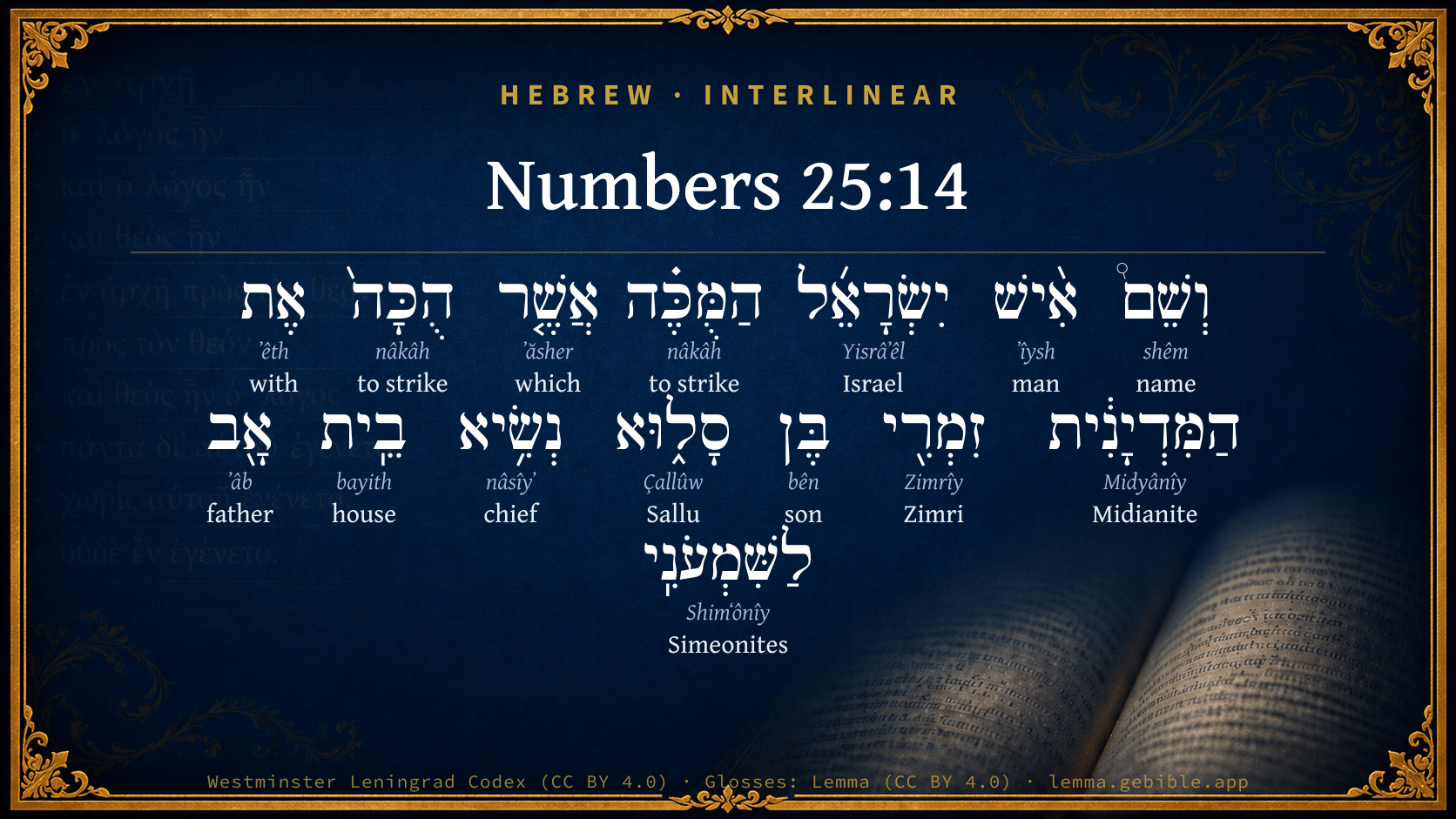
Hebrew (Westminster Leningrad Codex) Numbers 25:14 appears in the Hebrew Old Testament. The text above is from the Westminster Leningrad Codex. Each word links to its Strong’s number, a concise gloss, and parsing drawn from the Open Scriptures Hebrew Bible morphology. Click any word for its full Brown-Driver-Briggs (BDB) entry.
Download image
Cite this verse

Numbers 25:14 (World English Bible). Public Domain. Lemma interlinear Bible study tool, https://lemma.gebible.app/v/numbers/25/14.

Show BibTeX & RIS
BibTeX
RIS
English Translation
Now the name of the man of Israel that was slain, who was slain with the Midianite woman, was Zimri, the son of Salu, a prince of a fathers' house among the Simeonites.
World English Bible · Public Domain
Highlights
  • 3 first appearances in the Hebrew Bible
Full analysis ↓
Download a study sheet

One document with this verse’s original text, its word-by-word gloss line, the meaning frame, cross-references with their text, attributed commentary, and full source and license credits — printable, and it pastes into notes with its structure intact.

This verse Autodidact and up

Study sheet (.html) Plain text (.txt)

A passage Seminary Student

Up to 50 verses in one chapter. A passage sheet keeps up to 6 commentary sources and 12 cross-references per verse, in the order this page ranks them, and says so on the sheet whenever that leaves anything out. Ask for a single verse and you get the Autodidact verse sheet above.

Everything on this page stays free to read, with no account — the sheet is a download of what is already on screen, not access to it.

Want to remove ads? Support Godless Engineer
Compare translations 3

The same verse in 3 English versions, stacked beneath the original-language interlinear above. Click any original word for its lexicon entry.

Each is an independent rendering of the whole verse — the interlinear is not word-aligned to these translations.

Highlighted words mark where these versions differ — a whole-verse word diff, not a word-by-word alignment.

  • World English Bible Public Domain
    Now the name of the man of Israel that was slain, who was slain with the Midianite woman, was Zimri, the son of Salu, a prince of a fathers' house among the Simeonites.
  • King James Version Public Domain
    Now the name of the Israelite that was slain, even that was slain with the Midianitish woman, was Zimri, the son of Salu, a prince of a chief house among the Simeonites.
  • unfoldingWord Literal Text CC BY-SA 4.0
    And the name of the man of Israel, the struck down one who was struck down with the Midianite woman, was Zimri the son of Salu, the leader of a house of a father of the Simeonites.

unfoldingWord Literal Text — © unfoldingWord, licensed CC BY-SA 4.0. Word-aligned USFM3 via Door43 (git.door43.org/unfoldingWord/en_ult).

Versions to compare (up to 4)

3 of 4 selected

Show all 18 translations

Every available English version of this verse, each an independent rendering of the whole verse.

  • World English Bible Public Domain
    Now the name of the man of Israel that was slain, who was slain with the Midianite woman, was Zimri, the son of Salu, a prince of a fathers' house among the Simeonites.
  • Berean Standard Bible Public Domain
    The name of the Israelite who was slain with the Midianite woman was Zimri son of Salu, the leader of a Simeonite family.
  • Majority Standard Bible Public Domain
    The name of the Israelite who was slain with the Midianite woman was Zimri son of Salu, the leader of a Simeonite family.
  • King James Version Public Domain
    Now the name of the Israelite that was slain, even that was slain with the Midianitish woman, was Zimri, the son of Salu, a prince of a chief house among the Simeonites.
  • American Standard Version (1901) Public Domain
    Now the name of the man of Israel that was slain, who was slain with the Midianitish woman, was Zimri, the son of Salu, a prince of a fathers' house among the Simeonites.
  • Revised Version (1885) Public Domain
    Now the name of the man of Israel that was slain, who was slain with the Midianitish woman, was Zimri, the son of Salu, a prince of a fathers’ house among the Simeonites.
  • Geneva Bible (1599) Public Domain
    And the name of the Israelite thus slayne, which was killed with the Midianitish woman, was Zimri the sonne of Salu, prince of the familie of the Simeonites.
  • Douay-Rheims (1899) Public Domain
    And the name of the Israelite, was slain with the woman of Madian, was Zambri the son of Salu, a prince the kindred and tribe of Simeon.
  • Young's Literal Translation Public Domain
    And the name of the man of Israel who is smitten, who hath been smitten with the Midianitess, `is' Zimri son of Salu, prince of the house of a father of the Simeonite;
  • Literal Standard Version CC BY-SA 4.0
    And the name of the man of Israel who is struck, who has been struck with the Midianitess, [is] Zimri son of Salu, prince of the house of a father of the Simeonite;
  • Unlocked Literal Bible CC BY-SA 4.0
    Now the name of the Israelite man who was killed with the Midianite woman was Zimri son of Salu, a leader of an ancestor's family among the Simeonites.
  • unfoldingWord Literal Text CC BY-SA 4.0
    And the name of the man of Israel, the struck down one who was struck down with the Midianite woman, was Zimri the son of Salu, the leader of a house of a father of the Simeonites.
  • Darby Bible Public Domain
    And the name of the man of Israel that was slain, who was slain with the Midianitish woman, was Zimri, the son of Salu, the prince of a father's house of the Simeonites.
  • World Messianic Bible Public Domain
    Now the name of the man of Israel that was slain, who was slain with the Midianite woman, was Zimri, the son of Salu, a prince of a fathers’ house among the Simeonites.
  • Webster's Bible Public Domain
    Now the name of the Israelite that was slain, even that was slain with the Midianitish woman, was Zimri, the son of Salu, a prince of a chief house among the Simeonites.
  • Free Bible Version CC BY-SA 4.0
    The name of the Israelite who was killed with the Midianite woman was Zimri, son of Salu, a family leader of the tribe of Simeon.
  • Bible in Basic English Public Domain
    Now the man of Israel who was put to death with the woman of Midian was Zimri, the son of Salu, a chief of one of the families of the Simeonites.
  • JPS Tanakh (1917) Public Domain
    Now the name of the man of Israel that was slain, who was slain with the Midianitish woman, was Zimri, the son of Salu, a prince of a fathers' house among the Simeonites.

Literal Standard Version (2020), Covenant Press — licensed CC BY-SA 4.0. Text via the HelloAO Bible API (eBible.org). Unlocked Literal Bible (unfoldingWord) — licensed CC BY-SA 4.0. Text via the HelloAO Bible API (eBible.org). unfoldingWord Literal Text — © unfoldingWord, licensed CC BY-SA 4.0. Word-aligned USFM3 via Door43 (git.door43.org/unfoldingWord/en_ult). Free Bible Version, Dr. Jonathan Gallagher — licensed CC BY-SA 4.0. Text via the HelloAO Bible API (eBible.org).

Word by word

More ways to search: Search by grammar → Find every occurrence → Compare this word →

Practice this passage: Drill this verse → Learn its vocabulary →

לַשִּׁמְעֹנִֽי
Shimʻônîy
H8099
“to/for the · Simeonites”
Preposition, Determined + Noun, Gentilic, Masculine, Singular, Absolute
Part of Speech
Preposition + Noun
Type
Gentilic
Gender
Masculine
Number
Singular
State
Absolute
Full BDB Definition

Origin: patronymically from H8095

TWOT: None

Simeonites = see Simeon " harkening" - descendants of Simeon
  1. וְשֵׁם֩ shêm H8034 “and · name of” Conjunction + Noun, Common, Masculine, Singular, Construct
  2. אִ֨ישׁ ʼîysh H376 “man of” Noun, Common, Masculine, Singular, Construct
  3. יִשְׂרָאֵ֜ל Yisrâʼêl H3478 “Israel” Noun, Proper
  4. הַמֻּכֶּ֗ה nâkâh H5221 “the · struck” Particle, Definite Article + Verb, Hophal, Participle Passive, Masculine, Singular, Absolute
  5. אֲשֶׁ֤ר ʼăsher H834 “which” Particle, Relative
  6. הֻכָּה֙ nâkâh H5221 “to strike” Verb, Hophal, Perfect, 3rd Person, Masculine, Singular
  7. אֶת ʼêth H854 “with” Preposition
  8. הַמִּדְיָנִ֔ית Midyânîy H4084 “the · Midianite” Particle, Definite Article + Adjective, Adjective, Feminine, Singular, Absolute
  9. זִמְרִ֖י Zimrîy H2174 “Zimri” Noun, Proper
  10. בֶּן bên H1121 “son of” Noun, Common, Masculine, Singular, Construct
  11. סָל֑וּא Çallûw H5543 “Sallu” Noun, Proper
  12. נְשִׂ֥יא nâsîyʼ H5387 “chief of” Noun, Common, Masculine, Singular, Construct
  13. בֵֽית bayith H1004 “house of” Noun, Common, Masculine, Singular, Construct
  14. אָ֖ב ʼâb H1 “father” Noun, Common, Masculine, Singular, Absolute

About this verse

These counts appear in no published source. They are computed here, from the morphology-tagged text and Lemma’s own curated glosses. What Lemma adds →

15
words
14
distinct lemmas
Pentateuch
section

Notable vocabulary

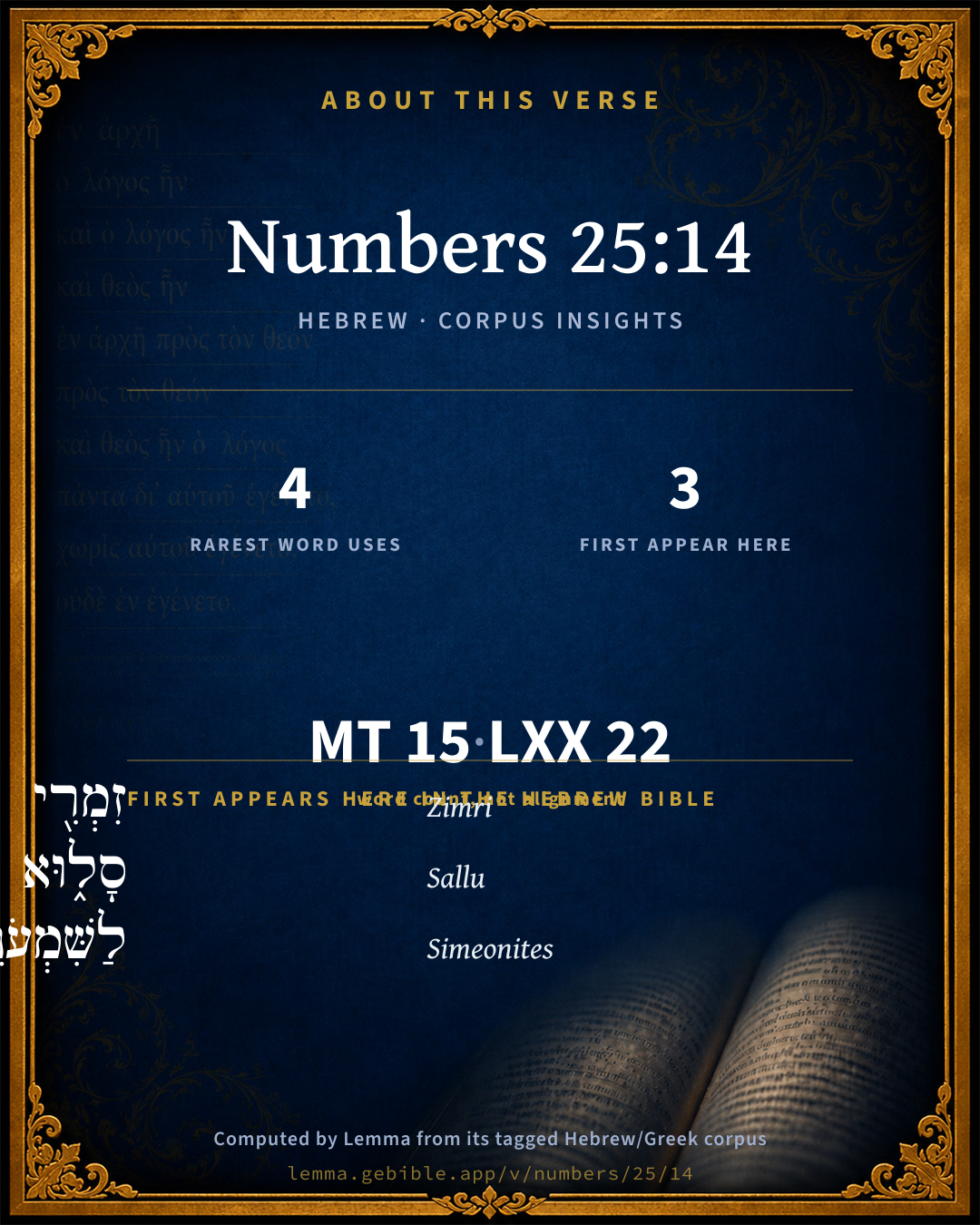
The rarest word here is לַשִּׁמְעֹנִֽי Simeonites H8099 — appearing just 4 times in the whole Hebrew Bible.

First appearance in Scripture

These words make their first canonical appearance in the Hebrew Bible here:

  • זִמְרִ֖י Zimri H2174
  • סָל֑וּא Sallu H5543
  • לַשִּׁמְעֹנִֽי Simeonites H8099

Shared distinctive vocabulary

לַשִּׁמְעֹנִֽי Simeonites H8099 occurs in 4 verses of the Hebrew Bible. Also found in:

Grammatical profile

  • 2 verbs
  • 10 nouns
  • 1 adjective
  • 1 preposition
  • 1 particle

Verb forms

  • הַמֻּכֶּ֗ה Hophal · Participle Passive
  • הֻכָּה֙ Hophal · Perfect

Repetition

A word recurs within this verse — often emphatic in Hebrew:

  • הַמֻּכֶּ֗ה to strike H5221 ×2

Hebrew & Septuagint length

In English translation the verse runs 33 words from the Hebrew and 29 from the Septuagint (LXX English) — closely comparable.

A rough comparison of the two English renderings, which tokenize alike — not a word-level alignment.

Word counts can differ between the Hebrew and the Greek without any difference in meaning — e.g. the Hebrew direct-object marker אֵת has no separate Greek word, and Greek often adds the article ὁ.

In the original languages it is 15 Hebrew tokens and 22 Greek tokens — but the two are counted differently (Hebrew bundles its prefixes and suffixes into one token; the Greek is in lemma form), so that isn’t a like-for-like length.

Cross-references

4

Topical passages linked to Numbers 25:14 in the Treasury of Scripture Knowledge — connected by theme and wording, ordered by reader-vote popularity; previews shown in the World English Bible.

  • Numbers 1:23 those who were numbered of them, of the tribe of Simeon, were fifty-nine thousand three hundred.
  • Numbers 25:4–5 Yahweh said to Moses, Take all the chiefs of the people, and hang them up to Yahweh before the sun, that the fierce anger of Yahweh may turn away from Israel.
  • Numbers 26:14 These are the families of the Simeonites, twenty-two thousand two hundred.
  • 2 Chronicles 19:7 Now therefore let the fear of Yahweh be on you; take heed and do it: for there is no iniquity with Yahweh our God, nor respect of persons, nor taking of bribes.

Cross-references courtesy of OpenBible.info (CC BY 4.0).

Hebrew and Greek witnesses Masoretic Hebrew ↔ Greek Septuagint

The same verse in the two great witnesses to the Old Testament, shown verse-for-verse.

These are two independent witnesses, not word-aligned to each other, and the Septuagint is shown in lemma (dictionary) form.

Hebrew Numbers 25:14 Masoretic · Westminster Leningrad Codex

וְשֵׁם֩ אִ֨ישׁ יִשְׂרָאֵ֜ל הַמֻּכֶּ֗ה אֲשֶׁ֤ר הֻכָּה֙ אֶת הַמִּדְיָנִ֔ית זִמְרִ֖י בֶּן סָל֑וּא נְשִׂ֥יא בֵֽית אָ֖ב לַשִּׁמְעֹנִֽי

Now the name of the man of Israel that was slain, who was slain with the Midianite woman, was Zimri, the son of Salu, a prince of a fathers' house among the Simeonites.

World English Bible · Public Domain

Greek LXX Numbers 25:14 Septuagint · lemma form

ὁ δέ ὄνομα ὁ ἄνθρωπος ὁ ἰσραηλίτης ὁ πλήσσω ὅς πλήσσω μετά ὁ μαδιανῖτις ζαμβρι υἱός σαλω ἄρχων οἶκος πατριά ὁ συμεων

Now the name of the struck Israelitish man, who was struck with the Madianitish woman, was Zambri son of Salmon, prince of a house of the tribe of Symeon.

LXX2012 (modern English Septuagint) · Public Domain

Hebrew: Westminster Leningrad Codex (CC BY 4.0). Greek: Septuagint (public domain); English from LXX2012 (modern English Septuagint) (Public Domain). How the Septuagint differs from the Hebrew →

Targum (Aramaic paraphrase)

2

The Targum is the ancient Jewish Aramaic paraphrase of the Hebrew Scriptures — an interpretive translation, not the Hebrew text itself. Onkelos (literal) and Pseudo-Jonathan (expansive) render the Torah, and Jonathan the Prophets. Coverage is partial: where no permissively-licensed English translation exists for a verse, only the Aramaic is shown. This is verse-level text, not a word-by-word alignment to the Hebrew.

  1. Targum Onkelos Torah (Genesis–Deuteronomy)
    וְשׁוּם גַבְרָא בַּר יִשְרָאֵל קְטִילָא דִי אִתְקְטֵל עִם מִדְיָנֵיתָא זִמְרִי בַּר סָלוּא רַב בֵּית אַבָּא לְבֵית שִׁמְעוֹן

    (no public-domain English translation for this verse)

    Targum Onkelos — Aramaic: “Onkelos Genesis” (public domain); “Onkelos Exodus” (public domain); “Onkelos Leviticus” (public domain); “Onkelos Numbers” (public domain); “Onkelos Deuteronomy” (public domain). English: “Sefaria Community Translation” (CC0 1.0 (public-domain dedication)); “J.W. Etheridge. The Targums of Onkelos and Jonathan Ben Uzziel on the Pentateuch. London: Longmans, Green, 1862” (public domain). Text via Sefaria.

  2. Targum Pseudo-Jonathan Torah (Genesis–Deuteronomy)
    וְשׁוּם גַבְרָא בַּר יִשְרָאֵל קְטִילָא דְאִתְקְטֵיל עִם מִדְיָינֵיתָא זִמְרִי בַּר סָלוּא רַב בֵּית אַבָּא לְשֵׁבֶט שִׁמְעוֹן

    Now the name of the man of Israel who was slain with the Midianitha was Zimri bar Salu, a chief of the house of his fathers of the tribe of Shemeon.

    Targum Pseudo-Jonathan — Aramaic: “Targum Jonathan on Genesis” (public domain); “Targum Jonathan on Exodus” (public domain); “Targum Jonathan on Leviticus” (public domain); “Targum Jonathan on Numbers” (public domain); “Targum Jonathan on Deuteronomy” (public domain). English: “The Targum of Jonathan ben Uzziel, trans. J. W. Etheridge, London, 1862” (public domain). Text via Sefaria.

Commentary

Notes on Numbers 25:14 from classic Christian and Jewish commentators (each source and its license shown beneath its notes). The classic Christian expositions comment on the surrounding passage and are grouped to its opening verse, so a note may address several verses; the Jewish commentaries on the Tanakh (Rashi and others) are per-verse, so they appear only where the commentator wrote on this verse.

Lemma curates 59 commentaries, every one of them public domain or Creative Commons licensed, each selected and text-cleaned for this edition rather than reprinted as found. About our sources →

Trapp's Complete Commentary

John Trapp

Num 25:14 Now the name of the Israelite that was slain, [even] that was slain with the Midianitish woman, [was] Zimri, the son of Salu, a prince of a chief house among the Simeonites.

Ver. 14. A prince of a chief house.] Whom yet Phineas spared not; as neither did John Baptist spare Herod; nor Nathan David; nor Bishop Lambert King Pippin, whom he freely reproved to his face for his adultery, A.D. 798, though he were afterwards therefore slain by the harlot’s brother. {a} Odo Severus, the twenty-second Archbishop of Canterbury, A.D. 934, dealt like plainly with King Edwin, excommunicated his concubines, and caused one of them, on whom the king doted unreasonably, to be fetched out of the court by violence, burnt her in the forehead with a hot iron, and banished her into Ireland. {b}

{a} Epitome Hist. Gall., p. 30.

{b} Godw., Catal.

John Trapp, A Commentary or Exposition upon All the Books of the Old and New Testament (1647–1656) — public domain. Text from a community e-Sword module.

Geneva Bible (1599)

Geneva Bible translators

Hebrew, of the house of the father.

Geneva Bible (1599) marginal notes — public domain. Text via Bolls.life.

Jamieson, Fausset & Brown

Robert Jamieson, A. R. Fausset & David Brown

Zimri, . . . a prince . . . among the Simeonites--The slaughter of a man of such high rank is mentioned as a proof of the undaunted zeal of Phinehas, for there might be numerous avengers of his blood.

Jamieson, Fausset & Brown — Commentary Critical and Explanatory on the Whole Bible (1871) — public domain (CC PDM 1.0). Text via the HelloAO Bible API.

Ellicott's Commentary for English Readers

(14) A prince of a chief house among the Simeonites.—Better, of a father’s house, &c. It is probable that the tribe of Simeon was deeply implicated in the transgression, and that those who belonged to that tribe were the chief sufferers in the plague. (See Num_26:14, and Note.)

A Bible Commentary for English Readers, edited by Charles John Ellicott (1878–1897) — public domain. Text from a community e-Sword module.

John Gill's Exposition

And the name of the Midianitish woman that was slain was Cozbi, the daughter of Zur,.... One of the five kings of Midian, Num 31:8 and so the Samaritan Chronicle says (k), it was the daughter of a king that came to a prince of the tribe of Simeon, and enticed him to eat of her food, and worship her idols. The Targum of Jonathan says she was called Selonae, the daughter of Balak, chief of the nation of Moab, whose habitation was in Midian:

he was head over a people, and of a chief house in Midian; that is, Zur, the father of Cozbi, was; there were five sons of Midian, whose names are given, Gen 25:4 from whence Jarchi concludes, that there were five principal families in Midian, and that this man was the head or chief of one of them, which is not improbable; and that also makes for the honour of Phinehas, that he spared not any for their rank and quality, of whatsoever nation they were.

(k) Apud Hottinger, ut supra. (Smergma Oriental, l. 1. c. 8. p. 448.)

John Gill's Exposition of the Whole Bible (1746–1763) — public domain (CC PDM 1.0). Text via the HelloAO Bible API.

Haydock's Catholic Bible Commentary

Kindred. Hebrew, "of a chief house among the Simeonites," as Sur was of equal nobility, "head over a people, and of a chief house in Madian," ver. 15. (Haydock) --- He is styled king, and one of the five princes of the nation, chap. xxxi. 8.

George Leo Haydock (1774–1849), Haydock's Catholic Family Bible and Commentary, 1859 edition — public domain. Excludes Psalms (Douay-Rheims chapter numbering differs from Protestant) and Deuterocanonical books (Catholic canon only).

Matthew Poole's English Annotations

A prince: this is added as a proof of Phinehas’s zeal, that he durst venture upon so great a person, who was likely to have many avengers of his blood.

Of a chief house, Heb. of the house of his father. Every tribe was divided into great households, called the houses of their fathers, Num 1:2, and he was the prince or chief of one of these, though not of fire whole tribe.

Among the Simeonites; of the tribe of Simeon, which seems to have been too much influenced by his and other such examples, so that for 59,300, which were numbered, Num 1:22,23, there were now only 22,000 Num 26:14.

Matthew Poole's English Annotations on the Holy Bible (1683–1685) — public domain. Text from a community e-Sword/MySword module.

The Pulpit Commentary

Now the name of the Israelite. These details as to names seem to have been added as an after-thought, for they would naturally have been given in verse 11, where the man and the woman are first mentioned. The woman"s name is given again in verse 18, as if for the first time. We may probably conclude that verses 14, 15 were inserted into the narrative either by the hand of Moses himself at a later date, or possibly by some subsequent hand. Zimri. This was not an uncommon name, but the individual who bears it here is not elsewhere mentioned.

The Pulpit Commentary (1880–1919), ed. H.D.M. Spence-Jones & Joseph S. Exell — public domain. Text from a community e-Sword module.

unfoldingWord translationNotes

Door43 World Missions Community

Now

This switches from the main story line to background information about Zimri and Kozbi. (See: Background Information)

who was killed

This can be stated in active form. AT: "whom Phinehas killed" (See: Active or Passive)

Zimri ... Salu ... Zur

These are names of men. (See: How to Translate Names)

Kozbi

This is the name of a woman. (See: How to Translate Names)

translationWords

name

Midian

Simeon

head

tribe

unfoldingWord translationNotes — © Distant Shores Media and the Door43 World Missions Community, licensed CC BY-SA 4.0. Source: git.door43.org/Door43/en_tn.

Rashi

Rabbi Shlomo Yitzchaki (Rashi)

ושם איש ישראל וגו׳ AND THE NAME OF THE ISRAELITE [WHO WAS SMITTEN] — Wherever it gives the genealogy of a good man in praise of him, it gives the genealogy of a bad man mentioned in the same story to disparage him (Midrash Tanchuma, Pinchas 2).

נשיא בית אב לשמעני A PRINCE OF A FATHER’S HOUSE AMONGST THE SIMEONITES — of one of the five 'father’s houses' which were of the tribe of Simeon. — Another explanation: This is stated to tell the praiseworthiness of Phineas: that although this man was a prince he did not refrain from showing his zeal against the profanation of the Divine Name — on this account Scripture tells you who it was (a prince!) that was smitten by him.

Rashi on the Tanakh — English translations: “The Judaica Press complete Tanach with Rashi, translated by A. J. Rosenberg” (CC BY 4.0); “Pentateuch with Rashi's commentary by M. Rosenbaum and A.M. Silbermann, 1929-1934” (public domain); “The Metsudah Tanach series, Lakewood, N.J” (CC BY 4.0); and “The Book of Joshua, Metsudah Publications, 1997” (CC BY 4.0). Text via Sefaria.

Lesson kit

Teaching starters — assembled from the data on this page, not authored interpretation. Every prompt links to the verse data it draws on. Edit before teaching.

Numbers, in the Pentateuch, opens this verse with 15 words (14 distinct Hebrew lemmas). Its most distinctive word is Shimʻônîy (“Simeonites”). A historical commentator’s framing appears above. Read the whole chapter for the surrounding context.

Discussion questions

  1. What does “Simeonites” (Shimʻônîy) contribute to the verse as a whole?
  2. 3 words here appear for the first time in Scripture. What is being introduced at this debut?
  3. Numbers 26:14 shares the word «Simeonites» with this verse. How do the two illuminate each other?
  4. “to strike” occurs 2× in this one verse. What is the effect of the repetition?
  5. The translations on this page render this verse differently — a whole-verse word diff, not a word-by-word alignment. What might account for the different wordings?
  6. The verb «הַמֻּכֶּ֗ה» is Hophal Participle Passive. How does its form color the action?
  7. Reading how Trapp's Complete Commentary and Geneva Bible (1599) read this verse, where do the two commentators agree and where do they part?

Things to notice

Reading settings

Reading text

Shown beneath each verse's original-language words.

Old Testament
Old Testament edition

Read the OT as the Masoretic Hebrew (MT) or the Greek Septuagint (LXX).

English shown for the Greek Septuagint (in the Hebrew ↔ Greek comparison).

Comparing translations? Open the Compare panel on any verse page to stack up to four side by side.