Exodus 35:27

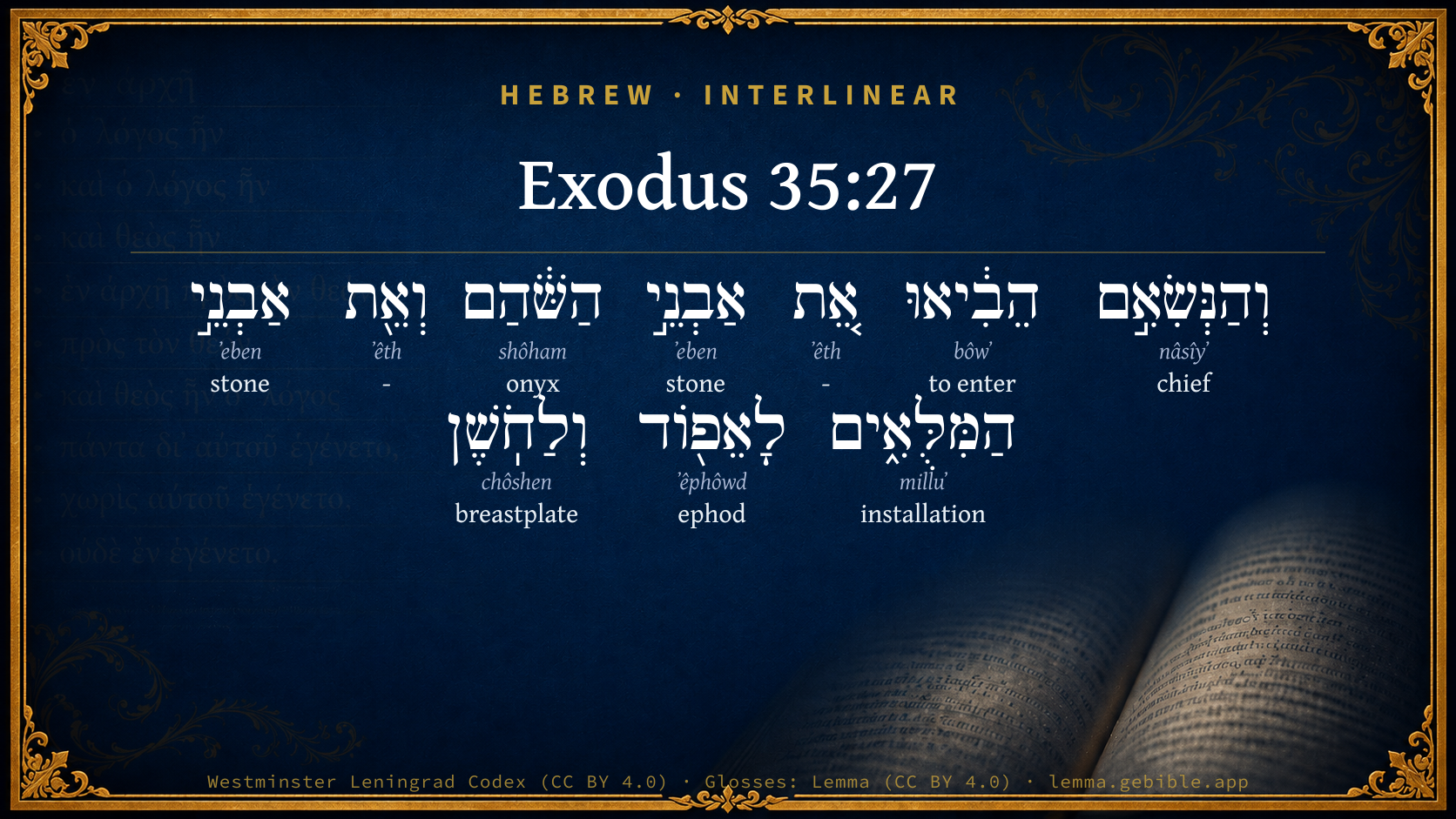
Hebrew (Westminster Leningrad Codex) Exodus 35:27 appears in the Hebrew Old Testament. The text above is from the Westminster Leningrad Codex. Each word links to its Strong’s number, a concise gloss, and parsing drawn from the Open Scriptures Hebrew Bible morphology. Click any word for its full Brown-Driver-Briggs (BDB) entry.
Download image
Cite this verse

Exodus 35:27 (World English Bible). Public Domain. Lemma interlinear Bible study tool, https://lemma.gebible.app/v/exodus/35/27.

Show BibTeX & RIS
BibTeX
RIS
English Translation
The rulers brought the onyx stones, and the stones to be set, for the ephod and for the breastplate;
World English Bible · Public Domain
Download a study sheet

One document with this verse’s original text, its word-by-word gloss line, the meaning frame, cross-references with their text, attributed commentary, and full source and license credits — printable, and it pastes into notes with its structure intact.

This verse Autodidact and up

Study sheet (.html) Plain text (.txt)

A passage Seminary Student

Up to 50 verses in one chapter. A passage sheet keeps up to 6 commentary sources and 12 cross-references per verse, in the order this page ranks them, and says so on the sheet whenever that leaves anything out. Ask for a single verse and you get the Autodidact verse sheet above.

Everything on this page stays free to read, with no account — the sheet is a download of what is already on screen, not access to it.

Want to remove ads? Support Godless Engineer
Compare translations 3

The same verse in 3 English versions, stacked beneath the original-language interlinear above. Click any original word for its lexicon entry.

Each is an independent rendering of the whole verse — the interlinear is not word-aligned to these translations.

Highlighted words mark where these versions differ — a whole-verse word diff, not a word-by-word alignment.

  • World English Bible Public Domain
    The rulers brought the onyx stones, and the stones to be set, for the ephod and for the breastplate;
  • King James Version Public Domain
    And the rulers brought onyx stones, and stones to be set, for the ephod, and for the breastplate;
  • unfoldingWord Literal Text CC BY-SA 4.0
    And the leaders brought the onyx stones and precious stones of setting for the ephod and for the breastpiece

unfoldingWord Literal Text — © unfoldingWord, licensed CC BY-SA 4.0. Word-aligned USFM3 via Door43 (git.door43.org/unfoldingWord/en_ult).

Versions to compare (up to 4)

3 of 4 selected

Show all 18 translations

Every available English version of this verse, each an independent rendering of the whole verse.

  • World English Bible Public Domain
    The rulers brought the onyx stones, and the stones to be set, for the ephod and for the breastplate;
  • Berean Standard Bible Public Domain
    The leaders brought onyx stones and gemstones to mount on the ephod and breastpiece,
  • Majority Standard Bible Public Domain
    The leaders brought onyx stones and gemstones to mount on the ephod and breastpiece,
  • King James Version Public Domain
    And the rulers brought onyx stones, and stones to be set, for the ephod, and for the breastplate;
  • American Standard Version (1901) Public Domain
    And the rulers brought the onyx stones, and the stones to be set, for the ephod, and for the breastplate;
  • Revised Version (1885) Public Domain
    And the rulers brought the onyx stones, and the stones to be set, for the ephod, and for the breastplate;
  • Geneva Bible (1599) Public Domain
    And ye rulers brought onix stones, and stones to be set in the Ephod, and in the brest plate:
  • Douay-Rheims (1899) Public Domain
    But the princes offered onyx stone, and precious stones, for the ephod and the rational,
  • Young's Literal Translation Public Domain
    And the princes have brought in the shoham stones, and the stones for settings, for the ephod, and for the breastplate,
  • Literal Standard Version CC BY-SA 4.0
    And the princes have brought in the shoham stones, and the stones for settings, for the ephod, and for the breastplate,
  • Unlocked Literal Bible CC BY-SA 4.0
    The leaders brought onyx stones and other gems to be set into the ephod and the breastpiece;
  • unfoldingWord Literal Text CC BY-SA 4.0
    And the leaders brought the onyx stones and precious stones of setting for the ephod and for the breastpiece
  • Darby Bible Public Domain
    And the principal men brought the onyx stones, and the stones to be set, for the ephod, and for the breastplate;
  • World Messianic Bible Public Domain
    The rulers brought the onyx stones and the stones to be set for the ephod and for the breastplate;
  • Webster's Bible Public Domain
    And the rulers brought onyx stones, and stones to be set, for the ephod, and for the breast-plate;
  • Free Bible Version CC BY-SA 4.0
    The leaders brought onyx stones and gemstones to make the ephod and breastpiece,
  • Bible in Basic English Public Domain
    And the rulers gave the beryls and the cut jewels for the ephod and the priest's bag;
  • JPS Tanakh (1917) Public Domain
    And the rulers brought the onyx stones, and the stones to be set, for the ephod, and for the breastplate;

Literal Standard Version (2020), Covenant Press — licensed CC BY-SA 4.0. Text via the HelloAO Bible API (eBible.org). Unlocked Literal Bible (unfoldingWord) — licensed CC BY-SA 4.0. Text via the HelloAO Bible API (eBible.org). unfoldingWord Literal Text — © unfoldingWord, licensed CC BY-SA 4.0. Word-aligned USFM3 via Door43 (git.door43.org/unfoldingWord/en_ult). Free Bible Version, Dr. Jonathan Gallagher — licensed CC BY-SA 4.0. Text via the HelloAO Bible API (eBible.org).

Word by word

More ways to search: Search by grammar → Find every occurrence → Compare this word →

Practice this passage: Drill this verse → Learn its vocabulary →

הַשֹּׁ֔הַם
shôham
H7718
“the · onyx”
Particle, Definite Article + Noun, Common, Masculine, Singular, Absolute
Part of Speech
Particle + Noun
Type
Common
Gender
Masculine
Number
Singular
State
Absolute
Full BDB Definition

Origin: from an unused root probably mean to blanch

TWOT: 2337

a precious stone or gem - probably onyx, chrysoprasus, beryl, malachite
  1. וְהַנְּשִׂאִ֣ם nâsîyʼ H5387 “and · the · chiefs” Conjunction + Particle, Definite Article + Noun, Common, Masculine, Plural, Absolute
  2. הֵבִ֔יאוּ bôwʼ H935 “to enter” Verb, Hiphil, Perfect, 3rd Person, Common, Plural
  3. אֵ֚ת ʼêth H853 “-” Particle, Direct Object
  4. אַבְנֵ֣י ʼeben H68 “stones of” Noun, Common, Feminine, Plural, Construct
  5. וְאֵ֖ת ʼêth H853 “and · -” Conjunction + Particle, Direct Object
  6. אַבְנֵ֣י ʼeben H68 “stones of” Noun, Common, Feminine, Plural, Construct
  7. הַמִּלֻּאִ֑ים milluʼ H4394 “the · installations” Particle, Definite Article + Noun, Common, Masculine, Plural, Absolute
  8. לָאֵפ֖וֹד ʼêphôwd H646 “to/for the · ephod” Preposition, Determined + Noun, Common, Masculine, Singular, Absolute
  9. וְלַחֹֽשֶׁן chôshen H2833 “and · to/for the · breastplate” Conjunction + Preposition, Determined + Noun, Common, Masculine, Singular, Absolute

About this verse

These counts appear in no published source. They are computed here, from the morphology-tagged text and Lemma’s own curated glosses. What Lemma adds →

10
words
8
distinct lemmas
Pentateuch
section

Notable vocabulary

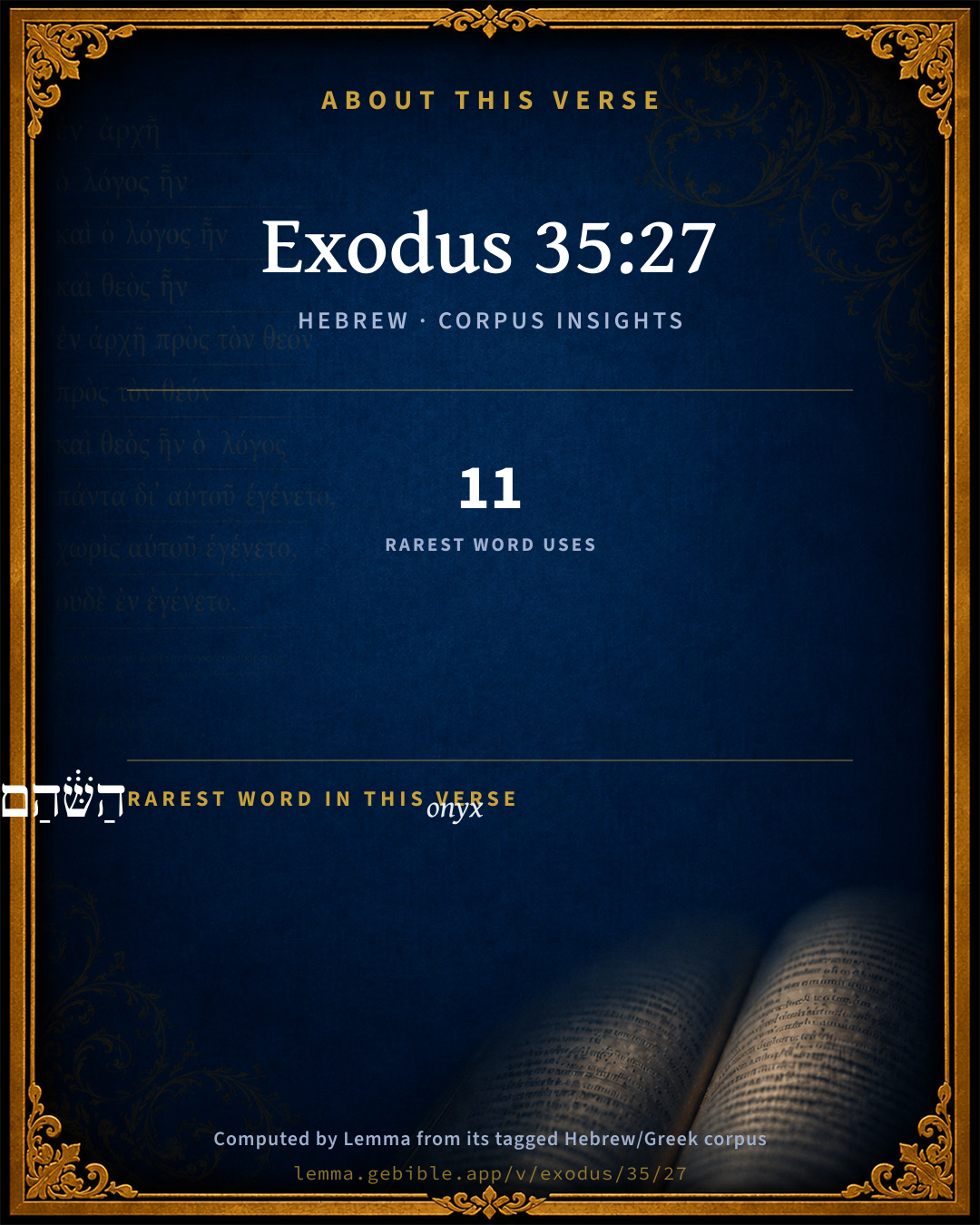
The rarest word here is הַשֹּׁ֔הַם onyx H7718 — appearing just 11 times in the whole Hebrew Bible.

Shared distinctive vocabulary

הַשֹּׁ֔הַם onyx H7718 occurs in 11 verses of the Hebrew Bible. Also found in:

Grammatical profile

  • 1 verb
  • 7 nouns
  • 2 particles

Verb forms

  • הֵבִ֔יאוּ Hiphil · Perfect

Repetition

A word recurs within this verse — often emphatic in Hebrew:

  • אַבְנֵ֣י stone H68 ×2

Hebrew & Septuagint length

In English translation the verse runs 19 words from the Hebrew and 18 from the Septuagint (LXX English) — closely comparable.

A rough comparison of the two English renderings, which tokenize alike — not a word-level alignment.

Word counts can differ between the Hebrew and the Greek without any difference in meaning — e.g. the Hebrew direct-object marker אֵת has no separate Greek word, and Greek often adds the article ὁ.

Cross-references

3

Topical passages linked to Exodus 35:27 in the Treasury of Scripture Knowledge — connected by theme and wording, ordered by reader-vote popularity; previews shown in the World English Bible.

  • 1 Chronicles 29:6 Then the princes of the fathers' [houses], and the princes of the tribes of Israel, and the captains of thousands and of hundreds, with the rulers over the king's work, offered willingly;
  • Ezra 2:68 Some of the heads of fathers' [houses], when they came to the house of Yahweh which is in Jerusalem, offered willingly for the house of God to set it up in its place:
  • Exodus 35:9 onyx stones, and stones to be set for the ephod and for the breastplate.

Cross-references courtesy of OpenBible.info (CC BY 4.0).

Hebrew and Greek witnesses Masoretic Hebrew ↔ Greek Septuagint

The same verse in the two great witnesses to the Old Testament, shown verse-for-verse.

These are two independent witnesses, not word-aligned to each other, and the Septuagint is shown in lemma (dictionary) form.

Hebrew Exodus 35:27 Masoretic · Westminster Leningrad Codex

וְהַנְּשִׂאִ֣ם הֵבִ֔יאוּ אֵ֚ת אַבְנֵ֣י הַשֹּׁ֔הַם וְאֵ֖ת אַבְנֵ֣י הַמִּלֻּאִ֑ים לָאֵפ֖וֹד וְלַחֹֽשֶׁן

The rulers brought the onyx stones, and the stones to be set, for the ephod and for the breastplate;

World English Bible · Public Domain

Greek LXX Exodus 35:27 Septuagint · lemma form

καί ὁ ἄρχων φέρω ὁ λίθος ὁ σμάραγδος καί ὁ λίθος ὁ πλήρωσις εἰς ὁ ἐπωμίς καί εἰς ὁ λογεῖον

And the rulers brought the emerald stones, and the stones for setting in the ephod, and the oracle,

LXX2012 (modern English Septuagint) · Public Domain

Hebrew: Westminster Leningrad Codex (CC BY 4.0). Greek: Septuagint (public domain); English from LXX2012 (modern English Septuagint) (Public Domain). How the Septuagint differs from the Hebrew →

Targum (Aramaic paraphrase)

2

The Targum is the ancient Jewish Aramaic paraphrase of the Hebrew Scriptures — an interpretive translation, not the Hebrew text itself. Onkelos (literal) and Pseudo-Jonathan (expansive) render the Torah, and Jonathan the Prophets. Coverage is partial: where no permissively-licensed English translation exists for a verse, only the Aramaic is shown. This is verse-level text, not a word-by-word alignment to the Hebrew.

  1. Targum Onkelos Torah (Genesis–Deuteronomy)
    וְרַבְרְבַיָא אַיְתִיאוּ יָת אַבְנֵי בוּרְלָא וְיָת אַבְנֵי אַשְׁלָמוּתָא לְשַׁקָעָא בְאֵפוֹדָא וּבְחוּשְׁנָא:

    (no public-domain English translation for this verse)

    Targum Onkelos — Aramaic: “Onkelos Genesis” (public domain); “Onkelos Exodus” (public domain); “Onkelos Leviticus” (public domain); “Onkelos Numbers” (public domain); “Onkelos Deuteronomy” (public domain). English: “Sefaria Community Translation” (CC0 1.0 (public-domain dedication)); “J.W. Etheridge. The Targums of Onkelos and Jonathan Ben Uzziel on the Pentateuch. London: Longmans, Green, 1862” (public domain). Text via Sefaria.

  2. Targum Pseudo-Jonathan Torah (Genesis–Deuteronomy)
    וַעֲנַנֵי שְׁמַיָא אָזְלִין לְפִישׁוֹן וְדַלְיַין מִתַּמָּן יַת אַבְנֵי בּוּרְלְוַת חֵילָא וְיַת אַבְנֵי אַשְׁלָמוּתָא לְשַׁקְעָא בְּאֵיפוֹדָא וּבְחוּשְׁנָא וּמַחְתַן יַתְהוֹן בְּאַנְפֵּי מַדְבְּרָא אָזְלִין רַבְרְבָנֵי יִשְרָאֵל וּמַיְיתַן יַתְהוֹן לִצְרוֹךְ עִיבִידְתָּא

    And the clouds of heaven went to the Phison, and drew up from thence onyx stones, and stones for infilling, to enchase the ephod and the breastplate, and spread them upon the face of the wilderness; and the princes of Israel went, and brought them for the need of the work.

    Targum Pseudo-Jonathan — Aramaic: “Targum Jonathan on Genesis” (public domain); “Targum Jonathan on Exodus” (public domain); “Targum Jonathan on Leviticus” (public domain); “Targum Jonathan on Numbers” (public domain); “Targum Jonathan on Deuteronomy” (public domain). English: “The Targum of Jonathan ben Uzziel, trans. J. W. Etheridge, London, 1862” (public domain). Text via Sefaria.

Commentary

Notes on Exodus 35:27 from classic Christian and Jewish commentators (each source and its license shown beneath its notes). The classic Christian expositions comment on the surrounding passage and are grouped to its opening verse, so a note may address several verses; the Jewish commentaries on the Tanakh (Rashi and others) are per-verse, so they appear only where the commentator wrote on this verse.

Lemma curates 59 commentaries, every one of them public domain or Creative Commons licensed, each selected and text-cleaned for this edition rather than reprinted as found. About our sources →

unfoldingWord translationNotes

Door43 World Missions Community

The leaders brought ... Moses to be made

For Exo 35:27-29 see how you translated many of these words in Exodus 25:1-2 and Exodus 25:3-7.

whose heart was willing

Here "heart" refers to the people. AT: "who was willing" (See: Synecdoche)

translationWords

ephod

breastplate

oil

lamp

anoint

incense

freewill offering

command

unfoldingWord translationNotes — © Distant Shores Media and the Door43 World Missions Community, licensed CC BY-SA 4.0. Source: git.door43.org/Door43/en_tn.

Adam Clarke's Commentary

Verse 27. The rulers brought onyx stones] These being persons of consequence, might be naturally expected to furnish the more scarce and costly articles. See how all join in this service! The men worked and brought offerings, the women spun and brought their ornaments, the rulers united with them, and delivered up their jewels! and all the children of Israel brought a willing offering unto the Lord, Ex 35:29.

Adam Clarke's Commentary on the Bible (1810–1826) — public domain. Text from a community e-Sword/MySword module.

Ellicott's Commentary for English Readers

(27) The rulers brought onyx stones, and stones to be set.—The “rulers” here intended are probably the “princes of the tribes” of Israel (Num_1:16; Num_3:3; Num_3:5, &c.). The twelve stones required for the breastplate would naturally be contributed by the twelve chiefs of the tribes whose names they were to bear (Exo_28:21). The two onyx stones for the ephod (Exo_28:9-12), may have been the further gift of two of the number, who happened to possess stones of the large size needed.

A Bible Commentary for English Readers, edited by Charles John Ellicott (1878–1897) — public domain. Text from a community e-Sword module.

The Cambridge Bible for Schools and Colleges

gen. ed. J. J. S. Perowne

27, 28. The contributions of the rulers (see on Exo_16:22); precious stones, spices, and oil (vv. 9, 8 = Exo_25:7; Exo_25:6).

The Cambridge Bible for Schools and Colleges (gen. ed. J. J. S. Perowne; Cambridge University Press, 1878–1918) — public domain. Text from a community e-Sword module.

John Gill's Exposition

And spice and oil,.... Such excellent spices and precious oil, pure oil olive, as the common people had not, and which they brought out of Egypt; the one was

for the light: for the light of the candlestick only; the oil, and other spices:

were for the anointing oil, and for the sweet incense; the spices for the former were pure myrrh, sweet cinnamon, sweet calamus and cassia; and for the latter, stacte, onycha, galbanum, with pure frankincense.

John Gill's Exposition of the Whole Bible (1746–1763) — public domain (CC PDM 1.0). Text via the HelloAO Bible API.

Albert Barnes' Notes on the Bible

The precious stones Exo 28:9 and spices were contributed by the rulers, who were more wealthy than the other Israelites.

Albert Barnes' Notes on the Bible (1834–1885) — public domain. Text from a community e-Sword/MySword module.

The Pulpit Commentary

Vers. 27, 28 The rulers are, no doubt, the "elders" of, Exo_3:16 Exo_4:29 Exo_24:9, etc. Moses had made them "rulers," or rather, "princes" (sarey) according to the advice of Jethro. (Exo_18:25) They brought onyx stones for the ephod (Exo_28:9-12) and stones to be set, i.e. , gems for the breastplate (ibid. 17-20); oil of olive for the lamp (Exo_27:20) and the holy ointment, (Exo_29:24) and spice for the same (ibid. 23, 24) and for the incense (ibid. 34).

The Pulpit Commentary (1880–1919), ed. H.D.M. Spence-Jones & Joseph S. Exell — public domain. Text from a community e-Sword module.

Keil & Delitzsch

C. F. Keil & F. Delitzsch

The precious stones for the robes of the high priest, and the spices for the incense and anointing oil, were presented by the princes of the congregation, who had such costly things in their possession.

Keil & Delitzsch — Biblical Commentary on the Old Testament (1861–1891) — public domain (CC PDM 1.0). Text via the HelloAO Bible API. (Old Testament only.)

Rashi

Rabbi Shlomo Yitzchaki (Rashi)

והנשאם הביאו AND THE PRINCES BROUGHT [ONYX STONES] R. Nathan asked, “What reason had the princes to give their contributions at the dedication of the altar (Numbers 7:12ff.) first of all the people, whereas at the work of the Tabernacle they were not the first, but the last to contribute?” But — replied he — the princes spoke thus: “Let the community in general contribute all they with to give and what will then be lacking we shall supply” But when the community gave everything needed in its entirety — as it is said, (Exodus 36:7) “For the stuff they had was enough [for all the work to make it, and some was left]” — the princes asked, “What can we now do?” therefore הביאו את אבני השהם וגו׳ THEY BROUGHT THE ONYX STONES etc. That is why they were the first to contribute at the consecration of the altar. Because, however, they were dilatory at the beginning, a letter is missing here from their title (thus intimating that something, viz., zeal was lacking in them): for it is written והנשאם instead of והנשיאים (Numbers Rabbah 12:16).

Rashi on the Tanakh — English translations: “The Judaica Press complete Tanach with Rashi, translated by A. J. Rosenberg” (CC BY 4.0); “Pentateuch with Rashi's commentary by M. Rosenbaum and A.M. Silbermann, 1929-1934” (public domain); “The Metsudah Tanach series, Lakewood, N.J” (CC BY 4.0); and “The Book of Joshua, Metsudah Publications, 1997” (CC BY 4.0). Text via Sefaria.

Lesson kit

Teaching starters — assembled from the data on this page, not authored interpretation. Every prompt links to the verse data it draws on. Edit before teaching.

Exodus, in the Pentateuch, opens this verse with 10 words (8 distinct Hebrew lemmas). Its most distinctive word is shôham (“onyx”). A historical commentator’s framing appears above. Read the whole chapter for the surrounding context.

Discussion questions

  1. The word shôham carries the sense “onyx.” How does it shape the verse?
  2. How does Genesis 2:12, which shares the word «onyx», read alongside this verse?
  3. What does the repetition of “stone” (2× in this one verse) do in this verse?
  4. The translations on this page render this verse differently — a whole-verse word diff, not a word-by-word alignment. What might account for the different wordings?
  5. «הֵבִ֔יאוּ» is a Hiphil Perfect verb. How does that grammatical form shape the action described?
  6. Compare how unfoldingWord translationNotes and Adam Clarke's Commentary read this verse. Where do they agree or differ?

Things to notice

  • These translations choose different wording for 7 words in this verse.
  • “stone” occurs 2× in this single verse.
  • 8 distinct Hebrew lemmas span 10 words in this verse.

Reading settings

Reading text

Shown beneath each verse's original-language words.

Old Testament
Old Testament edition

Read the OT as the Masoretic Hebrew (MT) or the Greek Septuagint (LXX).

English shown for the Greek Septuagint (in the Hebrew ↔ Greek comparison).

Comparing translations? Open the Compare panel on any verse page to stack up to four side by side.