Exodus 34:31

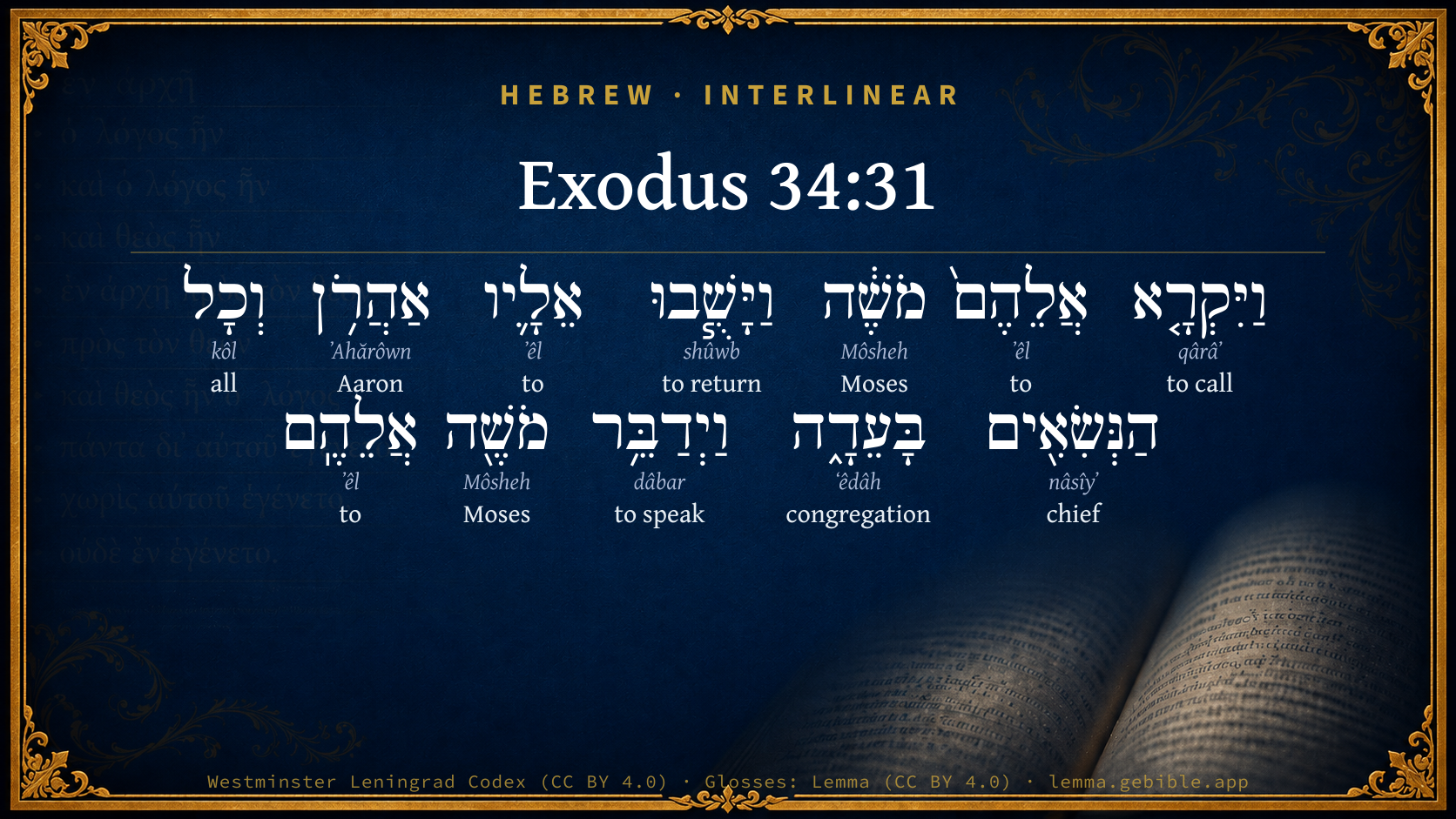
Hebrew (Westminster Leningrad Codex) Exodus 34:31 appears in the Hebrew Old Testament. The text above is from the Westminster Leningrad Codex. Each word links to its Strong’s number, a concise gloss, and parsing drawn from the Open Scriptures Hebrew Bible morphology. Click any word for its full Brown-Driver-Briggs (BDB) entry.
Download image
Cite this verse

Exodus 34:31 (World English Bible). Public Domain. Lemma interlinear Bible study tool, https://lemma.gebible.app/v/exodus/34/31.

Show BibTeX & RIS
BibTeX
RIS
English Translation
Moses called to them, and Aaron and all the rulers of the congregation returned to him; and Moses spoke to them.
World English Bible · Public Domain
Download a study sheet

One document with this verse’s original text, its word-by-word gloss line, the meaning frame, cross-references with their text, attributed commentary, and full source and license credits — printable, and it pastes into notes with its structure intact.

This verse Autodidact and up

Study sheet (.html) Plain text (.txt)

A passage Seminary Student

Up to 50 verses in one chapter. A passage sheet keeps up to 6 commentary sources and 12 cross-references per verse, in the order this page ranks them, and says so on the sheet whenever that leaves anything out. Ask for a single verse and you get the Autodidact verse sheet above.

Everything on this page stays free to read, with no account — the sheet is a download of what is already on screen, not access to it.

Want to remove ads? Support Godless Engineer
Compare translations 3

The same verse in 3 English versions, stacked beneath the original-language interlinear above. Click any original word for its lexicon entry.

Each is an independent rendering of the whole verse — the interlinear is not word-aligned to these translations.

Highlighted words mark where these versions differ — a whole-verse word diff, not a word-by-word alignment.

  • World English Bible Public Domain
    Moses called to them, and Aaron and all the rulers of the congregation returned to him; and Moses spoke to them.
  • King James Version Public Domain
    And Moses called unto them; and Aaron and all the rulers of the congregation returned unto him: and Moses talked with them.
  • unfoldingWord Literal Text CC BY-SA 4.0
    And Moses called to them, and Aaron and all of the leaders among the congregation returned to him. And Moses spoke to them.

unfoldingWord Literal Text — © unfoldingWord, licensed CC BY-SA 4.0. Word-aligned USFM3 via Door43 (git.door43.org/unfoldingWord/en_ult).

Versions to compare (up to 4)

3 of 4 selected

Show all 18 translations

Every available English version of this verse, each an independent rendering of the whole verse.

  • World English Bible Public Domain
    Moses called to them, and Aaron and all the rulers of the congregation returned to him; and Moses spoke to them.
  • Berean Standard Bible Public Domain
    But Moses called out to them; so Aaron and all the leaders of the congregation returned to him, and Moses spoke to them.
  • Majority Standard Bible Public Domain
    But Moses called out to them; so Aaron and all the leaders of the congregation returned to him, and Moses spoke to them.
  • King James Version Public Domain
    And Moses called unto them; and Aaron and all the rulers of the congregation returned unto him: and Moses talked with them.
  • American Standard Version (1901) Public Domain
    And Moses called unto them; and Aaron and all the rulers of the congregation returned unto him: and Moses spake to them.
  • Revised Version (1885) Public Domain
    And Moses called unto them; and Aaron and all the rulers of the congregation returned unto him: and Moses spake to them.
  • Geneva Bible (1599) Public Domain
    But Moses called them: and Aaron and all the chiefe of the congregation returned vnto him: and Moses talked with them.
  • Douay-Rheims (1899) Public Domain
    And being called by him, they returned, both Aaron and the rulers of the congregation. And after that he spoke to them.
  • Young's Literal Translation Public Domain
    And Moses calleth unto them, and Aaron and all the princes in the company return unto him, and Moses speaketh unto them;
  • Literal Standard Version CC BY-SA 4.0
    And Moses calls to them, and Aaron and all the princes in the congregation return to him, and Moses speaks to them;
  • Unlocked Literal Bible CC BY-SA 4.0
    But Moses called to them, and Aaron and all the leaders of the community came up to him. Then Moses spoke with them.
  • unfoldingWord Literal Text CC BY-SA 4.0
    And Moses called to them, and Aaron and all of the leaders among the congregation returned to him. And Moses spoke to them.
  • Darby Bible Public Domain
    And Moses called to them; and they turned to him, -- Aaron and all the principal men of the assembly; and Moses talked with them.
  • World Messianic Bible Public Domain
    Moses called to them, and Aaron and all the rulers of the congregation returned to him; and Moses spoke to them.
  • Webster's Bible Public Domain
    And Moses called to them; and Aaron and all the rulers of the congregation returned to him; and Moses talked with them.
  • Free Bible Version CC BY-SA 4.0
    But Moses called out to them, so Aaron and all the community leaders went over to him, and he talked with them.
  • Bible in Basic English Public Domain
    Then Moses sent for them; and Aaron, with the chiefs of the people, came to him; and Moses had talk with them.
  • JPS Tanakh (1917) Public Domain
    And Moses called unto them; and Aaron and all the rulers of the congregation returned unto him; and Moses spoke to them.

Literal Standard Version (2020), Covenant Press — licensed CC BY-SA 4.0. Text via the HelloAO Bible API (eBible.org). Unlocked Literal Bible (unfoldingWord) — licensed CC BY-SA 4.0. Text via the HelloAO Bible API (eBible.org). unfoldingWord Literal Text — © unfoldingWord, licensed CC BY-SA 4.0. Word-aligned USFM3 via Door43 (git.door43.org/unfoldingWord/en_ult). Free Bible Version, Dr. Jonathan Gallagher — licensed CC BY-SA 4.0. Text via the HelloAO Bible API (eBible.org).

Word by word

More ways to search: Search by grammar → Find every occurrence → Compare this word →

Practice this passage: Drill this verse → Learn its vocabulary →

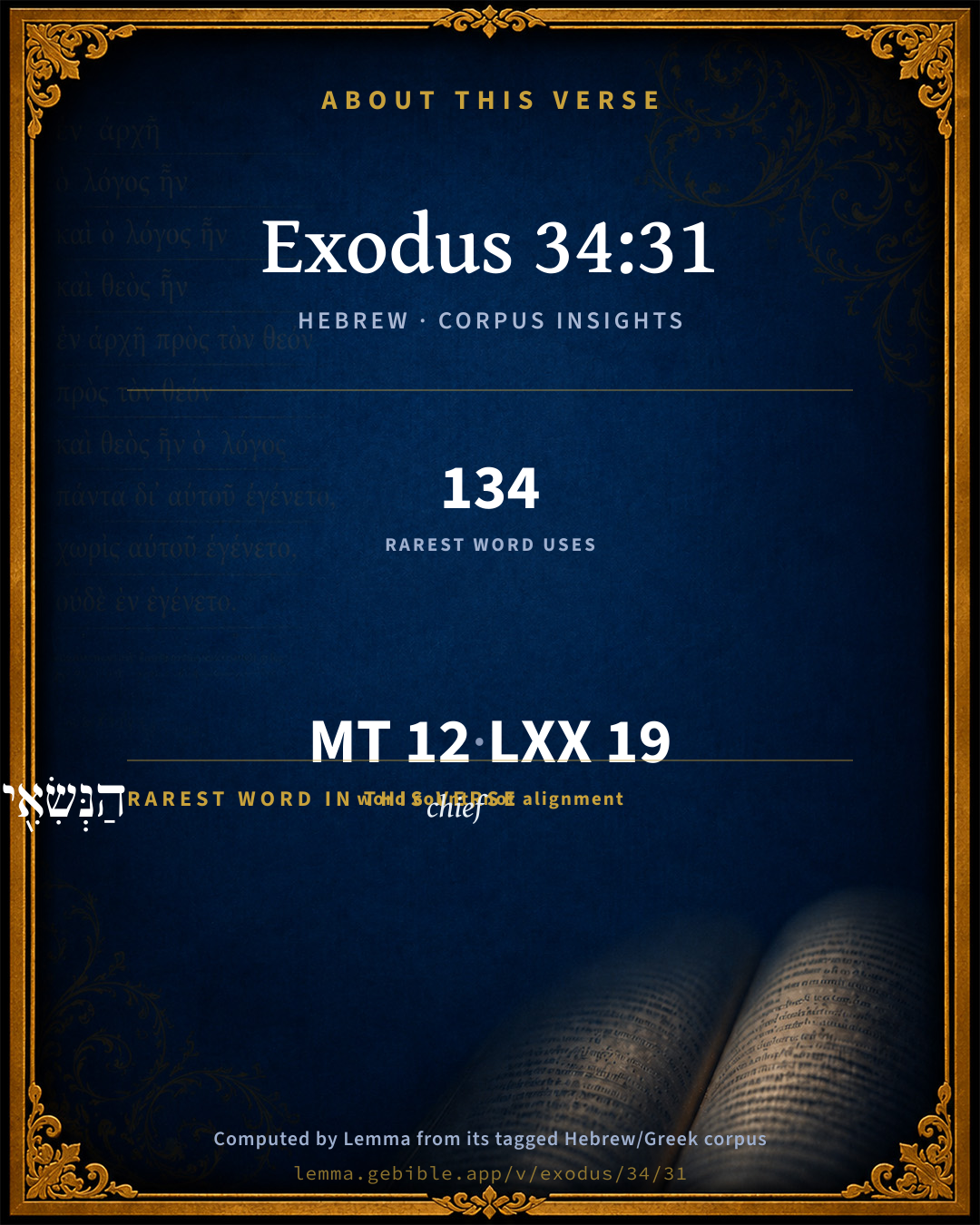
הַנְּשִׂאִ֖ים
nâsîyʼ
H5387
“the · chiefs”
Particle, Definite Article + Noun, Common, Masculine, Plural, Absolute
Part of Speech
Particle + Noun
Type
Common
Gender
Masculine
Number
Plural
State
Absolute
Full BDB Definition

Origin: from H5375

TWOT: 1421b , 1421c

one lifted up, chief, prince, captain, leader - rising mist, vapour
  1. וַיִּקְרָ֤א qârâʼ H7121 “and · to call” Conjunction + Verb, Qal, Sequential Imperfect, 3rd Person, Masculine, Singular
  2. אֲלֵהֶם֙ ʼêl H413 “to · them” Preposition + Suffix, Personal, 3rd Person, Masculine, Plural
  3. מֹשֶׁ֔ה Môsheh H4872 “Moses” Noun, Proper
  4. וַיָּשֻׁ֧בוּ shûwb H7725 “and · to return” Conjunction + Verb, Qal, Sequential Imperfect, 3rd Person, Masculine, Plural
  5. אֵלָ֛יו ʼêl H413 “to · him” Preposition + Suffix, Personal, 3rd Person, Masculine, Singular
  6. אַהֲרֹ֥ן ʼAhărôwn H175 “Aaron” Noun, Proper
  7. וְכָל kôl H3605 “and · all of” Conjunction + Noun, Common, Masculine, Singular, Construct
  8. בָּעֵדָ֑ה ʻêdâh H5712 “in/at the · congregation” Preposition, Determined + Noun, Common, Feminine, Singular, Absolute
  9. וַיְדַבֵּ֥ר dâbar H1696 “and · to speak” Conjunction + Verb, Piel, Sequential Imperfect, 3rd Person, Masculine, Singular
  10. מֹשֶׁ֖ה Môsheh H4872 “Moses” Noun, Proper
  11. אֲלֵהֶֽם ʼêl H413 “to · them” Preposition + Suffix, Personal, 3rd Person, Masculine, Plural

About this verse

These counts appear in no published source. They are computed here, from the morphology-tagged text and Lemma’s own curated glosses. What Lemma adds →

12
words
9
distinct lemmas
Pentateuch
section

Grammatical profile

  • 3 verbs
  • 6 nouns
  • 3 prepositions

Verb forms

  • וַיִּקְרָ֤א Qal · Sequential Imperfect
  • וַיָּשֻׁ֧בוּ Qal · Sequential Imperfect
  • וַיְדַבֵּ֥ר Piel · Sequential Imperfect

Repetition

Words recur within this verse — often emphatic in Hebrew:

  • מֹשֶׁ֔ה Moses H4872 ×2
  • אֲלֵהֶם֙ to H413 ×3

Hebrew & Septuagint length

In English translation the verse runs 21 words from the Hebrew and 21 from the Septuagint (LXX English) — the same length.

A rough comparison of the two English renderings, which tokenize alike — not a word-level alignment.

Word counts can differ between the Hebrew and the Greek without any difference in meaning — e.g. the Hebrew direct-object marker אֵת has no separate Greek word, and Greek often adds the article ὁ.

In the original languages it is 12 Hebrew tokens and 19 Greek tokens — but the two are counted differently (Hebrew bundles its prefixes and suffixes into one token; the Greek is in lemma form), so that isn’t a like-for-like length.

Cross-references

4

Topical passages linked to Exodus 34:31 in the Treasury of Scripture Knowledge — connected by theme and wording, ordered by reader-vote popularity; previews shown in the World English Bible.

  • Exodus 3:15 God said moreover to Moses, "You shall tell the children of Israel this, 'Yahweh, the God of your fathers, the God of Abraham, the God of Isaac, and the God of Jacob, has sent me to you.' This is my name forever, and this is my memorial to all generations.
  • Exodus 24:1–3 He said to Moses, "Come up to Yahweh, you, and Aaron, Nadab, and Abihu, and seventy of the elders of Israel; and worship from a distance.
  • Genesis 45:3 Joseph said to his brothers, "I am Joseph! Does my father still live?" His brothers couldn't answer him; for they were terrified at his presence.
  • Genesis 45:15 He kissed all his brothers, and wept on them. After that his brothers talked with him.

Cross-references courtesy of OpenBible.info (CC BY 4.0).

Hebrew and Greek witnesses Masoretic Hebrew ↔ Greek Septuagint

The same verse in the two great witnesses to the Old Testament, shown verse-for-verse.

These are two independent witnesses, not word-aligned to each other, and the Septuagint is shown in lemma (dictionary) form.

Hebrew Exodus 34:31 Masoretic · Westminster Leningrad Codex

וַיִּקְרָ֤א אֲלֵהֶם֙ מֹשֶׁ֔ה וַיָּשֻׁ֧בוּ אֵלָ֛יו אַהֲרֹ֥ן וְכָל הַנְּשִׂאִ֖ים בָּעֵדָ֑ה וַיְדַבֵּ֥ר מֹשֶׁ֖ה אֲלֵהֶֽם

Moses called to them, and Aaron and all the rulers of the congregation returned to him; and Moses spoke to them.

World English Bible · Public Domain

Greek LXX Exodus 34:31 Septuagint · lemma form

καί καλέω αὐτός μωυσῆς καί ἐπιστρέφω πρός αὐτός ααρων καί πᾶς ὁ ἄρχων ὁ συναγωγή καί λαλέω αὐτός μωυσῆς

And Moses called them, and Aaron and all the rulers of the synagogue turned towards him, and Moses spoke to them.

LXX2012 (modern English Septuagint) · Public Domain

Hebrew: Westminster Leningrad Codex (CC BY 4.0). Greek: Septuagint (public domain); English from LXX2012 (modern English Septuagint) (Public Domain). How the Septuagint differs from the Hebrew →

Targum (Aramaic paraphrase)

2

The Targum is the ancient Jewish Aramaic paraphrase of the Hebrew Scriptures — an interpretive translation, not the Hebrew text itself. Onkelos (literal) and Pseudo-Jonathan (expansive) render the Torah, and Jonathan the Prophets. Coverage is partial: where no permissively-licensed English translation exists for a verse, only the Aramaic is shown. This is verse-level text, not a word-by-word alignment to the Hebrew.

  1. Targum Onkelos Torah (Genesis–Deuteronomy)
    וּקְרָא לְהוֹן משֶׁה וְתָבוּ לְוָתֵהּ אַהֲרֹן וְכָל רַבְרְבַיָא בִּכְנִשְׁתָּא וּמַלֵל משֶׁה עִמְהוֹן:

    (no public-domain English translation for this verse)

    Targum Onkelos — Aramaic: “Onkelos Genesis” (public domain); “Onkelos Exodus” (public domain); “Onkelos Leviticus” (public domain); “Onkelos Numbers” (public domain); “Onkelos Deuteronomy” (public domain). English: “Sefaria Community Translation” (CC0 1.0 (public-domain dedication)); “J.W. Etheridge. The Targums of Onkelos and Jonathan Ben Uzziel on the Pentateuch. London: Longmans, Green, 1862” (public domain). Text via Sefaria.

  2. Targum Pseudo-Jonathan Torah (Genesis–Deuteronomy)
    וּקְרָא לְהוֹן משֶׁה וְתָבוּ לְוָותֵיהּ אַהֲרן וְכָל רַבְרְבַיָא דְאִתְמְנוּן נְגוֹדִין בִּכְנִישְׁתָּא וּמַלֵיל משֶׁה עִמְהוֹן

    And Mosheh called to them and Aharon, and all the princes who had been appointed chiefs in the congregation returned, and Mosheh conversed with them.

    Targum Pseudo-Jonathan — Aramaic: “Targum Jonathan on Genesis” (public domain); “Targum Jonathan on Exodus” (public domain); “Targum Jonathan on Leviticus” (public domain); “Targum Jonathan on Numbers” (public domain); “Targum Jonathan on Deuteronomy” (public domain). English: “The Targum of Jonathan ben Uzziel, trans. J. W. Etheridge, London, 1862” (public domain). Text via Sefaria.

Commentary

Notes on Exodus 34:31 from classic Christian and Jewish commentators (each source and its license shown beneath its notes). The classic Christian expositions comment on the surrounding passage and are grouped to its opening verse, so a note may address several verses; the Jewish commentaries on the Tanakh (Rashi and others) are per-verse, so they appear only where the commentator wrote on this verse.

Lemma curates 59 commentaries, every one of them public domain or Creative Commons licensed, each selected and text-cleaned for this edition rather than reprinted as found. About our sources →

Trapp's Complete Commentary

John Trapp

Exo 34:31 And Moses called unto them; and Aaron and all the rulers of the congregation returned unto him: and Moses talked with them.

Ver. 31. And Moses called unto them.] Having first vailed his face, as in Exo 34:33.

John Trapp, A Commentary or Exposition upon All the Books of the Old and New Testament (1647–1656) — public domain. Text from a community e-Sword module.

The Cambridge Bible for Schools and Colleges

gen. ed. J. J. S. Perowne

31. the rulers in the congregation] See on Exo_16:22.

The Cambridge Bible for Schools and Colleges (gen. ed. J. J. S. Perowne; Cambridge University Press, 1878–1918) — public domain. Text from a community e-Sword module.

John Gill's Exposition

But when Moses went in before the Lord to speak with him,.... Went into the tabernacle to converse with him, to pray unto him, and inquire about any matter of difficulty respecting the people of Israel he was concerned for, which he often did:

he took the vail off until he came out: and so when men are truly converted, and turn to the Lord, the vail of darkness and unbelief is removed, and the true light shines, in which they see things in another light than they did before; and when they come into his presence, they come with hearts opened and unveiled, all things being naked and open to him with whom they have to do; and particularly saints under the Gospel dispensation, with an open face, as in a glass, behold the glory of the Lord; and when they get to heaven, they will then see face to face, and know as they are known, Co2 3:16,

and he came out, and spake unto the children of Israel that which he was commanded; this respects not the present time of his coming down from the mount, or out of the tabernacle with the law and commands now given, for these he had already declared; but after times, and all such times when he went in to the Lord to inquire of him his mind and will concerning certain things, in which the people wanted information, when, upon his return, he acquainted them with whatsoever the Lord ordered to be done.

John Gill's Exposition of the Whole Bible (1746–1763) — public domain (CC PDM 1.0). Text via the HelloAO Bible API.

Matthew Poole's English Annotations

Unto him, to the tabernacle, which was still at a distance from the camp, though afterwards, God being reconciled, it was set up in the camp, Exo 40:34.

Matthew Poole's English Annotations on the Holy Bible (1683–1685) — public domain. Text from a community e-Sword/MySword module.

The Pulpit Commentary

Moses called unto them. Moses bade them approach no doubt assured them that there was no cause for fear (cf. Luk_24:38, Luk_24:39) and by his manner and familiar voice dispelled their fears and reassured them. Aaron and all the rulers returned unto him. Apparently, in their alarm they had drawn back. Being re-assured, they "returned."

The Pulpit Commentary (1880–1919), ed. H.D.M. Spence-Jones & Joseph S. Exell — public domain. Text from a community e-Sword module.

Rashi

Rabbi Shlomo Yitzchaki (Rashi)

הנשאים בעדה THE PRINCES IN THE CONGREGATION — is the same as the more usual expression נשיאי העדה, the princes of the congregation.

וידבר משה אלהם AND MOSES SPOKE TO THEM the message of the Almighty. This whole section (i. e. all the verbs in it) denotes frequentative action (thus וידבר means “Moses used to say”, ויקרא meant “He used to call”, נגשו means “they used to come near” etc).

Rashi on the Tanakh — English translations: “The Judaica Press complete Tanach with Rashi, translated by A. J. Rosenberg” (CC BY 4.0); “Pentateuch with Rashi's commentary by M. Rosenbaum and A.M. Silbermann, 1929-1934” (public domain); “The Metsudah Tanach series, Lakewood, N.J” (CC BY 4.0); and “The Book of Joshua, Metsudah Publications, 1997” (CC BY 4.0). Text via Sefaria.

Ramban (Nachmanides)

Rabbi Moshe ben Nachman (Ramban / Nachmanides)

VA’YEDABEIR MOSHEH’ (AND MOSES SPOKE) TO THEM. “This whole section denotes a [continuing] present action [thus making the sense of the verbs: ‘and Moses used to speak…’ ‘and they used to come near…’]. 32. AND AFTERWARDS ALL THE CHILDREN OF ISRAEL CAME NIGH. After Moses had taught the elders, he would again teach the section or the specific law to the Israelites.” All this is Rashi’s language. But it is not so [that this section describes a continuing occurrence — whenever Moses spoke to Israel]. Rather, Scripture is stating that when all Israel went forth to meet him [upon his descent from the mountain with the second Tablets], they saw the beams of glory streaming from his face, and they were afraid to come nigh him and stepped backwards. Perhaps they thought that the Glory of G-d was there, or that the angels of Him on high were with him, and they feared lest the Eternal break forth upon them. Then Moses called unto them; and Aaron and all the princes, who walked before them returned unto him, and Moses spoke to them words of peace, and told them the tidings of the forgiveness of their sin and of the Tablets he brought down. And afterwards when all the children of Israel saw that he was speaking with the princes of the congregation, they all came near to him, and then he commanded them all that the Eternal had spoken with him in Mount Sinai, these being the second Ten Commandments that He gave him, and all that was said to him from the beginning of, Observe thou that which I am commanding thee this day, to the end of the section; for he told them that G-d had commanded him to make a covenant with them after the tenor of these words., Verse 27. Scripture, however, shortened the account and narrated the matter in general terms. Then Scripture says that when Moses had done speaking with them the whole subject mentioned, he put a veil upon his face, for he understood that upon his return [from the mountain] the skin of his face sent forth beams, or perhaps they told it to him. Finally, after having told the account of the events of that day, Scripture states, But when Moses went in before the Eternal etc. It is this part of Scripture that represents the continuing action, meaning that so did Moses conduct himself with them all the days. section (from Verses 31 to 35) represents a frequentative action. According to Ramban this applies only to Verses 34-35.Vayakheil

Ramban (Nachmanides) on the Tanakh — English translation: “Commentary on the Torah by Ramban (Nachmanides). Translated and annotated by Charles B. Chavel. New York, Shilo Pub. House, 1971-1976” (CC BY 4.0). Text via Sefaria.

Lesson kit

Teaching starters — assembled from the data on this page, not authored interpretation. Every prompt links to the verse data it draws on. Edit before teaching.

Exodus, in the Pentateuch, opens this verse with 12 words (9 distinct Hebrew lemmas). Its most distinctive word is nâsîyʼ (“chief”). A historical commentator’s framing appears above. Read the whole chapter for the surrounding context.

Discussion questions

  1. The word nâsîyʼ carries the sense “chief.” How does it shape the verse?
  2. How does Exodus 3:15, which shares this passage’s theme, read alongside this verse?
  3. What does the repetition of “Moses” (2× in this one verse) do in this verse?
  4. These translations render this verse differently. What is at stake in choosing one wording over another?
  5. «וַיִּקְרָ֤א» is a Qal Sequential Imperfect verb. How does that grammatical form shape the action described?
  6. Compare how Trapp's Complete Commentary and The Cambridge Bible for Schools and Colleges read this verse. Where do they agree or differ?

Things to notice

Reading settings

Reading text

Shown beneath each verse's original-language words.

Old Testament
Old Testament edition

Read the OT as the Masoretic Hebrew (MT) or the Greek Septuagint (LXX).

English shown for the Greek Septuagint (in the Hebrew ↔ Greek comparison).

Comparing translations? Open the Compare panel on any verse page to stack up to four side by side.