Ezekiel 45:22

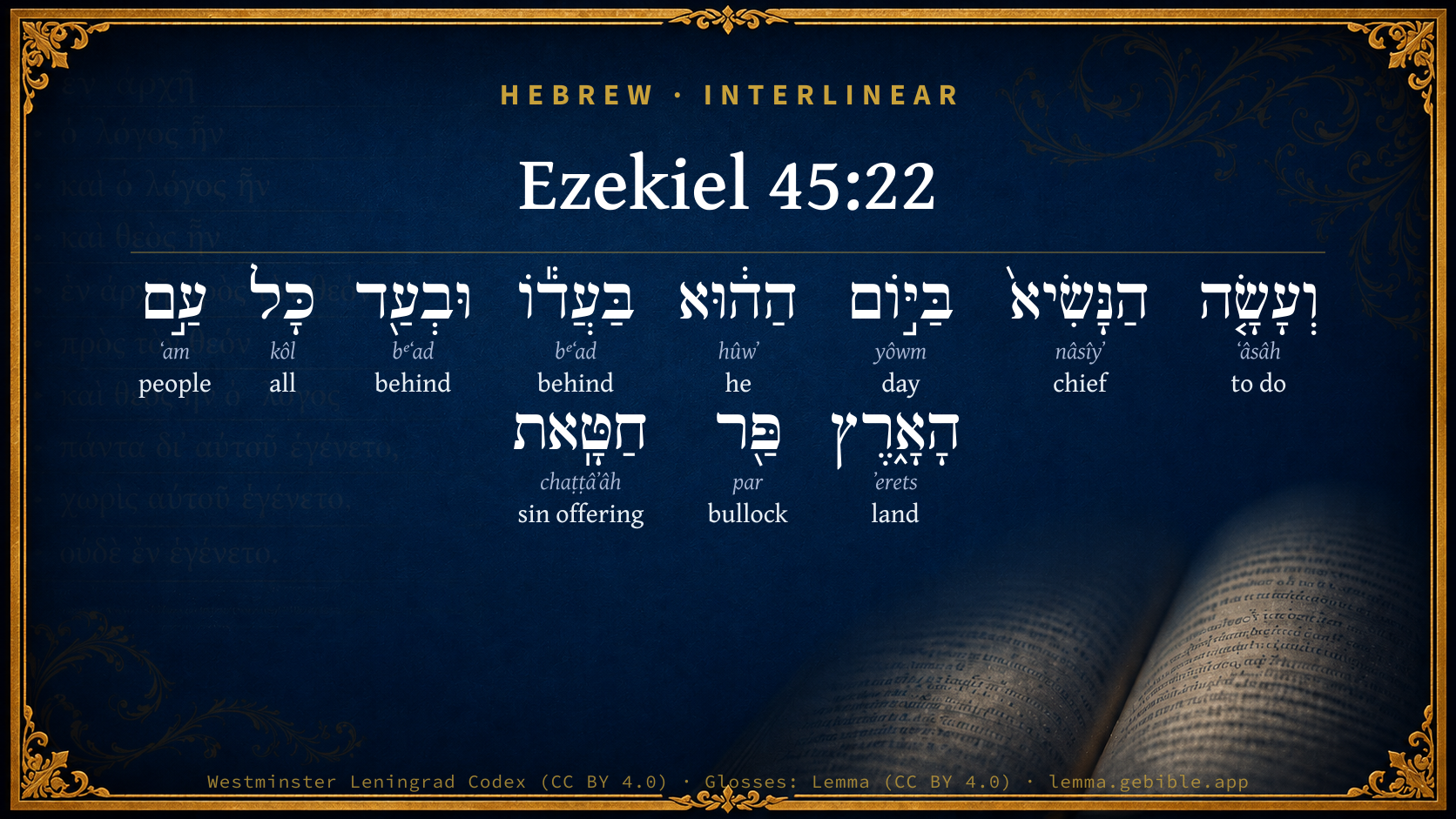
Hebrew (Westminster Leningrad Codex) Ezekiel 45:22 appears in the Hebrew Old Testament. The text above is from the Westminster Leningrad Codex. Each word links to its Strong’s number, a concise gloss, and parsing drawn from the Open Scriptures Hebrew Bible morphology. Click any word for its full Brown-Driver-Briggs (BDB) entry.
Download image
Cite this verse

Ezekiel 45:22 (World English Bible). Public Domain. Lemma interlinear Bible study tool, https://lemma.gebible.app/v/ezekiel/45/22.

Show BibTeX & RIS
BibTeX
RIS
English Translation
On that day shall the prince prepare for himself and for all the people of the land a bull for a sin-offering.
World English Bible · Public Domain
Download a study sheet

One document with this verse’s original text, its word-by-word gloss line, the meaning frame, cross-references with their text, attributed commentary, and full source and license credits — printable, and it pastes into notes with its structure intact.

This verse Autodidact and up

Study sheet (.html) Plain text (.txt)

A passage Seminary Student

Up to 50 verses in one chapter. A passage sheet keeps up to 6 commentary sources and 12 cross-references per verse, in the order this page ranks them, and says so on the sheet whenever that leaves anything out. Ask for a single verse and you get the Autodidact verse sheet above.

Everything on this page stays free to read, with no account — the sheet is a download of what is already on screen, not access to it.

Want to remove ads? Support Godless Engineer
Compare translations 3

The same verse in 3 English versions, stacked beneath the original-language interlinear above. Click any original word for its lexicon entry.

Each is an independent rendering of the whole verse — the interlinear is not word-aligned to these translations.

Highlighted words mark where these versions differ — a whole-verse word diff, not a word-by-word alignment.

  • World English Bible Public Domain
    On that day shall the prince prepare for himself and for all the people of the land a bull for a sin-offering.
  • King James Version Public Domain
    And upon that day shall the prince prepare for himself and for all the people of the land a bullock for a sin offering.
  • unfoldingWord Literal Text CC BY-SA 4.0
    On that day, the prince will prepare for himself and for all the people of the land a bull as a sin offering.

unfoldingWord Literal Text — © unfoldingWord, licensed CC BY-SA 4.0. Word-aligned USFM3 via Door43 (git.door43.org/unfoldingWord/en_ult).

Versions to compare (up to 4)

3 of 4 selected

Show all 18 translations

Every available English version of this verse, each an independent rendering of the whole verse.

  • World English Bible Public Domain
    On that day shall the prince prepare for himself and for all the people of the land a bull for a sin-offering.
  • Berean Standard Bible Public Domain
    On that day the prince shall provide a bull as a sin offering for himself and for all the people of the land.
  • Majority Standard Bible Public Domain
    On that day the prince shall provide a bull as a sin offering for himself and for all the people of the land.
  • King James Version Public Domain
    And upon that day shall the prince prepare for himself and for all the people of the land a bullock for a sin offering.
  • American Standard Version (1901) Public Domain
    And upon that day shall the prince prepare for himself and for all the people of the land a bullock for a sin-offering.
  • Revised Version (1885) Public Domain
    And upon that day shall the prince prepare for himself and for all the people of the land a bullock for a sin offering.
  • Geneva Bible (1599) Public Domain
    And vpon that day, shall the prince prepare for him selfe, and for all the people of the lande, a bullocke for a sinne offring.
  • Douay-Rheims (1899) Public Domain
    And the prince on that day shall offer for himself, and for all the people of the land, a calf for sin.
  • Young's Literal Translation Public Domain
    And the prince hath prepared on that day, for himself, and for all the people of the land, a bullock, a sin-offering.
  • Literal Standard Version CC BY-SA 4.0
    And the prince has prepared on that day, for himself, and for all the people of the land, a bullock, a sin-offering.
  • Unlocked Literal Bible CC BY-SA 4.0
    On that day, the prince will prepare for himself and for all the people of the land a bull as a sin offering.
  • unfoldingWord Literal Text CC BY-SA 4.0
    On that day, the prince will prepare for himself and for all the people of the land a bull as a sin offering.
  • Darby Bible Public Domain
    And upon that day shall the prince offer for himself and for all the people of the land a bullock for a sin-offering.
  • World Messianic Bible Public Domain
    On that day the prince shall prepare for himself and for all the people of the land a bull for a sin offering.
  • Webster's Bible Public Domain
    And upon that day shall the prince prepare for himself and for all the people of the land a bullock for a sin-offering.
  • Free Bible Version CC BY-SA 4.0
    On that day the prince will provide a bull as a sin offering for himself and for everyone in the country.
  • Bible in Basic English Public Domain
    And on that day the ruler is to give for himself and for all the people of the land an ox for a sin-offering.
  • JPS Tanakh (1917) Public Domain
    And upon that day shall the prince prepare for himself and for all the people of the land a bullock for a sin-offering.

Literal Standard Version (2020), Covenant Press — licensed CC BY-SA 4.0. Text via the HelloAO Bible API (eBible.org). Unlocked Literal Bible (unfoldingWord) — licensed CC BY-SA 4.0. Text via the HelloAO Bible API (eBible.org). unfoldingWord Literal Text — © unfoldingWord, licensed CC BY-SA 4.0. Word-aligned USFM3 via Door43 (git.door43.org/unfoldingWord/en_ult). Free Bible Version, Dr. Jonathan Gallagher — licensed CC BY-SA 4.0. Text via the HelloAO Bible API (eBible.org).

Word by word

More ways to search: Search by grammar → Find every occurrence → Compare this word →

Practice this passage: Drill this verse → Learn its vocabulary →

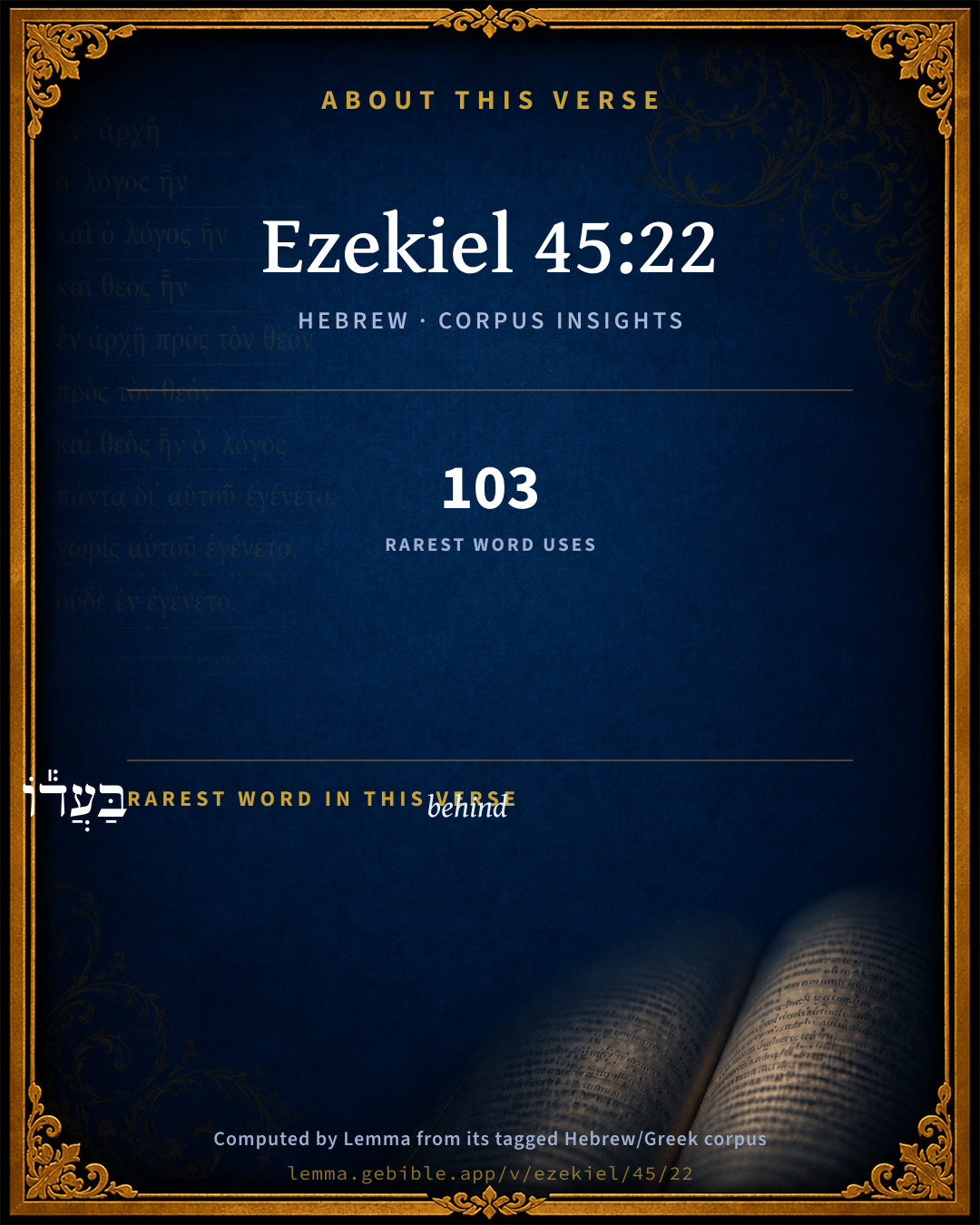
בַּעֲד֕וֹ
bᵉʻad
H1157
“behind · him”
Preposition + Suffix, Personal, 3rd Person, Masculine, Singular
Part of Speech
Preposition
Full BDB Definition

Origin: from H5704 with prepositional prefix

TWOT: 258a

behind, through, round about, on behalf of, away from, about - through (of action) - behind (with verbs of shutting) - about (with verbs of fencing) - on behalf of (metaphorically especially with Hithpael)
  1. וְעָשָׂ֤ה ʻâsâh H6213 “and · to do” Conjunction + Verb, Qal, Sequential Perfect, 3rd Person, Masculine, Singular
  2. הַנָּשִׂיא֙ nâsîyʼ H5387 “the · chief” Particle, Definite Article + Noun, Common, Masculine, Singular, Absolute
  3. בַּיּ֣וֹם yôwm H3117 “in/at the · day” Preposition, Determined + Noun, Common, Masculine, Singular, Absolute
  4. הַה֔וּא hûwʼ H1931 “the · he” Particle, Definite Article + Pronoun, Personal, 3rd Person, Masculine, Singular
  5. וּבְעַ֖ד bᵉʻad H1157 “and · behind” Conjunction + Preposition
  6. כָּל kôl H3605 “all of” Noun, Common, Masculine, Singular, Construct
  7. עַ֣ם ʻam H5971 “people of” Noun, Common, Masculine, Singular, Construct
  8. הָאָ֑רֶץ ʼerets H776 “the · land” Particle, Definite Article + Noun, Common, Both, Singular, Absolute
  9. פַּ֖ר par H6499 “bullock of” Noun, Common, Masculine, Singular, Construct
  10. חַטָּֽאת chaṭṭâʼâh H2403 “sin offering” Noun, Common, Feminine, Singular, Absolute

About this verse

These counts appear in no published source. They are computed here, from the morphology-tagged text and Lemma’s own curated glosses. What Lemma adds →

11
words
10
distinct lemmas
Prophets
section

Grammatical profile

  • 1 verb
  • 7 nouns
  • 1 pronoun
  • 2 prepositions

Verb forms

  • וְעָשָׂ֤ה Qal · Sequential Perfect

Repetition

A word recurs within this verse — often emphatic in Hebrew:

  • בַּעֲד֕וֹ behind H1157 ×2

Hebrew & Septuagint length

In English translation the verse runs 22 words from the Hebrew and 26 from the Septuagint (LXX English) — closely comparable.

A rough comparison of the two English renderings, which tokenize alike — not a word-level alignment.

Word counts can differ between the Hebrew and the Greek without any difference in meaning — e.g. the Hebrew direct-object marker אֵת has no separate Greek word, and Greek often adds the article ὁ.

Cross-references

4

Topical passages linked to Ezekiel 45:22 in the Treasury of Scripture Knowledge — connected by theme and wording, ordered by reader-vote popularity; previews shown in the World English Bible.

  • Leviticus 4:14 when the sin in which they have sinned is known, then the assembly shall offer a young bull for a sin offering, and bring it before the Tent of Meeting.
  • Matthew 20:28 even as the Son of Man came not to be served, but to serve, and to give his life as a ransom for many."
  • Matthew 26:26–28 As they were eating, Jesus took bread, gave thanks for it, and broke it. He gave to the disciples, and said, "Take, eat; this is my body."
  • 2 Corinthians 5:21 For him who knew no sin he made to be sin on our behalf; so that in him we might become the righteousness of God.

Cross-references courtesy of OpenBible.info (CC BY 4.0).

Hebrew and Greek witnesses Masoretic Hebrew ↔ Greek Septuagint

The same verse in the two great witnesses to the Old Testament, shown verse-for-verse.

These are two independent witnesses, not word-aligned to each other, and the Septuagint is shown in lemma (dictionary) form.

Hebrew Ezekiel 45:22 Masoretic · Westminster Leningrad Codex

וְעָשָׂ֤ה הַנָּשִׂיא֙ בַּיּ֣וֹם הַה֔וּא בַּעֲד֕וֹ וּבְעַ֖ד כָּל עַ֣ם הָאָ֑רֶץ פַּ֖ר חַטָּֽאת

On that day shall the prince prepare for himself and for all the people of the land a bull for a sin-offering.

World English Bible · Public Domain

Greek LXX Ezekiel 45:22 Septuagint · lemma form

καί ποιέω ὁ ἀποἡγέομαι ἐν ἐκεῖνος ὁ ἡμέρα ὑπέρ ἑαυτοῦ καί ὁ οἶκος καί ὑπέρ πᾶς ὁ λαός ὁ γῆ μόσχος ὑπέρ ἁμαρτία

And the prince shall offer in that day a calf for a sin-offering for himself, and the house, and for all the people of the land.

LXX2012 (modern English Septuagint) · Public Domain

Hebrew: Westminster Leningrad Codex (CC BY 4.0). Greek: Septuagint (public domain); English from LXX2012 (modern English Septuagint) (Public Domain). How the Septuagint differs from the Hebrew →

Targum (Aramaic paraphrase)

1

The Targum is the ancient Jewish Aramaic paraphrase of the Hebrew Scriptures — an interpretive translation, not the Hebrew text itself. Onkelos (literal) and Pseudo-Jonathan (expansive) render the Torah, and Jonathan the Prophets. Coverage is partial: where no permissively-licensed English translation exists for a verse, only the Aramaic is shown. This is verse-level text, not a word-by-word alignment to the Hebrew.

  1. Targum Jonathan Prophets (Joshua–Malachi)
    וְיַעְבֵּיד רַבָּא בְּיוֹמָא הַהוּא חִלוֹפוֹהִי וַחֲלַף כָּל עַמָא דְאַרְעָא תּוֹרָא דְחַטָאתָא:

    (no public-domain English translation for this verse)

    Targum Jonathan — Aramaic: “Mikraot Gedolot” (public domain). English: “Sefaria Community Translation” (CC0 1.0 (public-domain dedication)); “London "Chaldee Paraphrase," 1871” (public domain). Text via Sefaria.

Commentary

Notes on Ezekiel 45:22 from classic Christian and Jewish commentators (each source and its license shown beneath its notes). The classic Christian expositions comment on the surrounding passage and are grouped to its opening verse, so a note may address several verses; the Jewish commentaries on the Tanakh (Rashi and others) are per-verse, so they appear only where the commentator wrote on this verse.

Lemma curates 59 commentaries, every one of them public domain or Creative Commons licensed, each selected and text-cleaned for this edition rather than reprinted as found. About our sources →

Trapp's Complete Commentary

John Trapp

Eze 45:22 And upon that day shall the prince prepare for himself and for all the people of the land a bullock [for] a sin offering.

Ver. 22. Shall the prince prepare.] See Eze 45:17.

John Trapp, A Commentary or Exposition upon All the Books of the Old and New Testament (1647–1656) — public domain. Text from a community e-Sword module.

Ellicott's Commentary for English Readers

(22) A bullock for a sin offering.—In Eze_45:21 the Passover is appointed quite in accordance with the Mosaic institution, although there is a peculiarity in the language of the original which has led some writers to infer, unnecessarily, that the feast was to be kept for seven weeks. But the sacrifices are in many respects quite different. Nothing is said of the Paschal lamb itself: but this may be because it was understood as a matter of course. The sin offering by the Mosaic law (Num_28:17; Num_28:22) was to be a he-goat for each day; here, a bullock for the first day, and a he-goat for the other days (Eze_45:23). The burnt offering by the law was to be two bullocks, a ram, and seven yearling lambs for each day; here, seven bullocks and seven rams. The meat offering was to be three-tenths of an ephah of meal, mixed with oil, for each bullock, two-tenths for each ram, and one-tenth for each lamb, or one and a half ephahs in all daily; here, a whole ephah for each victim, making in all fourteen ephahs daily and as many hins of oil (Eze_45:24). The offerings required here therefore are much richer than under the law.

A Bible Commentary for English Readers, edited by Charles John Ellicott (1878–1897) — public domain. Text from a community e-Sword module.

The Cambridge Bible for Schools and Colleges

gen. ed. J. J. S. Perowne

22. prepare for himself] provide, Eze_45:17.

The Cambridge Bible for Schools and Colleges (gen. ed. J. J. S. Perowne; Cambridge University Press, 1878–1918) — public domain. Text from a community e-Sword module.

John Gill's Exposition

And upon that day,.... The fourteenth day of the month Nisan; the first day of the passover, as Kimchi observes:

shall the prince prepare for himself, and for all the people of the land, a bullock for a sin offering; here everything again is new, as the above Jewish writer observes; no one circumstance according to the law of Moses; which shows that this respects Gospel times; when the law would be null and void, the types and shadows gone, and the antitype take place, Christ the sum of all; under the law, every family was to prepare a lamb for themselves; but here the prince is to prepare for himself, and all the people of the land; by that it was to be a lamb, here a bullock, and that for a sin offering; whereas not a bullock, but a goat, was used for a sin offering. Christ himself is this Prince, and who has prepared himself a sacrifice, even for himself, his church, which is mystically himself; and to make atonement for all those sins which he took upon himself by imputation, and made his own; even for all his chosen people, and for all their sins: of his preparing this sacrifice, both to be offered up, and to be held forth in the ministry of the word; see Gill on Eze 45:17, and who is very fitly represented by a bullock for his labouriousness and strength, in bearing the sins of his people, when he became an offering for them.

John Gill's Exposition of the Whole Bible (1746–1763) — public domain (CC PDM 1.0). Text via the HelloAO Bible API.

Matthew Poole's English Annotations

Upon that day; upon the fourteenth day, on which the passover was slain.

The prince; as before, Eze 45:17,18.

Prepare for himself, to expiate his own sins.

And for all the people: see Eze 45:17, where the same is found.

Matthew Poole's English Annotations on the Holy Bible (1683–1685) — public domain. Text from a community e-Sword/MySword module.

The Pulpit Commentary

The first day of the feast proper, i.e. the fourteenth, should be distinguished by the prince"s presenting, for himself and for all the people of the land, a bullock for a sin offering. That this was a deviation from the earlier Mosaic legislation in three particulars is apparent. In, the first place, the "sin offering" here prescribed was manifestly to take precedence of the Paschal feast proper, whereas in the Paschal festival of the so-called priest-code the daffy sacrifices were appointed to begin on the fifteenth after the Paschal lamb had been slain and eaten. (Lev_23:8) In the second place, the sin offering was to consist of a bullock instead of a he-goat as formerly. (Num_28:22) In the third place, it was not intended to be renewed on each of the seven following days of the feast, but was designed, by repeating the sacrifice of the first and seventh days, to connect these with the fourteenth, on which the feast proper opened.

The Pulpit Commentary (1880–1919), ed. H.D.M. Spence-Jones & Joseph S. Exell — public domain. Text from a community e-Sword module.

John Wesley's Explanatory Notes

Upon that day - Upon the fourteenth day, on which the passover was slain.

John Wesley, Explanatory Notes Upon the Whole Bible (1754–1765) — public domain. Text via the GEBible commentary corpus.

Rashi

Rabbi Shlomo Yitzchaki (Rashi)

And the prince shall make on that day, etc. Our Rabbis (Hag. 13a) said that they sought to suppress the Book of Ezekiel for his words contradicted the words of the Torah. Indeed, Hananiah the son of Hezekiah the son of Gurion is remembered for good, for he sat in his attic and expounded on it. But because of our iniquities, what he expounded on these sacrificeswhy a bull is brought on the fourteenth day of Nissanhas been lost to us. I say that perhaps he is dealing with the fourteenth of Nissan of the first Passover in which the fully erected House will be dedicated, and this bull will be brought in lieu of the calf born of cattle that Aaron offered up on the eighth of investiture (Lev. 9:2). [Scripture] tells us that if he will not have offered it up on the eighth day of investiture, he should offer it up on the fourteenth of Nissan in order that he should be initiated for the service before the Festival, for it is incumbent upon him [to bring] the sacrifices and the burnt offering of the appointed time, as is stated above (v. 17): “And the burnt offerings and the meal-offerings and the libations on the festivals...shall devolve on the prince, etc.”

Rashi on the Tanakh — English translations: “The Judaica Press complete Tanach with Rashi, translated by A. J. Rosenberg” (CC BY 4.0); “Pentateuch with Rashi's commentary by M. Rosenbaum and A.M. Silbermann, 1929-1934” (public domain); “The Metsudah Tanach series, Lakewood, N.J” (CC BY 4.0); and “The Book of Joshua, Metsudah Publications, 1997” (CC BY 4.0). Text via Sefaria.

Lesson kit

Teaching starters — assembled from the data on this page, not authored interpretation. Every prompt links to the verse data it draws on. Edit before teaching.

Ezekiel, in the Prophets, opens this verse with 11 words (10 distinct Hebrew lemmas). Its most distinctive word is bᵉʻad (“behind”). A historical commentator’s framing appears above. Read the whole chapter for the surrounding context.

Discussion questions

  1. How does “behind” (bᵉʻad) shape what this verse is saying?
  2. Leviticus 4:14 shares this passage’s theme. How do the two illuminate each other?
  3. “behind” occurs 2× in this one verse. What is the effect of the repetition?
  4. These translations render this verse differently. What is at stake in choosing one wording over another?
  5. The verb «וְעָשָׂ֤ה» is Qal Sequential Perfect. How does its form color the action?
  6. Reading how Trapp's Complete Commentary and Ellicott's Commentary for English Readers read this verse, where do the two commentators agree and where do they part?

Things to notice

Reading settings

Reading text

Shown beneath each verse's original-language words.

Old Testament
Old Testament edition

Read the OT as the Masoretic Hebrew (MT) or the Greek Septuagint (LXX).

English shown for the Greek Septuagint (in the Hebrew ↔ Greek comparison).

Comparing translations? Open the Compare panel on any verse page to stack up to four side by side.