
Ezekiel 16:22

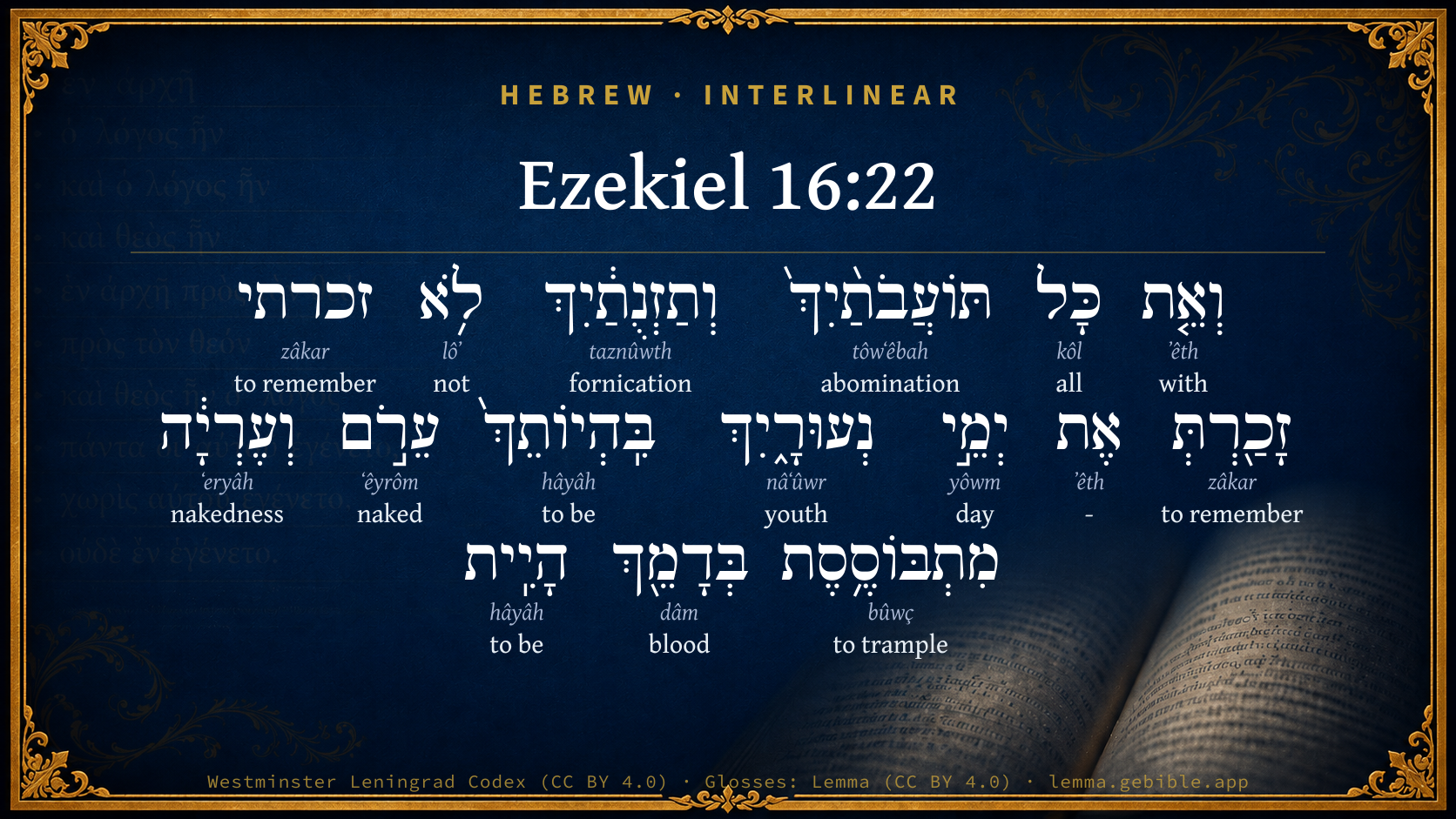
Hebrew (Westminster Leningrad Codex) Ezekiel 16:22 appears in the Hebrew Old Testament. The text above is from the Westminster Leningrad Codex. Each word links to its Strong’s number, a concise gloss, and parsing drawn from the Open Scriptures Hebrew Bible morphology. Click any word for its full Brown-Driver-Briggs (BDB) entry.
Download image
Cite this verse

Ezekiel 16:22 (World English Bible). Public Domain. Lemma interlinear Bible study tool, https://lemma.gebible.app/v/ezekiel/16/22.

Show BibTeX & RIS
BibTeX
RIS
English Translation
In all your abominations and your prostitution you have not remembered the days of your youth, when you were naked and bare, and was weltering in your blood.
World English Bible · Public Domain
Download a study sheet

One document with this verse’s original text, its word-by-word gloss line, the meaning frame, cross-references with their text, attributed commentary, and full source and license credits — printable, and it pastes into notes with its structure intact.

This verse Autodidact and up

Study sheet (.html) Plain text (.txt)

A passage Seminary Student

Up to 50 verses in one chapter. A passage sheet keeps up to 6 commentary sources and 12 cross-references per verse, in the order this page ranks them, and says so on the sheet whenever that leaves anything out. Ask for a single verse and you get the Autodidact verse sheet above.

Everything on this page stays free to read, with no account — the sheet is a download of what is already on screen, not access to it.

Want to remove ads? Support Godless Engineer
Compare translations 3

The same verse in 3 English versions, stacked beneath the original-language interlinear above. Click any original word for its lexicon entry.

Each is an independent rendering of the whole verse — the interlinear is not word-aligned to these translations.

Highlighted words mark where these versions differ — a whole-verse word diff, not a word-by-word alignment.

  • World English Bible Public Domain
    In all your abominations and your prostitution you have not remembered the days of your youth, when you were naked and bare, and was weltering in your blood.
  • King James Version Public Domain
    And in all thine abominations and thy whoredoms thou hast not remembered the days of thy youth, when thou wast naked and bare, and wast polluted in thy blood.
  • unfoldingWord Literal Text CC BY-SA 4.0
    In all your abominations and your acts of prostitution you have not thought about the days of your youth, when you were naked and bare as you thrashed about in your blood.

unfoldingWord Literal Text — © unfoldingWord, licensed CC BY-SA 4.0. Word-aligned USFM3 via Door43 (git.door43.org/unfoldingWord/en_ult).

Versions to compare (up to 4)

3 of 4 selected

Show all 18 translations

Every available English version of this verse, each an independent rendering of the whole verse.

  • World English Bible Public Domain
    In all your abominations and your prostitution you have not remembered the days of your youth, when you were naked and bare, and was weltering in your blood.
  • Berean Standard Bible Public Domain
    And in all your abominations and acts of prostitution, you did not remember the days of your youth when you were naked and bare, wallowing in your own blood.
  • Majority Standard Bible Public Domain
    And in all your abominations and acts of prostitution, you did not remember the days of your youth when you were naked and bare, wallowing in your own blood.
  • King James Version Public Domain
    And in all thine abominations and thy whoredoms thou hast not remembered the days of thy youth, when thou wast naked and bare, and wast polluted in thy blood.
  • American Standard Version (1901) Public Domain
    And in all thine abominations and thy whoredoms thou hast not remembered the days of thy youth, when thou wast naked and bare, and wast weltering in thy blood.
  • Revised Version (1885) Public Domain
    And in all thine abominations and thy whoredoms thou hast not remembered the days of thy youth, when thou wast naked and bare, and wast weltering in thy blood.
  • Geneva Bible (1599) Public Domain
    And in all thine abominations and whoredomes thou hast not remembred the dayes of thy youth, when thou wast naked and bare, and wast polluted in thy blood.
  • Douay-Rheims (1899) Public Domain
    And after all thy abominations, and fornications, thou hast not remembered the days of thy youth, when thou wast naked, and full of confusion, trodden under foot in thy own blood.
  • Young's Literal Translation Public Domain
    And with all thine abominations and thy whoredoms, Thou hast not remembered the days of thy youth, When thou wast naked and bare, Trodden down in thy blood thou wast!
  • Literal Standard Version CC BY-SA 4.0
    And with all your abominations and your whoredoms, || You have not remembered the days of your youth, || When you were naked and bare, || You were trodden down in your blood!
  • Unlocked Literal Bible CC BY-SA 4.0
    In all your abominations and your acts of prostitution you have not thought about the days of your youth, when you were naked and bare as you thrashed about in your blood.
  • unfoldingWord Literal Text CC BY-SA 4.0
    In all your abominations and your acts of prostitution you have not thought about the days of your youth, when you were naked and bare as you thrashed about in your blood.
  • Darby Bible Public Domain
    And in all thine abominations and thy whoredoms thou hast not remembered the days of thy youth, when thou wast naked and bare, when thou wast weltering in thy blood.
  • World Messianic Bible Public Domain
    In all your abominations and your prostitution you have not remembered the days of your youth, when you were naked and bare, and were wallowing in your blood.
  • Webster's Bible Public Domain
    And in all thy abominations and thy deeds of lewdness thou hast not remembered the days of thy youth, when thou wast naked and bare, and wast polluted in thy blood.
  • Free Bible Version CC BY-SA 4.0
    While you were busy with all your disgusting practices and your prostitution, you forgot about the time when you were young, completely naked and lying there kicking in your own blood.
  • Bible in Basic English Public Domain
    And in all your disgusting and false behaviour you had no memory of your early days, when you were uncovered and without clothing, stretched out in your blood.
  • JPS Tanakh (1917) Public Domain
    And in all thine abominations and thy harlotries thou hast not remembered the days of thy youth, when thou wast naked and bare, and wast wallowing in thy blood.

Literal Standard Version (2020), Covenant Press — licensed CC BY-SA 4.0. Text via the HelloAO Bible API (eBible.org). Unlocked Literal Bible (unfoldingWord) — licensed CC BY-SA 4.0. Text via the HelloAO Bible API (eBible.org). unfoldingWord Literal Text — © unfoldingWord, licensed CC BY-SA 4.0. Word-aligned USFM3 via Door43 (git.door43.org/unfoldingWord/en_ult). Free Bible Version, Dr. Jonathan Gallagher — licensed CC BY-SA 4.0. Text via the HelloAO Bible API (eBible.org).

Word by word

More ways to search: Search by grammar → Find every occurrence → Compare this word →

Practice this passage: Drill this verse → Learn its vocabulary →

וְעֶרְיָ֔ה
ʻeryâh
H6181
“and · nakedness”
Conjunction + Noun, Common, Feminine, Singular, Absolute
Part of Speech
Conjunction + Noun
Type
Common
Gender
Feminine
Number
Singular
State
Absolute
Full BDB Definition

Origin: from H6172

TWOT: 1692c

nudity, nakedness
  1. וְאֵ֤ת ʼêth H854 “and · with” Conjunction + Preposition
  2. כָּל kôl H3605 “all of” Noun, Common, Masculine, Singular, Construct
  3. תּוֹעֲבֹתַ֨יִךְ֙ tôwʻêbah H8441 “abominations · your” Noun, Common, Feminine, Plural, Construct + Suffix, Personal, 2nd Person, Feminine, Singular
  4. וְתַזְנֻתַ֔יִךְ taznûwth H8457 “and · fornications · your” Conjunction + Noun, Common, Feminine, Plural, Construct + Suffix, Personal, 2nd Person, Feminine, Singular
  5. לֹ֥א lôʼ H3808 “not” Particle, Negative
  6. זכרתי zâkar H2142 “to remember” Verb, Qal, Perfect, 2nd Person, Feminine, Singular
  7. זָכַ֖רְתְּ zâkar H2142 “to remember” Verb, Qal, Perfect, 2nd Person, Feminine, Singular
  8. אֶת ʼêth H853 “-” Particle, Direct Object
  9. יְמֵ֣י yôwm H3117 “days of” Noun, Common, Masculine, Plural, Construct
  10. נְעוּרָ֑יִךְ nâʻûwr H5271 “youth · your” Noun, Common, Both, Plural, Construct + Suffix, Personal, 2nd Person, Feminine, Singular
  11. בִּֽהְיוֹתֵךְ֙ hâyâh H1961 “in/at · to be · you” Preposition + Verb, Qal, Infinitive Construct + Suffix, Personal, 2nd Person, Feminine, Singular
  12. עֵרֹ֣ם ʻêyrôm H5903 “naked” Adjective, Adjective, Masculine, Singular, Absolute
  13. מִתְבּוֹסֶ֥סֶת bûwç H947 “trampling” Verb, Hithpolel, Participle Active, Feminine, Singular, Absolute
  14. בְּדָמֵ֖ךְ dâm H1818 “in/at · blood · your” Preposition + Noun, Common, Masculine, Singular, Construct + Suffix, Personal, 2nd Person, Feminine, Singular
  15. הָיִֽית hâyâh H1961 “to be” Verb, Qal, Perfect, 2nd Person, Feminine, Singular

About this verse

These counts appear in no published source. They are computed here, from the morphology-tagged text and Lemma’s own curated glosses. What Lemma adds →

16
words
14
distinct lemmas
Prophets
section

Notable vocabulary

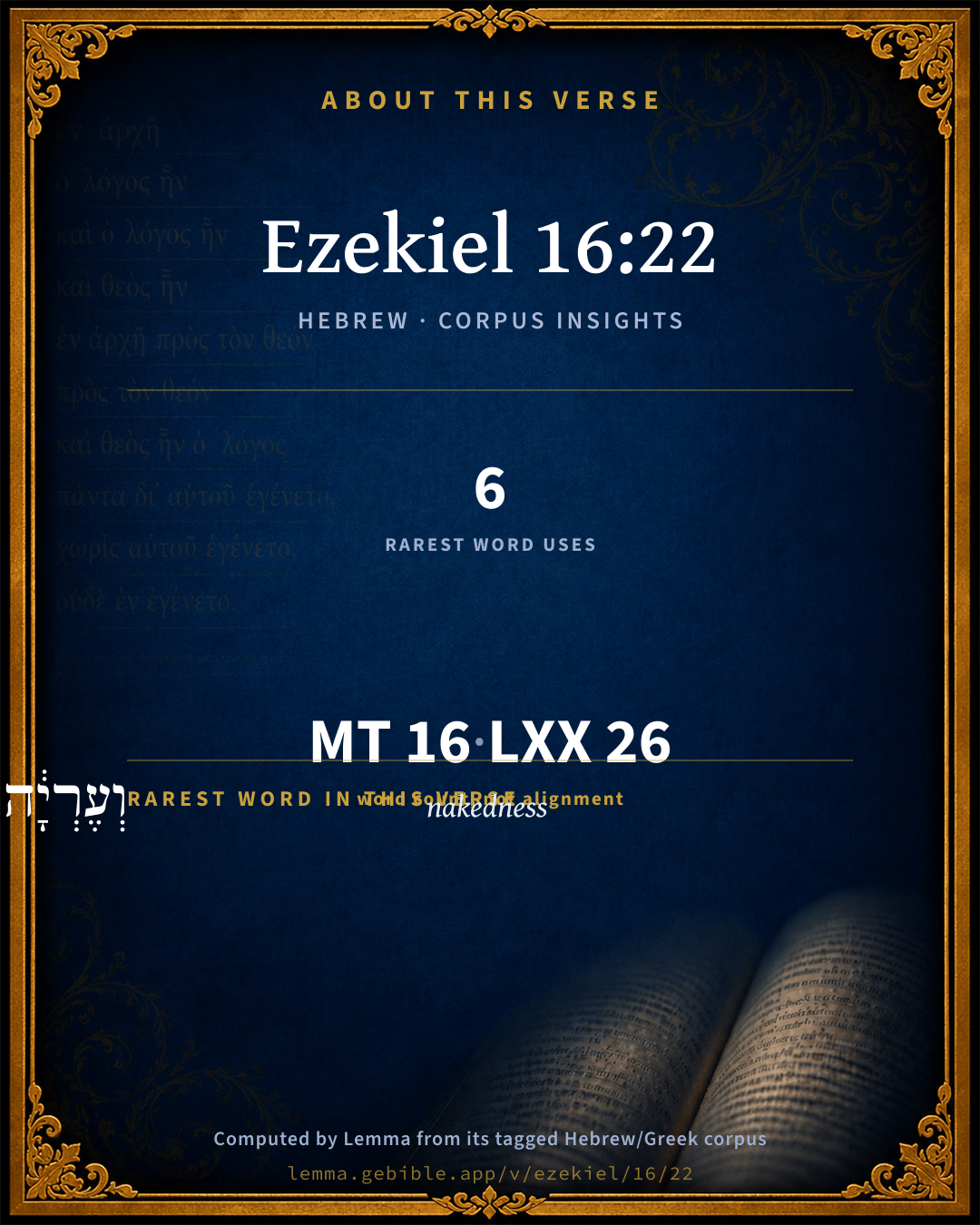
The rarest word here is וְעֶרְיָ֔ה nakedness H6181 — appearing just 6 times in the whole Hebrew Bible.

Shared distinctive vocabulary

וְעֶרְיָ֔ה nakedness H6181 occurs in 6 verses of the Hebrew Bible. Also found in:

Grammatical profile

  • 5 verbs
  • 7 nouns
  • 1 adjective
  • 1 preposition
  • 2 particles

Verb forms

  • זכרתי Qal · Perfect
  • זָכַ֖רְתְּ Qal · Perfect
  • בִּֽהְיוֹתֵךְ֙ Qal · Infinitive Construct
  • מִתְבּוֹסֶ֥סֶת Hithpolel · Participle Active
  • הָיִֽית Qal · Perfect

Repetition

Words recur within this verse — often emphatic in Hebrew:

  • זכרתי to remember H2142 ×2
  • בִּֽהְיוֹתֵךְ֙ to be H1961 ×2

Hebrew & Septuagint length

In English translation the verse runs 28 words from the Hebrew and 27 from the Septuagint (LXX English) — closely comparable.

A rough comparison of the two English renderings, which tokenize alike — not a word-level alignment.

Word counts can differ between the Hebrew and the Greek without any difference in meaning — e.g. the Hebrew direct-object marker אֵת has no separate Greek word, and Greek often adds the article ὁ.

In the original languages it is 16 Hebrew tokens and 26 Greek tokens — but the two are counted differently (Hebrew bundles its prefixes and suffixes into one token; the Greek is in lemma form), so that isn’t a like-for-like length.

Cross-references

6

Topical passages linked to Ezekiel 16:22 in the Treasury of Scripture Knowledge — connected by theme and wording, ordered by reader-vote popularity; previews shown in the World English Bible.

  • Jeremiah 2:2 Go, and cry in the ears of Jerusalem, saying, Thus says Yahweh, I remember for you the kindness of your youth, the love of your weddings; how you went after me in the wilderness, in a land that was not sown.
  • Ezekiel 16:43 Because you have not remembered the days of your youth, but have raged against me in all these things; therefore, behold, I also will bring your way on your head, says the Lord Yahweh: and you shall not commit this lewdness with all your abominations.
  • Hosea 11:1 "When Israel was a child, then I loved him, And called my son out of Egypt.
  • Ezekiel 16:3–7 and say, Thus says the Lord Yahweh to Jerusalem: Your birth and your birth is of the land of the Canaanite; the Amorite was your father, and your mother was a Hittite.
  • Ezekiel 16:60–63 Nevertheless I will remember my covenant with you in the days of your youth, and I will establish to you an everlasting covenant.
  • Hosea 2:3 Lest I strip her naked, And make her bare as in the day that she was born, And make her like a wilderness, And set her like a dry land, And kill her with thirst.

Cross-references courtesy of OpenBible.info (CC BY 4.0).

Hebrew and Greek witnesses Masoretic Hebrew ↔ Greek Septuagint

The same verse in the two great witnesses to the Old Testament, shown verse-for-verse.

These are two independent witnesses, not word-aligned to each other, and the Septuagint is shown in lemma (dictionary) form.

Hebrew Ezekiel 16:22 Masoretic · Westminster Leningrad Codex

וְאֵ֤ת כָּל תּוֹעֲבֹתַ֨יִךְ֙ וְתַזְנֻתַ֔יִךְ לֹ֥א זכרתי זָכַ֖רְתְּ אֶת יְמֵ֣י נְעוּרָ֑יִךְ בִּֽהְיוֹתֵךְ֙ עֵרֹ֣ם וְעֶרְיָ֔ה מִתְבּוֹסֶ֥סֶת בְּדָמֵ֖ךְ הָיִֽית

In all your abominations and your prostitution you have not remembered the days of your youth, when you were naked and bare, and was weltering in your blood.

World English Bible · Public Domain

Greek LXX Ezekiel 16:22 Septuagint · lemma form

οὗτος παρά πᾶς ὁ πορνεία σύ καί οὐ μιμνήσκω ὁ ἡμέρα ὁ νηπιότης σύ ὅτε εἰμί γυμνός καί ἀσχημονέω καί φύρομαι ἐν ὁ αἷμα σύ ζάω

This is beyond all your fornication, and you did not remember your infancy, when you were naked and bare, and did live though defiled in your blood.

LXX2012 (modern English Septuagint) · Public Domain

Hebrew: Westminster Leningrad Codex (CC BY 4.0). Greek: Septuagint (public domain); English from LXX2012 (modern English Septuagint) (Public Domain). How the Septuagint differs from the Hebrew →

Targum (Aramaic paraphrase)

1

The Targum is the ancient Jewish Aramaic paraphrase of the Hebrew Scriptures — an interpretive translation, not the Hebrew text itself. Onkelos (literal) and Pseudo-Jonathan (expansive) render the Torah, and Jonathan the Prophets. Coverage is partial: where no permissively-licensed English translation exists for a verse, only the Aramaic is shown. This is verse-level text, not a word-by-word alignment to the Hebrew.

  1. Targum Jonathan Prophets (Joshua–Malachi)
    וְיַת כָּל חוֹבֵי תוֹעֲבוֹתַיִךְ וְטַעֲוָתַיִךְ לָא אִדְכַּרְתְּ יַת יוֹמִין דְמִלְקַדְמִין כַּד הֲוִית מְטַלְטָלָא וּשְׁבִיקָא מִתְעַנְיָא בְּשִׁעְבּוּדַיִךְ הֲוֵית:

    (no public-domain English translation for this verse)

    Targum Jonathan — Aramaic: “Mikraot Gedolot” (public domain). English: “Sefaria Community Translation” (CC0 1.0 (public-domain dedication)); “London "Chaldee Paraphrase," 1871” (public domain). Text via Sefaria.

Commentary

Notes on Ezekiel 16:22 from classic Christian and Jewish commentators (each source and its license shown beneath its notes). The classic Christian expositions comment on the surrounding passage and are grouped to its opening verse, so a note may address several verses; the Jewish commentaries on the Tanakh (Rashi and others) are per-verse, so they appear only where the commentator wrote on this verse.

Lemma curates 59 commentaries, every one of them public domain or Creative Commons licensed, each selected and text-cleaned for this edition rather than reprinted as found. About our sources →

Trapp's Complete Commentary

John Trapp

Eze 16:22 And in all thine abominations and thy whoredoms thou hast not remembered the days of thy youth, when thou wast naked and bare, [and] wast polluted in thy blood.

Ver. 22. Thou hast not remembered the days of thy youth.] Hence all thy haughtiness and hauntiness. We should often say, as that noble Iphicrates the Athenian once did, Eξ οιων εις ο ια, From how small to how great matters hath the Lord raised me!

John Trapp, A Commentary or Exposition upon All the Books of the Old and New Testament (1647–1656) — public domain. Text from a community e-Sword module.

Jamieson, Fausset & Brown

Robert Jamieson, A. R. Fausset & David Brown

not remembered . . . youth--Forgetfulness of God's love is the source of all sins. Israel forgot her deliverance by God in the infancy of her national life. See Eze 16:43, to which Eze 16:60 forms a lovely contrast (Jer 2:2; Hos 11:1).

Jamieson, Fausset & Brown — Commentary Critical and Explanatory on the Whole Bible (1871) — public domain (CC PDM 1.0). Text via the HelloAO Bible API.

John Calvin's Commentaries

Here God accommodates to his own ends what he has hitherto related, namely, the extreme wickedness and baseness of the people’s ingratitude in thus prostituting themselves to idols. Hence he recalls to mind their condition when he espoused them. For if the wretched slavery from which they had been delivered had been present to their mind, they had not been so blinded with perverse confidence, nor had they exulted in their lasciviousness. But since they had forgotten all God’s benefits, they became lascivious, and prostrated themselves to foul idolatries, and provoked God in every way. Now the Prophet proves this when he says, behold, through these abominations the people did not remember their youth. Whence happens it that impure and lustful women thus despise their husbands, unless through being blinded by their own beauty? And since they do not recognize their own disgrace, they please themselves in foul loves, as says the Prophet Hosea, (Hosea 2:5.) Such then was the self-confidence of the, Jews, that they pleased themselves by their beauty and ornaments: though God’s glory and brightness shone forth in them, yet they did not perceive the source of their dignity; and hence the addition of ingratitude to pride. You have not remembered, says he, the days of thy youth, when you was naked, and bare, and defiled in thy blood. It follows —

John Calvin's Commentaries (1540-1563) — public domain. Text from the Calvin Translation Society English edition (1840s-50s) via the Christian Classics Ethereal Library (ccel.org). Calvin's coverage is partial (roughly two-thirds of the Bible); uncommented books and verses are honest gaps, never fabricated. The 19th-century editor's footnotes and remarks are omitted so the notes are faithfully Calvin's own voice.

The Cambridge Bible for Schools and Colleges

gen. ed. J. J. S. Perowne

22. So absorbed was Jerusalem in her infidelities that she remembered nothing of her early history, “the shame of her youth,” nor the compassion shewed her by Jehovah. On “polluted” cf. Eze_16:6.

The Cambridge Bible for Schools and Colleges (gen. ed. J. J. S. Perowne; Cambridge University Press, 1878–1918) — public domain. Text from a community e-Sword module.

John Gill's Exposition

And it came to pass after all thy wickedness,.... This refers either to what goes before, so Kimchi; and the sense is, it shall be again as it was at first, after and because of all the above wickedness committed, thou shalt be left naked and bare, and destitute of all that is good: or rather to what follows in the next clause; and the meaning is, to all this wickedness before mentioned, which was so great that it might be thought nothing more could be added to it; and yet the following things were, as building an eminent place, and high places, in all streets and heads of ways:

woe, woe unto thee, saith the Lord of hosts; which is repeated, to show the indignation of the Lord against all this wickedness; to arouse their attention to their sin and punishment, and to show the certainty of it; and it may be it denotes both their misery in this world, and in that to come. The Targum of the whole is,

"what shall be in thine end for all thy wickedness? the prophet said unto her, woe unto thee, because thou hast sinned; woe unto thee, because thou art not converted, saith the Lord God.''

John Gill's Exposition of the Whole Bible (1746–1763) — public domain (CC PDM 1.0). Text via the HelloAO Bible API.

Matthew Poole's English Annotations

Thou wast so intent upon and delighted in thy lewd courses, thou never thoughtest what once thou wast, or what again thou mightest be.

In all thine abominations, both corporal and spiritual.

Thy whoredoms: this is the same thing charged thus on her, because she would not consider, or lay it to heart.

Thou hast not remembered; thou hast utterly forgotten; it is a form of speech that contains more than the words seem to have in them, she had forgotten herself and her God.

Thy youth; the misery and loathsomeness of thy birth, which is expressed very elegantly.

1. Naked, as contemptible as poverty could make her.

2. Nay, she was nakedness itself, as the word will bear, exposed to all the suffering that can befall such poor helpless wretches.

3. Bleeding to death in a most loathsome, defiled condition, that none would come near her: but, ungrateful, she forgot all.

Matthew Poole's English Annotations on the Holy Bible (1683–1685) — public domain. Text from a community e-Sword/MySword module.

The Pulpit Commentary

Thou hast not remembered. The words gain a fuller significance when we recollect those of Ezekiel"s master. (Jer_2:2) The husband remembered "the love of her espousals;" the faithless wife forgot from what a life of shame and misery she had then been rescued.

The Pulpit Commentary (1880–1919), ed. H.D.M. Spence-Jones & Joseph S. Exell — public domain. Text from a community e-Sword module.

Rashi

Rabbi Shlomo Yitzchaki (Rashi)

the days of your youth My acts of kindness that I performed for you in Egypt.

Rashi on the Tanakh — English translations: “The Judaica Press complete Tanach with Rashi, translated by A. J. Rosenberg” (CC BY 4.0); “Pentateuch with Rashi's commentary by M. Rosenbaum and A.M. Silbermann, 1929-1934” (public domain); “The Metsudah Tanach series, Lakewood, N.J” (CC BY 4.0); and “The Book of Joshua, Metsudah Publications, 1997” (CC BY 4.0). Text via Sefaria.

Lesson kit

Teaching starters — assembled from the data on this page, not authored interpretation. Every prompt links to the verse data it draws on. Edit before teaching.

Ezekiel, in the Prophets, opens this verse with 16 words (14 distinct Hebrew lemmas). Its most distinctive word is ʻeryâh (“nakedness”). A historical commentator’s framing appears above. Read the whole chapter for the surrounding context.

Discussion questions

  1. What does “nakedness” (ʻeryâh) contribute to the verse as a whole?
  2. Ezekiel 16:7 shares the word «nakedness» with this verse. How do the two illuminate each other?
  3. “to remember” occurs 2× in this one verse. What is the effect of the repetition?
  4. These translations render this verse differently; the difference is in the English rendering, not the original. What questions does that raise?
  5. The verb «זכרתי» is Qal Perfect. How does its form color the action?
  6. Reading how Trapp's Complete Commentary and Jamieson, Fausset & Brown read this verse, where do the two commentators agree and where do they part?

Things to notice

Reading settings

Reading text

Shown beneath each verse's original-language words.

Old Testament
Old Testament edition

Read the OT as the Masoretic Hebrew (MT) or the Greek Septuagint (LXX).

English shown for the Greek Septuagint (in the Hebrew ↔ Greek comparison).

Comparing translations? Open the Compare panel on any verse page to stack up to four side by side.