Ezekiel 27:21

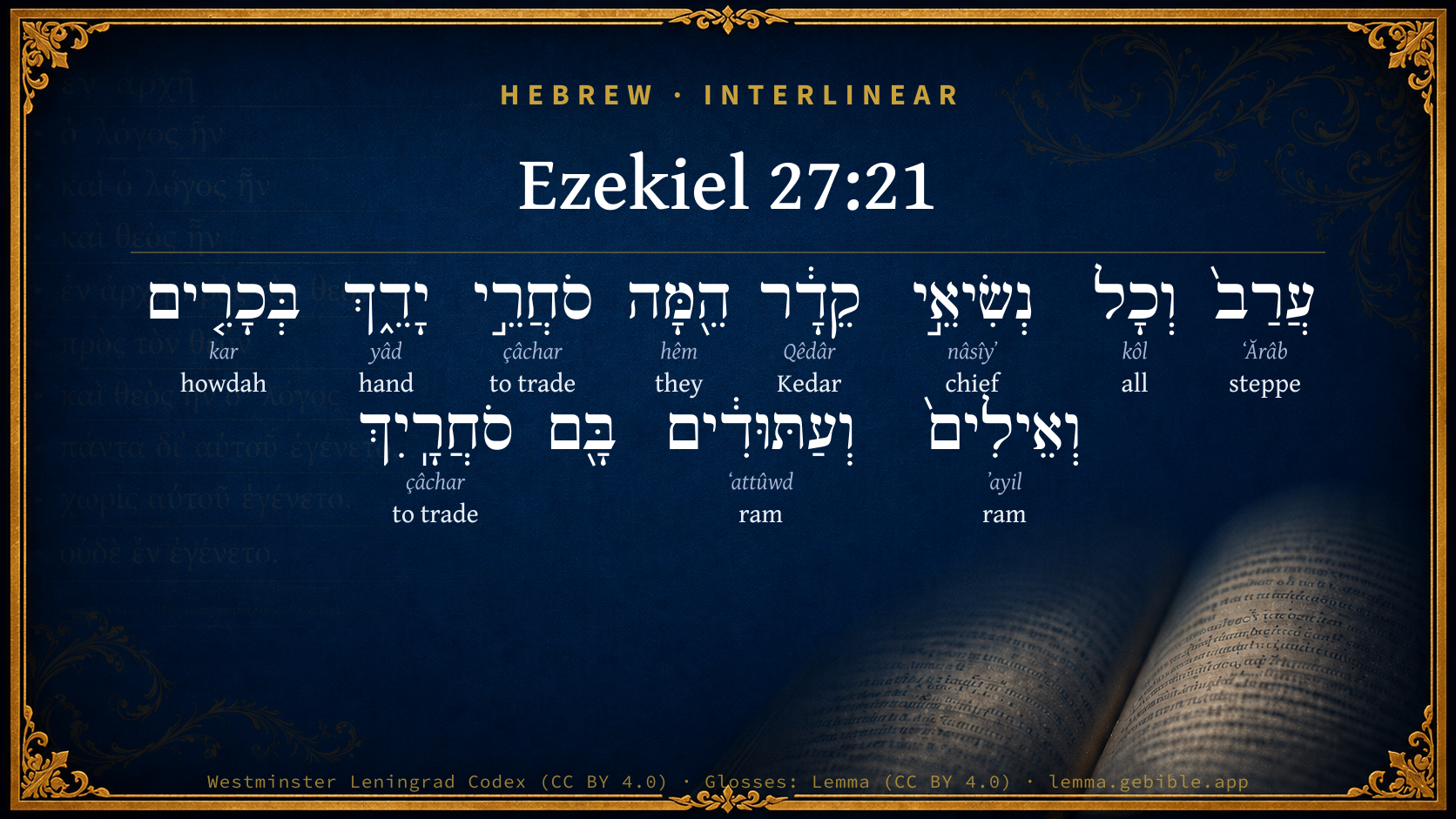
Hebrew (Westminster Leningrad Codex) Ezekiel 27:21 appears in the Hebrew Old Testament. The text above is from the Westminster Leningrad Codex. Each word links to its Strong’s number, a concise gloss, and parsing drawn from the Open Scriptures Hebrew Bible morphology. Click any word for its full Brown-Driver-Briggs (BDB) entry.
Download image
Cite this verse

Ezekiel 27:21 (World English Bible). Public Domain. Lemma interlinear Bible study tool, https://lemma.gebible.app/v/ezekiel/27/21.

Show BibTeX & RIS
BibTeX
RIS
English Translation
Arabia, and all the princes of Kedar, they were the merchants of your hand; in lambs, and rams, and goats, in these were they your merchants.
World English Bible · Public Domain
Download a study sheet

One document with this verse’s original text, its word-by-word gloss line, the meaning frame, cross-references with their text, attributed commentary, and full source and license credits — printable, and it pastes into notes with its structure intact.

This verse Autodidact and up

Study sheet (.html) Plain text (.txt)

A passage Seminary Student

Up to 50 verses in one chapter. A passage sheet keeps up to 6 commentary sources and 12 cross-references per verse, in the order this page ranks them, and says so on the sheet whenever that leaves anything out. Ask for a single verse and you get the Autodidact verse sheet above.

Everything on this page stays free to read, with no account — the sheet is a download of what is already on screen, not access to it.

Want to remove ads? Support Godless Engineer
Compare translations 3

The same verse in 3 English versions, stacked beneath the original-language interlinear above. Click any original word for its lexicon entry.

Each is an independent rendering of the whole verse — the interlinear is not word-aligned to these translations.

Highlighted words mark where these versions differ — a whole-verse word diff, not a word-by-word alignment.

  • World English Bible Public Domain
    Arabia, and all the princes of Kedar, they were the merchants of your hand; in lambs, and rams, and goats, in these were they your merchants.
  • King James Version Public Domain
    Arabia, and all the princes of Kedar, they occupied with thee in lambs, and rams, and goats: in these were they thy merchants.
  • unfoldingWord Literal Text CC BY-SA 4.0
    Arabia and all the chiefs of Kedar were traders with you; they provided you with lambs, rams and goats.

unfoldingWord Literal Text — © unfoldingWord, licensed CC BY-SA 4.0. Word-aligned USFM3 via Door43 (git.door43.org/unfoldingWord/en_ult).

Versions to compare (up to 4)

3 of 4 selected

Show all 18 translations

Every available English version of this verse, each an independent rendering of the whole verse.

  • World English Bible Public Domain
    Arabia, and all the princes of Kedar, they were the merchants of your hand; in lambs, and rams, and goats, in these were they your merchants.
  • Berean Standard Bible Public Domain
    Arabia and all the princes of Kedar were your customers, trading in lambs, rams, and goats.
  • Majority Standard Bible Public Domain
    Arabia and all the princes of Kedar were your customers, trading in lambs, rams, and goats.
  • King James Version Public Domain
    Arabia, and all the princes of Kedar, they occupied with thee in lambs, and rams, and goats: in these were they thy merchants.
  • American Standard Version (1901) Public Domain
    Arabia, and all the princes of Kedar, they were the merchants of thy hand; in lambs, and rams, and goats, in these were they thy merchants.
  • Revised Version (1885) Public Domain
    Arabia, and all the princes of Kedar, they were the merchants of thy hand; in lambs, and rams, and goats, in these were they thy merchants.
  • Geneva Bible (1599) Public Domain
    They of Arabia, and all the princes of Kedar occupied with thee, in lambes, and rammes and goates: in these were they thy marchants.
  • Douay-Rheims (1899) Public Domain
    Arabia, and all the princes of Cedar, they were the merchants of thy hand: thy merchants came to thee with lambs, and rants, and kids.
  • Young's Literal Translation Public Domain
    Arabia, and all princes of Kedar, They `are' the traders of thy hand, For lambs, and rams, and he-goats, In these thy merchants.
  • Literal Standard Version CC BY-SA 4.0
    Arabia, and all princes of Kedar, || They [are] the traders of your hand, || For lambs, and rams, and male goats, || In these your merchants.
  • Unlocked Literal Bible CC BY-SA 4.0
    Arabia and all the chiefs of Kedar were traders with you; they provided you with lambs, rams and goats.
  • unfoldingWord Literal Text CC BY-SA 4.0
    Arabia and all the chiefs of Kedar were traders with you; they provided you with lambs, rams and goats.
  • Darby Bible Public Domain
    Arabia and all the princes of Kedar were the merchants of thy hand: in lambs, and rams, and goats, in these did they trade with thee.
  • World Messianic Bible Public Domain
    “‘“Arabia and all the princes of Kedar were your favorite dealers in lambs, rams, and goats. In these, they were your merchants.
  • Webster's Bible Public Domain
    Arabia, and all the princes of Kedar, they occupied with thee in lambs, and rams, and goats: in these were they thy merchants.
  • Free Bible Version CC BY-SA 4.0
    Arabia and all the leaders of Kedar traded with you, supplying lambs, rams, and goats.
  • Bible in Basic English Public Domain
    Arabia and all the rulers of Kedar did business with you; in lambs and sheep and goats, in these they did business with you.
  • JPS Tanakh (1917) Public Domain
    Arabia, and all the princes of Kedar, they were the merchants of thy hand; in lambs, and rams, and goats, in these were they thy merchants.

Literal Standard Version (2020), Covenant Press — licensed CC BY-SA 4.0. Text via the HelloAO Bible API (eBible.org). Unlocked Literal Bible (unfoldingWord) — licensed CC BY-SA 4.0. Text via the HelloAO Bible API (eBible.org). unfoldingWord Literal Text — © unfoldingWord, licensed CC BY-SA 4.0. Word-aligned USFM3 via Door43 (git.door43.org/unfoldingWord/en_ult). Free Bible Version, Dr. Jonathan Gallagher — licensed CC BY-SA 4.0. Text via the HelloAO Bible API (eBible.org).

Word by word

More ways to search: Search by grammar → Find every occurrence → Compare this word →

Practice this passage: Drill this verse → Learn its vocabulary →

עֲרַב֙
ʻĂrâb
H6152
“steppe”
Noun, Proper
Part of Speech
Noun
Type
Proper
Full BDB Definition

Origin: from H6150 in the fig. sense of sterility

TWOT: 1688a , 1688c

steppe-dwellers - the people inhabiting the country east and south of Canaan, the nomadic desert Bedouins - Arabians, Arabs
  1. וְכָל kôl H3605 “and · all of” Conjunction + Noun, Common, Masculine, Singular, Construct
  2. נְשִׂיאֵ֣י nâsîyʼ H5387 “chiefs of” Noun, Common, Masculine, Plural, Construct
  3. קֵדָ֔ר Qêdâr H6938 “Kedar” Noun, Proper
  4. הֵ֖מָּה hêm H1992 “they” Pronoun, Personal, 3rd Person, Masculine, Plural
  5. סֹחֲרֵ֣י çâchar H5503 “trading” Verb, Qal, Participle Active, Masculine, Plural, Construct
  6. יָדֵ֑ךְ yâd H3027 “hand · your” Noun, Common, Both, Singular, Construct + Suffix, Personal, 2nd Person, Feminine, Singular
  7. בְּכָרִ֤ים kar H3733 “in/at · howdahs” Preposition + Noun, Common, Masculine, Plural, Absolute
  8. וְאֵילִים֙ ʼayil H352 “and · rams” Conjunction + Noun, Common, Masculine, Plural, Absolute
  9. וְעַתּוּדִ֔ים ʻattûwd H6260 “and · rams” Conjunction + Noun, Common, Masculine, Plural, Absolute
  10. סֹחֲרָֽיִךְ çâchar H5503 “trading · you” Verb, Qal, Participle Active, Masculine, Plural, Construct + Suffix, Personal, 2nd Person, Feminine, Singular

About this verse

These counts appear in no published source. They are computed here, from the morphology-tagged text and Lemma’s own curated glosses. What Lemma adds →

12
words
10
distinct lemmas
Prophets
section

Notable vocabulary

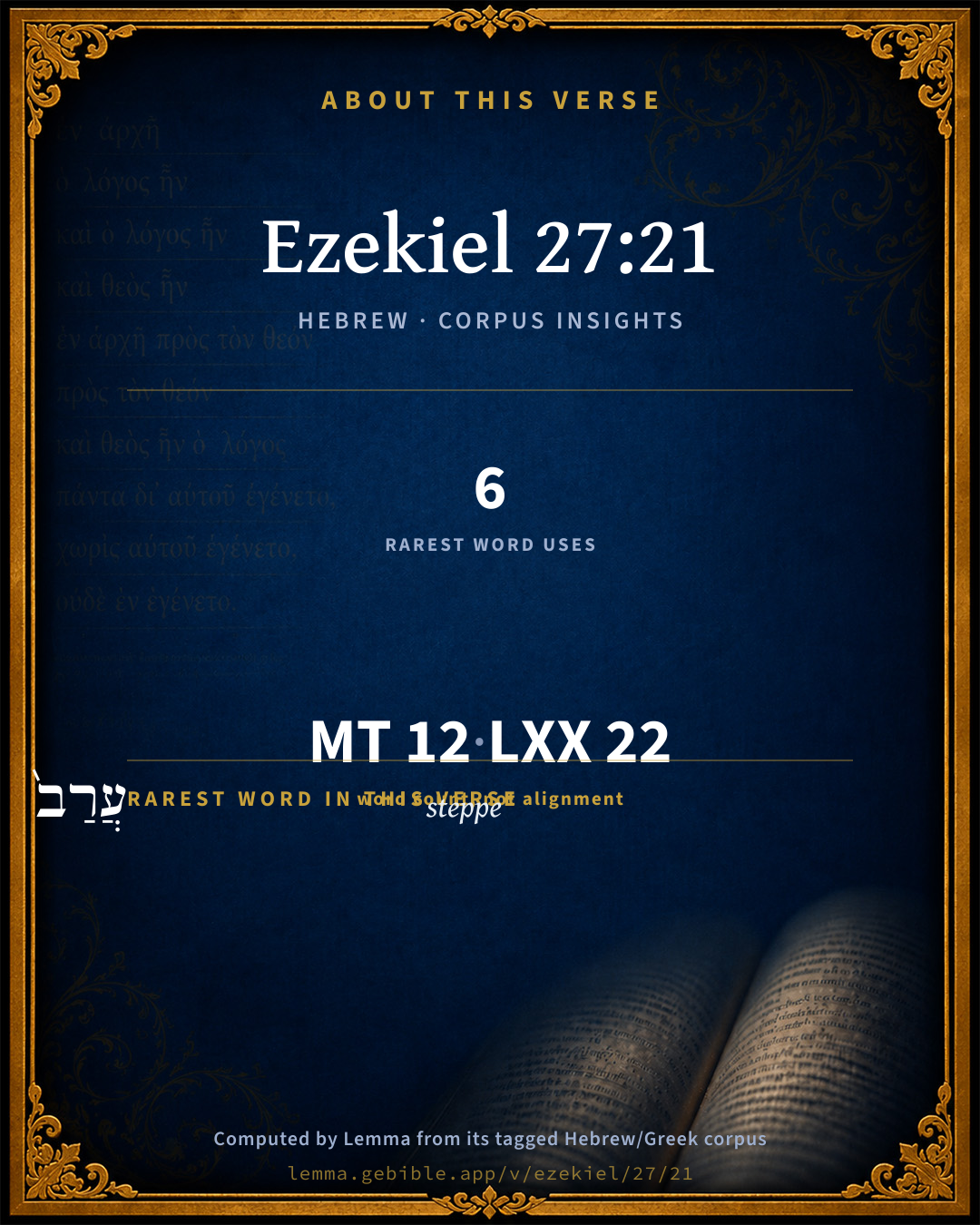
The rarest word here is עֲרַב֙ steppe H6152 — appearing just 6 times in the whole Hebrew Bible.

Shared distinctive vocabulary

עֲרַב֙ steppe H6152 occurs in 5 verses of the Hebrew Bible. Also found in:

Grammatical profile

  • 2 verbs
  • 8 nouns
  • 1 pronoun
  • 1 preposition

Verb forms

  • סֹחֲרֵ֣י Qal · Participle Active
  • סֹחֲרָֽיִךְ Qal · Participle Active

Repetition

A word recurs within this verse — often emphatic in Hebrew:

  • סֹחֲרֵ֣י to trade H5503 ×2

Hebrew & Septuagint length

In English translation the verse runs 26 words from the Hebrew and 25 from the Septuagint (LXX English) — closely comparable.

A rough comparison of the two English renderings, which tokenize alike — not a word-level alignment.

Word counts can differ between the Hebrew and the Greek without any difference in meaning — e.g. the Hebrew direct-object marker אֵת has no separate Greek word, and Greek often adds the article ὁ.

In the original languages it is 12 Hebrew tokens and 22 Greek tokens — but the two are counted differently (Hebrew bundles its prefixes and suffixes into one token; the Greek is in lemma form), so that isn’t a like-for-like length.

Cross-references

10

Topical passages linked to Ezekiel 27:21 in the Treasury of Scripture Knowledge — connected by theme and wording, ordered by reader-vote popularity; previews shown in the World English Bible.

  • Isaiah 60:7 All the flocks of Kedar shall be gathered together to you, the rams of Nebaioth shall minister to you; they shall come up with acceptance on my altar; and I will glorify the house of my glory.
  • Genesis 25:13 These are the names of the sons of Ishmael, by their names, according to the order of their birth: the firstborn of Ishmael, Nebaioth, then Kedar, Adbeel, Mibsam,
  • 1 Kings 10:15 besides [that which] the traders [brought], and the traffic of the merchants, and of all the kings of the mixed people, and of the governors of the country.
  • 1 Chronicles 1:29 These are their generations: the firstborn of Ishmael, Nebaioth; then Kedar, and Adbeel, and Mibsam,
  • 2 Chronicles 17:11 Some of the Philistines brought Jehoshaphat presents, and silver for tribute; the Arabians also brought him flocks, seven thousand and seven hundred rams, and seven thousand and seven hundred male goats.
  • Song of Solomon 1:5 I am dark, but lovely, You daughters of Jerusalem, Like Kedar's tents, Like Solomon's curtains.
  • Isaiah 21:16 For thus has the Lord said to me, Within a year, according to the years of a hireling, all the glory of Kedar shall fail;
  • Jeremiah 25:24 and all the kings of Arabia, and all the kings of the mixed people who dwell in the wilderness;
  • Acts 2:11 Cretans and Arabians: we hear them speaking in our languages the mighty works of God!"
  • Galatians 4:25 For this Hagar is Mount Sinai in Arabia, and answers to the Jerusalem that exists now, for she is in bondage with her children.

Cross-references courtesy of OpenBible.info (CC BY 4.0).

Hebrew and Greek witnesses Masoretic Hebrew ↔ Greek Septuagint

The same verse in the two great witnesses to the Old Testament, shown verse-for-verse.

These are two independent witnesses, not word-aligned to each other, and the Septuagint is shown in lemma (dictionary) form.

Hebrew Ezekiel 27:21 Masoretic · Westminster Leningrad Codex

עֲרַב֙ וְכָל נְשִׂיאֵ֣י קֵדָ֔ר הֵ֖מָּה סֹחֲרֵ֣י יָדֵ֑ךְ בְּכָרִ֤ים וְאֵילִים֙ וְעַתּוּדִ֔ים בָּ֖ם סֹחֲרָֽיִךְ

Arabia, and all the princes of Kedar, they were the merchants of your hand; in lambs, and rams, and goats, in these were they your merchants.

World English Bible · Public Domain

Greek LXX Ezekiel 27:21 Septuagint · lemma form

ὁ ἀραβία καί πᾶς ὁ ἄρχων κηδαρ οὗτος ἔμπορος σύ διά χείρ σύ κάμηλος καί κριός καί ἀμνός ἐν ὅς ἐνπορεύομαι σύ

Arabia and all the princes of Kedar, these were your traders with you, bringing camels, and lambs, and rams, in which they trade with you.

LXX2012 (modern English Septuagint) · Public Domain

On this verse, Joseph Benson's Commentary discusses the Septuagint’s reading. Read the note in Commentary ↓

Hebrew: Westminster Leningrad Codex (CC BY 4.0). Greek: Septuagint (public domain); English from LXX2012 (modern English Septuagint) (Public Domain). How the Septuagint differs from the Hebrew →

Targum (Aramaic paraphrase)

1

The Targum is the ancient Jewish Aramaic paraphrase of the Hebrew Scriptures — an interpretive translation, not the Hebrew text itself. Onkelos (literal) and Pseudo-Jonathan (expansive) render the Torah, and Jonathan the Prophets. Coverage is partial: where no permissively-licensed English translation exists for a verse, only the Aramaic is shown. This is verse-level text, not a word-by-word alignment to the Hebrew.

  1. Targum Jonathan Prophets (Joshua–Malachi)
    עֲרַב וְכָל רַבְרְבֵי נְבָט אִינוּן תַּגָרֵיךְ בְּתוֹרִין וְדִכְרִין וְגַדְיָן בְּהוֹן הֲוַת סְחוֹרְתִּיךְ:

    (no public-domain English translation for this verse)

    Targum Jonathan — Aramaic: “Mikraot Gedolot” (public domain). English: “Sefaria Community Translation” (CC0 1.0 (public-domain dedication)); “London "Chaldee Paraphrase," 1871” (public domain). Text via Sefaria.

Commentary

Notes on Ezekiel 27:21 from classic Christian and Jewish commentators (each source and its license shown beneath its notes). The classic Christian expositions comment on the surrounding passage and are grouped to its opening verse, so a note may address several verses; the Jewish commentaries on the Tanakh (Rashi and others) are per-verse, so they appear only where the commentator wrote on this verse.

Lemma curates 59 commentaries, every one of them public domain or Creative Commons licensed, each selected and text-cleaned for this edition rather than reprinted as found. About our sources →

Trapp's Complete Commentary

John Trapp

Eze 27:21 Arabia, and all the princes of Kedar, they occupied with thee in lambs, and rams, and goats: in these [were they] thy merchants.

Ver. 21. They occupied with thee in lambs.] Heb., They were the merchants of thy hand, or at thy hand, for cattle could not be carried far.

In these were they thy merchants.] Merchants are as useful in a commonwealth as mechanics, for exporting and importing commodities; only they must observe the gospel standard, "Whatever ye would that men should do to you, do ye the same to them."

John Trapp, A Commentary or Exposition upon All the Books of the Old and New Testament (1647–1656) — public domain. Text from a community e-Sword module.

Joseph Benson's Commentary

Eze 27:21-24. Arabia, &c., occupied with thee — Hebrew, ידן סחרי, were the merchants of thy hand; that is, they took off thy manufactures (see Eze 27:15) in exchange for cattle, in which their substance chiefly consisted. Of Kedar and its flocks, see notes on Isa 21:16-17; Isa 60:7. The merchants of Sheba and Raamah — These were people of Arabia Felix, dwelling near the Persian gulf. They traded in the rich products of their own country, namely, spices, precious stones, and gold, in which it abounded: see note on 1Ki 10:1; 1Ki 10:10. Haran, and Canneh, and Eden — By Haran here, it seems, the place is meant where Abraham dwelt when he came out of Ur of the Chaldees, (see Gen 11:31,) called Charræ by the Romans, and noted for the defeat of Crassus. Canneh some suppose to be the same place that is called Calneh, Amo 6:2, or Calno, Isa 10:9, a city near the Euphrates. Others take it for Ctesiphon, a noted city situate upon the river Tigris. Eden is joined with Haran, 2Ki 19:12, as it is here. The merchants of Sheba — There were two Shebas, as there were two Dedans; one descended from Raamah. (Gen 10:7,) the other from Jokshan, Abraham’s son, Gen 25:3. As the 22d verse is explained of the former, so the latter may be understood here: they were both in Arabia. And Chilmad — Both the Chaldee and LXX. explain this by Carmania. In chests of rich apparel, &c. — The rich apparel here spoken of was carefully packed up in chests of cedar, to give these clothes a fine scent, and preserve them from putrefaction.

Joseph Benson's Commentary on the Old and New Testaments (1811–1818) — public domain. Text from a community e-Sword module.

Geneva Bible (1599)

Geneva Bible translators

Or, were merchants whose merchandise passed through thine hands.

Geneva Bible (1599) marginal notes — public domain. Text via Bolls.life.

Jamieson, Fausset & Brown

Robert Jamieson, A. R. Fausset & David Brown

Arabia--the nomadic tribes of Arabia, among which Kedar was pre-eminent.

occupied with thee--literally, "of thy hand," that is, they traded with thee for wares, the product of thy hand (see on Eze 27:15-16).

Jamieson, Fausset & Brown — Commentary Critical and Explanatory on the Whole Bible (1871) — public domain (CC PDM 1.0). Text via the HelloAO Bible API.

Adam Clarke's Commentary

Verse 21. Arabia, and all the princes of Kedar] Arabia Deserta, on the confines of the Dead Sea. The Kedarenes inhabited the same country. These brought lambs, rams, and goats for the consumption of the city.

Adam Clarke's Commentary on the Bible (1810–1826) — public domain. Text from a community e-Sword/MySword module.

Ellicott's Commentary for English Readers

(21) Arabia . . . Kedar.—Arabia is never used in the Old Testament for the whole of the country now called by that name, but only for the desert part of it occupied by nomadic tribes. Kedar is the name of a nomadic pastoral race descended from Ishmael (Gen_25:13; comp. Isa_60:7).

A Bible Commentary for English Readers, edited by Charles John Ellicott (1878–1897) — public domain. Text from a community e-Sword module.

The Cambridge Bible for Schools and Colleges

gen. ed. J. J. S. Perowne

21. occupied with thee] Lit. were the merchants of thy hand, i.e. serving thee. Cf. Isa_60:7, “all the flocks of Kedar shall be gathered unto thee.” The Arab nomads were rich in flocks. Kedar (Gen_25:13, second son of Ishmael) was an important people toward the N. of Arabia. In Isa_60:7 they are named along with the Nabatheans; in Jer_49:28 they are threatened with destruction by Nebuchadnezzar, as they were threatened at an earlier time with an attack from the Assyrians (Isa_21:16). Outside of scripture they are mentioned first in the inscriptions of Assurbanipal (667–626 b.c.), where they are represented as dwelling between the gulf of Akaba and Babylon. Cf. the ref. Jer_2:10.

The Cambridge Bible for Schools and Colleges (gen. ed. J. J. S. Perowne; Cambridge University Press, 1878–1918) — public domain. Text from a community e-Sword module.

John Gill's Exposition

The merchants of Sheba and Raamah, they were thy merchants,.... This Sheba was the son of Raamah, Gen 10:7 who settled in Arabia Felix; where, according to Ptolemy (x), is a city called Rhegma; and so Raamah is pronounced in the Septuagint version of Gen 10:7,

they occupied in thy fairs with chief of all spices; as with myrrh and frankincense, with which they abounded: Pliny (y) says that the Arabians paid annually to the kings of Persia a thousand talents of frankincense; and that the Sabaeans (z) boiled their food, some with wood of frankincense, and others with wood of myrrh:

and with all precious stones, and gold; as jaspers, emeralds, carbuncles, and others, which Pliny (a) says are found in Arabia; and mention is made of the gold of Sheba, Psa 72:15 and Bochart thinks that Ophir, from whence the famous gold of that name was fetched, was in Arabia Felix; and it may be observed, that the queen of Sheba gave great quantities of gold, of spices, and of precious stones, to Solomon; and that he had much of these kinds yearly from the spice merchants, and kings of Arabia, Kg1 10:10; see Gill on Isa 60:6.

(x) Geograph. l. 6. c. 7. (y) Nat. Hist. l. 12. c. 17. (z) "----Solis est thurea virga Sabaeis". Virgil. Georgic. l. 2. (a) Nat. Hist. l. 37.

John Gill's Exposition of the Whole Bible (1746–1763) — public domain (CC PDM 1.0). Text via the HelloAO Bible API.

Haydock's Catholic Bible Commentary

CHAPTER XXVII.

George Leo Haydock (1774–1849), Haydock's Catholic Family Bible and Commentary, 1859 edition — public domain. Excludes Psalms (Douay-Rheims chapter numbering differs from Protestant) and Deuterocanonical books (Catholic canon only).

Matthew Poole's English Annotations

Arabia; a large country, and distinguished into Desert, or sandy, which cannot keep au honest man, but affords thieves enough; next the Stony, or Petraea, which afforded good pasturage for sheep and goats; and the third Felix, or happy, most remote from Tyre.

The princes; for there were many such among those Kedarens, or Scenites, who dwelt in tents, bred and fed cattle, and carried them to Tyre market; furnished the shambles at Tyre, and their altars too for sacrifices.

Matthew Poole's English Annotations on the Holy Bible (1683–1685) — public domain. Text from a community e-Sword/MySword module.

Whedon's Commentary on the Bible

Daniel D. Whedon

21. Arabia — It is only recently that Arabia has been explored and its inscriptions examined. The result shows us why this country occupied such an important place in the ancient world. Two great kingdoms have been revealed in South Arabia: one, that of Saba (Sheba), reaching back to Solomon’s time, while the Minaean probably precedes it by many centuries (Glaser, Hommel). The inscriptions prove that this people had rather a high civilization, lived in walled towns, built magnificent temples, carried on agriculture, mining, and manufactures, had an elaborate code of civil law, honored women, who could even rule as queens, cultivated the fine arts, and enjoyed an extended commerce. Incense was the chief export and the basis of the nation’s wealth. Mr. Bent has discovered that it is still produced at Dhofar at the rate of nine thousand hundredweight annually and myrrh also in large quantities (Nineteenth Century, October, 1895). Gold was another leading export, the mines being located in central Arabia. (Compare Eze_27:22.)

Kedar — a nomadic tribe in northern Arabia (Psa_120:5; Son_1:5) famous for its flocks, yet possessing “villages” (Isa_42:11.) In Assyrian inscriptions this tribe is located between Babylon and the Gulf of Akaba. (Compare Jer_2:10; Isa_60:7; Jer_49:28.) It may have been the king of these “Arabs” that Cambyses had to conciliate before crossing the desert. The term “Arab” in the Assyrian, as in the Bible writings, had a limited application and did not refer to the entire Sinaitic peninsula (Herodotus, Eze_3:5).

Daniel D. Whedon (gen. ed.), Commentary on the Old and New Testaments (1874–1909) — public domain. Text from a community e-Sword module.

The Pulpit Commentary

Arabia. The word, commonly in connection with Dedan, is used in the limited sense which attaches to it in the Old Testament. (2Ch_9:14; Isa_21:13; for Jer_25:24) the tribes of whatin Greek and Roman geography were known as Arabia Deserts. Kedar. The name (equivalent to "black-skinned") appears as that of the second son of Ishmael. (Gen_25:13) The black tents of Kedar (Son_1:5) indicate a nomadic tribe of the Bedouin type, famous, as in Isa_60:7 and Jer_49:28, Jer_49:29, for their flocks of sheep and camels. They appear, also, as having cities and villages Isa_42:11. The name is used in later rabbinic writings for all the inhabitants of Arabia.

The Pulpit Commentary (1880–1919), ed. H.D.M. Spence-Jones & Joseph S. Exell — public domain. Text from a community e-Sword module.

Rashi

Rabbi Shlomo Yitzchaki (Rashi)

with lambs [Heb. בְכָרִים,] lambs. Jonathan renders: with cattle, and so too did he render (II Kings 3: 4): “one hundred thousand bulls,” (כָּרִים) of Mesha, king of Moab.

Rashi on the Tanakh — English translations: “The Judaica Press complete Tanach with Rashi, translated by A. J. Rosenberg” (CC BY 4.0); “Pentateuch with Rashi's commentary by M. Rosenbaum and A.M. Silbermann, 1929-1934” (public domain); “The Metsudah Tanach series, Lakewood, N.J” (CC BY 4.0); and “The Book of Joshua, Metsudah Publications, 1997” (CC BY 4.0). Text via Sefaria.

Lesson kit

Teaching starters — assembled from the data on this page, not authored interpretation. Every prompt links to the verse data it draws on. Edit before teaching.

Ezekiel, in the Prophets, opens this verse with 12 words (10 distinct Hebrew lemmas). Its most distinctive word is ʻĂrâb (“steppe”). A historical commentator’s framing appears above. Read the whole chapter for the surrounding context.

Discussion questions

  1. What does “steppe” (ʻĂrâb) contribute to the verse as a whole?
  2. How does 1 Kings 10:15, which shares the word «steppe», read alongside this verse?
  3. What does the repetition of “to trade” (2× in this one verse) do in this verse?
  4. These translations render this verse differently; the difference is in the English rendering, not the original. What questions does that raise?
  5. «סֹחֲרֵ֣י» is a Qal Participle Active verb. How does that grammatical form shape the action described?
  6. Compare how Trapp's Complete Commentary and Joseph Benson's Commentary read this verse. Where do they agree or differ?

Things to notice

Reading settings

Reading text

Shown beneath each verse's original-language words.

Old Testament
Old Testament edition

Read the OT as the Masoretic Hebrew (MT) or the Greek Septuagint (LXX).

English shown for the Greek Septuagint (in the Hebrew ↔ Greek comparison).

Comparing translations? Open the Compare panel on any verse page to stack up to four side by side.