Ezekiel 38:3

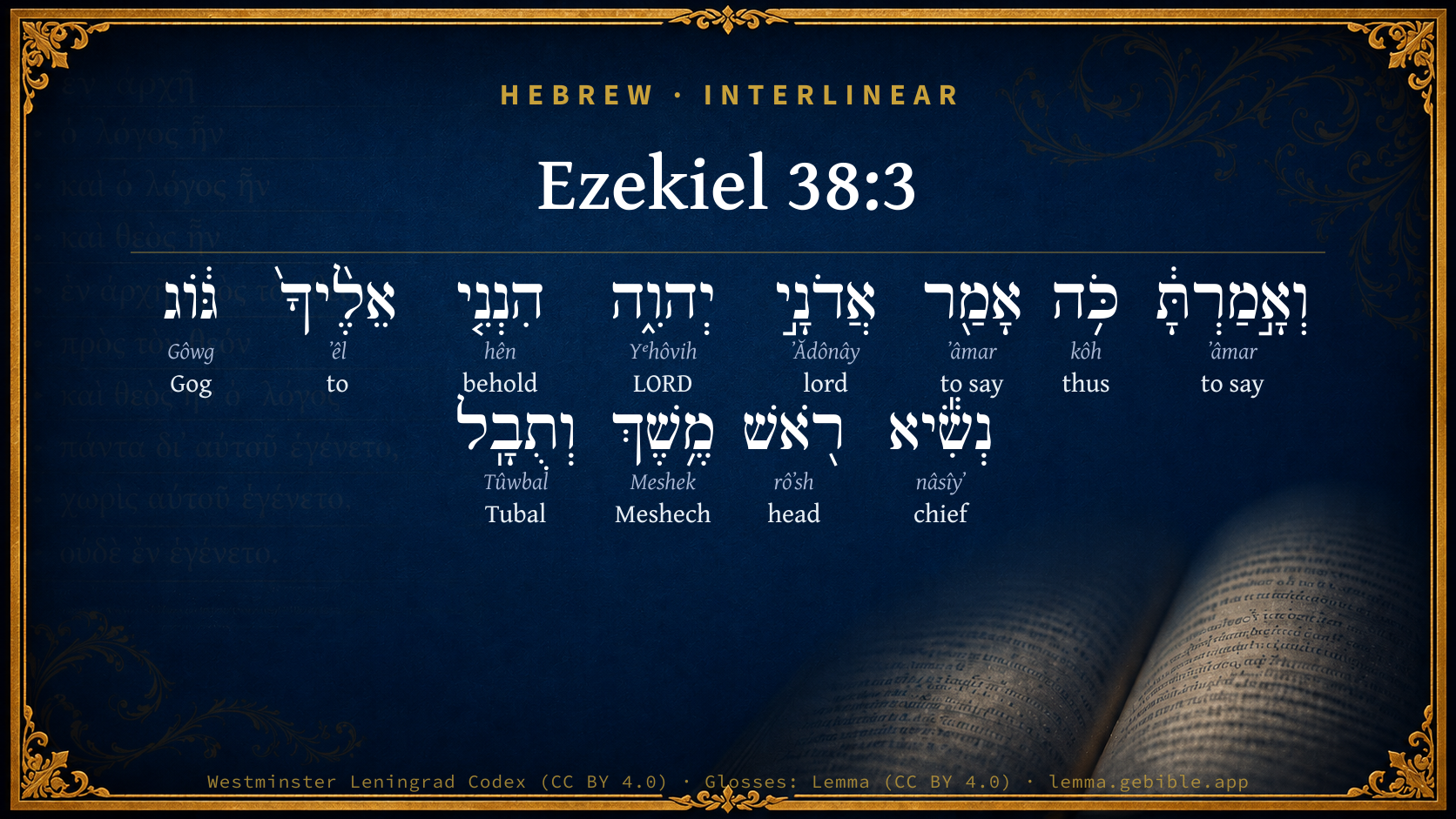
Hebrew (Westminster Leningrad Codex) Ezekiel 38:3 appears in the Hebrew Old Testament. The text above is from the Westminster Leningrad Codex. Each word links to its Strong’s number, a concise gloss, and parsing drawn from the Open Scriptures Hebrew Bible morphology. Click any word for its full Brown-Driver-Briggs (BDB) entry.
Download image
Cite this verse

Ezekiel 38:3 (World English Bible). Public Domain. Lemma interlinear Bible study tool, https://lemma.gebible.app/v/ezekiel/38/3.

Show BibTeX & RIS
BibTeX
RIS
English Translation
and say, Thus says the Lord Yahweh: Behold, I am against you, Gog, prince of Rosh, Meshech, and Tubal:
World English Bible · Public Domain
Download a study sheet

One document with this verse’s original text, its word-by-word gloss line, the meaning frame, cross-references with their text, attributed commentary, and full source and license credits — printable, and it pastes into notes with its structure intact.

This verse Autodidact and up

Study sheet (.html) Plain text (.txt)

A passage Seminary Student

Up to 50 verses in one chapter. A passage sheet keeps up to 6 commentary sources and 12 cross-references per verse, in the order this page ranks them, and says so on the sheet whenever that leaves anything out. Ask for a single verse and you get the Autodidact verse sheet above.

Everything on this page stays free to read, with no account — the sheet is a download of what is already on screen, not access to it.

Want to remove ads? Support Godless Engineer
Compare translations 3

The same verse in 3 English versions, stacked beneath the original-language interlinear above. Click any original word for its lexicon entry.

Each is an independent rendering of the whole verse — the interlinear is not word-aligned to these translations.

Highlighted words mark where these versions differ — a whole-verse word diff, not a word-by-word alignment.

  • World English Bible Public Domain
    and say, Thus says the Lord Yahweh: Behold, I am against you, Gog, prince of Rosh, Meshech, and Tubal:
  • King James Version Public Domain
    And say, Thus saith the Lord GOD; Behold, I am against thee, O Gog, the chief prince of Meshech and Tubal:
  • unfoldingWord Literal Text CC BY-SA 4.0
    Say, ‘The Lord Yahweh says this: Behold! I am against you, Gog, chief prince of Meshech and Tubal.

unfoldingWord Literal Text — © unfoldingWord, licensed CC BY-SA 4.0. Word-aligned USFM3 via Door43 (git.door43.org/unfoldingWord/en_ult).

Versions to compare (up to 4)

3 of 4 selected

Show all 18 translations

Every available English version of this verse, each an independent rendering of the whole verse.

  • World English Bible Public Domain
    and say, Thus says the Lord Yahweh: Behold, I am against you, Gog, prince of Rosh, Meshech, and Tubal:
  • Berean Standard Bible Public Domain
    and declare that this is what the Lord GOD says: Behold, I am against you, O Gog, chief prince of Meshech and Tubal.
  • Majority Standard Bible Public Domain
    and declare that this is what the Lord GOD says: Behold, I am against you, O Gog, chief prince of Meshech and Tubal.
  • King James Version Public Domain
    And say, Thus saith the Lord GOD; Behold, I am against thee, O Gog, the chief prince of Meshech and Tubal:
  • American Standard Version (1901) Public Domain
    and say, Thus saith the Lord Jehovah: Behold, I am against thee, O Gog, prince of Rosh, Meshech, and Tubal:
  • Revised Version (1885) Public Domain
    and say, Thus saith the Lord GOD: Behold, I am against thee, O Gog, prince of Rosh, Meshech, and Tubal:
  • Geneva Bible (1599) Public Domain
    And say, Thus sayth the Lord God, Behold, I come against thee, O Gog the chiefe prince of Meshech and Tubal.
  • Douay-Rheims (1899) Public Domain
    And say to him: Thus saith the Lord God: Behold, I come against thee, O Gog, the chief prince of Mosoch and Thubal.
  • Young's Literal Translation Public Domain
    and thou hast said: Thus saith the Lord Jehovah: Lo, I `am' against thee, O Gog, Prince of Rosh, Meshech, and Tubal,
  • Literal Standard Version CC BY-SA 4.0
    and you have said, Thus says Lord YHWH: Behold, I [am] against you, O Gog, || Chief prince of [[or prince of Rosh,]] Meshech and Tubal,
  • Unlocked Literal Bible CC BY-SA 4.0
    Say, 'The Lord Yahweh says this: Behold! I am against you, Gog, chief prince of Meshech and Tubal.
  • unfoldingWord Literal Text CC BY-SA 4.0
    Say, ‘The Lord Yahweh says this: Behold! I am against you, Gog, chief prince of Meshech and Tubal.
  • Darby Bible Public Domain
    and say, Thus saith the Lord Jehovah: Behold, I am against thee, O Gog, prince of Rosh, Meshech, and Tubal.
  • World Messianic Bible Public Domain
    and say, ‘The Lord GOD says: “Behold, I am against you, Gog, prince of Rosh, Meshech, and Tubal.
  • Webster's Bible Public Domain
    And say, Thus saith the Lord GOD: Behold, I am against thee, O Gog, the chief prince of Meshech and Tubal:
  • Free Bible Version CC BY-SA 4.0
    and declare that this is what the Lord God says: Watch out, I am condemning you, Gog, chief prince of Meshech and Tubal.
  • Bible in Basic English Public Domain
    And say, This is what the Lord has said: See, I am against you, O Gog, ruler of Rosh, Meshech, and Tubal:
  • JPS Tanakh (1917) Public Domain
    and say: Thus saith the Lord GOD: Behold, I am against thee, O Gog, chief prince of Meshech and Tubal;

Literal Standard Version (2020), Covenant Press — licensed CC BY-SA 4.0. Text via the HelloAO Bible API (eBible.org). Unlocked Literal Bible (unfoldingWord) — licensed CC BY-SA 4.0. Text via the HelloAO Bible API (eBible.org). unfoldingWord Literal Text — © unfoldingWord, licensed CC BY-SA 4.0. Word-aligned USFM3 via Door43 (git.door43.org/unfoldingWord/en_ult). Free Bible Version, Dr. Jonathan Gallagher — licensed CC BY-SA 4.0. Text via the HelloAO Bible API (eBible.org).

Word by word

More ways to search: Search by grammar → Find every occurrence → Compare this word →

Practice this passage: Drill this verse → Learn its vocabulary →

וְתֻבָֽל
Tûwbal
H8422
“and · Tubal”
Conjunction + Noun, Proper
Part of Speech
Conjunction + Noun
Type
Proper
Full BDB Definition

Origin: probably of foreign derivation

TWOT: None

Tubal = "thou shall be brought" - son of Japheth and grandson of Noah (noun proper masculine) - a region in east Asia Minor (noun proper territory) - perhaps nearly equal to Cappadocia
  1. וְאָ֣מַרְתָּ֔ ʼâmar H559 “and · to say” Conjunction + Verb, Qal, Sequential Perfect, 2nd Person, Masculine, Singular
  2. כֹּ֥ה kôh H3541 “thus” Adverb
  3. אָמַ֖ר ʼâmar H559 “to say” Verb, Qal, Perfect, 3rd Person, Masculine, Singular
  4. אֲדֹנָ֣י ʼĂdônây H136 “Lord · my” Noun, Common, Masculine, Plural, Construct + Suffix, Personal, 1st Person, Common, Singular
  5. יְהוִ֑ה Yᵉhôvih H3069 “LORD” Noun, Proper
  6. הִנְנִ֤י hên H2005 “behold · me” Particle, Demonstrative + Suffix, Personal, 1st Person, Common, Singular
  7. אֵלֶ֨יךָ֙ ʼêl H413 “to · you” Preposition + Suffix, Personal, 2nd Person, Masculine, Singular
  8. גּ֔וֹג Gôwg H1463 “Gog” Noun, Proper
  9. נְשִׂ֕יא nâsîyʼ H5387 “chief of” Noun, Common, Masculine, Singular, Construct
  10. רֹ֖אשׁ rôʼsh H7218 “head of” Noun, Common, Masculine, Singular, Construct
  11. מֶ֥שֶׁךְ Meshek H4902 “Meshech” Noun, Proper

About this verse

These counts appear in no published source. They are computed here, from the morphology-tagged text and Lemma’s own curated glosses. What Lemma adds →

12
words
11
distinct lemmas
Prophets
section

Notable vocabulary

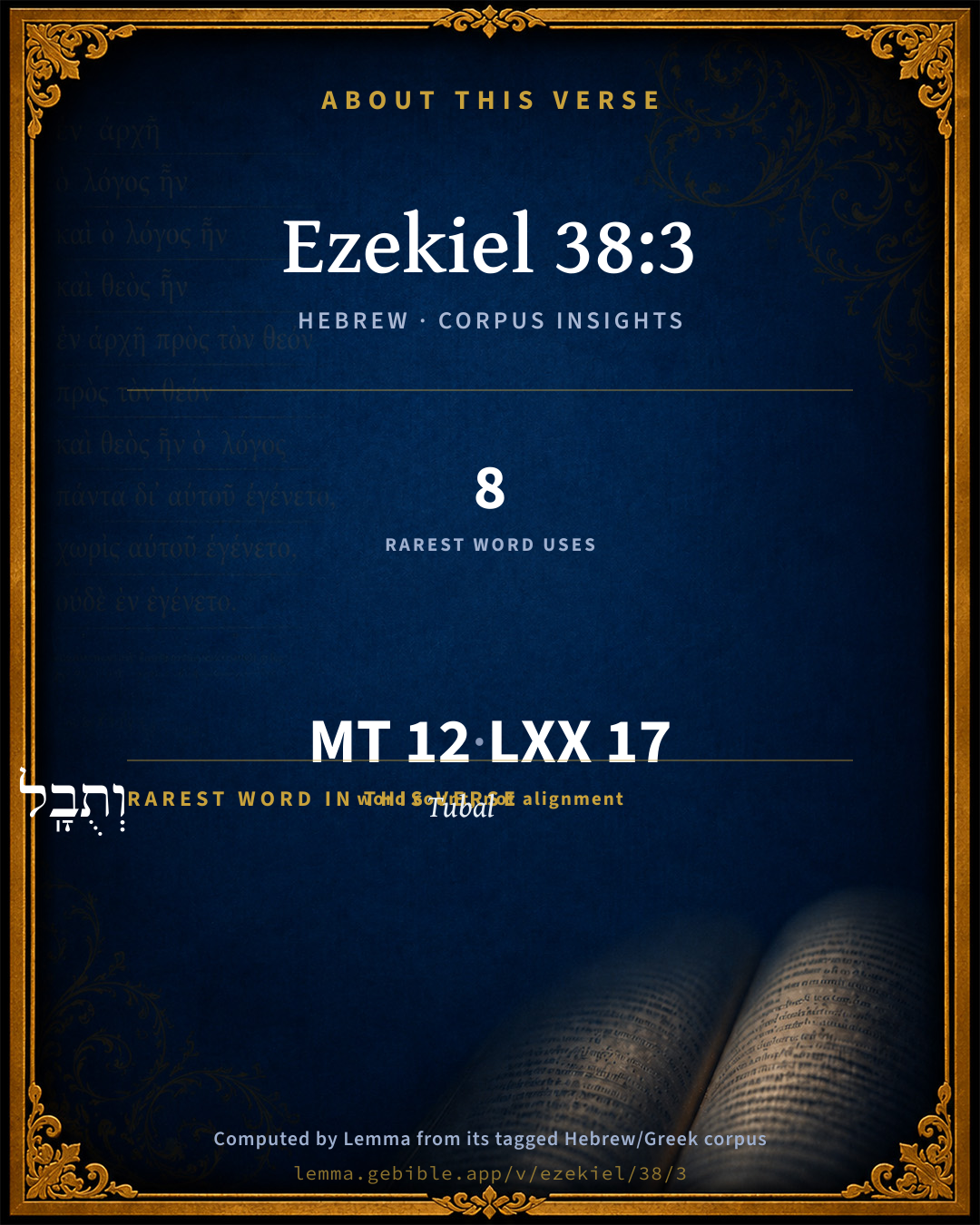
The rarest word here is וְתֻבָֽל Tubal H8422 — appearing just 8 times in the whole Hebrew Bible.

Shared distinctive vocabulary

וְתֻבָֽל Tubal H8422 occurs in 8 verses of the Hebrew Bible. Also found in:

Grammatical profile

  • 2 verbs
  • 7 nouns
  • 1 preposition
  • 1 adverb
  • 1 particle

Verb forms

  • וְאָ֣מַרְתָּ֔ Qal · Sequential Perfect
  • אָמַ֖ר Qal · Perfect

Repetition

A word recurs within this verse — often emphatic in Hebrew:

  • וְאָ֣מַרְתָּ֔ to say H559 ×2

Hebrew & Septuagint length

In English translation the verse runs 19 words from the Hebrew and 20 from the Septuagint (LXX English) — closely comparable.

A rough comparison of the two English renderings, which tokenize alike — not a word-level alignment.

Word counts can differ between the Hebrew and the Greek without any difference in meaning — e.g. the Hebrew direct-object marker אֵת has no separate Greek word, and Greek often adds the article ὁ.

In the original languages it is 12 Hebrew tokens and 17 Greek tokens — but the two are counted differently (Hebrew bundles its prefixes and suffixes into one token; the Greek is in lemma form), so that isn’t a like-for-like length.

Cross-references

4

Topical passages linked to Ezekiel 38:3 in the Treasury of Scripture Knowledge — connected by theme and wording, ordered by reader-vote popularity; previews shown in the World English Bible.

  • Ezekiel 13:8 Therefore thus says the Lord Yahweh: Because you have spoken falsehood, and seen lies, therefore, behold, I am against you, says the Lord Yahweh.
  • Ezekiel 29:3 speak, and say, Thus says the Lord Yahweh: Behold, I am against you, Pharaoh king of Egypt, the great monster that lies in the midst of his rivers, that has said, My river is my own, and I have made it for myself.
  • Ezekiel 35:3 and tell it, Thus says the Lord Yahweh: Behold, I am against you, Mount Seir, and I will stretch out my hand against you, and I will make you a desolation and an astonishment.
  • Ezekiel 39:1–10 You, son of man, prophesy against Gog, and say, Thus says the Lord Yahweh: Behold, I am against you, Gog, prince of Rosh, Meshech, and Tubal:

Cross-references courtesy of OpenBible.info (CC BY 4.0).

Hebrew and Greek witnesses Masoretic Hebrew ↔ Greek Septuagint

The same verse in the two great witnesses to the Old Testament, shown verse-for-verse.

These are two independent witnesses, not word-aligned to each other, and the Septuagint is shown in lemma (dictionary) form.

Hebrew Ezekiel 38:3 Masoretic · Westminster Leningrad Codex

וְאָ֣מַרְתָּ֔ כֹּ֥ה אָמַ֖ר אֲדֹנָ֣י יְהוִ֑ה הִנְנִ֤י אֵלֶ֨יךָ֙ גּ֔וֹג נְשִׂ֕יא רֹ֖אשׁ מֶ֥שֶׁךְ וְתֻבָֽל

and say, Thus says the Lord Yahweh: Behold, I am against you, Gog, prince of Rosh, Meshech, and Tubal:

World English Bible · Public Domain

Greek LXX Ezekiel 38:3 Septuagint · lemma form

καί εἶπον αὐτός ὅδε λέγω κύριος κύριος ἰδού ἐγώ ἐπί σύ γωγ ἄρχων ρως μοσοχ καί θοβελ

and say to him, Thus says the Lord God; Behold, I am against you, Rhos prince of Mesoch and Thobel:

LXX2012 (modern English Septuagint) · Public Domain

Hebrew: Westminster Leningrad Codex (CC BY 4.0). Greek: Septuagint (public domain); English from LXX2012 (modern English Septuagint) (Public Domain). How the Septuagint differs from the Hebrew →

Targum (Aramaic paraphrase)

1

The Targum is the ancient Jewish Aramaic paraphrase of the Hebrew Scriptures — an interpretive translation, not the Hebrew text itself. Onkelos (literal) and Pseudo-Jonathan (expansive) render the Torah, and Jonathan the Prophets. Coverage is partial: where no permissively-licensed English translation exists for a verse, only the Aramaic is shown. This is verse-level text, not a word-by-word alignment to the Hebrew.

  1. Targum Jonathan Prophets (Joshua–Malachi)
    וְתֵימַר כִּדְנַן אֲמַר יְיָ אֱלֹהִים הָא אֲנָא שְׁלַח רוּגְזִי עֲלָךְ גוֹג רַב רֵישׁ מֶשֶׁךְ וְתֻבָל:

    (no public-domain English translation for this verse)

    Targum Jonathan — Aramaic: “Mikraot Gedolot” (public domain). English: “Sefaria Community Translation” (CC0 1.0 (public-domain dedication)); “London "Chaldee Paraphrase," 1871” (public domain). Text via Sefaria.

Commentary

Notes on Ezekiel 38:3 from classic Christian and Jewish commentators (each source and its license shown beneath its notes). The classic Christian expositions comment on the surrounding passage and are grouped to its opening verse, so a note may address several verses; the Jewish commentaries on the Tanakh (Rashi and others) are per-verse, so they appear only where the commentator wrote on this verse.

Lemma curates 59 commentaries, every one of them public domain or Creative Commons licensed, each selected and text-cleaned for this edition rather than reprinted as found. About our sources →

Trapp's Complete Commentary

John Trapp

Eze 38:3 And say, Thus saith the Lord GOD; Behold, I [am] against thee, O Gog, the chief prince of Meshech and Tubal:

Ver. 3. Behold, I am against thee, O Gog.] Ecce ego ad re, Have at thee, Gog,

The chief prince of Meshech and Tubal.] These two are thus conjoined to show, as some think, that Turks and Popelings shall at length join their forces to root out the true religion, and that, while they are tumultuating and endeavouring the Church’s downfall, Christ shall come upon them and confound them. See on Rev 16:14; Rev 16:16. The Jews hold that this whole prophecy shall be fulfilled at the coming of their long looked for Messiah, and while they take all things therein according to the letter, they run into many very great errors. Propheta omnia loquitur magnificis verbis per hyperbolas.

John Trapp, A Commentary or Exposition upon All the Books of the Old and New Testament (1647–1656) — public domain. Text from a community e-Sword module.

Jamieson, Fausset & Brown

Robert Jamieson, A. R. Fausset & David Brown

His high-sounding titles are repeated to imply the haughty self-confidence of the invader as if invincible.

Jamieson, Fausset & Brown — Commentary Critical and Explanatory on the Whole Bible (1871) — public domain (CC PDM 1.0). Text via the HelloAO Bible API.

Ellicott's Commentary for English Readers

(3) The chief prince.—As in Eze_38:2, the prince of Rosh.

A Bible Commentary for English Readers, edited by Charles John Ellicott (1878–1897) — public domain. Text from a community e-Sword module.

The Cambridge Bible for Schools and Colleges

gen. ed. J. J. S. Perowne

3. chief prince] Cf. on Eze_38:2.

The Cambridge Bible for Schools and Colleges (gen. ed. J. J. S. Perowne; Cambridge University Press, 1878–1918) — public domain. Text from a community e-Sword module.

John Gill's Exposition

And say, thus saith the Lord God, behold, I am against thee, O Gog, the chief prince of Meshech and Tubal. Which is repeated for the confirmation of it, that so it would certainly be; that the Lord, the mighty God, and King of kings, would in his providence frown upon him, and appear against him; and his titles are repeated also, to show that all his greatness, grandeur, and power, would not protect him from the vengeance of God.

And say, thus saith the Lord God, behold, I am against thee, O Gog, the chief prince of Meshech and Tubal. Which is repeated for the confirmation of it, that so it would certainly be; that the Lord, the mighty God, and King of kings, would in his providence frown upon him, and appear against him; and his titles are repeated also, to show that all his greatness, grandeur, and power, would not protect him from the vengeance of God.

Ezekiel 38:4

eze 38:4

eze 38:4

eze 38:4And I will turn thee back, and put hooks into thy jaws,.... Or, I will put hooks in thy jaws, and with them turn thee back; or rather, "turn thee about" (f); and lead thee where and as I please; for this is not to be understood of God's putting hooks into his jaws, and leading him back from his enterprise of invading the land of Judea; as he put a hook in the nose and a bridle in the lips of the king of Assyria, and brought him back from Jerusalem, Isa 37:29, but of his using him thus in his providence to draw him to the land of Israel, out of his own land, as fishes are drawn with the hook out of the water. The sense is, that he would so work upon and influence the heart of Gog, that he should be inclined to come out of his own land and invade Judea; just as the Lord is said to draw Sisera and his army, Jdg 4:7, as Kimchi and Ben Melech observe. So the Targum,

"I will persuade thee, and put hooks in thy jaws;''

that is, incline his heart to take such a step, which should be to his destruction:

and I will bring thee forth, and all thine army; all his janizaries, and large army out of Turkey, and other parts of his dominions:

horses and horsemen; the Turkish armies, chiefly consisting of cavalry; See Gill on Rev 9:16,

all of them clothed with all sorts of armour; or completely clothed, as the Targum; for the word "armour" is not in the text; and besides, their armour is particularly mentioned afterwards; and so Kimchi has it, with all kind of ornaments, richly clothed and decorated, especially the principal officers, and, so made a fine show: even a

great company with bucklers and shields, all of them handling swords; or large armies, as the Targum; the Turks have always been used to bring prodigious large armies into the field; See Gill on Rev 9:16.

(f) "circumducam te", Piscator; "circumagam te", Grotius.

John Gill's Exposition of the Whole Bible (1746–1763) — public domain (CC PDM 1.0). Text via the HelloAO Bible API.

The Pulpit Commentary

I am against thee, O Gog. Just because Gog was against Israel, Jehovah was against Gog. Gog"s invasion of Israel"s land would be a declaration of war against Israel"s God. so that the conflict would rather be between Jehovah and Gog than between Israel and Gog. Hence throughout this prophecy Jehovah is represented as the principal actor on the side of Israel, who seeks her defense not in walls and bulwarks or in earthly alliances and military combinations,s in the days of the monarchy before the exile, but in the presence of Jehovah in her midst.

The Pulpit Commentary (1880–1919), ed. H.D.M. Spence-Jones & Joseph S. Exell — public domain. Text from a community e-Sword module.

Scofield Reference Notes

C. I. Scofield

Gog

See note 2, (See Scofield "Eze 38:2").

The Scofield Reference Bible (1917 edition), notes by C. I. Scofield — public domain. Text from a community e-Sword module.

Lesson kit

Teaching starters — assembled from the data on this page, not authored interpretation. Every prompt links to the verse data it draws on. Edit before teaching.

Ezekiel, in the Prophets, opens this verse with 12 words (11 distinct Hebrew lemmas). Its most distinctive word is Tûwbal (“Tubal”). A historical commentator’s framing appears above. Read the whole chapter for the surrounding context.

Discussion questions

  1. How does “Tubal” (Tûwbal) shape what this verse is saying?
  2. How does Genesis 10:2, which shares the word «Tubal», read alongside this verse?
  3. What does the repetition of “to say” (2× in this one verse) do in this verse?
  4. These translations render this verse differently. What is at stake in choosing one wording over another?
  5. «וְאָ֣מַרְתָּ֔» is a Qal Sequential Perfect verb. How does that grammatical form shape the action described?
  6. Compare how Trapp's Complete Commentary and Jamieson, Fausset & Brown read this verse. Where do they agree or differ?

Things to notice

Reading settings

Reading text

Shown beneath each verse's original-language words.

Old Testament
Old Testament edition

Read the OT as the Masoretic Hebrew (MT) or the Greek Septuagint (LXX).

English shown for the Greek Septuagint (in the Hebrew ↔ Greek comparison).

Comparing translations? Open the Compare panel on any verse page to stack up to four side by side.