Numbers 4:34

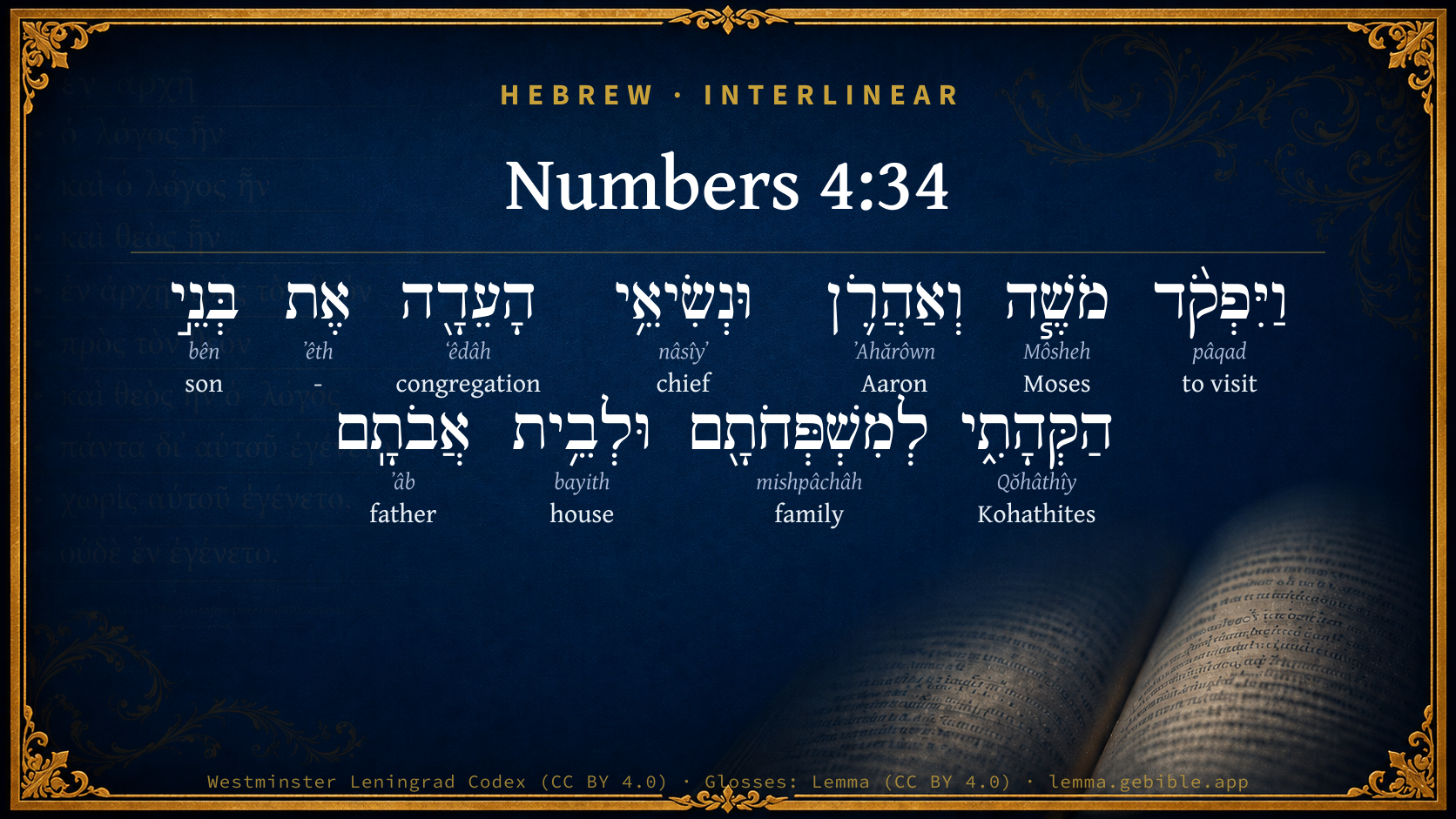
Hebrew (Westminster Leningrad Codex) Numbers 4:34 appears in the Hebrew Old Testament. The text above is from the Westminster Leningrad Codex. Each word links to its Strong’s number, a concise gloss, and parsing drawn from the Open Scriptures Hebrew Bible morphology. Click any word for its full Brown-Driver-Briggs (BDB) entry.
Download image
Cite this verse

Numbers 4:34 (World English Bible). Public Domain. Lemma interlinear Bible study tool, https://lemma.gebible.app/v/numbers/4/34.

Show BibTeX & RIS
BibTeX
RIS
English Translation
Moses and Aaron and the princes of the congregation numbered the sons of the Kohathites by their families, and by their fathers' houses,
World English Bible · Public Domain
Download a study sheet

One document with this verse’s original text, its word-by-word gloss line, the meaning frame, cross-references with their text, attributed commentary, and full source and license credits — printable, and it pastes into notes with its structure intact.

This verse Autodidact and up

Study sheet (.html) Plain text (.txt)

A passage Seminary Student

Up to 50 verses in one chapter. A passage sheet keeps up to 6 commentary sources and 12 cross-references per verse, in the order this page ranks them, and says so on the sheet whenever that leaves anything out. Ask for a single verse and you get the Autodidact verse sheet above.

Everything on this page stays free to read, with no account — the sheet is a download of what is already on screen, not access to it.

Want to remove ads? Support Godless Engineer
Compare translations 3

The same verse in 3 English versions, stacked beneath the original-language interlinear above. Click any original word for its lexicon entry.

Each is an independent rendering of the whole verse — the interlinear is not word-aligned to these translations.

Highlighted words mark where these versions differ — a whole-verse word diff, not a word-by-word alignment.

  • World English Bible Public Domain
    Moses and Aaron and the princes of the congregation numbered the sons of the Kohathites by their families, and by their fathers' houses,
  • King James Version Public Domain
    And Moses and Aaron and the chief of the congregation numbered the sons of the Kohathites after their families, and after the house of their fathers,
  • unfoldingWord Literal Text CC BY-SA 4.0
    And Moses and Aaron and the leaders of the congregation counted the sons of the Kohathite according to their clans and according to the house of their fathers,

unfoldingWord Literal Text — © unfoldingWord, licensed CC BY-SA 4.0. Word-aligned USFM3 via Door43 (git.door43.org/unfoldingWord/en_ult).

Versions to compare (up to 4)

3 of 4 selected

Show all 18 translations

Every available English version of this verse, each an independent rendering of the whole verse.

  • World English Bible Public Domain
    Moses and Aaron and the princes of the congregation numbered the sons of the Kohathites by their families, and by their fathers' houses,
  • Berean Standard Bible Public Domain
    So Moses, Aaron, and the leaders of the congregation numbered the Kohathites by their clans and families,
  • Majority Standard Bible Public Domain
    So Moses, Aaron, and the leaders of the congregation numbered the Kohathites by their clans and families,
  • King James Version Public Domain
    And Moses and Aaron and the chief of the congregation numbered the sons of the Kohathites after their families, and after the house of their fathers,
  • American Standard Version (1901) Public Domain
    And Moses and Aaron and the princes of the congregation numbered the sons of the Kohathites by their families, and by their fathers' houses,
  • Revised Version (1885) Public Domain
    And Moses and Aaron and the princes of the congregation numbered the sons of the Kohathites by their families, and by their fathers’ houses,
  • Geneva Bible (1599) Public Domain
    Then Moses and Aaron and the princes of the Congregation nombred the sonnes of the Kohathites, by their families and by the houses of their fathers,
  • Douay-Rheims (1899) Public Domain
    So Moses and Aaron and the princes of the synagogue reckoned up the sons of Caath, by their kindreds and the houses of their fathers,
  • Young's Literal Translation Public Domain
    And Moses numbereth -- Aaron also, and the princes of the company -- the sons of the Kohathite, by their families, and by the house of their fathers,
  • Literal Standard Version CC BY-SA 4.0
    And Moses numbers—Aaron also, and the princes of the congregation—the sons of the Kohathite, by their families, and by the house of their fathers,
  • Unlocked Literal Bible CC BY-SA 4.0
    Moses and Aaron and the leaders of the community counted the descendants of the Kohathites by the clans of their ancestor's families.
  • unfoldingWord Literal Text CC BY-SA 4.0
    And Moses and Aaron and the leaders of the congregation counted the sons of the Kohathite according to their clans and according to the house of their fathers,
  • Darby Bible Public Domain
    And Moses and Aaron and the princes of the assembly numbered the sons of the Kohathites after their families, and according to their fathers' houses,
  • World Messianic Bible Public Domain
    Moses and Aaron and the princes of the congregation counted the sons of the Kohathites by their families, and by their fathers’ houses,
  • Webster's Bible Public Domain
    And Moses and Aaron and the chief of the congregation numbered the sons of the Kohathites after their families, and after the house of their fathers,
  • Free Bible Version CC BY-SA 4.0
    Moses, Aaron, and the Israelite leaders registered the families of Kohath according to their family and father's line.
  • Bible in Basic English Public Domain
    So Moses and Aaron and the chiefs of the people took in hand the numbering of the sons of the Kohathites, by families, in the order of their fathers' houses;
  • JPS Tanakh (1917) Public Domain
    And Moses and Aaron and the princes of the congregation numbered the sons of the Kohathites by their families, and by their fathers' houses,

Literal Standard Version (2020), Covenant Press — licensed CC BY-SA 4.0. Text via the HelloAO Bible API (eBible.org). Unlocked Literal Bible (unfoldingWord) — licensed CC BY-SA 4.0. Text via the HelloAO Bible API (eBible.org). unfoldingWord Literal Text — © unfoldingWord, licensed CC BY-SA 4.0. Word-aligned USFM3 via Door43 (git.door43.org/unfoldingWord/en_ult). Free Bible Version, Dr. Jonathan Gallagher — licensed CC BY-SA 4.0. Text via the HelloAO Bible API (eBible.org).

Word by word

More ways to search: Search by grammar → Find every occurrence → Compare this word →

Practice this passage: Drill this verse → Learn its vocabulary →

הַקְּהָתִ֑י
Qŏhâthîy
H6956
“the · Kohathites”
Particle, Definite Article + Noun, Gentilic, Masculine, Singular, Absolute
Part of Speech
Particle + Noun
Type
Gentilic
Gender
Masculine
Number
Singular
State
Absolute
Full BDB Definition

Origin: patronymically from H6955

TWOT: None

Kohathites = see Kohath " assembly" - the descendants of Kohath, the 2nd son of Levi
  1. וַיִּפְקֹ֨ד pâqad H6485 “and · to visit” Conjunction + Verb, Qal, Sequential Imperfect, 3rd Person, Masculine, Singular
  2. מֹשֶׁ֧ה Môsheh H4872 “Moses” Noun, Proper
  3. וְאַהֲרֹ֛ן ʼAhărôwn H175 “and · Aaron” Conjunction + Noun, Proper
  4. וּנְשִׂיאֵ֥י nâsîyʼ H5387 “and · chiefs of” Conjunction + Noun, Common, Masculine, Plural, Construct
  5. הָעֵדָ֖ה ʻêdâh H5712 “the · congregation” Particle, Definite Article + Noun, Common, Feminine, Singular, Absolute
  6. אֶת ʼêth H853 “-” Particle, Direct Object
  7. בְּנֵ֣י bên H1121 “sons of” Noun, Common, Masculine, Plural, Construct
  8. לְמִשְׁפְּחֹתָ֖ם mishpâchâh H4940 “to/for · families · their” Preposition + Noun, Common, Feminine, Plural, Construct + Suffix, Personal, 3rd Person, Masculine, Plural
  9. וּלְבֵ֥ית bayith H1004 “and · to/for · house of” Conjunction + Preposition + Noun, Common, Masculine, Singular, Construct
  10. אֲבֹתָֽם ʼâb H1 “fathers · their” Noun, Common, Masculine, Plural, Construct + Suffix, Personal, 3rd Person, Masculine, Plural

About this verse

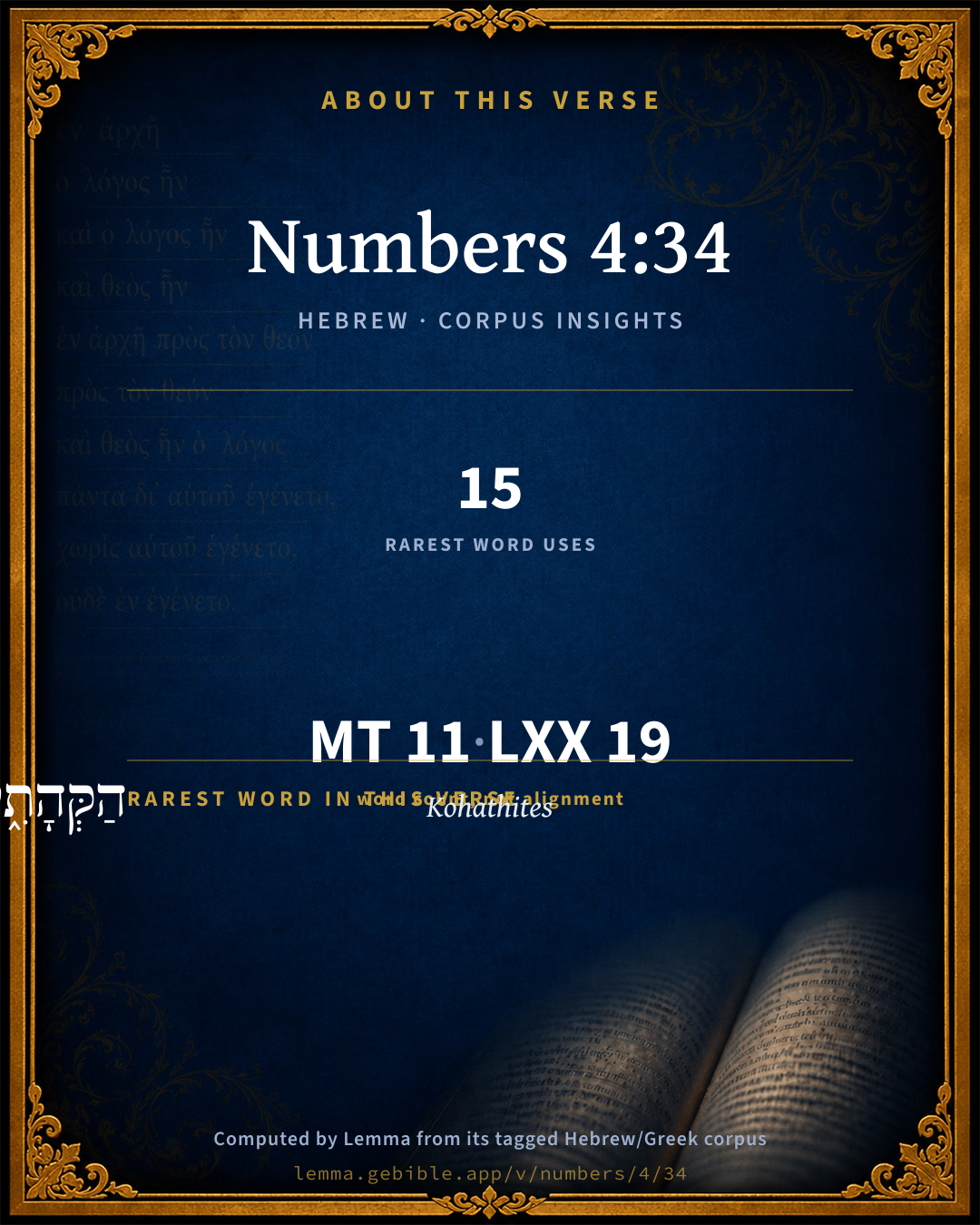
These counts appear in no published source. They are computed here, from the morphology-tagged text and Lemma’s own curated glosses. What Lemma adds →

11
words
11
distinct lemmas
Pentateuch
section

Notable vocabulary

The rarest word here is הַקְּהָתִ֑י Kohathites H6956 — appearing just 15 times in the whole Hebrew Bible.

Shared distinctive vocabulary

הַקְּהָתִ֑י Kohathites H6956 occurs in 15 verses of the Hebrew Bible. Also found in:

Grammatical profile

  • 1 verb
  • 9 nouns
  • 1 particle

Verb forms

  • וַיִּפְקֹ֨ד Qal · Sequential Imperfect

Hebrew & Septuagint length

In English translation the verse runs 23 words from the Hebrew and 28 from the Septuagint (LXX English) — closely comparable.

A rough comparison of the two English renderings, which tokenize alike — not a word-level alignment.

Word counts can differ between the Hebrew and the Greek without any difference in meaning — e.g. the Hebrew direct-object marker אֵת has no separate Greek word, and Greek often adds the article ὁ.

In the original languages it is 11 Hebrew tokens and 19 Greek tokens — but the two are counted differently (Hebrew bundles its prefixes and suffixes into one token; the Greek is in lemma form), so that isn’t a like-for-like length.

Hebrew and Greek witnesses Masoretic Hebrew ↔ Greek Septuagint

The same verse in the two great witnesses to the Old Testament, shown verse-for-verse.

These are two independent witnesses, not word-aligned to each other, and the Septuagint is shown in lemma (dictionary) form.

Hebrew Numbers 4:34 Masoretic · Westminster Leningrad Codex

וַיִּפְקֹ֨ד מֹשֶׁ֧ה וְאַהֲרֹ֛ן וּנְשִׂיאֵ֥י הָעֵדָ֖ה אֶת בְּנֵ֣י הַקְּהָתִ֑י לְמִשְׁפְּחֹתָ֖ם וּלְבֵ֥ית אֲבֹתָֽם

Moses and Aaron and the princes of the congregation numbered the sons of the Kohathites by their families, and by their fathers' houses,

World English Bible · Public Domain

Greek LXX Numbers 4:34 Septuagint · lemma form

καί ἐπισκέπτω μωυσῆς καί ἀαρών καί ὁ ἄρχων ἰσραήλ ὁ υἱός κααθ κατά δῆμος αὐτός κατά οἶκος πατριά αὐτός

And Moses and Aaron and the rulers of Israel took the number of the sons of Caath according to their families, according to the houses of their lineage;

LXX2012 (modern English Septuagint) · Public Domain

Hebrew: Westminster Leningrad Codex (CC BY 4.0). Greek: Septuagint (public domain); English from LXX2012 (modern English Septuagint) (Public Domain). How the Septuagint differs from the Hebrew →

Targum (Aramaic paraphrase)

2

The Targum is the ancient Jewish Aramaic paraphrase of the Hebrew Scriptures — an interpretive translation, not the Hebrew text itself. Onkelos (literal) and Pseudo-Jonathan (expansive) render the Torah, and Jonathan the Prophets. Coverage is partial: where no permissively-licensed English translation exists for a verse, only the Aramaic is shown. This is verse-level text, not a word-by-word alignment to the Hebrew.

  1. Targum Onkelos Torah (Genesis–Deuteronomy)
    וּמְנָא משֶׁה וְאַהֲרֹן וְרַבְרְבֵי כְנִשְׁתָּא יָת בְּנֵי קְהָת לְזַרְעֲיַתְהוֹן וּלְבֵית אֲבָהַתְהוֹן

    (no public-domain English translation for this verse)

    Targum Onkelos — Aramaic: “Onkelos Genesis” (public domain); “Onkelos Exodus” (public domain); “Onkelos Leviticus” (public domain); “Onkelos Numbers” (public domain); “Onkelos Deuteronomy” (public domain). English: “Sefaria Community Translation” (CC0 1.0 (public-domain dedication)); “J.W. Etheridge. The Targums of Onkelos and Jonathan Ben Uzziel on the Pentateuch. London: Longmans, Green, 1862” (public domain). Text via Sefaria.

  2. Targum Pseudo-Jonathan Torah (Genesis–Deuteronomy)
    וּמְנָא משֶׁה וְאַהֲרן יַת בְּנֵי קְהָת לִגְנִיסַתְהוֹן וּלְבֵית אֲבָהַתְהוֹן

    And Mosheh and Aharon numbered the sons of Kehath by their families, and by the house of their fathers,

    Targum Pseudo-Jonathan — Aramaic: “Targum Jonathan on Genesis” (public domain); “Targum Jonathan on Exodus” (public domain); “Targum Jonathan on Leviticus” (public domain); “Targum Jonathan on Numbers” (public domain); “Targum Jonathan on Deuteronomy” (public domain). English: “The Targum of Jonathan ben Uzziel, trans. J. W. Etheridge, London, 1862” (public domain). Text via Sefaria.

Commentary

Notes on Numbers 4:34 from classic Christian and Jewish commentators (each source and its license shown beneath its notes). The classic Christian expositions comment on the surrounding passage and are grouped to its opening verse, so a note may address several verses; the Jewish commentaries on the Tanakh (Rashi and others) are per-verse, so they appear only where the commentator wrote on this verse.

Lemma curates 59 commentaries, every one of them public domain or Creative Commons licensed, each selected and text-cleaned for this edition rather than reprinted as found. About our sources →

John Gill's Exposition

From thirty years old and upward even unto fifty years old,.... See Gill on Num 4:34.

.

Numbers 4:40

num 4:40

num 4:40

num 4:40Even those that were numbered of them,.... See Gill on Num 4:34;

John Gill's Exposition of the Whole Bible (1746–1763) — public domain (CC PDM 1.0). Text via the HelloAO Bible API.

The Biblical Illustrator

Joseph S. Exell

Num_4:34-49

They were numbered . . . every one according to his service.

Proportion between number and service

Looking at the relation of the numbers to the service required of them we discover illustrations of--

I. The wisdom of God. By this diversity of numbers among the Levite families, saith Trapp, God showeth His wisdom in fitting men for the work whereunto He hath appointed them, whether it requireth multitude or gifts (1Co_12:8-12). Every one hath his own share; all are not alike gifted.

II. The reasonableness of the divine requirements. Though the sum total of effective Levites, says Greenfield, was very small compared with that of the other tribes: yet they would be far more than could be employed at once in this service. But they might carry by turns and ease one another, and thus do the whole expeditiously and cheerfully. They would also have their own tents to remove, and their own families to take care of. There was an ample number for the performance of the work; and its distribution amongst so many would render it comparatively easy to every one. Gods claims upon us and our service are in the highest degree reasonable. He is a kind and gracious Master.

III. The exemplary obedience of the servants of the Lord. (W. Jones.)

Many in the Church who do not add to its service:

Observe--

1. That the Kohathites were in all eight thousand and six hundred, from a month old and upward: but of those there were but two thousand seven hundred and fifty serviceable men, not a third part. The Gershonites in all seven thousand and five hundred: and of them but two thousand six hundred and thirty serviceable men, little more than a third part. Note--Of the many that add to the numbers of the Church, there are comparatively but few that contribute to the service of it. So it has been, and so it is; many have a place in the tabernacle, that do but little of the work of the tabernacle (Php_2:20-21).

2. That the Merarites were but six thousand and two hundred in all; and yet of these there were three thousand and two hundred serviceable men, which were a good deal above half. The greatest burden lay upon that family, the boards, and pillars, and sockets. And God so ordered it, that though they were the fewest in number, yet they should have the most able men among them; for whatever service God calls men to, He will furnish them for it, and give strength in proportion to the work, grace sufficient.

3. The whole number of the able men of the tribe of Levi, which entered into Gods host to war His warfare, was but eight thousand five hundred and eighty; whereas the able men of the other tribes that entered into the host of Israel to war their warfare were many more. The least of the tribes had almost four times as many able men as the Levites, and some of them more than eight times as many. For those that are engaged in the service of this world, and war after the flesh, are many more than those that are devoted to the service of God, and fight the good fight of faith. (Matthew Henry, D. D.)

The numbered people:

I. Here is authority for the muster-roll--According to the commandment of the Lord they were numbered. It was not left to Moses to number the people without Divine sanction, else the deed might have been as evil in the sight of the Lord as that of David when he made a census of the nation: neither may any man at this day summon the saints of the Lord at his own discretion to enterprises for which they were never set apart. The armies of Israel are none of ours to lead whither we will, nor even to reckon up that the number may be told to our own honour.

1. Believers in Christ Jesus, you are now called forth to do suit and service, because like the tribe of Levi you are the Lords. He views you as the church of the firstborn, as the redeemed from among men, and as His peculiar inheritance, and therefore above all other men you are under His special rule and governance.

2. You are further called because this is a charge laid upon you of the Lord, to whom you specially belong. The Levites were not numbered with the rest of the nation, for their vocation was altogether different, and their whole business was about holy things. Ye see in this your calling, for hereunto are ye also ordained that ye may live unto the Lord alone.

3. The Lord may well call you to this service, seeing He has given you to His Son, even as He gave the Levites to Aaron, as it is written (Num_3:9), They are wholly given unto him out of the children of Israel. Because ye belong to Christ, therefore hide not yourselves from His service, but come forward with alacrity.

4. The Lord has constituted you the servants of all His people, even as He said of the Levites that they were to do the service of the children of Israel in the tabernacle of the congregation. We are debtors to all our brethren, and we are their servants to the full extent of our power.

II. Notice the appointment of the individuals--Every one according to his service, and according to his burden. By our varied gifts, positions, offices, and opportunities, we are as much set apart to special services as were the sons of Kohath, &c. Great evils arise out of persons mistaking their calling, and undertaking things of which they are not capable; and, on the other hand, the success of Christian work in a large measure arises out of places of usefulness being filled by the right men.

III. Our text is the summary of the chapter in which we have an account of the actual fulfilment of the Lords command by Moses. He numbered each family, and cast up the total of the tribe, at the same time mentioning in detail the peculiar service of each. We would imitate him at this important moment, and take the census of those who are consecrated to the Lords own service.

1. Where are you, then, who can bear the heavier service of the sanctuary, carrying its pillars, and the boards, and the sockets thereof? You are now needed to speak in the meetings, to lead the people in prayer, to order the assemblies, and to take the heavier work of this holy business. The Lord Jesus should have able men to speak for Him; He deserves the best of the best. Now is the hour, where is the man? Let no diffidence or love of ease keep one back who might make known the gospel and win a soul for Jesus.

2. But where are you who can only carry the pins and the cords? Your burden is lighter, but probably your strength is also less, and lighter though your load may be, the matters which you carry are quite as essential as the pillars and the boards. Where are you? You who can say a few words to lonely inquiring ones; you who can do no more than pray, where are you? At your posts, or idling? Answer quickly, for time and need are pressing. If the load which you can carry be so very small, be all the more ready to bear it.

3. Are you a lover of the Lord Jesus and do you wish to be omitted from the roll-call? If so, let it be known to yourself, and stated plainly to your conscience. Do not pretend to be a labourer and remain a loiterer, but openly avow to your own soul that you stand all the day idle, and feel fully justified in so doing. (C. H. Spurgeon.)

All have a work to do for God:

There is a work for all of us. And there is special work for each, work which I cannot do in a crowd, or as one of a mass, but as one man, acting singly, according to my own gifts, and under a sense of my personal responsibility. There is, no doubt, associated work for me to do; I must do my work as part of the worlds great whole, or as a member of some body. But I have a special work to do, as one individual who, by Gods plan and appointment, has a separate position, separate responsibilities, and a separate work; if I do not do it, it must be left undone. No one of my fellows can do that special work for me which I have come into the world to do; he may do a higher work, a greater work, but he cannot do my work. I cannot hand my work over to him, any more than I can hand over my responsibilities or my gifts. Nor can I delegate my work to an association of men, however well-ordered and powerful. They have their own work to do, and it may be a very noble one. But they cannot do my work for me. I must do it with these hands or with these lips which God has given me. I may do little or I may do much. That matters not. It must be my own work, and by doing my own work, poor as it may seem to some, I shall better fulfil Gods end in making me what I am, and more truly glorify His name, than if I were either going out of my own sphere to do the work of another, or calling in another into my sphere to do my proper work for me. (John Ruskin.)

Happiness of working for God:

The Rev. Andrew Fuller, the eminent Baptist minister, was depressed at one time by his people living in a low state of mind; they did nothing but sigh and groan. All his endeavours were fruitless to raise them to a higher spiritual life. Much perplexed, he made inquiry into their actions, and found that they were doing nothing for Christ. He at once set them to work, and a marked change took place; instead of sighs, groans, and gloomy faces, there were cheerfulness and faces glowing with happiness. If your state of heart and mind is low and depressed, carry the story of the life, death, and resurrection of the Saviour to some perishing soul; do something for the Master, and soon your heart will leap with joy and gratitude.

Unfaithful helpers are a burden

An overworked minister, whilst lamenting the lack of workers in his church, dozed, and, as the story goes, dreamed. He thought he was between the shafts of a four-wheeled coach, and four of his helpers were each pushing a wheel, and up the hill they all toiled together. Soon he felt the coach drag heavily, and at last he could pull no further so came to a standstill. On looking behind he discovered that his four helpers had quietly got inside to ride. How much happier and easier Christian work would be if all would do their best. (Young Mens Review.)

Power running to waste:

We are told sometimes of the vast power unutilised as the waters leap over the Falls of Niagara; in fact, statisticians have given us calculations of the marvellous saving of steam, which means coal, which means money, that might thus be saved. We are not sure but that it has been proved that there is power enough, if it could be communicated, to give electric light to the whole continent, and no one who has walked along the banks of the Niagara River for two or three miles above the Falls, and studied the tremendous force of the current, will hesitate to doubt such statements. Is there not in this a parable? There is a whole Niagara of Christian power running to waste in our land--power that if utilised would flash the light of salvation over the world, and bring in the perfect day of Christs kingdom on earth. Take any of our churches, what are a large portion of the members doing? Absolutely nothing--they are in their places on the Sabbath, and just possibly at the weekly prayer-meeting; beyond that what? But, I can do so little. Oh, my friend, pug your little and a thousand littles of your brethren together, and it would make a power that by the grace of God would be irresistible. Niagara is but the united power of a thousand streams far, far away. (Canadian Independent.)

.

The Biblical Illustrator, edited by Joseph S. Exell (c. 1880s–1900s) — public domain. Text from a community e-Sword module.

Whedon's Commentary on the Bible

Daniel D. Whedon

CENSUS OF COMPETENT LEVITES, Num_4:34-49.

The results of the enumeration of Levites between thirty and fifty years are here tabulated, together with the number of incompetents and the total:

COMPETENT.INCOMPETENT.TOTAL.Kohathites 2,7505,8508,600Gershonites 2,6304,8707,500Merarites 3,2003,0006,200Total 8,58013,72022,300

Percent.Competent Percent.Incompetent.Kohathites3268Gershonites3565Merarites5248The total number of competent men tallies well with the whole number of Levites. The percentage of competent Merarites is remarkable. “What an astonishing number of men, all purely ecclesiastics; all performing some service by which God is glorified, and the congregation at large benefitted!” — A. Clarke. We should not regard the thirteen thousand seven hundred and twenty incompetents as entirely useless. The care of the cattle and flocks, and the transportation of the families and their tents, would afford sufficient scope for the healthful activity of both the young and the old. Superannuates in the Christian ministry often glorify their Master more by suffering his will than by doing it.

By inspecting the above table the wisdom and goodness of Jehovah are seen in adjusting the heaviest burden to the strongest shoulders. Merari, numerically the least family, has the largest number of strong men, and the severest labour.

Daniel D. Whedon (gen. ed.), Commentary on the Old and New Testaments (1874–1909) — public domain. Text from a community e-Sword module.

Tyndale Open Study Notes

Tyndale Open Resources

4:34-49 The process of numbering and recording the Levites’ names and making sure that each man understood his assignment was an important step in organizing Israel to travel and camp in the correct manner and in safeguarding the Tabernacle.

Tyndale Open Study Notes — © Tyndale Open Resources, licensed CC BY-SA 4.0. Text via the HelloAO Bible API.

Matthew Henry's Commentary

We have here a particular account of the numbers of the three families of the Levites respectively, that is, of the effective men, between thirty years old and fifty. Observe, 1. The Kohathites were, in all, 8600 from a month old and upwards; but of these there were but 2750 serviceable men, not a third part. The Gershonites, in all, 7500, and of them but 2630 serviceable men, little more than a third part. Note, Of the many that add to the numbers of the church, there are comparatively but few that contribute to the service of it. So it has been, and so it is; many have a place in the tabernacle that do but little of the work of the tabernacle, Phi 2:20, Phi 2:21. 2. That the Merarites were but 6200 in all, and yet of these there were 3200 serviceable men, that is, more than half. The greatest burden lay upon that family, the boards, and pillars, and sockets; and God so ordered it that, though they were the fewest in number, yet they should have the most able men among them; for whatever service God calls men to he will furnish them for it, and give strength in proportion to the work, grace sufficient. 3. The whole number of the able men of the tribe of Levi who entered into God's host to war his warfare was but 8580, whereas the able men of the other tribes that entered into the host of Israel to war their warfare were many more. The least of the tribes had almost four times as many able men as the Levites, and some of them more than eight times as many; for those that are engaged in the service of this world, and war after the flesh, are many more than those that are devoted to the service of God, and fight the good fight of faith.

Matthew Henry's Commentary on the Whole Bible (1708–1710) — public domain (CC PDM 1.0). Text via the HelloAO Bible API.

Jamieson, Fausset & Brown

Robert Jamieson, A. R. Fausset & David Brown

Moses and Aaron and the chief of the congregation numbered the sons of the Kohathites, &c.--This enumeration was made on a different principle from that which is recorded in the preceding chapter [Num 3:15]. That was confined to the males from a month old and upward, while this was extended to all capable of service in the three classes of the Levitical tribe. In considering their relative numbers, the wisdom of Divine Providence appears in arranging that, whereas in the Kohathites and Gershonites, whose burdens were few and easier, there were but about a third part of them which were fit for service; the Merarites, whose burdens were more and heavier, had above one half of them fit for this work [POOLE]. The small population of this tribe, so inferior to that of the other tribes, is attempted to be explained (see on Num 3:39).

Next: Numbers Chapter 5

Jamieson, Fausset & Brown — Commentary Critical and Explanatory on the Whole Bible (1871) — public domain (CC PDM 1.0). Text via the HelloAO Bible API.

The Cambridge Bible for Schools and Colleges

gen. ed. J. J. S. Perowne

34–49. A detailed statement that Moses and Aaron numbered the men between the ages of 30 and 50 in the three Levitical families, as had been commanded.

The Cambridge Bible for Schools and Colleges (gen. ed. J. J. S. Perowne; Cambridge University Press, 1878–1918) — public domain. Text from a community e-Sword module.

Keil & Delitzsch

C. F. Keil & F. Delitzsch

Completion of the prescribed mustering, and statement of the number of men qualified for service in the three Levitical families: viz., 2750 Kohathites, 2630 Gershonites, and 3200 Merarites - in all, 8580 Levites fit for service: a number which bears a just proportion to the total number of male Levites of a month old and upwards, viz., 22,000.

Keil & Delitzsch — Biblical Commentary on the Old Testament (1861–1891) — public domain (CC PDM 1.0). Text via the HelloAO Bible API. (Old Testament only.)

Kretzmann's Popular Commentary

Paul E. Kretzmann

The Total Number of the Levites in Service

v. 34. And Moses and Aaron and the chief of the congregation numbered the sons of the Kohathites after their families and after the house of their fathers.

v. 35. From thirty years old and upward even unto fifty years old, every one that entereth into the service for the work in the Tabernacle of the Congregation,

v. 36. and those that were numbered of them by their families, were two thousand seven hundred and fifty.

v. 37. These were they that were numbered of the families of the Kohathites, all that might do service in the Tabernacle of the Congregation, being both of the right age and physically and mentally fit, which Moses and Aaron did number according to the commandment of the Lord by the hand of Moses.

v. 38. And those that were numbered of the sons of Gershon, throughout their families and by the house of their fathers,

v. 39. from thirty years old and upward even unto fifty years old, every one that entereth into the service for the work in the Tabernacle of the Congregation,

v. 40. even those that were numbered of them, throughout their families, by the house of their fathers, were two thousand and six hundred and thirty.

v. 41. These are they that were numbered of the families of the sons of Gershon, of all that might do service in the Tabernacle of the Congregation, whom Moses and Aaron did number according to the commandment of the Lord.

v. 42. And those that were numbered of the families of the sons of Merari, throughout their families, by the house of their fathers,

v. 43. from thirty years old and upward even unto fifty years old, every one that entereth into the service, for the work in the Tabernacle of the Congregation,

v. 44. even those that were numbered of them after their families, were three thousand and two hundred.

v. 45. These be those that were numbered of the families of the sons of Merari, whom. Moses and Aaron numbered according to the word of the Lord by the hand of Moses.

v. 46. All those that were numbered of the Levites, whom Moses and Aaron and the chief of Israel numbered, after their families, and after the house of their fathers,

v. 47. from thirty years old and upward even unto fifty years old, every one that came to do the service of the ministry, and the service of the burden in the Tabernacle of the Congregation,

v. 48. even those that were numbered of them, marshaled and enrolled for duty, for helping in the work of carrying the Tabernacle and its equipment from one station to the next, were eight thousand and five hundred and fourscore (8,580), a number which is in just about the right proportion to the total mustering of the Levites.

v. 49. According to the commandment of the Lord they were numbered by the hand of Moses, at his direction, every one according to his service and according to his burden, according to the things that were laid upon him at the mustering; thus were they numbered of him, as the Lord commanded Moses. They were told exactly what their individual duty consisted in, and could go ahead in an almost automatic manner. Such a wise distribution of burdens is to be recommended to this day in the Church of Christ; it makes for better work in the Lord’s vineyard.

Paul E. Kretzmann, Popular Commentary of the Bible (1921–1924) — public domain. Text from a community e-Sword module.

unfoldingWord translationNotes

Door43 World Missions Community

the descendants of the Kohathites

The refers to men. AT: "the male descendants of the Kohathites" (See: Assumed Knowledge and Implicit Information)

Kohathites

This refers to the descendants of Kohath. See how you translated this in Numbers 3:27.

thirty years old ... fifty years old

"30 years old ... 50 years old" (See: Numbers)

everyone who would join the company

Here the word "would" does not mean that the men "chose" to join the company but rather that they were "assigned" to the company. AT: "everyone who was assigned to join the company" (See: Assumed Knowledge and Implicit Information)

join the company to serve in the tent of meeting

The word "company" refers to the rest of the people working in the tent of meeting. See how you translated this phrase in Numbers 4:3.

2,750 men

"two thousand seven hundred and fifty men" (See: Numbers)

translationWords

Moses

family

unfoldingWord translationNotes — © Distant Shores Media and the Door43 World Missions Community, licensed CC BY-SA 4.0. Source: git.door43.org/Door43/en_tn.

Lesson kit

Teaching starters — assembled from the data on this page, not authored interpretation. Every prompt links to the verse data it draws on. Edit before teaching.

Numbers, in the Pentateuch, opens this verse with 11 words (11 distinct Hebrew lemmas). Its most distinctive word is Qŏhâthîy (“Kohathites”). A historical commentator’s framing appears above. Read the whole chapter for the surrounding context.

Discussion questions

  1. What does “Kohathites” (Qŏhâthîy) contribute to the verse as a whole?
  2. How does Numbers 3:27, which shares the word «Kohathites», read alongside this verse?
  3. These translations render this verse differently. What is at stake in choosing one wording over another?
  4. «וַיִּפְקֹ֨ד» is a Qal Sequential Imperfect verb. How does that grammatical form shape the action described?
  5. Compare how John Gill's Exposition and The Biblical Illustrator read this verse. Where do they agree or differ?

Things to notice

Reading settings

Reading text

Shown beneath each verse's original-language words.

Old Testament
Old Testament edition

Read the OT as the Masoretic Hebrew (MT) or the Greek Septuagint (LXX).

English shown for the Greek Septuagint (in the Hebrew ↔ Greek comparison).

Comparing translations? Open the Compare panel on any verse page to stack up to four side by side.