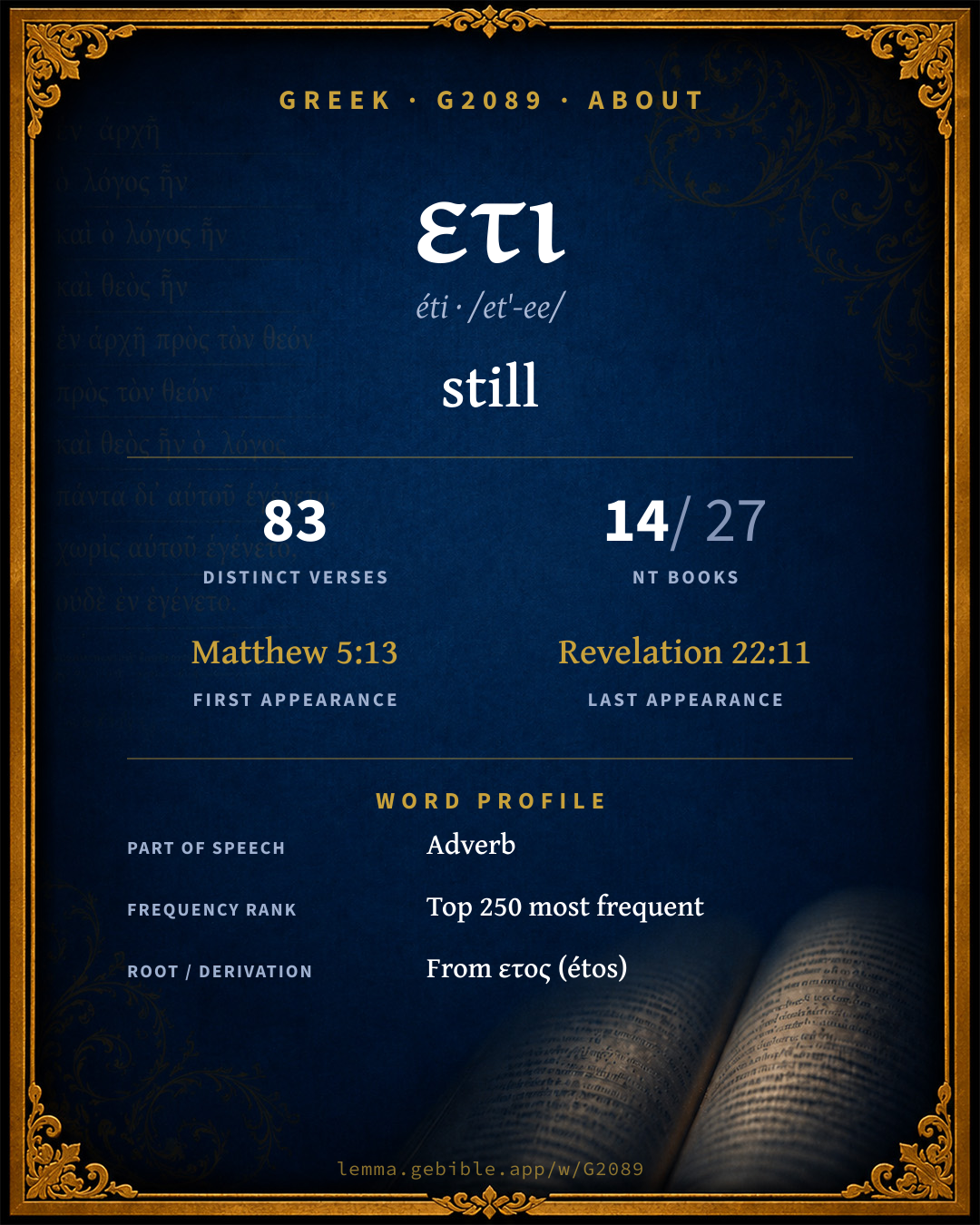
ἔτι
still
Full lexicon entry — Thayer's Greek Lexicon
From Thayer's Greek Lexicon
Where this word appears
Grammar key — what these labels mean
Part of speech
- Adverb
- A word that modifies a verb, adjective, or other adverb.
Every verse where G2089 appears — 83 distinct verses across 14 books. Click any verse to open its interlinear word-by-word view. Verse text shown in the World English Bible for context — . Each verse’s Greek form is shown with its reference; the English is not keyword-highlighted, since the data carries no word-level English alignment. Use “Compare translations” on any verse to read it across multiple English versions. This concordance covers the Greek New Testament; Septuagint (Greek Old Testament) occurrences of this word are not indexed here.
Matthew 8 verses
- Matthew 5:13 ἔτι adv "You are the salt of the earth, but if the salt has lost its flavor, with what will it be salted? It is then good for nothing, but to be cast out and trodden under the feet of men.
- Matthew 12:46 Ἔτι adv While he was yet speaking to the multitudes, behold, his mother and his brothers stood outside, seeking to speak to him.
- Matthew 17:5 ἔτι adv While he was still speaking, behold, a bright cloud overshadowed them. Behold, a voice came out of the cloud, saying, "This is my beloved Son, in whom I am well pleased. Listen to him."
- Matthew 18:16 ἔτι adv But if he doesn't listen, take one or two more with you, that at the mouth of two or three witnesses every word may be established.
- Matthew 19:20 ἔτι adv The young man said to him, "All these things I have observed from my youth. What do I still lack?"
- Matthew 26:47 ἔτι adv While he was still speaking, behold, Judas, one of the twelve, came, and with him a great multitude with swords and clubs, from the chief priest and elders of the people.
- Matthew 26:65 ἔτι adv Then the high priest tore his clothing, saying, "He has spoken blasphemy! Why do we need any more witnesses? Behold, now you have heard his blasphemy.
- Matthew 27:63 ἔτι adv saying, "Sir, we remember what that deceiver said while he was still alive: 'After three days I will rise again.'
Mark 5 verses
- Mark 5:35 ἔτι ἔτι adv adv While he was still speaking, they came from the synagogue ruler's house saying, "Your daughter is dead. Why bother the Teacher any more?"
- Mark 8:17 ἔτι adv Jesus, perceiving it, said to them, "Why do you reason that it's because you have no bread? Don't you perceive yet, neither understand? Is your heart still hardened?
- Mark 12:6 ἔτι adv Therefore still having one, his beloved son, he sent him last to them, saying, 'They will respect my son.'
- Mark 14:43 ἔτι adv Immediately, while he was still speaking, Judas, one of the twelve, came--and with him a multitude with swords and clubs, from the chief priests, the scribes, and the elders.
- Mark 14:63 ἔτι adv The high priest tore his clothes, and said, "What further need have we of witnesses?
Luke 16 verses
- Luke 1:15 ἔτι adv For he will be great in the sight of the Lord, and he will drink no wine nor strong drink. He will be filled with the Holy Spirit, even from his mother's womb.
- Luke 8:49 Ἔτι adv While he still spoke, one from the ruler of the synagogue's house came, saying to him, "Your daughter is dead. Don't trouble the Teacher."
- Luke 9:42 ἔτι adv While he was still coming, the demon threw him down and convulsed him violently. But Jesus rebuked the unclean spirit, and healed the boy, and gave him back to his father.
- Luke 14:22 ἔτι adv "The servant said, 'Lord, it is done as you commanded, and there is still room.'
- Luke 14:26 ἔτι adv "If anyone comes to me, and doesn't hate his own father, mother, wife, children, brothers, and sisters, yes, and his own life also, he can't be my disciple.
- Luke 14:32 ἔτι adv Or else, while the other is yet a great way off, he sends an envoy, and asks for conditions of peace.
- Luke 15:20 ἔτι adv "He arose, and came to his father. But while he was still far off, his father saw him, and was moved with compassion, and ran, and fell on his neck, and kissed him.
- Luke 16:2 ἔτι adv He called him, and said to him, 'What is this that I hear about you? Give an accounting of your management, for you can no longer be manager.'
- Luke 18:22 ἔτι adv When Jesus heard these things, he said to him, "You still lack one thing. Sell all that you have, and distribute it to the poor. You will have treasure in heaven. Come, follow me."
- Luke 20:36 ἔτι adv For they can't die any more, for they are like the angels, and are children of God, being children of the resurrection.
- Luke 22:47 Ἔτι adv While he was still speaking, behold, a multitude, and he who was called Judas, one of the twelve, was leading them. He came near to Jesus to kiss him.
- Luke 22:60 ἔτι adv But Peter said, "Man, I don't know what you are talking about!" Immediately, while he was still speaking, a rooster crowed.
- Luke 22:71 ἔτι adv They said, "Why do we need any more witness? For we ourselves have heard from his own mouth!"
- Luke 24:6 ἔτι adv He isn't here, but is risen. Remember what he told you when he was still in Galilee,
- Luke 24:41 ἔτι adv While they still didn't believe for joy, and wondered, he said to them, "Do you have anything here to eat?"
- Luke 24:44 ἔτι adv He said to them, "This is what I told you, while I was still with you, that all things which are written in the law of Moses, the prophets, and the psalms, concerning me must be fulfilled."
John 7 verses
- John 4:35 ἔτι adv Don't you say, 'There are yet four months until the harvest?' Behold, I tell you, lift up your eyes, and look at the fields, that they are white for harvest already.
- John 7:33 ἔτι adv Then Jesus said, "I will be with you a little while longer, then I go to him who sent me.
- John 12:35 ἔτι adv Jesus therefore said to them, "Yet a little while the light is with you. Walk while you have the light, that darkness doesn't overtake you. He who walks in the darkness doesn't know where he is going.
- John 13:33 ἔτι adv Little children, I will be with you a little while longer. You will seek me, and as I said to the Jews, 'Where I am going, you can't come,' so now I tell you.
- John 14:19 ἔτι adv Yet a little while, and the world will see me no more; but you will see me. Because I live, you will live also.
- John 16:12 ἔτι adv "I have yet many things to tell you, but you can't bear them now.
- John 20:1 ἔτι adv Now on the first day of the week, Mary Magdalene went early, while it was still dark, to the tomb, and saw the stone taken away from the tomb.
Acts 5 verses
- Acts 2:26 ἔτι adv Therefore my heart was glad, and my tongue rejoiced. Moreover my flesh also will dwell in hope;
- Acts 9:1 ἔτι adv But Saul, still breathing threats and slaughter against the disciples of the Lord, went to the high priest,
- Acts 10:44 Ἔτι adv While Peter was still speaking these words, the Holy Spirit fell on all those who heard the word.
- Acts 18:18 ἔτι adv Paul, having stayed after this many more days, took his leave of the brothers, and sailed from there for Syria, together with Priscilla and Aquila. He shaved his head in Cenchreae, for he had a vow.
- Acts 21:28 ἔτι adv crying out, "Men of Israel, help! This is the man who teaches all men everywhere against the people, and the law, and this place. Moreover, he also brought Greeks into the temple, and has defiled this holy place!"
Romans 5 verses
- Romans 3:7 ἔτι adv For if the truth of God through my lie abounded to his glory, why am I also still judged as a sinner?
- Romans 5:6 ἔτι ἔτι adv adv For while we were yet weak, at the right time Christ died for the ungodly.
- Romans 5:8 ἔτι adv But God commends his own love toward us, in that while we were yet sinners, Christ died for us.
- Romans 6:2 ἔτι adv May it never be! We who died to sin, how could we live in it any longer?
- Romans 9:19 ἔτι adv You will say then to me, "Why does he still find fault? For who withstands his will?"
1 Corinthians 4 verses
- 1 Corinthians 3:2 ἔτι adv I fed you with milk, not with meat; for you weren't yet ready. Indeed, not even now are you ready,
- 1 Corinthians 3:3 ἔτι adv for you are still fleshly. For insofar as there is jealousy, strife, and factions among you, aren't you fleshly, and don't you walk in the ways of men?
- 1 Corinthians 12:31 ἔτι adv But earnestly desire the best gifts. Moreover, I show a most excellent way to you.
- 1 Corinthians 15:17 ἔτι adv If Christ has not been raised, your faith is vain; you are still in your sins.
2 Corinthians 1 verse
Galatians 2 verses
- Galatians 1:10 ἔτι adv For am I now seeking the favor of men, or of God? Or am I striving to please men? For if I were still pleasing men, I wouldn't be a servant of Christ.
- Galatians 5:11 ἔτι ἔτι adv adv But I, brothers, if I still preach circumcision, why am I still persecuted? Then the stumbling-block of the cross has been removed.
Philippians 1 verse
2 Thessalonians 1 verse
Philemon 1 verse
Hebrews 13 verses
- Hebrews 7:10 ἔτι adv for he was yet in the loins of his father when Melchizedek met him.
- Hebrews 7:11 ἔτι adv Now if there was perfection through the Levitical priesthood (for under it the people have received the law), what further need was there for another priest to arise after the order of Melchizedek, and not be called after the order of Aaron?
- Hebrews 7:15 ἔτι adv This is yet more abundantly evident, if after the likeness of Melchizedek there arises another priest,
- Hebrews 8:12 ἔτι adv For I will be merciful to their unrighteousness. I will remember their sins and lawless deeds no more."
- Hebrews 9:8 ἔτι adv The Holy Spirit is indicating this, that the way into the Holy Place wasn't yet revealed while the first tabernacle was still standing;
- Hebrews 10:2 ἔτι adv Or else wouldn't they have ceased to be offered, because the worshippers, having been once cleansed, would have had no more consciousness of sins?
- Hebrews 10:17 ἔτι adv "I will remember their sins and their iniquities no more."
- Hebrews 10:37 ἔτι adv "In a very little while, He who comes will come, and will not wait.
- Hebrews 11:4 ἔτι adv By faith, Abel offered to God a more excellent sacrifice than Cain, through which he had testimony given to him that he was righteous, God bearing witness with respect to his gifts; and through it he, being dead, still speaks.
- Hebrews 11:32 ἔτι adv What more shall I say? For the time would fail me if I told of Gideon, Barak, Samson, Jephthah, David, Samuel, and the prophets;
- Hebrews 11:36 ἔτι adv Others were tried by mocking and scourging, yes, moreover by bonds and imprisonment.
- Hebrews 12:26 ἔτι adv whose voice shook the earth, then, but now he has promised, saying, "Yet once more I will shake not only the earth, but also the heavens."
- Hebrews 12:27 ἔτι adv This phrase, "Yet once more," signifies the removing of those things that are shaken, as of things that have been made, that those things which are not shaken may remain.
Revelation 14 verses
- Revelation 3:12 ἔτι adv He who overcomes, I will make him a pillar in the temple of my God, and he will go out from there no more. I will write on him the name of my God, and the name of the city of my God, the new Jerusalem, which comes down out of heaven from my God, and my own new name.
- Revelation 6:11 ἔτι adv A long white robe was given to each of them. They were told that they should rest yet for a while, until their fellow servants and their brothers, who would also be killed even as they were, should complete their course.
- Revelation 7:16 ἔτι ἔτι adv adv They will never be hungry, neither thirsty any more; neither will the sun beat on them, nor any heat;
- Revelation 9:12 ἔτι adv The first woe is past. Behold, there are still two woes coming after this.
- Revelation 12:8 ἔτι adv They didn't prevail, neither was a place found for him any more in heaven.
- Revelation 18:21 ἔτι adv A mighty angel took up a stone like a great millstone and cast it into the sea, saying, "Thus with violence will Babylon, the great city, be thrown down, and will be found no more at all.
- Revelation 18:22 ἔτι ἔτι ἔτι adv adv adv The voice of harpists, minstrels, flute players, and trumpeters will be heard no more at all in you. No craftsman, of whatever craft, will be found any more at all in you. The sound of a mill will be heard no more at all in you.
- Revelation 18:23 ἔτι ἔτι adv adv The light of a lamp will shine no more at all in you. The voice of the bridegroom and of the bride will be heard no more at all in you; for your merchants were the princes of the earth; for with your sorcery all the nations were deceived.
- Revelation 20:3 ἔτι adv and cast him into the abyss, and shut it, and sealed it over him, that he should deceive the nations no more, until the thousand years were finished. After this, he must be freed for a short time.
- Revelation 21:1 ἔτι adv I saw a new heaven and a new earth: for the first heaven and the first earth have passed away, and the sea is no more.
- Revelation 21:4 ἔτι ἔτι adv adv He will wipe away from them every tear from their eyes. Death will be no more; neither will there be mourning, nor crying, nor pain, any more. The first things have passed away."
- Revelation 22:3 ἔτι adv There will be no curse any more. The throne of God and of the Lamb will be in it, and his servants serve him.
- Revelation 22:5 ἔτι adv There will be no night, and they need no lamp light; for the Lord God will illuminate them. They will reign forever and ever.
- Revelation 22:11 ἔτι ἔτι ἔτι ἔτι adv adv adv adv He who acts unjustly, let him act unjustly still. He who is filthy, let him be filthy still. He who is righteous, let him do righteousness still. He who is holy, let him be holy still."
About this entry
At a glance — auto-summarized from this page’s data, not written by a person. Every figure links to its source below. This summary describes the numbers; it doesn’t interpret them.
“still” is the headline sense of the Greek verb ετι (éti). Older and newer Bibles part ways — “yet” in the King James Version, “still” (Berean Standard Bible) in modern versions. See the renderings breakdown. It appears 83 verses across 14 books of the Greek New Testament, among its moderately common vocabulary. Scripture first uses it in Matthew 5:13. See the sense tree, 83-verse concordance, and the renderings breakdown below.
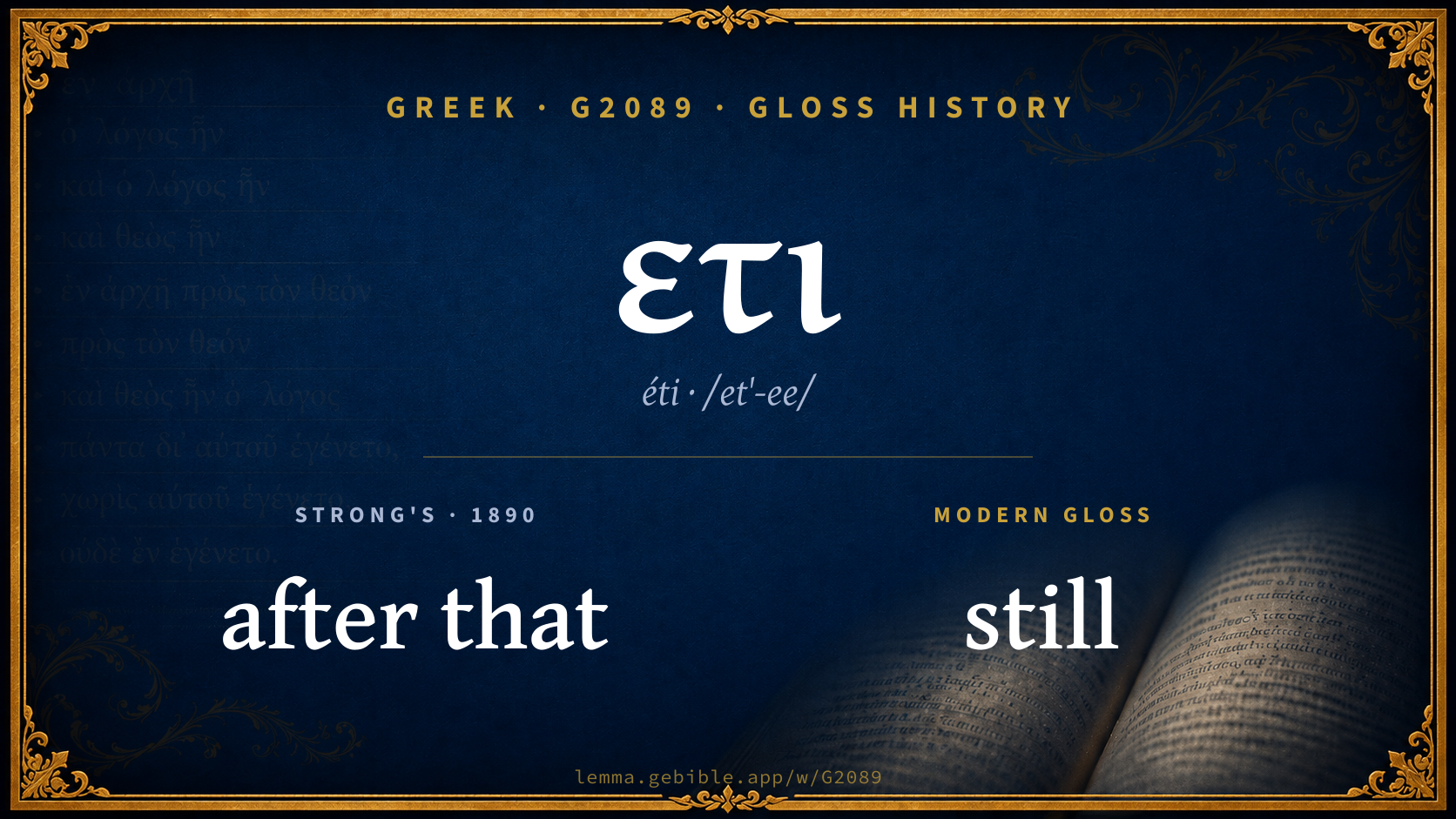
Gloss history
Strong's 1890 vs modern scholarship
About this word
Strong's G2089 catalogs a Greek word from the Greek New Testament.
These counts are not copied from any lexicon or concordance. They are computed here, from the morphology-tagged Greek New Testament. What Lemma adds →
- 83
- distinct verses
- The word appears in 83 distinct verses.
- 14 / 27
- NT books
- The word appears in 14 of 27 New Testament books.
- #181
- by frequency
- Top 250 most frequent Greek words (rank 181 of 5,347 Greek words by occurrence).
View all 83 occurrences in the concordance →
Most concentrated in
- Luke 16 verses 19%
- Revelation 14 verses 17%
- Hebrews 13 verses 16%
By section of the New Testament
By traditional corpus
Conventional, traditional groupings — biblical authorship is debated, so this is a traditional corpus grouping, not an authorship claim. Some books belong to more than one corpus (Luke is in both the Gospels and the Lukan corpus, and so on), so these shares overlap and need not total 100%. Each figure is a share of the word’s 83 distinct verses.
- Gospels 36 verses · 43%
- Lukan (Luke–Acts) 21 verses · 25%
- Johannine 21 verses · 25%
- Pauline corpus 15 verses · 18%
- Revelation 14 verses · 17%
- Hebrews 13 verses · 16%
How translations render this word
Counts come from each version’s own published word-to-Strong’s tagging or interlinear alignment — an approximate guide to how each version renders this word, not a word-level alignment the data otherwise carries. Because each total is that version’s own tagged count, the per-version totals vary from one another and need not match the appearance or distinct-verse counts above. These counts may also differ from a printed concordance because Lemma counts each distinctly tagged rendering and does not collapse phrase taggings into a single head-word total. This is a fixed set of word-tagged versions (KJV, ASV, BSB, ULT) and does not change with the reading translation you choose elsewhere. Each version’s license is shown beside its name below (and on Sources).
- King James Version: Yet 46×, More 15×, All 5×
- American Standard Version: Yet 39×, More 25×, Still 10×
- Berean Standard Bible: Still 19×, Again 7×, While 6×
- unfoldingWord Literal Text: Still 51×, Anymore 11×, Yet 7×
King James Version Public Domain
Renders G2089 across 100 tagged occurrences — most commonly:
Plus 13 renderings that appear only once — usually multi-word phrases or single function words the recovered tagging swept in, not distinct renderings. Not rendered by a distinct English word in 1 further occurrence.
American Standard Version Public Domain
Renders G2089 across 102 tagged occurrences — most commonly:
Plus 10 renderings that appear only once — usually multi-word phrases or single function words the recovered tagging swept in, not distinct renderings.
Berean Standard Bible Public Domain
Renders G2089 across 61 tagged occurrences — most commonly:
Plus 8 renderings that appear only once — usually multi-word phrases or single function words the recovered tagging swept in, not distinct renderings. Not rendered by a distinct English word in 15 further occurrences.
unfoldingWord Literal Text CC BY-SA 4.0
Renders G2089 across 94 tagged occurrences — most commonly:
Plus 5 renderings that appear only once — usually multi-word phrases or single function words the recovered tagging swept in, not distinct renderings.
Senses in Thayer's
The 1 sense Thayer's distinguishes for this word, in lexicon order (not ranked by frequency or importance). The full entry — with sub-senses — is in the Lexicon Entry tab.
- yet, still
Word origin
Derived from ετος (étos) (G2094) — year.
Perhaps akin to G2094 ; yet still (of time or degree): - after that also ever (any) further (t-) henceforth (more) hereafter (any) longer (any) more (-one) now still yet.
— Strong’s Exhaustive Concordance (1890), public domain.
Forms in the corpus
The 2 distinct written forms G2089 takes in the Greek New Testament, most frequent first — each parse links to that case’s occurrences in the concordance.
| Form | Parsing | Example | Uses |
|---|---|---|---|
| ἔτι éti | Adverb | Matthew 5:13 | 90 |
| Ἔτι Éti | Adverb | Matthew 12:46 | 4 |
Septuagint usage
The same Greek word ετι appears 439 times in the Greek Old Testament (Septuagint), across 408 verses in 35 books.
- 439
- LXX occurrences
- Tagged occurrences of this Greek word in the Septuagint.
- 408
- verses
- Distinct Septuagint verses containing this word.
- 35 / 39
- OT books
- The word appears in 35 of the 39 Old Testament books.
Sample Septuagint occurrences
- Genesis 2:9 ἔτι
- Exodus 2:3 ἔτι
- Leviticus 13:57 ἔτι
- Numbers 8:25 ἔτι
- Deuteronomy 3:26 ἔτι
- Joshua 1:11 ἔτι
- Judges 2:14 ἔτι
- Ruth 1:11 ἔτι
- 1 Samuel 1:18 ἔτι
- 2 Samuel 2:22 ἔτι
- 1 Kings 1:14 ἔτι
- 2 Kings 1:13 ἔτι
Septuagint occurrences (same lexeme)
Every verse where the same Strong’s number (G2089) appears in the Greek Septuagint — showing the first 50 of 408. Verse text shown in the World English Bible for context; the Greek form is the matched word — the English is not keyword-highlighted.
- Genesis 2:9 ἔτι Out of the ground Yahweh God made every tree to grow that is pleasant to the sight, and good for food; the tree of life also in the midst of the garden, and the tree of the knowledge of good and evil.
- Genesis 2:19 ἔτι Out of the ground Yahweh God formed every animal of the field, and every bird of the sky, and brought them to the man to see what he would call them. Whatever the man called every living creature, that was its name.
- Genesis 7:4 ἔτι In seven days, I will cause it to rain on the earth for forty days and forty nights. Every living thing that I have made, I will destroy from the surface of the ground."
- Genesis 8:10 ἔτι He stayed yet another seven days; and again he sent forth the dove out of the ark.
- Genesis 8:12 ἔτι He stayed yet another seven days, and sent forth the dove; and she didn't return to him any more.
- Genesis 8:21 ἔτι Yahweh smelled the sweet savor. Yahweh said in his heart, "I will not again curse the ground any more for man's sake, because the imagination of man's heart is evil from his youth; neither will I ever again strike everything living, as I have done.
- Genesis 9:11 ἔτι I will establish my covenant with you; neither will all flesh be cut off any more by the waters of the flood; neither will there any more be a flood to destroy the earth."
- Genesis 9:15 ἔτι and I will remember my covenant, which is between me and you and every living creature of all flesh, and the waters will no more become a flood to destroy all flesh.
- Genesis 17:5 ἔτι Neither will your name any more be called Abram, but your name will be Abraham; for the father of a multitude of nations have I made you.
- Genesis 18:29 ἔτι He spoke to him yet again, and said, "What if there are forty found there?" He said, "I will not do it for the forty's sake."
- Genesis 18:32 ἔτι He said, "Oh don't let the Lord be angry, and I will speak yet but this once. What if ten are found there?" He said, "I will not destroy it for the ten's sake."
- Genesis 24:20 ἔτι She hurried, and emptied her pitcher into the trough, and ran again to the well to draw, and drew for all his camels.
- Genesis 25:6 ἔτι but to the sons of the concubines who Abraham had, Abraham gave gifts. He sent them away from Isaac his son, while he yet lived, eastward, to the east country.
- Genesis 29:7 ἔτι He said, "Behold, it is still the middle of the day, not time to gather the cattle together. Water the sheep, and go and feed them."
- Genesis 29:9 ἔτι While he was yet speaking with them, Rachel came with her father's sheep, for she kept them.
- Genesis 29:27 ἔτι Fulfill the week of this one, and we will give you the other also for the service which you will serve with me yet seven other years."
- Genesis 29:34 ἔτι She conceived again, and bare a son. Said, "Now this time will my husband be joined to me, because I have borne him three sons." Therefore was his name called Levi.
- Genesis 29:35 ἔτι She conceived again, and bare a son. She said, "This time will I praise Yahweh." Therefore she named him Judah. Then she stopped bearing.
- Genesis 30:7 ἔτι Bilhah, Rachel's handmaid, conceived again, and bore Jacob a second son.
- Genesis 30:12 ἔτι Zilpah, Leah's handmaid, bore Jacob a second son.
- Genesis 30:19 ἔτι Leah conceived again, and bore a sixth son to Jacob.
- Genesis 31:14 ἔτι Rachel and Leah answered him, "Is there yet any portion or inheritance for us in our father's house?
- Genesis 32:29 ἔτι Jacob asked him, "Please tell me your name." He said, "Why is it that you ask what my name is?" He blessed him there.
- Genesis 35:9 ἔτι God appeared to Jacob again, when he came from Paddan Aram, and blessed him.
- Genesis 35:10 ἔτι God said to him, "Your name is Jacob. Your name shall not be Jacob any more, but your name will be Israel." He named him Israel.
- Genesis 37:8 ἔτι His brothers said to him, "Will you indeed reign over us? Or will you indeed have dominion over us?" They hated him all the more for his dreams and for his words.
- Genesis 37:30 ἔτι He returned to his brothers, and said, "The child is no more; and I, where will I go?"
- Genesis 38:4 ἔτι She conceived again, and bore a son; and she named him Onan.
- Genesis 38:5 ἔτι She yet again bore a son, and named him Shelah: and he was at Chezib, when she bore him.
- Genesis 38:26 ἔτι Judah acknowledged them, and said, "She is more righteous than I, because I didn't give her to Shelah, my son." He knew her again no more.
- Genesis 40:13 ἔτι Within three more days, Pharaoh will lift up your head, and restore you to your office. You will give Pharaoh's cup into his hand, the way you did when you were his cupbearer.
- Genesis 40:19 ἔτι Within three more days, Pharaoh will lift up your head from off you, and will hang you on a tree; and the birds will eat your flesh from off you."
- Genesis 43:7 ἔτι They said, "The man asked directly concerning ourselves, and concerning our relatives, saying, 'Is your father still alive? Have you another brother?' We just answered his questions. Is there any way we could know that he would say, 'Bring your brother down?'"
- Genesis 43:27 ἔτι He asked them of their welfare, and said, "Is your father well, the old man of whom you spoke? Is he yet alive?"
- Genesis 43:28 ἔτι They said, "Your servant, our father, is well. He is still alive." They bowed the head, and did homage.
- Genesis 44:14 ἔτι Judah and his brothers came to Joseph's house, and he was still there. They fell on the ground before him.
- Genesis 44:23 ἔτι You said to your servants, 'Unless your youngest brother comes down with you, you will see my face no more.'
- Genesis 44:28 ἔτι and the one went out from me, and I said, "Surely he is torn in pieces;" and I haven't seen him since.
- Genesis 45:1 ἔτι Then Joseph couldn't control himself before all those who stood before him, and he cried, "Cause every man to go out from me!" There stood no man with him, while Joseph made himself known to his brothers.
- Genesis 45:3 ἔτι Joseph said to his brothers, "I am Joseph! Does my father still live?" His brothers couldn't answer him; for they were terrified at his presence.
- Genesis 45:6 ἔτι For these two years the famine has been in the land, and there are yet five years, in which there will be neither plowing nor harvest.
- Genesis 45:11 ἔτι There I will nourish you; for there are yet five years of famine; lest you come to poverty, you, and your household, and all that you have."'
- Genesis 45:28 ἔτι Israel said, "It is enough. Joseph my son is still alive. I will go and see him before I die."
- Genesis 46:30 ἔτι Israel said to Joseph, "Now let me die, since I have seen your face, that you are still alive."
- Genesis 49:27 ἔτι "Benjamin is a ravenous wolf. In the morning he will devour the prey. At evening he will divide the spoil."
- Exodus 2:3 ἔτι When she could no longer hide him, she took a papyrus basket for him, and coated it with tar and with pitch. She put the child in it, and laid it in the reeds by the river's bank.
- Exodus 4:18 ἔτι Moses went and returned to Jethro his father-in-law, and said to him, "Please let me go and return to my brothers who are in Egypt, and see whether they are still alive." Jethro said to Moses, "Go in peace."
- Exodus 8:25 ἔτι Pharaoh called for Moses and for Aaron, and said, "Go, sacrifice to your God in the land!"
- Exodus 9:2 ἔτι For if you refuse to let them go, and hold them still,
- Exodus 9:17 ἔτι as you still exalt yourself against my people, that you won't let them go.
These are occurrences of the same Greek lexeme (G2089) in the Septuagint — not a translation of any one Hebrew word. The store carries no word-level Hebrew↔Greek alignment, so no Hebrew original is asserted here. Counts come from the recovered LXX Strong's tagging — high-frequency vocabulary is well covered, while rare or late forms may be untagged — so they reflect tagged occurrences and may slightly undercount.