2 Thessalonians 2:5

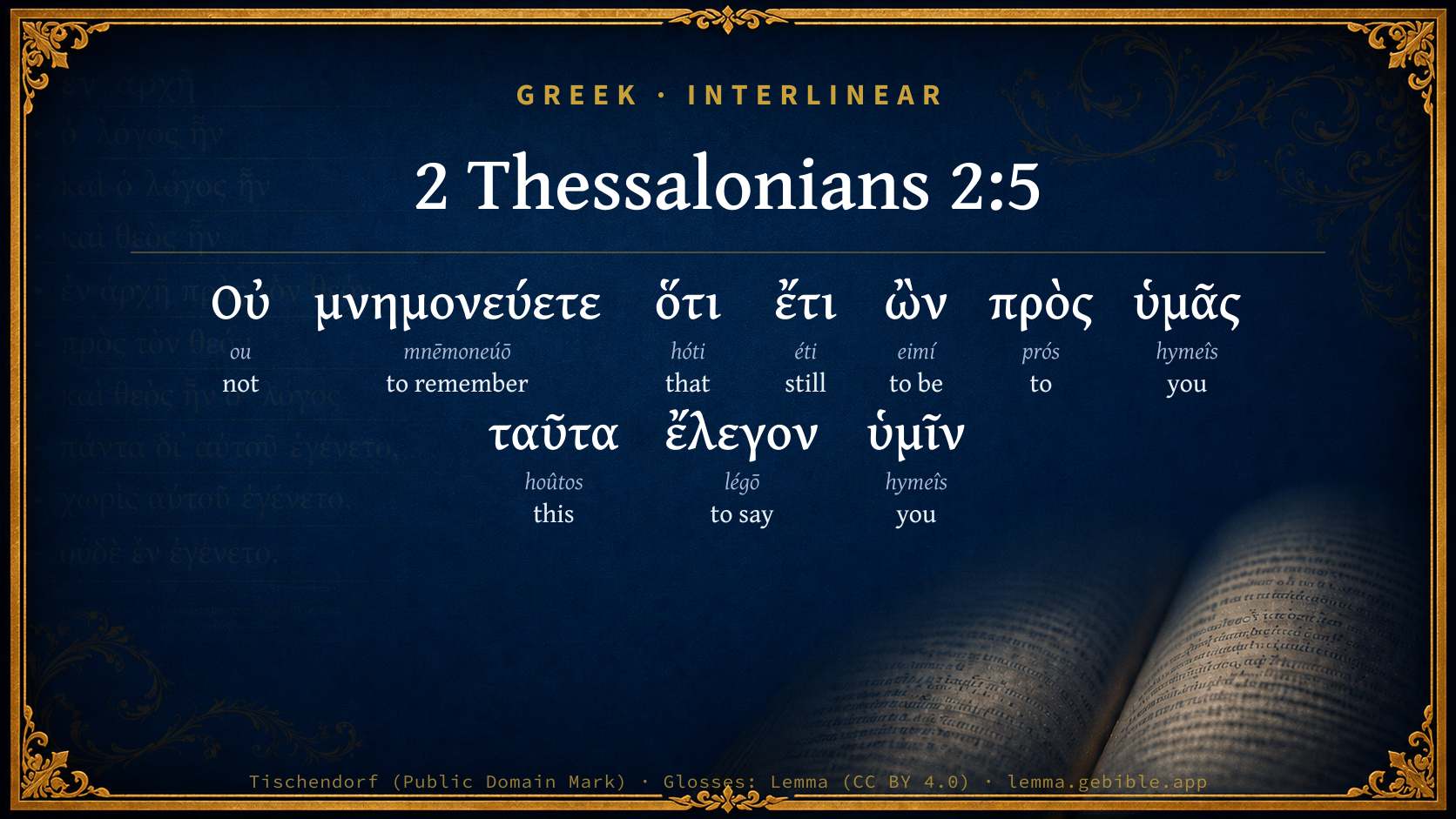
Greek (Tischendorf 8th ed.) 2 Thessalonians 2:5 appears in the Greek New Testament. The text above is from the Tischendorf 8th edition. Each word links to its Strong’s number and a concise gloss. Click any word for its full Thayer’s Greek Lexicon entry.
Download image
Cite this verse

2 Thessalonians 2:5 (World English Bible). Public Domain. Lemma interlinear Bible study tool, https://lemma.gebible.app/v/2-thessalonians/2/5.

Show BibTeX & RIS
BibTeX
RIS
English Translation
Don't you remember that, when I was still with you, I told you these things?
World English Bible · Public Domain
Download a study sheet

One document with this verse’s original text, its word-by-word gloss line, the meaning frame, cross-references with their text, attributed commentary, and full source and license credits — printable, and it pastes into notes with its structure intact.

This verse Autodidact and up

Study sheet (.html) Plain text (.txt)

A passage Seminary Student

Up to 50 verses in one chapter. A passage sheet keeps up to 6 commentary sources and 12 cross-references per verse, in the order this page ranks them, and says so on the sheet whenever that leaves anything out. Ask for a single verse and you get the Autodidact verse sheet above.

Everything on this page stays free to read, with no account — the sheet is a download of what is already on screen, not access to it.

Want to remove ads? Support Godless Engineer
Compare translations 3

The same verse in 3 English versions, stacked beneath the original-language interlinear above. Click any original word for its lexicon entry.

Each is an independent rendering of the whole verse — the interlinear is not word-aligned to these translations.

Highlighted words mark where these versions differ — a whole-verse word diff, not a word-by-word alignment.

  • World English Bible Public Domain
    Don't you remember that, when I was still with you, I told you these things?
  • King James Version Public Domain
    Remember ye not, that, when I was yet with you, I told you these things?
  • unfoldingWord Literal Text CC BY-SA 4.0
    Do you not remember that, still being with you, I was telling you these things?

unfoldingWord Literal Text — © unfoldingWord, licensed CC BY-SA 4.0. Word-aligned USFM3 via Door43 (git.door43.org/unfoldingWord/en_ult).

Versions to compare (up to 4)

3 of 4 selected

Show all 19 translations

Every available English version of this verse, each an independent rendering of the whole verse.

  • World English Bible Public Domain
    Don't you remember that, when I was still with you, I told you these things?
  • Berean Standard Bible Public Domain
    Do you not remember that I told you these things while I was still with you?
  • Majority Standard Bible Public Domain
    Do you not remember that I told you these things while I was still with you?
  • King James Version Public Domain
    Remember ye not, that, when I was yet with you, I told you these things?
  • American Standard Version (1901) Public Domain
    Remember ye not, that, when I was yet with you, I told you these things?
  • Revised Version (1885) Public Domain
    Remember ye not, that, when I was yet with you, I told you these things?
  • Geneva Bible (1599) Public Domain
    Remember ye not, that when I was yet with you, I tolde you these things?
  • Douay-Rheims (1899) Public Domain
    Remember you not, that when I was yet with you, I told you these things?
  • Young's Literal Translation Public Domain
    Do ye not remember that, being yet with you, these things I said to you?
  • Literal Standard Version CC BY-SA 4.0
    Do you not remember that, yet being with you, I said these things to you?
  • Unlocked Literal Bible CC BY-SA 4.0
    Do you not remember that when I was with you I told you these things?
  • unfoldingWord Literal Text CC BY-SA 4.0
    Do you not remember that, still being with you, I was telling you these things?
  • Darby Bible Public Domain
    Do ye not remember that, being yet with you, I said these things to you?
  • World Messianic Bible Public Domain
    Don’t you remember that when I was still with you, I told you these things?
  • Webster's Bible Public Domain
    Remember ye not, that when I was yet with you, I told you these things?
  • Free Bible Version CC BY-SA 4.0
    Don't you remember that I told you all this while I was still with you?
  • Bible in Basic English Public Domain
    Have you no memory of what I said when I was with you, giving you word of these things?
  • Text-Critical English NT CC BY 4.0
    Do you not remember that I told you these things when I was still with you?
  • Tyndale New Testament (1534) Public Domain
    Remember ye not that when I was yet with you I tolde you these thynges?

Literal Standard Version (2020), Covenant Press — licensed CC BY-SA 4.0. Text via the HelloAO Bible API (eBible.org). Unlocked Literal Bible (unfoldingWord) — licensed CC BY-SA 4.0. Text via the HelloAO Bible API (eBible.org). unfoldingWord Literal Text — © unfoldingWord, licensed CC BY-SA 4.0. Word-aligned USFM3 via Door43 (git.door43.org/unfoldingWord/en_ult). Free Bible Version, Dr. Jonathan Gallagher — licensed CC BY-SA 4.0. Text via the HelloAO Bible API (eBible.org).

Word by word

More ways to search: Search by grammar → Find every occurrence → Compare this word →

Practice this passage: Drill this verse → Learn its vocabulary →

About this verse

These counts appear in no published source. They are computed here, from the morphology-tagged text and Lemma’s own curated glosses. What Lemma adds →

10
words
9
distinct lemmas
Pauline Epistles
section

Notable vocabulary

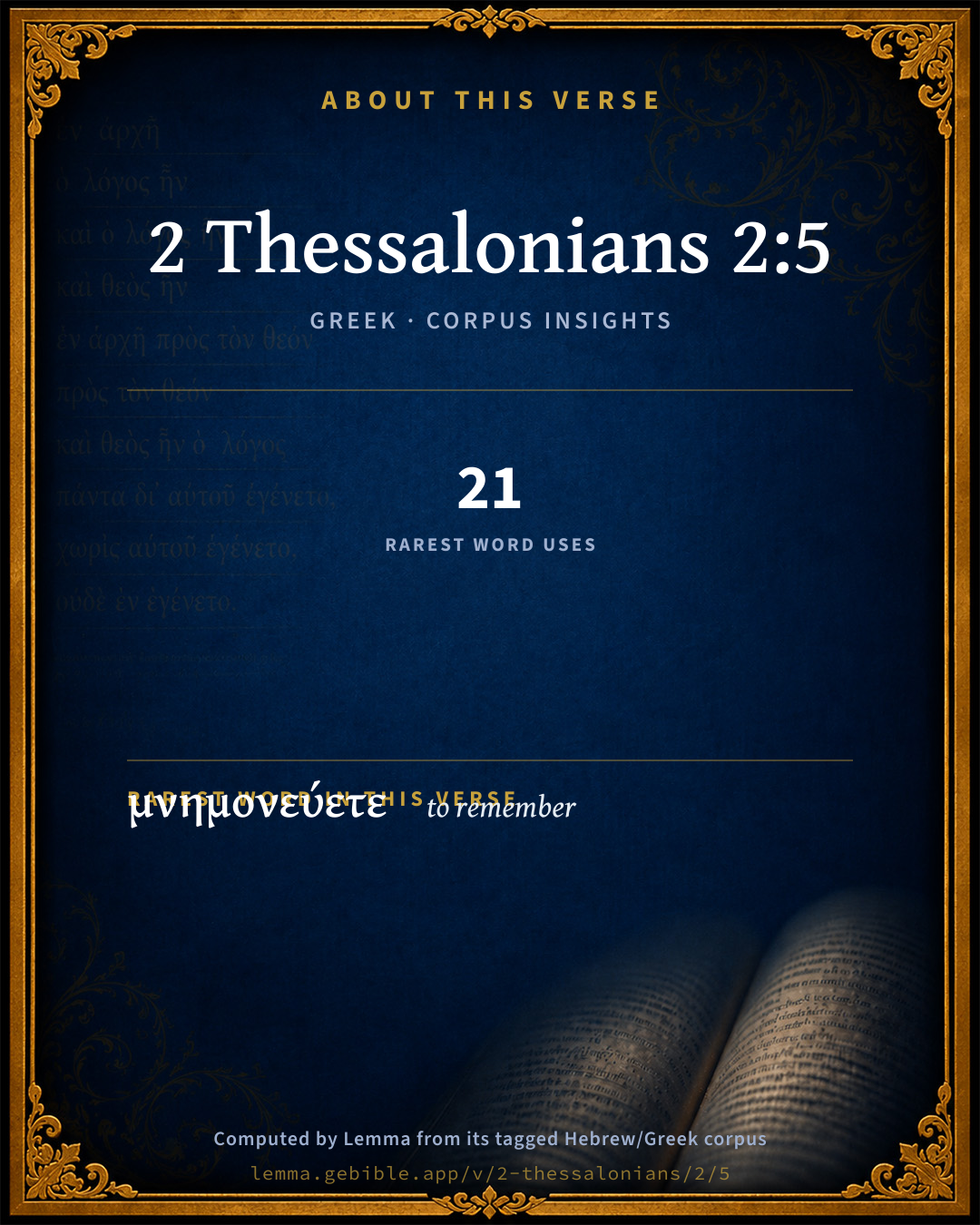
The rarest word here is μνημονεύετε to remember G3421 — appearing just 21 times in the whole Greek New Testament.

Shared distinctive vocabulary

μνημονεύετε to remember G3421 occurs in 21 verses of the Greek New Testament. Also found in:

Repetition

A word recurs within this verse:

  • ὑμᾶς you G5210 ×2

Cross-references

9

Topical passages linked to 2 Thessalonians 2:5 in the Treasury of Scripture Knowledge — connected by theme and wording, ordered by reader-vote popularity; previews shown in the World English Bible.

  • Matthew 16:9 Don't you yet perceive, neither remember the five loaves for the five thousand, and how many baskets you took up?
  • John 16:4 But I have told you these things, so that when the time comes, you may remember that I told you about them. I didn't tell you these things from the beginning, because I was with you.
  • Galatians 5:21 envyings, murders, drunkenness, orgies, and things like these; of which I forewarn you, even as I also forewarned you, that those who practice such things will not inherit the Kingdom of God.
  • 2 Peter 1:15 Yes, I will make every effort that you may always be able to remember these things even after my departure.
  • Mark 8:18 Having eyes, don't you see? Having ears, don't you hear? Don't you remember?
  • Luke 24:6–7 He isn't here, but is risen. Remember what he told you when he was still in Galilee,
  • Acts 20:31 Therefore watch, remembering that for a period of three years I didn't cease to admonish everyone night and day with tears.
  • 1 Thessalonians 2:11 As you know how we exhorted, comforted, and implored every one of you, as a father does his own children,
  • 2 Thessalonians 3:10 For even when we were with you, we commanded you this: "If anyone will not work, neither let him eat."

Cross-references courtesy of OpenBible.info (CC BY 4.0).

Commentary

Notes on 2 Thessalonians 2:5 from classic Christian and Jewish commentators (each source and its license shown beneath its notes). The classic Christian expositions comment on the surrounding passage and are grouped to its opening verse, so a note may address several verses; the Jewish commentaries on the Tanakh (Rashi and others) are per-verse, so they appear only where the commentator wrote on this verse.

Lemma curates 59 commentaries, every one of them public domain or Creative Commons licensed, each selected and text-cleaned for this edition rather than reprinted as found. About our sources →

Joseph Benson's Commentary

2Th 2:5-6. Remember ye not, &c. — These things were not asserted now merely to serve the present occasion: the apostle had spoken, yea, and borne a faithful testimony concerning them while he was at Thessalonica. Indeed, the rise and progress of this apostacy, with the various heresies connected with it, and the evils which were about to be occasioned by it, were matters of such offence and scandal, that unless the disciples had been forewarned concerning them, their happening might have led the weak to fancy that God had cast away all care of his church. The apostle, knowing this, made the prediction of these events the subject even of his first sermons to the Thessalonians, after they had embraced the gospel; and doubtless he followed the same course in all other places where he preached with any degree of success. See 1Ti 4:6. Beza observes that this prophecy was often repeated and earnestly inculcated in the first age, but is overlooked and neglected in modern times. And now ye know — By what I told you when I was with you; what with-holdeth — Restraineth the man of sin from exercising his impious tyranny. It seems the apostle, when at Thessalonica, besides speaking of the apostacy and of the man of sin, had told them what it was that hindered his appearance. But as he has not thought fit to commit that discovery to writing, we cannot determine with absolute certainty what it was; but if we may rely upon the concurrent testimonies of the Christian fathers, it was the Roman empire. Indeed, the caution which the apostle observes with respect to speaking of it, renders it highly probable that it was somewhat relating to the higher powers. He mentioned it in discourse, but would not commit it to writing. As he afterward exhorts the Thessalonians to hold the traditions which had been taught them, whether by word or his epistle, it is likely this was one of the traditions which he thought it proper to teach them. The apostle’s manner of speaking here, (that he might be revealed in his time, or in his own season, as εν τω εαυτου καιρω properly signifies,) seems to imply that there were reasons for permitting the corruptions of Christianity to proceed to a certain length. “Now what could these reasons be, unless to show mankind the danger of admitting any thing in religion but what is of divine appointment? For one error productive of superstition admitted, naturally leads to others, till at length religion is utterly deformed. Perhaps also these evils were permitted, that in the natural course of human affairs, Christianity being first corrupted and then purged, the truth might be so clearly established, as to be in no danger of any corruption in time to come.” — Macknight.

Joseph Benson's Commentary on the Old and New Testaments (1811–1818) — public domain. Text from a community e-Sword module.

Bengel's Gnomon

Johann Albrecht Bengel

2Th 2:5. Οὐ μνημονεύετε; do ye not remember?) The apostle intimates, that he neither contradicts himself, nor helps out his former statement by some sort of new declaration, as men under the influence of a fond imagination (conjecturers) are wont to do after being the cause of offence: that he had not said, the day of the Lord was near in such a sense, as that other important great events would not occur in the meantime.—ἔτι, yet) The Antithesis is νῦν, now, 2Th 2:6.—προς ὑμᾶς, with you) In the present day Judaism greatly prevails at Thessalonica, and at the proper time the opportunity will be given of observing whether the Iniquitous one [‘Wicked’] is to have a great party, especially in that city. Some even of the tribes [φυλῶν; not as Engl. Vers. kindreds] of Israel, before the death and resurrection of the two witnesses, will stand by the beast, Rev 11:9, and after the ascension of the witnesses into heaven, and the earthquake, will repent. In my opinion, it may happen, that a concealed Jew may become Pope; comp. Thes. 16., on 2Th 2:3 above. I do not assert this positively.—ἔλεγον ὑμῖν, I told you) So, 2Th 2:15, ye have been taught.

Bengel's Gnomon of the New Testament — English translation (T&T Clark, Edinburgh, 1860) — public domain. Text from a community e-Sword module.

Meyer's Critical & Exegetical Commentary

Heinrich August Wilhelm Meyer

2Th_2:5. Estius: Est … tacita objurgatio, quasi dicat: quum haec vobis praesens dixerim, non debebatis commoveri rumoribus aliquorum dicentium instare diem domini.

On πρὸς ὑμᾶς] see on 1Th_3:4.

ταῦτα] namely, the contents of 2Th_2:3-4. To assume, however, a parenthesis from 2Th_2:5 to οἴδατε in 2Th_2:6 (so Heinsius) is arbitrary.

Meyer — Critical and Exegetical Commentary on the New Testament — English translation by Peter Christie, edited by Frederick Crombie (T&T Clark, 1880) — public domain. Text from a community e-Sword module.

Expositor's Greek Testament

ed. W. Robertson Nicoll

2Th 2:5 . It was no after-thought, on Paul’s part (the singular rules out Spitta’s idea that Timothy wrote this apocalyptic piece). Nor was it an idiosyncrasy of his teaching. Especially since the days of Antiochus Epiphanes (Dan 7:11 ; cf. Gunkel’s Schöpfung u. Chaos , 221 f.), a more or less esoteric and varied Jewish tradition had pervaded pious circles, that the last days would be heralded by a proud uprising against God. The champion of this movement was no longer the Dragon or cosmic opponent of God, as in the older mythology (though traces of this belief still linger), but an individual ( ὁ ἄνομος ) who incorporates human wickedness ( τὸ μυστήριον τῆς ἀνομίας ) and infernal cunning in his own person, and who essays to supplant and suppress the worship of the true God, by claiming divine honours for himself. He is Satan’s messiah, an infernal caricature of the true messiah. Cf. Asc. Isa. , iv. 6, where it is said that Belial “will do and speak like the Beloved and he will say, I am God and before me there has been none”.

The Expositor's Greek Testament, edited by W. Robertson Nicoll (1897–1910) — public domain. Text from a community e-Sword module.

Geneva Bible (1599)

Geneva Bible translators

This prophecy was continually declared to the Ancient Church, but it was neglected of them that followed.

Geneva Bible (1599) marginal notes — public domain. Text via Bolls.life.

Jamieson, Fausset & Brown

Robert Jamieson, A. R. Fausset & David Brown

Remember, &c.--confuting those who represent Paul as having labored under error as to Christ's immediate coming when writing his first Epistle, and as now correcting that error.

I told you--more than once, literally, "I was telling," or "used to tell."

Jamieson, Fausset & Brown — Commentary Critical and Explanatory on the Whole Bible (1871) — public domain (CC PDM 1.0). Text via the HelloAO Bible API.

Adam Clarke's Commentary

Verse 5. I told you these things] In several parts of this description of the man of sin, the apostle alludes to a conversation which had taken place between him and the members of this Church when he was at Thessalonica; and this one circumstance will account for much of the obscurity that is in these verses. Besides, the apostle appears to speak with great caution, and does not at all wish to publish what he had communicated to them; the hints which he drops were sufficient to call the whole to their remembrance.

Adam Clarke's Commentary on the Bible (1810–1826) — public domain. Text from a community e-Sword/MySword module.

John Calvin's Commentaries

5 Do ye not remember? This added no small weight to the doctrine, that they had previously heard it from the mouth of Paul, that they might not think that it had been contrived by him at the instant. And as he had given them early warning as to the reign of Antichrist, and the devastation that was coming upon the Church, when no question had as yet been raised as to such things, he saw beyond all doubt that the doctrine was specially useful to be known. And, unquestionably, it is really so. Those whom he addressed were destined to see many things that would trouble them; and when posterity would see a large proportion of those who had made profession of the faith of Christ revolt from piety, maddened, as it were, by a gad-fly, or rather by a fury, what could they do but waver? This, however, was as a brazen wall — that matters were so appointed by God, because the ingratitude of men was worthy of such vengeance. Here we may see how forgetful men are in matters affecting their everlasting salvation. We must also observe Paul’s mildness; for while he might have been vehemently incensed, he does but mildly reprove them; for it is a fatherly way of reproving them to say to them, that they had allowed forgetfulness of a matter so important and so useful to steal in upon their minds.

John Calvin's Commentaries (1540-1563) — public domain. Text from the Calvin Translation Society English edition (1840s-50s) via the Christian Classics Ethereal Library (ccel.org). Calvin's coverage is partial (roughly two-thirds of the Bible); uncommented books and verses are honest gaps, never fabricated. The 19th-century editor's footnotes and remarks are omitted so the notes are faithfully Calvin's own voice.

Ellicott's Commentary for English Readers

(5) Remember ye not.—A rebuke of the same character as Rom_6:3; 1Co_6:19, and, like those, levelled at ignorance of what in apostolic days were thought the six fundamental points of Christian teaching (Heb_5:12; Heb_6:1-2). The doctrine of Antichrist would naturally form part of the course on resurrection and judgment. This explains how the doctrine was enforced (1) so early in the education of the Christian churches: “while I was yet with you” (see Introduction to the First Epistle to Thessalonians); and (2) so emphatically and repeatedly:” my habit was to tell you these things”—for the word translated “told” is in the imperfect tense, which means more than a single action. Notice that in St. Paul’s eager personal recollection, of thus teaching, he for once (and nowhere else) forgets Silas and Timothy: not “we,” but “I.” Imagine a forger who should forge with such subtlety! Mark also how erroneous is the opinion that St. Paul in this Epistle recedes from his former teaching about the Advent and its date.

A Bible Commentary for English Readers, edited by Charles John Ellicott (1878–1897) — public domain. Text from a community e-Sword module.

The Cambridge Bible for Schools and Colleges

gen. ed. J. J. S. Perowne

5. Remember ye not, that, when I was yet with you, I told you these things?] More precisely, I used to tell you; comp. 1Th_3:4, for the tense.

This reminder serves two purposes:—(1) It is a gentle reproof to the readers, who ought not to have been so easily unsettled by the alarmists, after what the Apostle had told them, (2) It obviates the necessity of explanation by letter. Any more explicit statement would probably have raised political suspicion, exposing the Apostle to a renewal of the charges which led to his expulsion from Thessalonica (see Act_17:6-7; Introd. pp. 15, 20, 21). St Paul had watchful enemies, who would be quick to seize on anything that might compromise him with the Roman Government.

The Cambridge Bible for Schools and Colleges (gen. ed. J. J. S. Perowne; Cambridge University Press, 1878–1918) — public domain. Text from a community e-Sword module.

John Gill's Exposition

Remember ye not, that when I was yet with you,.... At Thessalonica, for the apostle had been there in person, and had preached there with great boldness and success; he had declared the whole counsel of God, and the Gospel came in power and worked effectually in them, and yet there was too great a forgetfulness of it; with which the apostle tacitly charges them, and rebukes them gently for it; and as a faithful monitor, stirs up their pure minds by way of remembrance, and reminds them of former truths delivered to them:

I told you these things: or "words" as the Arabic version; concerning the coming of Christ as that it would not be yet, that there, must be a defection from the faith, and antichrist must be revealed; which shows that these were things of moment and importance, and were useful and profitable to be insisted on; and therefore the apostle had told them of them, and spoke freely and largely about them, at his first preaching among them, and were what he inculcated everywhere; and also that his doctrine was all of a piece at one time as another; it was not yea and nay, or contradictory; what he now said was no other than what he had said before; and therefore it was the more inexcusable in them, to be shaken or troubled by any means with another doctrine.

John Gill's Exposition of the Whole Bible (1746–1763) — public domain (CC PDM 1.0). Text via the HelloAO Bible API.

Trapp's Complete Commentary

John Trapp

5 Remember ye not, that, when I was yet with you, I told you these things?

Ver. 5. Remember ye not] Satan usually hides from us that which should help us. But as the soul should be as it were a holy ark; so should the memory be as the pot of manna, preserving holy truth for constant use.

John Trapp, A Commentary or Exposition upon All the Books of the Old and New Testament (1647–1656) — public domain. Text from a community e-Sword module.

Albert Barnes' Notes on the Bible

Remember ye not, that, when I was yet with you, I told you these things? - The whole subject of the second coming of the Saviour seems to have constituted an important part of the instructions of Paul when at Thessalonica. He now refers them to what he had told them respecting the great apostasy, to show that his views had not changed, and that he did not mean to have them understand that the world would soon come to an end. He had stated these things to them implying that a considerable interval must elapse before the Saviour would appear. Much of the obscurity of this prophecy arises from the fact, that the apostle alludes to things which he had told them when with them, of which we have now no knowledge. Hence, what would be perfectly clear to them, on reading this letter, is now difficult to be understood.

Albert Barnes' Notes on the Bible (1834–1885) — public domain. Text from a community e-Sword/MySword module.

Matthew Poole's English Annotations

The apostle tacitly upbraids them for their forgetfulness. To forget the things that have been taught us, is a great evil: Solomon often cautions against it, Pro 3:1; 4:5; and it is often reproved, Heb 12:5; Jam 1:24; and the contrary required, Mal 4:4; Joh 16:4; Jud 1:17; Rev 3:3. David hid the word in his heart, Psa 119:11, and the virgin Mary kept the angel’s sayings, Luk 2:19. The apostles did take care to tell the churches of the apostacy that would come, and of false prophets and teachers that would arise, as Paul the elders of Ephesus, Act 20:29,30, and Peter, 2Pe 2:1, and St. John of the coming of antichrist, 1Jo 2:18; and more fully, though obscurely, in the book of the Revelation; and the apostle here in this verse minds these Thessalonians that he told them of the coming of the man of sin before the coming of Christ, so that they should not have been shaken in their minds about Christ’s coming in that present age. And they told the churches of these things, that they might not be surprised by them, or offended at them, when they came.

Matthew Poole's English Annotations on the Holy Bible (1683–1685) — public domain. Text from a community e-Sword/MySword module.

Whedon's Commentary on the Bible

Daniel D. Whedon

5. Remember ye not—No reproof here, but one of several appeals to the memory of his readers, with which these epistles abound.

I told you— Probably not in his public preaching, but in private conversation. St. Paul, then, is not here giving them any new revelation, or any after-thought. He had told the Thessalonians at his first visit that events of unknown magnitude intervened between the present hour and the parousia.

Daniel D. Whedon (gen. ed.), Commentary on the Old and New Testaments (1874–1909) — public domain. Text from a community e-Sword module.

The Pulpit Commentary

Remember ye not, that, when I was yet with you, I told you these things? These words contain a reproach. Had the Thessalonians remembered the instructions of the apostle, they would not have been so soon shaken from their sober reason or troubled. The apostle, when he was in Thessalonica, had told them of these things; he had instructed them concerning the nature of the apostasy and the coming of the man of sin; so that, as already observed, this description, so obscure to us, was not obscure to the Thessalonians, they possessed the key to its interpretation.

The Pulpit Commentary (1880–1919), ed. H.D.M. Spence-Jones & Joseph S. Exell — public domain. Text from a community e-Sword module.

Kretzmann's Popular Commentary

Paul E. Kretzmann

The revelation of the mystery of iniquity:

v. 5. Remember ye not that, when I was yet with you, I told you these things?

v. 6. And now ye know what withholdeth That he might be revealed in his time.

v. 7. For the mystery of iniquity doth already work; only he who now letteth will let, until he be taken out of the way.

v. 8. And then shall that Wicked be revealed, whom the Lord shall consume with the spirit of His mouth, and shall destroy with the brightness of His coming;

v. 9. even him whose coming is after the working of Satan with all power and signs and lying wonders,

v. 10. and with all deceivableness of unrighteousness in them that perish, because they received not the love of the truth that they might be saved.

v. 11. And for this cause God shall send them strong delusion that they should believe a lie,

v. 12. that they all might be damned who believed not the truth, but had pleasure in unrighteousness.

This was not the first time that the apostle had given the Thessalonian Christians instruction concerning the great apostasy: Do you not remember that, while I was still with you, I told you this? He had made it a point to include this point in his oral instruction, not only once, but habitually. Surely it was merely necessary to remind them of the facts as they had learned them. Therefore also the apostle could continue: And now you know what withholds that he may be revealed in his own time. Before the writing of this letter, the contradicting and contradictory opinions which the Thessalonians heard might have tended to confuse them. But now that they recalled his oral instructions, they knew what he was referring to, they knew the reason for the delay, they knew what restrained Anti-Christ from being revealed before his appointed time. All that Paul had taught them, and a repetition at this time would be unnecessary; they would understand to what Paul was referring.

Just how serious the apostle thought the situation and its possible dangerous developments appears from his next words: For the mystery of lawlessness is active even now, only until he that withholds for the present is out of the way. He speaks of a mystery of lawlessness which was even then working and active; he sees before him the scattered, shapeless mass of ungodliness, which is first to gain form and personality in Anti-Christ. It was at that time still hidden and covered, one could not yet point out specific instances of its terrible power. But it was at work, it was influencing certain persons, for instance, Diotrephes, 3Jn 1:10, and other unruly spirits, 1Jn 2:18. Against a general development and manifestation of power, however, another force was opposing, a force or being that made it impossible for the lawlessness to have free rein until it should be removed. It is probable that Paul is referring to the fact that no bishop could attain to temporal power and honor as long as the Roman emperors could inaugurate persecutions.

When, however, this restriction would be removed, the hidden opposition to Christ, the lawlessness, would break forth: And then the Lawless One will be revealed, whom the Lord Jesus shall consume with the breath of His mouth, and He shall make an end of him by the appearing of His coming. "Then," sometime after the removal of the restriction which kept the hidden lawlessness from being put into execution openly. According to the manner of prophecy, events that are centuries apart are spoken of as occurring in quick succession or about the same time. The revealing of Anti-Christ as such took place through the Reformation of Luther. When he brought forth the everlasting Gospel out of the darkness of centuries, it was an easy matter for every Bible Christian to recognize the antichristian character of the Roman papacy and to withdraw from its soul-destroying influence, But the end is not yet; for though Anti-Christ has now been revealed and exposed before all the world, and though the Lord Jesus, through the breath of His mouth, through the sword of the Spirit in the Word, is counteracting the work of Anti-Christ and destroying his work in many instances, the final destruction will come only at the appearance of His coming. When the Lord returns, visibly and with a full revelation of His divine glory, He will put an end to the arrogance of Anti-Christ forever and give him his punishment with all evil-doers.

The reason for this uncompromising attitude is given in the further description: Whose coming is after the working of Satan in all power and signs and lying miracles, and in all deceitfulness of unrighteousness to them that are lost, because they did not accept the love of the truth that they might be saved. Although Anti-Christ has been exposed and his doom is inevitable, he is making the best of his time and of his situation in the Christian Church. Although he has lost his temporal power, he does not think for a moment of giving up his ambition, but his evil advent continues. He has his inspiration from Satan, from whom he also receives the remarkable power which his errors still exert in the world, in signs and wonders which are the product of lie and fraud, as witness the many healings which are credited to relics of saints. With the same cool audacity which has always characterized Anti-Christ, he continues in all deceit of unrighteousness. He has a glittering show of righteousness and holiness; good works, show, and pomp are flaunted before the eyes of the world at all times by the henchmen of Anti-Christ, yet he is full of unrighteousness. Fortunately, however, he has this influence and power only among those that are perishing, because they refused to accept the love of the truth, the simple Gospel-message of salvation, which teaches them the way of salvation. By the grace of God there is many a person that clings to the map of salvation through the merits of Jesus Christ alone, although outwardly under the dominion of the Roman See. But for those that reject the Word of Salvation and actually place their trust in their own merit and in that of the many saints that have been canonized, their destruction with their acknowledged head is a well-merited reward of their disobedience.

Of this St. Paul writes: And for this reason God sends them working of delusion that they should believe the falsehood, that all might be judged who did not believe the truth, but had pleasure in unrighteousness. For this reason, because they would not accept the love of the truth, the Gospel-message of their salvation, God punishes the deliberately disobedient people by giving their minds up to the lie which they preferred. A strength of deception enters their hearts; they become so -firmly convinced that their course is right that they absolutely refuse to turn back to the truth. They believe the lie, put all their faith and trust in falsehood, in conscious, willful, God-defying untruth. A devilish perversion has taken hold of them, making them blind to all sound and true doctrine. The result, therefore, is that all those that will not believe the truth, but find their pleasure in unrighteousness, in a total lack of the righteousness which the Lord demands, will be subject to the condemnation of the Lord. In this way Anti-Christ serves as a tool in God’s hands for the punishment of such people as reject the truth of the Gospel, surely an earnest warning in our days when the glamour and the pomp of Rome is unfolded before our eyes more and more.

Paul E. Kretzmann, Popular Commentary of the Bible (1921–1924) — public domain. Text from a community e-Sword module.

Burkitt's Expository Notes on the New Testament

William Burkitt

Observe here, That the doctrine of the rise and ruin of Antichrist is necessary to be made known; for though these things were not to come to pass in their days, yet St. Paul taught them before when present, and now repeateth it again when absent, to fasten it upon their mind and memories; it is necessary to deliver this doctrine, both to warn the faithful against delusion, and to fortify the faithful against persecution, and to keep them patient under it; for when Antichrist is discovered, Christians under his tyranny submit to sufferings more cheerfully: suffering under Antichristian persecutors is martyrdom and suffering for Christ, as well as under pagan persecutors.

William Burkitt's Expository Notes on the New Testament (1700–1703) — public domain. Text from a community e-Sword module.

McGarvey & Pendleton's Commentaries

J. W. McGarvey

Remember ye not, that, when I was yet with you, I told you these things? [Literally, was telling. He had repeated the instruction often, and now reproves the Thessalonians for forgetting what he did say, and being agitated by false reports of what he did not say.]

J. W. McGarvey (with Philip Y. Pendleton), Commentaries on the New Testament (The Fourfold Gospel, 1914; Acts; and the epistles) — public domain. Text from a community e-Sword/MySword module.

unfoldingWord translationNotes

Door43 World Missions Community

Do you not remember ... these things?

Paul uses a rhetorical question to remind them of his teaching when he was with them previously. This can be expressed as a statement. AT: "I am sure you remember ... these things." (See: Rhetorical Question)

these things

This refers to the return of Jesus, the day of the Lord, and the man of lawlessness.

he will be revealed only at the right time

This can be stated in active form. AT: "God will reveal the man of lawlessness when the time is right" (See: Active or Passive)

mystery of lawlessness

This refers to a sacred secret that only God knows.

who restrains him

To restrain someone is to hold them back or to keep them from doing what they want to do.

translationWords

reveal

mystery

lawful

unfoldingWord translationNotes — © Distant Shores Media and the Door43 World Missions Community, licensed CC BY-SA 4.0. Source: git.door43.org/Door43/en_tn.

Cambridge Greek Testament for Schools and Colleges

5. D* Ambrst, ετι εμου οντος, for ετι ων.

5. Οὐ μνημονεύετε ὅτι ἔτι ὤν πρὸς ὑμᾶς ταῦτα ἔλεγον ὑμῖν; Do you not remember that when I was still with you, I used to tell you these things? cf. 1Co 11:23; 1Co 15:1 f.; Php 3:18. With οὐ μνημονεύετε (wrongly rendered in Vulg. “Num retinetis?”—Ambrose, Beza, “Annon meministis?”) cf. in Pauline usage 1Th 2:9; Act 20:31. For ὢν πρὸς ὑμᾶς, see note on 1Th 3:4, also 2Th 3:1 below. Ἔτι ὣν implies that St Paul had spoken of these matters, as we should expect, toward the end of his ministry, when he had not “as yet” left them; cf. Act 18:18, Joh 20:1, &c., for ἔτι. On the probable duration of the mission in Thessalonica, see Introd. p. 20. Ἔλεγον, imperfect, of repeated discourse; cf. 1Th 3:4.

The first person singular in this reminder interrupts the plural pervading the Letter, and only appears again in 2Th 3:17. St Paul’s self-consciousness comes to the surface. What had been said on this mysterious and awful subject came from the principal writer (see 2Th 1:1), who had dealt with it on his own distinct authority; whereas in 1Th 3:4 and in 1Th 4:15—passages in different ways parallel to this—the communicative plural was used, no such personal distinctiveness of teaching being implied: cf. notes on the singular of 1Th 2:18; 1Th 3:5; 1Th 5:27; and Introd. pp. xxxix. f.

The reminder gently reproves the readers, who should not have been so easily disturbed by the alarmists, after what the Apostle had told them; it obviates further explanation in writing on a subject bordering upon politics, the more explicit treatment of which might have exposed the missionaries to a renewal in more dangerous form of the charges that led to their expulsion from Thessalonica: see Act 16:6 f.; Introd. pp. xxix. f. St Paul’s enemies would be quick to seize on anything calculated to compromise him with the Roman Government.

Cambridge Greek Testament for Schools and Colleges (Cambridge University Press, 1896; 21 vols, various authors incl. Carr, Maclear, Plummer, Farrar, Lumby, Moule, M. R. James, Simcox) — public domain. Text from a community e-Sword module.

Alford’s Greek Testament

Henry Alford

5.] conveys a reproach—they would not have been so lightly moved, if they had remembered this.

Henry Alford, The Greek Testament (1849–1861) — public domain. Text from a community e-Sword module.

International Critical Commentary

5. οὐ μνημονεύετε κτλ. With an unfinished sentence behind him (vv. 3-4), Paul abruptly reminds his readers that they have already been instructed in the matter of the times and seasons, particularly the signs which must precede the Parousia of Christ (ταῦτ referring strictly to vv. 3-4). With a trace of impatience it may be (contrast μνημονεύετ in I 2:9) he asks: “Do you not remember that when I was yet with you, I was repeatedly telling you these things?”

Paul is wont to appeal not only to the knowledge of his readers (cf. I 2:1, etc.), but also, and specifically, as Chrys. has seen, to his previous oral communications (3:10, I 3:4).—On πρὸς ὑμᾶς εἶνα, cf. 3:10, I 3:4.—Even without πολλάκι (Php 3:18), Ἔλεγο may denote customary or repeated action,—On the first person sing. without ἐγω, cf. 3:17; with ἐγω I 2:18, 3:5. —For ἔτι ὤ, DE have ἔτι ἐμοῦ ὄντο; so also Ambst (Souter). On the view that ἔτ (a word found in the Major Epistles and Php 1:9; cf. Luk 24:6, Luk 24:44) excludes a reference to Paul’s visit and indicates a reference to Timothy’s visit, and that therefore Timothy is here proclaiming himself that he is really the author of II (Spitta), see Mill. xc.

International Critical Commentary — older volumes (1896–1929), various authors — public domain. Text from a community e-Sword module.

Lesson kit

Teaching starters — assembled from the data on this page, not authored interpretation. Every prompt links to the verse data it draws on. Edit before teaching.

2 Thessalonians, in the Pauline Epistles, opens this verse with 10 words (9 distinct Greek lemmas). Its most distinctive word is mnēmoneúō (“to remember”). A historical commentator’s framing appears above. Read the whole chapter for the surrounding context.

Discussion questions

  1. How does “to remember” (mnēmoneúō) shape what this verse is saying?
  2. How does Matthew 16:9, which shares the word «to remember», read alongside this verse?
  3. What does the repetition of “you” (2× in this one verse) do in this verse?
  4. These translations render this verse differently. What is at stake in choosing one wording over another?
  5. Compare how Joseph Benson's Commentary and Bengel's Gnomon read this verse. Where do they agree or differ?

Things to notice

  • These translations choose different wording for 7 words in this verse.
  • “you” occurs 2× in this single verse.
  • 9 distinct Greek lemmas span 10 words in this verse.

Reading settings

Reading text

Shown beneath each verse's original-language words.

Old Testament
Old Testament edition

Read the OT as the Masoretic Hebrew (MT) or the Greek Septuagint (LXX).

English shown for the Greek Septuagint (in the Hebrew ↔ Greek comparison).

Comparing translations? Open the Compare panel on any verse page to stack up to four side by side.