
2 Corinthians 1:10

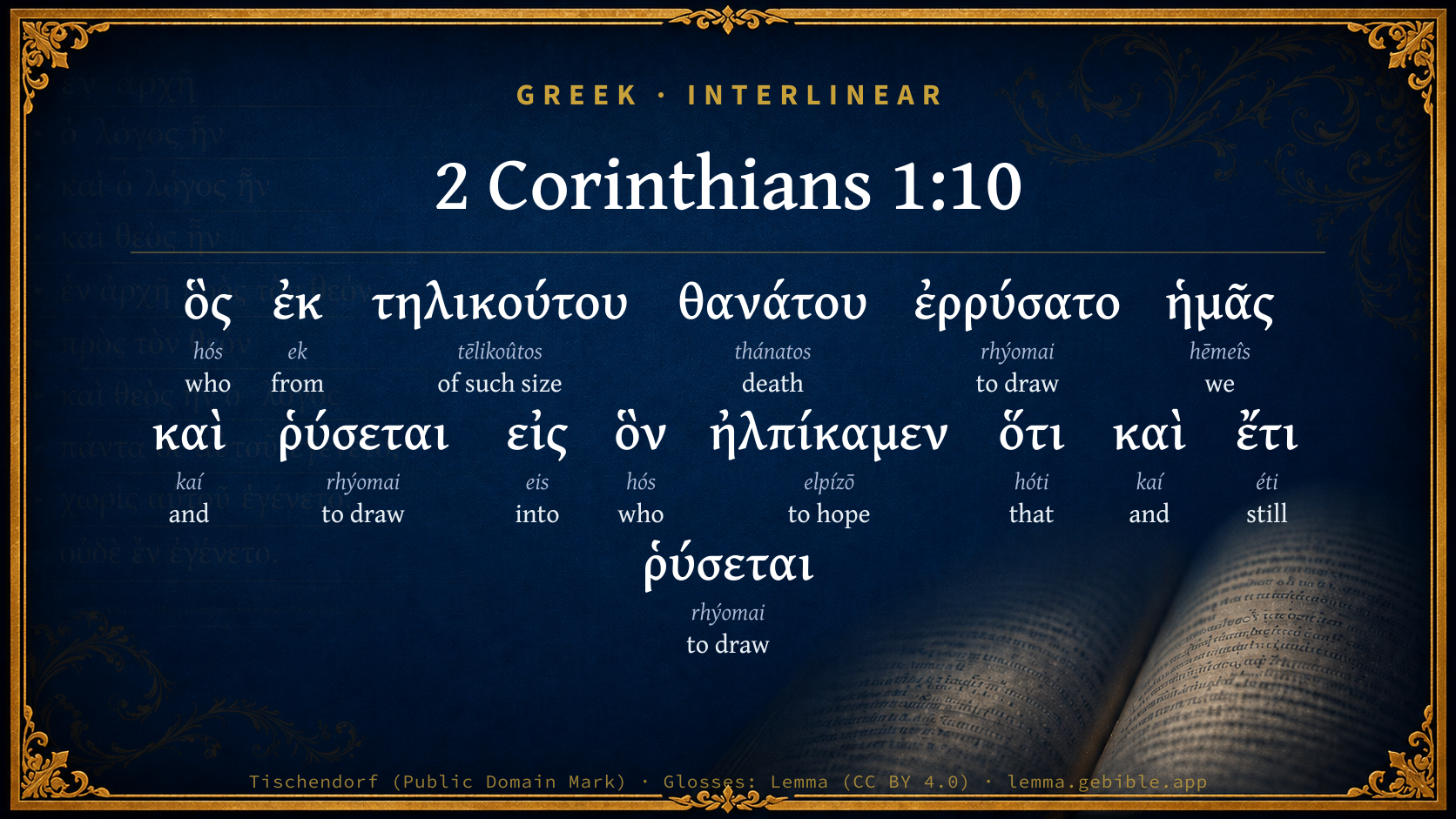
Greek (Tischendorf 8th ed.) 2 Corinthians 1:10 appears in the Greek New Testament. The text above is from the Tischendorf 8th edition. Each word links to its Strong’s number and a concise gloss. Click any word for its full Thayer’s Greek Lexicon entry.
Download image
Cite this verse

2 Corinthians 1:10 (World English Bible). Public Domain. Lemma interlinear Bible study tool, https://lemma.gebible.app/v/2-corinthians/1/10.

Show BibTeX & RIS
BibTeX
RIS
English Translation
who delivered us out of so great a death, and does deliver; on whom we have set our hope that he will also still deliver us;
World English Bible · Public Domain
Highlights
  • 1 first appearance in the Greek New Testament
Full analysis ↓
Download a study sheet

One document with this verse’s original text, its word-by-word gloss line, the meaning frame, cross-references with their text, attributed commentary, and full source and license credits — printable, and it pastes into notes with its structure intact.

This verse Autodidact and up

Study sheet (.html) Plain text (.txt)

A passage Seminary Student

Up to 50 verses in one chapter. A passage sheet keeps up to 6 commentary sources and 12 cross-references per verse, in the order this page ranks them, and says so on the sheet whenever that leaves anything out. Ask for a single verse and you get the Autodidact verse sheet above.

Everything on this page stays free to read, with no account — the sheet is a download of what is already on screen, not access to it.

Want to remove ads? Support Godless Engineer
Compare translations 3

The same verse in 3 English versions, stacked beneath the original-language interlinear above. Click any original word for its lexicon entry.

Each is an independent rendering of the whole verse — the interlinear is not word-aligned to these translations.

Highlighted words mark where these versions differ — a whole-verse word diff, not a word-by-word alignment.

  • World English Bible Public Domain
    who delivered us out of so great a death, and does deliver; on whom we have set our hope that he will also still deliver us;
  • King James Version Public Domain
    Who delivered us from so great a death, and doth deliver: in whom we trust that he will yet deliver us;
  • unfoldingWord Literal Text CC BY-SA 4.0
    who rescued us from so great a death, and he will rescue —on whom we have set our hope that he will rescue yet again,

unfoldingWord Literal Text — © unfoldingWord, licensed CC BY-SA 4.0. Word-aligned USFM3 via Door43 (git.door43.org/unfoldingWord/en_ult).

Versions to compare (up to 4)

3 of 4 selected

Show all 19 translations

Every available English version of this verse, each an independent rendering of the whole verse.

  • World English Bible Public Domain
    who delivered us out of so great a death, and does deliver; on whom we have set our hope that he will also still deliver us;
  • Berean Standard Bible Public Domain
    He has delivered us from such a deadly peril, and He will deliver us. In Him we have placed our hope that He will yet again deliver us,
  • Majority Standard Bible Public Domain
    He has delivered us from such a deadly peril, and He continues to deliver us. In Him we have placed our hope that He will yet again deliver us,
  • King James Version Public Domain
    Who delivered us from so great a death, and doth deliver: in whom we trust that he will yet deliver us;
  • American Standard Version (1901) Public Domain
    who delivered us out of so great a death, and will deliver: on whom we have set our hope that he will also still deliver us;
  • Revised Version (1885) Public Domain
    who delivered us out of so great a death, and will deliver: on whom we have set our hope that he will also still deliver us;
  • Geneva Bible (1599) Public Domain
    Who deliuered vs from so great a death, and doeth deliuer vs: in whom we trust, that yet hereafter he will deliuer vs,
  • Douay-Rheims (1899) Public Domain
    Who hath delivered and doth deliver us out of so great dangers: in whom we trust that he will yet also deliver us.
  • Young's Literal Translation Public Domain
    who out of so great a death did deliver us, and doth deliver, in whom we have hoped that even yet He will deliver;
  • Literal Standard Version CC BY-SA 4.0
    who delivered us out of so great a death, and delivers, in whom we have hoped that even yet He will deliver;
  • Unlocked Literal Bible CC BY-SA 4.0
    He rescued us from such a deadly peril, and he will rescue us again. On him we have set our hope that he will continue to deliver us.
  • unfoldingWord Literal Text CC BY-SA 4.0
    who rescued us from so great a death, and he will rescue —on whom we have set our hope that he will rescue yet again,
  • Darby Bible Public Domain
    who has delivered us from so great a death, and does deliver; in whom we confide that he will also yet deliver;
  • World Messianic Bible Public Domain
    who delivered us out of so great a death, and does deliver, on whom we have set our hope that he will also still deliver us,
  • Webster's Bible Public Domain
    Who delivered us from so great a death, and doth deliver: in whom we trust that he will yet deliver us:
  • Free Bible Version CC BY-SA 4.0
    He saved us from a terrible death, and he will do so again. We have total confidence in God that he will continue to save us.
  • Bible in Basic English Public Domain
    Who gave us salvation from so great a death: on whom we have put our hope that he will still go on to give us salvation;
  • Text-Critical English NT CC BY 4.0
    He rescued us from such a terrible death, and continues to rescue us. We have put our hope in him that he will rescue us yet again
  • Tyndale New Testament (1534) Public Domain
    and which delivered vs from so gret a deeth and doth delivre. On whom we trust that yet hereafter he will deliver

Literal Standard Version (2020), Covenant Press — licensed CC BY-SA 4.0. Text via the HelloAO Bible API (eBible.org). Unlocked Literal Bible (unfoldingWord) — licensed CC BY-SA 4.0. Text via the HelloAO Bible API (eBible.org). unfoldingWord Literal Text — © unfoldingWord, licensed CC BY-SA 4.0. Word-aligned USFM3 via Door43 (git.door43.org/unfoldingWord/en_ult). Free Bible Version, Dr. Jonathan Gallagher — licensed CC BY-SA 4.0. Text via the HelloAO Bible API (eBible.org).

Word by word

More ways to search: Search by grammar → Find every occurrence → Compare this word →

Practice this passage: Drill this verse → Learn its vocabulary →

τηλικούτου
tēlikoûtos
G5082
“of such size”
Demonstrative pronoun, Genitive, Singular, Masculine
Part of Speech
Demonstrative pronoun
Case
Genitive
Number
Singular
Gender
Masculine
Full Thayer's Definition

Origin: from a compound of G3588 with G2245 and G3778

TDNT: None

1. of age a. of such an age b. of so great an age, so old c. so young 2. of so great a size, in bulk 3. such and so great
  1. ὃς hós G3739 “who” Relative pronoun, Nominative, Singular, Masculine
  2. ἐκ ek G1537 “from” Preposition
  3. θανάτου thánatos G2288 “death” Noun, Genitive, Singular, Masculine
  4. ἐρρύσατο rhýomai G4506 “to draw” Verb, Aorist, Middle or Passive deponent, Indicative, 3rd person, Singular
  5. ἡμᾶς hēmeîs G2249 “we” Personal pronoun, 1st person, Accusative, Plural
  6. καὶ kaí G2532 “and” Conjunction
  7. ῥύσεται rhýomai G4506 “to draw” Verb, Future, Middle deponent, Indicative, 3rd person, Singular
  8. εἰς eis G1519 “into” Preposition
  9. ὃν hós G3739 “who” Relative pronoun, Accusative, Singular, Masculine
  10. ἠλπίκαμεν elpízō G1679 “to hope” Verb, Perfect, Active, Indicative, 1st person, Plural
  11. ὅτι hóti G3754 “that” Conjunction
  12. καὶ kaí G2532 “and” Conjunction
  13. ἔτι éti G2089 “still” Adverb
  14. ῥύσεται rhýomai G4506 “to draw” Verb, Future, Middle deponent, Indicative, 3rd person, Singular

About this verse

These counts appear in no published source. They are computed here, from the morphology-tagged text and Lemma’s own curated glosses. What Lemma adds →

15
words
11
distinct lemmas
Pauline Epistles
section

Notable vocabulary

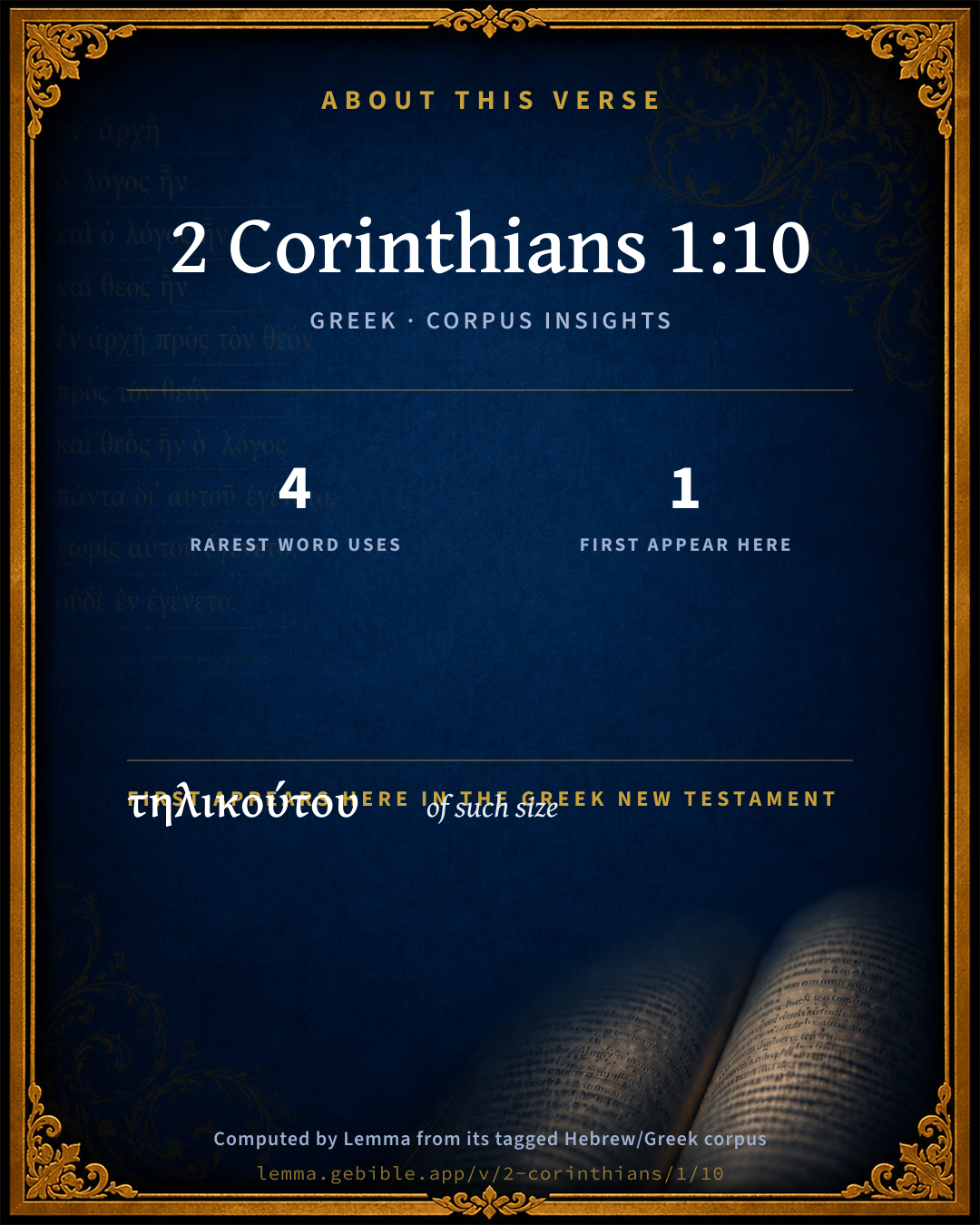
The rarest word here is τηλικούτου of such size G5082 — appearing just 4 times in the whole Greek New Testament.

First appearance in Scripture

This word makes its first canonical appearance in the Greek New Testament here:

  • τηλικούτου of such size G5082

Shared distinctive vocabulary

τηλικούτου of such size G5082 occurs in 4 verses of the Greek New Testament. Also found in:
Repetition

Words recur within this verse:

  • ἐρρύσατο to draw G4506 ×3
  • ὃς who G3739 ×2
  • καὶ and G2532 ×2

Cross-references

10

Topical passages linked to 2 Corinthians 1:10 in the Treasury of Scripture Knowledge — connected by theme and wording, ordered by reader-vote popularity; previews shown in the World English Bible.

  • 1 Timothy 4:10 For to this end we both labor and suffer reproach, because we have set our trust in the living God, who is the Savior of all men, especially of those who believe.
  • Psalms 34:19 Many are the afflictions of the righteous, But Yahweh delivers him out of them all.
  • 2 Peter 2:9 the Lord knows how to deliver the godly out of temptation and to keep the unrighteous under punishment for the day of judgment;
  • 1 Samuel 17:37 David said, Yahweh who delivered me out of the paw of the lion, and out of the paw of the bear, he will deliver me out of the hand of this Philistine. Saul said to David, Go, and Yahweh shall be with you.
  • Romans 15:31 that I may be delivered from those who are disobedient in Judea, and that my service which I have for Jerusalem may be acceptable to the saints;
  • 2 Timothy 4:17 But the Lord stood by me, and strengthened me, that through me the message might be fully proclaimed, and that all the Gentiles might hear; and I was delivered out of the mouth of the lion.
  • Acts 26:21 For this reason the Jews seized me in the temple, and tried to kill me.
  • 1 Samuel 7:12 Then Samuel took a stone, and set it between Mizpah and Shen, and called the name of it Ebenezer, saying, Hitherto has Yahweh helped us.
  • Job 5:17–22 "Behold, happy is the man whom God corrects: Therefore do not despise the chastening of the Almighty.
  • Isaiah 46:3 Listen to me, house of Jacob, and all the remnant of the house of Israel, that have been borne [by me] from their birth, that have been carried from the womb;

Cross-references courtesy of OpenBible.info (CC BY 4.0).

Commentary

Notes on 2 Corinthians 1:10 from classic Christian and Jewish commentators (each source and its license shown beneath its notes). The classic Christian expositions comment on the surrounding passage and are grouped to its opening verse, so a note may address several verses; the Jewish commentaries on the Tanakh (Rashi and others) are per-verse, so they appear only where the commentator wrote on this verse.

Lemma curates 59 commentaries, every one of them public domain or Creative Commons licensed, each selected and text-cleaned for this edition rather than reprinted as found. About our sources →

Bengel's Gnomon

Johann Albrecht Bengel

2Co 1:10. Ρύεται, delivers) The present, in respect of this affliction, i.e. whilst we are in a state of death, we are delivered.—ἠλπίκαμεν) we have obtained hope [we have trusted].—ῥύσεται, He will deliver) that I may be able to go to you.

Bengel's Gnomon of the New Testament — English translation (T&T Clark, Edinburgh, 1860) — public domain. Text from a community e-Sword module.

Meyer's Critical & Exegetical Commentary

Heinrich August Wilhelm Meyer

2Co_1:10. Result of this confidence, as well as the hope grounded thereon for the futur.

ἐκ τηλικ. θανάτου] out of so great death. Paul realizes to himself the special so mighty death-power which had threatened him (and Timothy), and by the expression ῥύεσθαι ἐκ θανάτου (see examples in Wetstein, p. 178) makes death appear as a hostile power by which he had been encompassed. Θάνατος does not signify peril of death (as most say, even Emmerling and Flatt), but it represents that sense. Comp. 2Co_11:23.

καὶ ῥύεται] The θλίψις, which had been survived in Asia, therefore still continued in its after-effects, which even extended over to Macedonia (perhaps by continued plots against their lives), and Paul and Timothy were still continuing[125] to experience the rescuing power of Go.

ἨΛΠΊΚΑΜΕΝ] have set our hope. See Herm. ad Viger. p. 748; Kühner, II. p. 71; comp. 1Co_15:19; 1Ti_5:5; 1Ti_6:17; Joh_6:45.

ὍΤΙ Κ. ἜΤΙ ῬΎΣΕΤΑΙ] that he will rescue (us) even further, namely, ἘΚ. ΤΗΛΙΚ ΘΑΝΆΤΟΥ, in the continuing danger from the Asiatic enemies which was still to be apprehended in the future. In the fact that Paul speaks of a present, nay, of a future rescue, Rückert finds a support for his opinion regarding a dangerous illness (not yet fully overcome); see on 2Co_1:8. But could no machinations pass over from Asia to Macedonia? and could not these be recognised by Paul as the more dangerous, in so far as they were more secret? Comp. Act_20:3.

[125] Hofmann reads the passage: καὶ ῥύσεται, εἰς ὃν ἠλπίκαμεν, καὶ ἔτι ῥύσεται. Accordingly, he takes the first καί as an also, beginning an independent sentence. With this expressive reference to the future Paul looks forward to the wide voyages still before him. In opposition to this we have, from a critical point of view, the facts that ὅτι before καὶ ἔτι is wanting only in B D* 64, and that it is supported by preponderating witnesses, even by those which have the reading ῥύσεται for ῥύεται, as C and א; and, from an exegetical point of view, the fact that the repetition καὶ ἔτι ῥύσεται amounts to a tautology without strengthening the thought in the least: for ἔτι follows as a matter of course from the ῥύσεται already said. Besides, against the whole reference to the shipwreck, see on ver. 8.

Meyer — Critical and Exegetical Commentary on the New Testament — English translation by Peter Christie, edited by Frederick Crombie (T&T Clark, 1880) — public domain. Text from a community e-Sword module.

Expositor's Greek Testament

ed. W. Robertson Nicoll

2Co 1:10 . ὅς ἐκ τηλικ . κ . τ . λ .: who delivered us out of so great a death, and will deliver (reading ῥύσεται ). The form of words recalls Rom 15:31 and 2Ti 4:17-18 , which would give some support to the theory that the great peril in question was persecution at the hands of opponents; but (as we have said on 2Co 1:8 ) it seems more probable that the Apostle’s deliverance was from a dangerous illness. It is possible, indeed, that we have here a reminiscence of Job 33:30 , ἐρύσατο τὴν ψυχήν μου ἐκ θανάτου , which would confirm this interpretation. Note that the preposition is ἐκ , not ἀπό ; ἀπό would only indicate deliverance from the neighbourhood of a danger; ἐκ indicates emergence from a danger to which one has actually been exposed (see Chase, Lord’s Prayer in the Early Church , pp. 71 ff.). Cf. with the whole phrase 2Ti 4:17-18 , ἐρύσθην ἐκ στόματος λέοντος , ῥύσεταί με ὁ κύριος κ . τ . λ . εἰς ὃν ἠλπίκαμεν : towards whom we have set our hope . εἰς with the acc. (see reff.) expresses the direction towards which hope looks; ἐπί with the dat. after ἐλπίζειν (1Ti 4:10 ; 1Ti 6:17 ) rather indicates that in which hope rests. Cf. Psa 4:6 , ἐλπίσατε ἐπὶ κύριον . The perfect ἠλπίκαμεν here has its full force, viz. , “towards whom we have set our hope, and continue to do so”; cf. 1Co 15:19 , 1Ti 5:5 ; 1Ti 6:17 . καὶ ἔτι ῥύσεται : the force of ἔτι (if indeed it be part of the true text: see crit. note) is to carry the mind on to the perils of the future, as distinguished from those of the present: He will continue to deliver us .

The Expositor's Greek Testament, edited by W. Robertson Nicoll (1897–1910) — public domain. Text from a community e-Sword module.

Geneva Bible (1599)

Geneva Bible translators

From these great dangers.

Geneva Bible (1599) marginal notes — public domain. Text via Bolls.life.

Jamieson, Fausset & Brown

Robert Jamieson, A. R. Fausset & David Brown

doth deliver--The oldest manuscripts read, "will deliver," namely, as regards immediately imminent dangers. "In whom we trust that He will also (so the Greek) yet deliver us," refers to the continuance of God's delivering help hereafter.

Jamieson, Fausset & Brown — Commentary Critical and Explanatory on the Whole Bible (1871) — public domain (CC PDM 1.0). Text via the HelloAO Bible API.

Adam Clarke's Commentary

Verse 10. Who delivered us from so great a death] For the circumstances were such that no human power could avail.

Will yet deliver us] Having had such a signal evidence of His interposition already, we will confide in him with an unshaken confidence that he will continue to support and deliver.

Adam Clarke's Commentary on the Bible (1810–1826) — public domain. Text from a community e-Sword/MySword module.

John Calvin's Commentaries

10. Who hath delivered us from so great a death Here he applies to himself personally, what he had stated in a general way, and by way of proclaiming the grace of God, he declares that he had not been disappointed in his expectation, inasmuch as he had been delivered from death, and that too, in no common form. As to his manner of expression, the hyperbole, which he makes use of, is not unusual in the Scriptures, for it frequently occurs, both in the Prophets and in the Psalms, and it is made use of even in common conversation. What Paul acknowledges as to himself personally, let every one now take home as applicable to himself.

In whom we have an assured hope. He promises himself as to the future, also, that beneficence of God, which he had often experienced in the past. Nor is it without good reason; for the Lord, by accomplishing in part what he has promised, bids us hope well as to what remains. Nay more, in proportion to the number of favors that we receive from him, does he by so many pledges, or earnests, as it were, confirm his promises. Now, although Paul had no doubt that God would of his own accord be present with him, yet he exhorts the Corinthians to commend to God in their prayers his safety. For when he assumes it as certain, that he will be aided by them, this declaration has the force of an exhortation, and he means that they would not merely do it as a matter of duty, but also with advantage.

“Your prayers, also,” he says, “will help me.” For God wills not that the duty of mutual intercession, which he enjoins upon us, should be without advantage. This ought to be a stimulus to us, on the one hand, to solicit the intercession of our brethren, when we are weighed down by any necessity, and, on the other, to render similar assistance in return, since we are informed, that it is not only a duty that is well pleasing to God, but also profitable to ourselves. Nor is it owing to distrust that the Apostle implores the friendly aid of his brethren, for, while he felt assured, that his safety would be the object of God’s care, though he were destitute of all human help, yet he knew that it was well pleasing to God, that he should be aided by the prayers of the saints. He had respect, also, to the promises that were given, that assistance of this kind would not be in vain. Hence, in order that he might not overlook any assistance that was appointed to him by God, he desired that the brethren should pray for his preservation.

The sum is this — that we follow the word of God, that is, that we obey his commandments and cleave to his promises. This is not the part of those who have recourse to the assistance of the dead; for not contented with the sources of help appointed by God, they call in to their aid a new one, that has no countenance from any declaration of Scripture. For whatever we find mentioned there as to mutual intercession, has no reference to the dead, but is expressly restricted to the living. Hence Papists act childishly in perverting those passages, so as to give some colour to their superstition.

John Calvin's Commentaries (1540-1563) — public domain. Text from the Calvin Translation Society English edition (1840s-50s) via the Christian Classics Ethereal Library (ccel.org). Calvin's coverage is partial (roughly two-thirds of the Bible); uncommented books and verses are honest gaps, never fabricated. The 19th-century editor's footnotes and remarks are omitted so the notes are faithfully Calvin's own voice.

Ellicott's Commentary for English Readers

(10) Who delivered us from so great a death.—Death in itself seems hardly to admit of such a qualifying adjective, but the words appear to have been used to represent the incidents of the death which seemed so near, the bodily anguish, the sense of prostration, almost, one might venture to say, the very presence of the king of terrors. As the word translated “so great” is strictly speaking, used of quality rather than quantity, we might almost translate it, so terrible a death.

And doth deliver.—The words are wanting in some of the better MSS., and others give them in the future. They may possibly have been inserted to carry the thought of the deliverance into the present as well as through the past and the future.

In whom we trust.—Better, in whom we have hoped. The verb is not the same as the “trust” of the preceding verse. The words imply that he was not yet altogether free, as man would judge, from the danger of a relapse. Life was for him, in relation both to bodily infirmities and perils of other kinds, a perpetual series of deliverances.

A Bible Commentary for English Readers, edited by Charles John Ellicott (1878–1897) — public domain. Text from a community e-Sword module.

The Cambridge Bible for Schools and Colleges

gen. ed. J. J. S. Perowne

10. from so great a death] i.e. from so great peril of death. St Paul speaks of the liability to death as death. Cf. ch. 2Co_4:11-12. Some regard it as equivalent to ‘so terrible a death.’ Yet surely the mode of death was a matter of trifling consequence to one like St Paul. See Php_1:21-23. Also ch. 2Co_11:23.

and doth deliver] These words are wanting in many MSS.

we trust] Literally, we have hoped, i.e. with Erasmus, spem fixam habemus. The word here translated ‘trust’ is not the same as that so translated in the preceding verse.

The Cambridge Bible for Schools and Colleges (gen. ed. J. J. S. Perowne; Cambridge University Press, 1878–1918) — public domain. Text from a community e-Sword module.

John Gill's Exposition

Who delivered us from so great a death,.... Accordingly, being enabled to trust in God, when all human hope and helps failed, to believe in hope against hope, then the Lord appeared for them, and delivered them from this heavy affliction; which, because by reason of it they were not only in danger of death, and threatened with, but were even under the sentence of it, is therefore called a death, and so great an one, see Co2 11:23. The apostle expresses the continuance of the mercy,

and doth deliver; which shows that they were still exposed to deaths and dangers, but were wonderfully preserved by the power of God, which gave great encouragement to them to hope and believe that God would still preserve them for further usefulness. The Alexandrian copy leaves out this clause, and so does the Syriac version.

In whom we trust that he will yet deliver us; all the three tenses, past, present, and future, are mentioned, which shows that an abiding sense of past and present deliverances serves greatly to animate faith in expectation of future ones.

John Gill's Exposition of the Whole Bible (1746–1763) — public domain (CC PDM 1.0). Text via the HelloAO Bible API.

Trapp's Complete Commentary

John Trapp

10 Who delivered us from so great a death, and doth deliver: in whom we trust that he will yet deliver us;

Ver. 10. In whom we trust] Experience breeds confidence. Thou hast, thou shalt, is an ordinary medium made use of by the Psalmist.

John Trapp, A Commentary or Exposition upon All the Books of the Old and New Testament (1647–1656) — public domain. Text from a community e-Sword module.

Albert Barnes' Notes on the Bible

Who delivered us from so great a death - From a death so terrible, and from a prospect so alarming. It is intimated here by the word which Paul uses, that the death which he apprehended was one of a character especially terrific - probably a death by wild beasts; note, 2Co 1:8. He was near to death; he had no hope of rescue; and the manner of the death which was threatened was especially frightful. Paul regarded rescue from such a death as a kind of resurrection: and felt that he owed his life to God as if he had raised him from the dead. All deliverance from imminent peril, and from dangerous sickness, whether of ourselves or our friends, should be regarded as a kind of resurrection from the dead. God could with infinite ease have taken away our breath, and it is only by his merciful interposition that we live.

And doth deliver - Continues yet to deliver us; or preserve us - intimating perhaps that danger had continued to follow him after the signal deliverance to which he particularly refers, and that he had continued to be in similar peril of his life. Paul was daily exposed to danger; and was constantly preserved by the good providence of God. In what manner he was rescued from the peril to which he was exposed he has no where intimated. It is implied, however, that it was by a remarkable divine interposition; but whether by miracle, or by the ordinary course of providence, he no where intimates. Whatever was the mode, however, Paul regarded God as the source of the deliverance, and felt that his obligations were due to him as his kind Preserver.

In whom we trust that he will yet deliver us - That he will continue to preserve us. We hope; we are accustomed to cherish the expectation that he will continue to defend us in the perils which we shall yet encounter. Paul felt that he was still exposed to danger. Everywhere he was liable to be persecuted (compare note, Act 20:23), and everywhere he felt that his life was in peril. Yet he had been thus far preserved in a most remarkable manner; and he felt assured that God would continue to interpose in his behalf, until his great purpose in regard to him should be fully accomplished, so that at the close of life he could look to God as his Deliverer, and feel that all along his perilous journey he had been his great Protector.

Albert Barnes' Notes on the Bible (1834–1885) — public domain. Text from a community e-Sword/MySword module.

Matthew Poole's English Annotations

So great a death, in this text, signifies no more than so great a trial of affliction; as he elsewhere saith, he was in deaths often, that is, in dangers of death. Nor (saith the apostle) were we only at that time in danger of our lives, nor had we only at that time an experience of God’s power, goodness, and faithfulness in our deliverance; but we are in jeopardy every hour, and experience the power of God in our deliverance yet every day. And it being for the advantage of the church of Christ, that our lives should be prolonged, (thuogh we desire rather to be dissolved, and to be with Christ), we are confident

that he will yet deliver. Former experiences of God’s goodness in delivering us out of troubles, ought to increase our faith, and beget a confidence in us, that God will yet deliver us, if it may be for his own glory, and our good.

Matthew Poole's English Annotations on the Holy Bible (1683–1685) — public domain. Text from a community e-Sword/MySword module.

Whedon's Commentary on the Bible

Daniel D. Whedon

10. Doth deliver—The danger and the deliverance were continuous. The nervous predisposition still hung over Paul, and his life was a constant deliverance from death. We may suggest as a strong proof of the real nature of Paul’s danger, his continued reserve in specifically naming it. Had it been a beast-fight, or a conspiracy, or an assault, or even “a weakness of the eyes,” he would have specified it; but here, as elsewhere, from its humiliating character it is covered under allusions and metaphors.

Daniel D. Whedon (gen. ed.), Commentary on the Old and New Testaments (1874–1909) — public domain. Text from a community e-Sword module.

The Pulpit Commentary

From so great a death. From a state of dejection and despair, which seemed to show death in all its power. (see 2Co_4:10-12) And doth deliver. Perhaps a pious marginal gloss which has crept into the text of some manuscripts. We trust; rather, we have set our hope. That. This word is omitted in some good manuscripts, as also are the words, "and doth deliver." He will yet deliver us. This implies either that the perils alluded to were not yet absolutely at an end, or St. Paul s consciousness that many a peril of equal intensity lay before him in the future.

The Pulpit Commentary (1880–1919), ed. H.D.M. Spence-Jones & Joseph S. Exell — public domain. Text from a community e-Sword module.

John Wesley's Explanatory Notes

We trust that he will still deliver - That we may at length be able to come to you.

John Wesley, Explanatory Notes Upon the Whole Bible (1754–1765) — public domain. Text via the GEBible commentary corpus.

Burkitt's Expository Notes on the New Testament

William Burkitt

Observe here, The deliverer, God; the delivered, St. Paul, and the saints that were in Asia with him; the deliverance itself, or the imminent and impending evil delivered from, death, great death, so great a death.

Learn, 1. That in times of great and imminent danger, God, and God alone, is the immediate deliverer of his children and people.

Learn, 2. That it is the property of a gracious heart to magnify and enhance the deliverance of a gracious God: He hath delivered us from so great a death, &c.

Learn, 3. That past and present experience of God’s power and goodness towards his people may and ought to encourage them to trust in him for time to come: former experience ought to encourage us to future dependence; when we can say, God hath delivered, and doth deliver, let our faith add, In him we trust that he will yet deliver.

William Burkitt's Expository Notes on the New Testament (1700–1703) — public domain. Text from a community e-Sword module.

McGarvey & Pendleton's Commentaries

J. W. McGarvey

who delivered us out of so great a death, and will deliver: on whom we have set our hope that he will also still deliver us ;

J. W. McGarvey (with Philip Y. Pendleton), Commentaries on the New Testament (The Fourfold Gospel, 1914; Acts; and the epistles) — public domain. Text from a community e-Sword/MySword module.

The People's New Testament

B. W. Johnson

10. Who delivered us out of so great a death. This points to some remarkable peril and signal deliverance. It is probable that Acts 20:30, 31, hints at it.

B. W. Johnson's The People's New Testament with Notes (1889–1891) — public domain. Electronic text from the Christian Classics Ethereal Library (CCEL) ThML edition.

Cambridge Greek Testament for Schools and Colleges

10. καὶ ῥύσεται (אBC) rather than καὶ ῥύεται (FGKL, Vulg.). AD1 omit both words. BD1M omit ὅτι.

10. ἐκ τηλικούτου θανάτου. Placed first with emphasis: out of so great a death delivered us and will deliver, on whom we have set our hope that He will also still deliver us. If we omit ὅτι, on whom we have set our hope; and He will still deliver us, while ye also help together, &c. See critical note. ‘Will still deliver’ intimates that the peril is not entirely over, or that it may return. This is against the uproar at Ephesus and shipwreck. It fits severe illness; but it fits anxiety about Corinthian loyalty or a combination of troubles still better. In Biblical Greek τηλικοῦτος is rare; here only in S. Paul.

Cambridge Greek Testament for Schools and Colleges (Cambridge University Press, 1896; 21 vols, various authors incl. Carr, Maclear, Plummer, Farrar, Lumby, Moule, M. R. James, Simcox) — public domain. Text from a community e-Sword module.

Alford’s Greek Testament

Henry Alford

10.] Who rescued us from so great a death, and will rescue us,—on whom we hope that He will also continue to rescue us. The rec. ῥύεται, has been substituted for the fut. ῥύσεται, as more appropriate. But it regards the immediate future,—the καὶ ἔτι ῥύσεται the continuance of God’s help in time distant and uncertain. The whole verse (as De W. confesses, who although he repudiates the Ephesian tumult, yet interprets the passage as alluding to external danger) seems to favour the idea of bodily sickness being in the Apostle’s mind.

Henry Alford, The Greek Testament (1849–1861) — public domain. Text from a community e-Sword module.

International Critical Commentary

10. ὃς ἐκ τηλικούτου θανάτου ἐρύσατο ἡμᾶς. ‘Who out of so great a death delivered us.’ He says ‘death’ rather than ‘peril of death,’ because he had regarded himself as a dead man; the ἐκ (not ἀπό) seems to imply peril rather than death personified, but Wetstein shows that ἐρύσατο ἐκ θανάτου is a common expression. This may be one of the rare N.T. reminiscences of the Book of Job;* ἐρύσατο τὴν ψυχήν μου ἐκ θανάτου (33:30). A comparison with ἐρύσθην ἐκ στόματος λέοντος. ῥύσεταί με ὁ κύριος (2Ti 4:17, 2Ti 4:18) and ἵνα ῥυσθῶ ἀπὸ τῶν άπειθούντων ἐν τῇ Ἰουδαίᾳ (Rom 15:31) rather favours the hypothesis that the great θλίψις in Asia was violent persecution. As in Heb 2:3, τηλικοῦτος here means ‘so great’ as to require such a Saviour: cf. Rev 16:18; Jas 3:4. In LXX the word is found in Macc. only; in class. Grk. it is used more often of age than of size, ‘so old,’ and sometimes ‘so young.’

καὶ ῥύσεται. This is superfluous, anticipating and somewhat spoiling the next clause. Hence some witnesses read ῥύεται or omit, and some editors either omit the word or adopt awkward punctuation: see critical note. But St Paul, in dictating, might easily repeat himself, toning down the confident ‘He will deliver’ into a confident hope that He will do so. Thus affliction is set before us as a school of sympathy (v. 4), a school of encouragement (v. 5), and a school of hope (v. 10). He proclaims that the rescue in all cases is God’s work, not their own: it must come from Him, if at all.

εἰς ὃδν ἠλπίκαμεν [ὅτι] καὶ ἔτι ῥύσεται. ‘Unto whom we have directed our hope that He will also still deliver us’; or, omitting ὅτι, ‘and He will still deliver us’; or ὅτι, ‘ may be intensive, ‘that He will indeed deliver us.’ Praescit se adhuc passurum qui sperat se liberandum (Pseudo-Primasius). He had enough experience of perils of death (11:23; 1Co 15:31) to feel that he must be prepared for others in the future. Cf. προαποθνήσκω πόλλους, θανάτους ὑπομένων (Philo, In Flaccum, 990 A); μενέτω ἐν ταῖς ψυχαῖς ἀκαθαίρετος ἡ ἐπὶ τὸν σωτῆρα Θεὸν ἐλπίς, ὃς πολλάκις ἐξ ἀμηχάνων καὶ ἀπόρων περιέσωσε τὸ ἔθνος (Leg. ad Caium, 574). For ἐλπίζειν εἰς, see Joh 5:45; 1Pe 3:5; ἐλπίζειν ἐπί is more common (Rom 15:12; 1Ti 4:10, 1Ti 5:5, 1Ti 6:17); in quo spem repositam habemus is nearer to ἐπί.

Origen (on Lev 11:2), with too rigid logic, argues that, as it is not to be supposed that St Paul expected to be immortal, he cannot mean physical death when he says that he hopes that God will continue to deliver him from deaths; he must mean sins. Origen evidently read ἐκ τηλικούτων θανάτων, With Vulg. (de tantis periculis) Syrr., Jerome (on Eph 1:13), Rufinus (ad loc.), Ambrst. He also read καὶ ῥύεται with D3 E F G K L M, Latt. Goth., Chrys. But ἐκ τηλικούτου θανάτου and καὶ ῥύσεται is to be preferred with א B C P 17, Copt. Arm. A D* omit καὶ ῥύσεται B D* M omit ὅτι, and F G place it affer καί Goth. Aeth. omit both καί and ἔτι. B. Weiss proposes to read εἰς ὃν ἠλπίκαμεν. καὶ ἔτι ῥύσεται.

International Critical Commentary — older volumes (1896–1929), various authors — public domain. Text from a community e-Sword module.

Lesson kit

Teaching starters — assembled from the data on this page, not authored interpretation. Every prompt links to the verse data it draws on. Edit before teaching.

2 Corinthians, in the Pauline Epistles, opens this verse with 15 words (11 distinct Greek lemmas). Its most distinctive word is tēlikoûtos (“of such size”). A historical commentator’s framing appears above. Read the whole chapter for the surrounding context.

Discussion questions

  1. What does “of such size” (tēlikoûtos) contribute to the verse as a whole?
  2. The word “of such size” first appears here in Scripture. What is being introduced at this debut?
  3. Hebrews 2:3 shares the word «of such size» with this verse. How do the two illuminate each other?
  4. “to draw” occurs 3× in this one verse. What is the effect of the repetition?
  5. The translations on this page render this verse differently — a whole-verse word diff, not a word-by-word alignment. What might account for the different wordings?
  6. Reading how Bengel's Gnomon and Meyer's Critical & Exegetical Commentary read this verse, where do the two commentators agree and where do they part?

Things to notice

  • 1 word makes its first canonical appearance in Scripture here.
  • These translations choose different wording for 13 words in this verse.
  • “to draw” occurs 3× in this single verse.
  • 11 distinct Greek lemmas span 15 words in this verse.

Reading settings

Reading text

Shown beneath each verse's original-language words.

Old Testament
Old Testament edition

Read the OT as the Masoretic Hebrew (MT) or the Greek Septuagint (LXX).

English shown for the Greek Septuagint (in the Hebrew ↔ Greek comparison).

Comparing translations? Open the Compare panel on any verse page to stack up to four side by side.