Galatians 1:10

Greek (Tischendorf 8th ed.) Galatians 1:10 appears in the Greek New Testament. The text above is from the Tischendorf 8th edition. Each word links to its Strong’s number and a concise gloss. Click any word for its full Thayer’s Greek Lexicon entry.
Download image
Cite this verse

Galatians 1:10 (World English Bible). Public Domain. Lemma interlinear Bible study tool, https://lemma.gebible.app/v/galatians/1/10.

Show BibTeX & RIS
BibTeX
RIS
English Translation
For am I now seeking the favor of men, or of God? Or am I striving to please men? For if I were still pleasing men, I wouldn't be a servant of Christ.
World English Bible · Public Domain
Download a study sheet

One document with this verse’s original text, its word-by-word gloss line, the meaning frame, cross-references with their text, attributed commentary, and full source and license credits — printable, and it pastes into notes with its structure intact.

This verse Autodidact and up

Study sheet (.html) Plain text (.txt)

A passage Seminary Student

Up to 50 verses in one chapter. A passage sheet keeps up to 6 commentary sources and 12 cross-references per verse, in the order this page ranks them, and says so on the sheet whenever that leaves anything out. Ask for a single verse and you get the Autodidact verse sheet above.

Everything on this page stays free to read, with no account — the sheet is a download of what is already on screen, not access to it.

Want to remove ads? Support Godless Engineer
Compare translations 3

The same verse in 3 English versions, stacked beneath the original-language interlinear above. Click any original word for its lexicon entry.

Each is an independent rendering of the whole verse — the interlinear is not word-aligned to these translations.

Highlighted words mark where these versions differ — a whole-verse word diff, not a word-by-word alignment.

  • World English Bible Public Domain
    For am I now seeking the favor of men, or of God? Or am I striving to please men? For if I were still pleasing men, I wouldn't be a servant of Christ.
  • King James Version Public Domain
    For do I now persuade men, or God? or do I seek to please men? for if I yet pleased men, I should not be the servant of Christ.
  • unfoldingWord Literal Text CC BY-SA 4.0
    For am I now trying to persuade men, or God? Or am I seeking to please men? If I were still pleasing men, I would not be a servant of Christ.

unfoldingWord Literal Text — © unfoldingWord, licensed CC BY-SA 4.0. Word-aligned USFM3 via Door43 (git.door43.org/unfoldingWord/en_ult).

Versions to compare (up to 4)

3 of 4 selected

Show all 19 translations

Every available English version of this verse, each an independent rendering of the whole verse.

  • World English Bible Public Domain
    For am I now seeking the favor of men, or of God? Or am I striving to please men? For if I were still pleasing men, I wouldn't be a servant of Christ.
  • Berean Standard Bible Public Domain
    Am I now seeking the approval of men, or of God? Or am I striving to please men? If I were still trying to please men, I would not be a servant of Christ.
  • Majority Standard Bible Public Domain
    Am I now seeking the approval of men, or of God? Or am I striving to please men? For if I were still trying to please men, I would not be a servant of Christ.
  • King James Version Public Domain
    For do I now persuade men, or God? or do I seek to please men? for if I yet pleased men, I should not be the servant of Christ.
  • American Standard Version (1901) Public Domain
    For am I now seeking the favor of men, or of God? or am I striving to please men? if I were still pleasing men, I should not be a servant of Christ.
  • Revised Version (1885) Public Domain
    For am I now persuading men, or God? or am I seeking to please men? if I were still pleasing men, I should not be a servant of Christ.
  • Geneva Bible (1599) Public Domain
    For nowe preach I mans doctrine, or Gods? or go I about to please men? for if I should yet please men, I were not the seruant of Christ.
  • Douay-Rheims (1899) Public Domain
    For do I now persuade men, or God? Or do I seek to please men? If I yet pleased men, I should not be the servant of Christ.
  • Young's Literal Translation Public Domain
    for now men do I persuade, or God? or do I seek to please men? for if yet men I did please -- Christ's servant I should not be.
  • Literal Standard Version CC BY-SA 4.0
    For do I now persuade men, or God? Or do I seek to please men? For if I yet pleased men—I should not be Christ’s servant.
  • Unlocked Literal Bible CC BY-SA 4.0
    For am I now seeking the approval of men or God? Am I seeking to please men? If I am still trying to please men, I am not a servant of Christ.
  • unfoldingWord Literal Text CC BY-SA 4.0
    For am I now trying to persuade men, or God? Or am I seeking to please men? If I were still pleasing men, I would not be a servant of Christ.
  • Darby Bible Public Domain
    For do I now seek to satisfy men or God? or do I seek to please men? If I were yet pleasing men, I were not Christ's bondman.
  • World Messianic Bible Public Domain
    For am I now seeking the favor of men, or of God? Or am I striving to please men? For if I were still pleasing men, I wouldn’t be a servant of Messiah.
  • Webster's Bible Public Domain
    For do I now persuade men, or God? or do I seek to please men? for if I yet pleased men, I should not be the servant of Christ.
  • Free Bible Version CC BY-SA 4.0
    Whose approval do you think I want—that of people, or of God? Do you think I'm trying to please people? If I wanted to please people I wouldn't be a servant of Christ!
  • Bible in Basic English Public Domain
    Am I now using arguments to men, or God? or is it my desire to give men pleasure? if I was still pleasing men, I would not be a servant of Christ.
  • Text-Critical English NT CC BY 4.0
    Am I now seeking the approval of men, or of God? Or am I trying to please men? If I were still trying to please men, I would not be a servant of Christ.
  • Tyndale New Testament (1534) Public Domain
    Preache I mannes doctrine or Godes? Ether go I about to please men? If I stodyed to please men I were not the servaunt of Christ.

Literal Standard Version (2020), Covenant Press — licensed CC BY-SA 4.0. Text via the HelloAO Bible API (eBible.org). Unlocked Literal Bible (unfoldingWord) — licensed CC BY-SA 4.0. Text via the HelloAO Bible API (eBible.org). unfoldingWord Literal Text — © unfoldingWord, licensed CC BY-SA 4.0. Word-aligned USFM3 via Door43 (git.door43.org/unfoldingWord/en_ult). Free Bible Version, Dr. Jonathan Gallagher — licensed CC BY-SA 4.0. Text via the HelloAO Bible API (eBible.org).

Word by word

More ways to search: Search by grammar → Find every occurrence → Compare this word →

Practice this passage: Drill this verse → Learn its vocabulary →

ἀρέσκειν
aréskō
G700
“to please”
Verb, Present, Active, Infinitive
Part of Speech
Verb
Tense
Present
Voice
Active
Mood
Infinitive
Full Thayer's Definition

Origin: probably from G142 (through the idea of exciting emotion)

TDNT: 08:35,8

1. to please 2. to strive to please a. to accommodate one's self to the opinions desires and interests of others
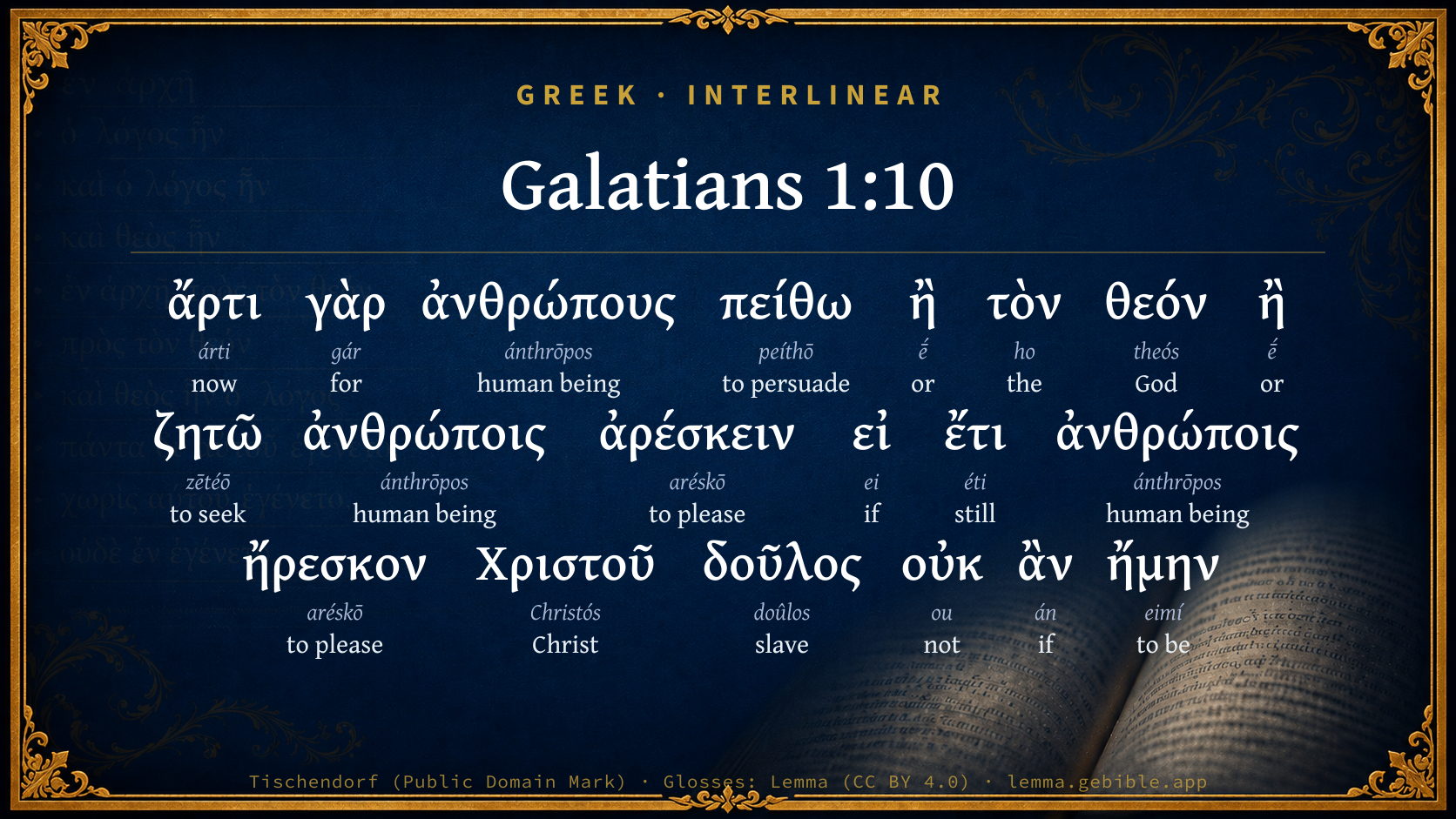
  1. ἄρτι árti G737 “now” Adverb
  2. γὰρ gár G1063 “for” Conjunction
  3. ἀνθρώπους ánthrōpos G444 “human being” Noun, Accusative, Plural, Masculine
  4. πείθω peíthō G3982 “to persuade” Verb, Present, Active, Indicative, 1st person, Singular
  5. ἢ ḗ G2228 “or” Particle
  6. τὸν ho G3588 “the” Article, Accusative, Singular, Masculine
  7. θεόν theós G2316 “God” Noun, Accusative, Singular, Masculine
  8. ἢ ḗ G2228 “or” Particle
  9. ζητῶ zētéō G2212 “to seek” Verb, Present, Active, Indicative, 1st person, Singular
  10. ἀνθρώποις ánthrōpos G444 “human being” Noun, Dative, Plural, Masculine
  11. εἰ ei G1487 “if” Conditional
  12. ἔτι éti G2089 “still” Adverb
  13. ἀνθρώποις ánthrōpos G444 “human being” Noun, Dative, Plural, Masculine
  14. ἤρεσκον aréskō G700 “to please” Verb, Imperfect, Active, Indicative, 1st person, Singular
  15. Χριστοῦ Christós G5547 “Christ” Noun, Genitive, Singular, Masculine
  16. δοῦλος doûlos G1401 “slave” Noun, Nominative, Singular, Masculine
  17. οὐκ ou G3756 “not” Particle, Negative
  18. ἂν án G302 “if” Particle
  19. ἤμην eimí G1510 “to be” Verb, Imperfect, Middle, Indicative, 1st person, Singular

About this verse

These counts appear in no published source. They are computed here, from the morphology-tagged text and Lemma’s own curated glosses. What Lemma adds →

20
words
16
distinct lemmas
Pauline Epistles
section

Notable vocabulary

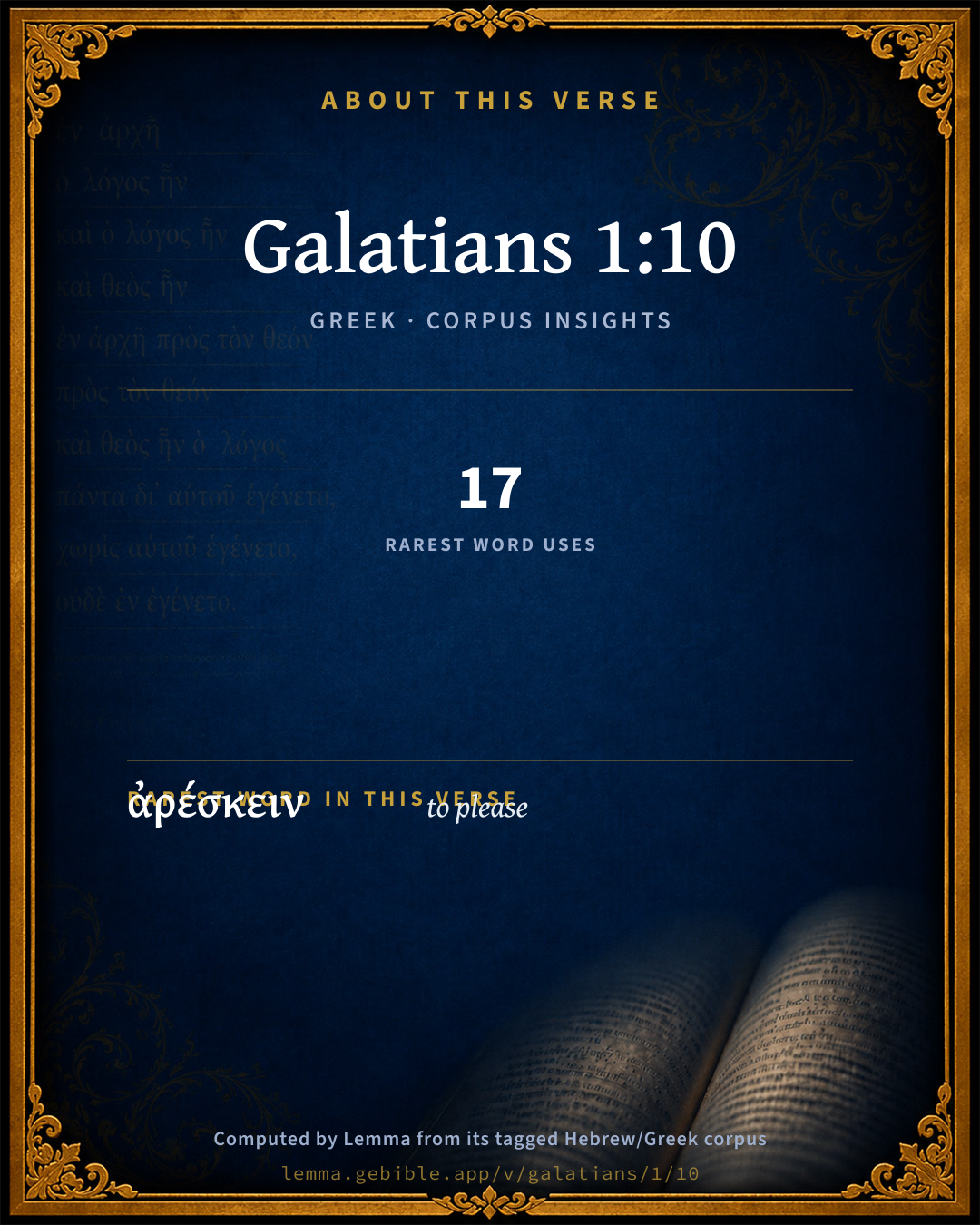
The rarest word here is ἀρέσκειν to please G700 — appearing just 17 times in the whole Greek New Testament.

Shared distinctive vocabulary

ἀρέσκειν to please G700 occurs in 16 verses of the Greek New Testament. Also found in:

Repetition

Words recur within this verse:

  • ἀνθρώπους human being G444 ×3
  • ἀρέσκειν to please G700 ×2
  • ἢ or G2228 ×2

Cross-references

14

Topical passages linked to Galatians 1:10 in the Treasury of Scripture Knowledge — connected by theme and wording, ordered by reader-vote popularity; previews shown in the World English Bible.

  • 1 Thessalonians 2:4 But even as we have been approved by God to be entrusted with the Gospel, so we speak; not as pleasing men, but God, who tests our hearts.
  • Acts 5:29 But Peter and the apostles answered, "We must obey God rather than men.
  • Ephesians 6:6 not in the way of service only when eyes are on you, as men-pleasers; but as servants of Christ, doing the will of God from the heart;
  • James 4:4 You adulterers and adulteresses, don't you know that friendship with the world is enmity with God? Whoever therefore wants to be a friend of the world makes himself an enemy of God.
  • Matthew 22:16 They sent their disciples to him, along with the Herodians, saying, "Teacher, we know that you are honest, and teach the way of God in truth, no matter who you teach, for you aren't partial to anyone.
  • Colossians 3:22 Servants, obey in all things those who are your masters according to the flesh, not just when they are looking, as men-pleasers, but in singleness of heart, fearing God.
  • 2 Corinthians 5:9–11 Therefore also we make it our aim, whether at home or absent, to be well pleasing to him.
  • Romans 2:29 but he is a Jew who is one inwardly, and circumcision is that of the heart, in the spirit not in the letter; whose praise is not from men, but from God.
  • Acts 4:19–20 But Peter and John answered them, "Whether it is right in the sight of God to listen to you rather than to God, judge for yourselves,
  • 2 Corinthians 12:19 Again, do you think that we are excusing ourselves to you? In the sight of God we speak in Christ. But all things, beloved, are for your edifying.
  • 1 John 3:9 Whoever is born of God doesn't commit sin, because his seed remains in him; and he can't sin, because he is born of God.
  • Romans 2:8 but to those who are self-seeking, and don't obey the truth, but obey unrighteousness, will be wrath and indignation,
  • Romans 1:1 Paul, a servant of Jesus Christ, called to be an apostle, set apart for the Gospel of God,
  • 1 Corinthians 10:33 even as I also please all men in all things, not seeking my own profit, but the profit of the many, that they may be saved.

Cross-references courtesy of OpenBible.info (CC BY 4.0).

Commentary

Notes on Galatians 1:10 from classic Christian and Jewish commentators (each source and its license shown beneath its notes). The classic Christian expositions comment on the surrounding passage and are grouped to its opening verse, so a note may address several verses; the Jewish commentaries on the Tanakh (Rashi and others) are per-verse, so they appear only where the commentator wrote on this verse.

Lemma curates 59 commentaries, every one of them public domain or Creative Commons licensed, each selected and text-cleaned for this edition rather than reprinted as found. About our sources →

The Biblical Illustrator

Joseph S. Exell

Gal_1:10

For do I now persuade men, or God?

or do I seek to please men?

I. That the governing principle and motive of the religious life, is a practical concern not for the favour of man, but for that of god. Do I now persuade men, or God? or do I seek to please men? for if I yet pleased men, I should not be the servant of Christ. The particle now seems to contrast his present line of conduct as a Christian with his former procedure as a Pharisee. Here we perceive, therefore, the high standard of moral action which Christianity enabled St. Paul to propose to himself. His object was not to please men, but God. Conventional utility is the standard of the world; and to please each other, so far as mutual interests can be advanced by the process, has been, time out of mind, the highest object contemplated in the codes of worldly men. But the Christian standard is far higher; and its results upon society, wherever it is acted upon, are invaluable. In every inquiry as to practical duty, Christianity brings the idea of the Supreme Being immediately before the mind--the great originator of human obligations--the infallible arbiter of human conduct--the final judge of human actions. The gospel is pre-eminently the religion of motives, and takes especial cognizance not only of what we do, but why we do it; and teaches us to inquire, not merely into the correctness of the action itself, but into the views and feelings whence it originated. In asserting his own freedom from selfish considerations, St. Paul incidentally taxes the false apostles with being governed by these debasing characteristics, their motives being notoriously too corrupt to bear the light. A supreme concern for the favour and friendship of God, as it is the governing principle of the religious life, has always distinguished the favoured servants of Christ. It was this principle of love and loyalty to heaven that induced Moses to relinquish the fleeting honours of a court, and to set at nought alike the treasures of Egypt and the frown of kings; for he endured at seeing Him who is invisible. This led the fathers of the Reformation, the Waldenses of the Continent, and the Puritans of a succeeding age, to endure obloquy, persecution, and martyrdom itself, rather than surrender the claims of conscience, or renounce their allegiance to the King of kings. And as the same causes must produce the same effects, this principle will induce us to take a decided part in the contest always going on.

II. The source whence all true knowledge of the gospel is to be derived, whether as a matter of doctrine or as a matter of experience. I certify to you, brethren, that the gospel which was preached of me was not after man, for I neither received it of man, neither was I taught it, but by the revelation of Jesus Christ. The religion we profess is not of man, but of God. This conviction is necessary.

1. To satisfy our reason as men.

2. To relieve our fears as sinners.

3. To promote our usefulness as Christians.

Improvement:

1. A broad line of distinction between the Christian and the hypocrite. The one seeks to commend himself to man, the other to God. The nominal Christian may say, I received my religion as an heirloom from my ancestors, or through the medium of educational bias and conviction; or from the lip of some eloquent expounder of evangelical doctrine; but the genuine disciple may, with unpresuming eye, look upwards and say, I received it, not of man, but by the revelation of Jesus Christ. Again. It teaches us to distinguish between the varieties of character which obtain within the precincts of the Church itself, between Christian and Christian, between those who give token of advanced spirituality and ripeness for heaven, and those of inferior attainments and of less vigorous piety. One star differeth from another star in glory. Some attain an early maturity, and some continue children in understanding to a late period in life. Some run with patience the race set before them; others halt in their mid-way course, and long to unclasp their armour, if they do not surrender their shield. Some, like the children of Israel at Horeb, are satisfied to skirt the base of the Mount; whilst others, like Moses, ascend its summit, converse with God face to face, an& bear about them much of the brightness and blessedness of the region in which they had found their happiness and their home. Some, like the Galatians, give ear to something very much like another gospel; others, like the apostle, amidst lamented infirmities, firmly abide by the revelation of Jesus Christ. Finally, Our subject reads aH impressive lesson to the ministers of religion. They must not, as Perkins judiciously remarks, content themselves with that teaching which they find in the schools; but they must learn Christ as Paul learned Him. They that would convert others must be effectually converted. John must first eat the book, and then prophesy. (The Evangelist.)

Men-pleasing condemned

I. The humour of desiring to be pleased, and the danger of it. A parasite is more welcome to us than a prophet. He is our apostle who will bring familiar and beloved arguments to persuade us to that to which we have persuaded ourselves already, and further our motion to that to which we are flying. Men would rather be cozened with a pleasing lie, than saved with a frowning and threatening truth. The causes from which this desire to be pleased proceedeth, and its hitter effects. 1.

(1) And, first, it hath no better original than defect, than a wilful and negligent failing in those duties to which nature and religion have obliged us, a leanness and emptiness of the soul, which, not willing to fill itself with righteousness, filleth itself with air, with false counsels and false attestations, with miserable comforts. It is a thing soon done, and requireth no labour nor study, to be pleased. We desire it as sick men do health, as prisoners do liberty, as men on the rack do ease: for a troubled spirit is an ill disease; not to have our will is the worst imprisonment; and to condemn a mans self in that which he alloweth and maketh his choice (Rom_14:22), is to put himself upon the rack. We may see it in our civil affairs and matters of lesser alloy: when anything lieth upon us as a burden, how willing are we to cast it off! When we are poor, we dream of riches, and make up that which is not with that which may be (Pro_23:5). When we have no house to hide our heads, we build a palace in the air. We are unwilling to suffer, but we are willing, nay, desirous, to be eased. And so it falleth out in the managing of our spiritual estate: we do as the apostle exhorteth (though not to this end), cast away everything that presseth down (Heb_12:1); but so cast it away as to leave it heavier than before; prefer a momentary ease, which we beg or borrow or force from things without us, before that peace which nothing can bring in but that grief and serious repentance which we put off with hands and words as a thing irksome and unpleasing.

(2) And thus, in the second place, proceedeth even from the force and power of conscience within us, which, ii we will not hearken to it as a friend, will turn Fury, and pursue and lash us; and if we will not obey her dictates, will make us feel her whip. This is our judge and our executioner.

2. Let us now see the danger of this humour, and the bitter effects it doth produce.

(1) And, first, this desire to be pleased placeth us out of all hope of succour, leaveth us like an army besieged when the enemy hath cut off all relief. It is a curse itself, and carrieth a train of curses with it. It maketh us blind to ourselves, and not fit to make use of other mens eyes.

(2) For, in the second place, this humour, this desire to be pleased, doth not make up our defects, but maketh them greater; doth not make vice a virtue,but sin more sinful. For he is a villain indeed that will be a villain, and yet be thought a saint; such a one as God will spew out of His mouth.

(3) For, in the third place, this humour, this desire to be pleased, doth not take the whip from conscience, but enrageth her; layeth her asleep, to awake with more terror. For conscience may be seared indeed (1Ti_4:2), but cannot be abolished; may sleep, but cannot die, but is as immortal as the soul itself. Conscience followeth our knowledge; and it is impossible to chase that away, impossible to be ignorant of that which I cannot but know. It is not conscience but our lusts that make the music.

II. We proceed now to lay open the other evil humour, of pleasing men, Which is more visible and eminent in the text. And indeed to desire to be pleased and to be ready to please, saith Isidore Pelusiot, to flatter and to be flattered, bear that near relation the one to the other that we never meet them asunder. It is the devils net, in which he catcheth two at once. If there be an itching ear, you cannot miss but you shall find a flattering tongue. If the king of Sicily delight in geometry, the whole court shall swarm with mathematicians. If Nero be lascivious, his palace shall be turned into a stew or brothelhouse, or worse. And, first, we must not imagine that St. Paul doth bring in here a cynical morosity or a Nabal-like churlishness; that none may speak to us, and we speak nothing but words; that we should make a noise like a dog, and so go round about the city (Psa_59:6-14); that we should be as thorns in our brethrens sides, ever pricking and galling them. What, then, is that which here St. Paul condemneth? Look into the text, and you shall see Christ and men as it were two opposite terms. If the man be in error, I must not please him in his error; for Christ is truth: if the man be in sin, I must not please him; for Christ is righteousness. So when men stand in opposition to Christ, when men will neither hear His voice nor follow Him in His ways, but delight themselves in their own, and rest and please themselves in error as in truth, to awake them out of this pleasant dream, we must trouble them, we must thunder to them, we must disquiet and displease them. For who would give an opiate pill to these lethargies? To please men, then, is to tell a sick man that he is well; a weak man, that he is strong; an erring man, that he is orthodox; instead of purging out the noxious humour, to nourish and increase it; to smooth and strew the ways of error with roses, that men may walk with ease and delight, and even dance to their destruction; to find out their palate, and to fit it; to envenom that more which they affect, as Agrippina gave Claudius the emperor poison in a mushroom. What a seditious flatterer is in a commonwealth, that a false apostle is in the Church. They are as loud for the truth as the best champions she hath; but either subtract from it, or add to it, or pervert and corrupt it, that so the truth itself may help to usher in a lie. When the truth itself doth not please us, any lie will please us; but then it must carry with it something of the truth. For instance: to acknowledge Christ, but with the law, is a dangerous mixture: it was the error of the Galatians here.

III. You see now what it is to please men, and from whence it proceedeth, from whence it springeth, even from that bitter root, the root of all evil, the love of the world. Let us now behold that huge distance and inconsistency which is between these two, the pleasing of men, and the service of Christ: If I yet please men, I am not the servant of Christ.

1. And, first, we cannot do both, not serve men and Christ, no more than you can draw the same straight line to two points, to touch them both (Mat_6:24).

2. Secondly. The servant must have his eye upon his master; and as he seeth him do, must do likewise. Power cannot flatter; and mercy is so intent on its work that it thinketh of nothing else. To work wonders to please men were the greatest wonder of all.

Application:

1. For conclusion, then: Let them who are set apart to lead others in the way of truth and righteousness take heed.

2. And of the person by His doctrine.

3. And therefore, in the last place, let us all, both teachers and hearers, purge out this evil humour of pleasing and being pleased: and let us, as the apostle exhorteth, consider one another to provoke unto love and to good works (Heb_10:24). Let us speak truth every one to his neighbour; for we are members one of another (Eph_4:25). (A. Faringdon.)

Applause of conscience best

One applause of conscience is worth all the triumphs in the world. (A. Faringdon.)

Truth better than flattery

Thou shalt not see thy brother sin; but thou shalt rebuke and save thy brother (Lev_19:17). Common charity requireth thus much at thy hand: and to make question of it is as if thou shouldst ask with Cain, Am I my brothers keeper? (Gen_4:9). This is the true and surest method of pleasing one another. For flattery, like the bee, carrieth honey in its mouth, but hath a sting in its tail; but truth is sharp and bitter at first, but at last more pleasant than manna. He that would seal up thy lips for the truth which thou speakest, will at last kiss those lips, and bless God in the day of His visitation. And this if we do, we shall please one another to edification (Rom_15:2), and not unto ruin. And thus all shall be pleased; the Physician, that he hath his intent, and the patient in his health: the strong shall be pleased in the weak, and the weak in the strong; the wise in the ignorant, and the ignorant in the wise: and Christ shall be well pleased to see brethren thus walk together in unity, strengthening and inciting one another in the ways of righteousness; and when we have thus walked hand-in-hand together to our journeys end, He shall admit us into His presence, where there is fulness of joy and pleasures for evermore (Psa_16:11). (A. Faringdon.)

Sinners not to be flattered

We should not mould and fit our best part to their worst, our reason to their lust; nor make our fancy the elaboratory to work out such essays as may please and destroy them. We should not foment the anger of the revenger to consume him, nor help the covetous to bury himself alive, nor the ambitious to break his neck, nor the schismatic to rend the seamless coat of Christ, nor the seditious to swim to hell in a river of blood: but we should bind the revengers hands, break the misers idols, bring down the ambitious to the dust, make up those rents which faction hath made, and confine the seditious to his own sphere and place. When the world pleaseth us, we are as willing to please the world, and we make it our stage, and act our parts; we call ourselves friends, and are but parasites; we call ourselves prophets, and are but wizards and jugglers; we call ourselves apostles, and are seducers; we call ourselves brethren, though it be in evil, and, like Hippocrates twins, we live and die together. We flatter, and are flattered; we are blind, and leaders of the blind, and fall together with them into the ditch. (A. Faringdon.)

Apostolic unpopularity

The gospel is unpopular

(1) Because of its holiness. It is the expression of the will of the All-holy, and demands submission and conformity to that will. Issuing from the fountain of purity, it calls for purity in every part. Only those who have the love of God in their hearts can appreciate and welcome it. To all others it must always be hateful.

(2) Because of its mysteriousness. Christ can only be apprehended by those who receive Him in faith; to others He is an enigma, and His salvation a thing beyond understanding; and men love not that which they are unable to comprehend. Pride of intellect protests against the gospels admitted mysteriousness.

(3) Because of its exclusiveness. It claims to be the one true system, and that all others are false; a claim which makes enemies of every other religions votaries, and of those who--caring for no religion themselves--would tolerate all.

(4) Because of its freeness. Men would prefer if the gospel asked for something at their hands, recognized that there was such a thing as human merit. A free gospel deals a blow to their self.conceit and self-satisfaction.

(5) Because of its aggressiveness. It is not content to leave men to themselves; and they resent every attempt at interference with them. The gospel offers no terms of compromise. In the name of God it demands unconditional submission. It aims at universal conquest. Hence its unpopularity with the world. (Emilius Bayley, B. D.)

Christian firmness

I. Christian firmness is not self-willed indifference to human opinion. On the contrary, the Christian is anxious to please and yield to others wherever his own interests alone are concerned. Many things he might rightly claim, he will shrink from pressing; many things that he may suffer, he will quietly submit to, rather than irritate the minds of men against the piety that he professes, or close the door against the future possibility of being the instrument of their conversion. Self-renunciation for the honour of God, or for the good of man, is the special spirit of a Christian. Nay, more; he will spare the feelings and humours of men whenever he lawfully can, doing things in their way rather than his own, being careful of appearances as well as realities. (Rom_12:17-18; 2Co_8:21; 1Ti_3:7; etc.)

II. Nor is it selfish inattention to human welfare. Salvation is not to be achieved in isolated effort, but is wrought out in the very nourishment and growth of those affections, occupations, and energies, which our duties in the world produce. There cannot be a genuine desire to save our own soul, a true Christian spirit of personal piety, which will not, from its very nature, expand beyond the confines of our own bosom, and overflow in copious streams towards all with whom we have to do.

III. It is simply paramount obedience to Divine authority. Pleasing men must always be subordinate to pleasing God. Every concession must be with a reservation of our Masters rights and privileges, honour and authority; every treaty must be so, for it is only good as it may be acknowledged and ratified by Him. All things may be tried for Him; hut nothing listened to against Him. (Prebendary Griffith.)

Right and wrong men-pleasing

We are not to please men, be they never so many or great, out of flatness of spirit, so as, for the pleasing of them, either go to neglect any part of our duty towards God and Christ; or

(2) to go against our own conscience, by doing any dishonest or unlawful thing; or,

(3) to do them harm whom we would please, by confirming them in their sins, humouring them in their peevishness, or but even cherishing their weakness; for weakness, though it may be borne with, yet it must not be cherished.

(4) But then, by yielding to their infirmities for a time, in hope to win them, by patiently expecting their conversion, or strengthening, by restoring them with the spirit of meekness, with meekness instructing them that oppose themselves, should we seek to please all men. (Bishop Christopher Wordsworth.)

Two earnest questions

1. Which seekest thou most--mans favour, or Gods favour?

2. Which is weightier--mans favour, or Gods favour? (J. P. Lange, D. D.)

Ministerial faithfulness and discretion

The love of popularity is a temptation from which few of us probably are free. The conscientious minister is constantly reminded of the fact that the fear of man bringeth a snare. In our public and private ministrations we often have to advocate truths which are uncongenial and unwelcome to many of those to whom we minister. A clear, decided, pointed application of Gods Word, must be unwelcome to the worldly, the careless, the self-indulgent, and the self-righteous. But we are naturally reluctant to forfeit the good opinion of others. Hence the temptation to modify, if not to hold back, offensive truths; to present our message, not in its naked simplicity, but in such a manner as shall disarm opposition; to avoid anything like close dealing with the conscience; to busy ourselves only with pointless generalities; to seek rather to please the imagination and gratify the taste, than to awaken conscience, to convince of sin, and to urge the surrender of heart and life to Christ. It is easy enough, by a little contrivance, to make our gospel popular. It is possible to teach truth, and nothing but truth, and yet to give no offence. We have only to modify our statements, or to generalize our applications, and the thing is done. We have but to omit an unpalatable truth, or so to state it as that none need apply it to themselves, and no objection will be raised. Men will tolerate, nay, approve of, a modified system of evangelical truth, to whom the entire presentment of such truth would be unacceptable. Four times, in a single verse, is the prophet warned against this temptation: And thou, son of man, be not afraid of them, neither be afraid of their words;… be not afraid of their words, nor be dismayed at their looks (Eze_2:6). And the Apostle Paul was fully conscious of the danger when he said, I have not shunned to declare unto you all the counsel of God (Act_20:27). At the same time; we must be careful that our unpopularity springs from legitimate causes: from the unreasonable opposition of the world to the truth of God, not from the just dislike of men to offensive peculiarities or positive faults. A Christian may be unpopular because he is vain, conceited, selfish, ungenial, narrow-minded, dogmatic, or the like. He may impute his unpopularity to his religion; whereas it comes rather from his want of religion: it originates not in the doctrine which he professes, but in his failure to adorn that doctrine in his daily life. Want of tact, again, in Christians often provokes opposition. The attempt to press the claims of religion upon others at unseasonable times, the employment of technical religious phraseology, the use of theological words and expressions not commonly heard in society, the thrusting of religious idiosyncrasies upon the unwilling and unsympathizing, are causes which frequently operate to the detriment of the principles which we have at heart. Christians should beware of mistaking forwardness for fidelity, and an obtrusive familiarity with sacred things for the honest outflowings of the heart full of love to God and man. Christian prudence is as needful, as worldly compromise is dangerous and wrong. In a word, we must not court unpopularity, or provoke it needlessly, or think that it never arises from any fault of our own. But, on the other hand, we must not dread it, lest we place ourselves among those who love the praise of men more than the praise of God. Ministers must ask, not how they may best please their congregations, but how they may save souls; not how they may stand well with the world, but how they may best serve their Master. (Emilius Bayley, B. D.)

Men-pleasing

Theodoric, an Arian king, did exceedingly affect a certain deacon, although orthodox. The deacon, thinking to please him better, and get preferment, became an Arian, which, when the king understood he changed his love into hatred, and caused his head to be struck from his shoulders. (Trapp.)

Pleasing men or serving Christ

A railway-gate keeper who, one cold night required every passenger to show his ticket before passing through to the train, and was rewarded with considerable grumbling and protesting, was told, You are a very unpopular man to-night. I only care to be popular with one man, was the reply, and that is the superintendent. He might have pleased the passengers, disobeyed orders, and lost his position. He was too wise for that; his business was to please one man--the man who hired him, gave him his orders, and rewarded him for faithfulness, and who would discharge him for disobedience. The servant of Christ has many opportunities to make himself unpopular. There are multitudes who would be glad to have him relax the strictness of his rules. If he is their servant they demand that he should consult their wishes. But if he serves them, he cannot serve the Lord. No man can serve two masters. He who tries to be popular with the world, will lose his popularity with the Lord. He will make friends, but he will lose the one Friend who is above all others. He will win plaudits, but he will not hear the gracious word, Well done! A faithful servant:--Not the least interesting of the monuments I saw amid the venerable ruins of Rome was one which held within its broken urn some half-burned bones. They were the ashes of one, who, as appeared from the inscription on the tablet, had belonged to Caesars household, and to the memory of whose virtues as a faithful, honest, and devoted servant, the emperor himself had ordered that marble to be raised. (T. Guthrie, D. D.)

A ministerial alternative

I. To please men by--

1. Watering down the doctrines of the gospel until they mean whatever hearers like to make them.

2. Toning down the precepts of the gospel until they are undistinguishable from the maxims of worldly policy.

3. Introducing secular expedients to attract audiences over whom an attenuated gospel has host its power.

4. Sinking the stern preacher of righteousness in the bland mover-about in society.

II. To serve Christ by--

1. The proclamation of unalterable trust.

2. The insistence of, and personal conformity to, a high moral standard.

3. The disdain of mere clap-trap and popular arts.

4. The imitation of the self-denying example of the Master. The one may please men; the other will save them. Bondage to man or to Christ:--

I. The necessity to please men represents in a very typical manner the non-freedom of the unredeemed man. This is a real slavery because--

1. It disturbs the development of an independent plan of life.

2. It is a part of the bondage of sin.

3. It involves servitude to the customs and fashions of the world.

II. Freedom from this yoke is only gained by entering the service of Christ. Just as the servant of a king boasts of his office as the highest liberty, so can we when we serve the Lord Christ.

III. Deliverance from the fear of man and the necessity of pleasing him, and servitude to Christ and pleasing Him, may be taken as a general description of Christian liberty. In conclusion--

1. Has the desire to have the good opinion of my neighbours any part in my profession of religion?

2. Even if my religious service is not done to be seen of men, is it a thing of form or principle?

3. Have I courage to dissent from the usages of society if my conscience protests? Do I always set before me, What does Christ demand? and not, What will men say? (Professor Robertson Smith.)

The servant of Christ

I. The servant.

1. He realizes the most perfect ideal of life. Others live for pleasure, wealth, fame; he for Christ.

2. He has the best Master.

3. He yields to the most valid claims--property, protection, redemption.

4. He has the strongest warrants--reason, conscience, love.

5. He is promised and enjoys the noblest reward--his Masters smile, his Sovereigns throne.

II. His service.

1. It is dignified in its sphere.

2. Grand in its motive--pleasing God.

3. Splendid in its instrument--the gospel.

4. Glorious in the freedom of its consecration.

5. Beneficent in the uses which it serves.

Persuading God

What the apostle means is making sure that God is with him. This can only be done by taking Gods way as ours, and not by hoping to get Him to, take ours as His. This much Paul says in vindication of his severity, whose office was that of a persuader of men. Nay, he says, the question is not of gaining over men, but of standing right with God, and that even at the expense of an absolute breach with men. At such a time as this, when deceitful men are striving to undo all my work for Christ, so far from being called to conciliate them, were I to do so I should not be a servant of Christ. (Professor Robertson Smith.)

Man-pleasing a vice in a moral reformer

Watch the author of a first poem or novel. What eagerness to see all the reviews; what anxiety till they come out; what manoeuvring to ascertain what people have said! And how many persons are there that, even after their apprenticeship in literature or art is over, can honestly affirm that the feeling has quite left them? Raphael must have liked to hear his pictures praised: nor was the approbation of the public a matter of indifference to the octogenarian Goethe, But though the artist or the literateur may so far make a merit of popularity it is quite different with the moral teacher or agent in great social changes. Popularity may happen to flow toward such a man, but it should not be treated as a reward or incentive, but rather as a means of deciding what proportion of society has been moved in the direction of his own spirit, and how much yet remains to be brought into subjection. In certain cases, indeed, it might be proper to lay it down as a maxim that he cannot honestly or efficiently accomplish his office without exciting opposition at every step he takes. (North British Review.)

Men-pleasing--its danger

The wise Phocion was so sensible how dangerous it was to be touched with what the multitude approved, that upon a general acclamation made when he was making an oration he turned to an intelligent friend and asked in a surprised manner, What slip have I made? (Steele.)

Men-pleasing the source of unfaithfulness

The soul that cannot entirely trust God, whether man be pleased or displeased, can never long be true to Him for while you are eyeing men you are losing God and stabbing religion at the very heart. (T. Manton.)

Men-pleasing--its cure

When one has learned to seek the honour that cometh from God only, he will take the withholding of the honour that cometh by man very lightly indeed. (Geo. Macdonald.)

The alternative to men-pleasing

Do not preach so much to please as to profit. Choose rather to discover mens sins than to show your own eloquence. That is the best looking-glass, not which is most gilded but which shows the truest face. (T. Watson.)

The servant of Christ

The title which the apostle gives himself, the servant, or the slave, of Christ, expresses, we may be sure, no mere acquiescence in some current fashion of Eastern speech, but the aspect of his life and conduct which he desires to keep before himself and others. St. Paul belonged to two worlds, the Jewish and the Greek, and in this title he has both worlds in view. In the language of the Psalter, and of the Hebrew prophets, every Israelite is, as such, a servant of the Lord, and to the collective people, viewed in its separate and its consecrated life, it is said, Thou, Israel, art My servant, thou whom I have taken from the ends of the earth, and called thee from the chief men thereof, and said unto thee, thou art My servant, I have chosen thee. But besides this general and ethical meaning, the title had a technical, official force. Any man who was marked out from among his fellows as having a special work to do for the Lord, was regarded as taken into the service of the invisible King, whose livery he thus wore by the force of events, and by his acts, and by the tenour of his life, in the eyes of his countrymen. In this sense, too, every member of the prophetic order came in time to be termed a servant of the Lord; and the title reached its highest significance when, in the later group of Isaiahs writings, it was used of the King Messiah, whose future humiliation and glory there mingled indistinctly with the nearer, although still distant, suffering and deliverance of the martyred people in Babylon. When, then, St. Peter and St. Jude, writing to Churches mainly or entirely of Jewish origin, styled themselves servants of Jesus Christ, they probably understood the title, chiefly if not exclusively, in the traditional and narrower Hebrew sense. But when St. Paul, writing to the Roman or Philippian Church, calls himself a servant of Christ, it is difficult to suppose that he does not read into the title the meaning which his readers would naturally find there, In these Churches, consisting altogether or predominantly of converts from heathendom, the phrase would rather suggest the ordinary slave of the GreekRoman world, than an inspired or distinguished servant of the Hebrew theocracy. That unseen, that immense population of human beings which worked, which suffered in silence, which tilled the fields, which manned the fleets, which constructed the palaces and the bridges of the world, which supplied to those who had property and power their cooks, their carpenters, their painters, their astronomers, their doctors, their poets, their copyists, their gladiators, their buffoons; which ministered to the refinement, intelligence, luxury, passions of the wealthy; which by its ceaseless and almost unnoticed waste of unregarded life satisfied the requirements, and helped to fill the coffers of the State. The slave class was almost the most prominent, as it was certainly the most mournful feature in the ancient society. In the view of antiquity, the slave was but an animated instrument, a mere body which chanced to be endowed with certain mental capacities. In the eye of the law, the slave was not a person: he was classed by the jurists with goods and with animals; he was sold, he was bequeathed by will, he was lent to a friend, he was shut up, he was banished, until the day of the later legislation he was killed--quite at the discretion of his owner. And St. Paul calls himself this--the slave of Jesus Christ! He was not merely a servant holding an honourable post in the kingdom of heaven, which he might relinquish at pleasure; he was consciously a slave. And in this abandonment of all human liberty at the feet of the Redeemer rain this utter surrender of the right to his intelligence, his affections, the employment of his time and his property, his movements from place to place, except as his Master might command, St. Paul found the true dignity and happiness of his being as a man. He belonged to Jesus Christ not by any original or solitary act of his own, but because, as he could not but acknowledge, Jesus Christ had paid for him, had bought him at an incalculable cost, out of slavery which was misery and degradation, into a service, which was freedom indeed. (Canon Liddon.)

Our duty with respect to public opinion

Public opinion is that common stock of thought and sentiment which is created by human society, or by a particular section of it; and it in turn keeps its authors under strict control. It is a natural product, it is a deposit which cannot but result from human intercourse. No sooner do men associate with one another, than a public opinion of some kind comes to be. And as civilization advances, and man multiplies the channels whereby he ascertains and governs the thought of his fellow-men, public opinion grows in strength, in area, and men voluntarily, or rather instinctively, abandon an increasing district of their understandings and conduct to its undisputed control. It varies in definiteness and in exigency with the number of human beings which it happens to represent. There is public opinion proper to each village and town, to each society and profession, to each country, to each civilization, to the world; but between the most general and the narrowest forms of this common body of thought and sentiment, there are bands and joints which weld the whole into a substantial unit; and in modern times public opinion has taken a concrete body and form, such as two centuries ago was undreamt of. It lives, it works in the daily press. In the press we see visibly embodied before our eyes this empire of opinion, with its countless varieties and sub-divisions, with its strong, corporate, and substantial unities. And so, face to face with the press, every man who hopes to keep his own conscience in moderately good order knows that in public opinion he encounters a force with which, sooner or later, on a large scale or a small, before the world or in the recesses of his own conscience, he must of necessity reckon; and that, whether he bears like St. Paul a commission from heaven, or endeavours to be loyal to such truth as he knows of chiefly or altogether among the concerns of earth. What is the duty of the Christian towards this ubiquitous, this penetrating agency? Is he to shut himself up and despise it, as might some Stoic of the earlier Stoic school? Assuredly not. St. Paul did not do that. He was respectful, even towards heathen opinion … Are we, then, to place ourselves trustfully under public opinion, to defer to and obey it, at least in a Christian country; and is it to furnish us in the last resort with the rule of conduct and criterion of moral, even religious, truth? Again, most assuredly not; for it is, in fact, a compromise between the many elements which go to make up human society; and the lower and selfish elements of thought and feeling are apt upon the whole to preponderate. Public opinion is too wanting in patience, in penetration, in delicacy, to deal successfully with religious questions. It cannot be right to cry Hosanna now; to-morrow, Crucify; to applaud in Galilee what you condemn in Jerusalem; to sanction in this generation what was denounced in that; to adore what you have burned, to burn what you have adored with conspicuous versatility, merely because a large body of human beings--the majority of them, it may be, quite without particular information on the subject in hand--love to have it so. To attempt to please men in this sense is, most assuredly, incompatible with the service of Christ. The Christian has, or ought to have, upon his heart and upon his conscience, the revelation of truth which in these great crises of life sets him above the exigencies of public opinion. He that is spiritual judgeth all things, but he himself is judged of no man. He will not, indeed, break with it lightly or wantonly; he will look ones and again, aye and a third time, to be sure that he is not himself deceived, if not in his principle yet in its application. But when this point is once clear, he will resolutely go forward. (Canon Liddon.)

Uncomfortable preaching

I remember one of my parishioners telling me that he thought a person should not go to church to be made uncomfortable. I replied that I thought so too; but whether it should be the sermon or the mans life that should be altered, so as to avoid the discomfort, must depend on whether the doctrine was right or wrong. (Archbishop Whately.)

Reward of men-pleasing--

One Sunday afternoon a well-known minister, fatigued after his labours in church, retired to his room to rest. He had not long lain down, before he fell asleep and began to dream. He dreamed, that on walking into his garden, he entered a bower that had been erected in it, where he sat down to read and meditate. While thus employed, he thought he heard some person enter the garden.; and, leaving his bower, he immediately hastened towards the spot whence the sound seemed to come, in order to discover who it was that had entered. He had not proceeded far before he discovered a particular friend of his, a minister of considerable talents and popularity. On approaching his friend, he was surprised to find on his countenance a gloom which it had not been wont to bear, indicating violent agitation of mind which seemed to arise from conscious remorse. After the usual salutations had passed, his friend asked the relater the time of the day. To which he replied, Twenty.five minutes after four. On hearing this the stranger said, It is only one hour since I died, and now--(here his countenance spoke unutterable horrors.) Why so troubled? inquired the dreaming minister. It is not, said he, because I have not preached the gospel; nor is it because I have not been rendered useful, for I have now many seals to my ministry that can bear testimony to the truth as it is in Jesus, which they have received from my lips; but it is because I have been accumulating to myself the praise of men, more than the honour which cometh from above; and, verily, I have my reward. Having thus said, he disappeared, and was seen no more. The minister awoke, and soon learned of the death of the popular preacher at the precise time indicated in the dream.

Attempts at men-pleasing not always successful

Dr. Dodds besetting sin seems to have been an excessive anxiety to give satisfaction to all, to please men of every shade of opinion. Having to preach one Sunday at a country town, where were two different meeting-houses, the one Calvinistic and the other Arminian, the doctor provided himself with two sermons as opposite in their doctrine as were the congregations he was to preach to. When he arrived at the place he mounted the Calvinistic pulpit in the morning, gave out his text, and began his sermon; but he had not proceeded far when he perceived that he had pulled out the wrong sermon. However, it was now too late to repair the mischief, so he was obliged to go through with it, much to his own discomfiture, and to the dissatisfaction of the people. Having but two sermons with him, and knowing that many of his morning hearers would follow him to the other meeting in the afternoon, he was under the necessity of preaching his Calvinistic discourse in the Arminian place of worship, and of course gave as much discontent to his second congregation as he had done to the first. The doctor mentioning his mistake shortly afterwards to an intimate friend, received sorry comfort from the reply: Never mind, sir; you only happened to put your hand into the wrong pocket!

Godless ministers

It is true that a man may impart light to others, who does not himself see the light. It is true that, like a concave speculum, cut from a block of ice, which by its power of concentrating the rays of the sun, kindles touchwood or explodes gunpowder, a preacher may set others on fire, when his own heart is cold as frost. It is true that he may stand like a lifeless finger-post, pointing the way on a road where he neither leads nor follows. (T. Guthrie, D. D.)

The Biblical Illustrator, edited by Joseph S. Exell (c. 1880s–1900s) — public domain. Text from a community e-Sword module.

Joseph Benson's Commentary

Gal 1:10. For — He here adds the reason why he speaks so confidently; do I now persuade, or satisfy, men — Is this what I aim at in preaching or writing? or God? — Do I endeavour, in my ministry, to ingratiate myself with men, or to approve myself to God? Or do I seek to please men — By a compliance with their prejudices or designs? For if I yet — Or still, as before my conversion; pleased men — Studied to please them; if this were my motive of action, nay, if I did in fact please the men who know not God, I should not be the servant of Christ — I should not deserve the name of a Christian, and much less that of a minister and an apostle. Hear this, all ye who vainly hope to keep in favour both with God and with the world! And let all those ministers especially observe it, who either alter or conceal the doctrines of the gospel, for fear of displeasing their hearers, or to gain popularity.

Joseph Benson's Commentary on the Old and New Testaments (1811–1818) — public domain. Text from a community e-Sword module.

The Preacher's Complete Homiletical Commentary

Joseph S. Exell (gen. ed.)

CRITICAL AND EXPLANATORY NOTES

Gal_1:11. Not after man.—Not according to man; not influenced by mere human considerations, as it would be if it were of human origin.

Gal_1:12. But by the revelation of Jesus Christ.—Probably this took place during the three years, in part of which the apostle sojourned in Arabia (Gal_1:17-18), in the vicinity of the scene of the giving of the law: a fit place for such a revelation of the gospel of grace which supersedes the ceremonial law. Though he had received no instruction from the apostles, but from the Holy Ghost, yet when he met them his gospel exactly agreed with theirs.

MAIN HOMILETICS OF THE PARAGRAPH.—Gal_1:10-12

The Superhuman Origin of the Gospel.

I. The gospel is not constructed on human principles.—“But I certify you, brethren, that the gospel which was preached of me is not after man” (Gal_1:11). Its character is such as the human mind would never have conceived. When it was first proclaimed it was the puzzle of the religious and the ridicule of the learned—“unto the Jews a stumbling-block, and unto the Greeks foolishness.” It is wholly opposed to the drift of human tendencies. Its supreme aim is to effect a complete transformation of human nature. Not to destroy that nature, but to renew, elevate, and sublimate it. By its principle of self-sacrificing love, its insistence of the essential oneness of the race, its methods in dealing with the world’s evils, its lofty morality, and its uncompromising claims of superiority the gospel transcends all the efforts of human ingenuity. Augustine, the father of Western theology in the fifth century, divided the human race into two classes—the one who lived according to man and the other who lived according to God. The gospel is the only revelation that teaches men how to live according to God.

II. The gospel does not pander to human tastes.—“For do I now persuade men, or God? or do I seek to please men? for if I yet pleased men, I should not be the servant of Christ” (Gal_1:10). The adversaries of the apostle insinuated that he was a trimmer, observing the law among the Jews and yet persuading the Gentiles to renounce it; becoming all things to all men that he might form a party of his own. Such an insinuation was based on an utter misconception of the gospel. So far from flattering, Paul preached a gospel that humbled men, demanding repentance and reform. It often came in collision with popular tastes and opinions; and though the apostle was a man of broad views and sympathies, he was ever the faithful and uncompromising servant of Christ. Public opinion may be hugely mistaken, and there is danger of over-estimating its importance. It is the lofty function of the preacher to create a healthy public opinion and Christianise it, and he can do this only by a scrupulous and constant representation of the mind of Christ, his divine Master. The wise Phocion was so sensible how dangerous it was to be touched with what the multitude approved that upon a general acclamation made when he was making an oration he turned to an intelligent friend and asked in a surprised manner, “What slip have I made?” George Macdonald once said, “When one has learned to seek the honour that cometh from God only, he will take the withholding of the honour that cometh by man very lightly indeed.”

III. The gospel has a distinctly superhuman origin.—“For I neither received it of man, neither was I taught it, but by the revelation of Jesus Christ” (Gal_1:12). Paul’s reception of the gospel was not only a revelation of Christ to him, but at the same time a revelation of Christ in him. The human vehicle was spiritually prepared for the reception and understanding of the divine message; and this moral transformation not only convinced him of the superhuman character of the gospel, but also empowered him with authority to declare it. The gospel carries with it the self-evidencing force of its divine origin in its effect upon both preacher and hearer. It is still an enigma to the mere intellectual student; only as it is received into the inmost soul, by the aid of the Holy Spirit, is its true nature apprehended and enjoyed.

Lessons.—

1. Man everywhere is in dire need of the gospel.

2. The human mind is incapable of constructing a saving gospel.

3. The gospel is inefficacious till it is received as a divine gift.

GERM NOTES ON THE VERSES

Gal_1:10. Fidelity in the Ministry.

I. The proper nature of the ministry is not the word or doctrine of man but of God.—Ministers are taught to handle their doctrine with modesty and humility, without ostentation, with reverence, and with a consideration of the majesty of God, whose doctrine it is they utter

II. The dispensing of the word must not be for the pleasing of men but God.—Ministers must not apply and fashion their doctrine to the affections, humours, and dispositions of men, but keep a good conscience and do their office.

III. If we seek to please men we cannot be the servants of God.—He that would be a faithful minister of the gospel must deny the pride of his heart, be emptied of ambition, and set himself wholly to seek the glory of God in his calling.—Perkins.

The Servant of Christ.

I. There is nothing dishonourable in the idea of a servant absolutely considered.—On the contrary, there may be much in it that is noble and venerable. Nothing can be more contemptible than an affectation of independence which resents or is ashamed of a servant’s name. And many who despise servants should be told that they themselves are so worthless that nobody would think of honouring them with hiring them for service. It was Christ’s honour that His Father so employed Him for the work of our salvation, and said, “Behold My Servant, whom I have chosen”; and the highest honour of the preachers of the gospel is that they are the ministers, that is, the servants, both of Christ and His Church. There are cases, no doubt, in which servitude is degrading. The master may be infamous; though even then the servant’s condition is not dishonourable, unless he be employed in infamous work. Many servants have wrought out most honourable names for themselves in doing good work under bad masters. Matthew Henry has said well that there is nothing mean but sin, and with such meanness and dishonour is every man affected who is not a servant of Christ. There is for us all the choice of only two conditions; there is not a third and neutral one. The alternative is a servant of the Son of God or a slave of sin. It may not be of sin in its most hideous forms, in the form in which it tyrannises over the drunkard, the lewd man, or the ambitious, but even in its milder and less-offensive form, when it may reign only with the power which it exercises over the worshipper of wealth or of human applause; still, it is a degrading vassalage. Let no worldly man, then, affect to pity or scorn the disciple of the gospel as being one whom superstition enslaves, though it were admitted to be a slavery; he himself labours under one infinitely more oppressive and degrading. Whose appears the greater liberty and the least oppression, his who is governed by the salutary laws of the gospel, or his who is the sport and victim of his own ignorance and passions, or of the opinion of the world, to which, at the expense of the violation of his own conscience, he feels himself compelled ignominiously to submit? The question needs not an answer. There is everything honourable in the one service, everything dishonourable in the other. Only that man is truly a free man who is a servant of Christ.

II. The servant of Christ.—Others profess that they are servants of God; the Christian replies that he is a servant of Christ. There is perhaps nothing by which his faith is more distinctly characterised than this. “Is he not, then, a servant of God?” some one may ask, either in the spirit of a scorning objector or in that of an astonished inquirer who is as yet ignorant of the beautiful mystery of Christian salvation. When others profess that they are the servants of God, and when the Christian replies that he is a servant of Christ, does it signify that he is not a servant of the eternal Father? Such is the question; and our reply is, that in serving Christ he approves himself not only the best servant of God, but the only one whose service is genuine. In serving Christ he serves God, because God has so appointed and ordained. He has ordained that we be the servants of His Son; and if we serve not His Son, then we resist His ordination, so that we serve neither His Son nor Himself.

III. The Christian is Christ’s servant, not by hire, but by purchase.—This is a circumstance which claims our most thoughtful consideration. In the case of a servant who is hired there is a limitation of the master’s right, by the terms of the agreement, in respect of the kind and amount of labour to be exacted. There is also a definite term, at the expiry of which the right of service ceases, and the remuneration of the service is exigible by law. There is a vast difference in the case of a purchased servant, or, as otherwise expressed, a slave. He is his master’s property, to be treated entirely according to his master’s discretion. There is no limitation either to the amount or nature of the work which he may exact. The period of service is for life, and no remuneration can be claimed for the labour, howsoever heavy and protracted. Our servant-condition in relation to Christ is of this character: He does not hire us, but has purchased us—purchased us by His blood, and made us His property, to be used according to His sovereign will. But this is far from being all. Our gracious Master often sinks, as it were, the consideration of His past services—of His humiliation, His privation, His wounds and agony by which he saved us from punishment and woe—and reasons and deals with us as if we were hired servants and could merit something at His hand, animating us in our work by exhibiting to our hope that crown of glory which He will confer on all who are faithful unto death. Blessed servitude—the servitude of the Christian! Servitude of peace! Servitude of honour! Servitude of liberty! Servitude of victory and everlasting glory!

1. The Christian, as a servant, submits his mind to the authority of Christ—submits it to Him in respect of his opinions; at the utterance of His word renounces its own judgments and prejudices, and turns away from the teaching of the world’s philosophy and priesthood in scorn, saying, “You have no part in me. Christ is the Lord of my conscience; I will listen to Him.”

2. As the servant of Christ, the Christian subjects his body to His control and regulation in the gratifying of its appetites, and in providing for its comfort and adornment; his lips in what they speak; his hands in what they do; his ears in what they listen to; his eyes in what they read and look at; and his feet in all their journeyings and movements.

3. As the servant of Christ, he regulates his family according to his Master’s mind and law.

4. As a servant of Christ, he conducts his business according to Christ’s law, with the strictest honesty, and for Christ’s end, distributing his profits in a proportion—I shall say a large proportion; nay, I shall say a very large proportion—to the maintenance and education of his family, and some provision of an inheritance for them, and even a considerable proportion for the gratification of his own tastes. Is not that a large allowance for a slave? But oh, some of you! you seize on all—wickedly appropriate all to yourselves, or part, and that with a grudge, a murmur, and a scowl, with but the smallest fraction to the Master’s poor and the Master’s Church! Slaves indeed! Slaves of Avarice and his daughter, Cruelty!

5. As a servant of Christ, the country of the Christian is Christ’s, to be regulated, so far as his influence and vote may extend, by Christ’s rule, for Christ’s ends.—W. Anderson, LL. D.

Gal_1:11-12. The Gospel and the Call to preach it.

I. It is necessary that men should be assured and certified that the doctrine of the gospel and the Scripture is not of man but of God.—That the Scripture is the word of God there are two testimonies.

1. One is the evidence of God’s Spirit imprinted and expressed in the Scriptures, and this is an excellence of the word of God above all words and writings of men and angels.

2. The second testimony is from the prophets and apostles, who were ambassadors of God extraordinarily to represent His authority unto His Church, and the penmen of the Holy Ghost to set down the true and proper word of God.

II. It is necessary that men should be assured in their consciences that the calling and authority of their teachers are of God.—To call men to the ministry and dispensation of the gospel belongs to Christ, who alone giveth the power, the will, the deed; and the Church can do no more than testify, publish, and declare whom God calleth.

III. The gospel which Paul preached was not human—he did not receive it, neither was he taught it by man; and preached it not by human but by divine authority.

1. Christ is the great prophet and doctor of the Church. His office is:

(1) To manifest and reveal the will of the Father touching the redemption of mankind.

(2) To institute the ministry of the word and to call and send ministers.

(3) To teach the heart within by illuminating the mind and by working a faith of the doctrine taught.

2. There are two ways whereby Christ teaches those who are to be teachers.

(1) By immediate revelation.

(2) By ordinary instruction in schools by the means and ministry of men.

IV. They who are to be teachers must first be taught, and they must teach that which they have first learned themselves. They are first to be taught, and that by men where revelation is wanting. This is the foundation of the schools of the prophets. All men should pray that God would prosper and bless all schools of learning where this kind of teaching is in use.—Perkins.

The Gospel a Divine Revelation.

I. It is not constructed by human ingenuity.—“The gospel which was preached of me is not after man” (Gal_1:11).

II. It derives no authority from man.—“For I neither received it of man” (Gal_1:12).

III. It is not acquired by mere mental culture.—“Neither was I taught it.”

IV. It is a direct and special revelation from heaven.—“But by the revelation of Jesus Christ.”

Apostolic Assurance of the Supernatural Character of the Gospel.—

1. It is the custom of the adversaries of the truth, when they have nothing to say in reason against the doctrine itself, to cast reproach on those who preach it, and to question their call and authority to preach, that so they may indirectly at least reflect upon the doctrine.

2. As none may take upon him to dispense the word of God publicly unto others without a call from God, so there are several sorts of callings: one of men and ordinary when God calls by the voices and consent of men; another of God and extraordinary, the call of the Church not intervening.

3. It is required of an apostle to have the infallible knowledge of the truth of the gospel, and this not wholly by the help of human means, as we learn at schools and by private study, but mainly by immediate inspiration from the Spirit of God. Paul shows that the gospel was not taught him of man; and this he saith, not to depress human learning, but that he may obviate the calumny of his adversaries who alleged he bad the knowledge of the gospel by ordinary instruction from men only, and so was no apostle.—Fergusson.

The Preacher's Complete Homiletical Commentary (gen. ed. Joseph S. Exell; Funk & Wagnalls, c. 1892) — public domain (pre-1929). A full-Bible homiletical/sermon-outline anthology covering 65 of 66 books (2 John is absent from the source module). Text from a community e-Sword module.

Scofield Reference Notes

C. I. Scofield

For now do

The demonstration is as follows:

(1) The Galatians know Paul, that he is no seeker after popularity Gal 1:10.

(2) He puts his known character back of the assertion that his Gospel of grace was a revelation from God (Gal 1:11; Gal 1:12).

(3) As for the Judaizers, Paul had been a foremost Jew, and had forsaken Judaism for something better (Gal 1:13; Gal 1:14).

(4) He had preached grace years before he saw any of the other apostles (Gal 1:15-24).

(5) When he did meet the other apostles they had nothing to add to his revelations Gal 2:1-6.

(6) The other apostles fully recognized Paul’s apostleship. Gal 2:7-10.

(7) If the legalizers pleaded Peter’s authority, the answer was that he himself had claimed none when rebuked (Gal 2:11-14).

The Scofield Reference Bible (1917 edition), notes by C. I. Scofield — public domain. Text from a community e-Sword module.

Tyndale Open Study Notes

Tyndale Open Resources

1:10 The tone and content of this letter make it clear that trying to win the approval of people was not Paul’s goal. Paul was probably criticized by the Judaizers for trying to please people by presenting only the part of the Good News pertaining to faith and grace, and not what they perceived to be the whole message including the law. • Being Christ’s servant requires fidelity to Christ, regardless of how people respond (cp. Acts 5:29; Eph 6:5-6; 1 Thes 2:3-6).

Tyndale Open Study Notes — © Tyndale Open Resources, licensed CC BY-SA 4.0. Text via the HelloAO Bible API.

Bengel's Gnomon

Johann Albrecht Bengel

Gal 1:10. Ἄρτι γὰρ, for now) The reason why even now he writes with such asseverations: now is repeated from Gal 1:9.—ἀνθρώπους, men) This word is without the article, but presently after, τὸν Θεὸν, God, with the article. Regard is to be had to God alone.—πείθω) πείθω τινὰ, is much the same as the word ἀρέσκω, which presently occurs, I seek to please any one: πείθειν τινὰ, to obtain the consent or indulgence of any one. Plato de Leg. lib. 10, at the beginning; comp. 2Co 5:11, note.—ἀνθρώποις, men) The antithesis is, of Christ.—ἔτι, yet) The meaning is, I have not heretofore sought, nor do I yet seek to please men; comp. yet, ch. Gal 5:11. The particles of the present time, ἄρτι, now, and ἔτι, yet, refute the words of him who troubled the Galatians. They here distinguish the present from the former time, not only when he was a Pharisee, but likewise when he was an apostle. As to the time when he was a Pharisee, Paul neither denies nor affirms in this passage. Paul not long before had circumcised Timothy for example. They were wishing to turn that circumstance as a conclusive argument against him with the Galatians.—ἀνθρώποις, men) for the feelings of men are at variance with those of God and Christ; hence, the evil of this present world, Gal 1:4.—ἠρέσκον, I pleased) ἀρέσκω, I seek to please, Rom 8:8, note. A man generally either pleases or displeases him, whom he either seeks or does not seek to please. Χριστοῦ, of Christ) whom I seek to please, as is becoming in a servant, Tit 2:9.

Bengel's Gnomon of the New Testament — English translation (T&T Clark, Edinburgh, 1860) — public domain. Text from a community e-Sword module.

Meyer's Critical & Exegetical Commentary

Heinrich August Wilhelm Meyer

Gal_1:10. Paul feels that the curse which he had just repeated twice might strike his readers as being repulsive and stern; and in reference thereto he now gives an explanatory justification (γάρ) of the harsh language. He would not have uttered that ἀνάθεμα ἔστω, if he had been concerned at present to influence men in his favour, and not God, etc.

ἄρτι] has the chief emphasis, corresponds to the ἄρτι in Gal_1:9, and is therefore to be understood, not, as it usually is (and by Wieseler also), in the wider sense of the period of the apostles Christian life generally, but (so Bengel, de Wette, Ellicott) in reference to the present moment, as in Gal_1:9, just as ἄρτι always in the N.T., corresponding to the Greek usage of the word, expresses the narrower idea modo, nunc ipsum, but does not represent the wider sense of νῦν (Gal_2:20; 2Co_5:16; Mat_26:53, et al.), which is not even the case in the passages in Lobeck, p. 20. Hence, often as νῦν in Pauls writings covers the whole period from his conversion, ἄρτι is never used in this sense, not even in 1Co_13:12. The latter rather singles out from the more general compass of the νῦν the present moment specially, as in the classical combination νῦν ἄρτι (Plat. Polit. p. 291 B, Men. p. 85 C). Now, Paul would say, just now, when he is induced to write this letter by the Judaizing reaction against the very essence of the true and sole gospel which he upheld,now, at this critical point of timeit could not possibly be his business to conciliate men, but God only. Comp. Hofmann.

ἀνθρώ πους] is quite general, and is not to be restricted either to his opponents (Hofmann) or otherwise. The category, which is pointed at, is negatived, and thus the generic ἀνθρώπ. needed no article (Stallbaum, ad Plat. Rep. p. 619. 13; Sauppe, ad Xen. Mem. i. 4, 14).

πείθω] persuadeo, whether by words or otherwise. The word never has any other signification; but the more precise definition of its meaning results from the context. Here, where that which was repulsive in the preceding curse is to receive explanation, and the parallel is ζητῶ ἀρέσκειν, and where also the words ἢ τὸν Θεόν must fit in with the idea of πείθω, it denotes, as often in classical authors (Nägelsbach zur Ilias. i. 100), to win over, to conciliate and render friendly to oneself (Act_12:20, and Kypke thereon). Comp. especially on πείθειν θεόν, Pind. Ol. ii. 144; Plat. Pol. iii. p. 390 E, ii. p. 364 C; Eur. Med. 964; also the passages from Josephus in Krebs. Lastly, the present tense expresses, I am occupied with it, I make it my business. See Bernhardy, p. 370. Our explanation of πείθω substantially agrees with that of Chrysostom, Theophylact, Flacius, Hammond, Grotius, Elsner, Cornelius a Lapide, Estius, Wolf, Zachariae, Morus, Koppe, and others; also Borger, Flatt, Winer, Rückert, Usteri, Matthies, Schott, Olshausen, Baumgarten-Crusius, de Wette, Ewald (who, however, restricts the reference of ἢ τὸν Θεόν, which there is nothing to limit, to the day of judgment), Wieseler, Hofmann, Reithmayr, and others. The interpretations which differ from this, such as humana suadeo or doceo, an divina (Erasmus, Luther, Beza, Vatablus, Gomarus, Cramer, Michaelis); or suadeone secundum homines an secundum Deum, thus expressing the intention and not the contents (Calvin); or suadeone vobis, ut hominibus credatis an ut Deo (Piscator, Pareus, Calixtus; so also in substance, Holsten, z. Evang. d. Paul. u. Petr. p. 332 ff., and Hilgenfeld), are contrary to the meaning of the word: for πείθειν τινά always means persuadere alicui, and is not to be identified with πείθειν τι (Act_19:8; Act_28:23), placing the personal accusative under the point of view of the thing.

ἢ ζητῶ ἀνθρώποις ἀρέσκειν] or do I strive to be an object of human goodwill?not tautological, but more general than the preceding. The stress which lies on ἀνθρώποις makes any saving clause on the part of expositors (as, for example, Schott, de ejusmodi cogitari studio hominibus placendi, quod Deo displiceat) appear unsuitable. Even by his winning accommodation (1Co_9:19 ff; 1Co_10:15) Paul sought not at all to please men, but rather God. Comp. 1Th_2:4.

εἰ ἔτι ἀνθρώποις ἤρεσκον κ.τ.λ.] contains the negative answer to the last question. The emphasis is placed first on ἀνθρώποις, and next on Χριστοῦ: If I still pleased men, if I were not already beyond the possession of human favour, but were still well-pleasing to men, I should not be Christs servant. According to de Wette, ἔτι is intended to affirm nothing more than that, if the one existed, the other could no longer exist. But in this case ἔτι must logically have been placed after οὐκ. The truth of the proposition, εἰ ἔτι κ.τ.λ., in which ἀνθρώπ. is not any more than before to be limited to Pauls opponents (according to Holsten, even including the apostles at Jerusalem), rests upon the principle that no one can serve two masters (Mat_6:24), and corresponds to the οὐαί of the Lord Himself (Luk_6:26), and to His own precedent (Joh_6:41). But how decidedly, even at that period of the development of his apostolic consciousness, Paul had the full and clear conviction that he was an object, not of human goodwill, but of human hatred and calumny, is specially evident from the Epistles to the Corinthians composed soon afterwards; comp., however, even 1Th_2:4 ff. In this he recognised a mark of the servant of God and Christ (2Co_6:4 ff; 2Co_11:23 ff.; 1Co_4:9). The ἀνθρώποις ἀρέσκειν is the result of ζητεῖν ἀνθρώποις ἀρέσκειν, and consequently means to please men, not to seek to please or to live to please them, as most expositors, even Rückert, Usteri, Schott, Baumgarten-Crusius,[22] quite arbitrarily assume, although apart from the context the words might have this meaning; see on 1Co_10:33; and comp. ἀνθρωπάρεσκος, Eph_6:6

ΧΡΙΣΤΟῦ ΔΟῦΛΟς ΟὐΚ ἊΝ ἬΜΗΝ] is understood by most expositors, following Chrysostom, including Koppe, Rosenmüller, Flatt, Paulus, Schott, Rückert, so should I now be no apostle, but I should have remained a Jew, Pharisee, and persecutor of Christians; taking, therefore, ΧΡΙΣΤΟῦ ΔΟῦΛΟς in an historical sense. But how feeble this idea would be, and how lacking the usual depth of the apostles thought! No; Χριστοῦ δοῦλος is to be taken in its ethical character (Erasmus, Grotius, Bengel, Semler, Zachariae, Baumgarten-Crusius, de Wette, Ewald, Wieseler, and others): Were I still well-pleasing to men, this would exclude the character of a servant of Christ, and I should not be such an one; whom men misunderstand, hate, persecute, revile. As to the relation, however, of our passage to 1Co_10:32, see Calovius, who justly remarks that in the latter passage the πάντα πᾶσιν ἀρέσκω is meant secundum Deum et ad hominum aedificationem, and not secundum auram et voluntatem nudam hominum.

[22] To live to please, to render oneself pleasing, is also Wieselers interpretation (comp. also Rom_15:1), who consistently understands the previous ἀρέσκειν in the same way. Comp. Winer and Hofmann. But there would thus be no motive for the change from ζητῶ ἀρέσκειν to ἤρεσκον only, which according to our view involves a very significant progress. Paul seeks not to please, and pleases not.

Meyer — Critical and Exegetical Commentary on the New Testament — English translation by Peter Christie, edited by Frederick Crombie (T&T Clark, 1880) — public domain. Text from a community e-Sword module.

Expositor's Greek Testament

ed. W. Robertson Nicoll

Gal 1:10-24 . REPUDIATION OF CORRUPT MOTIVES. EVIDENCE FROM PAUL’S PERSONAL HISTORY THAT HIS CONVERSION WAS DUE TO GOD, AND THAT HE WAS TAUGHT THE GOSPEL BY GOD INDEPENDENTLY OF THE TWELVE AND OF JERUSALEM.

Gal 1:10 . The order of words in the Greek text forbids the stress laid in our versions on the alternative men or God ; the meaning of which is besides a little obscure in this connection. The true rendering of ἤ is rather than (= μᾶλλον ἤ ), as in Mat 18:8 , Luk 15:7 ; Luk 17:2 , 1Co 14:19 : Am I now persuading men rather than God? This language indicates clearly what kind of calumnies had been circulated. His detractors accused him of sacrificing the truth of God for the sake of persuading men. It was, we know, his boast that he became all things to all men , but whereas his real motive was that he might win all to Christ, they insinuated that he was more bent on winning favour with men than on securing the approval of God. During his recent visit he had made two concessions to Jewish feeling; he had circumcised Timothy, and had recommended for adoption regulations tending to promote harmonious intercourse between Jewish and Gentile converts. It was easy to misrepresent these concessions as an abandonment of his former principles: and they furnished his enemies accordingly with a handle for decrying him as a time-server without fixed principles, now bent on winning Jewish favour, as he had been before on gaining the Gentiles (see Introd., p. 145, and cf. Gal 1:11 ). Ἄρτι . The Greek text throws the emphasis on this word, and its subtle irony is brought out by the ἔτι which follows. “Am I doing this now? Do you charge me now (he says in effect to these partisans of Judaism) with regarding men more than God? There was a time, before I knew Christ, when I did study to please men: if that were still my desire, I should not have been a servant of Christ.”

The Expositor's Greek Testament, edited by W. Robertson Nicoll (1897–1910) — public domain. Text from a community e-Sword module.

Cambridge Greek Testament for Schools and Colleges

10–2:21. ST PAUL’S DEFENCE OF HIMSELF

10–12. My one object is to please God, and to serve Christ, who revealed to me the Gospel

(Gal 1:10) I say “now,” for my words show clearly that I care not to win over men, but God alone. I once indeed tried to please men, but that was before my conversion. If that were still my practice I should not be Christ’s servant—His by right and my full consent. (Gal 1:11) I say that a change came over me; for I will tell you, my brothers, of the Gospel that I brought to you and how I came to preach it. It is not of human measure, (Gal 1:12) For indeed it came not to me from man at all, neither did human lips explain it to me, but it came entirely by revelation given me by Christ Himself.

10. ἄρτι γὰρ. The ἄρτι is not in contrast to the time before his conversion (see ἔτι infra), nor to the occasion when he circumcised Timothy, but only takes up the ἄρτι of Gal 1:9, emphasizing that sentence. The γάρ presents a proof that his strong asseveration there shows that he is not the smooth-tongued hypocrite that his adversaries would make him out to be. The conjectural emendation τί γάρ; (Rom 3:3) is quite unnecessary.

ἀνθρώπους πείθω, “Am I now winning over men” (Act 12:20; 2Ma 4:45)? i.e. am I softening down unwelcome truths to men, that I may by some means win them over to my way of thinking?

ἢ τὸν θεόν; possibly πείθω retains its full force: “or am I trying to persuade God, as though I would get Him to tone His message down?” But this attitude towards God seems to have no parallel in St Paul’s writings. Doubtless the clause is appended by zeugma, and means “Or am I not in reality concerned with God only?” For Gal 1:10-12 imply St Paul’s absolute dependence on God in contrast to men.

ἤ ζητῶ ἀνθρώποις ἀρέσκειν; cf. ἀνθρωπάρεσκος in Col 3:22, and perhaps 1Th 2:4, where however see Milligan. Probably both this and the preceding sentence refer to accusations, brought against St Paul by the Judaizers, that he accommodated the gospel to the heathen, allowing them not to observe the Jewish Law, although its observance was necessary, in order that he might persuade them to a kind of belief in Christ.

εἰ ἔτι ἀνθρώποις ἤρεσκον, cf. Gal 5:11. He refers to the time before his conversion when he showed complaisance to Jews in persecuting Christians.

Χριστοῦ δοῦλος οὐκ ἄν ἤμην. “I should not be Christ’s slave.” The emphatic position of Χριστοῦ suggests that he would be the slave of another (Rom 6:22). Probably St Paul already has in his mind the liberty he has obtained by being the slave of a Divine master; see Gal 4:5, Gal 5:1 notes.

Cambridge Greek Testament for Schools and Colleges (Cambridge University Press, 1896; 21 vols, various authors incl. Carr, Maclear, Plummer, Farrar, Lumby, Moule, M. R. James, Simcox) — public domain. Text from a community e-Sword module.

Geneva Bible (1599)

Geneva Bible translators

He toucheth the false apostles who had nothing but men in their mouths, and he, though he would derogate nothing from the Apostles, preacheth God and not men.

A confirmation taken both from the nature of the doctrine itself, and also from that manner which he useth in teaching: for neither saith he, did I teach those things which pleased men as these men do which put part of salvation in external things, and works of the Law, neither went I about to procure any man’s favor. And therefore the matter itself showeth that that doctrine which I delivered unto you, is heavenly.

Geneva Bible (1599) marginal notes — public domain. Text via Bolls.life.

Matthew Henry's Commentary

What Paul had said more generally, in the preface of this epistle, he now proceeds more particularly to enlarge upon. There he had declared himself to be an apostle of Christ; and here he comes more directly to support his claim to that character and office. There were some in the churches of Galatia who were prevailed with to call this in question; for those who preached up the ceremonial law did all they could to lessen Paul's reputation, who preached the pure gospel of Christ to the Gentiles: and therefore he here sets himself to prove the divinity both of his mission and doctrine, that thereby he might wipe off the aspersions which his enemies had cast upon him, and recover these Christians into a better opinion of the gospel he had preached to them. This he gives sufficient evidence of,

I. From the scope and design of his ministry, which was not to persuade men, but God, etc. The meaning of this may be either that in his preaching the gospel he did not act in obedience to men, but God, who had called him to this work and office; or that his aim therein was to bring persons to the obedience, not of men, but of God. As he professed to act by a commission from God; so that which he chiefly aimed at was to promote his glory, by recovering sinners into a state of subjection to him. And as this was the great end he was pursuing, so, agreeably hereunto, he did not seek to please men. He did not, in his doctrine, accommodate himself to the humours of persons, either to gain their affection or to avoid their resentment; but his great care was to approve himself to God. The judaizing teachers, by whom these churches were corrupted, had discovered a very different temper; they mixed works with faith, and the law with the gospel, only to please the Jews, whom they were willing to court and keep in with, that they might escape persecution. But Paul was a man of another spirit; he was not so solicitous to please them, nor to mitigate their rage against him, as to alter the doctrine of Christ either to gain their favour or to avoid their fury. And he gives this very good reason for it, that, if he yet pleased men, he would not be the servant of Christ. These he knew were utterly inconsistent, and that no man could serve two such masters; and therefore, though he would not needlessly displease any, yet he dared not allow himself to gratify men at the expense of his faithfulness to Christ. Thus, from the sincerity of his aims and intentions in the discharge of his office, he proves that he was truly an apostle of Christ. And from this his temper and behaviour we may note, 1. That the great end which ministers of the gospel should aim at is to bring men to God. 2. That those who are faithful will not seek to please men, but to approve themselves to God. 3. That they must not be solicitous to please men, if they would approve themselves faithful servants to Christ. But, if this argument should not be thought sufficient, he goes on to prove his apostleship,

II. From the manner wherein he received the gospel which he preached to them, concerning which he assures them (Gal 1:11, Gal 1:12) that he had it not by information from others, but by revelation from heaven. One thing peculiar in the character of an apostle was that he had been called to, and instructed for, this office immediately by Christ himself. And in this he here shows that he was by no means defective, whatever his enemies might suggest to the contrary. Ordinary ministers, as they receive their call to preach the gospel by the mediation of others, so it is by means of the instruction and assistance of others that they are brought to the knowledge of it. But Paul acquaints them that he had his knowledge of the gospel, as well as his authority to preach it, directly from the Lord Jesus: the gospel which he preached was not after man; he neither received it of man, nor was he taught it by man, but by immediate inspiration, or revelation from Christ himself. This he was concerned to make out, to prove himself an apostle: and to this purpose,

1. He tells them what his education was, and what, accordingly, his conversation in time past had been, Gal 1:13, Gal 1:14. Particularly, he acquaints them that he had been brought up in the Jewish religion, and that he had profited in it above many his equals of his own nation - that he had been exceedingly zealous of the traditions of the elders, such doctrines and customs as had been invented by their fathers, and conveyed down from one generation to another; yea, to such a degree that, in his zeal for them, he had beyond measure persecuted the church of God, and wasted it. He had not only been a rejecter of the Christian religion, notwithstanding the many evident proofs that were given of its divine origin; but he had been a persecutor of it too, and had applied himself with the utmost violence and rage to destroy the professors of it. This Paul often takes notice of, for the magnifying of that free and rich grace which had wrought so wonderful a change in him, whereby of so great a sinner he was made a sincere penitent, and from a persecutor had become an apostle. And it was very fit to mention it here; for it would hence appear that he was not led to Christianity, as many others are, purely by education, since he had been bred up in an enmity and opposition to it; and they might reasonably suppose that it must be something very extraordinary which had made so great a change in him, which had conquered the prejudices of his education, and brought him not only to profess, but to preach, that doctrine, which he had before so vehemently opposed.

2. In how wonderful a manner he was turned from the error of his ways, brought to the knowledge and faith of Christ, and appointed to the office of an apostle, Gal 1:15, Gal 1:16. This was not done in an ordinary way, nor by ordinary means, but in an extraordinary manner; for, (1.) God had separated him hereunto from his mother's womb: the change that was wrought in him was in pursuance of a divine purpose concerning him, whereby he was appointed to be a Christian and an apostle, before he came into the world, or had done either good or evil. (2.) he was called by his grace. All who are savingly converted are called by the grace of God; their conversion is the effect of his good pleasure concerning them, and is effected by his power and grace in them. But there was something peculiar in the case of Paul, both in the suddenness and in the greatness of the change wrought in him, and also in the manner wherein it was effected, which was not by the mediation of others, as the instruments of it, but by Christ's personal appearance to him, and immediate operation upon him, whereby it was rendered a more special and extraordinary instance of divine power and favour. (3.) He had Christ revealed in him. He was not only revealed to him, but in him. It will but little avail us to have Christ revealed to us if he is not also revealed in us; but this was not the case of Paul. It pleased God to reveal his Son in him, to bring him to the knowledge of Christ and his gospel by special and immediate revelation. And, (4.) It was with this design, that he should preach him among the heathen; not only that he should embrace him himself, but preach him to others; so that he was both a Christian and an apostle by revelation.

3. He acquaints them how he behaved himself hereupon, from Gal 1:16, to the end. Being thus called to his work and office, he conferred not with flesh and blood. This may be taken more generally, and so we may learn from it that, when God calls us by his grace, we must not consult flesh and blood. But the meaning of it here is that he did not consult men; he did not apply to any others for their advice and direction; neither did he go up to Jerusalem, to those that were apostles before him, as though he needed to be approved by them, or to receive any further instructions or authority from them: but, instead of that, he steered another course, and went into Arabia, either as a place of retirement proper for receiving further divine revelations, or in order to preach the gospel there among the Gentiles, being appointed to be the apostle of the Gentiles; and thence he returned again to Damascus, where he had first begun his ministry, and whence he had with difficulty escaped the rage of his enemies, Acts 9. It was not till three years after his conversion that he went up to Jerusalem, to see Peter; and when he did so he made but a very short stay with him, no more than fifteen days; nor, while he was there, did he go much into conversation; for others of the apostles he saw none, but James, the Lord's brother. So that it could not well be pretended that he was indebted to any other either for his knowledge of the gospel or his authority to preach it; but it appeared that both his qualifications for, and his call to, the apostolic office were extraordinary and divine. This account being of importance, to establish his claim to this office, to remove the unjust censures of his adversaries, and to recover the Galatians from the impressions they had received to his prejudice, he confirms it by a solemn oath (Gal 1:20), declaring, as in the presence of God, that what he had said was strictly true, and that he had not in the least falsified in what he had related, which, though it will not justify us in solemn appeals to God upon every occasion, yet shows that, in matters of weight and moment, this may sometimes not only be lawful, but duty. After this he acquaints them that he came into the regions of Syria and Cilicia: having made this short visit to Peter, he returns to his work again. He had no communication at that time with the churches of Christ in Judea, they had not so much as seen his face; but, having heard that he who persecuted them in times past now preached the faith which he once destroyed, they glorified God because of him; thanksgivings were rendered by many unto God on that behalf; the very report of this mighty change in him, as it filled them with joy, so it excited them to give glory to God on the account of it.

Matthew Henry's Commentary on the Whole Bible (1708–1710) — public domain (CC PDM 1.0). Text via the HelloAO Bible API.

Jamieson, Fausset & Brown

Robert Jamieson, A. R. Fausset & David Brown

For--accounting for the strong language he has just used.

do I now--resuming the "now" of Gal 1:9. "Am I now persuading men?" [ALFORD], that is, conciliating. Is what I have just now said a sample of men-pleasing, of which I am accused? His adversaries accused him of being an interested flatterer of men, "becoming all things to all men," to make a party for himself, and so observing the law among the Jews (for instance, circumcising Timothy), yet persuading the Gentiles to renounce it (Gal 5:11) (in order to flatter those, really keeping them in a subordinate state, not admitted to the full privileges which the circumcised alone enjoyed). NEANDER explains the "now" thus: Once, when a Pharisee, I was actuated only by a regard to human authority and to please men (Luk 16:15; Joh 5:44), but NOW I teach as responsible to God alone (Co1 4:3).

or God?--Regard is to be had to God alone.

for if I yet pleased men--The oldest manuscripts omit "for." "If I were still pleasing men," &c. (Luk 6:26; Joh 15:19; Th1 2:4; Jam 4:4; Jo1 4:5). On "yet," compare Gal 5:11.

servant of Christ--and so pleasing Him in all things (Tit 2:9; Col 3:22).

Jamieson, Fausset & Brown — Commentary Critical and Explanatory on the Whole Bible (1871) — public domain (CC PDM 1.0). Text via the HelloAO Bible API.

Adam Clarke's Commentary

Verse 10. Do I now persuade men, or God?] The words πειθειν τον θεον may be rendered to court or solicit the favour of God as the after clause sufficiently proves. This acceptation of πειθειν is very common in Greek authors. While the apostle was a persecutor of the Christians, he was the servant of men, and pleased men. When he embraced the Christian doctrine, he became the servant of GOD, and pleased HIM. He therefore intimates that he was a widely different person now from what he had been while a Jew.

Adam Clarke's Commentary on the Bible (1810–1826) — public domain. Text from a community e-Sword/MySword module.

John Calvin's Commentaries

Having extolled so confidently his own preaching, he now shows that this was no idle or empty boast. He supports his assertion by two arguments. The first is, that he was not prompted by ambition, or flattery, or any similar passion, to accommodate himself to the views of men. The second and far stronger argument is, that he was not the author of the gospel, but delivered faithfully what he had received from God.

10. For do I now persuade according to men or according to God? The ambiguity of the Greek construction in this passage, has given rise to a variety of expositions. Some render it, Do I now persuade men or God? Others interpret the words “God” and “men,” as meaning divine and human concerns. This sense would agree very well with the context, if it were not too wide a departure from the words. The view which I have preferred is more natural; for nothing is more common with the Greeks than to leave the preposition κατὰ, according to, to be understood.

Paul is speaking, not about the subject of his preaching, but about the purpose of his own mind, which could not refer so properly to men as to God. The disposition of the speaker, it must be owned, may have some influence on his doctrine. As corruption of doctrine springs from ambition, avarice, or any other sinful passion, so the truth is maintained in its purity by an upright conscience. And so he contends that his doctrine is sound, because it is not modified so as to gratify men.

Or, do I seek to please men? This second clause differs not much, and yet it differs somewhat from the former; for the desire of obtaining favor is one motive for speaking “according to men.” When there reigns in our hearts such ambition, that we desire to regulate our discourse so as to obtain the favor of men, our instructions cannot be sincere. Paul therefore declares, that he is in no degree chargeable with this vice; and, the more boldly to repel the calumnious insinuation, he employs the interrogative form of speech; for interrogations carry the greater weight, when our opponents are allowed an opportunity of replying, if they have anything to say. This expresses the great boldness which Paul derived from the testimony of a good conscience; for he knew that he had discharged his duty in such a manner as not to be liable to any reproach of that kind. (Acts 23:1; 2 Corinthians 1:12.)

If I yet pleased men This is a remarkable sentiment; that ambitious persons, that is, those who hunt after the applause of men, cannot serve Christ. He declares for himself, that he had freely renounced the estimation of men, in order to devote himself entirely to the service of Christ; and, in this respect, he contrasts his present position with that which he occupied at a former period of life. He had been regarded with the highest esteem, had received from every quarter loud applause; and, therefore, if he had chosen to please men, he would not have found it necessary to change his condition. But we may draw from it the general doctrine which I have stated, that those who resolve to serve Christ faithfully, must have boldness to despise the favor of men.

The word men is here employed in a limited sense; for the ministers of Christ ought not to labor for the express purpose of displeasing men. But there are various classes of men. Those to whom Christ “is precious,” (1 Peter 2:7,) are men whom we should endeavor to please in Christ; while they who choose that the true doctrine shall give place to their own passions, are men to whom we must give no countenance. And godly, upright pastors, will always find it necessary to contend with the offenses of those who choose that, on all points, their own wishes shall be gratified; for the Church will always contain hypocrites and wicked men, by whom their own lusts will be preferred to the word of God. And even good men, either through ignorance, or through weak prejudice, are sometimes tempted by the devil to be displeased with the faithful warnings of their pastor. Our duty, therefore, is not to take alarm at any kind of offenses, provided, at the same time, that we do not excite in weak minds a prejudice against Christ himself.

Many interpret this passage in a different manner, as implying an admission to the following effect: “If I pleased men, then I should not be the servant of Christ. I own it, but who shall bring such a charge against me? Who does not see that I do not court the favor of men?” But I prefer the former view, that Paul is relating how large an amount of the estimation of men he had relinquished, in order to devote himself to the service of Christ.

John Calvin's Commentaries (1540-1563) — public domain. Text from the Calvin Translation Society English edition (1840s-50s) via the Christian Classics Ethereal Library (ccel.org). Calvin's coverage is partial (roughly two-thirds of the Bible); uncommented books and verses are honest gaps, never fabricated. The 19th-century editor's footnotes and remarks are omitted so the notes are faithfully Calvin's own voice.

Ellicott's Commentary for English Readers

(10) You may take this vehemence of language as my answer to another charge that has been brought against me. I am accused of seeking popularity with men. Well, here at least is plainness of speech. If I seek to win favour with any one it is not with men, but God. The two things are really incompatible. If I were a. favourite with men I should be no true servant of Christ.

St. Paul naturally laid himself open to the charge of men-pleasing by the flexibility and largeness of his character. The trifles about which others quarrelled he could look upon with indifference, and his ready power of sympathy led him to enter as much as possible into the point of view of others: “To the Jews he became as a Jew,” &c. But where a question of principle was at stake he knew how to take his stand, and he let the Galatians see it in the very unequivocal language he is now using.

(10) Now.—In speaking thus.

Persuade.—Conciliate, seek to win favour with, or to make friends of.

For.—This word is omitted by all the best MSS. and editors. It is characteristic of the Apostle, especially in animated passages like the present, to omit the connecting particles which are so common in Greek. He has a simple answer to give to the accusation of time-serving, and he states it roundly: “If my present conduct was really that of a man-pleaser I should be something very different from what I am.”

Yet.—Still; at this late period of my career. The Apostle has cut himself adrift from the current of his age too thoroughly and too long for him to be still floating with the tide.

A Bible Commentary for English Readers, edited by Charles John Ellicott (1878–1897) — public domain. Text from a community e-Sword module.

The Cambridge Bible for Schools and Colleges

gen. ed. J. J. S. Perowne

10. For do I now … men, or God?] The particle ‘for’ connects this verse with what precedes. ‘I speak thus decisively and strongly, for in the first place my motives are pure and cannot be impugned; and secondly (Gal_1:11 foll.) the truths which I deliver are a revelation from God.’

now] ‘at this stage of my ministry.’ He could not be charged with a desire for popularity, which leads men to sinful concessions. He may be indirectly referring to the case of Peter, which is fully narrated, ch. Gal_2:11, &c.

persuade men, or God] The one word ‘persuade’, which cannot properly be applied to God, is used with both nouns by the grammatical figure Zeugma. “Can it be said of me now, that I am courting the favour of men, or am I seeking the favour of God?” The word rendered ‘persuade’ is translated “made … their friend”, Act_12:20. For the more common use of the verb, comp. 2Co_5:11, “we persuade men.”

if I yet … of Christ] If I any longer acted as men act by nature, before conversion to God. The ‘men-pleaser’ (Eph_6:6; Col_3:22) stands in strong contrast to the ‘servant’, the bondslave of Christ. “No man can serve (be a slave to) two masters,” Mat_6:24. The ‘slave’ not only does the will of his master, he belongs to his master.

The Cambridge Bible for Schools and Colleges (gen. ed. J. J. S. Perowne; Cambridge University Press, 1878–1918) — public domain. Text from a community e-Sword module.

John Gill's Exposition

For do I now persuade men, or God?.... To "persuade", is to teach; see Act 18:4 the sense of which, with respect to men, is easy, but, with regard to God, difficult; and indeed cannot be applied to him, consistent with his divine perfections; and therefore something must be understood, and which may be supplied either thus, "do I now persuade", you or others, that "men or God" are to be hearkened to? not men, but God; the apostle did not teach them to hearken either to himself, or any of the other apostles, Peter, James, and John, any further than as he and they preached the pure Gospel of Christ; but should they do otherwise, they were not to be attended to, but God, who spake by his Son; or Christ, who is God as well as man; who is the great prophet in the church, a son in his own house, whose voice is to be hearkened to in all matters of doctrine, worship, and duty: or thus, "do I now persuade" you, to obey "men or God"; not men, but God; he did not teach them to regard the traditions of the elders, or to obey the commandments of men, but, on the contrary, the ordinances of Christ, who is the one Lord, and only master, whose orders are to be observed: or thus, "do I now persuade", to trust in "men or God?" to believe in the one or the other; not in men, in the wisdom, strength, riches, and righteousness of men, but in the living God; in the grace of God, and in the blood, righteousness, and sacrifice of Christ: or thus, "do I persuade" for the sake of "men, or God?" not for the sake of gaining honour, glory, and applause from men, as the Pharisees and false apostles did, but for the glory of God, the hour of Christ, and the good of immortal souls: or else not persons, but things are meant, by men and God: and the sense is, that the apostle taught and persuaded men to believe, not things human, but divine; he did not preach himself, or seek to set up his own power and authority over men; or set forth his eloquence, learning, parts, and abilities; or to gain either applause or riches to himself; he did not teach human wisdom, the vain philosophy of the Gentiles, and opposition of science, falsely so called; nor the traditions of the elders, nor the commandments of men; nor the power and purity human nature, or the righteousness of man: but delivered things divine; he persuaded to things concerning God, and the kingdom of God; see Act 19:8 he taught, that without the regenerating grace of the Spirit of God, no man should see, and without the justifying righteousness of Christ, no man should enter into the kingdom of heaven, as his Lord had done before him; he preached the things concerning the grace and love of God, the person and offices of Christ, and the Spirit's work of regeneration and sanctification: the word "now", refers to all the time since his conversion, to the present: before his call by grace, he persuaded persons to hearken to men, to obey the traditions of the elders, to trust in their own righteousness for justification before God; but now he saw otherwise, and taught them to lay aside everything that was human, and to believe in God, trust in and depend on his justifying righteousness; and this he did, without any regard to the favour and affection of men, as appears from what follows:

or do I seek to please men? no, he neither pleased, nor sought to please them; neither in the matter of his ministry, which was the grace of God, salvation by a crucified Christ, and the things of the Spirit of God; for these were very distasteful to, and accounted foolishness by the men of the world; nor in the manner of it, which was not with excellency of speech, or the enticing words of man's wisdom, with the flowers of rhetoric, but in a plain and simple style. There is indeed a pleasing of men, which is right, and which the apostle elsewhere recommends, and was in the practice of himself; see Rom 15:2. This proceeds from right principles, by proper ways and means, and to right ends, the glory of God, the good, profit, edification, and salvation of men; and there is a pleasing of men that is wrong, which is done by dropping, concealing, or corrupting the doctrines of the Gospel, to gain the affection and applause of men, and amass wealth to themselves, as the false apostles did, and who are here tacitly struck at; a practice the apostle could by no means come into, and assigns this reason for it:

for if I yet pleased men, I should not be the servant of Christ: formerly he had studied to please men, when he held the clothes of those that stoned Stephen, made havoc of the church, hating men and women to prison; and went to the high priest, and asked letters of him to go to Damascus, and persecute the followers of Christ, thereby currying favour with him; but now it was otherwise, and he suggests, that was this his present temper and conduct he should have continued a Pharisee still, and have never entered into the service of Christ; for to please men, and be a servant of Christ, are things inconsistent, incompatible, and impracticable; no man pleaser can be a true faithful servant of Christ, or deserve the name of one: the apostle here refers to his office as an apostle of Christ, and minister of the Gospel, and not to his character as a private believer, in which sense every Christian is a servant of Christ; though to men is even contrary to this; for no man can serve two masters, God and the world, Christ and men. The Septuagint version of Psa 53:5 is, "for God hath scattered the bones", "of men pleasers", to which agree the Syriac and Arabic versions.

John Gill's Exposition of the Whole Bible (1746–1763) — public domain (CC PDM 1.0). Text via the HelloAO Bible API.

Trapp's Complete Commentary

John Trapp

10 For do I now persuade men, or God? or do I seek to please men? for if I yet pleased men, I should not be the servant of Christ.

Ver. 10. For do I now persuade men] That is, men’s doctrines and devices.

Or do I seek to please men] Ut κοινοφιλης, qui ab omnibus gratiam inire cupit, quem quidam per iocum Placentam vocat. Men pleasers, that curry favour with all, and covet to be counted no meddlers. These lose a friend of God. Neither do they long hold in with those whom for present they do so much please. Constantine checked a preacher, qui ausus est imperatorem in os beatum dicere, that was so bold as to call him a blessed man to his face, thinking thereby to ingratiate. (Euseb. de Vit. Const.) Theodoric, an Arian king, did exceedingly affect a certain deacon, although an orthodox. The deacon thinking to please him better and get preferment, became an Arian; which when the king understood, he changed his love into hatred, and caused his head to be struck from his shoulders. Erasmus, by seeking to please both sides, was neither owned by the Papists nor honoured by the Protestants, Pusillanimitas et ανθρωπαρεσκεια in praeclaro hoc Dei organo praepotuere. Dastardliness and man pleasance prevailed too much with him, who otherwise did the Church of God singular good service. (Amama.) How much better had he done if passing by Placenza he had held a straight course to Verona! but he dared not (as Luther) meddle either with the pope’s triple crown, or with the monks’ fat paunches, lest for his Vae vobis Woe to you, he should have been brought coram nobis, publicly to us, as father Latimer said. He held it best policy to keep his finger out of the sore: and either to say no more than Eli did to his sons, "Why do ye such things," &c., or than Jehoshaphat did to Ahab, "Let not the king say so." As pruriginosa istorum hominum scabies aspetiori certe strigili fricanda fuerat, saith Amama. But those men’s mangy hides deserved a sharper currycomb.

For if I yet pleased men] As once I did while I was a Pharisee.

I should not be, &c.] That rule holds good in rhetoric, but not in divinity, Non ad veritatem solum, sed etiam ad opinionem eorum qui audiunt, accommodanda est oratio. (Cic. in Partib.)

John Trapp, A Commentary or Exposition upon All the Books of the Old and New Testament (1647–1656) — public domain. Text from a community e-Sword module.

Albert Barnes' Notes on the Bible

For do I now persuade men, or God? - The word “now” (ἄρτι arti) is used here, evidently, to express a contrast between his present and his former purpose of life. Before his conversion to Christianity, he impliedly admits, that it was his object to conciliate the favor of people; that he derived his authority from them Act 9:1-2; that he endeavored to act so as to please them and gain their good esteem. But “now” he says, this was not his object. He had a higher aim. It was to please God, and to conciliate His favor. The object of this verse is obscure; but it seems to me to be connected with what follows, and to be designed to introduce that by showing that he had not now received his commission from human beings, but had received it from God. perhaps there may be an allusion to an implied allegation in regard to him. It may have been alleged (see the notes at the previous verses) that even he had changed his mind, and was now himself an observer of the laws of Moses. To this, perhaps, he replies, by this question, that such conduct would not have been inconsistent in his view, when it was his main purpose to please people, and when he derived his commission from them; but that now he had a higher aim.

His purpose was to please God; and he was not aiming in any way to gratify people. The word which is rendered “persuade” here (πείθω peithō), has been very variously interpreted. Tyndale renders it: “seek now the favor of men or of God?” Doddridge: “Do I now solicit the favor of men or of God?” This also is the interpretation of Grotius, Hammond, Elsner, Koppe, Rosenmuller, Bloomfield, etc. and is undoubtedly the true explanation. The word properly means to “persuade,” or to “convince”; Act 18:4; Act 28:23; 2Co 5:11. But it also means, to bring over to kind feelings, to conciliate, to pacify, to quiet. Septuagint, 1Sa 24:8; 2 Macc. 4:25; Act 12:20; 1Jo 3:19. By the question here, Paul means to say, that his great object was now to “please God.” He desired God’s favor rather than the favor of man. He acted with reference to His will. He derived his authority from God, and not from the Sanhedrin or any earthly council. And the purpose of all this is to say, that he had not received his commission to preach from man, but had received it directly from God.

Or do I seek to please men? - It is not my aim or purpose to please people, and to conciliate their favor; compare 1Th 2:4.

For if I yet pleased men - If I made it my aim to please people: if this was the regulating principle of my conduct. The word “yet” here (ἔτι eti) has reference to his former purpose. It implies that this had once been his aim. But he says if he had pursued that purpose to please people; if this had continued to be the aim of his life, he would not “now have been a servant of Christ. He had been constrained to abandon that purpose in order that he might be a servant of Christ; and the sentiment is, that in order that a man may become a Christian, it is necessary for him to abandon the purpose of pleasing people as the rule of his life. It may be implied also that if in fact a man makes it his aim to please people, or if this is the purpose for which he lives and acts, and if he shapes his conduct with reference to that, he cannot be a Christian or a servant of Christ. A Christian must act from higher motives than those, and he who aims supremely at the favor of his fellowmen has full evidence that he is not a Christian. A friend of Christ must do his duty, and must regulate his conduct by the will of God, whether people are pleased with it or not.

And it may be further implied that the life and deportment of a sincere Christian will not please people. It is not what they love. A holy, humble, spiritual life they do not love. It is true, indeed, that their consciences tell them that such a life is right; that they are often constrained to speak well of the life of Christians, and to commend it; it is true that they are constrained to respect a person who is a sincere Christian, and that they often put confidence in such a person; and it is true also that they often speak with respect of them when they are dead; but the life of an humble, devoted, and zealous Christian they do not love. It is contrary to their views of life. And especially if a Christian so lives and acts as to reprove them either by his words or by his life; or if a Christian makes his religion so prominent as to interfere with their pursuits or pleasures, they do not love it. It follows from this:

(1) That a Christian is not to expect to please people. He must not be disappointed, therefore, if he does not. His Master did not please the world; and it is enough for the disciple that he be as his Master.

(2) A professing Christian, and especially a minister, should be alarmed when the world flatters and caresses him. He should fear either:

That he is not living as he ought to do, and that sinners love him because he is so much like them, and keeps them in countenance; or, That they mean to make him betray his religion and become conformed to them.

It is a great point gained for the frivolous world, when it can, by its caresses and attentions, get a Christian to forsake a prayer-meeting for a party, or surrender his deep spirituality to engage in some political project. “Woe unto you,” said the Redeemer, “when all men speak well of you,” Luk 6:26.

(3) One of the main differences between Christians and the world is, that others aim to please people; the Christian aims to please only God. And this is a great difference.

(4) It follows that if people would become Christians, they must cease to make it their object to please people. They must be willing to be met with contempt and a frown; they must be willing to be persecuted and despised; they must he willing to lay aside all hope of the praise and the flattery of people, and be content with an honest effort to please God.

(5) True Christians must differ from the world. Their aims, feelings, purposes must be unlike the world. They are to be a special people; and they should be willing to be esteemed such. It does not follow, however, that a true Christian should not desire the good esteem of the world, or that he should be indifferent to an honorable reputation 1Ti 3:7; nor does it follow logically that a consistent Christian will not often command the respect of the world. In times of trial, the world will put confidence in Christians; when any work of benevolence is to be done, the world will instinctively look to Christians; and, notwithstanding, sinners will not love religion, yet they will secretly feel assured that some of the brightest ornaments of society are Christians, and that they have a claim to the confidence and esteem of their fellow-men.

The servant of Christ - A Christian.

Albert Barnes' Notes on the Bible (1834–1885) — public domain. Text from a community e-Sword/MySword module.

Haydock's Catholic Bible Commentary

If I did yet please men, I should not be the servant of Christ. I should not have embraced the Christian faith, I who was so zealous against it, and who by changing have exposed himself to persecutions, &c. (Witham)

George Leo Haydock (1774–1849), Haydock's Catholic Family Bible and Commentary, 1859 edition — public domain. Excludes Psalms (Douay-Rheims chapter numbering differs from Protestant) and Deuterocanonical books (Catholic canon only).

Matthew Poole's English Annotations

For do I now persuade men, or God? There is an emphasis in the particle now, since I became a Christian, and was made an apostle; while I was a Pharisee I did otherwise, but since I became an apostle of Jesus Christ, do I persuade you to hear what men say, or what God saith? Or (as others) do I persuade the things of men, their notions and doctrines, or the things of God? Or do I in my preaching aim at the gratifying or the pleasing of men, or the pleasing of God? The last is plainly said in the next words,

do I seek to please men? Which must not be understood in the full latitude of the term, but restrainedly, do I seek to please and humour men in things wherein they teach and act contrary to God? It is the duty of inferiors to please their superiors, and of all good ministers and Christians, to please their brethren, so far as may tend to the advantage of their souls; or in civil things, so as to maintain a friendly and peaceable society; but they ought not to do any thing in humour to them, by which God may be displeased. In which sense it is that the apostle adds:

For if I pleased men, that is, in saying as they say, and doing as they do, without regard to pleasing or displeasing of Christ,

I should not show myself

the servant of Christ; for his servants we are whom we obey, and our Lord hath taught us, that no man can serve two masters, that is, commanding contrary things.

Matthew Poole's English Annotations on the Holy Bible (1683–1685) — public domain. Text from a community e-Sword/MySword module.

Whedon's Commentary on the Bible

Daniel D. Whedon

10. For—The apostle seems almost to recoil from his own repeated fulminations. Shocked, are you, at my anathemas? My purpose is not now to persuade men, but to persuade God himself, that I am dealing faithfully with men.

Do I now—Is it the business I am now engaged in? Am I a human flatterer? My accursed, will show that I do not flatter you.

Or God—Is not my very readiness to sacrifice your good graces proof that I am true to

God? If… pleased men… not… of Christ—The crisis is now arrived in which pleasing men and serving Christ are incompatible. And you know which is my choice.

Daniel D. Whedon (gen. ed.), Commentary on the Old and New Testaments (1874–1909) — public domain. Text from a community e-Sword module.

The Pulpit Commentary

For do I now (arti gar); for at this hour. This "for" points back either to the fact of the apostle"s having now so solemnly pronounced afresh the awful anathema which at some former time he had uttered; or which, in effect, is nearly the same thing, to the tone of feeling which he in so doing evinced, and to his method of apostolic action which he therein exemplified. The adverb arti, as used in the New Testament, is distinguished from the more common "now" (nun), as denoting that space of time which is most closely present. This shade of meaning is conspicuous, e.g. in the "Suffer it to be so just now" of Mat_3:15, that is, during that brief, quickly vanishing moment in which the Messiah was by Divine appointment to appear subordinate in position to his forerunner. Sorti Mat_26:53, "Thinkest thou that I cannot beseech my Father, and he shall at this very moment send me more than twelve legions of angels? rti Joh_16:12, "Ye cannot bear them just now;" in a very short while they would be enabled to bear them. (rti) 1Co_13:12, "Just now we see in a mirror, darkly;" words written under a vivid sense of how brief the interval is which separates the present state of things from that of the life to come. (rti) 1Pe_1:8, "On whom, though just now ye see him not another outcome of the same feeling. Similarly, in 1Co_4:13 1Co_8:7, wv e arti means "until this very hour;" and, on the other side of the point of time indicated ajp arti is "from this very hour" in Mat_26:64; Joh_1:51. Many have supposed that the apostle is speaking of certain characteristics of his present course of behaviour as a believer and a servant of Christ, viewed in contrast with the life which he had once lived when an ardent disciple of Judaism. But the narrowly restrictive form of the adverb resists this interpretation, he could hardly with this reference in view have used the phrase "just now," or "at this very hour," of a tenor of life which he had been pursuing for now more than twenty years. Some eminent critics (Alford, Ellicott, Lightfoot, Sanday) take this arti as pointing to the style of language which the apostle is "just now" adopting: "Now, when I use such uncompromising language;" or, "There! is that the language of a manpleaser? Now do I," etc. It is an objection to this view that it gives the adverb a somewhat diverse sense to that which it bears in ver. 9; for whereas in ver. 9 arti, points to the circumstances of the present hour as prompting the apostle to the utterance of his anathema, according to the view referred to it here points to the present hour as exhibiting the apostle himself in a certain aspect. It is more obvious, and indeed gives the present use of the adverb more force, to take it in both verses with the like reference. In both the apostle refers to the present hour as a juncture in which he felt that it had become necessary to depart from his customary manner of using a winning style of address. At other times he will persuade and please; just now he cannot. Persuade men, or God? or do I seek to please men? (ajnqrwpouv peiqw h ton h zhtw ajnqrwpoiv ajreskein); do I persuade men or God? or do I seek to please men? Expositors have endeavoured to establish, as one sense of the Greek verb rendered "persuade," that of "making So-and-so one"s friend." No doubt it often means to prevail, or endeavour to prevail, upon others, by coaxing, persuasion, bribery, or anyhow, to go along with you in some particular course of thinking or acting indicated by the context; but it can nowhere. be shown to mean, when standing alone, "to win So-and-so"s friendship." Act_12:20, "Having persuaded Blastus" means "Having got Blastus to concur with them." Similarly, Mat_28:14, "We will persuade him," and RAPC 2Ma 4:45, "With a view to persuade the king." The verb is used here, in 2Co_5:11, "Knowing the fear of the Lord, we persuade men." In that passage the apostle states it to be his practice to make use of all means of persuasion in order to induce men to accept the gospel message. (comp. 2Co_6:1, "Working together with him, we intreat also that ye receive not the grace of God in vain He was not content with merely, as an ambassador, delivering the message and there leaving the matter; but made it his anxious concern to gain for the message acceptance, by the use of arguments addressed to the reason, and appeals addressed to the feelings, by putting himself, as it were, by the side of those he was addressing as one who sympathized to a large extent with their ways of thought, for the purpose of conducting them onward to concurrence with more perfect views. Among many examples which might be cited, illustrating his skill in persuasion, it will suffice to refer to the manner in which he dealt with the Athenians, with the Jews when speaking to them from the stairs, with King Agrippa, (Act_17:22-31 Act_22:1-21 Act_26:2, Act_26:3, Act_26:26, Act_26:27) and to his Epistle to Philemon. Another feature, closely connected with the one now mentioned, and here likewise referred to, is the care which the apostle took to "please men;" such a care as produced a manner towards his fellow-men far exceeding the courtesy and shows of respectful consideration which the law of charity ordinarily prescribes. For example, instead of thrusting forward into notice, as the spirit of unsympathetic pride naturally prompts us to do, the points on which he differed from others, and in reference to which he knew himself to he standing on higher ground than they, he chose rather to make prominent any points of agreement which he could find already subsisting, conciliating their candid interest by thus fraternally putting himself on a level with them. If this did not suffice for the purpose of enlisting their sympathies on behalf of himself and his views, he did not hesitate, in matters morally indifferent, to mortify and snub his own tastes, and forego the dissenting judgments of his. own superior enlightenment, "to buffet his body, as he expresses himself in 1Co_9:27, "and bring it into bondage," by following, how ever distasteful to himself, such practices as should get those whose spiritual improvement he was seeking, to feel, so to speak, comfortably at home with himself. In writing to the Corinthians the apostle in one passage (1Co_9:19-23) dwells at stone length upon this feature of his ministerial conduct, not ashamed of it, but manifestly glorying in it as a triumph of Christ"s grace in his soul. Presently after, at the close of the following chapter, he distinctly propounds himself, as in this respect a Christ-like pattern, for their imitation, "Even he writes as I please all men in all things, not seeking mine own profit, but the profit of the many, that they may be saved: be ye imitators of me, even as! also am of Christ." Both of these strongly marked features of his ministerial character were liable to he misunderstood, and by his detractors could be easily misconstrued as grave faults, lie was, in fact, accused of speciousness and insincerity, of double faced dealings, of simulation and dissimulation. We can easily understand how readily such accusations would be set on foot, and holy colourable they could be made to appear. That they painfully affected the apostle"s mind is evidenced by the frequency of the references he makes to them, and by the earnestness and deep pathos of feeling which not seldom mark those references. It is to such sinister criticism that he alludes, when in 2Co_5:11, cited above, after saying, "we persuade men," he adds, "but we are become manifest unto God," meaning that, though he did make a habit of laying himself out to persuade, yet the entire sincerity of his action, however misconstrued by men, was patent to the Divine eye. (comp. 2Co_1:12) Now, we have reason to believe that the apostle had been apprised, or at least that he suspected, that in Galatia also such misrepresentation of these characteristics of his ministry was rife. The Epistle supplies at least one token of such having probably been the case, We gather from Gal_5:11 that he had been said to be still "preaching circumcision." They who said this did so apparently in the sense that his having hitherto kept back this point of his doctrine in preaching to them was only an artifice of "persuasion;" that, in order to prevail upon them to accept the Christian faith, he had thought it expedient not at first to press upon them the observances of Judaism, while nevertheless he knew them to be necessary and was prepared by-and-by to insist upon their being attended to. St. Paul is conscious, therefore, of the existence on the part of some of the Galatian Churchmen of unfriendly suspicions with regard to his straightforwardness and uprightness. It is this stinging consciousness that occasions both the substance and the sharp abrupt tone of what he here says. The substance of the verse may be paraphrased thus: "I have written decisively and sternly; for at such a critical juncture as the present is it men that I can make it my business to "persuade," as they sneeringly but not un-truly say I love to do? or is it God that I care, so to speak, to persuade, to wit of my fidelity to the gospel which he has committed to my trust? They scoffingly say I love to "please men;" and I thank God I have been wont to "please men" to the very utmost of my power for their good; but is it my work just now to be pleasing men by ways of sweet tenderness and forbearance? If at this time I were still laying myself out to "please men," these men, to wit, who are making havoc of the gospel message, and you who are ignorantly listening to them, then were I no true servant of Christ." The interrogative form into which the apostle"s language suddenly breaks is apparently, here also as in 2Co_3:1, due to his that moment bethinking himself of those malicious censurers of him. We have here an example of the form of sentence which the grammarians call zeugma; that is to say, "God" is named in conjunction with "men," as an object to the action of the verb "persuade," whereas this verb, suitable enough with relation to men, can only by a strain upon its proper sense be employed with relation to God. The sentence would possibly have expressed what appears to have been the apostle"s real meaning with less ruggedness, but certainly with less intensity, if its second clause had been (perhaps) "or commend myself to God"s approval? (h sunistanw ejmauton tw Qew;)." (For other instances of zeugma, see (Luk_1:64; 1Co_3:2) The addition of the article before Qeon, while it is wanting before ajnqrwpouv, gives the noun a more grandiose tone, as if it were, "Do I persuade men or GOD?" For if I yet pleased men, I should not be the servant of Christ (eij eti ajnqrwpoiv hreskon Cristou doulov oujk an hmhn); if I still were pleasing men, I were no servant (Greek, bondserrant) of Christ"s. The received text of the Greek has "For if I still (eij gar eti);" but the "for" is omitted by recent editors. It makes no difference in the sense whether we retain it or not, for, retaining the "for," we should have to understand before it, "I trow not," or the like. The word "bondservant" here expresses the official relation of a Christian minister, one especially at his Divine Owner"s beck and call. So Rom_1:1; Php_1:1; 2Ti_2:24; Tit_1:1; Jam_1:1; 2Pe_1:1. The apostle means, "I were no servant of Christ in spirit and reality, whatever I might call myself." A good many expositors suppose the "still" to be said with reference to the time before the apostle"s conversion: "I were no apostle or Christian at all." But

(1) there is no indication either in this passage or anywhere that the apostle regarded his life before his conversion as characterized by the desire to please men;

(2) with the sense thus given to it, the thought, as Meyer observes, seems excessively tame;

(3) as thus explained, it would not harmonize with the apostle"s explicit and repeated declaration that, in the discharge of his high office, he did make a point of pleasing men.

The apostle"s explanation of his severity.

do I now conciliate men, or God? or do I seek to please men?" Let them judge after his anathemas whether he would make concessions to please or conciliate the Judaists.

I IT IS WRONG TO BE MEN-PLEASERS. Perhaps the apostle had been charged by his enemies with a too accommodating spirit in being a Gentile to Gentiles and a Jew to Jews. He says, "I please all men in all things" (l Corinthians 10:33); but this referred to circumstances in which he sought "the profit of men that they might be saved," and in which there was no principle involved. The true principle is," Let every one please his neighbour for his good to edification; for even Christ pleased not himself." But corrupt men-pleasing is that sinful complaisance to the humours and prejudices of men which sacrifices truth, righteousness, and honour. This sentence of the apostle is a rebuke to time-serving ministers who attenuate the claims of the gospel or conceal its doctrines to avert the displeasure or catch the applause of their hearers.

II THE SERVICE OF CHRIST DEMANDS A COMPLETE INDEPENDENCE. "For if I yet pleased men, I should not be the servant of Christ." The friendship of men would be dearly bought at the cost of the Lord"s friendship. "No man can serve two masters." To Christ he owes obedience, reverence, diligence, faithfulness; for he bore the "brands of his slavery." Therefore his subjection to him implied the rejection of all human authority in matters of faith. Yet it was not inconsistent with his being "a Jew to Jews," and" all things to all men," so long as he refused to compromise the truth of the gospel. The teacher who gives evidence that he pleases God rather than men, gives evidence likewise that his teaching is just and pure.

The Pulpit Commentary (1880–1919), ed. H.D.M. Spence-Jones & Joseph S. Exell — public domain. Text from a community e-Sword module.

John Wesley's Explanatory Notes

For - He adds the reason why he speaks so confidently. Do I now satisfy men - Is this what I aim at in preaching or writing? If I still - Since I was an apostle. Pleased men - Studied to please them; if this were my motive of action; nay, if I did in fact please the men who know not God. I should not be the servant of Christ - Hear this, all ye who vainly hope to keep in favour both with God and with the world!

John Wesley, Explanatory Notes Upon the Whole Bible (1754–1765) — public domain. Text via the GEBible commentary corpus.

Luther on Galatians

Martin Luther

VERSE 10. For do I now persuade men, or God?

With the same vehemence Paul continues: "You Galatians ought to be able to tell from my preaching and from the many afflictions which I have endured, whether I serve men or God. Everybody can see that my preaching has stirred up persecution against me everywhere, and has earned for me the cruel hatred of my own people, in fact the hatred of all men. This should convince you that by my preaching I do not seek the favor and praise of men, but the glory of God."

No man can say that we are seeking the favor and praise of men with our doctrine. We teach that all men are naturally depraved. We condemn man’s free will, his strength, wisdom, and righteousness. We say that we obtain grace by the free mercy of God alone for Christ’s sake. This is no preaching to please men. This sort of preaching procures for us the hatred and disfavor of the world, persecutions, excommunications, murders, and curses.

"Can’t you see that I seek no man’s favor by my doctrine?" asks Paul. "If I were anxious for the favor of men I would flatter them. But what do I do? I condemn their works. I teach things only that I have been commanded to teach from above. For that I bring down upon my head the wrath of Jews and Gentiles. My doctrine must be right. It must be divine. Any other doctrine cannot be better than mine. Any other doctrine must be false and wicked."

With Paul we boldly pronounce a curse upon every doctrine that does not agree with ours. We do not preach for the praise of men, or the favor of princes. We preach for the favor of God alone whose grace and mercy we proclaim. Whosoever teaches a gospel contrary to ours, or different from ours, let us be bold to say that he is sent of the devil.

VERSE 10. Or do I seek to please men?

"Do I serve men or God?" Paul keeps an eye on the false apostles, those flatterers of men. They taught circumcision to avoid the hatred and persecution of men.

To this day you will find many who seek to please men in order that they may live in peace and security. They teach whatever is agreeable to men, no matter whether it is contrary to God’s Word or their own conscience. But we who endeavor to please God and not men, stir up hell itself. We must suffer reproach, slanders, death.

For those who go about to please men we have a word from Christ recorded in the fifth chapter of St. John: "How can ye believe, which receive honor one of another, and seek not the honor that cometh from God alone?"

VERSE 10. For if I yet pleased men, I should not be the servant of Christ.

Observe the consummate cleverness with which the false apostles went about to bring Paul into disrepute. They combed Paul’s writings for contradictions (our opponents do the same) to accuse him of teaching contradictory things. They found that Paul had circumcised Timothy according to the Law, that Paul had purified himself with four other men in the Temple at Jerusalem, that Paul had shaven his head at Cenchrea. The false apostles slyly suggested that Paul had been constrained by the other apostles to observe these ceremonial laws. We know that Paul observed these decora out of charitable regard for the weak brethren. He did not want to offend them. But the false apostles turned Paul’s charitable regard to his disadvantage. If Paul had preached the Law and circumcision, if he had commended the strength and free will of man, he would not have been so obnoxious to the Jews. On the contrary they would have praised his every action.

Martin Luther — Commentary on the Epistle to the Galatians (1535), English translation by Theodore Graebner (Zondervan, 1939) — public domain (U.S. copyright not renewed). Text from a community e-Sword module.

Burkitt's Expository Notes on the New Testament

William Burkitt

Our apostle in these words discovers the great sincerity used in preaching the pure and unmixed doctrine of the gospel to the Galatians; for he did not persuade that men, but God, should be heard and obeyed, that so their faith might be founded upon divine, and not human authority; nor did he in his ministry aim at pleasing men, but Christ: for should he now please men, being an apostle, as he did at times past, being a Pharisee, he should not be the servant of Christ.

The ministers of Christ must not be men-pleasers; they must not please men either by flattery or falsehood, nor accommodate their doctrines to the humour and dispositions of men; pleasing of God is our great work and business, let us mind that: man-pleasing is endless, and needless, any farther than for their good, and the gospel’s gain.

Accordingly, the apostle tells us elsewhere, that he was made all things to all men, that he might gain some: not to make a present gain of them, but that they might be eternal gainers by him; it was not to exalt himself, but that Christ might be exalted in the hearts and lives of his hearers, that he sought in and by his ministry to please all men; and thus in imitation of him, let us seek to please all men for their good to edification.

William Burkitt's Expository Notes on the New Testament (1700–1703) — public domain. Text from a community e-Sword module.

McGarvey & Pendleton's Commentaries

J. W. McGarvey

For am I now seeking the favor of men, or of God? or am I striving to please men? if I were still pleasing men, I should not be a servant of Christ. [Paul's enemies accused him of being a time-serving, man-pleasing factionist, who, to gain for himself a large party of adherents, had allowed the Gentiles undue liberty, even receiving them into the fellowship of the church without subjecting them to the essential rite of circumcision, thus being content to let them rest in a low state of imperfection and perhaps even risk their salvation rather than alienate their affections by telling them unpalatable truths, or making unwelcome requirements. Paul therefore makes his present conduct an answer to all this. Neither in his present utterance or in his life since his conversion had he proved himself such a time-server. On the contrary, however, whenever a crisis arose requiring him to make a choice between pleasing man and God, he had spoken God's unpleasant truths freely, regardless of their effect on human friendship. Whatever he had done when he was a Pharisee to please priest or people, he was not continuing to do so now. He was no longer a Jew, a Pharisee, or a persecutor of Christians as he would be if he were pleasing men, but he was a servant of Christ; though being so involved being misunderstood, hated, slandered, persecuted and reviled.]

J. W. McGarvey (with Philip Y. Pendleton), Commentaries on the New Testament (The Fourfold Gospel, 1914; Acts; and the epistles) — public domain. Text from a community e-Sword/MySword module.

The People's New Testament

B. W. Johnson

10. For do I now persuade men, etc. Is this his motive, or to please God? If he sought to please men, he would never have become the servant of Christ. By so doing he had displeased all his own nation and brought on himself the hatred of men. See 2 Cor. 11:23.

B. W. Johnson's The People's New Testament with Notes (1889–1891) — public domain. Electronic text from the Christian Classics Ethereal Library (CCEL) ThML edition.

Alford’s Greek Testament

Henry Alford

10.] For (accounting for, and by so doing, softening, the seeming harshness of the last saying, by the fact which follows) am I now (ἄρτι takes up the ἄρτι of the last verse, having here the principal emphasis on it,—q. d. ‘in saying this,’—‘in what I have just said;’ ‘is this like an example of men-pleasing?’) persuading (seeking to win over to me, ζητῶν ἀρέσκειν nearly; see reff.) men (see 1Co 4:3; 2Co 5:11: not, as Erasm. (al. not Luther), ‘num res humanas suadeo, an divinas?’—nor as Calvin, ‘suadeone secundum homines an secundum Deum?’) or (am I conciliating) (πείθω losing its more proper meaning, as of course, when thus applied) God? or am I seeking to please men (a somewhat wider expression than the other, embracing his whole course of procedure)? (Nay) if I any longer (implying that such is the course of the world before conversion to Christ; not necessarily referring back to the time before his own conversion, any more than that is contained by implication in the words, but rather perhaps to the accumulated enormity of his being, after all he had gone through, a man-pleaser) were pleasing men (either (1) imperf., = ‘seeking to please:’ so that the fact, of being well-pleasing to men, does not come into question; or (2) as Mey., ‘the fact of pleasing, result of seeking to please:’ ‘if I were popular with men:’ the construction will bear both), I were not (ἤμην is a late form, found however in Xen. Cyr. vi. 1. 9: see Ellic. here) the (or a, but better ‘the’) servant of Christ. Some interpret χρ. δοῦ. οὐκ ἂν ἤμην as Chr., ἔτι μετὰ Ἰουδαίων ἤμην, ἔτι τὴν ἐκκλησίαν ἐδίωκον. But this would more naturally be expressed by οὐκ ἂν ἐγενόμην, and, as Mey. remarks, would give a very flat and poor sense: it is better therefore to take δοῦλος in its ethical, not its historical meaning.

11-Chap.

Henry Alford, The Greek Testament (1849–1861) — public domain. Text from a community e-Sword module.

International Critical Commentary

10. ἄρτι γὰρ ἀνθρώπους πείθω ἢ τὸν θεόν; “For am I now seeking the favour of men, or of God?” ἄρτι, now, i. e., in these utterances. The apostle evidently refers to a charge that on previous occasions or in other utterances he had shaped his words so as to win the favour of men. A similar charge was made by his opponents at Corinth, 2Co 10:1. πείθω means “to win the favour of,” “to conciliate,” as in 2 Mac. 4:45, Mat 28:14, Act 12:20. The present tense, by reason simply of the meaning of the word and the idea of action in progress suggested by the tense, has the meaning, “to seek the favour of.” BMT 11; GMT 25.

The force of γάρ is difficult to determine. If, indeed, as Win. Th. Preusch. et al. affirm, γάρ has a conclusive or illative force (derived, as some maintain, from its etymological sense as compounded of γέ and ἄρα), this meaning would be most suitable. The apostle would in that case draw from his preceding sentence the inference, expressed in a rhetorical question, that he is not pleasing men (as has been charged against him), but God. Or if it had the asseverative force attributed to it by Hoogeveen et al. (see Misener, The Meaning of Γάρ, Baltimore, 1904), this would also yield a suitable meaning: “Surely I am not now pleasing men, am I?” But most of the N. T. passages cited by Th. et al. as examples of the illative sense are as well or better explained as in some sense causal, and though there remain a very few which it is difficult to account for except on the assumption of an asseverative or illative force, whether primitive or derived (see Act 16:37, Php 1:3), yet in view of the preponderance of evidence and judgment that all the uses of γάρ are to be explained from its causal force (see Misener, op. cit.), and the fact that the only two N. T. cases that obstinately refuse to be reduced to this category are in condensed exclamatory phrases, we do not seem to be justified in assuming any other than a causal force here. In that case it must be either confirmatory—“and I mean what I say, for am I now?” etc.—or, explanatory and defensive, justifying the use of the strong and harsh language of vv. 8, 9— “and this I am justified in saying, for am I now?” etc. Of these two explanations the second is the more probable, since the preceding expression is already sufficiently strong and would naturally call for justification rather than confirmation. To this as to any form of the view that makes γάρ causal, it is indeed an objection that the clause introduced by γάρ ought naturally to be either a positive assertion, or a question the answer to which is to the opponent in argument so evident and unquestionable that it has the value of a proved assertion. See, e. g., Joh 7:41, Act 8:31, Act 8:19:35, 1Co 11:22. But this latter is precisely what this question does not furnish. To those to whom Paul is addressing himself it is by no means self-evident and unquestionable that he is concerned to win the favour of God and not of men. But ἄρτι with its backward reference to the strong language of the preceding sentences suggests that this language itself is appealed to as evidence that the apostle is not now seeking to please men but God, which fact, as γάρ shows, he in turn employs to justify the language. It is as if one reproved for undue severity should reply, “My language at least proves that I am no flatterer,” the answer tacitly implying that this fact justified the severity. Such a mode of expression is not impossible to one writing under strong emotion, and this interpretation furnishes the most probable explanation of both ἄρτι and γάρ.

ἢ ζητῶ ἀνθρώποις ἀρέσκειν; “Or am I seeking to please men?” These words only repeat a little more distinctly the thought of the preceding clause, ζητῶ ἀρέσκειν taking the place of πείθω and expressing the idea of attempt more definitely.

εἰ ἔτι ἀνθρώποις ἤρεσκον, Χριστοῦ δοῦλος οὐκ ἂν ἤμην. “If I were still pleasing men, I should not be a servant of Christ.” A supposition contrary to fact (BMT 248), implying that he is no longer pleasing men, and that he is a servant of Christ. The imperfect ἤρεσκον is doubtless like the πείθω above, conative, not resultative. This is the usual force of the progressive tenses in verbs of pleasing, persuading, and the like, which by their meaning suggest effort, and there is no occasion to regard the present instance as exceptional. That which the apostle says would prove him not to be a servant of Christ is, not a being pleasing to men, but an endeavour to please men. The expression is moreover comparative rather than absolute, signifying not the intention under any circumstances or in any degree to please men, but to please men in preference to God, as is implied in the preceding ἀνθρώπους … ἢ τὸν θεόν, and for his own advantage and convenience as the whole context suggests. There is no contradiction, therefore, between this assertion and that of 1Co 10:33: πάντα πᾶσιν ἀρέσκω, μὴ ζητῶν τὸ ἐμαυτοῦ σύμφορον ἀλλὰ τὸ τῶν πολλῶν, ἵνα σωθῶσιν. The meaning ascribed to the sentence by some of the Greek expositors and by a few moderns, according to which it expresses the course which the apostle would voluntarily have pursued if he had been seeking to win the approval of men, “I would not have entered the service of Christ but would have remained a Pharisee,” would almost of necessity have been expressed by οὐκ ἂν ἐγενόμην “I should not have become.” On Χριστοῦ without the article, as a proper name, cf. on τοῦ χριστοῦ in v. 7, and detached note on The Titles and Predicates of Jesus, III, p. 396. The whole sentence εἰ ἔτι … ἤμην is doubtless, though its relation to the preceding is not marked by any conjunction (the γάρ of TR. having no sufficient authority), a confirmation of the implied answer to the questions of the first part of the verse. The appeal, however, is not to the fact that he was a servant of Christ—this his opponents to whose criticisms he is at this moment addressing himself, would not have conceded—but to his own consciousness of the incongruity of men-pleasing and the service of Christ. It is as if he should say: “Surely I am not now a men-pleaser, for I myself recognise that that would make me no longer a servant of Christ.”

The connection of this verse with v. 9 is so obviously close, and vv. 11, 12 so clearly enter upon a new phase of the letter, that it is difficult to see how WH. could have made the paragraph begin at v. 10. RV. is obviously right in beginning it at v. 11.

It has been urged against taking ἤρεσκον as conative that the closely preceding ἀρέσκειν is evidently not conative, since the idea of attempt is separately expressed in ζητῶ. The objection, however, is of little force. The Greek verb ἀρέσκω in the present system means either “to be pleasing to” or (as nearly as it can be expressed in English) “to seek to please.” With a verb which by its tense suggests the idea of attempt, but only suggests it, the conative idea may be separately expressed, as in ζητῶ ἀρέσκειν, or may be left to be conveyed by the tense only, as in ἤρεσκον.

Ἔτι “still” (1) primarily a temporal particle marking action as continuing, “then as before,” or “now as heretofore,” is also used (2) to denote quantitative or numerical addition (ἔτι ἕνα ἢ δύο, “one or two more,” Mat 18:16), and (3) logical opposition (τί ἔτι κἀγὼ ὡς ἁμαρτωλὸς κρίνομαι: “why am I nevertheless judged as a sinner?” Rom 3:7). The second and third uses, of course, spring from the first, and occasional instances occur in which one or the other of these derived ideas is associated with the temporal idea and modifies it. See, e. g., Heb 11:4. In the present passage ἔτι might be (a) purely temporal, the comparison being with his pre-Christian life when he was not a servant of Christ; (b) purely temporal, the comparison being with a previous period of his Christian life when he was seeking to please men and, consequently, was not a servant of Christ; (c) purely temporal, the comparison being with a previous period of his Christian life, when, as alleged by his opponents, he was seeking to please men; or (d) temporal and adversative, ἔτι, meaning “still, despite all that I have passed through.” The interpretation (b) is excluded by the practical impossibility that Paul could characterise any part of his Christian life as one in which he was not a servant of Christ. The adversative rendering (d) is rendered improbable by the fact that his recent experiences were not such as to be specially calculated to eradicate the tendency to men-pleasing; rather, if anything, there was in them a temptation to seek to please men, a temptation to which his opponents alleged he had yielded. The interpretation (c) probably is correct to this extent, that the apostle has in mind the charges that have been made against him respecting his recent conduct as a Christian apostle, and means to say that whatever may have been alleged respecting that past conduct, now at least it cannot be charged that he is still seeking to please men. Yet it is doubtful whether the reference is solely to an alleged pleasing of men, and in so far as ἔτι implies a comparison with anything actual in the past, it must be with the days of his Phariseeism. For though Paul was perhaps less affected by the desire for the praise of men (Mat 6:2, Mat 6:5, Mat 6:16, Mat 6:23:5 ff.), having more desire for righteousness and divine approval, than most of his fellow Pharisees (Gal 1:14, Php 3:5), yet he would doubtless not hesitate to characterise that period of his life as one of men-pleasing as compared with his Christian life. The thought is therefore probably: “If I were still pleasing men, as was the case in the days of my Phariseeism, and as my opponents allege has been recently the case, I should not be a servant of Christ.”

Δοῦλος, properly “a slave, a bondservant,” is frequently used by N. T. writers to express their relation and that of believers in general to Christ and to God. The fundamental idea of the word is subjection, subservience, with which are associated more or less constantly the ideas of proprietorship by a master and service to him. The δοῦλος is subject to his master (κύριος, δεσπότης), belongs to him as his property, and renders him service. As applied to the Christian and describing his relation to Christ or God the word carries with it all three of these ideas, with varying degrees of emphasis in different cases, the fundamental idea of subjection, obedience, on the whole predominating. At the same time the conception of the slave as one who serves unintelligently and obeys from fear, is definitely excluded from the idea of the δοῦλος Χριστοῦ as held by Paul and other N. T. writers; δουλεία in this sense is denied, and υἱοθεσία affirmed in its place (Gal 4:1-7, Rom 8:15, Rom 8:16; cf. also Joh 15:15, Eph 6:5-8). The statement of Cremer correctly represents the thought of N. T. in general: “The normal moral relation of man to God is that of a δοῦλος τοῦ θεοῦ, whose own will though perfectly free is bound to God.” It is evidently such a full but free service of Christ that Paul has in mind here in the use of the term δοῦλος Χριστοῦ. The effort to please men conflicts with and excludes unreserved obedience to Christ. Cf. Deissmann, New Light from the Ancient East, p. 381.

II. PERSONAL PORTION OF THE LETTER

THE GENERAL THEME ESTABLISHED BY PROVING THE APOSTLE’S INDEPENDENCE OF ALL HUMAN AUTHORITY AND DIRECT RELATION TO CHRIST (1:11-2:21).

International Critical Commentary — older volumes (1896–1929), various authors — public domain. Text from a community e-Sword module.

Vincent's Word Studies in the New Testament

Marvin R. Vincent

For do I now persuade [αρτι γαρ - πειθω] . For introduces a justification of the severe language just used. The emphasis is on now, which answers to now in verse 9. I have been charged with conciliating men. Does this anathema of mine look like it? Is it a time for conciliatory words now, when Judaising emissaries are troubling you (verse 7) and persuading you to forsake the true gospel ? Persuade signifies conciliate, seek to win over.

Or God. Persuade or conciliate God is an awkward phrase; but the expression is condensed, and persuade is carried forward from the previous clause. This is not uncommon in Paul 's style : See Phl 1:5; Eph 1:15; Phi 2:6, where morfh form, applied to God, is probably the result of morfhn doulou form of a servant (verse 7) on which the main stress of the thought lies.

Marvin R. Vincent, Word Studies in the New Testament (1887–1900) — public domain. Text from a community e-Sword/MySword module.

Lesson kit

Teaching starters — assembled from the data on this page, not authored interpretation. Every prompt links to the verse data it draws on. Edit before teaching.

Galatians, in the Pauline Epistles, opens this verse with 20 words (16 distinct Greek lemmas). Its most distinctive word is aréskō (“to please”). A historical commentator’s framing appears above. Read the whole chapter for the surrounding context.

Discussion questions

  1. How does “to please” (aréskō) shape what this verse is saying?
  2. Matthew 14:6 shares the word «to please» with this verse. How do the two illuminate each other?
  3. “human being” occurs 3× in this one verse. What is the effect of the repetition?
  4. These translations render this verse differently; the difference is in the English rendering, not the original. What questions does that raise?
  5. Reading how The Biblical Illustrator and Joseph Benson's Commentary read this verse, where do the two commentators agree and where do they part?

Things to notice

  • These translations choose different wording for 14 words in this verse.
  • “human being” occurs 3× in this single verse.
  • 16 distinct Greek lemmas span 20 words in this verse.

Reading settings

Reading text

Shown beneath each verse's original-language words.

Old Testament
Old Testament edition

Read the OT as the Masoretic Hebrew (MT) or the Greek Septuagint (LXX).

English shown for the Greek Septuagint (in the Hebrew ↔ Greek comparison).

Comparing translations? Open the Compare panel on any verse page to stack up to four side by side.