

Revelation 21:4
Greek (Tischendorf 8th ed.) Revelation 21:4 appears in the Greek New Testament. The text above is from the Tischendorf 8th edition. Each word links to its Strong’s number and a concise gloss. Click any word for its full Thayer’s Greek Lexicon entry.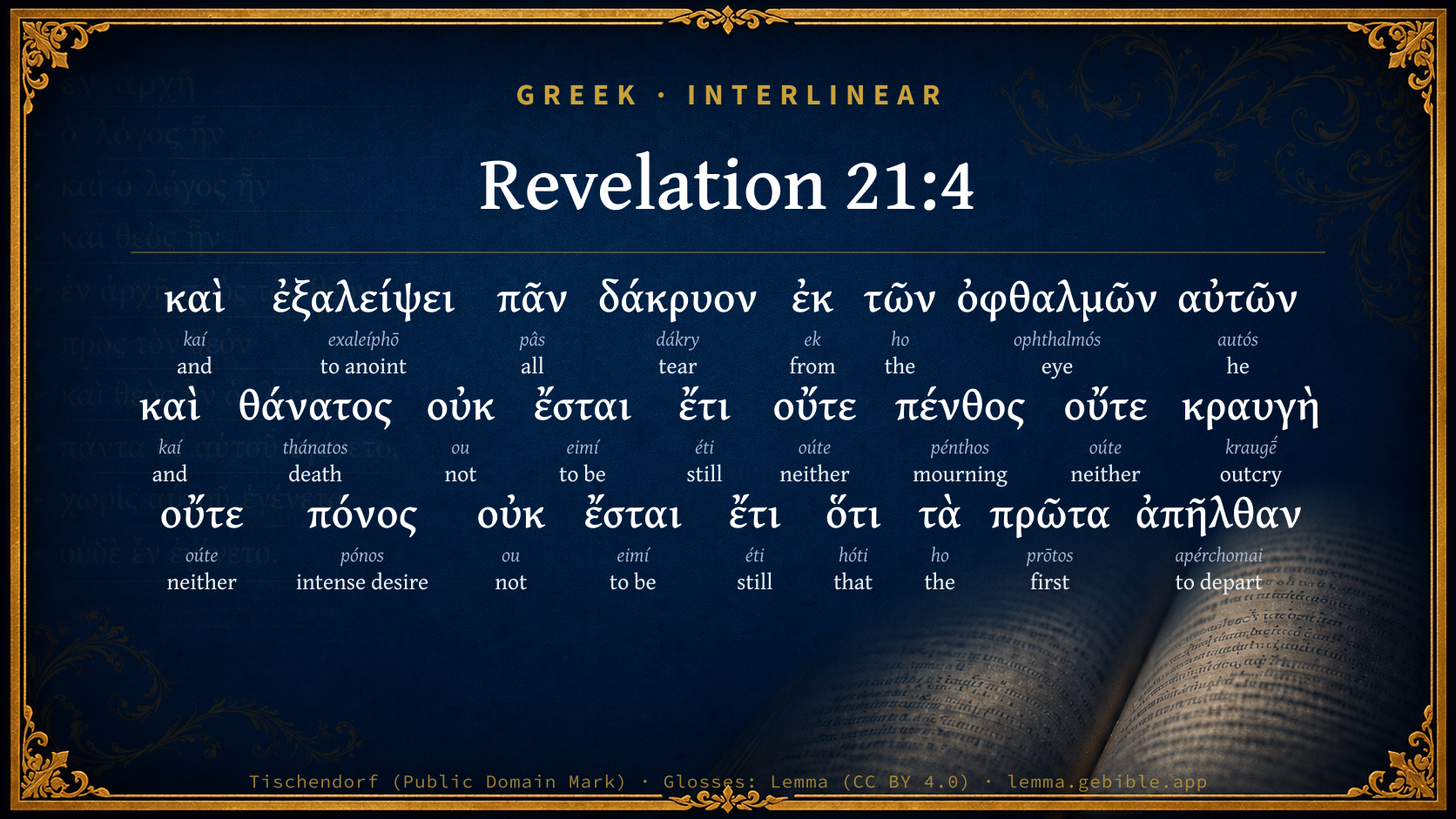
He will wipe away from them every tear from their eyes. Death will be no more; neither will there be mourning, nor crying, nor pain, any more. The first things have passed away."
Download a study sheet
One document with this verse’s original text, its word-by-word gloss line, the meaning frame, cross-references with their text, attributed commentary, and full source and license credits — printable, and it pastes into notes with its structure intact.
This verse Autodidact and up
A passage Seminary Student
Up to 50 verses in one chapter. A passage sheet keeps up to 6 commentary sources and 12 cross-references per verse, in the order this page ranks them, and says so on the sheet whenever that leaves anything out. Ask for a single verse and you get the Autodidact verse sheet above.
Everything on this page stays free to read, with no account — the sheet is a download of what is already on screen, not access to it.
Compare translations 3
The same verse in 3 English versions, stacked beneath the original-language interlinear above. Click any original word for its lexicon entry.
Each is an independent rendering of the whole verse — the interlinear is not word-aligned to these translations.
Highlighted words mark where these versions differ — a whole-verse word diff, not a word-by-word alignment.
-
World English Bible Public Domain
He will wipe away from them every tear from their eyes. Death will be no more; neither will there be mourning, nor crying, nor pain, any more. The first things have passed away."
-
King James Version Public Domain
And God shall wipe away all tears from their eyes; and there shall be no more death, neither sorrow, nor crying, neither shall there be any more pain: for the former things are passed away.
-
unfoldingWord Literal Text CC BY-SA 4.0
And he will wipe away every tear from their eyes, and death will not be any longer, nor grieving, nor crying, nor pain. They will not be any longer; the first have gone away.”
unfoldingWord Literal Text — © unfoldingWord, licensed CC BY-SA 4.0. Word-aligned USFM3 via Door43 (git.door43.org/unfoldingWord/en_ult).
Show all 19 translations
Every available English version of this verse, each an independent rendering of the whole verse.
-
World English Bible Public Domain
He will wipe away from them every tear from their eyes. Death will be no more; neither will there be mourning, nor crying, nor pain, any more. The first things have passed away."
-
Berean Standard Bible Public Domain
‘He will wipe away every tear from their eyes,’ and there will be no more death or mourning or crying or pain, for the former things have passed away.”
-
Majority Standard Bible Public Domain
‘He will wipe away every tear from their eyes,’ and there will be no more death or mourning or crying or pain, for the former things have passed away.”
-
King James Version Public Domain
And God shall wipe away all tears from their eyes; and there shall be no more death, neither sorrow, nor crying, neither shall there be any more pain: for the former things are passed away.
-
American Standard Version (1901) Public Domain
and he shall wipe away every tear from their eyes; and death shall be no more; neither shall there be mourning, nor crying, nor pain, any more: the first things are passed away.
-
Revised Version (1885) Public Domain
and he shall wipe away every tear from their eyes; and death shall be no more; neither shall there be mourning, nor crying, nor pain, any more: the first things are passed away.
-
Geneva Bible (1599) Public Domain
And God shall wipe away all teares from their eyes: and there shalbe no more death, neither sorow, neither crying, neither shall there be any more paine: for the first things are passed.
-
Douay-Rheims (1899) Public Domain
And God shall wipe away all tears from their eyes: and death shall be no more, nor mourning, nor crying, nor sorrow shall be any more, for the former things are passed away.
-
Young's Literal Translation Public Domain
and God shall wipe away every tear from their eyes, and the death shall not be any more, nor sorrow, nor crying, nor shall there be any more pain, because the first things did go away.'
-
Literal Standard Version CC BY-SA 4.0
and God will wipe away every tear from their eyes, and there will be no more death, nor sorrow, nor crying, nor will there be anymore pain, because the first things passed away.”
-
Unlocked Literal Bible CC BY-SA 4.0
He will wipe away every tear from their eyes, and there will be no more death, or grieving, or crying, or pain. The former things have passed away.
-
unfoldingWord Literal Text CC BY-SA 4.0
And he will wipe away every tear from their eyes, and death will not be any longer, nor grieving, nor crying, nor pain. They will not be any longer; the first have gone away.”
-
Darby Bible Public Domain
And he shall wipe away every tear from their eyes; and death shall not exist any more, nor grief, nor cry, nor distress shall exist any more, for the former things have passed away.
-
World Messianic Bible Public Domain
He will wipe away every tear from their eyes. Death will be no more; neither will there be mourning, nor crying, nor pain any more. The first things have passed away.”
-
Webster's Bible Public Domain
And God will wipe away all tears from their eyes; and there shall be no more death, neither sorrow, nor crying, neither shall there be any more pain: for the former things have passed away.
-
Free Bible Version CC BY-SA 4.0
He will wipe away every tear from their eyes, and death will never happen again. There will be no mourning or crying or pain ever again for the former world no longer exists.”
-
Bible in Basic English Public Domain
And he will put an end to all their weeping; and there will be no more death, or sorrow, or crying, or pain; for the first things have come to an end.
-
Text-Critical English NT CC BY 4.0
He will wipe away every tear from their eyes. Death will be no more, and there will no longer be mourning, crying, or pain, for the former things have passed away.”
-
Tyndale New Testament (1534) Public Domain
And God shall wype awaye all teares from their eyes. And there shalbe nomore deeth nether sorowe nether cryinge nether shall there be eny more payne for the olde thynges are gone.
Literal Standard Version (2020), Covenant Press — licensed CC BY-SA 4.0. Text via the HelloAO Bible API (eBible.org). Unlocked Literal Bible (unfoldingWord) — licensed CC BY-SA 4.0. Text via the HelloAO Bible API (eBible.org). unfoldingWord Literal Text — © unfoldingWord, licensed CC BY-SA 4.0. Word-aligned USFM3 via Door43 (git.door43.org/unfoldingWord/en_ult). Free Bible Version, Dr. Jonathan Gallagher — licensed CC BY-SA 4.0. Text via the HelloAO Bible API (eBible.org).
Word by word
More ways to search: Search by grammar → Find every occurrence → Compare this word →
Practice this passage: Drill this verse → Learn its vocabulary →
- Appears 4× in the Greek New Testament
- First appears at Colossians 4:13
- Part of Speech
- Noun
- Case
- Nominative
- Number
- Singular
- Gender
- Masculine
Full Thayer's Definition
- καὶ kaí G2532 “and” Conjunction
- ἐξαλείψει exaleíphō G1813 “to anoint” Verb, Future, Active, Indicative, 3rd person, Singular
- πᾶν pâs G3956 “all” Adjective, Accusative, Singular, Neuter
- δάκρυον dákry G1144 “tear” Noun, Accusative, Singular, Neuter
- ἐκ ek G1537 “from” Preposition
- τῶν ho G3588 “the” Article, Genitive, Plural, Masculine
- ὀφθαλμῶν ophthalmós G3788 “eye” Noun, Genitive, Plural, Masculine
- αὐτῶν autós G846 “he” Personal pronoun, Genitive, Plural, Masculine
- καὶ kaí G2532 “and” Conjunction
- θάνατος thánatos G2288 “death” Noun, Nominative, Singular, Masculine
- οὐκ ou G3756 “not” Particle, Negative
- ἔσται eimí G1510 “to be” Verb, Future, Middle deponent, Indicative, 3rd person, Singular
- ἔτι éti G2089 “still” Adverb
- οὔτε oúte G3777 “neither” Conjunction, Negative
- πένθος pénthos G3997 “mourning” Noun, Nominative, Singular, Neuter
- οὔτε oúte G3777 “neither” Conjunction, Negative
- κραυγὴ kraugḗ G2906 “outcry” Noun, Nominative, Singular, Feminine
- οὔτε oúte G3777 “neither” Conjunction, Negative
- πόνος pónos G4192 “intense desire” Noun, Nominative, Singular, Masculine
- οὐκ ou G3756 “not” Particle, Negative
- ἔσται eimí G1510 “to be” Verb, Future, Middle deponent, Indicative, 3rd person, Singular
- ἔτι éti G2089 “still” Adverb
- ὅτι hóti G3754 “that” Conjunction
- τὰ ho G3588 “the” Article, Nominative, Plural, Neuter
- πρῶτα prōtos G4413 “first” Adjective, Nominative, Plural, Neuter, Superlative
- ἀπῆλθαν apérchomai G565 “to depart” Verb, Aorist, Active, Indicative, 3rd person, Plural
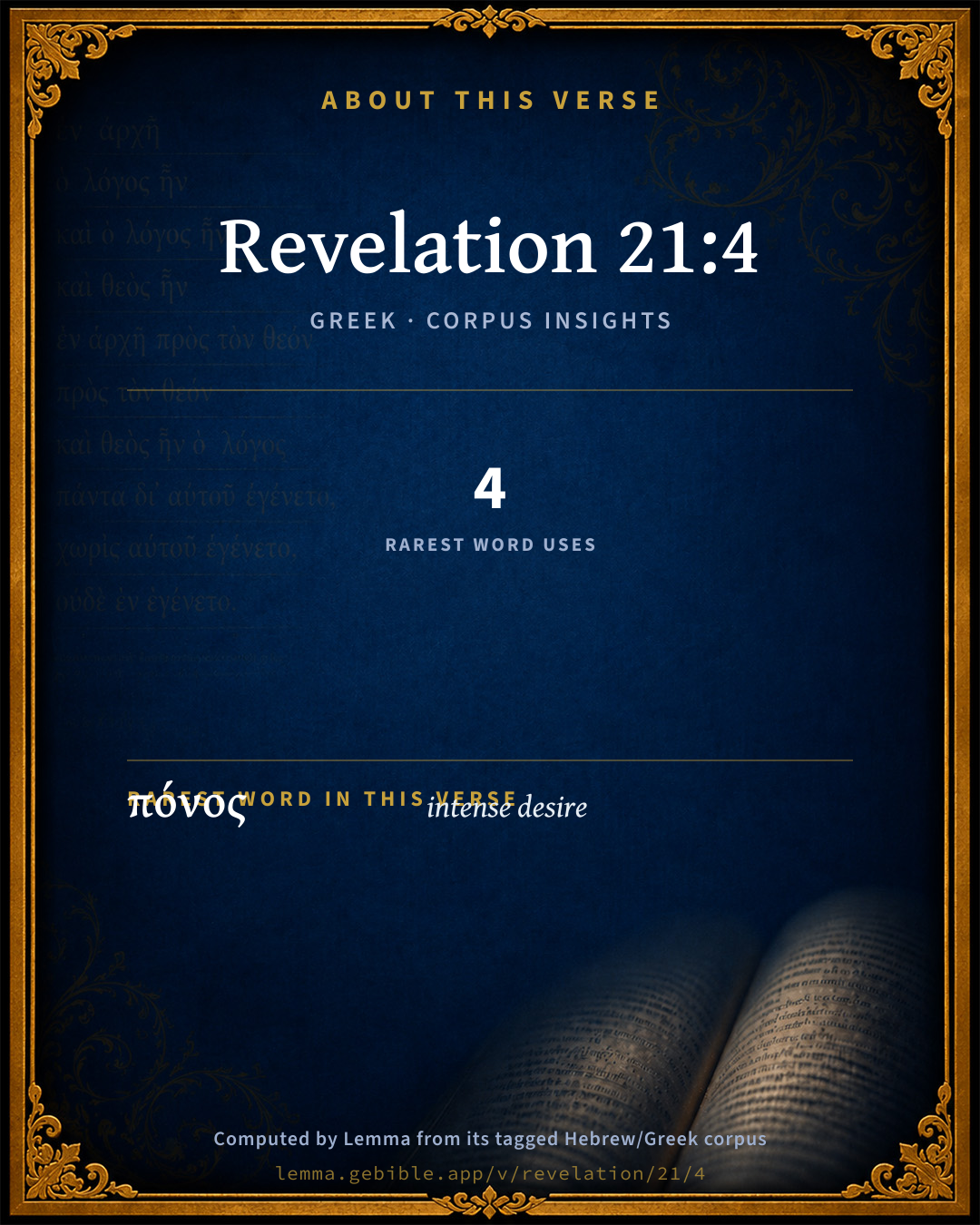
About this verse
These counts appear in no published source. They are computed here, from the morphology-tagged text and Lemma’s own curated glosses. What Lemma adds →
- 26
- words
- 19
- distinct lemmas
- Revelation
- section
Cross-references
22Topical passages linked to Revelation 21:4 in the Treasury of Scripture Knowledge — connected by theme and wording, ordered by reader-vote popularity; previews shown in the World English Bible.
- Isaiah 25:8 He has swallowed up death forever; and the Lord Yahweh will wipe away tears from off all faces; and the reproach of his people will he take away from off all the earth: for Yahweh has spoken it.
- Revelation 7:17 for the Lamb who is in the midst of the throne shepherds them, and leads them to springs of waters of life. And God will wipe away every tear from their eyes."
- 1 Corinthians 15:26 The last enemy that will be abolished is death.
- Isaiah 35:10 and the ransomed of Yahweh shall return, and come with singing to Zion; and everlasting joy shall be on their heads: they shall obtain gladness and joy, and sorrow and sighing shall flee away.
- Isaiah 60:20 Your sun shall no more go down, neither shall your moon withdraw itself; for Yahweh will be your everlasting light, and the days of your mourning shall be ended.
- 1 John 2:17 The world is passing away with its lusts, but he who does God's will remains forever.
- Isaiah 65:18–19 But be you glad and rejoice forever in that which I create; for, behold, I create Jerusalem a rejoicing, and her people a joy.
- Isaiah 51:11 The ransomed of Yahweh shall return, and come with singing to Zion; and everlasting joy shall be on their heads: they shall obtain gladness and joy; [and] sorrow and sighing shall flee away.
- Matthew 24:35 Heaven and earth will pass away, but my words will not pass away.
- Jeremiah 31:13 Then shall the virgin rejoice in the dance, and the young men and the old together; for I will turn their mourning into joy, and will comfort them, and make them rejoice from their sorrow.
- 1 Corinthians 15:54–58 But when this corruptible will have put on incorruption, and this mortal will have put on immortality, then what is written will happen: "Death is swallowed up in victory."
- Isaiah 30:19 For the people shall dwell in Zion at Jerusalem; you shall weep no more; he will surely be gracious to you at the voice of your cry; when he shall hear, he will answer you.
- Isaiah 61:3 to appoint to those who mourn in Zion, to give to them a garland for ashes, the oil of joy for mourning, the garment of praise for the spirit of heaviness; that they may be called trees of righteousness, the planting of Yahweh, that he may be glorified.
- Revelation 20:14 Death and Hades were thrown into the lake of fire. This is the second death, the lake of fire.
- Revelation 21:1 I saw a new heaven and a new earth: for the first heaven and the first earth have passed away, and the sea is no more.
- Hebrews 2:14–15 Since then the children have shared in flesh and blood, he also himself in like manner partook of the same, that through death he might bring to nothing him who had the power of death, that is, the devil,
- 2 Peter 3:10 But the day of the Lord will come as a thief in the night; in which the heavens will pass away with a great noise, and the elements will be dissolved with fervent heat, and the earth and the works that are in it will be burned up.
- Revelation 22:3 There will be no curse any more. The throne of God and of the Lamb will be in it, and his servants serve him.
- Hosea 13:14 I will ransom them from the power of Sheol. I will redeem them from death! Death, where are your plagues? Sheol, where is your destruction? Compassion will be hidden from my eyes.
- 1 Corinthians 7:31 and those who use the world, as not using it to the fullest. For the mode of this world passes away.
- Psalms 144:4 Man is like a breath. His days are like a shadow that passes away.
- 2 Corinthians 6:17 Therefore, "'Come out from among them, And be separate,' says the Lord, 'Touch no unclean thing. I will receive you.
Cross-references courtesy of OpenBible.info (CC BY 4.0).
Where the printed editions differ
1 variantPlaces in this verse where the major printed Greek editions disagree on the wording in a way that affects the translation — a comparison of editions, not a manuscript-by-manuscript collation. The editions are the modern critical texts (Nestlé-Aland 28/27, SBL, Westcott-Hort, Tregelles, Tyndale House) and the traditional texts behind the KJV (the Textus Receptus and the Byzantine/Majority text). It is not a claim about which reading is original.
-
Extra text
ὁ θεὸς
“the God”
In TR Not in NA28NA27TynSBLWHTregByzὁ θεὸς (ho theos) 'the God' is only in traditional manuscripts (TR)
Textual data: Translators Amalgamated Greek New Testament (STEPBible TAGNT) · CC BY 4.0.
Lesson kit
Teaching starters — assembled from the data on this page, not authored interpretation. Every prompt links to the verse data it draws on. Edit before teaching.
Revelation, in the Revelation, opens this verse with 26 words (19 distinct Greek lemmas). Its most distinctive word is pónos (“intense desire”). A historical commentator’s framing appears above. Read the whole chapter for the surrounding context.
Discussion questions
- How does “intense desire” (pónos) shape what this verse is saying?
- Colossians 4:13 shares the word «intense desire» with this verse. How do the two illuminate each other?
- “neither” occurs 3× in this one verse. What is the effect of the repetition?
- These translations render this verse differently. What is at stake in choosing one wording over another?
- Reading how The Biblical Illustrator and Joseph Benson's Commentary read this verse, where do the two commentators agree and where do they part?
Things to notice
- These translations choose different wording for 20 words in this verse.
- “neither” occurs 3× in this single verse.
- 19 distinct Greek lemmas span 26 words in this verse.
Commentary
Notes on Revelation 21:4 from classic Christian and Jewish commentators (each source and its license shown beneath its notes). The classic Christian expositions comment on the surrounding passage and are grouped to its opening verse, so a note may address several verses; the Jewish commentaries on the Tanakh (Rashi and others) are per-verse, so they appear only where the commentator wrote on this verse.
Lemma curates 59 commentaries, every one of them public domain or Creative Commons licensed, each selected and text-cleaned for this edition rather than reprinted as found. About our sources →
The Biblical Illustrator
Joseph S. Exell
The Biblical Illustrator, edited by Joseph S. Exell (c. 1880s–1900s) — public domain. Text from a community e-Sword module.
Joseph Benson's Commentary
Joseph Benson's Commentary on the Old and New Testaments (1811–1818) — public domain. Text from a community e-Sword module.
Tyndale Open Study Notes
Tyndale Open Resources
Tyndale Open Study Notes — © Tyndale Open Resources, licensed CC BY-SA 4.0. Text via the HelloAO Bible API.
Jamieson, Fausset & Brown
Robert Jamieson, A. R. Fausset & David Brown
Jamieson, Fausset & Brown — Commentary Critical and Explanatory on the Whole Bible (1871) — public domain (CC PDM 1.0). Text via the HelloAO Bible API.
Adam Clarke's Commentary
Adam Clarke's Commentary on the Bible (1810–1826) — public domain. Text from a community e-Sword/MySword module.
Ellicott's Commentary for English Readers
A Bible Commentary for English Readers, edited by Charles John Ellicott (1878–1897) — public domain. Text from a community e-Sword module.
The Cambridge Bible for Schools and Colleges
gen. ed. J. J. S. Perowne
The Cambridge Bible for Schools and Colleges (gen. ed. J. J. S. Perowne; Cambridge University Press, 1878–1918) — public domain. Text from a community e-Sword module.
John Gill's Exposition
John Gill's Exposition of the Whole Bible (1746–1763) — public domain (CC PDM 1.0). Text via the HelloAO Bible API.
Trapp's Complete Commentary
John Trapp
John Trapp, A Commentary or Exposition upon All the Books of the Old and New Testament (1647–1656) — public domain. Text from a community e-Sword module.
Albert Barnes' Notes on the Bible
Albert Barnes' Notes on the Bible (1834–1885) — public domain. Text from a community e-Sword/MySword module.
Matthew Poole's English Annotations
Matthew Poole's English Annotations on the Holy Bible (1683–1685) — public domain. Text from a community e-Sword/MySword module.
Whedon's Commentary on the Bible
Daniel D. Whedon
Daniel D. Whedon (gen. ed.), Commentary on the Old and New Testaments (1874–1909) — public domain. Text from a community e-Sword module.
The Pulpit Commentary
The Pulpit Commentary (1880–1919), ed. H.D.M. Spence-Jones & Joseph S. Exell — public domain. Text from a community e-Sword module.
John Wesley's Explanatory Notes
John Wesley, Explanatory Notes Upon the Whole Bible (1754–1765) — public domain. Text via the GEBible commentary corpus.
The People's New Testament
B. W. Johnson
B. W. Johnson's The People's New Testament with Notes (1889–1891) — public domain. Electronic text from the Christian Classics Ethereal Library (CCEL) ThML edition.
Cambridge Greek Testament for Schools and Colleges
Cambridge Greek Testament for Schools and Colleges (Cambridge University Press, 1896; 21 vols, various authors incl. Carr, Maclear, Plummer, Farrar, Lumby, Moule, M. R. James, Simcox) — public domain. Text from a community e-Sword module.
Vincent's Word Studies in the New Testament
Marvin R. Vincent
Marvin R. Vincent, Word Studies in the New Testament (1887–1900) — public domain. Text from a community e-Sword/MySword module.