Genesis 45:11

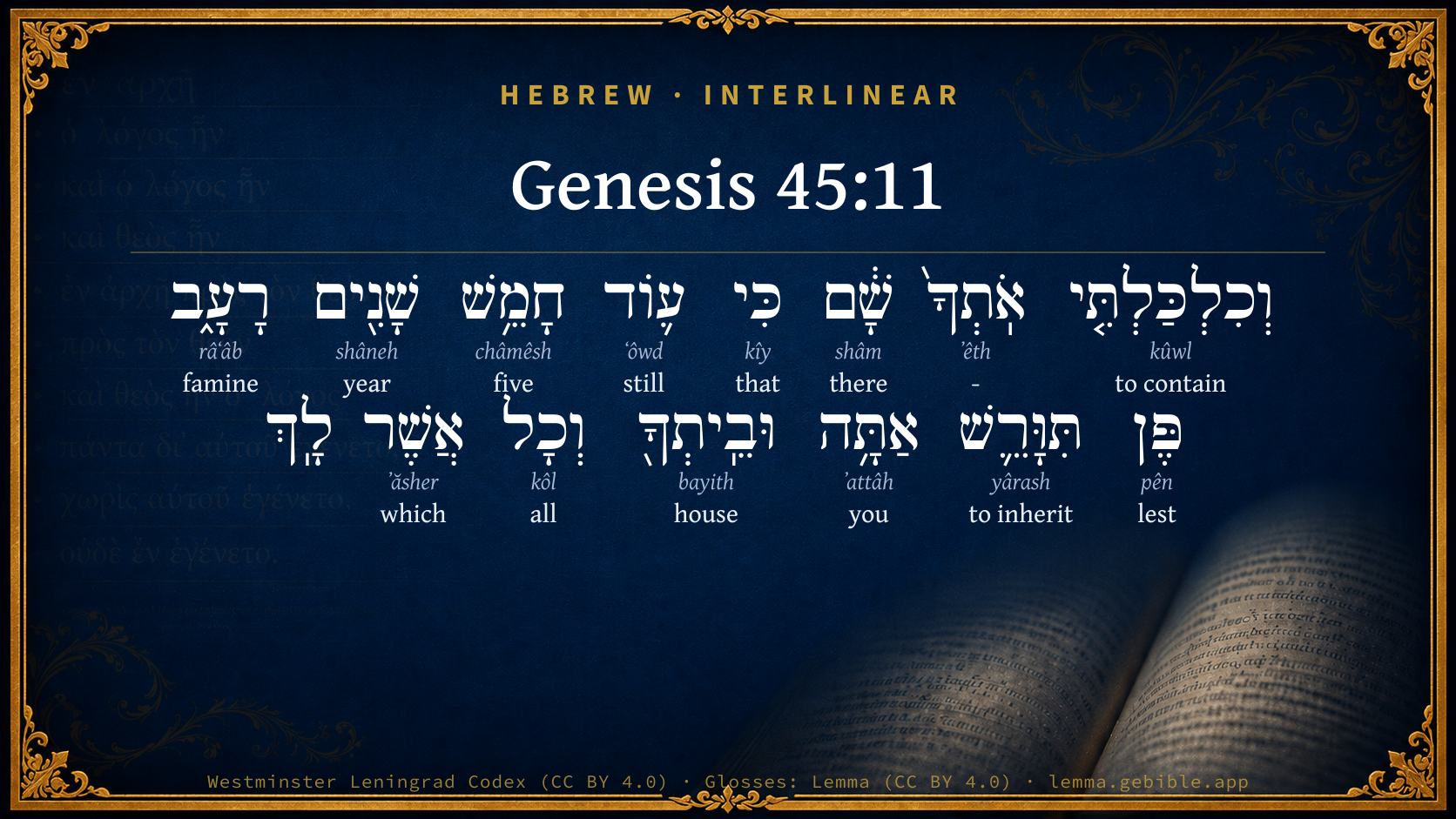
Hebrew (Westminster Leningrad Codex) Genesis 45:11 appears in the Hebrew Old Testament. The text above is from the Westminster Leningrad Codex. Each word links to its Strong’s number, a concise gloss, and parsing drawn from the Open Scriptures Hebrew Bible morphology. Click any word for its full Brown-Driver-Briggs (BDB) entry.
Download image
Cite this verse

Genesis 45:11 (World English Bible). Public Domain. Lemma interlinear Bible study tool, https://lemma.gebible.app/v/genesis/45/11.

Show BibTeX & RIS
BibTeX
RIS
English Translation
There I will nourish you; for there are yet five years of famine; lest you come to poverty, you, and your household, and all that you have."'
World English Bible · Public Domain
Highlights
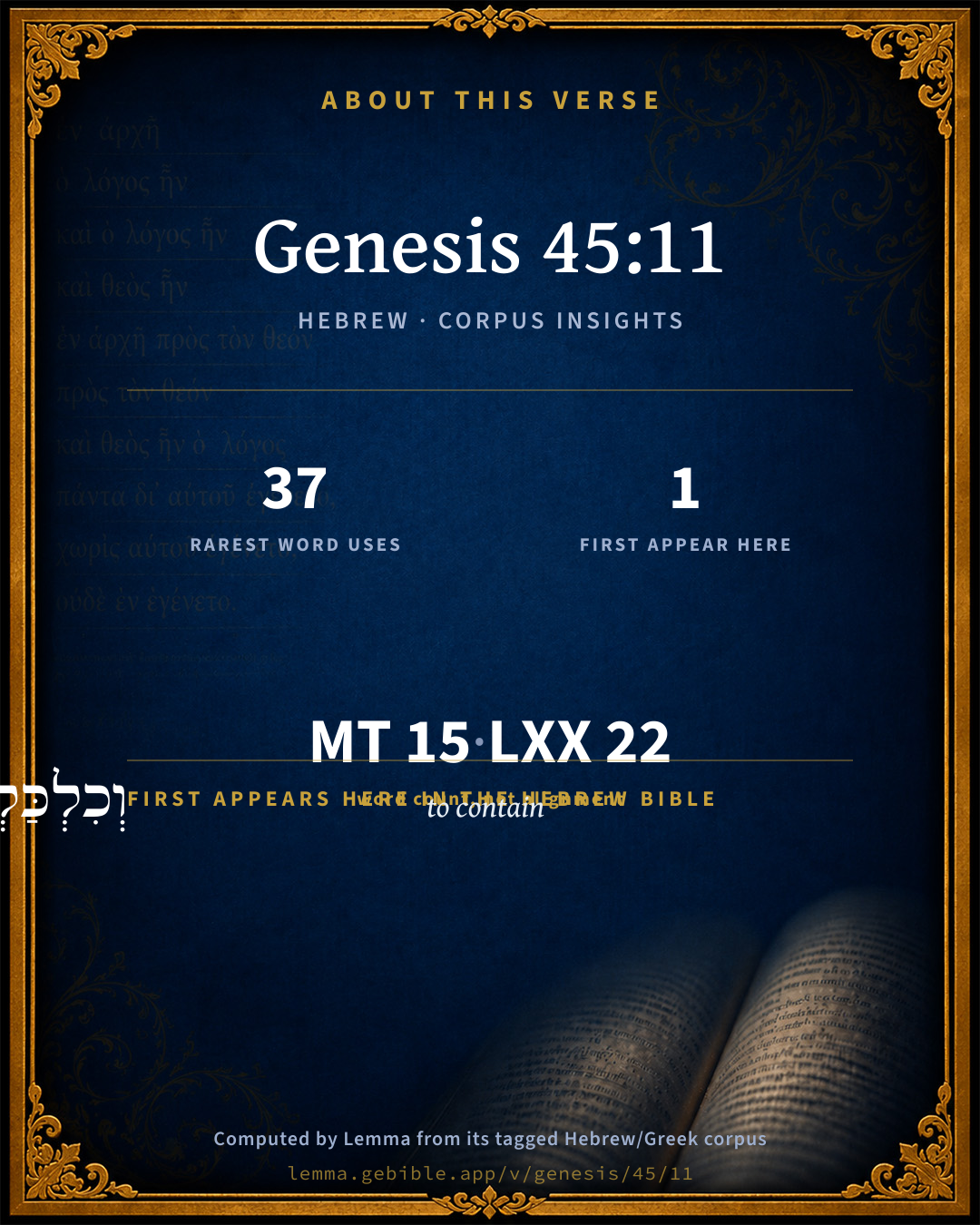
  • 1 first appearance in the Hebrew Bible
Full analysis ↓
Download a study sheet

One document with this verse’s original text, its word-by-word gloss line, the meaning frame, cross-references with their text, attributed commentary, and full source and license credits — printable, and it pastes into notes with its structure intact.

This verse Autodidact and up

Study sheet (.html) Plain text (.txt)

A passage Seminary Student

Up to 50 verses in one chapter. A passage sheet keeps up to 6 commentary sources and 12 cross-references per verse, in the order this page ranks them, and says so on the sheet whenever that leaves anything out. Ask for a single verse and you get the Autodidact verse sheet above.

Everything on this page stays free to read, with no account — the sheet is a download of what is already on screen, not access to it.

Want to remove ads? Support Godless Engineer
Compare translations 3

The same verse in 3 English versions, stacked beneath the original-language interlinear above. Click any original word for its lexicon entry.

Each is an independent rendering of the whole verse — the interlinear is not word-aligned to these translations.

Highlighted words mark where these versions differ — a whole-verse word diff, not a word-by-word alignment.

  • World English Bible Public Domain
    There I will nourish you; for there are yet five years of famine; lest you come to poverty, you, and your household, and all that you have."'
  • King James Version Public Domain
    And there will I nourish thee; for yet there are five years of famine; lest thou, and thy household, and all that thou hast, come to poverty.
  • unfoldingWord Literal Text CC BY-SA 4.0
    And I will provide for you there, because still five years of famine, so that you will not become impoverished, you and your household and all that to you.”’

unfoldingWord Literal Text — © unfoldingWord, licensed CC BY-SA 4.0. Word-aligned USFM3 via Door43 (git.door43.org/unfoldingWord/en_ult).

Versions to compare (up to 4)

3 of 4 selected

Show all 18 translations

Every available English version of this verse, each an independent rendering of the whole verse.

  • World English Bible Public Domain
    There I will nourish you; for there are yet five years of famine; lest you come to poverty, you, and your household, and all that you have."'
  • Berean Standard Bible Public Domain
    And there I will provide for you, because there will be five more years of famine. Otherwise, you and your household and everything you own will come to destitution.’
  • Majority Standard Bible Public Domain
    And there I will provide for you, because there will be five more years of famine. Otherwise, you and your household and everything you own will come to destitution.’
  • King James Version Public Domain
    And there will I nourish thee; for yet there are five years of famine; lest thou, and thy household, and all that thou hast, come to poverty.
  • American Standard Version (1901) Public Domain
    and there will I nourish thee; for there are yet five years of famine; lest thou come to poverty, thou, and thy household, and all that thou hast.
  • Revised Version (1885) Public Domain
    and there will I nourish thee; for there are yet five years of famine; lest thou come to poverty, thou, and thy household, and all that thou hast.
  • Geneva Bible (1599) Public Domain
    Also I will nourish thee there (for yet remaine fiue yeeres of famine) lest thou perish through pouertie, thou and thy houshold, and all that thou hast.
  • Douay-Rheims (1899) Public Domain
    And there I will feed thee, (for there are yet five years of famine remaining,) lest both thou perish, and thy house, and all things that thou hast.
  • Young's Literal Translation Public Domain
    and I have nourished thee there -- for yet `are' five years of famine -- lest thou become poor, thou and thy household, and all that thou hast.
  • Literal Standard Version CC BY-SA 4.0
    and I have nourished you there—for yet [are] five years of famine—lest you become poor, you and your household, and all that you have.
  • Unlocked Literal Bible CC BY-SA 4.0
    I will provide for you there, for there are still five years of famine, so that you do not come to poverty, you, your household, and all that you have.”'
  • unfoldingWord Literal Text CC BY-SA 4.0
    And I will provide for you there, because still five years of famine, so that you will not become impoverished, you and your household and all that to you.”’
  • Darby Bible Public Domain
    And there will I maintain thee; for yet there are five years of famine; in order that thou be not impoverished, thou, and thy household, and all that thou hast.
  • World Messianic Bible Public Domain
    There I will provide for you; for there are yet five years of famine; lest you come to poverty, you, and your household, and all that you have.”’
  • Webster's Bible Public Domain
    And there will I nourish thee, (for yet there are five years of famine,) lest thou, and thy household, and all that thou hast, should come to poverty.
  • Free Bible Version CC BY-SA 4.0
    I'll make sure you have food, because there are still five more years of famine to come. Otherwise you and your family and your animals are going to starve.’”
  • Bible in Basic English Public Domain
    And there I will take care of you, so that you and your family may not be in need, for there are still five bad years to come.
  • JPS Tanakh (1917) Public Domain
    and there will I sustain thee; for there are yet five years of famine; lest thou come to poverty, thou, and thy household, and all that thou hast.

Literal Standard Version (2020), Covenant Press — licensed CC BY-SA 4.0. Text via the HelloAO Bible API (eBible.org). Unlocked Literal Bible (unfoldingWord) — licensed CC BY-SA 4.0. Text via the HelloAO Bible API (eBible.org). unfoldingWord Literal Text — © unfoldingWord, licensed CC BY-SA 4.0. Word-aligned USFM3 via Door43 (git.door43.org/unfoldingWord/en_ult). Free Bible Version, Dr. Jonathan Gallagher — licensed CC BY-SA 4.0. Text via the HelloAO Bible API (eBible.org).

Word by word

More ways to search: Search by grammar → Find every occurrence → Compare this word →

Practice this passage: Drill this verse → Learn its vocabulary →

וְכִלְכַּלְתִּ֤י
kûwl
H3557
“and · to contain”
Conjunction + Verb, Pilpel, Sequential Perfect, 1st Person, Common, Singular
Part of Speech
Conjunction + Verb
Stem
Pilpel
Form
Sequential Perfect
Person
1st Person
Gender
Common
Number
Singular
Full BDB Definition

Origin: a primitive root

TWOT: 962

to seize, contain, measure - (Qal) to measure, calculate - (Pilpel) to sustain, maintain, contain - to sustain, support, nourish - to contain, hold in, restrain - to support, endure - (Polpal) to be supplied - (Hiphil) to contain, hold, hold in, endure - to contain - to sustain, endure
  1. אֹֽתְךָ֙ ʼêth H853 “- · you” Particle, Direct Object + Suffix, Personal, 2nd Person, Masculine, Singular
  2. שָׁ֔ם shâm H8033 “there” Adverb
  3. כִּי kîy H3588 “that” Conjunction
  4. ע֛וֹד ʻôwd H5750 “still” Adverb
  5. חָמֵ֥שׁ châmêsh H2568 “five” Adjective, Cardinal number, Feminine, Singular, Absolute
  6. שָׁנִ֖ים shâneh H8141 “years” Noun, Common, Feminine, Plural, Absolute
  7. רָעָ֑ב râʻâb H7458 “famine” Noun, Common, Masculine, Singular, Absolute
  8. פֶּן pên H6435 “lest” Conjunction
  9. תִּוָּרֵ֛שׁ yârash H3423 “to inherit” Verb, Niphal, Imperfect, 2nd Person, Masculine, Singular
  10. אַתָּ֥ה ʼattâh H859 “you” Pronoun, Personal, 2nd Person, Masculine, Singular
  11. וּבֵֽיתְךָ֖ bayith H1004 “and · house · your” Conjunction + Noun, Common, Masculine, Singular, Construct + Suffix, Personal, 2nd Person, Masculine, Singular
  12. וְכָל kôl H3605 “and · all of” Conjunction + Noun, Common, Masculine, Singular, Construct
  13. אֲשֶׁר ʼăsher H834 “which” Particle, Relative

About this verse

These counts appear in no published source. They are computed here, from the morphology-tagged text and Lemma’s own curated glosses. What Lemma adds →

15
words
14
distinct lemmas
Pentateuch
section

First appearance in Scripture

This word makes its first canonical appearance in the Hebrew Bible here:

  • וְכִלְכַּלְתִּ֤י to contain H3557

Shared distinctive vocabulary

וְכִלְכַּלְתִּ֤י to contain H3557 occurs in 36 verses of the Hebrew Bible. Also found in:

Grammatical profile

  • 2 verbs
  • 4 nouns
  • 1 adjective
  • 1 pronoun
  • 1 preposition
  • 2 conjunctions
  • 2 adverbs
  • 2 particles

Verb forms

  • וְכִלְכַּלְתִּ֤י Pilpel · Sequential Perfect
  • תִּוָּרֵ֛שׁ Niphal · Imperfect

Hebrew & Septuagint length

In English translation the verse runs 27 words from the Hebrew and 25 from the Septuagint (LXX English) — closely comparable.

A rough comparison of the two English renderings, which tokenize alike — not a word-level alignment.

Word counts can differ between the Hebrew and the Greek without any difference in meaning — e.g. the Hebrew direct-object marker אֵת has no separate Greek word, and Greek often adds the article ὁ.

In the original languages it is 15 Hebrew tokens and 22 Greek tokens — but the two are counted differently (Hebrew bundles its prefixes and suffixes into one token; the Greek is in lemma form), so that isn’t a like-for-like length.

Cross-references

5

Topical passages linked to Genesis 45:11 in the Treasury of Scripture Knowledge — connected by theme and wording, ordered by reader-vote popularity; previews shown in the World English Bible.

  • Genesis 47:12 Joseph nourished his father, his brothers, and all of his father's household, with bread, according to their families.
  • Genesis 47:6 The land of Egypt is before you. Make your father and your brothers dwell in the best of the land. Let them dwell in the land of Goshen. If you know any able men among them, then put them in charge of my cattle."
  • Matthew 15:5–6 But you say, 'Whoever may tell his father or his mother, "Whatever help you might otherwise have gotten from me is a gift devoted to God,"
  • 1 Timothy 5:4 But if any widow has children or grandchildren, let them learn first to show piety towards their own family, and to repay their parents, for this is acceptable in the sight of God.
  • Mark 7:9–12 He said to them, "Full well do you reject the commandment of God, that you may keep your tradition.

Cross-references courtesy of OpenBible.info (CC BY 4.0).

Hebrew and Greek witnesses Masoretic Hebrew ↔ Greek Septuagint

The same verse in the two great witnesses to the Old Testament, shown verse-for-verse.

These are two independent witnesses, not word-aligned to each other, and the Septuagint is shown in lemma (dictionary) form.

Hebrew Genesis 45:11 Masoretic · Westminster Leningrad Codex

וְכִלְכַּלְתִּ֤י אֹֽתְךָ֙ שָׁ֔ם כִּי ע֛וֹד חָמֵ֥שׁ שָׁנִ֖ים רָעָ֑ב פֶּן תִּוָּרֵ֛שׁ אַתָּ֥ה וּבֵֽיתְךָ֖ וְכָל אֲשֶׁר לָֽךְ

There I will nourish you; for there are yet five years of famine; lest you come to poverty, you, and your household, and all that you have."'

World English Bible · Public Domain

Greek LXX Genesis 45:11 Septuagint · lemma form

καί ἐκτρέφω σύ ἐκεῖ ἔτι γάρ πέντε ἔτος λιμός ἵνα μή ἐκτρίβω σύ καί ὁ υἱός σύ καί πᾶς ὁ ὑποἄρχω σύ

And I will nourish you there: for the famine is yet for five years; lest you be consumed, and your sons, and all your possessions.

LXX2012 (modern English Septuagint) · Public Domain

Hebrew: Westminster Leningrad Codex (CC BY 4.0). Greek: Septuagint (public domain); English from LXX2012 (modern English Septuagint) (Public Domain). How the Septuagint differs from the Hebrew →

Targum (Aramaic paraphrase)

2

The Targum is the ancient Jewish Aramaic paraphrase of the Hebrew Scriptures — an interpretive translation, not the Hebrew text itself. Onkelos (literal) and Pseudo-Jonathan (expansive) render the Torah, and Jonathan the Prophets. Coverage is partial: where no permissively-licensed English translation exists for a verse, only the Aramaic is shown. This is verse-level text, not a word-by-word alignment to the Hebrew.

  1. Targum Onkelos Torah (Genesis–Deuteronomy)
    וְאֵזוּן יָתָךְ תַּמָּן אֲרֵי עוֹד חֲמֵשׁ שְׁנִין כַּפְנָא דִּלְמָא תִתְמַסְכַּן אַתְּ וֶאֱנַשׁ בֵּיתָךְ וְכָל דִּי לָךְ

    (no public-domain English translation for this verse)

    Targum Onkelos — Aramaic: “Onkelos Genesis” (public domain); “Onkelos Exodus” (public domain); “Onkelos Leviticus” (public domain); “Onkelos Numbers” (public domain); “Onkelos Deuteronomy” (public domain). English: “Sefaria Community Translation” (CC0 1.0 (public-domain dedication)); “J.W. Etheridge. The Targums of Onkelos and Jonathan Ben Uzziel on the Pentateuch. London: Longmans, Green, 1862” (public domain). Text via Sefaria.

  2. Targum Pseudo-Jonathan Torah (Genesis–Deuteronomy)
    וְאֵיזוֹן יָתָךְ תַּמָן אֲרוּם עַד כְּדוֹן חָמֵשׁ שְׁנִין כַּפְנָא דִילְמָא תִתְמַסְכַּן אַנְתְּ וֶאֱנַשׁ בֵּיתָךְ וְכָל דִילָךְ

    And I will sustain you there, for there are yet five years of famine, lest thou and the men of thy house, and all that thou hast be wasted away.

    Targum Pseudo-Jonathan — Aramaic: “Targum Jonathan on Genesis” (public domain); “Targum Jonathan on Exodus” (public domain); “Targum Jonathan on Leviticus” (public domain); “Targum Jonathan on Numbers” (public domain); “Targum Jonathan on Deuteronomy” (public domain). English: “The Targum of Jonathan ben Uzziel, trans. J. W. Etheridge, London, 1862” (public domain). Text via Sefaria.

Commentary

Notes on Genesis 45:11 from classic Christian and Jewish commentators (each source and its license shown beneath its notes). The classic Christian expositions comment on the surrounding passage and are grouped to its opening verse, so a note may address several verses; the Jewish commentaries on the Tanakh (Rashi and others) are per-verse, so they appear only where the commentator wrote on this verse.

Lemma curates 59 commentaries, every one of them public domain or Creative Commons licensed, each selected and text-cleaned for this edition rather than reprinted as found. About our sources →

Trapp's Complete Commentary

John Trapp

Gen 45:11 And there will I nourish thee; for yet [there are] five years of famine; lest thou, and thy household, and all that thou hast, come to poverty.

Ver. 11. And there will I nourish thee.] To requite parents is "good and acceptable before God." {1Ti 5:4} At Athens, {a} it was death not to be kind to parents and cherish them. The stork nourisheth her old sire and dam with admirable piety, saith Pliny; {b} and is therefore called by the Hebrews Chasidah, or Merciful: and by the Latins Pietatis-cultrix. The cuckoo, on the other side, is worthily hated, for that she cruelly devoureth her own dam, the hedge sparrow, saith Melancthon. {c} Mice are said to nourish their old ones that cannot shift for themselves, insigni pietate, {d} Cornelius, among the Romans, got the name of Scipio, by his kindness to his blind father, to whom he was the staff of his old age; as Macrobius relateth. {e} And Aristotle {f} tells a strange story, how that, when from the hill Etna there ran down a torrent of fire that consumed all the houses thereabouts, in the midst of those fearful flames, God’s special care of the godly shined most brightly. For the river of fire parted itself, and made a kind of lane for those who ventured to rescue their aged parents, and pluck them out of the jaws of death. Our Saviour much distasted and detested that damnable doctrine of the Pharisees, teaching children to starve their parents, under pretence of devotion. {Mat 15:4-6} And what would he have said to the Popish Pharisees, that say, that a monk may not leave his cloister to relieve his father, but rather let him die for hunger in the streets? Christ upon his cross, though as full of sorrow as heart could hold, commended his mother to be kept by the disciple whom he loved, with Iδου η μητηρ σου. {Joh 19:27} Agreeable whereunto was that speech of the Samians, "I give thee this woman for a mother," {g} when to the richer of the citizens the mothers of those who died in the wars were given to be maintained by them.

{a} Athenis capitale fuit, parentibus θρεπτηρια non persolvere - Melanct., Not. in Hesiod.

{b} Plin., lib. x. cap. 23.

{c} Propriam matrem crudeliter devorat, currucam silicet. - Melancth.

{d} Mures genitores suos alunt insigni pietate. - Sphinx Philos., p. 230.

{e} Macrob., Satur., lib. i. cap. 6.

{f} Eνθα το των ευρεβων γενος εξοχως ετιμησε το δαιμονοιν - Aristot., De Mundo., cap. 6.

{g} Sοι παυτην διδωμαι την μητιρα.

John Trapp, A Commentary or Exposition upon All the Books of the Old and New Testament (1647–1656) — public domain. Text from a community e-Sword module.

Ellicott's Commentary for English Readers

(11) Thy household.—As the famine had lasted only two years, and as Jacob had preserved his flocks and herds, so probably he had lost few or none of the large number of men-servants and women-servants who belonged to him. He would thus go down to Egypt as head of a large tribe, who would be called Israelites after him, just as the Ishmaelites, to whom Joseph was sold (Gen_37:25), bore Ishmael’s name, not because they were lineally descended from him, but because he had made them subject to his authority and that of his race. In Gen_45:18 Joseph speaks of “their households,” showing that each of the patriarchs had now his own body of dependants, besides the still larger clan which belonged to Jacob.

A Bible Commentary for English Readers, edited by Charles John Ellicott (1878–1897) — public domain. Text from a community e-Sword module.

John Gill's Exposition

And there will I nourish thee,.... Provide for him and his family:

for yet there are five years of famine; still to come, two of the seven only being past:

lest thou, and thy household, and all that thou hast, come to poverty; his whole posterity be consumed, as it would be in all probability, if he did not procure food for his family during the famine.

John Gill's Exposition of the Whole Bible (1746–1763) — public domain (CC PDM 1.0). Text via the HelloAO Bible API.

Haydock's Catholic Bible Commentary

Perish. Hebrew, be reduced to poverty. He fed them like the priests, chap. xlvii. 12, 22. (Calmet)

George Leo Haydock (1774–1849), Haydock's Catholic Family Bible and Commentary, 1859 edition — public domain. Excludes Psalms (Douay-Rheims chapter numbering differs from Protestant) and Deuterocanonical books (Catholic canon only).

Whedon's Commentary on the Bible

Daniel D. Whedon

11. Will I nourish thee — The son whom God hath exalted will tenderly provide for the aged father who nourished him in his childhood.

Yet there are five years — With the assuring message of filial love goes also a prophetic word, showing that Joseph has a knowledge of the future such as only divinely-gifted seers possess.

Daniel D. Whedon (gen. ed.), Commentary on the Old and New Testaments (1874–1909) — public domain. Text from a community e-Sword module.

Rashi

Rabbi Shlomo Yitzchaki (Rashi)

פן תורש — The Targum renders this by דלמא תתמסכן LEST THOU BE IMPOVERISHED, for the verb is of the same root as we find in (1 Samuel 2:7) “The Lord maketh poor (מוריש) and maketh rich”.

Rashi on the Tanakh — English translations: “The Judaica Press complete Tanach with Rashi, translated by A. J. Rosenberg” (CC BY 4.0); “Pentateuch with Rashi's commentary by M. Rosenbaum and A.M. Silbermann, 1929-1934” (public domain); “The Metsudah Tanach series, Lakewood, N.J” (CC BY 4.0); and “The Book of Joshua, Metsudah Publications, 1997” (CC BY 4.0). Text via Sefaria.

Ramban (Nachmanides)

Rabbi Moshe ben Nachman (Ramban / Nachmanides)

LEST THOU COME TO POVERTY, THOU, AND THY HOUSEHOLD. Joseph said this by way of respect for his father. To his brothers he said, For G-d did send me before you to preserve life, and to give you a remnant, but to his father he did not want to say so. Instead, he said, “that if you will delay in the land of Canaan you will be impoverished for I could not send you much food from the royal storehouse as they will suspect me of selling it there in order to accumulate treasures of money and then return to my land and to my birthplace. But when you come here, and they will know that you are my father and brothers, the king will give me permission to sustain you.”

Ramban (Nachmanides) on the Tanakh — English translation: “Commentary on the Torah by Ramban (Nachmanides). Translated and annotated by Charles B. Chavel. New York, Shilo Pub. House, 1971-1976” (CC BY 4.0). Text via Sefaria.

Lesson kit

Teaching starters — assembled from the data on this page, not authored interpretation. Every prompt links to the verse data it draws on. Edit before teaching.

Genesis, in the Pentateuch, opens this verse with 15 words (14 distinct Hebrew lemmas). Its most distinctive word is kûwl (“to contain”). A historical commentator’s framing appears above. Read the whole chapter for the surrounding context.

Discussion questions

  1. How does “to contain” (kûwl) shape what this verse is saying?
  2. This is the first place “to contain” appears in Scripture (first appears here). What does its debut here establish?
  3. How does Genesis 47:12, which shares the word «to contain», read alongside this verse?
  4. These translations render this verse differently. What is at stake in choosing one wording over another?
  5. «וְכִלְכַּלְתִּ֤י» is a Pilpel Sequential Perfect verb. How does that grammatical form shape the action described?
  6. Compare how Trapp's Complete Commentary and Ellicott's Commentary for English Readers read this verse. Where do they agree or differ?

Things to notice

Reading settings

Reading text

Shown beneath each verse's original-language words.

Old Testament
Old Testament edition

Read the OT as the Masoretic Hebrew (MT) or the Greek Septuagint (LXX).

English shown for the Greek Septuagint (in the Hebrew ↔ Greek comparison).

Comparing translations? Open the Compare panel on any verse page to stack up to four side by side.