
John 14:19

Greek (Tischendorf 8th ed.) John 14:19 appears in the Greek New Testament. The text above is from the Tischendorf 8th edition. Each word links to its Strong’s number and a concise gloss. Click any word for its full Thayer’s Greek Lexicon entry.
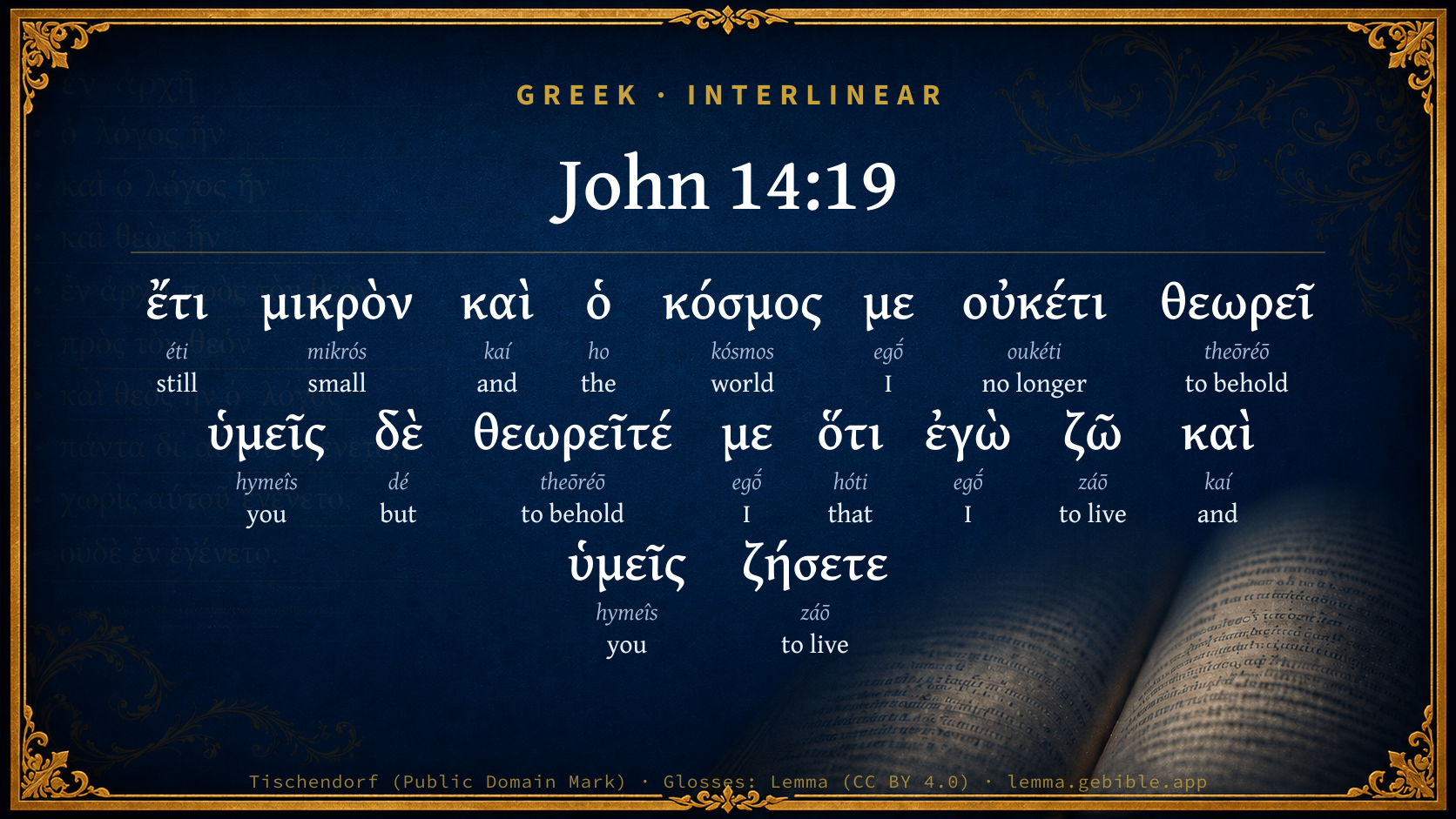
Download image
Cite this verse

John 14:19 (World English Bible). Public Domain. Lemma interlinear Bible study tool, https://lemma.gebible.app/v/john/14/19.

Show BibTeX & RIS
BibTeX
RIS
English Translation
Yet a little while, and the world will see me no more; but you will see me. Because I live, you will live also.
World English Bible · Public Domain
Download a study sheet

One document with this verse’s original text, its word-by-word gloss line, the meaning frame, cross-references with their text, attributed commentary, and full source and license credits — printable, and it pastes into notes with its structure intact.

This verse Autodidact and up

Study sheet (.html) Plain text (.txt)

A passage Seminary Student

Up to 50 verses in one chapter. A passage sheet keeps up to 6 commentary sources and 12 cross-references per verse, in the order this page ranks them, and says so on the sheet whenever that leaves anything out. Ask for a single verse and you get the Autodidact verse sheet above.

Everything on this page stays free to read, with no account — the sheet is a download of what is already on screen, not access to it.

Want to remove ads? Support Godless Engineer
Compare translations 3

The same verse in 3 English versions, stacked beneath the original-language interlinear above. Click any original word for its lexicon entry.

Each is an independent rendering of the whole verse — the interlinear is not word-aligned to these translations.

Highlighted words mark where these versions differ — a whole-verse word diff, not a word-by-word alignment.

  • World English Bible Public Domain
    Yet a little while, and the world will see me no more; but you will see me. Because I live, you will live also.
  • King James Version Public Domain
    Yet a little while, and the world seeth me no more; but ye see me: because I live, ye shall live also.
  • unfoldingWord Literal Text CC BY-SA 4.0
    Yet a short time and the world no longer sees me, but you see me. Because I live, you will also live.

unfoldingWord Literal Text — © unfoldingWord, licensed CC BY-SA 4.0. Word-aligned USFM3 via Door43 (git.door43.org/unfoldingWord/en_ult).

Versions to compare (up to 4)

3 of 4 selected

Show all 19 translations

Every available English version of this verse, each an independent rendering of the whole verse.

  • World English Bible Public Domain
    Yet a little while, and the world will see me no more; but you will see me. Because I live, you will live also.
  • Berean Standard Bible Public Domain
    In a little while the world will see Me no more, but you will see Me. Because I live, you also will live.
  • Majority Standard Bible Public Domain
    In a little while the world will see Me no more, but you will see Me. Because I live, you also will live.
  • King James Version Public Domain
    Yet a little while, and the world seeth me no more; but ye see me: because I live, ye shall live also.
  • American Standard Version (1901) Public Domain
    Yet a little while, and the world beholdeth me no more; but ye behold me: because I live, ye shall live also.
  • Revised Version (1885) Public Domain
    Yet a little while, and the world beholdeth me no more; but ye behold me: because I live, ye shall live also.
  • Geneva Bible (1599) Public Domain
    Yet a litle while, and the world shall see me no more, but ye shall see me: because I liue, ye shall liue also.
  • Douay-Rheims (1899) Public Domain
    Yet a little while: and the world seeth me no more. But you see me: because I live, and you shall live.
  • Young's Literal Translation Public Domain
    yet a little, and the world doth no more behold me, and ye behold me, because I live, and ye shall live;
  • Literal Standard Version CC BY-SA 4.0
    yet a little [while] and the world beholds Me no more, and you behold Me, because I live, and you will live;
  • Unlocked Literal Bible CC BY-SA 4.0
    Yet a short amount of time and the world will no longer see me, but you see me. Because I live, you will also live.
  • unfoldingWord Literal Text CC BY-SA 4.0
    Yet a short time and the world no longer sees me, but you see me. Because I live, you will also live.
  • Darby Bible Public Domain
    Yet a little and the world sees me no longer; but ye see me; because I live ye also shall live.
  • World Messianic Bible Public Domain
    Yet a little while, and the world will see me no more; but you will see me. Because I live, you will live also.
  • Webster's Bible Public Domain
    Yet a little while, and the world seeth me no more; but ye see me: because I live, ye shall live also.
  • Free Bible Version CC BY-SA 4.0
    Soon the world will not see me anymore, but you will see me. Because I live, you will live too.
  • Bible in Basic English Public Domain
    A little time longer, and the world will see me no more; but you will see me; and you will be living because I am living.
  • Text-Critical English NT CC BY 4.0
    Yet a little while and the world will see me no longer, but you will see me. Because I live, you also will live.
  • Tyndale New Testament (1534) Public Domain
    Yet a litell whyle and the worlde seith me no moare: but ye shall se me. For I live and ye shall live.

Literal Standard Version (2020), Covenant Press — licensed CC BY-SA 4.0. Text via the HelloAO Bible API (eBible.org). Unlocked Literal Bible (unfoldingWord) — licensed CC BY-SA 4.0. Text via the HelloAO Bible API (eBible.org). unfoldingWord Literal Text — © unfoldingWord, licensed CC BY-SA 4.0. Word-aligned USFM3 via Door43 (git.door43.org/unfoldingWord/en_ult). Free Bible Version, Dr. Jonathan Gallagher — licensed CC BY-SA 4.0. Text via the HelloAO Bible API (eBible.org).

Word by word

More ways to search: Search by grammar → Find every occurrence → Compare this word →

Practice this passage: Drill this verse → Learn its vocabulary →

μικρὸν
mikrós
G3398
“small”
Adjective, Accusative, Singular, Neuter
Part of Speech
Adjective
Case
Accusative
Number
Singular
Gender
Neuter
Full Thayer's Definition

Origin: apparently a primary word

TDNT: 14:48,6

1. small, little a. of size: hence of stature, of length b. of space c. of age: less by birth, younger d. of time: short, brief, a little while, how little! e. of quantity: i.e. number, amount f. of rank or influence
  1. ἔτι éti G2089 “still” Adverb
  2. καὶ kaí G2532 “and” Conjunction
  3. ὁ ho G3588 “the” Article, Nominative, Singular, Masculine
  4. κόσμος kósmos G2889 “world” Noun, Nominative, Singular, Masculine
  5. με egṓ G1473 “I” Personal pronoun, 1st person, Accusative, Singular
  6. οὐκέτι oukéti G3765 “no longer” Adverb, Negative
  7. θεωρεῖ theōréō G2334 “to behold” Verb, Present, Active, Indicative, 3rd person, Singular
  8. ὑμεῖς hymeîs G5210 “you” Personal pronoun, 2nd person, Nominative, Plural
  9. δὲ dé G1161 “but” Conjunction
  10. θεωρεῖτέ theōréō G2334 “to behold” Verb, Present, Active, Indicative, 2nd person, Plural
  11. με egṓ G1473 “I” Personal pronoun, 1st person, Accusative, Singular
  12. ὅτι hóti G3754 “that” Conjunction
  13. ἐγὼ egṓ G1473 “I” Personal pronoun, 1st person, Nominative, Singular
  14. ζῶ záō G2198 “to live” Verb, Present, Active, Indicative, 1st person, Singular
  15. καὶ kaí G2532 “and” Conjunction
  16. ὑμεῖς hymeîs G5210 “you” Personal pronoun, 2nd person, Nominative, Plural
  17. ζήσετε záō G2198 “to live” Verb, Future, Active, Indicative, 2nd person, Plural

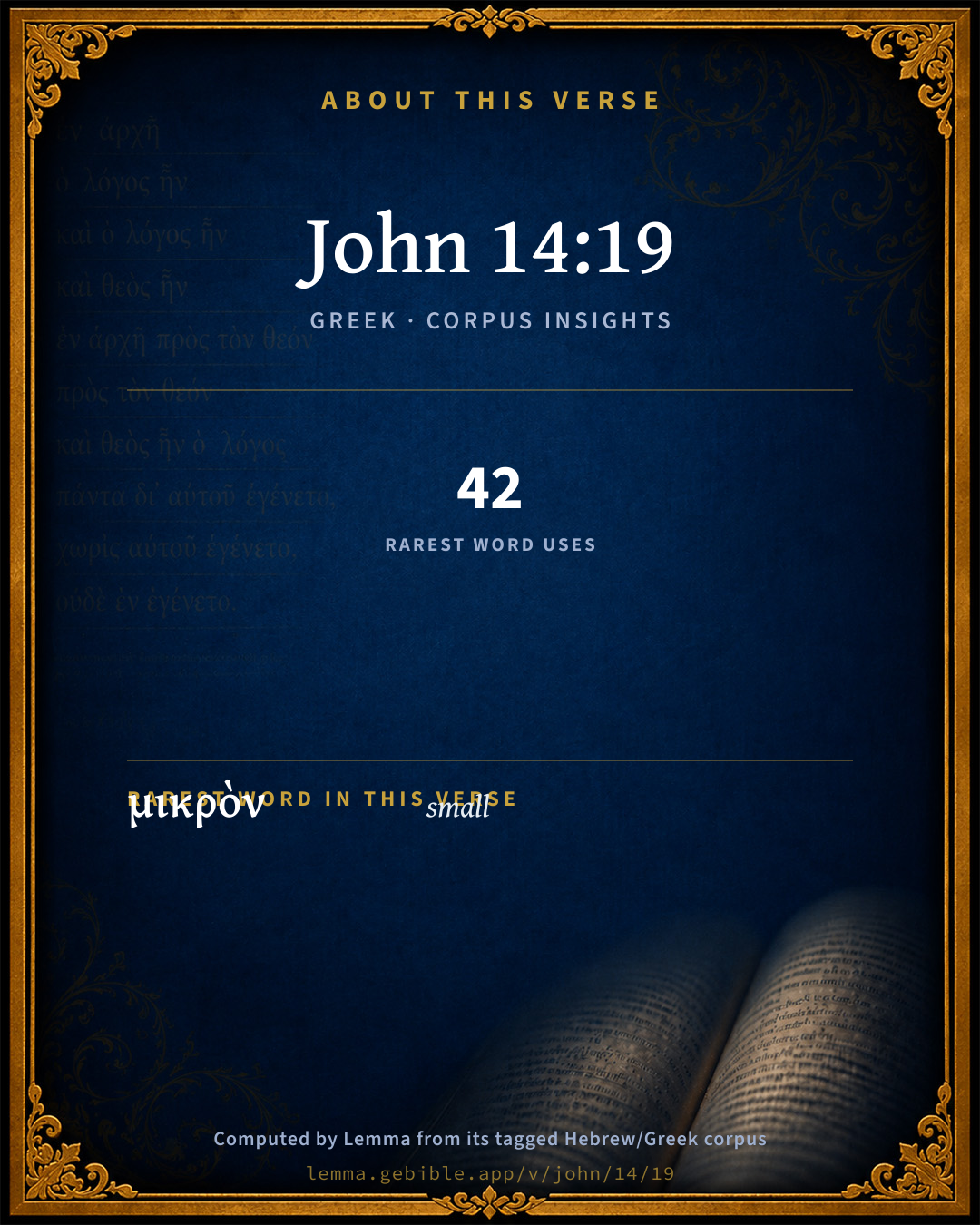
About this verse

These counts appear in no published source. They are computed here, from the morphology-tagged text and Lemma’s own curated glosses. What Lemma adds →

18
words
12
distinct lemmas
Gospels
section

Shared distinctive vocabulary

μικρὸν small G3398 occurs in 39 verses of the Greek New Testament. Also found in:
Repetition

Words recur within this verse:

  • θεωρεῖ to behold G2334 ×2
  • ζῶ to live G2198 ×2
  • με I G1473 ×3
  • καὶ and G2532 ×2
  • ὑμεῖς you G5210 ×2

Cross-references

17

Topical passages linked to John 14:19 in the Treasury of Scripture Knowledge — connected by theme and wording, ordered by reader-vote popularity; previews shown in the World English Bible.

  • John 16:16 A little while, and you will not see me. Again a little while, and you will see me."
  • John 6:56–58 He who eats my flesh and drinks my blood lives in me, and I in him.
  • John 7:33 Then Jesus said, "I will be with you a little while longer, then I go to him who sent me.
  • Hebrews 7:25 Therefore he is also able to save to the uttermost those who draw near to God through him, seeing he ever lives to make intercession for them.
  • Colossians 3:3–4 For you died, and your life is hidden with Christ in God.
  • John 11:25 Jesus said to her, "I am the resurrection and the life. He who believes in me, though he die, yet will he live.
  • John 16:22 Therefore you now have sorrow, but I will see you again, and your heart will rejoice, and no one will take your joy away from you.
  • 1 Corinthians 15:45 So also it is written, "The first man, Adam, became a living soul." The last Adam became a life-giving spirit.
  • 2 Corinthians 4:10–12 always carrying in the body the putting to death of the Lord Jesus, that the life of Jesus may also be revealed in our body.
  • Romans 5:10 For if, while we were enemies, we were reconciled to God through the death of his Son, much more, being reconciled, we will be saved by his life.
  • Romans 8:34 Who is he who condemns? It is Christ who died, yes rather, who was raised from the dead, who is at the right hand of God, who also makes intercession for us.
  • 1 Corinthians 15:20 But now Christ has been raised from the dead. He became the first fruits of those who are asleep.
  • John 8:21 Jesus said therefore again to them, "I am going away, and you will seek me, and you will die in your sins. Where I go, you can't come."
  • John 12:35 Jesus therefore said to them, "Yet a little while the light is with you. Walk while you have the light, that darkness doesn't overtake you. He who walks in the darkness doesn't know where he is going.
  • John 13:33 Little children, I will be with you a little while longer. You will seek me, and as I said to the Jews, 'Where I am going, you can't come,' so now I tell you.
  • John 14:6 Jesus said to him, "I am the way, the truth, and the life. No one comes to the Father, except through me.
  • 1 John 1:1–3 That which was from the beginning, that which we have heard, that which we have seen with our eyes, that which we saw, and our hands touched, concerning the Word of life

Cross-references courtesy of OpenBible.info (CC BY 4.0).

Commentary

Notes on John 14:19 from classic Christian and Jewish commentators (each source and its license shown beneath its notes). The classic Christian expositions comment on the surrounding passage and are grouped to its opening verse, so a note may address several verses; the Jewish commentaries on the Tanakh (Rashi and others) are per-verse, so they appear only where the commentator wrote on this verse.

Lemma curates 59 commentaries, every one of them public domain or Creative Commons licensed, each selected and text-cleaned for this edition rather than reprinted as found. About our sources →

Bengel's Gnomon

Johann Albrecht Bengel

Joh 14:19. Οὐκ ἔτι, no longer) Act 10:41, “God showed Him openly (after the Resurrection), not to all the people, but unto witnesses chosen before of God.”—θεωρεῖτέ με) ye see Me, and shall see Me, namely, alive. For even the force of the antithesis in οὐκ ἔτι, no longer, carries with it the need of supplying the Future [Whereas the world both seeth and shall see Me no more, ye both see and shall see Me].—ὅτι, because) The cause why they shall see Him.—ζῶ, I live) Not only I shall live, but I live: Rev 1:18, “I am He that liveth, and was dead; and, behold, I am alive for evermore.”—ζήσεσθε, ye shall live) The future: for the life of believers follows the life of Jesus; and it is not of themselves, but by (of) Him that they live. Comp. ch. Joh 6:57, “As the living Father hath sent Me, and I live by the Father, so he that eateth Me, even he shall live by Me.”

Bengel's Gnomon of the New Testament — English translation (T&T Clark, Edinburgh, 1860) — public domain. Text from a community e-Sword module.

Meyer's Critical & Exegetical Commentary

Heinrich August Wilhelm Meyer

Joh_14:19. Ἔτι μικρ.] sc. ἐστι. Comp. Joh_13:33, Joh_16:16; Heb_10:37; Hos_1:4; Psa_37:10.

οὐκέτι θεωρεῖ] Corporeally. Comp. also Act_10:41.

θεωρεῖτε] But you, whilst the world no more beholds me, do behold me, although corporeally I am no more present, through the experience of my spiritual presence;[152] you behold me spiritually, in that you experience my presence and my communion with you, in the communication of myself, and in my working upon you by means of the Paraclete. The terminus a quo of the present tenses, which represent the near future as present, is, indeed, not quite the same in θεωρεῖ and θεωρεῖτε, since the ὁ κόσμος με οὐκέτι θεωρεῖ already begins with the death of Jesus, but the ὑμεῖς δὲ θεωρ. με first after His return to the Father; this distinction, however, disappears before the Johannean view of the death of Jesus as a departure to God.

ὅτι ἐγὼ ζῶ, κ. ὑμ. ζήσεσθε] Not: because I live, you also will live (Nonnus, Beza, Godet), but, corresponding to the progress of the discourse (comp. Joh_14:17), a statement of the reason of what precedes: for I live, and you shall live. Note the change from the present to the future, and that ζῶ and ζήσεσθε cannot without arbitrariness be taken as essentially different in idea, but that ζῶ manifestly, since it exists without interruption (present), denotes the higher life of Christ independent of death, of Christ, who, by His departure to the Father, becomes a partaker of the heavenly glory. Christ lives, for He is, indeed, Himself the Possessor and bearer of the true ζωή (comp. Joh_5:26); death, which translates Him into the glory of the Father, by no means breaks off this true and higher life of His (although His life ἐν σαρκί ceases), but is only the medium of the consummation and transfiguration of this His ζῆν into the everlasting heavenly ζωή and δόξα (comp. Col_3:3-4). Out of this consciousness the Lord here utters the words: ἐγὼ ζῶ. And He adds thereto: καὶ ὑμεῖς ζήσεσθε: and you shall live, i.e. you shall be partakers (in its temporal development on to its glorious consummation) of the same higher ζωή, liable to no death (Joh_11:26), under the life-giving (Joh_6:33) influence of the Spirit. Stat enim illud fixum, nullam fore ejus vitam membris mortuis, Calvin. Thus the life is in both essentially alike, only with this difference, that it is original in Jesus, and with His approaching departure is already at its glorious consummation; but in the case of the disciples, being imparted by Christ in the Holy Spirit, who is the πνεῦμα τῆς ζωῆς (Rom_8:2), it is, in the first instance, to be unfolded within (before the Parousia as the living fellowship with the exalted Christ), in order to become, at the Parousia by means of the resurrection (Rom_8:11) and relative transformation (1Co_15:51-52), the participation in His δόξα. Comp. the idea of the συζῆν τῷ Χριστῷ in Paul, Rom_6:8; 2Co_7:3; 2Ti_2:11. The moment which assigns the reason (ὅτι) lies simply in this, that the above two-sided ζῆν is the necessary condition of the promised θεωρεῖτέ με. If the higher ζωή, that is meant, were to be the lot only of Christ, and not also thereafter (through the working of the Spirit) that of the disciples, there could be no mention of a beholding of the Lord on the part of the disciples. The paritas rationis for the mutual relation would be wanting, and thereby the disciples would lose the capacity (the eye, as it were) to see Christ. But thus the living behold the Living One. The reference to the resurrection of Jesus has led to interpretations like that of Grotius (comp. Euth. Zigabenus): you shall see me actually alive (non spectrum) and remaining in life amidst the impending dangers; or (so Theophylact, comp. Kuinoel): I shall, as having risen, be alive, and you shall be as newly made alive for joy! or: I rise again, and you shall (at the last day) arise (so Augustine). Again the interpretation of ζήσεσθε in Weiss (Lehrbegr. p. 70) of the new life, which arises in the disciples through the reappearance of the Risen One, who is recognised by them (as in the case of Thomas, Joh_20:28), is a forced expedient, proceeding from an erroneous assumption, and is not appropriate, moreover, to ἐν ἐκείνῃ τῇ ἡμέρᾳ, Joh_14:20, which is definite and valid for all disciples, nor to the intimate reciprocal confidence of Joh_14:20-21; wherefore Weiss again, adding violence to violence, explains Joh_14:21 of the further unfolding of the new communion begun with the appearances of the Risen One (p. 276). Had the resurrection been spoken of, the simplest explanation would be that of Kaeuffer, p. 136: quae instat fortunae vicissitudo nec me nec vos poterit pessumdare, according to which, however, a thought of much too small importance would result, and, besides, the change of tense is overlooked. But if, according to the above, both ζῶ and ζήσεσθε must embrace time and eternity, then De Wette has incorrectly limited ζήσεσθε to the life of faith with its joyous victory over death and the fear of death; on the other side again, Luthardt has erroneously understood it only of the life of transfiguration after the Parousia, because ἐγὼ ζῶ can only denote the glorified life,an assumption, however, which is unsupported, since the expression used is not ἐγὼ ζήσομαι.

[152] Not: through the being caught away to me at the Parousia (Luthardt). The οὐκέτι θεωρεῖ and the θεωρεῖτε must certainly he contemporaneous. Invisible for the world (comp. Joh_7:33-34), Christ is beheld by His own.

Meyer — Critical and Exegetical Commentary on the New Testament — English translation by Peter Christie, edited by Frederick Crombie (T&T Clark, 1880) — public domain. Text from a community e-Sword module.

Expositor's Greek Testament

ed. W. Robertson Nicoll

Joh 14:19 . In a short time, ἔτι μικρόν , the world would no longer see Him, but His disciples would be conscious of His presence, ὑμεῖς δὲ θεωρεῖτέ με , present for immediate future. His presence would be manifested in their new life which they would trace to Him, ὅτι ἐγὼ ζῶ , καὶ ὑμεῖς ζήσεσθε . This is confirmed by Paul’s “No longer I, but Christ liveth in me”. Gal 2:20 . The grand evidence of Christ’s continued life and presence is the Christian life of the disciple.

The Expositor's Greek Testament, edited by W. Robertson Nicoll (1897–1910) — public domain. Text from a community e-Sword module.

International Critical Commentary

19. ἔτι μικρὸν (see on 16:16) καὶ ὁ κόσμος με οὐκέτι θεωρεῖ, “the world perceiveth me no longer,” θεωρεῖν (see on 2:23) being used here of any kind of vision, for Jesus will have been removed from the world’s sight after His Passion.

ὑμεῖς δὲ θεωρεῖτέ με, “but you perceive me,” sc. with the spiritual perception which the disciples were to have of the Risen Lord. Jesus had indeed told them at an earlier point in this last discourse that, like the world, they would see Him no longer with the eyes of the body after His Passion: οὐκέτι θεωρεῖτέ με (16:10). The assurance of the present verse is in verbal, although not real, contradiction with the former warning. He had led them on step by step, in the endeavour to make them understand that it was better for them that He should be removed from their bodily eyes (16:7), and that He would be present with them spiritually. And, at last, He assures them—so intimate and vital will His presence be—“you shall perceive me” ὑμεῖς θεωρεῖτέ με, the present tense being used proleptically to mark the certainty of the future.

θεωρεῖν is the verb used of Mary’s “seeing” the Risen Lord (20:14), as it is used here of the disciples’ “seeing” Him after His Passion, while such “seeing” would be impossible for the unbelieving world.

A comparison of 14:19 with 16:10 goes far to show that 16:10 must be regarded as an earlier utterance than 14:19. See Introd., p. xxi.

ὅτι ἐγὼ ζῶ καὶ ὑμεῖς ζήσετε. So BL, but אADΓΔΘ have ζήσεσθε. This had been said before (6:57, where see note), and the thought is present also in Paul (Rom 5:10, 1Co 15:21, 1Co 15:22, Gal 2:20, Eph 2:5; cf. Rev 20:4). But the words “because I live, you also shall live,” have here a direct connexion with the context. Jesus has just assured the disciples that they shall “see” Him in His Risen Life. But this would only be possible—for ordinary physical vision is not in question—for those who are in spiritual sympathy with Him, who are “in Him” and in whom He abides (v. 20), who share His Life. And so He adds, “because I live, you also shall live”; not ye do live (in the present), for He was not yet risen from the dead, and His quickening power was not yet set free in those who “believed on Him.”

International Critical Commentary — older volumes (1896–1929), various authors — public domain. Text from a community e-Sword module.

Jamieson, Fausset & Brown

Robert Jamieson, A. R. Fausset & David Brown

world seeth--beholdeth.

me no more, but ye see--behold.

me--His bodily presence, being all the sight of Him which "the world" ever had, or was capable of, it "beheld Him no more" after His departure to the Father; but by the coming of the Spirit, the presence of Christ was not only continued to His spiritually enlightened disciples, but rendered far more efficacious and blissful than His bodily presence had been before the Spirit's coming.

because I live--not "shall live," only when raised from the dead; for it is His unextinguishable, divine life of which He speaks, in view of which His death and resurrection were but as shadows passing over the sun's glorious disk. (Compare Luk 24:5; Rev 1:18, "the Living One"). And this grand saying Jesus uttered with death immediately in view. What a brightness does this throw over the next clause, "ye shall live also!" "Knowest thou not," said LUTHER to the King of Terrors, "that thou didst devour the Lord Christ, but wert obliged to give Him back, and wert devoured of Him? So thou must leave me undevoured because I abide in Him, and live and suffer for His name's sake. Men may hunt me out of the world--that I care not for--but I shall not on that account abide in death. I shall live with my Lord Christ, since I know and believe that He liveth!" (quoted in STIER).

Jamieson, Fausset & Brown — Commentary Critical and Explanatory on the Whole Bible (1871) — public domain (CC PDM 1.0). Text via the HelloAO Bible API.

Adam Clarke's Commentary

Verse 19. Because I live] As surely as I shall rise from the dead, so shall ye. My resurrection shall be the proof and pledge of yours. And because I live a life of intercession for you at the right hand of God, ye shall live a life of grace and peace here, and a life of glory hereafter.

Adam Clarke's Commentary on the Bible (1810–1826) — public domain. Text from a community e-Sword/MySword module.

John Calvin's Commentaries

19. Yet a little while. He continues the commendation of special grace, which ought to have been sufficient for alleviating, and even for removing the grief of the disciples. “When I shall have withdrawn,” says he, “from the view of the world: still I shall be present with you.” That we may enjoy this secret beholding of Christ, we must not judge of his presence or his absence according to carnal perception, but we must earnestly employ the eyes of faith for contemplating his power. Thus believers always have Christ present by his Spirit, and behold him, though they be distant from him in body.

Because I live. This statement may be explained in two ways. Either it may be viewed as a confirmation of the former clause, because I live, and you shall live; or, it may be read separately, because I live, you also shall live; and then the meaning will be, that believers will live, because Christ liveth I willingly embrace the former opinion, and yet we may draw from it the other doctrine, that the life of Christ is the cause of our life. He begins by pointing out the cause of the difference, why he shall be seen by his disciples, and not by the world It isn’t because Christ cannot be seen but according to the spiritual life, of which the world is deprived. The world seeth not Christ; this is not wonderful, for the death of blindness is the cause; but as soon as any man begins to live by the Spirit, he is immediately endued with eyes to see Christ. Now, the reason of this is, that our life is closely connected with the life of Christ, and proceeds from it as from its source; for we are dead in ourselves, and the life with which we flatter ourselves is a very bad death. Accordingly, when the question is, how we are to obtain life, our eyes must be directed to Christ, and his life must be conveyed to us by faith, that our consciences may be fully convinced, that, so long as Christ lives, we are free from all danger of destruction; for it is an undoubted truth, that his life would be nothing, when his members were dead.

John Calvin's Commentaries (1540-1563) — public domain. Text from the Calvin Translation Society English edition (1840s-50s) via the Christian Classics Ethereal Library (ccel.org). Calvin's coverage is partial (roughly two-thirds of the Bible); uncommented books and verses are honest gaps, never fabricated. The 19th-century editor's footnotes and remarks are omitted so the notes are faithfully Calvin's own voice.

Ellicott's Commentary for English Readers

(19) Yet a little while.—Comp. Joh_13:33; Joh_16:16.

But ye see me—i.e., in the spiritual presence of the Paraclete. The words may indeed have their first fulfilment in the appearances of the forty days (comp. Act_10:41), but these appearances were themselves steps in the education which was leading the disciples from a trust in the physical to a trust in the spiritual presence. (Comp. Joh_20:17.) To the world the grave seemed the closing scene. They saw Him no more; they thought of Him as dead. To the believers who had the power to see Him He appeared as living, and in very deed was more truly with them and in them than He had been before.

Because I live, ye shall live also.—Better, for I live, and ye shall live. Our Lord speaks of His own life in the present. It is the essential life of which He is Himself the Source, and which is not affected by the physical death through which He is about to pass. They also who believe in Him shall have even here this principle of life, which in them too shall be affected by no change, but shall develop into the fulness of the life hereafter. Because He lives, and because they too shall live, therefore shall they see Him and realise His presence when the world seeth Him no more.

A Bible Commentary for English Readers, edited by Charles John Ellicott (1878–1897) — public domain. Text from a community e-Sword module.

The Cambridge Bible for Schools and Colleges

gen. ed. J. J. S. Perowne

19. a little while] Comp. Joh_13:33, Joh_16:16.

but ye see me] In the Paraclete, ever present with you.

because I live, ye shall live also] i.e. that higher and eternal life over which death has no power either in Christ or His followers. Christ has this life in Himself (Joh_5:26); His followers derive it from Him (Joh_5:21).

The Cambridge Bible for Schools and Colleges (gen. ed. J. J. S. Perowne; Cambridge University Press, 1878–1918) — public domain. Text from a community e-Sword module.

John Gill's Exposition

Yet a little while, and the world seeth me no more,.... The men of the world now see me with their bodily eyes, which is all the sight they have of me; and this they will be deprived of in a very little time; they will see me no more until the time that I shall come in the clouds of heaven to judge the world; and then every eye shall see me:

but ye see me; ye see me now, and shall see me after my resurrection, as they did; for then he appeared alive and conversed with them for forty days; and when he ascended into heaven, and sat down at the right hand of God, they saw him by faith crowned with glory and honour; and will see him as he is when he comes a second time to take them to himself in glory.

Because I live, ye shall believe also: Christ lives as God, as man, and as Mediator: as God, he lives the same life his Father does, partaking of the same nature, and possessing the same perfections; so he lived from everlasting, and will live to everlasting; as man, he lived first a private, and then a public life, attended with meanness, reproaches, sorrows, and sufferings; a life which was filled up with acts of devotion and piety to God, and with doing good to the bodies and souls of men; he lived in all obedience to the law of God, and at last endured the penalty of that law, in the room and stead of his people; when his life was taken away for a while, and then taken up by him again; and now, as man, he lives, and lives for evermore. As Mediator, he has his life from the Father, which is dependent upon him, by whom he was set up in an office capacity from everlasting; and as such will live to everlasting, to see the travail of his soul, the fruit of his sufferings, to make intercession for his people, and to rule until all enemies are made his footstool. And his people "live also", which is to be understood, not of the preservation of his disciples from dying with him, when he died; for then it should rather have been said, "because I die, ye shall live": nor of the continuance of their natural life in this world; for the saints are not to live always here; nor do they desire it, nor is it proper they should; death is for their advantage; it is a blessing to them. Though these words may be understood of a corporeal life, which they shall live after the resurrection; for though they die, they shall live again, and never die more; they shall not only live and reign with Christ a thousand years, but to all eternity. They also live a spiritual life now; a life of grace and holiness from Christ; a life of faith on him, and sometimes of communion with him, and desire to live to his honour and glory; and shall hereafter live an eternal life of perfection and pleasure, with Father, Son, and Spirit, for evermore. Now between these two lives, the life of Christ, and his people, there is a close connection; the one is dependent on the other, and secured by the other: "because I live, ye shall live also"; the spiritual life of a believer is from Christ, and is maintained by him; the same which is in the head, is in the members; yea, it is not so much they that live, as Christ that lives in them, and therefore their life can never be lost; it is bound up in the bundle of life with Christ, and is hid safe and secure with him in God, and so out of the reach both of men and devils. The corporeal life of the saints after death, in the resurrection morn, springs from, and is secured by the life of Christ: his resurrection from the dead is the pattern and pledge of theirs; he undertook to raise them from the dead, and will do it; as sure as his dead body is raised and lives, so sure shall theirs; their bodies, as well as their souls, are united to Christ; and by virtue of this union, which death does not, and cannot dissolve, they shall be raised and live again. They are in Christ whilst they are dead; and because they are "the dead in Christ", they shall "rise first". Their eternal life is in the hands of Christ, and when he, who is the true God, and their eternal life, shall appear, they shall appear with him in glory.

John Gill's Exposition of the Whole Bible (1746–1763) — public domain (CC PDM 1.0). Text via the HelloAO Bible API.

Trapp's Complete Commentary

John Trapp

19 Yet a little while, and the world seeth me no more; but ye see me: because I live, ye shall live also.

Ver. 19. But ye see me] The spiritual man hath "the mind of Christ," 1Co 2:16, and those things revealed unto him that natural eye never saw, carnal ear never heard, neither hath it entered into the heart of man the things which God hath prepared for them that love him; neither prepared only, but imparted to his beforehand, even in this life. For he reserves not all for the life to come, but gives a grape of Canaan in this wilderness, such as the world never tasted of.

John Trapp, A Commentary or Exposition upon All the Books of the Old and New Testament (1647–1656) — public domain. Text from a community e-Sword module.

Albert Barnes' Notes on the Bible

A little while - This was the day before his death.

Seeth me no more - No more until the day of judgment. The men of the world would not see him visibly, and they had not the eye of faith to discern him.

But ye see me - Ye shall continue to see me by faith, even when the world cannot. You will continue to see me by the eye of faith as still your gracious Saviour and Friend.

Because I live - Though the Saviour was about to die, yet was he also about to be raised from the dead. He was to continue to live, and though absent from them, yet he would feel the same interest in their welfare as when he was with them on earth. This expression does not refer “particularly” to his “resurrection,” but his “continuing to live.” He had a nature which could not die. As Mediator also he would be raised and continue to live: and he would have both power and inclination to give them also life, to defend them, and bring them with him.

Ye shall live also - This doubtless refers to their future life. And we learn from this:

That the life of the Christian depends on that of Christ. They are united; and if they were separated, the Christian could neither enjoy spiritual life here nor eternal joy hereafter. The fact that Jesus lives is a pledge that all who believe in him shall he saved. He has power over all our spiritual foes, and he can deliver us from the hands of our enemies, and from all temptations and trials.

Albert Barnes' Notes on the Bible (1834–1885) — public domain. Text from a community e-Sword/MySword module.

Haydock's Catholic Bible Commentary

The world seeth me no more, after my death; but you shall see me, conversing with you for forty days, after my resurrection. (Witham)

George Leo Haydock (1774–1849), Haydock's Catholic Family Bible and Commentary, 1859 edition — public domain. Excludes Psalms (Douay-Rheims chapter numbering differs from Protestant) and Deuterocanonical books (Catholic canon only).

Matthew Poole's English Annotations

The world seeth me now only with fleshly eyes; it will be but a little while, and the men of the world shall be able to see me no more; I shall be crucified, and laid in the grave; and though I shall rise again, yet I shall not be seen of them: (we read of no appearances of him after his resurrection, but to his disciples):

but ye see me, or shall see me; so they did often after his resurrection with their bodily eyes; or it may be understood of a spiritual sight by the eye of faith, or of a sight of experience; as seeing often in Scripture signifieth enjoying.

Because I live, that is, I shall live by my resurrection from the dead, and by my glorious ascension into heaven, you also shall live the life of grace here; and though your bodies must die, because of sin, yet your souls shall upon the death of your bodies live; and in the resurrection, both your souls and bodies shall live, and together be glorified with the: all this grace and mercy shall flow out to you from me as Mediator, and because I live.

Matthew Poole's English Annotations on the Holy Bible (1683–1685) — public domain. Text from a community e-Sword/MySword module.

Whedon's Commentary on the Bible

Daniel D. Whedon

19. Yet a little while—A few brief hours which precede my ascension.

Ye see me—With the eye of the spirit ye recognize that Christ is present. Some one has said that if the eye of our faith were as strong as the eye of our body, we should see the angels of God around us. Much better might it be said we should see a present Jesus before us.

Because I live, ye shall live—The word live is here to be taken in the very fulness of the term life. In the very garden of Eden the giving of a Redeemer preceded the continuance of the race. Had Christ not been promised and predetermined, Adam would have produced no progeny under the irremovable curse, and sure of an unavoidable eternal ruin. Had not Christ been given, the race would not have been begotten. Hence the atonement underlies our very physical life. Grace underlies nature. Hence because Christ lives we primitively live. But more especially after his ascension, it is because he lives that we live a spiritual life during the dispensation of the Spirit, and shall live a glorified life in the kingdom of glory. Well for us, then, that Christ cannot die, but ever liveth to intercede for us. Because he liveth we shall live also.

Daniel D. Whedon (gen. ed.), Commentary on the Old and New Testaments (1874–1909) — public domain. Text from a community e-Sword module.

The Pulpit Commentary

Yet a little while a few hours onlyand the world which cannot take from you (or even appreciate or receive) the Holy Spiritbeholdeth me no more. Their power of beholding me will be gone by their own act, they will have cursed and driven me away with the hellish cry, "Crucify him!" they will have slain and buried me out of their sight; but, notwithstanding this, you, by my coming to you in the power of the Spirit, will veritably behold me. Even more than this, because I live though I die, ye shall live also, in your intense spiritual apperception of my.continuity of life, of which you will have ocular and spiritual guarantee. Jesus here passed over the concrete fact of the Resurrection, to return to it afterwards. We know that the resurrection of his body and his victory over death became

(1) the condition of his sending the Spirit,

(2) the proof of his being the living One whom death could not hold, and

(3) the ground of the higher appreciation of the relation they sustained to him. But he fixed their attention on his continuous life (in spite of death), and their consequent life under the shadow of his Divine protection, without specifically mentioning the Resurrection, of which he had (in synoptic narrative) given them explicit but misapprehended prophecies. This version seems to be preferable to making the last clause oti , etc., a reason of the yewreite me a view advocated as possible by Meyer and Luthardt; or than the view which limits the oti zw to the yewreite : "Ye see me because I live, and as a consequence of this vision ye shall live also.

Hidden, yet revealed.

The "little while" doubtless refers to the very short time which was to elapse before Jesus" removal from the view of men. Thenceforth, he taught, the world should lose sight of him, but he should be plainly apprehended by the gaze of faith.

I UPON CHRIST"S DEPARTURE THE WORLD CEASED TO SEE HIM.

1. Whilst Jesus was upon earth, the unenlightened and unspiritual saw but little of him. It had been foretold that men should "see no beauty in him." "His own received him not." They saw in him a Friend of sinners, a carpenter"s son, One unlearned. But they saw in him no Divine glory, for they had no spiritual eyesight with which to discern it. Some there were who wished to behold his form and features, e.g. Zacchaeus, Herod, the Greeks, etc. But generally speaking, the Jews, because there was no sign such as they desired to witness, cared not to see anything of him. In his humiliation Jesus disappointed the expectations of the carnal, and offended their prejudices.

2. After Jesus was crucified, he was not to the apprehension of the world. Those who had seen but little of the Lord during his ministry, after his departure saw nothing of him. His enemies thought they had succeeded in altogether expelling hint from the world he came to save, and they had no further concern with him. And ever since, to the irreligious, Jesus is invisible and as it were non-existent. Perverted by prejudice and self-sufficiency, their minds are open to what interests them, but are closed against any communication with the Savior and the Lord of men.

II WHEN CHRIST WAS HIDDEN FROM THE EYES OF THE UNSPIRITUAL, HE WAS SEEN BY HIS FRIENDS MORE CLEARLY THAN BEFORE. There were those who learned to see in Jesus after his departure more than they had seen during his residence on earth. Just as the sailor can see a distant ship which the landsman"s eyes cannot discover; just as the scholar can read a difficult manuscript which is unintelligible to the unlearned; just so there were those who, during Christ"s ministry of humiliation, saw him to be full of grace and truth. Lowly, penitent, devout souls recognized his authority and felt his love. And after his departure, taught and illumined by the Spirit, they beheld indeed their Friend and King. Like the blind man whose eyes Jesus opened, they saw their Benefactor, believed, and worshipped. Stephen saw him in the hour of martyrdom; Saul saw him by the way. Christians see their Lord, in all the glory of his moral attributes, in all the adaptation of his mediatorial grace, in all the authority of his world-wide rule. Christians see their Lord so as to correct their views of all beside, and especially to moderate their earthly affections by the recognition of his superior excellence. Christians see their Lord as the Guide of their present course, and as the Object of their aspiring hope. He is now discerned by the eye of faith, and this vision is the pledge and the preparation for a vision fuller, clearer, and immortal. Faith shall give place to sight. The confident expectation of the Christian is that expressed by the apostle in the simple but soul-stirring words, "We shall see him as he is. T.

Life in Christ.

Sir Philip Sidney when on his death-bed reviewed the reasons upon which we base our hope of a conscious existence hereafter. First, he had related to him the arguments adduced by heathen philosophers, and then the declarations and promises to be found in Holy Scripture. When the dim light yielded by the former source brightened into the glorious daylight of Christian revelation, the dying hero"s mind was satisfied, and he died in hope of life immortal. Upon the decease of dear friends, upon the approach of age, nay, often in the silence of the night, the question comes before our mind Shall we live hereafter? Christianity alone can give a clear and satisfactory answer to this question. And that answer does not take the form of argument. But our religion teaches us to connect our individual prospects with our Divine Redeemer, and with our personal relation to him. Jesus himself teaches us to do this, and nowhere more succinctly and effectively than in these words: "Because I live, ye shall live also.

I THE GROUND OF THE CHRISTIAN LIFE IS IN THE LIFE OF THE LORD HIMSELF.

1. The true life of the Savior was not suspended by his death upon the cross.

2. Its continuance was manifested by the glorious resurrection from the dead of him over whom death had no power.

3. Christ"s life is revealed in the apocalyptic vision as powerful and benevolent, tie spake as the one Being who had known death only to vanquish it, and who had the keys of death and of the unseen world.

4. The means and the power of the spiritual life are provided by wisdom and the loving kindness of the living Lord. The outpouring of the Spirit is the life of the Church.

II THE LIFE OF CHRISTIANS IS ACCORDINGLY AKIN TO THAT OF THEIR LORD.

1. By "life" here and elsewhere in Scripture we are not to understand the mere continuance of being or even of consciousness, which would be an interpretation very derogatory to our Lord, but the life or the sensitiveness and energy of the spiritual nature.

2. This life partakes in the moral qualities of him from whom it is derived. Even in the physical realm the life which is derivative partakes of the character of its origin. As Christ lives in holiness, in wisdom, and in love, it is reasonably to be believed that such attributes of spiritual life are reflected in the character of Christ"s people. And this is actually the case; the "notes" or symptoms of the Christian life are not to be mistaken.

III THE SPIRITUAL LIFE IS THE IMMORTAL LIFE. in a memorable conversation which our Savior held with the Sadducees, this great principle was plainly asserted: "God is not the God of the dead, but of the living; for all live unto him." Through Christ, those who believe on him, and live in fellowship with him, share the life of God, and are partakers of the highest kind of immortality. As surely as Christ lives, who purchased his people with his blood, laying down his life that their life might be hid with him in God, so surely they shall be delivered from the death which is the doom of the unbelieving and the ungodly. Jesus says to us as we pursue the walk of faith and the words reach our ears like music in the darkness of earth"s night will see you again." And our hearts, cheered and emboldened by the promise, reply in loving confidence, in exulting aspiration and hope, "We shall see him as he is." "If my immortal Savior lives, Then my immortal life is sure: His Word a firm foundation gives; Here let me build and rest secure.

Separated, but not orphaned.

I JESUS CONTINUALLY THOUGHTFUL FOR HIS PEOPLE. These disciples could not for a moment place themselves in the present position of their Master. They knew not how he was feeling; they knew not what mental agonies were impending for him. He, on the other hand, the nearer he drew to his own crowning trials, the more he thought of all the terrible experiences of his disciples. Thus we see how entirely Divine Providence takes in all human needs. The time of desolation and perplexity for the disciples was really very short. It extended at the utmost from the arrest in Gethsemane to the morning of the resurrection. Then separation was swallowed up in reunion, and it was made clearer and clearer to the disciples that visible communion, however sweet, was to melt away into an invisible communion, equally sweet and vastly more helpful

II THE IMPOSSIBILITY OF ANY REAL SEPARATION BETWEEN JESUS AND HIS PEOPLE. The degree of such a separation is indicated by a very strong term. Much separation would be exaggerated if it were called orphanhood. Those are justly reckoned orphans who are bereft of their natural supports and defenses. Orphans must be provided for. Those who have once tasted the good word of life in Christ Jesus cannot get anything to nourish and augment life anywhere else. Hence we see the light in which Jesus looks upon such as are not yet in any living and abiding connection with himself. He looks on them as being unprovided for, in any true and proper manner. In comparison of any real discipline and preparation for the future, they are as the waifs and strays upon the streets, who grow up anyhow, and drift into a manhood of crime and misery. There is such a thing as practical orphanhood, without any consciousness of it. It is surely the intent of the Father of Jesus that we all should be his children; and if we cannot truly say, "Our Father in heaven," what is that but practical orphanhood? We have yet to find the fullness of sonship and brotherhood. It is possible to have the most loving and sheltering of human parentage and yet suffer as the worst of orphans. All other separations are to lose their sting and curse, because nothing can separate us from the love of God in Christ Jesus our Lord.

III THIS ABIDING COMMUNION IS MANIFESTLY IN THE FULLNESS OF THE TRINITY. Jesus has said that another Paraclete will come, even the Spirit of the truth. Thus he seems to separate himself, begins to depart from his disciples, and as it were looks over his shoulder while he speaks. He had, indeed, to honor the Holy Spirit. As the Father had glorified the Son, saying, "This is my beloved Son; hear ye him;" so Jesus glorifies the Spirit, saying as it were, "This is my Spirit; hear ye him." But immediately the distinction is drawn, there has to be an implication of the unity. Those who had heard Jesus say, "I and the Father are one," must also be made to feel that Jesus and the Spirit are one. And thus we are prepared for the undeniable and beautiful correspondence between the Gospels and the Epistles. The presence of Jesus is now universal as the air, and yet only comprehended and profited by when we have received the Holy Spirit. The Spirit reveals Jesus; does not bring the distant near, but simply lifts the hiding veil. Thus the full Trinity is nearest to us of all things, if only we can be established in living connection with it. Y.

The Pulpit Commentary (1880–1919), ed. H.D.M. Spence-Jones & Joseph S. Exell — public domain. Text from a community e-Sword module.

John Wesley's Explanatory Notes

But ye see me - That is, ye shall certainly see me. Because I live, ye shall live also - Because I am the living One in my Divine nature, and shall rise again in my human nature, and live for ever in heaven: therefore ye shall live the life of faith and love on earth, and hereafter the life of glory.

John Wesley, Explanatory Notes Upon the Whole Bible (1754–1765) — public domain. Text via the GEBible commentary corpus.

Scofield Reference Notes

C. I. Scofield

world

kosmos = world-system. Joh 15:18; Joh 15:19; Joh 7:7. (See Scofield "Rev 13:8").

The Scofield Reference Bible (1917 edition), notes by C. I. Scofield — public domain. Text from a community e-Sword module.

Burkitt's Expository Notes on the New Testament

William Burkitt

Here our Saviour foretells his approaching death, that within a little time the men of the world should see him no more; for though he rose again, the world saw him no more after his death; for we read of no appearance of him after his resurrection to any, but to his disciples only. Indeed his resurrection to any, but to his disciples only. Indeed the hour is coming when the world shall see him again: namely, at the day of judgment, when every eye shall behold him with terror and amazement.

Observe farther, The consolation given to his disciples, Ye shall see me; and because I live, ye shall live also. Because I am raised from the grave, I will quicken your dead bodies in the grave, and ye shall live also: and as I live by my ascension into heaven, so shall you my disciples live a life of grace here, and a life of glory with myself hereafter.

Learn hence, That a believer’s spiritual life is derived from Christ, who, by his spirit, communicates a quickening virtue to all his members; Because he lives, they shall live also. See how Christ binds up their life together with his own! As if he had said, "Whilst there is vital sap in the root, you that are branches in me shall not wither and die."

Observe lastly, A farther privilege insured to believers after Christ’s ascension, and the spirit’s mission; they should more perfectly understand the essential union betwixt Christ and his members!

At that day ye shall know that I am in my Father, &c. The knowledge which the saints now have of the mysterious and mystical union, is but dark and imperfect; but in heaven they shall understand these things clearly; then and there the essential union of Christ and his Father, and the mystical union between Christ and believers, will be more clearly understood, than we are capable to understand them in this our imperfect state.

William Burkitt's Expository Notes on the New Testament (1700–1703) — public domain. Text from a community e-Sword module.

Cambridge Greek Testament for Schools and Colleges

19. ζήσετε for ζήσεσθε; comp. Joh 6:57; Winer, p. 105.

19. ἔτι μικρόν. Comp. Joh 13:33, Joh 16:16. They behold Him in the Paraclete, ever present with them; and they shall have that higher and eternal life over which death has no power either in Him or His followers. Christ has this life in Himself (Joh 5:26); His followers derive it from Him (Joh 5:21).

Cambridge Greek Testament for Schools and Colleges (Cambridge University Press, 1896; 21 vols, various authors incl. Carr, Maclear, Plummer, Farrar, Lumby, Moule, M. R. James, Simcox) — public domain. Text from a community e-Sword module.

Alford’s Greek Testament

Henry Alford

19-21.] This ἔρχομαι is explained to consist in His presence among them by the life of His Resurrection, which is theirs; by (ver. 20) the witness of the Spirit in their hearts; and (ver. 21) their sanctification by the Spirit in love, and the consequent manifestation of Jesus to them.

Luthardt (ii. p. 309 f.) attempts to confine ἔρχομαι (and this whole passage) to the παρουσία, in spite of the plain sense of vv. 19, 20, relying on the analogy of Rev 22:17, and saying that on the common interpretation, the Church would have no cause to long for her Lord: and so Aug., Maldon., Hofm., al. But manifestly the context is against him: and he must thus explain away many other passages (e.g. Mat 18:20). The presence of Christ by the Spirit is none the less real, for being incomplete.

19.] The immediate reference of this θεωρεῖτε is to the forty days (see Act 10:41)—but only as leading on to its wider and deeper reference to the spiritual life.

ζῶ, not ζήσω—the principle of Life being immanent in Him.

ζήσετε, in all its fulness, including the most blessed sense of ζωή,—the Life of the Spirit,—here and hereafter. See Meyer’s note.

Henry Alford, The Greek Testament (1849–1861) — public domain. Text from a community e-Sword module.

Vincent's Word Studies in the New Testament

Marvin R. Vincent

Ye shall live also [και υμεις ζησεσθε] . This may also be rendered, and ye shall live, explaining the former statement, ye behold me. So Rev., in margin. This is better. John is not arguing for the dependence of their life on Christ 's, but for fellowship with Christ as the ground of spiritual vision.

Marvin R. Vincent, Word Studies in the New Testament (1887–1900) — public domain. Text from a community e-Sword/MySword module.

Lesson kit

Teaching starters — assembled from the data on this page, not authored interpretation. Every prompt links to the verse data it draws on. Edit before teaching.

John, in the Gospels, opens this verse with 18 words (12 distinct Greek lemmas). Its most distinctive word is mikrós (“small”). A historical commentator’s framing appears above. Read the whole chapter for the surrounding context.

Discussion questions

  1. What does “small” (mikrós) contribute to the verse as a whole?
  2. Matthew 10:42 shares the word «small» with this verse. How do the two illuminate each other?
  3. “to behold” occurs 2× in this one verse. What is the effect of the repetition?
  4. The translations on this page render this verse differently — a whole-verse word diff, not a word-by-word alignment. What might account for the different wordings?
  5. Reading how Bengel's Gnomon and Meyer's Critical & Exegetical Commentary read this verse, where do the two commentators agree and where do they part?

Things to notice

  • These translations choose different wording for 11 words in this verse.
  • “to behold” occurs 2× in this single verse.
  • 12 distinct Greek lemmas span 18 words in this verse.

Reading settings

Reading text

Shown beneath each verse's original-language words.

Old Testament
Old Testament edition

Read the OT as the Masoretic Hebrew (MT) or the Greek Septuagint (LXX).

English shown for the Greek Septuagint (in the Hebrew ↔ Greek comparison).

Comparing translations? Open the Compare panel on any verse page to stack up to four side by side.