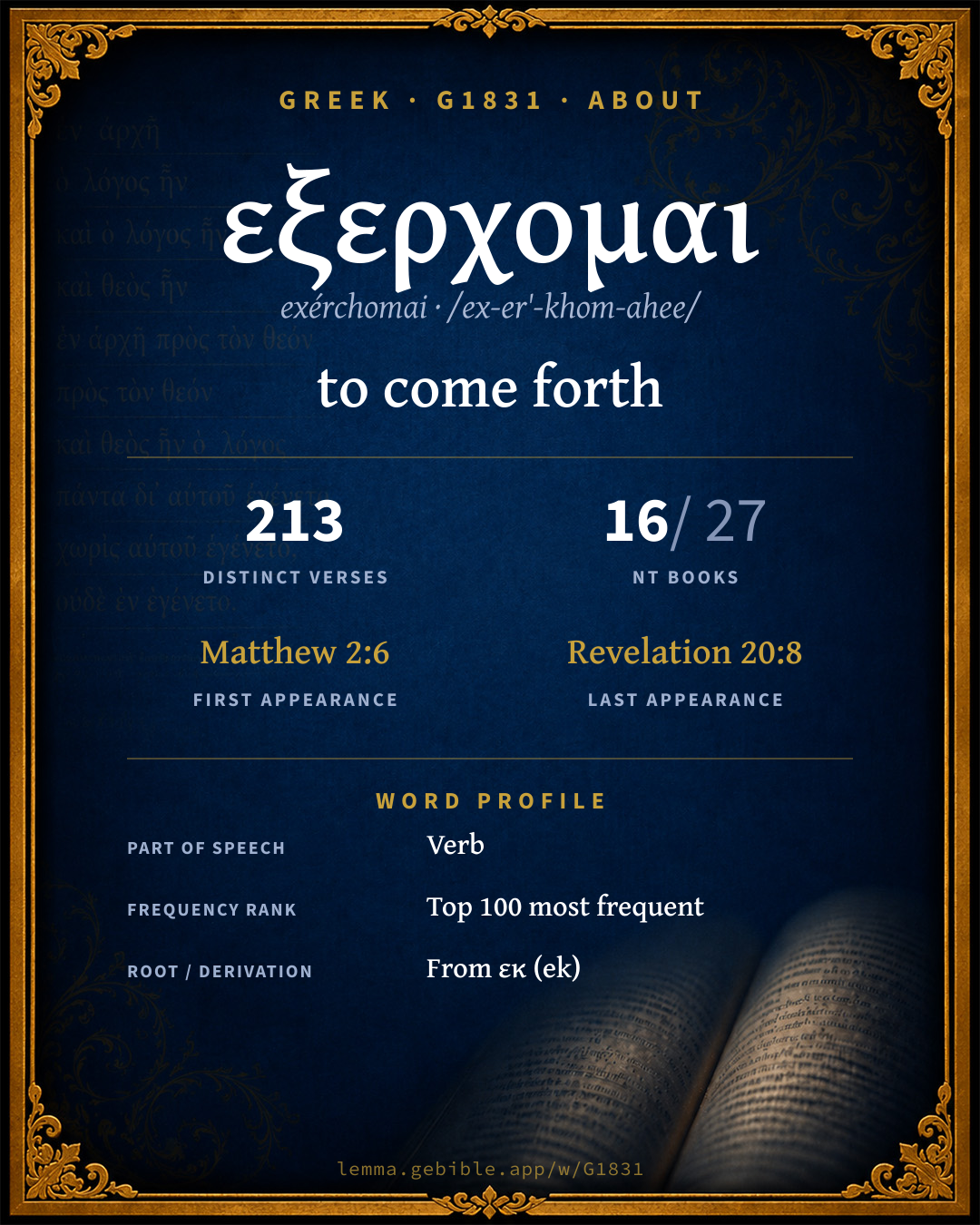
ἐξέρχομαι
to come forth
‘to come forth’ is one of 2 main senses fuller range ↓
Full lexicon entry — Thayer's Greek Lexicon
From Thayer's Greek Lexicon
Where this word appears
See every Aorist-tense verb in the Greek New Testament →
Grammar key — what these labels mean
Part of speech
- Verb
- An action or state-of-being word.
Tense
- Aorist
- Action viewed as a simple whole, without regard to duration — often past (perfective aspect).
- Present
- Ongoing or general action in present time (imperfective aspect).
- Perfect
- A completed past action with continuing present results.
- Future
- Action expected in future time.
- Imperfect
- Continuous or repeated action in past time (“was writing”).
- Pluperfect
- A past action completed before another past point (“had written”).
Voice
- Active
- The subject performs the action.
- Middle or Passive deponent
- Middle/passive in form but active in meaning.
- Middle deponent
- Middle in form but active in meaning.
Mood
- Indicative
- States a fact or asks a factual question (the mood of reality).
- Participle
- A verbal adjective (“writing,” “having written”).
- Imperative
- Expresses a command or request.
- Infinitive
- A verbal noun (“to write”), unmarked for person or number.
- Subjunctive
- Expresses probability, purpose, or possibility (the mood of contingency).
Case
- Nominative
- The case of the subject (and the predicate nominative).
- Genitive
- The case of source, possession, or “of” — answers “whose / from what.”
- Accusative
- The case of the direct object and of extent.
- Dative
- The case of the indirect object, means, or location — “to / for / with / in.”
Person
- 3rd person
- The one spoken about (“he / she / it / they”).
- 2nd person
- The one addressed (“you”).
- 1st person
- The speaker (“I / we”).
Gender
- Masculine
- Grammatically masculine.
- Feminine
- Grammatically feminine.
- Neuter
- Grammatically neuter.
Number
- Singular
- One.
- Plural
- More than one.
Every verse where G1831 appears in the Book of Matthew — 44 distinct verses. Click any verse to open its interlinear word-by-word view. Verse text shown in the World English Bible for context — . Each verse’s Greek form is shown with its reference; the English is not keyword-highlighted, since the data carries no word-level English alignment. Use “Compare translations” on any verse to read it across multiple English versions. This concordance covers the Greek New Testament; Septuagint (Greek Old Testament) occurrences of this word are not indexed here.
Matthew
- Matthew 2:6 ἐξελεύσεται fut mid.dep ind 3sg 'You Bethlehem, land of Judah, Are in no way least among the princes of Judah: For out of you shall come forth a governor, Who shall shepherd my people, Israel.'"
- Matthew 5:26 ἐξέλθῃς aor act subj 2sg Most assuredly I tell you, you shall by no means get out of there, until you have paid the last penny.
- Matthew 8:12 ἐξελεύσονται fut mid.dep ind 3pl but the children of the Kingdom will be thrown out into the outer darkness. There will be weeping and the gnashing of teeth."
- Matthew 8:28 ἐξερχόμενοι pres mid/pass.dep ptcp nom pl masc When he came to the other side, into the country of the Gergesenes, two people possessed by demons met him there, coming out of the tombs, exceedingly fierce, so that nobody could pass by that way.
- Matthew 8:32 ἐξελθόντες aor act ptcp nom pl masc He said to them, "Go!" They came out, and went into the herd of pigs: and behold, the whole herd of pigs rushed down the cliff into the sea, and died in the water.
- Matthew 8:34 ἐξῆλθεν aor act ind 3sg Behold, all the city came out to meet Jesus. When they saw him, they begged that he would depart from their borders.
- Matthew 9:26 ἐξῆλθεν aor act ind 3sg The report of this went out into all that land.
- Matthew 9:31 ἐξελθόντες aor act ptcp nom pl masc But they went out and spread abroad his fame in all that land.
- Matthew 9:32 ἐξερχομένων pres mid/pass.dep ptcp gen pl masc As they went out, behold, a mute man who was demon possessed was brought to him.
- Matthew 10:11 ἐξέλθητε aor act subj 2pl Into whatever city or village you enter, find out who in it is worthy; and stay there until you go on.
- Matthew 10:14 ἐξερχόμενοι pres mid/pass.dep ptcp nom pl masc Whoever doesn't receive you, nor hear your words, as you go out of that house or that city, shake off the dust from your feet.
- Matthew 11:7 ἐξήλθατε aor act ind 2pl As these went their way, Jesus began to say to the multitudes concerning John, "What did you go out into the wilderness to see? A reed shaken by the wind?
- Matthew 11:8 ἐξήλθατε aor act ind 2pl But what did you go out to see? A man in soft clothing? Behold, those who wear soft clothing are in king's houses.
- Matthew 11:9 ἐξήλθατε aor act ind 2pl But why did you go out? To see a prophet? Yes, I tell you, and much more than a prophet.
- Matthew 12:14 ἐξελθόντες aor act ptcp nom pl masc But the Pharisees went out, and conspired against him, how they might destroy him.
- Matthew 12:43 ἐξέλθῃ aor act subj 3sg But the unclean spirit, when he is gone out of the man, passes through waterless places, seeking rest, and doesn't find it.
- Matthew 12:44 ἐξῆλθον aor act ind 1sg Then he says, 'I will return into my house from which I came out,' and when he has come back, he finds it empty, swept, and put in order.
- Matthew 13:1 ἐξελθὼν aor act ptcp nom sg masc On that day Jesus went out of the house, and sat by the seaside.
- Matthew 13:3 ἐξῆλθεν aor act ind 3sg He spoke to them many things in parables, saying, "Behold, a farmer went out to sow.
- Matthew 13:49 ἐξελεύσονται fut mid.dep ind 3pl So will it be in the end of the world. The angels will come forth, and separate the wicked from among the righteous,
- Matthew 14:14 ἐξελθὼν aor act ptcp nom sg masc Jesus went out, and he saw a great multitude. He had compassion on them, and healed their sick.
- Matthew 15:18 ἐξέρχεται pres mid/pass.dep ind 3sg But the things which proceed out of the mouth come out of the heart, and they defile the man.
- Matthew 15:19 ἐξέρχονται pres mid/pass.dep ind 3pl For out of the heart come forth evil thoughts, murders, adulteries, sexual sins, thefts, false testimony, and blasphemies.
- Matthew 15:21 ἐξελθὼν aor act ptcp nom sg masc Jesus went out from there, and withdrew into the region of Tyre and Sidon.
- Matthew 15:22 ἐξελθοῦσα aor act ptcp nom sg fem Behold, a Canaanite woman came out from those borders, and cried, saying, "Have mercy on me, Lord, you son of David! My daughter is severely demonized!"
- Matthew 17:18 ἐξῆλθεν aor act ind 3sg Jesus rebuked him, the demon went out of him, and the boy was cured from that hour.
- Matthew 18:28 ἐξελθὼν aor act ptcp nom sg masc "But that servant went out, and found one of his fellow servants, who owed him one hundred denarii, and he grabbed him, and took him by the throat, saying, 'Pay me what you owe!'
- Matthew 20:1 ἐξῆλθεν aor act ind 3sg "For the Kingdom of Heaven is like a man who was the master of a household, who went out early in the morning to hire laborers for his vineyard.
- Matthew 20:3 ἐξελθὼν aor act ptcp nom sg masc He went out about the third hour, and saw others standing idle in the marketplace.
- Matthew 20:5 ἐξελθὼν aor act ptcp nom sg masc Again he went out about the sixth and the ninth hour, and did likewise.
- Matthew 20:6 ἐξελθὼν aor act ptcp nom sg masc About the eleventh hour he went out, and found others standing idle. He said to them, 'Why do you stand here all day idle?'
- Matthew 21:17 ἐξῆλθεν aor act ind 3sg He left them, and went out of the city to Bethany, and lodged there.
- Matthew 22:10 ἐξελθόντες aor act ptcp nom pl masc Those servants went out into the highways, and gathered together as many as they found, both bad and good. The wedding was filled with guests.
- Matthew 24:1 ἐξελθὼν aor act ptcp nom sg masc Jesus went out from the temple, and was going on his way. His disciples came to him to show him the buildings of the temple.
- Matthew 24:26 ἐξέλθητε aor act subj 2pl If therefore they tell you, 'Behold, he is in the wilderness,' don't go out; 'Behold, he is in the inner chambers,' don't believe it.
- Matthew 24:27 ἐξέρχεται pres mid/pass.dep ind 3sg For as the lightning comes forth from the east, and is seen even to the west, so will be the coming of the Son of Man.
- Matthew 25:1 ἐξῆλθον aor act ind 3pl "Then the Kingdom of Heaven will be like ten virgins, who took their lamps, and went out to meet the bridegroom.
- Matthew 25:6 ἐξέρχεσθε pres mid/pass.dep impv 2pl But at midnight there was a cry, 'Behold! The bridegroom is coming! Come out to meet him!'
- Matthew 26:30 ἐξῆλθον aor act ind 3pl When they had sung a hymn, they went out to the Mount of Olives.
- Matthew 26:55 ἐξήλθατε aor act ind 2pl In that hour Jesus said to the multitudes, "Have you come out as against a robber with swords and clubs to seize me? I sat daily in the temple teaching, and you didn't arrest me.
- Matthew 26:71 ἐξελθόντα aor act ptcp acc sg masc When he had gone out onto the porch, someone else saw him, and said to those who were there, "This man also was with Jesus of Nazareth."
- Matthew 26:75 ἐξελθὼν aor act ptcp nom sg masc Peter remembered the word which Jesus had said to him, "Before the rooster crows, you will deny me three times." He went out and wept bitterly.
- Matthew 27:32 Ἐξερχόμενοι pres mid/pass.dep ptcp nom pl masc As they came out, they found a man of Cyrene, Simon by name, and they compelled him to go with them, that he might carry his cross.
- Matthew 27:53 ἐξελθόντες aor act ptcp nom pl masc and coming out of the tombs after his resurrection, they entered into the holy city and appeared to many.
About this entry
At a glance — auto-summarized from this page’s data, not written by a person. Every figure links to its source below. This summary describes the numbers; it doesn’t interpret them.
εξερχομαι (exérchomai) is a Greek verb most often rendered “to come forth.” One archaism survives in the King James Version — “went forth” — where modern Bibles read “went out”; see the renderings breakdown. With 213 verses in 16 books, it is a common word in the Greek New Testament. Debuting at Matthew 2:6, it then recurs through the corpus. Its lexical range runs to 2 senses. The sections below give every sense, occurrence, and version rendering.
Gloss history
Strong's 1890 vs modern scholarship
About this word
Strong's G1831 catalogs a Greek word from the Greek New Testament.
These counts are not copied from any lexicon or concordance. They are computed here, from the morphology-tagged Greek New Testament. What Lemma adds →
- 213
- distinct verses
- The word appears in 213 distinct verses.
- 16 / 27
- NT books
- The word appears in 16 of 27 New Testament books.
- #74
- by frequency
- Top 100 most frequent Greek words (rank 74 of 5,347 Greek words by occurrence).
View all 213 occurrences in the concordance →
By section of the New Testament
By traditional corpus
Conventional, traditional groupings — biblical authorship is debated, so this is a traditional corpus grouping, not an authorship claim. Some books belong to more than one corpus (Luke is in both the Gospels and the Lukan corpus, and so on), so these shares overlap and need not total 100%. Each figure is a share of the word’s 213 distinct verses.
- Gospels 154 verses · 72%
- Lukan (Luke–Acts) 69 verses · 32%
- Johannine 48 verses · 23%
- Revelation 14 verses · 7%
- Pauline corpus 8 verses · 4%
- General (Catholic) Epistles 5 verses · 2%
- Hebrews 4 verses · 2%
How translations render this word
Counts come from each version’s own published word-to-Strong’s tagging or interlinear alignment — an approximate guide to how each version renders this word, not a word-level alignment the data otherwise carries. Because each total is that version’s own tagged count, the per-version totals vary from one another and need not match the appearance or distinct-verse counts above. These counts may also differ from a printed concordance because Lemma counts each distinctly tagged rendering and does not collapse phrase taggings into a single head-word total. This is a fixed set of word-tagged versions (KJV, ASV, BSB, ULT) and does not change with the reading translation you choose elsewhere. Each version’s license is shown beside its name below (and on Sources).
- King James Version: Went out 18×, Came 16×, Went 15×
- American Standard Version: Went out 18×, Went forth 15×, Came 14×
- Berean Standard Bible: Went out 27×, Came 11×, Left 10×
- unfoldingWord Literal Text: Went out 31×, Having gone out 28×, Came out 17×
King James Version Public Domain
Renders G1831 across 229 tagged occurrences — most commonly:
Plus other, less common renderings. Plus 57 renderings that appear only once — usually multi-word phrases or single function words the recovered tagging swept in, not distinct renderings. Not rendered by a distinct English word in 1 further occurrence.
American Standard Version Public Domain
Renders G1831 across 232 tagged occurrences — most commonly:
Plus other, less common renderings. Plus 50 renderings that appear only once — usually multi-word phrases or single function words the recovered tagging swept in, not distinct renderings.
Berean Standard Bible Public Domain
Renders G1831 across 215 tagged occurrences — most commonly:
Plus other, less common renderings. Plus 48 renderings that appear only once — usually multi-word phrases or single function words the recovered tagging swept in, not distinct renderings. Not rendered by a distinct English word in 2 further occurrences.
unfoldingWord Literal Text CC BY-SA 4.0
Renders G1831 across 229 tagged occurrences — most commonly:
Plus other, less common renderings. Plus 40 renderings that appear only once — usually multi-word phrases or single function words the recovered tagging swept in, not distinct renderings.
Senses in Thayer's
The 2 senses Thayer's distinguishes for this word, in lexicon order (not ranked by frequency or importance). The full entry — with sub-senses — is in the Lexicon Entry tab.
- with mention of the place out of which one goes, or the point from which he departs
- metaph.
Word origin
Derived from εκ (ek) (G1537) — from.
Forms in the corpus
The 42 distinct written forms G1831 takes in the Greek New Testament, most frequent first — each parse links to that tense’s occurrences in the concordance.
Same root — word family
Other Thayer's entries built from the same root as G1831, grouped by Strong’s listed origin. These share a root / origin per the lexicon — not necessarily a shared meaning. Each links to that word’s own entry.
Derives from
Shares the same root
- εκβαλλω ekbállō G1544 to cast out
- εκβασις ékbasis G1545 exit
- εκγαμιζω ekgamízō G1547 to give in marriage
- εκγαμισκω ekgamískō G1548 to give in marriage
- εκγονον ékgonon G1549 offspring
- εκδαπαναω ekdapanáō G1550 to spend
- εκδεχομαι ekdéchomai G1551 to receive
- εκδηλος ékdēlos G1552 evident
- εκδημεω ekdēméō G1553 to depart
- εκδιδωμι ekdídōmi G1554 to give out
- εκδιηγεομαι ekdiēgéomai G1555 to relate
- εκδικος ékdikos G1558 without justice
- εκδιωκω ekdiṓkō G1559 to banish
- εκδοτος ékdotos G1560 delivered up
- εκδυω ekdýō G1562 to put off
- εκζητεω ekzētéō G1567 to seek out
- εκθαμβος ékthambos G1569 astonished
- εκθετος ékthetos G1570 exposed
- εκκαθαιρω ekkathaírō G1571 to cleanse
- εκκαιω ekkaíō G1572 to burn
- εκκακεω ekkakéō G1573 to be exhausted
- εκκεντεω ekkentéō G1574 to pierce
- εκκλαω ekkláō G1575 to cut off
- εκκλειω ekkleíō G1576 to shut out
+88 more words share this root (not shown).
Compare all same-root words → Showing 4 of 114 — not the complete family. They share a root, not necessarily a meaning.
Septuagint usage
The same Greek word εξερχομαι appears 580 times in the Greek Old Testament (Septuagint), across 546 verses in 34 books.
- 580
- LXX occurrences
- Tagged occurrences of this Greek word in the Septuagint.
- 546
- verses
- Distinct Septuagint verses containing this word.
- 34 / 39
- OT books
- The word appears in 34 of the 39 Old Testament books.
Sample Septuagint occurrences
- Genesis 4:16 ἐκἔρχομαι
- Exodus 1:10 ἐκἔρχομαι
- Leviticus 8:33 ἐκἔρχομαι
- Numbers 1:1 ἐκἔρχομαι
- Deuteronomy 1:44 ἐκἔρχομαι
- Joshua 2:5 ἐκἔρχομαι
- Judges 1:10 ἐκἔρχομαι
- Ruth 1:7 ἐκἔρχομαι
- 1 Samuel 1:23 ἐκἔρχομαι
- 2 Samuel 2:12 ἐκἔρχομαι
- 1 Kings 2:30 ἐκἔρχομαι
- 2 Kings 2:21 ἐκἔρχομαι
Septuagint occurrences (same lexeme)
Every verse where the same Strong’s number (G1831) appears in the Greek Septuagint — showing the first 50 of 546. Verse text shown in the World English Bible for context; the Greek form is the matched word — the English is not keyword-highlighted.
- Genesis 4:16 ἐκἔρχομαι Cain went out from Yahweh's presence, and dwelt in the land of Nod, on the east of Eden.
- Genesis 8:7 ἐκἔρχομαι and he sent forth a raven. It went back and forth, until the waters were dried up from off the earth.
- Genesis 8:16 ἐκἔρχομαι "Go forth from the ark, you, and your wife, and your sons, and your sons' wives with you.
- Genesis 8:18 ἐκἔρχομαι Noah went forth, with his sons, his wife, and his sons' wives with him.
- Genesis 8:19 ἐκἔρχομαι Every animal, every creeping thing, and every bird, whatever moves on the earth, after their families, went forth out of the ark.
- Genesis 9:10 ἐκἔρχομαι and with every living creature that is with you: the birds, the cattle, and every animal of the earth with you. Of all that go out of the ark, even every animal of the earth.
- Genesis 9:18 ἐκἔρχομαι The sons of Noah who went forth from the ark were Shem, Ham, and Japheth. Ham is the father of Canaan.
- Genesis 9:22 ἐκἔρχομαι Ham, the father of Canaan, saw the nakedness of his father, and told his two brothers outside.
- Genesis 10:11 ἐκἔρχομαι Out of that land he went forth into Assyria, and built Nineveh, Rehoboth Ir, Calah,
- Genesis 10:14 ἐκἔρχομαι Pathrusim, Casluhim (which the Philistines descended from), and Caphtorim.
- Genesis 12:1 ἐκἔρχομαι Now Yahweh said to Abram, "Get out of your country, and from your relatives, and from your father's house, to the land that I will show you.
- Genesis 12:4 ἐκἔρχομαι So Abram went, as Yahweh had spoken to him. Lot went with him. Abram was seventy-five years old when he departed out of Haran.
- Genesis 12:5 ἐκἔρχομαι Abram took Sarai his wife, Lot his brother's son, all their substance that they had gathered, and the souls who they had gotten in Haran; and they went forth to go into the land of Canaan. Into the land of Canaan they came.
- Genesis 14:8 ἐκἔρχομαι There went out the king of Sodom, and the king of Gomorrah, and the king of Admah, and the king of Zeboiim, and the king of Bela (the same is Zoar); and they set the battle in array against them in the valley of Siddim;
- Genesis 14:17 ἐκἔρχομαι The king of Sodom went out to meet him, after his return from the slaughter of Chedorlaomer and the kings who were with him, at the valley of Shaveh (the same is the King's Valley).
- Genesis 15:4 ἐκἔρχομαι Behold, the word of Yahweh came to him, saying, "This man will not be your heir, but he who will come forth out of your own body will be your heir."
- Genesis 15:14 ἐκἔρχομαι I will also judge that nation, whom they will serve. Afterward they will come out with great substance.
- Genesis 17:6 ἐκἔρχομαι I will make you exceeding fruitful, and I will make nations of you. Kings will come out of you.
- Genesis 19:6 ἐκἔρχομαι Lot went out to them to the door, and shut the door after him.
- Genesis 19:14 ἐκἔρχομαι Lot went out, and spoke to his sons-in-law, who were pledged to marry his daughters, and said, "Get up! Get out of this place, for Yahweh will destroy the city." But he seemed to his sons-in-law to be joking.
- Genesis 19:15 ἐκἔρχομαι When the morning arose, then the angels hurried Lot, saying, "Arise, take your wife, and your two daughters who are here, lest you be consumed in the iniquity of the city."
- Genesis 19:23 ἐκἔρχομαι The sun was risen on the earth when Lot came to Zoar.
- Genesis 24:5 ἐκἔρχομαι The servant said to him, "What if the woman isn't willing to follow me to this land? Must I bring your son again to the land you came from?"
- Genesis 24:43 ἐκἔρχομαι Behold, I am standing by the spring of water. Let it happen, that the maiden who comes forth to draw, to whom I will say, Give me, I pray you, a little water from your pitcher to drink.
- Genesis 24:50 ἐκἔρχομαι Then Laban and Bethuel answered, "The thing proceeds from Yahweh. We can't speak to you bad or good.
- Genesis 24:63 ἐκἔρχομαι Isaac went out to meditate in the field at the evening. He lifted up his eyes, and saw, and, behold, there were camels coming.
- Genesis 25:25 ἐκἔρχομαι The first came out red all over, like a hairy garment. They named him Esau.
- Genesis 25:26 ἐκἔρχομαι After that, his brother came out, and his hand had hold on Esau's heel. He was named Jacob. Isaac was sixty years old when she bore them.
- Genesis 27:3 ἐκἔρχομαι Now therefore, please take your weapons, your quiver and your bow, and go out to the field, and take me venison.
- Genesis 27:30 ἐκἔρχομαι It happened, as soon as Isaac had made an end of blessing Jacob, and Jacob had just gone out from the presence of Isaac his father, that Esau his brother came in from his hunting.
- Genesis 28:10 ἐκἔρχομαι Jacob went out from Beersheba, and went toward Haran.
- Genesis 30:16 ἐκἔρχομαι Jacob came from the field in the evening, and Leah went out to meet him, and said, "You must come in to me; for I have surely hired you with my son's mandrakes." He lay with her that night.
- Genesis 31:13 ἐκἔρχομαι I am the God of Bethel, where you anointed a pillar, where you vowed a vow to me. Now arise, get out from this land, and return to the land of your birth."
- Genesis 31:33 ἐκἔρχομαι Laban went into Jacob's tent, into Leah's tent, and into the tent of the two maid-servants; but he didn't find them. He went out of Leah's tent, and entered into Rachel's tent.
- Genesis 34:1 ἐκἔρχομαι Dinah, the daughter of Leah, whom she bore to Jacob, went out to see the daughters of the land.
- Genesis 34:6 ἐκἔρχομαι Hamor the father of Shechem went out to Jacob to talk with him.
- Genesis 34:26 ἐκἔρχομαι They killed Hamor and Shechem, his son, with the edge of the sword, and took Dinah out of Shechem's house, and went away.
- Genesis 35:11 ἐκἔρχομαι God said to him, "I am God Almighty. Be fruitful and multiply. A nation and a company of nations will be from you, and kings will come out of your loins.
- Genesis 38:28 ἐκἔρχομαι It happened, when she travailed, that one put out a hand: and the midwife took and tied a scarlet thread on his hand, saying, "This came out first."
- Genesis 38:29 ἐκἔρχομαι It happened, as he drew back his hand, that behold, his brother came out, and she said, "Why have you made a breach for yourself?" Therefore his name was called Perez.
- Genesis 38:30 ἐκἔρχομαι Afterward his brother came out, that had the scarlet thread on his hand, and his name was called Zerah.
- Genesis 39:12 ἐκἔρχομαι She caught him by his garment, saying, "Lie with me!" He left his garment in her hand, and ran outside.
- Genesis 39:13 ἐκἔρχομαι It happened, when she saw that he had left his garment in her hand, and had run outside,
- Genesis 39:15 ἐκἔρχομαι It happened, when he heard that I lifted up my voice and cried, that he left his garment by me, and ran outside."
- Genesis 39:18 ἐκἔρχομαι and it happened, as I lifted up my voice and cried, that he left his garment by me, and ran outside."
- Genesis 41:46 ἐκἔρχομαι Joseph was thirty years old when he stood before Pharaoh king of Egypt. Joseph went out from the presence of Pharaoh, and went throughout all the land of Egypt.
- Genesis 42:15 ἐκἔρχομαι Hereby you shall be tested. By the life of Pharaoh you shall not go forth from here, unless your youngest brother come here.
- Genesis 43:31 ἐκἔρχομαι He washed his face, and came out. He controlled himself, and said, "Serve the meal."
- Genesis 44:4 ἐκἔρχομαι When they had gone out of the city, and were not yet far off, Joseph said to his steward, "Up, follow after the men. When you overtake them, ask them, 'Why have you rewarded evil for good?
- Genesis 44:28 ἐκἔρχομαι and the one went out from me, and I said, "Surely he is torn in pieces;" and I haven't seen him since.
These are occurrences of the same Greek lexeme (G1831) in the Septuagint — not a translation of any one Hebrew word. The store carries no word-level Hebrew↔Greek alignment, so no Hebrew original is asserted here. Counts come from the recovered LXX Strong's tagging — high-frequency vocabulary is well covered, while rare or late forms may be untagged — so they reflect tagged occurrences and may slightly undercount.