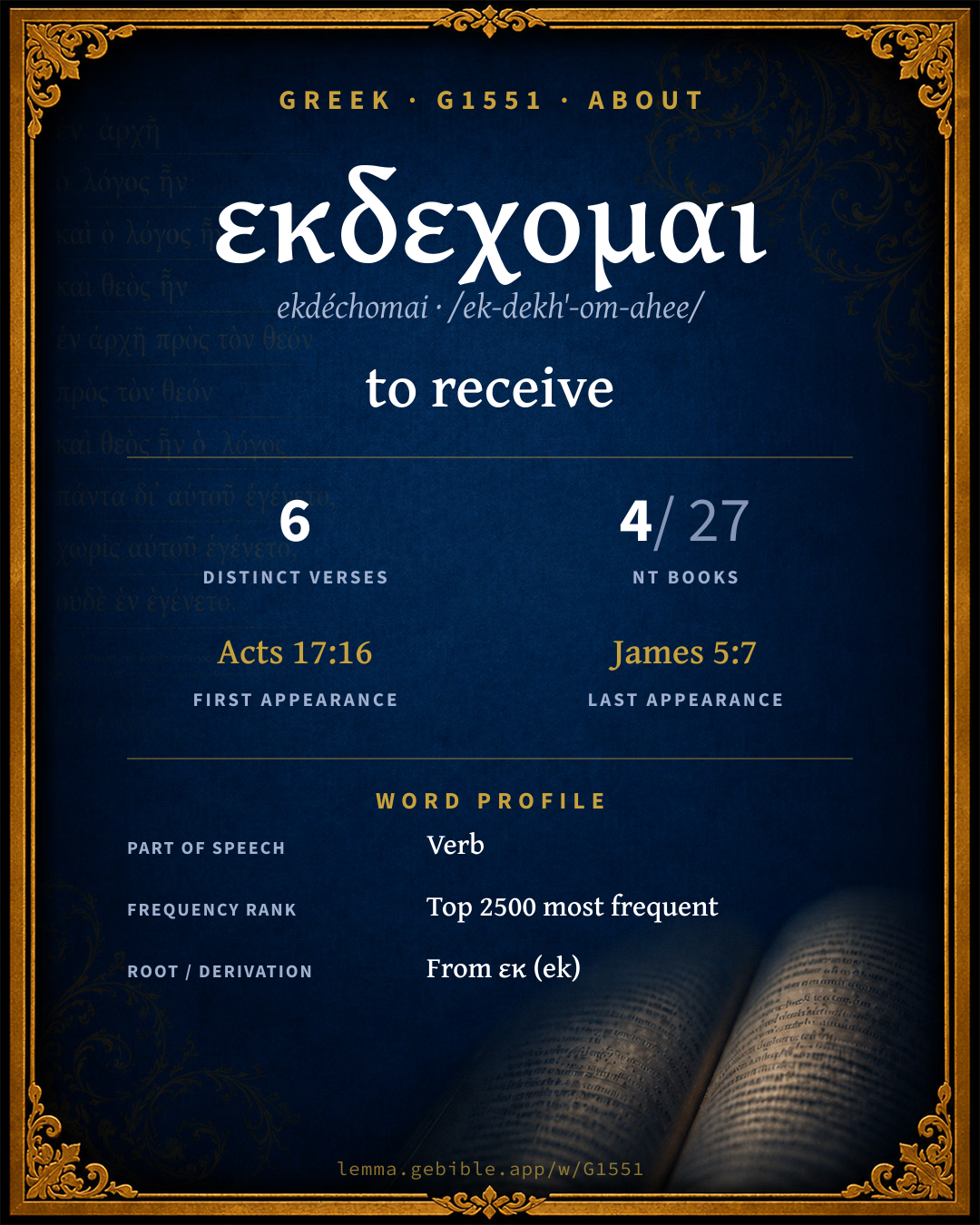
ἐκδέχομαι
to receive
‘to receive’ is one of 2 main senses fuller range ↓
Full lexicon entry — Thayer's Greek Lexicon
From Thayer's Greek Lexicon
Where this word appears
See every Present-tense verb in the Greek New Testament →
Grammar key — what these labels mean
Part of speech
- Verb
- An action or state-of-being word.
Tense
- Imperfect
- Continuous or repeated action in past time (“was writing”).
- Present
- Ongoing or general action in present time (imperfective aspect).
Voice
- Middle or Passive deponent
- Middle/passive in form but active in meaning.
Mood
- Indicative
- States a fact or asks a factual question (the mood of reality).
- Imperative
- Expresses a command or request.
- Participle
- A verbal adjective (“writing,” “having written”).
Case
- Genitive
- The case of source, possession, or “of” — answers “whose / from what.”
- Nominative
- The case of the subject (and the predicate nominative).
Person
- 3rd person
- The one spoken about (“he / she / it / they”).
- 1st person
- The speaker (“I / we”).
- 2nd person
- The one addressed (“you”).
Gender
- Masculine
- Grammatically masculine.
Number
- Singular
- One.
- Plural
- More than one.
Grammatical forms
- Verb, Imperfect, Middle or Passive deponent, Indicative, 3rd person, Singular 1 time (17%)
- Verb, Present, Middle or Passive deponent, Indicative, 1st person, Singular 1 time (17%)
- Verb, Present, Middle or Passive deponent, Indicative, 3rd person, Singular 1 time (17%)
- Verb, Present, Middle or Passive deponent, Imperative, 2nd person, Plural 1 time (17%)
- Verb, Present, Middle or Passive deponent, Participle, Genitive, Singular, Masculine 1 time (17%)
- Verb, Present, Middle or Passive deponent, Participle, Nominative, Singular, Masculine 1 time (17%)
Parsed forms decoded from the imported morphology (Robinson–Tischendorf, public domain), counted across 6 parsed occurrences — not distinct verses.
Every verse where G1551 appears — 6 distinct verses across 4 books. Click any verse to open its interlinear word-by-word view. Verse text shown in the World English Bible for context — . Each verse’s Greek form is shown with its reference; the English is not keyword-highlighted, since the data carries no word-level English alignment. Use “Compare translations” on any verse to read it across multiple English versions. This concordance covers the Greek New Testament; Septuagint (Greek Old Testament) occurrences of this word are not indexed here.
Acts 1 verse
1 Corinthians 2 verses
- 1 Corinthians 11:33 ἐκδέχεσθε pres mid/pass.dep impv 2pl Therefore, my brothers, when you come together to eat, wait one for another.
- 1 Corinthians 16:11 ἐκδέχομαι pres mid/pass.dep ind 1sg Therefore let no one despise him. But set him forward on his journey in peace, that he may come to me; for I expect him with the brothers.
Hebrews 2 verses
James 1 verse
About this entry
At a glance — auto-summarized from this page’s data, not written by a person. Every figure links to its source below. This summary describes the numbers; it doesn’t interpret them.
εκδεχομαι — transliterated ekdéchomai — is a Greek verb carrying the sense “to receive.” It first appears in Acts 17:16. The Greek New Testament uses it across 6 verses — uncommon. More than a third of its appearances fall in 1 Corinthians. Its lexical range runs to 2 senses. Each statement above links to its evidence; the full detail follows below.
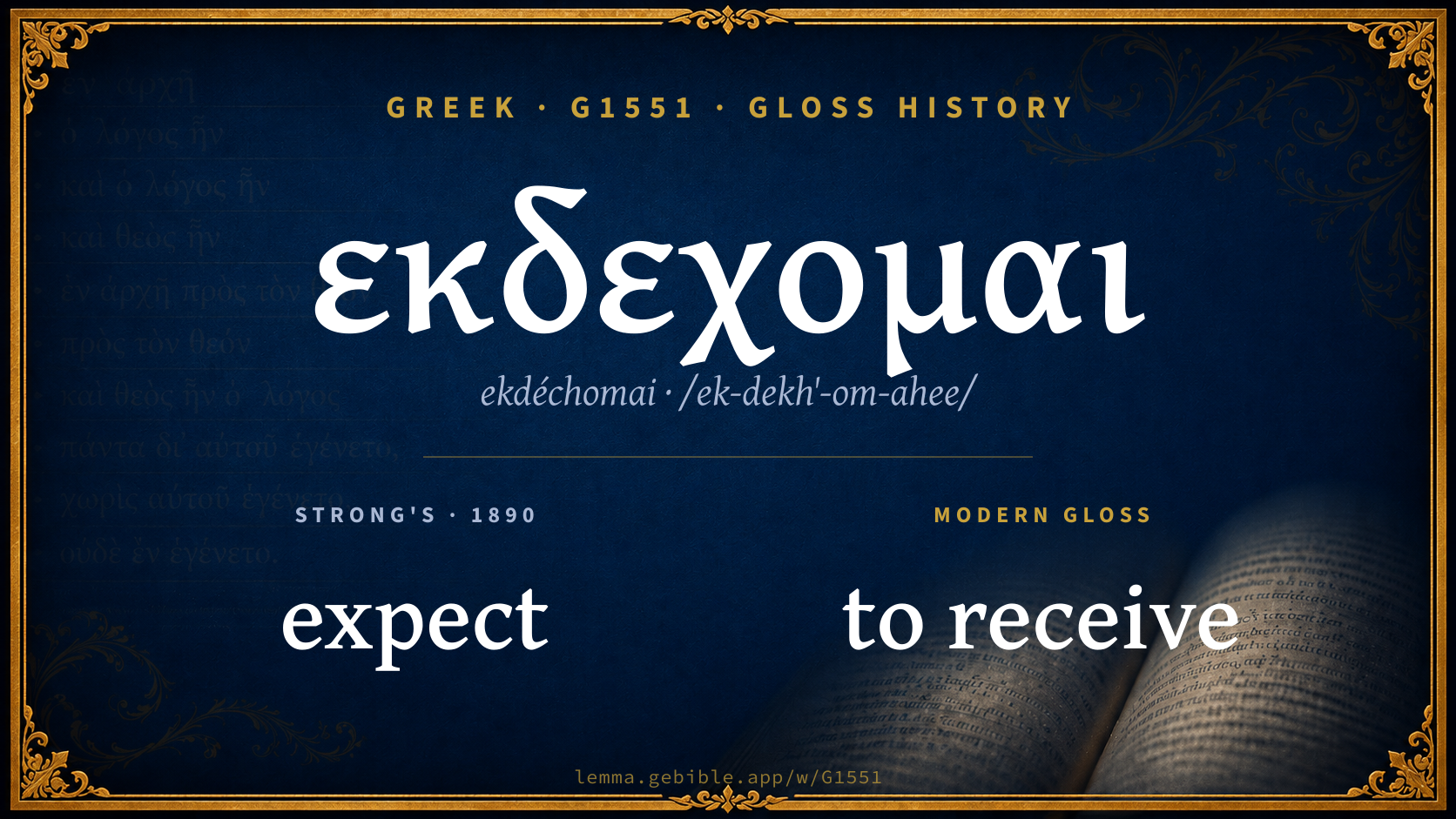
Gloss history
Strong's 1890 vs modern scholarship
About this word
Strong's G1551 catalogs a Greek word from the Greek New Testament.
These counts are not copied from any lexicon or concordance. They are computed here, from the morphology-tagged Greek New Testament. What Lemma adds →
- 6
- distinct verses
- The word appears in 6 distinct verses.
- 4 / 27
- NT books
- The word appears in 4 of 27 New Testament books.
- #1,476
- by frequency
- Top 2500 most frequent Greek words (rank 1,476 of 5,347 Greek words by occurrence).
View all 6 occurrences in the concordance →
Most concentrated in
- 1 Corinthians 2 verses 33%
- Hebrews 2 verses 33%
- Acts 1 verse 17%
By section of the New Testament
By traditional corpus
Conventional, traditional groupings — biblical authorship is debated, so this is a traditional corpus grouping, not an authorship claim. Some books belong to more than one corpus (Luke is in both the Gospels and the Lukan corpus, and so on), so these shares overlap and need not total 100%. Each figure is a share of the word’s 6 distinct verses.
- Pauline corpus 2 verses · 33%
- Hebrews 2 verses · 33%
- Lukan (Luke–Acts) 1 verse · 17%
- General (Catholic) Epistles 1 verse · 17%
How translations render this word
Counts come from each version’s own published word-to-Strong’s tagging or interlinear alignment — an approximate guide to how each version renders this word, not a word-level alignment the data otherwise carries. Because each total is that version’s own tagged count, the per-version totals vary from one another and need not match the appearance or distinct-verse counts above. These counts may also differ from a printed concordance because Lemma counts each distinctly tagged rendering and does not collapse phrase taggings into a single head-word total. This is a fixed set of word-tagged versions (KJV, ASV, BSB, ULT) and does not change with the reading translation you choose elsewhere. Each version’s license is shown beside its name below (and on Sources).
- King James Version: Expecting 1×, He looked for 1×, I look for 1×
- American Standard Version: Waited 2×
- Berean Standard Bible: Awaits 1×, He waits 1×, He was looking forward to 1×
- unfoldingWord Literal Text: Awaits 1×, He was waiting for 1×, I am expecting 1×
King James Version Public Domain
Renders G1551 across 8 tagged occurrences — most commonly:
American Standard Version Public Domain
Renders G1551 across 8 tagged occurrences — most commonly:
Plus 6 renderings that appear only once — usually multi-word phrases or single function words the recovered tagging swept in, not distinct renderings.
Berean Standard Bible Public Domain
Renders G1551 across 6 tagged occurrences — most commonly:
unfoldingWord Literal Text CC BY-SA 4.0
Renders G1551 across 7 tagged occurrences — most commonly:
Senses in Thayer's
The 2 senses Thayer's distinguishes for this word, in lexicon order (not ranked by frequency or importance). The full entry — with sub-senses — is in the Lexicon Entry tab.
- to receive, accept
- to look for, expect, wait for, await
Word origin
Derived from εκ (ek) (G1537) — from.
Forms in the corpus
The 6 distinct written forms G1551 takes in the Greek New Testament, most frequent first — each parse links to that tense’s occurrences in the concordance.
| Form | Parsing | Example | Uses |
|---|---|---|---|
| ἐκδέχεσθε ekdéchesthe | Verb, Present, Middle or Passive deponent, Imperative, 2nd person, Plural | 1 Corinthians 11:33 | 1 |
| ἐκδέχεται ekdéchetai | Verb, Present, Middle or Passive deponent, Indicative, 3rd person, Singular | James 5:7 | 1 |
| ἐκδέχομαι ekdéchomai | Verb, Present, Middle or Passive deponent, Indicative, 1st person, Singular | 1 Corinthians 16:11 | 1 |
| ἐκδεχομένου ekdechoménou | Verb, Present, Middle or Passive deponent, Participle, Genitive, Singular, Masculine | Acts 17:16 | 1 |
| ἐκδεχόμενος ekdechómenos | Verb, Present, Middle or Passive deponent, Participle, Nominative, Singular, Masculine | Hebrews 10:13 | 1 |
| ἐξεδέχετο exedécheto | Verb, Imperfect, Middle or Passive deponent, Indicative, 3rd person, Singular | Hebrews 11:10 | 1 |
Same root — word family
Other Thayer's entries built from the same root as G1551, grouped by Strong’s listed origin. These share a root / origin per the lexicon — not necessarily a shared meaning. Each links to that word’s own entry.
Derives from
Shares the same root
- εκβαλλω ekbállō G1544 to cast out
- εκβασις ékbasis G1545 exit
- εκγαμιζω ekgamízō G1547 to give in marriage
- εκγαμισκω ekgamískō G1548 to give in marriage
- εκγονον ékgonon G1549 offspring
- εκδαπαναω ekdapanáō G1550 to spend
- εκδηλος ékdēlos G1552 evident
- εκδημεω ekdēméō G1553 to depart
- εκδιδωμι ekdídōmi G1554 to give out
- εκδιηγεομαι ekdiēgéomai G1555 to relate
- εκδικος ékdikos G1558 without justice
- εκδιωκω ekdiṓkō G1559 to banish
- εκδοτος ékdotos G1560 delivered up
- εκδυω ekdýō G1562 to put off
- εκζητεω ekzētéō G1567 to seek out
- εκθαμβος ékthambos G1569 astonished
- εκθετος ékthetos G1570 exposed
- εκκαθαιρω ekkathaírō G1571 to cleanse
- εκκαιω ekkaíō G1572 to burn
- εκκακεω ekkakéō G1573 to be exhausted
- εκκεντεω ekkentéō G1574 to pierce
- εκκλαω ekkláō G1575 to cut off
- εκκλειω ekkleíō G1576 to shut out
- εκκλησια ekklēsía G1577 assembly
+88 more words share this root (not shown).
Derived from this word
Compare all same-root words → Showing 4 of 115 — not the complete family. They share a root, not necessarily a meaning.
Septuagint usage
The same Greek word εκδεχομαι appears 9 times in the Greek Old Testament (Septuagint), across 8 verses in 6 books.
- 9
- LXX occurrences
- Tagged occurrences of this Greek word in the Septuagint.
- 8
- verses
- Distinct Septuagint verses containing this word.
- 6 / 39
- OT books
- The word appears in 6 of the 39 Old Testament books.
Sample Septuagint occurrences
- Genesis 43:9 ἐκδέχομαι
- Psalms 118:122 ἐκδέχομαι
- Isaiah 57:1 ἐκδέχομαι
- Hosea 8:7 ἐκδέχομαι
- Micah 2:12 ἐκδέχομαι
- Nahum 3:18 ἐκδέχομαι
Septuagint occurrences (same lexeme)
Every verse where the same Strong’s number (G1551) appears in the Greek Septuagint. Verse text shown in the World English Bible for context; the Greek form is the matched word — the English is not keyword-highlighted.
- Genesis 43:9 ἐκδέχομαι I will be collateral for him. From my hand will you require him. If I don't bring him to you, and set him before you, then let me bear the blame forever,
- Genesis 44:32 ἐκδέχομαι For your servant became collateral for the boy to my father, saying, 'If I don't bring him to you, then I will bear the blame to my father forever.'
- Psalms 118:122 ἐκδέχομαι
- Isaiah 57:1 ἐκδέχομαι The righteous perishes, and no man lays it to heart; and merciful men are taken away, none considering that the righteous is taken away from the evil [to come].
- Hosea 8:7 ἐκδέχομαι For they sow the wind, And they will reap the whirlwind. He has no standing grain. The stalk will yield no head. If it does yield, strangers will swallow it up.
- Hosea 9:6 ἐκδέχομαι For, behold, they have gone away from destruction. Egypt will gather them up. Memphis will bury them. Nettles will possess their pleasant things of silver. Thorns will be in their tents.
- Micah 2:12 ἐκδέχομαι I will surely assemble, Jacob, all of you; I will surely gather the remnant of Israel; I will put them together as the sheep of Bozrah, As a flock in the midst of their pasture; They will swarm with people.
- Nahum 3:18 ἐκδέχομαι Your shepherds slumber, king of Assyria. Your nobles lie down. Your people are scattered on the mountains, and there is no one to gather them.
These are occurrences of the same Greek lexeme (G1551) in the Septuagint — not a translation of any one Hebrew word. The store carries no word-level Hebrew↔Greek alignment, so no Hebrew original is asserted here. Counts come from the recovered LXX Strong's tagging — high-frequency vocabulary is well covered, while rare or late forms may be untagged — so they reflect tagged occurrences and may slightly undercount.