
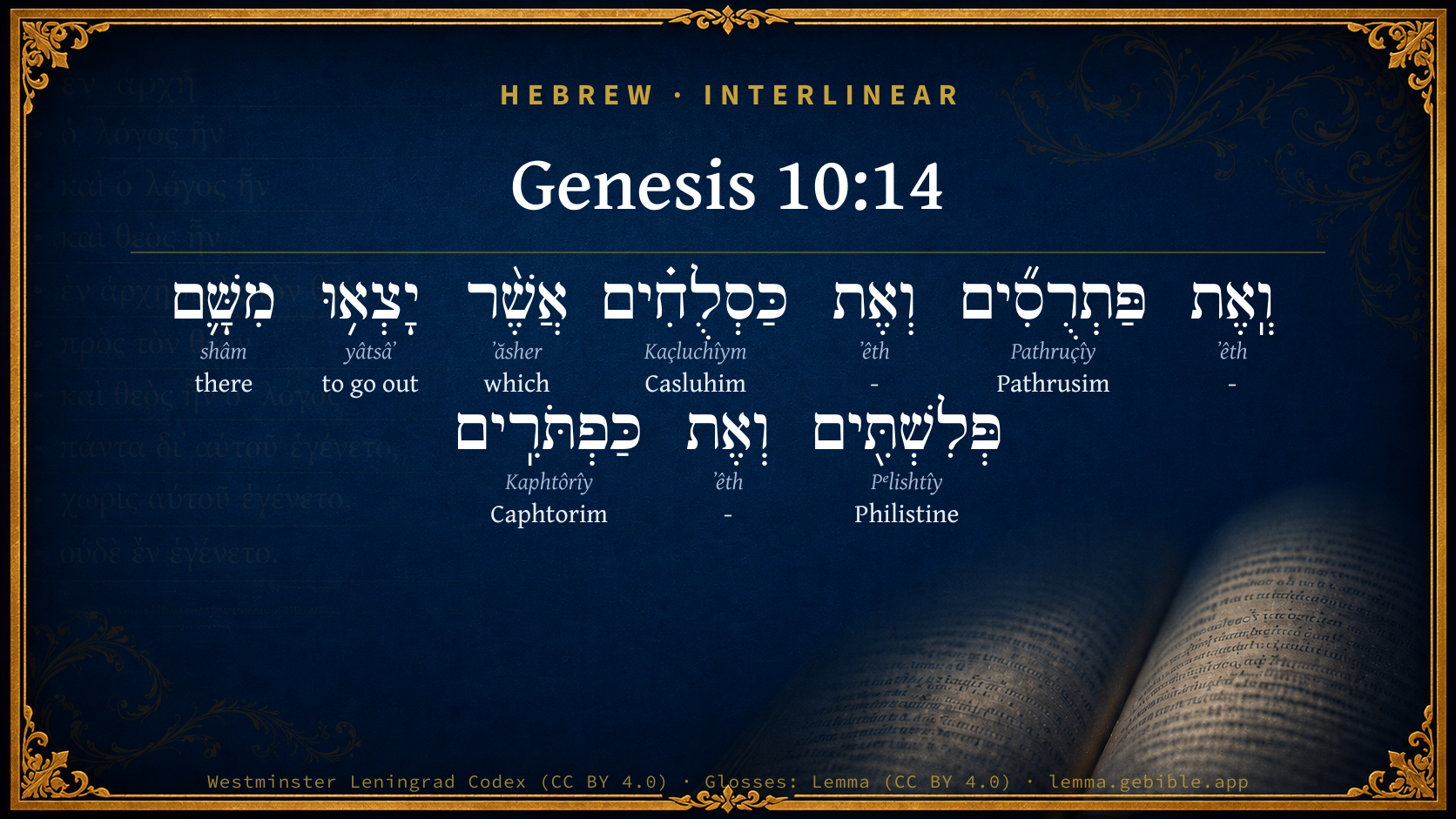
Genesis 10:14

Hebrew (Westminster Leningrad Codex) Genesis 10:14 appears in the Hebrew Old Testament. The text above is from the Westminster Leningrad Codex. Each word links to its Strong’s number, a concise gloss, and parsing drawn from the Open Scriptures Hebrew Bible morphology. Click any word for its full Brown-Driver-Briggs (BDB) entry.
Download image
Cite this verse

Genesis 10:14 (World English Bible). Public Domain. Lemma interlinear Bible study tool, https://lemma.gebible.app/v/genesis/10/14.

Show BibTeX & RIS
BibTeX
RIS
English Translation
Pathrusim, Casluhim (which the Philistines descended from), and Caphtorim.
World English Bible · Public Domain
Highlights Full analysis ↓
Download a study sheet

One document with this verse’s original text, its word-by-word gloss line, the meaning frame, cross-references with their text, attributed commentary, and full source and license credits — printable, and it pastes into notes with its structure intact.

This verse Autodidact and up

Study sheet (.html) Plain text (.txt)

A passage Seminary Student

Up to 50 verses in one chapter. A passage sheet keeps up to 6 commentary sources and 12 cross-references per verse, in the order this page ranks them, and says so on the sheet whenever that leaves anything out. Ask for a single verse and you get the Autodidact verse sheet above.

Everything on this page stays free to read, with no account — the sheet is a download of what is already on screen, not access to it.

Want to remove ads? Support Godless Engineer
Compare translations 3

The same verse in 3 English versions, stacked beneath the original-language interlinear above. Click any original word for its lexicon entry.

Each is an independent rendering of the whole verse — the interlinear is not word-aligned to these translations.

Highlighted words mark where these versions differ — a whole-verse word diff, not a word-by-word alignment.

  • World English Bible Public Domain
    Pathrusim, Casluhim (which the Philistines descended from), and Caphtorim.
  • King James Version Public Domain
    And Pathrusim, and Casluhim, (out of whom came Philistim,) and Caphtorim.
  • unfoldingWord Literal Text CC BY-SA 4.0
    and the Pathrusim and the Casluhim (whom the Philistim came from) and the Caphtorim.

unfoldingWord Literal Text — © unfoldingWord, licensed CC BY-SA 4.0. Word-aligned USFM3 via Door43 (git.door43.org/unfoldingWord/en_ult).

Versions to compare (up to 4)

3 of 4 selected

Show all 18 translations

Every available English version of this verse, each an independent rendering of the whole verse.

  • World English Bible Public Domain
    Pathrusim, Casluhim (which the Philistines descended from), and Caphtorim.
  • Berean Standard Bible Public Domain
    the Pathrusites, the Casluhites (from whom the Philistines came), and the Caphtorites.
  • Majority Standard Bible Public Domain
    the Pathrusites, the Casluhites (from whom the Philistines came), and the Caphtorites.
  • King James Version Public Domain
    And Pathrusim, and Casluhim, (out of whom came Philistim,) and Caphtorim.
  • American Standard Version (1901) Public Domain
    and Pathrusim, and Casluhim (whence went forth the Philistines), and Caphtorim.
  • Revised Version (1885) Public Domain
    and Pathrusim, and Casluhim (whence went forth the Philistines), and Caphtorim.
  • Geneva Bible (1599) Public Domain
    Pathrusim also, and Casluhim (out of whom came the Philistims) and Caphtorims.
  • Douay-Rheims (1899) Public Domain
    And Phetrusim, and Chasluim; of whom came forth the Philistines, and the Capthorim.
  • Young's Literal Translation Public Domain
    and the Pathrusim, and the Casluhim, (whence have come out Philistim,) and the Caphtorim.
  • Literal Standard Version CC BY-SA 4.0
    and the Pathrusim, and the Casluhim (from where have come out Philistim), and the Caphtorim.
  • Unlocked Literal Bible CC BY-SA 4.0
    the Pathrusites, the Kasluhites (from whom the Philistines came), and the Caphtorites.
  • unfoldingWord Literal Text CC BY-SA 4.0
    and the Pathrusim and the Casluhim (whom the Philistim came from) and the Caphtorim.
  • Darby Bible Public Domain
    and the Pathrusim, and the Casluhim, out of whom came the Philistines, and the Caphtorim.
  • World Messianic Bible Public Domain
    Pathrusim, Casluhim (which the Philistines descended from), and Caphtorim.
  • Webster's Bible Public Domain
    And Pathrusim, and Casluhim, (out of whom came Philistim,) and Caphtorim.
  • Free Bible Version CC BY-SA 4.0
    the Pathrusites, the Casluhites, and the Caphtorites (ancestors of the Philistines).
  • Bible in Basic English Public Domain
    And Pathrusim and Casluhim and Caphtorim, from whom came the Philistines.
  • JPS Tanakh (1917) Public Domain
    and Pathrusim, and Casluhim — whence went forth the Philistines — and Caphtorim.

Literal Standard Version (2020), Covenant Press — licensed CC BY-SA 4.0. Text via the HelloAO Bible API (eBible.org). Unlocked Literal Bible (unfoldingWord) — licensed CC BY-SA 4.0. Text via the HelloAO Bible API (eBible.org). unfoldingWord Literal Text — © unfoldingWord, licensed CC BY-SA 4.0. Word-aligned USFM3 via Door43 (git.door43.org/unfoldingWord/en_ult). Free Bible Version, Dr. Jonathan Gallagher — licensed CC BY-SA 4.0. Text via the HelloAO Bible API (eBible.org).

Word by word

More ways to search: Search by grammar → Find every occurrence → Compare this word →

Practice this passage: Drill this verse → Learn its vocabulary →

About this verse

These counts appear in no published source. They are computed here, from the morphology-tagged text and Lemma’s own curated glosses. What Lemma adds →

10
words
8
distinct lemmas
Pentateuch
section

Notable vocabulary

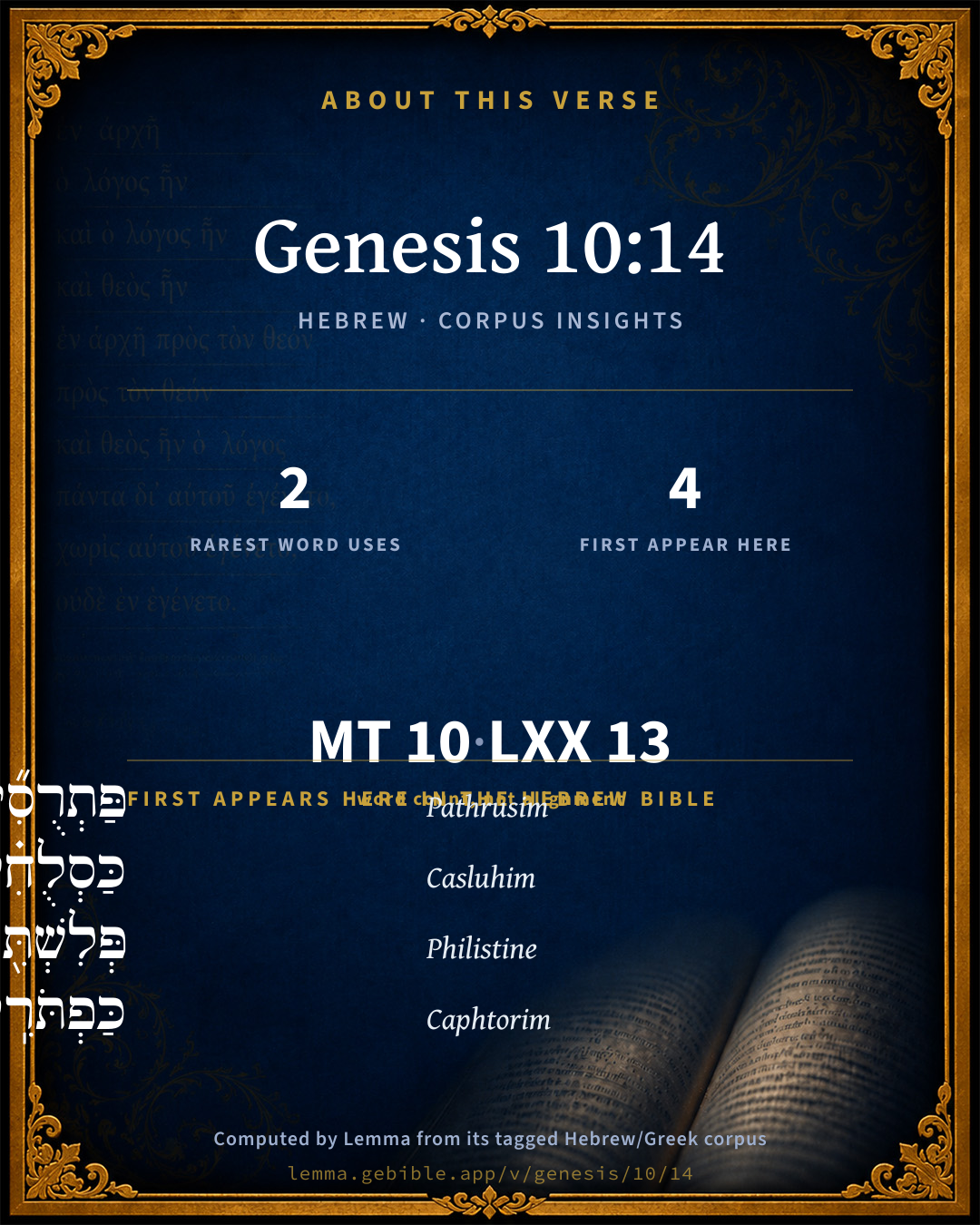
The rarest word here is פַּתְרֻסִ֞ים Pathrusim H6625 — appearing just 2 times in the whole Hebrew Bible.

First appearance in Scripture

These words make their first canonical appearance in the Hebrew Bible here:

  • פַּתְרֻסִ֞ים Pathrusim H6625
  • כַּסְלֻחִ֗ים Casluhim H3695
  • פְּלִשְׁתִּ֖ים Philistine H6430
  • כַּפְתֹּרִֽים Caphtorim H3732

Shared distinctive vocabulary

פַּתְרֻסִ֞ים Pathrusim H6625 occurs in 2 verses of the Hebrew Bible. Also found in:

Grammatical profile

  • 1 verb
  • 4 nouns
  • 1 adverb
  • 4 particles

Verb forms

  • יָצְא֥וּ Qal · Perfect

Hebrew & Septuagint length

In English translation the verse runs 9 words from the Hebrew and 13 from the Septuagint (LXX English) — the Septuagint runs noticeably longer here. See the side-by-side →

A rough comparison of the two English renderings, which tokenize alike — not a word-level alignment.

Word counts can differ between the Hebrew and the Greek without any difference in meaning — e.g. the Hebrew direct-object marker אֵת has no separate Greek word, and Greek often adds the article ὁ.

In the original languages it is 10 Hebrew tokens and 13 Greek tokens — but the two are counted differently (Hebrew bundles its prefixes and suffixes into one token; the Greek is in lemma form), so that isn’t a like-for-like length.

Cross-references

6

Topical passages linked to Genesis 10:14 in the Treasury of Scripture Knowledge — connected by theme and wording, ordered by reader-vote popularity; previews shown in the World English Bible.

  • Jeremiah 47:4 because of the day that comes to destroy all the Philistines, to cut off from Tyre and Sidon every helper who remains: for Yahweh will destroy the Philistines, the remnant of the isle of Caphtor.
  • Deuteronomy 2:23 and the Avvim, who lived in villages as far as Gaza, the Caphtorim, who came forth out of Caphtor, destroyed them, and lived in their place.)
  • 1 Chronicles 1:12 and Pathrusim, and Casluhim (from whence came the Philistines), and Caphtorim.
  • Amos 9:7 Are you not like the children of the Ethiopians to me, children of Israel?" says Yahweh. "Haven't I brought up Israel out of the land of Egypt, and the Philistines from Caphtor, and the Syrians from Kir?
  • Isaiah 11:11 It shall happen in that day, that the Lord will set his hand again the second time to recover the remnant of his people, who shall remain, from Assyria, and from Egypt, and from Pathros, and from Cush, and from Elam, and from Shinar, and from Hamath, and from the islands of the sea.
  • Jeremiah 44:1 The word that came to Jeremiah concerning all the Jews who lived in the land of Egypt, who lived at Migdol, and at Tahpanhes, and at Memphis, and in the country of Pathros, saying,

Cross-references courtesy of OpenBible.info (CC BY 4.0).

Hebrew and Greek witnesses Masoretic Hebrew ↔ Greek Septuagint

The same verse in the two great witnesses to the Old Testament, shown verse-for-verse.

Here the Septuagint runs noticeably longer than the Hebrew — LXX2012 (modern English Septuagint) 13 words vs World English Bible 9. A rough length comparison of the two English translations, not a word-level alignment — read both below.

These are two independent witnesses, not word-aligned to each other, and the Septuagint is shown in lemma (dictionary) form.

Hebrew Genesis 10:14 Masoretic · Westminster Leningrad Codex

וְֽאֶת פַּתְרֻסִ֞ים וְאֶת כַּסְלֻחִ֗ים אֲשֶׁ֨ר יָצְא֥וּ מִשָּׁ֛ם פְּלִשְׁתִּ֖ים וְאֶת כַּפְתֹּרִֽים

Pathrusim, Casluhim (which the Philistines descended from), and Caphtorim.

World English Bible · Public Domain

Greek LXX Genesis 10:14 Septuagint · lemma form

καί ὁ πατροσωνιιμ καί ὁ χασλωνιιμ ὅθεν ἐκἔρχομαι ἐκεῖθεν φυλιστιιμ καί ὁ καφθοριιμ

and the Patrosoniim, and the Chasmoniim (whence came forth Phylistiim) and the Gaphthoriim.

LXX2012 (modern English Septuagint) · Public Domain

On this verse, The Cambridge Bible for Schools and Colleges discusses the Septuagint’s reading. Read the note in Commentary ↓

Hebrew: Westminster Leningrad Codex (CC BY 4.0). Greek: Septuagint (public domain); English from LXX2012 (modern English Septuagint) (Public Domain). How the Septuagint differs from the Hebrew →

Targum (Aramaic paraphrase)

2

The Targum is the ancient Jewish Aramaic paraphrase of the Hebrew Scriptures — an interpretive translation, not the Hebrew text itself. Onkelos (literal) and Pseudo-Jonathan (expansive) render the Torah, and Jonathan the Prophets. Coverage is partial: where no permissively-licensed English translation exists for a verse, only the Aramaic is shown. This is verse-level text, not a word-by-word alignment to the Hebrew.

  1. Targum Onkelos Torah (Genesis–Deuteronomy)
    וְיָת פַּתְרוּסָאֵי וְיָת כַּסְלוּחָאֵי דִּי נְפָקוּ מִתַּמָּן פְּלִשְׁתָּאֵי וְיָת קַפּוּטְקָאֵי

    and Pathrusaee, and Kasluchaee, from whom came forth the Pelishtaee and Kaputkaee.

    Targum Onkelos — Aramaic: “Onkelos Genesis” (public domain); “Onkelos Exodus” (public domain); “Onkelos Leviticus” (public domain); “Onkelos Numbers” (public domain); “Onkelos Deuteronomy” (public domain). English: “Sefaria Community Translation” (CC0 1.0 (public-domain dedication)); “J.W. Etheridge. The Targums of Onkelos and Jonathan Ben Uzziel on the Pentateuch. London: Longmans, Green, 1862” (public domain). Text via Sefaria.

  2. Targum Pseudo-Jonathan Torah (Genesis–Deuteronomy)
    וְיַת נַסְיוֹטָאֵי וְיַת פַּנְטְפּוֹלוֹטָאֵי דִנְפָקוּ מִתַּמָן פְּלִישְׁתָּאֵי וְיַת קַפּוּדְקָאֵי

    and the Pathrosim, and the Nasiotaee, and the Pantapolotee, from whom went forth the Philistaee and the Kaphodikaee.

    Targum Pseudo-Jonathan — Aramaic: “Targum Jonathan on Genesis” (public domain); “Targum Jonathan on Exodus” (public domain); “Targum Jonathan on Leviticus” (public domain); “Targum Jonathan on Numbers” (public domain); “Targum Jonathan on Deuteronomy” (public domain). English: “The Targum of Jonathan ben Uzziel, trans. J. W. Etheridge, London, 1862” (public domain). Text via Sefaria.

Commentary

Notes on Genesis 10:14 from classic Christian and Jewish commentators (each source and its license shown beneath its notes). The classic Christian expositions comment on the surrounding passage and are grouped to its opening verse, so a note may address several verses; the Jewish commentaries on the Tanakh (Rashi and others) are per-verse, so they appear only where the commentator wrote on this verse.

Lemma curates 59 commentaries, every one of them public domain or Creative Commons licensed, each selected and text-cleaned for this edition rather than reprinted as found. About our sources →

Trapp's Complete Commentary

John Trapp

Gen 10:14 And Pathrusim, and Casluhim, (out of whom came Philistim,) and Caphtorim.

Ver. 14. {See Trapp on "Gen 10:13"}

John Trapp, A Commentary or Exposition upon All the Books of the Old and New Testament (1647–1656) — public domain. Text from a community e-Sword module.

Geneva Bible (1599)

Geneva Bible translators

Or, the Cappadocians.

Geneva Bible (1599) marginal notes — public domain. Text via Bolls.life.

Adam Clarke's Commentary

Verse 14. Pathrusim] The inhabitants of the Delta, in Egypt, according to the Chaldee paraphrase; but, according to Bochart, the people who inhabited the Thebaid, called Pathros in Scripture.

Casluhim] The inhabitants of Colchis; for almost all authors allow that Colchis was peopled from Egypt.

Philistim] The people called Philistines, the constant plagues and frequent oppressors of the Israelites, whose history may be seen at large in the books of Samuel, Kings, &c.

Caphtorim] Inhabitants of Cyprus according to Calmet.

Adam Clarke's Commentary on the Bible (1810–1826) — public domain. Text from a community e-Sword/MySword module.

The Cambridge Bible for Schools and Colleges

gen. ed. J. J. S. Perowne

14. Pathrusim] Clearly to be identified with Upper Egypt, “the southlanders.” “The land of the midday,” Egyptian Ptrsi, is the Pathros of Isa_11:11; Jer_44:1; Jer_44:15; Eze_29:14; Eze_30:14.

Casluhim] Not known; LXX Χασμωνιείμ, which has caused Max Müller to conjecture Nasamonim, a tribe in the vicinity of the great oasis of Ammon. Cf. 1Ch_1:12.

(whence went forth the Philistines), and Caphtorim] The parenthetical clause within the brackets seems to be out of place. According to Deu_2:23, Jer_47:4, Amo_9:7 the Philistines came out of Caphtor. Accordingly, we may conjecture the clause originally stood after the word “Caphtorim,” and has been accidentally transposed. On the other hand, this explanation seems so obvious, that some scholars consider that the clause “whence … the Philistines” is in its right place, but that the words “and Caphtorim” are only a gloss on the mention of “the Philistines.”

the Philistines] Heb. Pelishtim, identified by many Assyriologists with the Purasati, a predatory horde which established itself in the 13th century b.c. in the south of Phoenicia. On the origin of the Philistines, see Macalister’s Excavations at Gezer (Pal. Ex. Fund, 1912).

Caphtorim] The people of Caphtor which has commonly been identified with Crete. The only traces of real artistic work found at Gezer by Macalister were Minoan in character.

The Cambridge Bible for Schools and Colleges (gen. ed. J. J. S. Perowne; Cambridge University Press, 1878–1918) — public domain. Text from a community e-Sword module.

John Gill's Exposition

And Pathrusim,.... These are other descendants of Mizraim, the name of whose father very probably was Pathros, from whom the country of Pathros was called, and which is not only spoken of in Scripture along with Egypt, but as a part of it, Isa 11:11 and these Pathrusim were doubtless the inhabitants of it; which, as Bochart (u) has shown, is no other than Thebais, or the upper Egypt. Hillerus (w) takes the word to be compounded of and and renders it the corner of the Rosians, and makes it to be the same with the bay of Issus, where was a colony of Egypt, called Cilicians; but the former is more probable.

And Casluhim; these also were the posterity of Mizraim, by another son of his, from whence they had their name: according to Hillerus (x), they are the Solymi, a people near the Lycians and Pisidians, that came out of Egypt, and settled in those parts; but it is much more likely that they were, as Junius (y) observes, the inhabitants of Casiotis, a country mentioned by Ptolemy (z) in lower Egypt, at the entrance of it, where stood Mount Casius: but Bochart (a) is of opinion that they are the Colchi, the inhabitants of the country now called Mingrelia, and which, though at a distance from Egypt, the ancient inhabitants came from thence, as appears from several ancient authors of good credit, as the above learned writer shows.

Out of whom came Philistim, or the Philistines, a people often spoken of in Scripture: these sprung from the Casluhim, or were a branch of that people; according to Ben Melech they sprung both from them and from the Pathrusim; for Jarchi says they changed wives with one another, and so the Philistines sprung from them both; or these were a colony that departed from them, and settled elsewhere, as the Philistines did in the land of Canaan, from whence that part of it which they inhabited was called Palestine: and, if the Casluhim dwelt in Casiotis, at the entrance of Egypt, as before observed, they lay near the land of Canaan, and could easily pass into it. Some think this clause refers not to what goes before, but to what follows after:

and Caphtorim, and read the whole verse thus: "and Pathrusim, and Casluhim, and Caphtorim, out of whom came Philistim"; that is, they came out of the Caphtorim. What has led to such a transposition of the words in the text is Amo 9:7 "and the Philistines from Caphtor": but though they are said to he brought from a place called Caphtor, yet did not spring from the Caphtorim: to me it rather seems, that the two latter were brothers, and both sprung from the Casluhim; since the words may be rendered without a parenthesis: "and Caluhim, out of whom came Philistim and Caphtorim"; though perhaps it may be best of all to consider the two last as the same, and the words may be read, "out of whom came Philistim, even", or that is, "the Caphtorim"; for the Philistines, in the times of Jeremiah, are said to be the remnant of the country of Caphtor, Jer 47:4 and as in Amos the Philistines are said to come out of Caphtor, in Deu 2:23 they are called Caphtorim, that came out of Caphtor, who destroyed the Avim, which dwelt in Hazerim, even unto Azzah, or Gaza, afterwards a principal city of the Philistines: for then, and not before their settlement in the land of Canaan, were they so called; for the word Philistim signifies strangers, people of another country; and the Septuagint version always so renders the word: their true original name seems to be Caphtorim. Bochart (b) indeed will have the Caphtorim to be the Cappadocians, that dwelt near Colchis, about Trapezunt, where he finds a place called Side, which in Greek signifies a pomegranate, as Caphtor does in Hebrew; and so Hillerus (c) takes it for a name of the Cappadocians, who inhabited "Cappath Hor", or the side of Mount Hor, or , the side of Mount Taurus; and in this they both follow the Jewish Targumists, who everywhere render Caphtorim by Cappadocians, as the three Targums do here, and Caphtor by Cappadocia, and as Jonathan on Deu 2:23 but then thereby they understood a people and place in Egypt, even Damietta, the same they suppose with Pelusium; for other Jewish writers say (d), Caphutkia, or Cappadocia, is Caphtor, and in the Arabic language Damietta: so Benjamin of Tudela says (e), in two days I came to Damietta, this is Caphtor; and it seems pretty plain that Caphtor must be some place in Egypt, as Coptus, or some other, and that the Caphtorim, or Philistines, were originally Egyptians, since they descended from Mizraim.

(u) Phaleg. l. 4. c. 31. (w) Onomastic. Sacr. p. 161, 585. (x) Ibid. p. 161, 583, 777. (y) In loc. (z) Geograph. l. 4. c. 5. (a) Phaleg. l. 4. c. 31. (b) Phaleg. l. 4. c. 32. (c) Onamastic. Sacr. p. 160, 282. (d) Maimon. & Bartenora in Misn. Cetubot, c. 13, p. 11. (e) ltinerarium, p. 125.

John Gill's Exposition of the Whole Bible (1746–1763) — public domain (CC PDM 1.0). Text via the HelloAO Bible API.

Matthew Poole's English Annotations

Pathrusim, the inhabitants of Pathros; of which see Isa 11:11; Jer 44:1,15; Eze 29:14.

Out of whom came Philistim: the meaning is, they came out of his loins, or were his offspring, which might be true; though afterwards we find them seated amongst the offspring of Canaan, having driven out the former inhabitants, as was usual in those ancient times.

Object.

The Philistines are elsewhere said to come from Caphtorim: see Jer 47:4.

Answ. Therefore some make a trajection here, which is not unusual; and read the words thus, and Casluhim, and Caphtorim, out of whom me Philistim. But this seems forced, nor is it necessary; for the place may be thus read without any parenthesis, and Casluhim, out of whom came the Philistim and Caphtorim, which two latter were brethren, both the sons of Casluhim; and so might at first dwell together, whence their names are promiscuously used one for another; and the Caphtorims are said to dwell in Azzah, or Gaza, the known seat of the Philistines, Deu 2:23. Afterwards they might be divided, first in their dwellings, then in their affections, and war one against another; and the Caphtorims seem to have subdued and enslaved the Philistines, and carried them into their country, whom therefore God is said to bring and deliver from Caphtor, Amo 9:9; and the Caphtorims either then or afterward might be destroyed and extirpated by the hand of God or men, whence the Philistines, in after-times, are called The remnant of the country of Caphtor, Jer 47:4.

Matthew Poole's English Annotations on the Holy Bible (1683–1685) — public domain. Text from a community e-Sword/MySword module.

Whedon's Commentary on the Bible

Daniel D. Whedon

14. Pathrusim — Inhabitants of Pathros, an Egyptian word meaning southern region, (Gesenius,) Upper Egypt, Thebais.

Casluhim — Or better, Kasluchim. The word is, according to Knobel, Egyptian, meaning dwellers in the dry (or desolate) mountain; probably Mount Casius and the region about it. Casiotis, (the modern Cape El-Cos preserves the name,) the sandy region of North-east Egypt towards Philistia. From this people sprang the Colchians, who dwelt on the east shore of the Black Sea. (Herod., 2:104.)

Out of whom came Philistim — The Philistines, so often mentioned in the Old Testament; the Palestinians, as Philistia was the original Palestine, a name which afterwards came to mean the same as Canaan. Amos (Amo_9:7) and Jeremiah (Jer_47:4) describe the Philistines as coming from Caphtor, (Crete;) but this was also colonized from Egypt, so that there is no discrepancy. The primitive Philistine colony, probably, came from Casiotis, in Egypt, and was afterward re-enforced from Crete. Knobel (p. 215) understands this phrase to describe the place whence the Philistines came, that is, from Casiotis, and not to set forth their origin, translating משׁם, whence, and the word may certainly apply to the country or people. Knobel believes the Philistines to have been descendants of Shem through Lud.

Caphtorim — This name is preserved in the ancient Egyptian Coptos, whence Copt and Coptic, the names applied to the modern Egyptians. Probably it here refers to the island of Crete, which was colonized from Egypt. The Greek myths of Cecrops and Danaus point to an early colonization of the Greek coasts and cities from Egypt.

Daniel D. Whedon (gen. ed.), Commentary on the Old and New Testaments (1874–1909) — public domain. Text from a community e-Sword module.

The Pulpit Commentary

And Pathrusim. Pathros in Upper Egypt. And Casluhim. The Colchians, of Egyptian origin (Bochart, Gesenius); the inhabitants of the primitive Egyptian town Chemuis, later Panoplis (Kalisch). Out of whom came Philistim . The Philistines on the Mediterranean from Egypt to Joppa, who had five principal cities Gaza, Ashdod, Ashkelon, Gath, and Ekron. They are here described as an offshoot from Casluhim. The name has been derived from an Ethiopic root falasa , to emigrate; hence "immigrants" or "emigrants." Jer_47:4 and Amo_9:7 trace the Philistines to the Caphtorim. Michaelis solves the difficulty by transposing the clause to the end of the verse; Bochart by holding the Casluhim and Caphtorim to have intermingled; Keil and Lange by the conjecture that the original tribe the Casluhim was subsequently strengthened by an immigration from Caphtor. Against the Egyptian origin of the Philistines the possession of a Shemitic tongue and the non-observance of circumcision have been urged; but the first may have been acquired from the conquered Avim whose land they occupied, (Deu_2:28) and the exodus from Egypt may have taken place prior to the institution of the rite in question. And Caphtorim. Cappadocia (Bochart), Syrtis Major (Clericus), Crete (Calmer, Ewald), Cyprus (Michaelis, Rosenm Coptos, Kouft or Keft, a few miles north of Thebes (Kalisch).

The Pulpit Commentary (1880–1919), ed. H.D.M. Spence-Jones & Joseph S. Exell — public domain. Text from a community e-Sword module.

Rashi

Rabbi Shlomo Yitzchaki (Rashi)

ואת פתרסים ואת כסלחים אשר יצאו משם פלשתים AND PATHRUSIM AND CASLUHIM OUT OF WHOM CAME PHILISTIM — They (the Philistines) were descended from both of them for the Pathrusim and the Casluhim used to live together in promiscuous intercourse, and the Philistines were their offspring (Genesis Rabbah 37:5).

Rashi on the Tanakh — English translations: “The Judaica Press complete Tanach with Rashi, translated by A. J. Rosenberg” (CC BY 4.0); “Pentateuch with Rashi's commentary by M. Rosenbaum and A.M. Silbermann, 1929-1934” (public domain); “The Metsudah Tanach series, Lakewood, N.J” (CC BY 4.0); and “The Book of Joshua, Metsudah Publications, 1997” (CC BY 4.0). Text via Sefaria.

Radak

Rabbi David Kimhi (Radak)

ואת...אשר יצאו משם פלשתים, it is not clear if the Philistines are the offspring of only the Kassluchim or from both the Patrussim and the Kassluchim who had intermarried among themselves so that the Philistines had genetic input from both these families. It is interesting that the expression שם or משם, i.e. expressions used to describe physical locations, origins, are also used elsewhere in a genetic sense such as in Genesis 49,24 משם רועה אבן ישראל, “from there he became the shepherd of Israel.”

כפתרים, according to Rav Saadyah gaon, a tribe that used to live in the neighbourhood of Port Said in Eastern Egypt. The reason they are mentioned here separately is that although the Philistines, basically, are descended from the offspring of מצרים, the land of Egypt did not belong to them, so that the Israelites were entitled to take over the parts of the land of Canaan then inhabited by the Philistines.

Radak on the Tanakh — English translations: “Sefaria Community Translation” (CC0 1.0 (public-domain dedication)); “Eliyahu Munk, HaChut Hameshulash” (CC BY 4.0); “Rabbi Mike Feuer, Jerusalem Anthology” (CC BY 4.0); and “R. David Kimhi on the first book of Psalms, Translated by R.G. Finch, London, 1919” (public domain). Text via Sefaria.

Lesson kit

Teaching starters — assembled from the data on this page, not authored interpretation. Every prompt links to the verse data it draws on. Edit before teaching.

Genesis, in the Pentateuch, opens this verse with 10 words (8 distinct Hebrew lemmas). Its most distinctive word is Pathruçîy (“Pathrusim”). The Greek Septuagint runs longer here. A historical commentator’s framing appears above. Read the whole chapter for the surrounding context.

Discussion questions

  1. What does “Pathrusim” (Pathruçîy) contribute to the verse as a whole?
  2. 4 words here appear for the first time in Scripture. What is being introduced at this debut?
  3. 1 Chronicles 1:12 shares the word «Pathrusim» with this verse. How do the two illuminate each other?
  4. Compared with the Hebrew, the Septuagint runs longer here. What questions does that raise?
  5. The translations on this page render this verse differently — a whole-verse word diff, not a word-by-word alignment. What might account for the different wordings?
  6. The verb «יָצְא֥וּ» is Qal Perfect. How does its form color the action?
  7. Reading how Trapp's Complete Commentary and Geneva Bible (1599) read this verse, where do the two commentators agree and where do they part?

Things to notice

Reading settings

Reading text

Shown beneath each verse's original-language words.

Old Testament
Old Testament edition

Read the OT as the Masoretic Hebrew (MT) or the Greek Septuagint (LXX).

English shown for the Greek Septuagint (in the Hebrew ↔ Greek comparison).

Comparing translations? Open the Compare panel on any verse page to stack up to four side by side.