2 Corinthians 6:17

Greek (Tischendorf 8th ed.) 2 Corinthians 6:17 appears in the Greek New Testament. The text above is from the Tischendorf 8th edition. Each word links to its Strong’s number and a concise gloss. Click any word for its full Thayer’s Greek Lexicon entry.
Download image
Cite this verse

2 Corinthians 6:17 (World English Bible). Public Domain. Lemma interlinear Bible study tool, https://lemma.gebible.app/v/2-corinthians/6/17.

Show BibTeX & RIS
BibTeX
RIS
English Translation
Therefore, "'Come out from among them, And be separate,' says the Lord, 'Touch no unclean thing. I will receive you.
World English Bible · Public Domain
Highlights
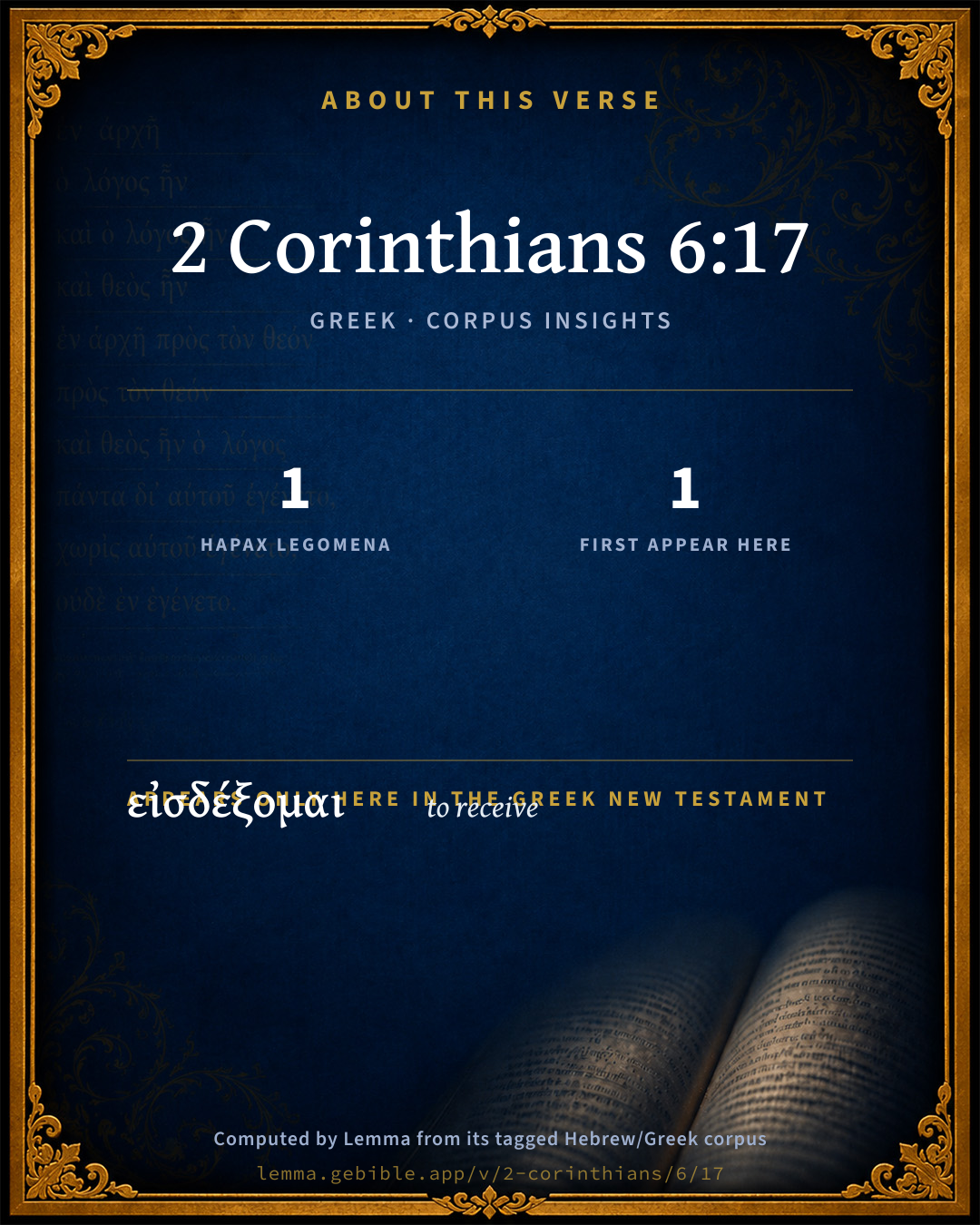
  • 1 hapax legomenon — only here in the Greek New Testament
  • 1 first appearance in the Greek New Testament
Full analysis ↓
Download a study sheet

One document with this verse’s original text, its word-by-word gloss line, the meaning frame, cross-references with their text, attributed commentary, and full source and license credits — printable, and it pastes into notes with its structure intact.

This verse Autodidact and up

Study sheet (.html) Plain text (.txt)

A passage Seminary Student

Up to 50 verses in one chapter. A passage sheet keeps up to 6 commentary sources and 12 cross-references per verse, in the order this page ranks them, and says so on the sheet whenever that leaves anything out. Ask for a single verse and you get the Autodidact verse sheet above.

Everything on this page stays free to read, with no account — the sheet is a download of what is already on screen, not access to it.

Want to remove ads? Support Godless Engineer
Compare translations 3

The same verse in 3 English versions, stacked beneath the original-language interlinear above. Click any original word for its lexicon entry.

Each is an independent rendering of the whole verse — the interlinear is not word-aligned to these translations.

Highlighted words mark where these versions differ — a whole-verse word diff, not a word-by-word alignment.

  • World English Bible Public Domain
    Therefore, "'Come out from among them, And be separate,' says the Lord, 'Touch no unclean thing. I will receive you.
  • King James Version Public Domain
    Wherefore come out from among them, and be ye separate, saith the Lord, and touch not the unclean thing; and I will receive you.
  • unfoldingWord Literal Text CC BY-SA 4.0
    Therefore, “Come out from the midst of them, and be separate,” says the Lord, “and touch no unclean thing,” and “I will welcome you.”

unfoldingWord Literal Text — © unfoldingWord, licensed CC BY-SA 4.0. Word-aligned USFM3 via Door43 (git.door43.org/unfoldingWord/en_ult).

Versions to compare (up to 4)

3 of 4 selected

Show all 19 translations

Every available English version of this verse, each an independent rendering of the whole verse.

  • World English Bible Public Domain
    Therefore, "'Come out from among them, And be separate,' says the Lord, 'Touch no unclean thing. I will receive you.
  • Berean Standard Bible Public Domain
    “Therefore come out from among them and be separate, says the Lord. Touch no unclean thing, and I will receive you.”
  • Majority Standard Bible Public Domain
    “Therefore come out from among them and be separate, says the Lord. Touch no unclean thing, and I will receive you.”
  • King James Version Public Domain
    Wherefore come out from among them, and be ye separate, saith the Lord, and touch not the unclean thing; and I will receive you.
  • American Standard Version (1901) Public Domain
    Wherefore Come ye out from among them, and be ye separate, saith the Lord, And touch no unclean thing; And I will receive you,
  • Revised Version (1885) Public Domain
    Wherefore Come ye out from among them, and be ye separate, saith the Lord, And touch no unclean thing; And I will receive you,
  • Geneva Bible (1599) Public Domain
    Wherefore come out from among them, and separate your selues, saith the Lord, and touch none vncleane thing, and I wil receiue you.
  • Douay-Rheims (1899) Public Domain
    Wherefore, Go out from among them, and be ye separate, saith the Lord, and touch not the unclean thing:
  • Young's Literal Translation Public Domain
    wherefore, come ye forth out of the midst of them, and be separated, saith the Lord, and an unclean thing do not touch, and I -- I will receive you,
  • Literal Standard Version CC BY-SA 4.0
    for this reason, come forth out of the midst of them, and be separated, says the LORD, and do not touch an unclean thing, and I will receive you,
  • Unlocked Literal Bible CC BY-SA 4.0
    Therefore, “Come out from among them, and be set apart,” says the Lord. “Touch no unclean thing, and I will welcome you.
  • unfoldingWord Literal Text CC BY-SA 4.0
    Therefore, “Come out from the midst of them, and be separate,” says the Lord, “and touch no unclean thing,” and “I will welcome you.”
  • Darby Bible Public Domain
    Wherefore come out from the midst of them, and be separated, saith [the] Lord, and touch not [what is] unclean, and *I* will receive you;
  • World Messianic Bible Public Domain
    Therefore “‘Come out from among them, and be separate,’ says the Lord. ‘Touch no unclean thing. I will receive you.
  • Webster's Bible Public Domain
    Wherefore come out from among them, and be ye separate, saith the Lord, and touch not the unclean thing; and I will receive you;
  • Free Bible Version CC BY-SA 4.0
    “So leave them, and separate yourselves from them, says the Lord. Don't touch anything that is unclean, and I will accept you.”
  • Bible in Basic English Public Domain
    For which cause, Come out from among them, and be separate, says the Lord, and let no unclean thing come near you; and I will take you for myself,
  • Text-Critical English NT CC BY 4.0
    Therefore, come out from among them and be separate, says the Lord. Touch no unclean thing, and I will receive you.
  • Tyndale New Testament (1534) Public Domain
    Wherfore come out from amonge the and separate youreselues (sayth the lorde) and touche none vncleane thynge: so wyll I receave you

Literal Standard Version (2020), Covenant Press — licensed CC BY-SA 4.0. Text via the HelloAO Bible API (eBible.org). Unlocked Literal Bible (unfoldingWord) — licensed CC BY-SA 4.0. Text via the HelloAO Bible API (eBible.org). unfoldingWord Literal Text — © unfoldingWord, licensed CC BY-SA 4.0. Word-aligned USFM3 via Door43 (git.door43.org/unfoldingWord/en_ult). Free Bible Version, Dr. Jonathan Gallagher — licensed CC BY-SA 4.0. Text via the HelloAO Bible API (eBible.org).

Word by word

More ways to search: Search by grammar → Find every occurrence → Compare this word →

Practice this passage: Drill this verse → Learn its vocabulary →

εἰσδέξομαι
eisdéchomai
G1523
“to receive”
Verb, Future, Middle deponent, Indicative, 1st person, Singular
Part of Speech
Verb
Tense
Future
Voice
Middle deponent
Mood
Indicative
Person
1st person
Number
Singular
Full Thayer's Definition

Origin: from G1519 and G1209

TDNT: 02:57,1

1. to receive kindly, to treat with favour
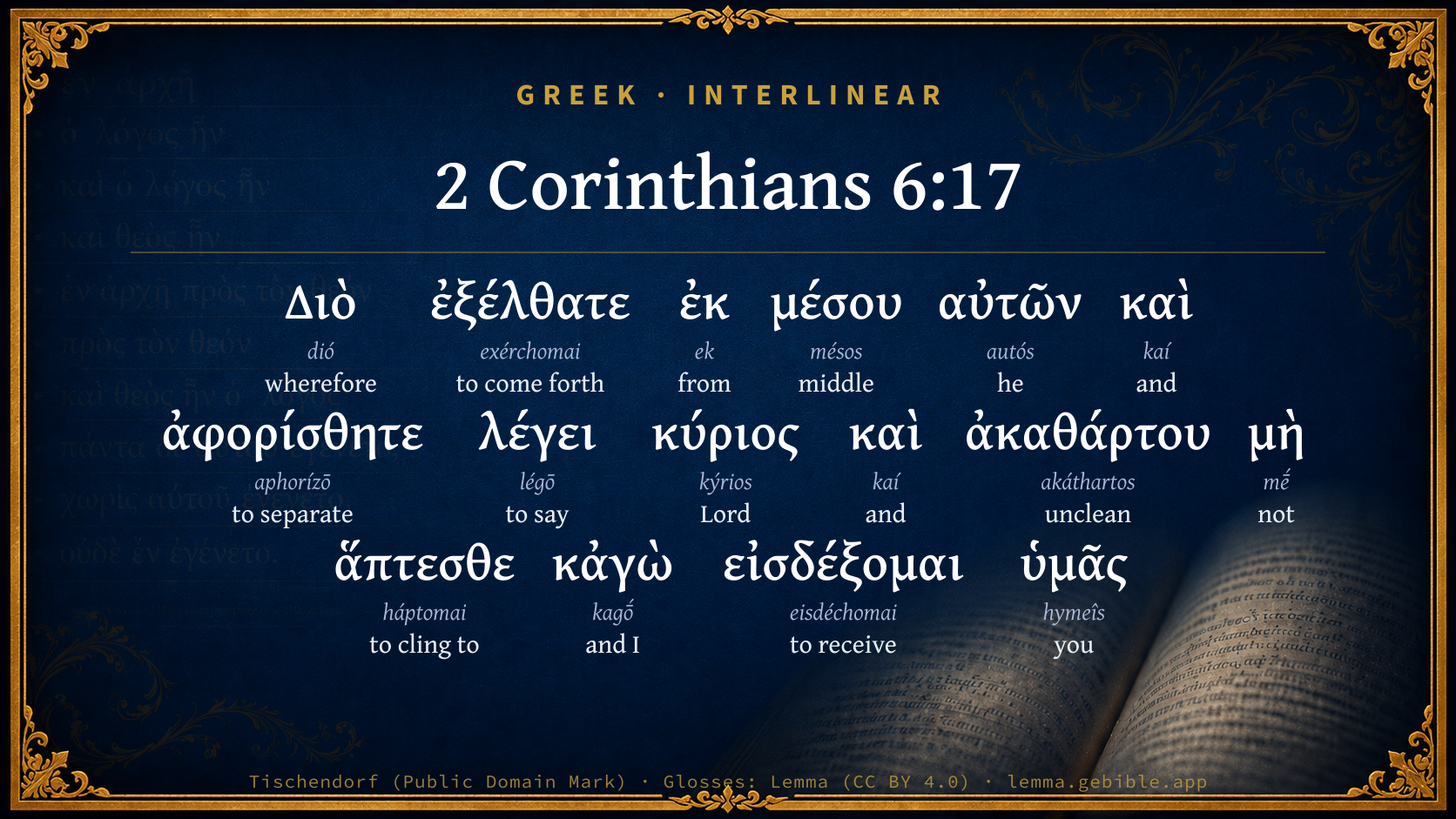
  1. Διὸ dió G1352 “wherefore” Conjunction
  2. ἐξέλθατε exérchomai G1831 “to come forth” Verb, Aorist, Active, Imperative, 2nd person, Plural
  3. ἐκ ek G1537 “from” Preposition
  4. μέσου mésos G3319 “middle” Adjective, Genitive, Singular, Neuter
  5. αὐτῶν autós G846 “he” Personal pronoun, Genitive, Plural, Masculine
  6. καὶ kaí G2532 “and” Conjunction
  7. ἀφορίσθητε aphorízō G873 “to separate” Verb, Aorist, Passive, Imperative, 2nd person, Plural
  8. λέγει légō G3004 “to say” Verb, Present, Active, Indicative, 3rd person, Singular
  9. κύριος kýrios G2962 “Lord” Noun, Nominative, Singular, Masculine
  10. καὶ kaí G2532 “and” Conjunction
  11. ἀκαθάρτου akáthartos G169 “unclean” Adjective, Genitive, Singular, Neuter
  12. μὴ mḗ G3361 “not” Particle, Negative
  13. ἅπτεσθε háptomai G680 “to cling to” Verb, Present, Middle, Imperative, 2nd person, Plural
  14. κἀγὼ kagṓ G2504 “and I” Personal pronoun, 1st person, Nominative, Singular, Aramaic form
  15. ὑμᾶς hymeîs G5210 “you” Personal pronoun, 2nd person, Accusative, Plural

About this verse

These counts appear in no published source. They are computed here, from the morphology-tagged text and Lemma’s own curated glosses. What Lemma adds →

16
words
15
distinct lemmas
Pauline Epistles
section

Notable vocabulary

1 hapax legomenon — a word that appears only here in the entire Greek New Testament:

  • εἰσδέξομαι to receive G1523

First appearance in Scripture

This word makes its first canonical appearance in the Greek New Testament here:

  • εἰσδέξομαι to receive G1523

Shared distinctive vocabulary

ἀφορίσθητε to separate G873 occurs in 9 verses of the Greek New Testament. Also found in:

Repetition

A word recurs within this verse:

Cross-references

14

Topical passages linked to 2 Corinthians 6:17 in the Treasury of Scripture Knowledge — connected by theme and wording, ordered by reader-vote popularity; previews shown in the World English Bible.

  • Isaiah 52:11 Depart you, depart you, go you out from there, touch no unclean thing; go you out of the midst of her; cleanse yourselves, you who bear the vessels of Yahweh.
  • Revelation 18:4 I heard another voice from heaven, saying, "Come out of her, my people, that you have no participation in her sins, and that you don't receive of her plagues,
  • 2 Corinthians 7:1 Having therefore these promises, beloved, let us cleanse ourselves from all defilement of flesh and spirit, perfecting holiness in the fear of God.
  • Psalms 1:1–3 Blessed is the man who doesn't walk in the counsel of the wicked, Nor stand in the way of sinners, Nor sit in the seat of scoffers;
  • Numbers 16:26 He spoke to the congregation, saying, Depart, I pray you, from the tents of these wicked men, and touch nothing of theirs, lest you be consumed in all their sins.
  • Ezra 10:11 Now therefore make confession to Yahweh, the God of your fathers, and do his pleasure; and separate yourselves from the peoples of the land, and from the foreign women.
  • Proverbs 9:6 Leave your simple ways, and live. Walk in the way of understanding."
  • Acts 2:40 With many other words he testified, and exhorted them, saying, "Save yourselves from this crooked generation!"
  • Jeremiah 51:6 Flee out of the midst of Babylon, and save every man his life; don't be cut off in her iniquity: for it is the time of Yahweh's vengeance; he will render to her a recompense.
  • John 6:37–38 All those who the Father gives me will come to me. Him who comes to me I will in no way throw out.
  • Numbers 16:21 Separate yourselves from among this congregation, that I may consume them in a moment.
  • Ezra 6:21 The children of Israel who had come again out of the captivity, and all such as had separated themselves to them from the filthiness of the nations of the land, to seek Yahweh, the God of Israel, ate,
  • Numbers 16:45 Get away from among this congregation, that I may consume them in a moment. They fell on their faces.
  • Romans 15:7 Therefore receive one another, even as Christ also received you, to the glory of God.

Cross-references courtesy of OpenBible.info (CC BY 4.0).

Commentary

Notes on 2 Corinthians 6:17 from classic Christian and Jewish commentators (each source and its license shown beneath its notes). The classic Christian expositions comment on the surrounding passage and are grouped to its opening verse, so a note may address several verses; the Jewish commentaries on the Tanakh (Rashi and others) are per-verse, so they appear only where the commentator wrote on this verse.

Lemma curates 59 commentaries, every one of them public domain or Creative Commons licensed, each selected and text-cleaned for this edition rather than reprinted as found. About our sources →

The Biblical Illustrator

Joseph S. Exell

2Co_6:17-18

Wherefore come ye out from among them, and be ye separate.

Separation from the world

When a person conversant with the vegetable productions of the earth, observes in the forest a plant whose properties he is desirous of improving, he removes it from its native wild into his garden. There, rooted in luxuriant soil, sheltered from inclement blasts, secured against immoderate humidity, duly watered in seasons of drought, defended from the encroachment of worthless herbs which even in that cultivated spot are continually springing on every side; it testifies by a conspicuous transformation the fostering care of its protector. Its growth enlarges; its juices are meliorated; its tints are heightened; its fragrance is exalted; its fruits are multiplied. It is no longer a barren weed; but the delight of him who has appropriated it to himself. In correspondence with the general outlines of this similitude, the God of mercy purifies unto Himself a peculiar people. Between the objects of favour, however, in the two cases, there exists a very important difference. The plant is unconscious, senseless, passive. Choice has no concern in its improvement. Not so the human being addressed by the gospel. Him God has created a moral agent. From him God requires active concurrence; co-operation of the will manifested by exertions of obedience. He does not hurry the man by arbitrary force from amidst the thorns and thistles of iniquity. Come out from among them, He cries, and be separate. Bestowing on the helpless individual adequate powers by the influence of His Spirit, He commands him to exert them and come forth. (T. Gisborne, M. A.)

Separation from the world, Christian service

I. Is a distinct act.

1. It is a change of masters.

2. It is a change of companion. Worldly men are not suitable, healthy, or possible companions for Christians.

3. It is a change of views, and habits, and ways.

II. Is a distinct existence. It involves a separateness. The Church is separate.

1. As an institution.

2. As a community.

3. As a moral influence.

III. Is a holy condition. Touch not the unclean thing. Although this at the first applied only to idolatry, we may take it as applying to every unclean thing.

1. Evil is offensive to God.

2. Evil hinders all good in the soul. It is as the thorns which destroy and choke the wheat.

3. Evil is incompatible with good. Fire and water cannot coexist.

IV. Brings the acceptance and reward of God. Acceptance involves--

1. Reconciliation.

2. Restoration to privileges.

3. Complete forgiveness, peace, and happiness. (J. J. S. Bird, M. A.)

Renouncing the world

I. We must renounce its corrupt maxims and doctrines.

II. We must forsake the unhallowed pleasures and amusements of the world.

III. We must be separated from the world in its general spirit and character. (J. Richards.)

Separation and adoption

I. The precept. In order to a Christian position there must be a special act which determines on which side of one fixed line the rest of our actions shall stand.

1. This act is the same deep necessity now that it was in Corinth. The human heart is the same, and the same temptations, with only slight variations in their form, still beset men. Every age brings its new brood of vices and adds to the funded stock, but very few that have once got a foothold die out. History hardly tells of one extinct species in the flora of guilt. If civilisation multiplies the refinements of culture, so does it the refinements of iniquity. Nay, men are just as eager to climb up some other way, instead of entering by the lowly door of repentance and faith. And therefore the responsibility of choice is just as pressing. It is impossible to evade it and slip into any third way. On one side we must be--Christs or Belials. We do assort with the unbelievers, or come out from among them and be separate, and the Judge knows which we do.

2. The Church has sometimes made a mistaken use of this truth. It has done so whenever it has stood, a Pharisee, aloof from the throng of humanity, saying scornfully, I am holier than thou. It has done so whenever it has made dress, badge, ritual, feeling, professions the line of distinction rather than a principle ruling the life. The right way for the Church to distinguish itself from the world is as its Head distinguished Himself--by a purer holiness and a warmer zeal to help and save the world. Christian men should be known by every nobler disposition, lovelier trait, and holier deed.

3. Nevertheless, it will be true that there is a distinction or a coming out, that mankind are of two armies under two leaders, that outward decency cannot be taken for inward renewal, self-cultivation for the upward-looking faith which works by love and through Christ receives the Spirit.

4. Till each individual soul has chosen to clear itself of all entangling alliances with the one of these two opposing forces and pledged itself to the other, how can it imagine it is safe?

5. A beginning and a continuing, a revolution and a habit, a new principle and a new life is this great decisive act. A coming out from irreligious associations is one part. It implies energy of purpose kindled by faith. Being separate implies the maintenance of the ground thus taken against all opponents, whether they frown or laugh, sneer or slight, reason or threaten. Touch not the renounced pollution, is an adjuration to the sanctified conscience. And these are the three daily heroisms in the discipline of the soldier of Jesus Christ.

II. To the sternness of the law is added the tenderness of grace.

1. If man will do his part, God does His. God worketh within us to will and to do, prompting holy desires and stirring the stagnant fountain. No man can come to Me except the Father who hath sent Me draw him. When that dinner of husks is fairly ended and the prodigals penitence has directed his feet towards home, the first form his lifted eyes see is his fathers, meeting him while yet a great way off. An infinite benediction falls on the returning child; you feel the power of the promise, I will receive you, etc. Sons and daughters! Not children merely, losing individual consolation in the generality of the family! God uses names that come nearer to personal affection and meet a personal want. He calleth His own by name. And whereas it was the Lord that said, Come, it is the Lord Almighty, with His onmipotence the guarantee of His promise, that says, Ye shall be My sons and My daughters.

2. The practical results upon character.

(1) Confirming, and chiefly by fostering in the heart a keener abhorrence of sin. Under the witnessing of that Divine Guest impurity, selfishness, uncharitableness grow insupportably hateful.

(2) Supporting: by supplying heavenly arms under the agitations of sorrow.

(3) Quickening: by fresh spiritual communications out of His own fulness, giving to your growing holiness an increasing power of life. (Bp. Huntington.)

Soul salvation consists in

I. World renunciation. Come out from among them. The renunciation must be--

1. Voluntary.

2. Entire. Touch not the unclean thing--i.e., sin, in all its forms and phases.

II. Divine adoption. I will receive you, etc. As a father, what does He do for His children?

1. He loves them.

2. He educates them.

3. He guards them.

4. He provides for them. (D. Thomas, D. D.)

The greatest revolution

The text demands a change in human life, of all changes the most urgent and glorious-the change without which all other changes are not only worthless, but disastrous. It involves--

I. An urgent separation. Come out from among them. Them--the carnal, idolatrous, corrupt men of the world.

1. How? Not by personally withdrawing from all communication with them. This, if possible, would neither be right, generous, nor useful. It means come out from them in spirit. Let your intercourse with them be like that of angels, who had no sooner discharged their errand than they flew back with rapid wing to the pure heavens again.

2. The Divine command implies--

(1) Urgency. So long as you mingle in sympathy with the ungodly you are degrading your nature, imperilling your interests, incurring the displeasure of your God.

(2) Strenuous effort. Heaven will not drag you out against your will; you must marshal your own energies and struggle away from the magic dominion of evil. He who would be free, himself must strike the blow. Come out from this moral Egypt; flee from this Sodom; forsake this Babylon!

II. A glorious identification. I will receive you, etc. Here is--

1. A Divine reception. Here is a compensation for all the sacrifices you may be required to make. What matters it that you leave old fellowships, even father, mother, children?

2. Divine affiliation. (Homilist.)

And will be a Father unto you.--

The Fatherhood of God

I. The promise.

1. I will be a Father unto you. Some may inquire, How is it that God here promises to be what He is? The text is an assurance that God will act the part of a Father. There is, alas! many a parent who does not act the part of a father to his children. But can God, the Father of spirits, act in an unpaternal way toward any of His children?

(1) No. He treats none with unkindness or injustice. His offers of mercy are to all; for all Christ died.

(2) Yes. In so far as His children refuse to allow Him to act a parental part. Consider the Prodigal Son. The father is still the father, but he does not act the part of a father, just because that child has chosen to betake himself to the far country. So soon as he penitently returns, the parent in loving welcome shows himself to be what he really is--a father. So God remains under all circumstances the Father of our spirits; and the question is, whether we will permit Him to be a father to us. It is one thing to have the conviction that God made us, and another to be assured that He loves us with as much individual tenderness as if no other created being existed. Do any ask, How can this be? How can it not be? If a man has seven children, does he love each only one-seventh as much us he would do if he had but one? Nay, if there be any difference, he will love each the more, because of the expansive influence on his heart of the love of the many. The infinite God does not love me less because I am one of millions. Let me place myself where I may rejoice in its manifestation.

2. And ye shall be My sons, etc. Is not this a needless tautology? No, God may be a father to us; but except we act as His children we cannot be happy. The love that a mother lavishes upon her wayward children avails not for his joy, but rather acts as a painful rebuke so long as he returns it not and leads an unfilial life. So with regard to God and man. How gracious, then, this twofold promise! He will not only show us parental affection, but give us a filial heart.

II. Its condition. Some ignore this, and then complain that in their experience the promise is not fulfilled.

1. Separation unto God is demanded (2Co_6:17). This does not imply a monkish seclusion. If the Church be so withdrawn from the world, how shall it leaven it with a holy influence? Touch not the unclean thing. Contagion is the idea conveyed. In time of plague it were cruel indeed if all were to flee, but it would be equally their duty to avoid, if possible, contracting the malady, for then their ability to help would be gone. The physician should attend the sufferers, but it would not be well for him to sleep in the infected apartment. But exactly from what amusements, societies, and occupations are we to separate ourselves? Each must be guided by conscience and Scripture. From all that is condemned by Gods Word, that is injurious to our spiritual welfare, that which, though not unlawful, is not needful for us, and may set a bad example, and that about the lawfulness of which we are in doubt we must withdraw ourselves. If the mother is uncertain as to whether some berry for which her child cries is poisonous or not, she will assuredly withhold it; and if we are undecided as to whether some occupation or amusement for which inclination clamours will prove harmful to our soul, let us give God, not our hearts, the benefit of the doubt.

2. Wherefore, thus referring to what he has already said--

(1) For what fellowship hath righteousness with unrighteousness? None, and the believer removing not therefrom is involved in contention which belies his Christianity.

(2) What communion hath light with darkness? None. If there be, it is to the detriment of the light. How has the brightness of many a Christian life been dimmed by intimacy with the ungodly!

(3) And what concord hath Christ with Belial? None. So is there none betwixt those who are Christs disciples and Satans servants. The withdrawal is not to be comprised in a single act, but must be the habit of the life. Pliable found it easy to run from the City of Destruction, hard to continue his journey. (Homilist.)

Sons of God

1. We have here one of the many instances in which the apostle quotes from the O.T. and applies it to Gentile Christians. Now having these promises--we, you, having them! The apostle identified the Jewish and Christian churches, and considered the Scriptures of the first, the inheritance of the second, and that promises addressed to the Jews, and having relation to local and temporary circumstances, have yet an eternal principle in them which makes them applicable to the church in all time.

2. Every thoughtful person is conscious, immediately the idea is suggested of men being the children of God, of the feeling that this relationship is common to all men. Paul himself adopts the saying of the Greek poet, And we His offspring are. Simply considered in their human character men are the children of God, but some men are the sons of God in a sense different from others.

I. The origin and source of this peculiar relationship, Christianity is a supernatural intervention of God, and it teaches that men become the sons of God in a sense which cannot be predicated of them in their previous natural condition (Joh_1:12-13). They are not born of blood, of one particular race; it is not because of being either Jew or Gentile, of the family of Seth or of Shem, which makes men sons of God. Nor of the will of the flesh. This privilege is not an inherent element in humanity which only requires development. Nor by the will of man--i.e., in respect to external acts, rites, or sacraments, which a man has power to dispense or to keep back; neither of caste, induction, or ritualism, but of God--you are born of Him. There is through Christ, and in connection with the truth of Christ, a direct influence and operation of the Spirit of God upon the soul of a believing man, infusing a new spiritual life into the conscience, and that spiritual living man is a son of God, and shelters himself under the Divine Fatherhood in a sense altogether unique.

II. Its privileges.

1. Honour, nobility. Behold what manner of love the Father hath bestowed upon us, that we should be called the sons of God!

2. The conscious utterance of sentiments and feelings appropriate to this relationship. Because ye are sons God hath sent forth the Spirit of His Son into your hearts, crying, Abba, Father.

3. The indwelling of the Spirit--the Spirit which regenerates and sanctifies, not only enters, but makes the heart His home, filling it with light and peace.

4. A life of filial confidence; the belief that they shall have from their Father what is necessary, both for temporal and spiritual life. Why take you thought for raiment, etc.?

5. Heirship. If children, then heirs, heirs of God and joint-heirs with Jesus Christ.

III. Its duties.

1. A perpetual, calm, grateful joy. I think it a great thing to be born into this world--to be a man. To be possessed of these senses and faculties, to have Gods universe spread before us with all the intellectual and moral force that we have within us, even life, with its warfare, its work, and its vicissitudes--about all these things there is joy. Aye, but to be born again, to have the spiritual eye opened to those things which are only realised by faith, to be born into this new and spiritual world, to awake up to a consciousness that through Christ we are the sons and daughters of God--how we ought to rejoice in that!

2. A ready acknowledgment of the relationship. Men are not ashamed to own a relationship with illustrious ancestors. And there is something wrong when Christians are ashamed of their relationship to God, of that highest nobility that God can confer.

3. Obedience.

(1) The obedience of children. A little child does not ask reasons, or if it does it is told to wait. Christians should apply this to themselves, and remember that part of the duty of sons to their Divine and loving Father is prompt obedience.

(2) But added to that there must be the obedience of men--I mean that with enlightened reason, and with high and glowing purpose, you shall determine that, God helping you, you will live and act worthy of your parentage.

4. Contentedness with our lot, and a using of our spiritual privileges--delight in the intercourse with our Father, acquiescence in chastisement, and an exercise of filial faith in what is to be the end proposed by Him.

5. A gradual preparation for that great day when the Son shall appear in the presence of the Father, and when there shall be a blessed realisation of the hope which has sustained the child from the beginning.

IV. Its ultimate consummation.

1. The glorification of your entire nature. You look for your Saviour to sanctify your souls, and you took for Him to change your body, that it may be fashioned like unto His glorious body. This is to be the beginning of the consummation, and will lead to the period when there will be the whole family in heaven.

2. Positive and conscious association with the elder sons of creation, who kept their first estate, and who rejoice over one sinner that repenteth. Their joy will be full when the two races--the fallen and the unfallen … shall be brought together in visible companionship before the throne of God. (T. Binney.)

.

The Biblical Illustrator, edited by Joseph S. Exell (c. 1880s–1900s) — public domain. Text from a community e-Sword module.

Joseph Benson's Commentary

2Co 6:17-18. Wherefore — Encouraged by this gracious promise, and that you may obtain the fulfilment of it; come out from among them — Withdraw yourselves from all intimate society with them; and be ye separate — As God’s promise of dwelling in a peculiar manner among the Israelites, obliged them to separate themselves from the converse of their heathen neighbours, that they might not be insnared with their superstitions; much more are Christians obliged, by that peculiar gracious presence of God which they enjoy, or may enjoy, to separate themselves from the society of the ungodly, and from all their sinful practices, customs, and habits. And touch not the unclean thing — Keep at the utmost distance from every person and thing whereby you might be drawn into evil, and contract guilt. And I will receive you — Into my house and family. And will be a father unto you — Will stand to you in the near relation of a father; loving you, caring and providing for you; allowing you near access to, and close intimacy with, myself. And ye shall be my sons and daughters — And therefore mine heirs, and joint-heirs with my only- begotten and beloved Son; saith the Lord Almighty — That infinitely great and omnipotent Being, who is the maker and upholder, the author and end of all things. This promise made to Solomon, (1Ch 28:6,) is here applied to all believers; as the promise made particularly to Joshua is applied to them, Heb 13:5. Who can express the worth, who can conceive the dignity of this divine adoption? Yet it belongs to all who believe the gospel with a living, operative faith; to all who so receive Christ in his sundry offices as to be born of God, Joh 1:12-13. They have access to the Almighty; such free and welcome access as a beloved child to an indulgent father. To him they may flee for aid in every difficulty, and from him obtain a supply of all their wants.

Joseph Benson's Commentary on the Old and New Testaments (1811–1818) — public domain. Text from a community e-Sword module.

Scofield Reference Notes

C. I. Scofield

come out from among them

Separation, Summary:

(1) Separation in Scripture is twofold: "from" whatever is contrary to the mind of God; and "unto" God Himself. The underlying principle is that in a moral universe it is impossible for God to fully bless and use His children who are in compromise or complicity with evil. The unequal yoke is anything which unites a child of God and an unbeliever in a common purpose Deu 22:10.

(2) Separation from evil implies (a) separation in desire, motive, and act, from the world, in the ethically bad sense of this present world-system. (See Scofield "Rev 13:8") and (b) separation from believers, especially false teachers, who are "vessels unto dishonour" 2Ti 2:20; 2Ti 2:21; 2Jn 1:9-11.

(3) Separation is not from contact with evil in the world or the church, but from complicity with and conformity to Joh 17:15; 2Co 6:14-18; Gal 6:1.

(4) The reward of separation is the full manifestation of the divine fatherhood 2Co 6:17; 2Co 6:18 unhindered communion and worship Heb 13:13-15 and fruitful service 2Ti 2:21 as world-conformity involves the loss of these, though not of salvation. Here, as in all else, Christ is the model. He was "holy, harmless, undefiled, and separate from sinners" Heb 7:26 and yet in such contact with them for their salvation that the Pharisees, who illustrate the mechanical and ascetic conception of separation (See Scofield "Mat 3:7"), judged Him as having lost His Nazarite character. Luk 7:39 Cf; 1Co 9:19-23; 1Co 10:27.

The Scofield Reference Bible (1917 edition), notes by C. I. Scofield — public domain. Text from a community e-Sword module.

Bengel's Gnomon

Johann Albrecht Bengel

2Co 6:17. Ἐξέλθετε—μὴ ἅπτεσθε) Isa 52:11, ἀπόστητε, ἀπόστητε, ἐξέλθετε ἐκεῖθεν, καὶ ἀκαθάρτου μὴ ἅψησθε· ἐξέλθτετ ἐκ μέσου αὐτῆς, ἀφορίσθητε, κ.τ.λ.—ἐκ μέσου αὐτῶν, from the midst of them) from the Gentiles.—λέγει Κυρίος, saith the Lord) The additional epithet follows [in 2Co 6:18, augmenting the force of the words by Epitasis (end.)], the Lord Almighty.—ἀκαθάρτου, unclean) The masculine, Isa 52:11; Isa 52:1: comp. Isa 65:5. To this may be referred, let us cleanse ourselves, ch. 2Co 7:1.—μὴ ἅπτεσθε, touch not) To see, when it is necessary, does not always defile: Act 11:6; to touch is more polluting.—εἰσδέξομαι, I will receive you [within] to me) as into a family or home [Comp. ch. 2Co 5:1-10.—V. g.] We are out of doors, but we are admitted within. The clause, Come out from, etc., corresponds to this. God is in the saints, 2Co 6:16, and the saints are in God. εἰσδέχομαι corresponds to the Hebrew word קנץ, Eze 20:41; Zep 3:19-20.

Bengel's Gnomon of the New Testament — English translation (T&T Clark, Edinburgh, 1860) — public domain. Text from a community e-Sword module.

Meyer's Critical & Exegetical Commentary

Heinrich August Wilhelm Meyer

2Co_6:17. With the foregoing quotation Paul now combines another in keeping with his aim (2Co_6:14), containing the application which God has made of His previous promise. But this quotation is still freer than the one before, after the LXX. Isa_52:11, and the last words, κἀγὼ εἰσδέξομαι ὑμᾶς, are perhaps joined with it through a reminiscence of Eze_20:34 (comp. Eze_11:17; Zec_10:8). Osiander and most expositors find in κἀγὼ εἰσδέξ. ὑμ. a reproduction approximately as to sense of the words in Isa_52:12 : καὶ ὁ ἐπισυνάγων ὑμᾶς κύριος ὁ θεὸς Ἰσραήλ; but this is, at any rate, far-fetched, and, considering Pauls usual freedom in joining different passages of the O. T., unnecessarily hars.

αὐτῶν] applies to the heathen.

ἀκαθάρτου μὴ ἅπτεσθε] Just as ἐξέλθετε κ.τ.λ. had referred (aorist) to the separation to be accomplished from the fellowship of heathen life, so this refers, in the sense of the prophetic fulfilment, to the continuing (present) abstinence from all heathen habits (not simply from offerings to idols), and κἀγὼ εἰσδέξ. ὑμ. to their reception into sonship, see 2Co_6:18. It is correlative to ἐξέλθατε; God wishes to receive those who have gone forth into His paternal house, i.e. into the fellowship of the true theocracy (2Co_6:18).

Meyer — Critical and Exegetical Commentary on the New Testament — English translation by Peter Christie, edited by Frederick Crombie (T&T Clark, 1880) — public domain. Text from a community e-Sword module.

Expositor's Greek Testament

ed. W. Robertson Nicoll

2Co 6:17 . διὸ ἐξέλθετε κ . τ . λ .: wherefore, “Come out from among them and be separate” saith the Lord , “ and touch not an unclean thing and I will receive you .” So, too, the Heavenly Voice of the Apocalypse cried “Come out of her” to those who were in danger of contamination with the sins of pagan Rome (Rev 18:4 ). But the command must not be misapplied. St. Peter was wrong in “separating” himself from his Gentile brethren (Gal 2:12 ), as he was wrong in calling that “unclean” which God had cleansed (Act 10:14 ). And St. Paul never counsels any at Corinth to “separate” himself from the body of his fellow Christians on account of their sinful lives. (1Co 5:13 is a direction to the Church to excommunicate a sinful member, a quite different thing.) To the Apostle separation from heathendom was imperative, but separation from the Christian Church was a schism and a sin.

The Expositor's Greek Testament, edited by W. Robertson Nicoll (1897–1910) — public domain. Text from a community e-Sword module.

Jamieson, Fausset & Brown

Robert Jamieson, A. R. Fausset & David Brown

Quoted from Isa 52:11, with the freedom of one inspired, who gives variations sanctioned by the Holy Spirit.

be ye separate--"be separated" (Hos 4:17).

touch not the unclean thing--rather, "anything unclean" (Co2 7:1; Mic 2:10). Touching is more polluting, as implying participation, than seeing.

receive you--The Greek implies, "to myself"; as persons heretofore out of doors, but now admitted within (Co2 5:1-10). With this accords the clause, "Come out from among them," namely, so as to be received to me. So Eze 20:41, "I will accept you"; and Zep 3:19, "gather her that was driven out." "The intercourse of believers with the world should resemble that of angels, who, when they have been sent a message from heaven, discharge their office with the utmost promptness, and joyfully fly back home to the presence of God" (Co1 7:31; Co1 5:9-10).

Jamieson, Fausset & Brown — Commentary Critical and Explanatory on the Whole Bible (1871) — public domain (CC PDM 1.0). Text via the HelloAO Bible API.

Adam Clarke's Commentary

Verse 17. Wherefore come out from among them] Is it not plain from this and the following verse that God would be their God only on the ground of their taking him for such, and that this depended on their being separated from the works and workers of iniquity? for God could not inhabit in them if they had concord with Belial, a portion with infidels; c. Those who will have the promises of God fulfilled to them must come under the conditions of these promises: if they are not separate-if they touch the unclean thing, God will not receive them and therefore will not be their God, nor shall they be his people.

Adam Clarke's Commentary on the Bible (1810–1826) — public domain. Text from a community e-Sword/MySword module.

John Calvin's Commentaries

17. Wherefore come out from the midst of them. This exhortation is taken from Isaiah 52:11, where the Prophet, when foretelling the deliverance, at length addresses the priests in these terms. For he makes use of a circumlocution to describe the priests, when he says, Ye that bear the vessels of the Lord, inasmuch as they had the charge of the vessels, by means of which the sacrifices, and other parts of divine worship, were performed. There can be no doubt that his design is to admonish them, that, while eagerly desirous to come forth, they should be on their guard against any contamination from the many pollutions with which the country was overrun. Now this is no less applicable to us, than to the ancient Levites, for if so much purity is required on the part of the keepers of the vessels, how much more in the vessels themselves! Now all our members are vessels, set apart for the spiritual worship of God; we are also a royal priesthood. (1 Peter 2:9.) Hence, as we are redeemed by the grace of God, it is befitting that we keep ourselves undefiled in respect of all uncleanness, that we may not pollute the sanctuary of God. As, however, while remaining in this world, we are nevertheless redeemed, and rescued, from the pollutions of the world, so we are not to quit life with the view of departing from all uncleanness, but must simply avoid all participation. The sum is this. “If with a true affection of the heart, we aim at the benefit of redemption, we must beware of defiling ourselves by any contamination from its pollutions.”

John Calvin's Commentaries (1540-1563) — public domain. Text from the Calvin Translation Society English edition (1840s-50s) via the Christian Classics Ethereal Library (ccel.org). Calvin's coverage is partial (roughly two-thirds of the Bible); uncommented books and verses are honest gaps, never fabricated. The 19th-century editor's footnotes and remarks are omitted so the notes are faithfully Calvin's own voice.

Ellicott's Commentary for English Readers

(17) Wherefore come out from among them.—Another composite quotation follows, beginning with Isa_52:11. In their primary historical sense, the words were addressed as to the priests and Levites who were to return from Babylon. They were not to bring back with them any symbol of that “unclean” ritual which they had witnessed there. The local and historical meaning has for the Apostle passed away, and the “unclean thing” is identified with the whole system of heathenism. The close connection of this verse with the great prophecy of the atoning work makes it probable that, in writing of that work, St. Paul had remembered, or, perhaps, actually turned to Isaiah 53, as it stood in the LXX. version, and so was led on to the verse which almost immediately preceded it. “I will receive you” comes, in lieu of the ending of Isaiah, from the Greek of Eze_11:17; Jer_24:5.

A Bible Commentary for English Readers, edited by Charles John Ellicott (1878–1897) — public domain. Text from a community e-Sword module.

The Cambridge Bible for Schools and Colleges

gen. ed. J. J. S. Perowne

17. Wherefore come out from among them] A combination of Isa_52:11 with Eze_20:34. This passage must be read in conjunction with 1Co_5:10, and must be understood not of absolute separation, but of abstinence from any kind of intimacy. “Wherever union in the highest cannot be, wherever idem velle atque idem nolle is impossible, there friendship and intimate partnership must not be tried.” Robertson.

and touch not the unclean thing] The passage (see Isa_52:11) refers to the priests and Levites, and relates to the ceremonial defilement caused by contact with whatever was unclean. See for instance Lev_11:8; Lev_11:24; Lev_11:31-40; also Rev_18:4.

The Cambridge Bible for Schools and Colleges (gen. ed. J. J. S. Perowne; Cambridge University Press, 1878–1918) — public domain. Text from a community e-Sword module.

John Gill's Exposition

And will be a father unto you,.... The same is promised to Solomon, Sa2 7:14 and said of Israel, Jer 31:9 which is thought to be referred unto. This is not to be understood of the first commencement of this relation, as though God now began to be their Father; nor indeed of the first manifestation of it, which had been already made to their souls by the Spirit of adoption, witnessing to their spirits that God was their Father, and they were his children; but of his acting, and continuing to act the part of a father to them; which he does, by pitying his children, sympathizing with them, and supporting them under all their trials and afflictions; by taking care of them, that they have food and raiment convenient for them; by laying up for them, as he has done in his covenant, in his Son, and in heaven; by communicating unto them, by passing by their offences and miscarriages to him, and by correcting them for their good, and at last giving them the heavenly inheritance, and putting them into the possession of it:

and ye shall be my sons and daughters. This also does not relate to the first act of adoption, when these persons first became the sons and daughters of God; for so they were by adopting grace, in the mind, counsel, and covenant of God, from eternity; as such they were considered when given to Christ, when he assumed their nature, and died to gather them together in one; and as antecedent to faith and the work of the Spirit upon their souls: nor even of the first discovery of this grace unto them; but the meaning is, that whereas they were the sons and daughters of God, they should be treated as such; whenever he spoke to them, or dealt with them in providence, he would speak to them and deal with them as children; or it may refer to the more full and open manifestation of their sonship, before angels and men, at the appearance of Christ: to all which is added,

saith the Lord Almighty; for confirmation sake, and to encourage the faith of the saints; since he who said all this is the Lord God Almighty, and so able to perform it; and of which, and his willingness, no question is to be made, since he has said it.

Next: 2 Corinthians Chapter 7

John Gill's Exposition of the Whole Bible (1746–1763) — public domain (CC PDM 1.0). Text via the HelloAO Bible API.

Trapp's Complete Commentary

John Trapp

17 Wherefore come out from among them, and be ye separate, saith the Lord, and touch not the unclean thing; and I will receive you,

Ver. 17. And be ye separate] For gross idolatry and for fundamental errors only must we separate. Corruptions grew so great in the Church of Rome, that it justly occasioned first the separation of the Greek Churches from the Latin, and then of the reformed Churches from the Roman. Machiavel observed; that after the thousandth year of Christ, there was nowhere less piety than in those that dwell nearest to Rome. (Disp. de Rep.) And Bellarmine bewails it, That ever since we cried up the pope for antichrist, his kingdom hath not only not increased, but hath greatly decreased. (Lib. iii. de Papa Rom. c. 21.)

And I will receive you] So you shall be no losers, I will put you into my bosom. God imparteth his sweetest comforts to his in the wilderness, Hos 2:14.

John Trapp, A Commentary or Exposition upon All the Books of the Old and New Testament (1647–1656) — public domain. Text from a community e-Sword module.

Albert Barnes' Notes on the Bible

Wherefore - Since you are a special people. Since God, the holy and blessed God, dwells with you and among you.

Come out from among them - That is, from among idolaters and unbelievers; from a frivolous and vicious world. These words are taken, by a slight change, from Isa 3:11. They are there applied to the Jews in Babylon, and are a solemn call which God makes on them to leave the place of their exile, to come out from among the idolaters of that city and return to their own land; see my note on that place. Babylon, in the Scriptures, is the emblem of whatever is proud, arrogant, wicked, and opposed to God; and Paul, therefore, applies the words here with great beauty and force to illustrate the duty of Christians in separating themselves from a vain, idolatrous, and wicked world.

And be ye separate - Separate from the world, and all its corrupting influences.

Saith the Lord - see Isa 3:11. Paul does not use this language as if it had original reference to Christians, but he applies it as containing an important principle that was applicable to the case which he was considering, or as language that would appropriately express the idea which he wished to convey. The language of the Old Testament is often used in this manner by the writers of the New.

And touch not the unclean thing - In Isaiah, “touch no unclean thing;” that is, they were to be pure, and to have no connection with idolatry in any of its forms. So Christians were to avoid all unholy contact with a vain and polluted world. The sense is, “Have no close connection with an idolater, or an unholy person. Be pure; and feel that you belong to a community that is under its own laws, and that is to be distinguished in moral purity from all the rest of the world.”

And I will receive you - That is, I will receive and recognize you as my friends and my adopted children. This could not be done until they were separated from an idolatrous and wicked world. The fact of their being received by God, and recognized as his children, depended on their coming out from the world. These words with the verses following, though used evidently somewhat in the form of a quotation, yet are not to be found in any single place in the Old Testament In 2Sa 7:14, God says of Solomon, “I will be his Father, and he shall be my son.” In Jer 31:9, God says, “For I am a Father to Israel, and Ephraim is my first-born.” It is probable that Paul had such passages in his eye, yet he doubtless designed rather to express the general sense of the promises of the Old Testament than to quote any single passage. Or why may it not be that we should regard Paul here himself as speaking as an inspired man directly, and making a promise then first communicated immediately from the Lord? Paul was inspired as well as the prophets; and it may be that he meant to communicate a promise directly from God. Grotius supposes that it was not taken from any particular place in the Old Testament, but was a part of a hymn that was in use among the Hebrews.

Albert Barnes' Notes on the Bible (1834–1885) — public domain. Text from a community e-Sword/MySword module.

Matthew Poole's English Annotations

The apostle here quoteth words out of the Old Testament, no where to be found there syllabically, without variation, but keeping to the sense of them, which is a thing very usual with the penmen of the New Testament. The first quotation seemeth to be taken from Isa 52:11; Depart ye, depart ye, go ye out from thence, touch no unclean thing; go ye out of the midst of her; be ye clean, that bear the vessels of the Lord. Interpreters are not agreed as to the term from whence the prophet there admonisheth the Jews to depart: some make it to be their former sinful courses; others make it to be the kingdom of the devil and antichrist; others make it to be literal Babylon; the prophet foreseeing, that when the Jews should have a liberty given them to leave Babylon, (which happened in the time of Cyrus the Persian monarch), some of them (now as it were incorporated with the Chaldeans) would linger, and find a difficulty to pluck up their stakes in Babylon, though it were in order to their return to Jerusalem, heretofore the joy and praise of the whole earth. Whatever was the prophet’s meaning, certain it is, the apostolical precept cannot be interpreted of a leaving literal Babylon, for neither the Christian jews, nor Gentiles, were at this time there; he must therefore be understood of a mystical Babylon. And the sense must be this: Come out and be ye separate from those with whom your souls will be in as much danger as the Jews were in the literal Babylon. But whether by these are to be understood idolaters only, or all notorious scandalous livers, is the question: The true determination of which, I conceive, dependeth upon the sense of those words: Come out, be ye separated; which words, I think, are not fully interpreted by those that follow,

touch not the unclean thing; for, doubtless, the former words are a precept concerning the means to be used in order to that as an end, it being a hard thing to touch pitch, and not to be defiled therewith. On the other side, they interpret it too rigidly, who make it to be a prohibition of all commerce or company with such persons; for this is contrary to the apostolical doctrine in his former Epistle to this church, where he had allowed, 1Co 5:1-13, a civil commerce and traffic with the worst of men; and, 1Co 7:1-40, had forbidden the separation of Christians and heathens, once joined in marriage, unless the unbeliever first departed. The text therefore must be understood only of elective and unnecessary, intimate communion; and is much the same with that, 2Co 6:14; Be ye not unequally yoked with unbelievers. So as that it doth by no means justify the withdrawing of all civil or religious communion from those whose judgments or practice in all things we cannot approve; it only justifieth our withdrawing our communion from idolaters, and from notorious scandalous sinners in such duties and actions, or in such degrees, as we are under no obligation to have fellowship and communion with them in; and our forbearing to touch their unclean things in that fellowship and communion which we are allowed with them, having no fellowship with them in their unfruitful works of darkness, but reproving them, even while in civil things, and some religious actions, we have some fellowship with them.

Matthew Poole's English Annotations on the Holy Bible (1683–1685) — public domain. Text from a community e-Sword/MySword module.

Whedon's Commentary on the Bible

Daniel D. Whedon

17. Wherefore—In order to secure the fulfilment of these promises they must be a faithful and not an apostate Church.

Come out—The earnest warning of Jehovah (to his people to come out from Babylon) applied to the Christian Church to come out from the uncleanness of an unregenerate world. This injunction requires not hatred against the wicked as men, but avoidance of participation in their works as sinners, or in such associations with them as imply a countenancing of their sins.

The unclean thing—The thing defiled with sin, by whose touch you would yourself be defiled.

I will receive you—Namely, into favour and fellowship with myself, and to all the joys of my salvation.

Daniel D. Whedon (gen. ed.), Commentary on the Old and New Testaments (1874–1909) — public domain. Text from a community e-Sword module.

The Pulpit Commentary

From among them; i.e. from among the unbelievers. Touch not the unclean thing (Lev_11:8, etc.; Isa_52:11) I will receive you. (comp. Eze_20:34) These promises to Israel are naturally transferred to the ideal Israel, the Christian Church.

Christian relations with the world.

This verse is a partial quotation from Isa_52:11, which reads, "Depart ye, depart ye, go ye out from thence, touch no unclean thing; go ye out of the midst of her; be ye clean, that bear the vessels of the Lord." The first reference of these words is to the captives in Babylon, who were thus counselled to prepare for their return to Canaan, and to see to it that they carried back with them none of the evils of the idolatrous land in which they had so long sojourned. "The local and historical meaning has for the apostle passed away, and the "unclean thing" is identified with the whole system of heathenism." Since we are counselled to be separate from the world, it will be well for us to understand what is properly meant by "the world." Some have thought that they were called to separate from the world of creation, and compel themselves to find no interest in field, or flower, or song, or the thousandfold charms of nature. Others have thought that "the world" must mean the mass of humanity, and so a true religious life could only be lived in convent or hermit cell. Others, again, think that "the world" must mean the common scenes and pleasures of life, and that we can only live for God by resisting every pleasure and severing ourselves from every form of personal enjoyment. But "the world," in the New Testament sense, is not a thing or a set of things, but a spirit and disposition it is worldliness. It is none of these things, but it may be in them all. It is all these if we persist in having them without God. This green earth, with its vales and hills, apart from God, is just "the world." But with God, seen as God"s, it is no longer "the world;" it is the footstool of the eternal throne, the dwelling place of the Divine majesty, the garment of the all-glorious King. The mass of humanity, without God, is just "the world;" but in the light of God"s relation, it is the Father"s family, the Father"s school. The common cares and pleasures of life are filled with an infinite meaning and importance when they become the testing scenes out of which God purposes to bring his children, "faultless in the presence of his glory." Whether a thing is worldly or not depends simply on this Can you see God in it? To the Christian man God is in everything, and if he finds anything into which he cannot bring the thought of God, then he calls that worldly and shrinks from it. The "world" is that act, that scene, with which we feel the cherished thought of God does not harmonize. It is heaven where God is; it is earth where he is not: it is hell where he will not come.

I THE CHRISTIAN MUST BE IN THE WORLD. He cannot, he may not, get free from outward and physical relations. His present sphere of life and duty is earthly; and his Master did not pray that his disciples should be taken "out of the world.

II THE CHRISTIAN NEED NOT BE OF THE WORLD. In the sense of adopting its principles or its maxims, yielding to its fashions or seeking its ends.

III THE CHRISTIAN MAY BE ABOVE THE WORLD. In the sense of having a Divine life, which masters worldly principles, resists worldly influences, and even makes him a quickening and healing power on the world, as Christ himself was. This is expressed in plain terms by the apostle, in Rom_12:2, "Be not conformed to this world: but be ye transformed by the renewing of your mind." The separation from the world is not to be effected by any mere watching of our acts and habits. Let us realize the higher transformation in the renewal of our minds, and we shall find it easy to reach a true nonconformity to the world. He who glorifies God in the spirit will be sure to glorify him in the body too. He who is daily more renewed in mind will most readily discover, in practical details, what is the "good, and acceptable, and perfect will of God. R.T.

The Pulpit Commentary (1880–1919), ed. H.D.M. Spence-Jones & Joseph S. Exell — public domain. Text from a community e-Sword module.

John Wesley's Explanatory Notes

Touch not the unclean person - Keep at the utmost distance from him. And I will receive you - Into my house and family. Isaiah lii, 11; Zephaniah iii, 19, 20.

John Wesley, Explanatory Notes Upon the Whole Bible (1754–1765) — public domain. Text via the GEBible commentary corpus.

Burkitt's Expository Notes on the New Testament

William Burkitt

As if the apostle had said "Go not then to the idol’s temples, join not with idolaters in communion to avoid persecution; but come out from amongst them, as an holy people separated to the Lord, and defile not yourselves with any unclean thing; and while you are pure, and cleave to God, he wil own you for his sons and daughters."

Observe here, 1. A pressing exhortation to make a full separation from unclean persons and things, particularly from all idolatry and idolatrous worship; Come out from among them. The words are taken out of Isa 52:11 where the prophet exhorts the remnant of Israel to come fully out of unclean Babylon.

Learn hence, That God expects and requires his saints should make a separation from all uncleanness, but especially from the uncleanness of idolatry. God expects a separation from us, from all unclean courses, from all unclean company, from the presence and appearance of all uncleanness, from communion with idolatrous churches, and from communicating with what is sinful in the truest churches of Christ upon earth.

Observe, 2. A quickening encouragement to back this exhortaion: I will receive you, and be a Father to you.

Here is a twofold promise,

1. Of reception, I will receive you.

2. Of adoption, I will be a father to you.

God will receive them both into his house and heart.

Learn hence, That Almighty God will, as a Father, undoubtedly receive all those into his family and favour who renounce communion with all impurity. As he is Almighty, he is abundantly able, and as he is a Father, he is graciously willing, to recompense all the services and sufferings of his children, for the honour and interest of his name and truth.

It is sufficiently known how this text hath been mispplied by separatists to very bad purposes:

1. To justify their schismatical separation from the best and purest of the reformed churches, under pretence of finding greater purity among themselves: whereas nothig will justify a separation from a church, but that which makes a separation between God and that church. If the church’s way of worship (in their opinion) be faulty, they presently pronounce it false, and they must not join in false worship, if all that is faulty be false worship: if Christ doth not disown his church for that faultiness, we ought not to desert her for it.

2. Others would seek occasion from these words, to justify their practice, in refusing to come to the Lord’s table where some vicious persons are apprehended to be, lest they should pollute the ordinance, and there touch the unclean thing; whereas the presence of a bad man at the sacrament pollutes the ordinance only to himself; for unto the pure all things are pure; and who will neglect a certain duty, to escape an uncertain danger? True, we must not own such worship, as we know God rejecteth. But as God pardoneth the faulty imperfections of other men’s worship, and of our own also, thus must we bear with our own and one another’s failings that are tolerable, so far as we cannot cure them.

Woe unto us, had Almighty God no more charity for us than we have for one another! A defective worship is not a false worship; sinful defects in the administration of ordinances, do not hinder the saving effects of ordinances; a wise and good man is certainly as great an enemy to separation, as he is to superstition: doctrines crying up purity, to the ruin of unity, reject; for the gospel calls for unity, as well as for purity.

William Burkitt's Expository Notes on the New Testament (1700–1703) — public domain. Text from a community e-Sword module.

Godbey's Commentary on the New Testament

William B. Godbey

REGENERATION AND SANCTIFICATION

17. “Therefore come out from the midst of them and be ye separate, saith the Lord, and touch not the unclean thing: and I will receive you.

18. “And I will be unto you for a Father, and you shall be unto me for sons and daughters, saith the Lord mighty.” This is clear, grand and glorious on regeneration, a splendid text from which to preach this precious grace to lost sinners. Here the Almighty condescends to call them from the deep abysses of slumdom and filthy cess-pools of iniquity, kindly and lovingly entreating them to leave the devil and his filth, outright and forever, bidding adieu to their old companions in vice and immorality, with a distinct understanding that they are never to return. How lovingly and importunately He here pleads with them, “Touch not the unclean thing”;

i. e., when they leave the devil, their wicked companions and sins, they are never again to touch them. Millions are now in Hell he undertook gradually to break off from sinful habits. In that case the gradualism generally runs the wrong way. No drunkard ever reforms gradually; he can not do it. With him it is sudden and eternal abandonment and dissolution of all partnership with the whisky devil, or damnation world without end. There is no successful reform without adhesion to the Divine mandate, “Touch not the unclean thing.” When the sinner does his part, leaves the devil and all sin never to go back, then he has nothing to do but come to God by simple faith in His promise here given, “I will receive you, I will be unto you a Father, and you shall be unto me sons and daughters, saith the Lord Almighty.” God’s word never can fail. If it did, His throne would crumble and His kingdom fall. Hence the vilest sinner has nothing to do but take God at His word, leave all and leave forever, coming to God with the full assurance of faith — “Him that cometh unto me I will in no wise cast out.” How strange the guilty, debauched millions of earth do not heed this call of loving mercy and fly at once to the embrace of a sympathizing Heavenly Father, thus passing triumphantly out of darkness into light, out of bondage in freedom, out of pollution into purity, out of death into life, out of Hell into Heaven.

1. “Having, therefore, these promises, beloved, let us cleanse ourselves from all the pollution of the flesh and spirit, perfecting holiness in the fear of God .” This is one of the many instances in which the uninspired chapter- makers committed an egregious blunder, by cutting the paragraph in two in the middle, illustrating the fact that they did not know much about the meaning of the Scripture. So this verse belongs to the preceding subject of regeneration, confirmatory not only of the two separate and distinct works of grace in the plan of salvation, but their intimate proximity either to other. It only took Israel eleven days to travel from Mt. Sinai, on the bank of the Red Sea, to Kadesh-Barnea, which means “holy delight” and lies right on the order of Canaan. God’s an was for them to enter the land of corn and wine at that early date instead of retreating away and wandering forty years in the waste, howling wilderness. This verse, so clear and explicit on entire sanctification as a second work of grace, follows immediately after the preceding verses expository of regeneration, showing that young converts should not delay till they grieve away the Spirit, but hasten with all expedition into entire sanctification. The promises here mentioned are given in the preceding verses, where God most unequivocally promises the sinner regeneration and adoption when he comes to Him by simple faith, having abandoned the devil and all of his sins, leaving his kingdom forever. We find two distinct departments appertaining to this glorious second work of grace, i. e., the flesh and the spirit. What is the “filthiness of the flesh”? Tobacco in all of its forms and phases is terribly filthy, really intolerably nasty, so much so that a decent sinner such as your humble servant once was, though brought up in the worst tobacco State in the world, never could use it. While all my friends not only used it, but tried to get me to do the same, my sense of decency revolted against it, even in my childhood. It is a rank narcotic poison, productive of paralysis, dyspepsia, heart disease, Bright’s disease, and a vast catalogue of terrible physical maladies. A sinner ought to quit it for the sake of common decency; a Christian, for Jesus’ sake; but if you get truly sanctified, it will do its own quitting, as you will get so near God you will be afraid He will smell your filthy tobacco breath when you pray. Opium is also a terrible filthiness of your flesh which none but Jesus with His sanctifying blood can eradicate out of the craving system. Intoxicating drinks must all go forever in this dark catalogue. There is to be no compromise whatever along this line. Gluttony must go, too.

The physical can no longer predominate over the spiritual if you are going to be holy to the Lord. The hog must go down and the angel come up. Jewelry and all needless ornamentation and gaudy display pollute your body, and disqualify it to become the honored and beautiful temple of the Holy Ghost. If you get sanctified, you no longer need artistic beauty in any of its forms and phases, as you have the beauty of holiness, which so eclipses all others as to bury them away in eternal oblivion. In the motley group designated “filthiness of the Spirit,” we find evil tempers, passions, incentives and predilections generally, such as anger, wrath, malice, revenge, envy, jealousy, pride, vanity, lust, egotism, sectarianism, and the malevolent affections indiscriminately. All these are the works of the devil, which Jesus came to destroy (1Jn 3:8). You have nothing to do but turn them over to Him and leave them with Him. He will exterminate them world without end. To this glorious reality the Holiness Movement furnishes witnesses by wholesale who were once the slaves of the whisky devil, besotted drunkards; and the lust devil, debauched libertines, down at the bottom of slumdom. They are now standing in front of the battle waving the blood-stained banner, shouting the war-cry, and ranked among the most efficient preachers of the age. You need not think that anything is hard for Omnipotent Grace. You have nothing to do but give Him a chance. “Perfecting holiness in the fear of God.” This clause is expository of the preceding commandment to “cleanse ourselves from all the filthiness of the flesh and the spirit.” Whenever we get rid of all our unholiness, then our holiness is perfect, i. e., complete, has the field without a rival. This follows as a logical sequence from the simple fact that all of our unholiness either appertains to body or soul. Hence, when we get rid of these two classes of pollution, which is the antithesis of holiness, then we have what the Scripture calls perfect or complete holiness. Remember this is a statement of quality rather than quantity. A small garden may be as clean as a large field, yet there is a great difference in magnitude. When you get saved from all the “filthiness of the flesh and spirit,” your holiness is complete, though you may be but a spiritual infant contemplating growth into manhood. Yet we must not follow natural analogies too far, lest these metaphors break down and become incorrect, as we have a rule in rhetoric that we are not to press a metaphor too far, as it is only legitimate for exegesis within its sphere. In the spiritual realm, while sanctification gives us purity and subsequent growth in grace maturity, yet we must bear in mind that in spiritualities there is no getting old in the sense of incurring infirmity, as in the case of the body. But while we grow into maturity, we continue to grow more rapidly than ever, never reaching the terminus and never getting old, but blooming in immortal youth forever, growing on till we leave this world, and then growing in Heaven more rapidly than ever we did on earth, because Heaven is much more congenial to growth and prosperity than this world, this spiritual growth and development continuing through all eternity.

William B. Godbey, Commentary on the New Testament (1896–1900) — public domain. Text from a community e-Sword module.

McGarvey & Pendleton's Commentaries

J. W. McGarvey

Wherefore Come ye out from among them, and be ye separate, saith the Lord [ Isa_52:11] , And touch no unclean thing; And I will receive you ,

J. W. McGarvey (with Philip Y. Pendleton), Commentaries on the New Testament (The Fourfold Gospel, 1914; Acts; and the epistles) — public domain. Text from a community e-Sword/MySword module.

The People's New Testament

B. W. Johnson

17. Wherefore come out from among them, and be ye separate, etc. Quoted from Isa. 52:11. A call to Israel to cleanse itself from pagan pollutions.

B. W. Johnson's The People's New Testament with Notes (1889–1891) — public domain. Electronic text from the Christian Classics Ethereal Library (CCEL) ThML edition.

unfoldingWord translationNotes

Door43 World Missions Community

General Information:

Paul quotes portions from the Old Testament prophets, Isaiah and Ezekiel.

be set apart

This can be stated in active form. AT: "set yourselves apart" or "allow me to set you apart" (See: Active or Passive)

Touch no unclean thing

This can be stated in positive terms. AT: "Touch only things that are clean" (See: Double Negatives)

translationWords

set apart

lord

clean

God the Father

son

Almighty

unfoldingWord translationNotes — © Distant Shores Media and the Door43 World Missions Community, licensed CC BY-SA 4.0. Source: git.door43.org/Door43/en_tn.

Cambridge Greek Testament for Schools and Colleges

17. διὸ Ἐξέλθατε. The Apostle draws the conclusion to which he pointed in 2Co 6:14. God’s people must be separated from the life of the heathen, at once and decisively (aor. imperat.). The quotation is made freely from memory, and is a mosaic of several passages; Isa 52:11-12; Eze 20:34; comp. Eze 11:17; Zep 3:20; Zec 10:8. Exite de medio eorum, non corpore, sed mente, non vagatione loci, sed devotione (Atto Verc.).

κἀγὼ εἰσδέξομαι ὑμᾶς. And I will welcome you. The compound occurs nowhere else in the N.T., but is fairly common in the LXX., esp. of the Divine promises (Hos 8:10; Mic 4:6; Zec 10:10; Jer 23:3; &c.), as here. Cremer, Lex. p. 687. In Lk. and Acts ἀποδέχομαι is common. Both mean ‘receive with favour.’

Cambridge Greek Testament for Schools and Colleges (Cambridge University Press, 1896; 21 vols, various authors incl. Carr, Maclear, Plummer, Farrar, Lumby, Moule, M. R. James, Simcox) — public domain. Text from a community e-Sword module.

Alford’s Greek Testament

Henry Alford

17.] The necessity of separation from the heathen enforced by another citation,—Isa 52:11,—freely given from memory; κἀγὼ εἰσδέξ. ὑμ. being moreover substituted, from Eze 20:34, for προπορεύσεται γὰρ πρότερος ὑμῶν κύριος, κ. ὁ ἐπισυνάγων ὑμᾶς θεὸς Ἰσραήλ. The ἀκάθαρτον must be understood of the pollutions of heathenism generally, not of any one especial polluted thing, as meat offered to idols.

Henry Alford, The Greek Testament (1849–1861) — public domain. Text from a community e-Sword module.

International Critical Commentary

17. διὸ ἐξέλθατε. The διό introduces the practical conclusion to be drawn from vv. 14-16, and to make it as impressive as possible it is expressed in language taken from the utterances of Jehovah in O.T. The withdrawal is to be moral and spiritual, not local; it is not meant that Christians are to migrate from heathen cities. And the aor. imperat. shows that the withdrawal is to be immediate and decisive, as in 18:4, where Swete remarks that “the cry ἑζελθε, ἐξέλθετε, rings through the Hebrew history; in the call of Abram, in the rescue of Lot, in the Exodus, in the call to depart from the neighbourhood of the tents of Dathan and Abiram, etc.” Cf. Eph 5:11; 1Ti 5:22. See Index IV.

ἀκαθάρτου μὴ ἅπτεσθε. In Heb. it is an unclean person. Here the adj. may be masc. or neut. Luther, AV, RV., follow Chrys. in regarding it as neur.

εἰσδέξομαι ὑμᾶς. ‘Will receive you with favour.’ The compound verb is found in LXX, esp. of God’s promises, but no where else in N.T. St Luke, both in Gospel and Acts, often has ἀποδέχομαι in the same sense = ‘welcome.’

International Critical Commentary — older volumes (1896–1929), various authors — public domain. Text from a community e-Sword module.

Vincent's Word Studies in the New Testament

Marvin R. Vincent

Come out, etc. Isa 52:11, 12, after the Septuagint, with several changes.

Marvin R. Vincent, Word Studies in the New Testament (1887–1900) — public domain. Text from a community e-Sword/MySword module.

Lesson kit

Teaching starters — assembled from the data on this page, not authored interpretation. Every prompt links to the verse data it draws on. Edit before teaching.

2 Corinthians, in the Pauline Epistles, opens this verse with 16 words (15 distinct Greek lemmas). Its most distinctive word is eisdéchomai (“to receive”). A historical commentator’s framing appears above. Read the whole chapter for the surrounding context.

Discussion questions

  1. How does “to receive” (eisdéchomai) shape what this verse is saying?
  2. This verse holds 1 word here found nowhere else in the Greek New Testament. What might the rare word draw attention to?
  3. The word “to receive” first appears here in Scripture. What is being introduced at this debut?
  4. Matthew 13:49 shares the word «to separate» with this verse. How do the two illuminate each other?
  5. “and” occurs 2× in this one verse. What is the effect of the repetition?
  6. These translations render this verse differently; the difference is in the English rendering, not the original. What questions does that raise?
  7. Reading how The Biblical Illustrator and Joseph Benson's Commentary read this verse, where do the two commentators agree and where do they part?

Things to notice

  • 1 word in this verse appears nowhere else in the Greek New Testament.
  • 1 word makes its first canonical appearance in Scripture here.
  • These translations choose different wording for 7 words in this verse.
  • “and” occurs 2× in this single verse.
  • 15 distinct Greek lemmas span 16 words in this verse.

Reading settings

Reading text

Shown beneath each verse's original-language words.

Old Testament
Old Testament edition

Read the OT as the Masoretic Hebrew (MT) or the Greek Septuagint (LXX).

English shown for the Greek Septuagint (in the Hebrew ↔ Greek comparison).

Comparing translations? Open the Compare panel on any verse page to stack up to four side by side.