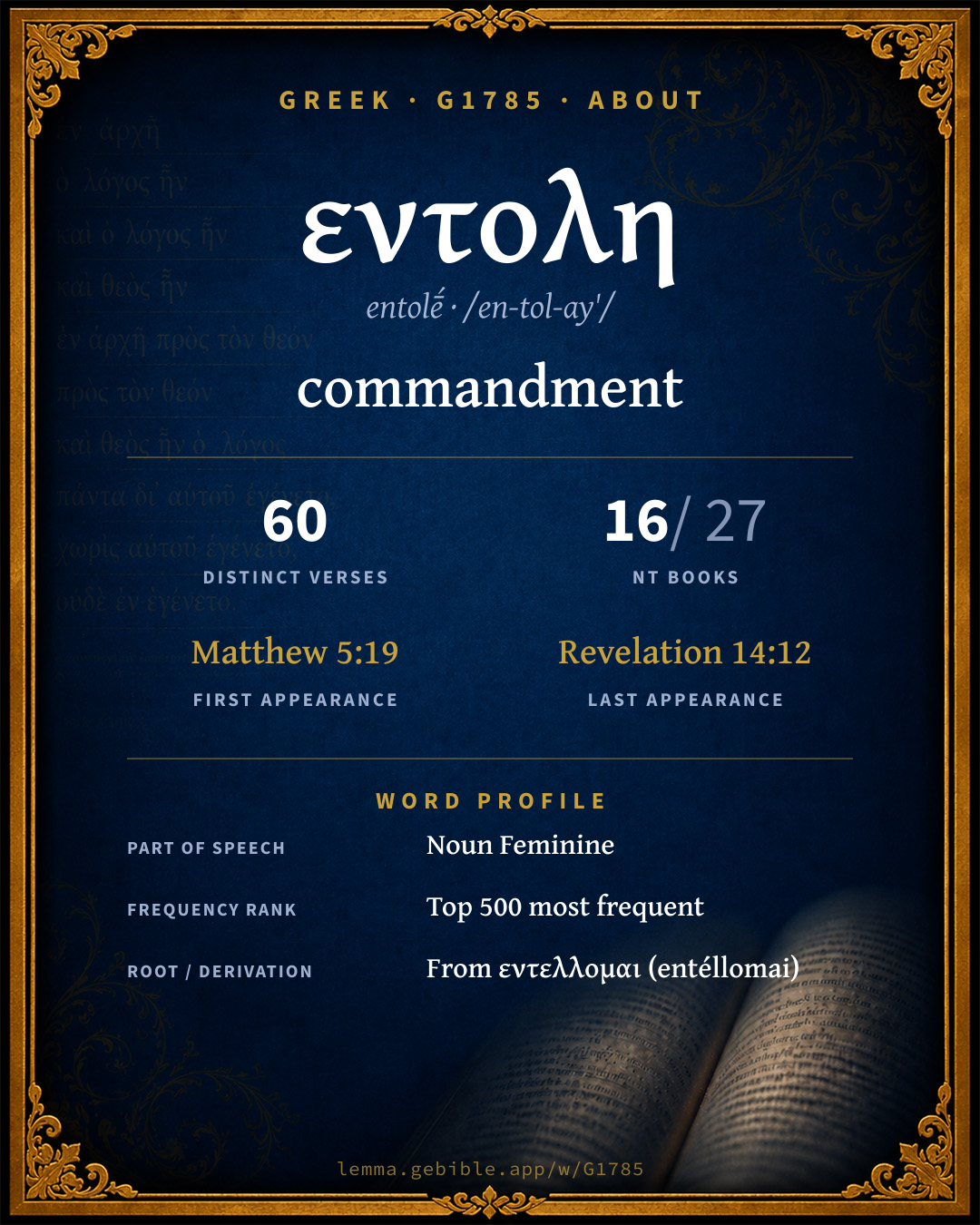
ἐντολή
commandment
‘commandment’ is one of 2 main senses fuller range ↓
Full lexicon entry — Thayer's Greek Lexicon
From Thayer's Greek Lexicon
Where this word appears
See every Accusative-case word in the Greek New Testament →
Grammar key — what these labels mean
Part of speech
- Noun
- A naming word — a person, place, thing, or idea.
Case
- Accusative
- The case of the direct object and of extent.
- Nominative
- The case of the subject (and the predicate nominative).
- Genitive
- The case of source, possession, or “of” — answers “whose / from what.”
- Dative
- The case of the indirect object, means, or location — “to / for / with / in.”
Gender
- Feminine
- Grammatically feminine.
Number
- Singular
- One.
- Plural
- More than one.
Grammatical forms
- Noun, Accusative, Singular, Feminine 19 times (29%)
- Noun, Accusative, Plural, Feminine 18 times (27%)
- Noun, Nominative, Singular, Feminine 13 times (20%)
- Noun, Genitive, Singular, Feminine 9 times (14%)
- Noun, Dative, Plural, Feminine 3 times (5%)
- Noun, Genitive, Plural, Feminine 3 times (5%)
- Noun, Nominative, Plural, Feminine 1 time (2%)
Parsed forms decoded from the imported morphology (Robinson–Tischendorf, public domain), counted across 66 parsed occurrences — not distinct verses.
Every verse where G1785 appears — 60 distinct verses across 16 books. Click any verse to open its interlinear word-by-word view. Verse text shown in the World English Bible for context — . Each verse’s Greek form is shown with its reference; the English is not keyword-highlighted, since the data carries no word-level English alignment. Use “Compare translations” on any verse to read it across multiple English versions. This concordance covers the Greek New Testament; Septuagint (Greek Old Testament) occurrences of this word are not indexed here.
Matthew 6 verses
- Matthew 5:19 ἐντολῶν n gen pl fem Whoever, therefore, shall break one of these least commandments, and teach others to do so, shall be called least in the Kingdom of Heaven; but whoever shall do and teach them shall be called great in the Kingdom of Heaven.
- Matthew 15:3 ἐντολὴν n acc sg fem He answered them, "Why do you also disobey the commandment of God because of your tradition?
- Matthew 19:17 ἐντολάς n acc pl fem He said to him, "Why do you call me good? No one is good but one, that is, God. But if you want to enter into life, keep the commandments."
- Matthew 22:36 ἐντολὴ n nom sg fem "Teacher, which is the greatest commandment in the law?"
- Matthew 22:38 ἐντολή n nom sg fem This is the first and great commandment.
- Matthew 22:40 ἐντολαῖς n dat pl fem The whole law and the prophets depend on these two commandments."
Mark 6 verses
- Mark 7:8 ἐντολὴν n acc sg fem "For you set aside the commandment of God, and hold tightly to the tradition of men--the washing of pitchers and cups, and you do many other such things."
- Mark 7:9 ἐντολὴν n acc sg fem He said to them, "Full well do you reject the commandment of God, that you may keep your tradition.
- Mark 10:5 ἐντολὴν n acc sg fem But Jesus said to them, "For your hardness of heart, he wrote you this commandment.
- Mark 10:19 ἐντολὰς n acc pl fem You know the commandments: 'Do not murder,' 'Do not commit adultery,' 'Do not steal,' 'Do not give false testimony,' 'Do not defraud,' 'Honor your father and mother.'"
- Mark 12:28 ἐντολὴ n nom sg fem One of the scribes came, and heard them questioning together. Knowing that he had answered them well, asked him, "Which commandment is the greatest of all?"
- Mark 12:31 ἐντολὴ n nom sg fem The second is like this, 'You shall love your neighbor as yourself.' There is no other commandment greater than these."
Luke 4 verses
- Luke 1:6 ἐντολαῖς n dat pl fem They were both righteous before God, walking blamelessly in all the commandments and ordinances of the Lord.
- Luke 15:29 ἐντολήν n acc sg fem But he answered his father, 'Behold, these many years I have served you, and I never disobeyed a commandment of yours, but you never gave me a goat, that I might celebrate with my friends.
- Luke 18:20 ἐντολὰς n acc pl fem You know the commandments: 'Don't commit adultery,' 'Don't murder,' 'Don't steal,' 'Don't give false testimony,' 'Honor your father and your mother.'"
- Luke 23:56 ἐντολήν n acc sg fem They returned, and prepared spices and ointments. On the Sabbath they rested according to the commandment.
John 9 verses
- John 10:18 ἐντολὴν n acc sg fem No one takes it away from me, but I lay it down by myself. I have power to lay it down, and I have power to take it again. I received this commandment from my Father."
- John 11:57 ἐντολὰς n acc pl fem Now the chief priests and the Pharisees had commanded that if anyone knew where he was, he should report it, that they might seize him.
- John 12:49 ἐντολὴν n acc sg fem For I spoke not from myself, but the Father who sent me, he gave me a commandment, what I should say, and what I should speak.
- John 12:50 ἐντολὴ n nom sg fem I know that his commandment is eternal life. The things therefore which I speak, even as the Father has said to me, so I speak."
- John 13:34 ἐντολὴν n acc sg fem A new commandment I give to you, that you love one another, just like I have loved you; that you also love one another.
- John 14:15 ἐντολὰς n acc pl fem If you love me, keep my commandments.
- John 14:21 ἐντολάς n acc pl fem One who has my commandments, and keeps them, that person is one who loves me. One who loves me will be loved by my Father, and I will love him, and will reveal myself to him."
- John 15:10 ἐντολάς ἐντολὰς n acc pl fem n acc pl fem If you keep my commandments, you will remain in my love; even as I have kept my Father's commandments, and remain in his love.
- John 15:12 ἐντολὴ n nom sg fem "This is my commandment, that you love one another, even as I have loved you.
Acts 1 verse
Romans 7 verses
- Romans 7:8 ἐντολῆς n gen sg fem But sin, finding occasion through the commandment, produced in me all kinds of coveting. For apart from the law, sin is dead.
- Romans 7:9 ἐντολῆς n gen sg fem I was alive apart from the law once, but when the commandment came, sin revived, and I died.
- Romans 7:10 ἐντολὴ n nom sg fem The commandment, which was for life, this I found to be for death;
- Romans 7:11 ἐντολῆς n gen sg fem for sin, finding occasion through the commandment, deceived me, and through it killed me.
- Romans 7:12 ἐντολὴ n nom sg fem Therefore the law indeed is holy, and the commandment holy, and righteous, and good.
- Romans 7:13 ἐντολῆς n gen sg fem Did then that which is good become death to me? May it never be! But sin, that it might be shown to be sin, by working death to me through that which is good; that through the commandment sin might become exceeding sinful.
- Romans 13:9 ἐντολή n nom sg fem For the commandments, "You shall not commit adultery," "You shall not murder," "You shall not steal," "You shall not give false testimony," "You shall not covet," and whatever other commandments there are, are all summed up in this saying, namely, "You shall love your neighbor as yourself."
1 Corinthians 1 verse
Ephesians 2 verses
- Ephesians 2:15 ἐντολῶν n gen pl fem having abolished in the flesh the hostility, the law of commandments contained in ordinances, that he might create in himself one new man of the two, making peace;
- Ephesians 6:2 ἐντολὴ n nom sg fem "Honor your father and mother," which is the first commandment with a promise:
Colossians 1 verse
1 Timothy 1 verse
Titus 1 verse
Hebrews 4 verses
- Hebrews 7:5 ἐντολὴν n acc sg fem They indeed of the sons of Levi who receive the priest's office have a commandment to take tithes of the people according to the law, that is, of their brothers, though these have come out of the loins of Abraham,
- Hebrews 7:16 ἐντολῆς n gen sg fem who has been made, not after the law of a fleshly commandment, but after the power of an endless life:
- Hebrews 7:18 ἐντολῆς n gen sg fem For there is an annulling of a foregoing commandment because of its weakness and uselessness
- Hebrews 9:19 ἐντολῆς n gen sg fem For when every commandment had been spoken by Moses to all the people according to the law, he took the blood of the calves and the goats, with water and scarlet wool and hyssop, and sprinkled both the book itself and all the people,
2 Peter 2 verses
- 2 Peter 2:21 ἐντολῆς n gen sg fem For it would be better for them not to have known the way of righteousness, than, after knowing it, to turn back from the holy commandment delivered to them.
- 2 Peter 3:2 ἐντολῆς n gen sg fem that you should remember the words which were spoken before by the holy prophets, and the commandments of us, the apostles of the Lord and Savior:
1 John 10 verses
- 1 John 2:3 ἐντολὰς n acc pl fem This is how we know that we know him: if we keep his commandments.
- 1 John 2:4 ἐντολὰς n acc pl fem One who says, "I know him," and doesn't keep his commandments, is a liar, and the truth isn't in him.
- 1 John 2:7 ἐντολὴν ἐντολὴν ἐντολὴ n acc sg fem n acc sg fem n nom sg fem Brothers, I write no new commandment to you, but an old commandment which you had from the beginning. The old commandment is the word which you heard from the beginning.
- 1 John 2:8 ἐντολὴν n acc sg fem Again, I write a new commandment to you, which is true in him and in you; because the darkness is passing away, and the true light already shines.
- 1 John 3:22 ἐντολὰς n acc pl fem and whatever we ask, we receive from him, because we keep his commandments and do the things that are pleasing in his sight.
- 1 John 3:23 ἐντολὴ ἐντολὴν n nom sg fem n acc sg fem This is his commandment, that we should believe in the name of his Son, Jesus Christ, and love one another, even as he commanded.
- 1 John 3:24 ἐντολὰς n acc pl fem He who keeps his commandments remains in him, and he in him. By this we know that he remains in us, by the Spirit which he gave us.
- 1 John 4:21 ἐντολὴν n acc sg fem This commandment we have from him, that he who loves God should also love his brother.
- 1 John 5:2 ἐντολὰς n acc pl fem By this we know that we love the children of God, when we love God and keep his commandments.
- 1 John 5:3 ἐντολὰς ἐντολαὶ n acc pl fem n nom pl fem For this is the love of God, that we keep his commandments. His commandments are not grievous.
2 John 3 verses
- 2 John 1:4 ἐντολὴν n acc sg fem I rejoice greatly that I have found some of your children walking in truth, even as we have been commanded by the Father.
- 2 John 1:5 ἐντολὴν n acc sg fem Now I beg you, dear lady, not as though I wrote to you a new commandment, but that which we had from the beginning, that we love one another.
- 2 John 1:6 ἐντολὰς ἐντολή n acc pl fem n nom sg fem This is love, that we should walk according to his commandments. This is the commandment, even as you heard from the beginning, that you should walk in it.
Revelation 2 verses
- Revelation 12:17 ἐντολὰς n acc pl fem The dragon grew angry with the woman, and went away to make war with the rest of her seed, who keep God's commandments and hold Jesus' testimony.
- Revelation 14:12 ἐντολὰς n acc pl fem Here is the patience of the saints, those who keep the commandments of God, and the faith of Jesus."
About this entry
At a glance — auto-summarized from this page’s data, not written by a person. Every figure links to its source below. This summary describes the numbers; it doesn’t interpret them.
At its core, εντολη (entolḗ) means “commandment.” It first appears in Matthew 5:19. Spanning 60 verses in 16 books, it ranks among the moderately common words of the Greek New Testament. Ranging over 2 senses, it is not a single-sense word. Sharing its root, it stands alongside εντελλομαι and ενταλμα. Dig into 60-verse concordance and the renderings breakdown below.
Gloss history
Strong's 1890 vs modern scholarship
About this word
Strong's G1785 catalogs a Greek word from the Greek New Testament.
These counts are not copied from any lexicon or concordance. They are computed here, from the morphology-tagged Greek New Testament. What Lemma adds →
- 60
- distinct verses
- The word appears in 60 distinct verses.
- 16 / 27
- NT books
- The word appears in 16 of 27 New Testament books.
- #251
- by frequency
- Top 500 most frequent Greek words (rank 251 of 5,347 Greek words by occurrence).
View all 60 occurrences in the concordance →
By section of the New Testament
By traditional corpus
Conventional, traditional groupings — biblical authorship is debated, so this is a traditional corpus grouping, not an authorship claim. Some books belong to more than one corpus (Luke is in both the Gospels and the Lukan corpus, and so on), so these shares overlap and need not total 100%. Each figure is a share of the word’s 60 distinct verses.
- Gospels 25 verses · 42%
- Johannine 24 verses · 40%
- General (Catholic) Epistles 15 verses · 25%
- Pauline corpus 13 verses · 22%
- Lukan (Luke–Acts) 5 verses · 8%
- Hebrews 4 verses · 7%
- Revelation 2 verses · 3%
How translations render this word
Counts come from each version’s own published word-to-Strong’s tagging or interlinear alignment — an approximate guide to how each version renders this word, not a word-level alignment the data otherwise carries. Because each total is that version’s own tagged count, the per-version totals vary from one another and need not match the appearance or distinct-verse counts above. These counts may also differ from a printed concordance because Lemma counts each distinctly tagged rendering and does not collapse phrase taggings into a single head-word total. This is a fixed set of word-tagged versions (KJV, ASV, BSB, ULT) and does not change with the reading translation you choose elsewhere. Each version’s license is shown beside its name below (and on Sources).
- King James Version: Commandment 42×, Commandments 27×, Precept 2×
- American Standard Version: Commandment 41×, Commandments 24×, A 2×
- Berean Standard Bible: Commandment 28×, Commandments 23×, Command 4×
- unfoldingWord Literal Text: Commandment 32×, Commandments 22×, Command 10×
King James Version Public Domain
Renders G1785 across 71 tagged occurrences — most commonly:
American Standard Version Public Domain
Renders G1785 across 74 tagged occurrences — most commonly:
Plus 5 renderings that appear only once — usually multi-word phrases or single function words the recovered tagging swept in, not distinct renderings.
Berean Standard Bible Public Domain
Renders G1785 across 66 tagged occurrences — most commonly:
Plus 7 renderings that appear only once — usually multi-word phrases or single function words the recovered tagging swept in, not distinct renderings. Not rendered by a distinct English word in 1 further occurrence.
unfoldingWord Literal Text CC BY-SA 4.0
Renders G1785 across 77 tagged occurrences — most commonly:
Plus 5 renderings that appear only once — usually multi-word phrases or single function words the recovered tagging swept in, not distinct renderings.
Senses in Thayer's
The 2 senses Thayer's distinguishes for this word, in lexicon order (not ranked by frequency or importance). The full entry — with sub-senses — is in the Lexicon Entry tab.
- an order, command, charge, precept, injunction
- a prescribed rule in accordance with which a thing is done
Word origin
Derived from εντελλομαι (entéllomai) (G1781) — to command.
From G1781 ; injunction that is an authoritative prescription : - commandment precept.
— Strong’s Exhaustive Concordance (1890), public domain.
Forms in the corpus
The 10 distinct written forms G1785 takes in the Greek New Testament, most frequent first — each parse links to that case’s occurrences in the concordance.
| Form | Parsing | Example | Uses |
|---|---|---|---|
| ἐντολὴν entolḕn | Noun, Accusative, Singular, Feminine | Matthew 15:3 | 17 |
| ἐντολὰς entolàs | Noun, Accusative, Plural, Feminine | Mark 10:19 | 14 |
| ἐντολὴ entolḕ | Noun, Nominative, Singular, Feminine | Matthew 22:36 | 10 |
| ἐντολῆς entolē̂s | Noun, Genitive, Singular, Feminine | Romans 7:8 | 9 |
| ἐντολάς entolás | Noun, Accusative, Plural, Feminine | Matthew 19:17 | 4 |
| ἐντολή entolḗ | Noun, Nominative, Singular, Feminine | Matthew 22:38 | 3 |
| ἐντολαῖς entolaîs | Noun, Dative, Plural, Feminine | Matthew 22:40 | 3 |
| ἐντολῶν entolō̂n | Noun, Genitive, Plural, Feminine | Matthew 5:19 | 3 |
| ἐντολήν entolḗn | Noun, Accusative, Singular, Feminine | Luke 15:29 | 2 |
| ἐντολαὶ entolaì | Noun, Nominative, Plural, Feminine | 1 John 5:3 | 1 |
Same root — word family
Other Thayer's entries built from the same root as G1785, grouped by Strong’s listed origin. These share a root / origin per the lexicon — not necessarily a shared meaning. Each links to that word’s own entry.
Derives from
Shares the same root
Compare all same-root words → They share a root, not necessarily a meaning.
Septuagint usage
The same Greek word εντολη appears 187 times in the Greek Old Testament (Septuagint), across 184 verses in 21 books.
- 187
- LXX occurrences
- Tagged occurrences of this Greek word in the Septuagint.
- 184
- verses
- Distinct Septuagint verses containing this word.
- 21 / 39
- OT books
- The word appears in 21 of the 39 Old Testament books.
Sample Septuagint occurrences
- Genesis 26:5 ἐντολή
- Exodus 12:17 ἐντολή
- Leviticus 4:13 ἐντολή
- Numbers 15:22 ἐντολή
- Deuteronomy 4:2 ἐντολή
- Joshua 5:6 ἐντολή
- Judges 3:4 ἐντολή
- 1 Samuel 13:13 ἐντολή
- 1 Kings 2:3 ἐντολή
- 2 Kings 17:13 ἐντολή
- 1 Chronicles 28:7 ἐντολή
- 2 Chronicles 7:19 ἐντολή
Septuagint occurrences (same lexeme)
Every verse where the same Strong’s number (G1785) appears in the Greek Septuagint — showing the first 50 of 184. Verse text shown in the World English Bible for context; the Greek form is the matched word — the English is not keyword-highlighted.
- Genesis 26:5 ἐντολή because Abraham obeyed my voice, and kept my charge, my commandments, my statutes, and my laws."
- Exodus 12:17 ἐντολή You shall observe the feast of unleavened bread; for in this same day have I brought your hosts out of the land of Egypt: therefore shall you observe this day throughout your generations by an ordinance forever.
- Exodus 15:26 ἐντολή and he said, "If you will diligently listen to the voice of Yahweh your God, and will do that which is right in his eyes, and will pay attention to his commandments, and keep all his statutes, I will put none of the diseases on you, which I have put on the Egyptians; for I am Yahweh who heals you."
- Exodus 16:28 ἐντολή Yahweh said to Moses, "How long do you refuse to keep my commandments and my laws?
- Exodus 24:12 ἐντολή Yahweh said to Moses, "Come up to me on the mountain, and stay here, and I will give you the tables of stone with the law and the commands that I have written, that you may teach them."
- Leviticus 4:13 ἐντολή "'If the whole congregation of Israel sins, and the thing is hidden from the eyes of the assembly, and they have done any of the things which Yahweh has commanded not to be done, and are guilty;
- Leviticus 4:22 ἐντολή "'When a ruler sins, and unwittingly does any one of all the things which Yahweh his God has commanded not to be done, and is guilty;
- Leviticus 4:27 ἐντολή "'If anyone of the common people sins unwittingly, in doing any of the things which Yahweh has commanded not to be done, and is guilty;
- Leviticus 5:17 ἐντολή "If anyone sins, and does any of the things which Yahweh has commanded not to be done; though he didn't know it, yet he is guilty, and shall bear his iniquity.
- Leviticus 5:21 ἐντολή
- Leviticus 22:31 ἐντολή "Therefore you shall keep my commandments, and do them. I am Yahweh.
- Leviticus 26:3 ἐντολή "'If you walk in my statutes, and keep my commandments, and do them;
- Leviticus 26:15 ἐντολή and if you shall reject my statutes, and if your soul abhors my ordinances, so that you will not do all my commandments, but break my covenant;
- Leviticus 27:34 ἐντολή These are the commandments which Yahweh commanded Moses for the children of Israel on Mount Sinai.
- Numbers 15:22 ἐντολή When you shall err, and not observe all these commandments, which Yahweh has spoken to Moses,
- Numbers 15:31 ἐντολή Because he has despised the word of Yahweh, and has broken his commandment, that soul shall utterly be cut off; his iniquity shall be on him.
- Numbers 15:39 ἐντολή and it shall be to you for a fringe, that you may look on it, and remember all the commandments of Yahweh, and do them; and that you not follow after your own heart and your own eyes, after which you use to play the prostitute;
- Numbers 15:40 ἐντολή that you may remember and do all my commandments, and be holy to your God.
- Numbers 36:13 ἐντολή These are the commandments and the ordinances which Yahweh commanded by Moses to the children of Israel in the plains of Moab by the Jordan at Jericho.
- Deuteronomy 4:2 ἐντολή You shall not add to the word which I command you, neither shall you diminish from it, that you may keep the commandments of Yahweh your God which I command you.
- Deuteronomy 4:40 ἐντολή You shall keep his statutes, and his commandments, which I command you this day, that it may go well with you, and with your children after you, and that you may prolong your days in the land, which Yahweh your God gives you, forever.
- Deuteronomy 5:29 ἐντολή Oh that there were such a heart in them, that they would fear me, and keep all my commandments always, that it might be well with them, and with their children forever!
- Deuteronomy 5:31 ἐντολή But as for you, stand you here by me, and I will speak to you all the commandment, and the statutes, and the ordinances, which you shall teach them, that they may do them in the land which I give them to possess it.
- Deuteronomy 6:1 ἐντολή Now this is the commandment, the statutes, and the ordinances, which Yahweh your God commanded to teach you, that you might do them in the land where you go over to possess it;
- Deuteronomy 6:2 ἐντολή that you might fear Yahweh your God, to keep all his statutes and his commandments, which I command you, you, and your son, and your son's son, all the days of your life; and that your days may be prolonged.
- Deuteronomy 6:17 ἐντολή You shall diligently keep the commandments of Yahweh your God, and his testimonies, and his statutes, which he has commanded you.
- Deuteronomy 6:25 ἐντολή It shall be righteousness to us, if we observe to do all this commandment before Yahweh our God, as he has commanded us.
- Deuteronomy 7:9 ἐντολή Know therefore that Yahweh your God, he is God, the faithful God, who keeps covenant and loving kindness with them who love him and keep his commandments to a thousand generations,
- Deuteronomy 7:11 ἐντολή You shall therefore keep the commandment, and the statutes, and the ordinances, which I command you this day, to do them.
- Deuteronomy 8:1 ἐντολή All the commandment which I command you this day shall you observe to do, that you may live, and multiply, and go in and possess the land which Yahweh swore to your fathers.
- Deuteronomy 8:2 ἐντολή You shall remember all the way which Yahweh your God has led you these forty years in the wilderness, that he might humble you, to prove you, to know what was in your heart, whether you would keep his commandments, or not.
- Deuteronomy 8:6 ἐντολή You shall keep the commandments of Yahweh your God, to walk in his ways, and to fear him.
- Deuteronomy 8:11 ἐντολή Beware lest you forget Yahweh your God, in not keeping his commandments, and his ordinances, and his statutes, which I command you this day:
- Deuteronomy 10:13 ἐντολή to keep the commandments of Yahweh, and his statutes, which I command you this day for your good?
- Deuteronomy 11:8 ἐντολή Therefore shall you keep all the commandment which I command you this day, that you may be strong, and go in and possess the land, where you go over to possess it;
- Deuteronomy 11:13 ἐντολή It shall happen, if you shall listen diligently to my commandments which I command you this day, to love Yahweh your God, and to serve him with all your heart and with all your soul,
- Deuteronomy 11:22 ἐντολή For if you shall diligently keep all this commandment which I command you, to do it, to love Yahweh your God, to walk in all his ways, and to cleave to him;
- Deuteronomy 11:27 ἐντολή the blessing, if you shall listen to the commandments of Yahweh your God, which I command you this day;
- Deuteronomy 11:28 ἐντολή and the curse, if you shall not listen to the commandments of Yahweh your God, but turn aside out of the way which I command you this day, to go after other gods, which you have not known.
- Deuteronomy 13:5 ἐντολή That prophet, or that dreamer of dreams, shall be put to death, because he has spoken rebellion against Yahweh your God, who brought you out of the land of Egypt, and redeemed you out of the house of bondage, to draw you aside out of the way which Yahweh your God commanded you to walk in. So shall you put away the evil from the midst of you.
- Deuteronomy 13:19 ἐντολή
- Deuteronomy 15:5 ἐντολή if only you diligently listen to the voice of Yahweh your God, to observe to do all this commandment which I command you this day.
- Deuteronomy 16:12 ἐντολή You shall remember that you were a bondservant in Egypt: and you shall observe and do these statutes.
- Deuteronomy 17:19 ἐντολή and it shall be with him, and he shall read therein all the days of his life; that he may learn to fear Yahweh his God, to keep all the words of this law and these statutes, to do them;
- Deuteronomy 17:20 ἐντολή that his heart not be lifted up above his brothers, and that he not turn aside from the commandment, to the right hand, or to the left: to the end that he may prolong his days in his kingdom, he and his children, in the midst of Israel.
- Deuteronomy 19:9 ἐντολή if you shall keep all this commandment to do it, which I command you this day, to love Yahweh your God, and to walk ever in his ways; then shall you add three cities more for you, besides these three:
- Deuteronomy 26:13 ἐντολή You shall say before Yahweh your God, I have put away the holy things out of my house, and also have given them to the Levite, and to the foreigner, to the fatherless, and to the widow, according to all your commandment which you have commanded me: I have not transgressed any of your commandments, neither have I forgotten them:
- Deuteronomy 26:18 ἐντολή and Yahweh has declared you this day to be a people for his own possession, as he has promised you, and that you should keep all his commandments;
- Deuteronomy 27:1 ἐντολή Moses and the elders of Israel commanded the people, saying, Keep all the commandment which I command you this day.
- Deuteronomy 27:10 ἐντολή You shall therefore obey the voice of Yahweh your God, and do his commandments and his statutes, which I command you this day.
These are occurrences of the same Greek lexeme (G1785) in the Septuagint — not a translation of any one Hebrew word. The store carries no word-level Hebrew↔Greek alignment, so no Hebrew original is asserted here. Counts come from the recovered LXX Strong's tagging — high-frequency vocabulary is well covered, while rare or late forms may be untagged — so they reflect tagged occurrences and may slightly undercount.