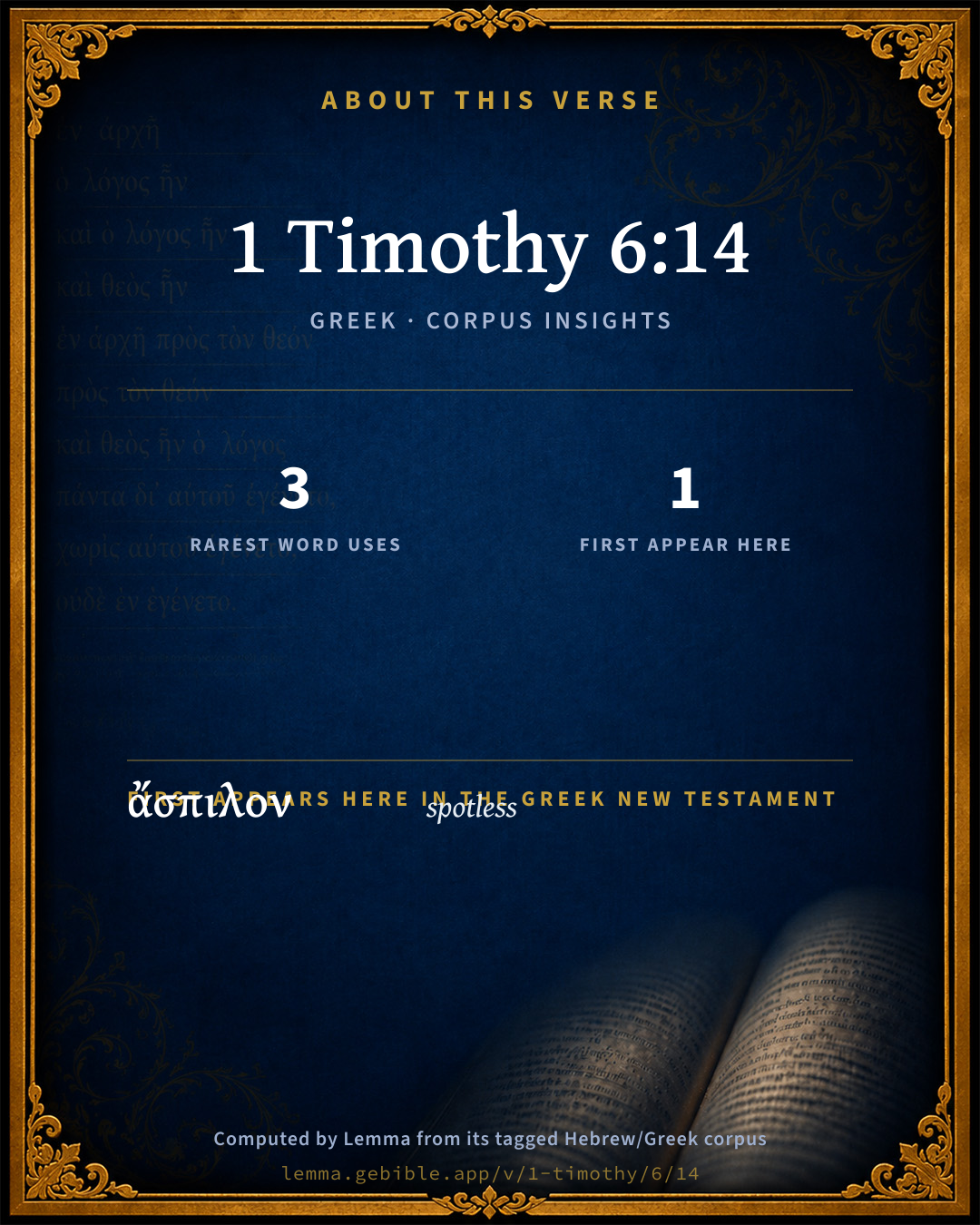
1 Timothy 6:14

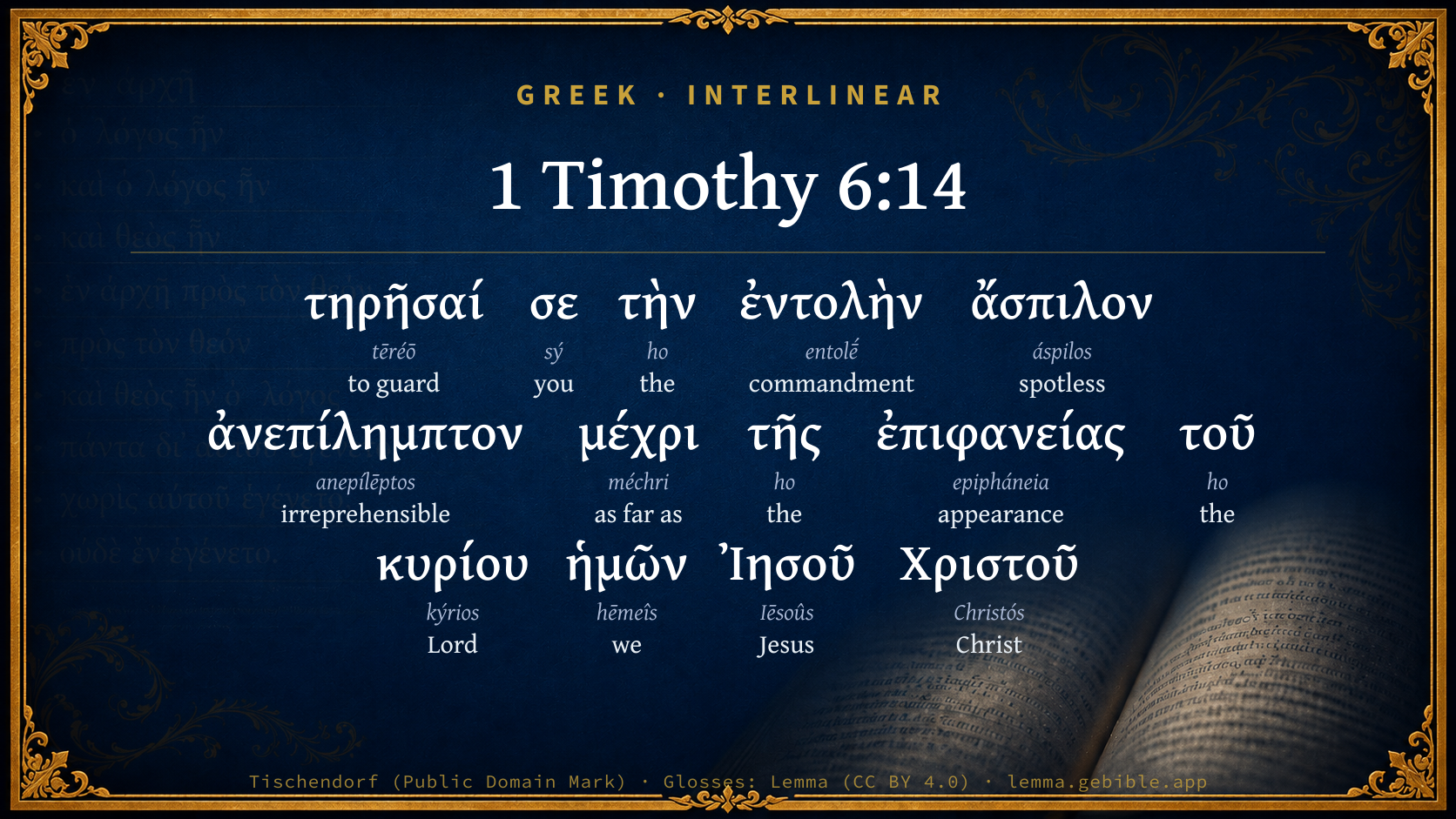
Greek (Tischendorf 8th ed.) 1 Timothy 6:14 appears in the Greek New Testament. The text above is from the Tischendorf 8th edition. Each word links to its Strong’s number and a concise gloss. Click any word for its full Thayer’s Greek Lexicon entry.
Download image
Cite this verse

1 Timothy 6:14 (World English Bible). Public Domain. Lemma interlinear Bible study tool, https://lemma.gebible.app/v/1-timothy/6/14.

Show BibTeX & RIS
BibTeX
RIS
English Translation
that you keep the commandment without spot, blameless, until the appearing of our Lord Jesus Christ;
World English Bible · Public Domain
Highlights
  • 1 first appearance in the Greek New Testament
Full analysis ↓
Download a study sheet

One document with this verse’s original text, its word-by-word gloss line, the meaning frame, cross-references with their text, attributed commentary, and full source and license credits — printable, and it pastes into notes with its structure intact.

This verse Autodidact and up

Study sheet (.html) Plain text (.txt)

A passage Seminary Student

Up to 50 verses in one chapter. A passage sheet keeps up to 6 commentary sources and 12 cross-references per verse, in the order this page ranks them, and says so on the sheet whenever that leaves anything out. Ask for a single verse and you get the Autodidact verse sheet above.

Everything on this page stays free to read, with no account — the sheet is a download of what is already on screen, not access to it.

Want to remove ads? Support Godless Engineer
Compare translations 3

The same verse in 3 English versions, stacked beneath the original-language interlinear above. Click any original word for its lexicon entry.

Each is an independent rendering of the whole verse — the interlinear is not word-aligned to these translations.

Highlighted words mark where these versions differ — a whole-verse word diff, not a word-by-word alignment.

  • World English Bible Public Domain
    that you keep the commandment without spot, blameless, until the appearing of our Lord Jesus Christ;
  • King James Version Public Domain
    That thou keep this commandment without spot, unrebukable, until the appearing of our Lord Jesus Christ:
  • unfoldingWord Literal Text CC BY-SA 4.0
    that you keep the commandment spotless, irreproachable, until the appearance of our Lord Jesus Christ,

unfoldingWord Literal Text — © unfoldingWord, licensed CC BY-SA 4.0. Word-aligned USFM3 via Door43 (git.door43.org/unfoldingWord/en_ult).

Versions to compare (up to 4)

3 of 4 selected

Show all 19 translations

Every available English version of this verse, each an independent rendering of the whole verse.

  • World English Bible Public Domain
    that you keep the commandment without spot, blameless, until the appearing of our Lord Jesus Christ;
  • Berean Standard Bible Public Domain
    Keep this commandment without stain or reproach until the appearance of our Lord Jesus Christ,
  • Majority Standard Bible Public Domain
    Keep this commandment without stain or reproach until the appearance of our Lord Jesus Christ,
  • King James Version Public Domain
    That thou keep this commandment without spot, unrebukable, until the appearing of our Lord Jesus Christ:
  • American Standard Version (1901) Public Domain
    that thou keep the commandment, without spot, without reproach, until the appearing of our Lord Jesus Christ:
  • Revised Version (1885) Public Domain
    that thou keep the commandment, without spot, without reproach, until the appearing of our Lord Jesus Christ:
  • Geneva Bible (1599) Public Domain
    That thou keepe this commandement without spot, and vnrebukeable, vntill the appearing of our Lord Iesus Christ,
  • Douay-Rheims (1899) Public Domain
    That thou keep the commandment without spot, blameless, unto the coming of our Lord Jesus Christ,
  • Young's Literal Translation Public Domain
    that thou keep the command unspotted, unblameable, till the manifestation of our Lord Jesus Christ,
  • Literal Standard Version CC BY-SA 4.0
    that you keep the command unspotted, unblameable, until the appearing of our Lord Jesus Christ,
  • Unlocked Literal Bible CC BY-SA 4.0
    Keep the commandment without spot or blame until the appearance of our Lord Jesus Christ.
  • unfoldingWord Literal Text CC BY-SA 4.0
    that you keep the commandment spotless, irreproachable, until the appearance of our Lord Jesus Christ,
  • Darby Bible Public Domain
    that thou keep the commandment spotless, irreproachable, until the appearing of our Lord Jesus Christ;
  • World Messianic Bible Public Domain
    that you keep the commandment without spot, blameless until the appearing of our Lord Yeshua the Messiah,
  • Webster's Bible Public Domain
    That thou keep this commandment without spot, unrebukable, until the appearing of our Lord Jesus Christ:
  • Free Bible Version CC BY-SA 4.0
    is to follow faithfully what you've been told so you will be above criticism until our Lord Jesus Christ appears.
  • Bible in Basic English Public Domain
    To keep the word untouched by evil, clear from all shame, till the revelation of our Lord Jesus Christ:
  • Text-Critical English NT CC BY 4.0
    that yoʋ obey what has been commanded without fault or reproach until the appearing of our Lord Jesus Christ,
  • Tyndale New Testament (1534) Public Domain
    that thou kepe the commaundement and be with out spotte and vnrebukeable vntyll the apperynge of oure lorde Iesus Christ

Literal Standard Version (2020), Covenant Press — licensed CC BY-SA 4.0. Text via the HelloAO Bible API (eBible.org). Unlocked Literal Bible (unfoldingWord) — licensed CC BY-SA 4.0. Text via the HelloAO Bible API (eBible.org). unfoldingWord Literal Text — © unfoldingWord, licensed CC BY-SA 4.0. Word-aligned USFM3 via Door43 (git.door43.org/unfoldingWord/en_ult). Free Bible Version, Dr. Jonathan Gallagher — licensed CC BY-SA 4.0. Text via the HelloAO Bible API (eBible.org).

Word by word

More ways to search: Search by grammar → Find every occurrence → Compare this word →

Practice this passage: Drill this verse → Learn its vocabulary →

ἀνεπίλημπτον
anepílēptos
G423
“irreprehensible”
Adjective, Accusative, Singular, Feminine
Part of Speech
Adjective
Case
Accusative
Number
Singular
Gender
Feminine
Full Thayer's Definition

Origin: from G1 (as a negative particle) and a derivative of G1949

TDNT: 04:09,5

1. not apprehended, that cannot be laid hold of 2. that cannot be reprehended, not open to censure, irreproachable
  1. τηρῆσαί tēréō G5083 “to guard” Verb, Aorist, Active, Infinitive
  2. σε sý G4771 “you” Personal pronoun, 2nd person, Accusative, Singular
  3. τὴν ho G3588 “the” Article, Accusative, Singular, Feminine
  4. ἐντολὴν entolḗ G1785 “commandment” Noun, Accusative, Singular, Feminine
  5. ἄσπιλον áspilos G784 “spotless” Adjective, Accusative, Singular, Feminine
  6. μέχρι méchri G3360 “as far as” Adverb
  7. τῆς ho G3588 “the” Article, Genitive, Singular, Feminine
  8. ἐπιφανείας epipháneia G2015 “appearance” Noun, Genitive, Singular, Feminine
  9. τοῦ ho G3588 “the” Article, Genitive, Singular, Masculine
  10. κυρίου kýrios G2962 “Lord” Noun, Genitive, Singular, Masculine
  11. ἡμῶν hēmeîs G2249 “we” Personal pronoun, 1st person, Genitive, Plural
  12. Ἰησοῦ Iēsoûs G2424 “Jesus” Noun, Genitive, Singular, Masculine
  13. Χριστοῦ Christós G5547 “Christ” Noun, Genitive, Singular, Masculine

About this verse

These counts appear in no published source. They are computed here, from the morphology-tagged text and Lemma’s own curated glosses. What Lemma adds →

14
words
12
distinct lemmas
Pauline Epistles
section

Notable vocabulary

The rarest word here is ἀνεπίλημπτον irreprehensible G423 — appearing just 3 times in the whole Greek New Testament.

First appearance in Scripture

This word makes its first canonical appearance in the Greek New Testament here:

  • ἄσπιλον spotless G784

Shared distinctive vocabulary

ἀνεπίλημπτον irreprehensible G423 occurs in 3 verses of the Greek New Testament. Also found in:

Repetition

A word recurs within this verse:

Cross-references

26

Topical passages linked to 1 Timothy 6:14 in the Treasury of Scripture Knowledge — connected by theme and wording, ordered by reader-vote popularity; previews shown in the World English Bible.

  • 2 Peter 3:14 Therefore, beloved, seeing that you look for these things, be diligent to be found in peace, without blemish and blameless in his sight.
  • 1 Peter 1:7 that the proof of your faith, which is more precious than gold that perishes even though it is tested by fire, may be found to result in praise, glory, and honor at the revelation of Jesus Christ--
  • 1 Thessalonians 5:23 May the God of peace himself sanctify you completely. May your whole spirit, soul, and body be preserved blameless at the coming of our Lord Jesus Christ.
  • Philippians 1:10 so that you may approve the things that are excellent; that you may be sincere and without offense to the day of Christ;
  • Titus 2:13 looking for the blessed hope and appearing of the glory of our great God and Savior, Jesus Christ;
  • Hebrews 9:28 so Christ also, having been once offered to bear the sins of many, will appear a second time, without sin, to those who are eagerly waiting for him for salvation.
  • Jude 1:24 Now to him who is able to keep them from stumbling, and to present you faultless before the presence of his glory in great joy,
  • 1 Chronicles 28:9–10 You, Solomon my son, know the God of your father, and serve him with a perfect heart and with a willing mind; for Yahweh searches all hearts, and understands all the imaginations of the thoughts: if you seek him, he will be found of you; but if you forsake him, he will cast you off forever.
  • Song of Solomon 4:7 You are all beautiful, my love. There is no spot in you.
  • 1 Corinthians 1:8 who will also confirm you until the end, blameless in the day of our Lord Jesus Christ.
  • Colossians 1:22 yet now he has reconciled in the body of his flesh through death, to present you holy and without blemish and blameless before him,
  • 2 Thessalonians 2:8 Then the lawless one will be revealed, whom the Lord will kill with the breath of his mouth, and bring to nothing by the brightness of his coming;
  • 1 Timothy 4:11–16 Command and teach these things.
  • 2 Timothy 4:1 I charge you therefore before God and the Lord Jesus Christ, who will judge the living and the dead at his appearing and his Kingdom:
  • Hebrews 9:14 how much more will the blood of Christ, who through the eternal Spirit offered himself without blemish to God, cleanse your conscience from dead works to serve the living God?
  • Revelation 1:7 Behold, he is coming with the clouds, and every eye will see him, including those who pierced him. All the tribes of the earth will mourn over him. Even so, Amen.
  • 1 Chronicles 28:20 David said to Solomon his son, Be strong and of good courage, and do it: don't be afraid, nor be dismayed; for Yahweh God, even my God, is with you; he will not fail you, nor forsake you, until all the work for the service of the house of Yahweh is finished.
  • Ephesians 5:27 that he might present the assembly to himself gloriously, not having spot or wrinkle or any such thing; but that it should be holy and without blemish.
  • Philippians 1:6 being confident of this very thing, that he who began a good work in you will complete it until the day of Jesus Christ.
  • Philippians 2:15 that you may become blameless and harmless, children of God without blemish in the midst of a crooked and perverse generation, among whom you are seen as lights in the world,
  • Colossians 4:17 Tell Archippus, "Take heed to the ministry which you have received in the Lord, that you fulfill it."
  • 1 Thessalonians 3:13 to the end he may establish your hearts blameless in holiness before our God and Father, at the coming of our Lord Jesus with all his saints.
  • 2 Thessalonians 2:1 Now, brothers, concerning the coming of our Lord Jesus Christ, and our gathering together to him, we ask you
  • 1 Timothy 6:20 Timothy, guard that which is committed to you, turning away from the empty chatter and oppositions of the knowledge which is falsely so called;
  • 1 Peter 1:19 but with precious blood, as of a lamb without spot, the blood of Christ;
  • 1 John 3:2 Beloved, now we are children of God, and it is not yet revealed what we will be. But we know that, when he is revealed, we will be like him; for we will see him just as he is.

Cross-references courtesy of OpenBible.info (CC BY 4.0).

Commentary

Notes on 1 Timothy 6:14 from classic Christian and Jewish commentators (each source and its license shown beneath its notes). The classic Christian expositions comment on the surrounding passage and are grouped to its opening verse, so a note may address several verses; the Jewish commentaries on the Tanakh (Rashi and others) are per-verse, so they appear only where the commentator wrote on this verse.

Lemma curates 59 commentaries, every one of them public domain or Creative Commons licensed, each selected and text-cleaned for this edition rather than reprinted as found. About our sources →

Tyndale Open Study Notes

Tyndale Open Resources

6:14 until our Lord Jesus Christ comes again (literally until the appearance of our Lord Jesus Christ): Christ’s comings, both past (2 Tim 1:10; Titus 2:11) and future (2 Tim 4:1, 8; Titus 2:13), are described in the letters to Timothy and Titus as “epiphanies” or “appearances.” An epiphany is a divine intervention in a particular historical moment. The church is positioned between these past and future appearances of Christ. Christ’s first, saving epiphany made possible a new life; his future epiphany will achieve final salvation. Though the present is evil (the “last times,” 1 Tim 4:1-3; 2 Tim 3:1-9), our anticipation of Christ’s appearance creates accountability for living a godly life in the present. By contrast, the false teachers advocated sinful behaviors because they assumed the resurrection had already occurred (2 Tim 2:18). In response, Paul makes clear that salvation has begun but is not yet complete. The conduct of God’s household requires responsible living in the light of Christ’s past, present, and future saving work (1 Tim 3:15-16; Titus 2:11-14).

Tyndale Open Study Notes — © Tyndale Open Resources, licensed CC BY-SA 4.0. Text via the HelloAO Bible API.

Bengel's Gnomon

Johann Albrecht Bengel

1Ti 6:14. Τὴν) this.—ἄσπιλον, ἀνεπίληπτον, without spot, unrebukeable) in the masculine gender.[51]—μέχρι, until) Believers, in regulating their practice, used in that day to set before themselves the day of Christ as near at hand: we are accustomed to set before us the hour of death.—ἐπιφανείας, the appearing) This word often occurs in the second Epistle to Timothy and in the Epistle to Titus.

[51] i.e. Agreeing with σε, not with τὴν ἐντολήν.—ED.

Bengel's Gnomon of the New Testament — English translation (T&T Clark, Edinburgh, 1860) — public domain. Text from a community e-Sword module.

Expositor's Greek Testament

ed. W. Robertson Nicoll

1Ti 6:14 . τηρῆσαι κ . τ . λ .: The phrase τηρεῖν τὴν ἐντολήν , τὰς ἐντολάς or τὸν λόγον , τοὺς λόγους is a common one; found in Mat 19:17 , and especially in the Johannine writings; but wherever it occurs it means to obey or observe a command or a saying; whereas here it means to preserve intact . Perhaps the two meanings were present to the apostle’s mind; and no doubt in actual experience they merge one into the other; for a tradition is only preserved by obedience to the demand which it makes for observance. This use of the verb and the similar τὴν πίστιν τετήρηκα , 2Ti 4:7 , mutually illustrate each other. τὴν ἐντολὴν τηρεῖν is probably equivalent to τὴν παραθήκην φυλάσσειν , understanding the tradition or deposit in the most comprehensive moral and spiritual sense, in which it is nothing else than “the law of the Gospel ( cf. ἡ παραγγελία , 1Ti 1:5 ), the Gospel viewed as a rule of life” (so Ell. and Alf.). St. Paul would not have distinguished this from the charge given to Timothy at his baptism. Cyril Jer. ( Cat . 1Ti 6:13 ), in quoting this passage, substitutes ταύτην τὴν παραδεδομένην πίστιν for ἐντολήν . This interpretation is permissible so long as we do not divorce creed from character.

ἄσπιλον ἀνεπίλημπτον : These epithets present a difficulty somewhat similar to that presented by τηρῆσαι . ἄσπιλος is a personal epithet (though applied to οὐρανός , Job 15:15 , Symm.); and so is ἀνεπίλημπτος . See reff. on both. Alford shows, after De Wette, by examples from Philo and Plato, that ἀνεπίλ . may be applied to impersonal objects, such as τέχνη , τὸ λεγόμενον . Nevertheless although it would be intolerably awkward to refer the adjectives to σε the ordinary construction with τηρεῖν being that the qualifying adj. should belong to its object, e.g. , 1Ti 5:22 ; Jam 1:27 ; 2Co 11:9 (Alf.) yet St. Paul had the personal reference to Timothy chiefly in his mind when he chose these words as qualifying ἐντολήν ; and the R.V., which places a comma after commandment , possibly is intended to suggest a similar view. The man and the word are similarly identified in the parable of the Sower (Mat 13:19 , etc.). If Timothy “keeps himself unspotted” (Jas 1:27 ) and “without reproach,” the ἐντολή , so far as he is concerned, will be maintained flawless.

The Ancient Homily which used to be attributed to Clem. Rom. contains a sentence written in a similar tone (§8), τηρήσατε τὴν σάρκα ἁγνὴν καὶ τὴν σφραγῖδα ἄσπιλον , ἵνα τὴν ζωην ἀπολάβωμεν .

μέχρι τῆς ἐπιφανείας , κ . τ . λ .: Death may mark the close of our probation state; but we shall not render the account of our stewardship until the ἐπιφάνεια . When the Pastorals were written the ἐπιφάνεια had in men’s thoughts of it receded beyond each man’s death. At an earlier period Christians set it before them as men now set death. In 2Th 2:8 the compound phrase occurs ἐπιφάν . τῆς παρουσίας αὐτοῦ . ἐπιφάνεια is the term used in the Pastoral Epistles (see reff.); but the Second Coming of Christ is called παρουσία in 1Co 15:23 ; 1Th 2:19 ; 1Th 3:13 ; 1Th 4:15 ; 1Th 5:23 , 2Th 2:1 . In 2Ti 1:10 , ἐπιφάνεια includes the first manifestation of Christ in the flesh; and this application of the term is in exact correspondence with its use in heathen sacred associations, where it denoted “a conspicuous appearance or intervention of the higher powers on behalf of their worshippers”. The title ἐπιφανής , assumed by the Seleucidæ, meant a claim to be worshipped as an incarnation of Zeus or Apollo, as the case might be (see Moulton and Milligan, Expositor , vii., vii. 380).

The Expositor's Greek Testament, edited by W. Robertson Nicoll (1897–1910) — public domain. Text from a community e-Sword module.

Jamieson, Fausset & Brown

Robert Jamieson, A. R. Fausset & David Brown

keep this commandment--Greek, "the commandment," that is, the Gospel rule of life (Ti1 1:5; Joh 13:34; Pe2 2:21; Pe2 3:2).

without spot, unrebukeable--agreeing with "thou." Keep the commandment and so be without spot," &c. "Pure" (Ti1 5:22; Eph 5:27; Jam 1:27; Pe2 3:14).

until the appearing of . . . Christ--His coming in person (Th2 2:8; Tit 2:13). Believers then used in their practice to set before themselves the day of Christ as near at hand; we, the hour of death [BENGEL]. The fact has in all ages of the Church been certain, the time as uncertain to Paul, as it is to us; hence, Ti1 6:15, he says, "in HIS times": the Church's true attitude is that of continual expectation of her Lord's return (Co1 1:8; Phi 1:6, Phi 1:10).

Jamieson, Fausset & Brown — Commentary Critical and Explanatory on the Whole Bible (1871) — public domain (CC PDM 1.0). Text via the HelloAO Bible API.

Adam Clarke's Commentary

Verse 14. That thou keep this commandment without spot] Two things are mentioned here:

1. That the commandment itself - the whole doctrine of Christ, should be kept entire.

2. That his life should be agreeable to that doctrine. Keep it without spot - let there be no blot on the sacred book; add nothing to it; take nothing from it; change nothing in it. Deliver down to thy successors the truth as thou hast had it from God himself.

Unrebukable] Let there be nothing in thy conduct or spirit contrary to this truth. Keep the truth, and the truth will keep thee.

Until the appearing of our Lord] Hand it down pure, and let thy conduct be a comment on it, that it may continue in the world and in the Church till the coming of Christ.

Adam Clarke's Commentary on the Bible (1810–1826) — public domain. Text from a community e-Sword/MySword module.

John Calvin's Commentaries

14 That thou, keep the commandment. By the word commandment he means all that he hath hitherto said about the office of Timothy, the sum of which was, that he should show himself to be a faithful minister to Christ and to the Church. What is the use of extending this to the whole law? But perhaps it will be thought preferable to view it as denoting the office which he had received by divine authority; for we are appointed to be ministers of the Church on no other condition than this, that God enjoins upon us whatever he wishes us to do. Thus to “keep the commandment” would be nothing else than to discharge honestly the office committed to him. I certainly view it as referring altogether to the ministry of Timothy.

Spotless and unblameable Whether we consider the case or the termination of the two Greek adjectives which are thus translated, they may apply either to the commandment given, or to the person of Timothy; but the meaning which I have assigned is much more appropriate. Paul informs Timothy, that he must he wish to discharge his office in a proper manner.

Till the revelation of our Lord Jesus Christ It is impossible to tell how necessary it was to all the godly, at that time, to have their mind entirely fixed on the day of Christ; because innumerable offenses existed everywhere in the world. They were assailed on every hand, were universally hated and abhorred, were exposed to the mockeries of all, were oppressed every day with new calamities; and yet they saw no fruit of so many toils and annoyances. What then remained, but that in thought they should fly away to that blessed day of our redemption?

Yet the same reason is in force with regard to us in the present day, and indeed applies equally to almost every age. How many things does Satan constantly present to our eyes, which, but for this, would a thousand times draw us aside from the right course! I say nothing about fires, and swords, and banishments, and all time furious attacks of enemies. I say nothing about slanders and other vexations. How many things are within, that are far worse! Ambitious men openly attack us, Epicureans and Lucianists jeer at us, impudent men provoke us, hypocrites murmur at us, they who are wise after the flesh secretly bite us, we are harassed by various methods in every direction. In short, it is a great miracle that any man perseveres steadfastly in an office so difficult and so dangerous. The only remedy for all these difficulties is, to cast our eyes towards the appearing of Christ, and to keep them fixed on it continually.

John Calvin's Commentaries (1540-1563) — public domain. Text from the Calvin Translation Society English edition (1840s-50s) via the Christian Classics Ethereal Library (ccel.org). Calvin's coverage is partial (roughly two-thirds of the Bible); uncommented books and verses are honest gaps, never fabricated. The 19th-century editor's footnotes and remarks are omitted so the notes are faithfully Calvin's own voice.

Ellicott's Commentary for English Readers

(14) That thou keep this commandment without spot, unrebukeable.—Here St. Paul specifies what was the charge he was commending in such earnest, solemn language to his disciple and representative at Ephesus. It was that he should keep the commandment without spot, unrebukeable. The commandment was the teaching of Jesus Christ, the gospel message, that was to be proclaimed in all its fulness; and that this might be done effectually it was needful that the life of its preacher should be without flaw—blameless; in other words, it was absolutely requisite that the chief pastor in Ephesus should live the life he preached. There were those (the false teachers of whom he had been speaking, well known to Timothy) whose lives had dishonoured the glorious commandment they professed to love and teach.

Until the appearing of our Lord Jesus Christ.—The speedy return of the Lord in glory was, no doubt, looked for in the Church of the first days. The expressions of 1Th_4:15-18 evidently were written at a time when the second advent of Messiah was looked on as probably near at hand. By slow degrees—as one great teacher of the first days after the other fell asleep in Jesus, and the first generation of believers was rapidly passing away, and no fresh sign of the coming in glory was manifested—the strong expressions used in the first fervour which succeeded the Pentecost morning began to be qualified, as in this Epistle, written far on in St. Paul’s life, by words which seemed to say to Timothy: “Keep the Master’s commandment pure and blameless till the hour of that glorious Epiphany which your eyes will possibly behold.”

A Bible Commentary for English Readers, edited by Charles John Ellicott (1878–1897) — public domain. Text from a community e-Sword module.

The Cambridge Bible for Schools and Colleges

gen. ed. J. J. S. Perowne

14. that thou keep this commandment] the commandment; this phrase in the singular or plural (as indicated above, 1Ti_6:13) specially characterises St John’s first epistle and is closely linked with the confession of the true Christ: and the commandment there is ‘love’: see e.g. 1Jn_3:23. Again St Paul here, in 1Ti_6:13-14, ‘I charge thee’ &c. Is clearly recurring to ‘the charge’ of 1Ti_1:5, ‘the end’ of which is ‘love, out of a pure heart and a good conscience and faith unfeigned.’ We have therefore no difficulty as to ‘the commandment’ here.

without spot, unrebukeable] Both words used of persons only in N.T., elsewhere of things; the latter has occurred 1Ti_3:2 and 1Ti_5:7, and so A.V. apparently here refers them to Timothy; R.V. alters, giving the alliter ation and leaving open the question whether they agree with the subject or the object without spot, without reproach. The early Greek interpreters take them with ‘commandment,’ which on the whole the construction favours.

the appearing of our Lord] At His second Advent; lit. ‘the Epiphany.’ After use in the Apostle’s earliest letters, 2Th_2:8, which dealt directly with the subject, the word has been dormant till now; now in each of the latest letters (here and Tit_2:13 and 2Ti_4:1; 2Ti_4:8) it shines out, as is so natural after the 15 years that have made an old man of him:—‘Surely the world too is growing old; Timothy may see His coming: yet let it be its own time—no nearer, no further.’

The Cambridge Bible for Schools and Colleges (gen. ed. J. J. S. Perowne; Cambridge University Press, 1878–1918) — public domain. Text from a community e-Sword module.

John Gill's Exposition

That thou keep this commandment,.... Meaning either what he had now last of all enjoined him, to fight the good fight of faith; or the whole of the orders he had given him throughout the epistle, relating both to the doctrine and discipline of the house of God; or rather the work and office of preaching the Gospel, which was committed to him by the Holy Ghost, and enjoined him by the commandment of the everlasting God: and this the apostle, before God and Christ, charges him to observe and keep, in the following manner,

without spot, and unrebukeable; the sense is, that he would discharge his ministerial function with all faithfulness and purity; that he would sincerely, and without any adulteration, preach the pure Gospel of Christ; and that he would so behave in his life and conversation, that his ministry might not be justly blamed by men, or he be rebuked by the church here, or by Christ hereafter: and this he would have him do,

until the appearing of our Lord Jesus Christ; to judge the quick and dead at the last day, and which will be very illustrious and glorious. Now Christ is hid from the eyes of men, but to them that look for him he will appear a second time in great glory; in the glory of his Father, and of his own, and of the holy angels; and when his saints will appear with him in glory: and this the apostle the rather mentions, since every man's work and ministry will then be made manifest; this bright day of Christ's appearing will declare it, and everyone must give an account of himself, and his talents, unto him: and this shows that the apostle did not design this charge, and these instructions, for Timothy only, but for all other ministers of the Gospel, till the second coming of Christ; though this was then, as now, so much unknown, when it would be, that it could not be said but Timothy might live unto it.

John Gill's Exposition of the Whole Bible (1746–1763) — public domain (CC PDM 1.0). Text via the HelloAO Bible API.

Trapp's Complete Commentary

John Trapp

14 That thou keep this commandment without spot, unrebukeable, until the appearing of our Lord Jesus Christ:

Ver. 14. Without spot] Of foul sins, Deu 32:5.

Unrebukeable] So as no just exception can be laid against thee for allowance of lesser evils.

Until the appearing] επιφανειαν. Illustrem illum adventure, as Beza renders it; the bright, clear, or radiant appearing. St Paul would have Timothy so carry himself as if Christ should then come, and to remit nothing of his zeal, though he should live till that time.

John Trapp, A Commentary or Exposition upon All the Books of the Old and New Testament (1647–1656) — public domain. Text from a community e-Sword module.

Albert Barnes' Notes on the Bible

That thou keep this commandment - Referring particularly to the solemn injunction which he had just given him, to “fight the good fight of faith,” but perhaps also including all that he had enjoined on him.

Without spot - It seems harsh, and is unusual, to apply the epithet, “without spot” - ἄσπιλος aspilos - to a command or doctrine, and the passage may be so construed that this may be understood as referring to Timothy himself - “That thou keep the commandment so that thou mayest be without spot and unrebukable.” See Bloomfield, Crit. Dig., in loc. The word here rendered “without spot,” occurs in the New Testament only here and in Jam 1:27; 1Pe 1:19; 2Pe 3:14. It means without any “stain” or “blemish; pure.” If applied here to Timothy, it means that he should so keep the command that there would be no stain on his moral character; if to the doctrine, that that should be kept pure.

Unrebukable - So that there be no occasion for reproach or reproof; see notes on Phi 2:15.

Until the appearing of our Lord Jesus Christ - see notes on 1Th 2:19; 1Th 4:16; 1Th 5:23.

Albert Barnes' Notes on the Bible (1834–1885) — public domain. Text from a community e-Sword/MySword module.

Haydock's Catholic Bible Commentary

That thou keep the commandment. Some understand that of fighting manfully; others of loving God; others rather comprehend all that St. Paul had commanded him, and all the instructions given. --- Unto the coming of our Lord;[9] which coming, he in due time will shew. This is the construction by the Greek. (Witham) --- This coming will be desirable for Christians who have preserved or recovered their baptismal innocence, and for pastors who have faithfully fulfilled their ministry; but terrible, in the extreme, for all who have lived in the constant neglect and omission of their duties.

===============================

[BIBLIOGRAPHY]

Usque ad Adventum Domini, quem, &c. Greek: mechri tes epiphaneias...en, not Greek: on, and so must agree with adventum.

George Leo Haydock (1774–1849), Haydock's Catholic Family Bible and Commentary, 1859 edition — public domain. Excludes Psalms (Douay-Rheims chapter numbering differs from Protestant) and Deuterocanonical books (Catholic canon only).

Matthew Poole's English Annotations

The charge is, that he faithfully perform all the duties belonging to him as a Christian and a minister, commissioned from God, in the whole course of his life, that he may not be liable to a just accusation for the neglect of any part of his office. This is enforced by the consideration of the appearance of our Lord Jesus Christ, that is, in the day of judgment, as the following words make evident. Yet the apostle seems to speak of it, as if Timothy should continue in his ministry till that appearance. But it is manifest by his cautionlug the Thessalonians against that false conceit, 2Th 2:2,3, that the apostle knew the contrary; for he assures them that that day should not come till many great things enumerated by him should be accomplished. The meaning therefore of the words

until the appearing of our Lord Jesus Christ, is the same with our Saviour’s command to the angel of the church of Smyrna: Be thou faithful unto death, Rev 2:10; for the whole flux of time from the death of any person till the day of judgment makes no alteration in his life; and consequently, whoever is faithful unto the death is so till the appearing of Christ. And there is no motive more powerful to a zealous and faithful discharge of our duty, no excitation more rousing from the security and carelessness of the flesh, than the serious believing consideration of the glorious reward to be dispersed by our Saviour to his faithful servants in that day, and the dreadful condemnation that shall pass upon those who have been careless and negligent in the sacred ministry.

Matthew Poole's English Annotations on the Holy Bible (1683–1685) — public domain. Text from a community e-Sword/MySword module.

Whedon's Commentary on the Bible

Daniel D. Whedon

14. This commandment—Greek, not this, but the.

Commandment—A different word from that in 1Ti_1:5, yet designating the same thing, namely, the law in the gospel; the commandment to live the life of faith and holiness. Of that commandment to men Timothy is the depositary and holder; he has it in charge; and he must keep it without spot, so that it be stainless and unrebukable, above all reproach.

The appearing—The epiphany. See note on 2Th_2:2.

Daniel D. Whedon (gen. ed.), Commentary on the Old and New Testaments (1874–1909) — public domain. Text from a community e-Sword module.

The Pulpit Commentary

The for this, A.V without reproach for unrebukable, A.V The commandment (thn ejntolhn). The phrase is peculiar, and must have some special meaning. Perhaps, as Bishop Wordsworth expounds it, "the commandment" is that law of faith and duty to which Timothy vowed obedience at his baptism, and is parallel to "the good confession." Some think that the command given in vers. 11, 12 is referred to; and this is the meaning of the A.V "this." Without spot, without reproach. There is a difference of opinion among commentators, whether these two adjectives (aspilon ajnepilhpton) belong to the commandment or to the person, i.e. Timothy. The introduction of se after thrhsai; the facts that thrhsai talav, without any addition, means "to keep the commandments," and that in the New Testament, aspilov and ajnepilhptov always are used of persons, not things (Jam_1:27; 1Pe_1:19; 2Pe_3:14; 1Ti_3:2, 1Ti_5:7) and the consideration that the idea of the person being found blameless in, or kept blameless unto, the coming of Christ. is a frequent one in the Epistles (Jude 2Pe_3:14; 1Co_1:8; Col_1:22; 1Th_3:13 1Th_5:23) seem to point strongly, if not conclusively, to the adjectives aspilon and ajnepilhpton here agreeing with se, not with ejntolhn. The appearing (than). The thought of the second advent of the Lord Jesus, always prominent in the mind of St. Paul (1Co_1:7, 8 4:5 15:23; Col_3:4; 1Th_3:13 1Th_4:5; 2Th_1:9, etc.) seems to have acquired fresh intensity amidst the troubles and dangers of the closing years of his life, both as an object of hope and as a motive of action. (2Ti_1:10 2Ti_2:12 2Ti_4:1, 2Ti_4:8; Tit_2:13)

The Pulpit Commentary (1880–1919), ed. H.D.M. Spence-Jones & Joseph S. Exell — public domain. Text from a community e-Sword module.

Fairbairn on Ezekiel, Jonah & the Pastoral Epistles

Patrick Fairbairn

Ver. 14. Here follows the thing charged upon Timothy: that thou keep the commandment spotless and unrebukeable until the appearance of our Lord Jesus Christ. Various shades of meaning have been put upon the commandment (τὴν ἐντολὴν) which Timothy was enjoined to observe or keep. As there is nothing of a special kind mentioned in the preceding context to which it can fitly be referred, it is most naturally understood of the moral obligation generally, the injunction or rule implied in the very nature of the gospel to adhere to the great principles of truth and righteousness, or to give the gospel as to what it teaches and requires a practical and embodied form. This practical imperative of the gospel (if we may so speak) the apostle calls Timothy to keep spotless and unrebukeable,—a somewhat peculiar form of exhortation, certainly, as these epithets are strictly applicable to persons only, though there are not wanting instances of a more extended application in other writers (as in Philo, de Opif., ἡ ἀνεπίληπτος τέχνη; Plato, Phil. 43, ἀνεπιληπτότερον τὸ λεγόμενον). Considered by itself, of course, a thing inherently good cannot become subject to any real tarnish or defilement: it must ever remain what its own essential nature makes it; and of nothing involving moral obligation may this more properly be said than in respect to the ethical bearing of the gospel. But contemplated from a popular point of view, a reproach or charge is naturally conceived to be brought on a scheme of doctrine or duty when its acknowledged representatives give an exhibition of it which palpably offends against men’s notions of the pure and good; or, in the case of the gospel, is contrary to its real character. And this is plainly what is meant here: it is that Timothy might be careful so to bear himself in the ministry of the gospel, and the intercourse of daily life, as to prevent God’s word and service from suffering reproach through his failures; and though the expressions used by the apostle have immediate respect to the commandment itself, not to the observance of Timothy, yet practically it is all one with saying, as Chrysostom puts it, that Timothy should beware of contracting any stain in respect to his doctrine or manner of life. And this till the appearance (the epiphany) of our Lord Jesus Christ—the second advent, which was certainly contemplated by the eye of faith as near, yet not so as to be confidently expected at any definite period, or within the limits of that generation. This is rendered clear by the statements of Paul in one of his earliest epistles (2Th 2:1-12), and also in a measure by what follows here.

Patrick Fairbairn — An Exposition of Ezekiel (1851), Jonah (1849), and The Pastoral Epistles (1874) — public domain. Text from a community e-Sword module.

The People's New Testament

B. W. Johnson

14. That thou keep the commandment. Not one only, but the will of Christ. Until the appearing. The language seems to imply a feeling that Christ would come in Timothy's time; at any rate Timothy is to keep that in view.

B. W. Johnson's The People's New Testament with Notes (1889–1891) — public domain. Electronic text from the Christian Classics Ethereal Library (CCEL) ThML edition.

Cambridge Greek Testament for Schools and Colleges

14. τηρῆσαί σε τὴν ἐντολὴν κ.τ.λ., to keep the commandment &c, sc. not (a) the special commands of 1Ti 6:11-12 nor (b) vaguely, the Gospel considered as a rule of life, but (c) the baptismal charge, to which allusion was made in 1Ti 6:12. The words are clearly taken thus in [2 Clem.] § 8: τηρήσατε τὴν σάρκα ἁγνὴν καὶ τὴν σφραγῖδα (sc. of baptism) ἄσπιλον, ἵνα τὴν αἰώνιον ζωὴν ἀπολάβωμεν. And so they are understood by Cyril of Jerusalem, who in quoting 1Ti 6:13-14 (Cat. 1Ti 6:13) substitutes τὴν παραδεδομένην πίστιν for ἐντολήν.

ἄσπιλον, without spot. We have ἄσπιλον ἑαυτὸν τηρεῖν in Jas 1:27, and the word occurs 1Pe 1:19; 2Pe 3:14, but not elsewhere in the Greek Bible. For ἀνεπίλημπτον see on 1Ti 3:2. It is a question whether these two words go with σε or with ἐντολήν; but although the former is a possible construction and is favoured by the fact that the words are applied to persons elsewhere in the N.T., yet it is more natural to take them with ἐντολή, as they are taken (see above) by Cyril and 2 Clement, in company with the ancient versions. We have ἀνεπίλημπτος applied to τέχνη in Philo (de Opif. 22) and to προαίρεσις in Polybius (Hist. XIV. 2. 14), so that it is plainly not restricted to persons.

μέχρι τῆς ἐπιφανείας κ.τ.λ., until the Manifestation &c., sc. the Second Advent, which St Paul always kept in the foreground of his thoughts and hopes. There is nothing in this passage which suggests that he expected it soon; indeed καιροῖς ἰδίοις of the next verse shews that he recognised that its time is only known to God.

ἐπιφάνεια is frequently used in the LXX. (esp. 2 Macc.) of manifestations of the Divine glory; it is not found in the N.T. outside the Pastorals save at 2Th 2:8. The expressions used by St Paul as descriptive of the Second Advent are worth collecting: (i.) ἡ ἡμέρα τοῦ Κυρίου, at 1Th 5:2; 1Co 1:8; 1Co 5:5; cp. Php 1:10; 2Ti 1:12. (2.) ἡ ἀποκάλυψις τοῦ κυρίου Ἰη., at 2Th 1:7; 1Co 1:7. (3.) ἡ παρουσία at 1Th 2:19; 1Th 3:13; 1Th 4:15; 1Th 5:23; 2Th 2:1; 2Th 2:9. (4.) ἡ ἐπιφάνεια τῆς παρουσίας αὐτοῦ at 2Th 2:8. (5.) ἡ ἐπιφάνεια αὐτοῦ at 1Ti 4:14; 2Ti 4:1; 2Ti 4:8 (it is applied to the Lord’s First Coming in 2Ti 1:10) and (6.) ἡ ἐπιφάνεια τῆς δόξης τοῦ μεγάλου θεοῦ καὶ σωτῆρος ἡμῶν Χριστοῦ Ἰησοῦ (Tit 2:13). The variety of these shews significantly that the argument, which has been sometimes urged against the genuineness of the Pastorals, resting on the usage in them of ἐπιφάνεια instead of παρουσία, the usual word for the Second Advent in the Thessalonian Epistles, is destitute of any solid ground. In [2 Clem.] 12 and 17 we have the similar phrase ἡ ἡμέρα τῆς ἐπιφανείας τοῦ θεοῦ.

Cambridge Greek Testament for Schools and Colleges (Cambridge University Press, 1896; 21 vols, various authors incl. Carr, Maclear, Plummer, Farrar, Lumby, Moule, M. R. James, Simcox) — public domain. Text from a community e-Sword module.

International Critical Commentary

14. τὴν ἐντολήν] “The charge given thee at baptism,” cf. 2 Clem. 8, τηρήσατε τὴν σάρκα ἁγνὴν καὶ τὴν σφραγῖδα ἂσπιλον: perhaps also more widely “the whole Christian commands”; cf. 1:4 τῆς παραγγελίας, 1:18. St. Cyril of Jerusalem (Cat. v. 13) paraphrases it τὴν παραδιδομένην πίστιν.

ἂσπιλον] possibly agreeing with σε (cf. Jas 1:27, Jas 1:2 P 3:14), but probably with ἐντολήν; cf. Job 15:16 (Symm.) of the heavens, Eph 5:27 of the Church. The commands must be kept clear, not explained away, and yet presented with such tact as not to cause offence.

ἐπιφανείας] cf. Tit 2:11 note. The thought of the dawning of light which will test the minister’s work and character is prominent here; cf. δείξει 15, 1Co 4:5.

International Critical Commentary — older volumes (1896–1929), various authors — public domain. Text from a community e-Sword module.

Vincent's Word Studies in the New Testament

Marvin R. Vincent

Commandment [εντολην] . Usually of a single commandment or injunction, but sometimes for the whole body of the moral precepts of Christianity, as 2Pe 2:21; 2Pe 3:2. The reference may be explained by hJ paraggelia the commandment, ch. 1 5, meaning the gospel as the divine standard of conduct and faith. Comp. 2Ti 1:14. The phrase threin thn ejntolhn to keep the commandment is Johannine. See Joh 14:15, 21; Joh 14:10; 1Jo 2:3, 4; 1Jo 3:22, 24; 1Jo 5:3.

Without spot [ασπιλον] . Unsullied. Comp. Jas 1:27; 1Pe 1:19; 2Pe 3:14.

Appearing [επιφανειας] . See on 2Th 2:8. In the Books of Macc. it is used to describe appearances and interventions Or God for the aid of his people. See 2 Macc. 2 21; 3 24; 14 15; 14 27; 3 Macc. 5 : 8,

1Ti 6:15In 2Ti 4:18, and Tit 2:13, it denotes, as here, the second coming of Christ. In 2Ti 1:10, his historical manifestation, for which also the verb ejpifainein is used, Tit 2:11; Tit 3:4. for the Lord is second advent Paul commonly uses parousia presence; once the verb faneroun to make manifest (Col 3:4), and once ajpokaluyiv revelation (2Th 1:7). It is quite possible that the word ejpifaneia, so characteristic of these Epistles, grew out of the Gnostic vocabulary, in which it was used of the sudden appearing of the hitherto concealed heavenly aeon, Christ. This they compared to a sudden light from heaven; and Christ, who thus appeared, though only docetically, without an actual fleshly body, was styled swthr savior, although his oneness with the God of creation was denied. The Creator and the Redeemer were not the same, but were rather opposed. Christ was only a factor of a great cosmological process of development. As Neander observes : "The distinctive aim of the Gnostics was to apprehend the appearance of Christ and the new creation proceeding from him in their connection with the evolution of the whole universe."

Marvin R. Vincent, Word Studies in the New Testament (1887–1900) — public domain. Text from a community e-Sword/MySword module.

Lesson kit

Teaching starters — assembled from the data on this page, not authored interpretation. Every prompt links to the verse data it draws on. Edit before teaching.

1 Timothy, in the Pauline Epistles, opens this verse with 14 words (12 distinct Greek lemmas). Its most distinctive word is anepílēptos (“irreprehensible”). A historical commentator’s framing appears above. Read the whole chapter for the surrounding context.

Discussion questions

  1. What does “irreprehensible” (anepílēptos) contribute to the verse as a whole?
  2. The word “spotless” first appears here in Scripture. What is being introduced at this debut?
  3. 1 Timothy 3:2 shares the word «irreprehensible» with this verse. How do the two illuminate each other?
  4. “the” occurs 3× in this one verse. What is the effect of the repetition?
  5. These translations render this verse differently. What is at stake in choosing one wording over another?
  6. Reading how Tyndale Open Study Notes and Bengel's Gnomon read this verse, where do the two commentators agree and where do they part?

Things to notice

  • 1 word makes its first canonical appearance in Scripture here.
  • These translations choose different wording for 9 words in this verse.
  • “the” occurs 3× in this single verse.
  • 12 distinct Greek lemmas span 14 words in this verse.

Reading settings

Reading text

Shown beneath each verse's original-language words.

Old Testament
Old Testament edition

Read the OT as the Masoretic Hebrew (MT) or the Greek Septuagint (LXX).

English shown for the Greek Septuagint (in the Hebrew ↔ Greek comparison).

Comparing translations? Open the Compare panel on any verse page to stack up to four side by side.