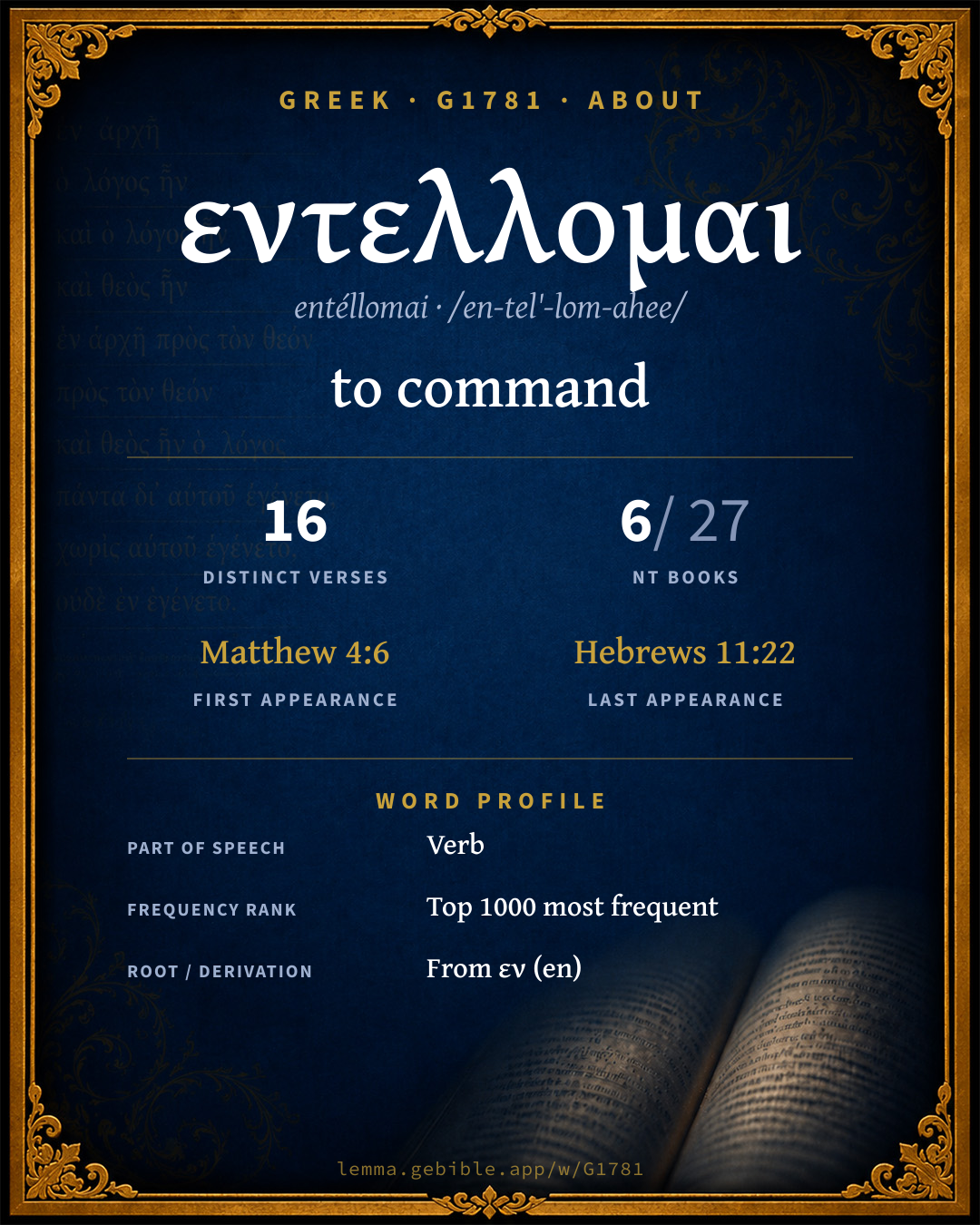
ἐντέλλομαι
to command
Full lexicon entry — Thayer's Greek Lexicon
From Thayer's Greek Lexicon
Where this word appears
See every Aorist-tense verb in the Greek New Testament →
Grammar key — what these labels mean
Part of speech
- Verb
- An action or state-of-being word.
Tense
- Aorist
- Action viewed as a simple whole, without regard to duration — often past (perfective aspect).
- Future
- Action expected in future time.
- Present
- Ongoing or general action in present time (imperfective aspect).
- Perfect
- A completed past action with continuing present results.
Voice
- Middle deponent
- Middle in form but active in meaning.
- Middle or Passive deponent
- Middle/passive in form but active in meaning.
- Passive
- The subject receives the action.
Mood
- Indicative
- States a fact or asks a factual question (the mood of reality).
- Participle
- A verbal adjective (“writing,” “having written”).
Case
- Nominative
- The case of the subject (and the predicate nominative).
Person
- 3rd person
- The one spoken about (“he / she / it / they”).
- 1st person
- The speaker (“I / we”).
Gender
- Masculine
- Grammatically masculine.
Number
- Singular
- One.
Grammatical forms
- Verb, Aorist, Middle deponent, Indicative, 3rd person, Singular 9 times (56%)
- Verb, Future, Middle or Passive deponent, Indicative, 3rd person, Singular 2 times (13%)
- Verb, Present, Middle or Passive deponent, Indicative, 1st person, Singular 2 times (13%)
- Verb, Aorist, Middle deponent, Indicative, 1st person, Singular 1 time (6%)
- Verb, Aorist, Middle or Passive deponent, Participle, Nominative, Singular, Masculine 1 time (6%)
- Verb, Perfect, Passive, Indicative, 3rd person, Singular 1 time (6%)
Parsed forms decoded from the imported morphology (Robinson–Tischendorf, public domain), counted across 16 parsed occurrences — not distinct verses.
Every verse where G1781 appears — 16 distinct verses across 6 books. Click any verse to open its interlinear word-by-word view. Verse text shown in the World English Bible for context — . Each verse’s Greek form is shown with its reference; the English is not keyword-highlighted, since the data carries no word-level English alignment. Use “Compare translations” on any verse to read it across multiple English versions. This concordance covers the Greek New Testament; Septuagint (Greek Old Testament) occurrences of this word are not indexed here.
Matthew 5 verses
- Matthew 4:6 ἐντελεῖται fut mid/pass.dep ind 3sg and said to him, "If you are the Son of God, throw yourself down, for it is written, 'He will give his angels charge concerning you.' and, 'On their hands they will bear you up, So that you don't dash your foot against a stone.'"
- Matthew 15:4 ἐνετείλατο aor mid.dep ind 3sg For God commanded, 'Honor your father and your mother,' and, 'He who speaks evil of father or mother, let him be put to death.'
- Matthew 17:9 ἐνετείλατο aor mid.dep ind 3sg As they were coming down from the mountain, Jesus commanded them, saying, "Don't tell anyone what you saw, until the Son of Man has risen from the dead."
- Matthew 19:7 ἐνετείλατο aor mid.dep ind 3sg They asked him, "Why then did Moses command us to give her a bill of divorce, and divorce her?"
- Matthew 28:20 ἐνετειλάμην aor mid.dep ind 1sg teaching them to observe all things that I commanded you. Behold, I am with you always, even to the end of the age." Amen.
Mark 2 verses
- Mark 10:3 ἐνετείλατο aor mid.dep ind 3sg He answered, "What did Moses command you?"
- Mark 13:34 ἐνετείλατο aor mid.dep ind 3sg "It is like a man, traveling to another country, having left his house, and given authority to his servants, and to each one his work, and also commanded the doorkeeper to keep watch.
Luke 1 verse
John 4 verses
- John 8:5 ἐνετείλατο aor mid.dep ind 3sg Now in our law, Moses commanded us to stone such. What then do you say about her?"
- John 14:31 ἐνετείλατο aor mid.dep ind 3sg But that the world may know that I love the Father, and as the Father commanded me, even so I do. Arise, let us go from here.
- John 15:14 ἐντέλλομαι pres mid/pass.dep ind 1sg You are my friends, if you do whatever I command you.
- John 15:17 ἐντέλλομαι pres mid/pass.dep ind 1sg "I command these things to you, that you may love one another.
Acts 2 verses
- Acts 1:2 ἐντειλάμενος aor mid/pass.dep ptcp nom sg masc until the day in which he was received up, after he had given commandment through the Holy Spirit to the apostles whom he had chosen.
- Acts 13:47 ἐντέταλται perf pass ind 3sg For so has the Lord commanded us, saying, 'I have set you as a light for the Gentiles, That you should bring salvation to the uttermost parts of the earth.'"
Hebrews 2 verses
- Hebrews 9:20 ἐνετείλατο aor mid.dep ind 3sg saying, "This is the blood of the covenant which God has commanded you."
- Hebrews 11:22 ἐνετείλατο aor mid.dep ind 3sg By faith, Joseph, when his end was near, made mention of the departure of the children of Israel; and gave instructions concerning his bones.
About this entry
At a glance — auto-summarized from this page’s data, not written by a person. Every figure links to its source below. This summary describes the numbers; it doesn’t interpret them.
εντελλομαι — transliterated entéllomai — is a Greek verb carrying the sense “to command.” Debuting at Matthew 4:6, it then recurs through the corpus. It appears 16 verses across 6 books of the Greek New Testament, among its uncommon vocabulary. More than a quarter of its appearances fall in Matthew. Related forms include εν, εγγραφω and εγγυος. Each statement above links to its evidence; the full detail follows below.
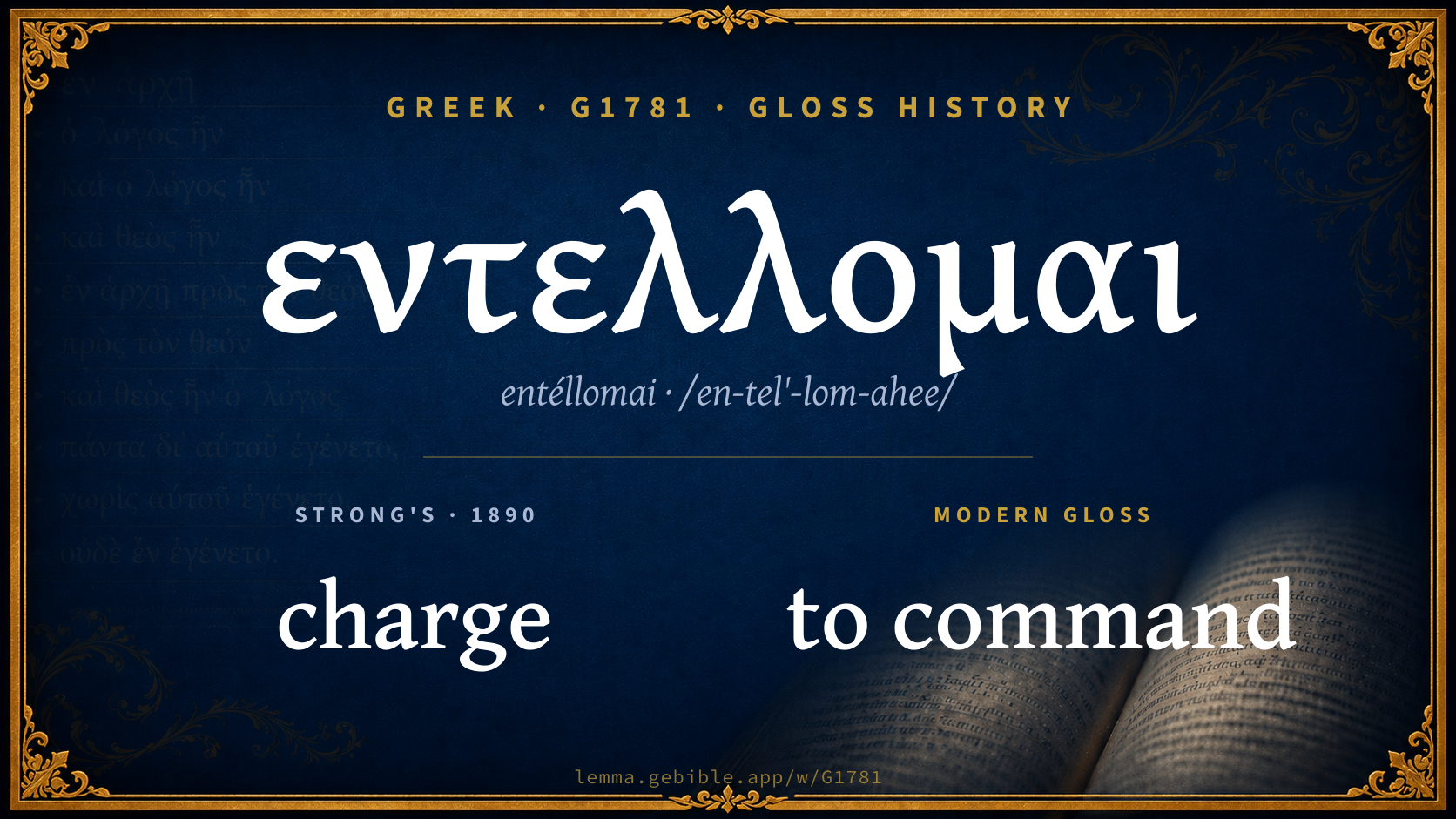
Gloss history
Strong's 1890 vs modern scholarship
About this word
Strong's G1781 catalogs a Greek word from the Greek New Testament.
These counts are not copied from any lexicon or concordance. They are computed here, from the morphology-tagged Greek New Testament. What Lemma adds →
- 16
- distinct verses
- The word appears in 16 distinct verses.
- 6 / 27
- NT books
- The word appears in 6 of 27 New Testament books.
- #726
- by frequency
- Top 1000 most frequent Greek words (rank 726 of 5,347 Greek words by occurrence).
View all 16 occurrences in the concordance →
By section of the New Testament
By traditional corpus
Conventional, traditional groupings — biblical authorship is debated, so this is a traditional corpus grouping, not an authorship claim. Some books belong to more than one corpus (Luke is in both the Gospels and the Lukan corpus, and so on), so these shares overlap and need not total 100%. Each figure is a share of the word’s 16 distinct verses.
- Gospels 12 verses · 75%
- Johannine 4 verses · 25%
- Lukan (Luke–Acts) 3 verses · 19%
- Hebrews 2 verses · 13%
How translations render this word
Counts come from each version’s own published word-to-Strong’s tagging or interlinear alignment — an approximate guide to how each version renders this word, not a word-level alignment the data otherwise carries. Because each total is that version’s own tagged count, the per-version totals vary from one another and need not match the appearance or distinct-verse counts above. These counts may also differ from a printed concordance because Lemma counts each distinctly tagged rendering and does not collapse phrase taggings into a single head-word total. This is a fixed set of word-tagged versions (KJV, ASV, BSB, ULT) and does not change with the reading translation you choose elsewhere. Each version’s license is shown beside its name below (and on Sources).
- King James Version: Commanded 4×, Command 3×, Charge 2×
- American Standard Version: Commanded 6×, Command 3×, Charge 2×
- Berean Standard Bible: Has commanded 3×, Command 2×, Commanded 2×
- unfoldingWord Literal Text: Commanded 5×, Command 3×, Did 2×
King James Version Public Domain
Renders G1781 across 21 tagged occurrences — most commonly:
Plus 10 renderings that appear only once — usually multi-word phrases or single function words the recovered tagging swept in, not distinct renderings.
American Standard Version Public Domain
Renders G1781 across 24 tagged occurrences — most commonly:
Plus 9 renderings that appear only once — usually multi-word phrases or single function words the recovered tagging swept in, not distinct renderings.
Berean Standard Bible Public Domain
Renders G1781 across 15 tagged occurrences — most commonly:
Plus 6 renderings that appear only once — usually multi-word phrases or single function words the recovered tagging swept in, not distinct renderings.
unfoldingWord Literal Text CC BY-SA 4.0
Renders G1781 across 20 tagged occurrences — most commonly:
Plus 8 renderings that appear only once — usually multi-word phrases or single function words the recovered tagging swept in, not distinct renderings.
Senses in Thayer's
The 1 sense Thayer's distinguishes for this word, in lexicon order (not ranked by frequency or importance). The full entry — with sub-senses — is in the Lexicon Entry tab.
- to order, command to be done, enjoin
Word origin
Derived from εν (en) (G1722).
Forms in the corpus
The 6 distinct written forms G1781 takes in the Greek New Testament, most frequent first — each parse links to that tense’s occurrences in the concordance.
| Form | Parsing | Example | Uses |
|---|---|---|---|
| ἐνετείλατο eneteílato | Verb, Aorist, Middle deponent, Indicative, 3rd person, Singular | Matthew 15:4 | 9 |
| ἐντέλλομαι entéllomai | Verb, Present, Middle or Passive deponent, Indicative, 1st person, Singular | John 15:14 | 2 |
| ἐντελεῖται enteleîtai | Verb, Future, Middle or Passive deponent, Indicative, 3rd person, Singular | Matthew 4:6 | 2 |
| ἐνετειλάμην eneteilámēn | Verb, Aorist, Middle deponent, Indicative, 1st person, Singular | Matthew 28:20 | 1 |
| ἐντέταλται entétaltai | Verb, Perfect, Passive, Indicative, 3rd person, Singular | Acts 13:47 | 1 |
| ἐντειλάμενος enteilámenos | Verb, Aorist, Middle or Passive deponent, Participle, Nominative, Singular, Masculine | Acts 1:2 | 1 |
Same root — word family
Other Thayer's entries built from the same root as G1781, grouped by Strong’s listed origin. These share a root / origin per the lexicon — not necessarily a shared meaning. Each links to that word’s own entry.
Derives from
Shares the same root
- εγγραφω engráphō G1449 to inscribe
- εγγυος éngyos G1450 surety
- εγκαθετος enkáthetos G1455 to spy
- εγκαινια enkaínia G1456 dedication
- εγκαλεω enkaléō G1458 to accuse
- εγκαταλειπω enkataleípō G1459 to abandon
- εγκατοικεω enkatoikéō G1460 to dwell
- εγκεντριζω enkentrízō G1461 to graft
- εγκομβοομαι enkombóomai G1463 band
- εγκοπτω enkóptō G1465 to hinder
- εγκρατης enkratḗs G1468 strong
- εγκρινω enkrínō G1469 to judge worthy
- εγκρυπτω enkrýptō G1470 to conceal
- εγκυος énkyos G1471 pregnant
- εγχριω enchríō G1472 to anoint
- ελλογεω ellogéō G1677 impute
- εμβαινω embaínō G1684 to enter
- εμβαλλω embállō G1685 to cast in
- εμβαπτω embáptō G1686 to dip in
- εμβατευω embateúō G1687 to enter
- εμβιβαζω embibázō G1688 to lead in
- εμβλεπω emblépō G1689 to look at
- εμβριμαομαι embrimáomai G1690 to warn sternly
- εμμαινομαι emmaínomai G1693 to rage against
+58 more words share this root (not shown).
Derived from this word
Compare all same-root words → Showing 4 of 86 — not the complete family. They share a root, not necessarily a meaning.
Septuagint usage
The same Greek word εντελλομαι appears 366 times in the Greek Old Testament (Septuagint), across 351 verses in 27 books.
- 366
- LXX occurrences
- Tagged occurrences of this Greek word in the Septuagint.
- 351
- verses
- Distinct Septuagint verses containing this word.
- 27 / 39
- OT books
- The word appears in 27 of the 39 Old Testament books.
Sample Septuagint occurrences
- Genesis 2:16 ἐντέλλομαι
- Exodus 4:28 ἐντέλλομαι
- Leviticus 6:2 ἐντέλλομαι
- Numbers 1:54 ἐντέλλομαι
- Deuteronomy 1:3 ἐντέλλομαι
- Joshua 1:7 ἐντέλλομαι
- Judges 2:20 ἐντέλλομαι
- Ruth 2:9 ἐντέλλω
- 1 Samuel 13:13 ἐντέλλομαι
- 2 Samuel 4:12 ἐντέλλω
- 1 Kings 1:35 ἐντέλλομαι
- 2 Kings 11:5 ἐντέλλομαι
Septuagint occurrences (same lexeme)
Every verse where the same Strong’s number (G1781) appears in the Greek Septuagint — showing the first 50 of 351. Verse text shown in the World English Bible for context; the Greek form is the matched word — the English is not keyword-highlighted.
- Genesis 2:16 ἐντέλλομαι Yahweh God commanded the man, saying, "Of every tree of the garden you may freely eat:
- Genesis 3:11 ἐντέλλομαι God said, "Who told you that you were naked? Have you eaten from the tree that I commanded you not to eat from?"
- Genesis 3:17 ἐντέλλομαι To Adam he said, "Because you have listened to your wife's voice, and have eaten of the tree, of which I commanded you, saying, 'You shall not eat of it,' cursed is the ground for your sake. In toil you will eat of it all the days of your life.
- Genesis 6:22 ἐντέλλομαι Thus Noah did. According to all that God commanded him, so he did.
- Genesis 7:5 ἐντέλλομαι Noah did everything that Yahweh commanded him.
- Genesis 7:9 ἐντέλλομαι went by pairs to Noah into the ark, male and female, as God commanded Noah.
- Genesis 7:16 ἐντέλλομαι Those who went in, went in male and female of all flesh, as God commanded him; and Yahweh shut him in.
- Genesis 12:20 ἐντέλλομαι Pharaoh gave men charge concerning him: and they brought him on the way, and his wife, and all that he had.
- Genesis 21:4 ἐντέλλομαι Abraham circumcised his son, Isaac, when he was eight days old, as God had commanded him.
- Genesis 27:8 ἐντέλλομαι Now therefore, my son, obey my voice according to that which I command you.
- Genesis 28:1 ἐντέλλομαι Isaac called Jacob, blessed him, and commanded him, "You shall not take a wife of the daughters of Canaan.
- Genesis 28:6 ἐντέλλομαι Now Esau saw that Isaac had blessed Jacob and sent him away to Paddan Aram, to take him a wife from there, and that as he blessed him he gave him a charge, saying, "You shall not take a wife of the daughters of Canaan,"
- Genesis 32:5 ἐντέλλομαι I have oxen, donkeys, flocks, men-servants, and maid-servants. I have sent to tell my lord, that I may find favor in your sight.'"
- Genesis 32:18 ἐντέλλομαι Then you shall say, 'They are your servant, Jacob's. It is a present sent to my lord, Esau. Behold, he also is behind us.'"
- Genesis 32:20 ἐντέλλομαι You shall say, 'Not only that, but behold, your servant, Jacob, is behind us.'" For, he said, "I will appease him with the present that goes before me, and afterward I will see his face. Perhaps he will accept me."
- Genesis 42:25 ἐντέλλομαι Then Joseph commanded to fill their bags with grain, and to restore every man's money into his sack, and to give them food for the way. So it done to them.
- Genesis 44:1 ἐντέλλομαι He commanded the steward of his house, saying, "Fill the men's sacks with food, as much as they can carry, and put every man's money in his sack's mouth.
- Genesis 45:19 ἐντέλλομαι Now you are commanded: do this. Take wagons out of the land of Egypt for your little ones, and for your wives, and bring your father, and come.
- Exodus 4:28 ἐντέλλομαι Moses told Aaron all the words of Yahweh with which he had sent him, and all the signs with which he had charged him.
- Exodus 7:2 ἐντέλλομαι You shall speak all that I command you; and Aaron your brother shall speak to Pharaoh, that he let the children of Israel go out of his land.
- Exodus 7:6 ἐντέλλομαι Moses and Aaron did so. As Yahweh commanded them, so they did.
- Exodus 7:10 ἐντέλλομαι Moses and Aaron went in to Pharaoh, and they did so, as Yahweh had commanded: and Aaron cast down his rod before Pharaoh and before his servants, and it became a serpent.
- Exodus 7:20 ἐντέλλομαι Moses and Aaron did so, as Yahweh commanded; and he lifted up the rod, and struck the waters that were in the river, in the sight of Pharaoh, and in the sight of his servants; and all the waters that were in the river were turned to blood.
- Exodus 12:28 ἐντέλλομαι The children of Israel went and did so; as Yahweh had commanded Moses and Aaron, so they did.
- Exodus 12:50 ἐντέλλομαι Thus did all the children of Israel. As Yahweh commanded Moses and Aaron, so they did.
- Exodus 23:15 ἐντέλλομαι You shall observe the feast of unleavened bread. Seven days you shall eat unleavened bread, as I commanded you, at the time appointed in the month Abib (for in it you came out from Egypt), and no one shall appear before me empty.
- Exodus 23:22 ἐντέλλομαι But if you indeed listen to his voice, and do all that I speak, then I will be an enemy to your enemies, and an adversary to your adversaries.
- Exodus 25:22 ἐντέλλομαι There I will meet with you, and I will tell you from above the mercy seat, from between the two cherubim which are on the ark of the testimony, all that I command you for the children of Israel.
- Exodus 29:35 ἐντέλλομαι "Thus shall you do to Aaron, and to his sons, according to all that I have commanded you. Seven days shall you consecrate them.
- Exodus 31:11 ἐντέλλομαι the anointing oil, and the incense of sweet spices for the holy place: according to all that I have commanded you they shall do."
- Exodus 32:8 ἐντέλλομαι They have turned aside quickly out of the way which I commanded them. They have made themselves a molten calf, and have worshiped it, and have sacrificed to it, and said, 'These are your gods, Israel, which brought you up out of the land of Egypt.'"
- Exodus 34:11 ἐντέλλομαι Observe that which I command you this day. Behold, I drive out before you the Amorite, the Canaanite, the Hittite, the Perizzite, the Hivite, and the Jebusite.
- Exodus 34:18 ἐντέλλομαι "You shall keep the feast of unleavened bread. Seven days you shall eat unleavened bread, as I commanded you, at the time appointed in the month Abib; for in the month Abib you came out from Egypt.
- Exodus 34:32 ἐντέλλομαι Afterward all the children of Israel came near, and he gave them all of the commandments that Yahweh had spoken with him on Mount Sinai.
- Exodus 34:34 ἐντέλλομαι But when Moses went in before Yahweh to speak with him, he took the veil off, until he came out; and he came out, and spoke to the children of Israel that which he was commanded.
- Exodus 40:16 ἐντέλλομαι Thus did Moses: according to all that Yahweh commanded him, so he did.
- Leviticus 6:2 ἐντέλλομαι "If anyone sins, and commits a trespass against Yahweh, and deals falsely with his neighbor in a matter of deposit, or of bargain, or of robbery, or has oppressed his neighbor,
- Leviticus 7:36 ἐντέλλομαι which Yahweh commanded to be given them of the children of Israel, in the day that he anointed them. It is their portion forever throughout their generations.
- Leviticus 7:38 ἐντέλλομαι which Yahweh commanded Moses in Mount Sinai, in the day that he commanded the children of Israel to offer their offerings to Yahweh, in the wilderness of Sinai.
- Leviticus 8:5 ἐντέλλομαι Moses said to the congregation, "This is the thing which Yahweh has commanded to be done."
- Leviticus 8:21 ἐντέλλομαι He washed the innards and the legs with water; and Moses burned the whole ram on the altar. It was a burnt offering for a sweet savor. It was an offering made by fire to Yahweh; as Yahweh commanded Moses.
- Leviticus 8:29 ἐντέλλομαι Moses took the breast, and waved it for a wave offering before Yahweh. It was Moses' portion of the ram of consecration, as Yahweh commanded Moses.
- Leviticus 8:34 ἐντέλλομαι What has been done this day, so Yahweh has commanded to do, to make atonement for you.
- Leviticus 8:35 ἐντέλλομαι At the door of the Tent of Meeting you shall stay day and night seven days, and keep the charge of Yahweh, that you don't die: for so I am commanded."
- Leviticus 9:5 ἐντέλλομαι They brought what Moses commanded before the Tent of Meeting: and all the congregation drew near and stood before Yahweh.
- Leviticus 9:7 ἐντέλλομαι Moses said to Aaron, "Draw near to the altar, and offer your sin offering, and your burnt offering, and make atonement for yourself, and for the people; and offer the offering of the people, and make atonement for them; as Yahweh commanded."
- Leviticus 9:10 ἐντέλλομαι but the fat, and the kidneys, and the cover from the liver of the sin offering, he burned upon the altar; as Yahweh commanded Moses.
- Leviticus 10:13 ἐντέλλομαι and you shall eat it in a holy place, because it is your portion, and your sons' portion, of the offerings of Yahweh made by fire: for so I am commanded.
- Leviticus 17:2 ἐντέλλομαι "Speak to Aaron, and to his sons, and to all the children of Israel, and say to them: 'This is the thing which Yahweh has commanded,
- Leviticus 24:2 ἐντέλλομαι "Command the children of Israel, that they bring to you pure olive oil beaten for the light, to cause a lamp to burn continually.
These are occurrences of the same Greek lexeme (G1781) in the Septuagint — not a translation of any one Hebrew word. The store carries no word-level Hebrew↔Greek alignment, so no Hebrew original is asserted here. Counts come from the recovered LXX Strong's tagging — high-frequency vocabulary is well covered, while rare or late forms may be untagged — so they reflect tagged occurrences and may slightly undercount.