1 John 2:8

Greek (Tischendorf 8th ed.) 1 John 2:8 appears in the Greek New Testament. The text above is from the Tischendorf 8th edition. Each word links to its Strong’s number and a concise gloss. Click any word for its full Thayer’s Greek Lexicon entry.
Download image
Cite this verse

1 John 2:8 (World English Bible). Public Domain. Lemma interlinear Bible study tool, https://lemma.gebible.app/v/1-john/2/8.

Show BibTeX & RIS
BibTeX
RIS
English Translation
Again, I write a new commandment to you, which is true in him and in you; because the darkness is passing away, and the true light already shines.
World English Bible · Public Domain
Download a study sheet

One document with this verse’s original text, its word-by-word gloss line, the meaning frame, cross-references with their text, attributed commentary, and full source and license credits — printable, and it pastes into notes with its structure intact.

This verse Autodidact and up

Study sheet (.html) Plain text (.txt)

A passage Seminary Student

Up to 50 verses in one chapter. A passage sheet keeps up to 6 commentary sources and 12 cross-references per verse, in the order this page ranks them, and says so on the sheet whenever that leaves anything out. Ask for a single verse and you get the Autodidact verse sheet above.

Everything on this page stays free to read, with no account — the sheet is a download of what is already on screen, not access to it.

Want to remove ads? Support Godless Engineer
Compare translations 3

The same verse in 3 English versions, stacked beneath the original-language interlinear above. Click any original word for its lexicon entry.

Each is an independent rendering of the whole verse — the interlinear is not word-aligned to these translations.

Highlighted words mark where these versions differ — a whole-verse word diff, not a word-by-word alignment.

  • World English Bible Public Domain
    Again, I write a new commandment to you, which is true in him and in you; because the darkness is passing away, and the true light already shines.
  • King James Version Public Domain
    Again, a new commandment I write unto you, which thing is true in him and in you: because the darkness is past, and the true light now shineth.
  • unfoldingWord Literal Text CC BY-SA 4.0
    Again, I am writing a new commandment to you, which is true in him and in you, because the darkness is going away, and the true light is already shining.

unfoldingWord Literal Text — © unfoldingWord, licensed CC BY-SA 4.0. Word-aligned USFM3 via Door43 (git.door43.org/unfoldingWord/en_ult).

Versions to compare (up to 4)

3 of 4 selected

Show all 19 translations

Every available English version of this verse, each an independent rendering of the whole verse.

  • World English Bible Public Domain
    Again, I write a new commandment to you, which is true in him and in you; because the darkness is passing away, and the true light already shines.
  • Berean Standard Bible Public Domain
    Then again, I am also writing to you a new commandment, which is true in Him and also in you. For the darkness is fading and the true light is already shining.
  • Majority Standard Bible Public Domain
    Then again, I am also writing to you a new commandment, which is true in Him and also in you. For the darkness is fading and the true light is already shining.
  • King James Version Public Domain
    Again, a new commandment I write unto you, which thing is true in him and in you: because the darkness is past, and the true light now shineth.
  • American Standard Version (1901) Public Domain
    Again, a new commandment write I unto you, which thing is true in him and in you; because the darkness is passing away, and the true light already shineth.
  • Revised Version (1885) Public Domain
    Again, a new commandment write I unto you, which thing is true in him and in you; because the darkness is passing away, and the true light already shineth.
  • Geneva Bible (1599) Public Domain
    Againe, a new comandement I write vnto you, that which is true in him, and also in you: for the darkenes is past, and that true light now shineth.
  • Douay-Rheims (1899) Public Domain
    Again a new commandment I write unto you, which thing is true both in him and in you; because the darkness is passed, and the true light now shineth.
  • Young's Literal Translation Public Domain
    again, a new command I write to you, which thing is true in him and in you, because the darkness doth pass away, and the true light doth now shine;
  • Literal Standard Version CC BY-SA 4.0
    again, a new command I write to you, which is true in Him and in you, because the darkness is passing away, and the true light now shines;
  • Unlocked Literal Bible CC BY-SA 4.0
    Yet I am writing a new commandment to you, which is true in Christ and in you, because the darkness is passing away, and the true light is already shining.
  • unfoldingWord Literal Text CC BY-SA 4.0
    Again, I am writing a new commandment to you, which is true in him and in you, because the darkness is going away, and the true light is already shining.
  • Darby Bible Public Domain
    Again, I write a new commandment to you, which thing is true in him and in you, because the darkness is passing and the true light already shines.
  • World Messianic Bible Public Domain
    Again, I write a new commandment to you, which is true in him and in you, because the darkness is passing away and the true light already shines.
  • Webster's Bible Public Domain
    Again, a new commandment I write to you, which thing is true in him and in you: because the darkness is past, and the true light now shineth.
  • Free Bible Version CC BY-SA 4.0
    But in a sense I am giving you a new commandment. Its truth is revealed in Jesus and in you, for the darkness is coming to an end and the true light is already shining.
  • Bible in Basic English Public Domain
    Again, I give you a new law, which is true in him and in you; for the night is near its end and the true light is even now shining out.
  • Text-Critical English NT CC BY 4.0
    Yet I am writing you a new commandment, which is true in him and in you, because the darkness is passing away, and the true light is already shining.
  • Tyndale New Testament (1534) Public Domain
    Agayne a newe commaundement I write vnto you a thynge that is true in him and also in you: for the darknes is past and the true lyght now shyneth.

Literal Standard Version (2020), Covenant Press — licensed CC BY-SA 4.0. Text via the HelloAO Bible API (eBible.org). Unlocked Literal Bible (unfoldingWord) — licensed CC BY-SA 4.0. Text via the HelloAO Bible API (eBible.org). unfoldingWord Literal Text — © unfoldingWord, licensed CC BY-SA 4.0. Word-aligned USFM3 via Door43 (git.door43.org/unfoldingWord/en_ult). Free Bible Version, Dr. Jonathan Gallagher — licensed CC BY-SA 4.0. Text via the HelloAO Bible API (eBible.org).

Word by word

More ways to search: Search by grammar → Find every occurrence → Compare this word →

Practice this passage: Drill this verse → Learn its vocabulary →

παράγεται
parágō
G3855
“to pass by”
Verb, Present, Middle, Indicative, 3rd person, Singular
Part of Speech
Verb
Tense
Present
Voice
Middle
Mood
Indicative
Person
3rd person
Number
Singular
Full Thayer's Definition

Origin: from G3844 and G71

TDNT: 03:09,2

1. pass by a. to lead past, lead by b. to lead aside, mislead 1. to lead away c. to lead to 1. to lead forth, bring forward 2. to pass by, go past a. to depart, go away 3. metaph. disappear
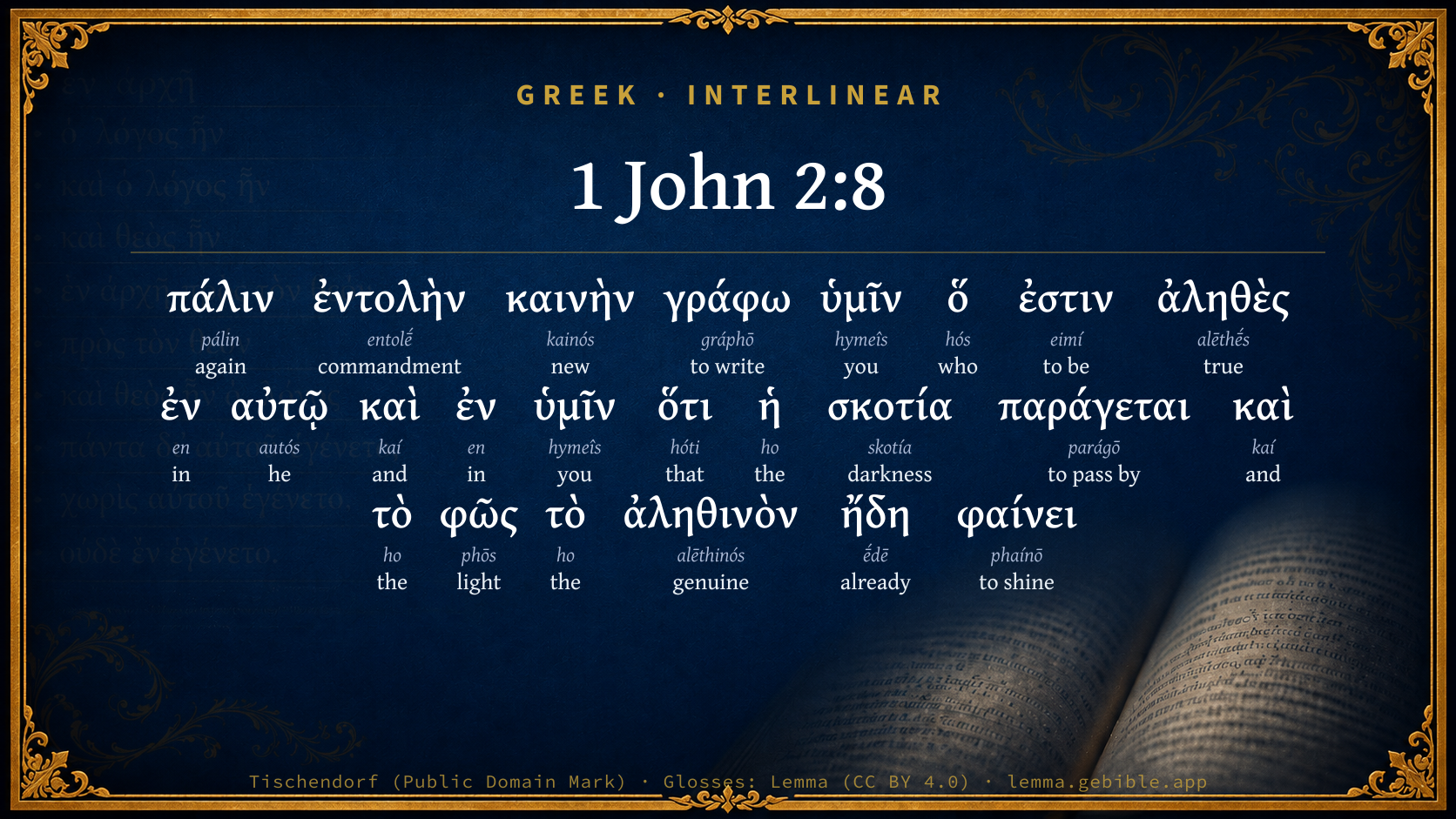
  1. πάλιν pálin G3825 “again” Adverb
  2. ἐντολὴν entolḗ G1785 “commandment” Noun, Accusative, Singular, Feminine
  3. καινὴν kainós G2537 “new” Adjective, Accusative, Singular, Feminine
  4. γράφω gráphō G1125 “to write” Verb, Present, Active, Indicative, 1st person, Singular
  5. ὑμῖν hymeîs G5210 “you” Personal pronoun, 2nd person, Dative, Plural
  6. ὅ hós G3739 “who” Relative pronoun, Nominative, Singular, Neuter
  7. ἐστιν eimí G1510 “to be” Verb, Present, Active, Indicative, 3rd person, Singular
  8. ἀληθὲς alēthḗs G227 “true” Adjective, Nominative, Singular, Neuter
  9. ἐν en G1722 “in” Preposition
  10. αὐτῷ autós G846 “he” Personal pronoun, Dative, Singular, Masculine
  11. καὶ kaí G2532 “and” Conjunction
  12. ἐν en G1722 “in” Preposition
  13. ὑμῖν hymeîs G5210 “you” Personal pronoun, 2nd person, Dative, Plural
  14. ὅτι hóti G3754 “that” Conjunction
  15. ἡ ho G3588 “the” Article, Nominative, Singular, Feminine
  16. σκοτία skotía G4653 “darkness” Noun, Nominative, Singular, Feminine
  17. καὶ kaí G2532 “and” Conjunction
  18. τὸ ho G3588 “the” Article, Nominative, Singular, Neuter
  19. φῶς phōs G5457 “light” Noun, Nominative, Singular, Neuter
  20. τὸ ho G3588 “the” Article, Nominative, Singular, Neuter
  21. ἀληθινὸν alēthinós G228 “genuine” Adjective, Nominative, Singular, Neuter
  22. ἤδη ḗdē G2235 “already” Adverb
  23. φαίνει phaínō G5316 “to shine” Verb, Present, Active, Indicative, 3rd person, Singular

About this verse

These counts appear in no published source. They are computed here, from the morphology-tagged text and Lemma’s own curated glosses. What Lemma adds →

24
words
19
distinct lemmas
General Epistles
section

Notable vocabulary

The rarest word here is παράγεται to pass by G3855 — appearing just 10 times in the whole Greek New Testament.

Shared distinctive vocabulary

παράγεται to pass by G3855 occurs in 10 verses of the Greek New Testament. Also found in:

Repetition

Words recur within this verse:

Cross-references

30

Topical passages linked to 1 John 2:8 in the Treasury of Scripture Knowledge — connected by theme and wording, ordered by reader-vote popularity; previews shown in the World English Bible.

  • Ephesians 5:8 For you were once darkness, but are now light in the Lord. Walk as children of light,
  • Romans 13:12 The night is far gone, and the day is near. Let's therefore throw off the works of darkness, and let's put on the armor of light.
  • John 13:34 A new commandment I give to you, that you love one another, just like I have loved you; that you also love one another.
  • John 8:12 Again, therefore, Jesus spoke to them, saying, "I am the light of the world. He who follows me will not walk in the darkness, but will have the light of life."
  • 2 Corinthians 4:4–6 in whom the god of this world has blinded the minds of the unbelieving, that the light of the Gospel of the glory of Christ, who is the image of God, should not dawn on them.
  • John 1:9 The true light that enlightens everyone was coming into the world.
  • John 12:46 I have come as a light into the world, that whoever believes in me may not remain in the darkness.
  • John 1:4–5 In him was life, and the life was the light of men.
  • 1 John 4:21 This commandment we have from him, that he who loves God should also love his brother.
  • Malachi 4:2 But to you who fear my name shall the sun of righteousness arise with healing in its wings. You will go out, and leap like calves of the stall.
  • 1 Thessalonians 5:4–8 But you, brothers, aren't in darkness, that the day should overtake you like a thief.
  • Psalms 27:1 Yahweh is my light and my salvation. Whom shall I fear? Yahweh is the strength of my life. Of whom shall I be afraid?
  • Psalms 36:9 For with you is the spring of life. In your light shall we see light.
  • Isaiah 60:1–3 Arise, shine; for your light is come, and the glory of Yahweh is risen on you.
  • Luke 1:79 To shine on those who sit in darkness and the shadow of death; To guide our feet into the way of peace."
  • John 15:12–15 "This is my commandment, that you love one another, even as I have loved you.
  • Acts 17:30 The times of ignorance therefore God overlooked. But now he commands that all people everywhere should repent,
  • Acts 26:18 to open their eyes, that they may turn from darkness to light and from the power of Satan to God, that they may receive remission of sins and an inheritance among those who are sanctified by faith in me.'
  • 2 Corinthians 8:9 For you know the grace of our Lord Jesus Christ, that, though he was rich, yet for your sakes he became poor, that you through his poverty might become rich.
  • Ephesians 5:1–2 Be therefore imitators of God, as beloved children.
  • 2 Timothy 1:10 but has now been revealed by the appearing of our Savior, Christ Jesus, who abolished death, and brought life and immortality to light through the Gospel.
  • 1 John 3:14–16 We know that we have passed out of death into life, because we love the brothers. He who doesn't love his brother remains in death.
  • 1 John 4:11 Beloved, if God loved us in this way, we also ought to love one another.
  • Song of Solomon 2:11–12 For, behold, the winter is past. The rain is over and gone.
  • Isaiah 9:2 The people who walked in darkness have seen a great light: those who lived in the land of the shadow of death, on them has the light shined.
  • Matthew 4:16 The people who sat in darkness saw a great light, To those who sat in the region and shadow of death, To them light has dawned."
  • John 12:35 Jesus therefore said to them, "Yet a little while the light is with you. Walk while you have the light, that darkness doesn't overtake you. He who walks in the darkness doesn't know where he is going.
  • Psalms 84:11 For Yahweh God is a sun and a shield. Yahweh will give grace and glory. He withholds no good thing from those who walk blamelessly.
  • 1 Peter 1:21 who through him are believers in God, who raised him from the dead, and gave him glory; so that your faith and hope might be in God.
  • 1 Peter 4:1–3 Forasmuch then as Christ suffered for us in the flesh, arm yourselves also with the same mind; for he who has suffered in the flesh has ceased from sin;

Cross-references courtesy of OpenBible.info (CC BY 4.0).

Commentary

Notes on 1 John 2:8 from classic Christian and Jewish commentators (each source and its license shown beneath its notes). The classic Christian expositions comment on the surrounding passage and are grouped to its opening verse, so a note may address several verses; the Jewish commentaries on the Tanakh (Rashi and others) are per-verse, so they appear only where the commentator wrote on this verse.

Lemma curates 59 commentaries, every one of them public domain or Creative Commons licensed, each selected and text-cleaned for this edition rather than reprinted as found. About our sources →

Tyndale Open Study Notes

Tyndale Open Resources

2:8 Yet it is also new: Jesus’ command provided the new basis for their love in his own demonstration of love to the disciples (John 13:1-17). • the darkness is disappearing and the true light is already shining: The light of the Good News expels darkness. Darkness cannot overcome it, especially where believers are living out the love that is in Christ.

Tyndale Open Study Notes — © Tyndale Open Resources, licensed CC BY-SA 4.0. Text via the HelloAO Bible API.

Bengel's Gnomon

Johann Albrecht Bengel

1Jn 2:8. Ἐντολὴν καινὴν, a new precept) which is now first written to you in this Epistle. This passage savours of the fulness of the Spirit in the apostle.—ὃ ἐστιν ἀληθὲς, that which is truth) Truth, substantively, as in 1Jn 2:27, where truth and a lie are opposed to each other. Thence also ὃ is put for ἣ, that is, the commandment (ἐντολή). The sense is: the commandment, or precept, is truth; that is, the darkness truly passes away, etc. As in 1Jn 2:7, to the word old, so in this ver., to the word new, its definition is immediately subjoined, what is the old, and what is the new. The old is that which we had from the beginning: the new is that which is true in Jesus Christ and in us. The difference of time in the words, ye had, and it is, tends to this. In Christ all things are always true, and were so from that beginning; but in Christ and in us, conjointly, the precept is then truth, when we acknowledge the truth, which is in Him, and have the same flourishing in us. John praises the present state of those to whom he writes, as one even more highly favoured than that very state which they had had at the beginning of their hearing the Gospel, as Rom 13:11-12; whence also the old precept could with pleasantness be proposed to them under a new method.—ὅτ because. This is that precept, the love of a brother, from the light. Hence at the beginning of 1Jn 2:9 therefore is to be understood. Comp. ch. 1Jn 1:5-6.—παράγεται) He does not say παράγει, passes by, but παράγεται, is caused to pass, is changed, so that at length it is absorbed. The same word is used, 1Jn 2:17, where it is opposed to abiding. Thus Ezr 9:2, Septuagint, παρήχθη σπέρμα τὸ ἅγιον, the holy seed was transferred, or caused to pass to the nations, and was mingled with them. Herodian: ὄνομα παραχθὲν, a name changed, transferred from another, or to another.—Book I., ch. 16, and V. 7. The present is to be observed, as in shineth.—τὸ φῶς τὸ ἀληθινὸν, the true light) Jesus Christ: Joh 1:9.—ἤδη) now, with you; but it will shine the more for ever: 1Jn 2:28. Comp. until now, 1Jn 2:9.—φαίνει, shineth) On this account it was now less needful for John to bring forward the prophets in his Epistles than it was for Peter; whose 2d Epistle, 2Pe 1:19, comp. respecting the day and the morning star. Peter, with his Epistles, stands about midway between the suffering of Christ and the close of the life of John.

Bengel's Gnomon of the New Testament — English translation (T&T Clark, Edinburgh, 1860) — public domain. Text from a community e-Sword module.

Meyer's Critical & Exegetical Commentary

Heinrich August Wilhelm Meyer

1Jn_2:8. πάλιν ἐντολὴν καινὴν κ.τ.λ.] Almost all commentators hold that the ἐντολὴ καινή is the same ἐντολή as was the subject of 1Jn_2:7; differently Ebrard, who explains as follows: With 1Jn_2:7 begins a new section which continues to 1Jn_2:29, in which the leading thought is the position of the readers to the light as one which was already shining; by ἐντ. παλαιά is meant the clause, chap. 1Jn_1:5 : ὁ Θεὸς φῶς ἐστι; by ἐντ. καινή, on the other hand, the following clause: ἡ σκοτία παράγεται καὶ τὸ φῶς τὸ ἀληθινὸν ἤδη φαίνει;[107] the relative clause Ὅ ἙΣΤΙΝ ἈΛΗΘῈς Κ.Τ.Λ. belongs, by apposition, to the following sentence: ὍΤΙ Ἡ ΣΚΟΤΊΑ Κ.Τ.Λ., and states to what extent the essential true light has already begun to shine, namely, the fact that the light already shines has a double sphere in which it is ἈΛΗΘΈς, i.e. actually realized, first in Christ, but then also ἐν ὑμῖν, i.e. in the Ephesian readers themselves, and equally in all true Christians. This explanation is, however, incorrect; for(1) the truth ἡ σκοτία παράγεται κ.τ.λ. can just as little be called an ἘΝΤΟΛΉ as the sentence Ὁ ΘΕῸς Φῶς ἘΣΤΙ (see on 1Jn_2:7); (2) the relative clause, if it was to be a preceding apposition to Ἡ ΣΚΟΤΊΑ Κ.Τ.Λ., would have had to come after ὍΤΙ; according to the structure of the verse, Ὅ must necessarily be connected with what precedes; (3) it is a false idea, that that which the clause ὍΤΙ Ἡ ΣΚΟΤΊΑ expresses was actually realized in Christ; the incorrectness of this idea is concealed in Ebrards interpretation in this way, no doubt, that he gives to ἘΝ ΑὐΤῷ a different relation from that which he gives ἘΝ ὙΜῖΝ, and changes the present ΠΑΡΆΓΕΤΑΙ into the perfect.[108] Nor is the opinion that we are to understand by ἘΝΤ. ΠΑΛ. the commandment of walking in light, and by ἘΝΤ. ΚΑΙΝΉ, on the other hand, that of brotherly love (1Jn_2:9), tenable, because these commandments, according to their import, are not two distinct commandments, but one and the same commandment. Still more unjustifiable is the assumption of S. Schmid, that in 1Jn_2:7 the fundamental law of Christianity, namely, justification by faith, but here the commandment of Christian sanctification, is meant; and that of Weiss, that by ἘΝΤΟΛΉ, 1Jn_2:7, is to be understood the evangelical message of salvation, but here the commandment of love. The apostle, having in view here the same commandment as in 1Jn_2:7, says: Again a new commandment I write unto you, which thing is true in Him and in you: because the darkness is past, and the true light now shineth. The relative clause ὅ ἐστιν κ.τ.λ. serves not merely to establish the statement that the commandment is a new one (Socinus, Flacius, Morus, Hornejus, de Wette-Brückner, Lücke, ed. 2 and 3, ed. 1 of this commentary, Erdmann, etc.);[109] but the apostle thereby describes the commandment, yet not in a material way, so that ὅ would be referred to the substance of it (Oecumenius, Luther, Baumgarten-Crusius, Semler, Frommann, Düsterdieck, etc.),[110] but only in a formal way, as that which is actually fulfilled in Christ and in his readers; as the commandment in 1Jn_2:7 was also only defined in a formal way by ἣν εἴχετε ἀπʼ ἀρχῆς.

ὅ ἐστιν … ἐν ὑμῖν is the object belonging to ΓΡΆΦΩ, and ἘΝΤΟΛῊΝ ΚΑΙΝΉΝ is to be taken as the accusative of more particular definition; this construction of it is found in Ewald, only he explains ἘΝ ΑὐΤῷ incorrectly by: in the last-mentioned (in 1Jn_2:7) word of God; most recently it has been accepted by Braune with the interpretation here given. The sense accordingly is: that which is already true, i.e. fulfilled, in Christ and in you, namely, the τηρεῖν τὰς ἐντολὰς τοῦ Θεοῦ (comp. Joh_15:10, where Christ says of Himself: ἘΓῺ ΤᾺς ἘΝΤΟΛᾺς ΤΟῦ ΠΑΤΡΌς ΜΟΥ ΤΕΤΉΡΗΚΑ), I write unto you as a new commandment.[111] With this view it is self-evident that the apostle calls the old commandment a new one only in so far as he writes it anew to them. It is true a different reference has usually been given to καινή, by understanding it either of the constant endurance of the commandment of love (Calvin: novum dieit, quod Deus quotidie suggerendo veluti renovat; Joannes negat ejusmodi esse doctrinam de fratribus diligendis, quae tempore obsolescat: sed perpetuo vigere), or to indicate that this commandment first entered into the world along with Christianitywhether emphasis was put more upon the substance of it (Lücke, de Wette, ed. 1 of this comm.), or upon the mere time of it (Düsterdieck);[112] but these constructions, not being indicated in the context, are purely forced.

On πάλιν, Erasmus says: et contrarietatem declarat et iterationem; hic autem non repetitionis sed contrarietatis est declaratio; with this interpretation almost all commentators agree, referring πάλιν to the idea ἐντ. καινήν; but an antithetical construction is foreign to the word; it is = again, once more, is to be connected with γράφω, and is explained by the fact that the readers have already heard the commandment, nay, even are already fulfilling it. Lücke and de Wette connect it directly with the verb, but in such a way that even they give to it an antithetical reference.[113]

ἐστὶν ἀληθές] ἀληθής signifies here the actual reality, as in Act_12:9 (see Meyer on this passage).

ἘΝ ΑὐΤῷ] ἘΝ is to be retained in its special meaning, not = respectu, in reference to, nor is it used of the subject in which something true is to be recognized as true (1Jn_2:3) (de Wette), for there is no mention here of any knowledge. That by αὐτός here not God (Jachmann), but Christ is to be understood, is shown by the context. Socinus incorrectly explains ἘΝ ΑὐΤῷ = per se ac simpliciter. On the point that ἩΜῖΝ is not to be read, see the critical notes. Grotius unjustifiably understands by ἩΜῖΝ the apostles.

Neander has a wrong conception of the relation of ἘΝ ΑὐΤῷ and ἘΝ ὙΜῖΝ when he explains: it takes place in reference to Christ and in reference to the church, therefore in reference to their mutual relationship to one another.

ὅτι ἡ σκοτία κ.τ.λ.] ὅτι is not used declaratively, nor in such a way as to be dependent on ἀληθές (it is true that the darkness, etc.), or on ἘΝΤΟΛΉΝ (Castellio, Socinus, Bengel, Ebrard),to both these views the structure of the verse is opposed,but causally; this is rightly perceived by most of the commentators; but it is incorrect when they connect it with the immediately preceding ὅ ἐστιν ἀληθὲς κ.τ.λ., for the double-membered clause: ὍΤΙ Ἡ ΣΚΟΤΊΑ … ΦΑΊΝΕΙ, being a confirmatory clause, does not stand in a corresponding relationship to the thought: Ὅ ἘΣΤΙΝ ἈΛ.… ὙΜῖΝ, which it is intended to confirm.[114] By ὅτι κ.τ.λ. the apostle rather states the reason why he writes to them as a new commandment that which is true in Christ and in them (Düsterdieck, Braune); this reason is the already commenced disappearance of darkness and shining of the true light. The contrasted words Ἡ ΣΚΟΤΊΑ and ΤῸ Φῶς ΤῸ ἈΛΗΘΙΝΌΝ are to be taken in ethical sense (Braune);[115] the former idea signifies the darkness which consists in error and sin, as it exists outside the fellowship with God; the latter, the light which consists in truth and holiness, as it proceeds from Christ, who Himself is the true light. It is incorrect to understand here by ΤῸ Φῶς ΤῸ ἈΛ., Christ Himself (Bengel, Erdmann), as the contrast with Ἡ ΣΚΟΤΊΑ shows. ἈΛΗΘΙΝΌς is an expression which is almost confined to the writings of John; outside them it is only found in Luk_16:11, 1Th_1:9, and three times in the Epistle to the Hebrews; it describes the light of which the apostle is speaking as the eternal, essential light, of which the earthly light is merely the transitory reflection; see especially Neander on this passage.

ΠΑΡΆΓΕΤΑΙ is translated by the Vulgate as perfect: quoniam tenebrae transierunt; similarly by Luther: the darkness is past; and Calvin directly says: Praesens tempus loco Praeteriti. This, however, is arbitrary; the present is to be retained as such; it is used in the same sense as in 1Co_7:31 : ΠΑΡΆΓΕΙ (see Meyer on this passage), so that we must interpret: the σκοτία is in the state of passing away. It is unnecessary to take παράγεται, with Bengel, with whom Sander and Besser agree, as passive (Bengel: non dicit ΠΑΡΆΓΕΙ transit, sed ΠΑΡΆΓΕΤΑΙ traducitur, commutatur, ita ut tandem absorbeatur); it is more natural to regard it as the middle form with intransitive meaning. With the meaning: is in the state of passing, corresponds the particle ἬΔΗ with ΦΑΊΝΕΙ, which is not = now (Luther), but by which the moment is described in which the darkness is retreating before the light, at which therefore neither has the darkness already completely disappeared, nor is the light completely dominant. Most of the commentators, both the older and more recent (Baumgarten-Crusius, de Wette-Brückner, Lücke, Sander, Düsterdieck, Erdmann, Ebrard), take this as referring to Christianity in general, in so far as by it, as the true light, the old darkness is being ever more and more overcome; but by the word ἬΔΗ the apostle shows that in these words he is looking forward to a future time at which that victory will have been completely won, and which he regards as close at hand (so also Braune). The moment in which he writes this is in his eyes, therefore, no other than that which immediately precedes the second coming of Christ, and which He Himself in 1Jn_2:18 calls the ἘΣΧΆΤΗ ὭΡΑ,[116] in which it is of the greater importance for Christians, by keeping the commandment, to show themselves as children of the light. The same train of thought essentially occurs here as afterwards in 1Jn_2:15-18; compare also the Pauline ἡ νὺξ προέκοψεν, ἡ δὲ ἡμέρα ἤγγικε, Rom_13:12.

[107] The same view is found in Castellio, Socinus, and Bengel. The latter remarks on ἐντολὴν καινήν: praeceptum novum, quod nobis nunc primum in hac epistola scribitur; and on ὅτι: quod hoc est illud praeceptum, to which he then very strangely adds: amor fratris, ex luce.

[108] Ebrard says: The eternally existing light is one which has already appeared ἐν αὐτῷ, in so far as in Christ the light objectivized has arisen for the world and has overcome the darkness, and ἐν ὑμῖν in so far as also subjectively to the readers the light of the gospel has arisen, and they also subjectively have been drawn from darkness unto light. By ἐν ὑμῖν he means, therefore, the readers, in whom, i.e. in whose souls, the transition from darkness to light has taken place; by ἐν αὐτῷ, however, not Christ, in whom, but the world, for which that has happened objectively, inasmuch as Christ entered as the light into the darkness of the world. Quite a different meaning, therefore, is here assigned to ἐν αὐτῷ from that which is given to ἐν ὑμῖν, as the difference in the relation from the antithesis of objective and subjective clearly shows.It is not merely the change of the present παράγεται into the perfect that is the cause of this treatment, for it appears elsewhere in the commentary,thus on p. 148: that which is true in Christ and in you, that the darkness is past, etc.; p. 150: similar to the new announcement, that the darkness is past, etc.; p. 155: It is the truth, that the darkness is past; against which, on the other hand, παράγεται is correctly explained on p. 150: the darkness is passing by, is in a state of passing away, of disappearing.

[109] For if ὅ ἐστιν κ.τ.λ. is, according to the intention of the apostle, to be referred to the idea of the newness of the commandment, he wouldfirst, have given this idea a more independent form than he has given it as a simple attribute of the object ἐντολήν depending on γράφω; and, secondly, not have given the confirmation of the statement (that the commandment is a new one) in a sentence which does not so much show the truth of this idea as merely state the sphere in which that statement is true; to which may be added, that the idea so resulting is itself so indistinct, that it requires, in order to be understood, an explanatory circumlocution, such as: that the commandment is a new one has its truth in Christ, inasmuch as it did not exist before Him, etc. (ed. 1 of this comm.). Besides, an emphasis unwarranted by the context is placed on the idea of the newness of the commandment, especially if it is thought that the following ὅτι again serves to establish the thought expressed in the confirmatory clause (Lücke, de Wette, Brückner).

[110] Düsterdieck, it is true, approves of Knapps paraphrase, which agrees with the above explanation: πάλιν (ὡς) ἐντολὴν καιν. γρ. ὑμῖν τοῦτο ὅ ἐστιν ἀληθές κ.τ.λ.; but, with the idea of a constructio ad sensum, refers ὅ to the preceding ἐντολήν, so that this forms the object of γράφω, which by the relative clause obtains its more particular definition. In opposition to this construction, de Wette has rightly observed that it has grammatical difficulty. When Düsterdieck, in reply to Lückes objection, that with that interpretation it would need to run ἥ ἐστιν ἀληθής, says that it is not the ἐντολή itself as such, but its substance in Christ, etc., that has been fulfilled, Ebrards observation is a sufficient answer: That which is required in the ἐντολή is nothing else than just the ἐντολή itself; the requirement itself is fulfilled in Christ when its substance is fulfilled in Him.

[111] That John places before his readers anew as a commandment that which already has been fulfilled in them, is clearly not more strange than that he declares to them truths of which he himself says that they know them already (comp. ver. 21). Brückner admits that the construction here advocated is simple and clear, but groundlessly thinks that the strangeness of this form of speech is not mitigated by the reference to ver. 21.

[112] On the basis of the right view of ἀπʼ ἀρχῆς, ver. 7, we find the nature of the newness of the commandment indicated just in this; this, however, is only the case if the temporal reference is retained in its purity. This Düsterdieck indeed insists on; but this relation has only force if we regard at the same time the substance of the commandment, as Düsterdieck does. But nothing in the context indicates this new substance, and it is therefore very differently defined by the commentators.

[113] Lücke does so when he says: In ver. 8, John continues correctingly thus: Again a new commandment I write unto you. (In the edition of 1851, Lücke agrees with the usual acceptation: Againin contrasta new commandment I write unto you; see ed. 3, p. 249, note 1.)De Wette does not expressly give his opinion about πάλιν; but when he thinks that John should properly have written: again a new commandment I call it, and when he then paraphrases it: The commandment of love is an old and long-known one to you; but (as it is altogether revealed as a new one by Christ) for you who partake in the newness of life it is in an especial manner a new one, the antithetical reference is clearly brought out by him also.

[114] With this connection of the thoughts, the double-membered clause: ὅτι ἡ σκοτία … φαίνει, must confirm both ἐστιν ἀλ. ἐν αὐτῷ and also ἐστιν ἀλ. ἐν ὑμῖν. Now, when Lücke makes the apostle to say, as a proof that the commandment to walk in light shows itself in Christ and in his readers as a new one: Not only in Christ Himself (ἐν αὐτῷ) has the true light appeared, but it has also shed itself abroad, dispelling the darkness in the minds of his readers (ἐν ὑμῖν), and is shining in them, he attributes the thought really expressed by the apostle (ἡ σκοτία … φαίνει) only to ἐν ὑμῖν; while to ἐν αὐτῷ, on the other hand, he attributes an idea which the apostle has not expressed.Brückner says: The ἐν αὐτῷ refers to καὶ τὸ φῶς κ.τ.λ., the ἐν ὑμῖν rather to ἡ σκοτία κ.τ.λ.; but this reference of the one member of the confirmatory clause to the one element of the thought to be confirmed must be regarded as unjustified, although Brückner thinks it can easily be imagined that the apostle in the one part of the confirmation had in view rather the latter, and in the other rather the former part of the clause to be confirmed, for such a different reference is in no way hinted at; besides, ἤδη is here altogether left out of view. Düsterdieck rightly establishes the proposition that the whole sentence: ἀληθ.… ὑμῖν, is to be regarded as confirmed by the whole sentence: ὅτι ἡ σκ.… φαίνει; but when he then, in interpretation, says: Already the darkness is dispelled by the true light, which shines in truth in Christ and in His believers (in so far, namely, as brotherly love attained its most perfect manifestation in the walk of Christ, and is exercised by believers also), it is only the second part of the confirmatory clause that is referred by him to ἐν αὐτῷ καὶ ἐν ὑμῖν, but not the first part; and this indeed is quite natural, since in Christ a disappearance of darkness is not imaginable.

[115] It was to be expected that Weiss here also denies to the ideas σκοτία and φῶς the ethical meaning, and wants to be understood by the former only error, by the latter only the knowledge of God. Weiss himself, however, views them both so that they are of ethicaland not merely theoreticalcharacter; and, moreover, as he admits that with the former error sin, and with the latter knowledge holiness, is necessarily connected, it is so much the more arbitrary to allege that John, in the use of these ideas, utterly ignored this necessary connection.

[116] Rickli: John says this of the time in which they are living, and in which the great work of the Lord had had a wonderful, rapid progress of development. The true Light, the Lord in His perfect manifestation of divine truth, is already shining; … already the great morning is dawning for mankind. When the Lord shall return, then shall be the perfect day of God. Towards this manifestation all believers walk.

Meyer — Critical and Exegetical Commentary on the New Testament — English translation by Peter Christie, edited by Frederick Crombie (T&T Clark, 1880) — public domain. Text from a community e-Sword module.

Expositor's Greek Testament

ed. W. Robertson Nicoll

1Jn 2:8 . πάλιν , “again,” i.e. in another sense, from another point of view, not in itself but in our recognition of it, “it is a new commandment”. ὅ ἐστιν ἀληθές , in apposition to ἐντολήν “a thing which is true,” viz. , the paramount necessity of Love. This truth, though unperceived, is contained in the revelation of Jesus Christ ( ἐν αὐτῷ ) and proved in the experience of believers ( ἐν ὑμῖν ). It is a fact that hatred of one’s brother clouds the soul and shuts out the light. “I know this,” says the Apostle, “because the darkness is passing away and the light, the true light, is already shining,” i.e. my eyes are getting accustomed to the light of the Gospel-revelation, and I have seen this truth which at first was hidden from me. Adjectives in - ινός denote the material of which the thing is made; and ἀληθινός is used of the real as opposed either to the type ( cf. Joh 6:32 ; Joh 15:1 ; Heb 8:2 ; Heb 9:24 ) or to the counterfeit ( cf. Symb. Nic. : Θεὸν ἀληθινὸν ἐκ Θεοῦ ἀληθινοῦ “very God of very God,” i.e. the real God as opposed to false gods, idols, which were “things of naught”). The opposite of to τὸ φῶς τὸ ἀληθινόν is, on the one hand, the dim light of the Jewish Law (the type) and, on the other, the false light of human speculation (the counterfeit).

The Expositor's Greek Testament, edited by W. Robertson Nicoll (1897–1910) — public domain. Text from a community e-Sword module.

Geneva Bible (1599)

Geneva Bible translators

He addeth that the doctrine indeed is old, but it is now after a sort new both in respect of Christ, and also of us: in whom he through the Gospel, engraveth his Law effectually, not in tables of stone, but in our minds.

Which thing (to wit, that the doctrine is new of which I write unto you) is true in him and in you.

Geneva Bible (1599) marginal notes — public domain. Text via Bolls.life.

Jamieson, Fausset & Brown

Robert Jamieson, A. R. Fausset & David Brown

a new commandment--It was "old," in that Christians as such had heard it from the first; but "new" (Greek, "kaine," not "nea": new and different from the old legal precept) in that it was first clearly promulgated with Christianity; though the inner spirit of the law was love even to enemies, yet it was enveloped in some bitter precepts which caused it to be temporarily almost unrecognized, till the Gospel came. Christianity first put love to brethren on the new and highest MOTIVE, instinctive love to Him who first loved us, constraining us to love all, even enemies, thereby walking in the steps of Him who loved us when enemies. So Jesus calls it "new," Joh 13:34-35, "Love one another as I have loved you" (the new motive); Joh 15:12.

which thing is true in him and in you--"In Christ all things are always true, and were so from the beginning; but in Christ and in us conjointly the commandment [the love of brethren] is then true when we acknowledge the truth which is in Him, and have the same flourishing in us" [BENGEL]. ALFORD explains, "Which thing (the fact that the commandment is a new one) is true in Him and in you because the darkness is passing away, and the true light is now shining; that is, the commandment is a new one, and this is true both in the case of Christ and in the case of you; because in you the darkness is passing away, and in Him the true light is shining; therefore, on both accounts, the command is a new one: new as regards you, because you are newly come from darkness into light; new as regards Him, because He uttered it when He came into the world to lighten every man, and began that shining which even now continues." I prefer, as BENGEL, to explain, The new commandment finds its truth in its practical realization in the walk of Christians in union with Christ. Compare the use of "verily," Jo1 2:5. Joh 4:42, "indeed"; Joh 6:55. The repetition of "in" before "you," "in Him and in you," not "in Him and you" implies that the love commandment finds its realization separately: first it did so "in Him," and then it does so "in us," in so far as we now "also walk even as He walked"; and yet it finds its realization also conjointly, by the two being united in one sentence, even as it is by virtue of the love commandment having been first fulfilled in Him, that it is also now fulfilled in us, through His Spirit in us: compare a similar case, Joh 20:17, "My Father and your Father"; by virtue of His being "My Father," He is also your Father.

darkness is past--rather, as in Jo1 2:17, "is passing away." It shall not be wholly "past" until "the Sun of righteousness" shall arise visibly; "the light is now shining" already, though but partially until the day bursts forth.

Jamieson, Fausset & Brown — Commentary Critical and Explanatory on the Whole Bible (1871) — public domain (CC PDM 1.0). Text via the HelloAO Bible API.

Adam Clarke's Commentary

Verse 8. Which thing is true in him and in you] It is true that Christ loved the world so well as to lay down his life for it; and it was true in them, in all his faithful followers at that time, who were ready to lay down their lives for the testimony of Jesus. There is a saying in Synopsis Sohar, p. 94, n. 51, that may cast some light on this passage: That way in which the just have walked, although it be OLD, yet may be said to be NEW in the love of the righteous. The love that the righteous bear to God and to each other is a renewal of the commandment.

The darkness is past] The total thick darkness of the heathen world, and the comparative darkness of the Mosaic dispensation, are now passing away; and the pure and superior light of Christianity is now diffusing its beams everywhere. He does not say that the darkness was all gone by, but παραγεται, it is passing away; he does not say that the fulness of the light had appeared, but ηδηφαινει, it is now shining and will shine more and more to the perfect day; for the darkness passes away in proportion as the light shines and increases.

Adam Clarke's Commentary on the Bible (1810–1826) — public domain. Text from a community e-Sword/MySword module.

John Calvin's Commentaries

8 Again, a new commandment Interpreters do not appear to me to have attained the meaning of the Apostle. He says new, because God, as it were, renews it by daily suggesting it, so that the faithful may practice it through their whole life, for nothing more excellent can be sought for by them. The elements which children learn give place in time to what is higher and more solid. On the contrary, John denies that the doctrine respecting brotherly love is of this kind, is one which grows old with time, but that it is perpetually in force, so that it is no less the highest perfection than the very beginning.

It was, however, necessary that this should be added, for as men are more curious than what they ought to be, there are many who always seek something new. Hence there is a weariness as to simple doctrine, which produces innumerable prodigies of errors, when every one gapes continually for new mysteries. Now, when it is known that the Lord proceeds in the same even course, in order to keep us through life in that which we have learnt, a bridle is cast on desires of this kind. Let him, then, who would reach the goal of wisdom, as to the right way of living, make proficiency in love.

Which then is true, or which is truth. He proves by this reason what he had said; for this one command respecting love, as to our conduct in life, constitutes the whole truth of Christ. Besides, what other greater revelation can be expected? for Christ, doubtless, is the end and the completion of all things. Hence the word truth means this, that they stood, as it were at the goal, for it is to be taken for a completion or a perfect state. He joins Christ to them, as the head to the members, as though he had said, that the body of the Church has no other perfection, or, that they would then be really united to Christ, if holy love existed continually among them.

Some give another explanation, “That which is the truth in Christ, is also in you.” But I do not see what the meaning of this is.

Because the darkness is past. The present time is here instead of the past; for he means, that as soon as Christ brings light, we have the full brightness of knowledge: not that every one of the faithful becomes wise the first day as much as he ought to be, (for even Paul testifies that he labored to apprehend what he had not apprehended, (Philippians 3:12,) but that the knowledge of Christ alone is sufficient to dissipate darkness. Hence, daily progress is necessary; and the faith of every one has its dawn before it reaches the noonday. But as God continues the inculcation of the same doctrine, in which he bids us to make advances, the knowledge of the Gospel is justly said to be the true light, when Christ, the Sun of righteousness, shines. Thus the way is shut up against the audacity of those men who try to corrupt the purity of the Gospel by their own fictions; and we may safely denounce an anathema on the whole theology of the Pope, for it wholly obscures the true light.

John Calvin's Commentaries (1540-1563) — public domain. Text from the Calvin Translation Society English edition (1840s-50s) via the Christian Classics Ethereal Library (ccel.org). Calvin's coverage is partial (roughly two-thirds of the Bible); uncommented books and verses are honest gaps, never fabricated. The 19th-century editor's footnotes and remarks are omitted so the notes are faithfully Calvin's own voice.

The Cambridge Bible for Schools and Colleges

gen. ed. J. J. S. Perowne

8. Again, a new commandment I write unto you, which thing is true] Or, Again, as a new commandment I write unto you a thing which is true. Or, Again, a new commandment write I unto you, namely that which is true. It is difficult to decide between these three renderings; but the third is simpler than the first. Both Tyndale and the Genevan Version have ‘a thing that is true’. If we adopt the rendering of A. V. and R. V., the meaning seems to be, that the newness of the commandment is true, both in the case of Christ, who promulgated it afresh, and in the case of you, who received it afresh. If we prefer the simpler rendering, the meaning will be, that what has already been shewn to be true by the pattern life of Christ and by the efforts of Christians to imitate it, is now given by S. John as a new commandment. The ‘Again’ introduces a new view: that which from one point of view was an old commandment, from another was a new one. It was old, but not obsolete, ancient but not antiquated: it had been renewed in a fuller sense; it had received a fresh sanction. Thus both those who feared innovations and those who disliked what was stale might feel satisfied.

in Him and in you] Note the double preposition, implying that it is true in the case of Christ in a different sense from that in which it is true in the case of Christians. He reissued the commandment and was the living embodiment and example of it; they accepted it and endeavoured to follow it: both illustrated its truth and soundness. See on 1Jn_1:3, where ‘with’ is repeated, and on Joh_20:2, where ‘to’ is repeated. The reading ‘in us’ is certainly to be rejected.

because the darkness is past] Rather, is passing away (1Jn_2:17): present tense of a process still going on (1Jn_2:17). All earlier English Versions are wrong here, from Wiclif onwards, misled by transierunt tenebrae in the Vulgate. On ‘darkness’ see on 1Jn_1:5. The ‘because’ introduces the reason why he writes as a new commandment what has been proved true by the example of Christ and their own experience. The ideal state of things, to which the perfect fulfilment of this commandment belongs, has already begun: ‘The darkness is on the wane, the true light is shewing its power; therefore I bid you to walk as children of light’. Comp. 1Th_5:5.

the true light now shineth] Or, the light, the true (light), is already shining or, giving light: the article is repeated, as in the case of ‘the life, the eternal (life)’ in 1Jn_1:2, and ‘the commandment, the old (commandment)’ in 1Jn_2:7; and if we have ‘is passing’ rather than ‘passeth’, we should have ‘is shining’ rather than ‘shineth’. Here we have not precisely the same word for ‘true’ as in the previous sentence. In ‘a thing which is true’ (ἀληθές) ‘true’ is opposed to ‘lying’: here ‘true’ (ἀληθινὸν) is opposed to ‘spurious’, and is just the old English ‘very’. In ‘Very God of very God’ in the Nicene Creed, ‘very’ represents the word here rendered ‘true’. ‘True’ in this sense means ‘genuine’, or ‘that which realises the idea formed of it’, and hence ‘perfect.’ Christ and the Gospel are ‘the perfect light’ in opposition to the imperfect light of the Law and the Prophets and the false light of Gnostic philosophy. This form of the word ‘true’ is almost peculiar to S. John: it occurs 4 times in this Epistle, 9 times in the Gospel and 10 times in the Apocalypse: elsewhere in the N.T. only 5 times. Christ in the Gospel is called ‘the perfect Vine’ (Joh_15:1), ‘the perfect Bread’ (Joh_6:32) and ‘the perfect Light’ (1Jn_1:9). It is comparatively unimportant whether we interpret ‘the perfect light’ here to mean Christ, or the light of the truth, or the kingdom of heaven: but Joh_1:5; Joh_1:9 will certainly incline us to the first of these interpretations. The contrast with the impersonal darkness does not disprove this here any more than in Joh_1:5. Darkness is never personal; it is not an effluence from Satan as light is from God or from Christ. It is the result, not of the presence of the evil one, but of the absence of God. Comp. ‘Ye were once darkness, but now light in the Lord: walk as children of light’ (Eph_5:8).

The Cambridge Bible for Schools and Colleges (gen. ed. J. J. S. Perowne; Cambridge University Press, 1878–1918) — public domain. Text from a community e-Sword module.

John Gill's Exposition

Again, a new commandment I write unto you,.... Which is the same with the former, considered in different respects. The command of brotherly love is a new one; that is, it is an excellent one, as a new name is an excellent name, and a new song is an excellent one; it is renewed by Christ under the Gospel dispensation; it is newly explained by him, and purged from the false glosses of the Scribes and Pharisees; see Mat 5:43; and enforced by him with a new argument, and by a new example of his own, even his own love to his people; and which is observed by them in a new manner, they being made new creatures; and this law being anew written in their hearts, under the renewing work of the Spirit of God, as a branch of the new covenant of grace; see Joh 13:34. The Jews (c) expect , "a new law" to be given them by the bands of the Messiah; and a new one he has given, even the new commandment of love, and which is the fulfilling of the law.

Which things is true in him, and in you. The Alexandrian copy reads, "in us"; the sense is either, it is true "in itself", as the phrase will bear to be rendered, and it is verified in you, or in us, to be a new commandment; or it is true in Christ, it is yea and amen in him; it has its full completion in him, who is the fulfilling end of the law, as well as it has been faithfully delivered, truly explained, and warmly and affectionately recommended and urged by him; and he is the great pattern and exemplar of it: and the love which this new commandment requires is really and truly in the saints, implanted in them in regeneration, is a fruit of the Spirit, and which faith works by, and will always continue in them; and should be in its actings like Christ's, true, sincere, cordial, affectionate, constant, and universal: and some think the word or "is", or "let it be", is wanting in the last clause, and may be read, "which thing is true in him, and is", or "let it be in you": that is, as love to the brethren is true and sincere in Christ, so it is, or should be in you; it should be without dissimulation, and so it was, as the reason following shows:

because the darkness is past, or is "passing"; meaning either the darkness of the ceremonial law, which lay in dark types and shadows, and in cloudy sacrifices, and mystical representations of things, and was a shadow of good things to come; and its shadows were now fleeing away apace, in fact as well as in right; and so the Alexandrian copy reads, "because the shadow is passing away"; the night of Jewish darkness was far spent, and the Gospel day was not only broke, but it was, or near noonday, which brought the light of faith, and the heat of love with it: or else the darkness of sin and ignorance, of a state of nature, and of the kingdom of Satan, in which the people of God are before conversion; which then passes away gradually, by little and little, for it is not removed at once, or wholly gone; for though the saints are at once removed out of a state of darkness, and from the kingdom of darkness, and the power of it, yet they are not wholly free from the darkness of sin and ignorance, they still see but through a glass darkly: and the words are better rendered, the darkness passes", or "is passing away", and not is past", or "has passed away"; for as yet it is not entirely gone;

and the true light now shineth; either the Gospel, which is a light, and a true and substantial one, in distinction from the dim light of nature, or the shadowy law of Moses; and which now, under the present dispensation, shines out in a most glorious manner, as the sun in its full strength; and so the Ethiopic version renders it, "the light of truth"; the word of truth, the Gospel of our salvation: or Jesus Christ, who is so called, Joh 1:9; in distinction from typical lights, as the "Urim" on the high priest's breastplate, the candlestick in the tabernacle and temple, and the pillar of fire by night, which guided the Israelites through the wilderness; and in opposition to all false lights, to the Scribes and Pharisees, to false Christs and false prophets, which are so many "ignes fatui"; but Christ is the sun of righteousness that is risen in our "horizon", and the true light which shines out in a most illustrious manner: or the light of grace is here intended, that light which the Spirit of God illuminates with in conversion; in which a man sees sin in its true colours, and has a spiritual and saving sight of Christ, of pardon, peace, life, righteousness, and salvation by him; which is no other than the light of faith, by which an enlightened person sees the Son, looks to him, and has an evidence of the unseen glories of another world. Now this is a true light, things are seen by the believer in a right light, both his own sins, and the person, blood, and righteousness of Christ; this is a shining one, which cannot but be observed by himself, and shines more and more to the perfect day; and it now shines as it did not before, in a state of nature, and continues to shine, and ever will: this light will never be put out, and is the cause of brotherly love, being truly in the saints, and of the continuance of it; before this light shines, men live in malice, but when it comes and shines, as they walk in light, they walk in love.

(c) Yalkut Simconi, par. 2. fol. 461.

John Gill's Exposition of the Whole Bible (1746–1763) — public domain (CC PDM 1.0). Text via the HelloAO Bible API.

Trapp's Complete Commentary

John Trapp

8 Again, a new commandment I write unto you, which thing is true in him and in you: because the darkness is past, and the true light now shineth.

Ver. 8. A new commandment] {See Trapp on "Joh 13:34"} "A new commandment" it is called, saith a late learned interpreter, 1. Because it was renewed by the Lord after it had been as it were antiquated, and almost extinguished. 2. Because it was commanded to such men as were new or renewed. 3. Because it was an excellent commandment.

John Trapp, A Commentary or Exposition upon All the Books of the Old and New Testament (1647–1656) — public domain. Text from a community e-Sword module.

Albert Barnes' Notes on the Bible

Again, a new commandment I write unto you - “And yet, that which I write to you, and particularly enjoin on you, deserves in another sense to be called a new commandment, though it has been also inculcated from the beginning, for it was called new by the Saviour himself.” Or the meaning may be, “In addition to the general precepts which I have referred to, I do now call your attention to the new commandment of the Saviour, that which he himself called new.” There can be no doubt here that John refers to the commandment to “love one another,” (see 1Jo 2:9-11), and that it is here called new, not in the sense that John inculcated it as a novel doctrine, but in the sense that the Saviour called it such. For the reasons why it was so called by him, see the notes at Joh 13:34.

Which thing is true in him - In the Lord Jesus. That is, which commandment or law of love was illustrated in him, or was manifested by him in his contact with his disciples. That which was most prominent in him was this very love which he enjoined on all his followers.

And in you - Among you. That is, you have manifested it in your contact with each other. It is not new in the sense that you have never heard of it, and have never evinced it, but in the sense only that he called it new.

Because the darkness is past, and the true light now shineth - The ancient systems of error, under which people hated each other, have passed away, and you are brought into the light of the true religion. Once you were in darkness, like others; now the light of the pure gospel shines around you, and that requires, as its distinguishing characteristic, love. Religion is often represented as light; and Christ spoke of himself, and was spoken of, as the Light of the world. See the notes at Joh 1:4-5. Compare Joh 8:12; Joh 12:35-36, Joh 12:46; Isa 9:2.

Albert Barnes' Notes on the Bible (1834–1885) — public domain. Text from a community e-Sword/MySword module.

Matthew Poole's English Annotations

Yet also he calls it a new commandment, as our Saviour did, Joh 13:34, upon the subjoined accounts.

Which thing is true; i.e. evident, or verified, fulfilled, exemplified.

In him; viz. in that new and high demonstration he had given of the sincerity and greatness of his own love, laying down his life for us, as Joh 15:13.

And in you; or, us, (as some read), i.e. the mind of God herein is by a new and fresh light most evidently and gloriously signified in or among you, (the subject being here collective and plural, admits this varied and very usual sense of the particle in), inasmuch as

the darkness is past; i.e. the heathenish ignorance that made the world barbarous; a darkness in which the furious lusts and passions of men are wont to rage, turning this earth into another hell, Psa 74:20, is in a great measure vanished; and also the dark umbrage of the Judaic dispensation, (some read σκια for σκοτια, not darkness, but shadow), in which the love of God to men was more obscurely represented, is past away and gone,

and the true light now shineth; the love and grace of God towards sinners (the pattern and argument of our mutual love to one another) shines with

true light, that is evident, in opposition to darkness, or immediately substantial, in opposition to type or shadow, as Joh 1:9,14,17; representing the gracious design of God, and his very nature, who is love, 1Jo 4:8,16, with so bright and glorious beams as ought to transform us into his likeness; and which therefore render the mutual hatred of one another the most incongruous thing to us in the world. Whereupon he adds... {see 1Jo 2:9}

Matthew Poole's English Annotations on the Holy Bible (1683–1685) — public domain. Text from a community e-Sword/MySword module.

The Pulpit Commentary

Again. The palin indicates another point of view what in one sense was not fresh, in another sense was so. It is impossible to be certain as to the meaning of o ejstin ajlhqev k.t.l.. It may mean

(1) "which thing (the newness of the command) is true; or

(2) "as a fresh commandment I am writing to you a thing which is true.

But for the practical example of the life of Christ, and men"s acceptance of it, the command to love one"s neighbour might have remained old and become obsolete.

Oti is almost certainly "because," not "that;" it introduces the reason why he writes, not the substance of, the fresh commandment. How can "the darkness is passing away," etc., be a commandment? The light, the true light to fwv ton; i.e., the real, the perfect, the very light, that which most fully realizes the ideal of light; in opposition to those "wandering stars, for whom the blackness of darkness hath been reserved for ever". (Jud_1:13; cf Joh_1:4, 9 6:32 15:1) Christ is the perfect Light, as he is the perfect Bread and the perfect Vine.

The Pulpit Commentary (1880–1919), ed. H.D.M. Spence-Jones & Joseph S. Exell — public domain. Text from a community e-Sword module.

John Wesley's Explanatory Notes

Again, I do write a new commandment to you - Namely, with regard to loving one another. A commandment which, though it also was given long ago, yet is truly new in him and in you. It was exemplified in him, and is now fulfilled by you, in such a manner as it never was before. For there is no comparison between the state of the Old Testament believers, and that which ye now enjoy: the darkness of that dispensation is passed away; and Christ the true light now shineth in your hearts.

John Wesley, Explanatory Notes Upon the Whole Bible (1754–1765) — public domain. Text via the GEBible commentary corpus.

The People's New Testament

B. W. Johnson

8. Again, a new commandment. Yet this commandment, the substance of which is brotherly love, is in one sense new (see John 13:34), because it was first taught them by Christ. Which thing is true. Its truth is shown in the life of Christ and in your life. Because the darkness is past. The truth of the new commandment is shown because you have come out of the darkness and are walking in the light that shineth. He that keeps the new commandment walks in the light.

B. W. Johnson's The People's New Testament with Notes (1889–1891) — public domain. Electronic text from the Christian Classics Ethereal Library (CCEL) ThML edition.

Cambridge Greek Testament for Schools and Colleges

8. For σκοτία ([478][479] and Versions) [480] has σκία.

[478] 4th century. Brought to Rome about 1460. It is entered in the earliest catalogue of the Vatican Library, 1475. All three Epistles.

[479] 5th century. A palimpsest: the original writing has been partially rubbed out and the works of Ephraem the Syrian have been written over it. In the National Library at Paris. Part of the First and Third Epistles; 1Jn 1:1 to 1Jn 4:2; 3Jn 1:3-14. Of the whole N.T. the only Books entirely missing are 2 John and 2 Thessalonians.

[480] 5th century. Brought by Cyril Lucar, Patriarch of Constantinople, from Alexandria, and afterwards presented by him to Charles I. in 1628. In the British Museum. All three Epistles.

8. πάλιν ἐντ. καινὴν γρ. ὑμ., ὅ ἐστιν ἀληθές. Either, Again, a new commandment I write unto you, which thing is true: Or, Again, as a new commandment I write unto you a thing which is true: Or, Again, a new commandment write I unto you, namely that which is true. It is difficult to decide between these three renderings; but the third is simpler than the first. Both Tyndale and the Genevan Version have ‘a thing that is true’: Beza; id quod verum est in ipso: Luther; das da wahrhaftig ist. If we adopt the rendering of A.V. and R.V., the meaning seems to be, that the newness of the commandment is true, both in the case of Christ, who promulgated it afresh, and in the case of you, who received it afresh. If we prefer the simpler rendering, the meaning will be, that what has already been shewn to be true by the pattern life of Christ and by the efforts of Christians to imitate it, is now given by S. John as a new commandment. The πάλιν introduces a new view: that which from one point of view was an old commandment, from another was a new one. It was old, but not obsolete, ancient, but not antiquated: it had been renewed in a fuller sense; it had received a fresh sanction. Thus both those who feared innovations and those who disliked what was stale might feel satisfied.

ἐν αὐτῷ καὶ ἐν ὑμῖν. Note the double preposition, implying that it is true in the case of Christ in a different sense from that in which it is true in the case of Christians. He reissued the commandment and was the living embodiment and example of it; they accepted it and endeavoured to follow it: both illustrated its truth and soundness. See on 1Jn 1:3, where μετά is repeated, and on Joh 20:2, where πρός is repeated. The reading ἐν ἡμῖν is certainly to be rejected.

ὅτι ἡ σκ. παράγεται. Because the darkness is passing away: present tense of a process still going on (1Jn 2:17). All earlier English Versions are wrong here, from Wiclif onwards, misled by transierunt tenebrae in the Vulgate. So also Luther: denn die Finsterniss ist vergangen. On σκοτία see on 1Jn 1:5. The ὅτι introduces the reason why he writes as a new commandment what has been proved true by the example of Christ and their own experience. The ideal state of things, to which the perfect fulfilment of this commandment belongs, has already begun: ‘The darkness is on the wane, the true light is shewing its power; therefore I bid you to walk as children of light.’ Comp. 1Co 7:31, where παράγει used intransitively is rightly rendered ‘passeth away,’ praeterit, vergehet. Παράγεται here is middle rather than passive, of a cloud withdrawing rather than of a veil being withdrawn. Comp. Rom 13:12; 1Th 5:5.

The difference between the Vulgate (Cod. Am.) and Jerome (Adv. Jovin. I. 40) is here remarkable. In his own treatise he has Mandatum novum scripsi vobis, quod est verissimum, et in Christo, et in nobis: quia tenebrae praeterierunt et lux jam lucet. In the Vulgate he has Iterum mandatum novum scribo vobis, quod est verum et in ipso et in vobis; quoniam tenebrae transierunt et lumen verum jam lucet.

τὸ φῶς τὸ ἀλ. ἤδη φαίνει. The light, the true light, is already shining. For the repetition of the article comp. 1Jn 2:7; 1Jn 1:2. ‘Is shining’ rather than ‘shineth,’ to correspond with ‘is passing away.’ It is the nature of light not merely to appear (φαίνεσθαι) but to lighten (φαίνειν): comp. Joh 1:5. We might render here, as in Gen 1:17, ‘is already giving light.’ Ἀληθινόν is ‘true’ as opposed to ‘spurious,’ while ἀληθές in the previous clause is ‘true’ as opposed to ‘lying’: the one is verum, the other verax. Ἀληθινός is ‘genuine,’ and hence ‘perfect,’ as realising the idea formed of it. It is represented by the old English ‘very,’ the word which both Wiclif and Purvey here employ, although they translate verum in the first part of the verse by ‘true.’ ‘Very God of Very God’ in the Nicene Creed is Θεὸν ἀληθινὸν ἐκ Θεοῦ ἀληθινοῦ. Christ and the Gospel are ‘the perfect Light’ in opposition to the imperfect light of the Law and the Prophets. They are realities; the others were types and figures. They are ‘the genuine Light’ in opposition to the false light of Gnostic philosophy. Ἀληθινός is almost peculiar to S. John; four times in this Epistle, nine times in the Gospel, ten times in Revelation: elsewhere in N.T. only five times. Christ is ὁ ἄρτος ὁ ἀληθινός (Joh 6:32) and ἡ ἄμπελος ἡ ἀληθινή (Joh 15:1) as well as τὸ φῶς τὸ ἀληθινόν (Joh 1:9). This last passage combined with Joh 1:5 renders it probable that Christ is intended here, rather than the light of the truth or the kingdom of heaven: although the difference between the three interpretations is not important. The contrast with the impersonal darkness does not disprove this here any more than in Joh 1:5. Darkness is never personal; it is not an effluence from Satan as light is from God or from Christ. It is the result, not of the presence of the evil one, but of the absence of God. Comp. ‘Ye were once darkness, but now light in the Lord: walk as children of light’ (Eph 5:8).

Cambridge Greek Testament for Schools and Colleges (Cambridge University Press, 1896; 21 vols, various authors incl. Carr, Maclear, Plummer, Farrar, Lumby, Moule, M. R. James, Simcox) — public domain. Text from a community e-Sword module.

Alford’s Greek Testament

Henry Alford

8.] Again (this πάλιν is what is called ἐπανορθωτικόν; takes up and contravenes what has been as yet said: q. d., “in another view of the subject, …:” “et contrarietatem declarat et iterationem, hic autem non repetitionis sed contrarietatis est declaratio,” as Erasm. It refers to the whole sentence, not merely to γράφω. The emphasis is on καινήν) a new commandment write I unto you (“new,” in three possible ways of interpretation: 1) “novum dicit quod Deus quotidie suggerendo veluti renovat: … Joannes negat ejusmodi esse doctrinam de fratribus diligendis, quæ tempore obsolescat: sed perpetuo vigere,” Calv.: or 2) “illam præceptionem quam vobis dudum cognitam esse dixi, sic vobis denuo commendo atque injungo, tanquam si nova esset, nec vobis antehac unquam cognita,” Knapp, and so Neander; or 3) in that it was first promulgated with Christianity and unknown before. The two first are condemned by the fact, that the word in each case on which the stress of the interpretation rests, is not expressed in the text: there is for 1) no ἀεί, for 2) no νῦν. The third agrees well both with the context and with St. John’s habit of thought, as well as with matter of fact, and our Lord’s own words, Joh 13:34, Joh 15:12. When Lücke objects to it that thus we have to take παλαιάν and καινήν in two different senses, he hits in fact the very point in which this interpretation approves itself the most to those who are familiar with the oxymoron of St. John’s style. As Düsterd. replies, “when I stand at the point of time indicated by ἀπʼ ἀρχῆς, and look forwards on the Christian life of the readers, the ἐντολή appears as one long known; the readers have known it from the beginning as an essential commandment, they have had it as long as they have been Christians: on the other hand, if I look backward on the life of the readers before that ἀρχή, whether they were before that Jews or Gentiles, this same commandment of necessity appears as a new one, essentially Christian, first beginning for the readers with that beginning; for even for the Jewish Christians the command of brotherly love is a new one, seeing that it is ordained in imitation of Christ, Joh 13:34”), which (thing, viz the fact that the commandment is a new one: see below) is true in Him and in you: because the darkness is passing away, and the true light is now shining (i. e. the commandment is a new one, and this is true both in (the case of) Him (Christ) and in (the case of) you: because (ἐν ὑμῖν) the darkness is passing away, and (ἐν αὐτῷ) the true light is shining: therefore on both accounts the command is a new one: new as regards you, because you are newly come from darkness into light: new as regards Him, because He uttered it when He came into the world to lighten every man, and began that shining which even now continues. This reference of the two clauses I hold fast against Düsterdieck, who maintains that the ὅ refers to the content of the ἐντολή, viz. walking in brotherly love: that the commandment finds its fulfilment (ἀληθές ἐστιν?) in the walk of Christians in union with Christ. But to this there are several objections which he has not noticed: 1) the probable logic of the sentence. The Apostle has made what is apparently a paradoxical assertion. He has stated that the commandment is not new but old, and then has, notwithstanding, asserted its newness. Then he proceeds ὅ ἐστιν ἀληθὲς.… ὅτι κ.τ.λ. Is it not probable that this form of sentence introduces the explanation of the paradox? Is it probable, as would be the case on the other view, that so startling a proposition (after ver. 7) as πάλιν ἐντολὴν καινὴν γράφω ὑμῖν, would remain altogether unexplained? 2) the word ἀληθές. Düsterd. says, “The Apostle calls that which is enjoined in the ἐντολή, ἀληθές, because it finds its truth in its living activity, in its practical reality: it is in deed and truth (ἀληθῶς, ver. 5, Joh 4:42, (6:55)) living and present, and so far true, real.” But even granting this sense of ἀληθής to be possible (which may be doubted: ἀληθῶς is clearly no case in point, its adverbial character removing it into another phase of predication), is it likely that so unusual and harsh a word would be chosen as the adj. ἀληθές (rather than the adv. ἀληθῶς) when the obvious sense of ἀληθές would so naturally refer it, in the reader’s mind, to the καινότης just asserted? 3) Düsterd. has entirely neglected the repetition of the prep. ἐν, which fact separates off ἐν αὐτῷ and ἐν ὑμῖν as two distinct departments, and prevents their being considered in union. “Him,” Christ, the Head, and “you,” the readers, as the members, which depend on the Head as the grapes on the true vine, the Apostle regards as united in the real community of life (ch. 1:3 f.), &c. But this would require ἐν αὐτῷ καὶ ὑμῖν: and accordingly a little below he says, “Ihm und Euch ist es wahr, was Iohannes fordert.” 4) The strict present παράγεται is disregarded by D.’s explanation. He upholds indeed a present sense, as against the “transierunt tenebræ” of the vulgate (“the darkness is past,” E. V.), but makes no further remark, not seeing apparently how peculiarly this present fits the application of the sentence to accounting for the newness of the commandment—“You are living in a time when the darkness is rolling away, even now passing:” so that the command, which is of the Light, is well said to be “new.”

As in almost every verse of this difficult portion of the Epistle, the divergencies of interpretation are almost endless. Some few only of them can be mentioned here. That recently defended (as above) by Düsterdieck, was before taken by Œc., Luther, Grot., Knapp, Baumg.-Crus., Semler, &c.: that which I have maintained, by Calvin, Socinus, Flacius, Calov., Morus, Horneius, De Wette, Lücke, Neander, Huther. Some take the ὅτι as declarative: “it is true, that the darkness,” &c.: so Castellio, Socinus, Bengel, “ὅτι, quod: hoc est illud præceptum, amor fratris, ex luce.” Erasm., Episcopius, Grot., separate the words ὅ ἐστιν ἀληθὲς ἐν αὐτῷ καὶ ἐν ὑμῖν into subject and predicate: “quod verum est in illo (Christo), id etiam in vobis verum est,” or “esse debet.” The whole discussion, carried into most minute detail, may be seen in Düsterdieck’s note. To mention two matters of verbal nicety: 1) παράγεται need not be pressed, with Bengel, to its passive meaning: “non dicit παράγει, transit, sed -εται, traducitur, commutatur, ut tandem absorbeatur. Idem verbum, ver. 17, ubi opponitur mansioni.” But the passive is not necessary for this sense: nay, in ver. 17 it is hardly admissible, and there can be no doubt that the middle was intended, in the same sense as the intr. act., 1Co 7:31: 2) ἤδη φαίνει, joined with the present παράγεται, is best taken to mean, not the full and entire shining of the true light, but its beginning to shine: its full light at the coming of the Lord, is indeed close at hand, ver. 18, and to that the ἤδη φαίνει looks on.

9,

Henry Alford, The Greek Testament (1849–1861) — public domain. Text from a community e-Sword module.

International Critical Commentary

8. The command, which is as old as the Law of Moses, even if the writer did not regard it as implicitly contained in the story of Cain and Abel (cf. 3:11, 12, ἵνα ἀγαπῶμεν ἀλλήλους· οὐ καθὼς Καὶν κ.τ.λ.) becomes new “in Him (i.e. Christ) and in you.” The ἐντολή, “Thou shalt love thy neighbour,” received an altogether new meaning and scope in the light of Christ’s teaching as to “Who my neighbour is,” of His own example shown most clearly in His treatment of Tax-gatherers and Aliens, and of the carrying out of His example by His followers in the admission of Gentiles to the full privileges of Christianity on equal terms with the Jews. In Christ and in Christians the old command had gained “new significance and fresh result.” The verse had, no doubt, a special significance in view of the recent victory gained over the false teaching, and its depreciation of the law of love, which characterized the conduct and the thought of its supporters. The author rightly saw in recent events how the Church had “rescued the law of love” from the darkness which threatened to overwhelm it. The true light was shining more brightly in consequence, and the darkness more quickly passing away. But though these recent events were the occasion, they do not exhaust the meaning of the words, which have a far wider reference. Wurm, who argues with great plausibility for the reference to the victory over the false teachers (see esp. p. 104), apparently confines the reference to that incident too narrowly. Though it affords a fairly adequate explanation of the words ἐν ὑμῖν, it is unsatisfactory as an explanation of ἐν αὐτῷ. The new significance of the law of love in Christ and in Christians had a far wider application. The light of the true knowledge of God was already shining and dispelling the darkness of exclusiveness by the light of love wheresoever the “darkness overtook it not.”

πάλιν] The word clearly introduces another description of the same commandment, not another command. Cf. Joh 16:28, πάλιν ἀφίημι τὸν κόσμον, where πάλιν cannot mean “a second time,” and 1Co 12:21, οὐ δύναται ὁ ὀφθαλμὸς εἰπεῖν τῇ χειρί … ἢ πάλιν ἡ κεφαλὴ τοῖς ποσίν. Cf. also Joh 19:37; Rom 15:10, Rom 15:11, Rom 15:12; 1Co 3:20; (?) 2Co 10:7, 2Co 10:11:16; Heb 1:5, (?) 6, 2:13, 4:5, 10:30. The use of πάλιν in the N.T. to introduce another quotation in proof of the same point, or a further thought about the same subject, is fully established.

ὅ] The antecedent to the neuter relative is the clause ἐντολὴν καινὴν γράφω ὑμῖν. “It is a new commandment that I write unto you.” The order lays the emphasis on ἐντολὴν καινήν. It is the “newness” of the old command which is said to be true in Him and in His followers.

ὅτι … φαίνει] The shining of the true light reveals the true character of that which the darkness hid or obscured. The force of the present tense in παράγεται and φαίνει is significant. They must be interpreted as presents. All is not yet clear and known, but the process has already begun. The darkness is passing away. Contrast “It has become bright as the sun upon earth, and the darkness is past” (Book of Enoch 58:5).There are many indications in the Epistle that the writer regards the Parousia as imminent. Cf. especially ver. 18, ἐσχάτη ὥρα ἐστίν. The present verse throws some light on the difficult question of the relation between the teaching of the Gospel and that of the Epistle on the subject of the Parousia. In the Epistle the expectation is more clearly stated and more obviously felt than in the Gospel, though in the earlier work the idea of “the last day” not only receives definite expression, but is something more than an obsolete conception, alien to the author’s real thoughts and sympathy, or a mere condescension to popular Christianity, fed on Apocalyptic expectation and unable to bear a purely spiritual interpretation. A difference of emphasis is not necessarily a change of view. It is doubtful if the two conceptions are really inconsistent. Their inconsistency would not be felt by a writer of the particular type of thought which characterizes the author. Their meeting point lies in the idea of “manifestation,” which is his characteristic expression for the Parousia, as also for the earthly life of the Lord. For him the “Presence” is no sudden unveiling of a man from heaven, who in the twinkling of an eye shall destroy the old and set up the new. It is the consummation of a process which is continuously going on. It is the final manifestation of the things that are, and therefore the passing away of all that is phenomenal. As eternal life “is” now and “shall be” hereafter, as judgment is a process already going on, because men must show their true nature by their attitude to the Christ, while its completion is a final act; so the Parousia is the complete manifestation of that which is already at work. The time of its completion is still thought of as “the last day,” and “the day of judgment.” The true light is already shining, and the darkness is passing away. But He who is coming will come.

καινην] om. I a 1100 (310) K δ161.

ο … αυτω] in qua est ueritas, boh. | εστιν] μενει H δ3 (C) Ia 200f.

ο εστιν αληθες] om. I a 70.

αληθες] post αυτω A.

εν υμιν] א B C K L al. longe plur. cat. vg. sah. boh-ed. syrsch etp txt arm. aeth. Thphyl. Oec. Aug. Bed.] εν ημιν A P 4. 7. 9. 22. 29. 31. 34. 47. 76* cscr tol. boh-cod. syrp mg Hier.: om. εν H δ162 (269).

σκοτια] σκια A.9. The true light was already shining and gaining ground. The darkness was passing away. But it had not yet passed. The perfect day had not yet dawned. All had not yet recognized the light. And all who claimed to have done so could not make good their claim. The true light, when once apprehended, leads to very definite results. The claim to have recognized it, if not borne out by their presence, is false. These results are presented in sentences similar to vv. 4 and 6. The writer puts before his readers the cases of typical individuals, he that saith, he that loveth, he that hateth. The falsity of the claim is sharply stated. At the same time the form of expression (ἐντῇ σκοτίᾳ ἐστὶν ἕως ἄρτι) would seem to suggest that there is more excuse for self-deception. The claimant is not called ψεύστης (v. 4). “It is always easy to mistake an intellectual knowledge for a spiritual knowledge of the Truth” (Westcott). To claim to have knowledge of God, actually realized in personal experience (γινώσκειν), without obeying his commands, is deliberate falsehood. To claim spiritual illumination without love may be due to the fact that we are deceiving ourselves. It may be the result of mistaken notions as to the function of the intellect. Those who put forward such a claim only show that their apprehension of the “light” is not at present so complete as they imagine.

The “light” is, of course, that which illumines the moral and spiritual spheres. Cf. Origen, Comm. in Joann. xiii. 23, φῶς οὗν ὀνομάζεται ὁ θεὸς ἀπὸ τοῦ σωματικοῦ φωτὸς μεταληφθεὶς εἰς ἀόρατον καὶ ἀσώματον φῶς, διὰ τὴν ἐν τῷ φωτίζειν νοητοὺς ὀφθαλμοὺς δύναμιν οὕτω λεγόμενος. In virtue of such “light” it is possible for men to go forward in moral duty and spiritual growth, just as the light of the sun makes it possible for them to walk on the earth’s surface without stumbling or tripping up (cf. Joh 11:9 f.).

μισῶν] The writer naturally does not deal with the possibility of intermediate states between love and hatred. In so far as the attitude of any particular man towards his fellow-man is not love, it is hatred. In so far as it is not hatred, it is love. The statements are absolute. The writer is not now concerned with their applicability to the complex feelings of one man towards another in actual life, or how the feelings of love and hatred are mingled in them. It is his custom to make absolute statements, without any attempt to work out their bearing on actual individual cases. His work is that of the prophet, not of the casuist.τὸν ἀδελφὸν αὐτοῦ] The full meaning of these verses can be realized only in the light of the revelation of the brotherhood of all men in Christ. In spite of the statements which are usually made to the contrary, we are hardly justified in saying that this universalism is beyond the writer’s vision. The Christ of the Fourth Gospel is the Light of the World, but the command to love one another is given to those who have recognized His claims. In the Epistle, Christ is the Propitiation for the whole world. But this is potential rather than actual. The writer has to deal with present circumstances, and polemical aims undoubtedly colour the expression of his views. Prophet and not casuist as he is, he is nevertheless too much in earnest to lose sight of the practical. Vague generalities are not the instruments with which he works. A vapid philanthropy, or a pretentious cosmopolitanism, which might neglect the more obvious duties of love lying closer to hand, would find no favour with him. The wider brotherhood might be a hope for the future, as it is for us. But the idea of brotherhood was actually realized among Christians, though in his own community it is clear that much was still wanting in this respect. It is of this brotherhood that he is primarily thinking. In his letters to individuals this is even clearer than here (cf. 3Jn 1:5, 3Jn 1:10). And the usage of the word ἀδελφοί in the New Testament certainly favours this view. At the same time, the wider view of the Sermon on the Mount and the Parable of the Good Samaritan is in no way contradicted by the more limited statements of this Epistle. The language used here lends itself easily to a similar expansion. The Lord had summarized the teaching of the Mosaic Law in the words, “Thou shalt love thy neighbour and hate thine enemy.” The new light had revealed the brotherhood of all men. In its light the term “brother” includes both classes, neighbours and enemies, whom the Law had separated. He who now hates his “brother” has not had his mental vision cleared by the light. The writer’s words can easily be made to convey the wider truth. He certainly would not contradict it. What he enforces is the first step towards its realization. And he is always thinking of the next step which his readers must take. Note the emphatic position of ἕως ἄρτι: the light is shining and he is in darkness still.

Om. totum comma sahd.

εν 2o]pr. ψευστης εστιν και א 15. 43. 98. 137 arm. aeth. Cypr.

σκοτια] σκια 100 (mg.).

International Critical Commentary — older volumes (1896–1929), various authors — public domain. Text from a community e-Sword module.

Vincent's Word Studies in the New Testament

Marvin R. Vincent

New commandment. The commandment of love is both old and new. Old, because John's readers have had it from the beginning of their Christian experience. New, because, in the unfolding of Christian experience, it has developed new power, meaning, and obligation, and closer correspondence "with the facts of Christ 's life, with the crowning mystery of His passion, and with the facts of the Christian life."

Which thing is true [ο εστιν αληθες] . The expression which thing, or that which, refers either to the commandment of love, or to the fact stated, viz., that the old commandment is new. The fact that the old commandment is new is true in Him and in us. On the whole I prefer this. In Him and in us. For us, read you. The fact that the old commandment is new, is true in Him (Christ), since He gave it as a new commandment, and illustrated it by His word and example. It is true in you, since you did not receive it until Christ gave it, and since the person and life of Christ are appealing to you in new lights and with fresh power as your Christian life develops. In Him, points back to as He walked.

Because. Explaining the apparent paradox.

The darkness [η σκοτια] . See on Joh 1:5. God is light; and whatever is not in fellowship with God is therefore darkness. In all cases where the word is not used of physical darkness, it means moral insensibility to the divine light; moral blindness or obtuseness. Compare Joh 8:12; Joh 12:35, 46; l Joh 2:9, 11.

Is past [παραγεται] . Wrong. The passing is not represented as accomplished, but as in progress. Rev., rightly rendering the present tense, is passing away.

The true light [το φως το αληθινον] . Lit., the light, the true (light). See on that eternal life (i. 2). True, not as distinguished from false, but as answering to the true ideal. See on Joh 1:9. The true light is the revelation of God in Christ. See on 1Jo 1:5.

Shineth [φαινει] . See on Joh 1:5. Compare Rev 1:16; Rev 8:12; Rev 21:23; 2Pe 1:19. See also Rom 13:11 sqq.; Tit 2:11; Tit 3:4.

Marvin R. Vincent, Word Studies in the New Testament (1887–1900) — public domain. Text from a community e-Sword/MySword module.

Lesson kit

Teaching starters — assembled from the data on this page, not authored interpretation. Every prompt links to the verse data it draws on. Edit before teaching.

1 John, in the General Epistles, opens this verse with 24 words (19 distinct Greek lemmas). Its most distinctive word is parágō (“to pass by”). A historical commentator’s framing appears above. Read the whole chapter for the surrounding context.

Discussion questions

  1. What does “to pass by” (parágō) contribute to the verse as a whole?
  2. Matthew 9:9 shares the word «to pass by» with this verse. How do the two illuminate each other?
  3. “the” occurs 3× in this one verse. What is the effect of the repetition?
  4. The translations on this page render this verse differently — a whole-verse word diff, not a word-by-word alignment. What might account for the different wordings?
  5. Reading how Tyndale Open Study Notes and Bengel's Gnomon read this verse, where do the two commentators agree and where do they part?

Things to notice

Reading settings

Reading text

Shown beneath each verse's original-language words.

Old Testament
Old Testament edition

Read the OT as the Masoretic Hebrew (MT) or the Greek Septuagint (LXX).

English shown for the Greek Septuagint (in the Hebrew ↔ Greek comparison).

Comparing translations? Open the Compare panel on any verse page to stack up to four side by side.