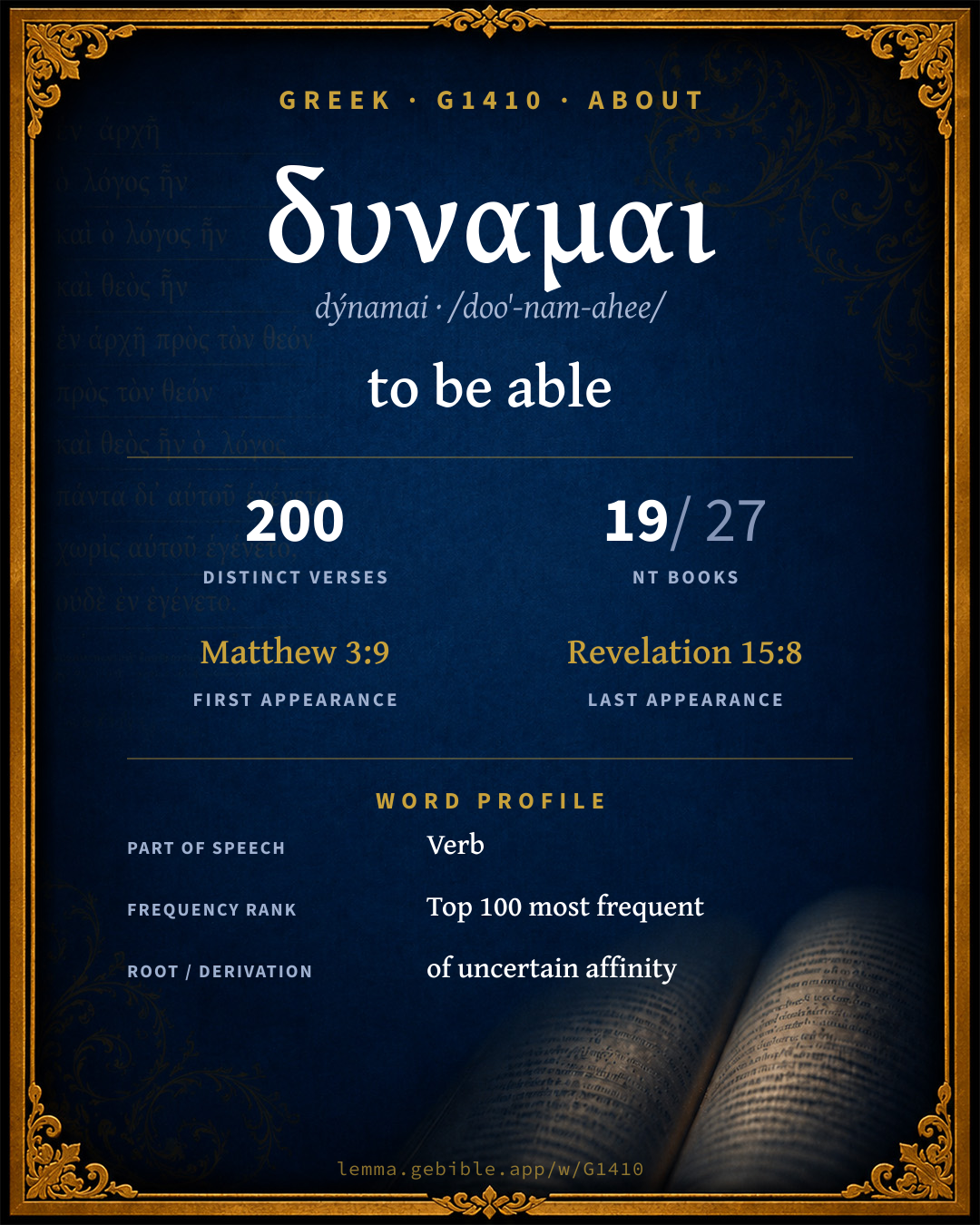
δύναμαι
to be able
‘to be able’ is one of 3 main senses fuller range ↓
Full lexicon entry — Thayer's Greek Lexicon
From Thayer's Greek Lexicon
Where this word appears
See every Present-tense verb in the Greek New Testament →
Grammar key — what these labels mean
Part of speech
- Verb
- An action or state-of-being word.
Tense
- Present
- Ongoing or general action in present time (imperfective aspect).
- Imperfect
- Continuous or repeated action in past time (“was writing”).
- Future
- Action expected in future time.
- Aorist
- Action viewed as a simple whole, without regard to duration — often past (perfective aspect).
Voice
- Middle or Passive deponent
- Middle/passive in form but active in meaning.
- Middle deponent
- Middle in form but active in meaning.
- Passive deponent
- Passive in form but active in meaning.
Mood
- Indicative
- States a fact or asks a factual question (the mood of reality).
- Infinitive
- A verbal noun (“to write”), unmarked for person or number.
- Participle
- A verbal adjective (“writing,” “having written”).
- Optative
- Expresses a wish or a remote possibility.
- Subjunctive
- Expresses probability, purpose, or possibility (the mood of contingency).
Case
- Nominative
- The case of the subject (and the predicate nominative).
- Accusative
- The case of the direct object and of extent.
- Dative
- The case of the indirect object, means, or location — “to / for / with / in.”
- Genitive
- The case of source, possession, or “of” — answers “whose / from what.”
Person
- 3rd person
- The one spoken about (“he / she / it / they”).
- 2nd person
- The one addressed (“you”).
- 1st person
- The speaker (“I / we”).
Gender
- Masculine
- Grammatically masculine.
- Neuter
- Grammatically neuter.
- Feminine
- Grammatically feminine.
Number
- Singular
- One.
- Plural
- More than one.
16 verses where G1410 appears in the Present tense in the Book of Acts. Filtered view — show all forms. Click any verse to open its interlinear word-by-word view. Verse text shown in the World English Bible for context — . Each verse’s Greek form is shown with its reference; the English is not keyword-highlighted, since the data carries no word-level English alignment. Use “Compare translations” on any verse to read it across multiple English versions. This concordance covers the Greek New Testament; Septuagint (Greek Old Testament) occurrences of this word are not indexed here.
Acts
- Acts 4:16 δυνάμεθα pres mid/pass.dep ind 1pl saying, "What shall we do to these men? Because indeed a notable miracle has been done through them, as can be plainly seen by all who dwell in Jerusalem, and we can't deny it.
- Acts 4:20 δυνάμεθα pres mid/pass.dep ind 1pl for we can't help telling the things which we saw and heard."
- Acts 8:31 δυναίμην pres mid/pass.dep opt 1sg He said, "How can I, unless someone explains it to me?" He begged Philip to come up and sit with him.
- Acts 10:47 δύναται pres mid/pass.dep ind 3sg "Can any man forbid the water, that these who have received the Holy Spirit as well as we should not be baptized?"
- Acts 15:1 δύνασθε pres mid/pass.dep ind 2pl Some men came down from Judea and taught the brothers, "Unless you are circumcised after the custom of Moses, you can't be saved."
- Acts 17:19 δυνάμεθα pres mid/pass.dep ind 1pl They took hold of him, and brought him to the Areopagus, saying, "May we know what this new teaching is, which is spoken by you?
- Acts 20:32 δυναμένῳ pres mid/pass.dep ptcp dat sg masc Now, brothers, I entrust you to God, and to the word of his grace, which is able to build up, and to give you the inheritance among all those who are sanctified.
- Acts 21:34 δυναμένου pres mid/pass.dep ptcp gen sg masc Some shouted one thing, and some another, among the crowd. When he couldn't find out the truth because of the noise, he commanded him to be brought into the barracks.
- Acts 24:11 δυναμένου pres mid/pass.dep ptcp gen sg masc seeing that you can recognize that it is not more than twelve days since I went up to worship at Jerusalem.
- Acts 24:13 δύνανταί pres mid/pass.dep ind 3pl Nor can they prove to you the things of which they now accuse me.
- Acts 25:11 δύναται pres mid/pass.dep ind 3sg For if I have done wrong, and have committed anything worthy of death, I don't refuse to die; but if none of those things is true that they accuse me of, no one can give me up to them. I appeal to Caesar!"
- Acts 27:12 δύναιντο pres mid/pass.dep opt 3pl Because the haven was not suitable to winter in, the majority advised going to sea from there, if by any means they could reach Phoenix, and winter there, which is a port of Crete, looking northeast and southeast.
- Acts 27:15 δυναμένου pres mid/pass.dep ptcp gen sg neut When the ship was caught, and couldn't face the wind, we gave way to it, and were driven along.
- Acts 27:31 δύνασθε pres mid/pass.dep ind 2pl Paul said to the centurion and to the soldiers, "Unless these stay in the ship, you can't be saved."
- Acts 27:39 δύναιντο pres mid/pass.dep opt 3pl When it was day, they didn't recognize the land, but they noticed a certain bay with a beach, and they decided to try to drive the ship onto it.
- Acts 27:43 δυναμένους pres mid/pass.dep ptcp acc pl masc But the centurion, desiring to save Paul, stopped them from their purpose, and commanded that those who could swim should throw themselves overboard first to go toward the land;
About this entry
At a glance — auto-summarized from this page’s data, not written by a person. Every figure links to its source below. This summary describes the numbers; it doesn’t interpret them.
δυναμαι — transliterated dýnamai — is a Greek verb carrying the sense “to be able.” Its English rendering has broadened — “can” classically, “able” (unfoldingWord Literal Text) in modern versions; see the renderings breakdown. The Greek New Testament uses it across 200 verses — common. It first appears in Matthew 3:9. Its lexical range runs to 3 senses. See the sense tree, 200-verse concordance, and the renderings breakdown below.
Gloss history
Strong's 1890 vs modern scholarship
About this word
Strong's G1410 catalogs a Greek word from the Greek New Testament.
These counts are not copied from any lexicon or concordance. They are computed here, from the morphology-tagged Greek New Testament. What Lemma adds →
- 200
- distinct verses
- The word appears in 200 distinct verses.
- 19 / 27
- NT books
- The word appears in 19 of 27 New Testament books.
- #78
- by frequency
- Top 100 most frequent Greek words (rank 78 of 5,347 Greek words by occurrence).
View all 200 occurrences in the concordance →
By section of the New Testament
By traditional corpus
Conventional, traditional groupings — biblical authorship is debated, so this is a traditional corpus grouping, not an authorship claim. Some books belong to more than one corpus (Luke is in both the Gospels and the Lukan corpus, and so on), so these shares overlap and need not total 100%. Each figure is a share of the word’s 200 distinct verses.
- Gospels 116 verses · 58%
- Johannine 47 verses · 24%
- Lukan (Luke–Acts) 46 verses · 23%
- Pauline corpus 35 verses · 18%
- Revelation 10 verses · 5%
- Hebrews 9 verses · 5%
- General (Catholic) Epistles 9 verses · 5%
How translations render this word
Counts come from each version’s own published word-to-Strong’s tagging or interlinear alignment — an approximate guide to how each version renders this word, not a word-level alignment the data otherwise carries. Because each total is that version’s own tagged count, the per-version totals vary from one another and need not match the appearance or distinct-verse counts above. These counts may also differ from a printed concordance because Lemma counts each distinctly tagged rendering and does not collapse phrase taggings into a single head-word total. This is a fixed set of word-tagged versions (KJV, ASV, BSB, ULT) and does not change with the reading translation you choose elsewhere. Each version’s license is shown beside its name below (and on Sources).
- King James Version: Can 45×, Could 16×, Is able 10×
- American Standard Version: Can 50×, Could 14×, Is able 10×
- Berean Standard Bible: Can 54×, Cannot 26×, Could 17×
- unfoldingWord Literal Text: Able 92×, Is able 32×, Is 27×
King James Version Public Domain
Renders G1410 across 160 tagged occurrences — most commonly:
Plus other, less common renderings. Plus 28 renderings that appear only once — usually multi-word phrases or single function words the recovered tagging swept in, not distinct renderings. Not rendered by a distinct English word in 54 further occurrences.
American Standard Version Public Domain
Renders G1410 across 187 tagged occurrences — most commonly:
Plus other, less common renderings. Plus 36 renderings that appear only once — usually multi-word phrases or single function words the recovered tagging swept in, not distinct renderings.
Berean Standard Bible Public Domain
Renders G1410 across 205 tagged occurrences — most commonly:
Plus other, less common renderings. Plus 30 renderings that appear only once — usually multi-word phrases or single function words the recovered tagging swept in, not distinct renderings. Not rendered by a distinct English word in 4 further occurrences.
unfoldingWord Literal Text CC BY-SA 4.0
Renders G1410 across 317 tagged occurrences — most commonly:
Plus other, less common renderings. Plus 24 renderings that appear only once — usually multi-word phrases or single function words the recovered tagging swept in, not distinct renderings.
Senses in Thayer's
The 3 senses Thayer's distinguishes for this word, in lexicon order (not ranked by frequency or importance). The full entry — with sub-senses — is in the Lexicon Entry tab.
- to be able, have power whether by virtue of one's own ability and resources, or of a state of mind, or through…
- to be able to do something
- to be capable, strong and powerful
Word origin
Origin: of uncertain affinity
Of uncertain affinity; to be able or possible : - be able can (do + -not) could may might be possible be of power.
— Strong’s Exhaustive Concordance (1890), public domain.
Forms in the corpus
The 45 distinct written forms G1410 takes in the Greek New Testament, most frequent first — each parse links to that tense’s occurrences in the concordance.
Same root — word family
Other Thayer's entries built from the same root as G1410, grouped by Strong’s listed origin. These share a root / origin per the lexicon — not necessarily a shared meaning. Each links to that word’s own entry.
Derived from this word
Compare all same-root words → They share a root, not necessarily a meaning.
Septuagint usage
The same Greek word δυναμαι appears 226 times in the Greek Old Testament (Septuagint), across 217 verses in 32 books.
- 226
- LXX occurrences
- Tagged occurrences of this Greek word in the Septuagint.
- 217
- verses
- Distinct Septuagint verses containing this word.
- 32 / 39
- OT books
- The word appears in 32 of the 39 Old Testament books.
Sample Septuagint occurrences
- Genesis 13:6 δύναμαι
- Exodus 2:3 δύναμαι
- Leviticus 26:37 δύναμαι
- Numbers 9:6 δύναμαι
- Deuteronomy 1:9 δύναμαι
- Joshua 7:12 δύναμαι
- Judges 1:19 δύναμαι
- Ruth 4:6 δύναμαι
- 1 Samuel 3:2 δύναμαι
- 2 Samuel 3:11 δύναμαι
- 1 Kings 3:9 δύναμαι
- 2 Kings 3:26 δύναμαι
Septuagint occurrences (same lexeme)
Every verse where the same Strong’s number (G1410) appears in the Greek Septuagint — showing the first 50 of 217. Verse text shown in the World English Bible for context; the Greek form is the matched word — the English is not keyword-highlighted.
- Genesis 13:6 δύναμαι The land was not able to bear them, that they might live together: for their substance was great, so that they could not live together.
- Genesis 13:16 δύναμαι I will make your offspring as the dust of the earth, so that if a man can number the dust of the earth, then your seed may also be numbered.
- Genesis 15:5 δύναμαι Yahweh brought him outside, and said, "Look now toward the sky, and count the stars, if you are able to count them." He said to Abram, "So shall your seed be."
- Genesis 19:19 δύναμαι See now, your servant has found favor in your sight, and you have magnified your loving kindness, which you have shown to me in saving my life. I can't escape to the mountain, lest evil overtake me, and I die.
- Genesis 19:22 δύναμαι Hurry, escape there, for I can't do anything until you get there." Therefore the name of the city was called Zoar.
- Genesis 24:50 δύναμαι Then Laban and Bethuel answered, "The thing proceeds from Yahweh. We can't speak to you bad or good.
- Genesis 29:8 δύναμαι They said, "We can't, until all the flocks are gathered together, and they roll the stone from the well's mouth. Then we water the sheep."
- Genesis 30:8 δύναμαι Rachel said, "With mighty wrestlings have I wrestled with my sister, and have prevailed." She named him Naphtali.
- Genesis 31:35 δύναμαι She said to her father, "Don't let my lord be angry that I can't rise up before you; for the manner of women is on me." He searched, but didn't find the teraphim.
- Genesis 32:26 δύναμαι The man said, "Let me go, for the day breaks." Jacob said, "I won't let you go, unless you bless me."
- Genesis 34:14 δύναμαι and said to them, "We can't do this thing, to give our sister to one who is uncircumcised; for that is a reproach to us.
- Genesis 36:7 δύναμαι For their substance was too great for them to dwell together, and the land of their travels couldn't bear them because of their cattle.
- Genesis 37:4 δύναμαι His brothers saw that their father loved him more than all his brothers, and they hated him, and couldn't speak peaceably to him.
- Genesis 41:49 δύναμαι Joseph laid up grain as the sand of the sea, very much, until he stopped counting, for it was without number.
- Genesis 43:32 δύναμαι They served him by himself, and them by themselves, and the Egyptians, that ate with him, by themselves, because the Egyptians don't eat bread with the Hebrews, for that is an abomination to the Egyptians.
- Genesis 44:1 δύναμαι He commanded the steward of his house, saying, "Fill the men's sacks with food, as much as they can carry, and put every man's money in his sack's mouth.
- Genesis 44:22 δύναμαι We said to my lord, 'The boy can't leave his father: for if he should leave his father, his father would die.'
- Genesis 44:26 δύναμαι We said, 'We can't go down. If our youngest brother is with us, then will we go down: for we may not see the man's face, unless our youngest brother is with us.'
- Genesis 45:1 δύναμαι Then Joseph couldn't control himself before all those who stood before him, and he cried, "Cause every man to go out from me!" There stood no man with him, while Joseph made himself known to his brothers.
- Genesis 45:3 δύναμαι Joseph said to his brothers, "I am Joseph! Does my father still live?" His brothers couldn't answer him; for they were terrified at his presence.
- Genesis 48:10 δύναμαι Now the eyes of Israel were dim for age, so that he couldn't see. He brought them near to him; and he kissed them, and embraced them.
- Exodus 2:3 δύναμαι When she could no longer hide him, she took a papyrus basket for him, and coated it with tar and with pitch. She put the child in it, and laid it in the reeds by the river's bank.
- Exodus 4:13 δύναμαι He said, "Oh, Lord, please send someone else."
- Exodus 7:18 δύναμαι The fish that are in the river shall die, and the river shall become foul; and the Egyptians shall loathe to drink water from the river."'"
- Exodus 7:21 δύναμαι The fish that were in the river died; and the river became foul, and the Egyptians couldn't drink water from the river; and the blood was throughout all the land of Egypt.
- Exodus 7:24 δύναμαι All the Egyptians dug round about the river for water to drink; for they couldn't drink of the water of the river.
- Exodus 8:14 δύναμαι They gathered them together in heaps, and the land stank.
- Exodus 9:11 δύναμαι The magicians couldn't stand before Moses because of the boils; for the boils were on the magicians, and on all the Egyptians.
- Exodus 10:5 δύναμαι and they shall cover the surface of the earth, so that one won't be able to see the earth. They shall eat the residue of that which has escaped, which remains to you from the hail, and shall eat every tree which grows for you out of the field.
- Exodus 12:39 δύναμαι They baked unleavened cakes of the dough which they brought forth out of Egypt; for it wasn't leavened, because they were thrust out of Egypt, and couldn't wait, neither had they prepared for themselves any food.
- Exodus 15:23 δύναμαι When they came to Marah, they couldn't drink from the waters of Marah, for they were bitter. Therefore the name of it was called Marah.
- Exodus 18:18 δύναμαι You will surely wear away, both you, and this people that is with you; for the thing is too heavy for you. You are not able to perform it yourself alone.
- Exodus 18:23 δύναμαι If you will do this thing, and God commands you so, then you will be able to endure, and all of these people also will go to their place in peace."
- Exodus 19:23 δύναμαι Moses said to Yahweh, "The people can't come up to Mount Sinai, for you charged us, saying, 'Set bounds around the mountain, and sanctify it.'"
- Exodus 33:20 δύναμαι He said, "You cannot see my face, for man may not see me and live."
- Exodus 40:32 δύναμαι When they went into the tent of meeting, and when they came near to the altar, they washed, as Yahweh commanded Moses.
- Leviticus 26:37 δύναμαι They will stumble over one another, as it were before the sword, when no one pursues: and you will have no power to stand before your enemies.
- Numbers 9:6 δύναμαι There were certain men, who were unclean because of the dead body of a man, so that they could not keep the Passover on that day, and they came before Moses and before Aaron on that day.
- Numbers 11:14 δύναμαι I am not able to bear all this people alone, because it is too heavy for me.
- Numbers 13:30 δύναμαι Caleb stilled the people before Moses, and said, Let us go up at once, and possess it; for we are well able to overcome it.
- Numbers 13:31 δύναμαι But the men who went up with him said, We aren't able to go up against the people; for they are stronger than we.
- Numbers 14:16 δύναμαι Because Yahweh was not able to bring this people into the land which he swore to them, therefore he has slain them in the wilderness.
- Numbers 22:6 δύναμαι Please come now therefore curse me this people; for they are too mighty for me: peradventure I shall prevail, that we may strike them, and that I may drive them out of the land; for I know that he whom you bless is blessed, and he whom you curse is cursed.
- Numbers 22:11 δύναμαι Behold, the people that is come out of Egypt, it covers the surface of the earth: now, come curse me them; peradventure I shall be able to fight against them, and shall drive them out.
- Numbers 22:18 δύναμαι Balaam answered the servants of Balak, If Balak would give me his house full of silver and gold, I can't go beyond the word of Yahweh my God, to do less or more.
- Numbers 22:37 δύναμαι Balak said to Balaam, Didn't I earnestly send to you to call you? why didn't you come to me? am I not able indeed to promote you to honor?
- Numbers 24:13 δύναμαι If Balak would give me his house full of silver and gold, I can't go beyond the word of Yahweh, to do either good or bad of my own mind; what Yahweh speaks, that will I speak?
- Deuteronomy 1:9 δύναμαι I spoke to you at that time, saying, I am not able to bear you myself alone:
- Deuteronomy 1:12 δύναμαι How can I myself alone bear your encumbrance, and your burden, and your strife?
- Deuteronomy 7:17 δύναμαι If you shall say in your heart, These nations are more than I; how can I dispossess them?
These are occurrences of the same Greek lexeme (G1410) in the Septuagint — not a translation of any one Hebrew word. The store carries no word-level Hebrew↔Greek alignment, so no Hebrew original is asserted here. Counts come from the recovered LXX Strong's tagging — high-frequency vocabulary is well covered, while rare or late forms may be untagged — so they reflect tagged occurrences and may slightly undercount.