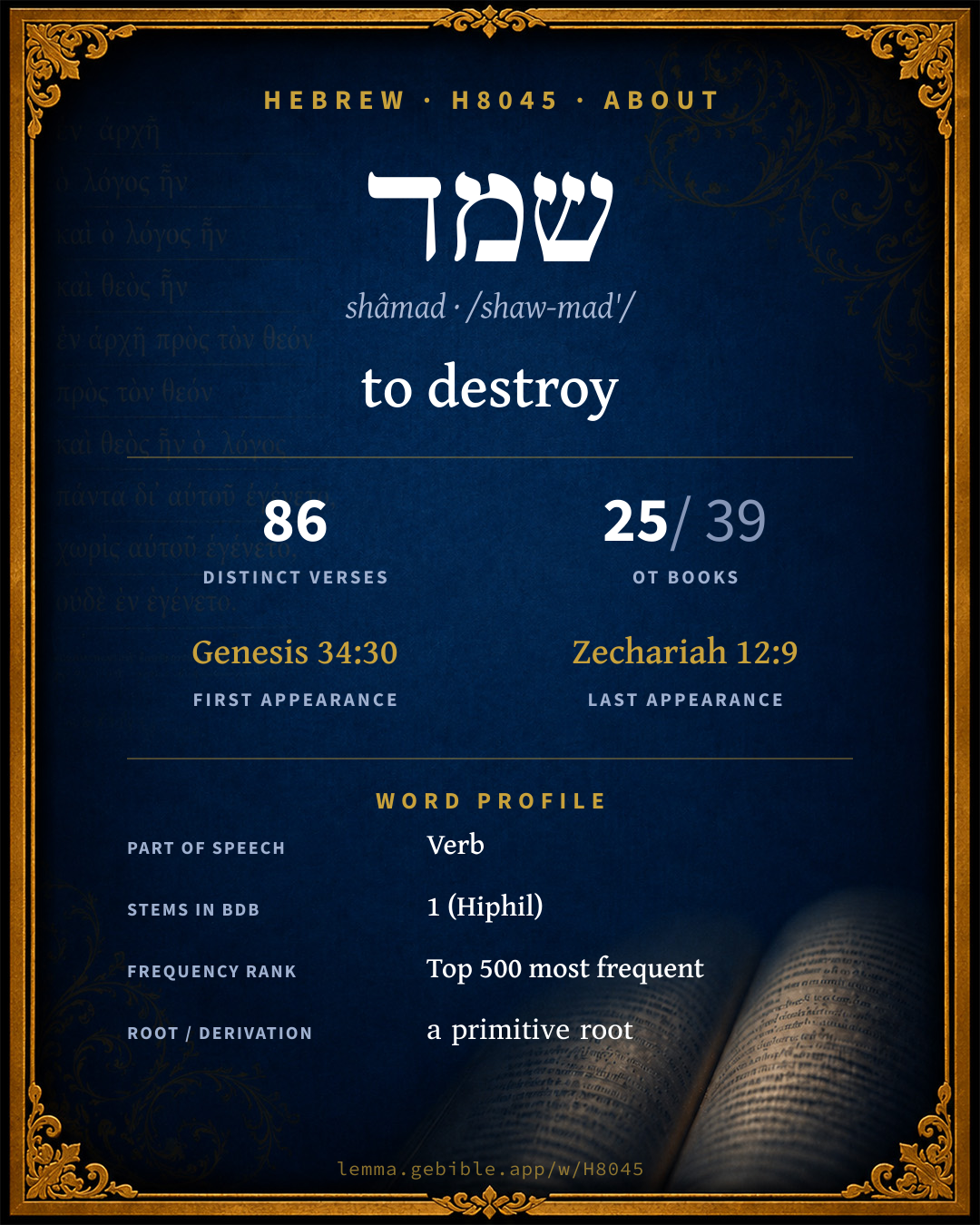
שָׁמַד
to destroy
also: exterminate, be destroyed, be exterminated fuller range ↓
Full lexicon entry — Brown-Driver-Briggs (BDB)
From Brown-Driver-Briggs (BDB)
Where this word appears
See every Hiphil verb in the Hebrew Bible →
Grammar key — what these labels mean
Part of speech
- Verb
- An action or state-of-being word.
Stem
- Hiphil
- The causative active stem (“he caused / brought about”). Here: ‘annihilate’
- Niphal
- Usually the simple passive or reflexive of the Qal (“he was written”).
Form
- Infinitive Construct
- A bound verbal noun, frequently with prepositions (“to write / in writing”).
- Perfect
- A completed action or state — Hebrew marks aspect (completeness) more than strict tense (“he wrote”).
- Sequential Perfect
- A perfect with prefixed waw continuing a preceding imperfect or command (waw-consecutive perfect).
- Imperfect
- An incomplete, ongoing, or future action (“he will / would write”).
- Sequential Imperfect
- An imperfect with prefixed waw — the standard past-narrative form (waw-consecutive imperfect).
- Infinitive Absolute
- An unbound verbal noun, often intensifying or standing in for a finite verb.
- Cohortative
- A first-person volitional form expressing wish or resolve (“let me / let us write”).
- Imperative
- A direct command (“write!”).
Person
- 3rd Person
- The one spoken about (“he / she / it / they”).
- 1st Person
- The speaker (“I / we”).
- 2nd Person
- The one addressed (“you”).
Gender
- Masculine
- Grammatically masculine.
- Common
- Either gender — not distinguished for this form.
- Feminine
- Grammatically feminine.
Number
- Singular
- One.
- Plural
- More than one (in Hebrew, generally three or more).
Grammatical forms 29 distinct
- Verb, Hiphil, Infinitive Construct 25 times (28%)
- Verb, Hiphil, Perfect, 3rd Person, Masculine, Singular 8 times (9%)
- Verb, Niphal, Infinitive Construct 8 times (9%)
- Verb, Hiphil, Sequential Perfect, 1st Person, Common, Singular 5 times (6%)
- Verb, Hiphil, Imperfect, 3rd Person, Masculine, Singular 4 times (4%)
- Verb, Niphal, Sequential Perfect, 3rd Person, Masculine, Singular 3 times (3%)
- Verb, Hiphil, Sequential Imperfect, 1st Person, Common, Singular 3 times (3%)
- Verb, Hiphil, Sequential Imperfect, 3rd Person, Masculine, Singular 3 times (3%)
+21 more forms (31 occurrences)
Parsed forms decoded from the imported morphology (morphhb / Westminster Leningrad Codex — WLC text public domain, morphhb tagging CC BY 4.0), counted across 90 parsed occurrences — not distinct verses.
Every verse where H8045 appears — 86 distinct verses across 25 books. Click any verse to open its interlinear word-by-word view. Verse text shown in the World English Bible for context — . Each verse’s Hebrew form is shown with its reference; the English is not keyword-highlighted, since the data carries no word-level English alignment. Use “Compare translations” on any verse to read it across multiple English versions. This concordance covers the Hebrew Bible; Septuagint (Greek Old Testament) occurrences are not indexed here.
Genesis 1 verse
Leviticus 1 verse
Numbers 1 verse
Deuteronomy 28 verses
- Deuteronomy 1:27 לְ/הַשְׁמִידֵֽ/נוּ prep + Hiphil inf.cs + sfx pers 1cp and you murmured in your tents, and said, Because Yahweh hated us, he has brought us forth out of the land of Egypt, to deliver us into the hand of the Amorites, to destroy us.
- Deuteronomy 2:12 וַ/יַּשְׁמִידוּ/ם֙ conj + Hiphil wimpf 3mp + sfx pers 3mp The Horites also lived in Seir before, but the children of Esau succeeded them; and they destroyed them from before them, and lived in their place; as Israel did to the land of his possession, which Yahweh gave to them.)
- Deuteronomy 2:21 וַ/יַּשְׁמִידֵ֤/ם conj + Hiphil wimpf 3ms + sfx pers 3mp a people great, and many, and tall, as the Anakim; but Yahweh destroyed them before them; and they succeeded them, and lived in their place;
- Deuteronomy 2:22 הִשְׁמִ֤יד Hiphil pf 3ms as he did for the children of Esau, who dwell in Seir, when he destroyed the Horites from before them; and they succeeded them, and lived in their place even to this day:
- Deuteronomy 2:23 הִשְׁמִידֻ֖/ם Hiphil pf 3cp + sfx pers 3mp and the Avvim, who lived in villages as far as Gaza, the Caphtorim, who came forth out of Caphtor, destroyed them, and lived in their place.)
- Deuteronomy 4:3 הִשְׁמִיד֛/וֹ Hiphil pf 3ms + sfx pers 3ms Your eyes have seen what Yahweh did because of Baal Peor; for all the men who followed Baal Peor, Yahweh your God has destroyed them from the midst of you.
- Deuteronomy 4:26 הִשָּׁמֵ֖ד תִּשָּׁמֵדֽוּ/ן Niphal inf.abs Niphal impf 2mp + sfx n I call heaven and earth to witness against you this day, that you shall soon utterly perish from off the land whereunto you go over the Jordan to possess it; you shall not prolong your days on it, but shall utterly be destroyed.
- Deuteronomy 6:15 וְ/הִשְׁמִ֣ידְ/ךָ֔ conj + Hiphil wpf 3ms + sfx pers 2ms for Yahweh your God in the midst of you is a jealous God; lest the anger of Yahweh your God be kindled against you, and he destroy you from off the face of the earth.
- Deuteronomy 7:4 וְ/הִשְׁמִידְ/ךָ֖ conj + Hiphil wpf 3ms + sfx pers 2ms For he will turn away your son from following me, that they may serve other gods: so will the anger of Yahweh be kindled against you, and he will destroy you quickly.
- Deuteronomy 7:23 הִשָּׁמְדָֽ/ם Niphal inf.cs + sfx pers 3mp But Yahweh your God will deliver them up before you, and will confuse them with a great confusion, until they be destroyed.
- Deuteronomy 7:24 הִשְׁמִֽדְ/ךָ֖ Hiphil inf.cs + sfx pers 2ms He will deliver their kings into your hand, and you shall make their name to perish from under the sky: there shall no man be able to stand before you, until you have destroyed them.
- Deuteronomy 9:3 יַשְׁמִידֵ֛/ם Hiphil impf 3ms + sfx pers 3mp Know therefore this day, that Yahweh your God is he who goes over before you as a devouring fire; he will destroy them, and he will bring them down before you: so shall you drive them out, and make them to perish quickly, as Yahweh has spoken to you.
- Deuteronomy 9:8 לְ/הַשְׁמִ֥יד prep + Hiphil inf.cs Also in Horeb you provoked Yahweh to wrath, and Yahweh was angry with you to destroy you.
- Deuteronomy 9:14 וְ/אַשְׁמִידֵ֔/ם conj + Hiphil coh 1cs + sfx pers 3mp let me alone, that I may destroy them, and blot out their name from under the sky; and I will make of you a nation mightier and greater than they.
- Deuteronomy 9:19 לְ/הַשְׁמִ֣יד prep + Hiphil inf.cs For I was afraid of the anger and hot displeasure, with which Yahweh was angry against you to destroy you. But Yahweh listened to me that time also.
- Deuteronomy 9:20 לְ/הַשְׁמִיד֑/וֹ prep + Hiphil inf.cs + sfx pers 3ms Yahweh was very angry with Aaron to destroy him: and I prayed for Aaron also at the same time.
- Deuteronomy 9:25 לְ/הַשְׁמִ֥יד prep + Hiphil inf.cs So I fell down before Yahweh the forty days and forty nights that I fell down, because Yahweh had said he would destroy you.
- Deuteronomy 12:30 הִשָּׁמְדָ֣/ם Niphal inf.cs + sfx pers 3mp take heed to yourself that you not be ensnared to follow them, after that they are destroyed from before you; and that you not inquire after their gods, saying, How do these nations serve their gods? even so will I do likewise.
- Deuteronomy 28:20 הִשָּֽׁמֶדְ/ךָ֤ Niphal inf.cs + sfx pers 2ms Yahweh will send on you cursing, confusion, and rebuke, in all that you put your hand to do, until you are destroyed, and until you perish quickly; because of the evil of your doings, by which you have forsaken me.
- Deuteronomy 28:24 הִשָּׁמְדָֽ/ךְ Niphal inf.cs + sfx pers 2fs Yahweh will make the rain of your land powder and dust: from the sky shall it come down on you, until you are destroyed.
- Deuteronomy 28:45 הִשָּֽׁמְדָ֑/ךְ Niphal inf.cs + sfx pers 2fs All these curses shall come on you, and shall pursue you, and overtake you, until you are destroyed; because you didn't listen to the voice of Yahweh your God, to keep his commandments and his statutes which he commanded you:
- Deuteronomy 28:48 הִשְׁמִיד֖/וֹ Hiphil inf.cs + sfx pers 3ms therefore shall you serve your enemies whom Yahweh shall send against you, in hunger, and in thirst, and in nakedness, and in want of all things: and he shall put a yoke of iron on your neck, until he have destroyed you.
- Deuteronomy 28:51 הִשָּֽׁמְדָ/ךְ֒ Niphal inf.cs + sfx pers 2fs and shall eat the fruit of your cattle, and the fruit of your ground, until you are destroyed; that also shall not leave you grain, new wine, or oil, the increase of your cattle, or the young of your flock, until they have caused you to perish.
- Deuteronomy 28:61 הִשָּׁמְדָֽ/ךְ Niphal inf.cs + sfx pers 2fs Also every sickness, and every plague, which is not written in the book of this law, them will Yahweh bring on you, until you are destroyed.
- Deuteronomy 28:63 וּ/לְ/הַשְׁמִ֣יד conj + prep + Hiphil inf.cs It shall happen that as Yahweh rejoiced over you to do you good, and to multiply you, so Yahweh will rejoice over you to cause you to perish, and to destroy you; and you shall be plucked from off the land where you go in to possess it.
- Deuteronomy 31:3 יַשְׁמִ֞יד Hiphil impf 3ms Yahweh your God, he will go over before you; he will destroy these nations from before you, and you shall dispossess them: [and] Joshua, he shall go over before you, as Yahweh has spoken.
- Deuteronomy 31:4 הִשְׁמִ֖יד Hiphil pf 3ms Yahweh will do to them as he did to Sihon and to Og, the kings of the Amorites, and to their land; whom he destroyed.
- Deuteronomy 33:27 הַשְׁמֵֽד Hiphil impv 2ms The eternal God is [your] dwelling-place, Underneath are the everlasting arms. He thrust out the enemy from before you, Said, Destroy.
Joshua 6 verses
- Joshua 7:12 תַשְׁמִ֛ידוּ Hiphil impf 2mp Therefore the children of Israel can't stand before their enemies; they turn their backs before their enemies, because they are become accursed: I will not be with you any more, except you destroy the devoted thing from among you.
- Joshua 9:24 וּ/לְ/הַשְׁמִ֛יד conj + prep + Hiphil inf.cs They answered Joshua, and said, Because it was certainly told your servants, how that Yahweh your God commanded his servant Moses to give you all the land, and to destroy all the inhabitants of the land from before you; therefore we were sore afraid for our lives because of you, and have done this thing.
- Joshua 11:14 הִשְׁמִדָ/ם֙ Hiphil inf.cs + sfx pers 3mp All the spoil of these cities, and the cattle, the children of Israel took for a prey to themselves; but every man they struck with the edge of the sword, until they had destroyed them, neither left they any who breathed.
- Joshua 11:20 הַשְׁמִידָ֔/ם Hiphil inf.cs + sfx pers 3mp For it was of Yahweh to harden their hearts, to come against Israel in battle, that he might utterly destroy them, that they might have no favor, but that he might destroy them, as Yahweh commanded Moses.
- Joshua 23:15 הַשְׁמִיד֣/וֹ Hiphil inf.cs + sfx pers 3ms It shall happen, that as all the good things are come on you of which Yahweh your God spoke to you, so will Yahweh bring on you all the evil things, until he have destroyed you from off this good land which Yahweh your God has given you.
- Joshua 24:8 וָ/אַשְׁמִידֵ֖/ם conj + Hiphil wimpf 1cs + sfx pers 3mp I brought you into the land of the Amorites, that lived beyond the Jordan: and they fought with you; and I gave them into your hand, and you possessed their land; and I destroyed them from before you.
Judges 1 verse
1 Samuel 1 verse
2 Samuel 5 verses
- 2 Samuel 14:7 וְ/נַשְׁמִ֖ידָה conj + Hiphil coh 1cp Behold, the whole family is risen against your handmaid, and they say, Deliver him who struck his brother, that we may kill him for the life of his brother whom he killed, and so destroy the heir also. Thus will they quench my coal which is left, and will leave to my husband neither name nor remainder on the surface of the earth.
- 2 Samuel 14:11 יַשְׁמִ֖ידוּ Hiphil impf 3mp Then said she, Please let the king remember Yahweh your God, that the avenger of blood destroy not any more, lest they destroy my son. He said, As Yahweh lives, there shall not one hair of your son fall to the earth.
- 2 Samuel 14:16 לְ/הַשְׁמִ֨יד prep + Hiphil inf.cs For the king will hear, to deliver his servant out of the hand of the man who would destroy me and my son together out of the inheritance of God.
- 2 Samuel 21:5 נִשְׁמַ֕דְנוּ Niphal pf 1cp They said to the king, The man who consumed us, and who devised against us, [that] we should be destroyed from remaining in any of the borders of Israel,
- 2 Samuel 22:38 וָ/אַשְׁמִידֵ֑/ם conj + Hiphil wimpf 1cs + sfx pers 3mp I have pursued my enemies, and destroyed them; Neither did I turn again until they were consumed.
1 Kings 3 verses
- 1 Kings 13:34 וּ/לְ/הַשְׁמִ֔יד conj + prep + Hiphil inf.cs This thing became sin to the house of Jeroboam, even to cut it off, and to destroy it from off the surface of the earth.
- 1 Kings 15:29 הִשְׁמִד֑/וֹ Hiphil pf 3ms + sfx pers 3ms It happened that, as soon as he was king, he struck all the house of Jeroboam: he didn't leave to Jeroboam any who breathed, until he had destroyed him; according to the saying of Yahweh, which he spoke by his servant Ahijah the Shilonite;
- 1 Kings 16:12 וַ/יַּשְׁמֵ֣ד conj + Hiphil wimpf 3ms Thus did Zimri destroy all the house of Baasha, according to the word of Yahweh, which he spoke against Baasha by Jehu the prophet,
2 Kings 3 verses
- 2 Kings 10:17 הִשְׁמִיד֑/וֹ Hiphil pf 3ms + sfx pers 3ms When he came to Samaria, he struck all who remained to Ahab in Samaria, until he had destroyed him, according to the word of Yahweh, which he spoke to Elijah.
- 2 Kings 10:28 וַ/יַּשְׁמֵ֥ד conj + Hiphil wimpf 3ms Thus Jehu destroyed Baal out of Israel.
- 2 Kings 21:9 הִשְׁמִ֣יד Hiphil pf 3ms But they didn't listen: and Manasseh seduced them to do that which is evil more than did the nations whom Yahweh destroyed before the children of Israel.
1 Chronicles 1 verse
2 Chronicles 3 verses
- 2 Chronicles 20:10 הִשְׁמִידֽוּ/ם Hiphil pf 3cp + sfx pers 3mp Now, behold, the children of Ammon and Moab and Mount Seir, whom you would not let Israel invade, when they came out of the land of Egypt, but they turned aside from them, and didn't destroy them;
- 2 Chronicles 20:23 וּ/לְ/הַשְׁמִ֑יד conj + prep + Hiphil inf.cs For the children of Ammon and Moab stood up against the inhabitants of Mount Seir, utterly to kill and destroy them: and when they had made an end of the inhabitants of Seir, everyone helped to destroy another.
- 2 Chronicles 33:9 הִשְׁמִ֣יד Hiphil pf 3ms Manasseh seduced Judah and the inhabitants of Jerusalem, so that they did evil more than did the nations whom Yahweh destroyed before the children of Israel.
Esther 5 verses
- Esther 3:6 לְ/הַשְׁמִ֧יד prep + Hiphil inf.cs But he scorned the thought of laying hands on Mordecai alone; for they had made known to him the people of Mordecai: therefore Haman sought to destroy all the Jews who were throughout the whole kingdom of Ahasuerus, even the people of Mordecai.
- Esther 3:13 לְ/הַשְׁמִ֡יד prep + Hiphil inf.cs Letters were sent by posts into all the king's provinces, to destroy, to kill, and to cause to perish, all Jews, both young and old, little children and women, in one day, even on the thirteenth [day] of the twelfth month, which is the month Adar, and to take the spoil of them for a prey.
- Esther 4:8 לְ/הַשְׁמִידָ/ם֙ prep + Hiphil inf.cs + sfx pers 3mp Also he gave him the copy of the writing of the decree that was given out in Shushan to destroy them, to show it to Esther, and to declare it to her, and to charge her that she should go in to the king, to make supplication to him, and to make request before him, for her people.
- Esther 7:4 לְ/הַשְׁמִ֖יד prep + Hiphil inf.cs for we are sold, I and my people, to be destroyed, to be slain, and to perish. But if we had been sold for bondservants and bondmaids, I had held my peace, although the adversary could not have compensated for the king's damage.
- Esther 8:11 לְ/הַשְׁמִיד֩ prep + Hiphil inf.cs in which the king granted the Jews who were in every city to gather themselves together, and to stand for their life, to destroy, to kill, and to cause to perish, all the power of the people and province that would assault them, [their] little ones and women, and to take the spoil of them for a prey,
Psalms 6 verses
- Psalms 37:38 נִשְׁמְד֣וּ Niphal pf 3cp As for transgressors, they shall be destroyed together. The future of the wicked shall be cut off.
- Psalms 83:10 נִשְׁמְד֥וּ Niphal pf 3cp Who perished at Endor, Who became as dung for the earth.
- Psalms 92:7 לְ/הִשָּֽׁמְדָ֥/ם prep + Niphal inf.cs + sfx pers 3mp Though the wicked spring up as the grass, And all the evil-doers flourish, They will be destroyed forever.
- Psalms 106:23 לְֽ/הַשְׁמִ֫ידָ֥/ם prep + Hiphil inf.cs + sfx pers 3mp Therefore he said that he would destroy them, Had Moses, his chosen, not stood before him in the breach, To turn away his wrath, so that he wouldn't destroy them.
- Psalms 106:34 הִ֭שְׁמִידוּ Hiphil pf 3cp They didn't destroy the peoples, As Yahweh commanded them,
- Psalms 145:20 יַשְׁמִֽיד Hiphil impf 3ms Yahweh preserves all those who love him, But all the wicked he will destroy.
Proverbs 1 verse
Isaiah 6 verses
- Isaiah 10:7 לְ/הַשְׁמִ֣יד prep + Hiphil inf.cs However he doesn't mean so, neither does his heart think so; but it is in his heart to destroy, and to cut off not a few nations.
- Isaiah 13:9 יַשְׁמִ֥יד Hiphil impf 3ms Behold, the day of Yahweh comes, cruel, with wrath and fierce anger; to make the land a desolation, and to destroy the sinners of it out of it.
- Isaiah 14:23 הַשְׁמֵ֔ד Hiphil inf.abs I will also make it a possession for the porcupine, and pools of water: and I will sweep it with the broom of destruction, says Yahweh of Hosts.
- Isaiah 23:11 לַ/שְׁמִ֖ד prep + Hiphil inf.cs He has stretched out his hand over the sea, he has shaken the kingdoms: Yahweh has given commandment concerning Canaan, to destroy the strongholds of it.
- Isaiah 26:14 וַ/תַּשְׁמִידֵ֔/ם conj + Hiphil wimpf 2ms + sfx pers 3mp [They are] dead, they shall not live; [they are] deceased, they shall not rise: therefore have you visited and destroyed them, and made all memory of them to perish.
- Isaiah 48:19 יִשָּׁמֵ֛ד Niphal impf 3ms your seed also had been as the sand, and the offspring of your loins like the grains of it: his name would not be cut off nor destroyed from before me.
Jeremiah 2 verses
- Jeremiah 48:8 וְ/נִשְׁמַ֣ד conj + Niphal wpf 3ms The destroyer shall come on every city, and no city shall escape; the valley also shall perish, and the plain shall be destroyed; as Yahweh has spoken.
- Jeremiah 48:42 וְ/נִשְׁמַ֥ד conj + Niphal wpf 3ms Moab shall be destroyed from being a people, because he has magnified himself against Yahweh.
Lamentations 1 verse
Ezekiel 4 verses
- Ezekiel 14:9 וְ/הִ֨שְׁמַדְתִּ֔י/ו conj + Hiphil wpf 1cs + sfx pers 3ms If the prophet be deceived and speak a word, I, Yahweh, have deceived that prophet, and I will stretch out my hand on him, and will destroy him from the midst of my people Israel.
- Ezekiel 25:7 אַשְׁמִ֣ידְ/ךָ֔ Hiphil impf 1cs + sfx pers 2ms therefore, behold, I have stretched out my hand on you, and will deliver you for a spoil to the nations; and I will cut you off from the peoples, and I will cause you to perish out of the countries: I will destroy you; and you shall know that I am Yahweh.
- Ezekiel 32:12 וְ/נִשְׁמַ֖ד conj + Niphal wpf 3ms By the swords of the mighty will I cause your multitude to fall; the terrible of the nations are they all: and they shall bring to nothing the pride of Egypt, and all the multitude of it shall be destroyed.
- Ezekiel 34:16 אַשְׁמִ֖יד Hiphil impf 1cs I will seek that which was lost, and will bring back that which was driven away, and will bind up that which was broken, and will strengthen that which was sick: but the fat and the strong I will destroy; I will feed them in justice.
Daniel 1 verse
Hosea 1 verse
Amos 2 verses
- Amos 2:9 הִשְׁמַ֤דְתִּי וָ/אַשְׁמִ֤יד Hiphil pf 1cs conj + Hiphil wimpf 1cs Yet I destroyed the Amorite before them, Whose height was like the height of the cedars, And he was strong as the oaks; Yet I destroyed his fruit from above, and his roots from beneath.
- Amos 9:8 וְ/הִשְׁמַדְתִּ֣י הַשְׁמֵ֥יד אַשְׁמִ֛יד conj + Hiphil wpf 1cs Hiphil inf.abs Hiphil impf 1cs Behold, the eyes of the Lord Yahweh are on the sinful kingdom, and I will destroy it from off the surface of the earth; except that I will not utterly destroy the house of Jacob," says Yahweh.
Micah 1 verse
Haggai 1 verse
Zechariah 1 verse
About this entry
At a glance — auto-summarized from this page’s data, not written by a person. Every figure links to its source below. This summary describes the numbers; it doesn’t interpret them.
“to destroy” is the headline sense of the Hebrew verb שמד (shâmad). Beyond “to destroy” it also covers “exterminate”, “be destroyed”, and “be exterminated” — see its full sense range. The Hebrew Bible uses it across 86 verses — moderately common. More than a third of its appearances fall in Deuteronomy. Its earliest occurrence is Genesis 34:30. The sections below give every sense, occurrence, and version rendering.
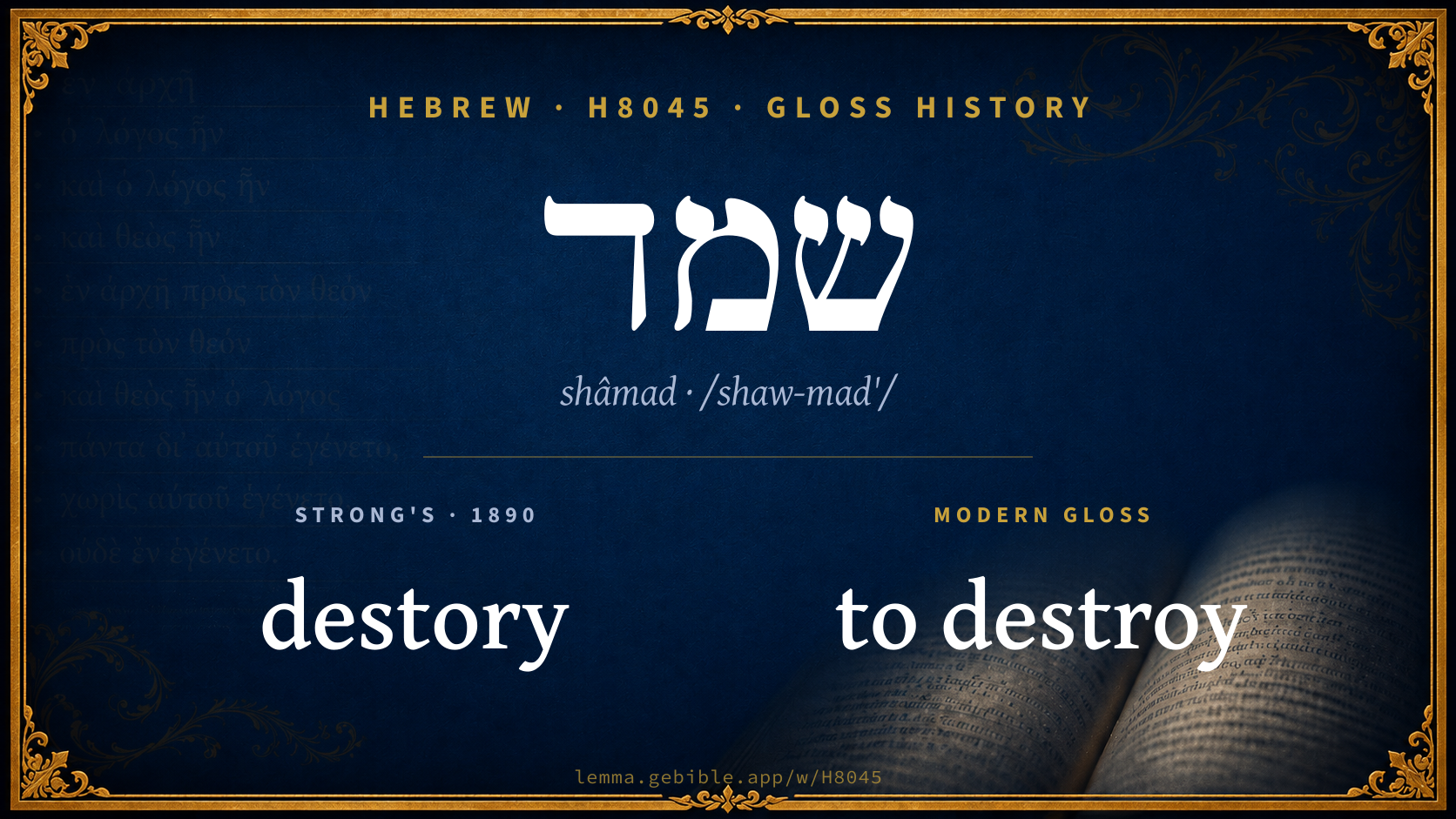
Gloss history
Strong's 1890 vs modern scholarship
About this word
Strong's H8045 catalogs a Hebrew word from the Hebrew Old Testament.
These counts are not copied from any lexicon or concordance. They are computed here, from the morphology-tagged Hebrew Old Testament. What Lemma adds →
- 86
- distinct verses
- The word appears in 86 distinct verses.
- 25 / 39
- OT books
- The word appears in 25 of 39 Old Testament books.
- #462
- by frequency
- Top 500 most frequent Hebrew words (rank 462 of 8,640 Hebrew words by occurrence).
View all 86 occurrences in the concordance →
Most concentrated in
- Deuteronomy 28 verses 33%
- Joshua 6 verses 7%
- Psalms 6 verses 7%
By section of the Old Testament
By traditional corpus
Conventional, traditional groupings — biblical authorship is debated, so this is a traditional corpus grouping, not an authorship claim. Each share is this word’s portion of its verses in that division of the Hebrew canon. Each figure is a share of the word’s 86 distinct verses.
- Prophets (Nevi'im) 37 verses · 43%
- Torah (Pentateuch) 31 verses · 36%
- Writings (Ketuvim) 18 verses · 21%
How translations render this word
Counts come from each version’s own published word-to-Strong’s tagging or interlinear alignment — an approximate guide to how each version renders this word, not a word-level alignment the data otherwise carries. Because each total is that version’s own tagged count, the per-version totals vary from one another and need not match the appearance or distinct-verse counts above. These counts may also differ from a printed concordance because Lemma counts each distinctly tagged rendering and does not collapse phrase taggings into a single head-word total. This is a fixed set of word-tagged versions (KJV, ASV, BSB, ULT) and does not change with the reading translation you choose elsewhere. Each version’s license is shown beside its name below (and on Sources).
- King James Version: Destroy 15×, Destroyed 10×, I will destroy 5×
- American Standard Version: Destroy 16×, Destroyed 10×, I will destroy 5×
- Berean Standard Bible: Destroy 11×, Will be destroyed 6×, Destruction 5×
- unfoldingWord Literal Text: Destroy 15×, I will destroy 5×, You are destroyed 5×
King James Version Public Domain
Renders H8045 across 90 tagged occurrences — most commonly:
Plus 40 renderings that appear only once — usually multi-word phrases or single function words the recovered tagging swept in, not distinct renderings.
American Standard Version Public Domain
Renders H8045 across 90 tagged occurrences — most commonly:
Plus 45 renderings that appear only once — usually multi-word phrases or single function words the recovered tagging swept in, not distinct renderings.
Berean Standard Bible Public Domain
Renders H8045 across 88 tagged occurrences — most commonly:
Plus other, less common renderings. Plus 37 renderings that appear only once — usually multi-word phrases or single function words the recovered tagging swept in, not distinct renderings. Not rendered by a distinct English word in 2 further occurrences.
unfoldingWord Literal Text CC BY-SA 4.0
Renders H8045 across 97 tagged occurrences — most commonly:
Plus other, less common renderings. Plus 40 renderings that appear only once — usually multi-word phrases or single function words the recovered tagging swept in, not distinct renderings.
Senses in the full BDB
What do BDB’s symbols mean?
BDB uses these scholarly abbreviations:
| Symbol | Meaning |
|---|---|
| 𝔊 | the Septuagint (the ancient Greek translation, LXX) |
| 𝔙 | the Vulgate (the Latin translation) |
| 𝔖 | the Syriac version (the Peshitta) |
| 𝔗 | the Targum (the Aramaic translation) |
| ψ | the Psalms |
| √ | root (the underlying root or stem) |
| ‖ | parallel passage (a synonymous or contrasted parallel) |
| † | the dagger: every passage where the word occurs is cited |
The 2 senses and sub-senses the full Brown-Driver-Briggs lexicon distinguishes for this word, in lexicon order (not ranked by frequency), with BDB’s own verbatim wording and sub-sense lettering. Shown in Hebrew script with BDB’s own scholarly abbreviations. The condensed entry is in the Lexicon Entry tab. See also the Forms in the corpus table below.
Hiphil
- 1. annihilate, exterminate
- 2. destroy
Senses from the full Brown-Driver-Briggs lexicon (Brown, Driver, Briggs; Oxford 1906 — public domain), digitized via Sefaria, supplemented by the OpenScriptures HebrewLexicon (CC BY 4.0). Full attribution on Sources.
Word origin
[ שָׁמַד ] 90 vb. Niph. be exterminated, destroyed
— Brown-Driver-Briggs (Oxford 1906, public domain), digitized via Sefaria, supplemented by the OpenScriptures HebrewLexicon (CC BY 4.0). See Sources.
Origin: a primitive root
Jastrow Dictionary
A second Hebrew/Aramaic lexicon for comparison, covering Aramaic and post-biblical (Talmudic, Targumic, Midrashic) usage that the biblical-Hebrew BDB does not. Matched by lemma rather than by Strong’s number, so a lemma may carry more than one Jastrow headword (shown separately below), and the entries cover usage well beyond the Bible.
שָׁמַד
- Hif.; cmp. שמם, to be waste.
- [to destroy,] to persecute; to force to apostasy. Gen. R. s. 82 ואם לאו הרי אני מְשַׁמֵּד אתכם and if you cannot answer, I will force you to forswear your religion; Yalk. Is. 263 אַשְׁמִיד (Hif.).—Part. pass. מְשׁוּמָּד converted to heathenism, q. v.
- 1. to destroy. Esth. R. to III, 6 אני אמרתי להַשְׁמִידָם … להַשְׁמִיד וכ׳ I (the Lord) intended to destroy them, and, as it were, could not …, and thou wilt destroy, slay &c.? Ib. to III, 12; a. e.
- 2. to force to apostasy, v. supra.
- 1. to be destroyed, cut off. Yalk. Lev. 558 דואג נ׳ מעולם וכ׳ Doeg was cut off from this and from the other world; (Tanḥ. M’tsorʿa 2 נשתרש).
- 2. to apostatize. Y. Gitt. VII, beg. 48ᶜ. Y. Hor. I, 45ᵈ bot. Y. Succ. V, end, 55ᶜ מרים … שׁנִשְׁתַּמְּדָה וכ׳ Miriam … who renounced her religion, and married a Roman officer; Tosef. Succ. IV, 28ᵈ; Bab. Succ. 56ᵇ Ms. M. (ed. שהמירה דתה).
שְׁמַד
- to force to apostasy. Y. Shebi. IV, 35ᵃ bot. לא מתכוון מְשַמַּדְתְּכוֹן he has no intention to make you abandon your religion (to persecute you for your religion’s sake), but only to collect taxes &c.; Y. Snh. III, 21ᵇ top משמדתהון (corr. acc.). Ib. לא אתכוון מְשַׁמַּדְתְּהוֹן וכ׳ he had no intention to force them to violate their religious laws, but merely wanted to eat fresh bread; Y. Shebi. l. c. מְשַׁמַּדְתּוֹן.
- to renounce one’s religion, apostatize. Targ. O. Ex. XII, 43 (h. text בן נכר).—Kidd. 72ᵃ שמתינהו … ואִישְׁתַּמּוּד R. A. excommunicated them, and they renounced Judaism.
שְׁמָד
- (preced.) [attempt at destruction,] religious persecution. Tosef. Ab. Zar. V (VI), 6 בי מוסייאות … שעת הש׳ אע"פ שעבר הש׳ וכ׳ altars which gentiles have put up at a time of religious persecution are forbidden (as to the use of the materials) even after the persecution is over; Y. ib. V, 45ᵃ top; Bab. ib. 54ᵃ Ms. M. (ed. בשעת הגזירה). Tosef. Sabb. XV (XVI), 17 במה דברים אמורים שלא בשעת הש׳ אבל בשעת הש׳ וכ׳ this (that one may violate religious laws to save his life) is said only when there is no general religious persecution, but during a persecution one must give up his life even for the least essential law; Snh. 74ᵃ Ms. M. (ed. גזירת המלכות). Cant. R. to II, 5 שלפי הש׳, v. שֶׁלֶף; Sabb. 60ᵃ Ms. M. (ed. הגזרה); a. fr.—Pl. שְׁמָדִים, שְׁמָדִין. Gen. R. s. 67 (ref. to Gen. XXVII, 40) אם ראית … גזור עליו ש׳ וכ׳ when thou (Esau-Rome) seest thy brother (Jacob) cast off the yoke of the Law, decree persecutions over him, and thou shalt have power over him. Midr. Till. to Ps. XVIII, 5 שכמה ש׳ גזרו עלינו בימיה for they decreed many persecutions over us in her (Rome’s) days; a. e. e.g. Genesis 27:40
A Dictionary of the Targumim, the Talmud Babli and Yerushalmi, and the Midrashic Literature (Marcus Jastrow; London, Luzac, 1903) — Public Domain. Digitized via Sefaria. Digitized via Sefaria. Full attribution on Sources.
Forms in the corpus
The 85 distinct written forms H8045 takes in the Hebrew Bible, most frequent first — each parse links to that stem’s occurrences in the concordance. Hebrew forms include their vowel points and cantillation, so a single lemma takes many written forms.
The 60 most common forms are shown; 25 rarer forms follow in the full concordance.
Same root — word family
Other BDB entries built from the same root as H8045, grouped by Strong’s listed origin. These share a root / origin per the lexicon — not necessarily a shared meaning. Each links to that word’s own entry.
Derived from this word
Compare all same-root words → They share a root, not necessarily a meaning.
Septuagint verse parallels
This word appears in 82 verses that also exist in the Greek Old Testament (Septuagint), out of the 86 Hebrew verses it occurs in. You can read those verses in Greek by switching the Old Testament edition to the Septuagint.
Read these verses in the Septuagint
- Genesis 34:30
- Leviticus 26:30
- Numbers 33:52
- Deuteronomy 1:27
- Joshua 7:12
- Judges 21:16
- 1 Samuel 24:21
- 2 Samuel 14:7
- 1 Kings 13:34
- 2 Kings 10:17
- 1 Chronicles 5:25
- 2 Chronicles 20:10
This is a verse-level parallel only — the same verses exist in both the Hebrew and Greek Old Testaments. No word-level Hebrew↔Greek correspondence is claimed: the data carries no such alignment, so no Greek word is shown as this Hebrew word’s translation. Coverage is not total — the Septuagint omits the deuterocanon and renumbers the Psalms, so some Hebrew verses have no direct Greek parallel.