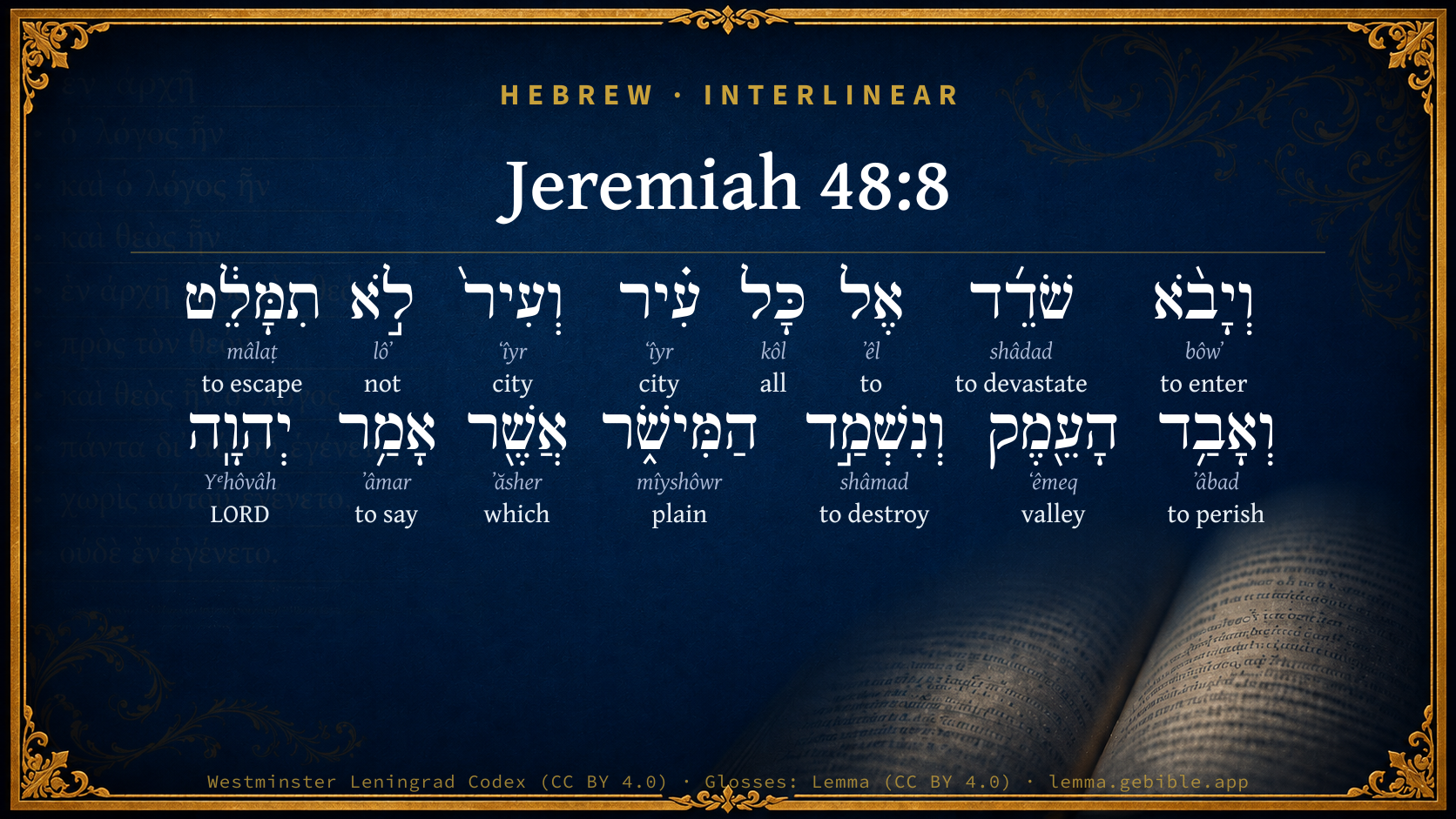
Jeremiah 48:8

Hebrew (Westminster Leningrad Codex) Jeremiah 48:8 appears in the Hebrew Old Testament. The text above is from the Westminster Leningrad Codex. Each word links to its Strong’s number, a concise gloss, and parsing drawn from the Open Scriptures Hebrew Bible morphology. Click any word for its full Brown-Driver-Briggs (BDB) entry.
Download image
Cite this verse

Jeremiah 48:8 (World English Bible). Public Domain. Lemma interlinear Bible study tool, https://lemma.gebible.app/v/jeremiah/48/8.

Show BibTeX & RIS
BibTeX
RIS
English Translation
The destroyer shall come on every city, and no city shall escape; the valley also shall perish, and the plain shall be destroyed; as Yahweh has spoken.
World English Bible · Public Domain
Download a study sheet

One document with this verse’s original text, its word-by-word gloss line, the meaning frame, cross-references with their text, attributed commentary, and full source and license credits — printable, and it pastes into notes with its structure intact.

This verse Autodidact and up

Study sheet (.html) Plain text (.txt)

A passage Seminary Student

Up to 50 verses in one chapter. A passage sheet keeps up to 6 commentary sources and 12 cross-references per verse, in the order this page ranks them, and says so on the sheet whenever that leaves anything out. Ask for a single verse and you get the Autodidact verse sheet above.

Everything on this page stays free to read, with no account — the sheet is a download of what is already on screen, not access to it.

Want to remove ads? Support Godless Engineer
Compare translations 3

The same verse in 3 English versions, stacked beneath the original-language interlinear above. Click any original word for its lexicon entry.

Each is an independent rendering of the whole verse — the interlinear is not word-aligned to these translations.

Highlighted words mark where these versions differ — a whole-verse word diff, not a word-by-word alignment.

  • World English Bible Public Domain
    The destroyer shall come on every city, and no city shall escape; the valley also shall perish, and the plain shall be destroyed; as Yahweh has spoken.
  • King James Version Public Domain
    And the spoiler shall come upon every city, and no city shall escape: the valley also shall perish, and the plain shall be destroyed, as the LORD hath spoken.
  • unfoldingWord Literal Text CC BY-SA 4.0
    For the destroyer will come to every city; no city will escape. So the valley will perish and the plain will be devastated, as Yahweh has said.

unfoldingWord Literal Text — © unfoldingWord, licensed CC BY-SA 4.0. Word-aligned USFM3 via Door43 (git.door43.org/unfoldingWord/en_ult).

Versions to compare (up to 4)

3 of 4 selected

Show all 18 translations

Every available English version of this verse, each an independent rendering of the whole verse.

  • World English Bible Public Domain
    The destroyer shall come on every city, and no city shall escape; the valley also shall perish, and the plain shall be destroyed; as Yahweh has spoken.
  • Berean Standard Bible Public Domain
    The destroyer will move against every city, and not one town will escape. The valley will also be ruined, and the high plain will be destroyed, as the LORD has said.
  • Majority Standard Bible Public Domain
    The destroyer will move against every city, and not one town will escape. The valley will also be ruined, and the high plain will be destroyed, as the LORD has said.
  • King James Version Public Domain
    And the spoiler shall come upon every city, and no city shall escape: the valley also shall perish, and the plain shall be destroyed, as the LORD hath spoken.
  • American Standard Version (1901) Public Domain
    And the destroyer shall come upon every city, and no city shall escape; the valley also shall perish, and the plain shall be destroyed; as Jehovah hath spoken.
  • Revised Version (1885) Public Domain
    And the spoiler shall come upon every city, and no city shall escape; the valley also shall perish, and the plain shall be destroyed; as the LORD hath spoken.
  • Geneva Bible (1599) Public Domain
    And the destroyer shall come vpon all cities, and no citie shall escape: the valley also shall perish and the plaine shalbe destroyed as the Lord hath spoken.
  • Douay-Rheims (1899) Public Domain
    And the spoiler shall come upon every city, and no city shall escape: and the valleys shall perish, and the plains shall be destroyed, for the Lord hath spoken:
  • Young's Literal Translation Public Domain
    And come in doth a spoiler unto every city, And no city doth escape, And perished hath the valley, And destroyed been the plain, as Jehovah said.
  • Literal Standard Version CC BY-SA 4.0
    And a spoiler comes to every city, || And no city escapes, || And the valley has perished, || And the plain has been destroyed, as YHWH said.
  • Unlocked Literal Bible CC BY-SA 4.0
    For the destroyer will come to every city; no city will escape. So the valley will perish and the plain will be devastated, as Yahweh has said.
  • unfoldingWord Literal Text CC BY-SA 4.0
    For the destroyer will come to every city; no city will escape. So the valley will perish and the plain will be devastated, as Yahweh has said.
  • Darby Bible Public Domain
    And the waster shall come upon every city, that not a city shall escape; and the valley shall perish, and the plateau shall be destroyed: as Jehovah hath said.
  • World Messianic Bible Public Domain
    The destroyer will come on every city, and no city will escape; the valley also will perish, and the plain will be destroyed, as the LORD has spoken.
  • Webster's Bible Public Domain
    And the spoiler shall come upon every city, and no city shall escape: the valley also shall perish, and the plain shall be destroyed, as the LORD hath spoken.
  • Free Bible Version CC BY-SA 4.0
    The invaders will attack every town; not a single one will escape destruction. The valley will be ruined, and the plain will be destroyed, for the Lord has spoken.
  • Bible in Basic English Public Domain
    And the attacker will come against every town, not one will be safe; and the valley will be made waste, and destruction will come to the lowland, as the Lord has said.
  • JPS Tanakh (1917) Public Domain
    And the spoiler shall come upon every city, and no city shall escape; the valley also shall perish, and the plain shall be destroyed; as the LORD hath spoken.

Literal Standard Version (2020), Covenant Press — licensed CC BY-SA 4.0. Text via the HelloAO Bible API (eBible.org). Unlocked Literal Bible (unfoldingWord) — licensed CC BY-SA 4.0. Text via the HelloAO Bible API (eBible.org). unfoldingWord Literal Text — © unfoldingWord, licensed CC BY-SA 4.0. Word-aligned USFM3 via Door43 (git.door43.org/unfoldingWord/en_ult). Free Bible Version, Dr. Jonathan Gallagher — licensed CC BY-SA 4.0. Text via the HelloAO Bible API (eBible.org).

Word by word

More ways to search: Search by grammar → Find every occurrence → Compare this word →

Practice this passage: Drill this verse → Learn its vocabulary →

הַמִּישֹׁ֑ר
mîyshôwr
H4334
“the · plain”
Particle, Definite Article + Noun, Common, Masculine, Singular, Absolute
Part of Speech
Particle + Noun
Type
Common
Gender
Masculine
Number
Singular
State
Absolute
Full BDB Definition

Origin: from H3474

TWOT: 930f

level place, uprightness - level country, table-land, plain - level place - uprightness
  1. וְיָבֹ֨א bôwʼ H935 “and · to enter” Conjunction + Verb, Qal, Imperfect, 3rd Person, Masculine, Singular
  2. שֹׁדֵ֜ד shâdad H7703 “devastating” Verb, Qal, Participle Active, Masculine, Singular, Absolute
  3. אֶל ʼêl H413 “to” Preposition
  4. כָּל kôl H3605 “all of” Noun, Common, Masculine, Singular, Construct
  5. עִ֗יר ʻîyr H5892 “city” Noun, Common, Feminine, Singular, Absolute
  6. וְעִיר֙ ʻîyr H5892 “and · city” Conjunction + Noun, Common, Feminine, Singular, Absolute
  7. לֹ֣א lôʼ H3808 “not” Particle, Negative
  8. תִמָּלֵ֔ט mâlaṭ H4422 “to escape” Verb, Niphal, Imperfect, 3rd Person, Feminine, Singular
  9. וְאָבַ֥ד ʼâbad H6 “and · to perish” Conjunction + Verb, Qal, Sequential Perfect, 3rd Person, Masculine, Singular
  10. הָעֵ֖מֶק ʻêmeq H6010 “the · valley” Particle, Definite Article + Noun, Common, Masculine, Singular, Absolute
  11. וְנִשְׁמַ֣ד shâmad H8045 “and · to destroy” Conjunction + Verb, Niphal, Sequential Perfect, 3rd Person, Masculine, Singular
  12. אֲשֶׁ֖ר ʼăsher H834 “which” Particle, Relative
  13. אָמַ֥ר ʼâmar H559 “to say” Verb, Qal, Perfect, 3rd Person, Masculine, Singular
  14. יְהוָֽה Yᵉhôvâh H3068 “LORD” Noun, Proper

About this verse

These counts appear in no published source. They are computed here, from the morphology-tagged text and Lemma’s own curated glosses. What Lemma adds →

15
words
14
distinct lemmas
Prophets
section

Notable vocabulary

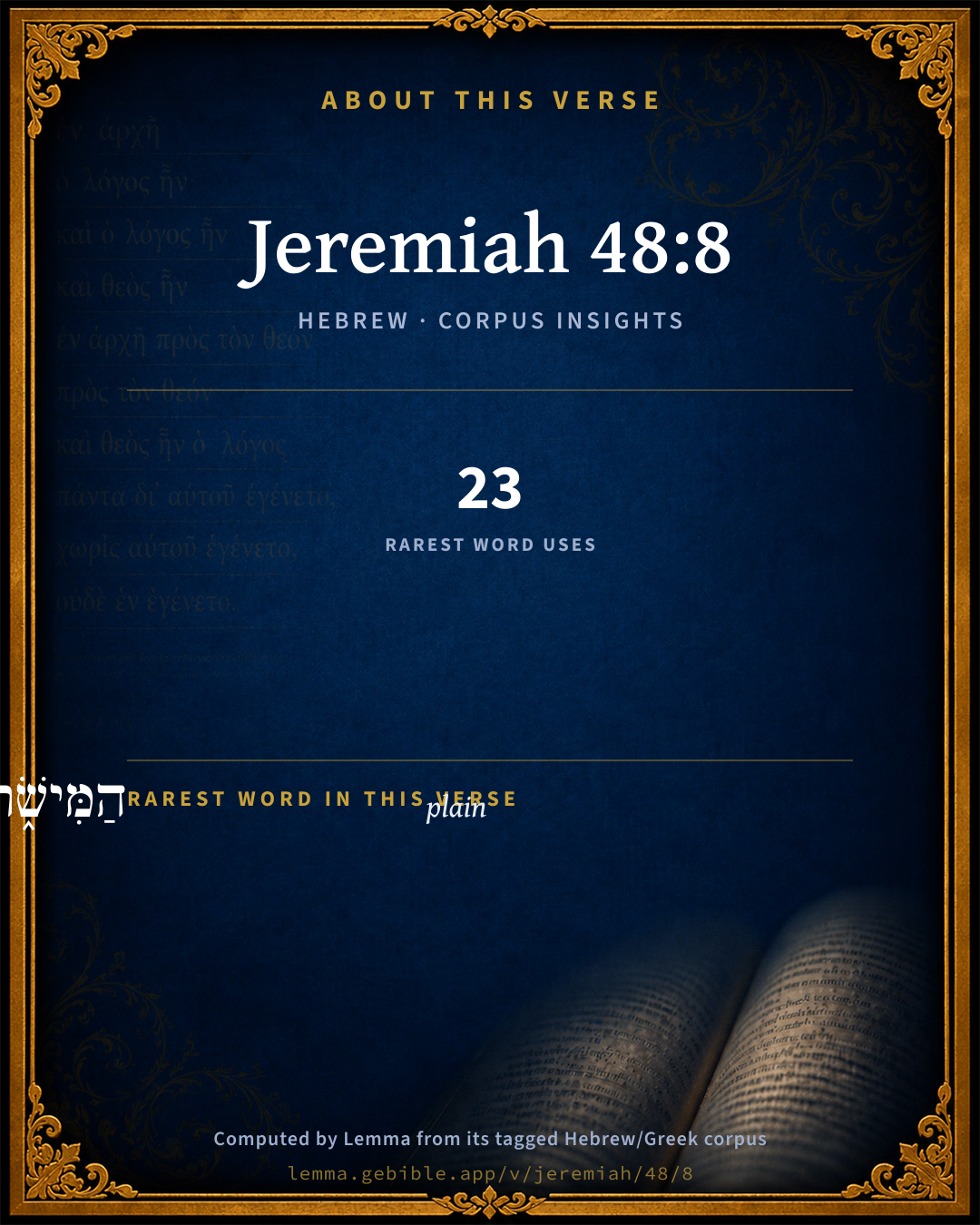
The rarest word here is הַמִּישֹׁ֑ר plain H4334 — appearing just 23 times in the whole Hebrew Bible.

Shared distinctive vocabulary

הַמִּישֹׁ֑ר plain H4334 occurs in 23 verses of the Hebrew Bible. Also found in:

Grammatical profile

  • 6 verbs
  • 6 nouns
  • 1 preposition
  • 2 particles

Verb forms

  • וְיָבֹ֨א Qal · Imperfect
  • שֹׁדֵ֜ד Qal · Participle Active
  • תִמָּלֵ֔ט Niphal · Imperfect
  • וְאָבַ֥ד Qal · Sequential Perfect
  • וְנִשְׁמַ֣ד Niphal · Sequential Perfect
  • אָמַ֥ר Qal · Perfect

Repetition

A word recurs within this verse — often emphatic in Hebrew:

  • עִ֗יר city H5892 ×2

Cross-references

10

Topical passages linked to Jeremiah 48:8 in the Treasury of Scripture Knowledge — connected by theme and wording, ordered by reader-vote popularity; previews shown in the World English Bible.

  • Jeremiah 6:26 Daughter of my people, gird you with sackcloth, and wallow yourself in ashes: make you mourning, as for an only son, most bitter lamentation; for the destroyer shall suddenly come on us.
  • Joshua 13:9 from Aroer, that is on the edge of the valley of the Arnon, and the city that is in the middle of the valley, and all the plain of Medeba to Dibon;
  • Joshua 13:17 Heshbon, and all its cities that are in the plain; Dibon, and Bamoth Baal, and Beth Baal Meon,
  • Joshua 13:21 and all the cities of the plain, and all the kingdom of Sihon king of the Amorites, who reigned in Heshbon, whom Moses struck with the chiefs of Midian, Evi, and Rekem, and Zur, and Hur, and Reba, the princes of Sihon, who lived in the land.
  • Jeremiah 15:8 Their widows are increased to me above the sand of the seas; I have brought on them against the mother of the young men a destroyer at noonday: I have caused anguish and terrors to fall on her suddenly.
  • Jeremiah 25:9 behold, I will send and take all the families of the north, says Yahweh, and [I will send] to Nebuchadrezzar the king of Babylon, my servant, and will bring them against this land, and against the inhabitants of it, and against all these nations round about; and I will utterly destroy them, and make them an astonishment, and a hissing, and perpetual desolations.
  • Jeremiah 48:18 You daughter who dwells in Dibon, come down from your glory, and sit in thirst; for the destroyer of Moab is come up against you, he has destroyed your strongholds.
  • Jeremiah 48:20–25 Moab is disappointed; for it is broken down: wail and cry; tell you it by the Arnon, that Moab is laid waste.
  • Jeremiah 51:56 for the destroyer is come on her, even on Babylon, and her mighty men are taken, their bows are broken in pieces; for Yahweh is a God of recompenses, he will surely requite.
  • Ezekiel 25:9 therefore, behold, I will open the side of Moab from the cities, from his cities which are on his frontiers, the glory of the country, Beth-jeshimoth, Baal Meon, and Kiriathaim,

Cross-references courtesy of OpenBible.info (CC BY 4.0).

Hebrew and Greek witnesses Masoretic Hebrew ↔ Greek Septuagint

The same verse in the two great witnesses to the Old Testament, shown verse-for-verse.

These are two independent witnesses, not word-aligned to each other, and the Septuagint is shown in lemma (dictionary) form.

Hebrew Jeremiah 48:8 Masoretic · Westminster Leningrad Codex

וְיָבֹ֨א שֹׁדֵ֜ד אֶל כָּל עִ֗יר וְעִיר֙ לֹ֣א תִמָּלֵ֔ט וְאָבַ֥ד הָעֵ֖מֶק וְנִשְׁמַ֣ד הַמִּישֹׁ֑ר אֲשֶׁ֖ר אָמַ֥ר יְהוָֽה

The destroyer shall come on every city, and no city shall escape; the valley also shall perish, and the plain shall be destroyed; as Yahweh has spoken.

World English Bible · Public Domain

Greek LXX Structure differs

In the Septuagint, Jeremiah is about an eighth shorter than the Hebrew and arranges its material differently — the Oracles Against the Nations (Hebrew chapters 46–51) appear in the middle of the Greek book, after 25:13. Because the chapter and verse boundaries do not line up, a verse-for-verse comparison with the Hebrew is not shown.

A verse-for-verse comparison isn’t shown here because the chapters and verses don’t line up. Switch to the LXX edition with the MT / LXX toggle above to read the Greek directly.

Hebrew: Westminster Leningrad Codex (CC BY 4.0). Greek: Septuagint (public domain); English from a public-domain English Septuagint. How the Septuagint differs from the Hebrew →

Targum (Aramaic paraphrase)

1

The Targum is the ancient Jewish Aramaic paraphrase of the Hebrew Scriptures — an interpretive translation, not the Hebrew text itself. Onkelos (literal) and Pseudo-Jonathan (expansive) render the Torah, and Jonathan the Prophets. Coverage is partial: where no permissively-licensed English translation exists for a verse, only the Aramaic is shown. This is verse-level text, not a word-by-word alignment to the Hebrew.

  1. Targum Jonathan Prophets (Joshua–Malachi)
    וְיֵיתוּן בָּזוֹזִין עַל כָּל קִרְוֵיהוֹן וְקִרְוָא מִנְהוֹן לָא תִשְׁתֵּיזִיב וְיֵיבְדוּן דְיָתְבִין בְּעוּמָקָא וְיִשְׁתֵּיצוּן דְשָׁרָן בְּמֵישְׁרָא דַאֲמַר יְיָ:

    (no public-domain English translation for this verse)

    Targum Jonathan — Aramaic: “Mikraot Gedolot” (public domain). English: “Sefaria Community Translation” (CC0 1.0 (public-domain dedication)); “London "Chaldee Paraphrase," 1871” (public domain). Text via Sefaria.

Commentary

Notes on Jeremiah 48:8 from classic Christian and Jewish commentators (each source and its license shown beneath its notes). The classic Christian expositions comment on the surrounding passage and are grouped to its opening verse, so a note may address several verses; the Jewish commentaries on the Tanakh (Rashi and others) are per-verse, so they appear only where the commentator wrote on this verse.

Lemma curates 59 commentaries, every one of them public domain or Creative Commons licensed, each selected and text-cleaned for this edition rather than reprinted as found. About our sources →

Trapp's Complete Commentary

John Trapp

Jer 48:8 And the spoiler shall come upon every city, and no city shall escape: the valley also shall perish, and the plain shall be destroyed, as the LORD hath spoken.

Ver. 8. And the spoiler shall come,] i.e., Nebuchadnezzar.

As the Lord hath spoken.] Who hath given him a commission, and made him his executioner.

John Trapp, A Commentary or Exposition upon All the Books of the Old and New Testament (1647–1656) — public domain. Text from a community e-Sword module.

Tyndale Open Study Notes

Tyndale Open Resources

48:8-10 The Lord sentenced all the towns of Moab to destruction, and he warned the agents of his judgment to faithfully carry out his decree.

Tyndale Open Study Notes — © Tyndale Open Resources, licensed CC BY-SA 4.0. Text via the HelloAO Bible API.

Jamieson, Fausset & Brown

Robert Jamieson, A. R. Fausset & David Brown

the valley . . . shall perish--that is, those dwelling in the valley.

Jamieson, Fausset & Brown — Commentary Critical and Explanatory on the Whole Bible (1871) — public domain (CC PDM 1.0). Text via the HelloAO Bible API.

John Calvin's Commentaries

He confirms the previous verse; nor ought he to be deemed too wordy, for this prophecy was not announced, that it might cherish the hope and patience of the faithful only for a few days; but it was necessary for them to rest dependent for a long time on this promise, which God had given them many years before. This, then, is the reason why the Prophet confirms at large a truth in itself sufficiently clear. Come, he says, shall a waster to all the cities It now appears more clearly why he mentioned some of the cities, though, as we shall see, they were many, even that the Israelites might know that all the land of Moab was to be given up to desolation: Nor shall a city escape, for destroyed shall be the valley and the plain, as Jehovah has spoken It follows, —

John Calvin's Commentaries (1540-1563) — public domain. Text from the Calvin Translation Society English edition (1840s-50s) via the Christian Classics Ethereal Library (ccel.org). Calvin's coverage is partial (roughly two-thirds of the Bible); uncommented books and verses are honest gaps, never fabricated. The 19th-century editor's footnotes and remarks are omitted so the notes are faithfully Calvin's own voice.

Ellicott's Commentary for English Readers

(8) The valley also shall perish . . .—The cities of “the plain” are enumerated in Jer_48:21-24. They belonged to the Arabah, the sunken valley of the Jordan, the “plains of Moab” of Num_22:1; Deu_3:10; Deu_4:43. The “valley” here is not connected with anything that helps us to identify it, but it may have been that of the Arnon, or the words may be used generically for “every valley” and “every plain.”

A Bible Commentary for English Readers, edited by Charles John Ellicott (1878–1897) — public domain. Text from a community e-Sword module.

The Cambridge Bible for Schools and Colleges

gen. ed. J. J. S. Perowne

8. the valley] the valley of the Jordan towards the Dead Sea.

the plain] the tableland of Moab.

The Cambridge Bible for Schools and Colleges (gen. ed. J. J. S. Perowne; Cambridge University Press, 1878–1918) — public domain. Text from a community e-Sword module.

John Gill's Exposition

And the spoiler shall come upon every city,.... That is, Nebuchadnezzar king of Babylon, and his army. The Targum is, the spoilers, who came against and took every city of Moab, and wasted them. Josephus (n) makes particular mention of Nebuchadnezzar subduing the Ammonites and Moabites:

and no city shall escape; the spoiler, and destruction by him:

the valley also shall perish, and the plain shall be destroyed, as the Lord hath spoken; not only the cities, and the inhabitants of them; but the inhabitants of the valleys and plains, as the Targum paraphrases it, should be destroyed; and also the corn that grew upon them, and the flocks and herds that grazed there, exactly as the Lord had foretold.

(n) Antiqu. l. 10. c. 9. sect. 7.

John Gill's Exposition of the Whole Bible (1746–1763) — public domain (CC PDM 1.0). Text via the HelloAO Bible API.

Albert Barnes' Notes on the Bible

The valley - The lowlands on the east bank of the Jordan, and at the top of the Dead Sea.

The plain - An upland pasture; it answers very much to downs: so in Jer 48:21.

Albert Barnes' Notes on the Bible (1834–1885) — public domain. Text from a community e-Sword/MySword module.

Haydock's Catholic Bible Commentary

Spoiler, or "thief," (prædo) a title which Nabuchodonosor deserved, on account of his unjust conquests. (Calmet)

George Leo Haydock (1774–1849), Haydock's Catholic Family Bible and Commentary, 1859 edition — public domain. Excludes Psalms (Douay-Rheims chapter numbering differs from Protestant) and Deuterocanonical books (Catholic canon only).

Matthew Poole's English Annotations

That is, all the parts of the country of Moab, and all the cities, as well those that stood upon hills and mountainous places, as those that stood in valleys; because or for the Lord had said it (for so the particle we translate as is bettea translated).

Matthew Poole's English Annotations on the Holy Bible (1683–1685) — public domain. Text from a community e-Sword/MySword module.

Whedon's Commentary on the Bible

Daniel D. Whedon

8. The valley of the Jordan in Moab, and the plain or level upland stretching between the Arnon and Heshbon, shall be overrun with this destruction. The last is called repeatedly “the fields of Moab” in Ruth and elsewhere.

Daniel D. Whedon (gen. ed.), Commentary on the Old and New Testaments (1874–1909) — public domain. Text from a community e-Sword module.

The Pulpit Commentary

The valley... the plain. The latter (Hebrew, mishor) is the upland region which extends from the Jordan eastward of Jericho into the Arabian desert; in Num_21:20 it is called the "field" (i.e. "open country") of Moab. The former means that part of the Jordan valley which borders on this upland "plain" towards the west.

The Pulpit Commentary (1880–1919), ed. H.D.M. Spence-Jones & Joseph S. Exell — public domain. Text from a community e-Sword module.

unfoldingWord translationNotes

Door43 World Missions Community

For the destroyer will come to every city

Here "the destroyer" represents the enemy army. AT: "For the enemy army will come to every city and destroy it" (See: Assumed Knowledge and Implicit Information)

no city will escape

Here "city" represents the people. AT: "no people from any city will escape" (See: Metonymy)

So the valley will perish and the plain will be devastated

Here "valley" and "plain" represent the cities and the people in those places AT: "So the enemy army will destroy everything in the valleys and on the plains" (See: Metonymy)

Give wings to Moab, for she must certainly fly away

Helping the people is spoken of as if they would put wings on the people so that could fly away. AT: "Help the people of Moab to escape as if you were giving them wings to fly away" (See: Metaphor)

Give wings to Moab, for she must certainly fly away

The translation of the original language is uncertain. Some Bibles translate this as "Set up a tombstone for Moab, for the enemy will certainly destroy it." Other Bibles translate it as "Put salt on the cities of Moab, for the enemy will completely destroy it." Enemies through salt on ruins to keep thing from ever growing there again.

from shedding blood

Here "blood" represents a person's life. And "shedding blood" is an idiom that means to kill. AT: "from killing people" (See: Metonymy and Idiom)

translationWords

destroy

perish

devastate

Yahweh

Moab

waste

life

works

curse

sword

blood

unfoldingWord translationNotes — © Distant Shores Media and the Door43 World Missions Community, licensed CC BY-SA 4.0. Source: git.door43.org/Door43/en_tn.

Lesson kit

Teaching starters — assembled from the data on this page, not authored interpretation. Every prompt links to the verse data it draws on. Edit before teaching.

Jeremiah, in the Prophets, opens this verse with 15 words (14 distinct Hebrew lemmas). Its most distinctive word is mîyshôwr (“plain”). A historical commentator’s framing appears above. Read the whole chapter for the surrounding context.

Discussion questions

  1. What does “plain” (mîyshôwr) contribute to the verse as a whole?
  2. How does Deuteronomy 3:10, which shares the word «plain», read alongside this verse?
  3. What does the repetition of “city” (2× in this one verse) do in this verse?
  4. These translations render this verse differently. What is at stake in choosing one wording over another?
  5. «וְיָבֹ֨א» is a Qal Imperfect verb. How does that grammatical form shape the action described?
  6. Compare how Trapp's Complete Commentary and Tyndale Open Study Notes read this verse. Where do they agree or differ?

Things to notice

Reading settings

Reading text

Shown beneath each verse's original-language words.

Old Testament
Old Testament edition

Read the OT as the Masoretic Hebrew (MT) or the Greek Septuagint (LXX).

English shown for the Greek Septuagint (in the Hebrew ↔ Greek comparison).

Comparing translations? Open the Compare panel on any verse page to stack up to four side by side.