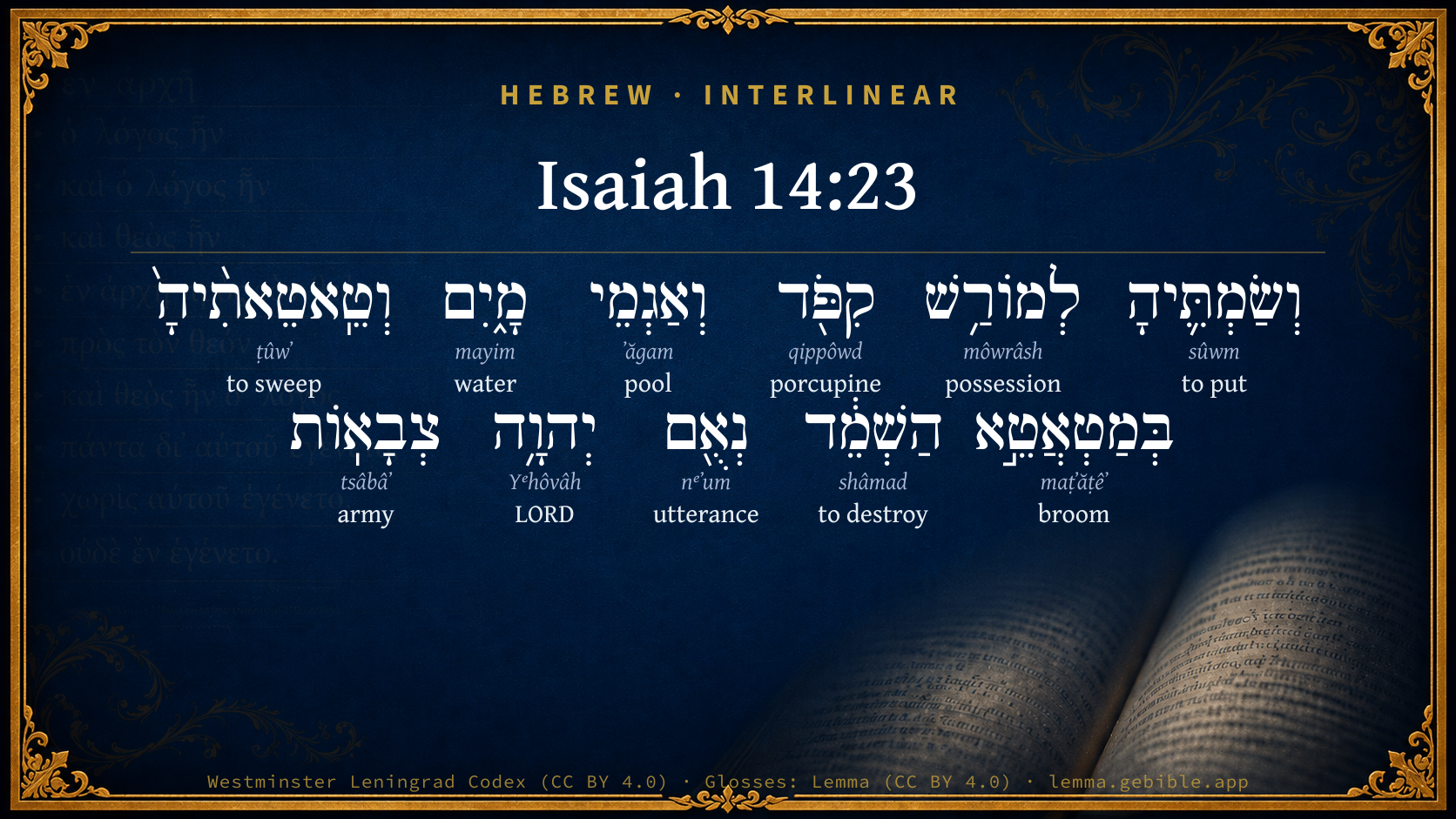
Isaiah 14:23

Hebrew (Westminster Leningrad Codex) Isaiah 14:23 appears in the Hebrew Old Testament. The text above is from the Westminster Leningrad Codex. Each word links to its Strong’s number, a concise gloss, and parsing drawn from the Open Scriptures Hebrew Bible morphology. Click any word for its full Brown-Driver-Briggs (BDB) entry.
Download image
Cite this verse

Isaiah 14:23 (World English Bible). Public Domain. Lemma interlinear Bible study tool, https://lemma.gebible.app/v/isaiah/14/23.

Show BibTeX & RIS
BibTeX
RIS
English Translation
I will also make it a possession for the porcupine, and pools of water: and I will sweep it with the broom of destruction, says Yahweh of Hosts.
World English Bible · Public Domain
Highlights
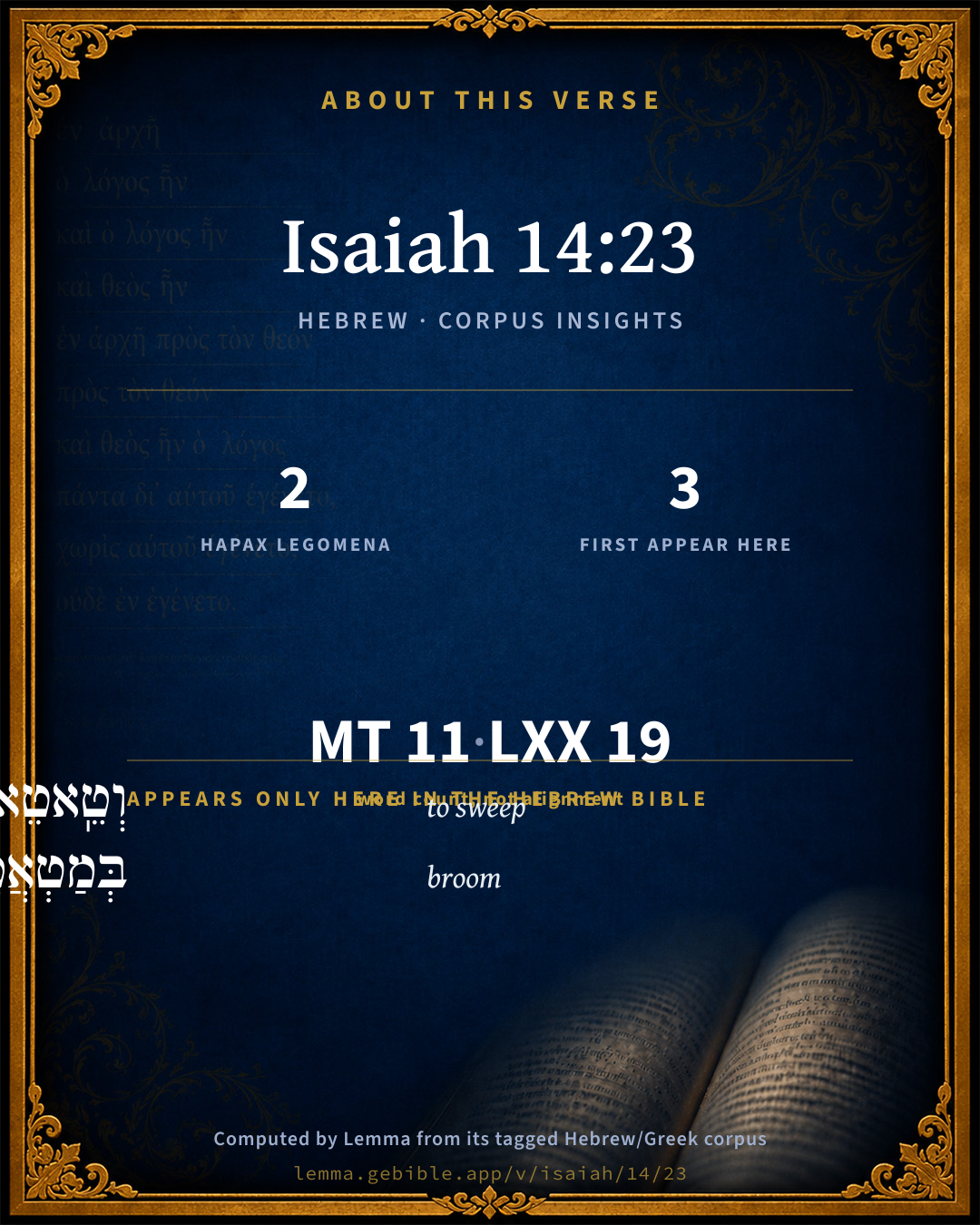
  • 2 hapax legomena — only here in the Hebrew Bible
  • 3 first appearances in the Hebrew Bible
Full analysis ↓
Download a study sheet

One document with this verse’s original text, its word-by-word gloss line, the meaning frame, cross-references with their text, attributed commentary, and full source and license credits — printable, and it pastes into notes with its structure intact.

This verse Autodidact and up

Study sheet (.html) Plain text (.txt)

A passage Seminary Student

Up to 50 verses in one chapter. A passage sheet keeps up to 6 commentary sources and 12 cross-references per verse, in the order this page ranks them, and says so on the sheet whenever that leaves anything out. Ask for a single verse and you get the Autodidact verse sheet above.

Everything on this page stays free to read, with no account — the sheet is a download of what is already on screen, not access to it.

Want to remove ads? Support Godless Engineer
Compare translations 3

The same verse in 3 English versions, stacked beneath the original-language interlinear above. Click any original word for its lexicon entry.

Each is an independent rendering of the whole verse — the interlinear is not word-aligned to these translations.

Highlighted words mark where these versions differ — a whole-verse word diff, not a word-by-word alignment.

  • World English Bible Public Domain
    I will also make it a possession for the porcupine, and pools of water: and I will sweep it with the broom of destruction, says Yahweh of Hosts.
  • King James Version Public Domain
    I will also make it a possession for the bittern, and pools of water: and I will sweep it with the besom of destruction, saith the LORD of hosts.
  • unfoldingWord Literal Text CC BY-SA 4.0
    “And I will make it a possession of the bittern and pools of water, and I will sweep it with the broom of destruction” —the declaration of Yahweh of Armies. q1

unfoldingWord Literal Text — © unfoldingWord, licensed CC BY-SA 4.0. Word-aligned USFM3 via Door43 (git.door43.org/unfoldingWord/en_ult).

Versions to compare (up to 4)

3 of 4 selected

Show all 18 translations

Every available English version of this verse, each an independent rendering of the whole verse.

  • World English Bible Public Domain
    I will also make it a possession for the porcupine, and pools of water: and I will sweep it with the broom of destruction, says Yahweh of Hosts.
  • Berean Standard Bible Public Domain
    “I will make her a place for owls and for swamplands; I will sweep her away with the broom of destruction,” declares the LORD of Hosts.
  • Majority Standard Bible Public Domain
    “I will make her a place for owls and for swamplands; I will sweep her away with the broom of destruction,” declares the LORD of Hosts.
  • King James Version Public Domain
    I will also make it a possession for the bittern, and pools of water: and I will sweep it with the besom of destruction, saith the LORD of hosts.
  • American Standard Version (1901) Public Domain
    I will also make it a possession for the porcupine, and pools of water: and I will sweep it with the besom of destruction, saith Jehovah of hosts.
  • Revised Version (1885) Public Domain
    I will also make it a possession for the porcupine, and pools of water: and I will sweep it with the besom of destruction, saith the LORD of hosts.
  • Geneva Bible (1599) Public Domain
    And I wil make it a possession to ye hedgehogge, and pooles of water, and I will sweepe it with the besome of destruction, sayeth the Lord of hostes.
  • Douay-Rheims (1899) Public Domain
    And I will make it a possession for the ericius and pools of waters, and I will sweep it and wear it out with a besom, saith the Lord of hosts.
  • Young's Literal Translation Public Domain
    And have made it for a possession of a bittern, And ponds of waters, And daubed it with the mire of destruction, The affirmation of Jehovah of Hosts!
  • Literal Standard Version CC BY-SA 4.0
    “And have made it for a possession of a hedgehog, || And ponds of waters, || And swept it with the broom of destruction,” || A declaration of YHWH of Hosts!
  • Unlocked Literal Bible CC BY-SA 4.0
    “I will also make her into a possession of owls, and into pools of water, and I will sweep her with the broom of destruction”—this is the declaration of Yahweh of hosts.
  • unfoldingWord Literal Text CC BY-SA 4.0
    “And I will make it a possession of the bittern and pools of water, and I will sweep it with the broom of destruction” —the declaration of Yahweh of Armies. q1
  • Darby Bible Public Domain
    And I will make it a possession for the bittern, and pools of water; and I will sweep it with the besom of destruction, saith Jehovah of hosts.
  • World Messianic Bible Public Domain
    “I will also make it a possession for the porcupine, and pools of water. I will sweep it with the broom of destruction,” says the LORD of Hosts.
  • Webster's Bible Public Domain
    I will also make it a possession for the bittern, and pools of water: and I will sweep it with the besom of destruction, saith the LORD of hosts.
  • Free Bible Version CC BY-SA 4.0
    I will make Babylon into a place for water birds and into marshland. I will sweep her away with the broom of destruction, declares the Lord Almighty.”
  • Bible in Basic English Public Domain
    And I will make you a heritage for the hedgehog, and pools of water: and I will go through it with the brush of destruction, says the Lord of armies.
  • JPS Tanakh (1917) Public Domain
    I will also make it a possession for the bittern, and pools of water; and I will sweep it with the besom of destruction, saith the LORD of hosts.

Literal Standard Version (2020), Covenant Press — licensed CC BY-SA 4.0. Text via the HelloAO Bible API (eBible.org). Unlocked Literal Bible (unfoldingWord) — licensed CC BY-SA 4.0. Text via the HelloAO Bible API (eBible.org). unfoldingWord Literal Text — © unfoldingWord, licensed CC BY-SA 4.0. Word-aligned USFM3 via Door43 (git.door43.org/unfoldingWord/en_ult). Free Bible Version, Dr. Jonathan Gallagher — licensed CC BY-SA 4.0. Text via the HelloAO Bible API (eBible.org).

Word by word

More ways to search: Search by grammar → Find every occurrence → Compare this word →

Practice this passage: Drill this verse → Learn its vocabulary →

וְטֵֽאטֵאתִ֨יהָ֙
ṭûwʼ
H2894
“and · to sweep · her”
Conjunction + Verb, Pilpel, Sequential Perfect, 1st Person, Common, Singular + Suffix, Personal, 3rd Person, Feminine, Singular
Part of Speech
Conjunction + Verb
Stem
Pilpel
Form
Sequential Perfect
Person
1st Person
Gender
Common
Number
Singular
Full BDB Definition

Origin: a primitive root

TWOT: 785

(Pilpel) to sweep, sweep away
  1. וְשַׂמְתִּ֛יהָ sûwm H7760 “and · to put · her” Conjunction + Verb, Qal, Sequential Perfect, 1st Person, Common, Singular + Suffix, Personal, 3rd Person, Feminine, Singular
  2. לְמוֹרַ֥שׁ môwrâsh H4180 “to/for · possession of” Preposition + Noun, Common, Masculine, Singular, Construct
  3. קִפֹּ֖ד qippôwd H7090 “porcupine” Noun, Common, Masculine, Singular, Absolute
  4. וְאַגְמֵי ʼăgam H98 “and · pools of” Conjunction + Noun, Common, Masculine, Plural, Construct
  5. מָ֑יִם mayim H4325 “water(s)” Noun, Common, Masculine, Plural, Absolute
  6. בְּמַטְאֲטֵ֣א maṭʼăṭêʼ H4292 “in/at · broom of” Preposition + Noun, Common, Masculine, Singular, Construct
  7. הַשְׁמֵ֔ד shâmad H8045 “to destroy” Verb, Hiphil, Infinitive Absolute
  8. נְאֻ֖ם nᵉʼum H5002 “utterance of” Noun, Common, Masculine, Singular, Construct
  9. יְהוָ֥ה Yᵉhôvâh H3068 “LORD” Noun, Proper
  10. צְבָאֽוֹת tsâbâʼ H6635 “armies” Noun, Common, Both, Plural, Absolute

About this verse

These counts appear in no published source. They are computed here, from the morphology-tagged text and Lemma’s own curated glosses. What Lemma adds →

11
words
11
distinct lemmas
Prophets
section

Notable vocabulary

2 hapax legomena — words that appear only here in the entire Hebrew Bible:

  • וְטֵֽאטֵאתִ֨יהָ֙ to sweep H2894
  • בְּמַטְאֲטֵ֣א broom H4292

First appearance in Scripture

These words make their first canonical appearance in the Hebrew Bible here:

  • קִפֹּ֖ד porcupine H7090
  • וְטֵֽאטֵאתִ֨יהָ֙ to sweep H2894
  • בְּמַטְאֲטֵ֣א broom H4292

Shared distinctive vocabulary

לְמוֹרַ֥שׁ possession H4180 occurs in 3 verses of the Hebrew Bible. Also found in:

Grammatical profile

  • 3 verbs
  • 8 nouns

Verb forms

  • וְשַׂמְתִּ֛יהָ Qal · Sequential Perfect
  • וְטֵֽאטֵאתִ֨יהָ֙ Pilpel · Sequential Perfect
  • הַשְׁמֵ֔ד Hiphil · Infinitive Absolute

Hebrew & Septuagint length

In English translation the verse runs 28 words from the Hebrew and 32 from the Septuagint (LXX English) — closely comparable.

A rough comparison of the two English renderings, which tokenize alike — not a word-level alignment.

Word counts can differ between the Hebrew and the Greek without any difference in meaning — e.g. the Hebrew direct-object marker אֵת has no separate Greek word, and Greek often adds the article ὁ.

In the original languages it is 11 Hebrew tokens and 19 Greek tokens — but the two are counted differently (Hebrew bundles its prefixes and suffixes into one token; the Greek is in lemma form), so that isn’t a like-for-like length.

Cross-references

11

Topical passages linked to Isaiah 14:23 in the Treasury of Scripture Knowledge — connected by theme and wording, ordered by reader-vote popularity; previews shown in the World English Bible.

  • Zephaniah 2:14 Herds will lie down in the midst of her, all the animals of the nations. Both the pelican and the porcupine will lodge in its capitals. Their calls will echo through the windows. Desolation will be in the thresholds, for he has laid bare the cedar beams.
  • 1 Kings 14:10 therefore, behold, I will bring evil on the house of Jeroboam, and will cut off from Jeroboam every man-child, him who is shut up and him who is left at large in Israel, and will utterly sweep away the house of Jeroboam, as a man sweeps away dung, until it be all gone.
  • Isaiah 13:21–22 But wild animals of the desert shall lie there; and their houses shall be full of doleful creatures; and ostriches shall dwell there, and wild goats shall dance there.
  • Isaiah 34:11–15 But the pelican and the porcupine shall possess it; and the owl and the raven shall dwell therein: and he will stretch over it the line of confusion, and the plummet of emptiness.
  • Revelation 14:8 Another, a second angel, followed, saying, "Babylon the great has fallen, which has made all the nations to drink of the wine of the wrath of her sexual immorality."
  • 2 Kings 21:13 I will stretch over Jerusalem the line of Samaria, and the plummet of the house of Ahab; and I will wipe Jerusalem as a man wipes a dish, wiping it and turning it upside down.
  • Jeremiah 51:25–26 Behold, I am against you, destroying mountain, says Yahweh, which destroy all the earth; and I will stretch out my hand on you, and roll you down from the rocks, and will make you a burnt mountain.
  • Jeremiah 51:42–43 The sea is come up on Babylon; she is covered with the multitude of the waves of it.
  • Revelation 18:2 He cried with a mighty voice, saying, "Fallen, fallen is Babylon the great, and she has become a habitation of demons, a prison of every unclean spirit, and a prison of every unclean and hateful bird!
  • Revelation 18:21–23 A mighty angel took up a stone like a great millstone and cast it into the sea, saying, "Thus with violence will Babylon, the great city, be thrown down, and will be found no more at all.
  • Jeremiah 50:39–40 Therefore the wild animals of the desert with the wolves shall dwell there, and the ostriches shall dwell therein: and it shall be no more inhabited forever; neither shall it be lived in from generation to generation.

Cross-references courtesy of OpenBible.info (CC BY 4.0).

Hebrew and Greek witnesses Masoretic Hebrew ↔ Greek Septuagint

The same verse in the two great witnesses to the Old Testament, shown verse-for-verse.

These are two independent witnesses, not word-aligned to each other, and the Septuagint is shown in lemma (dictionary) form.

Hebrew Isaiah 14:23 Masoretic · Westminster Leningrad Codex

וְשַׂמְתִּ֛יהָ לְמוֹרַ֥שׁ קִפֹּ֖ד וְאַגְמֵי מָ֑יִם וְטֵֽאטֵאתִ֨יהָ֙ בְּמַטְאֲטֵ֣א הַשְׁמֵ֔ד נְאֻ֖ם יְהוָ֥ה צְבָאֽוֹת

I will also make it a possession for the porcupine, and pools of water: and I will sweep it with the broom of destruction, says Yahweh of Hosts.

World English Bible · Public Domain

Greek LXX Isaiah 14:23 Septuagint · lemma form

καί τίθημι ὁ βαβυλωνία ἔρημος ὥστε καταοἰκέω ἐχίνος καί εἰμί εἰς οὐδείς καί τίθημι αὐτός πηλός βάραθρον εἰς ἀπώλεια

And I will make the region of Babylon desert, so that hedgehogs shall dwell there, and it shall come to nothing: and I will make it a pit of clay for destruction.

LXX2012 (modern English Septuagint) · Public Domain

On this verse, Adam Clarke's Commentary discusses the Septuagint’s reading. Read the note in Commentary ↓

Hebrew: Westminster Leningrad Codex (CC BY 4.0). Greek: Septuagint (public domain); English from LXX2012 (modern English Septuagint) (Public Domain). How the Septuagint differs from the Hebrew →

Targum (Aramaic paraphrase)

1

The Targum is the ancient Jewish Aramaic paraphrase of the Hebrew Scriptures — an interpretive translation, not the Hebrew text itself. Onkelos (literal) and Pseudo-Jonathan (expansive) render the Torah, and Jonathan the Prophets. Coverage is partial: where no permissively-licensed English translation exists for a verse, only the Aramaic is shown. This is verse-level text, not a word-by-word alignment to the Hebrew.

  1. Targum Jonathan Prophets (Joshua–Malachi)
    וַאֲשַׁוִינָהּ לִירוּתַת קוּפְדִין בֵּית צָדוּ בִּיצִין דְמַיָן וֶאֱהַמְמִינָהּ כְּמָא דִמְהַמְמִין בִּמְבִינָא וַאֲתַבְּבִינָהּ לְשֵׁיצָאָה אֲמַר יְיָ צְבָאוֹת:

    And I will make it an inheritance for the hedgehog, a place of desolation, pools of water: and I will sweep her as they are sweeping with a besom: and I will throw her down to destroy her, saith the Lord of hosts.

    Targum Jonathan — Aramaic: “Mikraot Gedolot” (public domain). English: “Sefaria Community Translation” (CC0 1.0 (public-domain dedication)); “London "Chaldee Paraphrase," 1871” (public domain). Text via Sefaria.

Commentary

Notes on Isaiah 14:23 from classic Christian and Jewish commentators (each source and its license shown beneath its notes). The classic Christian expositions comment on the surrounding passage and are grouped to its opening verse, so a note may address several verses; the Jewish commentaries on the Tanakh (Rashi and others) are per-verse, so they appear only where the commentator wrote on this verse.

Lemma curates 59 commentaries, every one of them public domain or Creative Commons licensed, each selected and text-cleaned for this edition rather than reprinted as found. About our sources →

Trapp's Complete Commentary

John Trapp

Isa 14:23 I will also make it a possession for the bittern, and pools of water: and I will sweep it with the besom of destruction, saith the LORD of hosts.

Ver. 23. I will also make it a possession for the bittern.] Which is a kind of water fowl that maketh a hideous noise.

And I will sweep it with the besom of destruction.] Scopa vastatrice verram eam, Vatab. I will not brush them for ornament, but sweep them, or rather scrub them to their ruin by my Persian Praedones, whom I will set upon them. And here the Jewish Rabbis acknowledge that they came to understand this text by hearing an Arabian woman mention a broom or a besom in her language, to her maid. {a} Apollos, a learned teacher, may yet learn of a tent maker.

{a} Scopis non purgatoriis sed perditoriis. - R. David in Radic. שׁא שׁא. - Mercer. in Pagnin. Thesaur.

John Trapp, A Commentary or Exposition upon All the Books of the Old and New Testament (1647–1656) — public domain. Text from a community e-Sword module.

Geneva Bible (1599)

Geneva Bible translators

Or, tortoise.

Geneva Bible (1599) marginal notes — public domain. Text via Bolls.life.

Jamieson, Fausset & Brown

Robert Jamieson, A. R. Fausset & David Brown

bittern--rather, "the hedgehog" [MAURER and GESENIUS]. STRABO (16:1) states that enormous hedgehogs were found in the islands of the Euphrates.

pools--owing to Cyrus turning the waters of the Euphrates over the country.

besom--sweep-net [MAURER], (Kg1 14:10; Kg2 21:13).

This would comfort the Jews when captives in Babylon, being a pledge that God, who had by that time fulfilled the promise concerning Sennacherib (though now still future), would also fulfil His promise as to destroying Babylon, Judah's enemy.

Jamieson, Fausset & Brown — Commentary Critical and Explanatory on the Whole Bible (1871) — public domain (CC PDM 1.0). Text via the HelloAO Bible API.

Adam Clarke's Commentary

Verse 23. I will sweep it with the besom of destruction - "I will plunge it in the miry gulf of destruction"] I have here very nearly followed the Version of the Septuagint; the reasons for which see in the last note on De Poesi Hebr. Praelect, xxviii.

The besom of destruction, as our Version renders it. במטאטא bematate. This, says Kimchi, is a Chaldee word: and it is worthy of remark that the prophet, writing to the Chaldeans, uses several words peculiar to their own language to point out the nature of the Divine judgments, and the causes of them. See Clarke on Jer 10:11. Sixteen of Kennicott's MSS., and seventeen of De Rossi's, and one ancient of my own, have the word במטאטי bematatey, in the plural. "I will sweep her with the besoms of destruction."

Adam Clarke's Commentary on the Bible (1810–1826) — public domain. Text from a community e-Sword/MySword module.

Ellicott's Commentary for English Readers

(23) I will also make it a possession for the bittern . . .—Naturalists are not agreed as to the meaning of the noun. In the LXX. and Vulgate it appears as “hedgehog,” or “porcupine,” and the “tortoise,” “beaver,” “otter,” and “owl” have all been suggested by scholars. Its conjunction with “pelican in Isa_34:11 and Zep_2:14, and with” pools of water “here, is in favour of some kind of water-fowl. The “hedgehog” frequents dry places, and not marshes, and does not roost, as in Zep_2:14, on the capitals of ruined columns. On the whole, therefore, “bittern” (Botaurus stellaris) may as well stand.

Pools of water.—These were the natural result of the breaking up of the canals, sluices, reservoirs, which had kept the overflow of the Euphrates within bounds (Diod. Sic., ii. 7).

I will sweep it with the besom of destruction . . .—The phrase has its parallel in the “sieve of vanity,” in Isa_30:28. (Comp. Isa_34:11) The force of the image must not be lost sight of Babylon is to be swept away as men sweep away some foul rubbish from their house. The world is cleaner for its destruction. The solemn doom closes the “burden” of Babylon.

A Bible Commentary for English Readers, edited by Charles John Ellicott (1878–1897) — public domain. Text from a community e-Sword module.

The Cambridge Bible for Schools and Colleges

gen. ed. J. J. S. Perowne

23. the bittern] (ch. Isa_34:11; Zep_2:14). Usually rendered “hedgehog” (R.V. porcupine) in accordance with the LXX. and Vulg. and the analogy of Arabic. The bittern certainly suits the scene best, and it is said to have the hedgehog’s trick of rolling itself up into an unrecognisable mass. (Tristram, Natural History of the Bible, p. 243.)

pools of water] marshes, caused by the overflow of the Euphrates when the dykes and canals were no longer kept in repair.

The Cambridge Bible for Schools and Colleges (gen. ed. J. J. S. Perowne; Cambridge University Press, 1878–1918) — public domain. Text from a community e-Sword module.

John Gill's Exposition

I will also make it a possession for the bittern,.... Instead of being possessed by any of the family of the king of Babylon. The "bittern" is a kind of water fowl, which, by putting its bill into mire, or a broken reed, is said to make a most horrible noise. Some think the "owl" is meant, which dwells in desolate and ruinous places; and others take it to be the "ospray", a sort of eagle that preys upon fish and ducks; according to Kimchi, the "tortoise" is meant; some will have it that the "beaver" or castor is intended; Jarchi understands it of the porcupine or "hedgehog"; and in the Arabic language this creature is called "kunphud", which is pretty near the Hebrew word "kippod", here used; to which Bochartus agrees; but, whatever creature is meant, the design is to show that Babylon should not be inhabited by men, but by birds or beasts of prey, or noxious animals; and so mystical Babylon is said to be a cage of every unclean and hateful bird, Rev 18:2,

and pools of water; Babylon being situated in a marshy ground, and by the river Euphrates; and when that river was turned by Cyrus (i), and afterwards its banks neglected, in course of time the water overflowed the place where the city was, and all about it, and so easily came to be what is here predicted it should; see Rev 18:21,

and I will sweep it with the besom of destruction, saith the Lord of hosts; and so clear it at once of all its inhabitants, wealth, and riches, and entirely remove its large walls and stately buildings, no more to be seen, just as a house is swept clean of all its dust; intimating, that this superb city, and all belonging to it, should be reduced to dust, and be as easily swept away as dust is with a besom. The word for "sweep", and a "besom", is only used in this place, and has this signification in the Arabic language; it is said in the Talmud (k), that the Rabbins knew not the meaning of this word, till they heard an Arabian girl say to her fellow servant,

"take this besom, and sweep the house.''

expressing the word here used.

(i) Xenophon. Cyropaedia, l. 7. c. 23. (k) Roshhashana, fol. 26. 2. Megilla, fol. 18. 1.

John Gill's Exposition of the Whole Bible (1746–1763) — public domain (CC PDM 1.0). Text via the HelloAO Bible API.

Albert Barnes' Notes on the Bible

I will also make it a possession for the bittern - The word ‘bittern,’ in English, means a bird with long legs and neck, that stalks among reeds and sedge, feeding upon fish. The Hebrew word (קפד qı̂ppod), occurs but five times Isa 34:11; Zep 2:14. According to Bochart and Gesenius, it means the hedgehog. It has been variously rendered. Some have supposed it to be a land animal; some an aquatic animal; and most have regarded it as a fowl. Bochart has proved that the hedgehog or porcupine is found on the shores of the Euphrates. He translates this place, ‘I will place Babylon for an habitation of the porcupine, even the pools of water;’ that is, the pools that are round about Babylon shall become so dry that porcupines may dwell there (see Bochart, “Hieroz.” iii. 36. pp. 1036-1042).

And pools of water - Bochart supposes this means, even the pools of water shall become dry. But the common interpretation is to be preferred, that Babylon itself should become filled with pools of water. This was done by Cyrus’ directing the waters of the Euphrates from their channel when the city was taken, and by the fact that the waters never returned again to their natural bed, so that the region was overflowed with water (see the notes at Isa. 13.)

And I will sweep it with the besom of destruction - A besom is a broom; and the sense here is, that God would entirely destroy Babylon, and render it wholly uninbabitable.

Albert Barnes' Notes on the Bible (1834–1885) — public domain. Text from a community e-Sword/MySword module.

Haydock's Catholic Bible Commentary

Besom. Reducing it to a heap of rubbish, (chap. xiii. 21.; Calmet) as the event shewed. (Watson)

George Leo Haydock (1774–1849), Haydock's Catholic Family Bible and Commentary, 1859 edition — public domain. Excludes Psalms (Douay-Rheims chapter numbering differs from Protestant) and Deuterocanonical books (Catholic canon only).

Matthew Poole's English Annotations

The bittern; a great water fowl, which thrusting its bill into some broken reed, or hollow thing, makes a great noise; which also delights in solitary places, as also in waterish grounds, such as those were about Babylon. Others render the word hedge-hog, or porcupine; but this being not considerable in itself, nor at all necessary for the clearing of the text, I shall not trouble the English reader with any discourse about it; and the learned may consult my Latin Synopsis.

Pools of water: the ground about Babylon was of itself very moist and waterish, because of the great river Euphrates running by it, which was kept from overflowing the country with charge and labour; which being neglected, as it must needs be when the city was destroyed and dispeopled, it was easily turned into pools of water.

Matthew Poole's English Annotations on the Holy Bible (1683–1685) — public domain. Text from a community e-Sword/MySword module.

The Pulpit Commentary

A possession for the bittern. Some water-bird or other is probably intended, since the word used is joined in Isa_36:11 with the names of three other birds, and is also certainly a bird"s name in Zep_2:14; but the identification with the "bittern" is a mere guess, and rests on no authority. And pools of water. The swampy character of the country about the ruins of Babylon is generally noticed by travelers. It arises from neglect of the dams along the course of the Euphrates. Ker Porter says that "large deposits of the Euphrates water are left stagnant in the hollows between the ruins" ("Travels," vol. 2. p. 389).

The Pulpit Commentary (1880–1919), ed. H.D.M. Spence-Jones & Joseph S. Exell — public domain. Text from a community e-Sword module.

John Wesley's Explanatory Notes

Bittern - A great water fowl, which delights in solitary places, as also in watery grounds. Such as those were about Babylon. Pools - The ground about Babylon was of itself very moist, because of the great river Euphrates, running by it, which was kept from overflowing the country with charge and labour; this being neglected, when the city was destroyed, it was easily turned into pools of water.

John Wesley, Explanatory Notes Upon the Whole Bible (1754–1765) — public domain. Text via the GEBible commentary corpus.

J. A. Alexander on Isaiah

Joseph Addison Alexander

“And I will render it (literally, place it for) a possession (or inheritance) of the porcupine, and pools of water, and will sweep it with the broom (or besom) of destruction.” The porcupine is here mentioned only as a solitary animal frequenting marshy grounds. The construction is not, I will make the pools of water a possession, etc. by drying them up, nor, I will make it a possession for pools of water, but, I will make it a possession for the porcupine and (will convert it into) pools of water. The exposure of the level plains of Babylonia to continual inundation without great preventive care, and the actual promotion of its desolation by this very cause, are facts distinctly stated by the ancient writers. Some suppose this evil to have had its origin in the diversion of the waters of the Euphrates by Cyrus.

Joseph Addison Alexander, The Prophecies of Isaiah (1846–1847; New York: Scribner, 1870–1878) — public domain. Text from a community e-Sword module.

Kretzmann's Popular Commentary

Paul E. Kretzmann

Prophecies Against Assyria and Philistia

v. 24. The Lord of hosts, the Commander of all the forces of heaven, hath sworn, saying, Surely as I have thought, as He had disposed or planned, so shall it come to pass, this prophecy preceding that against Babylon in point of human time; and as I have purposed, so shall it stand, this prophecy being practically a continuation of 10:34;

v. 25. that I will break the Assyrian in My land, overthrowing his power within the boundaries of Judah, and upon My mountains tread him under foot, for the turning-point in the Assyrian fortunes came at Libnah, in the foothills of the Judean mountains, with the destruction of Sennacherib’s forces, 2 Kings 19. Then shall his yoke depart from off them, namely, the inhabitants of Judah, and his burden depart from off their shoulders, so that the design of the invader could not be accomplished.

v. 26. This is the purpose that is purposed upon the whole earth, in the counsel of the Lord, in whose hand is the government of the whole earth; and this is the hand that is stretched out upon all the nations, and every decree of the Lord has significance for all men.

v. 27. For the Lord of hosts hath purposed, and who shall disannul it? No power of the world can prevent its execution. And his hand is stretched out, and who shall turn it back? No man can turn Him aside from the acts which He has determined upon.

v. 28. In the year that King Ahaz died, about 727 B. C. was this burden, this sentence of judgment upon the Philistines, who just at this time prepared to regain their ancient power:

v. 29. Rejoice not thou, whole Palestina, that is, Philistia, because the rod of him that smote thee is broken, the Philistines being of the opinion that the alliance of Syria and the Northern Kingdom, as a consequence of which Ahaz and Judah had become vassals of Assyria, 2Ki 16:5-9, had resulted in breaking the power of Judah, which had only just before that been asserted by Uzziah, 2Ch 26:6; for out of the serpent’s root shall come forth a cockatrice, that is, an adder, a still more poisonous serpent, and his fruit shall be a fiery flying serpent, the reference probably being to Hezekiah, who promptly smote the Philistines and definitely brought about their destruction, 2Ki 18:8.

v. 30. And the first-born of the poor shall feed, and the needy shall lie down in safety, that is, the inhabitants of Judah would enjoy peace and safety under the reign of Hezekiah, over against Philistia; and I will kill thy root with famine, thus eradicating the Philistines as a people, and he, Hezekiah, shall slay thy remnant, thereby carrying out God’s punishment upon the ancient enemies of Judah.

v. 31. Howl, O gate! the strong fortifications of the Philistine cities being meant. Cry, O city! Ashdod and Gaza having retained much of their ancient glory. Thou, whole Palestina, art dissolved, melting away to nothing; for there shall come from the North a smoke, namely, the Assyrian hordes with their ruthless devastations, and none shall be alone in his appointed times, literally, "and none is by himself in his armies," the Assyrian soldiers knowing neither weariness nor insubordination, but all filled with that one idea—the lust of conquest.

v. 32. What shall one, then, answer the messengers of the nation? What answer do the messengers of the nation bring? What report did the ambassadors of various heathen nations make when they returned to their own countries after viewing the results of God’s punishment of Philistia and His protection of Judah? That the Lord hath founded Zion, and the poor of His people shall trust in it, the troubled refugees being safe within its walls. In this way the Lord protects those who believe in Him against all enemies, He Himself being their Refuge and Strength.

Paul E. Kretzmann, Popular Commentary of the Bible (1921–1924) — public domain. Text from a community e-Sword module.

Rashi

Rabbi Shlomo Yitzchaki (Rashi)

hedgehog Heb. קִפֹּד [hricon or hericon in O.F.] [In Modern French it is spelled herisson.]

and I will sweep Heb. וְטִאטֵאתִיהָ, an expression of sweeping [eskober in O.F.], as our Rabbis stated: The Rabbis did not know the meaning of וְטִאטֵאתִיהָ בְּמַטְאֲטֵא הַשְׁמֵד, until they heard [Rabbi’s (R. Judah Hanasi’s) maidservant say to her friend, “Take a broom (מַטְאֲטֵא) and sweep (וְטַאְטְאִי) the house.”]

Rashi on the Tanakh — English translations: “The Judaica Press complete Tanach with Rashi, translated by A. J. Rosenberg” (CC BY 4.0); “Pentateuch with Rashi's commentary by M. Rosenbaum and A.M. Silbermann, 1929-1934” (public domain); “The Metsudah Tanach series, Lakewood, N.J” (CC BY 4.0); and “The Book of Joshua, Metsudah Publications, 1997” (CC BY 4.0). Text via Sefaria.

Ibn Ezra

Rabbi Abraham ibn Ezra

קפוד Hedgehog. A well known animal. According to some קפוד is derived from קפד to roll—comp. קפדתי I rolled (xxxviii 12)—on account of its power of rolling itself together.

מטאטא Besom. All agree that this word is hap. leg.; it signifies an instrument wherewith refuse is removed.

Ibn Ezra on the Tanakh — English translations: “Sefaria Community Translation” (CC0 1.0 (public-domain dedication)); “Yalkut, Sifsei Chachomim Chumash, Metsudah Publications, 2009” (CC BY 4.0); and “Commentary of Ibn Ezra on Isaiah - trans. by M. Friedlander, 1873” (public domain). Text via Sefaria.

Lesson kit

Teaching starters — assembled from the data on this page, not authored interpretation. Every prompt links to the verse data it draws on. Edit before teaching.

Isaiah, in the Prophets, opens this verse with 11 words (11 distinct Hebrew lemmas). Its most distinctive word is ṭûwʼ (“to sweep”). A historical commentator’s framing appears above. Read the whole chapter for the surrounding context.

Discussion questions

  1. The word ṭûwʼ carries the sense “to sweep.” How does it shape the verse?
  2. 2 words here appear nowhere else in the Hebrew Bible. Why might the author reach for such rare wording?
  3. 3 words make their first appearance in Scripture here. What does this debut establish?
  4. How does Job 17:11, which shares the word «possession», read alongside this verse?
  5. These translations render this verse differently; the difference is in the English rendering, not the original. What questions does that raise?
  6. «וְשַׂמְתִּ֛יהָ» is a Qal Sequential Perfect verb. How does that grammatical form shape the action described?
  7. Compare how Trapp's Complete Commentary and Geneva Bible (1599) read this verse. Where do they agree or differ?

Things to notice

Reading settings

Reading text

Shown beneath each verse's original-language words.

Old Testament
Old Testament edition

Read the OT as the Masoretic Hebrew (MT) or the Greek Septuagint (LXX).

English shown for the Greek Septuagint (in the Hebrew ↔ Greek comparison).

Comparing translations? Open the Compare panel on any verse page to stack up to four side by side.