Isaiah 13:9

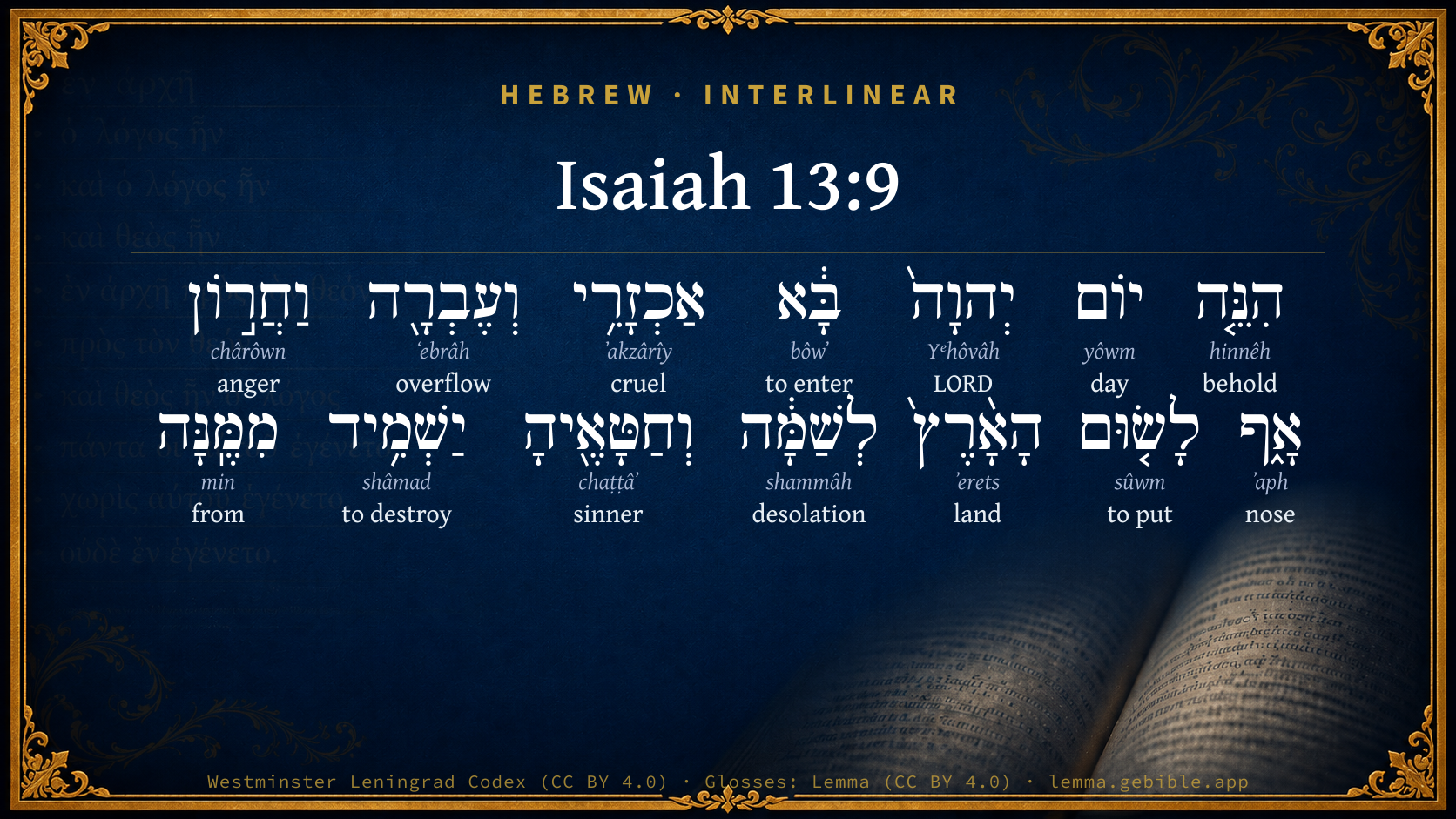
Hebrew (Westminster Leningrad Codex) Isaiah 13:9 appears in the Hebrew Old Testament. The text above is from the Westminster Leningrad Codex. Each word links to its Strong’s number, a concise gloss, and parsing drawn from the Open Scriptures Hebrew Bible morphology. Click any word for its full Brown-Driver-Briggs (BDB) entry.
Download image
Cite this verse

Isaiah 13:9 (World English Bible). Public Domain. Lemma interlinear Bible study tool, https://lemma.gebible.app/v/isaiah/13/9.

Show BibTeX & RIS
BibTeX
RIS
English Translation
Behold, the day of Yahweh comes, cruel, with wrath and fierce anger; to make the land a desolation, and to destroy the sinners of it out of it.
World English Bible · Public Domain
Download a study sheet

One document with this verse’s original text, its word-by-word gloss line, the meaning frame, cross-references with their text, attributed commentary, and full source and license credits — printable, and it pastes into notes with its structure intact.

This verse Autodidact and up

Study sheet (.html) Plain text (.txt)

A passage Seminary Student

Up to 50 verses in one chapter. A passage sheet keeps up to 6 commentary sources and 12 cross-references per verse, in the order this page ranks them, and says so on the sheet whenever that leaves anything out. Ask for a single verse and you get the Autodidact verse sheet above.

Everything on this page stays free to read, with no account — the sheet is a download of what is already on screen, not access to it.

Want to remove ads? Support Godless Engineer
Compare translations 3

The same verse in 3 English versions, stacked beneath the original-language interlinear above. Click any original word for its lexicon entry.

Each is an independent rendering of the whole verse — the interlinear is not word-aligned to these translations.

Highlighted words mark where these versions differ — a whole-verse word diff, not a word-by-word alignment.

  • World English Bible Public Domain
    Behold, the day of Yahweh comes, cruel, with wrath and fierce anger; to make the land a desolation, and to destroy the sinners of it out of it.
  • King James Version Public Domain
    Behold, the day of the LORD cometh, cruel both with wrath and fierce anger, to lay the land desolate: and he shall destroy the sinners thereof out of it.
  • unfoldingWord Literal Text CC BY-SA 4.0
    Behold, the day of Yahweh is coming, cruel, with wrath and burning of nose, to make the land a desolation, and he will destroy its sinners from it.

unfoldingWord Literal Text — © unfoldingWord, licensed CC BY-SA 4.0. Word-aligned USFM3 via Door43 (git.door43.org/unfoldingWord/en_ult).

Versions to compare (up to 4)

3 of 4 selected

Show all 18 translations

Every available English version of this verse, each an independent rendering of the whole verse.

  • World English Bible Public Domain
    Behold, the day of Yahweh comes, cruel, with wrath and fierce anger; to make the land a desolation, and to destroy the sinners of it out of it.
  • Berean Standard Bible Public Domain
    Behold, the Day of the LORD is coming—cruel, with fury and burning anger—to make the earth a desolation and to destroy the sinners within it.
  • Majority Standard Bible Public Domain
    Behold, the Day of the LORD is coming—cruel, with fury and burning anger—to make the earth a desolation and to destroy the sinners within it.
  • King James Version Public Domain
    Behold, the day of the LORD cometh, cruel both with wrath and fierce anger, to lay the land desolate: and he shall destroy the sinners thereof out of it.
  • American Standard Version (1901) Public Domain
    Behold, the day of Jehovah cometh, cruel, with wrath and fierce anger; to make the land a desolation, and to destroy the sinners thereof out of it.
  • Revised Version (1885) Public Domain
    Behold, the day of the LORD cometh, cruel, with wrath and fierce anger; to make the land a desolation, and to destroy the sinners thereof out of it.
  • Geneva Bible (1599) Public Domain
    Beholde, the day of the Lord commeth, cruel, with wrath and fierce anger to lay the land wast: and he shall destroy the sinners out of it.
  • Douay-Rheims (1899) Public Domain
    Behold, the day of the Lord shall come, a cruel day, and full of indignation, and of wrath, and fury, to lay the land desolate, and to destroy the sinners thereof out of it.
  • Young's Literal Translation Public Domain
    Lo, the day of Jehovah doth come, Fierce, with wrath, and heat of anger, To make the land become a desolation, Yea, its sinning ones He destroyeth from it.
  • Literal Standard Version CC BY-SA 4.0
    Behold, the Day of YHWH comes, || Fierce, with wrath, and heat of anger, || To make the land become a desolation, || Indeed, He destroys its sinning ones from it.
  • Unlocked Literal Bible CC BY-SA 4.0
    See, the day of Yahweh comes with cruel wrath and overflowing anger, to make the land a desolation and to destroy the sinners from it.
  • unfoldingWord Literal Text CC BY-SA 4.0
    Behold, the day of Yahweh is coming, cruel, with wrath and burning of nose, to make the land a desolation, and he will destroy its sinners from it.
  • Darby Bible Public Domain
    Behold, the day of Jehovah cometh, cruel both with wrath and fierce anger, to lay the earth desolate; and he will destroy the sinners thereof out of it.
  • World Messianic Bible Public Domain
    Behold, the day of the LORD comes, cruel, with wrath and fierce anger; to make the land a desolation, and to destroy its sinners out of it.
  • Webster's Bible Public Domain
    Behold, the day of the LORD cometh, cruel both with wrath and fierce anger, to lay the land desolate: and he will destroy its sinners out of it.
  • Free Bible Version CC BY-SA 4.0
    Look! The day of the Lord is coming—cruel, with fury and fierce anger—to devastate the land and to wipe out its sinners.
  • Bible in Basic English Public Domain
    See, the day of the Lord is coming, cruel, with wrath and burning passion: to make the land a waste, driving the sinners in it to destruction.
  • JPS Tanakh (1917) Public Domain
    Behold, the day of the LORD cometh, cruel, and full of wrath and fierce anger; to make the earth a desolation, and to destroy the sinners thereof out of it,

Literal Standard Version (2020), Covenant Press — licensed CC BY-SA 4.0. Text via the HelloAO Bible API (eBible.org). Unlocked Literal Bible (unfoldingWord) — licensed CC BY-SA 4.0. Text via the HelloAO Bible API (eBible.org). unfoldingWord Literal Text — © unfoldingWord, licensed CC BY-SA 4.0. Word-aligned USFM3 via Door43 (git.door43.org/unfoldingWord/en_ult). Free Bible Version, Dr. Jonathan Gallagher — licensed CC BY-SA 4.0. Text via the HelloAO Bible API (eBible.org).

Word by word

More ways to search: Search by grammar → Find every occurrence → Compare this word →

Practice this passage: Drill this verse → Learn its vocabulary →

אַכְזָרִ֥י
ʼakzârîy
H394
“cruel”
Adjective, Adjective, Masculine, Singular, Absolute
Part of Speech
Adjective
Type
Adjective
Gender
Masculine
Number
Singular
State
Absolute
Full BDB Definition

Origin: from H393

TWOT: 971b

cruel
  1. הִנֵּ֤ה hinnêh H2009 “behold” Particle, Demonstrative
  2. יוֹם yôwm H3117 “day of” Noun, Common, Masculine, Singular, Construct
  3. יְהוָה֙ Yᵉhôvâh H3068 “LORD” Noun, Proper
  4. בָּ֔א bôwʼ H935 “to enter” Verb, Qal, Perfect, 3rd Person, Masculine, Singular
  5. וְעֶבְרָ֖ה ʻebrâh H5678 “and · overflow” Conjunction + Noun, Common, Feminine, Singular, Absolute
  6. וַחֲר֣וֹן chârôwn H2740 “and · anger of” Conjunction + Noun, Common, Masculine, Singular, Construct
  7. אָ֑ף ʼaph H639 “nose” Noun, Common, Masculine, Singular, Absolute
  8. לָשׂ֤וּם sûwm H7760 “to put” Preposition + Verb, Qal, Infinitive Construct
  9. הָאָ֨רֶץ֙ ʼerets H776 “the · land” Particle, Definite Article + Noun, Common, Both, Singular, Absolute
  10. לְשַׁמָּ֔ה shammâh H8047 “to/for · desolation” Preposition + Noun, Common, Feminine, Singular, Absolute
  11. וְחַטָּאֶ֖יהָ chaṭṭâʼ H2400 “and · sinner · her” Conjunction + Adjective, Adjective, Masculine, Plural, Construct + Suffix, Personal, 3rd Person, Feminine, Singular
  12. יַשְׁמִ֥יד shâmad H8045 “to destroy” Verb, Hiphil, Imperfect, 3rd Person, Masculine, Singular
  13. מִמֶּֽנָּה min H4480 “from · her” Preposition + Suffix, Personal, 3rd Person, Feminine, Singular

About this verse

These counts appear in no published source. They are computed here, from the morphology-tagged text and Lemma’s own curated glosses. What Lemma adds →

14
words
14
distinct lemmas
Prophets
section

Notable vocabulary

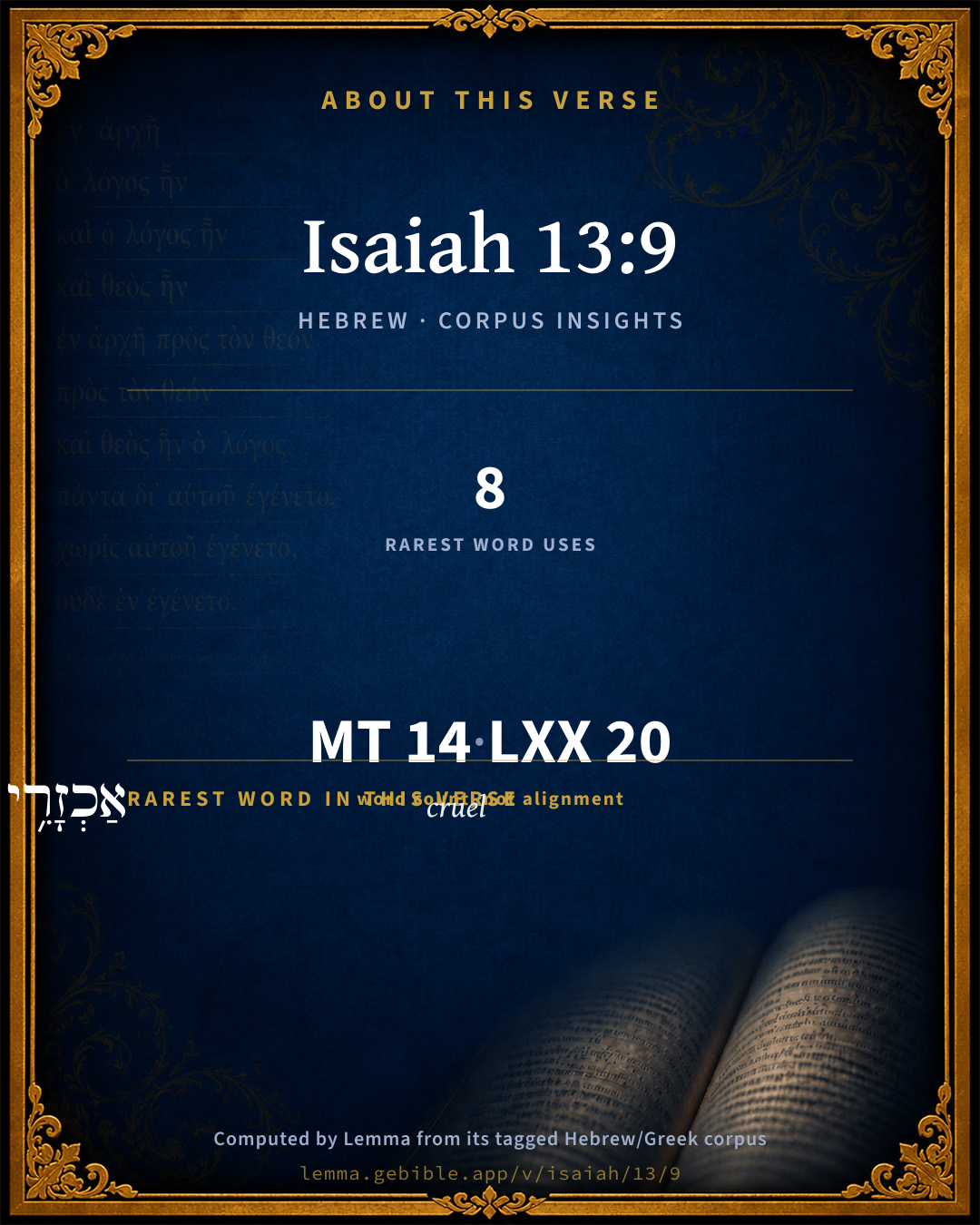
The rarest word here is אַכְזָרִ֥י cruel H394 — appearing just 8 times in the whole Hebrew Bible.

Shared distinctive vocabulary

אַכְזָרִ֥י cruel H394 occurs in 8 verses of the Hebrew Bible. Also found in:

Grammatical profile

  • 3 verbs
  • 7 nouns
  • 2 adjectives
  • 1 preposition
  • 1 particle

Verb forms

  • בָּ֔א Qal · Perfect
  • לָשׂ֤וּם Qal · Infinitive Construct
  • יַשְׁמִ֥יד Hiphil · Imperfect

Hebrew & Septuagint length

In English translation the verse runs 28 words from the Hebrew and 31 from the Septuagint (LXX English) — closely comparable.

A rough comparison of the two English renderings, which tokenize alike — not a word-level alignment.

Word counts can differ between the Hebrew and the Greek without any difference in meaning — e.g. the Hebrew direct-object marker אֵת has no separate Greek word, and Greek often adds the article ὁ.

In the original languages it is 14 Hebrew tokens and 20 Greek tokens — but the two are counted differently (Hebrew bundles its prefixes and suffixes into one token; the Greek is in lemma form), so that isn’t a like-for-like length.

Cross-references

14

Topical passages linked to Isaiah 13:9 in the Treasury of Scripture Knowledge — connected by theme and wording, ordered by reader-vote popularity; previews shown in the World English Bible.

  • Nahum 1:6 Who can stand before his indignation? Who can endure the fierceness of his anger? His wrath is poured out like fire, and the rocks are broken apart by him.
  • Malachi 4:1 "For, behold, the day comes, it burns as a furnace; and all the proud, and all who work wickedness, will be stubble; and the day that comes will burn them up," says Yahweh of Hosts, "that it shall leave them neither root nor branch.
  • Isaiah 13:15–18 Everyone who is found shall be thrust through; and everyone who is taken shall fall by the sword.
  • Isaiah 13:6 Wail; for the day of Yahweh is at hand; as destruction from the Almighty shall it come.
  • Psalms 104:35 Let sinners be consumed out of the earth. Let the wicked be no more. Bless Yahweh, my soul. Praise Yah!
  • Isaiah 47:10–15 For you have trusted in your wickedness; you have said, None sees me; your wisdom and your knowledge, it has perverted you, and you have said in your heart, I am, and there is none else besides me.
  • Jeremiah 6:22–23 Thus says Yahweh, Behold, a people comes from the north country; and a great nation shall be stirred up from the uttermost parts of the earth.
  • Jeremiah 50:40–42 As when God overthrew Sodom and Gomorrah and the neighbor cities of it, says Yahweh, so shall no man dwell there, neither shall any son of man sojourn therein.
  • Jeremiah 51:35–58 The violence done to me and to my flesh be on Babylon, shall the inhabitant of Zion say; and, My blood be on the inhabitants of Chaldea, shall Jerusalem say.
  • Nahum 1:2 Yahweh is a jealous God and avenges. Yahweh avenges and is full of wrath. Yahweh takes vengeance on his adversaries, and he maintains wrath against his enemies.
  • Revelation 17:16–17 The ten horns which you saw, and the beast, these will hate the prostitute, and will make her desolate, and will make her naked, and will eat her flesh, and will burn her utterly with fire.
  • Proverbs 2:22 But the wicked will be cut off from the land. The treacherous will be rooted out of it.
  • Revelation 18:8 Therefore in one day her plagues will come: death, mourning, and famine; and she will be utterly burned with fire; for the Lord God who has judged her is strong.
  • Revelation 19:17–21 I saw an angel standing in the sun. He cried with a loud voice, saying to all the birds that fly in the sky, "Come! Be gathered together to the great supper of God,

Cross-references courtesy of OpenBible.info (CC BY 4.0).

Hebrew and Greek witnesses Masoretic Hebrew ↔ Greek Septuagint

The same verse in the two great witnesses to the Old Testament, shown verse-for-verse.

These are two independent witnesses, not word-aligned to each other, and the Septuagint is shown in lemma (dictionary) form.

Hebrew Isaiah 13:9 Masoretic · Westminster Leningrad Codex

הִנֵּ֤ה יוֹם יְהוָה֙ בָּ֔א אַכְזָרִ֥י וְעֶבְרָ֖ה וַחֲר֣וֹן אָ֑ף לָשׂ֤וּם הָאָ֨רֶץ֙ לְשַׁמָּ֔ה וְחַטָּאֶ֖יהָ יַשְׁמִ֥יד מִמֶּֽנָּה

Behold, the day of Yahweh comes, cruel, with wrath and fierce anger; to make the land a desolation, and to destroy the sinners of it out of it.

World English Bible · Public Domain

Greek LXX Isaiah 13:9 Septuagint · lemma form

ἰδού γάρ ἡμέρα κύριος ἀνίατος ἔρχομαι θυμός καί ὀργή τίθημι ὁ οἰκέω ὅλος ἔρημος καί ὁ ἁμαρτωλός ἀποὀλλύω ἐκ αὐτός

For behold! the day of the Lord is coming which can’t be escaped, a day of wrath and anger, to make the world desolate, and to destroy sinners out of it.

LXX2012 (modern English Septuagint) · Public Domain

On this verse, Keil & Delitzsch discusses the Septuagint’s reading. Read the note in Commentary ↓

Hebrew: Westminster Leningrad Codex (CC BY 4.0). Greek: Septuagint (public domain); English from LXX2012 (modern English Septuagint) (Public Domain). How the Septuagint differs from the Hebrew →

Targum (Aramaic paraphrase)

1

The Targum is the ancient Jewish Aramaic paraphrase of the Hebrew Scriptures — an interpretive translation, not the Hebrew text itself. Onkelos (literal) and Pseudo-Jonathan (expansive) render the Torah, and Jonathan the Prophets. Coverage is partial: where no permissively-licensed English translation exists for a verse, only the Aramaic is shown. This is verse-level text, not a word-by-word alignment to the Hebrew.

  1. Targum Jonathan Prophets (Joshua–Malachi)
    הָא יוֹמָא מִן קֳדָם יְיָ עֲתִיד לְמֵיתֵי אַכְזָרִי וְתַעֲבוֹר וּתְקוֹף רְגַז לְשַׁוָאָה אַרְעָא לְצָדוּ וְחַיָבָהָא יְשֵׁיצֵי מִנָהּ:

    Behold, the day from before the presence of the Lord cometh, cruel both with wrath and fierce anger, to lay the land desolate: and He shall destroy the sinners out of it.

    Targum Jonathan — Aramaic: “Mikraot Gedolot” (public domain). English: “Sefaria Community Translation” (CC0 1.0 (public-domain dedication)); “London "Chaldee Paraphrase," 1871” (public domain). Text via Sefaria.

Commentary

Notes on Isaiah 13:9 from classic Christian and Jewish commentators (each source and its license shown beneath its notes). The classic Christian expositions comment on the surrounding passage and are grouped to its opening verse, so a note may address several verses; the Jewish commentaries on the Tanakh (Rashi and others) are per-verse, so they appear only where the commentator wrote on this verse.

Lemma curates 59 commentaries, every one of them public domain or Creative Commons licensed, each selected and text-cleaned for this edition rather than reprinted as found. About our sources →

Jamieson, Fausset & Brown

Robert Jamieson, A. R. Fausset & David Brown

cruel--not strictly, but unsparingly just; opposed to mercy. Also answering to the cruelty (in the strict sense) of Babylon towards others (Isa 14:17) now about to be visited on itself.

the land--"the earth" [HORSLEY]. The language of Isa 13:9-13 can only primarily and partially apply to Babylon; fully and exhaustively, the judgments to come, hereafter, on the whole earth. Compare Isa 13:10 with Mat 24:29; Rev 8:12. The sins of Babylon, arrogancy (Isa 13:11; Isa 14:11; Isa 47:7-8), cruelty, false worship (Jer 50:38), persecution of the people of God (Isa 47:6), are peculiarly characteristic of the Antichristian world of the latter days (Dan 11:32-37; Rev 17:3, Rev 17:6; Rev 18:6-7, Rev 18:9-14, Rev 18:24).

Jamieson, Fausset & Brown — Commentary Critical and Explanatory on the Whole Bible (1871) — public domain (CC PDM 1.0). Text via the HelloAO Bible API.

Trapp's Complete Commentary

John Trapp

Isa 13:9 Behold, the day of the LORD cometh, cruel both with wrath and fierce anger, to lay the land desolate: and he shall destroy the sinners thereof out of it.

Ver. 9. Behold the day of the Lord cometh cruel.] So it shall seem to the enemies, because "an evil, an only evil, behold, is come," {Eze 7:5} without mixture of mercy.

John Trapp, A Commentary or Exposition upon All the Books of the Old and New Testament (1647–1656) — public domain. Text from a community e-Sword module.

Joseph Benson's Commentary

Isa 13:9-10. Behold the day — cruel both with wrath and fierce anger — Dr. Waterland renders the clause, fierceness, wrath, and hot anger: divers words are heaped together, to signify the extremity of the divine indignation; to lay the land desolate — Hebrew, לשׁום לשׁמה, to make it a desolation, an entire and perpetual desolation, Isa 13:19-22. And he shall destroy the sinners thereof — The inhabitants of that city, who had persisted in their idolatries, oppressions, and all sorts of luxuries, notwithstanding the faithful testimony against their practices borne by Daniel, Shadrach, Meshach, and Abed-nego, and other pious Jews, and the solemn warnings given by God himself to Nebuchadnezzar, in repeated dreams and visions, and the humiliating and distressing affliction wherewith that monarch was chastised: see Dan 4:13-33. For the stars of heaven — Here the calamity to be brought upon them is set forth “under the figure of a dreadful tempest, inducing such a face of things in the heavens as the prophet describes.” It would be so grievous as to “deprive them of all light, that is, of all joy and consolation, as well as of the causes of them, and would fill them with sorrow and distress, and a fearful sense of the divine wrath poured forth from heaven upon them.” Or, rather, the prophet foretels the utter subversion of their republic, and the entire overthrow of their religion and polity, under the emblem of the extinction or passing away of the sun, moon, and stars, and all the heavenly bodies. For, as Bishop Lowth observes, the Hebrew writers, “to express happiness, prosperity, the instauration and advancement of states, kingdoms, and potentates, make use of images taken from the most striking parts of nature; from the heavenly bodies, from the sun, moon, and stars, which they describe as shining with increased splendour, and never setting; the moon becomes like the meridian sun, and the sun’s light is augmented seven-fold: see Isa 30:26. New heavens and a new earth are created, and a brighter age commences. On the contrary, the overthrow and destruction of kingdoms are represented by opposite images; the stars are obscured, the moon withdraws her light, and the sun shines no more; the earth quakes, and the heavens tremble; and all things seem tending to their original chaos.”

Joseph Benson's Commentary on the Old and New Testaments (1811–1818) — public domain. Text from a community e-Sword module.

Scofield Reference Notes

C. I. Scofield

Day of the Lord

(Day of Jehovah) vs.

Isa 2:10-22; Isa 4:1-6; Isa 11:10-13; Isa 13:9-16; Isa 24:21-23; Isa 26:20; Isa 26:21; Isa 63:1-6; Isa 66:15-24; Rev 19:11-21.

The Scofield Reference Bible (1917 edition), notes by C. I. Scofield — public domain. Text from a community e-Sword module.

The Cambridge Bible for Schools and Colleges

gen. ed. J. J. S. Perowne

9. land] Rather, earth, as in Isa_13:5.

9–16. The middle division of the prophecy enlarges on the nature, purpose and effects of this day of Jehovah.

The Cambridge Bible for Schools and Colleges (gen. ed. J. J. S. Perowne; Cambridge University Press, 1878–1918) — public domain. Text from a community e-Sword module.

John Gill's Exposition

Behold, the day of the Lord cometh,.... Or "is come" (e); said in Isa 13:6 to be at hand, but now it is represented in prophecy as already come:

cruel both with wrath and fierce anger; which, whether referred to "the Lord", or to "the day", the sense is the same; the day may be said to be cruel, and full of wrath and fury, because of the severity and fierceness of the Lord's anger, exercised upon the Babylonians in it; and he may be said to be so, not that he really is cruel, or exceeds the bounds of justice, but because he seemed to be so to the objects of his displeasure; as a judge may be thought to be cruel and severe by the malefactor, when he only pronounces and executes a righteous judgment on him; a heap of words are here made use of, to express the greatness and fierceness of divine wrath:

to lay the land desolate; the land of the Chaldeans:

and he shall destroy the sinners thereof out of it; this shows that what is before said most properly belongs to the Lord, to whom the destruction of Babylon, and the country belonging to it, must be ascribed; and indeed it was such as could not be brought about by human force; the moving cause of which was the sin of the inhabitants, some of whom were notorious sinners, for whose sakes it was destroyed by the Lord, and they in the midst of it, or out of it; see Psa 104:35.

(e) "venit", Piscator; "veniens", Montanus.

John Gill's Exposition of the Whole Bible (1746–1763) — public domain (CC PDM 1.0). Text via the HelloAO Bible API.

Albert Barnes' Notes on the Bible

The day of the Lord cometh - See Isa 13:6.

Cruel - (אכזרי 'akezārı̂y). This does not mean that “God” is cruel, but that the ‘day of Yahweh’ that was coming should be unsparing and destructive to them. It would be the exhibition of “justice,” but not of “cruelty;” and the word stands opposed here to mercy, and means that God would not spare them. The effect would be that the inhabitants of Babylon would be destroyed.

Fierce anger - Hebrew, (חרון אף 'aph chărôn) ‘A glow, or burning of anger.’ The phrase denotes the most intense indignation (compare Num 25:4; Num 32:14; 1Sa 28:18).

To lay the land desolate - Chaldea, Isa 13:5.

Albert Barnes' Notes on the Bible (1834–1885) — public domain. Text from a community e-Sword/MySword module.

Haydock's Catholic Bible Commentary

Desolate. This was effected in the course of many centuries. (Calmet) --- The building of Seleucia caused Babylon to be deserted. (Pliny, [Natural History?] vi. 27.) --- Hence we know not at present where it was situated.

George Leo Haydock (1774–1849), Haydock's Catholic Family Bible and Commentary, 1859 edition — public domain. Excludes Psalms (Douay-Rheims chapter numbering differs from Protestant) and Deuterocanonical books (Catholic canon only).

Matthew Poole's English Annotations

Cruel both with wrath and fierce anger; divers words are heaped together, to signify the extremity of his anger.

The sinners thereof; the inhabitants of that city, who were guilty of so much idolatry and cruelty, and all sorts of luxury.

Matthew Poole's English Annotations on the Holy Bible (1683–1685) — public domain. Text from a community e-Sword/MySword module.

Whedon's Commentary on the Bible

Daniel D. Whedon

9, 10. Day of the Lord cometh — The meaning the same as in Isa_13:6.

Cruel — Applied to “day,” etc., and means, rather, terrible, inexorable; a judgment so viewed abstractly, and to human view.

Wrath… fierce anger — Predicates also applying to “day,” and characterizing it. If the preposition “with” is to be used, (which from the text is doubtful,) the sense remains the same.

Sinners — They who in Babylon had incurred such fierce retribution.

Stars of heaven — The Chaldeans were of note, far and near, as cultivators of astronomy; hence Isaiah’s use of this illustration.

Shall not give their light — No metaphor so vividly represents calamity as extinguishment of light. (See Isa_34:4; Mat_24:29, et plura.) Not Babylonians alone, but Egyptians and Phenicians gave much attention to astronomy, as evidenced by very early attempts at regulating time divisions by the solar and lunar motions and revolutions. Exo_7:11; Lev_20:27; Lev_19:31; Deu_18:10. These passages show that astrology, which was interdicted to the Hebrews, was connected with their study of astronomy.

Daniel D. Whedon (gen. ed.), Commentary on the Old and New Testaments (1874–1909) — public domain. Text from a community e-Sword module.

The Pulpit Commentary

The day of the Lord (see the comment on ver. 6). Cruel; i.e. severe and painful, not really "cruel." To lay the land desolate. As in ver. 5, so here, many would translate ha-arets by "the earth," and understand a desolation extending far beyond Babylonia. But this is not necessary.

The Pulpit Commentary (1880–1919), ed. H.D.M. Spence-Jones & Joseph S. Exell — public domain. Text from a community e-Sword module.

John Wesley's Explanatory Notes

Behold - Divers words are heaped together, to signify the extremity of his anger.

John Wesley, Explanatory Notes Upon the Whole Bible (1754–1765) — public domain. Text via the GEBible commentary corpus.

Keil & Delitzsch

C. F. Keil & F. Delitzsch

The day of Jehovah's wrath is coming - a starless night - a nightlike, sunless day. "Behold, the day of Jehovah cometh, a cruel one, and wrath and fierce anger, to turn the earth into a wilderness: and its sinners He destroys out of it. For the stars of heaven, and its Orions, will not let their light shine: the sun darkens itself at its rising, and the moon does not let its light shine." The day of Jehovah cometh as one cruelly severe ('aczâri, an adj. rel. from 'aczâr, chosh, kosh, to be dry, hard, unfelling), as purely an overflowing of inward excitement, and as burning anger; lâsūm is carried on by the finite verb, according to a well-known alteration of style (= ūlehashmı̄d). It is not indeed the general judgment which the prophet is depicting here, but a certain historical catastrophe falling upon the nations, which draws the whole world into sympathetic suffering. 'Eretz, therefore (inasmuch as the notions of land generally, and some particular land or portion of the earth, are blended together - a very elastic term, with vanishing boundaries), is not merely the land of Babylon here, as Knobel supposes, but the earth. Verse 10 shows in what way the day of Jehovah is a day of wrath. Even nature clothes itself in the colour of wrath, which is the very opposite to light. The heavenly lights above the earth go out; the moon does not shine; and the sun, which is about to rise, alters its mind. "The Orions" are Orion itself and other constellations like it, just as the morning stars in Job 38:7 are Hesperus and other similar stars. It is more probable that the term cesiil is used for Orion in the sense of "the fool" (= foolhardy),

(Note: When R. Samuel of Nehardea, the astronomer, says in his b. Berachoth 58b, "If it were not for the heat of the cesil, the world would perish from the cold of the Scorpion, and vice versa," - he means by the cesil Orion; and the true meaning of the passage is, that the constellations of Orion and the Scorpion, one of which appears in the hot season, and the other in the cold, preserve the temperature in equilibrium.)

according to the older translators (lxx ὁ ̓Ωρίων, Targum nephilehon from nephila', Syr. gaboro, Arab. gebbâr, the giant), than that it refers to Suhêl, i.e., Canopus (see the notes on Job 9:9; Job 38:31), although the Arabic suhêl does occur as a generic name for stars of surpassing splendour (see at Job 38:7). The comprehensive term employed is similar to the figure of speech met with in Arabic (called taglı̄b, i.e., the preponderance of the pars potior), in such expressions as "the two late evenings" for the evening and late evening, "the two Omars" for Omar and Abubekr, though the resemblance is still greater to the Latin Scipiones, i.e., men of Scipio's greatness. Even the Orions, i.e., those stars which are at other times the most conspicuous, withhold their light; for when God is angry, the principle of anger is set in motion even in the natural world, and primarily in the stars that were created "for signs (compare Gen 1:14 with Jer 10:2).

Keil & Delitzsch — Biblical Commentary on the Old Testament (1861–1891) — public domain (CC PDM 1.0). Text via the HelloAO Bible API. (Old Testament only.)

J. A. Alexander on Isaiah

Joseph Addison Alexander

All this must happen and at a set time, “for behold the day of Jehovah cometh, terrible, and wrath and heat of anger, to place (or make) the land a waste, and its sinners he (or it, the day) will destroy from it (or out of it).” The moral causes of the ruin threatened are significantly intimated by the Prophet’s calling the people of the earth or land its sinners.

Joseph Addison Alexander, The Prophecies of Isaiah (1846–1847; New York: Scribner, 1870–1878) — public domain. Text from a community e-Sword module.

unfoldingWord translationNotes

Door43 World Missions Community

the day of Yahweh comes with cruel wrath and overflowing anger

The day coming with wrath and anger means that there will be wrath and anger on that day. The abstract nouns "wrath" and "anger" can be expressed with the adjectives "furious" and "angry." AT: "on the day of Yahweh, he will be furious and extremely angry" (See: Metaphor and Assumed Knowledge and Implicit Information)

overflowing anger

Anger here is spoken of as if the one who is angry is a container filled with anger. Overflowing anger means that he is extremely angry. (See: Metaphor)

to make the land a desolation

This can be reworded so that the abstract noun "desolation" is expressed with the verb "ruin." AT: "to ruin the land" (See: Abstract Nouns)

The stars of heaven and the constellations

"The stars in the sky"

will not give their light

Giving light represents "shining." AT: "will not shine" (See: Idiom)

The sun will be darkened

This can be stated in active form. AT: "Yahweh will darken the sun" or "The sun will be dark" (See: Active or Passive)

translationWords

day of the Lord

wrath

anger

desolate

sin

heaven

unfoldingWord translationNotes — © Distant Shores Media and the Door43 World Missions Community, licensed CC BY-SA 4.0. Source: git.door43.org/Door43/en_tn.

Rashi

Rabbi Shlomo Yitzchaki (Rashi)

and its sinners Heb. וְחַטָּאֶיהָ, similar to חוֹטְאֶיהָ.

Rashi on the Tanakh — English translations: “The Judaica Press complete Tanach with Rashi, translated by A. J. Rosenberg” (CC BY 4.0); “Pentateuch with Rashi's commentary by M. Rosenbaum and A.M. Silbermann, 1929-1934” (public domain); “The Metsudah Tanach series, Lakewood, N.J” (CC BY 4.0); and “The Book of Joshua, Metsudah Publications, 1997” (CC BY 4.0). Text via Sefaria.

Ibn Ezra

Rabbi Abraham ibn Ezra

אכזרי Cruel. The י is paragogic, as in ) not radical but formative; (b) not essential but superfluous. פנימי inner (1 Kings 6:27).

The land, viz., of the Chaldæans.

Ibn Ezra on the Tanakh — English translations: “Sefaria Community Translation” (CC0 1.0 (public-domain dedication)); “Yalkut, Sifsei Chachomim Chumash, Metsudah Publications, 2009” (CC BY 4.0); and “Commentary of Ibn Ezra on Isaiah - trans. by M. Friedlander, 1873” (public domain). Text via Sefaria.

Lesson kit

Teaching starters — assembled from the data on this page, not authored interpretation. Every prompt links to the verse data it draws on. Edit before teaching.

Isaiah, in the Prophets, opens this verse with 14 words (14 distinct Hebrew lemmas). Its most distinctive word is ʼakzârîy (“cruel”). A historical commentator’s framing appears above. Read the whole chapter for the surrounding context.

Discussion questions

  1. How does “cruel” (ʼakzârîy) shape what this verse is saying?
  2. Proverbs 5:9 shares the word «cruel» with this verse. How do the two illuminate each other?
  3. These translations render this verse differently; the difference is in the English rendering, not the original. What questions does that raise?
  4. The verb «בָּ֔א» is Qal Perfect. How does its form color the action?
  5. Reading how Jamieson, Fausset & Brown and Trapp's Complete Commentary read this verse, where do the two commentators agree and where do they part?

Things to notice

Reading settings

Reading text

Shown beneath each verse's original-language words.

Old Testament
Old Testament edition

Read the OT as the Masoretic Hebrew (MT) or the Greek Septuagint (LXX).

English shown for the Greek Septuagint (in the Hebrew ↔ Greek comparison).

Comparing translations? Open the Compare panel on any verse page to stack up to four side by side.