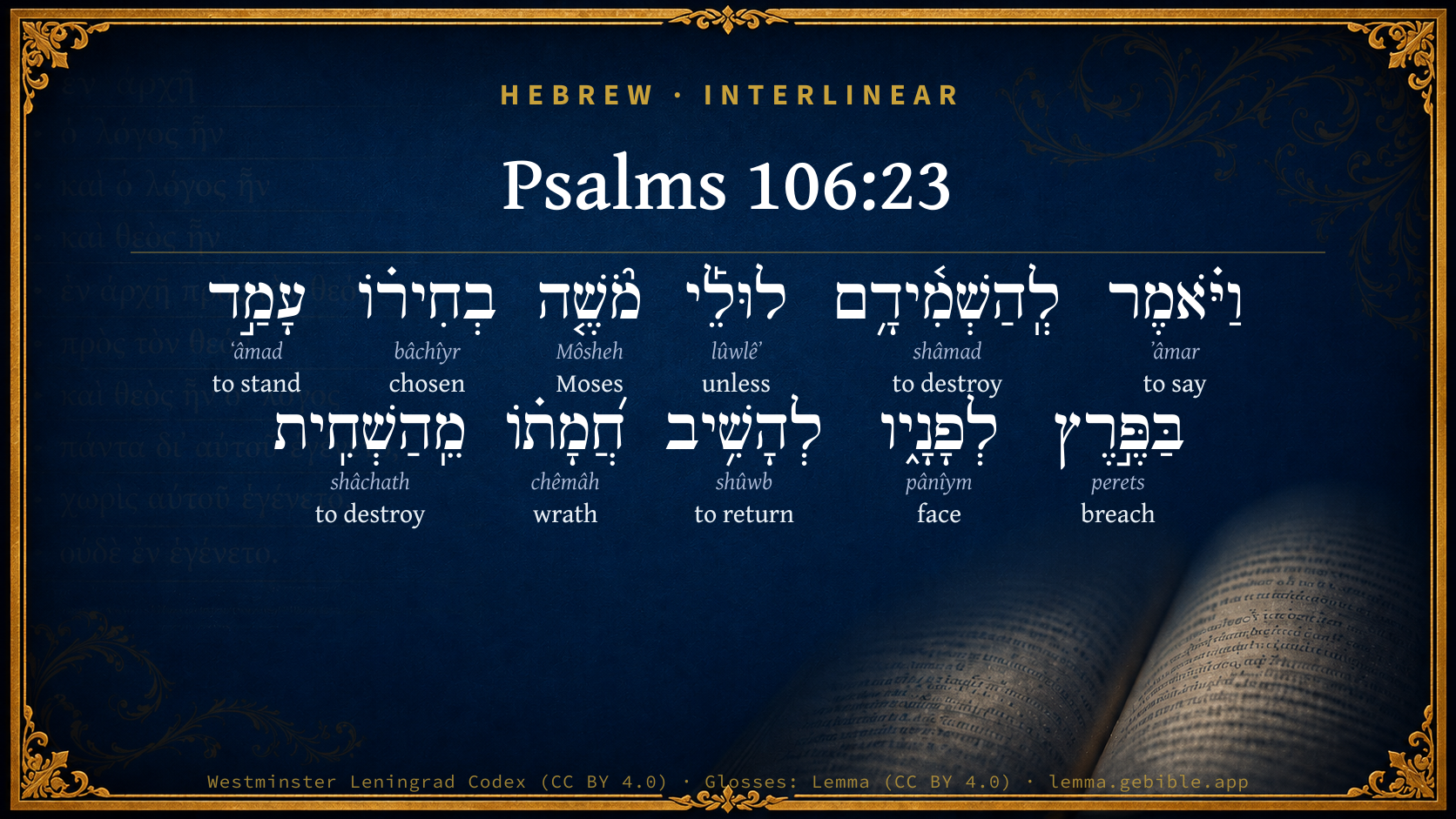
Psalms 106:23

Hebrew (Westminster Leningrad Codex) Psalms 106:23 appears in the Hebrew Old Testament. The text above is from the Westminster Leningrad Codex. Each word links to its Strong’s number, a concise gloss, and parsing drawn from the Open Scriptures Hebrew Bible morphology. Click any word for its full Brown-Driver-Briggs (BDB) entry.
Download image
Cite this verse

Psalms 106:23 (World English Bible). Public Domain. Lemma interlinear Bible study tool, https://lemma.gebible.app/v/psalms/106/23.

Show BibTeX & RIS
BibTeX
RIS
English Translation
Therefore he said that he would destroy them, Had Moses, his chosen, not stood before him in the breach, To turn away his wrath, so that he wouldn't destroy them.
World English Bible · Public Domain
Download a study sheet

One document with this verse’s original text, its word-by-word gloss line, the meaning frame, cross-references with their text, attributed commentary, and full source and license credits — printable, and it pastes into notes with its structure intact.

This verse Autodidact and up

Study sheet (.html) Plain text (.txt)

A passage Seminary Student

Up to 50 verses in one chapter. A passage sheet keeps up to 6 commentary sources and 12 cross-references per verse, in the order this page ranks them, and says so on the sheet whenever that leaves anything out. Ask for a single verse and you get the Autodidact verse sheet above.

Everything on this page stays free to read, with no account — the sheet is a download of what is already on screen, not access to it.

Want to remove ads? Support Godless Engineer
Compare translations 3

The same verse in 3 English versions, stacked beneath the original-language interlinear above. Click any original word for its lexicon entry.

Each is an independent rendering of the whole verse — the interlinear is not word-aligned to these translations.

Highlighted words mark where these versions differ — a whole-verse word diff, not a word-by-word alignment.

  • World English Bible Public Domain
    Therefore he said that he would destroy them, Had Moses, his chosen, not stood before him in the breach, To turn away his wrath, so that he wouldn't destroy them.
  • King James Version Public Domain
    Therefore he said that he would destroy them, had not Moses his chosen stood before him in the breach, to turn away his wrath, lest he should destroy them.
  • unfoldingWord Literal Text CC BY-SA 4.0
    So he said to annihilate them— had not Moses, his chosen one, stood in the breach to his face, to turn away his heat from destroying.

unfoldingWord Literal Text — © unfoldingWord, licensed CC BY-SA 4.0. Word-aligned USFM3 via Door43 (git.door43.org/unfoldingWord/en_ult).

Versions to compare (up to 4)

3 of 4 selected

Show all 18 translations

Every available English version of this verse, each an independent rendering of the whole verse.

  • World English Bible Public Domain
    Therefore he said that he would destroy them, Had Moses, his chosen, not stood before him in the breach, To turn away his wrath, so that he wouldn't destroy them.
  • Berean Standard Bible Public Domain
    So He said He would destroy them—had not Moses His chosen one stood before Him in the breach to divert His wrath from destroying them.
  • Majority Standard Bible Public Domain
    So He said He would destroy them—had not Moses His chosen one stood before Him in the breach to divert His wrath from destroying them.
  • King James Version Public Domain
    Therefore he said that he would destroy them, had not Moses his chosen stood before him in the breach, to turn away his wrath, lest he should destroy them.
  • American Standard Version (1901) Public Domain
    Therefore he said that he would destroy them, Had not Moses his chosen stood before him in the breach, To turn away his wrath, lest he should destroy `them'.
  • Revised Version (1885) Public Domain
    Therefore he said that he would destroy them, had not Moses his chosen stood before him in the breach, to turn away his wrath, lest he should destroy them.
  • Geneva Bible (1599) Public Domain
    Therefore he minded to destroy them, had not Moses his chosen stand in the breach before him to turne away his wrath, least he shoulde destroy them.
  • Douay-Rheims (1899) Public Domain
    And he said that he would destroy them: had not Moses his chosen stood before him in the breach: To turn away his wrath, lest he should destroy them.
  • Young's Literal Translation Public Domain
    And He saith to destroy them, Unless Moses, His chosen one, Had stood in the breach before Him, To turn back His wrath from destroying.
  • Literal Standard Version CC BY-SA 4.0
    And He commands to destroy them, || Unless Moses, His chosen one, || Had stood in the breach before Him, || To turn back His wrath from destroying.
  • Unlocked Literal Bible CC BY-SA 4.0
    So he said he would destroy them— had not Moses, his chosen one, stood in the breach before him, to turn away his anger from destroying them.
  • unfoldingWord Literal Text CC BY-SA 4.0
    So he said to annihilate them— had not Moses, his chosen one, stood in the breach to his face, to turn away his heat from destroying.
  • Darby Bible Public Domain
    And he said that he would destroy them, had not Moses, his chosen, stood before him in the breach, to turn away his fury, lest he should destroy [them].
  • World Messianic Bible Public Domain
    Therefore he said that he would destroy them, had Moses, his chosen, not stood before him in the breach, to turn away his wrath, so that he wouldn’t destroy them.
  • Webster's Bible Public Domain
    Therefore he said that he would destroy them, had not Moses his chosen stood before him in the breach, to turn away his wrath, lest he should destroy them.
  • Free Bible Version CC BY-SA 4.0
    So he said he was going to destroy them. But Moses, his chosen leader, placed himself between the Lord and the people to persuade the Lord not to destroy them in his anger.
  • Bible in Basic English Public Domain
    And he was purposing to put an end to them if Moses, his special servant, had not gone up before him, between him and his people, turning back his wrath, to keep them from destruction.
  • JPS Tanakh (1917) Public Domain
    Therefore He said that He would destroy them, had not Moses His chosen stood before Him in the breach, to turn back His wrath, lest He should destroy them.

Literal Standard Version (2020), Covenant Press — licensed CC BY-SA 4.0. Text via the HelloAO Bible API (eBible.org). Unlocked Literal Bible (unfoldingWord) — licensed CC BY-SA 4.0. Text via the HelloAO Bible API (eBible.org). unfoldingWord Literal Text — © unfoldingWord, licensed CC BY-SA 4.0. Word-aligned USFM3 via Door43 (git.door43.org/unfoldingWord/en_ult). Free Bible Version, Dr. Jonathan Gallagher — licensed CC BY-SA 4.0. Text via the HelloAO Bible API (eBible.org).

Word by word

More ways to search: Search by grammar → Find every occurrence → Compare this word →

Practice this passage: Drill this verse → Learn its vocabulary →

בְחִיר֗וֹ
bâchîyr
H972
“chosen · his”
Adjective, Adjective, Masculine, Singular, Construct + Suffix, Personal, 3rd Person, Masculine, Singular
Part of Speech
Adjective
Type
Adjective
Gender
Masculine
Number
Singular
State
Construct
Full BDB Definition

Origin: from H977

TWOT: 231c

chosen, choice one, chosen one, elect (of God)
  1. וַיֹּ֗אמֶר ʼâmar H559 “and · to say” Conjunction + Verb, Qal, Sequential Imperfect, 3rd Person, Masculine, Singular
  2. לְֽהַשְׁמִ֫ידָ֥ם shâmad H8045 “to destroy · them” Preposition + Verb, Hiphil, Infinitive Construct + Suffix, Personal, 3rd Person, Masculine, Plural
  3. לוּלֵ֡י lûwlêʼ H3884 “unless” Conjunction
  4. מֹ֘שֶׁ֤ה Môsheh H4872 “Moses” Noun, Proper
  5. עָמַ֣ד ʻâmad H5975 “to stand” Verb, Qal, Perfect, 3rd Person, Masculine, Singular
  6. בַּפֶּ֣רֶץ perets H6556 “in/at the · breach” Preposition, Determined + Noun, Common, Masculine, Singular, Absolute
  7. לְפָנָ֑יו pânîym H6440 “to/for · face(s) · his” Preposition + Noun, Common, Both, Plural, Construct + Suffix, Personal, 3rd Person, Masculine, Singular
  8. לְהָשִׁ֥יב shûwb H7725 “to return” Preposition + Verb, Hiphil, Infinitive Construct
  9. חֲ֝מָת֗וֹ chêmâh H2534 “wrath · his” Noun, Common, Feminine, Singular, Construct + Suffix, Personal, 3rd Person, Masculine, Singular
  10. מֵֽהַשְׁחִֽית shâchath H7843 “from · to destroy” Preposition + Verb, Hiphil, Infinitive Construct

About this verse

These counts appear in no published source. They are computed here, from the morphology-tagged text and Lemma’s own curated glosses. What Lemma adds →

11
words
11
distinct lemmas
Wisdom
section

Notable vocabulary

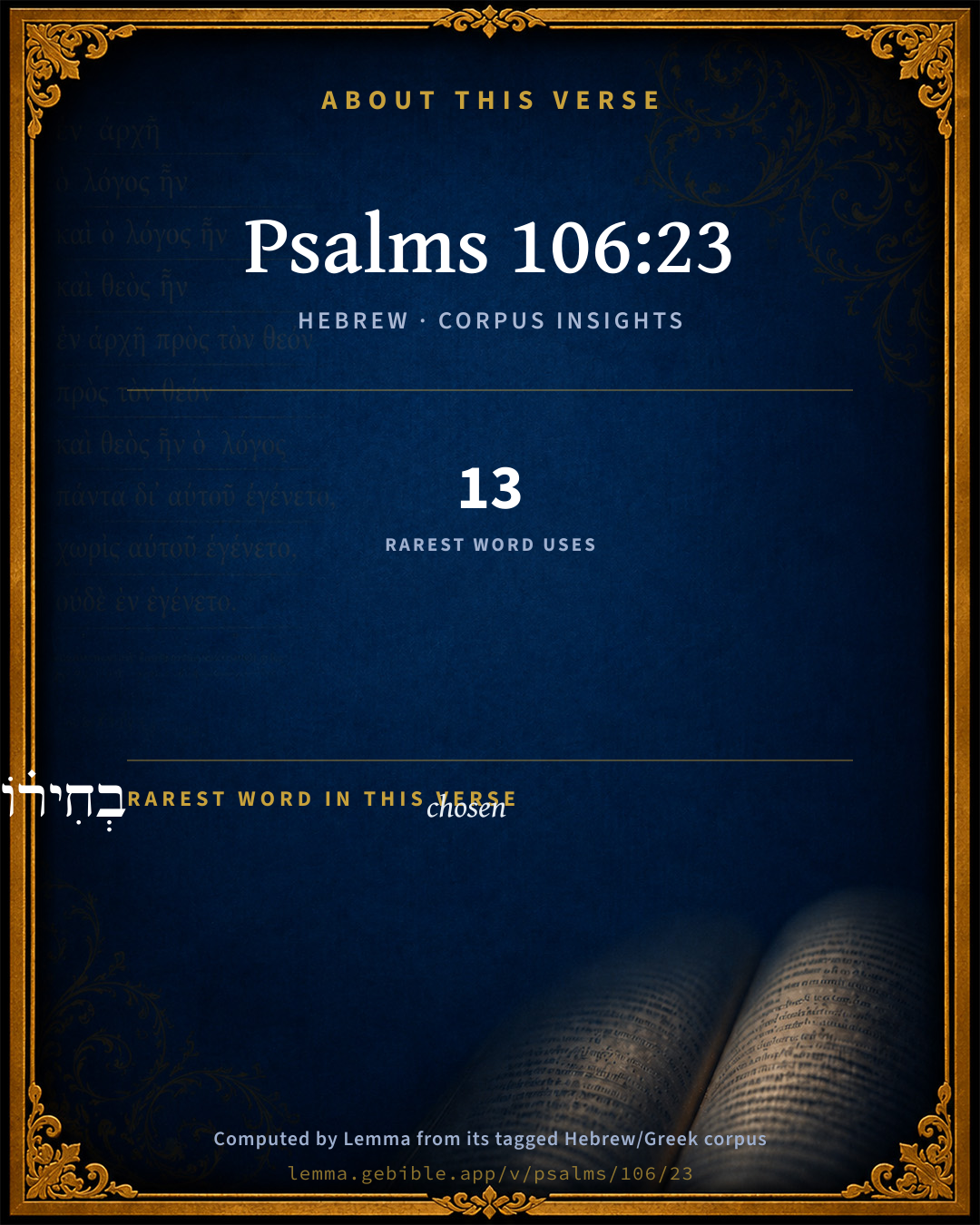
The rarest word here is בְחִיר֗וֹ chosen H972 — appearing just 13 times in the whole Hebrew Bible.

Shared distinctive vocabulary

בְחִיר֗וֹ chosen H972 occurs in 13 verses of the Hebrew Bible. Also found in:

Grammatical profile

  • 5 verbs
  • 4 nouns
  • 1 adjective
  • 1 conjunction

Verb forms

  • וַיֹּ֗אמֶר Qal · Sequential Imperfect
  • לְֽהַשְׁמִ֫ידָ֥ם Hiphil · Infinitive Construct
  • עָמַ֣ד Qal · Perfect
  • לְהָשִׁ֥יב Hiphil · Infinitive Construct
  • מֵֽהַשְׁחִֽית Hiphil · Infinitive Construct

Hebrew & Septuagint length

In English translation the verse runs 30 words from the Hebrew and 37 from the Septuagint (LXX English) — closely comparable.

A rough comparison of the two English renderings, which tokenize alike — not a word-level alignment.

Word counts can differ between the Hebrew and the Greek without any difference in meaning — e.g. the Hebrew direct-object marker אֵת has no separate Greek word, and Greek often adds the article ὁ.

Cross-references

17

Topical passages linked to Psalms 106:23 in the Treasury of Scripture Knowledge — connected by theme and wording, ordered by reader-vote popularity; previews shown in the World English Bible.

  • Deuteronomy 9:13–14 Furthermore Yahweh spoke to me, saying, I have seen this people, and, behold, it is a stiff-necked people:
  • Deuteronomy 9:25 So I fell down before Yahweh the forty days and forty nights that I fell down, because Yahweh had said he would destroy you.
  • Ezekiel 22:30 I sought for a man among them, who should build up the wall, and stand in the gap before me for the land, that I should not destroy it; but I found none.
  • James 5:16 Confess your offenses to one another, and pray one for another, that you may be healed. The effective, earnest prayer of a righteous man is powerfully effective.
  • Exodus 32:32 Yet now, if you will, forgive their sin-- and if not, please blot me out of your book which you have written."
  • Numbers 16:5 and he spoke to Korah and to all his company, saying, In the morning Yahweh will show who are his, and who is holy, and will cause him to come near to him: even him whom he shall choose will he cause to come near to him.
  • Psalms 105:6 You seed of Abraham, his servant, You children of Jacob, his chosen ones.
  • Ezekiel 13:5 You have not gone up into the gaps, neither built up the wall for the house of Israel, to stand in the battle in the day of Yahweh.
  • Ezekiel 20:8 But they rebelled against me, and would not listen to me; they did not every man cast away the abominations of their eyes, neither did they forsake the idols of Egypt. Then I said I would pour out my wrath on them, to accomplish my anger against them in the midst of the land of Egypt.
  • Matthew 12:18 "Behold, my servant whom I have chosen; My beloved in whom my soul is well pleased: I will put my Spirit on him. He will proclaim justice to the Gentiles.
  • Exodus 32:10–14 Now therefore leave me alone, that my wrath may burn hot against them, and that I may consume them; and I will make of you a great nation."
  • Deuteronomy 9:19 For I was afraid of the anger and hot displeasure, with which Yahweh was angry against you to destroy you. But Yahweh listened to me that time also.
  • Psalms 105:26 He sent Moses, his servant, And Aaron, whom he had chosen.
  • Jeremiah 5:1 Run you back and forth through the streets of Jerusalem, and see now, and know, and seek in the broad places of it, if you can find a man, if there are any who does justly, who seeks truth; and I will pardon her.
  • Deuteronomy 10:10 I stayed on the mountain, as at the first time, forty days and forty nights: and Yahweh listened to me that time also; Yahweh would not destroy you.
  • John 15:16 You didn't choose me, but I chose you, and appointed you, that you should go and bear fruit, and that your fruit should remain; that whatever you will ask of the Father in my name, he may give it to you.
  • John 15:19 If you were of the world, the world would love its own. But because you are not of the world, since I chose you out of the world, therefore the world hates you.

Cross-references courtesy of OpenBible.info (CC BY 4.0).

Hebrew and Greek witnesses Masoretic Hebrew ↔ Greek Septuagint

The same verse in the two great witnesses to the Old Testament, shown verse-for-verse.

You’re reading Greek Psalm 105 (Hebrew Psalm 106). The Septuagint counts the superscription, so verse numbers can differ from the Hebrew — chapter-level alignment, not verse-by-verse. Numbering follows Rahlfs.

These are two independent witnesses, not word-aligned to each other, and the Septuagint is shown in lemma (dictionary) form.

Hebrew Psalms 106:23 Masoretic · Westminster Leningrad Codex

וַיֹּ֗אמֶר לְֽהַשְׁמִ֫ידָ֥ם לוּלֵ֡י מֹ֘שֶׁ֤ה בְחִיר֗וֹ עָמַ֣ד בַּפֶּ֣רֶץ לְפָנָ֑יו לְהָשִׁ֥יב חֲ֝מָת֗וֹ מֵֽהַשְׁחִֽית

Therefore he said that he would destroy them, Had Moses, his chosen, not stood before him in the breach, To turn away his wrath, so that he wouldn't destroy them.

World English Bible · Public Domain

Greek LXX Greek Psalm 105:23 Septuagint · lemma form

καί εἶπον ὁ ἐκὀλεθρεύω αὐτός εἰ μή μωυσῆς ὁ ἐκλεκτός αὐτός ἵστημι ἐν ὁ θραῦσις ἐνώπιον αὐτός ὁ ἀποστρέφω ὁ ὀργή αὐτός ὁ μή ἐκὀλεθρεύω

So he said that he would have destroyed them, had not Moses his chosen stood before him in the breach, to turn him away from the fierceness of his anger, so that he should not destroy them.

LXX2012 (modern English Septuagint) · Public Domain

On this verse, Adam Clarke's Commentary discusses the Septuagint’s reading. Read the note in Commentary ↓

Hebrew: Westminster Leningrad Codex (CC BY 4.0). Greek: Septuagint (public domain); English from LXX2012 (modern English Septuagint) (Public Domain). How the Septuagint differs from the Hebrew →

Commentary

Notes on Psalms 106:23 from classic Christian and Jewish commentators (each source and its license shown beneath its notes). The classic Christian expositions comment on the surrounding passage and are grouped to its opening verse, so a note may address several verses; the Jewish commentaries on the Tanakh (Rashi and others) are per-verse, so they appear only where the commentator wrote on this verse.

Lemma curates 59 commentaries, every one of them public domain or Creative Commons licensed, each selected and text-cleaned for this edition rather than reprinted as found. About our sources →

Trapp's Complete Commentary

John Trapp

Psa 106:23 Therefore he said that he would destroy them, had not Moses his chosen stood before him in the breach, to turn away his wrath, lest he should destroy [them].

Ver. 23. Therefore he said that he would destroy them] Idolatry is a people desolating sin. God was once in a mind to have destroyed this people utterly, and to have left none but Moses, Exo 32:10; Exo 32:31, &c., promising him a great fortune if he would have suffered it; but he, tendering God’s glory more than his own greatness, refused it: choice and excellent spirits use to do so.

Had not Moses his chosen] "Chosen" to represent Christ in his mediatorship.

Stood up in the breach] A metaphor from military matters. When a stronghold is besieged, and a breach made, valiant soldiers use to make up that breach with their own bodies, till the enemy be beaten back. God’s wrath was even breaking in upon the people. Moses prayed instantly and constantly, even the most part of those forty days and nights he spent in the mount, Deu 9:9; Deu 9:11; Deu 9:18; Deu 9:25, and at length prevailed. See Eze 13:5; Eze 22:30.

John Trapp, A Commentary or Exposition upon All the Books of the Old and New Testament (1647–1656) — public domain. Text from a community e-Sword module.

J. A. Alexander on Psalms

Joseph Addison Alexander

23. (Psa 106:23) And he said he would destroy them—unless Moses his elect had stood in the breach before him, to turn back his wrath from destroying. The first and last verbs are different in Hebrew, but have only one exact equivalent in English. The second clause is not a part of what God said, but a historical statement of what really prevented the execution of his threatening. He said he would destroy them, and he would have done so, had not Moses, etc. Moses is called the Elect or Chosen of Jehovah, as having been selected and set apart to be God's instrument in the great work of deliverance and legislation. The plural is elsewhere applied to the whole nation as the chosen people. See above, Psa 106:5, and Psa 105:43. Stood in the breach is a military figure, drawn from the desperate defence of a besieged town or fortress. Compare Jer 15:1, Eze 13:5; Eze 22:30. The historical reference is to Exo 32:11-14, Deu 9:18-19. To turn back his wrath is to prevent its accomplishing its object. See above, on Psa 78:38, and compare Num 25:11.

Joseph Addison Alexander, The Psalms Translated and Explained (1850) — public domain. Text from a community e-Sword module.

Geneva Bible (1599)

Geneva Bible translators

If Moses by his intercession had not obtained God’s favor against their rebellions.

Geneva Bible (1599) marginal notes — public domain. Text via Bolls.life.

Adam Clarke's Commentary

Verse 23. Moses his chosen] Or elect; (Vulgate, electus ejus; Septuagint, ὁ εκλεκτος αυτου;) the person that he had appointed for this work. It would be very difficult to show that this word in any part of the Old Testament refers to the eternal state of any man, much less to the doctrine of unconditional election and reprobation.

Adam Clarke's Commentary on the Bible (1810–1826) — public domain. Text from a community e-Sword/MySword module.

John Calvin's Commentaries

23. And he said The prophet informs us, by these words, that the people had a feeling sense of their remarkable deliverance from impending destruction, by means of prayer alone, which, for a season, restrained God’s vengeance from bursting forth against them. In a very short time, however, they return to their wonted disposition of mind, a striking proof of the awful perversity of their hearts. To represent how highly God was offended, the prophet says that he had purposed to destroy the transgressors: not that God is subject to human passions, to be very angry for a little, and then immediately afterwards, on being appeased, changes his purpose; for God, in his secret counsel, had resolved upon their forgiveness, even as he actually did pardon them. But the prophet makes mention of another purpose, by which God designed to strike the people with terror, that coming to know and acknowledge the greatness of their sin, they might be humbled on account of it. This is that repentance so frequently referred to in the Scriptures. Not that God is mutable in himself; but he speaks after the manner of men, that we may be affected with a more feeling sense of his wrath: like a king who had resolved to pardon an offender, yet sisted him before his judgment-seat, the more effectually to impress him with the magnitude of the kindness done to him. God, therefore, while he keeps to himself his secret purpose, declared openly to the people that they had committed a trespass which deserved to be punished with eternal death. Next he says that Moses stood in the breach, meaning that he had made intercession with God, lest his awful vengeance might break forth among the people. There is here an allusion to the manner in which cities are stormed; for if a breach is made in the wall by any of the various engines which are employed in war, brave soldiers will instantly throw themselves into the breach to defend it. Hence Ezekiel reproaches the false prophets, who, unlike Moses, deceiving the people by their flatteries, making, as it were, a mud-wall, do not place themselves in the breach in the day of battle.

“Ye have not gone up into the gaps, neither made up the hedge for the house of Israel, to stand in the battle in the day of the Lord,” Ezekiel 13:5.

Some expositors are of opinion that the prophet refers to the separation which the people had made among themselves in violating the covenant of God, and the sacred relation in which they stood to each other; but the meaning is the same. For in that breach which gave rise to this metaphor or similitude, God, in defending his people so faithfully, was to them in place of a wall or bulwark. Having provoked him to anger anew, he was about to rush upon them for their destruction, had not Moses interposed as their intercessor.

John Calvin's Commentaries (1540-1563) — public domain. Text from the Calvin Translation Society English edition (1840s-50s) via the Christian Classics Ethereal Library (ccel.org). Calvin's coverage is partial (roughly two-thirds of the Bible); uncommented books and verses are honest gaps, never fabricated. The 19th-century editor's footnotes and remarks are omitted so the notes are faithfully Calvin's own voice.

Ellicott's Commentary for English Readers

(23) Stood before him in the breach . . .—This is generally explained after Eze_22:30, where undoubtedly it is an image taken from the defence of a besieged town. (Comp. Eze_13:5.) But it is possible that we should render, “Had not Moses stood before him (i.e., submissively; see Gen_41:46; Deu_1:38) in the breaking forth (of his anger),” since the verb from which the substantive here used comes is the one employed (Exo_19:22), “lest the Lord break forth upon them.” So the LXX. seem to have understood the passage, since they render here by the same word, which in Psa_106:30 does duty for “plague.” (Comp. Vulg., refractio.)

A Bible Commentary for English Readers, edited by Charles John Ellicott (1878–1897) — public domain. Text from a community e-Sword module.

The Cambridge Bible for Schools and Colleges

gen. ed. J. J. S. Perowne

23. Cp. Exo_32:10 ff.; Num_14:11 ff. But the language is taken from Deu_9:25-26, where the same two words for ‘destroy’ are used as here.

stood before him in the breach] A military metaphor. Moses confronted God with intercession like the warrior who stands in the breach of the city wall to repel the enemy at the risk of his life. Cp. Eze_22:30; Jer_18:20.

The Cambridge Bible for Schools and Colleges (gen. ed. J. J. S. Perowne; Cambridge University Press, 1878–1918) — public domain. Text from a community e-Sword module.

John Gill's Exposition

Therefore he said that he would destroy them,.... He said in his word, the Targum adds; he thought within himself he would; he seemed determined in his own mind to destroy them, being provoked at their wretched forgetfulness of him, and their idolatry; he said to Moses,

let me alone, that my wrath may wax hot against them, and that I may consume them, Exo 32:10. The decree indeed was not gone forth, but there was such an appearance of displeasure as if ruin was determined; and a great number was destroyed, and the whole body was threatened.

Had not Moses his chosen stood before him in the breach; made between God and the Israelites by their sin; the allusion is either to an hedge broken down, at which a spoiler enters, unless made up, Eze 22:30, or to a breach made in the wall of a besieged city, at which the besieger enters, unless stopped by the besieged, Isa 30:13, or to the bank or dam of a river broken down, which lets in a flood of waters, Sa2 5:20. So Moses made up the hedge, and stood in the gap; he presented himself to God, rushing in like a man of war, and pouring out his wrath like an inundation of waters: this is to be understood of his fervent and importunate prayer to God on the behalf of this people, and which succeeded.

To turn away his wrath, lest he should destroy them; Exo 32:11 so the Targum,

"unless Moses his chosen had rose up and strengthened, or prevailed in his prayer before him to turn away his wrath from destroying.''

This shows the power and efficacy of prayer, and of what avail it is with God, especially the prayer of his elect; it was Moses, his chosen, that prayed, a choice servant of his; and whom he had chosen to everlasting life, as well as to be the deliverer, guide, and governor of Israel; see Luk 18:7. Herein he was an eminent type of Christ, as in other things; as Moses was a mediator between God and the people of Israel, so is Christ between God and his people. Sin is a transgression of God's law, a breaking of his statutes, which he has set as an hedge, fence, or wall, about man; and this has made a breach between God and man; which lets in the wrath of God as a flood, and justice as an armed man: and terrible it is to consider there is no standing before him, and making up the breach; but Christ has interposed as a surety, made satisfaction to law and justice, and procured peace and reconciliation; and so, by his atonement and intercession, has made up the breach, appeased the wrath of God, and turned it away, and prevented the ruin and destruction of his people.

John Gill's Exposition of the Whole Bible (1746–1763) — public domain (CC PDM 1.0). Text via the HelloAO Bible API.

Albert Barnes' Notes on the Bible

Therefore he said that he would destroy them - See Exo 32:10-14. He threatened to destroy them, and he would have done it, if Moses had not interposed and pleaded for them. There was nothing strange or very unusual in this. Many a descending curse upon guilty people is turned away by prayer, and by human intervention. We are constantly endeavoring to turn aside evils which would come upon others - by our intervention - by labor or by prayer. Thus, when we toil to provide food for our children, or give it in charity to the poor, we are endeavoring to avert the evil of starvation which would otherwise come upon them; when we provide for them clothing, we turn away the evils of nakedness and cold; when we give them medicine we turn away the evil of long-continued disease or of death; when we rush through the flames if a house is on fire, or venture out in a rough sea in a boat, to save others from devouring flame or from a watery grave, we seek to turn aside evils which would otherwise come upon them. So when we pray for others we may turn away evils which would otherwise descend on the guilty. No one can estimate the number or the amount of evils which are thus turned away from the guilty and the suffering by intervention and intercession; no one can tell how many of the blessings of his own life he owes to the intercessions and the toils of others. “All the blessings that come upon sinners - “all” that is done to turn away deserved wrath from people - is owing to the fact that the one great Intercessor - greater than Moses - cast himself into the “breach,” and himself met and rolled back the woes which were coming upon a guilty world. “Had not Moses his chosen.” Chosen to lead and guide his people to the promised land.

Stood before him - Presented himself before him.

In the breach - literally, “in the breaking.” The allusion is to a breach made in a wall 1Ki 11:27; Isa 30:13; Amo 4:3; Job 30:14, and to the force with which an army rushes through a breach that is thus made. So God seemed to be about to come forth to destroy the nation.

Albert Barnes' Notes on the Bible (1834–1885) — public domain. Text from a community e-Sword/MySword module.

Matthew Poole's English Annotations

He said; he declared his intention in express words, as Exo 32:10, and elsewhere.

In the breach: God had made a hedge or wall about them; but they had made a gap or breach in it by their sins, at which the Lord, who was now justly become their enemy, might enter to destroy them; which he had certainly done, if Moses by his prevailing intercession had not hindered him. See Deu 9:12; 10:10. It is a metaphor from a besieged city, where the enemy endeavours to make a breach in the walls, and thereby to enter into the city; which he will do, unless some valiant champion stand in the gap to oppose him.

Matthew Poole's English Annotations on the Holy Bible (1683–1685) — public domain. Text from a community e-Sword/MySword module.

The Treasury of David

Charles H. Spurgeon

Ver. 23. Therefore he said that he would destroy them. The threatening of destruction came at last. For the first wilderness sin he chastened them, sending leanness into their soul; for the second he weeded out the offenders, the flame burned up the wicked; for the third he threatened to destroy them; for the fourth he lifted up his hand and almost came to blows (Ps 106:26); for the fifth he actually smote them, "and the plague brake in among them"; and so the punishment increased with their perseverance in sin. This is worth noting, and it should serve as a warning to the man who goeth on in his iniquities. God tries words before he comes to blows, "he said that he would destroy them": but his words are not to be trifled with, for he means them, and has power to make them good.

Had not Moses his chosen stood before him in the breach. Like a bold warrior who defends the wall when there is an opening for the adversary and destruction is rushing in upon the city, Moses stopped the way of avenging justice with his prayers. Moses had great power with God. He was an eminent type of our Lord, who is called, as Moses here is styled, "mine elect, in whom my soul delighteth." As the Elect Redeemer interposed between the Lord and a sinful world, so did Moses stand between the Lord and his offending people. The story as told by Moses himself is full of interest and instruction, and tends greatly to magnify the goodness of the Lord, who thus suffered himself to be turned from the fierceness of his anger.

With disinterested affection, and generous renunciation of privileges offered to himself and his family, the great Lawgiver interceded with the Lord

to turn away his wrath, lest he should destroy them. Behold the power of a righteous man's intercession. Mighty as was the sin of Israel to provoke vengeance, prayer was mightier in turning it away. How diligently ought we to plead with the Lord for this guilty world, and especially for his own backsliding people! Who would not employ an agency so powerful for an end so gracious! The Lord still harkens to the voice of a man, shall not our voices be often exercised in supplicating for a guilty people?

Ver. 23. Moses his chosen stood before him in the breach. Moses stood in the gap, and diverted the wrath of God; the hedge of religion and worship was broken down by a golden calf, and he made it up: Nu 16:41-42, the people murmured, rose up against Moses and Aaron, trod down the hedge of authority, whereupon the plague brake in upon them; presently Aaron steps That into the gap, makes up the hedge, and stops the plague, Nu 16:47-48 which they did was honourable; and they were repairers of breaches. We, through infinite mercy, have had some like Moses and Aaron, to make up our hedges, raise up our foundations, and stop some gaps; but all our gaps are not yet stopped. Are there not gaps in the hedge of doctrine? If it were not so, how came in such erroneous, blasphemous, and wild opinions amongst us? Are there not gaps in the hedges of civil and ecclesiastical authority? Do not multitudes trample upon magistracy and ministry, all powers, both human and divine? Are there not gaps in the worship of God? Do not too many tread down all churches, all ordinances, yea, the very Scriptures? Are there not gaps in the hedge of justice, through which the bulls of Bashan enter, which oppress the poor, and crush the needy? Am 4:1: Are there not gaps in the hedge of love; is not that bond of perfection broken? Are there not bitter envyings and strife amongst us; do we not bite and devour one another? Are there not gaps in the hedge of conscience? Is not the peace broken between God and your souls? Doth not Satan come in oft at the gap, and disturb you? Are there not gaps also in your several relations, whereby he gets advantage? Surely, if our eyes be in our heads, we may see gaps enough. William Greenhill.

Ver. 23. The breach. This is a metaphor taken from a city which is besieged, and in the walls of which the enemy having made a "breach" is just entering in, to destroy it, unless he be driven back by some valiant warrior. Thus Moses stood, as it were "in the breach", and averted the wrath of God, when he was just going to destroy the Israelites. See Ex 32:1-35. Thomas Fenton.

Ver. 23. If Christians could be brought to entertain a just sense of the value and power of intercessory prayer, surely it would abound. It is a terrible reproof against the lying prophets of Ezekiel's time: "Ye have not gone up into the gaps, neither made up the hedge for the house of Israel to stand in the battle in the day of the Lord" (Eze 13:5). Compare Ex 32:9-14. William S. Plumer.

Ver. 23. Moses, the intercessor, a type of our Lord. Carefully study his pleading as recorded in Ex 32:1-35.

Ver. 23.

1. Mediation required: "He said that he would destroy them", etc.

2. Mediation offered: "Moses stood before him in the breach."

3. Mediation accepted: "To turn away his wrath", etc. Ex 32:1-35. G.R.

Psalms 106:24*

Charles H. Spurgeon's The Treasury of David (1869–1885) — public domain. Psalms only. Text from a community e-Sword/MySword module.

Whedon's Commentary on the Bible

Daniel D. Whedon

23. He said… he would destroy them—The allusion is to Exo_32:11-14. In the matter of the golden calf they had completely forfeited all the promises of the covenant.

Had not Moses his chosen stood before him— “God puts the fate of the nation into the hand of Moses, that he may remember his mediatorial office, (Deu_5:5; Gal_3:19,) and show himself worthy of his calling.” The proposal to destroy the people and make of Moses a great nation, “constituted a great test for Moses, whether he would be willing to give up his own people as the price of his own exaltation. And he stood the test.”—Keil and Delitzsch.

Daniel D. Whedon (gen. ed.), Commentary on the Old and New Testaments (1874–1909) — public domain. Text from a community e-Sword module.

The Pulpit Commentary

Therefore he said that he would destroy them; literally, and he said. On the apostasy at Sinai, God expressed to Moses an intention to destroy the entire people of Israel, save only himself, and to "make of him a great nation". (Exo_32:10; comp. Deu_9:14, Deu_9:25) Had not Moses his chosen steed before him in the breach. Moses was "chosen" by God to lead the Israelites out of Egypt, (Exo_3:10) and forced to accept the office. (Exo_4:1-17) When Israel angered God at Sinai, he stood in the gap," like a brave soldier guarding his city when the enemy has breached the wall. (Exo_32:11-13, Exo_32:31-34) To turn away his wrath, lest he should destroy them. God was ready to have destroyed all Israel, and to have raised up a new Israel out of the descendants of Moses, had not Moses pleaded with extreme earnestness on the people"s behalf. (Exo_32:32)

Moses as mediator.

"Had not Moses his chosen stood before him in the breach, to turn away his wrath, lest he should destroy them." "The intercession of Moses is compared to the act of a brave leader, covering with his body the breach made in the walls of his fortress." See the figure as given in Eze_22:30. The account of Moses" intercession is found in Exo_32:10-14. The point on which we dwell is the fitness of Moses to be the mediator on this occasion.

I THE FITNESS ARISING FROM HIS OFFICIAL POSITION. He was the agent appointed by God, through whom his will might be sent to the people. He was the representative of the people, appointed by them to conduct all negotiations with Jehovah in their name. He was the proper person; and foreshadows the Lord Jesus Christ as revealer of God to men, and negotiator for men with God.

II THE FITNESS ARISING FROM THE CONFIDENCES MOSES HAD WON. He had gained both power and right by his faithful service of the people, and by his holy familiarity with God. We may say that God had proved him, and so had confidence in him. And the people had proved him, and knew well that they had no better friend. Christ is "beloved Son," and our best Friend.

III THE FITNESS ARISING FROM THE PERSONAL FEELING OF Moses. He was supremely indignant at the sin of the people; so much so as to have lost his self-control, and flung down the tables. That right feeling towards the sin fitted him to mediate. He made no excuse; he could but plead for pardon. A man with no adequate sense of the iniquity could not have been acceptable as a mediator. But Moses was also supremely pitiful towards the erring people, and this gave him the fitting tenderness in pleading for their forgiveness. So in Christ we find deepest impressions of the evil of sin, uniting with supreme love for the sinners.

IV THE FITNESS ARISING FROM THE VIGOUR OF MOSES" RULE. God knew that Moses could punish; and if the more serious judgment on the sin was removed, still there must be such punishment as would adequately impress the evil of the sin. Moses was a fitting mediator, because God was assured that he would not neglect this educative and disciplinary judgment. God, if we may so speak, graciously yielded to Moses" persuasions, because he knew that his honour was safe in Moses" hands. So Christ in his mediation "magnifies the Law, and makes it honourable. R.T.

The Pulpit Commentary (1880–1919), ed. H.D.M. Spence-Jones & Joseph S. Exell — public domain. Text from a community e-Sword module.

John Wesley's Explanatory Notes

Breach - God had made a wall about them; but they had made a breach in it by their sins, at which the Lord, who was now justly become their enemy, might enter to destroy them; which he had certainly done, if Moses by his prevailing intercession had not hindered him.

John Wesley, Explanatory Notes Upon the Whole Bible (1754–1765) — public domain. Text via the GEBible commentary corpus.

Lesson kit

Teaching starters — assembled from the data on this page, not authored interpretation. Every prompt links to the verse data it draws on. Edit before teaching.

Psalms, in the Wisdom, opens this verse with 11 words (11 distinct Hebrew lemmas). Its most distinctive word is bâchîyr (“chosen”). A historical commentator’s framing appears above. Read the whole chapter for the surrounding context.

Discussion questions

  1. How does “chosen” (bâchîyr) shape what this verse is saying?
  2. 2 Samuel 21:6 shares the word «chosen» with this verse. How do the two illuminate each other?
  3. These translations render this verse differently; the difference is in the English rendering, not the original. What questions does that raise?
  4. The verb «וַיֹּ֗אמֶר» is Qal Sequential Imperfect. How does its form color the action?
  5. Reading how Trapp's Complete Commentary and J. A. Alexander on Psalms read this verse, where do the two commentators agree and where do they part?

Things to notice

Reading settings

Reading text

Shown beneath each verse's original-language words.

Old Testament
Old Testament edition

Read the OT as the Masoretic Hebrew (MT) or the Greek Septuagint (LXX).

English shown for the Greek Septuagint (in the Hebrew ↔ Greek comparison).

Comparing translations? Open the Compare panel on any verse page to stack up to four side by side.