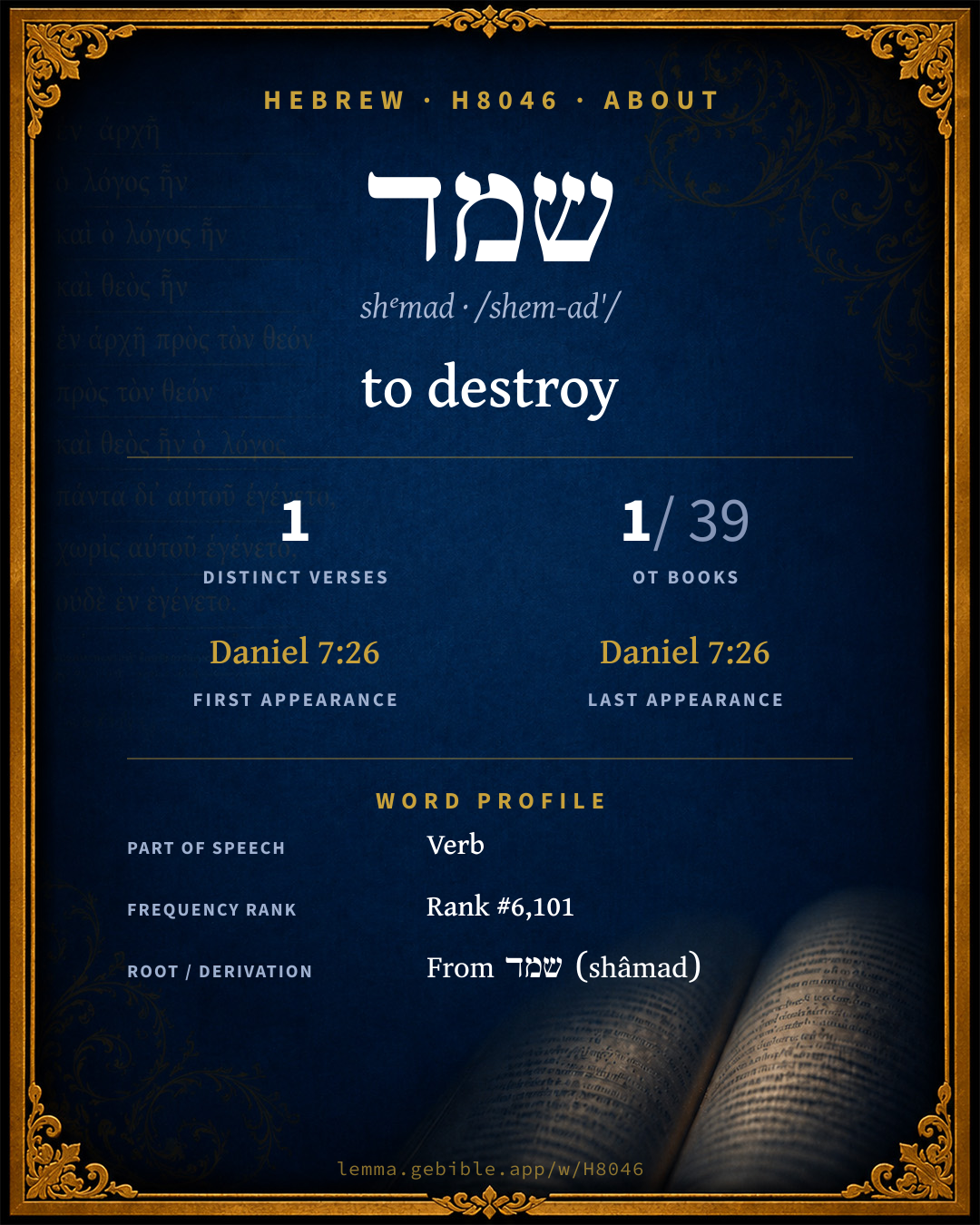
שְׁמַד
to destroy
Full lexicon entry — Brown-Driver-Briggs (BDB)
From Brown-Driver-Briggs (BDB)
Where this word appears
Grammar key — what these labels mean
Stem
- Hiphil
- The causative active stem (“he caused / brought about”).
Form
- Infinitive Construct
- A bound verbal noun, frequently with prepositions (“to write / in writing”).
Every verse where H8046 appears — 1 distinct verse across 1 book. Click any verse to open its interlinear word-by-word view. Verse text shown in the World English Bible for context — . Each verse’s Hebrew form is shown with its reference; the English is not keyword-highlighted, since the data carries no word-level English alignment. Use “Compare translations” on any verse to read it across multiple English versions. This concordance covers the Hebrew Bible; Septuagint (Greek Old Testament) occurrences are not indexed here.
Daniel 1 verse
About this entry
At a glance — auto-summarized from this page’s data, not written by a person. Every figure links to its source below. This summary describes the numbers; it doesn’t interpret them.
The Hebrew verb שמד centers on the idea of “to destroy.” It is rare — just 1 verse in the entire Hebrew Bible. The word gravitates to Daniel (100%). A true hapax — its single appearance is Daniel 7:26. For the data behind this summary, explore the sense tree and the renderings breakdown below.
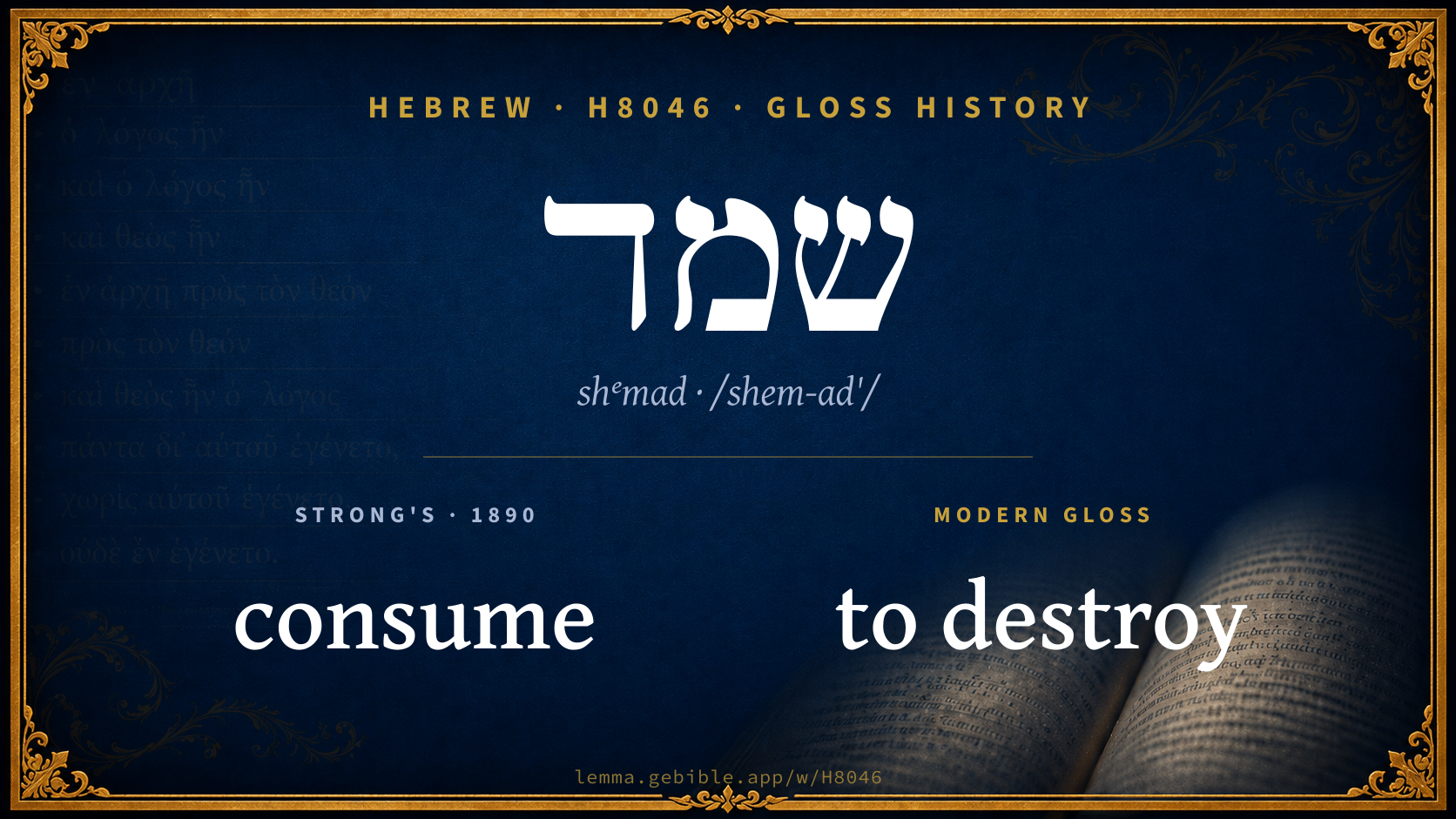
Gloss history
Strong's 1890 vs modern scholarship
About this word
Strong's H8046 catalogs a Hebrew word from the Hebrew Old Testament.
These counts are not copied from any lexicon or concordance. They are computed here, from the morphology-tagged Hebrew Old Testament. What Lemma adds →
- 1
- distinct verses
- The word appears in 1 distinct verse.
- 1 / 39
- OT books
- The word appears in 1 of 39 Old Testament books.
- #6,101
- by frequency
- Rank #6,101 (rank 6,101 of 8,640 Hebrew words by occurrence).
View all 1 occurrence in the concordance →
Most concentrated in
- Daniel 1 verse 100%
By section of the Old Testament
By traditional corpus
Conventional, traditional groupings — biblical authorship is debated, so this is a traditional corpus grouping, not an authorship claim. Each share is this word’s portion of its verses in that division of the Hebrew canon. Each figure is a share of the word’s 1 distinct verse.
- Writings (Ketuvim) 1 verse · 100%
How translations render this word
Counts come from each version’s own published word-to-Strong’s tagging or interlinear alignment — an approximate guide to how each version renders this word, not a word-level alignment the data otherwise carries. Because each total is that version’s own tagged count, the per-version totals vary from one another and need not match the appearance or distinct-verse counts above. These counts may also differ from a printed concordance because Lemma counts each distinctly tagged rendering and does not collapse phrase taggings into a single head-word total. This is a fixed set of word-tagged versions (KJV, ASV, BSB, ULT) and does not change with the reading translation you choose elsewhere. Each version’s license is shown beside its name below (and on Sources).
- King James Version: Consume 1×
- American Standard Version: Consume 1×
- Berean Standard Bible: Completely destroyed 1×
- unfoldingWord Literal Text: Be consumed 1×
King James Version Public Domain
Renders H8046 across 1 tagged occurrence — most commonly:
American Standard Version Public Domain
Renders H8046 across 1 tagged occurrence — most commonly:
Berean Standard Bible Public Domain
Renders H8046 across 1 tagged occurrence — most commonly:
unfoldingWord Literal Text CC BY-SA 4.0
Renders H8046 across 1 tagged occurrence — most commonly:
Senses in BDB
The 1 sense BDB distinguishes for this word, in lexicon order (not ranked by frequency or importance). The full entry — with sub-senses — is in the Lexicon Entry tab.
- (Aphel) to destroy
Word origin
[ שְׁמַד ] vb. Haph. destroy;— Dn 7:26
— Brown-Driver-Briggs (Oxford 1906, public domain), digitized via Sefaria, supplemented by the OpenScriptures HebrewLexicon (CC BY 4.0). See Sources.
Derived from שמד (shâmad) (H8045) — to destroy.
Jastrow Dictionary
A second Hebrew/Aramaic lexicon for comparison, covering Aramaic and post-biblical (Talmudic, Targumic, Midrashic) usage that the biblical-Hebrew BDB does not. Matched by lemma rather than by Strong’s number, so a lemma may carry more than one Jastrow headword (shown separately below), and the entries cover usage well beyond the Bible.
שָׁמַד
- Hif.; cmp. שמם, to be waste.
- [to destroy,] to persecute; to force to apostasy. Gen. R. s. 82 ואם לאו הרי אני מְשַׁמֵּד אתכם and if you cannot answer, I will force you to forswear your religion; Yalk. Is. 263 אַשְׁמִיד (Hif.).—Part. pass. מְשׁוּמָּד converted to heathenism, q. v.
- 1. to destroy. Esth. R. to III, 6 אני אמרתי להַשְׁמִידָם … להַשְׁמִיד וכ׳ I (the Lord) intended to destroy them, and, as it were, could not …, and thou wilt destroy, slay &c.? Ib. to III, 12; a. e.
- 2. to force to apostasy, v. supra.
- 1. to be destroyed, cut off. Yalk. Lev. 558 דואג נ׳ מעולם וכ׳ Doeg was cut off from this and from the other world; (Tanḥ. M’tsorʿa 2 נשתרש).
- 2. to apostatize. Y. Gitt. VII, beg. 48ᶜ. Y. Hor. I, 45ᵈ bot. Y. Succ. V, end, 55ᶜ מרים … שׁנִשְׁתַּמְּדָה וכ׳ Miriam … who renounced her religion, and married a Roman officer; Tosef. Succ. IV, 28ᵈ; Bab. Succ. 56ᵇ Ms. M. (ed. שהמירה דתה).
שְׁמַד
- to force to apostasy. Y. Shebi. IV, 35ᵃ bot. לא מתכוון מְשַמַּדְתְּכוֹן he has no intention to make you abandon your religion (to persecute you for your religion’s sake), but only to collect taxes &c.; Y. Snh. III, 21ᵇ top משמדתהון (corr. acc.). Ib. לא אתכוון מְשַׁמַּדְתְּהוֹן וכ׳ he had no intention to force them to violate their religious laws, but merely wanted to eat fresh bread; Y. Shebi. l. c. מְשַׁמַּדְתּוֹן.
- to renounce one’s religion, apostatize. Targ. O. Ex. XII, 43 (h. text בן נכר).—Kidd. 72ᵃ שמתינהו … ואִישְׁתַּמּוּד R. A. excommunicated them, and they renounced Judaism.
שְׁמָד
- (preced.) [attempt at destruction,] religious persecution. Tosef. Ab. Zar. V (VI), 6 בי מוסייאות … שעת הש׳ אע"פ שעבר הש׳ וכ׳ altars which gentiles have put up at a time of religious persecution are forbidden (as to the use of the materials) even after the persecution is over; Y. ib. V, 45ᵃ top; Bab. ib. 54ᵃ Ms. M. (ed. בשעת הגזירה). Tosef. Sabb. XV (XVI), 17 במה דברים אמורים שלא בשעת הש׳ אבל בשעת הש׳ וכ׳ this (that one may violate religious laws to save his life) is said only when there is no general religious persecution, but during a persecution one must give up his life even for the least essential law; Snh. 74ᵃ Ms. M. (ed. גזירת המלכות). Cant. R. to II, 5 שלפי הש׳, v. שֶׁלֶף; Sabb. 60ᵃ Ms. M. (ed. הגזרה); a. fr.—Pl. שְׁמָדִים, שְׁמָדִין. Gen. R. s. 67 (ref. to Gen. XXVII, 40) אם ראית … גזור עליו ש׳ וכ׳ when thou (Esau-Rome) seest thy brother (Jacob) cast off the yoke of the Law, decree persecutions over him, and thou shalt have power over him. Midr. Till. to Ps. XVIII, 5 שכמה ש׳ גזרו עלינו בימיה for they decreed many persecutions over us in her (Rome’s) days; a. e. e.g. Genesis 27:40
A Dictionary of the Targumim, the Talmud Babli and Yerushalmi, and the Midrashic Literature (Marcus Jastrow; London, Luzac, 1903) — Public Domain. Digitized via Sefaria. Digitized via Sefaria. Full attribution on Sources.
Septuagint verse parallels
This word appears in 1 verse that also exists in the Greek Old Testament (Septuagint), out of the 1 Hebrew verse it occurs in. You can read those verses in Greek by switching the Old Testament edition to the Septuagint.
Read these verses in the Septuagint
This is a verse-level parallel only — the same verses exist in both the Hebrew and Greek Old Testaments. No word-level Hebrew↔Greek correspondence is claimed: the data carries no such alignment, so no Greek word is shown as this Hebrew word’s translation. Coverage is not total — the Septuagint omits the deuterocanon and renumbers the Psalms, so some Hebrew verses have no direct Greek parallel.