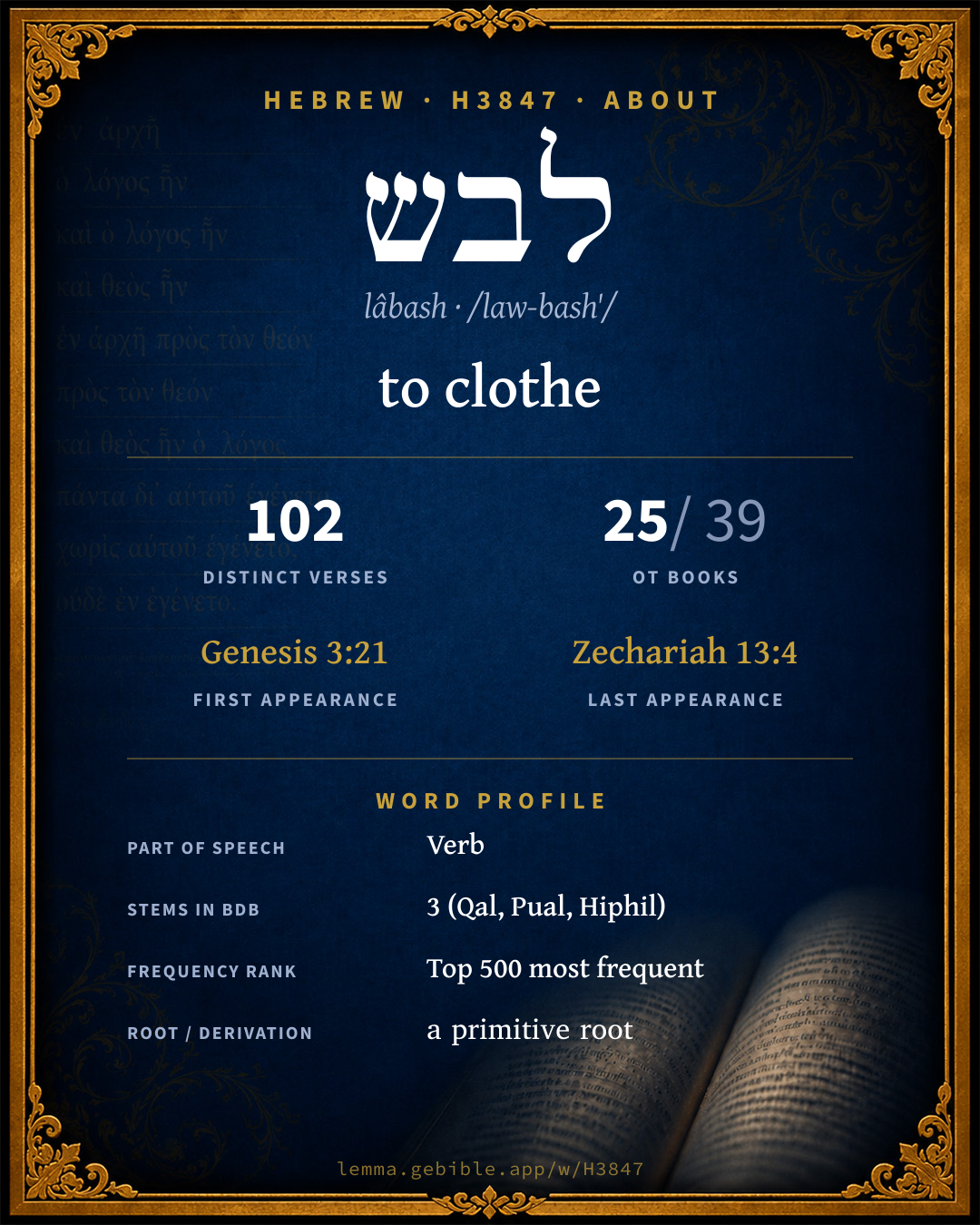
לָבֵשׁ
to clothe
‘to clothe’ is one of 3 main senses fuller range ↓
Full lexicon entry — Brown-Driver-Briggs (BDB)
From Brown-Driver-Briggs (BDB)
Where this word appears
See every Qal verb in the Hebrew Bible →
Grammar key — what these labels mean
Part of speech
- Verb
- An action or state-of-being word.
- Adjective
- A word that describes or qualifies a noun.
Stem
- Qal
- The basic, simple active stem — the plain form of the verb (“he wrote”). Here: ‘lit. put on’
- Hiphil
- The causative active stem (“he caused / brought about”). Here: ‘c. 2 acc.’
- Pual
- The passive counterpart of the Piel. Here: ‘only Pt. pl.’
Form
- Imperfect
- An incomplete, ongoing, or future action (“he will / would write”).
- Sequential Imperfect
- An imperfect with prefixed waw — the standard past-narrative form (waw-consecutive imperfect).
- Participle Passive
- A verbal adjective expressing action received (“written”).
- Perfect
- A completed action or state — Hebrew marks aspect (completeness) more than strict tense (“he wrote”).
- Sequential Perfect
- A perfect with prefixed waw continuing a preceding imperfect or command (waw-consecutive perfect).
- Imperative
- A direct command (“write!”).
- Infinitive Construct
- A bound verbal noun, frequently with prepositions (“to write / in writing”).
- Infinitive Absolute
- An unbound verbal noun, often intensifying or standing in for a finite verb.
- Participle Active
- A verbal adjective expressing ongoing or characteristic action (“writing / one who writes”).
- Jussive
- A third- or second-person volitional form expressing wish or command (“let him write”).
State
- Absolute
- The independent form of a noun, not bound to a following word.
- Construct
- A noun bound to a following noun in a possessive / “of” relationship (the construct chain).
Person
- 3rd Person
- The one spoken about (“he / she / it / they”).
- 2nd Person
- The one addressed (“you”).
- 1st Person
- The speaker (“I / we”).
Gender
- Masculine
- Grammatically masculine.
- Common
- Either gender — not distinguished for this form.
- Feminine
- Grammatically feminine.
Number
- Plural
- More than one (in Hebrew, generally three or more).
- Singular
- One.
65 distinct verses where H3847 appears in the Qal stem, across 23 books. Filtered view — show all forms. Click any verse to open its interlinear word-by-word view. Verse text shown in the World English Bible for context — . Each verse’s Hebrew form is shown with its reference; the English is not keyword-highlighted, since the data carries no word-level English alignment. Use “Compare translations” on any verse to read it across multiple English versions. This concordance covers the Hebrew Bible; Septuagint (Greek Old Testament) occurrences are not indexed here.
Genesis 2 verses
- Genesis 28:20 לִ/לְבֹּֽשׁ prep + Qal inf.cs Jacob vowed a vow, saying, "If God will be with me, and will keep me in this way that I go, and will give me bread to eat, and clothing to put on,
- Genesis 38:19 וַ/תִּלְבַּ֖שׁ conj + Qal wimpf 3fs She arose, and went away, and put off her veil from her, and put on the garments of her widowhood.
Exodus 1 verse
Leviticus 7 verses
- Leviticus 6:10 וְ/לָבַ֨שׁ יִלְבַּ֣שׁ conj + Qal wpf 3ms Qal impf 3ms The priest shall put on his linen garment, and he shall put on his linen breeches upon his body; and he shall remove the ashes from where the fire has consumed the burnt offering on the altar, and he shall put them beside the altar.
- Leviticus 6:11 וְ/לָבַ֖שׁ conj + Qal wpf 3ms He shall take off his garments, and put on other garments, and carry the ashes outside the camp to a clean place.
- Leviticus 16:4 יִלְבָּ֗שׁ וּ/לְבֵשָֽׁ/ם Qal impf 3ms conj + Qal wpf 3ms + sfx pers 3mp He shall put on the holy linen coat, and he shall have the linen breeches on his body, and shall put on the linen sash, and he shall be dressed with the linen turban. They are the holy garments. He shall bathe his body in water, and put them on.
- Leviticus 16:23 לָבַ֖שׁ Qal pf 3ms "Aaron shall come into the Tent of Meeting, and shall take off the linen garments, which he put on when he went into the Holy Place, and shall leave them there.
- Leviticus 16:24 וְ/לָבַ֖שׁ conj + Qal wpf 3ms Then he shall bathe himself in water in a holy place, and put on his garments, and come out and offer his burnt offering and the burnt offering of the people, and make atonement for himself and for the people.
- Leviticus 16:32 וְ/לָבַ֛שׁ conj + Qal wpf 3ms The priest, who is anointed and who is consecrated to be priest in his father's place, shall make the atonement, and shall put on the linen garments, even the holy garments.
- Leviticus 21:10 לִ/לְבֹּ֖שׁ prep + Qal inf.cs "'He who is the high priest among his brothers, upon whose head the anointing oil is poured, and that is consecrated to put on the garments, shall not let the hair of his head hang loose, nor tear his clothes;
Deuteronomy 2 verses
Judges 1 verse
1 Samuel 2 verses
- 1 Samuel 17:5 לָב֑וּשׁ Qal ptcp.pass ms He had a helmet of brass on his head, and he was clad with a coat of mail; and the weight of the coat was five thousand shekels of brass.
- 1 Samuel 28:8 וַ/יִּלְבַּשׁ֙ conj + Qal wimpf 3ms Saul disguised himself, and put on other clothing, and went, he and two men with him, and they came to the woman by night: and he said, Please divine to me by the familiar spirit, and bring me up whoever I shall name to you.
2 Samuel 2 verses
- 2 Samuel 13:18 תִּלְבַּ֧שְׁןָ Qal impf 3fp She had a garment of various colors on her; for with such robes were the king's daughters who were virgins dressed. Then his servant brought her out, and bolted the door after her.
- 2 Samuel 14:2 וְ/לִבְשִׁי conj + Qal impv 2fs Joab sent to Tekoa, and fetched there a wise woman, and said to her, please act like a mourner, and put on mourning clothing, Please, and don't anoint yourself with oil, but be as a woman who has a long time mourned for the dead:
1 Kings 1 verse
1 Chronicles 1 verse
2 Chronicles 3 verses
- 2 Chronicles 6:41 יִלְבְּשׁ֣וּ Qal impf 3mp Now therefore arise, Yahweh God, into your resting-place, you, and the ark of your strength: let your priests, Yahweh God, be clothed with salvation, and let your saints rejoice in goodness.
- 2 Chronicles 18:29 לְבַ֣שׁ Qal impv 2ms The king of Israel said to Jehoshaphat, I will disguise myself, and go into the battle; but put you on your robes. So the king of Israel disguised himself; and they went into the battle.
- 2 Chronicles 24:20 לָֽבְשָׁה֙ Qal pf 3fs The Spirit of God came on Zechariah the son of Jehoiada the priest; and he stood above the people, and said to them, Thus says God, Why disobey you the commandments of Yahweh, so that you can't prosper? because you have forsaken Yahweh, he has also forsaken you.
Esther 3 verses
- Esther 4:1 וַ/יִּלְבַּ֥שׁ conj + Qal wimpf 3ms Now when Mordecai knew all that was done, Mordecai tore his clothes, and put on sackcloth with ashes, and went out into the midst of the city, and cried with a loud and a bitter cry;
- Esther 5:1 וַ/תִּלְבַּ֤שׁ conj + Qal wimpf 3fs Now it happened on the third day, that Esther put on her royal clothing, and stood in the inner court of the king's house, over against the king's house: and the king sat on his royal throne in the royal house, over against the entrance of the house.
- Esther 6:8 לָֽבַשׁ Qal pf 3ms let royal clothing be brought which the king uses to wear, and the horse that the king rides on, and on the head of which a crown royal is set:
Job 5 verses
- Job 7:5 לָ֘בַ֤שׁ Qal pf 3ms My flesh is clothed with worms and clods of dust. My skin closes up, and breaks out afresh.
- Job 8:22 יִלְבְּשׁוּ Qal impf 3mp Those who hate you shall be clothed with shame. The tent of the wicked shall be no more."
- Job 27:17 יִלְבָּ֑שׁ Qal impf 3ms He may prepare it, but the just shall put it on, And the innocent shall divide the silver.
- Job 29:14 לָ֭בַשְׁתִּי וַ/יִּלְבָּשֵׁ֑/נִי Qal pf 1cs conj + Qal wimpf 3ms + sfx pers 1cs I put on righteousness, and it clothed me. My justice was as a robe and a diadem.
- Job 40:10 תִּלְבָּֽשׁ Qal juss 2ms "Now deck yourself with excellency and dignity. Array yourself with honor and majesty.
Psalms 7 verses
- Psalms 35:26 יִֽלְבְּשׁוּ Qal impf 3mp Let them be disappointed and confounded together who rejoice at my calamity. Let them be clothed with shame and dishonor who magnify themselves against me.
- Psalms 65:13 לָבְשׁ֬וּ Qal pf 3cp The pastures are covered with flocks. The valleys also are clothed with grain. They shout for joy! They also sing.
- Psalms 93:1 לָ֫בֵ֥שׁ לָבֵ֣שׁ Qal pf 3ms Qal pf 3ms Yahweh reigns! He is clothed with majesty! Yahweh is armed with strength. The world also is established. It can't be moved.
- Psalms 104:1 לָבָֽשְׁתָּ Qal pf 2ms Bless Yahweh, my soul. Yahweh, my God, you are very great. You are clothed with honor and majesty.
- Psalms 109:18 וַ/יִּלְבַּ֥שׁ conj + Qal wimpf 3ms He clothed himself also with cursing as with his garment. It came into his inward parts like water, Like oil into his bones.
- Psalms 109:29 יִלְבְּשׁ֣וּ Qal impf 3mp Let my adversaries be clothed with dishonor. Let them cover themselves with their own shame as with a robe.
- Psalms 132:9 יִלְבְּשׁוּ Qal impf 3mp Let your priest be clothed with righteousness. Let your saints shout for joy!"
Proverbs 1 verse
Song of Solomon 1 verse
Isaiah 5 verses
- Isaiah 4:1 נִלְבָּ֑שׁ Qal impf 1cp Seven women shall take hold of one man in that day, saying, "We will eat our own bread, and wear our own clothing: only let us be called by your name. Take away our reproach."
- Isaiah 49:18 תִלְבָּ֔שִׁי Qal impf 2fs Lift up your eyes round about, and see: all these gather themselves together, and come to you. As I live, says Yahweh, you shall surely clothe you with them all as with an ornament, and gird yourself with them, like a bride.
- Isaiah 51:9 לִבְשִׁי Qal impv 2fs Awake, awake, put on strength, arm of Yahweh; awake, as in the days of old, the generations of ancient times. Isn't it you who did cut Rahab in pieces, who pierced the monster?
- Isaiah 52:1 לִבְשִׁ֥י לִבְשִׁ֣י Qal impv 2fs Qal impv 2fs Awake, awake, put on your strength, Zion; put on your beautiful garments, Jerusalem, the holy city: for henceforth there shall no more come into you the uncircumcised and the unclean.
- Isaiah 59:17 וַ/יִּלְבַּ֤שׁ וַ/יִּלְבַּ֞שׁ conj + Qal wimpf 3ms conj + Qal wimpf 3ms He put on righteousness as a breastplate, and a helmet of salvation on his head; and he put on garments of vengeance for clothing, and was clad with zeal as a mantle.
Jeremiah 2 verses
- Jeremiah 4:30 תִלְבְּשִׁ֨י Qal impf 2fs You, when you are made desolate, what will you do? Though you clothe yourself with scarlet, though you deck you with ornaments of gold, though you enlarge your eyes with paint, in vain do you make yourself beautiful; [your] lovers despise you, they seek your life.
- Jeremiah 46:4 לִבְשׁ֖וּ Qal impv 2mp Harness the horses, and get up, you horsemen, and stand forth with your helmets; furbish the spears, put on the coats of mail.
Ezekiel 11 verses
- Ezekiel 7:27 יִלְבַּ֣שׁ Qal impf 3ms The king shall mourn, and the prince shall be clothed with desolation, and the hands of the people of the land shall be troubled: I will do to them after their way, and according to their deserts will I judge them; and they shall know that I am Yahweh.
- Ezekiel 9:2 לָבֻ֣שׁ Qal ptcp.pass ms Behold, six men came from the way of the upper gate, which lies toward the north, every man with his slaughter weapon in his hand; and one man in the midst of them clothed in linen, with a writer's inkhorn by his side. They went in, and stood beside the brazen altar.
- Ezekiel 9:3 הַ/לָּבֻ֣שׁ ptcl def.art + Qal ptcp.pass ms The glory of the God of Israel was gone up from the cherub, whereupon it was, to the threshold of the house: and he called to the man clothed in linen, who had the writer's inkhorn by his side.
- Ezekiel 10:2 לְבֻ֣שׁ Qal ptcp.pass ms He spoke to the man clothed in linen, and said, Go in between the whirling [wheels], even under the cherub, and fill both your hands with coals of fire from between the cherubim, and scatter them over the city. He went in as I watched.
- Ezekiel 10:6 לְבֻֽשׁ Qal ptcp.pass ms cs It came to pass, when he commanded the man clothed in linen, saying, Take fire from between the whirling wheels, from between the cherubim, that he went in, and stood beside a wheel.
- Ezekiel 10:7 לְבֻ֣שׁ Qal ptcp.pass ms cs The cherub stretched forth his hand from between the cherubim to the fire that was between the cherubim, and took [of it], and put it into the hands of him who was clothed in linen, who took it and went out.
- Ezekiel 26:16 יִלְבָּ֨שׁוּ֙ Qal impf 3mp Then all the princes of the sea shall come down from their thrones, and lay aside their robes, and strip off their embroidered garments: they shall clothe themselves with trembling; they shall sit on the ground, and shall tremble every moment, and be astonished at you.
- Ezekiel 34:3 תִּלְבָּ֔שׁוּ Qal impf 2mp You eat the fat, and you clothe you with the wool, you kill the fatlings; but you don't feed the sheep.
- Ezekiel 42:14 ילבשו וְ/לָבְשׁוּ֙ Qal impf 3mp conj + Qal wpf 3cp When the priests enter in, then shall they not go out of the holy place into the outer court, but there they shall lay their garments in which they minister; for they are holy: and they shall put on other garments, and shall approach to that which pertains to the people.
- Ezekiel 44:17 יִלְבָּ֑שׁוּ Qal impf 3mp It shall be that, when they enter in at the gates of the inner court, they shall be clothed with linen garments; and no wool shall come on them, while they minister in the gates of the inner court, and within.
- Ezekiel 44:19 וְ/לָֽבְשׁוּ֙ conj + Qal wpf 3cp When they go forth into the outer court, even into the outer court to the people, they shall put off their garments in which they minister, and lay them in the holy chambers; and they shall put on other garments, that they not sanctify the people with their garments.
Daniel 3 verses
- Daniel 10:5 לָב֣וּשׁ Qal ptcp.pass ms I lifted up my eyes, and looked, and, behold, a man clothed in linen, whose loins were girded with pure gold of Uphaz:
- Daniel 12:6 לְב֣וּשׁ Qal ptcp.pass ms cs One said to the man clothed in linen, who was above the waters of the river, How long shall it be to the end of these wonders?
- Daniel 12:7 לְב֣וּשׁ Qal ptcp.pass ms cs I heard the man clothed in linen, who was above the waters of the river, when he held up his right hand and his left hand to heaven, and swore by him who lives forever that it shall be for a time, times, and a half; and when they have made an end of breaking in pieces the power of the holy people, all these things shall be finished.
Jonah 1 verse
Zephaniah 1 verse
Haggai 1 verse
Zechariah 2 verses
- Zechariah 3:3 לָבֻ֖שׁ Qal ptcp.pass ms Now Joshua was clothed with filthy garments, and was standing before the angel.
- Zechariah 13:4 יִלְבְּשׁ֛וּ Qal impf 3mp It will happen in that day, that the prophets will each be ashamed of his vision, when he prophesies; neither will they wear a hairy mantle to deceive:
About this entry
At a glance — auto-summarized from this page’s data, not written by a person. Every figure links to its source below. This summary describes the numbers; it doesn’t interpret them.
לבש (lâbash) is a Hebrew verb most often rendered “to clothe.” Debuting at Genesis 3:21, it then recurs through the corpus. The Hebrew Bible uses it across 102 verses — common. Different stems carry different senses — BDB groups them under 3 stems, among them Qal and Pual. Related forms include לבוש, לבש and מלבוש. The sections below give every sense, occurrence, and version rendering.
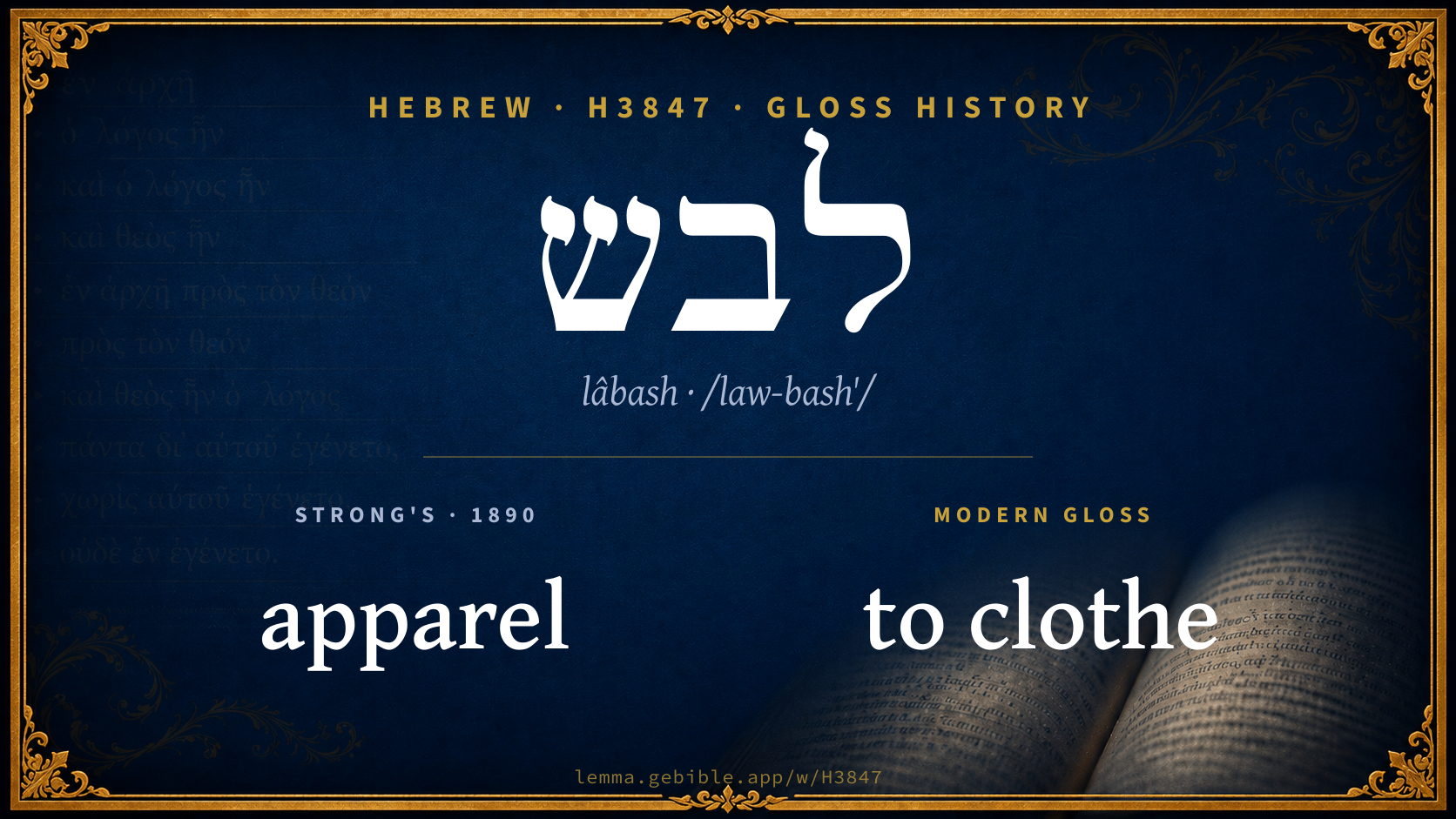
Gloss history
Strong's 1890 vs modern scholarship
About this word
Strong's H3847 catalogs a Hebrew word from the Hebrew Old Testament.
These counts are not copied from any lexicon or concordance. They are computed here, from the morphology-tagged Hebrew Old Testament. What Lemma adds →
- 102
- distinct verses
- The word appears in 102 distinct verses.
- 25 / 39
- OT books
- The word appears in 25 of 39 Old Testament books.
- #390
- by frequency
- Top 500 most frequent Hebrew words (rank 390 of 8,640 Hebrew words by occurrence).
View all 102 occurrences in the concordance →
By section of the Old Testament
By traditional corpus
Conventional, traditional groupings — biblical authorship is debated, so this is a traditional corpus grouping, not an authorship claim. Each share is this word’s portion of its verses in that division of the Hebrew canon. Each figure is a share of the word’s 102 distinct verses.
- Prophets (Nevi'im) 41 verses · 40%
- Writings (Ketuvim) 36 verses · 35%
- Torah (Pentateuch) 25 verses · 25%
How translations render this word
Counts come from each version’s own published word-to-Strong’s tagging or interlinear alignment — an approximate guide to how each version renders this word, not a word-level alignment the data otherwise carries. Because each total is that version’s own tagged count, the per-version totals vary from one another and need not match the appearance or distinct-verse counts above. These counts may also differ from a printed concordance because Lemma counts each distinctly tagged rendering and does not collapse phrase taggings into a single head-word total. This is a fixed set of word-tagged versions (KJV, ASV, BSB, ULT) and does not change with the reading translation you choose elsewhere. Each version’s license is shown beside its name below (and on Sources).
- King James Version: Clothed 14×, Put on 11×, Put 9×
- American Standard Version: Clothed 14×, Put 9×, Put on 9×
- Berean Standard Bible: Clothed 10×, Dressed 10×, Put on 9×
- unfoldingWord Literal Text: Put on 12×, Clothed 9×, Wear 7×
King James Version Public Domain
Renders H3847 across 111 tagged occurrences — most commonly:
Plus other, less common renderings. Plus 51 renderings that appear only once — usually multi-word phrases or single function words the recovered tagging swept in, not distinct renderings. Not rendered by a distinct English word in 1 further occurrence.
American Standard Version Public Domain
Renders H3847 across 111 tagged occurrences — most commonly:
Plus other, less common renderings. Plus 51 renderings that appear only once — usually multi-word phrases or single function words the recovered tagging swept in, not distinct renderings.
Berean Standard Bible Public Domain
Renders H3847 across 109 tagged occurrences — most commonly:
Plus 50 renderings that appear only once — usually multi-word phrases or single function words the recovered tagging swept in, not distinct renderings. Not rendered by a distinct English word in 1 further occurrence.
unfoldingWord Literal Text CC BY-SA 4.0
Renders H3847 across 124 tagged occurrences — most commonly:
Plus other, less common renderings. Plus 54 renderings that appear only once — usually multi-word phrases or single function words the recovered tagging swept in, not distinct renderings.
14 senses and sub-senses in the full BDB
Hebrew verbs can shift meaning by stem (binyan): Qal is the basic action, Niphal is often passive or reflexive, Piel often intensifies or makes it factitive, and Hiphil is typically causative. The senses below are grouped under the stem BDB assigns to each. This entry also uses Pual (the passive of Piel).
What do BDB’s symbols mean?
BDB uses these scholarly abbreviations:
| Symbol | Meaning |
|---|---|
| 𝔊 | the Septuagint (the ancient Greek translation, LXX) |
| 𝔙 | the Vulgate (the Latin translation) |
| 𝔖 | the Syriac version (the Peshitta) |
| 𝔗 | the Targum (the Aramaic translation) |
| ψ | the Psalms |
| √ | root (the underlying root or stem) |
| ‖ | parallel passage (a synonymous or contrasted parallel) |
| † | the dagger: every passage where the word occurs is cited |
The 14 senses and sub-senses the full Brown-Driver-Briggs lexicon distinguishes for this word, in lexicon order (not ranked by frequency), with BDB’s own verbatim wording and sub-sense lettering. Shown in Hebrew script with BDB’s own scholarly abbreviations. The condensed entry is in the Lexicon Entry tab. See also the Forms in the corpus table below.
Qal
- Pf. 3 m.s. לָבֵ֣שׁ, לָ֫בֵ֥שׁ ψ 93:1; לָ֮בַ֤שׁ Jb 7:5 + 2 times; וְלָבַשׁ (cons.) Lv 6:3 + 3 times; sf. וּלְבֵשָׁם (cons.) Lv 16:4; 3 fs. לָֽבְשָׁה Ju 6:34 + 2 times, etc. (Ez 42:14 read prob. וְלָֽבְשׁוּ Qr, for ילבשׁו Kt, but cl. perhaps interpol., v. Co); Impf. 3 ms. יִלְבַּשׁ Dt 22:5 +; sf. וַיִּלְבָּשֵׁנִי Jb 29:14, יִלְבָּשָׁם Ex 29:30; 1 s. sf. אֶלְבָּשֶׁ֑נָּה Ct 5:3; 3 fpl. תִּלְבַּשְׁןָ 2 S 13:18, etc.; Imv. ms. לְבַשׁ 1 K 22:30, etc.; Inf. abs. לָבוֹשׁ Hg 1:6; cstr. לִלְבֹּשׁ Gn 28:20 Lv 21:10; Pt. act. pl. הַלֹּבְשִׁים Zp 1:8; pass. abs. לָבוּשׁ 1 S 17:5; Dn 10:5; לָבֻשׁ Ez 9:2 + 3 times; cstr. לְבוּשׁ Dn 12:6, 7, לְבֻשׁ Ez 9:11 + 3 times; pl. cstr. לְבֻשֵׁי Ez 23:6 + 2 times;— e.g. Psalms 93:1
- a. lit. put on (one’s own) garment (acc.) Gn 38:19; 1 S 28:8; 2 S 14:2; 1 K 22:30 = 2 Ch 18:29, Ex 29:30; Lv 6:3, 4; 16:4(×2), 23, 24, 32; 21:10; Dt 22:5; Ez 44:17, 19, and so 42:14 Qr (v. supr.), Jon 3:5; Ct 5:3; Est 4:1; 5:1; c. acc. garment + עַל־בְּשָׂרוֹ Lv 16:3; of putting on armour Je 46:4; = wear (more or less habitually), c. acc. of garment, Is 4:1; Dt 22:11; Zp 1:8; Zc 13:4; of Jerus. under fig. of woman Je 4:30, of rulers under fig. of shepherds Ez 34:3, cf. כֵּן תִּלְבַּשְׁןָ 2 S 13:18 (no acc.) e.g. Genesis 38:19
- b. very often fig., put on, be clothed with, c. acc. of garment;—לָבַשׁ בְּשָׂרִי רִמָּה Jb 7:5 my flesh is clothed (i.e. covered) with worms; of Jerus., be clothed with inhabitants Is 49:18; of pasture, with flocks ψ 65:14; more often the garment is some abstract quality, e.g. righteousness, majesty, beauty, strength, etc.;—וַיִּלְבַּשׁ צְדָקָה כַּשִּׁרְיָן Is 59:17 he (י׳) hath put on righteousness as a breastplate, cf. v 17 (vengeance), ψ 93:1 (majesty), v 1 (strength), 104:1 (honour and majesty), Is 51:9 (strength); also Jb 40:10; said of men, 2 Ch 6:41 (salvation), ψ 132:9 (righteousness), Jb 29:14 (id.); of Zion Is 52:1(×2); also in bad sense, clothed with terror, trembling, shame, etc., Ez 7:27; 26:16; Jb 8:22; ψ 35:26; 109:29, cf. v 18 (cursing). e.g. Job 7:5
- c. lit. put on, obj. om., נָתַן … בֶּגֶד לִלְבּשׁ Gn 28:20 Jb 27:17; Inf. abs. לָבוֹשׁ Hg 1:6 (there is) a clothing, but he has nothing for warmth. e.g. Genesis 28:20
- d. once c. בְּ, לְבוּשׁ … אֲשֶׁר לָבַשׁ בּוֹ Est 6:8. e.g. Esther 6:8
- e. Pt. pass., clothed with, chiefly Ezek.;—c. acc. of garment, Ez 9:2, 3; Zc 3:3; Pr 31:21; Dn 10:5; of wearing armour 1 S 17:5; cstr. before garment, לְבֻשׁ הַבַּדִּים Ez 9:11; 10:2, 6, 7, cf. 23:6, 12; 38:4; Dn 12:6, 7. e.g. Ezekiel 9:2
- f. fig.:—וְרוּחַ י׳ לָֽבְשָׁה אֶת־גִּדְע֑וֹן Ju 6:34 and the spirit of י׳ clothed itself with Gideon, i.e. (GFM) took possession of him (cf. ܠܒܺܝܫ possessed); so 1 Ch 12:18; 2 Ch 24:20; צֶדֶק לָבַשְׁתִּי וַיִּלְבָּשֵׁנִי Jb 29:14 and it clothed itself in me, as it were, became incarnate in me. e.g. Judges 6:34
Pual
- only Pt. pl. מְלֻבָּשִׁים arrayed, c. acc. of garment 1 K 22:10 = 2 Ch 18:9, 2 Ch 5:12; abs. in full apparel Ezr 3:10. e.g. 1 Kings 22:10
Hiphil
- Pf. 3 ms. sf. הִלְבִּישַׁנִי Is 61:10; 3 fs. הִלְבִּישָׁה Gn 27:16; 2 ms. וְהִלְבַּשְׁתָּ֫ Ex 28:41 + 3 times; sf. וְהִלְבַּשְׁתָּם (consec.) Ex 29:8; Nu 20:26; 1 s. sf. וְהִלְבַּשְׁתִּיו Is 22:21; 3 pl. הִלְבִּישׁוּ 2 Ch 28:15, וְהִלְבִּשׁוּ (consec.) Est 6:9; Impf. 3 ms. וַיַּלְבֵּשׁ Gn 41:42 + 5 times; sf. וַיַּלְבִּשֵׁם Gn 3:21; Lv 8:13; 3 fs. תַּלְבִּישׁ Pr 23:21, etc.; Inf. abs. הַלְבֵּשׁ Zc 3:4; cstr. הַלְבִּישׁ Est 4:4; Pt. sf. הַמַּלְבִּֽשְׁכֶּם 1 S 1:24;—clothe, array with. e.g. Isaiah 61:10
- 1. usually c. 2 acc.,
- a. lit. וַיּלְבֵּשׁ אֹתוֹ בִּגְדֵי־שֵׁשׁ Gn 41:42; 2 S 1:24; Is 22:21; Ex 28:41; 29:5, 8; 40:13, 14 Lv 8:7, 13 Nu 20:26, 28 Zc 3:4, 5; of clothing Jerus. under fig. of infant Ez 16:10; of putting armour on some one 1 S 17:38(×2). e.g. Genesis 41:42
- b. fig., Jb 10:11 thou hast clothed me with skin and flesh; cf. 39:19 (quivering of horse’s neck); Is 50:3; 61:10; ψ 132:16, 18. e.g. Job 10:11
- 2. c. acc. garment only, Gn 27:16 (+ עַל־יָדָיו); fig., Pr 23:21. e.g. Genesis 27:16
- 3. c. acc. pers. only Gn 3:21; 27:15 2 Ch 28:15(×2) Est 4:4; 6:9, 11. e.g. Genesis 3:21
Senses from the full Brown-Driver-Briggs lexicon (Brown, Driver, Briggs; Oxford 1906 — public domain), digitized via Sefaria, supplemented by the OpenScriptures HebrewLexicon (CC BY 4.0). Full attribution on Sources.
Word origin
vb. put on (a garment), wear, clothe, be clothed (NH id.; Aramaic לִבֵישׁ ܠܒܶܫ; Assyrian labâšu; Arabic لَبِسَ; Ethiopic ለብሰ );
— Brown-Driver-Briggs (Oxford 1906, public domain), digitized via Sefaria, supplemented by the OpenScriptures HebrewLexicon (CC BY 4.0). See Sources.
Origin: a primitive root
Jastrow Dictionary
A second Hebrew/Aramaic lexicon for comparison, covering Aramaic and post-biblical (Talmudic, Targumic, Midrashic) usage that the biblical-Hebrew BDB does not. Matched by lemma rather than by Strong’s number, so a lemma may carry more than one Jastrow headword (shown separately below), and the entries cover usage well beyond the Bible.
לָבַשׁ
- (b. h.) [to join closely; denom. לְבוּשׁ garment, whence] לָבֵשׁ, לָבַשׁ to be dressed; to put on (an undergarment), contrad. to עטף, כסה. Y. R. Hash. I, 57ᵇ top אדם … לוֹבֵשׁ שחורים ומתעטף וכ׳ a defendant before a human court puts on dark clothes and wraps himself in dark clothes, …; אבל ישראל אינו כן אלא לוֹבְשִׁים וכ׳ but not so the Israelites (on the New Year), but they put on white (festive) clothes &c. M. Kat. 17ᵃ יִלְבַּשׁ שחורים ויתעטף וכ׳ let him put on dark clothes &c.; Kidd. 40ᵃ; Ḥag. 16ᵃ.—Gen. R. s. 75 לוֹבְשֵׁי ברזל; Yalk. ib. 130 לְבוּשֵׁי, v. בַּרְזֶל. Ex. R. s. 15 בריאים כדי לִלְבּוֹשׁ וכ׳ strong enough to wear helmets &c.; a. fr.—Part. pass. לָבוּשׁ, pl. לְבוּשִׁים. Ib. אחד ערום ואחד ל׳ one (the depth) was naked, the other (the earth) was covered (with water). Pesik. Aḥăré, p. 177ᵇ ל׳ לבנים וכ׳ clad in white and wrapped in white. Yalk. Gen. 130, v. supra; a. fr.
- to invest; part. pass. מְלוּבָּשׁ. B. Bath. 122ᵃ מל׳ אורים וכ׳ invested with the Urim and Tummim. Tosef. Ohol. XIII, 5 [read with R. S. to Ohol. XII, 4) מלבין שׁהוא מלובש בפיקות a bed frame upholstered with tufts.
- to clothe, invest. Ex. R. l. c. הפשיט … והִלְבִּישָׁהּ לחבירו he caused one slave to take off his garment and the other to put it on. Sot. 14ᵃ מה הוא מַלְבִּישׁ … אף אתה הַלְבֵּשׁ וכ׳ as He clothes the naked …, so do thou &c. Tanḥ. Ḥayé 3 ומַלְבִּישָׁן כלי זיין וכ׳ (not ומלביש) and clothes them in armor &c. Ib. (ref. to Ps. CIV, 1) זה העוז שהִלְבַּשְׁתִּיךָ בים that is the strength with which I invested thee at the Red Sea. Ib. מהודך והדרך הִלְבַּשְׁתָּ לראשו וכ׳ part of thy glory and majesty hast thou put on Abraham’s head by granting him the dignity of old age. Yoma 5ᵇ כיצד הִלְבִּישָׁן in what order did Moses clothe them?—Y. Shek. V, 49ᵃ (expl. פנחס המַלְבִּישׁ, ib. V, 1, Mish. ed. על המלבוש) שהיה מַלְבִּישׁ בגדי וכ׳ he invested (the appointed person) with (had in charge) the high priest’s garments; a. fr. e.g. Psalms 104:1
לְבֵשׁ
- Targ. Gen. XXXVIII, 19; a. fr.—Part. לְבִישׁ, לָבִישׁ. Targ. Job XXVII, 17. Targ. Ez. IX, 2; a. fr.—Ber. 28ᵃ מאן דלביש מדא יִלְבַּשׁ מדא ומאן … ואנא אַלְבְּשֵׁיה let him who has been invested with the priest’s cloak wear it; or shall he who is not invested say to him who has been, take off thy cloak, and I will put it on?; i.e. let us respect the hereditary office of the Nasi, v. מַזֶּה. Keth. 54ᵃ לְבִישְׁתִּינְהוּ ואיכסתינהו לכוליה מנא she put on all her dresses and wraps. Sabb. 10ᵇ [read:] מֵילָתָא אַלְּבִישַׁיְיהוּ יקירן (v. Rabb. D. S. a. l. note 30) cloaks are precious on those who are invested with them, i.e. a pupil likes to quote his teacher; a. fr.
- 1. same. Targ. Ps. XCIII, 1; a. e.—Ber. l. c. Ms. M. אַלְבְּשִׁינֵיה, v. supra.
- 2. to clothe. Targ. Ps. CXXXII, 16. Targ. Job XXIX, 14 ואַלְבְּשִׁנָנִי and it clothed (protected) me; a. e.—Kidd. 30ᵇ ונַלְבִּישָׁהּ ונכסייה (not ולבשייה) and let him clothe and cover her. Y. Keth. XII, 35ᵃ top אַלְבְּשׁוּנִי; Y. Kil. IX, 32ᵇ top מלבשוני (corr. acc.), v. בּוּרְדִּיקָא. Tam. 32ᵃ; a. e.—Trnsf. to take hold of, seize. Kidd. 81ᵇ יצר אַלְבְּשָׁהּ (her bashfulness in the presence of her father is a sign that) sensuality has seized her; Keth. 51ᵇ יצר אלבשה passion has overpowered her (she speaks under the influence of sensual excitement).
A Dictionary of the Targumim, the Talmud Babli and Yerushalmi, and the Midrashic Literature (Marcus Jastrow; London, Luzac, 1903) — Public Domain. Digitized via Sefaria. Digitized via Sefaria. Full attribution on Sources.
Forms in the corpus
The 96 distinct written forms H3847 takes in the Hebrew Bible, most frequent first — each parse links to that stem’s occurrences in the concordance. Hebrew forms include their vowel points and cantillation, so a single lemma takes many written forms.
The 60 most common forms are shown; 36 rarer forms follow in the full concordance.
Same root — word family
Other BDB entries built from the same root as H3847, grouped by Strong’s listed origin. These share a root / origin per the lexicon — not necessarily a shared meaning. Each links to that word’s own entry.
Derived from this word
- לבוש lᵉbûwsh H3830 clothing
- לבש lᵉbash H3848 to be clothed
- מלבוש malbûwsh H4403 clothing
- תלבשת talbôsheth H8516 garment
Compare all same-root words → Showing 4 of 5 — not the complete family. They share a root, not necessarily a meaning.
Septuagint verse parallels
This word appears in 95 verses that also exist in the Greek Old Testament (Septuagint), out of the 102 Hebrew verses it occurs in. You can read those verses in Greek by switching the Old Testament edition to the Septuagint.
Read these verses in the Septuagint
- Genesis 3:21
- Exodus 28:41
- Leviticus 6:10
- Numbers 20:26
- Deuteronomy 22:5
- Judges 6:34
- 1 Samuel 17:5
- 2 Samuel 1:24
- 1 Kings 22:10
- 1 Chronicles 12:18
- 2 Chronicles 5:12
- Ezra 3:10
This is a verse-level parallel only — the same verses exist in both the Hebrew and Greek Old Testaments. No word-level Hebrew↔Greek correspondence is claimed: the data carries no such alignment, so no Greek word is shown as this Hebrew word’s translation. Coverage is not total — the Septuagint omits the deuterocanon and renumbers the Psalms, so some Hebrew verses have no direct Greek parallel.