
Ezekiel 10:6

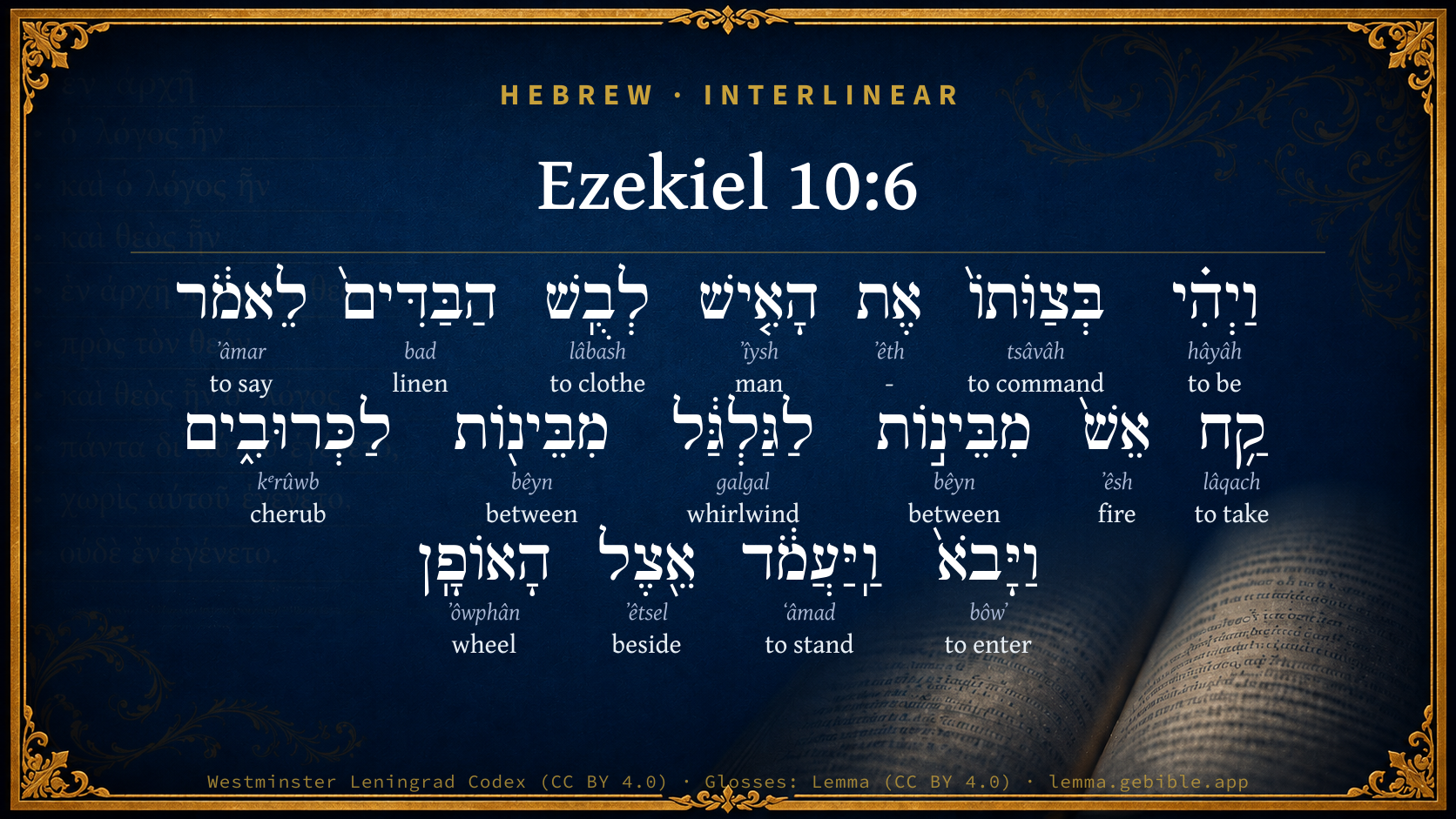
Hebrew (Westminster Leningrad Codex) Ezekiel 10:6 appears in the Hebrew Old Testament. The text above is from the Westminster Leningrad Codex. Each word links to its Strong’s number, a concise gloss, and parsing drawn from the Open Scriptures Hebrew Bible morphology. Click any word for its full Brown-Driver-Briggs (BDB) entry.
Download image
Cite this verse

Ezekiel 10:6 (World English Bible). Public Domain. Lemma interlinear Bible study tool, https://lemma.gebible.app/v/ezekiel/10/6.

Show BibTeX & RIS
BibTeX
RIS
English Translation
It came to pass, when he commanded the man clothed in linen, saying, Take fire from between the whirling wheels, from between the cherubim, that he went in, and stood beside a wheel.
World English Bible · Public Domain
Download a study sheet

One document with this verse’s original text, its word-by-word gloss line, the meaning frame, cross-references with their text, attributed commentary, and full source and license credits — printable, and it pastes into notes with its structure intact.

This verse Autodidact and up

Study sheet (.html) Plain text (.txt)

A passage Seminary Student

Up to 50 verses in one chapter. A passage sheet keeps up to 6 commentary sources and 12 cross-references per verse, in the order this page ranks them, and says so on the sheet whenever that leaves anything out. Ask for a single verse and you get the Autodidact verse sheet above.

Everything on this page stays free to read, with no account — the sheet is a download of what is already on screen, not access to it.

Want to remove ads? Support Godless Engineer
Compare translations 3

The same verse in 3 English versions, stacked beneath the original-language interlinear above. Click any original word for its lexicon entry.

Each is an independent rendering of the whole verse — the interlinear is not word-aligned to these translations.

Highlighted words mark where these versions differ — a whole-verse word diff, not a word-by-word alignment.

  • World English Bible Public Domain
    It came to pass, when he commanded the man clothed in linen, saying, Take fire from between the whirling wheels, from between the cherubim, that he went in, and stood beside a wheel.
  • King James Version Public Domain
    And it came to pass, that when he had commanded the man clothed with linen, saying, Take fire from between the wheels, from between the cherubims; then he went in, and stood beside the wheels.
  • unfoldingWord Literal Text CC BY-SA 4.0
    It came about, when God commanded the man dressed in linen and said, “Take fire from between the wheels that are between the cherubim,” the man went in and stood beside a wheel.

unfoldingWord Literal Text — © unfoldingWord, licensed CC BY-SA 4.0. Word-aligned USFM3 via Door43 (git.door43.org/unfoldingWord/en_ult).

Versions to compare (up to 4)

3 of 4 selected

Show all 18 translations

Every available English version of this verse, each an independent rendering of the whole verse.

  • World English Bible Public Domain
    It came to pass, when he commanded the man clothed in linen, saying, Take fire from between the whirling wheels, from between the cherubim, that he went in, and stood beside a wheel.
  • Berean Standard Bible Public Domain
    When the LORD commanded the man clothed in linen, saying, “Take fire from within the wheelwork, from among the cherubim,” the man went in and stood beside a wheel.
  • Majority Standard Bible Public Domain
    When the LORD commanded the man clothed in linen, saying, “Take fire from within the wheelwork, from among the cherubim,” the man went in and stood beside a wheel.
  • King James Version Public Domain
    And it came to pass, that when he had commanded the man clothed with linen, saying, Take fire from between the wheels, from between the cherubims; then he went in, and stood beside the wheels.
  • American Standard Version (1901) Public Domain
    And it came to pass, when he commanded the man clothed in linen, saying, Take fire from between the whirling wheels, from between the cherubim, that he went in, and stood beside a wheel.
  • Revised Version (1885) Public Domain
    And it came to pass, when he commanded the man clothed in linen, saying, Take fire from between the whirling wheels, from between the cherubim, that he went in, and stood beside a wheel.
  • Geneva Bible (1599) Public Domain
    And when he had commanded the man clothed with linnen, saying, Take fire from betweene the wheeles, and from betweene ye Cherubims, then he went in and stood beside ye wheele.
  • Douay-Rheims (1899) Public Domain
    And when he had commanded the man that was clothed with linen, saying: Take fire from the midst of the wheels that are between the cherubims: he went in and stood beside the wheel,
  • Young's Literal Translation Public Domain
    And it cometh to pass, in His commanding the man clothed with linen, saying, `Take fire from between the wheel, from between the cherubs,' and he goeth in and standeth near the wheel,
  • Literal Standard Version CC BY-SA 4.0
    And it comes to pass, in His commanding the man clothed with linen, saying, “Take fire from between the wheel, from between the cherubim,” and he goes in and stands near the wheel,
  • Unlocked Literal Bible CC BY-SA 4.0
    It came about, when God commanded the man dressed in linen and said, “Take fire from between the wheels that are between the cherubim,” the man went in and stood beside a wheel.
  • unfoldingWord Literal Text CC BY-SA 4.0
    It came about, when God commanded the man dressed in linen and said, “Take fire from between the wheels that are between the cherubim,” the man went in and stood beside a wheel.
  • Darby Bible Public Domain
    And it came to pass when he had commanded the man clothed with linen, saying, Take fire from between the wheels, from between the cherubim, then he went in, and stood beside the wheel.
  • World Messianic Bible Public Domain
    It came to pass, when he commanded the man clothed in linen, saying, “Take fire from between the whirling wheels, from between the cherubim,” that he went in and stood beside a wheel.
  • Webster's Bible Public Domain
    And it came to pass, that when he had commanded the man clothed with linen, saying, Take fire from between the wheels, from between the cherubim; then he went in, and stood beside the wheels.
  • Free Bible Version CC BY-SA 4.0
    When the Lord ordered the man in linen, “Go and get some fire from in between the wheels, from among the cherubim,” the man went in and stood beside one of the wheels.
  • Bible in Basic English Public Domain
    And when he gave orders to the man clothed in linen, saying, Take fire from between the wheels, from between the winged ones, then he went in and took his place at the side of a wheel.
  • JPS Tanakh (1917) Public Domain
    And it came to pass, when He commanded the man clothed in linen, saying: 'Take fire from between the wheelwork, from between the cherubim', that he went in, and stood beside a wheel.

Literal Standard Version (2020), Covenant Press — licensed CC BY-SA 4.0. Text via the HelloAO Bible API (eBible.org). Unlocked Literal Bible (unfoldingWord) — licensed CC BY-SA 4.0. Text via the HelloAO Bible API (eBible.org). unfoldingWord Literal Text — © unfoldingWord, licensed CC BY-SA 4.0. Word-aligned USFM3 via Door43 (git.door43.org/unfoldingWord/en_ult). Free Bible Version, Dr. Jonathan Gallagher — licensed CC BY-SA 4.0. Text via the HelloAO Bible API (eBible.org).

Word by word

More ways to search: Search by grammar → Find every occurrence → Compare this word →

Practice this passage: Drill this verse → Learn its vocabulary →

לַגַּלְגַּ֔ל
galgal
H1534
“to/for the · whirlwind”
Preposition, Determined + Noun, Common, Masculine, Singular, Absolute
Part of Speech
Preposition + Noun
Type
Common
Gender
Masculine
Number
Singular
State
Absolute
Full BDB Definition

Origin: by reduplication from H1556

TWOT: 353i

wheel, whirl, whirlwind, whirling - wheel - whirl (of dust, chaff)
  1. וַיְהִ֗י hâyâh H1961 “and · to be” Conjunction + Verb, Qal, Sequential Imperfect, 3rd Person, Masculine, Singular
  2. בְּצַוֺּתוֹ֙ tsâvâh H6680 “in/at · to command · him” Preposition + Verb, Piel, Infinitive Construct + Suffix, Personal, 3rd Person, Masculine, Singular
  3. אֶת ʼêth H853 “-” Particle, Direct Object
  4. הָאִ֤ישׁ ʼîysh H376 “the · man” Particle, Definite Article + Noun, Common, Masculine, Singular, Absolute
  5. לְבֻֽשׁ lâbash H3847 “clothed” Verb, Qal, Participle Passive, Masculine, Singular, Construct
  6. הַבַּדִּים֙ bad H906 “the · linen” Particle, Definite Article + Noun, Common, Masculine, Plural, Absolute
  7. לֵאמֹ֔ר ʼâmar H559 “to say” Preposition + Verb, Qal, Infinitive Construct
  8. קַ֥ח lâqach H3947 “take” Verb, Qal, Imperative, 2nd Person, Masculine, Singular
  9. אֵשׁ֙ ʼêsh H784 “fire” Noun, Common, Both, Singular, Absolute
  10. מִבֵּינ֣וֹת bêyn H996 “from · between” Preposition + Preposition
  11. מִבֵּינ֖וֹת bêyn H996 “from · between” Preposition + Preposition
  12. לַכְּרוּבִ֑ים kᵉrûwb H3742 “to/for the · cherubim” Preposition, Determined + Noun, Common, Masculine, Plural, Absolute
  13. וַיָּבֹא֙ bôwʼ H935 “and · to enter” Conjunction + Verb, Qal, Sequential Imperfect, 3rd Person, Masculine, Singular
  14. וַֽיַּעֲמֹ֔ד ʻâmad H5975 “and · to stand” Conjunction + Verb, Qal, Sequential Imperfect, 3rd Person, Masculine, Singular
  15. אֵ֖צֶל ʼêtsel H681 “beside” Preposition
  16. הָאוֹפָֽן ʼôwphân H212 “the · wheel” Particle, Definite Article + Noun, Common, Masculine, Singular, Absolute

About this verse

These counts appear in no published source. They are computed here, from the morphology-tagged text and Lemma’s own curated glosses. What Lemma adds →

17
words
16
distinct lemmas
Prophets
section

Notable vocabulary

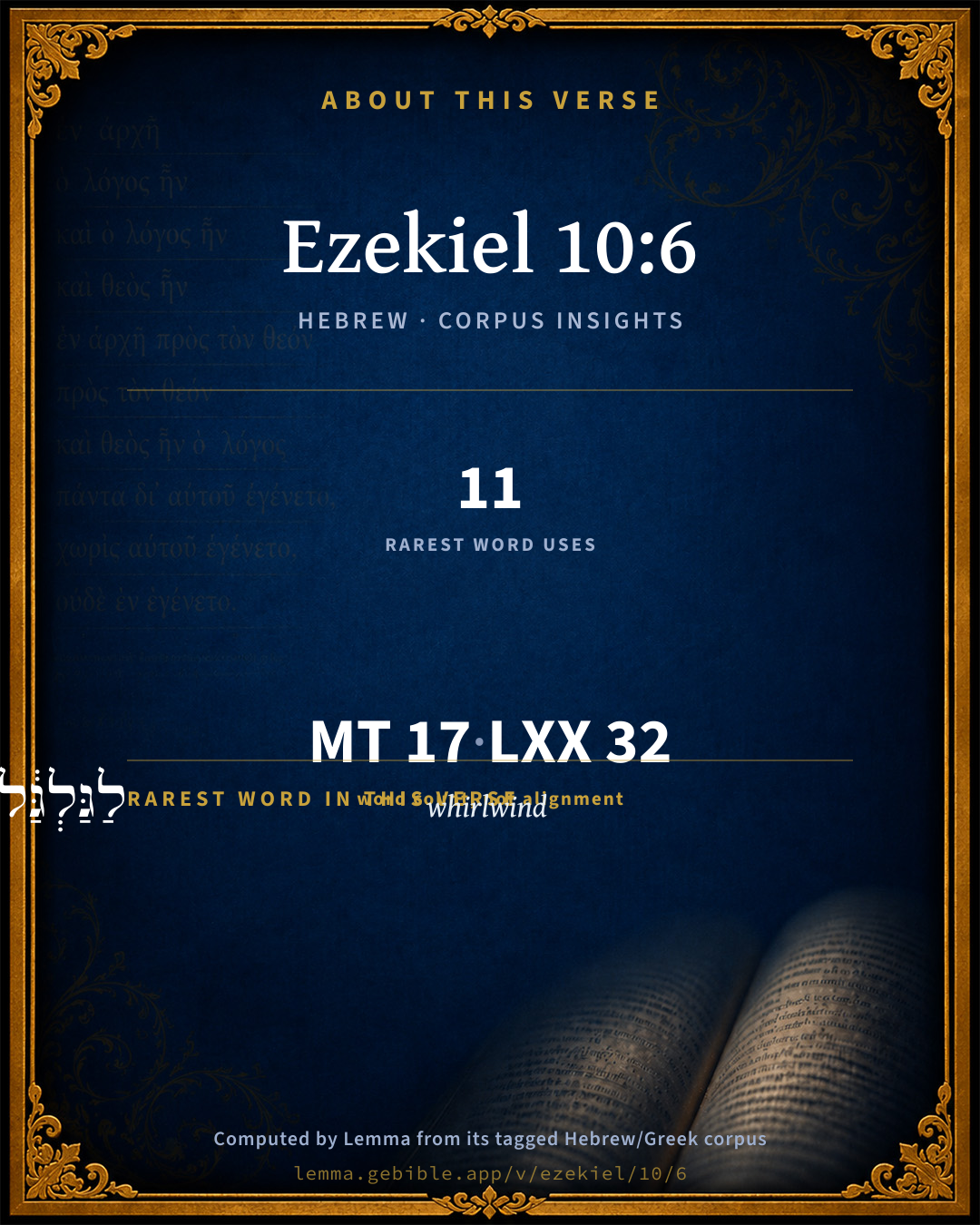
The rarest word here is לַגַּלְגַּ֔ל whirlwind H1534 — appearing just 11 times in the whole Hebrew Bible.

Shared distinctive vocabulary

לַגַּלְגַּ֔ל whirlwind H1534 occurs in 11 verses of the Hebrew Bible. Also found in:

Grammatical profile

  • 7 verbs
  • 6 nouns
  • 3 prepositions
  • 1 particle

Verb forms

  • וַיְהִ֗י Qal · Sequential Imperfect
  • בְּצַוֺּתוֹ֙ Piel · Infinitive Construct
  • לְבֻֽשׁ Qal · Participle Passive
  • לֵאמֹ֔ר Qal · Infinitive Construct
  • קַ֥ח Qal · Imperative
  • וַיָּבֹא֙ Qal · Sequential Imperfect
  • וַֽיַּעֲמֹ֔ד Qal · Sequential Imperfect

Repetition

A word recurs within this verse — often emphatic in Hebrew:

  • מִבֵּינ֣וֹת between H996 ×2

Hebrew & Septuagint length

In English translation the verse runs 33 words from the Hebrew and 38 from the Septuagint (LXX English) — closely comparable.

A rough comparison of the two English renderings, which tokenize alike — not a word-level alignment.

Word counts can differ between the Hebrew and the Greek without any difference in meaning — e.g. the Hebrew direct-object marker אֵת has no separate Greek word, and Greek often adds the article ὁ.

In the original languages it is 17 Hebrew tokens and 32 Greek tokens — but the two are counted differently (Hebrew bundles its prefixes and suffixes into one token; the Greek is in lemma form), so that isn’t a like-for-like length.

Cross-references

3

Topical passages linked to Ezekiel 10:6 in the Treasury of Scripture Knowledge — connected by theme and wording, ordered by reader-vote popularity; previews shown in the World English Bible.

  • Ezekiel 10:2 He spoke to the man clothed in linen, and said, Go in between the whirling [wheels], even under the cherub, and fill both your hands with coals of fire from between the cherubim, and scatter them over the city. He went in as I watched.
  • Psalms 80:1 Hear us, Shepherd of Israel, You who lead Joseph like a flock, You who sit above the cherubim, shine forth.
  • Psalms 99:1 Yahweh reigns! Let the peoples tremble. He sits enthroned among the cherubim. Let the earth be moved.

Cross-references courtesy of OpenBible.info (CC BY 4.0).

Hebrew and Greek witnesses Masoretic Hebrew ↔ Greek Septuagint

The same verse in the two great witnesses to the Old Testament, shown verse-for-verse.

These are two independent witnesses, not word-aligned to each other, and the Septuagint is shown in lemma (dictionary) form.

Hebrew Ezekiel 10:6 Masoretic · Westminster Leningrad Codex

וַיְהִ֗י בְּצַוֺּתוֹ֙ אֶת הָאִ֤ישׁ לְבֻֽשׁ הַבַּדִּים֙ לֵאמֹ֔ר קַ֥ח אֵשׁ֙ מִבֵּינ֣וֹת לַגַּלְגַּ֔ל מִבֵּינ֖וֹת לַכְּרוּבִ֑ים וַיָּבֹא֙ וַֽיַּעֲמֹ֔ד אֵ֖צֶל הָאוֹפָֽן

It came to pass, when he commanded the man clothed in linen, saying, Take fire from between the whirling wheels, from between the cherubim, that he went in, and stood beside a wheel.

World English Bible · Public Domain

Greek LXX Ezekiel 10:6 Septuagint · lemma form

καί γίγνομαι ἐν ὁ ἐντέλλομαι αὐτός ὁ ἀνήρ ὁ ἐνδύω ὁ στολή ὁ ἅγιος λέγω λαμβάνω πῦρ ἐκ μέσος ὁ τροχός ἐκ μέσος ὁ χερουβείμ καί εἰςἔρχομαι καί ἵστημι ἔχω ὁ τροχός

And it came to pass, when he gave a charge to the man clothed with the sacred robe, saying, Take fire from between the wheels from between the cherubs, that he went in, and stood near the wheels.

LXX2012 (modern English Septuagint) · Public Domain

Hebrew: Westminster Leningrad Codex (CC BY 4.0). Greek: Septuagint (public domain); English from LXX2012 (modern English Septuagint) (Public Domain). How the Septuagint differs from the Hebrew →

Targum (Aramaic paraphrase)

1

The Targum is the ancient Jewish Aramaic paraphrase of the Hebrew Scriptures — an interpretive translation, not the Hebrew text itself. Onkelos (literal) and Pseudo-Jonathan (expansive) render the Torah, and Jonathan the Prophets. Coverage is partial: where no permissively-licensed English translation exists for a verse, only the Aramaic is shown. This is verse-level text, not a word-by-word alignment to the Hebrew.

  1. Targum Jonathan Prophets (Joshua–Malachi)
    וַהֲוָה בְּפַקְדוּתֵיהּ יַת גַבְרָא דְלָבֵישׁ לְבוּשַׁיָא לְמֵימַר סָב אֶשְׁתָּא מִבֵּינֵי גַלְגְלַיָא מִבֵּינֵי כְרוּבַיָא וְעַל וְקָם בִּסְטַר גַלְגְלָא:

    (no public-domain English translation for this verse)

    Targum Jonathan — Aramaic: “Mikraot Gedolot” (public domain). English: “Sefaria Community Translation” (CC0 1.0 (public-domain dedication)); “London "Chaldee Paraphrase," 1871” (public domain). Text via Sefaria.

Commentary

Notes on Ezekiel 10:6 from classic Christian and Jewish commentators (each source and its license shown beneath its notes). The classic Christian expositions comment on the surrounding passage and are grouped to its opening verse, so a note may address several verses; the Jewish commentaries on the Tanakh (Rashi and others) are per-verse, so they appear only where the commentator wrote on this verse.

Lemma curates 59 commentaries, every one of them public domain or Creative Commons licensed, each selected and text-cleaned for this edition rather than reprinted as found. About our sources →

Trapp's Complete Commentary

John Trapp

Eze 10:6 And it came to pass, [that] when he had commanded the man clothed with linen, saying, Take fire from between the wheels, from between the cherubims; then he went in, and stood beside the wheels.

Ver. 6. When he had commanded the man.] Christ as mediator was at his Father’s command. {Mat 12:18 Joh 14:31; Joh 15:10}

Then he went in and stood beside the wheels.] As considering, saith one, the mutability and uncertainty of all things, and observing the equity of the divine proceedings.

John Trapp, A Commentary or Exposition upon All the Books of the Old and New Testament (1647–1656) — public domain. Text from a community e-Sword module.

Jamieson, Fausset & Brown

Robert Jamieson, A. R. Fausset & David Brown

went in--not into the temple, but between the cherubim. Ezekiel sets aside the Jews' boast of the presence of God with them. The cherubim, once the ministers of grace, are now the ministers of vengeance. When "commanded," He without delay obeys (Psa 40:8; Heb 10:7).

Jamieson, Fausset & Brown — Commentary Critical and Explanatory on the Whole Bible (1871) — public domain (CC PDM 1.0). Text via the HelloAO Bible API.

John Calvin's Commentaries

Here the Prophet teaches the end of the vision. The Jews thought that they should always be safe and secure under God’s presence; they thought that the sacred fire on the altar availed for the expiation of all wickedness. But God showed that he so resided in the temple that he clothed himself with wrath against them, and that the cherubim were keepers of his arms by which they were at length to be destroyed. We see, therefore, that this false and perverse glowing by which the Jews were intoxicated was cut from under them, since they thought that God was in some way bound to themselves exclusively. Hence the angel is ordered to take fire and to sprinkle it about the city, that it may be destroyed by the burning. But this was necessary, because the Jews, while they for a long time obstinately abused the forbearance of God, could not be induced to repent by any fear of his wrath. For this reason this vision was shown to the Prophet. Then he says that fire was given, but whence was it taken? it was, says he, in the midst of the cherubim. When David prays to God, he makes mention of the cherubim, (Psalm 80:1,) by which a more familiar access is laid open, and deservedly so; because God, when inviting the faithful to himself, as if he stretched forth his hands to them, had angels at hand who brought him in contact with men. Now the Prophet teaches, that God’s presence was of no use to the Jews, because he was in arms for their destruction; and the cherubim, who were formerly ministers of his grace, were now at hand to execute his vengeance, since they extend fire from hand to hand for the conflagration of the whole city. For he says, that he was come who was clad in linen garments, and stood near the wheels, by which words he signifies, that angels were thoroughly prepared to obey God’s commands in every particular. In men there is great delay and even languor; but the Prophet assures us, that angels were ready for the performance of their duty. As soon as God shows them what he wishes to be done, they have their hands extended, and thus they are prepared to execute his will. For this reason he says, that they stood near the wheels It follows —

John Calvin's Commentaries (1540-1563) — public domain. Text from the Calvin Translation Society English edition (1840s-50s) via the Christian Classics Ethereal Library (ccel.org). Calvin's coverage is partial (roughly two-thirds of the Bible); uncommented books and verses are honest gaps, never fabricated. The 19th-century editor's footnotes and remarks are omitted so the notes are faithfully Calvin's own voice.

The Cambridge Bible for Schools and Colleges

gen. ed. J. J. S. Perowne

6. On the fire between the cherubim, cf. Eze_1:13.

The Cambridge Bible for Schools and Colleges (gen. ed. J. J. S. Perowne; Cambridge University Press, 1878–1918) — public domain. Text from a community e-Sword module.

John Gill's Exposition

And it came to pass, that when he had commanded the man clothed with linen,.... After the orders were given by him that was upon the throne to the man thus described:

saying, take fire from between the wheels, from between the cherubim; as in Eze 10:2;

then he went in; immediately, into the place where the wheels and cherubim were; even under the firmament of heaven, and the throne that was in it:

and stood beside the wheels, or "wheel"; to see what it was, as Kimchi thinks; or rather in order to go in between them, as he was bid to do, Eze 10:2.

John Gill's Exposition of the Whole Bible (1746–1763) — public domain (CC PDM 1.0). Text via the HelloAO Bible API.

Matthew Poole's English Annotations

See Eze 10:2, which is the same in effect with this. What is said to be between the wheels is said also to be between the cherubims; which represent angels, the ministers of God’s providence; and so what now is observed to be among the wheels, in the effects or order of God’s providence, is among or between the angels, the ministerial causes thereof.

Then he went in, readily obeyed,

and stood beside the wheels; either as one that deferred execution, to try whether the city would repent, or as one that was to give some further order to angels, that were to be the ministers of his just displeasure; and whereas, Eze 10:3, the cherubims stood as servants waiting, here Christ stands as a Lord commanding; they obey him, he obeys his Father.

Matthew Poole's English Annotations on the Holy Bible (1683–1685) — public domain. Text from a community e-Sword/MySword module.

Whedon's Commentary on the Bible

Daniel D. Whedon

6. Take fire — Fire symbolizes God’s purity. “What really destroys the town is the destructive holiness of Jehovah.” — Orelli.

Daniel D. Whedon (gen. ed.), Commentary on the Old and New Testaments (1874–1909) — public domain. Text from a community e-Sword module.

John Wesley's Explanatory Notes

And stood - Either as one that deferred execution, to try whether the city would repent, or as one who was to give some farther order to the angels, that were to be the ministers of his just displeasure.

John Wesley, Explanatory Notes Upon the Whole Bible (1754–1765) — public domain. Text via the GEBible commentary corpus.

unfoldingWord translationNotes

Door43 World Missions Community

It came about

This phrase is used here to mark when the action starts. If your language has a way for doing this, you could consider using it here.

when God commanded the man dressed in linen and said

This is a repeat of the information that was given in Ezekiel 10:2. After talking about the cherubim and God's glory in Eze 10:3-5, Ezekiel returns to telling about the man who was wearing linen.

the man dressed in linen

Translate "linen" as in Ezekiel 9:1.

beside a wheel

Translate "wheel" as in Ezekiel 1:15.

I saw on the cherubim something like a man's hand under their wings

"I saw that the cherubim had something like a man's hand under their wings"

translationWords

command

fire

cherub

unfoldingWord translationNotes — © Distant Shores Media and the Door43 World Missions Community, licensed CC BY-SA 4.0. Source: git.door43.org/Door43/en_tn.

Lesson kit

Teaching starters — assembled from the data on this page, not authored interpretation. Every prompt links to the verse data it draws on. Edit before teaching.

Ezekiel, in the Prophets, opens this verse with 17 words (16 distinct Hebrew lemmas). Its most distinctive word is galgal (“whirlwind”). A historical commentator’s framing appears above. Read the whole chapter for the surrounding context.

Discussion questions

  1. How does “whirlwind” (galgal) shape what this verse is saying?
  2. Psalms 77:18 shares the word «whirlwind» with this verse. How do the two illuminate each other?
  3. “between” occurs 2× in this one verse. What is the effect of the repetition?
  4. These translations render this verse differently. What is at stake in choosing one wording over another?
  5. The verb «וַיְהִ֗י» is Qal Sequential Imperfect. How does its form color the action?
  6. Reading how Trapp's Complete Commentary and Jamieson, Fausset & Brown read this verse, where do the two commentators agree and where do they part?

Things to notice

Reading settings

Reading text

Shown beneath each verse's original-language words.

Old Testament
Old Testament edition

Read the OT as the Masoretic Hebrew (MT) or the Greek Septuagint (LXX).

English shown for the Greek Septuagint (in the Hebrew ↔ Greek comparison).

Comparing translations? Open the Compare panel on any verse page to stack up to four side by side.