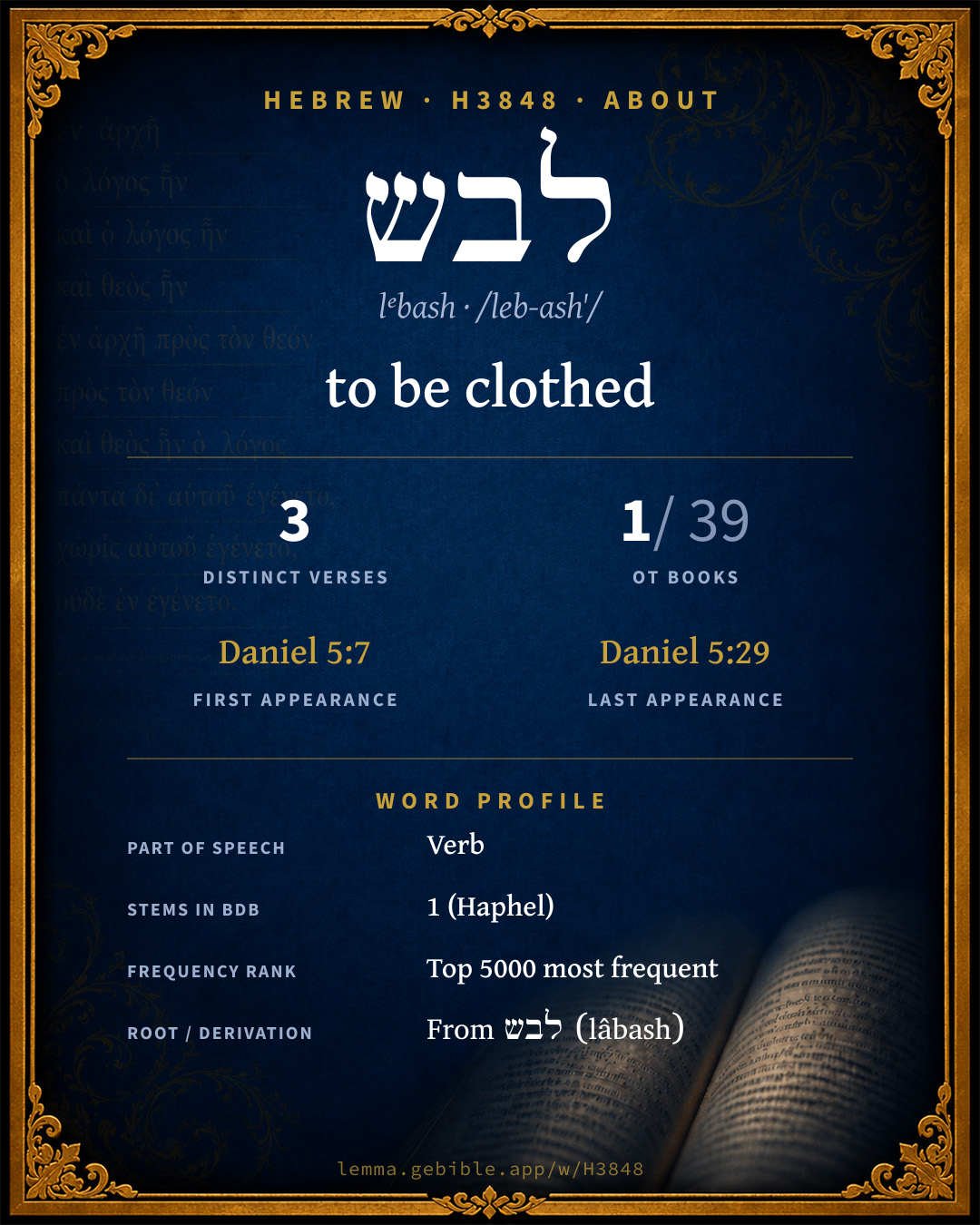
לְבֵשׁ
to be clothed
‘to be clothed’ is one of 3 main senses fuller range ↓
Full lexicon entry — Brown-Driver-Briggs (BDB)
From Brown-Driver-Briggs (BDB)
Where this word appears
See every Qal verb in the Hebrew Bible →
Grammar key — what these labels mean
Part of speech
- Verb
- An action or state-of-being word.
Stem
- Hiphil
- The causative active stem (“he caused / brought about”).
- Qal
- The basic, simple active stem — the plain form of the verb (“he wrote”).
Form
- Perfect
- A completed action or state — Hebrew marks aspect (completeness) more than strict tense (“he wrote”).
- Imperfect
- An incomplete, ongoing, or future action (“he will / would write”).
Person
- 3rd Person
- The one spoken about (“he / she / it / they”).
- 2nd Person
- The one addressed (“you”).
Gender
- Masculine
- Grammatically masculine.
Number
- Plural
- More than one (in Hebrew, generally three or more).
- Singular
- One.
Grammatical forms
- Verb, Hiphil, Perfect, 3rd Person, Masculine, Plural 1 time (33%)
- Verb, Qal, Imperfect, 2nd Person, Masculine, Singular 1 time (33%)
- Verb, Qal, Imperfect, 3rd Person, Masculine, Singular 1 time (33%)
Parsed forms decoded from the imported morphology (morphhb / Westminster Leningrad Codex — WLC text public domain, morphhb tagging CC BY 4.0), counted across 3 parsed occurrences — not distinct verses.
Every verse where H3848 appears — 3 distinct verses across 1 book. Click any verse to open its interlinear word-by-word view. Verse text shown in the World English Bible for context — . Each verse’s Hebrew form is shown with its reference; the English is not keyword-highlighted, since the data carries no word-level English alignment. Use “Compare translations” on any verse to read it across multiple English versions. This concordance covers the Hebrew Bible; Septuagint (Greek Old Testament) occurrences are not indexed here.
Daniel 3 verses
- Daniel 5:7 יִלְבַּ֗שׁ Qal impf 3ms The king cried aloud to bring in the enchanters, the Chaldeans, and the soothsayers. The king spoke and said to the wise men of Babylon, Whoever shall read this writing, and show me the interpretation of it, shall be clothed with purple, and have a chain of gold about his neck, and shall be the third ruler in the kingdom.
- Daniel 5:16 תִלְבַּ֗שׁ Qal impf 2ms But I have heard of you, that you can give interpretations, and dissolve doubts; now if you can read the writing, and make known to me the interpretation of it, you shall be clothed with purple, and have a chain of gold about your neck, and shall be the third ruler in the kingdom.
- Daniel 5:29 וְ/הַלְבִּ֤ישׁוּ conj + Hiphil pf 3mp Then commanded Belshazzar, and they clothed Daniel with purple, and put a chain of gold about his neck, and made proclamation concerning him, that he should be the third ruler in the kingdom.
About this entry
At a glance — auto-summarized from this page’s data, not written by a person. Every figure links to its source below. This summary describes the numbers; it doesn’t interpret them.
The Hebrew verb לבש centers on the idea of “to be clothed.” A scarce word — 3 verses in all of the Hebrew Bible. Daniel dominates its distribution — 3 of 3 verses. Its earliest occurrence is Daniel 5:7. Its meaning spans more than one sense — see its full sense range. Dig into 3-verse concordance and the renderings breakdown below.
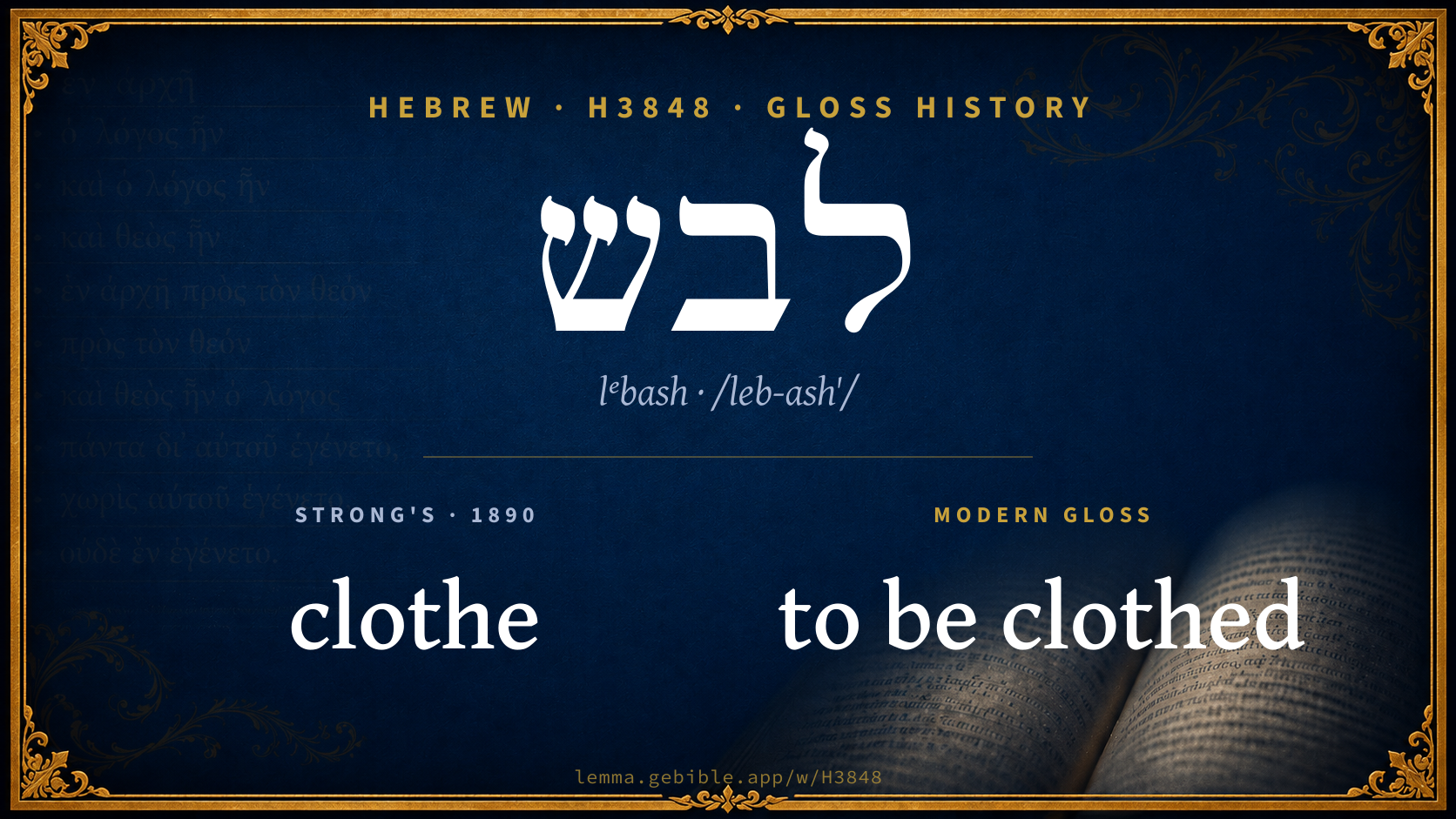
Gloss history
Strong's 1890 vs modern scholarship
About this word
Strong's H3848 catalogs a Hebrew word from the Hebrew Old Testament.
These counts are not copied from any lexicon or concordance. They are computed here, from the morphology-tagged Hebrew Old Testament. What Lemma adds →
- 3
- distinct verses
- The word appears in 3 distinct verses.
- 1 / 39
- OT books
- The word appears in 1 of 39 Old Testament books.
- #4,179
- by frequency
- Top 5000 most frequent Hebrew words (rank 4,179 of 8,640 Hebrew words by occurrence).
View all 3 occurrences in the concordance →
Most concentrated in
- Daniel 3 verses 100%
By section of the Old Testament
By traditional corpus
Conventional, traditional groupings — biblical authorship is debated, so this is a traditional corpus grouping, not an authorship claim. Each share is this word’s portion of its verses in that division of the Hebrew canon. Each figure is a share of the word’s 3 distinct verses.
- Writings (Ketuvim) 3 verses · 100%
How translations render this word
Counts come from each version’s own published word-to-Strong’s tagging or interlinear alignment — an approximate guide to how each version renders this word, not a word-level alignment the data otherwise carries. Because each total is that version’s own tagged count, the per-version totals vary from one another and need not match the appearance or distinct-verse counts above. These counts may also differ from a printed concordance because Lemma counts each distinctly tagged rendering and does not collapse phrase taggings into a single head-word total. This is a fixed set of word-tagged versions (KJV, ASV, BSB, ULT) and does not change with the reading translation you choose elsewhere. Each version’s license is shown beside its name below (and on Sources).
- King James Version: Thereof shall be clothed 1×, Thereof thou shalt be clothed 1×, They clothed 1×
- American Standard Version: Thereof 2×
- Berean Standard Bible: They clothed 1×, Will be clothed 1×, You will be clothed 1×
- unfoldingWord Literal Text: They clothed 1×, Will be clothed 1×, You will be clothed 1×
King James Version Public Domain
Renders H3848 across 3 tagged occurrences — most commonly:
American Standard Version Public Domain
Renders H3848 across 3 tagged occurrences — most commonly:
Plus 1 rendering that appears only once — usually multi-word phrases or single function words the recovered tagging swept in, not distinct renderings.
Berean Standard Bible Public Domain
Renders H3848 across 3 tagged occurrences — most commonly:
unfoldingWord Literal Text CC BY-SA 4.0
Renders H3848 across 3 tagged occurrences — most commonly:
Senses in the full BDB
What do BDB’s symbols mean?
BDB uses these scholarly abbreviations:
| Symbol | Meaning |
|---|---|
| 𝔊 | the Septuagint (the ancient Greek translation, LXX) |
| 𝔙 | the Vulgate (the Latin translation) |
| 𝔖 | the Syriac version (the Peshitta) |
| 𝔗 | the Targum (the Aramaic translation) |
| ψ | the Psalms |
| √ | root (the underlying root or stem) |
| ‖ | parallel passage (a synonymous or contrasted parallel) |
| † | the dagger: every passage where the word occurs is cited |
The 1 sense the full Brown-Driver-Briggs lexicon distinguishes for this word, in lexicon order (not ranked by frequency), with BDB’s own verbatim wording and sub-sense lettering. Shown in Hebrew script with BDB’s own scholarly abbreviations. The condensed entry is in the Lexicon Entry tab. See also the Forms in the corpus table below.
Haphel
- . clothe one
Senses from the full Brown-Driver-Briggs lexicon (Brown, Driver, Briggs; Oxford 1906 — public domain), digitized via Sefaria, supplemented by the OpenScriptures HebrewLexicon (CC BY 4.0). Full attribution on Sources.
Word origin
[ לְבֵשׁ ] vb. be clothed
— Brown-Driver-Briggs (Oxford 1906, public domain), digitized via Sefaria, supplemented by the OpenScriptures HebrewLexicon (CC BY 4.0). See Sources.
Derived from לבש (lâbash) (H3847) — to clothe.
Jastrow Dictionary
A second Hebrew/Aramaic lexicon for comparison, covering Aramaic and post-biblical (Talmudic, Targumic, Midrashic) usage that the biblical-Hebrew BDB does not. Matched by lemma rather than by Strong’s number, so a lemma may carry more than one Jastrow headword (shown separately below), and the entries cover usage well beyond the Bible.
לָבַשׁ
- (b. h.) [to join closely; denom. לְבוּשׁ garment, whence] לָבֵשׁ, לָבַשׁ to be dressed; to put on (an undergarment), contrad. to עטף, כסה. Y. R. Hash. I, 57ᵇ top אדם … לוֹבֵשׁ שחורים ומתעטף וכ׳ a defendant before a human court puts on dark clothes and wraps himself in dark clothes, …; אבל ישראל אינו כן אלא לוֹבְשִׁים וכ׳ but not so the Israelites (on the New Year), but they put on white (festive) clothes &c. M. Kat. 17ᵃ יִלְבַּשׁ שחורים ויתעטף וכ׳ let him put on dark clothes &c.; Kidd. 40ᵃ; Ḥag. 16ᵃ.—Gen. R. s. 75 לוֹבְשֵׁי ברזל; Yalk. ib. 130 לְבוּשֵׁי, v. בַּרְזֶל. Ex. R. s. 15 בריאים כדי לִלְבּוֹשׁ וכ׳ strong enough to wear helmets &c.; a. fr.—Part. pass. לָבוּשׁ, pl. לְבוּשִׁים. Ib. אחד ערום ואחד ל׳ one (the depth) was naked, the other (the earth) was covered (with water). Pesik. Aḥăré, p. 177ᵇ ל׳ לבנים וכ׳ clad in white and wrapped in white. Yalk. Gen. 130, v. supra; a. fr.
- to invest; part. pass. מְלוּבָּשׁ. B. Bath. 122ᵃ מל׳ אורים וכ׳ invested with the Urim and Tummim. Tosef. Ohol. XIII, 5 [read with R. S. to Ohol. XII, 4) מלבין שׁהוא מלובש בפיקות a bed frame upholstered with tufts.
- to clothe, invest. Ex. R. l. c. הפשיט … והִלְבִּישָׁהּ לחבירו he caused one slave to take off his garment and the other to put it on. Sot. 14ᵃ מה הוא מַלְבִּישׁ … אף אתה הַלְבֵּשׁ וכ׳ as He clothes the naked …, so do thou &c. Tanḥ. Ḥayé 3 ומַלְבִּישָׁן כלי זיין וכ׳ (not ומלביש) and clothes them in armor &c. Ib. (ref. to Ps. CIV, 1) זה העוז שהִלְבַּשְׁתִּיךָ בים that is the strength with which I invested thee at the Red Sea. Ib. מהודך והדרך הִלְבַּשְׁתָּ לראשו וכ׳ part of thy glory and majesty hast thou put on Abraham’s head by granting him the dignity of old age. Yoma 5ᵇ כיצד הִלְבִּישָׁן in what order did Moses clothe them?—Y. Shek. V, 49ᵃ (expl. פנחס המַלְבִּישׁ, ib. V, 1, Mish. ed. על המלבוש) שהיה מַלְבִּישׁ בגדי וכ׳ he invested (the appointed person) with (had in charge) the high priest’s garments; a. fr. e.g. Psalms 104:1
לְבֵשׁ
- Targ. Gen. XXXVIII, 19; a. fr.—Part. לְבִישׁ, לָבִישׁ. Targ. Job XXVII, 17. Targ. Ez. IX, 2; a. fr.—Ber. 28ᵃ מאן דלביש מדא יִלְבַּשׁ מדא ומאן … ואנא אַלְבְּשֵׁיה let him who has been invested with the priest’s cloak wear it; or shall he who is not invested say to him who has been, take off thy cloak, and I will put it on?; i.e. let us respect the hereditary office of the Nasi, v. מַזֶּה. Keth. 54ᵃ לְבִישְׁתִּינְהוּ ואיכסתינהו לכוליה מנא she put on all her dresses and wraps. Sabb. 10ᵇ [read:] מֵילָתָא אַלְּבִישַׁיְיהוּ יקירן (v. Rabb. D. S. a. l. note 30) cloaks are precious on those who are invested with them, i.e. a pupil likes to quote his teacher; a. fr.
- 1. same. Targ. Ps. XCIII, 1; a. e.—Ber. l. c. Ms. M. אַלְבְּשִׁינֵיה, v. supra.
- 2. to clothe. Targ. Ps. CXXXII, 16. Targ. Job XXIX, 14 ואַלְבְּשִׁנָנִי and it clothed (protected) me; a. e.—Kidd. 30ᵇ ונַלְבִּישָׁהּ ונכסייה (not ולבשייה) and let him clothe and cover her. Y. Keth. XII, 35ᵃ top אַלְבְּשׁוּנִי; Y. Kil. IX, 32ᵇ top מלבשוני (corr. acc.), v. בּוּרְדִּיקָא. Tam. 32ᵃ; a. e.—Trnsf. to take hold of, seize. Kidd. 81ᵇ יצר אַלְבְּשָׁהּ (her bashfulness in the presence of her father is a sign that) sensuality has seized her; Keth. 51ᵇ יצר אלבשה passion has overpowered her (she speaks under the influence of sensual excitement).
A Dictionary of the Targumim, the Talmud Babli and Yerushalmi, and the Midrashic Literature (Marcus Jastrow; London, Luzac, 1903) — Public Domain. Digitized via Sefaria. Digitized via Sefaria. Full attribution on Sources.
Forms in the corpus
The 3 distinct written forms H3848 takes in the Hebrew Bible, most frequent first — each parse links to that stem’s occurrences in the concordance. Hebrew forms include their vowel points and cantillation, so a single lemma takes many written forms.
| Form | Parsing | Example | Uses |
|---|---|---|---|
| וְ/הַלְבִּ֤ישׁוּ | Verb, Hiphil, Perfect, 3rd Person, Masculine, Plural | Daniel 5:29 | 1 |
| יִלְבַּ֗שׁ | Verb, Qal, Imperfect, 3rd Person, Masculine, Singular | Daniel 5:7 | 1 |
| תִלְבַּ֗שׁ | Verb, Qal, Imperfect, 2nd Person, Masculine, Singular | Daniel 5:16 | 1 |
Same root — word family
Other BDB entries built from the same root as H3848, grouped by Strong’s listed origin. These share a root / origin per the lexicon — not necessarily a shared meaning. Each links to that word’s own entry.
Derives from
Shares the same root
Compare all same-root words → Showing 4 of 5 — not the complete family. They share a root, not necessarily a meaning.
Septuagint verse parallels
This word appears in 2 verses that also exist in the Greek Old Testament (Septuagint), out of the 3 Hebrew verses it occurs in. You can read those verses in Greek by switching the Old Testament edition to the Septuagint.
Read these verses in the Septuagint
This is a verse-level parallel only — the same verses exist in both the Hebrew and Greek Old Testaments. No word-level Hebrew↔Greek correspondence is claimed: the data carries no such alignment, so no Greek word is shown as this Hebrew word’s translation. Coverage is not total — the Septuagint omits the deuterocanon and renumbers the Psalms, so some Hebrew verses have no direct Greek parallel.