
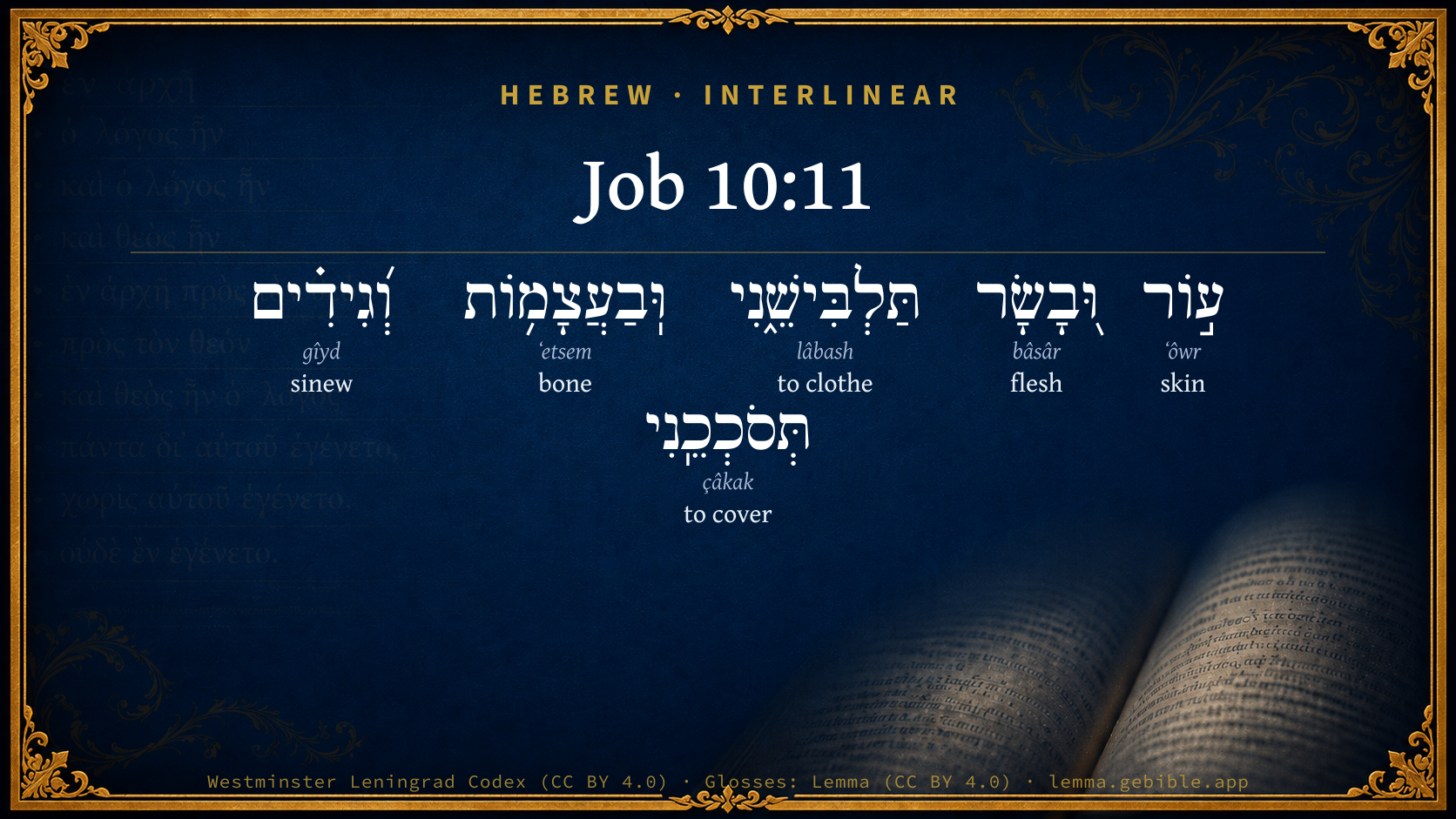
Job 10:11

Hebrew (Westminster Leningrad Codex) Job 10:11 appears in the Hebrew Old Testament. The text above is from the Westminster Leningrad Codex. Each word links to its Strong’s number, a concise gloss, and parsing drawn from the Open Scriptures Hebrew Bible morphology. Click any word for its full Brown-Driver-Briggs (BDB) entry.
Download image
Cite this verse

Job 10:11 (World English Bible). Public Domain. Lemma interlinear Bible study tool, https://lemma.gebible.app/v/job/10/11.

Show BibTeX & RIS
BibTeX
RIS
English Translation
You have clothed me with skin and flesh, And knit me together with bones and sinews.
World English Bible · Public Domain
Download a study sheet

One document with this verse’s original text, its word-by-word gloss line, the meaning frame, cross-references with their text, attributed commentary, and full source and license credits — printable, and it pastes into notes with its structure intact.

This verse Autodidact and up

Study sheet (.html) Plain text (.txt)

A passage Seminary Student

Up to 50 verses in one chapter. A passage sheet keeps up to 6 commentary sources and 12 cross-references per verse, in the order this page ranks them, and says so on the sheet whenever that leaves anything out. Ask for a single verse and you get the Autodidact verse sheet above.

Everything on this page stays free to read, with no account — the sheet is a download of what is already on screen, not access to it.

Want to remove ads? Support Godless Engineer
Compare translations 3

The same verse in 3 English versions, stacked beneath the original-language interlinear above. Click any original word for its lexicon entry.

Each is an independent rendering of the whole verse — the interlinear is not word-aligned to these translations.

Highlighted words mark where these versions differ — a whole-verse word diff, not a word-by-word alignment.

  • World English Bible Public Domain
    You have clothed me with skin and flesh, And knit me together with bones and sinews.
  • King James Version Public Domain
    Thou hast clothed me with skin and flesh, and hast fenced me with bones and sinews.
  • unfoldingWord Literal Text CC BY-SA 4.0
    You have clothed me with skin and flesh and you have knit me together with bones and tendons.

unfoldingWord Literal Text — © unfoldingWord, licensed CC BY-SA 4.0. Word-aligned USFM3 via Door43 (git.door43.org/unfoldingWord/en_ult).

Versions to compare (up to 4)

3 of 4 selected

Show all 18 translations

Every available English version of this verse, each an independent rendering of the whole verse.

  • World English Bible Public Domain
    You have clothed me with skin and flesh, And knit me together with bones and sinews.
  • Berean Standard Bible Public Domain
    You clothed me with skin and flesh, and knit me together with bones and sinews.
  • Majority Standard Bible Public Domain
    You clothed me with skin and flesh, and knit me together with bones and sinews.
  • King James Version Public Domain
    Thou hast clothed me with skin and flesh, and hast fenced me with bones and sinews.
  • American Standard Version (1901) Public Domain
    Thou hast clothed me with skin and flesh, And knit me together with bones and sinews.
  • Revised Version (1885) Public Domain
    Thou hast clothed me with skin and flesh, and knit me together with bones and sinews.
  • Geneva Bible (1599) Public Domain
    Thou hast clothed me with skin and flesh, and ioyned me together with bones and sinewes.
  • Douay-Rheims (1899) Public Domain
    Thou hast clothed me with skin and flesh: thou hast put me together with bones and sinews:
  • Young's Literal Translation Public Domain
    Skin and flesh Thou dost put on me, And with bones and sinews dost fence me.
  • Literal Standard Version CC BY-SA 4.0
    Skin and flesh You put on me, || And fence me with bones and sinews.
  • Unlocked Literal Bible CC BY-SA 4.0
    You have clothed me with skin and flesh and knit me together with bones and sinews.
  • unfoldingWord Literal Text CC BY-SA 4.0
    You have clothed me with skin and flesh and you have knit me together with bones and tendons.
  • Darby Bible Public Domain
    Thou hast clothed me with skin and flesh, and knit me together with bones and sinews;
  • World Messianic Bible Public Domain
    You have clothed me with skin and flesh, and knit me together with bones and sinews.
  • Webster's Bible Public Domain
    Thou hast clothed me with skin and flesh, and hast fenced me with bones and sinews.
  • Free Bible Version CC BY-SA 4.0
    You clothed me with skin and flesh; you wove my body together with bones and muscles.
  • Bible in Basic English Public Domain
    By you I was clothed with skin and flesh, and joined together with bones and muscles.
  • JPS Tanakh (1917) Public Domain
    Thou hast clothed me with skin and flesh, and knit me together with bones and sinews.

Literal Standard Version (2020), Covenant Press — licensed CC BY-SA 4.0. Text via the HelloAO Bible API (eBible.org). Unlocked Literal Bible (unfoldingWord) — licensed CC BY-SA 4.0. Text via the HelloAO Bible API (eBible.org). unfoldingWord Literal Text — © unfoldingWord, licensed CC BY-SA 4.0. Word-aligned USFM3 via Door43 (git.door43.org/unfoldingWord/en_ult). Free Bible Version, Dr. Jonathan Gallagher — licensed CC BY-SA 4.0. Text via the HelloAO Bible API (eBible.org).

Word by word

More ways to search: Search by grammar → Find every occurrence → Compare this word →

Practice this passage: Drill this verse → Learn its vocabulary →

About this verse

These counts appear in no published source. They are computed here, from the morphology-tagged text and Lemma’s own curated glosses. What Lemma adds →

6
words
6
distinct lemmas
Wisdom
section

Notable vocabulary

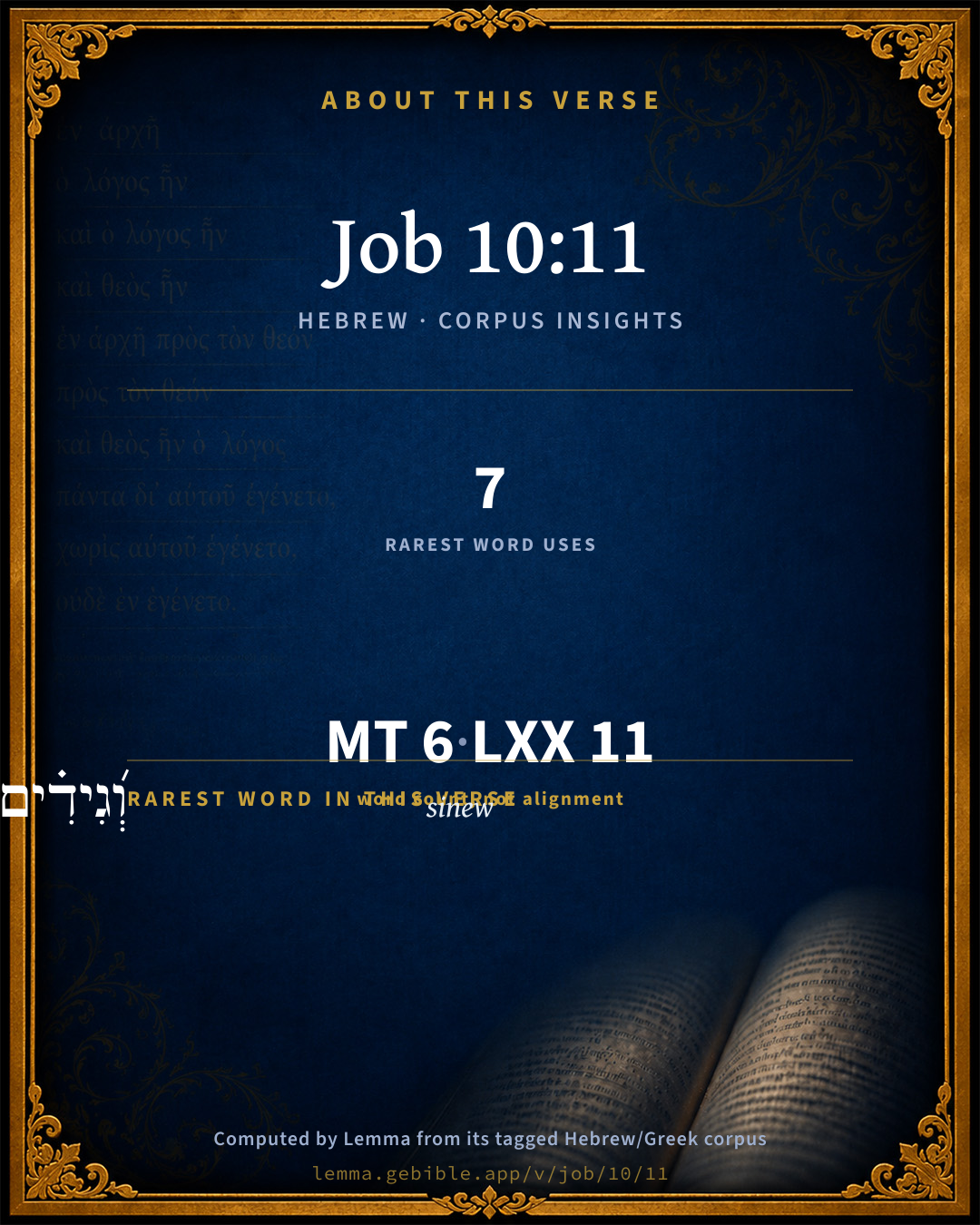
The rarest word here is וְ֝גִידִ֗ים sinew H1517 — appearing just 7 times in the whole Hebrew Bible.

Shared distinctive vocabulary

וְ֝גִידִ֗ים sinew H1517 occurs in 6 verses of the Hebrew Bible. Also found in:

Grammatical profile

  • 2 verbs
  • 4 nouns

Verb forms

  • תַּלְבִּישֵׁ֑נִי Hiphil · Imperfect
  • תְּסֹכְכֵֽנִי Poel · Imperfect

Hebrew & Septuagint length

In English translation the verse runs 16 words from the Hebrew and 16 from the Septuagint (LXX English) — the same length.

A rough comparison of the two English renderings, which tokenize alike — not a word-level alignment.

Word counts can differ between the Hebrew and the Greek without any difference in meaning — e.g. the Hebrew direct-object marker אֵת has no separate Greek word, and Greek often adds the article ὁ.

In the original languages it is 6 Hebrew tokens and 11 Greek tokens — but the two are counted differently (Hebrew bundles its prefixes and suffixes into one token; the Greek is in lemma form), so that isn’t a like-for-like length.

Cross-references

4

Topical passages linked to Job 10:11 in the Treasury of Scripture Knowledge — connected by theme and wording, ordered by reader-vote popularity; previews shown in the World English Bible.

  • Ezekiel 37:4–8 Again he said to me, Prophesy over these bones, and tell them, you dry bones, hear the word of Yahweh.
  • Job 40:17–18 He moves his tail like a cedar: The sinews of his thighs are knit together.
  • Ephesians 4:16 from whom all the body, being fitted and knit together through that which every joint supplies, according to the working in measure of each individual part, makes the body increase to the building up of itself in love.
  • 2 Corinthians 5:2–3 For most assuredly in this we groan, longing to be clothed with our habitation which is from heaven;

Cross-references courtesy of OpenBible.info (CC BY 4.0).

Hebrew and Greek witnesses Masoretic Hebrew ↔ Greek Septuagint

The same verse in the two great witnesses to the Old Testament, shown verse-for-verse.

These are two independent witnesses, not word-aligned to each other, and the Septuagint is shown in lemma (dictionary) form.

Hebrew Job 10:11 Masoretic · Westminster Leningrad Codex

ע֣וֹר וּ֭בָשָׂר תַּלְבִּישֵׁ֑נִי וּֽבַעֲצָמ֥וֹת וְ֝גִידִ֗ים תְּסֹכְכֵֽנִי

You have clothed me with skin and flesh, And knit me together with bones and sinews.

World English Bible · Public Domain

Greek LXX Job 10:11 Septuagint · lemma form

δέρμα καί κρέας ἐγώ ἐνδύω ὀστέον δέ καί νεῦρον ἐγώ ἐνεἴρω

And you did clothe me with skin and flesh, and frame me with bones and sinews.

LXX2012 (modern English Septuagint) · Public Domain

Hebrew: Westminster Leningrad Codex (CC BY 4.0). Greek: Septuagint (public domain); English from LXX2012 (modern English Septuagint) (Public Domain). How the Septuagint differs from the Hebrew →

Commentary

Notes on Job 10:11 from classic Christian and Jewish commentators (each source and its license shown beneath its notes). The classic Christian expositions comment on the surrounding passage and are grouped to its opening verse, so a note may address several verses; the Jewish commentaries on the Tanakh (Rashi and others) are per-verse, so they appear only where the commentator wrote on this verse.

Lemma curates 59 commentaries, every one of them public domain or Creative Commons licensed, each selected and text-cleaned for this edition rather than reprinted as found. About our sources →

Trapp's Complete Commentary

John Trapp

Job 10:11 Thou hast clothed me with skin and flesh, and hast fenced me with bones and sinews.

Ver. 11. Thou hast clothed me with skin and flesh] Out of that soft and liquid substance (the slime of my parents’ loins), grossed first into a rude fleshy mass, and consolidated, thou hast made not only a thin skin and firm flesh, but also hard bones and knitting nerves; and all this for a garment or guardment to those more noble inward parts, the brain, heart, liver, &c., which Job here accounts to be the man, when he saith, "Thou hast clothed me," that is, my vital parts, with the upper garment of skin, and with the under garment of flesh, all which, and the rest of the parts, both similar and organical, are in their origin but the same matter which God hath thus diversified, and all by the book, Psa 139:16. Had he left out any member in his common place book, thou hadst wanted it, saith one.

And hast fenced me with bones and sinews] Bones are the pillars of the body, giving it stability, straightness, and form. The Rabbis say, there are as many of them in man’s body as there are affirmative precepts in the law, that all his bones may say, Lord, who is like unto thee? &c., Psa 35:10. By the sinews are the bones knit together, that upon them man may move from place to place as he pleaseth. Sense also and motion is by these, in their wonderful and inexplicable conjugations, conveyed to the rest of the parts. It is God alone that knoweth how the bones (think the same of the sinews, arteries, veins, gristles, flesh, and blood, &c.) do grow in the womb of her that is with child, Ecc 11:5. The anatomists find out every day almost new wonders; and an ancient styles man the miracle of miracles. Besides what is seen, God hath packed many rarities, mysteries, yea, miracles together in man’s chest. And surely, saith Mr Caryl, if all the angels in heaven had studied to this day, they could not have cast man into a more curious mould, or have given a fairer or more correct edition of him.

John Trapp, A Commentary or Exposition upon All the Books of the Old and New Testament (1647–1656) — public domain. Text from a community e-Sword module.

Joseph Benson's Commentary

Job 10:11. Thou hast clothed me with skin — Covered my inward and more noble parts, which are first formed. So he proceeds in describing man’s formation gradually. And fenced me with bones — The stay and strength of the body; and some of them, as the scull and ribs, enclose and defend its vital parts.

Joseph Benson's Commentary on the Old and New Testaments (1811–1818) — public domain. Text from a community e-Sword module.

Jamieson, Fausset & Brown

Robert Jamieson, A. R. Fausset & David Brown

fenced--or "inlaid" (Psa 139:15); "curiously wrought" [UMBREIT]. In the fœtus the skin appears first, then the flesh, then the harder parts.

Jamieson, Fausset & Brown — Commentary Critical and Explanatory on the Whole Bible (1871) — public domain (CC PDM 1.0). Text via the HelloAO Bible API.

The Cambridge Bible for Schools and Colleges

gen. ed. J. J. S. Perowne

11. fenced me] Rather, woven, or, knit me.

The Cambridge Bible for Schools and Colleges (gen. ed. J. J. S. Perowne; Cambridge University Press, 1878–1918) — public domain. Text from a community e-Sword module.

John Gill's Exposition

Thou hast granted me life and favour,.... Or "lives" (q); natural life; both in the womb, where and when he was quickened, and at his birth, when he was brought into the world, and began to live in it; the rational soul may be intended, by which he lived; which, when created and infused into man, and united to his body, he becomes a living man; it is the presence of that which causes life, and the absence or removal of that which causes death; and this is a "grant" or gift from God, who gives to all his creatures life and breath, and all things; see Job 33:4; and is a "favour" also; a mercy, the chief of mercies; it is more than meat; yea, all a man has he will give for his life: besides this, Job had a spiritual life, a principle of it implanted in him; God had quickened him when dead in trespasses and sins; the spirit of life from Christ had entered into him, and he was become a living spiritual man: this likewise was a "grant" from God, a free grace gift of his; it is he that gives the living water, and gives it freely, or it would not be grace; for it is a "favour" which flows from the free grace and good will of God; it is owing to the great love wherewith he loves men that he quickens them; his time is a time of love, and so of life; and eternal life is the consequent of this, and is inseparably connected with it; and Job had an interest in it, a right unto it, and a meetness for it; he bad knowledge of it, faith in it, and hope of enjoying it, and knew that after death he should live this life; see Job 19:26; and this is a gift of God through Christ, owing to his good pleasure, the fruit of his favour and loving kindness: though by "favour" may be meant something distinct from life; either the care of him in the womb, and the taking of him out from thence, which are sometimes observed as singular mercies and favours; see Psa 22:9; or the beauty and comeliness of his body, such as was on Moses, David, and others; see Pro 31:30; or rather it intends in general all the temporal blessings of life, food and raiment, every thing necessary for the comfort and support of life; and which are all mercies and favours, and what men are undeserving of; and especially spiritual blessings, or the blessings of grace; and the word here used is often used for grace and mercy, and may signify the several graces of the Spirit bestowed in regeneration, as faith, hope, love, &c. which are all the gifts of God, and the effects of his favour and good will; as also the blessings of, justifying, pardoning, and adopting grace; all which Job was favoured with, as well as with supplies of grace from time to time, and the fresh discoveries of the favour and loving kindness of God to him, which is better than life:

and thy visitation hath preserved my spirit; kept him alive, in a natural sense, while in the womb, as Jarchi, where he was in a wonderful manner nourished; and when he came out from thence, exposed to many difficulties and dangers, and during his helpless and infant state, and amidst a variety of troubles throughout the whole of his life hitherto; and which was owing to God's visitation of him in a way of mercy every morning; and which was no other than his providence or daily care of him, and concern for him; and so Mr. Broughton renders it "thy providence" (r), and so some others: likewise he preserved his soul or spirit in a spiritual sense, in Christ Jesus, in whose bands he put him; he hid his life in him, and bound it up in the bundle of life with him; he kept him by his power as in a garrison, and preserved him safe to his kingdom and glory; and this is to be ascribed to his visitation of him in a way of grace, through the redemption of Christ, and the effectual calling of the blessed Spirit, and the constant supplies of grace vouchsafed from time to time: the Targum is, "thy remembrance": for it is owing to God's remembrance of his people that he visits them, either in providence or grace; and when he visits them with his providence, or with his gracious presence and protection, it is plain he remembers them: now since God had favoured him with such blessings of nature, providence, and grace, he reasons with him about his present circumstances; that, after all this, surely he would not destroy him and cut him off; at least he knew not how well to reconcile past favours with such hard and severe usage as he thought he met with from him.

(q) "vitas", Montanus, Bolducius. (r) "providentia tua", Tigurine version, Munster, Michaelis.

John Gill's Exposition of the Whole Bible (1746–1763) — public domain (CC PDM 1.0). Text via the HelloAO Bible API.

Albert Barnes' Notes on the Bible

Thou hast clothed me with skin and flesh - This refers, undoubtedly, to the formation of man in his foetal existence, and is designed to denote that the whole organization of the human frame was to be traced to God. Grotius remarks that this is the order in which the infant is formed - that the skin appears first, then the flesh, then the harder parts of the frame. On this subject, the reader may consult Dunglison’s Physiology, vol. ii. p. 340ff.

And hast fenced me - Margin, Hedged. Literally, Hast covered me. The sense is plain. God had formed him as he was, and to him he owed his life, and all that he had. Job asks with the deepest interest whether God would take down a frame formed in this manner, and reduce it again to dust? Would it not be more for his honor to preserve it still - at least to the common limit of human life?

Albert Barnes' Notes on the Bible (1834–1885) — public domain. Text from a community e-Sword/MySword module.

Matthew Poole's English Annotations

Clothed me, i.e. covered my inward and more noble parts; which, as philosophers and physicians observe, are first formed. So he proceeds in describing man’s formation gradually.

With bones and sinews; which are the stay and strength of the body; and some of them, as the skull and ribs, enclose and defend its vital and most noble parts.

Matthew Poole's English Annotations on the Holy Bible (1683–1685) — public domain. Text from a community e-Sword/MySword module.

Whedon's Commentary on the Bible

Daniel D. Whedon

11. Fenced me — Interwoven me. Just as we speak of muscular tissues, or the texture (texere, to weave) of a physical organ. The Scriptures ascribe the origin of each individual to the creative work of God, as much so as the existence of Adam. “The order of creative growth is here from soft to hard,” says Grotius. “The Jews hold that a contrary order is to be observed in the resurrection.”

Daniel D. Whedon (gen. ed.), Commentary on the Old and New Testaments (1874–1909) — public domain. Text from a community e-Sword module.

The Pulpit Commentary

Thou hast clothed me with skin and flesh. "To thee," that is, "I owe the delicate skin, which encloses my frame, and keeps it compact; to thee I owe the flesh whereof my frame chiefly consists." And hast fenced ms with bones and sinews; rather, and hast woven me"or knit me to gether. (see the Revised Version, and comp. Psa_139:13, where the same verb is used in the same sense) The idea is that the body altogether is woven and compacted of skin, bone, flesh, sinews, etc., into a delicate and elaborate garment. (comp. 2Co_5:2-4)

The Pulpit Commentary (1880–1919), ed. H.D.M. Spence-Jones & Joseph S. Exell — public domain. Text from a community e-Sword module.

John Wesley's Explanatory Notes

Clothed - Covered my inward and more noble parts; which are first formed. So he proceeds in describing man's formation gradually. Bones - The stay and strength of the body; and some of them, as the skull and ribs, enclose and defend its vital parts.

John Wesley, Explanatory Notes Upon the Whole Bible (1754–1765) — public domain. Text via the GEBible commentary corpus.

Lesson kit

Teaching starters — assembled from the data on this page, not authored interpretation. Every prompt links to the verse data it draws on. Edit before teaching.

Job, in the Wisdom, opens this verse with 6 words (6 distinct Hebrew lemmas). Its most distinctive word is gîyd (“sinew”). A historical commentator’s framing appears above. Read the whole chapter for the surrounding context.

Discussion questions

  1. What does “sinew” (gîyd) contribute to the verse as a whole?
  2. Genesis 32:32 shares the word «sinew» with this verse. How do the two illuminate each other?
  3. These translations render this verse differently. What is at stake in choosing one wording over another?
  4. The verb «תַּלְבִּישֵׁ֑נִי» is Hiphil Imperfect. How does its form color the action?
  5. Reading how Trapp's Complete Commentary and Joseph Benson's Commentary read this verse, where do the two commentators agree and where do they part?

Things to notice

Reading settings

Reading text

Shown beneath each verse's original-language words.

Old Testament
Old Testament edition

Read the OT as the Masoretic Hebrew (MT) or the Greek Septuagint (LXX).

English shown for the Greek Septuagint (in the Hebrew ↔ Greek comparison).

Comparing translations? Open the Compare panel on any verse page to stack up to four side by side.