
Deuteronomy 22:11

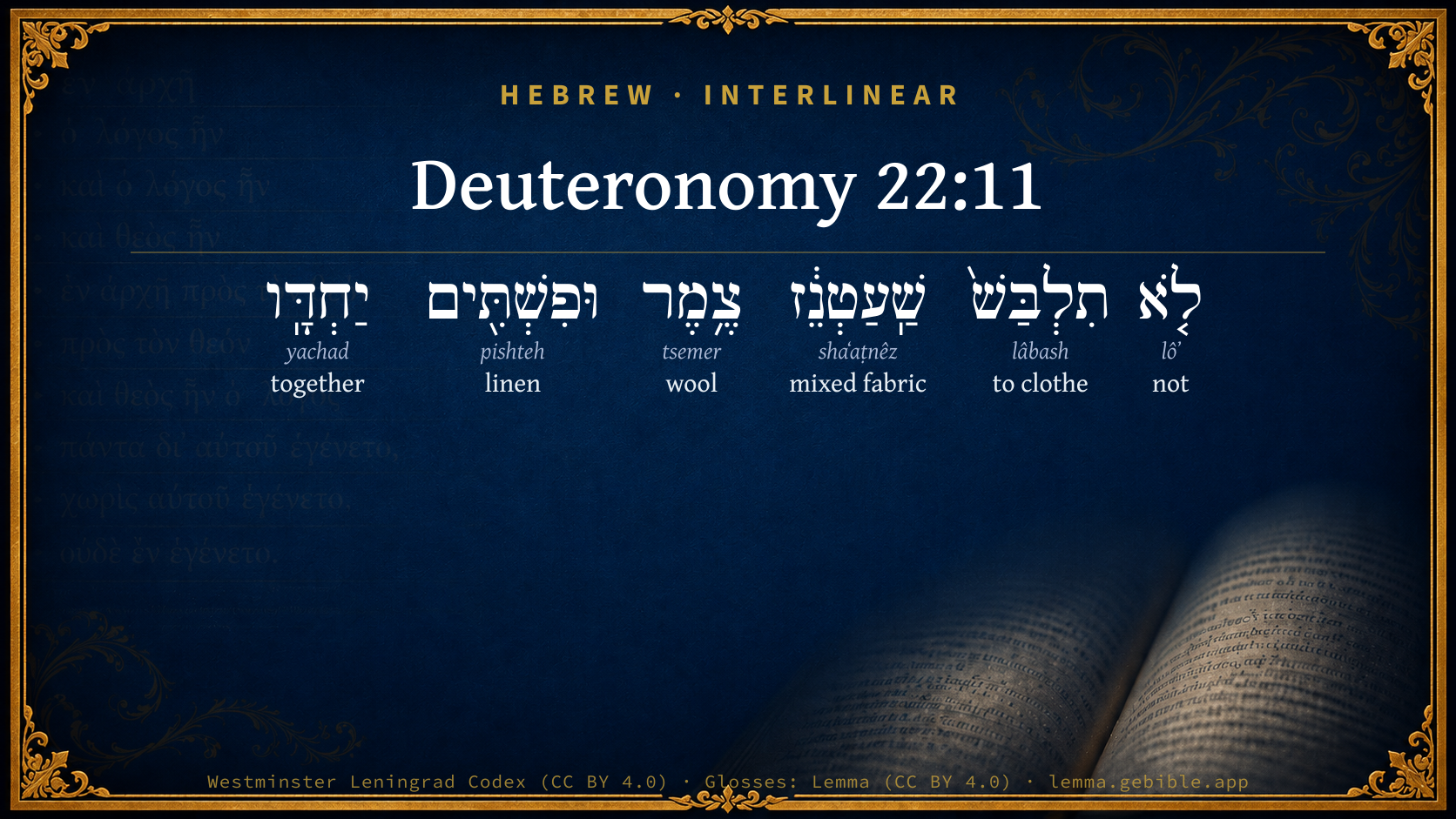
Hebrew (Westminster Leningrad Codex) Deuteronomy 22:11 appears in the Hebrew Old Testament. The text above is from the Westminster Leningrad Codex. Each word links to its Strong’s number, a concise gloss, and parsing drawn from the Open Scriptures Hebrew Bible morphology. Click any word for its full Brown-Driver-Briggs (BDB) entry.
Download image
Cite this verse

Deuteronomy 22:11 (World English Bible). Public Domain. Lemma interlinear Bible study tool, https://lemma.gebible.app/v/deuteronomy/22/11.

Show BibTeX & RIS
BibTeX
RIS
English Translation
You shall not wear a mixed stuff, wool and linen together.
World English Bible · Public Domain
Download a study sheet

One document with this verse’s original text, its word-by-word gloss line, the meaning frame, cross-references with their text, attributed commentary, and full source and license credits — printable, and it pastes into notes with its structure intact.

This verse Autodidact and up

Study sheet (.html) Plain text (.txt)

A passage Seminary Student

Up to 50 verses in one chapter. A passage sheet keeps up to 6 commentary sources and 12 cross-references per verse, in the order this page ranks them, and says so on the sheet whenever that leaves anything out. Ask for a single verse and you get the Autodidact verse sheet above.

Everything on this page stays free to read, with no account — the sheet is a download of what is already on screen, not access to it.

Want to remove ads? Support Godless Engineer
Compare translations 3

The same verse in 3 English versions, stacked beneath the original-language interlinear above. Click any original word for its lexicon entry.

Each is an independent rendering of the whole verse — the interlinear is not word-aligned to these translations.

Highlighted words mark where these versions differ — a whole-verse word diff, not a word-by-word alignment.

  • World English Bible Public Domain
    You shall not wear a mixed stuff, wool and linen together.
  • King James Version Public Domain
    Thou shalt not wear a garment of divers sorts, as of woolen and linen together.
  • unfoldingWord Literal Text CC BY-SA 4.0
    You shall not wear mixed material, wool and linen, together.

unfoldingWord Literal Text — © unfoldingWord, licensed CC BY-SA 4.0. Word-aligned USFM3 via Door43 (git.door43.org/unfoldingWord/en_ult).

Versions to compare (up to 4)

3 of 4 selected

Show all 18 translations

Every available English version of this verse, each an independent rendering of the whole verse.

  • World English Bible Public Domain
    You shall not wear a mixed stuff, wool and linen together.
  • Berean Standard Bible Public Domain
    Do not wear clothes of wool and linen woven together.
  • Majority Standard Bible Public Domain
    Do not wear clothes of wool and linen woven together.
  • King James Version Public Domain
    Thou shalt not wear a garment of divers sorts, as of woolen and linen together.
  • American Standard Version (1901) Public Domain
    Thou shalt not wear a mingled stuff, wool and linen together.
  • Revised Version (1885) Public Domain
    Thou shalt not wear a mingled stuff, wool and linen together.
  • Geneva Bible (1599) Public Domain
    Thou shalt not weare a garment of diuers sorts, as of woollen and linen together.
  • Douay-Rheims (1899) Public Domain
    Thou shalt not wear a garment that is woven of woollen and linen together.
  • Young's Literal Translation Public Domain
    `Thou dost not put on a mixed cloth, wool and linen together.
  • Literal Standard Version CC BY-SA 4.0
    You do not put on mixed material, wool and linens together.
  • Unlocked Literal Bible CC BY-SA 4.0
    You must not wear fabric made of wool and linen together.
  • unfoldingWord Literal Text CC BY-SA 4.0
    You shall not wear mixed material, wool and linen, together.
  • Darby Bible Public Domain
    Thou shalt not wear a garment of mixed material, [woven] of wool and linen together.
  • World Messianic Bible Public Domain
    You shall not wear clothes of wool and linen woven together.
  • Webster's Bible Public Domain
    Thou shalt not wear a garment of divers sorts, as of woolen and linen together.
  • Free Bible Version CC BY-SA 4.0
    Don't wear clothes made of wool and linen woven together.
  • Bible in Basic English Public Domain
    Do not have clothing made of two sorts of thread, wool and linen together.
  • JPS Tanakh (1917) Public Domain
    Thou shalt not wear a mingled stuff, wool and linen together.

Literal Standard Version (2020), Covenant Press — licensed CC BY-SA 4.0. Text via the HelloAO Bible API (eBible.org). Unlocked Literal Bible (unfoldingWord) — licensed CC BY-SA 4.0. Text via the HelloAO Bible API (eBible.org). unfoldingWord Literal Text — © unfoldingWord, licensed CC BY-SA 4.0. Word-aligned USFM3 via Door43 (git.door43.org/unfoldingWord/en_ult). Free Bible Version, Dr. Jonathan Gallagher — licensed CC BY-SA 4.0. Text via the HelloAO Bible API (eBible.org).

Word by word

More ways to search: Search by grammar → Find every occurrence → Compare this word →

Practice this passage: Drill this verse → Learn its vocabulary →

About this verse

These counts appear in no published source. They are computed here, from the morphology-tagged text and Lemma’s own curated glosses. What Lemma adds →

6
words
6
distinct lemmas
Pentateuch
section

Notable vocabulary

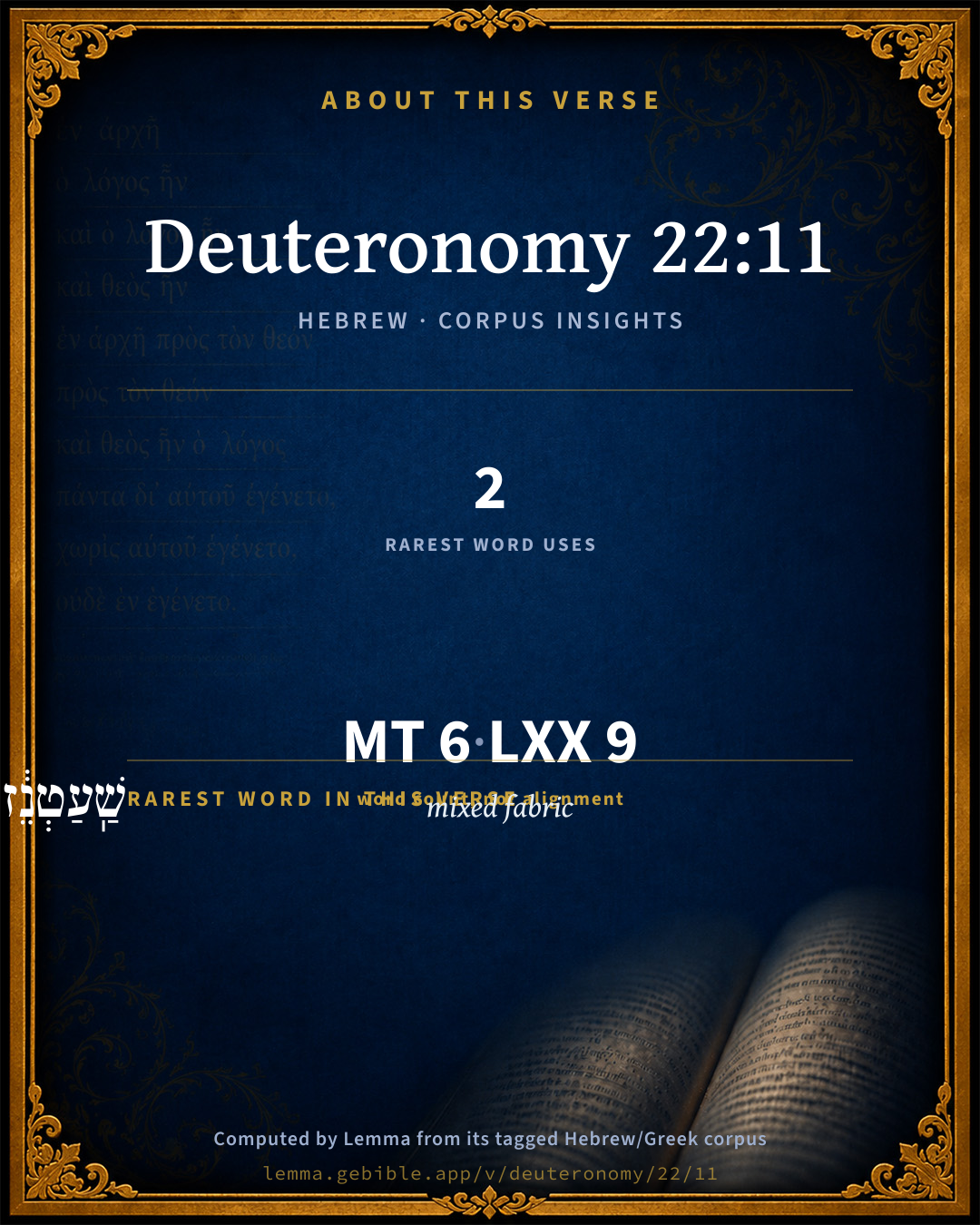
The rarest word here is שַֽׁעַטְנֵ֔ז mixed fabric H8162 — appearing just 2 times in the whole Hebrew Bible.

Shared distinctive vocabulary

שַֽׁעַטְנֵ֔ז mixed fabric H8162 occurs in 2 verses of the Hebrew Bible. Also found in:

Grammatical profile

  • 1 verb
  • 3 nouns
  • 1 adverb
  • 1 particle

Verb forms

  • תִלְבַּשׁ֙ Qal · Imperfect

Hebrew & Septuagint length

In English translation the verse runs 11 words from the Hebrew and 11 from the Septuagint (LXX English) — the same length.

A rough comparison of the two English renderings, which tokenize alike — not a word-level alignment.

Word counts can differ between the Hebrew and the Greek without any difference in meaning — e.g. the Hebrew direct-object marker אֵת has no separate Greek word, and Greek often adds the article ὁ.

In the original languages it is 6 Hebrew tokens and 9 Greek tokens — but the two are counted differently (Hebrew bundles its prefixes and suffixes into one token; the Greek is in lemma form), so that isn’t a like-for-like length.

Cross-references

1

Topical passages linked to Deuteronomy 22:11 in the Treasury of Scripture Knowledge — connected by theme and wording, ordered by reader-vote popularity; previews shown in the World English Bible.

  • Leviticus 19:19 "'You shall keep my statutes. "'You shall not crossbreed different kinds of animals. "'you shall not sow your field with two kinds of seed; "'neither shall there come upon on you a garment made of two kinds of material.

Cross-references courtesy of OpenBible.info (CC BY 4.0).

Hebrew and Greek witnesses Masoretic Hebrew ↔ Greek Septuagint

The same verse in the two great witnesses to the Old Testament, shown verse-for-verse.

These are two independent witnesses, not word-aligned to each other, and the Septuagint is shown in lemma (dictionary) form.

Hebrew Deuteronomy 22:11 Masoretic · Westminster Leningrad Codex

לֹ֤א תִלְבַּשׁ֙ שַֽׁעַטְנֵ֔ז צֶ֥מֶר וּפִשְׁתִּ֖ים יַחְדָּֽו

You shall not wear a mixed stuff, wool and linen together.

World English Bible · Public Domain

Greek LXX Deuteronomy 22:11 Septuagint · lemma form

οὐ ἐνδύω κίβδηλος ἔριον καί λίνον ἐν ὁ αὐτός

You shall not wear a mingled garment, woollen and linen together.

LXX2012 (modern English Septuagint) · Public Domain

On this verse, The Cambridge Bible for Schools and Colleges discusses the Septuagint’s reading. Read the note in Commentary ↓

Hebrew: Westminster Leningrad Codex (CC BY 4.0). Greek: Septuagint (public domain); English from LXX2012 (modern English Septuagint) (Public Domain). How the Septuagint differs from the Hebrew →

Targum (Aramaic paraphrase)

2

The Targum is the ancient Jewish Aramaic paraphrase of the Hebrew Scriptures — an interpretive translation, not the Hebrew text itself. Onkelos (literal) and Pseudo-Jonathan (expansive) render the Torah, and Jonathan the Prophets. Coverage is partial: where no permissively-licensed English translation exists for a verse, only the Aramaic is shown. This is verse-level text, not a word-by-word alignment to the Hebrew.

  1. Targum Onkelos Torah (Genesis–Deuteronomy)
    לָא תִלְבַּשּׁ שַׁעַטְנֵזָא עֲמַר וְכִתָּן מְחֻבַּר כַּחֲדָא

    (no public-domain English translation for this verse)

    Targum Onkelos — Aramaic: “Onkelos Genesis” (public domain); “Onkelos Exodus” (public domain); “Onkelos Leviticus” (public domain); “Onkelos Numbers” (public domain); “Onkelos Deuteronomy” (public domain). English: “Sefaria Community Translation” (CC0 1.0 (public-domain dedication)); “J.W. Etheridge. The Targums of Onkelos and Jonathan Ben Uzziel on the Pentateuch. London: Longmans, Green, 1862” (public domain). Text via Sefaria.

  2. Targum Pseudo-Jonathan Torah (Genesis–Deuteronomy)
    לָא תֶהֱווֹן לָבְשׁוּן וּמִשְׁתַּחֲנִין בִּכְסוּ דְּשִׁיעַ וְעָזֵיל וְנֵיז עֲמַר וְכִיתָּן מְעַרְבִין כַּחֲדָא

    You shall not clothe nor warm yourselves with a garment combed (carded) or netted, or interwoven with woollen and linen mixed together.

    Targum Pseudo-Jonathan — Aramaic: “Targum Jonathan on Genesis” (public domain); “Targum Jonathan on Exodus” (public domain); “Targum Jonathan on Leviticus” (public domain); “Targum Jonathan on Numbers” (public domain); “Targum Jonathan on Deuteronomy” (public domain). English: “The Targum of Jonathan ben Uzziel, trans. J. W. Etheridge, London, 1862” (public domain). Text via Sefaria.

Commentary

Notes on Deuteronomy 22:11 from classic Christian and Jewish commentators (each source and its license shown beneath its notes). The classic Christian expositions comment on the surrounding passage and are grouped to its opening verse, so a note may address several verses; the Jewish commentaries on the Tanakh (Rashi and others) are per-verse, so they appear only where the commentator wrote on this verse.

Lemma curates 59 commentaries, every one of them public domain or Creative Commons licensed, each selected and text-cleaned for this edition rather than reprinted as found. About our sources →

The Biblical Illustrator

Joseph S. Exell

Deu_22:11

Thou shalt not wear a garment of divers sorts.

The moral and the positive in the duties of life

I. That this precept exhibits a positive duty. The ground of this ordinance is to be sought for, not in the nature of things, but in the will of God.

II. That as the inculcation of a positive duty the precept of the text was not so binding upon the Jews as those duties which were wholly moral. A Jew might be reduced to the alternative either of wearing no garment at all, or of wearing one woven of woollen and linen together. The preservation of health is a moral duty, and therefore more important than the observance of a ritual precept.

III. That we, who live under the Gospel dispensation, are not bound to observe this precept at all. Neither sowing your fields with wheat and rye together, nor ploughing with horses and oxen together, nor wearing a garment of wool, or of linen, or of divers sorts, availeth anything, but a new creature.

IV. That while we are under no manner of obligation to observe this precept in its literal meaning, still the moral principle which underlies that meaning, and which it was intended to illustrate, is as binding now as ever--as binding upon us as it was upon the Jews. This prohibition, in its primary application to the Israelites, was doubtless intended to show that they were not to mingle themselves with the heathen, nor to weave any of the usages of the Gentiles into the ordinances of God. This is the spirit of the precept, and it is as binding upon us as it was upon them. We are to avoid an accommodating way of dealing with the Divine law. We are not to alter its sacred principles to suit the temper of the times, and the habits of the world. (R. Harley.)

The robe of Christs righteousness, and the sin of wearing anything with it

I. The robe of righteousness which all Gods people must wear. It may perhaps be said, that as the text merely forbids our interweaving woollen and linen together, it leaves it at our choice whether the garment of our salvation shall be woollen or linen. But it is not so. It must be of linen, and of fine linen only (Rev_19:7-8). This robe of righteousness is for two purposes.

1. For their justification. The robe of righteousness must not only be such as Jehovah can accept, but it must be such as He cannot reject--it must be the pure, perfect, supernatural, Divine righteousness of an incarnate God.

2. And this robe of righteousness is not only for our justification, but for our sanctification also. The man who has the robe of Christs righteousness upon him, must have the influences of Christs Spirit within him, for it is only by our sanctification that we can prove the reality of our justification. There is a renewing process as well as a reconciling one.

II. The offensiveness of all attempts to weave anything with it.

1. It is an insult to God the Father, who has determined that every child of His family shall be habited in the one robe of the family--the perfect spotless garment of His only begotten Son, unto and upon all them that believe. How, then, must that man expect to be dealt with, who, in the wantonness of his resistance to Gods method of salvation, shall refuse to rest solely on the righteousness of Gods own Son, or shall dream of adding thereto his own imperfect and perishable doings? The consequence can only be, that all the sanctions and severities of Gods unchanging law will be let loose upon him in all their force, if he ventures either on his own merits only, in a woollen garment, or conjointly on his own and on the Saviours in a garment of linen and woollen together, and thus refuse his undivided reliance on Him alone, who magnified the law and made it honourable.

2. Nor, assuredly, is there less insult offered to God the Son, in this attempt to combine works and grace in the matter of salvation. For what purpose was His mission to our world? Did He not pour out His soul an offering for sin, and by His obedience unto death bring in everlasting righteousness? Think you, then, that this great and gracious Saviour will consent to be insulted by mens attempts to join their works with His, and to wear a garment of divers sorts, as of woollen and linen together, when the fine linen only of His finished work--dyed in His precious blood--is the righteousness of the saints? Know ye not that He lays an absolute claim to all the honour of our salvation? That He will suffer no righteousness to be put in competition with His? That He will not give His glory, nor the least degree of it, to another? (R. C. Dillon, D. D.)

The linsey-woolsey garment

The woollen garment in the text is a shadow of the righteousness of the law or the righteousness of works; the linen also is a shadow of the righteousness of faith, or Christs righteousness. To speak after the manner of the Gospel, the text teacheth us not to blend both together. There are three sorts of preachers who receive the Scripture and confess the God of Abraham.

1. The first are such as preach the law alone, and these are generally Jews, and men of their spirit.

2. The second sort are evangelists or true Gospel preachers, ministers of the New Testament, who preach only the Lord our righteousness, and who will know nothing among their congregations, and souls committed to their charge, but Jesus Christ and Him crucified.

3. There are others who sin against the law, and against the Gospel, blending both together, and teaching the people to wear the garment of linen and woollen, of all which I intend to speak freely. I do not wonder that St. Peter calls the law a yoke, which neither they nor their fathers could bear, because it must have been so to them who heard not plainly of Jesus and His salvation. Who, under the law, could have any comfort when he knew he was under the curse as long as he continued not in all things of the book of the law to do them? The more sincere the more unhappy such were who served under the law, and heard of no way to heaven but a perfect obedience to all the ordinances of God. The true Christian preacher is one whom the God of the whole earth, the Lord who gave the law, has taught, and who is convinced that the law was given to make sin known, and to make it more exceedingly sinful, and that righteousness comes not by that means, but by Christ Jesus, who is become righteousness to everyone that believeth; and having heard the Gospel with ears to hear, and having understood the gracious sayings of Jesus, and been a witness himself both of the deplorable estate under the law and the deliverance by the merits and Cross of the Lamb, determines only to know and preach Him crucified everywhere. This is the only white linen, the only righteousness which the saints wear above, and which can make them beautiful and fair in the eyes of God Almighty, and in the sight of His holy angels. There are yet other preachers who, in a measure, preach the law, and seem as if they believed morality and obedience were the only cause of our being accepted with God. They insist upon the necessity of making ourselves righteous, but lest they should awaken the consciences of those who hear them, they tell them, When you have done all you can, Christ will do the rest; He will make perfect your good works with His righteousness; you must begin and set about the work by repenting and living a religious life; and if that is not sufficient, when you come to die He will supply the deficiency and make it up with His merits. This is the device of man entirely, and cannot be found in all the Scripture. This is crying peace when there is no peace, and healing the wound slightly. This is mingling the woollen and linen together, and making the commandment of God void by the traditions of men. However the Lord approves of the faithfulness of His people, and will greatly reward their good works and labours of love which have been done for his names sake, and blames such whose works were faulty; yet that righteousness which saves the soul, and is the only proper righteousness, is the obedience, sufferings, and merits of our crucified God and Lord Jesus Christ; and this is imputed to us by believing in Him. This was the way in which the father of the faithful found righteousness, and was justified in the eight of God, and in this only a soul can be clothed at the great day. Have you never made any show of religion, but have lived altogether without seeking righteousness hitherto? Now let it be so no more; come now to Jesus, the Friend of publicans and sinners, and He who hanged naked on the Cross will hide your shame. Or, are you devout and religious? Have you attempted by the law and striven by works to become righteous, and when ye failed patched up your rags with Christs merits, Gods mercy, and the like? Have ye, to quiet your conscience, mingled the woollen and linen together? Now, then, throw away the linsey-woolsey cloth, the forbidden garment, the unclean and illegal dress, and approach naked to Him who clothes the lilies of the field, and He will be your covering, and you shall appear at His wedding in linen clean and white. (John Cennick.)

The unmixed garment

1. Such a command may seem very strange to us--that they were not to mix wool and linen in the same garment; but after mature reflection, we are led to see the infinite care God has over the smallest interests of His people; it shows, also, that God sees an infinite fitness of things which is too fine for our gross apprehension.

2. Scripture has its only true and preeminent meaning when applied to the inner moral robing of Christians. We are not to have our souls garniture mixed, partly of the wool of carnality and partly of the linen of spirituality. Grant that the great majority of believers, or more strictly half-believers, are sadly mixed in their religious character and experience; grant also that every Christian is mixed--partly spiritual and partly carnal--in the first stage of grace, yet the only and universal standard in the Scriptures of Divine truth is unmixedness of moral character. (H. Daniel.)

.

The Biblical Illustrator, edited by Joseph S. Exell (c. 1880s–1900s) — public domain. Text from a community e-Sword module.

Tyndale Open Study Notes

Tyndale Open Resources

22:11 Keeping wool and linen separate illustrated Israel’s separation as God’s holy people (see also Lev 19:19).

Tyndale Open Study Notes — © Tyndale Open Resources, licensed CC BY-SA 4.0. Text via the HelloAO Bible API.

Jamieson, Fausset & Brown

Robert Jamieson, A. R. Fausset & David Brown

thou shalt not wear a garment of divers sorts--The essence of the crime (Zep 1:8) consisted, not in wearing a woollen and a linen robe, but in the two stuffs being woven together, according to a favorite superstition of ancient idolaters (see on Lev 19:19).

Jamieson, Fausset & Brown — Commentary Critical and Explanatory on the Whole Bible (1871) — public domain (CC PDM 1.0). Text via the HelloAO Bible API.

Ellicott's Commentary for English Readers

(11) A garment . . . of woollen and linen together.—In Eze_44:17-18, the priests are altogether forbidden the use of woollen garments during their ministry. “The fine linen is the righteousness of saints” (Rev_19:8), literally, their requirements. That is what they need. But it is said of the priests in Ezekiel, “They shall not gird themselves with anything that causeth sweat: That which cometh out of the man defileth him.” Again, in God’s dwelling-place, the interior or mishkân, the tabernacle where He abode, was of fine linen. The outer tent and coverings were of hair and skin and wool. The tabernacle where He dwells, and the earthly house of the tabernacle, must be kept distinct, while His tabernacle “remaineth among us in the midst of our uncleanness.” (See Lev_16:16).

A Bible Commentary for English Readers, edited by Charles John Ellicott (1878–1897) — public domain. Text from a community e-Sword module.

The Cambridge Bible for Schools and Colleges

gen. ed. J. J. S. Perowne

11. a mingled stuff] Heb. sha‘aṭnez, a foreign word, and perhaps Egyptian (doubtfully derived from the Coptic saht, ‘woven,’ and nudj, ‘false’), LXX κίβδηλος. Also in Lev_19:19, which has a garment of two kinds for the wool and linen together of D. According to Hos_2:5; Hos_2:9, Israel attributed her wool and flax (and other products) to the Baalîm, and if as is probable different products were attributed to different Baals we have a confirmation of the theory stated above in the introd. note. Josephus, IV. Antt. Deu_8:11, gives another reason.

The Cambridge Bible for Schools and Colleges (gen. ed. J. J. S. Perowne; Cambridge University Press, 1878–1918) — public domain. Text from a community e-Sword module.

John Gill's Exposition

Thou shalt not wear a garment of divers sorts,.... The Jews say nothing is forbidden under the name of sorts but what is spun and wove, as it is said, "thou shalt not wear sheatnez", a thing that is carded, spun, and wove (l); which Ainsworth translates "linsie woolsie", and is explained by what follows: as "of woollen and linen together"; of which See Gill on Lev 19:19, whereas Josephus (m) observes, this was granted to the priests only to wear such garments. Bochart (n) affirms it to be false; but that great man is mistaken; the blue, purple, and scarlet, in the priests' garments, were no other than dyed wool; and it is a sentiment in general received by the Jews, that the priests wore no other but woollen and linen in their service; see the note on the above place; otherwise this law is so strictly observed, as not, to sew a woollen garment with linen thread, and so on the contrary (o).

(l) Misn. Celaim. c. 9. sect. 8. (m) Antiqu. l. 4. c. 8. sect. 11. (n) Hierozoic. par. 1. l. 2. c. 45. col. 491. (o) Leo Modena's History of Rites, &c. l. 1. c. 5.

John Gill's Exposition of the Whole Bible (1746–1763) — public domain (CC PDM 1.0). Text via the HelloAO Bible API.

Haydock's Catholic Bible Commentary

Together. This is now lawful. But a virgin consecrated to God, must not dress like a married woman: the different states of life must not be confounded. (St. Augustine, contra Faustus vi. 9.) (Du Hamel)

George Leo Haydock (1774–1849), Haydock's Catholic Family Bible and Commentary, 1859 edition — public domain. Excludes Psalms (Douay-Rheims chapter numbering differs from Protestant) and Deuterocanonical books (Catholic canon only).

The Pulpit Commentary

A garment of diverse sorts; sha"atnez, a kind of cloth in which threads of linen and threads of woollen were interwoven. The meaning of the word is uncertain. The LXX render by kibdhlov, "spurious, bad;" Aquila, by ajntidiakeimenon, "variously disposed, diverse." No Semitic etymology can be found for the word, and as the Hebrews derived the textile art from Egypt, the home of that art, the word is probably of Egyptian origin.

The Pulpit Commentary (1880–1919), ed. H.D.M. Spence-Jones & Joseph S. Exell — public domain. Text from a community e-Sword module.

Rashi

Rabbi Shlomo Yitzchaki (Rashi)

שעטנז is an expression for a mixture. Our Rabbis explained it to mean a material that is calendered (pressed, שוע), or woven (טווי), or twisted (נוז) together (Sifrei Devarim 232:1); (שעטנז is taken to be an abbreviation of these words; cf. Rashi on Leviticus 19:19 and our Note thereon).

Rashi on the Tanakh — English translations: “The Judaica Press complete Tanach with Rashi, translated by A. J. Rosenberg” (CC BY 4.0); “Pentateuch with Rashi's commentary by M. Rosenbaum and A.M. Silbermann, 1929-1934” (public domain); “The Metsudah Tanach series, Lakewood, N.J” (CC BY 4.0); and “The Book of Joshua, Metsudah Publications, 1997” (CC BY 4.0). Text via Sefaria.

Lesson kit

Teaching starters — assembled from the data on this page, not authored interpretation. Every prompt links to the verse data it draws on. Edit before teaching.

Deuteronomy, in the Pentateuch, opens this verse with 6 words (6 distinct Hebrew lemmas). Its most distinctive word is shaʻaṭnêz (“mixed fabric”). A historical commentator’s framing appears above. Read the whole chapter for the surrounding context.

Discussion questions

  1. The word shaʻaṭnêz carries the sense “mixed fabric.” How does it shape the verse?
  2. How does Leviticus 19:19, which shares the word «mixed fabric», read alongside this verse?
  3. The translations on this page render this verse differently — a whole-verse word diff, not a word-by-word alignment. What might account for the different wordings?
  4. «תִלְבַּשׁ֙» is a Qal Imperfect verb. How does that grammatical form shape the action described?
  5. Compare how The Biblical Illustrator and Tyndale Open Study Notes read this verse. Where do they agree or differ?

Things to notice

Reading settings

Reading text

Shown beneath each verse's original-language words.

Old Testament
Old Testament edition

Read the OT as the Masoretic Hebrew (MT) or the Greek Septuagint (LXX).

English shown for the Greek Septuagint (in the Hebrew ↔ Greek comparison).

Comparing translations? Open the Compare panel on any verse page to stack up to four side by side.