Zephaniah 1:8

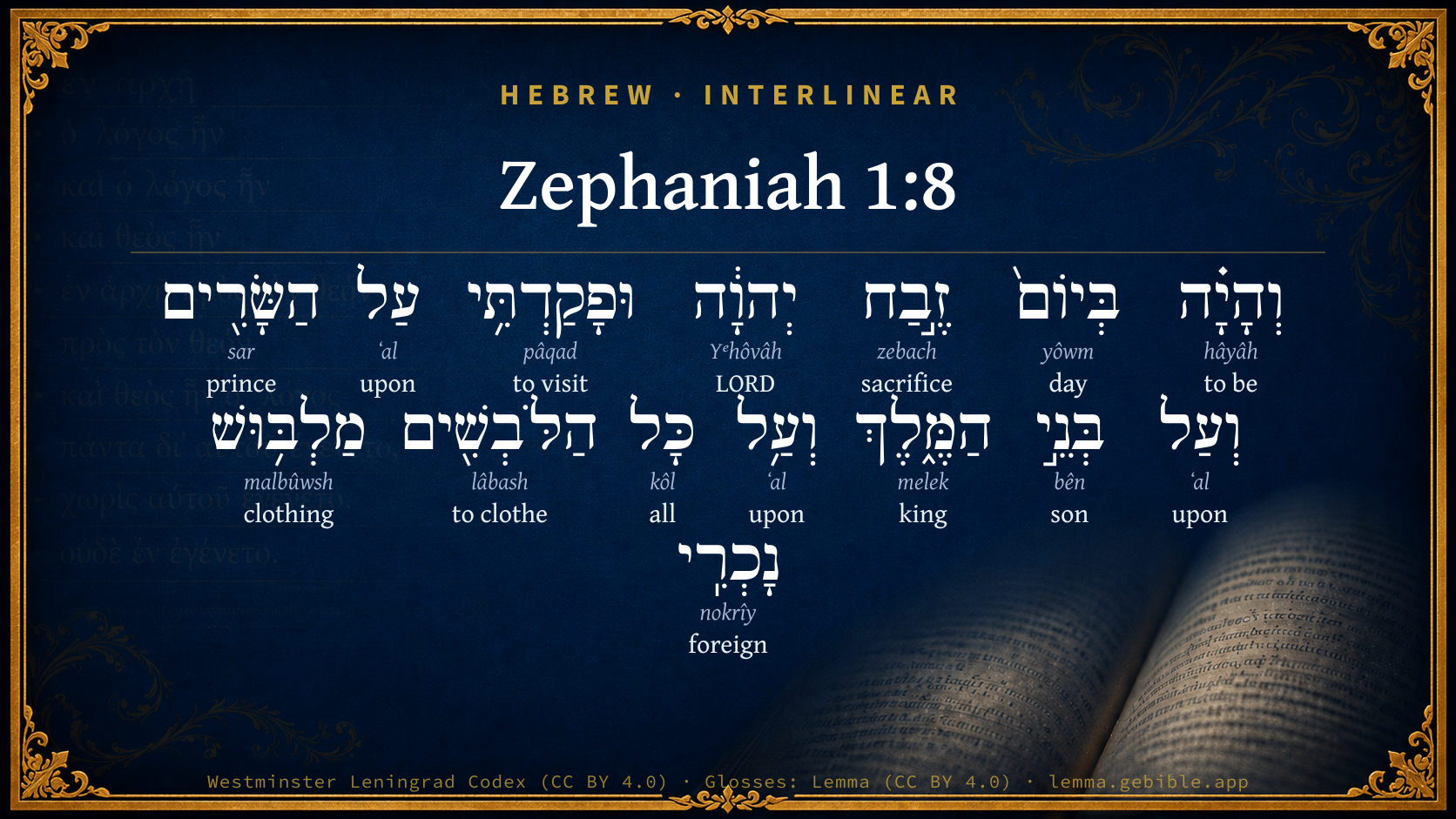
Hebrew (Westminster Leningrad Codex) Zephaniah 1:8 appears in the Hebrew Old Testament. The text above is from the Westminster Leningrad Codex. Each word links to its Strong’s number, a concise gloss, and parsing drawn from the Open Scriptures Hebrew Bible morphology. Click any word for its full Brown-Driver-Briggs (BDB) entry.
Download image
Cite this verse

Zephaniah 1:8 (World English Bible). Public Domain. Lemma interlinear Bible study tool, https://lemma.gebible.app/v/zephaniah/1/8.

Show BibTeX & RIS
BibTeX
RIS
English Translation
It will happen in the day of Yahweh's sacrifice, that I will punish the princes, the king's sons, and all those who as are clothed with foreign clothing.
World English Bible · Public Domain
Download a study sheet

One document with this verse’s original text, its word-by-word gloss line, the meaning frame, cross-references with their text, attributed commentary, and full source and license credits — printable, and it pastes into notes with its structure intact.

This verse Autodidact and up

Study sheet (.html) Plain text (.txt)

A passage Seminary Student

Up to 50 verses in one chapter. A passage sheet keeps up to 6 commentary sources and 12 cross-references per verse, in the order this page ranks them, and says so on the sheet whenever that leaves anything out. Ask for a single verse and you get the Autodidact verse sheet above.

Everything on this page stays free to read, with no account — the sheet is a download of what is already on screen, not access to it.

Want to remove ads? Support Godless Engineer
Compare translations 3

The same verse in 3 English versions, stacked beneath the original-language interlinear above. Click any original word for its lexicon entry.

Each is an independent rendering of the whole verse — the interlinear is not word-aligned to these translations.

Highlighted words mark where these versions differ — a whole-verse word diff, not a word-by-word alignment.

  • World English Bible Public Domain
    It will happen in the day of Yahweh's sacrifice, that I will punish the princes, the king's sons, and all those who as are clothed with foreign clothing.
  • King James Version Public Domain
    And it shall come to pass in the day of the LORD's sacrifice, that I will punish the princes, and the king's children, and all such as are clothed with strange apparel.
  • unfoldingWord Literal Text CC BY-SA 4.0
    “And it will happen on the day of the sacrifice of Yahweh that I will visit upon the princes and upon the sons of the king and upon all the ones wearing foreign clothing,

unfoldingWord Literal Text — © unfoldingWord, licensed CC BY-SA 4.0. Word-aligned USFM3 via Door43 (git.door43.org/unfoldingWord/en_ult).

Versions to compare (up to 4)

3 of 4 selected

Show all 18 translations

Every available English version of this verse, each an independent rendering of the whole verse.

  • World English Bible Public Domain
    It will happen in the day of Yahweh's sacrifice, that I will punish the princes, the king's sons, and all those who as are clothed with foreign clothing.
  • Berean Standard Bible Public Domain
    “On the Day of the LORD’s sacrifice I will punish the princes, the sons of the king, and all who are dressed in foreign apparel.
  • Majority Standard Bible Public Domain
    “On the Day of the LORD’s sacrifice I will punish the princes, the sons of the king, and all who are dressed in foreign apparel.
  • King James Version Public Domain
    And it shall come to pass in the day of the LORD's sacrifice, that I will punish the princes, and the king's children, and all such as are clothed with strange apparel.
  • American Standard Version (1901) Public Domain
    And it shall come to pass in the day of Jehovah's sacrifice, that I will punish the princes, and the king's sons, and all such as are clothed with foreign apparel.
  • Revised Version (1885) Public Domain
    And it shall come to pass in the day of the LORD’S sacrifice, that I will punish the princes, and the king’s sons, and all such as are clothed with foreign apparel.
  • Geneva Bible (1599) Public Domain
    And it shalbe in the day of the Lords sacrifice, that I will visite the princes and the Kings children, and all such as are clothed with strange apparell.
  • Douay-Rheims (1899) Public Domain
    And it shall come to pass in the day of the victim of the Lord, that I will visit upon the princes, and upon the king's sons, and upon all such as are clothed with strange apparel.
  • Young's Literal Translation Public Domain
    And it hath come to pass, In the day of the sacrifice of Jehovah, That I have laid a charge on the heads, And on sons of the king, And on all putting on strange clothing.
  • Literal Standard Version CC BY-SA 4.0
    “And it has come to pass, || In the day of the sacrifice of YHWH, || That I have laid a charge on the heads, || And on sons of the king, || And on all putting on strange clothing.
  • Unlocked Literal Bible CC BY-SA 4.0
    “It will come about on the day of Yahweh's sacrifice, that I will punish the princes and the king's sons, and everyone dressed in foreign clothes.
  • unfoldingWord Literal Text CC BY-SA 4.0
    “And it will happen on the day of the sacrifice of Yahweh that I will visit upon the princes and upon the sons of the king and upon all the ones wearing foreign clothing,
  • Darby Bible Public Domain
    And it shall come to pass in the day of Jehovah's sacrifice, that I will punish the princes, and the king's sons, and all such as are clothed with foreign apparel.
  • World Messianic Bible Public Domain
    It will happen in the day of the LORD’s sacrifice that I will punish the princes, the king’s sons, and all those who are clothed with foreign clothing.
  • Webster's Bible Public Domain
    And it shall come to pass in the day of the LORD'S sacrifice, that I will punish the princes, and the king's children, and all such as are clothed with foreign apparel.
  • Free Bible Version CC BY-SA 4.0
    Then on the day of the Lord's sacrifice I will punish the officials and the king's sons, and those who follow pagan ways.
  • Bible in Basic English Public Domain
    And it will come about in the day of the Lord's offering, that I will send punishment on the rulers and the king's sons and all who are clothed in robes from strange lands.
  • JPS Tanakh (1917) Public Domain
    And it shall come to pass in the day of the LORD'S sacrifice, that I will punish the princes, and the king's sons, and all such as are clothed with foreign apparel.

Literal Standard Version (2020), Covenant Press — licensed CC BY-SA 4.0. Text via the HelloAO Bible API (eBible.org). Unlocked Literal Bible (unfoldingWord) — licensed CC BY-SA 4.0. Text via the HelloAO Bible API (eBible.org). unfoldingWord Literal Text — © unfoldingWord, licensed CC BY-SA 4.0. Word-aligned USFM3 via Door43 (git.door43.org/unfoldingWord/en_ult). Free Bible Version, Dr. Jonathan Gallagher — licensed CC BY-SA 4.0. Text via the HelloAO Bible API (eBible.org).

Word by word

More ways to search: Search by grammar → Find every occurrence → Compare this word →

Practice this passage: Drill this verse → Learn its vocabulary →

מַלְבּ֥וּשׁ
malbûwsh
H4403
“clothing”
Noun, Common, Masculine, Singular, Absolute
Part of Speech
Noun
Type
Common
Gender
Masculine
Number
Singular
State
Absolute
Full BDB Definition

Origin: from H3847

TWOT: 1075b

clothing, apparel, vestments, raiment, attire
  1. וְהָיָ֗ה hâyâh H1961 “and · to be” Conjunction + Verb, Qal, Sequential Perfect, 3rd Person, Masculine, Singular
  2. בְּיוֹם֙ yôwm H3117 “in/at · day of” Preposition + Noun, Common, Masculine, Singular, Construct
  3. זֶ֣בַח zebach H2077 “sacrifice of” Noun, Common, Masculine, Singular, Construct
  4. יְהוָ֔ה Yᵉhôvâh H3068 “LORD” Noun, Proper
  5. וּפָקַדְתִּ֥י pâqad H6485 “and · to visit” Conjunction + Verb, Qal, Sequential Perfect, 1st Person, Common, Singular
  6. עַל ʻal H5921 “upon” Preposition
  7. הַשָּׂרִ֖ים sar H8269 “the · princes” Particle, Definite Article + Noun, Common, Masculine, Plural, Absolute
  8. וְעַל ʻal H5921 “and · upon” Conjunction + Preposition
  9. בְּנֵ֣י bên H1121 “sons of” Noun, Common, Masculine, Plural, Construct
  10. הַמֶּ֑לֶךְ melek H4428 “the · king” Particle, Definite Article + Noun, Common, Masculine, Singular, Absolute
  11. וְעַ֥ל ʻal H5921 “and · upon” Conjunction + Preposition
  12. כָּל kôl H3605 “all of” Noun, Common, Masculine, Singular, Construct
  13. הַלֹּבְשִׁ֖ים lâbash H3847 “the · clothing” Particle, Definite Article + Verb, Qal, Participle Active, Masculine, Plural, Absolute
  14. נָכְרִֽי nokrîy H5237 “foreign” Adjective, Adjective, Masculine, Singular, Absolute

About this verse

These counts appear in no published source. They are computed here, from the morphology-tagged text and Lemma’s own curated glosses. What Lemma adds →

15
words
13
distinct lemmas
Prophets
section

Notable vocabulary

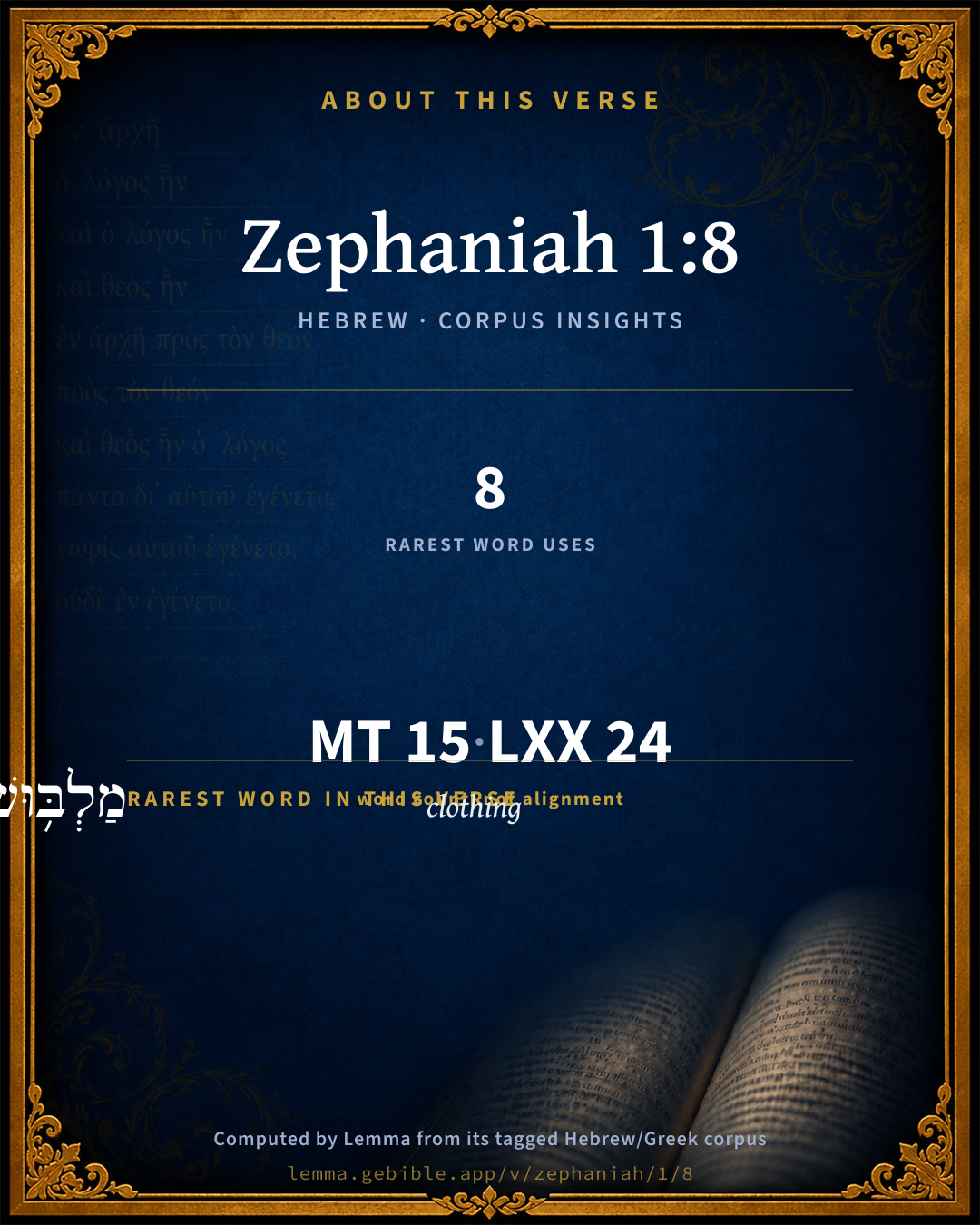
The rarest word here is מַלְבּ֥וּשׁ clothing H4403 — appearing just 8 times in the whole Hebrew Bible.

Shared distinctive vocabulary

מַלְבּ֥וּשׁ clothing H4403 occurs in 7 verses of the Hebrew Bible. Also found in:

Grammatical profile

  • 3 verbs
  • 8 nouns
  • 1 adjective
  • 3 prepositions

Verb forms

  • וְהָיָ֗ה Qal · Sequential Perfect
  • וּפָקַדְתִּ֥י Qal · Sequential Perfect
  • הַלֹּבְשִׁ֖ים Qal · Participle Active

Repetition

A word recurs within this verse — often emphatic in Hebrew:

Hebrew & Septuagint length

In English translation the verse runs 28 words from the Hebrew and 33 from the Septuagint (LXX English) — closely comparable.

A rough comparison of the two English renderings, which tokenize alike — not a word-level alignment.

Word counts can differ between the Hebrew and the Greek without any difference in meaning — e.g. the Hebrew direct-object marker אֵת has no separate Greek word, and Greek often adds the article ὁ.

In the original languages it is 15 Hebrew tokens and 24 Greek tokens — but the two are counted differently (Hebrew bundles its prefixes and suffixes into one token; the Greek is in lemma form), so that isn’t a like-for-like length.

Cross-references

13

Topical passages linked to Zephaniah 1:8 in the Treasury of Scripture Knowledge — connected by theme and wording, ordered by reader-vote popularity; previews shown in the World English Bible.

  • Isaiah 24:21 It shall happen in that day, that Yahweh will punish the host of the high ones on high, and the kings of the earth on the earth.
  • 2 Kings 25:19–21 and out of the city he took an officer who was set over the men of war; and five men of those who saw the king's face, who were found in the city; and the scribe, the captain of the host, who mustered the people of the land; and sixty men of the people of the land, who were found in the city.
  • Isaiah 3:18–24 In that day the Lord will take away the beauty of their anklets, the headbands, the crescent necklaces,
  • Isaiah 39:7 Of your sons who shall issue from you, whom you shall father, shall they take away; and they shall be eunuchs in the palace of the king of Babylon.
  • Jeremiah 22:11–19 For thus says Yahweh touching Shallum the son of Josiah, king of Judah, who reigned instead of Josiah his father, [and] who went forth out of this place: He shall not return there any more.
  • Jeremiah 22:24–30 As I live, says Yahweh, though Coniah the son of Jehoiakim king of Judah were the signet on my right hand, yet would I pluck you there;
  • Jeremiah 39:6–7 Then the king of Babylon killed the sons of Zedekiah in Riblah before his eyes: also the king of Babylon killed all the nobles of Judah.
  • 2 Kings 23:30–34 His servants carried him in a chariot dead from Megiddo, and brought him to Jerusalem, and buried him in his own tomb. The people of the land took Jehoahaz the son of Josiah, and anointed him, and made him king in his father's place.
  • 2 Kings 25:6–7 Then they took the king, and carried him up to the king of Babylon to Riblah; and they gave judgment on him.
  • 2 Kings 10:22 He said to him who was over the vestry, Bring forth vestments for all the worshippers of Baal. He brought them forth vestments.
  • 2 Kings 24:12–13 and Jehoiachin the king of Judah went out to the king of Babylon, he, and his mother, and his servants, and his princes, and his officers: and the king of Babylon took him in the eighth year of his reign.
  • Isaiah 10:12 Therefore it shall happen that, when the Lord has performed his whole work on Mount Zion and on Jerusalem, I will punish the fruit of the stout heart of the king of Assyria, and the glory of his high looks.
  • Deuteronomy 22:5 A woman shall not wear men's clothing, neither shall a man put on women's clothing; for whoever does these things is an abomination to Yahweh your God.

Cross-references courtesy of OpenBible.info (CC BY 4.0).

Hebrew and Greek witnesses Masoretic Hebrew ↔ Greek Septuagint

The same verse in the two great witnesses to the Old Testament, shown verse-for-verse.

These are two independent witnesses, not word-aligned to each other, and the Septuagint is shown in lemma (dictionary) form.

Hebrew Zephaniah 1:8 Masoretic · Westminster Leningrad Codex

וְהָיָ֗ה בְּיוֹם֙ זֶ֣בַח יְהוָ֔ה וּפָקַדְתִּ֥י עַל הַשָּׂרִ֖ים וְעַל בְּנֵ֣י הַמֶּ֑לֶךְ וְעַ֥ל כָּל הַלֹּבְשִׁ֖ים מַלְבּ֥וּשׁ נָכְרִֽי

It will happen in the day of Yahweh's sacrifice, that I will punish the princes, the king's sons, and all those who as are clothed with foreign clothing.

World English Bible · Public Domain

Greek LXX Zephaniah 1:8 Septuagint · lemma form

καί εἰμί ἐν ἡμέρα θυσία κύριος καί ἐκδικέω ἐπί ὁ ἄρχων καί ἐπί ὁ οἶκος ὁ βασιλεύς καί ἐπί πᾶς ὁ ἐνδύω ἔνδυμα ἀλλότριος

And it shall come to pass in the day of the Lord's sacrifice, that I will take vengeance on the princes, and on the king's house, and upon all that wear strange apparel.

LXX2012 (modern English Septuagint) · Public Domain

On this verse, Whedon's Commentary on the Bible discusses the Septuagint’s reading. Read the note in Commentary ↓

Hebrew: Westminster Leningrad Codex (CC BY 4.0). Greek: Septuagint (public domain); English from LXX2012 (modern English Septuagint) (Public Domain). How the Septuagint differs from the Hebrew →

Targum (Aramaic paraphrase)

1

The Targum is the ancient Jewish Aramaic paraphrase of the Hebrew Scriptures — an interpretive translation, not the Hebrew text itself. Onkelos (literal) and Pseudo-Jonathan (expansive) render the Torah, and Jonathan the Prophets. Coverage is partial: where no permissively-licensed English translation exists for a verse, only the Aramaic is shown. This is verse-level text, not a word-by-word alignment to the Hebrew.

  1. Targum Jonathan Prophets (Joshua–Malachi)
    וִיהֵי בְּיוֹם קְטָלָא דַעֲתִיד לְמֵיתֵי מִן קֳדָם יְיָ וְאַסְעַר עַל רַבְרְבַיָא וְעַל בְּנֵי מַלְכָּא וְעַל כָּל דְמִתְרַגְשִׁין לְמִפְלַח לְטַעֲוָתָא:

    (no public-domain English translation for this verse)

    Targum Jonathan — Aramaic: “Mikraot Gedolot” (public domain). English: “Sefaria Community Translation” (CC0 1.0 (public-domain dedication)); “London "Chaldee Paraphrase," 1871” (public domain). Text via Sefaria.

Commentary

Notes on Zephaniah 1:8 from classic Christian and Jewish commentators (each source and its license shown beneath its notes). The classic Christian expositions comment on the surrounding passage and are grouped to its opening verse, so a note may address several verses; the Jewish commentaries on the Tanakh (Rashi and others) are per-verse, so they appear only where the commentator wrote on this verse.

Lemma curates 59 commentaries, every one of them public domain or Creative Commons licensed, each selected and text-cleaned for this edition rather than reprinted as found. About our sources →

The Cambridge Bible for Schools and Colleges

gen. ed. J. J. S. Perowne

8. I will punish the princes] lit. visit upon the princes. The princes are the nobles, particularly those entrusted with judicial and similar offices.

the king’s children] The children of the king are the royal house in general, hardly Josiah’s own sons, who in the eighteenth year of his reign were aged ten and twelve (2Ki_23:31; 2Ki_23:36). For “children” Sept. reads house of the king, a reading which at least suggests the right meaning. The words “children” and “house” are occasionally confused. Sept. reads “house” where Heb. has “children” in Jer_16:15; Eze_2:3; 1Ch_2:10, and on the other hand it reads “children” where Heb. has “house” in Gen_45:11; Exo_16:31; Jos_17:17; Jos_18:5; Hos_1:7.

clothed with strange apparel] i.e. foreign apparel. It would be the royal family, “behold, they that wear soft clothing are in kings’ houses” (Mat_11:8), and the nobility who were given to this practice.

8–13. The classes in Jerusalem on which the judgment will fall

The errors and sins assailed by Zephaniah are the same as those attacked by earlier prophets, e.g. (1) the false worship, Zep_1:4-6, cf. Amo_4:4 ff.; Isa_1:11 ff.; (2) the civil wrong and injustice, Zep_1:9, cf. Amo_5:7; Amo_5:10-13; Isa_3:12-15; Isa_5:8; Isa_5:23; (3) dissatisfaction with the idea of the theocratic state and its place among the nations, and consequent assumption of foreign manners, Zep_1:8, cf. Isa_2:6; Isa_8:6 (they reject the waters of Shiloah that go softly), though possibly the luxury of foreign apparel may also be stigmatised (Amo_6:3-7); and (4) religious indifference and insensibility to the operations of Jehovah, Zep_1:12, cf. Amo_6:1; Amo_6:13-14; Isa_5:11-12; Isa_6:9-10; Isa_29:9-12, the result of which was an absorbing devotion to secular business, Zep_1:11, cf. Amo_8:5.

The Cambridge Bible for Schools and Colleges (gen. ed. J. J. S. Perowne; Cambridge University Press, 1878–1918) — public domain. Text from a community e-Sword module.

Trapp's Complete Commentary

John Trapp

Zep 1:8 And it shall come to pass in the day of the LORD’S sacrifice, that I will punish the princes, and the king’s children, and all such as are clothed with strange apparel.

Ver. 8. And it shall come to pass in the day of the Lord’s sacrifice] Or, good cheer; for at their sacrifices they used to feast their friends; and here the Lord is providing dainties for his guests; viz. the flesh of princes, gallants, courtiers, Zep 1:9, merchants, Zep 1:11, who use to eat the fat and drink the sweet, "nourishing their hearts as in a day of slaughter," Jas 5:5; and now also for a day of slaughter, when the beasts shall tear their flesh and the birds bare their bones.

That I will punish the princes and the king’s children] Who might seem to be safest of any, and farthest off from danger; but God’s hand can easily reach them, and shall do with the first, because their faults fly fast abroad upon those two wings of example and scandal. See this threatening fulfilled in Josiah’s sons, those degenerate plants, Heroum filii noxae. Jehoahaz ambitiously stepped into his father’s throne before his elder brother, and was soon after carried down to Egypt, and there slain. Jehoiakim, the elder brother, succeeded him; but rebelling against the King of Babylon, he was carried captive, and dying by the way, was buried with the burial of an ass, being cast out, to be torn by birds and beasts, according to this prophecy, Jer 22:19. Jechoniah came after, and was likewise carried into captivity: but because he hearkened to Jeremiah, persuading him to yield, and to go into voluntary banishment, he had some good days toward his latter end, Jer 52:31-32. Lastly Zedekiah, another son of Josiah, was made king; who as he was worse than the former, so he sped worse. See Jer 39:6-7. Potentes potenter torquebantur. The powerful are twisted powerfully.

And all such as are clothed with strange apparel] Those gallants, that imitated in their raiment those whom they most inclined to; some the Egyptians, others the Babylonians. A vanity not known in England, they say, till the wars in Holland. And (as ex malls moribus bonae leges) then first were great ruffs, with huge wide sets, and cloaks reaching almost to the ankles, no less uncomely than costly, restrained by proclamation (Camd. Eliz. 215). Now, what so common with our fashion mongers (against whom this is a stinging and a flaming text) than to be clothed with strange apparel, a la mode de France especially, and other Popish countries? But what saith one, borrow not (fashions) of the Egyptians; if you do you may get their boils and botches; of the Polonians, lest you get the plica Polonica in your hairy scalps; of the French, lest the lues Gallica befall you. Oh what enemy of thine hath taught thee so much vanity? said Mr John Fox to his son, returning from his travels, and attired in a loose outlandish fashion. (Hist. of Modern Divin.) Those that affected the Babylonian habit were sent captives to Babylon, Eze 23:15, and those proud dames (whose wardrobe is inventoried, Isa 3:16-24) were a cause that the mighty men fell in battle, Isa 3:25-26. Seneca complaineth, that many in his time were more solicitous of their attire than of their good behaviour; and that they had rather the commonwealth should be troubled than their locks and set looks. And doth not our age abound with such fantastic Cincinnatuli?

John Trapp, A Commentary or Exposition upon All the Books of the Old and New Testament (1647–1656) — public domain. Text from a community e-Sword module.

The Biblical Illustrator

Joseph S. Exell

Zep_1:8

I will punish . . . all such as are clothed with strange apparel

The sinfulness of strange apparel

I.

The criminals. Consider the principals, and the accessaries.

II. The crime. Either wearing exotic and foreign apparel, or such as they had newly invented among themselves.

III. The punishment. This is indefinitely expressed. How, in what way, degree, or measure, He will punish, He reserves to Himself. (Vincent Alsop, A. M.)

The Biblical Illustrator, edited by Joseph S. Exell (c. 1880s–1900s) — public domain. Text from a community e-Sword module.

Joseph Benson's Commentary

Zep 1:8-9. In that day I will punish the princes and the king’s children — In 2Ki 25:7; 2Ki 25:21, we read of the fulfilling of both these particulars; the sons of King Zedekiah, and the principal officers of the state, being slain by the order of the king of Babylon. And all such as are clothed with strange apparel — Used for idolatrous purposes: see Deu 22:11. There were peculiar vestments belonging to the worship of each idol; hence the command of Jehu, 2Ki 10:22, Bring forth vestments for all the worshippers of Baal. The text may likewise be explained of such men as wore women’s apparel, and such women as wore that of men, which was contrary to an express law, Deu 22:5, and was a rite observed in the worship of some idols. In the same day will I punish all those that leap on the threshold — Or rather, over the threshold. The expression is thought to denote some idolatrous rite, like that which was practised in the temple of Dagon, where the priests did not tread upon the threshold, 1Sa 5:5. Thus the Chaldee paraphrast interprets it of those who walked after the laws or rites of the Philistines. Capellus, however, understands it of those who invaded the house of their neighbours, joyfully bounding on the threshold. “This sense is favoured by what follows.” — Newcome. Which fill their masters’ houses with violence and deceit — Who enter into other men’s houses, and take away their goods by fraud or violence, and carry them to the houses of their masters. The iniquitous officers of the kings and princes seem to be here intended, who employed all the arts of deceit and oppression, as well as of open violence, to fill their master’s coffers.

Joseph Benson's Commentary on the Old and New Testaments (1811–1818) — public domain. Text from a community e-Sword module.

Keil & Delitzsch

C. F. Keil & F. Delitzsch

The judgment will fall with equal severity upon the idolatrous and sinners of every rank (Zep 1:8-11), and no one in Jerusalem will be able to save himself from it (Zep 1:12, Zep 1:13). In three double verses Zephaniah brings out three classes of men who differ in their civil position, and also in their attitude towards God, as those who will be smitten by the judgment: viz., (1) the princes, i.e., the royal family and superior servants of the king, who imitate the customs of foreigners, and oppress the people (Zep 1:8, Zep 1:9); (2) the merchants, who have grown rich through trade and usury (Zep 1:10, Zep 1:11); (3) the irreligious debauchees (Zep 1:12, Zep 1:13). The first of these he threatens with visitation. Zep 1:8. "And it will come to pass in the day of Jehovah's sacrifice, that I visit the princes and the king's sons, and all who clothe themselves in foreign dress. Zep 1:9. And I visit every one who leaps over the threshold on that day, those who fill the Lord's house with violence and deceit." The enumeration of those who are exposed to the judgment commences with the princes, i.e., the heads of the tribes and families, who naturally filled the higher offices of state; and the king's sons, not only the sons of Josiah, who were still very young (see the Introduction), but also the sons of the deceased kings, the royal princes generally. The king himself is not named, because Josiah walked in the ways of the Lord, and on account of his piety and fear of God was not to lie to see the outburst of the judgment (Kg2 22:19-20; Ch2 34:27-28). The princes and king's sons are threatened with punishment, not on account of the high position which they occupied in the state, but on account of the ungodly disposition which they manifested. For since the clauses which follow not only mention different classes of men, but also point out the sins of the different classes, we must also expect this in the case of the princes and the king's sons, and consequently must refer the dressing in foreign clothes, which is condemned in the second half of the verse, to the princes and king's sons also, and understand the word "all" as relating to those who imitated their manners without being actually princes or king's sons. Malbūsh nokhrı̄ (foreign dress) does not refer to the clothes worn by the idolaters in their idolatrous worship (Chald., Rashi, Jer.), nor to the dress prohibited in the law, viz., "women dressing in men's clothes, or men dressing in women's clothes" (Deu 22:5, Deu 22:11), as Grotius maintains, nor to clothes stolen from the poor, or taken from them as pledges; but, as nokhrı̄ signifies a foreigner, to foreign dress. Drusius has already pointed this out, and explains the passage as follows: "I think that the reference is to all those who betrayed the levity of their minds by wearing foreign dress. For I have no doubt that in that age some copied the Egyptians in their style of dress, and others the Babylonians, according as they favoured the one nation or the other. The prophet therefore says, that even those who adopted foreign habits, and conformed themselves to the customs of the victorious nation, would not be exempt." The last allusion is certainly untenable, and it would be more correct to say with Strauss: "The prophets did not care for externals of this kind, but it was evident to them that 'as the dress, so the heart;' that is to say, the clothes were witnesses in their esteem of the foreign inclinations of the heart." In Zep 1:9 many commentators find a condemnation of an idolatrous use of foreign customs; regarding the leaping over the threshold as an imitation of the priests of Dagon, who adopted the custom, according to Sa1 5:5, of leaping over the threshold when they entered the temple of that idol. But an imitation of that custom could only take place in temples of Dagon, and it appears perfectly inconceivable that it should have been transferred to the threshold of the king's palace, unless the king was regarded as an incarnation of Dagon, - a thought which could never enter the minds of Israelitish idolaters, since even the Philistian kings did not hold themselves to be incarnations of their idols. If we turn to the second hemistich, the thing condemned is the filling of their masters' houses with violence; and this certainly does not stand in any conceivable relation to that custom of the priests of Dagon; and yet the words "who fill," etc., are proved to be explanatory of the first half of the verse, by the fact that the second clause is appended without the copula Vav, and without the repetition of the preposition על. Now, if a fresh sin were referred to there, the copula Vav, at all events, could not have been omitted. We must therefore understand by the leaping over the threshold a violent and sudden rushing into houses to steal the property of strangers (Calvin, Ros., Ewald, Strauss, and others), so that the allusion is to "dishonourable servants of the king, who thought that they could best serve their master by extorting treasures from their dependants by violence and fraud" (Ewald). אדניהם, of their lord, i.e., of the king, not "of their lords:" the plural is in the pluralis majestatis, as in Sa1 26:16; Sa2 2:5, etc.

Keil & Delitzsch — Biblical Commentary on the Old Testament (1861–1891) — public domain (CC PDM 1.0). Text via the HelloAO Bible API. (Old Testament only.)

Tyndale Open Study Notes

Tyndale Open Resources

1:8 The leaders and princes of Judah were the tribal chieftains of Israel (Num 1:4), court officials (1 Chr 22:17), district supervisors (1 Kgs 20:14-15), city officials (Judg 8:6), military leaders (1 Kgs 2:5; 2 Kgs 1:9-14; 25:23, 26), or even religious leaders (Ezra 8:24). Their influential role put them in a position of heightened responsibility before God (cp. Jas 3:1).

Tyndale Open Study Notes — © Tyndale Open Resources, licensed CC BY-SA 4.0. Text via the HelloAO Bible API.

Geneva Bible (1599)

Geneva Bible translators

Meaning, the courtiers, which did imitate the strange apparel of other nations to win their favor thereby, and to appear glorious in the eyes of all others, read Ezek. 23:14, 15.

Geneva Bible (1599) marginal notes — public domain. Text via Bolls.life.

Jamieson, Fausset & Brown

Robert Jamieson, A. R. Fausset & David Brown

the princes--who ought to have been an example of good to others, but were ringleaders in all evil.

the king's children--fulfilled on Zedekiah's children (Jer 39:6); and previously, on Jehoahaz and Eliakim, the sons of Josiah (Kg2 23:31, Kg2 23:36; Ch2 36:6; compare also Kg2 20:18; Kg2 21:13). Huldah the prophetess (Kg2 22:20) intimated that which Zephaniah now more expressly foretells.

all such as are clothed with strange apparel--the princes or courtiers who attired themselves in costly garments, imported from abroad; partly for the sake of luxury, and partly to ingratiate themselves with foreign great nations whose costume as well as their idolatries they imitated, [CALVIN]; whereas in costume, as in other respects, God would have them to be separate from the nations. GROTIUS refers the "strange apparel" to garments forbidden by the law, for example, men's garments worn by women, and vice versa, a heathen usage in the worship of Mars and Venus (Deu 22:5).

Jamieson, Fausset & Brown — Commentary Critical and Explanatory on the Whole Bible (1871) — public domain (CC PDM 1.0). Text via the HelloAO Bible API.

Adam Clarke's Commentary

Verse 8. I will punish the princes, and the king's children] After the death of Josiah the kingdom of Judah saw no prosperity, and every reign terminated miserably; until at last King Zedekiah and the king's children were cruelly massacred at Riblah, when Nebuchadnezzar had taken Jerusalem.

Strange apparel] I really think this refers more to their embracing idolatrous customs and heathen usages, than to their changing their dress. They acquired new habits, as we would say; customs, that they used as they did their clothing-at all times, and in every thing.

Adam Clarke's Commentary on the Bible (1810–1826) — public domain. Text from a community e-Sword/MySword module.

Ellicott's Commentary for English Readers

(8) The king’s children.—The misfortunes which were to befall Josiah’s children, Jehoahaz and Jehoiakim (see 2 Kings 23, 24), are perhaps in the prophet’s eye. But if we are correct in our view of the date of writing (see Introd. II.) these princes must have been as yet mere children, and could hardly have provoked the prophet’s curse by any extraordinary display of wickedness. It therefore appears better to suppose that the king’s brothers or uncles are meant. (Comp. the phrase in 2Ki_11:2; 2Ch_22:11.)

Clothed with strange apparel.—Zephaniah means those who have imitated the luxurious dress of foreign nations: e.g., perhaps the gorgeous apparel of Assyria and Babylonia (Eze_23:12-15). This desire for strange clothing is specially noticed as a mark of apostasy, because the national dress, with its blue riband at the fringe, was appointed that the Jews might “look upon it, and remember all the commandments of the Lord, and do them” (Num_15:38-39).

A Bible Commentary for English Readers, edited by Charles John Ellicott (1878–1897) — public domain. Text from a community e-Sword module.

John Gill's Exposition

And it shall come to pass in the day of the Lord's sacrifice, &c.] When the above sacrifice prepared shall be offered, and the slaughter of his people made, when his wrath shall be poured out upon them, within the time of its beginning and ending: that I will punish the princes, and the king's children; either the children of Josiah, who, though a good prince, his children did evil in the sight of the Lord, and were punished by him: Jehoahaz, after a three months' reign was carried down to Egypt, and died there; Jehoiakim, his elder brother, that succeeded him, rebelling against the king of Babylon, in the fourth year of his reign, fell into his hands, and died, and was buried with the burial of an ass; and Jeconiah his son was carried captive into Babylon, and there remained to the day of his death; and with him were carried the whole royal family, and all the princes, and all the mighty men of valour, ( 2 Kings 24:14 ) or else the children of Zedekiah, another son of Josiah, and the last of the kings of Judah, who was carried captive by Nebuchadnezzar king of Babylon, who before his eyes slew his sons, and all the princes of Judah, and then put out his eyes, and bound him in chains, ( Jeremiah 52:10 Jeremiah 52:11 ) and thus this prophecy had its accomplishment: and all such as are clothed with strange apparel; either which they put on in honour of the idols they worshipped, as Jarchi; so the heathens wore one sort of garments for one idol, and another sort for another; or these were men of a pharisaical cast, who wore garments different from others, that they might be thought to be very holy and religious, which sense is mentioned by Kimchi; or they were such, which he also observes, who, seeing some to have plenty of good clothes, stole them from them, and put them on; or such who arrayed themselves in garments that did not belong to their sex, men put on women's garments, and women clothed themselves with men's, and both strange apparel; or rather this points at such persons, who, in their apparel, imitated the fashions and customs of foreign nations; which probably began with the king's children and courtiers, and were followed by others. The Targum is, ``and upon all those that make a noise at the worship of idols.''

John Gill's Exposition of the Whole Bible (1746–1763) — public domain (CC PDM 1.0). Text via the HelloAO Bible API.

Albert Barnes' Notes on the Bible

I will punish - (Literally, visit upon). God seems oftentimes to be away from His own world. People plot, design, say, in word or in deed, “who is Lord over us?” God is, as it were, a stranger in it, or as a man, who hath “taken a journey into afar country.” God uses our own language to us. “I will visit,” inspecting (so to say), examining, sifting, reviewing, and when man’s sins require it, allowing the weight of His displeasure to fall upon them.

The princes - The prophet again, in vivid detail (as his characteristic is), sets forth together sin and punishment. Amid the general chastisement of all, when all should become one sacrifice, they who sinned most should be punished most. The evil priests had received their doom. Here he begins anew with the mighty of the people and so goes down, first to special spots of the city, then to the whole, man by man. Josiah being a godly king, no mention is made of him. Thirteen years before his death, he received the promise of God, “because thine heart was tender, and thou hast humbled thyself before the Lord - I will gather thee unto thy fathers, and thou shalt be gathered unto thy grave in peace, and thou shalt not see all the evil which I will bring upon this place” 2Ki 22:19-20. In remarkable contrast to Jeremiah, who had to be, in detail and continual pleading with his people, a prophet of judgment to come, until these judgments broke upon them, and so was the reprover of the evil sovereigns who succeeded Josiah, Zephaniah has to pronounce God’s judgments only on the “princes” and “the king’s children.”

Jeremiah, in his inaugural vision, was forewarned, that “the kings Judah, its princes, priests, and the people of the land” Jer 1:18 should war against him, because he should speak unto them all which God should command him. And thenceforth, Jeremiah impleads or threatens kings and the princes together Jer 2:26; Jer 4:9; Jer 8:1; Jer 24:8; Jer 32:37; Jer 34:21. Zephaniah contrariwise, his office lying wholly within the reign of Josiah, describes the princes again as “roaring lions” Zep 3:3, but says nothing of the king, as neither does Micah Mic 3:1, Mic 3:9, in the reign, it may be, of Jotham or Hezekiah. Isaiah speaks of princes, as “rebellious and companions of thieves” Isa 1:23. Jeremiah speaks of them as idolaters Jer 31:32-34; Jer 44:21. They appear to have had considerable influence, which on one occasion they employed in defense of Jeremiah Jer 26:16, but mostly for evil Jer 37:15; Jer 38:4, Jer 38:16. Zedekiah inquired of Jeremiah secretly for fear of them Jer 37:17; Jer 38:14-27. They brought destruction upon themselves by what men praise, their resistance to Nebuchadnezzar, but against the declared mind of God. Nebuchadnezzar unwittingly fulfilled the prophets’ word, when he “slew all the nobles of Judah, the eunuch who was over the war, and seven men of them that were near the king’s person, and the principal scribe of the host” Jer 39:6; Jer 52:25-27.

And the king’s children - Holy Scripture mentions chief persons only by name. Isaiah had prophesied the isolated lonely loveless lot of descendants of Hezekiah who should be “eunuchs in the palace of the king of Babylon” Isa 39:7, associated only with those intriguing pests of Eastern courts, a lot in itself worse than the sword (although to Daniel God overruled it to good) and Zedekiah’s sons were slain before his eyes and his race extinct. Jehoiakim died a disgraced death, and Jehoiachin was imprisoned more than half the life of man.

And all such as are clothed with strange apparel - Israel was reminded by its dress, that it belonged to God. It was no great thing in itself; “a band of dark blue Num 15:38; Deu 22:12 upon the fringes at the four corners of their garments.” But “the band of dark blue” was upon the high priest’s mitre, with the plate engraved, “Holiness to the Lord” Exo 28:36, fastened upon it; “with a band of dark blue” also was the breastplate Exo 39:21 bound to the ephod of the high priest. So then, simple as it was, it seems to have designated the whole nation, as “a kingdom of priests, an holy nation” Exo 19:6. It was appointed to them, “that ye may look upon it, and remember all the commandments of the Lord and do them, and that ye seek not after your own heart and your own eyes, after which ye use to go a whoring; that ye may remember and do all My commandments, and be holy unto your God” Num 15:39-40. They might say, “it is but “a band of blue;”” but the “band of blue” was the soldier’s badge, which marked them as devoted to the service of their God; indifference to or shame of it involved indifference to or shame of the charge given them therewith, and to their calling as a peculiar people. The choice of the strange apparel involved the choice to be as the nations of the world; “we will be as the pagan, as the families of the countries” Eze 20:33.

All luxurious times copy foreign dress, and with it, foreign manners and luxuries; from where even the pagan Romans were zealous against its use. It is very probable that with the foreign dress foreign idolatry was imported . The Babylonian dress was very gorgeous, such as was the admiration of the simpler Jews. “Her captains and rulers clothed in perfection, girded with girdles upon their loins, with flowing dyed attire upon their heads” Eze 23:12, Eze 23:15. Ezekiel had to frame words to express the Hebrew idea of their beauty. Jehoiakim is reproved among other things for his luxury Jer 22:14-15. Outward dress always betokens the inward mind, and in its turn acts upon it. An estranged dress betokened an estranged heart, from where it is used as an image of the whole spiritual mind Rom 13:14; Col 3:12; Eph 4:24. Jerome: “The garment of the sons of the king and the apparel of princes which we receive in Baptism, is Christ, according to that, “Put ye on the Lord Jesus Christ,” and “Put ye on bowels of mercy, goodness, humililty, patience,” and the rest. Wherein, we are commanded to be clothed with the new man from heaven according to our Creator, and to “lay aside” the clothing of “the old man with his deeds” Eph 4:22. Whereas, then we ought to be clothed in such raiment, for mercy we put on cruelty, for patience, impatience, for righteousness, iniquity; in a word, for virtues, vices, for Christ, antichrist. Whence it is said of such an one, “He is clothed with cursing as with a garment” Psa 109:17. These the Lord will visit most manifestly at His Coming.” Rup.: “Thinkest thou that hypocrisy is “strange apparel?” Of a truth. For what stranger apparel than sheeps’ clothing to ravening wolves? What stranger than for him who “within is full of iniquity, to appear outwardly righteous before men?” Mat 23:28.

Albert Barnes' Notes on the Bible (1834–1885) — public domain. Text from a community e-Sword/MySword module.

Haydock's Catholic Bible Commentary

Victim. Hebrew, "sacrifice." But Manuscript 1. Camb. has, "in that day, says the Lord," eeva nam being substituted for zebach, (Haydock) which is "a very remarkable variation." In ver. 7, it has Jehovah Elohim printed Adonai Jehovah. (Kennicott) --- Princes. After the death of Josias all fell to ruin. His sons were deposed, and led into captivity with the chief nobility and priests, who were richly adorned, and imitated the manners of idolaters, or kept the garments of the poor, Exodus xxii. 26., and Deuteronomy xxii. 5, 11, &c. (Calmet) --- All the posterity of Josias was afflicted. Joachaz died in Egypt; Joakim was harassed and put to death; Sedezias taken, and his eyes put out, when his children had been slain. Jechonias, or Joachin, was detained in prison at Babylon for a long time. (Worthington)

George Leo Haydock (1774–1849), Haydock's Catholic Family Bible and Commentary, 1859 edition — public domain. Excludes Psalms (Douay-Rheims chapter numbering differs from Protestant) and Deuterocanonical books (Catholic canon only).

Matthew Poole's English Annotations

It shall come to pass; it shall most certainly be fulfilled what I threaten I will most surely execute.

In the day of the Lord’s sacrifice; of slaughter to be made by the Babylonians, called here a day of sacrifice, that we might see clearly the just and exemplary proceedings of God; these people sinned in sacrificing to strange gods, and God will punish them, making them a strange sacrifice to his anger.

I will punish; the punishment shall appear to be from my hand, as he threatens often by Ezekiel.

The princes; nobles about the court, the great ones, who dreamed of shifting better than others, but fell with the first, 2Ki 25:19-21.

The king’s children; sons and grandchildren too of good Josiah. Jehoahaz died a captive in Egypt, 2Ki 23:34. Jehoiakim died on the way, or in Babylon, buried with the burial of an ass, Jer 22:18,19. Jeconiah, carried to Babylon, sped somewhat, yet but little, better; there he died a captive. As for Zedekiah and his children, these were slain before his face, then his eyes put out, and he led into miserable captivity.

Clothed with strange apparel; some say the strange apparel of idolatrous priests; others say, and more likely, the garb of foreigners, imitated by the wanton Jews.

Matthew Poole's English Annotations on the Holy Bible (1683–1685) — public domain. Text from a community e-Sword/MySword module.

Whedon's Commentary on the Bible

Daniel D. Whedon

8, 9. In agreement with the other pre-exilic prophets Zephaniah names the nobles and princes as special objects of the divine wrath, because they have sinned most persistently against the divine will.

Princes — See on Hos_3:4.

The king’s children — LXX., “the king’s house.” The latter is accepted as original by some because the other is thought to create a chronological difficulty. The condemnation presupposes that the children had reached the age of responsibility, but if the prophecy is dated before 621 B.C. the children of King Josiah must have been very young at the time of its delivery (compare 2Ki_23:31; 2Ki_23:36). “Children” and “house” are sometimes interchanged in the Old Testament, but such interchange need not be assumed here, for why restrict the term to the sons of Josiah? It may be intended to include the sons of the deceased kings, Amon and Manasseh, and may be equivalent to “royal princes.” What the prophet means to say is that not even the royal family will escape the judgment. It is worthy of notice that there is no condemnation of the king. At the time of Zephaniah’s preaching, Josiah was too young to commit very serious offenses; besides, it is not improbable that even during the early years of his reign he was under prophetic influence, which would prevent him from committing the crimes of his predecessors.

Such as are clothed with strange apparel — R.V., “foreign apparel.” An evidence of indulgence and of disregard of the simplicity characteristic of the ancient Hebrews. Only the court and the nobles could afford these costly garments (compare Mat_11:8), and they secured the means with which to purchase them by oppression and violence (compare Isa_2:6-7; Deu_22:11; Lev_19:19). It has been suggested to place 9b after 8a and 8b after 9a, but this rearrangement is no improvement over the present text. Zep_1:9 condemns other forms of wrongdoing.

Those that leap on the threshold — Better, R.V., “over the threshold.” Since this expression occurs only here, commentators differ widely in their interpretations. Some think that it refers to a superstitious rite of the idol worshipers (compare 1Sa_5:5), but the second part of the verse does not favor this view. There is no conjunction between the two parts, which indicates that no new transgression is condemned; the filling of the house with violence and deceit is closely connected with the leaping over the threshold. Hence Ewald is probably right when he says that even 9a refers to “dishonest servants of the royal court who seek to serve their lord well by exacting treasures from his subjects by force and fraud.” It may be a sort of proverbial phrase for breaking into other people’s houses for purposes of robbery.

Their masters’ houses — R.V., “their master’s house.” Not the house of Jehovah, but the house of the chief to whom they render unscrupulous service.

With violence and deceit — With treasures and possessions secured through violence and fraud. Similar condemnations may be read in all the pre-exilic prophets (compare Amo_3:10; Mic_3:1-3; Eze_22:25-29). Jehovah must punish these outrages.

Daniel D. Whedon (gen. ed.), Commentary on the Old and New Testaments (1874–1909) — public domain. Text from a community e-Sword module.

The Pulpit Commentary

The prophet names the three classes of people who shall be smitten in this judgment. First, the princes. In the day of the Lord"s sacrifice (see note on ver. 7). God is speaking; so the name of the Lord is employed instead of the pronoun. (comp. Lam_3:66) I will punish; literally, visit upon (ver. 12; Amo_3:14). The princes. The heads of tribes and families, nobles and magistrates. The king"s children (sons ); Septuagint, towv , "the house of the king." The royal family, not specially the sons of Josiah, who, if they were then in existence, must have been mere children, but princes of the royal house. The reference may be particularly to the sons of the king reigning when the judgment fell. (see 2Ki_25:7) The king himself is not mentioned as subject to the judgment, inasmuch as he was pious and obedient. (2Ch_34:27, etc.) In the mention of these "children" Keil finds proof of the late origin of the prophecy. Such as are clothed with strange apparel. This clause must represent the sin for which the princes are "visited." "Strange" apparel means "foreign" apparel, and this implied foreign manners and habits. The Israelites were reminded by their very dress that they were a peculiar people, consecrated to God"s service. (Num_15:37, etc.; Deu_22:12) These nobles, however, assumed the dress of the Egyptians and other nations with which they came in contact, and, despising their own national customs, copied the manners and vices of foreigners. (comp. Isa_3:16-24 Eze_20:32 RAPC 1Ma 1:11-15)

Vers. 8, 9. "No respect of persons.

I SOCIETY IS COMPOSED OF VARIOUS GRADES. There are royal personages, "the princes" and "the king"s children" (ver. 8); there are "the merchant people" (ver. 11); there are masters and servants (ver. 9); there are nobles in affluence, who can clothe themselves with "strange apparel" (ver. 8); and there are the poor and needy. Nor would it be advantageous to society to break down these distinctions. An equal division of wealth and rank would be found both impracticable and undesirable. What is needed is the cultivation, amongst all sections of society, of the spirit of regard and good will. If the injunctions of God"s Word were heeded, wrong doing would cease, the ruler would not oppress the subject, the employer would not act unjustly towards the employed, nor the employed refuse to abide by just regulations. It is not by breaking down the social distinctions of society that the existing wrongs are to be redressed, but by a wider diffusion amongst all classes of the pure teachings of the religion of peace and love.

II IS EACH OF THESE GRADES THE WORKING OF EVIL MAY BE TRACED. In vers. 8 and 9 this is indicated. Princes, nobles, retainers, menials, alike corrupted their way. Pride in bearing and in attire, the emulating of the vices of the heathen, injustice and wrong, "violence and deceit," prevailed amongst all classes. Sin is a disease, the contagious influence of which spreads through society at large, causing sickliness and ending in moral death. It has been fittingly compared to the Egyptian plague of frogs, for as these coming up from the river afflicted king, nobles, magicians, and people alike, so sin in its varied forms and hurtful influence has been felt by all.

III THE DIVINE JUDGMENTS ON ACCOUNT OF SIN WILL BE RIGHTEOUSLY AWARDED AND WITHOUT PARTIALITY. Princes, nobles, merchants, servants, will be reckoned with according to their works (vers. 8, 9). With God there is "no respect of persons." Here social position and influence screen wrong doers at times from reaping the just consequences of their evil doing. However justly the administrators of human law may desire to act, and to remove the reproach that "there is one law for the rich and another for the poor," the fact remains that the former class, when pursued by the baud of justice, can command assistance such as is denied to the latter, and the employment of which has often moderated the sentence inflicted. But the "righteous Lord, who loveth righteousness," will "give to every man according as his work shall be.

Foreign clothes.

I A BOND OF INTERNATIONAL UNION. The interchange of commodities among the different peoples of the earth one of the surest means of promoting peace and causing wars to cease.

II A SIGN OF ADVANCING CIVILIZATION. When a nation"s wants multiply beyond its own power directly to meet them, it naturally draws upon the resources of lands and peoples beyond itself. Thus while the existence of these wants marks the upward progress of the nation itself, the effort needed to supply them acts as a stimulus to other peoples to join in the onward march.

III A SYMPTOM OF DECLINING PATRIOTISM. No truer indication that the national sentiment amongst a people is becoming feeble than the slavish imitation of the manners and customs, speech and dress, of a stronger neighbour.

IV A SYMBOL OF RELIGIOUS DECLENSION. In this light regarded by the Egyptian or Chaldean raiment worn by Judaean princes and peasants meant that their hearts were hankering after Egyptian or Chaldean idolatry. So when Christians conform to the world"s ways, adopting its maxims and principles, manners and customs, thoughts and feelings, sentiments and practices all of which should be to them what foreign clothes were to Israel there is reason to suspect that a backward movement in religion has begun. T.W.

The Pulpit Commentary (1880–1919), ed. H.D.M. Spence-Jones & Joseph S. Exell — public domain. Text from a community e-Sword module.

John Wesley's Explanatory Notes

The princes - The great ones, who dreamed of shifting better than others, but fell with the first, 2 Kings xxv, 19-21. Children - Sons and grand-children, Josiah: Jehoahaz died a captive in Egypt, 2 Kings xxiii, 34, Jehoakim died in Babylon, and was buried with the burial of an ass, Jer. xxii, 18, 19, Jeconiah died a captive: and Zedekiah and his children, fared still worse. Strange apparel - The garb of foreigners, imitated by the wanton Jews.

John Wesley, Explanatory Notes Upon the Whole Bible (1754–1765) — public domain. Text via the GEBible commentary corpus.

Rashi

Rabbi Shlomo Yitzchaki (Rashi)

gentile garb Ornaments of the idols.

Rashi on the Tanakh — English translations: “The Judaica Press complete Tanach with Rashi, translated by A. J. Rosenberg” (CC BY 4.0); “Pentateuch with Rashi's commentary by M. Rosenbaum and A.M. Silbermann, 1929-1934” (public domain); “The Metsudah Tanach series, Lakewood, N.J” (CC BY 4.0); and “The Book of Joshua, Metsudah Publications, 1997” (CC BY 4.0). Text via Sefaria.

Lesson kit

Teaching starters — assembled from the data on this page, not authored interpretation. Every prompt links to the verse data it draws on. Edit before teaching.

Zephaniah, in the Prophets, opens this verse with 15 words (13 distinct Hebrew lemmas). Its most distinctive word is malbûwsh (“clothing”). A historical commentator’s framing appears above. Read the whole chapter for the surrounding context.

Discussion questions

  1. What does “clothing” (malbûwsh) contribute to the verse as a whole?
  2. How does 1 Kings 10:5, which shares the word «clothing», read alongside this verse?
  3. What does the repetition of “upon” (3× in this one verse) do in this verse?
  4. The translations on this page render this verse differently — a whole-verse word diff, not a word-by-word alignment. What might account for the different wordings?
  5. «וְהָיָ֗ה» is a Qal Sequential Perfect verb. How does that grammatical form shape the action described?
  6. Compare how The Cambridge Bible for Schools and Colleges and Trapp's Complete Commentary read this verse. Where do they agree or differ?

Things to notice

Reading settings

Reading text

Shown beneath each verse's original-language words.

Old Testament
Old Testament edition

Read the OT as the Masoretic Hebrew (MT) or the Greek Septuagint (LXX).

English shown for the Greek Septuagint (in the Hebrew ↔ Greek comparison).

Comparing translations? Open the Compare panel on any verse page to stack up to four side by side.