
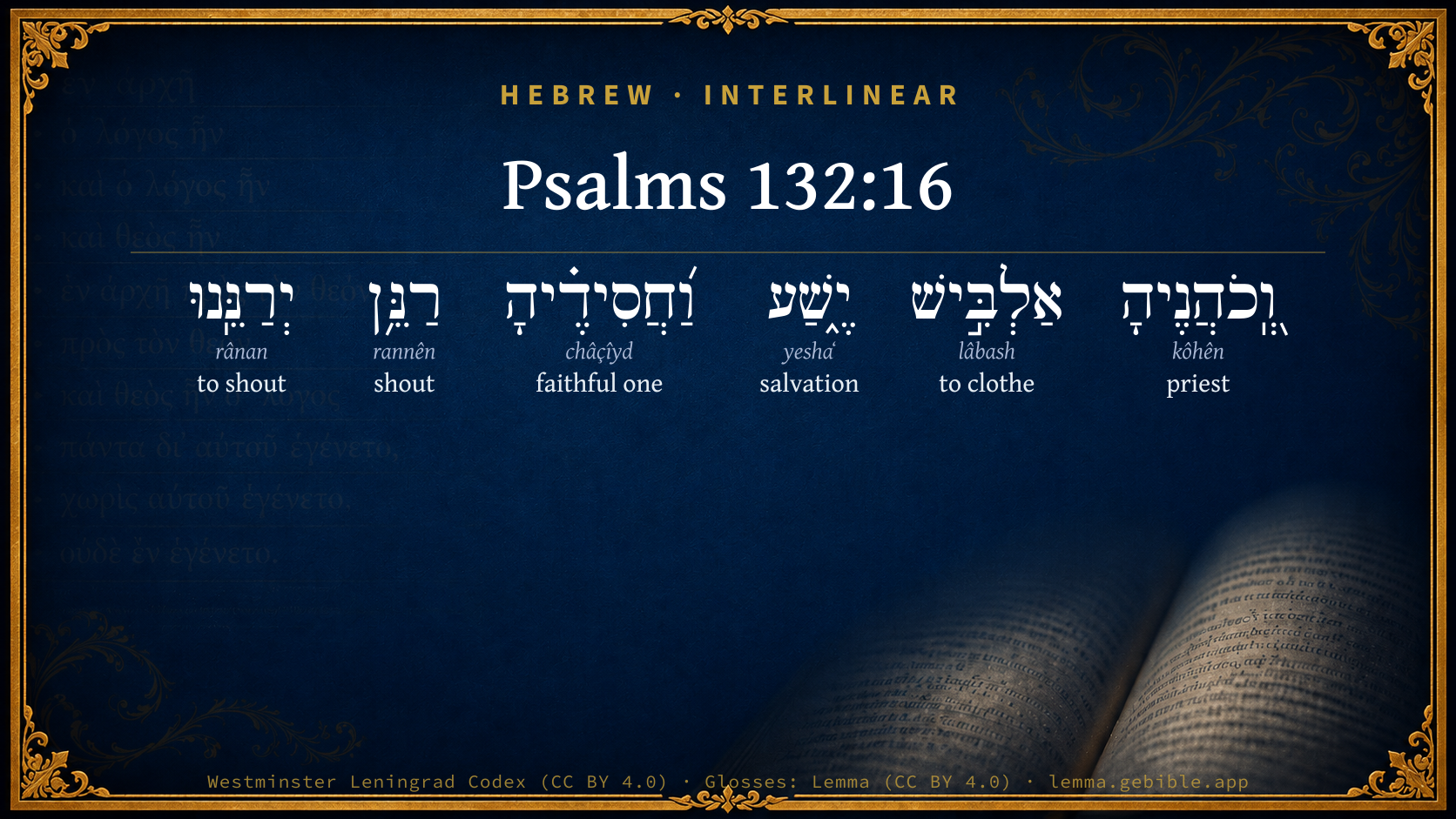
Psalms 132:16

Hebrew (Westminster Leningrad Codex) Psalms 132:16 appears in the Hebrew Old Testament. The text above is from the Westminster Leningrad Codex. Each word links to its Strong’s number, a concise gloss, and parsing drawn from the Open Scriptures Hebrew Bible morphology. Click any word for its full Brown-Driver-Briggs (BDB) entry.
Download image
Cite this verse

Psalms 132:16 (World English Bible). Public Domain. Lemma interlinear Bible study tool, https://lemma.gebible.app/v/psalms/132/16.

Show BibTeX & RIS
BibTeX
RIS
English Translation
Her priests I will also clothe with salvation. Her saints will shout aloud for joy.
World English Bible · Public Domain
Highlights
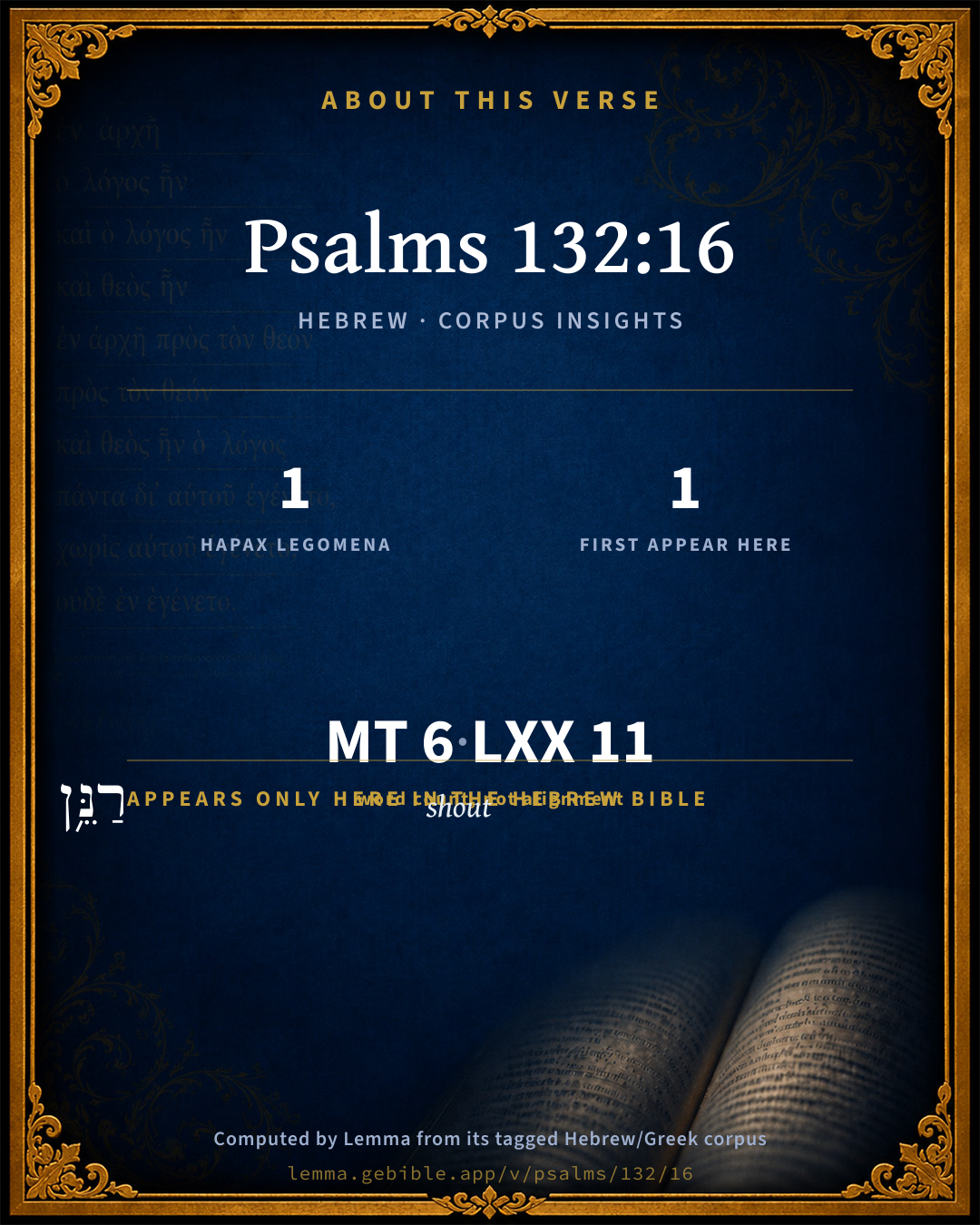
  • 1 hapax legomenon — only here in the Hebrew Bible
  • 1 first appearance in the Hebrew Bible
Full analysis ↓
Download a study sheet

One document with this verse’s original text, its word-by-word gloss line, the meaning frame, cross-references with their text, attributed commentary, and full source and license credits — printable, and it pastes into notes with its structure intact.

This verse Autodidact and up

Study sheet (.html) Plain text (.txt)

A passage Seminary Student

Up to 50 verses in one chapter. A passage sheet keeps up to 6 commentary sources and 12 cross-references per verse, in the order this page ranks them, and says so on the sheet whenever that leaves anything out. Ask for a single verse and you get the Autodidact verse sheet above.

Everything on this page stays free to read, with no account — the sheet is a download of what is already on screen, not access to it.

Want to remove ads? Support Godless Engineer
Compare translations 3

The same verse in 3 English versions, stacked beneath the original-language interlinear above. Click any original word for its lexicon entry.

Each is an independent rendering of the whole verse — the interlinear is not word-aligned to these translations.

Highlighted words mark where these versions differ — a whole-verse word diff, not a word-by-word alignment.

  • World English Bible Public Domain
    Her priests I will also clothe with salvation. Her saints will shout aloud for joy.
  • King James Version Public Domain
    I will also clothe her priests with salvation: and her saints shall shout aloud for joy.
  • unfoldingWord Literal Text CC BY-SA 4.0
    And her priests I will clothe salvation, and her faithful, shouting they will shout for joy.

unfoldingWord Literal Text — © unfoldingWord, licensed CC BY-SA 4.0. Word-aligned USFM3 via Door43 (git.door43.org/unfoldingWord/en_ult).

Versions to compare (up to 4)

3 of 4 selected

Show all 17 translations

Every available English version of this verse, each an independent rendering of the whole verse.

  • World English Bible Public Domain
    Her priests I will also clothe with salvation. Her saints will shout aloud for joy.
  • Berean Standard Bible Public Domain
    I will clothe her priests with salvation, and her saints will sing out in joy.
  • Majority Standard Bible Public Domain
    I will clothe her priests with salvation, and her saints will sing out in joy.
  • King James Version Public Domain
    I will also clothe her priests with salvation: and her saints shall shout aloud for joy.
  • American Standard Version (1901) Public Domain
    Her priests also will I clothe with salvation; And her saints shall shout aloud for joy.
  • Revised Version (1885) Public Domain
    Her priests also will I clothe with salvation: and her saints shall shout aloud for joy.
  • Geneva Bible (1599) Public Domain
    And will clothe her Priests with saluation, and her Saints shall shoute for ioye.
  • Young's Literal Translation Public Domain
    And her priests I clothe `with' salvation, And her pious ones do sing aloud.
  • Literal Standard Version CC BY-SA 4.0
    And I clothe her priests [with] salvation, || And her pious ones sing aloud.
  • Unlocked Literal Bible CC BY-SA 4.0
    I will clothe her priests with salvation, her faithful ones will shout aloud for joy.
  • unfoldingWord Literal Text CC BY-SA 4.0
    And her priests I will clothe salvation, and her faithful, shouting they will shout for joy.
  • Darby Bible Public Domain
    And I will clothe her priests with salvation, and her saints shall shout aloud for joy.
  • World Messianic Bible Public Domain
    I will also clothe her priests with salvation. Her holy ones will shout aloud for joy.
  • Webster's Bible Public Domain
    I will also clothe her priests with salvation, and her saints shall shout aloud for joy.
  • Free Bible Version CC BY-SA 4.0
    I will clothe its priests with salvation; and its faithful people will shout for joy.
  • Bible in Basic English Public Domain
    Her priests will be clothed with salvation; and her saints will give cries of joy.
  • JPS Tanakh (1917) Public Domain
    Her priests also will I clothe with salvation; and her saints shall shout aloud for joy.

Literal Standard Version (2020), Covenant Press — licensed CC BY-SA 4.0. Text via the HelloAO Bible API (eBible.org). Unlocked Literal Bible (unfoldingWord) — licensed CC BY-SA 4.0. Text via the HelloAO Bible API (eBible.org). unfoldingWord Literal Text — © unfoldingWord, licensed CC BY-SA 4.0. Word-aligned USFM3 via Door43 (git.door43.org/unfoldingWord/en_ult). Free Bible Version, Dr. Jonathan Gallagher — licensed CC BY-SA 4.0. Text via the HelloAO Bible API (eBible.org).

Word by word

More ways to search: Search by grammar → Find every occurrence → Compare this word →

Practice this passage: Drill this verse → Learn its vocabulary →

About this verse

These counts appear in no published source. They are computed here, from the morphology-tagged text and Lemma’s own curated glosses. What Lemma adds →

6
words
6
distinct lemmas
Wisdom
section

Notable vocabulary

1 hapax legomenon — a word that appears only here in the entire Hebrew Bible:

  • רַנֵּ֥ן shout H7444

First appearance in Scripture

This word makes its first canonical appearance in the Hebrew Bible here:

  • רַנֵּ֥ן shout H7444

Shared distinctive vocabulary

וַ֝חֲסִידֶ֗יהָ faithful one H2623 occurs in 32 verses of the Hebrew Bible. Also found in:

Grammatical profile

  • 3 verbs
  • 2 nouns
  • 1 adjective

Verb forms

  • אַלְבִּ֣ישׁ Hiphil · Imperfect
  • רַנֵּ֥ן Piel · Infinitive Absolute
  • יְרַנֵּֽנוּ Piel · Imperfect

Hebrew & Septuagint length

In English translation the verse runs 15 words from the Hebrew and 13 from the Septuagint (LXX English) — closely comparable.

A rough comparison of the two English renderings, which tokenize alike — not a word-level alignment.

Word counts can differ between the Hebrew and the Greek without any difference in meaning — e.g. the Hebrew direct-object marker אֵת has no separate Greek word, and Greek often adds the article ὁ.

In the original languages it is 6 Hebrew tokens and 11 Greek tokens — but the two are counted differently (Hebrew bundles its prefixes and suffixes into one token; the Greek is in lemma form), so that isn’t a like-for-like length.

Cross-references

9

Topical passages linked to Psalms 132:16 in the Treasury of Scripture Knowledge — connected by theme and wording, ordered by reader-vote popularity; previews shown in the World English Bible.

  • 2 Chronicles 6:41 Now therefore arise, Yahweh God, into your resting-place, you, and the ark of your strength: let your priests, Yahweh God, be clothed with salvation, and let your saints rejoice in goodness.
  • Psalms 132:9 Let your priest be clothed with righteousness. Let your saints shout for joy!"
  • Isaiah 61:10 I will greatly rejoice in Yahweh, my soul shall be joyful in my God; for he has clothed me with the garments of salvation, he has covered me with the robe of righteousness, as a bridegroom decks himself with a garland, and as a bride adorns herself with her jewels.
  • John 16:24 Until now, you have asked nothing in my name. Ask, and you will receive, that your joy may be made full.
  • Psalms 140:4 Yahweh, keep me from the hands of the wicked. Preserve me from the violent men who have determined to trip my feet.
  • Hosea 11:12 Ephraim surrounds me with falsehood, And the house of Israel with deceit; And Judah still us unruly with God, And is unfaithful to the Holy One.
  • Zechariah 9:9 Rejoice greatly, daughter of Zion! Shout, daughter of Jerusalem! Behold, your king comes to you! He is righteous, and having salvation; Lowly, and riding on a donkey, Even on a colt, the foal of a donkey.
  • Zechariah 9:15–17 Yahweh of Hosts will defend them; And they will destroy and overcome with sling-stones; And they will drink, and roar as through wine; And they will be filled like bowls, Like the corners of the altar.
  • Galatians 3:27 For as many of you as were baptized into Christ have put on Christ.

Cross-references courtesy of OpenBible.info (CC BY 4.0).

Hebrew and Greek witnesses Masoretic Hebrew ↔ Greek Septuagint

The same verse in the two great witnesses to the Old Testament, shown verse-for-verse.

You’re reading Greek Psalm 131 (Hebrew Psalm 132). The Septuagint counts the superscription, so verse numbers can differ from the Hebrew — chapter-level alignment, not verse-by-verse. Numbering follows Rahlfs.

These are two independent witnesses, not word-aligned to each other, and the Septuagint is shown in lemma (dictionary) form.

Hebrew Psalms 132:16 Masoretic · Westminster Leningrad Codex

וְֽ֭כֹהֲנֶיהָ אַלְבִּ֣ישׁ יֶ֑שַׁע וַ֝חֲסִידֶ֗יהָ רַנֵּ֥ן יְרַנֵּֽנוּ

Her priests I will also clothe with salvation. Her saints will shout aloud for joy.

World English Bible · Public Domain

Greek LXX Greek Psalm 131:16 Septuagint · lemma form

ὁ ἱερεύς αὐτός ἐνδύω σωτηρία καί ὁ ὅσιος αὐτός ἀγαλλίασις ἀγαλλιάομαι

I will clothe her priests with salvation; and her saints shall greatly exult.

LXX2012 (modern English Septuagint) · Public Domain

On this verse, John Gill's Exposition discusses the Septuagint’s reading. Read the note in Commentary ↓

Hebrew: Westminster Leningrad Codex (CC BY 4.0). Greek: Septuagint (public domain); English from LXX2012 (modern English Septuagint) (Public Domain). How the Septuagint differs from the Hebrew →

Commentary

Notes on Psalms 132:16 from classic Christian and Jewish commentators (each source and its license shown beneath its notes). The classic Christian expositions comment on the surrounding passage and are grouped to its opening verse, so a note may address several verses; the Jewish commentaries on the Tanakh (Rashi and others) are per-verse, so they appear only where the commentator wrote on this verse.

Lemma curates 59 commentaries, every one of them public domain or Creative Commons licensed, each selected and text-cleaned for this edition rather than reprinted as found. About our sources →

Trapp's Complete Commentary

John Trapp

Psa 132:16 I will also clothe her priests with salvation: and her saints shall shout aloud for joy.

Ver. 16. I will also clothe her priests, &c.] So that they shall save themselves and those that hear them, 1Ti 4:16. Thus God answereth his people’s prayers both for temporals and spirituals; see Psa 132:9, and that with an overplus of comfort; they shall shout aloud.

John Trapp, A Commentary or Exposition upon All the Books of the Old and New Testament (1647–1656) — public domain. Text from a community e-Sword module.

The Biblical Illustrator

Joseph S. Exell

Psa_132:16

I will also clothe her priests with salvation.

A consecration sermon

I. The Promiser I: that is, the Lord; the most true, the most constant, the most powerful God; most true and sincere in the declaration of His purpose, meet constant and immutable in the prosecution, most powerful and uncontrollable in the perfect execution thereof. These glorious attributes and perfections of His, so often celebrated in Holy Writ, do ground our reliance on all Gods promises, and do oblige us, notwithstanding the greatest improbabilities or difficulties objected, to believe the infallible performance of this.

II. The persons whom the promise mainly regards.

1. Priests; that is, persons peculiarly devoted to, and employed in, sacred matters; distinguished expressly from the poor (that is, other meek and humble persons); and from the saints (that is, all other good and religious men).

2. Her priests; that is, the priests of Zion: of that Zion which the Lord hath chosen; which He hath desired for His permanent habitation; which He hath resolved to rest and reside in for ever. Whence it plainly enough follows that the priests and pastors of the Christian Church are hereby, if not solely, yet principally designed.

III. The matter of the promise. I will clothe, etc. The least we can imagine here promised to the priests of Zion, will comprehend these three things.

1. A free and safe condition of life: that they be not exposed to continual dangers of ruin; of miserable sufferance or remediless injury: that the benefits of peace, and law, and public protection shall particularly appertain to them.

2. A provision of competent subsistence for them: that their condition of life be not wholly necessitous, or very penurious; but that they shall be furnished with such reasonable supplies as are requisite to encourage them in the cheerful performance of their duty.

3. A suitable degree of respect, and so high a station among men, as may commend them to general esteem, and vindicate them from contempt.

IV. The reasons.

1. Gods honour is concerned in the safe, comfortable, and honourable estate of His priests; and that on account of those manifold relations, whereby they stand allied, appropriated, and devoted to Himself. They are in a peculiar manner His servants, stewards, ambassadors, co-workers, etc.

2. The good of the Church requires that the priesthood be well protected, well provided for, and well regarded.

3. Common equity requires this. Is there any office more laborious, more vexatious than theirs; accompanied with more wearisome toil, more solicitous care, more tedious attendance? (Isaac Barrow, D. D.)

The Biblical Illustrator, edited by Joseph S. Exell (c. 1880s–1900s) — public domain. Text from a community e-Sword module.

J. A. Alexander on Psalms

Joseph Addison Alexander

16. (Psa 132:16) And her priests I will clothe with salvation; and her saints shall shout, shall shout (for joy). This is the promise corresponding to the prayer in Psa 132:9. The word salvation, for which righteousness was substituted there, is here restored from the original passage, 2Ch 6:41. The last verb in Hebrew means to express joy by shouting or singing. As to the emphatic repetition, see above, on Psa 132:15.

Joseph Addison Alexander, The Psalms Translated and Explained (1850) — public domain. Text from a community e-Sword module.

Geneva Bible (1599)

Geneva Bible translators

That is, with my protection, whereby they shall be safe.

Geneva Bible (1599) marginal notes — public domain. Text via Bolls.life.

Adam Clarke's Commentary

Verse 16. I will also clothe her priests] All Christian ministers, with salvation; this shall appear in all their conduct. Salvation - redemption from all sin through the blood of the Lamb, shall be their great and universal message.

Adam Clarke's Commentary on the Bible (1810–1826) — public domain. Text from a community e-Sword/MySword module.

The Cambridge Bible for Schools and Colleges

gen. ed. J. J. S. Perowne

16. Her priests also will I clothe with salvation] The correlative of righteousness in Psa_132:9. He will prosper those who minister faithfully. Cp. Isa_61:10. Health in P.B.V. is an archaism for healing, deliverance, salvation. Cp. Psa_67:2.

The Cambridge Bible for Schools and Colleges (gen. ed. J. J. S. Perowne; Cambridge University Press, 1878–1918) — public domain. Text from a community e-Sword module.

John Gill's Exposition

His enemies will I clothe with shame, With the garments of shame, as the Targum; very different from the clothing of Zion's priests; all that are incensed against Christ as a King and Saviour shall sooner or later be ashamed; either here, when brought to a sense of their evil, to repentance for it, and faith in him; or hereafter, at the resurrection, when they will rise to shame and everlasting contempt, and when they shall see him come in the clouds of heaven, in power and great glory, to judge the world in righteousness, Isa 45:24;

but upon himself shall his crown flourish; being crowned with glory and honour, as he now is at the right hand of God, he reigns, and will reign, till all his enemies become his footstool; his throne is for ever and ever, and his kingdom an everlasting one; and will be very flourishing in the latter day, when his subjects shall be many, and when there shall be an abundance of peace and prosperity, and of that no end; the crown of the Messiah shall flourish on him as a king, shine out and be very conspicuous, as Aben Ezra and Jarchi interpret the word used; and so his crown as a priest; the same word is used of the holy crown of the priests put upon the mitre, on which Holiness to the Lord was inscribed; and the Septuagint, Vulgate Latin, Syriac, Arabic, and Ethiopic versions, render it, "my holiness"; and, as his own crown is a never-fading one, such an one he will give to his ministers, and all that love him appearing, Pe1 5:4.

Next: Psalms Chapter 133

John Gill's Exposition of the Whole Bible (1746–1763) — public domain (CC PDM 1.0). Text via the HelloAO Bible API.

Albert Barnes' Notes on the Bible

I will also clothe her priests with salvation - See the notes at Psa 132:9, where - instead of the word which in 2Ch 6:41, as here, is “salvation,” we find the word “righteousness.” The promise here corresponds to the prayer in Psa 132:9. It is a reason why God should interpose. What they prayed for Psa 132:9, had been expressly promised, and that promise is now urged as a plea why the prayer should be granted.

And her saints shall shout aloud for joy - See Psa 132:9. In 2Ch 6:41 the prayer is, “And let thy saints rejoice in goodness.” The sense is not materially varied. The Hebrew is, “And let thy saints rejoicing rejoice;” that is, let them shout, shout; let them be full of joy.

Albert Barnes' Notes on the Bible (1834–1885) — public domain. Text from a community e-Sword/MySword module.

Matthew Poole's English Annotations

With salvation; with my saving graces and blessings; with righteousness, as thou didst desire, Psa 132:9; and moreover, with that protection and benediction which by my promise belongs to righteous persons.

Matthew Poole's English Annotations on the Holy Bible (1683–1685) — public domain. Text from a community e-Sword/MySword module.

The Treasury of David

Charles H. Spurgeon

Ver. 16. More is promised than was prayed for. See how the ninth verse asks for the priests to be clad in righteousness, and the answer is, I will also clothe her priests with salvation. God is wont to do exceeding abundantly, above all that we ask or even think. Righteousness is but one feature of blessing, salvation is the whole of it. What cloth of gold is this! What more than regal array! Garments of salvation! we know who has woven them, who has dyed them, and who has given them to his people. These are the best robes for priests and preachers, for princes and people; there is none like them; give them me. Not every priest shall be thus clothed, but only her priests, those who truly belong to Zion by faith which is in Christ Jesus who hath made them priests unto God. These, are clothed by the Lord himself, and none can clothe as he does. It even the grass of the field is so clothed by the Creator as to out do Solomon in all his glory, how must his own children be clad? Truly he shall be admired in his saints; the liveries of his servants shall be the wonder of heaven. And her saints shall shout aloud for joy. Again we have a golden answer to a silver prayer. The Psalmist would have the "saints shout for joy." "That they shall do", saith the Lord, "and aloud too"; they shall be exceedingly full of delight; their songs and shouts shall be so hearty that they shall sound as the noise of many waters, and as great thunders. These joyful ones are not, however, the mimic saints of superstition, but her saints, saints of the Most High, "sanctified in Christ Jesus." These shall be so abundantly blessed and so satisfied, and so apparelled that they can do no otherwise than shout to show their astonishment, their triumph, their gratitude, their exultation, their enthusiasm, their joy in the Lord. Zion has no dumb saints. The sight of God at rest among his chosen is enough to make the most silent shout. If the morning stars sang together when the earth and heavens were made, much more will all the sons of God shout for joy when the new heavens and the new earth are finished, and the New Jerusalem comes down out of heaven from God, prepared as a bride for her husband. Meanwhile, even now the dwelling of the Lord among us is a perennial fountain of sparkling delight to all holy minds. This shouting for joy is guaranteed to Zion's holy ones: God says they shall shout aloud, and depend upon it they will: who shall stop them of this glorying? The Lord hath said by his Spirit, "let them shout aloud": who is he that shall make them hold their peace? The Bridegroom is with them, and shall the children of the bride chamber fast?: Nay, verily, we rejoice, yea and will rejoice.

Ver. 16. I will clothe her priests with salvation. Their salvation shall be evident and conspicuous, just as a garment is. Aben Ezra.

Ver. 16. God's presence is an earnest of all good; for all this follows upon "here will I dwell." By it he giveth meat to the hungry, and comfort to the poor, even the Bread of Life to the believing and repenting soul; by it he himself is the sanctification of his priests, and his righteousness and salvation is their most glorious vesture; and by his presence he maketh his elect ever glad, filling their hearts with joy and their mouths with songs. J. W. Burgon.

Ver. 16. Her saints shall shout aloud for joy. It would astonish and amuse a European stranger to hear these natives sing. They have not the least idea either of harmony or melody; noise is what they best understand, and he that sings the loudest is considered to sing the best. I have occasionally remonstrated with them on the subject; but the reply I once received silenced me for ever after. "Sing softly, brother", I said to one of the principal members. "Sing softly!" he replied, "is it you, our father, who tells us to sing softly? Did you ever hear us sing the praises of our Hindu gods? how we threw our heads backward, and with all our might shouted out the praises of those who are no gods I and now do you tell us to whisper the praises of Jesus? No, sir, we cannotwe must express in loud tones our gratitude to him who loved us, and died for us!" And so they continued to sing with all their might, and without further remonstrance. G. Gogerly, in "The Pioneers: a Narrative of the Bengal Mission, " 1870

Ver. 16,18. Two forms of clothing: salvation and shame, prepared for his priests and Iris enemies. Which will you wear?

Psalms 132:17*

Charles H. Spurgeon's The Treasury of David (1869–1885) — public domain. Psalms only. Text from a community e-Sword/MySword module.

Whedon's Commentary on the Bible

Daniel D. Whedon

16. As Psa_132:15 secures temporal blessings, so here the spiritual are guaranteed also.

Daniel D. Whedon (gen. ed.), Commentary on the Old and New Testaments (1874–1909) — public domain. Text from a community e-Sword module.

The Pulpit Commentary

I will also clothe her priests with salvation (comp. ver. 9). More is pro-raised than was asked for. And her saints shall shout aloud for joy. Here, too, the promise goes beyond the request in ver. 9.

The Pulpit Commentary (1880–1919), ed. H.D.M. Spence-Jones & Joseph S. Exell — public domain. Text from a community e-Sword module.

John Wesley's Explanatory Notes

Salvation - With thy saving graces and blessings.

John Wesley, Explanatory Notes Upon the Whole Bible (1754–1765) — public domain. Text via the GEBible commentary corpus.

Lesson kit

Teaching starters — assembled from the data on this page, not authored interpretation. Every prompt links to the verse data it draws on. Edit before teaching.

Psalms, in the Wisdom, opens this verse with 6 words (6 distinct Hebrew lemmas). Its most distinctive word is rannên (“shout”). A historical commentator’s framing appears above. Read the whole chapter for the surrounding context.

Discussion questions

  1. How does “shout” (rannên) shape what this verse is saying?
  2. 1 word here appears nowhere else in the Hebrew Bible. Why might the author reach for such rare wording?
  3. This is the first place “shout” appears in Scripture (first appears here). What does its debut here establish?
  4. How does Deuteronomy 33:8, which shares the word «faithful one», read alongside this verse?
  5. These translations render this verse differently; the difference is in the English rendering, not the original. What questions does that raise?
  6. «אַלְבִּ֣ישׁ» is a Hiphil Imperfect verb. How does that grammatical form shape the action described?
  7. Compare how Trapp's Complete Commentary and The Biblical Illustrator read this verse. Where do they agree or differ?

Things to notice

Reading settings

Reading text

Shown beneath each verse's original-language words.

Old Testament
Old Testament edition

Read the OT as the Masoretic Hebrew (MT) or the Greek Septuagint (LXX).

English shown for the Greek Septuagint (in the Hebrew ↔ Greek comparison).

Comparing translations? Open the Compare panel on any verse page to stack up to four side by side.