
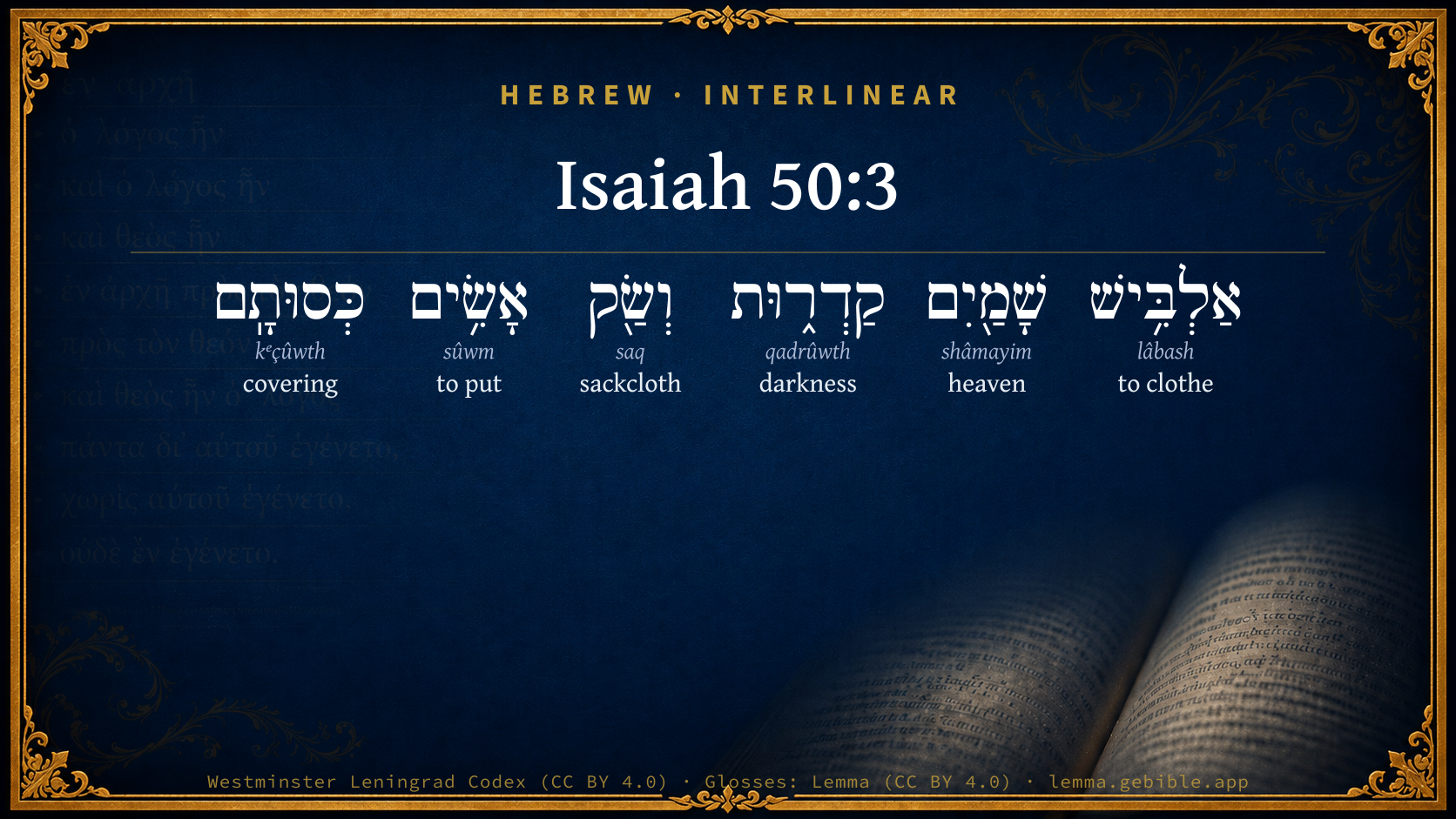
Isaiah 50:3

Hebrew (Westminster Leningrad Codex) Isaiah 50:3 appears in the Hebrew Old Testament. The text above is from the Westminster Leningrad Codex. Each word links to its Strong’s number, a concise gloss, and parsing drawn from the Open Scriptures Hebrew Bible morphology. Click any word for its full Brown-Driver-Briggs (BDB) entry.
Download image
Cite this verse

Isaiah 50:3 (World English Bible). Public Domain. Lemma interlinear Bible study tool, https://lemma.gebible.app/v/isaiah/50/3.

Show BibTeX & RIS
BibTeX
RIS
English Translation
I clothe the heavens with blackness, and I make sackcloth their covering.
World English Bible · Public Domain
Highlights
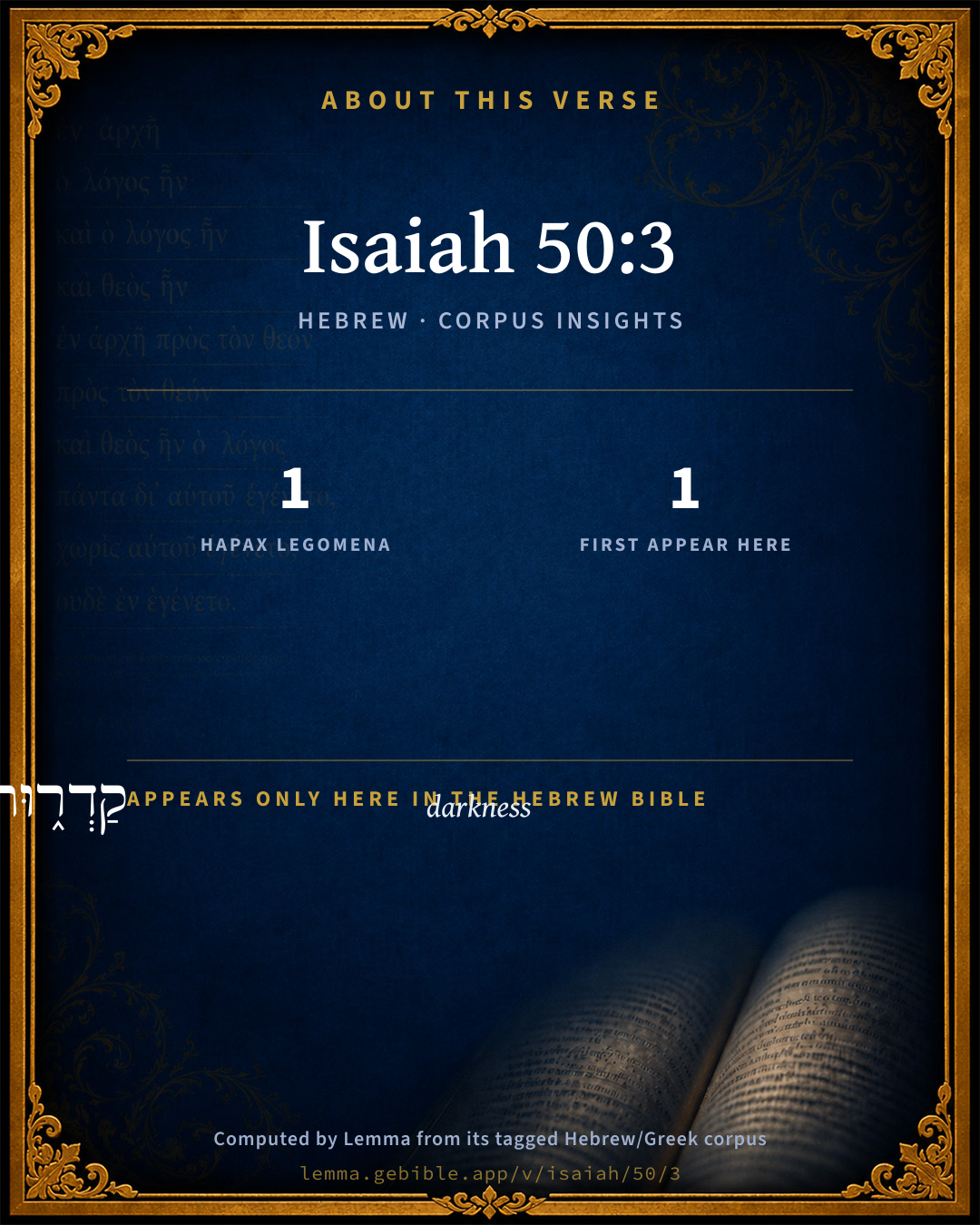
  • 1 hapax legomenon — only here in the Hebrew Bible
  • 1 first appearance in the Hebrew Bible
Full analysis ↓
Download a study sheet

One document with this verse’s original text, its word-by-word gloss line, the meaning frame, cross-references with their text, attributed commentary, and full source and license credits — printable, and it pastes into notes with its structure intact.

This verse Autodidact and up

Study sheet (.html) Plain text (.txt)

A passage Seminary Student

Up to 50 verses in one chapter. A passage sheet keeps up to 6 commentary sources and 12 cross-references per verse, in the order this page ranks them, and says so on the sheet whenever that leaves anything out. Ask for a single verse and you get the Autodidact verse sheet above.

Everything on this page stays free to read, with no account — the sheet is a download of what is already on screen, not access to it.

Want to remove ads? Support Godless Engineer
Compare translations 3

The same verse in 3 English versions, stacked beneath the original-language interlinear above. Click any original word for its lexicon entry.

Each is an independent rendering of the whole verse — the interlinear is not word-aligned to these translations.

Highlighted words mark where these versions differ — a whole-verse word diff, not a word-by-word alignment.

  • World English Bible Public Domain
    I clothe the heavens with blackness, and I make sackcloth their covering.
  • King James Version Public Domain
    I clothe the heavens with blackness, and I make sackcloth their covering.
  • unfoldingWord Literal Text CC BY-SA 4.0
    I clothe the heavens darkness, and I make sackcloth their covering.” q1

unfoldingWord Literal Text — © unfoldingWord, licensed CC BY-SA 4.0. Word-aligned USFM3 via Door43 (git.door43.org/unfoldingWord/en_ult).

Versions to compare (up to 4)

3 of 4 selected

Show all 18 translations

Every available English version of this verse, each an independent rendering of the whole verse.

  • World English Bible Public Domain
    I clothe the heavens with blackness, and I make sackcloth their covering.
  • Berean Standard Bible Public Domain
    I clothe the heavens in black and make sackcloth their covering.”
  • Majority Standard Bible Public Domain
    I clothe the heavens in black and make sackcloth their covering.”
  • King James Version Public Domain
    I clothe the heavens with blackness, and I make sackcloth their covering.
  • American Standard Version (1901) Public Domain
    I clothe the heavens with blackness, and I make sackcloth their covering.
  • Revised Version (1885) Public Domain
    I clothe the heavens with blackness, and I make sackcloth their covering.
  • Geneva Bible (1599) Public Domain
    I clothe the heauens with darkenesse, and make a sacke their couering.
  • Douay-Rheims (1899) Public Domain
    I will clothe the heavens with darkness, and will make sackcloth their covering.
  • Young's Literal Translation Public Domain
    I clothe the heavens `with' blackness, And sackcloth I make their covering.
  • Literal Standard Version CC BY-SA 4.0
    I clothe the heavens [with] blackness, || And I make their covering sackcloth.”
  • Unlocked Literal Bible CC BY-SA 4.0
    I clothe the sky with darkness; I cover it with sackcloth.”
  • unfoldingWord Literal Text CC BY-SA 4.0
    I clothe the heavens darkness, and I make sackcloth their covering.” q1
  • Darby Bible Public Domain
    I clothe the heavens with blackness, and I make sackcloth their covering.
  • World Messianic Bible Public Domain
    I clothe the heavens with blackness. I make sackcloth their covering.”
  • Webster's Bible Public Domain
    I clothe the heavens with blackness, and I make sackcloth their covering.
  • Free Bible Version CC BY-SA 4.0
    I can make the heavens go dark, covering them with sackcloth like they're in mourning.
  • Bible in Basic English Public Domain
    By me the heavens are clothed with black, and I make haircloth their robe.
  • JPS Tanakh (1917) Public Domain
    I clothe the heavens with blackness, and I make sackcloth their covering.

Literal Standard Version (2020), Covenant Press — licensed CC BY-SA 4.0. Text via the HelloAO Bible API (eBible.org). Unlocked Literal Bible (unfoldingWord) — licensed CC BY-SA 4.0. Text via the HelloAO Bible API (eBible.org). unfoldingWord Literal Text — © unfoldingWord, licensed CC BY-SA 4.0. Word-aligned USFM3 via Door43 (git.door43.org/unfoldingWord/en_ult). Free Bible Version, Dr. Jonathan Gallagher — licensed CC BY-SA 4.0. Text via the HelloAO Bible API (eBible.org).

Word by word

More ways to search: Search by grammar → Find every occurrence → Compare this word →

Practice this passage: Drill this verse → Learn its vocabulary →

About this verse

These counts appear in no published source. They are computed here, from the morphology-tagged text and Lemma’s own curated glosses. What Lemma adds →

6
words
6
distinct lemmas
Prophets
section

Notable vocabulary

1 hapax legomenon — a word that appears only here in the entire Hebrew Bible:

  • קַדְר֑וּת darkness H6940

First appearance in Scripture

This word makes its first canonical appearance in the Hebrew Bible here:

  • קַדְר֑וּת darkness H6940

Shared distinctive vocabulary

כְּסוּתָֽם covering H3682 occurs in 8 verses of the Hebrew Bible. Also found in:

Grammatical profile

  • 2 verbs
  • 4 nouns

Verb forms

  • אַלְבִּ֥ישׁ Hiphil · Imperfect
  • אָשִׂ֥ים Qal · Imperfect

Hebrew & Septuagint length

In English translation the verse runs 12 words from the Hebrew and 14 from the Septuagint (LXX English) — closely comparable.

A rough comparison of the two English renderings, which tokenize alike — not a word-level alignment.

Word counts can differ between the Hebrew and the Greek without any difference in meaning — e.g. the Hebrew direct-object marker אֵת has no separate Greek word, and Greek often adds the article ὁ.

Cross-references

4

Topical passages linked to Isaiah 50:3 in the Treasury of Scripture Knowledge — connected by theme and wording, ordered by reader-vote popularity; previews shown in the World English Bible.

  • Revelation 6:12 I saw when he opened the sixth seal, and there was a great earthquake. The sun became black as sackcloth made of hair, and the whole moon became as blood.
  • Psalms 18:11–12 He made darkness his hiding-place, his pavilion around him, Darkness of waters, thick clouds of the skies.
  • Exodus 10:21 Yahweh said to Moses, "Stretch out your hand toward the sky, that there may be darkness over the land of Egypt, even darkness which may be felt."
  • Matthew 27:45 Now from the sixth hour there was darkness over all the land until the ninth hour.

Cross-references courtesy of OpenBible.info (CC BY 4.0).

Hebrew and Greek witnesses Masoretic Hebrew ↔ Greek Septuagint

The same verse in the two great witnesses to the Old Testament, shown verse-for-verse.

These are two independent witnesses, not word-aligned to each other, and the Septuagint is shown in lemma (dictionary) form.

Hebrew Isaiah 50:3 Masoretic · Westminster Leningrad Codex

אַלְבִּ֥ישׁ שָׁמַ֖יִם קַדְר֑וּת וְשַׂ֖ק אָשִׂ֥ים כְּסוּתָֽם

I clothe the heavens with blackness, and I make sackcloth their covering.

World English Bible · Public Domain

Greek LXX Isaiah 50:3 Septuagint · lemma form

καί ἐνδύω ὁ οὐρανός σκότος καί τίθημι ὡς σάκκος ὁ περιβόλαιον αὐτός

I will clothe the sky with darkness, and will make its covering as sackcloth.

LXX2012 (modern English Septuagint) · Public Domain

Hebrew: Westminster Leningrad Codex (CC BY 4.0). Greek: Septuagint (public domain); English from LXX2012 (modern English Septuagint) (Public Domain). How the Septuagint differs from the Hebrew →

Targum (Aramaic paraphrase)

1

The Targum is the ancient Jewish Aramaic paraphrase of the Hebrew Scriptures — an interpretive translation, not the Hebrew text itself. Onkelos (literal) and Pseudo-Jonathan (expansive) render the Torah, and Jonathan the Prophets. Coverage is partial: where no permissively-licensed English translation exists for a verse, only the Aramaic is shown. This is verse-level text, not a word-by-word alignment to the Hebrew.

  1. Targum Jonathan Prophets (Joshua–Malachi)
    אֲכַסֵי שְׁמַיָא כִּדְבְּקַבְלָא וּבְסַקָא אֲשַׁוֵי כְּסוּתְהוֹן:

    I cover the heavens as with blackness, and as with sackcloth I make their covering.

    Targum Jonathan — Aramaic: “Mikraot Gedolot” (public domain). English: “Sefaria Community Translation” (CC0 1.0 (public-domain dedication)); “London "Chaldee Paraphrase," 1871” (public domain). Text via Sefaria.

Commentary

Notes on Isaiah 50:3 from classic Christian and Jewish commentators (each source and its license shown beneath its notes). The classic Christian expositions comment on the surrounding passage and are grouped to its opening verse, so a note may address several verses; the Jewish commentaries on the Tanakh (Rashi and others) are per-verse, so they appear only where the commentator wrote on this verse.

Lemma curates 59 commentaries, every one of them public domain or Creative Commons licensed, each selected and text-cleaned for this edition rather than reprinted as found. About our sources →

Trapp's Complete Commentary

John Trapp

Isa 50:3 I clothe the heavens with blackness, and I make sackcloth their covering.

Ver. 3. I clothe the heavens with blackness.] I did so in that three days’ darkness in Egypt, {Exo 10:21-22} and shall do so again at the time of my passion. I can therefore, doubtless, deliver you, not only from Babylon, but from sin, death, and hell, by giving you an entrance into heaven by the waters of baptism, and by bringing you out of darkness into my marvellous light. {1Pe 2:9}

And make sackcloth their covering.] Ita ut coelum pullata veste obtensum fuisse dixeris. So Rev 6:12.

John Trapp, A Commentary or Exposition upon All the Books of the Old and New Testament (1647–1656) — public domain. Text from a community e-Sword module.

Tyndale Open Study Notes

Tyndale Open Resources

50:3 Phenomena such as darkness and the wearing of clothes of mourning were associated with the day of the Lord (13:10; see study note on 2:5-22). The mention of darkness might allude to the plague of darkness in Egypt (Exod 10:21).

Tyndale Open Study Notes — © Tyndale Open Resources, licensed CC BY-SA 4.0. Text via the HelloAO Bible API.

Geneva Bible (1599)

Geneva Bible translators

As I did in Egypt in token of my displeasure, Exod. 10:21.

Geneva Bible (1599) marginal notes — public domain. Text via Bolls.life.

Jamieson, Fausset & Brown

Robert Jamieson, A. R. Fausset & David Brown

heavens . . . blackness--another of the judgments on Egypt to be repeated hereafter on the last enemy of God's people (Exo 10:21).

sackcloth-- (Rev 6:12).

Jamieson, Fausset & Brown — Commentary Critical and Explanatory on the Whole Bible (1871) — public domain (CC PDM 1.0). Text via the HelloAO Bible API.

The Cambridge Bible for Schools and Colleges

gen. ed. J. J. S. Perowne

3. Comp. Exo_10:21 with blackness] with murky storm-clouds. The word, which occurs only here, denotes (like sackcloth in the next clause) the garb of mourning. Cf. Rev_6:12.

The strophe ends somewhat abruptly, and the thought is perhaps incomplete.

The Cambridge Bible for Schools and Colleges (gen. ed. J. J. S. Perowne; Cambridge University Press, 1878–1918) — public domain. Text from a community e-Sword module.

John Gill's Exposition

I clothe the heavens with blackness,.... With gross and thick darkness; perhaps referring to the three days' darkness the Egyptians were in, Exo 10:12, or with thick and black clouds, as in tempestuous weather frequently; or by eclipses of the sun; there was an extraordinary instance of great darkness at the time of Christ's crucifixion, Mat 27:45.

and I make sackcloth their covering; that being black, and used in times of mourning; the allusion may be to the tents of Kedar, which were covered with sackcloth, or such like black stuff. The fall of the Pagan empire, through the power of Christ and his Gospel, is signified by the sun becoming black as sackcloth of hair, Rev 6:12. Jarchi interprets this parabolically of the princes of the nations, when the Lord shall come to take vengeance upon them; as Kimchi does the sea, and the rivers, in the preceding verse, of the good things of the nations of the world, which they had in great abundance, and should be destroyed.

John Gill's Exposition of the Whole Bible (1746–1763) — public domain (CC PDM 1.0). Text via the HelloAO Bible API.

Albert Barnes' Notes on the Bible

I clothe the heavens with blackness - With the dark clouds of a tempest - perhaps with an allusion to the remarkable clouds and tempests that encircled the brow of Sinai when he gave the law. Or possibly alluding to the thick darkness which he brought over the land of Egypt (Exo 10:21; Grotius). In the previous verse, he had stated what he did on the earth, and referred to the exhibitions of his great power there. He here refers to the exhibition of his power in the sky; and the argument is, that he who had thus the power to spread darkness over the face of the sky, had power also to deliver his people.

I make sackcloth their covering - Alluding to the clouds. Sackcloth was a coarse and dark cloth which was usually worn as an emblem of mourning (see the note at Isa 3:24). The same image is used in Rev 6:12 : ‘And I beheld when he had opened the sixth seal, and lo, there was a great earthquake; and the sun became black as sackcloth of hair.’ To say, therefore, that the heavens were clothed with sackcloth, is one of the most striking and impressive figures which can be conceived.

Albert Barnes' Notes on the Bible (1834–1885) — public domain. Text from a community e-Sword/MySword module.

Matthew Poole's English Annotations

I clothe the heavens with blackness; or, I will or can clothe &c. What I once did in Egypt, when I drew black curtains before all the heavenly lights, and caused an unparalleled and amazing darkness for three days together, to the great terror of mine enemies, so I can and will do still when it is necessary to save my people. And therefore you have no reason to distrust me.

I make sackcloth their covering; I cover them with thick and dark clouds, black as sackcloth, as is said, Rev 6:12, or as that stuff of which the tents of Kedar were made, Son 1:5. From this and some other expressions it appears that they wore a black sackcloth, which also was most suitable to the state of mourners, by whom it was used.

Matthew Poole's English Annotations on the Holy Bible (1683–1685) — public domain. Text from a community e-Sword/MySword module.

Whedon's Commentary on the Bible

Daniel D. Whedon

3. I clothe the heavens with blackness — As at Sinai, but I cause the terror stricken still to live, and lay before them my commands. Should not such a husband, such a father, helper, friend, be worthy of confidence?

Daniel D. Whedon (gen. ed.), Commentary on the Old and New Testaments (1874–1909) — public domain. Text from a community e-Sword module.

The Pulpit Commentary

I clothe the heavens with blackness. (comp. Jer_4:28 Eze_32:7, 8 Joe_2:10 Joe_3:15 Mat_24:29 Luk_21:25 Rev_6:12) The Egyptian plague of darkness (Exo_10:21-23) is not adequate to the expressions here used. God means to assert his power of leaving all nature in absolute darkness, if he so choose a power necessarily belonging to him who said, "Let there be light; and there was light". (Gen_1:3) I make sackcloth their covering. (see Rev_6:12, "The sun became black as sackcloth of hair

The Pulpit Commentary (1880–1919), ed. H.D.M. Spence-Jones & Joseph S. Exell — public domain. Text from a community e-Sword module.

John Wesley's Explanatory Notes

I clothe - When it is necessary to save my people, I cover them with thick and dark clouds black as sackcloth, Rev. vi, 12.

John Wesley, Explanatory Notes Upon the Whole Bible (1754–1765) — public domain. Text via the GEBible commentary corpus.

J. A. Alexander on Isaiah

Joseph Addison Alexander

The description of Jehovah’s power, as displayed in His control of the elements, is still continued. “I will clothe the heavens in blackness.” The Hebrew noun, according to its etymology, denotes not merely a black color, but such a color used as a sign of mourning. Thus understood, it corresponds exactly to the following words, where the customary mourning dress of ancient times is mentioned. “And sackcloth I will place (or make) their covering.” The reference of this verse to the plague of darkness in the land of Egypt is admissible only in the sense explained above with respect to the passage of the Red Sea, namely, as a particular allusion comprehended in a general description. Some writers understand it as referring to the usual phenomena of storms, or even to the obscuration of the sky by clouds; but it is inconceivable that such an every-day occurrence should be coupled with the drying up of seas and rivers, as a proof of God’s power over nature and the elements. The sense required by the connection is that of an extraordinary darkness (such as that of an eclipse), or even an extinction of the heavenly bodies, as in Isa 13:10.

Joseph Addison Alexander, The Prophecies of Isaiah (1846–1847; New York: Scribner, 1870–1878) — public domain. Text from a community e-Sword module.

Rashi

Rabbi Shlomo Yitzchaki (Rashi)

I clothe the heavens The host of the heavens, the princes of the heathens (nations [Mss. and K’li Paz]), when I come to mete out retribution upon the nations.

Rashi on the Tanakh — English translations: “The Judaica Press complete Tanach with Rashi, translated by A. J. Rosenberg” (CC BY 4.0); “Pentateuch with Rashi's commentary by M. Rosenbaum and A.M. Silbermann, 1929-1934” (public domain); “The Metsudah Tanach series, Lakewood, N.J” (CC BY 4.0); and “The Book of Joshua, Metsudah Publications, 1997” (CC BY 4.0). Text via Sefaria.

Ibn Ezra

Rabbi Abraham ibn Ezra

מלבוש קדרׂות ═ קדרות With black cloth, that is, with clouds. Some understand it to refer to an eclipse of the sun, when the sky becomes obscure in the middle of the day, and appears as if covered with sackcloth, which is usually black.

Ibn Ezra on the Tanakh — English translations: “Sefaria Community Translation” (CC0 1.0 (public-domain dedication)); “Yalkut, Sifsei Chachomim Chumash, Metsudah Publications, 2009” (CC BY 4.0); and “Commentary of Ibn Ezra on Isaiah - trans. by M. Friedlander, 1873” (public domain). Text via Sefaria.

Lesson kit

Teaching starters — assembled from the data on this page, not authored interpretation. Every prompt links to the verse data it draws on. Edit before teaching.

Isaiah, in the Prophets, opens this verse with 6 words (6 distinct Hebrew lemmas). Its most distinctive word is qadrûwth (“darkness”). A historical commentator’s framing appears above. Read the whole chapter for the surrounding context.

Discussion questions

  1. What does “darkness” (qadrûwth) contribute to the verse as a whole?
  2. 1 word here appears nowhere else in the Hebrew Bible. Why might the author reach for such rare wording?
  3. This is the first place “darkness” appears in Scripture (first appears here). What does its debut here establish?
  4. How does Genesis 20:16, which shares the word «covering», read alongside this verse?
  5. The translations on this page render this verse differently — a whole-verse word diff, not a word-by-word alignment. What might account for the different wordings?
  6. «אַלְבִּ֥ישׁ» is a Hiphil Imperfect verb. How does that grammatical form shape the action described?
  7. Compare how Trapp's Complete Commentary and Tyndale Open Study Notes read this verse. Where do they agree or differ?

Things to notice

  • 1 word in this verse appears nowhere else in the Hebrew Bible.
  • 1 word makes its first canonical appearance in Scripture here.
  • These translations choose different wording for 3 words in this verse.
  • 6 distinct Hebrew lemmas span 6 words in this verse.

Reading settings

Reading text

Shown beneath each verse's original-language words.

Old Testament
Old Testament edition

Read the OT as the Masoretic Hebrew (MT) or the Greek Septuagint (LXX).

English shown for the Greek Septuagint (in the Hebrew ↔ Greek comparison).

Comparing translations? Open the Compare panel on any verse page to stack up to four side by side.