Ezekiel 16:10

Hebrew (Westminster Leningrad Codex) Ezekiel 16:10 appears in the Hebrew Old Testament. The text above is from the Westminster Leningrad Codex. Each word links to its Strong’s number, a concise gloss, and parsing drawn from the Open Scriptures Hebrew Bible morphology. Click any word for its full Brown-Driver-Briggs (BDB) entry.
Download image
Cite this verse

Ezekiel 16:10 (World English Bible). Public Domain. Lemma interlinear Bible study tool, https://lemma.gebible.app/v/ezekiel/16/10.

Show BibTeX & RIS
BibTeX
RIS
English Translation
I clothed you also with embroidered work, and shod you with sealskin, and I girded you about with fine linen, and covered you with silk.
World English Bible · Public Domain
Highlights
  • 1 first appearance in the Hebrew Bible
Full analysis ↓
Download a study sheet

One document with this verse’s original text, its word-by-word gloss line, the meaning frame, cross-references with their text, attributed commentary, and full source and license credits — printable, and it pastes into notes with its structure intact.

This verse Autodidact and up

Study sheet (.html) Plain text (.txt)

A passage Seminary Student

Up to 50 verses in one chapter. A passage sheet keeps up to 6 commentary sources and 12 cross-references per verse, in the order this page ranks them, and says so on the sheet whenever that leaves anything out. Ask for a single verse and you get the Autodidact verse sheet above.

Everything on this page stays free to read, with no account — the sheet is a download of what is already on screen, not access to it.

Want to remove ads? Support Godless Engineer
Compare translations 3

The same verse in 3 English versions, stacked beneath the original-language interlinear above. Click any original word for its lexicon entry.

Each is an independent rendering of the whole verse — the interlinear is not word-aligned to these translations.

Highlighted words mark where these versions differ — a whole-verse word diff, not a word-by-word alignment.

  • World English Bible Public Domain
    I clothed you also with embroidered work, and shod you with sealskin, and I girded you about with fine linen, and covered you with silk.
  • King James Version Public Domain
    I clothed thee also with broidered work, and shod thee with badgers' skin, and I girded thee about with fine linen, and I covered thee with silk.
  • unfoldingWord Literal Text CC BY-SA 4.0
    I dressed you in embroidered clothes and placed leather sandals on your feet. I wrapped you with fine linen and covered you with silk.

unfoldingWord Literal Text — © unfoldingWord, licensed CC BY-SA 4.0. Word-aligned USFM3 via Door43 (git.door43.org/unfoldingWord/en_ult).

Versions to compare (up to 4)

3 of 4 selected

Show all 18 translations

Every available English version of this verse, each an independent rendering of the whole verse.

  • World English Bible Public Domain
    I clothed you also with embroidered work, and shod you with sealskin, and I girded you about with fine linen, and covered you with silk.
  • Berean Standard Bible Public Domain
    I clothed you in embroidered cloth and gave you sandals of fine leather. I wrapped you in fine linen and covered you with silk.
  • Majority Standard Bible Public Domain
    I clothed you in embroidered cloth and gave you sandals of fine leather. I wrapped you in fine linen and covered you with silk.
  • King James Version Public Domain
    I clothed thee also with broidered work, and shod thee with badgers' skin, and I girded thee about with fine linen, and I covered thee with silk.
  • American Standard Version (1901) Public Domain
    I clothed thee also with broidered work, and shod thee with sealskin, and I girded thee about with fine linen, and covered thee with silk.
  • Revised Version (1885) Public Domain
    I clothed thee also with broidered work, and shod thee with sealskin, and I girded thee about with fine linen, and covered thee with silk.
  • Geneva Bible (1599) Public Domain
    I clothed thee also with broydred worke, and shod thee with badgers skin: and I girded thee about with fine linen, and I couered thee with silke.
  • Douay-Rheims (1899) Public Domain
    And I clothed thee with embroidery, and shed thee with violet coloured shoes: and I girded thee about with fine linen, and clothed thee with fine garments.
  • Young's Literal Translation Public Domain
    And I clothe thee with embroidery, And I shoe thee with badger's skin, And I gird thee with fine linen, And I cover thee with figured silk.
  • Literal Standard Version CC BY-SA 4.0
    And I clothe you with embroidery, || And I shoe you with tachash [skin], || And I gird you with fine linen, || And I cover you with figured silk.
  • Unlocked Literal Bible CC BY-SA 4.0
    I dressed you in embroidered clothes and placed leather sandals on your feet. I wrapped you with fine linen and covered you with silk.
  • unfoldingWord Literal Text CC BY-SA 4.0
    I dressed you in embroidered clothes and placed leather sandals on your feet. I wrapped you with fine linen and covered you with silk.
  • Darby Bible Public Domain
    and I clothed thee with embroidered work, and shod thee with badgers' skin, and I bound thee about with byssus, and covered thee with silk.
  • World Messianic Bible Public Domain
    I clothed you also with embroidered work and put leather sandals on you. I dressed you with fine linen and covered you with silk.
  • Webster's Bible Public Domain
    I clothed thee also with broidered work, and shod thee with badgers' skin, and I girded thee with fine linen, and I covered thee with silk.
  • Free Bible Version CC BY-SA 4.0
    I put a beautifully embroidered dress on you and gave you fine leather sandals. I clothed you in fine linen and covered you with silk.
  • Bible in Basic English Public Domain
    And I had you clothed with needlework, and put leather shoes on your feet, folding fair linen about you and covering you with silk.
  • JPS Tanakh (1917) Public Domain
    I clothed thee also with richly woven work, and shod thee with sealskin, and I wound fine linen about thy head, and covered thee with silk.

Literal Standard Version (2020), Covenant Press — licensed CC BY-SA 4.0. Text via the HelloAO Bible API (eBible.org). Unlocked Literal Bible (unfoldingWord) — licensed CC BY-SA 4.0. Text via the HelloAO Bible API (eBible.org). unfoldingWord Literal Text — © unfoldingWord, licensed CC BY-SA 4.0. Word-aligned USFM3 via Door43 (git.door43.org/unfoldingWord/en_ult). Free Bible Version, Dr. Jonathan Gallagher — licensed CC BY-SA 4.0. Text via the HelloAO Bible API (eBible.org).

Word by word

More ways to search: Search by grammar → Find every occurrence → Compare this word →

Practice this passage: Drill this verse → Learn its vocabulary →

מֶֽשִׁי
meshîy
H4897
“silk”
Noun, Common, Masculine, Singular, Absolute
Part of Speech
Noun
Type
Common
Gender
Masculine
Number
Singular
State
Absolute
Full BDB Definition

Origin: from H4871

TWOT: 1256

a costly material for garment - perhaps silk
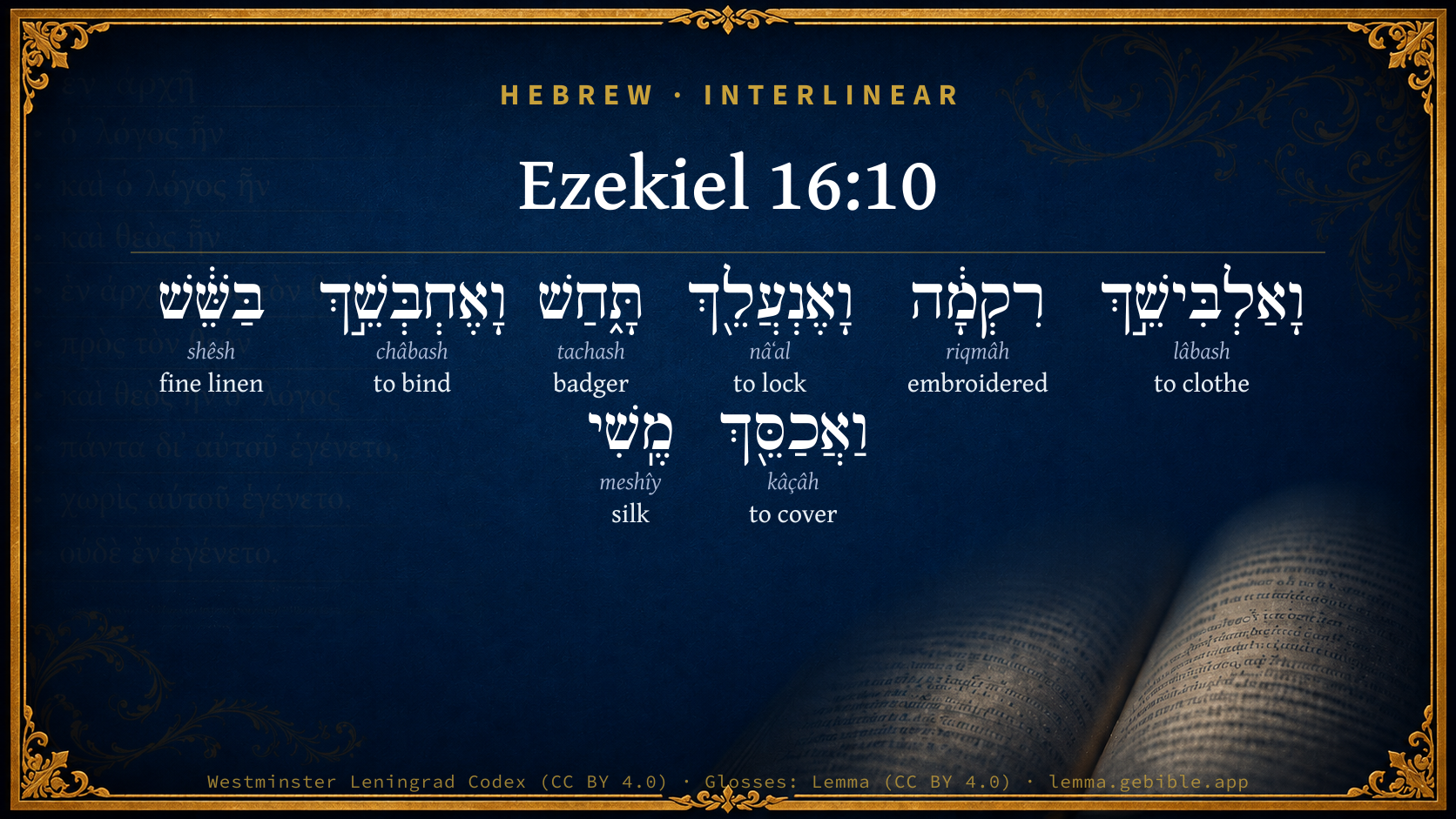
  1. וָאַלְבִּישֵׁ֣ךְ lâbash H3847 “and · to clothe · you” Conjunction + Verb, Hiphil, Sequential Imperfect, 1st Person, Common, Singular + Suffix, Personal, 2nd Person, Feminine, Singular
  2. רִקְמָ֔ה riqmâh H7553 “embroidered” Noun, Common, Feminine, Singular, Absolute
  3. וָאֶנְעֲלֵ֖ךְ nâʻal H5274 “and · to lock · you” Conjunction + Verb, Qal, Sequential Imperfect, 1st Person, Common, Singular + Suffix, Personal, 2nd Person, Feminine, Singular
  4. תָּ֑חַשׁ tachash H8476 “badger” Noun, Common, Masculine, Singular, Absolute
  5. וָאֶחְבְּשֵׁ֣ךְ châbash H2280 “and · to bind · you” Conjunction + Verb, Qal, Sequential Imperfect, 1st Person, Common, Singular + Suffix, Personal, 2nd Person, Feminine, Singular
  6. בַּשֵּׁ֔שׁ shêsh H8336 “in/at the · fine linen” Preposition, Determined + Noun, Common, Masculine, Singular, Absolute
  7. וַאֲכַסֵּ֖ךְ kâçâh H3680 “and · to cover · you” Conjunction + Verb, Piel, Sequential Imperfect, 1st Person, Common, Singular + Suffix, Personal, 2nd Person, Feminine, Singular

About this verse

These counts appear in no published source. They are computed here, from the morphology-tagged text and Lemma’s own curated glosses. What Lemma adds →

8
words
8
distinct lemmas
Prophets
section

Notable vocabulary

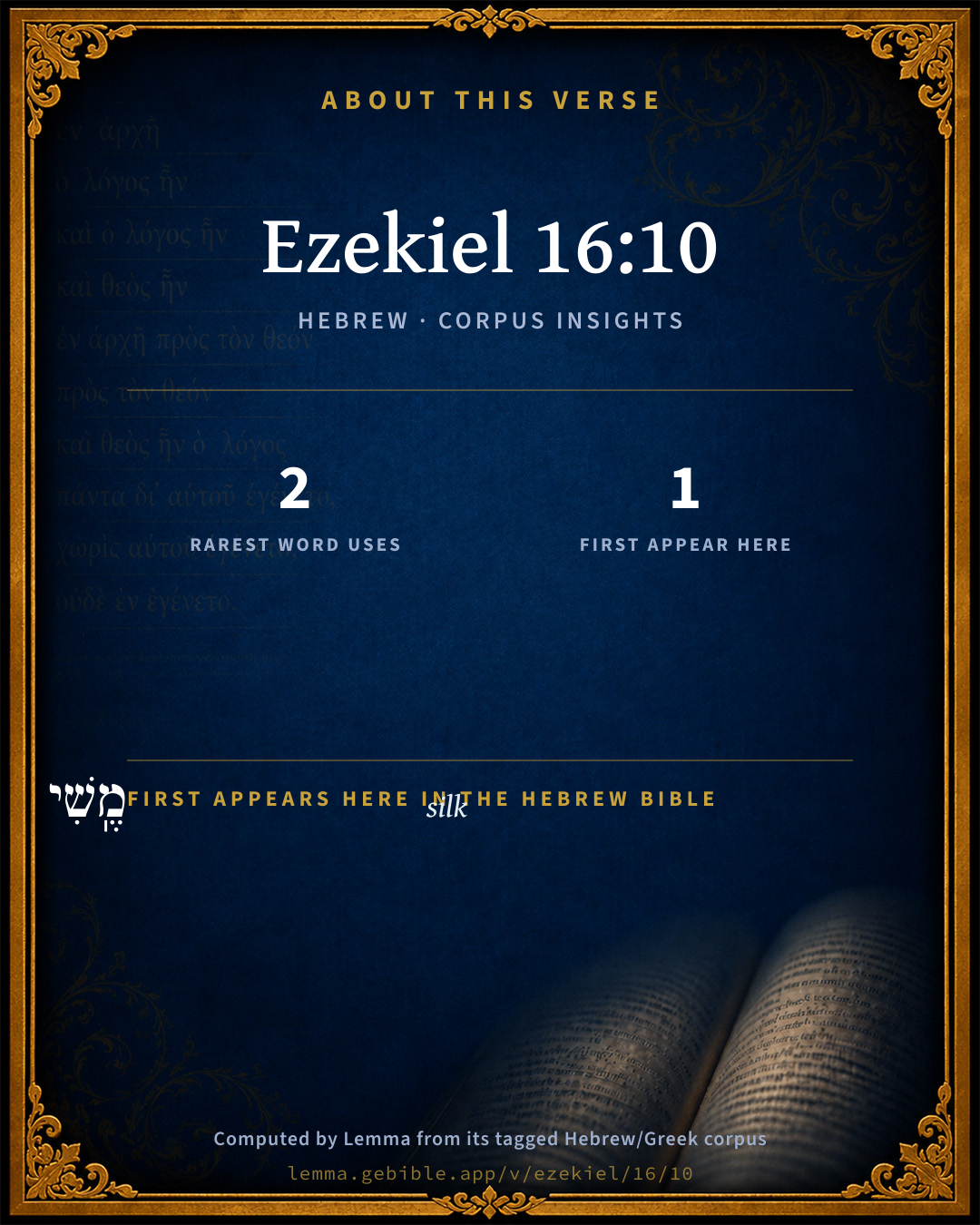
The rarest word here is מֶֽשִׁי silk H4897 — appearing just 2 times in the whole Hebrew Bible.

First appearance in Scripture

This word makes its first canonical appearance in the Hebrew Bible here:

  • מֶֽשִׁי silk H4897

Shared distinctive vocabulary

מֶֽשִׁי silk H4897 occurs in 2 verses of the Hebrew Bible. Also found in:

Grammatical profile

  • 4 verbs
  • 4 nouns

Verb forms

  • וָאַלְבִּישֵׁ֣ךְ Hiphil · Sequential Imperfect
  • וָאֶנְעֲלֵ֖ךְ Qal · Sequential Imperfect
  • וָאֶחְבְּשֵׁ֣ךְ Qal · Sequential Imperfect
  • וַאֲכַסֵּ֖ךְ Piel · Sequential Imperfect

Hebrew & Septuagint length

In English translation the verse runs 25 words from the Hebrew and 24 from the Septuagint (LXX English) — closely comparable.

A rough comparison of the two English renderings, which tokenize alike — not a word-level alignment.

Word counts can differ between the Hebrew and the Greek without any difference in meaning — e.g. the Hebrew direct-object marker אֵת has no separate Greek word, and Greek often adds the article ὁ.

Cross-references

22

Topical passages linked to Ezekiel 16:10 in the Treasury of Scripture Knowledge — connected by theme and wording, ordered by reader-vote popularity; previews shown in the World English Bible.

  • Ezekiel 16:18 and you took your embroidered garments, and covered them, and did set my oil and my incense before them.
  • Ezekiel 16:13 Thus was you decked with gold and silver; and your clothing was of fine linen, and silk, and embroidered work; you ate fine flour, and honey, and oil; and you were exceeding beautiful, and you did prosper to royal estate.
  • Exodus 26:36 "You shall make a screen for the door of the Tent, of blue, and purple, and scarlet, and fine twined linen, the work of the embroiderer.
  • Psalms 45:13–14 The princess inside is all glorious. Her clothing is interwoven with gold.
  • Isaiah 61:10 I will greatly rejoice in Yahweh, my soul shall be joyful in my God; for he has clothed me with the garments of salvation, he has covered me with the robe of righteousness, as a bridegroom decks himself with a garland, and as a bride adorns herself with her jewels.
  • Genesis 41:42 Pharaoh took off his signet ring from his hand, and put it on Joseph's hand, and arrayed him in robes of fine linen, and put a gold chain about his neck,
  • Exodus 26:14 You shall make a covering for the tent of rams' skins dyed red, and a covering of sea cow hides above.
  • Exodus 28:5 They shall take the gold, and the blue, and the purple, and the scarlet, and the fine linen.
  • Exodus 39:27–28 They made the coats of fine linen of woven work for Aaron, and for his sons,
  • Isaiah 61:3 to appoint to those who mourn in Zion, to give to them a garland for ashes, the oil of joy for mourning, the garment of praise for the spirit of heaviness; that they may be called trees of righteousness, the planting of Yahweh, that he may be glorified.
  • Ezekiel 27:16 Syria was your merchant by reason of the multitude of your handiworks: they traded for your wares with emeralds, purple, and embroidered work, and fine linen, and coral, and rubies.
  • Luke 15:22 "But the father said to his servants, 'Bring out the best robe, and put it on him. Put a ring on his hand, and shoes on his feet.
  • Revelation 19:8 It was given to her that she would array herself in bright, pure, fine linen: for the fine linen is the righteous acts of the saints.
  • Exodus 25:5 rams' skins dyed red, sea cow hides, acacia wood,
  • Proverbs 31:22 She makes for herself carpets of tapestry. Her clothing is fine linen and purple.
  • Ezekiel 16:7 I caused you to multiply as that which grows in the field, and you increased and grew great, and you attained to excellent ornament; your breasts were fashioned, and your hair was grown; yet you were naked and bare.
  • Ezekiel 26:16 Then all the princes of the sea shall come down from their thrones, and lay aside their robes, and strip off their embroidered garments: they shall clothe themselves with trembling; they shall sit on the ground, and shall tremble every moment, and be astonished at you.
  • Ezekiel 27:7 Of fine linen with embroidered work from Egypt was your sail, that it might be to you for an ensign; blue and purple from the isles of Elishah was your awning.
  • 1 Peter 3:3–4 Let your beauty be not just the outward adorning of braiding the hair, and of wearing jewels of gold, or of putting on fine clothing;
  • Revelation 7:9–14 After these things I looked, and behold, a great multitude, which no man could number, out of every nation and of all tribes, peoples, and languages, standing before the throne and before the Lamb, dressed in white robes, with palm branches in their hands.
  • Revelation 18:12 merchandise of gold, silver, precious stones, pearls, fine linen, purple, silk, scarlet, all expensive wood, every vessel of ivory, every vessel made of most precious wood, and of brass, and iron, and marble;
  • Revelation 21:2 I saw the holy city, New Jerusalem, coming down out of heaven from God, made ready like a bride adorned for her husband.

Cross-references courtesy of OpenBible.info (CC BY 4.0).

Hebrew and Greek witnesses Masoretic Hebrew ↔ Greek Septuagint

The same verse in the two great witnesses to the Old Testament, shown verse-for-verse.

These are two independent witnesses, not word-aligned to each other, and the Septuagint is shown in lemma (dictionary) form.

Hebrew Ezekiel 16:10 Masoretic · Westminster Leningrad Codex

וָאַלְבִּישֵׁ֣ךְ רִקְמָ֔ה וָאֶנְעֲלֵ֖ךְ תָּ֑חַשׁ וָאֶחְבְּשֵׁ֣ךְ בַּשֵּׁ֔שׁ וַאֲכַסֵּ֖ךְ מֶֽשִׁי

I clothed you also with embroidered work, and shod you with sealskin, and I girded you about with fine linen, and covered you with silk.

World English Bible · Public Domain

Greek LXX Ezekiel 16:10 Septuagint · lemma form

καί ἐνδύω σύ ποικίλος καί ὑποδέω σύ ὑάκινθος καί ζωννύω σύ βύσσος καί περιβάλλω σύ τρίχαπτος

And I clothed you with embroidered garments, and clothed you beneath with purple, and girded you with fine linen, and clothed you with silk,

LXX2012 (modern English Septuagint) · Public Domain

On this verse, The Cambridge Bible for Schools and Colleges discusses the Septuagint’s reading. Read the note in Commentary ↓

Hebrew: Westminster Leningrad Codex (CC BY 4.0). Greek: Septuagint (public domain); English from LXX2012 (modern English Septuagint) (Public Domain). How the Septuagint differs from the Hebrew →

Targum (Aramaic paraphrase)

1

The Targum is the ancient Jewish Aramaic paraphrase of the Hebrew Scriptures — an interpretive translation, not the Hebrew text itself. Onkelos (literal) and Pseudo-Jonathan (expansive) render the Torah, and Jonathan the Prophets. Coverage is partial: where no permissively-licensed English translation exists for a verse, only the Aramaic is shown. This is verse-level text, not a word-by-word alignment to the Hebrew.

  1. Targum Jonathan Prophets (Joshua–Malachi)
    וְאַלְבִּישֵׁית יַתְכוֹן לְבוּשֵׁי צִיוּרִין מֵחָמְדַת סָנְאֵיכוֹן וִיהָבֵית מְסַן דִיקַר בְּרַגְלֵיכוֹן וְקַדְשֵׁית מִנְכוֹן כַּהֲנַיָא לְמֶהֱוֵי מְשַׁמְשִׁין קֳדָמַי בְּמִצְנְפָן דְבוּץ וְיַת כַּהֲנָא רַבָּא בִּלְבוּשֵׁי צִבְעוֹנִין:

    And I dressed you in embroidered garments from your enemies' treasure, and placed a shoe of glory on your feet, and sanctified from among you the priests to be serving before Me in a linen turban, and the high priest in colored garments.

    Targum Jonathan — Aramaic: “Mikraot Gedolot” (public domain). English: “Sefaria Community Translation” (CC0 1.0 (public-domain dedication)); “London "Chaldee Paraphrase," 1871” (public domain). Text via Sefaria.

Commentary

Notes on Ezekiel 16:10 from classic Christian and Jewish commentators (each source and its license shown beneath its notes). The classic Christian expositions comment on the surrounding passage and are grouped to its opening verse, so a note may address several verses; the Jewish commentaries on the Tanakh (Rashi and others) are per-verse, so they appear only where the commentator wrote on this verse.

Lemma curates 59 commentaries, every one of them public domain or Creative Commons licensed, each selected and text-cleaned for this edition rather than reprinted as found. About our sources →

Jamieson, Fausset & Brown

Robert Jamieson, A. R. Fausset & David Brown

eze 16:10Psa 45:13-14, similarly describes the Church (Israel, the appointed mother of Christendom) adorned as a bride (so Isa 61:10). It is Messiah who provides the wedding garment (Rev 3:18; Rev 19:8).

badgers' skin--tahash; others translate, "seal skins." They formed the over-covering of the tabernacle, which was, as it were, the nuptial tent of God and Israel (Exo 26:14), and the material of the shoes worn by the Hebrews on festival days. (See on Exo 25:5).

fine linen--used by the priests (Lev 6:10); emblem of purity.

Jamieson, Fausset & Brown — Commentary Critical and Explanatory on the Whole Bible (1871) — public domain (CC PDM 1.0). Text via the HelloAO Bible API.

Trapp's Complete Commentary

John Trapp

Eze 16:10 I clothed thee also with broidered work, and shod thee with badgers’ skin, and I girded thee about with fine linen, and I covered thee with silk.

Ver. 10. I clothed thee also with broidered work.] Phrygionica veste variegata. With variety of precious graces, whereby thou didst outshine Solomon in all his bravery; for one grain of faith is of better worth than all the gold of Ophir, and one remnant of hope beyond all the gay clothing in the world.

And girded thee about with fine linen.] The Church hath a rich wardrobe for woollens and linens; God’s plenty of both.

John Trapp, A Commentary or Exposition upon All the Books of the Old and New Testament (1647–1656) — public domain. Text from a community e-Sword module.

The Biblical Illustrator

Joseph S. Exell

Eze_16:10-14

I clothed thee also with broidered work.

The clothing of Gods people

See with what matchless generosity the Lord provides for His peoples apparel.

1. They are so arrayed that the Divine skill is seen producing an unrivalled broidered work, in which every attribute takes its part and every Divine beauty is revealed. No art like the art displayed in our salvation, no cunning workmanship like that beheld in the righteousness of the saints. Justification has engrossed learned pens in all ages of the Church, and will be the theme of admiration in eternity. God has indeed curiously wrought it.

2. With all this elaboration there is mingled utility and durability, comparable to our being shod with badgers skins. The animal here meant is unknown, but its skin covered the tabernacle, and formed one of the finest and strongest leathers known. The righteousness which is of God by faith endureth forever, and he who is shod with this Divine preparation will tread the desert safely, and may even set his foot upon the lion and the adder.

3. Purity and dignity of our holy vesture are brought out in the fine linen. When the Lord sanctifies His people, they are clad as priests in pure white; not the snow itself excels them; they are in the eyes of men and angels fair to look upon, and even in the Lords eves they are without spot.

4. Meanwhile the royal apparel is delicate and rich as silk! No expense is spared, no beauty withheld, no daintiness denied.

5. Surely there is gratitude to be felt and joy to be expressed. Come, my heart, refuse not thy evening hallelujah! Tune thy pipes! Touch thy chords! (C. H. Spurgeon.)

The Biblical Illustrator, edited by Joseph S. Exell (c. 1880s–1900s) — public domain. Text from a community e-Sword module.

Adam Clarke's Commentary

Verse 10. I clothed thee also with broidered work] Cloth on which various figures, in various colours, were wrought by the needle.

With badgers' skin] See Ex 25:5. The same kind of skin with which the tabernacle was covered.

Fine linen] בשש beshesh, with cotton. I have seen cloth of this kind enveloping the finest mummies.

I covered thee with silk.] משי meshi. Very probably the produce of the silk-worm.

Adam Clarke's Commentary on the Bible (1810–1826) — public domain. Text from a community e-Sword/MySword module.

John Calvin's Commentaries

Here the Prophet, in a metaphor, relates other benefits of God by which he liberally adorned his people; for we know that nothing has been omitted in God’s pouring forth the riches of his goodness on the people. And as to the explanations which some give of these female ornaments allegorically, I do not approve of it, as they fruitlessly conjecture many trifles which are at variance with each other. First of all, their conjectures may be refuted by the Prophet’s words: then, if we suffer the Prophet’s words to be turned and twisted, what these allegorical interpreters chatter with each other is entirely contrary in their meaning. Let us, therefore, be content with the genuine sense, that God was so generous towards the Israelites that he poured forth all his blessings in enriching them. Now, if one asks how the people were adorned? I answer, in two ways — first, God embraced them with his favor, and promised to be their God, and this was their chief honor; as Moses says they were naked, and their shame was discovered when they set up an idol in the place of God. He now adds a second kind of blessing, when God took care of them in the desert: he appeared by day in a cloud, and by night in a pillar of fire: the water flowed for them from the rock; daily food was given them from heaven, as if God with his own hands had placed it within their mouths: then in his strength they conquered their enemies, and entered the promised land; while he slew the nations for them, and gave them quiet possession and dominion there: then he blessed the land, so that it nourished them abundantly, and made it testify that it was no vain promise that the land should flow with milk and honey. (Exodus 3:17; Exodus 13:21, 22; Exodus 16:15,16; Exodus 17:6; Exodus 22:25; Numbers 20:11.) Ezekiel includes all these things under necklaces, bracelets, gold, silver, linen garments, broidered work, etc. As to the particular words I will not, accurately insist, unless I shortly touch on a point or two which may occasion doubt.

When he says that he clothed them, רקמה, rekmeh, this is in accordance with eastern customs: for they were accustomed to use clothing of different colors; as Benjamin wore a dress of this kind when he was a boy; and this was no royal splendor on his father’s part, who was a shepherd, but simply the usual custom. At this day, indeed, if any one among us wore a party colored garment, it would not be manly: nay, women who desire such variety in colors show themselves to have cast off all modesty. But among the Orientals, as I have said, this was the usual kind of dress. He afterwards adds, I shod thee with badgers’ skin. I know not why Jerome translates it violet-colored, and others hyacinth: it is sufficiently clear that it was a precious kind of skin. The word is often used by Moses when treating of the tabernacle; for the coverings were of violet-colored skin, and the whole tabernacle was covered with them. The badger was an animal unknown to us: but since he is here treating of shoes, there is no doubt that the skin was more elegant, and more highly esteemed by God. (Exodus 35:23; 36:19.) Afterwards he adds, I bound thee with fine linen. We know that linen garments were in more frequent use among that people than in Greece or in Italy, or in these parts: for linen was rarely used by the Romans even in their greatest luxury; but in the East they wore linen, as that region is very warm. But we know that linen is very fine, and that they were accustomed to weave transparent veils. Now this clothing was commonly worn by men in the East, though it is by no means manly: nay, in women it is scarcely tolerable. But the priests afterwards adopted the custom, and clothed themselves in linen while performing sacred rites. The Papal priests too — apes in all things — have imitated the custom; and although they do not wear fine linen, yet use linen robes, which they call surplices.

He now adds, and I covered thee with silk, or silken garments, or silk cloth. He adds, that he placed bracelets upon the hands: barbarians call them armlets. This luxury was spread abroad almost everywhere; but the circular ornament which the Prophet adds to it was rejected by other nations. He puts a chain round the neck: chains were in common use as they are this day: nay, to necklaces were added looser chains — double, threefold, and fourfold; for this fault was too common. And what he afterwards adds of the ring was left to the Orientals, for they had jewels hanging from their nostrils: and I wonder why interpreters put earrings here, and then instead of earrings put nose-rings. But the Prophet here means a ring, whence a jewel was hung from the nose; and this with us is ridiculous and deforming: but in those barbarous regions both men and women have gems hanging from both their noses and ears. He adds, a crown on thy head. He does not mean a diadem or crown as a sign of royalty, but an ornament sufficiently common.

John Calvin's Commentaries (1540-1563) — public domain. Text from the Calvin Translation Society English edition (1840s-50s) via the Christian Classics Ethereal Library (ccel.org). Calvin's coverage is partial (roughly two-thirds of the Bible); uncommented books and verses are honest gaps, never fabricated. The 19th-century editor's footnotes and remarks are omitted so the notes are faithfully Calvin's own voice.

Ellicott's Commentary for English Readers

(10) Badgers’ skin.—See Exo_25:5. The thing intended is a fine kind of leather prepared from the skin of some sea animal; but the critics differ as to the particular animal intended, whether the dolphin or the dugong. “Fine linen” was a luxury much valued by the ancients, while “silk” is a word used only here and in Eze_16:13, and its meaning is much questioned. By its etymology it is thought to express fineness of texture; and our translators have followed the rabbinical tradition in understanding it to mean silk.

A Bible Commentary for English Readers, edited by Charles John Ellicott (1878–1897) — public domain. Text from a community e-Sword module.

The Cambridge Bible for Schools and Colleges

gen. ed. J. J. S. Perowne

10. The costly clothing.

broidered work] Psa_45:14; Jdg_5:30. The word might mean work of various colours (Exo_26:36). So Eze_16:13; Eze_16:18.

badgers’ skin] According to most, skin of the sea-cow or manati, an animal allied to the dolphin, and found in the Red Sea. The name is found in Assyrian; the Assyrian kings crossed the Euphrates in ships made of the skin of this animal, and Salmaneser pursued his foes on lake Van in such ships. These facts suggest that the skins were readily procured not only in Mesopotamia but even in Armenia, and that some land animal must have furnished them. On these grounds Fried. Del. (Prolegomena, p. 78) decides for the wether. See Dill. on Exo_25:5.

fine linen] i.e. byssus. It is not certain whether the byssus was cotton or linen, or both. It was worn by the priests (Exo_39:27), and by persons of rank (Gen_41:42). The “girding” or binding here can hardly refer to the headdress (Exo_29:9), because in Eze_16:13 the “clothing” is said to be of fine linen (cf. Eze_16:12 or headdress).

covered thee with silk] The word again only in Eze_16:13. It may be doubtful if silk was worn as early as the time of the prophet. The LXX. and ancients thought of some very thin and delicate material. The kind of garment was probably some large wrapper or veil covering the whole person.

Eze_16:11-12. Her ornaments.

The Cambridge Bible for Schools and Colleges (gen. ed. J. J. S. Perowne; Cambridge University Press, 1878–1918) — public domain. Text from a community e-Sword module.

John Gill's Exposition

And I decked thee also with ornaments,.... The Targum interprets this of the ornament of the words of the law; see Pro 1:8; but may be as well understood of good works done in obedience to them, from a right principle, and to right ends; which adorn professors of religion, their profession, and the doctrines of Christ, which they profess, Ti1 2:9; or rather the graces of the Spirit, which are all of them very ornamental to the saints, as faith, hope, love, humility, &c. and are in the sight of God of great price, Pe1 3:3;

and I put bracelets upon thine hands; which the Targum also explains of the law, written on two tables of stone, and given by the hands of Moses; the words of which, as Jarchi says, were put one against another, five against five; "hands" being the instruments of action may denote good works, which the Lord enables his people to perform; and which appear beautiful, as hands with bracelets on them, when they spring from love, are done in faith, and with a view to the glory of God:

and a chain on thy neck; this the Targum understands of sanctification, paraphrasing it,

"and with the holiness of my great name I sanctified you;''

and may be applied to the graces of the Spirit, which are as a chain, whose links are inseparably joined together; for, where one grace is, there are all the rest, faith, hope, charity, &c. see Sol 1:10; or else to the blessings of grace, which also are linked together, and cannot be parted; where the one is, the other are likewise, Eph 1:3, Rom 8:30; and both graces and blessings make the saint very beautiful.

John Gill's Exposition of the Whole Bible (1746–1763) — public domain (CC PDM 1.0). Text via the HelloAO Bible API.

Albert Barnes' Notes on the Bible

Badgers’ skin - Probably the skin of the dolphin or dugong (Exo 25:5 note).

Silk - For a robe, a turban, or (as gauze) for a transparent veil; the derivation of the word in the original is much disputed.

Albert Barnes' Notes on the Bible (1834–1885) — public domain. Text from a community e-Sword/MySword module.

Haydock's Catholic Bible Commentary

Embroidery. Literally, "various colours." (Haydock) --- But this is the import, Psalm xliv. 10. --- Violet, or dark blue, appropriated to princes. --- Linen, or cotton, Exodus xxv., and Proverbs xxxi. 24. (Calmet) --- Fine. Literally, "thin." Hebrew Mesi, (Haydock) "silken." (Jarchi; Pagnin, &c.) Silk was used much later at Rome, (Calmet) and was reprobated as not covering the body sufficiently. Cois tibi pene videre est

Ut nudam.----- (Horace, i. Sat. ii.)

(Seneca, Ben. vii. 9.) --- Septuagint Greek: trichapto, according to Hesychius, &c., denotes "a silk ribbon for the hair;" (Calmet) a robe as delicate as hair, (St. Jerome) or a transparent veil for the head. (Theodoret) --- Such are still worn in the East. Hair is used in the veil opposite to the eyes, that the ladies may see without being seen. (Calmet)

George Leo Haydock (1774–1849), Haydock's Catholic Family Bible and Commentary, 1859 edition — public domain. Excludes Psalms (Douay-Rheims chapter numbering differs from Protestant) and Deuterocanonical books (Catholic canon only).

Matthew Poole's English Annotations

So miserably poor was this creature, that she had not clothes to her back; he gave them who married her.

Broidered work; rich and beautiful needle-work of divers colours, much above the state of an abject infant, and suited to the bounty and riches of him who gave them.

Badgers’ skin; those Eastern people had an art of curiously dressing and colouring the skins of those beasts, of which they made their neatest festival shoes, and these were for the richest and greatest personages to use.

I girded thee, both for strength, activity, and ornament.

With fine linen; both soft, warm, and comely. Such soft raiment, used in kings courts, intimate the advancement of tills abject to royal state, as well as delicately clothed.

I covered thee; either covered, as the upper garment covers all the rest, or as curtains of the bed cover one who is laid to rest within them. The veil this virgin was covered with when she appeared abroad, and her furniture at home, were very rich, and proportioned to her Lord’s grandeur and riches.

Matthew Poole's English Annotations on the Holy Bible (1683–1685) — public domain. Text from a community e-Sword/MySword module.

The Pulpit Commentary

Broidered work; the "raiment of needlework" of Jud_1:5:30; Exo_35:35 Exo_38:23. The word meets us again Eze_27:24, as among the imports of Tyre from Egypt. Curiously enough, the Hebrew verb (rakam) has passed through Arabic into tide languages of Western Europe, and we have the Italian ricamare, the Spanish recamare, the French recamer, for" embroidering." Badgers" skin. Elsewhere in the Old Testament the word is found only in the Pentateuch. (Exo_28:5 Exo_26:14; Num_4:6, Num_4:8, Num_4:10, e t al. ) It has been commonly taken as meaning the skin of some animal badger, dolphin, or porpoise, or, as in the Revised Version, seal, which was used for sandals. All the older versions, however, take it as a word of colour, the LXX giving uJakinqon ("dark red"); Aquila, Symmachus, and Vulgate, ianthino ("violet"). Possibly the two meanings may coalesce, one giving the material, the other the tint which met the eye. Fine linen. The byssus of Egyptian manufacture. (Exo_25:4 Exo_26:1 Exo_39:3, et al. ) Silk. The Hebrew word (here and in ver. 13) does not occur elsewhere. The word so translated in Pro_31:22 is that which we find here and elsewhere for "fine linen." Silk, in the strict sense of the term, had its birthplace in China, and there is no evidence that even the commerce of Tyre extended so far; but the context points to some fine texture of the lawn or muslin kind, like the Coan vestments of the Greeks. So the LXX gives tricapto) as though it were made of fine hair; the Vulgate, subtilia. It is significant that three out of the four articles specified are prominent (as the references show) in the description of the tabernacle and the priestly dress, in Exo 28:, Exo_28:39. The dress of the bride symbolized the ritual and cultus of Judaism.

The Pulpit Commentary (1880–1919), ed. H.D.M. Spence-Jones & Joseph S. Exell — public domain. Text from a community e-Sword module.

John Wesley's Explanatory Notes

Broidered - Rich and beautiful needle-work. Badgers skin - The eastern people had an art of curiously dressing and colouring the skins of those beasts, of which they made their neatest shoes, for the richest and greatest personages.

John Wesley, Explanatory Notes Upon the Whole Bible (1754–1765) — public domain. Text via the GEBible commentary corpus.

Rashi

Rabbi Shlomo Yitzchaki (Rashi)

And I clothed you with embroidered garments “And I clothed you with embroidered garments of the spoils of your enemies.”

and I shod you with badger [Jonathan renders:] And I put shoes of glory on your feet.

and I girded you Heb. וָאֶחְבְּשֵּׁךּ. [Jonathan renders:] and I hallowed priests of you to be serving before Me with turbans of fine linen.

and I covered you with silk Heb. מֶשִּׁי, soie in French. And the High Priest with colored raiment, and [according to] Midrash Aggadah (Mid. Song 4:2), these are the seven clouds of glory, as it is written (Exod. 13:22): “He did not move (יָמִישּׁ) the pillar of cloud by day.”

Rashi on the Tanakh — English translations: “The Judaica Press complete Tanach with Rashi, translated by A. J. Rosenberg” (CC BY 4.0); “Pentateuch with Rashi's commentary by M. Rosenbaum and A.M. Silbermann, 1929-1934” (public domain); “The Metsudah Tanach series, Lakewood, N.J” (CC BY 4.0); and “The Book of Joshua, Metsudah Publications, 1997” (CC BY 4.0). Text via Sefaria.

Lesson kit

Teaching starters — assembled from the data on this page, not authored interpretation. Every prompt links to the verse data it draws on. Edit before teaching.

Ezekiel, in the Prophets, opens this verse with 8 words (8 distinct Hebrew lemmas). Its most distinctive word is meshîy (“silk”). A historical commentator’s framing appears above. Read the whole chapter for the surrounding context.

Discussion questions

  1. The word meshîy carries the sense “silk.” How does it shape the verse?
  2. This is the first place “silk” appears in Scripture (first appears here). What does its debut here establish?
  3. How does Ezekiel 16:13, which shares the word «silk», read alongside this verse?
  4. These translations render this verse differently. What is at stake in choosing one wording over another?
  5. «וָאַלְבִּישֵׁ֣ךְ» is a Hiphil Sequential Imperfect verb. How does that grammatical form shape the action described?
  6. Compare how Jamieson, Fausset & Brown and Trapp's Complete Commentary read this verse. Where do they agree or differ?

Things to notice

Reading settings

Reading text

Shown beneath each verse's original-language words.

Old Testament
Old Testament edition

Read the OT as the Masoretic Hebrew (MT) or the Greek Septuagint (LXX).

English shown for the Greek Septuagint (in the Hebrew ↔ Greek comparison).

Comparing translations? Open the Compare panel on any verse page to stack up to four side by side.