Jonah 3:5

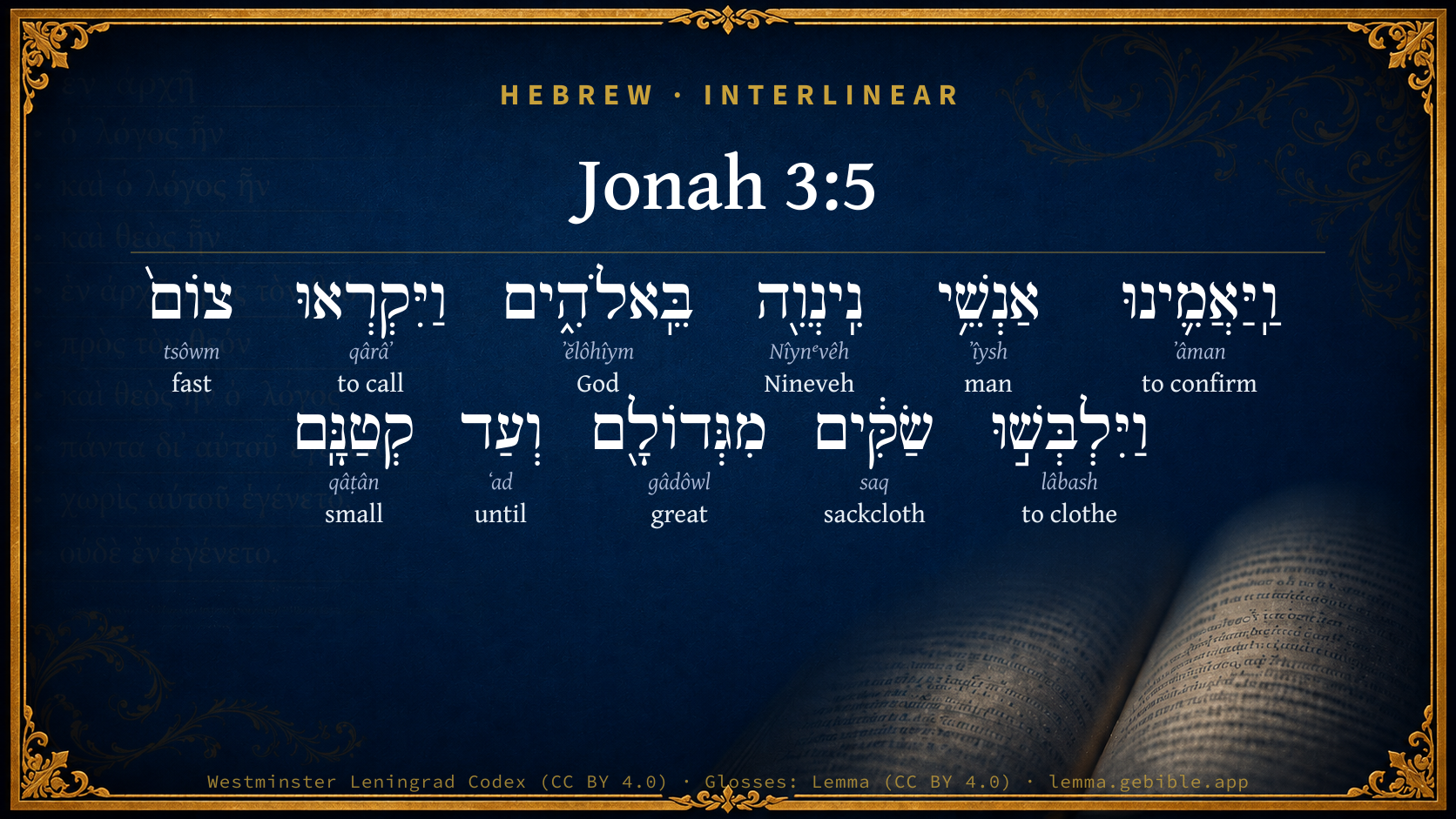
Hebrew (Westminster Leningrad Codex) Jonah 3:5 appears in the Hebrew Old Testament. The text above is from the Westminster Leningrad Codex. Each word links to its Strong’s number, a concise gloss, and parsing drawn from the Open Scriptures Hebrew Bible morphology. Click any word for its full Brown-Driver-Briggs (BDB) entry.
Download image
Cite this verse

Jonah 3:5 (World English Bible). Public Domain. Lemma interlinear Bible study tool, https://lemma.gebible.app/v/jonah/3/5.

Show BibTeX & RIS
BibTeX
RIS
English Translation
The people of Nineveh believed God; and they proclaimed a fast, and put on sackcloth, from the greatest of them even to the least of them.
World English Bible · Public Domain
Download a study sheet

One document with this verse’s original text, its word-by-word gloss line, the meaning frame, cross-references with their text, attributed commentary, and full source and license credits — printable, and it pastes into notes with its structure intact.

This verse Autodidact and up

Study sheet (.html) Plain text (.txt)

A passage Seminary Student

Up to 50 verses in one chapter. A passage sheet keeps up to 6 commentary sources and 12 cross-references per verse, in the order this page ranks them, and says so on the sheet whenever that leaves anything out. Ask for a single verse and you get the Autodidact verse sheet above.

Everything on this page stays free to read, with no account — the sheet is a download of what is already on screen, not access to it.

Want to remove ads? Support Godless Engineer
Compare translations 3

The same verse in 3 English versions, stacked beneath the original-language interlinear above. Click any original word for its lexicon entry.

Each is an independent rendering of the whole verse — the interlinear is not word-aligned to these translations.

Highlighted words mark where these versions differ — a whole-verse word diff, not a word-by-word alignment.

  • World English Bible Public Domain
    The people of Nineveh believed God; and they proclaimed a fast, and put on sackcloth, from the greatest of them even to the least of them.
  • King James Version Public Domain
    So the people of Nineveh believed God, and proclaimed a fast, and put on sackcloth, from the greatest of them even to the least of them.
  • unfoldingWord Literal Text CC BY-SA 4.0
    And the men of Nineveh believed God. And they proclaimed a fast and put on sackcloth, from the greatest of them even to the least of them.

unfoldingWord Literal Text — © unfoldingWord, licensed CC BY-SA 4.0. Word-aligned USFM3 via Door43 (git.door43.org/unfoldingWord/en_ult).

Versions to compare (up to 4)

3 of 4 selected

Show all 18 translations

Every available English version of this verse, each an independent rendering of the whole verse.

  • World English Bible Public Domain
    The people of Nineveh believed God; and they proclaimed a fast, and put on sackcloth, from the greatest of them even to the least of them.
  • Berean Standard Bible Public Domain
    And the Ninevites believed God. They proclaimed a fast and dressed in sackcloth, from the greatest of them to the least.
  • Majority Standard Bible Public Domain
    And the Ninevites believed God. They proclaimed a fast and dressed in sackcloth, from the greatest of them to the least.
  • King James Version Public Domain
    So the people of Nineveh believed God, and proclaimed a fast, and put on sackcloth, from the greatest of them even to the least of them.
  • American Standard Version (1901) Public Domain
    And the people of Nineveh believed God; and they proclaimed a fast, and put on sackcloth, from the greatest of them even to the least of them.
  • Revised Version (1885) Public Domain
    And the people of Nineveh believed God; and they proclaimed a fast, and put on sackcloth, from the greatest of them even to the least of them.
  • Geneva Bible (1599) Public Domain
    So the people of Nineueh beleeued God, and proclaimed a fast, and put on sackcloth from ye greatest of the euen to the least of them.
  • Douay-Rheims (1899) Public Domain
    And the men of Ninive believed in God: and they proclaimed a fast, and put on sackcloth from the greatest to the least.
  • Young's Literal Translation Public Domain
    And the men of Nineveh believe in God, and proclaim a fast, and put on sackcloth, from their greatest even unto their least,
  • Literal Standard Version CC BY-SA 4.0
    And the men of Nineveh believe in God, and proclaim a fast, and put on sackcloth, from their greatest even to their least,
  • Unlocked Literal Bible CC BY-SA 4.0
    The people of Nineveh believed God and they proclaimed a fast. They all put on sackcloth, from the greatest of them down to the least of them.
  • unfoldingWord Literal Text CC BY-SA 4.0
    And the men of Nineveh believed God. And they proclaimed a fast and put on sackcloth, from the greatest of them even to the least of them.
  • Darby Bible Public Domain
    And the men of Nineveh believed God, and proclaimed a fast, and put on sackcloth, from the greatest of them even to the least of them.
  • World Messianic Bible Public Domain
    The people of Nineveh believed God; and they proclaimed a fast and put on sackcloth, from their greatest even to their least.
  • Webster's Bible Public Domain
    So the people of Nineveh believed God, and proclaimed a fast, and put on sackcloth, from the greatest of them even to the least of them.
  • Free Bible Version CC BY-SA 4.0
    The people of Nineveh believed in God. They announced a fast, and all of them, from the greatest to the least, put on sackcloth.
  • Bible in Basic English Public Domain
    And the people of Nineveh had belief in God; and a time was fixed for going without food, and they put on haircloth, from the greatest to the least.
  • JPS Tanakh (1917) Public Domain
    And the people of Nineveh believed God; and they proclaimed a fast, and put on sackcloth, from the greatest of them even to the least of them.

Literal Standard Version (2020), Covenant Press — licensed CC BY-SA 4.0. Text via the HelloAO Bible API (eBible.org). Unlocked Literal Bible (unfoldingWord) — licensed CC BY-SA 4.0. Text via the HelloAO Bible API (eBible.org). unfoldingWord Literal Text — © unfoldingWord, licensed CC BY-SA 4.0. Word-aligned USFM3 via Door43 (git.door43.org/unfoldingWord/en_ult). Free Bible Version, Dr. Jonathan Gallagher — licensed CC BY-SA 4.0. Text via the HelloAO Bible API (eBible.org).

Word by word

More ways to search: Search by grammar → Find every occurrence → Compare this word →

Practice this passage: Drill this verse → Learn its vocabulary →

נִֽינְוֵ֖ה
Nîynᵉvêh
H5210
“Nineveh”
Noun, Proper
Part of Speech
Noun
Type
Proper
Full BDB Definition

Origin: of foreign origin

TWOT: None

Nineveh = "abode of Ninus" - capital of the ancient kingdom of Assyria; located on the east bank of the Tigris river, 550 miles (880 kilometers) from its mouth and 250 miles (400 kilometers) north of Babylon
  1. וַֽיַּאֲמִ֛ינוּ ʼâman H539 “and · to confirm” Conjunction + Verb, Hiphil, Sequential Imperfect, 3rd Person, Masculine, Plural
  2. אַנְשֵׁ֥י ʼîysh H376 “men of” Noun, Common, Masculine, Plural, Construct
  3. בֵּֽאלֹהִ֑ים ʼĕlôhîym H430 “in/at · God(s)” Preposition + Noun, Common, Masculine, Plural, Absolute
  4. וַיִּקְרְאוּ qârâʼ H7121 “and · to call” Conjunction + Verb, Qal, Sequential Imperfect, 3rd Person, Masculine, Plural
  5. צוֹם֙ tsôwm H6685 “fast” Noun, Common, Masculine, Singular, Absolute
  6. וַיִּלְבְּשׁ֣וּ lâbash H3847 “and · to clothe” Conjunction + Verb, Qal, Sequential Imperfect, 3rd Person, Masculine, Plural
  7. שַׂקִּ֔ים saq H8242 “sacks” Noun, Common, Masculine, Plural, Absolute
  8. מִגְּדוֹלָ֖ם gâdôwl H1419 “from · great · their” Preposition + Adjective, Adjective, Masculine, Singular, Construct + Suffix, Personal, 3rd Person, Masculine, Plural
  9. וְעַד ʻad H5704 “and · until” Preposition + Preposition
  10. קְטַנָּֽם qâṭân H6996 “small · their” Adjective, Adjective, Masculine, Singular, Construct + Suffix, Personal, 3rd Person, Masculine, Plural

About this verse

These counts appear in no published source. They are computed here, from the morphology-tagged text and Lemma’s own curated glosses. What Lemma adds →

11
words
11
distinct lemmas
Prophets
section

Notable vocabulary

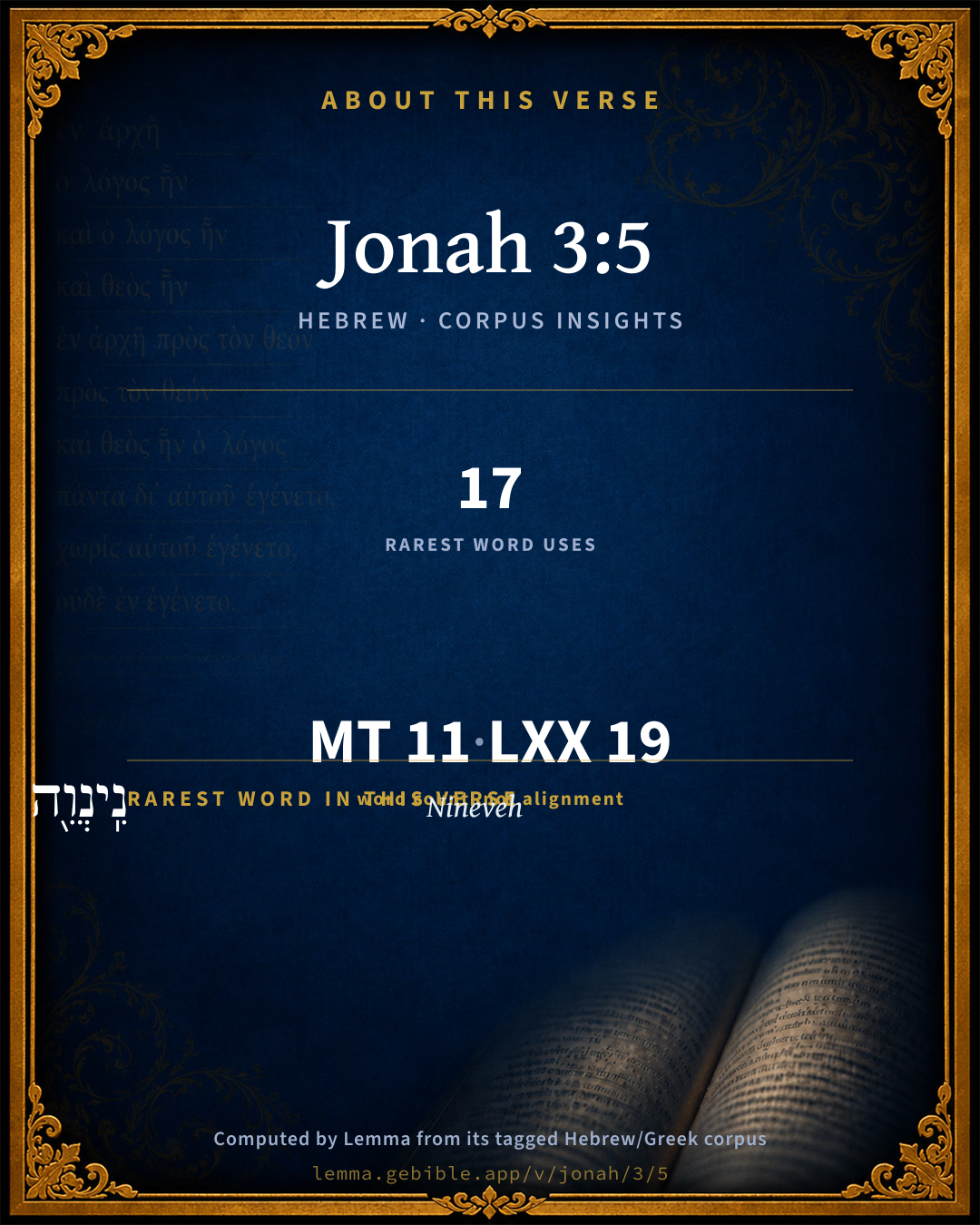
The rarest word here is נִֽינְוֵ֖ה Nineveh H5210 — appearing just 17 times in the whole Hebrew Bible.

Shared distinctive vocabulary

נִֽינְוֵ֖ה Nineveh H5210 occurs in 16 verses of the Hebrew Bible. Also found in:

Grammatical profile

  • 3 verbs
  • 5 nouns
  • 2 adjectives
  • 1 preposition

Verb forms

  • וַֽיַּאֲמִ֛ינוּ Hiphil · Sequential Imperfect
  • וַיִּקְרְאוּ Qal · Sequential Imperfect
  • וַיִּלְבְּשׁ֣וּ Qal · Sequential Imperfect

Hebrew & Septuagint length

In English translation the verse runs 26 words from the Hebrew and 25 from the Septuagint (LXX English) — closely comparable.

A rough comparison of the two English renderings, which tokenize alike — not a word-level alignment.

Word counts can differ between the Hebrew and the Greek without any difference in meaning — e.g. the Hebrew direct-object marker אֵת has no separate Greek word, and Greek often adds the article ὁ.

In the original languages it is 11 Hebrew tokens and 19 Greek tokens — but the two are counted differently (Hebrew bundles its prefixes and suffixes into one token; the Greek is in lemma form), so that isn’t a like-for-like length.

Cross-references

16

Topical passages linked to Jonah 3:5 in the Treasury of Scripture Knowledge — connected by theme and wording, ordered by reader-vote popularity; previews shown in the World English Bible.

  • Luke 11:32 The men of Nineveh will stand up in the judgment with this generation, and will condemn it: for they repented at the preaching of Jonah, and behold, one greater than Jonah is here.
  • Daniel 9:3 I set my face to the Lord God, to seek by prayer and petitions, with fasting and sackcloth and ashes.
  • Joel 2:12–17 "Yet even now," says Yahweh, "turn to me with all your heart, And with fasting, and with weeping, and with mourning."
  • Matthew 12:41 The men of Nineveh will stand up in the judgment with this generation, and will condemn it, for they repented at the preaching of Jonah; and behold, someone greater than Jonah is here.
  • 2 Chronicles 20:3 Jehoshaphat feared, and set himself to seek to Yahweh; and he proclaimed a fast throughout all Judah.
  • Joel 1:14 Sanctify a fast. Call a solemn assembly. Gather the elders, And all the inhabitants of the land, to the house of Yahweh, your God, And cry to Yahweh.
  • Exodus 9:18–21 Behold, tomorrow about this time I will cause it to rain a very grievous hail, such as has not been in Egypt since the day it was founded even until now.
  • Jeremiah 31:34 and they shall teach no more every man his neighbor, and every man his brother, saying, Know Yahweh; for they shall all know me, from the least of them to the greatest of them, says Yahweh: for I will forgive their iniquity, and their sin will I remember no more.
  • Jeremiah 36:9 Now it happened in the fifth year of Jehoiakim the son of Josiah, king of Judah, in the ninth month, that all the people in Jerusalem, and all the people who came from the cities of Judah to Jerusalem, proclaimed a fast before Yahweh.
  • Acts 8:10 to whom they all listened, from the least to the greatest, saying, "This man is that great power of God."
  • Acts 27:25 Therefore, sirs, cheer up! For I believe God, that it will be just as it has been spoken to me.
  • Hebrews 11:1 Now faith is assurance of things hoped for, proof of things not seen.
  • Hebrews 11:7 By faith, Noah, being warned about things not yet seen, moved with godly fear, prepared an ark for the saving of his house, through which he condemned the world, and became heir of the righteousness which is according to faith.
  • Ezra 8:21 Then I proclaimed a fast there, at the river Ahava, that we might humble ourselves before our God, to seek of him a straight way for us, and for our little ones, and for all our substance.
  • Jeremiah 42:1 Then all the captains of the forces, and Johanan the son of Kareah, and Jezaniah the son of Hoshaiah, and all the people from the least even to the greatest, came near,
  • Jeremiah 42:8 Then called he Johanan the son of Kareah, and all the captains of the forces who were with him, and all the people from the least even to the greatest,

Cross-references courtesy of OpenBible.info (CC BY 4.0).

Hebrew and Greek witnesses Masoretic Hebrew ↔ Greek Septuagint

The same verse in the two great witnesses to the Old Testament, shown verse-for-verse.

These are two independent witnesses, not word-aligned to each other, and the Septuagint is shown in lemma (dictionary) form.

Hebrew Jonah 3:5 Masoretic · Westminster Leningrad Codex

וַֽיַּאֲמִ֛ינוּ אַנְשֵׁ֥י נִֽינְוֵ֖ה בֵּֽאלֹהִ֑ים וַיִּקְרְאוּ צוֹם֙ וַיִּלְבְּשׁ֣וּ שַׂקִּ֔ים מִגְּדוֹלָ֖ם וְעַד קְטַנָּֽם

The people of Nineveh believed God; and they proclaimed a fast, and put on sackcloth, from the greatest of them even to the least of them.

World English Bible · Public Domain

Greek LXX Jonah 3:5 Septuagint · lemma form

καί ἐνπιστεύω ὁ ἀνήρ νινευη ὁ θεός καί κηρύσσω νηστεία καί ἐνδύω σάκκος ἀπό μέγας αὐτός ἕως μικρός αὐτός

And the men of Nineve believed God, and proclaimed a fast, and put on sackcloths, from the greatest of them to the least of them.

LXX2012 (modern English Septuagint) · Public Domain

Hebrew: Westminster Leningrad Codex (CC BY 4.0). Greek: Septuagint (public domain); English from LXX2012 (modern English Septuagint) (Public Domain). How the Septuagint differs from the Hebrew →

Targum (Aramaic paraphrase)

1

The Targum is the ancient Jewish Aramaic paraphrase of the Hebrew Scriptures — an interpretive translation, not the Hebrew text itself. Onkelos (literal) and Pseudo-Jonathan (expansive) render the Torah, and Jonathan the Prophets. Coverage is partial: where no permissively-licensed English translation exists for a verse, only the Aramaic is shown. This is verse-level text, not a word-by-word alignment to the Hebrew.

  1. Targum Jonathan Prophets (Joshua–Malachi)
    וְהֵימִינוּ אַנְשֵׁי נִינְוֵה בְּמֵימְרָא דַייָ וּגְזָרוּ צוֹמָא וַאֲסָרוּ שַׂקִין מֵרַבְּהוֹן וְעַד זְעָרֵיהוֹן:

    And the people of Nineveh believed the word of the LORD, and they decreed a fast and bound with sackcloth, from the greatest to the smallest.

    Targum Jonathan — Aramaic: “Mikraot Gedolot” (public domain). English: “Sefaria Community Translation” (CC0 1.0 (public-domain dedication)); “London "Chaldee Paraphrase," 1871” (public domain). Text via Sefaria.

Commentary

Notes on Jonah 3:5 from classic Christian and Jewish commentators (each source and its license shown beneath its notes). The classic Christian expositions comment on the surrounding passage and are grouped to its opening verse, so a note may address several verses; the Jewish commentaries on the Tanakh (Rashi and others) are per-verse, so they appear only where the commentator wrote on this verse.

Lemma curates 59 commentaries, every one of them public domain or Creative Commons licensed, each selected and text-cleaned for this edition rather than reprinted as found. About our sources →

Trapp's Complete Commentary

John Trapp

Jon 3:5 So the people of Nineveh believed God, and proclaimed a fast, and put on sackcloth, from the greatest of them even to the least of them.

Ver. 5. So the people of Nineveh believed God] See the mighty power of God’s holy word. "The weapons of our warfare are not carnal, but mighty through God to the pulling down of strong holds," 2Co 10:4, to the laying flat those walls of Jericho, making the devil fall as lightning from the heaven of men’s hearts, Luk 10:18. These Ninevites, though rich, great, peaceable, prosperous, profane above measure (as great cities use to be), &c., yet, at the preaching of Jonah, they believed God, and repented of their evil ways; whether truly and seriously I have not to say. There is a historical faith, an assent to the truth of what God speaketh, and trembling thereat, Jas 2:19; there is also a natural and moral repentance wrought by natural conscience, such as was that of Pharaoh, Saul, Ahab, Alexander the Great, when, having killed Clitus, he was troubled in conscience, and sent to all kind of philosophers (as it were to so many ministers) to know what he might do to appease his conscience, and satisfy for his sin. There are very good authors that hold this conversion of the Ninevites to have been sound and serious (and for this they allege that of our Saviour, Mat 12:41), flowing from a lively faith in God, which is the root of all the rest of the graces, the very womb wherein they are received; the fountain also and foundation of all good works, as the apostle Peter hinteth when he saith, 2Pe 1:5, "add to your faith virtue," which is nothing else but faith exercised.

And proclaimed a fast, and put on sackcloth] These were the fruits of their faith; and though but bodily exercises and external performances, yet they might serve both to evidence and to increase their inward humiliation. Ieiunium et saccus arma poenitentiae (Jerome). True it is that hypocrites and heathens may do all this and more, as Ahab; those Psa 78:34; Psa 78:36 Isa 58:3. The Romans in a strait, ad Deos populum et vota convertunt, commanded the whole people with their wives and little ones to pray and pacify the gods, to fill all the temples, and the women to sweep and rub the pavements thereof with the hairs of their heads (Liv. 1. 3).

From the greatest, &c.] {See Trapp on "Joe 2:16"}

John Trapp, A Commentary or Exposition upon All the Books of the Old and New Testament (1647–1656) — public domain. Text from a community e-Sword module.

Albert Barnes' Notes on the Bible

And the people of Nineveh believed God; - strictly, “believed in God.” To “believe in God” expresses more heart-belief, than to “believe God” in itself need convey. To believe God is to believe what God says, to be true; “to believe in” or “on God” expresses not belief only, but that belief resting in God, trusting itself and all its concerns with Him. It combines hope and trust with faith, and love too, since, without love, there cannot be trust. They believed then the preaching of Jonah, and that He, in Whose Name Jonah spake, had all power in heaven and earth. But they believed further in His unknown mercies; they cast themselves upon the goodness of the hitherto “unknown God.” Yet they believed in Him, as the Supreme God, “the” object of awe, the God אלהים 'ĕlohı̂ym Jon 3:5, Jon 3:8, האלהים ha'ĕlohı̂ym Jon 3:9, although they knew Him not, as He Is , the Self-Existent One. Jonah does not say how they were thus persuaded.

God the Holy Spirit relates the wonders of God’s Omnipotence as common everyday things. They are no marvels to Him Who performed them. “He commanded and they were done.” He spake with power to the hearts which He had made, and they were turned to Him. Any human means are secondary, utterly powerless, except in “His” hands Who Alone doth all things through whomsoever He doth them. Our Lord tells us that “Jonah” himself “was a sign unto the Ninevites” . Whether then the mariners spread the history, or howsoever the Ninevites knew the personal history of Jonah, he, in his own person and in what befell him, was a sign to them. They believed that God, Who avenged “his” disobedience, would avenge their’s. They believed perhaps, that God must have some great mercy in store for them, Who not only sent His prophet so far from his own land to “them” who had never owned, never worshiped Him, but had done such mighty wonders to subdue His prophet’s resistance and to make him go to them.

And proclaimed a fast and put on sackcloth - It was not then a repentance in word only, but in deed. A fast was at that time entire abstinence from all food until evening; the haircloth was a harsh garment, irritating and afflictive to the body. They who did so, were (as we may still see from the Assyrian sculptures) men of pampered and luxurious habits, uniting sensuality and fierceness. Yet this they did at once, and as it seems, for the 40 days. They “proclaimed a fast.” They did not wait for the supreme authority. Time was urgent, and they would lose none of it. In this imminent peril of God’s displeasure, they acted as men would in a conflagration. People do not wait for orders to put out a fire, if they can, or to prevent it from spreading. Whoever they were who proclaimed it, whether those in inferior authority, each in his neighborhood, or whether it spread from man to man, as the tidings spread, it was done at once. It seems to have been done by acclamation, as it were, one common cry out of the one common terror. For it is said of them, as one succession of acts, “the men of Nineveh believed in God, and proclaimed a fast, and put on sackcloth from their great to their little,” every age, sex, condition . “Worthy of admiration is that exceeding celerity and diligence in taking counsel, which, although in the same city with the king, perceived that they must provide for the common and imminent calamity, not waiting to ascertain laboriously the king’s pleasure.” In a city, 60 miles in circumference, some time must needs be lost, before the king could be approached; and we know, in some measure, the forms required in approaching Eastern monarchs of old.

Albert Barnes' Notes on the Bible (1834–1885) — public domain. Text from a community e-Sword/MySword module.

The Biblical Illustrator

Joseph S. Exell

Jon_3:5-9

So the people of Nineveh believed God.

Belief inspired by fear

How came the Ninevites to believe God, as no hope of salvation was given them? For there can be no faith without an acquaintance with the paternal kindness of God; whoever regards God as angry with, him must necessarily despair. Since, then, Jonah gave them no knowledge of Gods mercy he must have greatly terrified the Ninevites, and not have called them to faith. The answer is, that the expression is to be taken as including a part for the whole; for there is no perfect faith when men, being called to repentance, do suppliantly humble themselves before God; but yet it is a part of faith, for the apostle says in Heb_11:1-40., that Noah through faith feared; he deduces the fear which Noah entertained on account of the oracular word he received from faith, showing thereby that it was faith in part, and pointing out the source from which it proceeded. At the same time, the mind of the holy patriarch must have been moved by other things besides threatenings when he built an ark for himself as the means of safety. We may thus, by taking a part for the whole, explain this place--that the Ninevites believed God; for as they knew that God required the deserved punishment, they submitted to Him, and at the same time solicited pardon; but the Ninevites derived from the words of Jonah something more than mere terror, for had they only apprehended this--that they were guilty before God, and were justly summoned to punishment, they would have been confounded and stunned with dread, and could never have been encouraged to seek forgiveness. Inasmuch, then, as they suppliantly prostrated themselves before God, they must certainly have conceived some hope of grace. They were not, therefore, so touched with penitence and the fear of God but that they had some knowledge of Divine grace; thus they believed God, for though they were aware that they were most worthy of death, they yet despaired not, but betook themselves to prayer. They must therefore have derived more advantage from the preaching of Jonah than the mere knowledge that they were guilty before God. (John Calvin.)

Nineveh brought to repentance

Analyse and examine the main features of this repentance of the men of Nineveh.

I. The people of nineveh believed god. The men of Nineveh saw at once the reason for this sentence, for the very first impression produced on them was a belief in God. By this is implied not merely the acceptance of Gods message as truth, but the much greater belief in God. Israels God could not have been unknown to the Ninevites.

II. Mourning in the city became universal. The sin had been universal, and so now became the mourning.

III. They turned from their evil way. Mourning was merely the outward expression of sorrow and repentance. The grand fact is the sincerity of the repentance. They were led to alter their conduct and change their whole manner of life.

IV. They cried mightily unto God. And that cry of Nineveh was not unheard. It came up into the ears of the Lord of Sabaoth. (James Menzies.)

The nature and result of true repentance

The Book of Jonah illustrates mans perverseness, Gods love to sinners, Gods tenderness to His people. It contains a type of our Lords work. It shows God ever the same, whether dealing with Gentile or Jew: stern against sin; yearning over sinners; faithful to promises. As to the repentance of the Ninevites, mark--

I. Its origin. They believed God. Repentance starts from faith and leads to faith. No true repentance till there is belief--

1. That sin is hurtful.

2. That life is fleeting.

3. That Gods Word is true.

Faith of Ninevites very simple,--perhaps ignorant, yet they were led on. It came from God. The Holy Spirits work thus to convince of sin.

II. Its symptoms.

1. Self-abasement.

2. It was universal.

3. It was thorough.

The next symptom was earnest prayer.

(1) They did not stop at humiliation; they cried for pardon.

(2) They looked to the right source for help.

(3) They cried mightily, as if they meant it.

The next symptom was reformation. They turned from their evil way. They brought forth fruits meet for repentance. The only proof of true repentance is to give up sin utterly. Not only fast for sin, but abstain from sin.

III. The result, God repented; that is, He changed His dealings. This was foretold as possible. Yet forty days,--a time of grace given. There is room in the all wise decrees for answers to faithful prayer. Application--

1. Gods laws are the same for all. We have more light, more responsibility than had the Ninevites; but for us the path is the same. Contrition, faith, pardon.

2. Have we repented? A greater than Jonas calls us. By His Word, His work, His death. Let us turn to Him while the day of salvation lasts.

3. What an encouragement to the true penitent. There is joy in the presence of the angels of God over one sinner that repenteth. (A. G. Hellicar, M. A.)

The repentance of the Ninevites

Notice the substance of Jonahs proclamation, and the strong effect which it was made instrumental in producing. Most probably, while with the zeal of an awakened spirit Jonah began to execute his commission, the burden of it, Yet forty days and Nineveh shall be destroyed, was but used by him as a general theme suggestive of enlargement. To the eye of sense the enterprise thus commenced might seem most formidable and dangerous. But, in the view of faith, difficulties vanished. The effect produced was remarkable. All ranks were pervaded by feelings of disquietude and alarm. The woeful tidings spread from mouth to mouth. God gave unwonted power to the message of His servant, so that the inhabitants of this great and dissipated city were roused to deep concern, and its myriads bowed themselves in penitence and prayer. The impression produced might be partly the mere result of apprehension, as the sinner is often scared for a time, but without lasting and salutary effect. We must distinguish between such transient and partial feelings and genuine penitence. The latter issues in return to Him who has been so grievously offended. Its reality is shown in amendment of life. Notice the general nature of the Ninevites penitence here described, in which We must recognise the exertion of a Divine influence and power. Fear is contagious: faith is the result of Divine influence upon the heart; and it shows the influence of prevailing wickedness in a community that, while some are roused by the preaching of the Gospel to religious earnestness and activity, a much larger proportion too often remain indifferent and slothful. The penitence of the Ninevites was in many cases genuine. We are reminded by this narrative of the propriety of rulers, in their official capacity, employing their influence with a view to promote the interests of righteousness and truth. Civil eminence is to be consecrated to Gods service. We have ground for judging of the pervading and thorough character of the transaction. The vast city was filled with fear and lamentation. The outward signs of abasement were everywhere discernible. Had the repentance of the Ninevites been confined to external indications it would have been exclusive of that homage which God requires, and has alone declared His readiness to accept. The most important feature of the sorrow consisted, not in the covering of the limbs with sackcloth, but in their crying mightily unto God, and in turning every one from their evil way, and from the violence that was in their hands. Godly sorrow will be followed by amendment, the view of sin by its loathing and detestation. We gather from this narrative the propriety of a nation, when threatened by disaster, turning to the great source of sufficiency and strength. And also the happy results that may be expected to follow from such a public recognition of the Ruler of the universe. Stand in awe of Gods mighty power, and admire the wonders of Divine mercy and patience. This history is fitted to remind Christians of their duty and their strength. The duty is to Go into all the world and preach,--not the thunderings of wrath, nor the avenging sentence merely of a broken law, but--the Gospel to every creature. (A. Bonar, D. D.)

Repentance

1. Note the renewed charge to the penitent prophet, and his new eagerness to fulfil it. It is Gods mercy that gives us the opportunity of effacing past disobedience by new alacrity. The second charge is possibly distinguishable from the first as being less precise. The substance of the message is set forth. The preaching which I bid thee,--not his own imaginations, nor any fine things of his own spinning.

2. Note the repentance of Nineveh. The impression made by Jonahs terrible cry is perfectly credible and natural in the excitable population of an eastern city, in which even now any appeal to terror, especially if associated with religious and prophetic claims, easily sets the whole in a frenzy. The specified tokens of repentance are those of ordinary mourning, such as were common all over the East, with only the strange addition which smacks of heathen ideas, that the animals were made sharers in them. There is great significance in that believing God (verse 5). The foundation of all true repentance is crediting Gods Word of threatening, and therefore realising the danger as well as the disobedience of our sin. We learn from the Ninevites what is true repentance. The deepest meaning of the whole narrative is set forth in our Lords use of it when He holds up the men of Nineveh as a condemnatory instance to the hardened consciences of His hearers. The story was a smiting blow to the proud exclusiveness and self-complacent contempt of prophetic warnings, which marked the entire history of Gods people. But if repentance be but transient, it leaves the heart harder than before.

3. Note the repentance of God. All Gods promises and threatenings are conditional God threatens precisely in order that He may not have to perform His threatenings. He repents of the evil which He said He would do when they repent of the evil which they have done. (A. Maclaren, D. D.)

Jonah at Nineveh

I. Ninevehs sin. Nahum describes Nineveh as the bloody city, all full of lies and robbery. Zephaniah calls it filthy and polluted, the oppressing city. The Ninevites were gross and sensual, cruel in war, eagerly self-indulgent; a people of splendid physique and surprising courage, but cultivating bodily excellences and seeking physical pleasures without thought of their higher nature.

II. Jonahs preaching. Dove-like, he was timid and despondent. He naturally shrank from delivering a message which might save a godless and hostile people from destruction. Jonahs mission was one of great risk.

III. Ninevehs repentance. The Ninevites stand aghast before Jonah. Though an immoral, yet they are a religious people. They believe in a higher power. They are moved by the voice of prophets. Jonahs terrible words are not unheeded. A panic seizes the inhabitants. The king also heard and believed; but he and his advisers discerned a ray of hope. A possibility of pardon seemed to be hinted in the very language of the message, and had foundation in the teachings of natural religion. What causes human misery?--Sin, nothing but sin. If the cause be removed may not the result cease? Still, in this chain of reasoning there is one broken link, and the Ninevites were not certain it could be welded. To stop present sin is indeed to stop the cause of woe; but repentance does not affect the past, and the momentum of sins before committed may hurl a train of miseries far into the future. Repentance is, in fact, of itself an insufficient ground for forgiveness. It does not touch the past. The wonder is, how God, on the ground of mans repentance, can make it consistent to forgive him. Had not God at this very hour of Ninevehs sin had it in His plan to send His Son to earth to die for man there could have been no forgiveness for Nineveh. The turning or repentance was the condition on which God would forgive. Was this repentance sincere and lasting? It did not produce permanent results upon the nation. But this is no reason to suppose that the reformation in Jonahs time was not thorough. A nation easily relapses into sin. There is no evidence that pains were taken to confirm the work at Nineveh.

IV. Gods forgiveness. God repented. How shall we reconcile this statement with Gods unchangeableness? It is man that changes, not God. How shall we reconcile the state-merit with Gods veracity? When God threatens, if the condition of things be changed which makes the evil necessary, the threatening may be mitigated, if not given up entirely. How shall we reconcile Gods forgiveness with Gods justice? Repentance does not atone for the past. It simply is mans part in making Christs work efficacious. Repentance stops the entrance of further evil into the heart. The narrative strikingly illustrates Gods love, His eagerness, we may say, to forgive. The love-side of Gods nature is peculiarly prominent in the Christian dispensation. Notice, in conclusion, the contrasts suggested by the text. The case of Nineveh stands before the impenitent to-day as an expostulation and a rebuke. (Sermons by Monday Club.)

Genuine reformation

The end of all providential mercies, the theme of all Divine teachers, the indispensable condition of all true human power, dignity, and blessedness, is genuine reformation.

I. Its method.

1. It was effected through man. Why did the Almighty require the services of Jonah? Why did He not speak with an audible voice to the men of Nineveh Himself? Or why did He not dispatch an angel from His throne? Or still, why did He not write what He had to say to them in red flame above their heads? All we answer is, Such is not Gods method with man. He makes man the organ of blessing man. This plan serves several important purposes.

(1) It serves to deepen mans interest in his race.

(2) It stimulates men to seek the improvement of their race. If they are to advance they must look to themselves, etc.

(3) It confers signal honour on the race.

(4) It shows Gods wisdom and power in the race. We have this treasure in earthen Vessels.

2. It was effected through man speaking, Jonah was sent to speak, he was to preach unto the city. Truth spoken is the converting force. Christianity written, as compared with Christianity spoken, is as the winter to the summer sky. It may give as much light, but not as much heat; and without the summer radiance the landscapes will wither and the fountains freeze.

3. It was effected through man speaking what God said. Preach unto it the preaching that I bid thee. Had he spoken his own thoughts, no valuable effect would have been produced. Gods thoughts are the converting forces. Gods thoughts are always reasonable and universally benevolent.

II. Its development.

1. This reformation began with the intellect. So the people of Nineveh believed God. All moral reformation begins with the intellect--the beliefs. Men must believe what God says, or no saving effect can be produced.

2. This reformation proceeded to the heart. They put on sackcloth, from the greatest of them even to the least of them. As they thought upon what they heard, deep contrition seized them, etc.

3. This reformation extended to the outward life. They turned from their evil way. They renounced their old habits of wickedness, and adopted a new and virtuous course of life. Such is ever the natural development of true reformation. Divine ideas first enter the intellect, they are believed, they pass to the heart and generate emotions, and these emotions come forth in new actions. True reformation works from the centre to the circumference, from the heart to the extremities.

III. Its value. And God repented of the evil that He had said He would do unto them; and He did it not. Though this wonderful language is in accommodation to our modes of thought and action, it has a profound significance. It does not mean that God changed His mind towards them;--this would be impossible.

1. It is Gods immutable purpose to pardon repentant sinners. When the impenitent therefore become penitent, Gods conduct so far as they are concerned is changed. (Homilist.)

Effect of Jonahs preaching

In this chapter we have the prophets second call, and what came of His obedience to it.

I. A new spirit (verses 1-3). In part, the command is the same as before. In part, it was unlike the first. Before it was, Cry against it. Now it is, Preach unto it. Here is an intimation of just that mercy against which the prophet before rebelled. Jonah implicitly obeyed it. Here was a new spirit. God had just given him needed discipline. No doubt He now gave him needed grace. It is by both that He prepares us for usefulness.

II. A faithful sermon (verse 4). In this sermon two things are noteworthy.

1. It was direct, simple, plain. There is no enlargement, no argument, no exhortation. There is great power in simplicity. It is Gods own truth, not human additions to it, or commendations of it, which stirs the consciences and wins the hearts of men.

2. It was also alarming. It sounded just one note, and that was a note of warning. It was an unqualified announcement of coming judgment. Denunciations and threatenings alone can never win and subdue to repentance. But Gods denunciations and threatenings never are alone. There was mercy, as well as justice, in the alarm which Jonah sounded. But neither the plainness nor the faithfulness of Jonahs preaching can fully account for the results which followed.

(1) Behind the message was the messenger.

(2) Our Saviour tells us that He was Himself a sign to the Ninevites.

(3) God was with the message spoken, to make it effective by the influence of His Spirit.

III. A repentant city (verses 5-9). Those that heard gave heed. The people seem to have moved first.

1. There was first the fasting, together with the sackcloth and ashes. What did these signify but confession of sin and grief therefor?

2. The supplication for mercy.

3. A moral change.

4. This repentance had its root in faith.

IV. Judgment averted (verse 10). How widespread and deep the work was we cannot tell. (Sermons by Monday Club.)

Gods purpose of grace in the salvation of sinners

The purpose of God unfolds itself gradually in the course of His providence; and when we see the end from the beginning, we see that it is a purpose of grace. He wished to save the men of Nineveh and the only way of salvation with God was repentance unto life. The history of their repentance is therefore the revelation of Gods purpose of grace in the salvation of sinners. God renewed His commission to Jonah, but He does not upbraid the prophet with his former refusal. All that is required is the doing of duty. That is the fruit meet for repentance. If there be any difference between this call and the former, it is that the terms of the second are more absolute and less definite. Jonah now yielded to the Spirit of the Lord. He went according to the Word of the Lord. That was all the difference between Jonah a sinner and Jonah a saint, between the old man and the new. The old resists the Spirit and yields to the flesh; the new resists the flesh and yields to the Spirit. Gods will, not his own nor mans, was now the law of Jonahs life. The Lord said Go; go therefore he must, go in spite of the world, go in spite of self, go whatever should be his fate or his reception at Nineveh. All the ancients speak of Nineveh as an exceeding great city. It must have been a sublime spectacle, to see this single man going from one end to another of this great heathen city, and at every step, or at every street, repeating the same awful message of God. The terms of the prophecy were most absolute. No proof was offered of the prophets divine commission. No call to repentance was addressed to their consciences. No promise was made, or hope held out. The people believed God, and the immediate effect of their faith was repentance. They proclaimed a national and universal fast. They thus humbled themselves as sinners before God. In so doing they obeyed the voice of conscience. By the joint authority of the king and his government a proclamation was issued for public fasting, prayer, and penitence on the part of the people. While they cast themselves on Gods mercy, they were to turn every one from his evil way, and from the violence that was in their hands. Their faith was but a peradventure; their hope was in Gods mercy. And God repented when they repented. He did not change His purpose, He only changed His method of outworking His purpose. His are purposes of grace, even when they seem to be nothing but proclamations of wrath to the uttermost. They are given for the very purpose of bringing the sinner to salvation by bringing him to repentance. Why is there no such humiliation before God on account of sin, personal and national, nowadays?

1. Because there are few like Jonah to preach repentance: if they are called to preach, to be Gods witnesses, in whatever place or way or walk of life, they are called to testify against the world that has not come to repentance.

2. Because the message of God is not seen to be a matter of fact as personal, and to those who are sinners like the men of Nineveh as terrible as that of Jonah to Nineveh.

3. Because Gods purpose of grace revealed in the Gospel is little realised in its fulness and freeness of grace. Two things in relation to salvation which this history sets in the clearest light.

(1) Repentance is the fruit of faith, not the root. The men of Nineveh believed God, and therefore they repented. So must all sinners.

(2) Faith in God, when it is living and genuine, ever works by such repentance, where there is such sin, personal or national. Faith brings the sinner to God, as a man who must bear his own burden, and answer to God for his own personal guilt. (N. Paisley.)

Jonahs preaching

God had delivered Jonah; but Gods pardoning mercy was no plea for negligence of duty. The Lord requires Jonah to consider again the message with which he was originally charged. God will have His people obey His will instantly, unreservedly, and with a full desire to carry it out in all things.

I. The substance of the message which Jonah was bidden to deliver. He has to proclaim that destruction is nigh at hand, that evil awaits the city, and that this evil is the immediate act of God. Second causes there may be, but they are only second. Most people talk in their time of trouble about God being all-merciful. It is true, but He is also holy and faithful and just. Men speak of Gods mercy as if it were to set aside Gods truth.

II. The conduct of the Ninevites. They acknowledged that the message must have come from the Lord. External signs of repentance were used, anal external signs are useful when they express internal feeling. Here we find that these outward signs were to be accompanied by prayer for pardon and for the averting of judgments, and also by cessation from sin.

III. The mercy of the Lord. He is indeed more ready to forgive than to punish. Though there are fearful threatenings spoken in Gods Word against the impenitent, there are full and free offers of mercy and pardon to every soul that turns from his wickedness and believes in Jesus. (Montagu Villiers, M. A.)

The Biblical Illustrator, edited by Joseph S. Exell (c. 1880s–1900s) — public domain. Text from a community e-Sword module.

Joseph Benson's Commentary

Jon 3:5-6. So the people of Nineveh believed God, &c. — “The fame,” says Lowth, “of the wonderful works God had wrought for the Jews, was spread over the eastern parts of the world. This might make the Ninevites hearken to a man of that nation, that came to them as sent by God. And it is likely that he gave them an account of the miraculous circumstances which attended his own mission. But, without question, a sense of their own guilt, and their deserving whatever punishment Heaven could inflict, was a principal reason that moved them to have a regard to this message. And by the men of Nineveh’s repenting at the preaching of Jonah, God designed to upbraid the stubbornness of his own people, and shame them, as it were, into repentance; lest the men of Nineveh should rise up in judgment against them, as our Saviour speaks of the Jews in his own time, Mat 12:41.” And proclaimed a fast — The king and his nobles, or those in authority, ordered that every one should fast for three days, and put on habits of sorrow and humiliation. For word came unto the king of Nineveh — Archbishop Usher, in his Annals ad A.M. 3233, supposes this prince to have been Pul, the king of Assyria, (Nineveh being then the capital city of that empire,) who afterward invaded the kingdom of Israel, in the days of Menahem, 2Ki 15:19 : it being very agreeable to the methods of Providence to make use of a heathen king, that was penitent, to punish the impenitence of God’s own people Israel. And he arose from his throne, &c. — He laid aside all his state, and put on the habit of a penitent.

Joseph Benson's Commentary on the Old and New Testaments (1811–1818) — public domain. Text from a community e-Sword module.

Whedon's Commentary on the Bible

Daniel D. Whedon

5-9. The effect of the preaching. The effects were immediate. The Ninevites believed God and humbled themselves before him in sincere repentance.

Believed God — Or, believed in God (Gen_15:6). They regarded him as the supreme God, to whom they owed allegiance. This recognition made them conscious of their past transgressions, and immediately they set about to secure divine forgiveness. How Jonah, a Hebrew, made himself understood in Nineveh is not stated; some refer, in explanation, to Isa_36:11, as if he had used the Aramaic language, but the passage does not prove that in Jonah’s days the common people, either among the Hebrews or among the Assyrians, spoke or understood that language.

Proclaimed a fast,… put on sackcloth — See on Joe_1:8; Joe_1:13-14.

Greatest… least — In rank as well as in age; all without exception.

For word came — This translation seems to imply that the acts of mourning mentioned in Jon_3:5 were instituted at the royal command, which does not seem to be the thought of the author. The Hebrew is simply, “And the word came”; R.V., “And the tidings reached”; which marks a new step in the proceedings. When the report of Jonah’s preaching and of its effect reaches the king he also immediately humbles himself before Jehovah.

King of Nineveh — For the more common “king of Assyria”; see Introduction, p. 335.

Arose from his throne — In order to descend from it. His acts are recorded in detail, so as to portray more forcibly the humility and sincerity of the king’s repentance.

His robe — The splendid garment of royalty. What a contrast between it and the garment of mourning!

Sackcloth — See references on Jon_3:5 (compare Jer_6:26; Eze_27:30-31).

Sat in ashes — Another sign of deepest mourning (Job_2:8). A.B. Davidson, commenting on the latter passage, says, “By the ‘ashes’ is probably meant the Mazbalah, the place outside the Arabic towns where the zibl, that is, dung and other rubbish of the place, is thrown.”

In addition to this personal renunciation the king proclaimed, by royal decree, a day of fasting and supplication, and exhorted all to bring forth “fruits worthy of repentance,” in the hope that God may yet be merciful.

7a, the introduction to the decree itself, may be rendered more accurately, “And he made proclamation and published through Nineveh. By the decree of the king and his nobles, thus:… .” The first clause contains the words of the narrator; the second those of the heralds by whom the proclamation was made, indicating the authority for the command about to be given.

Decree — The Hebrew word occurs only here in this sense; it is found quite frequently in the Aramaic portions of Ezra and Daniel; evidently it was a technical term for royal edicts, at least for those of Babylonian and Persian kings.

Nobles — The ministers associated with the king in the government.

Man and beast are to join in the fast.

Beast — The domestic animals; defined more closely in “herd nor flock,” that is, cattle and sheep. They are not to taste anything; the beasts are not to be driven to pasture, nor are they to drink water. Both man and beast are to be clothed in sackcloth and “cry mightily” unto God in penitent supplication.

God — The proclamation does not use the name Jehovah.

Turn — The repentance is to be real; a godly sorrow that impels men to turn from their evil ways. Even the Assyrian idolater is represented as realizing the essential requirements of the God of the Hebrews (Mic_6:8; compare Joe_2:13). R.V. presents a more accurate rendering of Jon_3:8 a, “But let them be covered with sackcloth, both man and beast, and let them cry mightily.” Some modern commentators consider “both man and beast” in this passage a later interpolation. If this view is correct, Jon_3:8 speaks of men only, while Jon_3:7 joins the beasts with the men. With reference to the participation of animals in the mourning G.A. Smith says, “The beasts are made to share in its observance, as in the Orient they always shared and still share in funeral pomp and trappings.” Herodotus (Jonah 9:24) records that the Persians, after the fall of their commander, allowed horses and beasts of burden to participate in the mourning.

Jon_3:9 is the concluding portion of the royal edict. The king expresses the hope that the evidences of grief and repentance may move God to stay the judgment.

Who can tell — Perhaps. He does not want to presume too much.

Turn and repent — The same words as in Joe_2:14 (see on Joe_2:13).

His fierce anger — The holiness of God manifests itself in hatred for everything that is impure. The fierceness of the divine wrath is due to the greatness of the wickedness of the Ninevites (Jon_1:2), which the king seems ready to acknowledge.

Daniel D. Whedon (gen. ed.), Commentary on the Old and New Testaments (1874–1909) — public domain. Text from a community e-Sword module.

Tyndale Open Study Notes

Tyndale Open Resources

3:5-6 For the second time in this short book, pagans respond favorably to the Lord (cp. 1:16). • In ancient Israel, fasting would often accompany prayer and repentance in times of distress (see 2 Sam 1:12; Neh 1:4). Wearing burlap and sitting on a heap of ashes would often accompany mourning and sorrowful repentance (see Gen 37:34; Job 16:15; Lam 2:10). The Assyrians apparently had similar customs. These activities allowed the participants to express their grief in a tangible way for all, including God, to see. • The repentance of the Ninevites was an indictment against the hard-hearted in Jesus’ day (Matt 12:41).

Tyndale Open Study Notes — © Tyndale Open Resources, licensed CC BY-SA 4.0. Text via the HelloAO Bible API.

Geneva Bible (1599)

Geneva Bible translators

For he declared that he was a Prophet sent to them from God to denounce his judgments against them.

Geneva Bible (1599) marginal notes — public domain. Text via Bolls.life.

Jamieson, Fausset & Brown

Robert Jamieson, A. R. Fausset & David Brown

believed God--gave credit to Jonah's message from God; thus recognizing Jehovah as the true God.

fast . . . sackcloth--In the East outward actions are often used as symbolical expressions of inward feelings. So fasting and clothing in sackcloth were customary in humiliation. Compare in Ahab's case, parallel to that of Nineveh, both receiving a respite on penitence (; ; ).

from the greatest . . . to the least--The penitence was not partial, but pervading all classes.

Jamieson, Fausset & Brown — Commentary Critical and Explanatory on the Whole Bible (1871) — public domain (CC PDM 1.0). Text via the HelloAO Bible API.

Adam Clarke's Commentary

Verse 5. The people of Nineveh believed God] They had no doubt that the threatening would be fulfilled, unless their speedy conversion prevented it; but, though not expressed, they knew that the threatening was conditional. "The promises and threatenings of God, which are merely personal, either to any particular man or number of men, are always conditional, because the wisdom of God hath thought fit to make these depend on the behaviour of men." - Dr. S. Clarke's Sermons, vol. i.

Proclaimed a fast] And never was there one so general, so deep, and so effectual. Men and women, old and young, high and low, and even the cattle themselves, all kept such a fast as the total abstinence from food implies.

Adam Clarke's Commentary on the Bible (1810–1826) — public domain. Text from a community e-Sword/MySword module.

John Calvin's Commentaries

One thing, escaped me in the third verse: Jonah said that Nineveh was a city great to God. This form of speech is common in Scripture: for the Hebrews call that Divine, whatever it be, that is superior or excellent: so they say, the cedars of God, the mountains of God, the fields of God, when they are superior in height or in any other respect. Hence a city is called the city of God, when it is beyond others renowned. I wished briefly to allude to this subject, because some, with too much refinement and even puerility says that it was called the city of God, because it was the object of God’s care, and in which he intended to exhibit a remarkable instance of conversion. But, as I have said, this is to be taken as the usual mode of speaking in similar cases.

I now return to the text: Jonah says, that the citizens of Nineveh believed God . We hence gather that the preaching of Jonah was not so concise but that he introduced his discourse by declaring that he was God’s Prophet, and that he did not proclaim these commands without authority; and we also gather that Jonah so denounced ruin, that at the same time he showed God to be the avenger of sins that he reproved the Ninevites, and, as it were, summoned them to God’s tribunal, making known to them their guilt; for had he spoken only of punishment, it could not certainly have been otherwise, but that the Ninevites must have rebelled furiously against God; but by showing to them their guilt, he led them to acknowledge that the threatened punishment was just, and thus he prepared them for humility and penitence. Both these things may be collected from this expression of Jonah, that the Ninevites believed God; for were they not persuaded that the command came from heaven, what was their faith? Let us then know, that Jonah had so spoken of his vocation, that the Ninevites felt assured that he was a celestial herald: hence was their faith: and further, the Ninevites would never have so believed as to put on sackcloth, had they not been reminded of their sins. There is, therefore, no doubt but that Jonah, while crying against Nineveh, at the same time made known how wickedly the men lived, and how grievous were their offenses against God. Hence then it was that they put on sackcloth, and suppliantly fled to God’s mercy: they understood that they were deservedly summoned to judgment on account of their wicked lives.

But it may be asked, how came the Ninevites to believe God, as no hope of salvation was given them? for there can be no faith without an acquaintance with the paternal kindness of God; whosoever regards God as angry with him must necessarily despair. Since then Jonah gave them no knowledge of God’s mercy, he must have greatly terrified the Ninevites, and not have called them to faith. The answer is, that the expression is to be taken as including a part for the whole; for there is no perfect faith when men, being called to repentance, do suppliantly humble themselves before God; but yet it is a part of faith; for the Apostle says, in Hebrew 11:7, that Noah through faith feared; he deduces the fear which Noah entertained on account of the oracular word he received, from faith, showing thereby that it was faith in part, and pointing out the source from which it proceeded. At the same time, the mind of the holy Patriarch must have been moved by other things besides threatening, when he built an ark for himself, as the means of safety. We may thus, by taking a part for the whole, explain this, place, — that the Ninevites believed God; for as they knew that God required the deserved punishment, they submitted to him, and, at the same time, solicited pardon: but the Ninevites, no doubt, derived from the words of Jonah something more than mere terror: for had they only apprehended this — that they were guilty before God, and were justly summoned to punishment, they would have been confounded and stunned with dread, and could never have been encouraged to seek forgiveness. Inasmuch then as they suppliantly prostrated themselves before God, they must certainly have conceived some hope of grace. They were not, therefore, so touched with penitence and the fear of God, but that they had some knowledge of divine grace: thus they believed God; for though they were aware that they were most worthy of death, they yet despaired not, but retook themselves to prayer. Since then we see that the Ninevites sought this, remedy, we must feel assured that they derived more advantage from the preaching of Jonah than the mere knowledge that they were guilty before God: this ought certainly to be understood. But we shall speak more on the subject in our next lecture.

John Calvin's Commentaries (1540-1563) — public domain. Text from the Calvin Translation Society English edition (1840s-50s) via the Christian Classics Ethereal Library (ccel.org). Calvin's coverage is partial (roughly two-thirds of the Bible); uncommented books and verses are honest gaps, never fabricated. The 19th-century editor's footnotes and remarks are omitted so the notes are faithfully Calvin's own voice.

Ellicott's Commentary for English Readers

(5) Believed God.—Or, believed in God. Notice again an implied contrast to the dulness of the Jews, who were “slow to believe” the prophetic warnings addressed to themselves.

Proclaimed a fast.—Apparently on a spontaneous resolution of the people themselves. (See Note to Jon_3:6.) The fast would no doubt be for one day, according to the Jewish and the general Oriental custom.

A Bible Commentary for English Readers, edited by Charles John Ellicott (1878–1897) — public domain. Text from a community e-Sword module.

The Cambridge Bible for Schools and Colleges

gen. ed. J. J. S. Perowne

5–10. The Happy Result of Jonah’s Preaching

5. believed God] Or, believed in God. Three things their faith certainly embraced. They believed in the God of the Hebrews, as the true God. They believed in His power to execute the threat which He had held out. They believed in His mercy and willingness to forgive the penitent. And this was marvellous faith in heathen, contrasting favourably with that of the chosen people. “So great faith” had not been found, “no not in Israel.” What they knew of the Hebrews and their God (for doubtless they recognised in Jonah a Jewish prophet) may have contributed to the result. That they knew also the miraculous history of Jonah’s mission to them, and so were the better prepared to credit him, appears to be plainly taught us by our Lord. It is difficult to understand how Jonah should have been “a sign unto the Ninevites,” corresponding in any way to the sign, which by His resurrection the “Son of man” was to “the men of that generation,” (Luk_11:30 with Mat_12:38-41,) unless they were aware that he had passed, as it were, through death to life again, on his way to preach to them. How that information reached them we have no means of judging certainly. Of course it may have come to them from the lips of Jonah himself, though we have seen reason (see note on Jon_3:4) to regard that as improbable. Alford speaks of “his preaching after his resurrection to the Ninevites, announcing (for that would necessarily be involved in that preaching) the wonderful judgment of God in bringing him there, and thus making his own deliverance, that he might preach to them, a sign to that people.”

The Cambridge Bible for Schools and Colleges (gen. ed. J. J. S. Perowne; Cambridge University Press, 1878–1918) — public domain. Text from a community e-Sword module.

John Gill's Exposition

So the people of Nineveh believed God,.... Or "in God" (r): in the word of the Lord, as the Targum; they believed there was a God, and that he, in whose name Jonah came, was the true God; they believed the word the prophet spake was not the word of man, but, the word of God; faith came by hearing the word, which is the spring of true repentance, and the root of all good works. Kimchi and R. Jeshuah, in Aben Ezra, suppose that the men of the ship, in which Jonah had been, were at Nineveh; and these testified that they had cast him into the sea, and declared the whole affair concerning him; and this served greatly to engage their attention to him, and believe what he said: but this is not certain; and, besides, their faith was the effect of the divine power that went along with the preaching of Jonah, and not owing to the persuasion of men;

and proclaimed a fast; not of themselves, but by the order of their king, as follows; though Kimchi thinks this was before that:

and put on sackcloth, from the greatest of them even to the least of them; both, with respect to rank and age, so universal were their fasting and mourning; in token of which they stripped themselves of their common and rich apparel, and clothed themselves with sackcloth; as was usual in extraordinary cases of mourning, not only with the Jews, but other nations.

(Jonah would be a quite a sight to behold. The digestive juices of the fish would have turned his skin to a most unnatural colour and his hair was most like all gone. Indeed, anyone looking like that would attract your attention and give his message more credence, especially after he told you what had happened to him. A God who creates storms, prepares large fish to swallow a man and preserves him in the fish, would not likely have too much trouble destroying your city. Editor)

(r) "in Deum", V. L.

John Gill's Exposition of the Whole Bible (1746–1763) — public domain (CC PDM 1.0). Text via the HelloAO Bible API.

Haydock's Catholic Bible Commentary

God. They were convinced that he had wrought such wonders in the person of Jonas, with a desire of their welfare, particularly as he allowed them some delay. Accordingly they did penance for about forty days, and their conversion was so sincere, that Christ proposes it to his disciples, Matthew xii. 41. (Calmet) --- Thus "the city was overturned in its perverse manners." (St. Augustine, City of God xxi. 24., and Psalm l.) --- They were at an end, and the city was renovated. (Haydock)

George Leo Haydock (1774–1849), Haydock's Catholic Family Bible and Commentary, 1859 edition — public domain. Excludes Psalms (Douay-Rheims chapter numbering differs from Protestant) and Deuterocanonical books (Catholic canon only).

Matthew Poole's English Annotations

So, Heb. And,

the people of Nineveh; the inhabitants who heard; they first believed who first heard, and successively others as soon as they heard.

Believed God, speaking by his prophet; they knew their own sins. Though Jonah were a stranger to them, yet because, coming in God’s name, he did very particularly, fully, and to the life enumerate, decipher, and lay open their sins, with what they deserved, what might be expected, what God threatened from heaven, all which concurring wrought them to believe their danger, God’s mercy, and the possibility of escape if they repent. Whether the fame of Jonah’s deliverance came to Nineveh before him appears not, nor is it likely it should come so far and so fast, though it were known on the Syrian coast, and about Tyre and Zidon; possibly Jonah might publish it in Nineveh.

Proclaimed a fast; every one called upon other to fast, of cried out it was high time to fast, repent, and supplicate God, so some think; but this passage is an anticipation, tells us what was done, and will tell us afterwards on what grounds, authority, and example it was done.

Put on sackcloth; a ceremony very usual in mournings, private or public, in those countries, and a token of their true mourning; this all did, great and small, rich and poor.

Matthew Poole's English Annotations on the Holy Bible (1683–1685) — public domain. Text from a community e-Sword/MySword module.

The Pulpit Commentary

Vers. 5-9. The Ninevites hearken to the cry of Jonah, believe in God, and repent.

Believed God; believed in God, which implies trust and hope; Vulgate, crediderunt in Deum. They recognized Jonah as God"s messenger; they recognized God"s power as able to execute the threat, and they had confidence in his mercy if they repented. This great result has seemed to some incredible, and has occasioned doubts to be east upon the history. But, as we have seen in the Introduction, Jonah"s mission occurred probably at a time of national depression, when men"s minds were disposed to expect calamity, and anxious to avert it by any means. Other considerations led to the same result. They had heard much of the God of the Hebrews, much of the doings of his great prophets Elijah and Elisha; and now they had in their midst one of these holy men, who, as they were informed, had been miraculously preserved from death in order to carry his message to them; for that it was thus that Jonah was "a sign unto the Ninevites" (Luk_11:30) seems most certain. They saw the Divine inspiration beaming in his look, dictating his utterance, animating his bearing, filling him with courage, confidence, and faith. The credulity with which they received the announcements of their own seers, their national predilection for presages and omens, encouraged them to open their ears to this stranger, and to regard his mission with grave attention. Their own conscience, too, was on the prophet"s side, and assisted his words with its powerful pleading. So they believed in God, and proclaimed a fast. Spontaneously, without any special order from the authorities. Before the final fall of Nineveh, the inscriptions mention, the then king ordered a fast of one hundred days and nights to the gods in order to avert the threatened danger (see a note by Professor Sayce, in G. Smith"s "History of Babylon," p. 156). Put on sackcloth. (comp. Gen_37:34 1Ki_21:27 Joe_1:13) The custom of changing the dress in token of mourning was not confined to the Hebrews. (comp. Eze_26:16)

National repentance.

No doubt repentance is an individual exercise of heart; yet when the bulk of a community is pervaded by similar sentiments, it may be a national exercise also. Such seems to have been the case with the population of Nineveh; Jonah"s witness was believed by one and by another, until belief became general; and, as penitence, fear, and supplication spread from man to man, the city seemed moved by one common impulse, leading the whole population to the feet of God.

I SUCH REPENTANCE BEGINS IN FAITH. The inhabitants of the great city credited the message of the Hebrew prophet; that is, they believed that the Supreme Ruler and Judge was displeased with them because of their sinfulness; that they wore liable to the punishment which the godless, the vicious, the criminal deserve; and perhaps also that, notwithstanding their dangerous condition, there was some hope for them in the Divine mercy, if they would but turn unto God. Certainly the gospel of Christ does not ask the sinner to yield his belief merely to the tidings of God"s justice and holiness; it invites him also to give credence to its offers of salvation.

II SUCH REPENTANCE MANIFESTS ITSELF IN CONTRITION AND IN ALL THE SIGNS OF SINCERE REGRET AND DISTRESS BECAUSE OF SIN. There is something very affecting in the spectacle of a nation mourning and lamenting because of a great bereavement, when an honoured sovereign, a trusted minister, a mighty warrior, passes away. But the pathos and the moral significance of that national mourning are far greater which is prompted by a general consciousness of sin, by a conviction of national wrong doing, by humiliation before an omniscient and righteous God. The tokens of such contrition, as recorded in the text to have been displayed in Nineveh, were appropriate to that time and community, and accorded with the customs of the East, But whatever be the manifestations of sorrow, the first essential is that it be real, as in the sight of the heart searching God.

III SUCH REPENTANCE PERVADES THE WHOLE COMMUNITY. In most cities are individuals who sigh and cry for the abominations done by the people. Even a few are as salt to preserve the mass from corruption. For the sake of a very few a city may be spared the doom deserved. But a nation in mourning for sin is a sight as sublime as it is affecting. Nineveh is in this respect an example to other sinful cities. The king led the way, and his subjects followed. Even the least, the lowest, joined in the solemn act of penitence. Such repentance is indeed repentance unto life; it cannot be unheeded or unrewarded by Heaven.

Vers. 5-9. The repentance of Nineveh.

"So the people of Nineveh believed God, and proclaimed a fast, and put on sackcloth, from the greatest of them even to the least of them," etc. Here is Jonah in Nineveh alone against the world. Oh, the moral grandeur of the sight! resting on God alone to his faith it was to him marvellous success of his preaching, through Divine power working in him and through him. Observe the contrast to Noah and to Lot. He is like John the Baptist a torch, setting all on fire. We notice the effects of his crying the cry which God bade him.

I THE PEOPLE OF NINEVEH BELIEVED GOD. (Ver. 5) Apparently "the people" were first impressed deep religious impressions commonly begin with them, and rise from them to the upper class common people heard Jesus gladly." There are many hindrances among men of wealth and station to religious impression, but Providence gives compensations poor have the gospel preached unto them." They believed God. They saw in Josiah only a messenger the messenger of God, who made the earth and the sea. Probably they had heard his history, for "Jonah was a sign to the Ninevites." Before one, in whose person there had been given such tokens of the Divine power, both to punish and to save, they stood in awe. "The busy crowd is by and by arrested; a solemn awe steals over the minds of the people, they press around the preacher to know who and whence he is, and why he utters such an ominous cry in their streets; and hearing as they now do, that, so far from lightly denouncing this doom against them, he had already, at the hazard of his life, shrunk from executing the charge committed to him, that he had been cast out for his wilful resistance into the mighty deep, and miraculously restored only that he might be sent forth anew to utter the cry they now heard of approaching destruction learning all this concerning Jonah and his burden, how solemn and perilous must their situation have appeared in their eves!" (Kitto). He whom they now heard proclaiming his warning was the messenger of that God who had roused the storm and cast him overboard; who had prepared the great fish to swallow him, keep him alive within its huge body, and then vomit him on the dry land; and who had sent him back to deliver his message, "Yet forty days, and Nineveh shall be destroyed." The whole community were actuated by a common feeling. "Word came to the king." All ranks and classes were moved by the message of the strange preacher; all realized that the anger of God and the coming destruction of the city were awful calamities; as of the Pharisees at John"s baptism, the question might have been asked, "Who hath warned you to flee from the wrath to come?" When God makes his voice heard, he bows the hearts of the people like the heart of one man.

II PROCLAMATION OF A FAST. An external token of distress is deemed fitting heathen fasts extended to animals as well as men. "It was a custom among the ancient heathen to withhold food from their cattle as well as from themselves in times of mourning and humiliation; in some instances they cut off the hair of their beasts as well as their own" (Kitto). Attitude of the king, great and noble (ver. 6) all his pride and vain glory laid aside he humbles himself openly before God contrast this with spirit of Sennacherib afterwards (2Ki 18 2Ki 19) kings never so great as when they pay honour to him by whom kings reign the King of Nineveh rose above all shame and vanity, saw only the dread reality, and acted accordingly. Kings are in their noblest attitude when leading their people to honour God.

III PRAYER DEMANDED. "Let them cry mightily unto God." All their own gods are to be set aside this God only is to be recognized. No one seems to have said a word for the Assyrian gods God is in the heavens: he hath done whatsoever he hath pleased". (Psa_115:3) Prayer is often derided by the world in time of pressing danger the praying people are the wise, the patriotic, the true people. Real prayer is no barren form them cry mightily to God throw their whole souls into the exercise pray as for dear life. The true idea of prayer is beseeching God"s mercy beseeching it as the one only resource what alone can save from misery and ruin.

IV MORAL REFORMATION DEMANDED. "Let them turn every one from his evil way, and from the violence that is in their hands." The humiliation of the people more than external the wicked forsake his way, and the unrighteous man his thoughts" (Isa_55:7) instinctive recognition of the holiness of God it is unholy acts and an unholy spirit that excite his displeasure. (see Isa_58:5-7) Violence specified the rapacious cruelty which characterized the people, and the cry of which had come up before God. When once conscience was roused, it would condemn these acts of violence very loudly. Interesting and beautiful sight all classes hastening to put away their evil ways, and reversing them, doing the very opposite to what they had been wont to do. "Sinners listened to Jonah, And each one confessed his sins. The polluted city heard him, And quickly put off its abominations. Masters also heard him, And proclaimed freedom to their bondmen:... At the voice of Jonah honourable women Brought down their pride in sackcloth: The repentance was indeed sincere When haughty women put on humility!... The gay laid restraint upon their eyes, That they might not gaze on women. Women laid aside their ornaments, That those who looked on them might not stumble. (Ephraem Syrus, translated by Burgess.)

Abiding picture of what ought to be the attitude of kings and people in times of national calamity sin is then felt to be a curse and a poison: "Search us, O God, and know our hearts; try us, and know our thoughts, and see if there be any wicked way in us, and lead us in the way everlasting.

V REASON FOR THESE STEPS. (Ver. 9) "Who can tell if God will turn and repent, and turn away from his fierce wrath, that we perish not?" Only a possibility can tell?" But in time of extreme peril a possibility ought to be acted on. "We cannot plead this on the score of justice, neither can we ply his faithfulness with any specific assurance of mercy, given to meet the necessities of our case; we have nothing to encourage us but the general character of God himself, as manifested in his dealings with men on earth. But still we have that, and the matter is not altogether hopeless. For why should God have sent his prophet to admonish us of sin, and foretell his impending judgment a prophet too who has himself been the subject of singular mercy and forbearance? If destruction alone had been his object, would he not rather have allowed us to sleep on in our sinfulness? And why in particular should these forty days have been made to run between our doom and our punishment? Surely this bespeaks some thought of mercy in God; it must have been meant to leave the door still open to us for forgiveness and peace" (Fairbairn). The proclamation and the reason for it were not perfect did not go beyond the spirit of fear and trembling but the Ninevites acted on their light. "if there be first a ready mind, it is accepted according to what a man hath, and not according to what he hath not". (2Co_8:12) Whoever faithfully follows the light he has may look for more him that hath shall be given." It is interesting to think how Jonah"s prophecy would affect the young, and it is the property of childhood to receive testimony with full belief in it. Possibly the emotion of the children may have helped to move the parents. Prospect of speedy death is naturally more terrible to young than old. The following picture of the scene by Ephraem Syrus may be quoted:"The children inquired while weeping Of their fathers, in the midst of their tears, "Narrate to us, O parents, How many days yet remain Prom the time which that Hebrew preacher Hath determined for us? And what hour he hath indicated When we shall go down below to Sheol? And in what day will it be That this fair city shall be destroyed? And further, when will the last day be, After which we shall not exist? When will the season arrive, When mortal pangs shall seize on all of us? And when, throughout the world Shall fly the tidings of our ruin? And the passing spectators shall gaze upon The city overthrown upon its masters?" "When the parents listened to these things From the mouth of their little ones, Their tears most bitterly Overflowed, and suffused their children, And dropped at the same time on the persons Of the speakers and the hearers. And the fathers were not able To find utterance through sighing; For their grief had closed up The straight path of words; And their speech was interrupted By the weeping of their beloved ones?

Read the analogy between threatened destruction of Nineveh and destruction of sinners at the last day. Reasons for repentance in one case infinitely stronger in other. Natural indifference and unbelief of men in reference to the latter. Accumulated guilt of those who refuse him that speaketh from heaven. "The men of Nineveh will rise up in the judgment with the men of this generation, and condemn it; for they repented at the preaching of Jonah: and behold, a greater than Jonah is here.

(1) They had but one preacher, and that a stranger.

(2) They heard but one message, and it was wrath.

(3) They had but a vague hope of mercy. W.G.B.

Vers. 5-9. Jonah"s successful ministry in Nineveh.

With a quick and marvellous success was Jonah"s ministry crowned. Doubtless the Ninevites knew how he had sought to escape his mission to them, and all the perilous and miraculous consequences of his flight. This seems clearly implied in our Lord"s words, who says that Jonah was "a sign unto the Ninevites." And he only could be this in so far as they were acquainted with his history. He was "a sign" that Jehovah was not to be trifled with. If he, a friend of Jehovah, had been punished, what might the enemies expect? "A sign "also of Jehovah"s mercy as well as justice. If he had been saved, might not they? If their case had been utterly hopeless, why had he come at all? So, though they had seen no miracle, they "believed God." That doom was at hand; doom that might who could tell? be averted, if they "battered the gates of heaven with storms of prayer." They proclaimed a fast; "the people;" for then, as always, national repentance and reformation worked its way upward. Here, from the people, at length reaching the nobles and the king. He, too, was a man and in peril, and, like his subjects, must repent. And, by royal proclamation, all were bidden fast, be clad in sackcloth; the creatures, too, dependent on them, by their mute misery were to share in the national humiliation. Above all, let the people "cease to do evil," and show a changed heart by an altered life. The humiliation of the Ninevites was

I ROOTED IN FAITH. "They believed God." What were Asshur and their many gods to them now? Jehovah was the living God. All else were dead. They believed in his power to punish; and also (though doubt may have mingled with their faith) that if they turned from their evil way, he would turn from the fierceness of his anger, and they should perish not. Not "idle words" were Jonah"s. Not heard with critic ear. Not questioned, much less opposed. Jonah who was he? God"s messenger. They believed God. Hence their repentance. Had they not believed, they had been unrepentant. How they rebuke many among us today! Those who have heard many of God"s messengers: why turn they not from their evil way? Because they believe not God. This is the capital count in the Divine indictment against man. He makes God a liar. He believes not the testimony God has given in his Son. The terrible testimony against sin as the dark, dreadful evil it is. The gracious testimony to his unutterable love, that only could be truly vocal as it spoke in the sorrow, sufferings, and death agonies of his Son. Did man believe with the heart this, it would be to repentance to righteousness. "Believe God." Rooted in faith, the conduct of the Ninevites was

II FRUITFUL IN REPENTANCE. True belief and true repentance are ever connected as root and fruit. "If faith produce no works, I see That faith is not a living tree.

The Ninevites fasted, put on sackcloth, cried mightily to God. And is the expression of our repentance to be the same as theirs? Are we to fast? If given to the pleasures of the table, to fulness of bread, abstinence will be welL. Whatever hinders the soul must be avoided. If gay clothing is a temptation to us, we must watch against that peril. The soul must be supreme. Let it "cry mightily." Cry that it may be truly repentant. For "godly sorrow" is the gift of God. The doom coming on the Ninevites was averted. By what? Not the fasting; not the sackcloth; not even the mighty crying, though a whole city was at prayer. God saw their works, that they turned from their evil way" (ver. 10). That plucked them from the peril. There was repentance a change of mind; reformation a change of life. All is nothing without that. Turn from all evil. Have you wronged another. Confess it; make restitution. Be the changed mind seen in the changed life. The way of sin is an evil way and ends in evil. Turn from it. "Lord, make me pure and holy, but not now," prayed the unconverted Augustine. It must be now. Turn from sin, and "who can tell if God will turn?" "Tell?" You know as did not the Ninevites the glorious gospel, that God waits to be gracious; that for Christ"s sake he will forgive you. Be not shamed and condemned by the repentant Ninevites. "They repented at the preaching of Jonah; and, behold, a greater than Jonah is here. G.T.C.

The Pulpit Commentary (1880–1919), ed. H.D.M. Spence-Jones & Joseph S. Exell — public domain. Text from a community e-Sword module.

John Wesley's Explanatory Notes

From the greatest - Great and small, rich and poor.

John Wesley, Explanatory Notes Upon the Whole Bible (1754–1765) — public domain. Text via the GEBible commentary corpus.

Keil & Delitzsch

C. F. Keil & F. Delitzsch

The Ninevites believed in God, since they hearkened to the preaching of the prophet sent to them by God, and humbled themselves before God with repentance. They proclaimed a fast, and put on sackcloth (penitential garments: see at Joe 1:13-14; Kg1 21:27, etc.), "from their great one even to their small one," i.e., both old and young, all without exception. Even the king, when the matter (had-dâbhâr) came to his knowledge, i.e., when he was informed of Jonah's coming, and of his threatening prediction, descended from his throne, laid aside his royal robe ('addereth, see at Jos 7:21), wrapt himself in a sackcloth, and sat down in ashes, as a sign of the deepest mourning (compare Job 2:8), and by a royal edict appointed a general fast for man and beast. ויּזעק, he caused to be proclaimed. ויּאמר, and said, viz., through his heralds. מפּעם הם, ex decreto, by command of the king and his great men, i.e., his ministers (פעם = פעם, Dan 3:10, Dan 3:29, a technical term for the edicts of the Assyrian and Babylonian kings). "Man and beast (viz., oxen and sheep) are to taste nothing; they are not to pasture (the cattle are not to be driven to the pasture), and are to drink no water." אל, for which we should expect לא, may be explained from the fact that the command is communicated directly. Moreover, man and beast are to be covered with mourning clothes, and cry to God bechozqâh, i.e., strongly, mightily, and to turn every one from his evil ways: so "will God perhaps (מי יודע) turn and repent (yâshūbh venicham, as in Joe 2:14), and desist from the fierceness of His anger (cf. Exo 32:12), that we perish not." This verse (Jon 3:9) also belongs to the king's edict. The powerful impression made upon the Ninevites by Jonah's preaching, so that the whole city repented in sackcloth and ashes, is quite intelligible, if we simply bear in mind the great susceptibility of Oriental races to emotion, the awe of one Supreme Being which is peculiar to all the heathen religions of Asia, and the great esteem in which soothsaying and oracles were held in Assyria from the very earliest times (vid., Cicero, de divinat. i. 1); and if we also take into calculation the circumstance that the appearance of a foreigner, who, without any conceivable personal interest, and with the most fearless boldness, disclosed to the great royal city its godless ways, and announced its destruction within a very short period with the confidence so characteristic of the God-sent prophets, could not fail to make a powerful impression upon the minds of the people, which would be all the stronger if the report of the miraculous working of the prophets of Israel had penetrated to Nineveh. There is just as little to surprise us in the circumstance that the signs of mourning among the Ninevites resemble in most respects the forms of penitential mourning current among the Israelites, since these outward signs of mourning are for the most part the common human expressions of deep sorrow of heart, and are found in the same or similar forms among all the nations of antiquity (see the numerous proofs of this which are collected in Winer's Real-wrterbuch, art. Trauer; and in Herzog's Cyclopaedia). Ezekiel (Eze 26:16) depicts the mourning of the Tyrian princes over the ruin of their capital in just the same manner in which that of the king of Nineveh is described here in Jon 3:6, except that, instead of sackcloth, he mentions trembling as that with which they wrap themselves round. The garment of haircloth (saq) worn as mourning costume reaches as far back as the patriarchal age (cf. Gen 37:34; Job 16:15). Even the one feature which is peculiar to the mourning of Nineveh - namely, that the cattle also have to take part in the mourning - is attested by Herodotus (9:24) as an Asiatic custom.

(Note: Herodotus relates that the Persians, when mourning for their general, Masistios, who had fallen in the battle at Platea, shaved off the hair from their horses, and adds, "Thus did the barbarians, in their way, mourn for the deceased Masistios." Plutarch relates the same thing (Aristid. 14 fin. Compare Brissonius, de regno Pers. princip. ii. p. 206; and Periz. ad Aeliani Var. hist. vii. 8). The objection made to this by Hitzig - namely, that the mourning of the cattle in our book is not analogous to the case recorded by Herodotus, because the former was an expression of repentance - has no force whatever, for the simple reason that in all nations the outward signs of penitential mourning are the same as those of mourning for the dead.)

This custom originated in the idea that there is a biotic rapport between man and the larger domestic animals, such as oxen, sheep, and goats, which are his living property. It is only to these animals that there is any reference here, and not to "horses, asses, and camels, which were decorated at other times with costly coverings," as Marck, Rosenmller, and others erroneously assume. Moreover, this was not done "with the intention of impelling the men to shed hotter tears through the lowing and groaning of the cattle" (Theodoret); or "to set before them as in a mirror, through the sufferings of the innocent brutes, their own great guilt" (Chald.); but it was a manifestation of the thought, that just as the animals which live with man are drawn into fellowship with his sin, so their sufferings might also help to appease the wrath of God. And although this thought might not be free from superstition, there lay at the foundation of it this deep truth, that the irrational creature is made subject to vanity on account of man's sins, and sighs along with man for liberation from the bondage of corruption (Rom 8:19.). We cannot therefore take the words "cry mightily unto God" as referring only to the men, as many commentators have done, in opposition to the context; but must regard "man and beast" as the subject of this clause also, since the thought that even the beasts cry to or call upon God in distress has its scriptural warrant in Joe 1:20.

Keil & Delitzsch — Biblical Commentary on the Old Testament (1861–1891) — public domain (CC PDM 1.0). Text via the HelloAO Bible API. (Old Testament only.)

Fairbairn on Ezekiel, Jonah & the Pastoral Epistles

Patrick Fairbairn

A spirit of reckless levity and unbelief might still have led the people to treat all with indifference, and to add to their other sins by rejecting the Lord’s messenger as a false witness, and one that sought to trouble them with groundless fears. But a different spirit happily prevailed; and, regarding themselves as standing on the verge of ruin, they now presented the example of a people effectually roused from their spiritual slumber, and applying in earnest to the work of reformation. “So the people of Nineveh believed God, and proclaimed a fast, and put on sackcloth, from the greatest of them even to the least of them. For word came unto the king of Nineveh, and he arose from his throne, and he laid his robe from him, and covered him with sackcloth, and sat in ashes. And he caused it to be proclaimed and published through Nineveh by the decree of the king and his nobles, saying, Let neither man nor beast, herd nor flock, taste any thing: let them not feed, nor drink water: but let man and beast be covered with sackcloth, and cry mightily unto God: yea, let them turn every one from his evil way, and from the violence that is in their hands. Who can tell if God will turn and repent, and turn away from his fierce anger, that we perish not?”

1. In these words, considered as a description of sincere and genuine repentance, we have to note, first, the awakened and heartfelt concern which pervaded the people. All classes shared in it, and those now took the lead in expressing their convictions of guilt and danger, whose situation invested them with the greatest responsibility. The king and nobles of Nineveh were not ashamed to own themselves believers in the word of God, and afraid of suffering the inflictions of his displeasure; but, convinced themselves of the greatness of the emergency, they endeavoured to arouse others to the same, not by any external compulsion, but by openly accrediting, on their authority, the truthfulness of the prophet’s testimony, and calling upon the people to meet the evil that threatened them in a becoming spirit. Happy for Nineveh at such a season that her rulers knew thus the time of their visitation! And happy must it be for any land, when those who occupy its highest places of power and influence are the foremost in confessing the truth of God, and acting suitably to its requirements! Unfortunately, it is rather the reverse of this which usually attracts our notice. The spirit of the gospel, instead of coming down from the higher places of the earth, recommended by all that is attractive and influential in society, has for the most part been left to work its way upward in the face of a counter spirit, nowhere so firmly seated and so vigorously put forth as in the palaces of the great. But whether among great or small, whenever the word of God really takes hold of the conscience, the first symptom always discovers itself in such a spirit of heartfelt concern as we find here, leading men to grapple in earnest with the things of God, and rendering it impossible for them any longer to trifle with interests so momentous, and dangers so pressing.

2. Secondly, The repentance at Nineveh was marked by a spirit of deep humiliation and abasement. This was manifested by a variety of outward actions, in accordance partly with the lively temperament of the people of the East, and partly also with the symbolical spirit which so deeply pervaded the religions of antiquity. Both circumstances naturally led the Ninevites to embody in external acts and corporeal gestures the pungent feelings that were experienced in their bosom. The clothing with sackcloth, therefore, sitting in ashes and fasting, in which to some extent even the cattle were made to take their share, in token of the felt urgency of the case, is merely to he regarded as the sign—in their circumstances the natural and appropriate sign—of a deeply humbled and prostrate heart. Apart from this, such things were not then, neither are they now, of any worth in the sight of God, and hence are never enjoined in Scripture as in themselves ordinances of God, having an inherent efficacy and value. Appropriate forms they were, and nothing more, through which the heart, pierced with convictions of sin, and trembling for fear of God’s judgments, might give outward expression to what it felt within. It was still the state of heart itself on which God looked with satisfaction—both then, when such external forms were commonly resorted to, and now, when they are as commonly laid aside. (Some even among Protestants (to say nothing of the ceremonialists of Rome, and their semi-Protestant imitators) are disposed to make an exception in favour of fasting, and to regard it as in the proper sense an ordinance of God, and one still in force. Such persons can of course appeal to the practice of the apostolic Church. On more than one occasion we read of the disciples giving themselves to fasting; and in 1Co 7:5, St Paul, according to the authorized version, exhorts believers at Corinth in certain circumstances “rather to give themselves to fasting and prayer.” The reading of this text is now universally regarded as corrupt, and in the later editions of the original the word for fasting is omitted. In regard to the practice of the primitive Church, it is neither set forth, nor can it properly be viewed, as a rule; for it was evidently continued as a custom from former times, just as the anointing of the sick in Mar 16:13, and Jas 5:14, the abstinence from blood, and observance of Jewish customs generally. But not even in the law of Moses (notwithstanding that fasting came to be much in use among the Jews), was there any command respecting fasting. The only thing approaching to it is the injunction on the people “to afflict their souls” on the day of atonement, which in later times was understood to require a corporeal fast, as in earlier ones it was very probably accompanied with the same. Hence the day itself was familiarly called the fast.— (Act 27:9) Such corporeal abstinence was never properly enjoined; it is even plainly disparaged by the prophets (Isa 58:3-6; Zec 7:5; Joe 2:12-13), on account of the strong tendency of the mind to substitute this mere bodily deprivation for internal compunction. And what our Lord says in Matthew 6 evidently points in the same direction; even when men did feel it proper to fast, they were still to anoint their heads, and not appear unto others to fast. Our Lord sought to call men away from the mere outward act to the humbled and contrite spirit, which alone was of any account in the sight of God. When persons find from experience that this spiritual effect may be best produced by the accompaniment of outward fasting, they are doubtless at liberty to follow the practice, though the danger will always require to be well guarded against of its degenerating into formalism, and feeding the spirit of self-righteousness. A judicious and sensible essay on this subject was lately published by Mr John Collyer Knight, London.)

3. Again, the reformation at Nineveh discovered its genuineness by proper resolutions and purposes of amendment. The sorrow and regret that were felt for the past, gave rise to better counsels for the future; each one turned from his evil way, and from the violence that was in their hands. By this the Ninevites showed how well they had come to understand the character of God. They knew him to be no capricious and arbitrary being, but holy, just, and good—one who comes near to the execution of judgment only as the righteous avenger of sin, and who must, therefore, regard all repentance as a mockery which stops short of a renunciation and abhorrence of the misdeeds which have provoked his displeasure. By turning from their misdeeds on this occasion, the Ninevites justified God as righteous for having come near to them, as he did, in the way of judgment; and virtually declared that they had no reason to expect the reversal of the doom but by entering on paths conformable to his holiness. What a reflection would it involve on the character of God for any one to think otherwise! God must first cease to be the Holy One and the Just, before he can recall the sentence of condemnation against transgressors, and make them partakers of blessing while they are still following the ways of unrighteousness—he must appear, if not directly the patron of sin, at least comparatively indifferent to the distinctions between right and wrong!

Patrick Fairbairn — An Exposition of Ezekiel (1851), Jonah (1849), and The Pastoral Epistles (1874) — public domain. Text from a community e-Sword module.

Radak

Rabbi David Kimhi (Radak)

"And they believed"- because the sailors were in the city and they testified about Yonah that they had cast him into the sea, and the rest of his story as it happened. This is why they believed his prophecy and repented completely.

"They proclaimed a fast"- [even] before the king's warning, they repented on their own, and they fasted, and they wore sackcloth.

Radak on the Tanakh — English translations: “Sefaria Community Translation” (CC0 1.0 (public-domain dedication)); “Eliyahu Munk, HaChut Hameshulash” (CC BY 4.0); “Rabbi Mike Feuer, Jerusalem Anthology” (CC BY 4.0); and “R. David Kimhi on the first book of Psalms, Translated by R.G. Finch, London, 1919” (public domain). Text via Sefaria.

Ibn Ezra

Rabbi Abraham ibn Ezra

"And they believed"- [this case is] like [it says in the verse]: "and the people believed" (Shemot 4:31).

and the essence of [the meaning of the word]: "in God" is [that the believed] "in the word of God."

Ibn Ezra on the Tanakh — English translations: “Sefaria Community Translation” (CC0 1.0 (public-domain dedication)); “Yalkut, Sifsei Chachomim Chumash, Metsudah Publications, 2009” (CC BY 4.0); and “Commentary of Ibn Ezra on Isaiah - trans. by M. Friedlander, 1873” (public domain). Text via Sefaria.

Lesson kit

Teaching starters — assembled from the data on this page, not authored interpretation. Every prompt links to the verse data it draws on. Edit before teaching.

Jonah, in the Prophets, opens this verse with 11 words (11 distinct Hebrew lemmas). Its most distinctive word is Nîynᵉvêh (“Nineveh”). A historical commentator’s framing appears above. Read the whole chapter for the surrounding context.

Discussion questions

  1. How does “Nineveh” (Nîynᵉvêh) shape what this verse is saying?
  2. Genesis 10:11 shares the word «Nineveh» with this verse. How do the two illuminate each other?
  3. These translations render this verse differently; the difference is in the English rendering, not the original. What questions does that raise?
  4. The verb «וַֽיַּאֲמִ֛ינוּ» is Hiphil Sequential Imperfect. How does its form color the action?
  5. Reading how Trapp's Complete Commentary and Albert Barnes' Notes on the Bible read this verse, where do the two commentators agree and where do they part?

Things to notice

Reading settings

Reading text

Shown beneath each verse's original-language words.

Old Testament
Old Testament edition

Read the OT as the Masoretic Hebrew (MT) or the Greek Septuagint (LXX).

English shown for the Greek Septuagint (in the Hebrew ↔ Greek comparison).

Comparing translations? Open the Compare panel on any verse page to stack up to four side by side.