
2 Chronicles 5:12

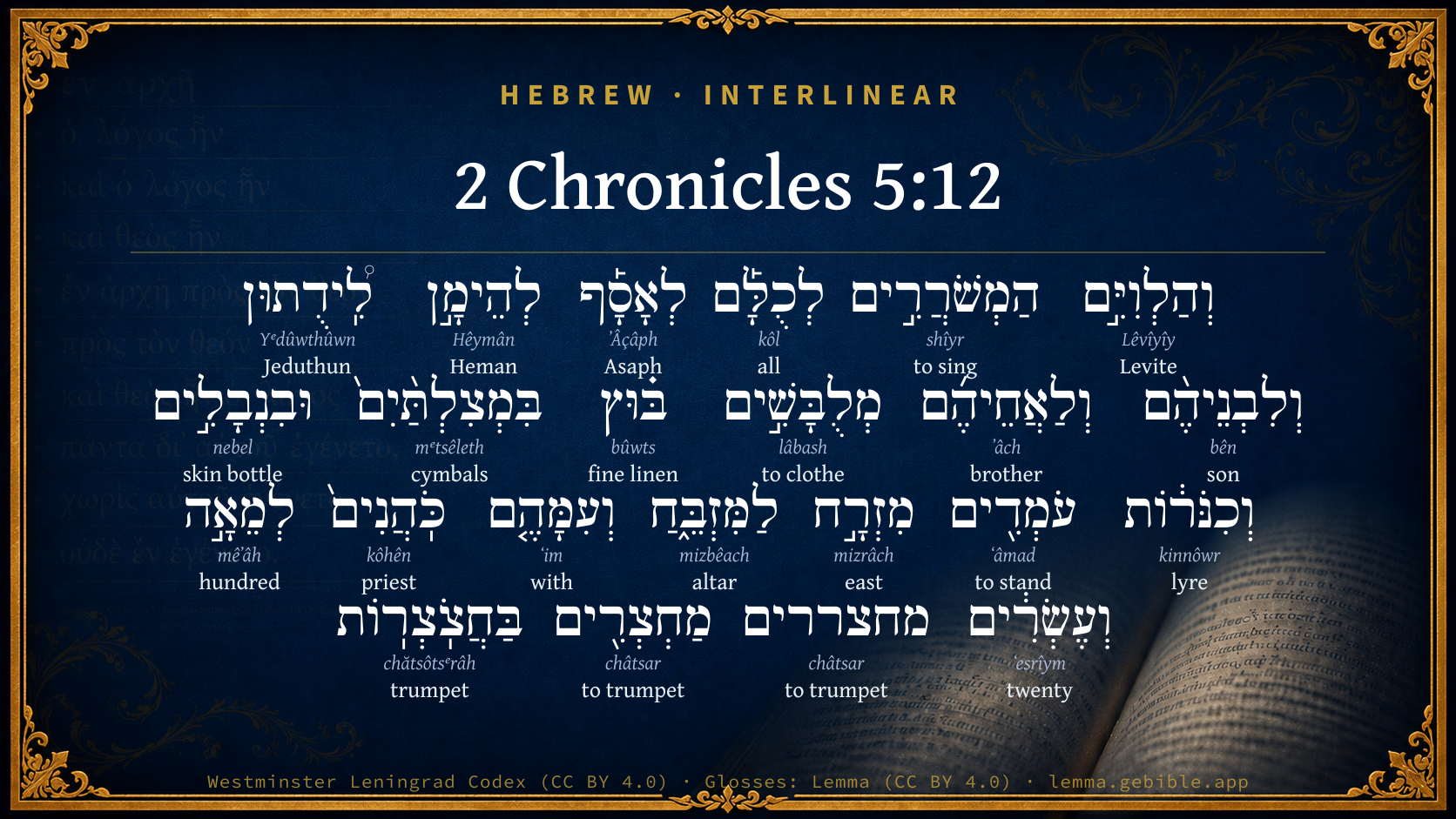
Hebrew (Westminster Leningrad Codex) 2 Chronicles 5:12 appears in the Hebrew Old Testament. The text above is from the Westminster Leningrad Codex. Each word links to its Strong’s number, a concise gloss, and parsing drawn from the Open Scriptures Hebrew Bible morphology. Click any word for its full Brown-Driver-Briggs (BDB) entry.
Download image
Cite this verse

2 Chronicles 5:12 (World English Bible). Public Domain. Lemma interlinear Bible study tool, https://lemma.gebible.app/v/2-chronicles/5/12.

Show BibTeX & RIS
BibTeX
RIS
English Translation
also the Levites who were the singers, all of them, even Asaph, Heman, Jeduthun, and their sons and their brothers, arrayed in fine linen, with cymbals and psalteries and harps, stood at the east end of the altar, and with them one hundred twenty priests sounding with trumpets;)
World English Bible · Public Domain
Download a study sheet

One document with this verse’s original text, its word-by-word gloss line, the meaning frame, cross-references with their text, attributed commentary, and full source and license credits — printable, and it pastes into notes with its structure intact.

This verse Autodidact and up

Study sheet (.html) Plain text (.txt)

A passage Seminary Student

Up to 50 verses in one chapter. A passage sheet keeps up to 6 commentary sources and 12 cross-references per verse, in the order this page ranks them, and says so on the sheet whenever that leaves anything out. Ask for a single verse and you get the Autodidact verse sheet above.

Everything on this page stays free to read, with no account — the sheet is a download of what is already on screen, not access to it.

Want to remove ads? Support Godless Engineer
Compare translations 3

The same verse in 3 English versions, stacked beneath the original-language interlinear above. Click any original word for its lexicon entry.

Each is an independent rendering of the whole verse — the interlinear is not word-aligned to these translations.

Highlighted words mark where these versions differ — a whole-verse word diff, not a word-by-word alignment.

  • World English Bible Public Domain
    also the Levites who were the singers, all of them, even Asaph, Heman, Jeduthun, and their sons and their brothers, arrayed in fine linen, with cymbals and psalteries and harps, stood at the east end of the altar, and with them one hundred twenty priests sounding with trumpets;)
  • King James Version Public Domain
    Also the Levites which were the singers, all of them of Asaph, of Heman, of Jeduthun, with their sons and their brethren, being arrayed in white linen, having cymbals and psalteries and harps, stood at the east end of the altar, and with them an hundred and twenty priests sounding with trumpets:)
  • unfoldingWord Literal Text CC BY-SA 4.0
    And the Levites, the singers, all of them, Asaph, Heman, Jeduthun, and their sons and their brothers, clothed in fine linen, with cymbals, and with harps and lyres, were standing to the east of the altar. And with them, 120 priests sounding with trumpets.

unfoldingWord Literal Text — © unfoldingWord, licensed CC BY-SA 4.0. Word-aligned USFM3 via Door43 (git.door43.org/unfoldingWord/en_ult).

Versions to compare (up to 4)

3 of 4 selected

Show all 18 translations

Every available English version of this verse, each an independent rendering of the whole verse.

  • World English Bible Public Domain
    also the Levites who were the singers, all of them, even Asaph, Heman, Jeduthun, and their sons and their brothers, arrayed in fine linen, with cymbals and psalteries and harps, stood at the east end of the altar, and with them one hundred twenty priests sounding with trumpets;)
  • Berean Standard Bible Public Domain
    all the Levitical singers—Asaph, Heman, Jeduthun, and their sons and relatives—stood on the east side of the altar, dressed in fine linen and playing cymbals, harps, and lyres, accompanied by 120 priests sounding trumpets.
  • Majority Standard Bible Public Domain
    all the Levitical singers—Asaph, Heman, Jeduthun, and their sons and relatives—stood on the east side of the altar, dressed in fine linen and playing cymbals, harps, and lyres, accompanied by 120 priests sounding trumpets.
  • King James Version Public Domain
    Also the Levites which were the singers, all of them of Asaph, of Heman, of Jeduthun, with their sons and their brethren, being arrayed in white linen, having cymbals and psalteries and harps, stood at the east end of the altar, and with them an hundred and twenty priests sounding with trumpets:)
  • American Standard Version (1901) Public Domain
    also the Levites who were the singers, all of them, even Asaph, Heman, Jeduthun, and their sons and their brethren, arrayed in fine linen, with cymbals and psalteries and harps, stood at the east end of the altar, and with them a hundred and twenty priests sounding with trumpets;)
  • Revised Version (1885) Public Domain
    also the Levites which were the singers, all of them, even Asaph, Heman, Jeduthun, and their sons and their brethren, arrayed in fine linen, with cymbals and psalteries and harps, stood at the east end of the altar, and with them an hundred and twenty priests sounding with trumpets:)
  • Geneva Bible (1599) Public Domain
    And the Leuites the singers of all sortes, as of Asaph, of Heman, of Ieduthun, and of their sonnes and of their brethren, being clad in fine linen, stoode with cymbales, and with violes and harpes at the East ende of the altar, and with them an hundreth and twentie Priestes blowing with trumpets:
  • Douay-Rheims (1899) Public Domain
    Both the Levites and the singing men, that is, both they that were under Asaph, and they that were under Heman, and they that were under Idithun, with their sons, and their brethren, clothed with fine linen, sounded with cymbals, and psalteries, and harps, standing on the east side of the altar, and with them a hundred and twenty priests, sounding with trumpets.
  • Young's Literal Translation Public Domain
    and the Levites, the singers, to all of them, to Asaph, to Heman, to Jeduthun, and to their sons, and to their brethren, clothed in white linen, with cymbals, and with psalteries, and harps, are standing on the east of the altar, and with them priests, to a hundred and twenty, blowing with trumpets --
  • Literal Standard Version CC BY-SA 4.0
    and the Levites, the singers, to all of them, to Asaph, to Heman, to Jeduthun, and to their sons, and to their brothers, clothed in white linen, with cymbals, and with psalteries, and harps, are standing on the east of the altar, and with them one hundred and twenty priests blowing with trumpets—
  • Unlocked Literal Bible CC BY-SA 4.0
    Also the Levites who were the singers, all of them, including Asaph, Heman, Jeduthun, and their sons and brothers, clothed in fine linen and playing cymbals, harps, and lyres, stood at the east end of the altar. With them were 120 priests blowing trumpets.
  • unfoldingWord Literal Text CC BY-SA 4.0
    And the Levites, the singers, all of them, Asaph, Heman, Jeduthun, and their sons and their brothers, clothed in fine linen, with cymbals, and with harps and lyres, were standing to the east of the altar. And with them, 120 priests sounding with trumpets.
  • Darby Bible Public Domain
    and the Levites the singers, all they of Asaph, of Heman, of Jeduthun, with their sons and their brethren, clad in byssus, with cymbals and lutes and harps, stood at the east end of the altar, and with them a hundred and twenty priests sounding with trumpets),
  • World Messianic Bible Public Domain
    also the Levites who were the singers, all of them, even Asaph, Heman, Jeduthun, and their sons and their brothers, arrayed in fine linen, with cymbals and stringed instruments and harps, stood at the east end of the altar, and with them one hundred twenty priests sounding with shofars );
  • Webster's Bible Public Domain
    Also the Levites who were the singers, all of them of Asaph, of Heman, of Jeduthun, with their sons and their brethren; being arrayed in white linen, having cymbals and psalteries and harps, stood at the east end of the altar, and with them a hundred and twenty priests sounding with trumpets:)
  • Free Bible Version CC BY-SA 4.0
    All the Levites who were singers—Asaph, Heman, Jeduthun, and their sons and relatives—stood on the east side of the altar. They were dressed in fine linen, striking cymbals, playing harps and lyres, and accompanied by one hundred and twenty priests sounding trumpets.
  • Bible in Basic English Public Domain
    And the Levites who made the music, all of them, Asaph, Heman, Jeduthun, and their sons and brothers, robed in fair linen, were in their places with their brass and corded instruments at the east side of the altar, and with them a hundred and twenty priests blowing horns;)
  • JPS Tanakh (1917) Public Domain
    also the Levites who were the singers, all of them, even Asaph, Heman, Jeduthun, and their sons and their brethren, arrayed in fine linen, with cymbals and psalteries and harps, stood at the east end of the altar, and with them a hundred and twenty priests sounding with trumpets —

Literal Standard Version (2020), Covenant Press — licensed CC BY-SA 4.0. Text via the HelloAO Bible API (eBible.org). Unlocked Literal Bible (unfoldingWord) — licensed CC BY-SA 4.0. Text via the HelloAO Bible API (eBible.org). unfoldingWord Literal Text — © unfoldingWord, licensed CC BY-SA 4.0. Word-aligned USFM3 via Door43 (git.door43.org/unfoldingWord/en_ult). Free Bible Version, Dr. Jonathan Gallagher — licensed CC BY-SA 4.0. Text via the HelloAO Bible API (eBible.org).

Word by word

More ways to search: Search by grammar → Find every occurrence → Compare this word →

Practice this passage: Drill this verse → Learn its vocabulary →

בּ֗וּץ
bûwts
H948
“fine linen”
Noun, Common, Masculine, Singular, Absolute
Part of Speech
Noun
Type
Common
Gender
Masculine
Number
Singular
State
Absolute
Full BDB Definition

Origin: from an unused root (of the same form) meaning to bleach, i.e. (intransitive) be white

TWOT: 219

byssus, a costly, fine white linen cloth made in Egypt
  1. וְהַלְוִיִּ֣ם Lêvîyîy H3881 “and · the · Levites” Conjunction + Particle, Definite Article + Noun, Gentilic, Masculine, Plural, Absolute
  2. הַמְשֹׁרֲרִ֣ים shîyr H7891 “the · singing” Particle, Definite Article + Verb, Polel, Participle Active, Masculine, Plural, Absolute
  3. לְכֻלָּ֡ם kôl H3605 “to/for · all · their” Preposition + Noun, Common, Masculine, Singular, Construct + Suffix, Personal, 3rd Person, Masculine, Plural
  4. לְאָסָ֡ף ʼÂçâph H623 “to/for · Asaph” Preposition + Noun, Proper
  5. לְהֵימָ֣ן Hêymân H1968 “to/for · Heman” Preposition + Noun, Proper
  6. לִֽ֠ידֻתוּן Yᵉdûwthûwn H3038 “to/for · Jeduthun” Preposition + Noun, Proper
  7. וְלִבְנֵיהֶ֨ם bên H1121 “and · to/for · sons · their” Conjunction + Preposition + Noun, Common, Masculine, Plural, Construct + Suffix, Personal, 3rd Person, Masculine, Plural
  8. וְלַאֲחֵיהֶ֜ם ʼâch H251 “and · to/for · brothers · their” Conjunction + Preposition + Noun, Common, Masculine, Plural, Construct + Suffix, Personal, 3rd Person, Masculine, Plural
  9. מְלֻבָּשִׁ֣ים lâbash H3847 “clothed” Verb, Pual, Participle Passive, Masculine, Plural, Absolute
  10. בִּמְצִלְתַּ֨יִם֙ mᵉtsêleth H4700 “in/at · cymbals” Preposition + Noun, Common, Feminine, Dual, Absolute
  11. וּבִנְבָלִ֣ים nebel H5035 “and · in/at · skin bottles” Conjunction + Preposition + Noun, Common, Masculine, Plural, Absolute
  12. וְכִנֹּר֔וֹת kinnôwr H3658 “and · lyres” Conjunction + Noun, Common, Masculine, Plural, Absolute
  13. עֹמְדִ֖ים ʻâmad H5975 “standing” Verb, Qal, Participle Active, Masculine, Plural, Absolute
  14. מִזְרָ֣ח mizrâch H4217 “east” Noun, Common, Masculine, Singular, Absolute
  15. לַמִּזְבֵּ֑חַ mizbêach H4196 “to/for the · altar” Preposition, Determined + Noun, Common, Masculine, Singular, Absolute
  16. וְעִמָּהֶ֤ם ʻim H5973 “and · with · them” Conjunction + Preposition + Suffix, Personal, 3rd Person, Masculine, Plural
  17. כֹּֽהֲנִים֙ kôhên H3548 “priests” Noun, Common, Masculine, Plural, Absolute
  18. לְמֵאָ֣ה mêʼâh H3967 “to/for · hundred” Preposition + Adjective, Cardinal number, Both, Singular, Absolute
  19. וְעֶשְׂרִ֔ים ʻesrîym H6242 “and · twenty” Conjunction + Adjective, Cardinal number, Both, Plural, Absolute
  20. מחצררים châtsar H2690 “trumpeting” Verb, Hiphil, Participle Active, Masculine, Plural, Absolute
  21. מַחְצְרִ֖ים châtsar H2690 “trumpeting” Verb, Hiphil, Participle Active, Masculine, Plural, Absolute
  22. בַּחֲצֹֽצְרֽוֹת chătsôtsᵉrâh H2689 “in/at · trumpets” Preposition + Noun, Common, Feminine, Plural, Absolute

About this verse

These counts appear in no published source. They are computed here, from the morphology-tagged text and Lemma’s own curated glosses. What Lemma adds →

23
words
22
distinct lemmas
Historical
section

Notable vocabulary

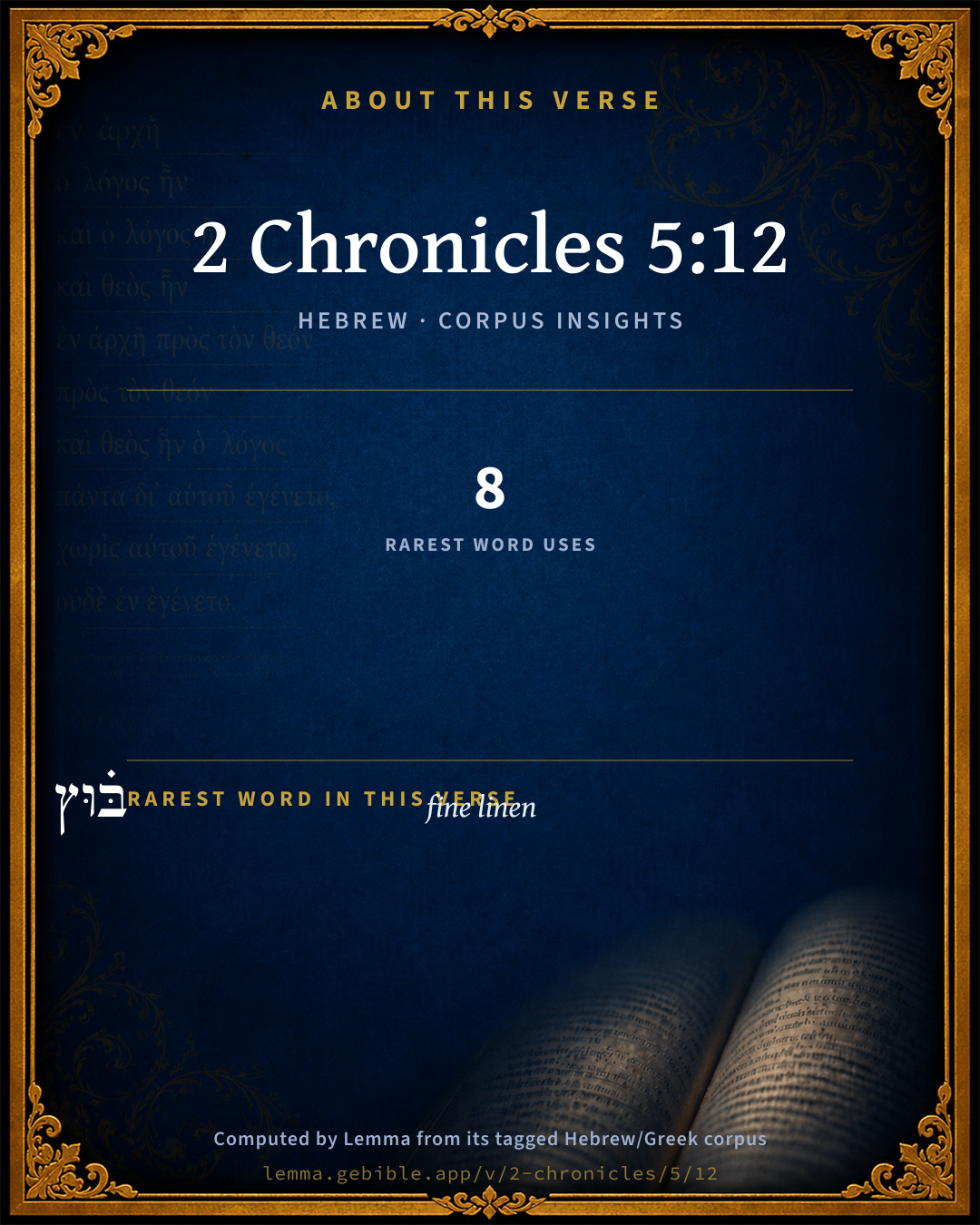
The rarest word here is בּ֗וּץ fine linen H948 — appearing just 8 times in the whole Hebrew Bible.

Shared distinctive vocabulary

בּ֗וּץ fine linen H948 occurs in 8 verses of the Hebrew Bible. Also found in:

Grammatical profile

  • 5 verbs
  • 15 nouns
  • 2 adjectives
  • 1 preposition

Verb forms

  • הַמְשֹׁרֲרִ֣ים Polel · Participle Active
  • מְלֻבָּשִׁ֣ים Pual · Participle Passive
  • עֹמְדִ֖ים Qal · Participle Active
  • מחצררים Hiphil · Participle Active
  • מַחְצְרִ֖ים Hiphil · Participle Active

Repetition

A word recurs within this verse — often emphatic in Hebrew:

  • מחצררים to trumpet H2690 ×2

Hebrew & Septuagint length

In English translation the verse runs 48 words from the Hebrew and 52 from the Septuagint (LXX English) — closely comparable.

A rough comparison of the two English renderings, which tokenize alike — not a word-level alignment.

Word counts can differ between the Hebrew and the Greek without any difference in meaning — e.g. the Hebrew direct-object marker אֵת has no separate Greek word, and Greek often adds the article ὁ.

Cross-references

25

Topical passages linked to 2 Chronicles 5:12 in the Treasury of Scripture Knowledge — connected by theme and wording, ordered by reader-vote popularity; previews shown in the World English Bible.

  • 1 Chronicles 15:24 Shebaniah, and Joshaphat, and Nethanel, and Amasai, and Zechariah, and Benaiah, and Eliezer, the priests, did blow the trumpets before the ark of God: and Obed-edom and Jehiah were doorkeepers for the ark.
  • 1 Chronicles 6:33 These are those who waited, and their sons. Of the sons of the Kohathites: Heman the singer, the son of Joel, the son of Samuel,
  • 1 Chronicles 6:39 His brother Asaph, who stood on his right hand, even Asaph the son of Berechiah, the son of Shimea,
  • 1 Chronicles 23:5 and four thousand were doorkeepers; and four thousand praised Yahweh with the instruments which I made, [said David], for giving praise.
  • 2 Chronicles 7:6 The priests stood, according to their offices; the Levites also with instruments of music of Yahweh, which David the king had made to give thanks to Yahweh, (for his loving kindness endures for ever), when David praised by their ministry: and the priests sounded trumpets before them; and all Israel stood.
  • 2 Chronicles 29:25 He set the Levites in the house of Yahweh with cymbals, with psalteries, and with harps, according to the commandment of David, and of Gad the king's seer, and Nathan the prophet; for the commandment was of Yahweh by his prophets.
  • Psalms 68:25 The singers went before, the minstrels followed after, In the midst of the ladies playing with tambourines,
  • Psalms 150:3–5 Praise him with the sounding of the trumpet! Praise him with harp and lyre!
  • Numbers 10:1–5 Yahweh spoke to Moses, saying,
  • Joshua 6:6–20 Joshua the son of Nun called the priests, and said to them, Take up the ark of the covenant, and let seven priests bear seven trumpets of rams' horns before the ark of Yahweh.
  • 1 Chronicles 13:8 David and all Israel played before God with all their might, even with songs, and with harps, and with psalteries, and with tambourines, and with cymbals, and with trumpets.
  • 1 Chronicles 15:16–22 David spoke to the chief of the Levites to appoint their brothers the singers, with instruments of music, psalteries and harps and cymbals, sounding aloud and lifting up the voice with joy.
  • 1 Chronicles 15:27 David was clothed with a robe of fine linen, and all the Levites who bore the ark, and the singers, and Chenaniah the master of the song [with] the singers: and David had on him an ephod of linen.
  • 1 Chronicles 16:4–6 He appointed certain of the Levites to minister before the ark of Yahweh, and to celebrate and to thank and praise Yahweh, the God of Israel:
  • 1 Chronicles 16:41–42 and with them Heman and Jeduthun, and the rest who were chosen, who were mentioned by name, to give thanks to Yahweh, because his loving kindness endures forever;
  • 1 Chronicles 23:30 and to stand every morning to thank and praise Yahweh, and likewise in the evening;
  • 1 Chronicles 25:1–7 Moreover, David and the captains of the host set apart for the service certain of the sons of Asaph, and of Heman, and of Jeduthun, who should prophesy with harps, with psalteries, and with cymbals: and the number of those who did the work according to their service was:
  • Ezra 3:10–11 When the builders laid the foundation of the temple of Yahweh, they set the priests in their clothing with trumpets, and the Levites the sons of Asaph with cymbals, to praise Yahweh, after the order of David king of Israel.
  • Psalms 50:1 The Mighty One, God, Yahweh, speaks, And calls the earth from sunrise to sunset.
  • Psalms 62:1 My soul rests in God alone. My salvation is from him.
  • Psalms 88:1 Yahweh, the God of my salvation, I have cried day and night before you.
  • Psalms 92:3 With the ten-stringed lute, with the harp, And with the melody of the lyre.
  • Psalms 149:3 Let them praise his name in the dance! Let them sing praises to him with tambourine and harp!
  • Revelation 15:6 The seven angels who had the seven plagues came out, clothed with pure, bright linen, and wearing golden sashes around their breasts.
  • Revelation 19:8 It was given to her that she would array herself in bright, pure, fine linen: for the fine linen is the righteous acts of the saints.

Cross-references courtesy of OpenBible.info (CC BY 4.0).

Hebrew and Greek witnesses Masoretic Hebrew ↔ Greek Septuagint

The same verse in the two great witnesses to the Old Testament, shown verse-for-verse.

These are two independent witnesses, not word-aligned to each other, and the Septuagint is shown in lemma (dictionary) form.

Hebrew 2 Chronicles 5:12 Masoretic · Westminster Leningrad Codex

וְהַלְוִיִּ֣ם הַמְשֹׁרֲרִ֣ים לְכֻלָּ֡ם לְאָסָ֡ף לְהֵימָ֣ן לִֽ֠ידֻתוּן וְלִבְנֵיהֶ֨ם וְלַאֲחֵיהֶ֜ם מְלֻבָּשִׁ֣ים בּ֗וּץ בִּמְצִלְתַּ֨יִם֙ וּבִנְבָלִ֣ים וְכִנֹּר֔וֹת עֹמְדִ֖ים מִזְרָ֣ח לַמִּזְבֵּ֑חַ וְעִמָּהֶ֤ם כֹּֽהֲנִים֙ לְמֵאָ֣ה וְעֶשְׂרִ֔ים מחצררים מַחְצְרִ֖ים בַּחֲצֹֽצְרֽוֹת

also the Levites who were the singers, all of them, even Asaph, Heman, Jeduthun, and their sons and their brothers, arrayed in fine linen, with cymbals and psalteries and harps, stood at the east end of the altar, and with them one hundred twenty priests sounding with trumpets;)

World English Bible · Public Domain

Greek LXX 2 Chronicles 5:12 Septuagint · lemma form

καί ὁ λευείτης ὁ ψαλτῳδός πᾶς ὁ υἱός ασαφ ὁ αιμαν ὁ ιδιθουν καί ὁ υἱός αὐτός καί ὁ ἀδελφός αὐτός ὁ ἐνδύω στολή βύσσινος ἐν κύμβαλον καί ἐν νάβλα καί ἐν κινύρα ἵστημι κατέναντι ὁ θυσιαστήριον καί μετά αὐτός ἱερεύς ἑκατόν εἴκοσι σαλπίζω ὁ σάλπιγξ

that all the singing Levites assigned to the sons of Asaph, to Aeman, to Idithun, and to his sons, and to his brethren, of them that were clothed in linen garments, with cymbals and lutes and harps, were standing before the altar, and with them one hundred and twenty priests, blowing trumpets.

LXX2012 (modern English Septuagint) · Public Domain

Hebrew: Westminster Leningrad Codex (CC BY 4.0). Greek: Septuagint (public domain); English from LXX2012 (modern English Septuagint) (Public Domain). How the Septuagint differs from the Hebrew →

Commentary

Notes on 2 Chronicles 5:12 from classic Christian and Jewish commentators (each source and its license shown beneath its notes). The classic Christian expositions comment on the surrounding passage and are grouped to its opening verse, so a note may address several verses; the Jewish commentaries on the Tanakh (Rashi and others) are per-verse, so they appear only where the commentator wrote on this verse.

Lemma curates 59 commentaries, every one of them public domain or Creative Commons licensed, each selected and text-cleaned for this edition rather than reprinted as found. About our sources →

Trapp's Complete Commentary

John Trapp

2Ch 5:12 Also the Levites [which were] the singers, all of them of Asaph, of Heman, of Jeduthun, with their sons and their brethren, [being] arrayed in white linen, having cymbals and psalteries and harps, stood at the east end of the altar, and with them an hundred and twenty priests sounding with trumpets:)

Ver. 12. Being arrayed in white linen.] Which might remind them of that innoceney and integrity required of them.

John Trapp, A Commentary or Exposition upon All the Books of the Old and New Testament (1647–1656) — public domain. Text from a community e-Sword module.

The Biblical Illustrator

Joseph S. Exell

2Ch_5:12-13

Also the the Levites, which were the singers.

The temple choir

I. Music and revelation from God. There is no fuller revelation of God in Nature than is found in these laws of sound, by which He comes into the very heart of man, even to its inmost recesses of love and adoration; and it requires only a sensitive, child-like heart to interpret this speechless music locked within Nature as the voice of God pleading to be let out into music, and praise through the heart of man, for so only can His works praise Him.

II. Music as a science to cultivate.

III. Music consecrated to its highest use in the worship of God. (J. Wolfendale.)

Music in the churches

I propose to speak about sacred music.

I. Its importance. This is apparent--

1. From the fact that God commanded it. Through Paul He tells us to admonish one another in psalms and hymns and spiritual songs, and through David He cries out, Sing ye to God, all ye kingdoms of the earth. I think there are more commands in the Bible to sing than there are to pray.

2. From the impressiveness of the exercise. You know something of what secular music has achieved. One inspiriting national air is worth thirty thousand men as a standing army. In the earlier part of the late war the Government proposed to economise in bands of music, and many of them were sent home; but the generals in the army sent word to Washington: You are making a great mistake. We are falling back and falling back. We have not enough music. Then the Government changed its mind: more bands of music were sent to the field, and the day of shameful defeat terminated. Many of you are illustrations of what sacred song can do. Through it you were brought into the kingdom of Jesus Christ.

3. From its power to soothe perturbation.

4. From its power to arouse to action.

II. Some of the obstacles in the way of its advancement.

1. It has been impressed into the service of superstition.

2. An inordinate fear of criticism.

3. There has been so much angry discussion on the subject.

4. The erroneous notion that this part of the service could be conducted by delegation. (T. De Witt Talmage.)

United praise as a means of grace

I. That the glory of the Lord began to appear when the assembly were employed in praise and thanksgiving. Praise is the most acceptable service we can be engaged in: Whoso offereth praise giorifieth Me. Prayer is an expression of our indigence and weakness. Thanksgiving expresseth our relish of the sweetness of benefits received; but praise rises above all selfish regards, and directly terminates on the greatness and amiableness of God Himself. The habitations of the blessed continually resound with the high praises of God. Did we praise God more, He would give us greater cause to praise Him. It is suggestive that the Lords Prayer both begins and ends with adoration.

II. The subject of praise, which God honoured with this token of His acceptance, was His own goodness and everlasting mercy. God is best pleased with our praises when we adore and celebrate those perfections of His nature which dispose Him to pity the miserable, and have the kindest aspect towards the children of men.

III. The seriousness and fervour of this devout assembly. They devoted their whole strength and activity, as if they were ambitious to spend themselves in this heavenly employment. The devotion of the soul is the soul of devotion.

IV. The harmony and unanimity of these ancient worshippers. They were all as one, and made one sound to be heard in praising and thanking the Lord (Act_2:1-2; Psa_133:1-3.; Mat_5:23-24). (R. Walker.)

On psalmody

I. Why or for what end music is used in religious worship. By the constitution of our nature music, by a mysterious and potent agency, awakens the heart, concentrates the thoughts, and elevates the soul, and the end of music in religious worship is to assist our devotions, by an application to our affections of that which has upon them a powerful action to excite and direct them; by engaging us in an exercise in which sympathy has large scope, and every one acts upon the rest, to enable us to animate each other; to pour forth our praises and adorations in a way that is significant and edifying, delightsome and impressive. Hence--

1. The absurdity of making music in our religious services a mere matter of entertainment.

2. All kinds of music which have no tendency to aid and gratify devotion ought to be banished from the house of God.

II. Some of the examples and authorities for making music a handmaid to religion (Job_38:7; Gen_4:21; Exo_15:20; Psa_47:6; Psa_98:7; Eph_5:19; Mat_26:30).

III. After what manner the first Christians performed this service. The nearer we come to the model of the primitive Church in this, the nearer we shall approach to perfection. The psalmody of the first Christians was plain, simple, and solemn. Their tunes were, probably, easy and few, and the character of them such as expressed humility and love, and was calculated rather to melt than to capture the heart. Afterwards, as piety declined, it became necessary to re-excite and re-animate it by more striking music; and the whole congregation was divided into two parts, which sang responsive to each other.

IV. Some brief suggestions how we may use this part of divine service to our own benefit and the glory of god. (Bp. Dehon.)

Advantages of music in public worship

I. they lifted up their voice. Those whom nature has gifted with a voice ought to lift it up not only in making responses but also in singing the praises of their Creator and Redeemer. The choir should not be deputed by the congregation to praise God in their stead. Its office is rather to lead their united praises.

II. In acceptable worship the praise of the heart must accompany the praise of the lips: They were as one to make one sound to be heard in praising and thanking the Lord. Their hearts were all at one with the trumpets and cymbals and instruments of music. Those who sing loudly the praises of God should let heart, lips, and life be a well-tuned instrument devoted to the service of the sanctuary. The man who sings beautiful words with an angels tongue, and leads an unholy life, pronounces his own condemnation.

III. Those who are anxious that the praise of the heart should accompany the praise of the lips will find themselves greatly aided by instruments of music: They lifted up their voice with the trumpets and cymbals and instruments of music. Instrumental music unites voices which would otherwise be discordant, and removes the diffidence of those who might otherwise be silent in the service of the sanctuary. Instrumental music removes weariness from the mind, banishes wandering thoughts, and enables us to mount above the world and the things of the world, and to hold high converse with the adorable Trinity. It also conveys to us a lively image of the worship and services of the heavenly sanctuary. (Rev_14:2; Rev_14:8). We must learn to distinguish between the natural effect of music on the senses and the spiritual effect of Divine truths on the soul.

IV. The subject-matter of praise: Gods goodness in creation and redemption.

V. Gods testimony of approbation: the cloud filled the house. This was designed to impress their senses with an awful reverence of God.

VI. The time when God gave them this remarkable token of His approbation: When they lifted up their voice. Conclusion: So that the priests could not stand to minister by reason of the cloud. These show that, when Christ should come, the priests should not minister in their former manner. We are now called upon to renounce every altar but the Cross, and every sacrifice but the Victim which bled on Calvary. As s spiritual priesthood, we have to present our bodies a living sacrifice. (Canon Arthur R. Pennington.)

That then the house was filled with a cloud (with 2Ch_7:1-8).--

Temple glories

The two passages of Scripture which I have read to you give you two pictures. In the first you have the cloud, in the second you have the fire; and in these two together you have the sacred mystic symbols of the presence of the Eternal God in the midst of His people.

I. The first of these passages affords me the first head of my discourse. Let us note--

1. The occupation in which the people were engaged. They were praising God--

(1) Unanimously.

(2) Heartily.

(3) Scripturally.

They sung that old psalm, His mercy endureth for ever.

2. While thus engaged the cloud filled the sacred places.

3. Then a solemn awe fell on all that were gathered that day.

4. The suppliants felt they might pray more earnestly because they prayed surely.

II. The first text has had reference to the past. The next dwells specially upon the future. After praise, joined with solemn prayer and sacrifice, the fire came down.

1. How much the preacher wants this fire! Oh! I have heard a man preach a sermon to which an angel might have listened for its faultless truthfulness, but it lacked fire; but I have known another whose ministry was faulty in many respects, but yet he spoke like a man that meant what he said, with his heart boiling over at his eyes, and men were moved and many souls were saved.

2. But we need this fire upon the hearers too. How well people listen when they come to hear something! What a noble effect is produced when once the fire comes upon a congregation! (C. H. Spurgeon.)

.

The Biblical Illustrator, edited by Joseph S. Exell (c. 1880s–1900s) — public domain. Text from a community e-Sword module.

The Pulpit Commentary

This verse, marked off in the Authorized Version in brackets, is most graphic. First all the priests, who were not hors de combat, i.e. all the "courses" of them together, thronged the arena; and now they are joined by all the Levites who were singers, of them of Asaph, of Heman, of Jeduthun, (1Ch_25:1-31) i.e. twenty-four choirs in one, with their sons and their brethren; and this collected choir is arrayed in white linen; and they have three kinds of musical instruments cymbals (Psalm el. 5) and psalteries (or lutes) and harps; 1Ch_16:5 1Ch_25:1) and they take up their station at the east end of the altar, and still further a strong support flanks these of a hundred and twenty priests sounding with Trumpets. (1Ch_16:6) So ends our inopportune Authorized Version parenthesis. But to what all this? It is a scene in a nation"s history, in the universal Church"s history; it is witnessed from heaven, and by Heaven"s will recorded in the book on earth, which will endure through all generations, as long as the sun and moon endure, as ushering in the moment when, as described in the next verse, to the unanimous fervent adoration and praise of man, God bent a willing, gracious ear, and to earth the glory of heaven drew nigh. Cymbals. The word used here ( denoting strictly "pair of cymbals," occurs eleven times in Chronicles, once in Ezra, and once in Nehemiah. Another form of essentially the same word occurs once in 2Sa_6:5 and twice in Psa_150:5. This last passage notes two kinds of cymbals the "loud" and the "high-sounding." It was the former of these that Asaph, Heman, and Jeduthun used, and their use was probably to regulate or beat the time (see Smith"s "Bible Dictionary," 1:375, 376; Conder"s "Handbook to the Bible," p. 167, 2nd edit.). Psalteries (lbn). This word occurs twenty-eight times in the Old Testament, but of these it is translated (Authorized Version) four times as "viols" (Isa_5:12 Isa_14:11; Amo_5:23 Amo_6:5) it is also once rendered "vessels of flagons", (Isa_22:24) but the margin offers the version "instruments of viols." While the cymbal was, of course, an instrument of percussion, the psaltery was one of strings its use was as an accompaniment to the voice. The first mention of it is very interesting. (1Sa_10:5) Compare also David"s and Solomon"s psaltery in 2Sa_6:5; 2Ch_9:11. Harps (rwNKi) This word occurs forty-two times, beginning with Oj Gen_4:21. Trumpets (hrx) This word (including eleven of the personal forms of it, as e.g. the person blowing the trumpet) occurs just forty times, beginning with Num_10:2. It was the straight tuba, and was not, therefore, the same with the ram"s-horn shaped buccina (rpvo) generally rendered in the Authorized Version "cornet," but sometimes "trumpet;" the specialty of the cornet being to blow a sound for a signal or summons of some sort, whether secular as in war, or sacred as for some festival. The trumpets of our verse evidently (Num_10:8) were in a particular sense the instrument of the priests.

The Pulpit Commentary (1880–1919), ed. H.D.M. Spence-Jones & Joseph S. Exell — public domain. Text from a community e-Sword module.

Jamieson, Fausset & Brown

Robert Jamieson, A. R. Fausset & David Brown

the Levites which were the singers--On great and solemn occasions, such as this, a full choir was required, and their station was taken with scrupulous regard to their official parts: the family of Heman occupied the central place, the family of Asaph stood on his right, and that of Jeduthun on his left; the place allotted to the vocal department was a space between the court of Israel and the altar in the east end of the priests' court.

with them an hundred and twenty priests sounding with trumpets--The trumpet was always used by the priests, and in the divine service it was specially employed in calling the people together during the holy solemnities, and in drawing attention to new and successive parts of the ritual. The number of trumpets used in the divine service could not be less than two (Num 10:2), and their greatest number never exceeded the precedent set at the dedication of the temple. The station where the priests were sounding with trumpets was apart from that of the other musicians; for while the Levite singers occupied an orchestra east of the altar, the priests stood at the marble table on the southwest of the altar. There both of them stood with their faces to the altar. The manner of blowing the trumpets was, first, by a long plain blast, then by one with breakings and quaverings, and then by a long plain blast again [BROWN, Jewish Antiquities].

Jamieson, Fausset & Brown — Commentary Critical and Explanatory on the Whole Bible (1871) — public domain (CC PDM 1.0). Text via the HelloAO Bible API.

Adam Clarke's Commentary

Verse 12. A hundred and twenty priests] Cymbals, psalteries, and harps, of any kind, in union with a hundred and twenty trumpets or horns, could not produce much harmony; as to melody, that must have been impossible, as the noise was too great.

Adam Clarke's Commentary on the Bible (1810–1826) — public domain. Text from a community e-Sword/MySword module.

Ellicott's Commentary for English Readers

(12) All of them of Asaph . . . brethren.—Heb., to all of them, to Asaph, to Heman, &c., &c., and to their sons, and to their brethren. This use of the particle le (to, for) is characteristic of the chronicler, whose style in these verses stands in marked contrast with the former part of the chapter. As to the Levitical guilds of musicians, comp. 1Ch_25:1-7; 1Ch_15:16, seq.

Arrayed in white linen.—1Ch_15:27.

Having cymbals and psalteries and harps.—With cymbals and nebels and kinnors (harps and lutes, or guitars). (See 1Ch_15:28.)

Stood at the east end of the altar.—Were standing east of the altar.

And with them . . . trumpets.—And with them priests, to a hundred and twenty, were trumpeting with trumpets. (See 1Ch_15:24.)

An hundred and twenty.—Thus five to each of the twenty-four classes of the priests.

The mark of parenthesis should be cancelled.

A Bible Commentary for English Readers, edited by Charles John Ellicott (1878–1897) — public domain. Text from a community e-Sword module.

The Cambridge Bible for Schools and Colleges

gen. ed. J. J. S. Perowne

12. of Asaph, of Heman, of Jeduthun, with their sons] R.V. even Asaph, Heman, Jeduthun, and their sons. Cp. 1Ch_25:1-7.

being arrayed in white linen] R.V. arrayed in fine linen.

psalteries … harps] See 1Ch_13:8, notes.

at the east end of the altar] Looking westward, facing the Holy of Holies. To face the East was to turn the back upon the sanctuary; Eze_8:16.

trumpets] See 1Ch_15:24, note.

The Cambridge Bible for Schools and Colleges (gen. ed. J. J. S. Perowne; Cambridge University Press, 1878–1918) — public domain. Text from a community e-Sword module.

Haydock's Catholic Bible Commentary

Linen, or "robes of silk." Protestants, "white linen." (Haydock)

George Leo Haydock (1774–1849), Haydock's Catholic Family Bible and Commentary, 1859 edition — public domain. Excludes Psalms (Douay-Rheims chapter numbering differs from Protestant) and Deuterocanonical books (Catholic canon only).

Lesson kit

Teaching starters — assembled from the data on this page, not authored interpretation. Every prompt links to the verse data it draws on. Edit before teaching.

2 Chronicles, in the Historical, opens this verse with 23 words (22 distinct Hebrew lemmas). Its most distinctive word is bûwts (“fine linen”). A historical commentator’s framing appears above. Read the whole chapter for the surrounding context.

Discussion questions

  1. What does “fine linen” (bûwts) contribute to the verse as a whole?
  2. 1 Chronicles 4:21 shares the word «fine linen» with this verse. How do the two illuminate each other?
  3. “to trumpet” occurs 2× in this one verse. What is the effect of the repetition?
  4. These translations render this verse differently. What is at stake in choosing one wording over another?
  5. The verb «הַמְשֹׁרֲרִ֣ים» is Polel Participle Active. How does its form color the action?
  6. Reading how Trapp's Complete Commentary and The Biblical Illustrator read this verse, where do the two commentators agree and where do they part?

Things to notice

Reading settings

Reading text

Shown beneath each verse's original-language words.

Old Testament
Old Testament edition

Read the OT as the Masoretic Hebrew (MT) or the Greek Septuagint (LXX).

English shown for the Greek Septuagint (in the Hebrew ↔ Greek comparison).

Comparing translations? Open the Compare panel on any verse page to stack up to four side by side.