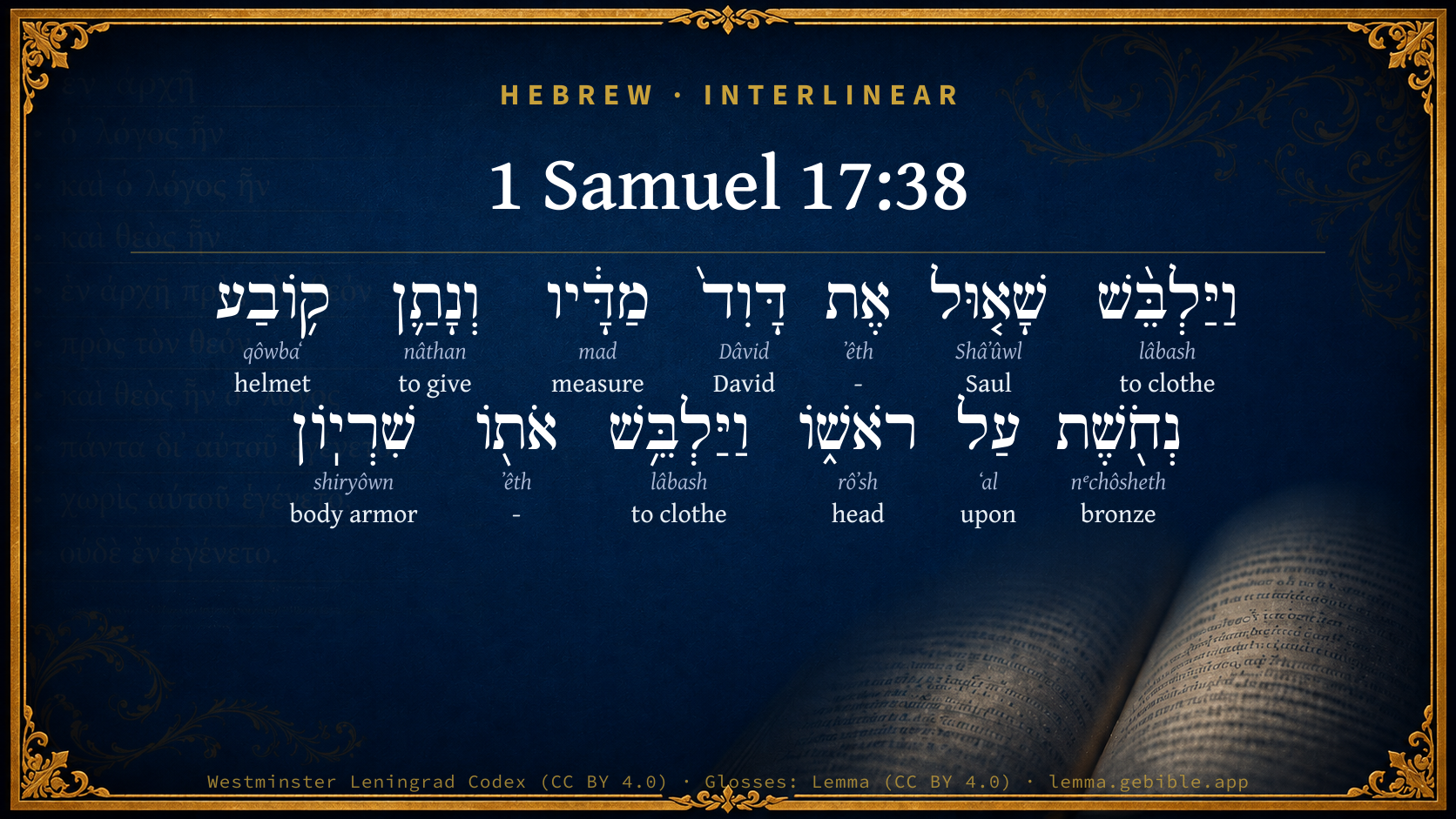
1 Samuel 17:38

Hebrew (Westminster Leningrad Codex) 1 Samuel 17:38 appears in the Hebrew Old Testament. The text above is from the Westminster Leningrad Codex. Each word links to its Strong’s number, a concise gloss, and parsing drawn from the Open Scriptures Hebrew Bible morphology. Click any word for its full Brown-Driver-Briggs (BDB) entry.
Download image
Cite this verse

1 Samuel 17:38 (World English Bible). Public Domain. Lemma interlinear Bible study tool, https://lemma.gebible.app/v/1-samuel/17/38.

Show BibTeX & RIS
BibTeX
RIS
English Translation
Saul clad David with his clothing, and he put a helmet of brass on his head, and he clad him with a coat of mail.
World English Bible · Public Domain
Highlights Full analysis ↓
Download a study sheet

One document with this verse’s original text, its word-by-word gloss line, the meaning frame, cross-references with their text, attributed commentary, and full source and license credits — printable, and it pastes into notes with its structure intact.

This verse Autodidact and up

Study sheet (.html) Plain text (.txt)

A passage Seminary Student

Up to 50 verses in one chapter. A passage sheet keeps up to 6 commentary sources and 12 cross-references per verse, in the order this page ranks them, and says so on the sheet whenever that leaves anything out. Ask for a single verse and you get the Autodidact verse sheet above.

Everything on this page stays free to read, with no account — the sheet is a download of what is already on screen, not access to it.

Want to remove ads? Support Godless Engineer
Compare translations 3

The same verse in 3 English versions, stacked beneath the original-language interlinear above. Click any original word for its lexicon entry.

Each is an independent rendering of the whole verse — the interlinear is not word-aligned to these translations.

Highlighted words mark where these versions differ — a whole-verse word diff, not a word-by-word alignment.

  • World English Bible Public Domain
    Saul clad David with his clothing, and he put a helmet of brass on his head, and he clad him with a coat of mail.
  • King James Version Public Domain
    And Saul armed David with his armor, and he put an helmet of brass upon his head; also he armed him with a coat of mail.
  • unfoldingWord Literal Text CC BY-SA 4.0
    Then Saul clothed David his garments and put a helmet of bronze on his head, and he clothed him a coat.

unfoldingWord Literal Text — © unfoldingWord, licensed CC BY-SA 4.0. Word-aligned USFM3 via Door43 (git.door43.org/unfoldingWord/en_ult).

Versions to compare (up to 4)

3 of 4 selected

Show all 18 translations

Every available English version of this verse, each an independent rendering of the whole verse.

  • World English Bible Public Domain
    Saul clad David with his clothing, and he put a helmet of brass on his head, and he clad him with a coat of mail.
  • Berean Standard Bible Public Domain
    Then Saul clothed David in his own tunic, put a bronze helmet on his head, and dressed him in armor.
  • Majority Standard Bible Public Domain
    Then Saul clothed David in his own tunic, put a bronze helmet on his head, and dressed him in armor.
  • King James Version Public Domain
    And Saul armed David with his armor, and he put an helmet of brass upon his head; also he armed him with a coat of mail.
  • American Standard Version (1901) Public Domain
    And Saul clad David with his apparel, and he put a helmet of brass upon his head, and he clad him with a coat of mail.
  • Revised Version (1885) Public Domain
    And Saul clad David with his apparel, and he put an helmet of brass upon his head, and he clad him with a coat of mail.
  • Geneva Bible (1599) Public Domain
    And Saul put his rayment vpon Dauid, and put an helmet of brasse vpon his head, and put a brigandine vpon him.
  • Douay-Rheims (1899) Public Domain
    And Saul clothed David with his garments, and put a helmet of brass upon his head, and armed him with a coat of mail.
  • Young's Literal Translation Public Domain
    And Saul clotheth David with his long robe, and hath put a helmet of brass on his head, and doth clothe him with a coat of mail.
  • Literal Standard Version CC BY-SA 4.0
    And Saul clothes David with his long robe, and has put a helmet of bronze on his head, and clothes him with a coat of mail.
  • Unlocked Literal Bible CC BY-SA 4.0
    Saul clothed David with his armor. He put a helmet of bronze upon his head, and he clothed him with a coat of chainmail.
  • unfoldingWord Literal Text CC BY-SA 4.0
    Then Saul clothed David his garments and put a helmet of bronze on his head, and he clothed him a coat.
  • Darby Bible Public Domain
    And Saul clothed David with his dress, and put a helmet of bronze upon his head, and clothed him with a corselet.
  • World Messianic Bible Public Domain
    Saul dressed David with his clothing. He put a helmet of bronze on his head, and he clad him with a coat of mail.
  • Webster's Bible Public Domain
    And Saul armed David with his armor, and he put a helmet of brass upon his head; also he armed him with a coat of mail.
  • Free Bible Version CC BY-SA 4.0
    Saul gave David his own battle clothes to wear, placed a bronze helmet on his head, and put armor on him.
  • Bible in Basic English Public Domain
    Then Saul gave David his clothing of war, and put a head-dress of brass on his head and had him clothed with a coat of metal.
  • JPS Tanakh (1917) Public Domain
    And Saul clad David with his apparel, and he put a helmet of brass upon his head, and he clad him with a coat of mail.

Literal Standard Version (2020), Covenant Press — licensed CC BY-SA 4.0. Text via the HelloAO Bible API (eBible.org). Unlocked Literal Bible (unfoldingWord) — licensed CC BY-SA 4.0. Text via the HelloAO Bible API (eBible.org). unfoldingWord Literal Text — © unfoldingWord, licensed CC BY-SA 4.0. Word-aligned USFM3 via Door43 (git.door43.org/unfoldingWord/en_ult). Free Bible Version, Dr. Jonathan Gallagher — licensed CC BY-SA 4.0. Text via the HelloAO Bible API (eBible.org).

Word by word

More ways to search: Search by grammar → Find every occurrence → Compare this word →

Practice this passage: Drill this verse → Learn its vocabulary →

ק֥וֹבַע
qôwbaʻ
H6959
“helmet of”
Noun, Common, Masculine, Singular, Construct
Part of Speech
Noun
Type
Common
Gender
Masculine
Number
Singular
State
Construct
Full BDB Definition

Origin: a form collateral to H3553

TWOT: 1993

helmet
  1. וַיַּלְבֵּ֨שׁ lâbash H3847 “and · to clothe” Conjunction + Verb, Hiphil, Sequential Imperfect, 3rd Person, Masculine, Singular
  2. שָׁא֤וּל Shâʼûwl H7586 “Saul” Noun, Proper
  3. אֶת ʼêth H853 “-” Particle, Direct Object
  4. דָּוִד֙ Dâvid H1732 “David” Noun, Proper
  5. מַדָּ֔יו mad H4055 “measures · his” Noun, Common, Masculine, Plural, Construct + Suffix, Personal, 3rd Person, Masculine, Singular
  6. וְנָתַ֛ן nâthan H5414 “and · to give” Conjunction + Verb, Qal, Perfect, 3rd Person, Masculine, Singular
  7. נְחֹ֖שֶׁת nᵉchôsheth H5178 “bronze” Noun, Common, Feminine, Singular, Absolute
  8. עַל ʻal H5921 “upon” Preposition
  9. רֹאשׁ֑וֹ rôʼsh H7218 “head · his” Noun, Common, Masculine, Singular, Construct + Suffix, Personal, 3rd Person, Masculine, Singular
  10. וַיַּלְבֵּ֥שׁ lâbash H3847 “and · to clothe” Conjunction + Verb, Hiphil, Sequential Imperfect, 3rd Person, Masculine, Singular
  11. אֹת֖וֹ ʼêth H853 “- · him” Particle, Direct Object + Suffix, Personal, 3rd Person, Masculine, Singular
  12. שִׁרְיֽוֹן shiryôwn H8302 “body armor” Noun, Common, Both, Singular, Absolute

About this verse

These counts appear in no published source. They are computed here, from the morphology-tagged text and Lemma’s own curated glosses. What Lemma adds →

13
words
11
distinct lemmas
Historical
section

Notable vocabulary

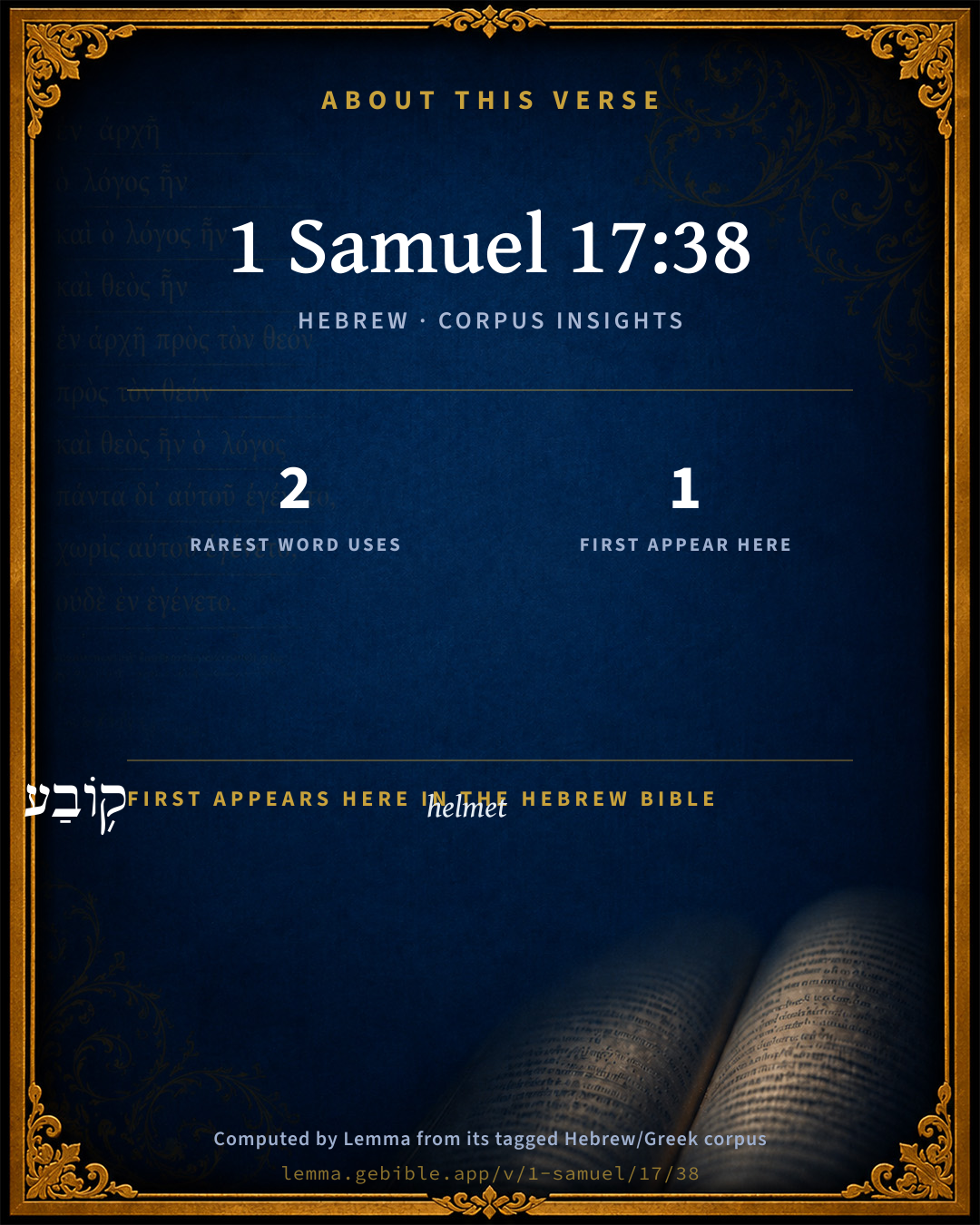
The rarest word here is ק֥וֹבַע helmet H6959 — appearing just 2 times in the whole Hebrew Bible.

First appearance in Scripture

This word makes its first canonical appearance in the Hebrew Bible here:

  • ק֥וֹבַע helmet H6959

Shared distinctive vocabulary

ק֥וֹבַע helmet H6959 occurs in 2 verses of the Hebrew Bible. Also found in:

Grammatical profile

  • 3 verbs
  • 7 nouns
  • 1 preposition
  • 2 particles

Verb forms

  • וַיַּלְבֵּ֨שׁ Hiphil · Sequential Imperfect
  • וְנָתַ֛ן Qal · Perfect
  • וַיַּלְבֵּ֥שׁ Hiphil · Sequential Imperfect

Repetition

A word recurs within this verse — often emphatic in Hebrew:

  • וַיַּלְבֵּ֨שׁ to clothe H3847 ×2

Hebrew & Septuagint length

In English translation the verse runs 25 words from the Hebrew and 16 from the Septuagint (LXX English) — the Septuagint runs noticeably shorter here. See the side-by-side →

A rough comparison of the two English renderings, which tokenize alike — not a word-level alignment.

Word counts can differ between the Hebrew and the Greek without any difference in meaning — e.g. the Hebrew direct-object marker אֵת has no separate Greek word, and Greek often adds the article ὁ.

Hebrew and Greek witnesses Masoretic Hebrew ↔ Greek Septuagint

The same verse in the two great witnesses to the Old Testament, shown verse-for-verse.

Here the Septuagint runs noticeably shorter than the Hebrew — LXX2012 (modern English Septuagint) 16 words vs World English Bible 25. A rough length comparison of the two English translations, not a word-level alignment — read both below.

These are two independent witnesses, not word-aligned to each other, and the Septuagint is shown in lemma (dictionary) form.

Hebrew 1 Samuel 17:38 Masoretic · Westminster Leningrad Codex

וַיַּלְבֵּ֨שׁ שָׁא֤וּל אֶת דָּוִד֙ מַדָּ֔יו וְנָתַ֛ן ק֥וֹבַע נְחֹ֖שֶׁת עַל רֹאשׁ֑וֹ וַיַּלְבֵּ֥שׁ אֹת֖וֹ שִׁרְיֽוֹן

Saul clad David with his clothing, and he put a helmet of brass on his head, and he clad him with a coat of mail.

World English Bible · Public Domain

Greek LXX 1 Samuel 17:38 Septuagint · lemma form
And Saul clothed David with a military coat, and put his brazen helmet on his head.

LXX2012 (modern English Septuagint) · Public Domain

Hebrew: Westminster Leningrad Codex (CC BY 4.0). Greek: Septuagint (public domain); English from LXX2012 (modern English Septuagint) (Public Domain). How the Septuagint differs from the Hebrew →

Targum (Aramaic paraphrase)

1

The Targum is the ancient Jewish Aramaic paraphrase of the Hebrew Scriptures — an interpretive translation, not the Hebrew text itself. Onkelos (literal) and Pseudo-Jonathan (expansive) render the Torah, and Jonathan the Prophets. Coverage is partial: where no permissively-licensed English translation exists for a verse, only the Aramaic is shown. This is verse-level text, not a word-by-word alignment to the Hebrew.

  1. Targum Jonathan Prophets (Joshua–Malachi)
    וְאַלְבֵּישׁ שָׁאוּל יַת דָוִד לְבוּשׁוֹהִי וִיהַב קוּלַס דִנְחָשׁ עַל רֵישֵׁיהּ וְאַלְבֵּישׁ יָתֵיהּ שִׁרְיָנָא:

    (no public-domain English translation for this verse)

    Targum Jonathan — Aramaic: “Mikraot Gedolot” (public domain). English: “Sefaria Community Translation” (CC0 1.0 (public-domain dedication)); “London "Chaldee Paraphrase," 1871” (public domain). Text via Sefaria.

Commentary

Notes on 1 Samuel 17:38 from classic Christian and Jewish commentators (each source and its license shown beneath its notes). The classic Christian expositions comment on the surrounding passage and are grouped to its opening verse, so a note may address several verses; the Jewish commentaries on the Tanakh (Rashi and others) are per-verse, so they appear only where the commentator wrote on this verse.

Lemma curates 59 commentaries, every one of them public domain or Creative Commons licensed, each selected and text-cleaned for this edition rather than reprinted as found. About our sources →

Trapp's Complete Commentary

John Trapp

1Sa 17:38 And Saul armed David with his armour, and he put an helmet of brass upon his head; also he armed him with a coat of mail.

Ver. 38. And Saul armed David with his armour.] Not the same that himself used to wear, for there would have been no proportionableness; but with armour taken out of Saul’s armory or storehouse, and meet for David’s body.

John Trapp, A Commentary or Exposition upon All the Books of the Old and New Testament (1647–1656) — public domain. Text from a community e-Sword module.

Joseph Benson's Commentary

1Sa 17:38. Saul armed David with his armour — Not that which he was wont to wear himself, for he was so tall it would not have fitted David, but with armour taken out of his armory. The Hebrew word מדיו, madaiv, however, here rendered armour, more properly signifies his vestments, or his garments, and is so translated chap. 1Sa 18:4, and in most other places where it occurs. Indeed his armour is distinguished from this, and particularly described in the following words. He therefore, doubtless, speaks in this clause of some military vestments which were then used in war, and were contrived for defence, as buff coats now are.

Joseph Benson's Commentary on the Old and New Testaments (1811–1818) — public domain. Text from a community e-Sword module.

Jamieson, Fausset & Brown

Robert Jamieson, A. R. Fausset & David Brown

Saul armed David with his armour--The ancient Hebrews were particularly attentive to the personal safety of their warriors, and hence Saul equipped the youthful champion with his own defensive accoutrements, which would be of the best style. It is probable that Saul's coat of mail, or corslet, was a loose shirt, otherwise it could not have fitted both a stripling and a man of the colossal stature of the king.

Jamieson, Fausset & Brown — Commentary Critical and Explanatory on the Whole Bible (1871) — public domain (CC PDM 1.0). Text via the HelloAO Bible API.

Adam Clarke's Commentary

Verse 38. Saul armed David] He knew that although the battle was the Lord's, yet prudent means should be used to secure success.

Adam Clarke's Commentary on the Bible (1810–1826) — public domain. Text from a community e-Sword/MySword module.

Ellicott's Commentary for English Readers

(38) And Saul armed David with his armour.—But the king was determined to omit no earthly means of securing victory to his young champion, and we read how he made him try on his own various pieces of fighting array, doubtless the best-tempered and costliest that the camp of Israel possessed. The word rendered “his armour” literally signifies his garments, that is, the dress worn beneath the mail. Upon this was buckled on the heavy metal armour suit, with the great fighting sword and the royal helm. It is not necessary to suppose David was at all of the same proportions as Saul, for much of the dress could have been speedily adjusted to the requirements of one slighter and shorter than the king; besides, the result shows they were, in spite of alteration, far too heavy and cumbersome. “I cannot go with these,” simply said the brave boy, his purpose, however, of meeting the Philistine giant quite unshaken, though he found his comparatively weak person unable to bear the weight of the king’s panoply or to wield his arms.

A Bible Commentary for English Readers, edited by Charles John Ellicott (1878–1897) — public domain. Text from a community e-Sword module.

The Cambridge Bible for Schools and Colleges

gen. ed. J. J. S. Perowne

38. armed David with his armour] Clothed David with his dress: probably a special military dress adapted to be worn with armour. The sword was fastened to it (1Sa_17:39). Cp. 1Sa_18:4 (E. V. garments).

a coat of mail] A corselet. The fact that he could wear Saul’s armour at all shews that he must have been full grown, perhaps about twenty years old.

The Cambridge Bible for Schools and Colleges (gen. ed. J. J. S. Perowne; Cambridge University Press, 1878–1918) — public domain. Text from a community e-Sword module.

John Gill's Exposition

And Saul armed David with his armour,.... Not with what he wore himself; for it cannot be thought he would strip himself of his armour in the field of battle, and when just going to it; and besides what suited the one would not be fit for the other, their bulk and stature being different i but this was some armour Saul had brought with him, besides what he himself wore, to furnish any with that might want it:

and he put an helmet of brass upon his head; such an one, though not so large as Goliath had, these being usually made of brass; See Gill on Sa1 17:5,

also he armed him with a coat of mail; which probably was of brass also, and like that of Goliath's too, only lesser, Sa1 17:5.

John Gill's Exposition of the Whole Bible (1746–1763) — public domain (CC PDM 1.0). Text via the HelloAO Bible API.

Matthew Poole's English Annotations

With his armour; either,

1. With Saul’s own armour which he used to wear in battle; which seems not to agree with the extraordinary height of Saul’s stature, 1Sa 10:23; nor is it like that Saul would disarm himself, when he was going forth to the battle, 1Sa 17:20,21. Or,

2. With armour taken out of his armoury. Not that the whole armory of Saul was brought into the field; but that some chosen arms were taken out thence, and brought for any emergent occasion. Or rather,

3. With his vestments, or garments. For,

1. So the Hebrew word properly and usually signifies; and so this same word is translated, 1Sa 18:4.

2. His armour is distinguished from this, and is particularly described in the following words. He seems therefore to speak of some military vestments which were then used in war, and were contrived for defence; such as buff-coats now are.

Matthew Poole's English Annotations on the Holy Bible (1683–1685) — public domain. Text from a community e-Sword/MySword module.

The Pulpit Commentary

Vers. 38-40. Saul armed David with his armour. Rather, "Saul clad David in his war dress." The word does not mean arms, either offensive or defensive; for in 1Sa_4:12, where it is rendered "clothes," we read of its being rent. It occurs again in 1Sa_18:4, and is there rendered "garments." Strictly it was the soldier"s coat, worn under his armour, and girt close to the body by the sword belt. It does not follow that David was as tall as Saul because he thus put on his military coat; for it would be adjusted to the body by the belt, and its length was not a matter of much consequence. When, then, it is said that David girded his sword upon his armour, it means upon this coat, though the corselet of mail would also be worn over it. He assayed to go. Ie. he made an attempt at going, took a short walk thus arrayed, making trial all the while of his equipments; and he found them so cumbrous that he felt that he would have no chance against the Philistine except as a light-armed soldier. The agility of his movements would then make him a match for one so heavily overweighted as Goliath. Wearing, therefore, only his shepherd"s dress, armed only with a sling, David descended into the ravine which separated the two armies, chose there five pebbles, and, clambering up the other side, advanced towards the Philistine. For brook the Hebrew has "torrent bed." Condor speaks of a torrent flowing through the ravine (see on ver. 2).

Vers. 38-40.

Naturalness.

The facts are

1. Saul clothes David with his armour.

2. David, distrusting its value, puts it aside.

3. He goes forth to the conflict armed only with a sling and a stone.

There is a curious blending of cowardice, prudence, and folly in Saul"s conduct. Not daring to fight the foe, he hesitates not to accept a youth; and while providing ordinary armour for his defence, he fails to see that an armed youth would really be at a disadvantage with an armed giant. Apart from higher considerations, David"s good sense shows him that free nimbleness would be of more value than limbs stiffened under a coat of mail. The gentle negation, "I have not proved them," covered a positive faith in other armour often proved. He would be David in the conflict, and no one else. The issue was staked on his perfect naturalness. He knew "in whom he believed," and was true to his own individuality. The teaching is wide and important in relation to

I EDUCATION. To be natural is one of the ends of education, and there is a naturalness in the means and process by which alone that and all the ends of education will be secured. While psychologically the sum of faculties is the same in all, the relative power of them may vary. Constitutional tendencies and tastes also greatly differ. The inherent capacity of certain faculties seems likewise to be affected by inheritance. Discrimination is therefore requisite in education, otherwise we may place a Saul"s armour on a David, and encumber his mental movements. No doubt a weak faculty is benefited by being stimulated to work, and a deficient taste may be improved by exercise; but the apportionment of work to faculties and tastes should be regulated, not by some general average of minds, but by what will make the most of the idiosyncrasies of the individual. That educational training and equipment is natural which leaves the mind most free and effective. What is gained on one side by painful drudgery may be lost on another by embitterment and crippled talents. Especially in religious education is this important. Let us not clothe the mental nature of children with the forms suited to men. Probably much of the distaste for religious instruction springs from the perfect unsuitability of the form to the receptivity of the mind.

II OCCUPATION. Success in any calling depends largely on the naturalness of it to the abilities, tastes, and aspirations of the employed. The Goliath of poverty and disappointment too frequently overpowers really good and able men, because their occupation, though good and useful in itself, is unnatural to them. In the pressure of life it is hard, no doubt, to find the proper place for each one; but more forethought on the part of parents and guardians would obviate some of the evils. The over crowding and eager race of men, trampling one another down in poverty, raises the thought whether these troubles are not the voice of Providence calling on men to spread abroad and cultivate the rich distant lands waiting for occupants. Naturalness of occupation and of manner is also desirable in works of charity and religion. Let not men be armed with powers and prerogatives out of accord with their mental and moral stature. Let not the youth of the Church, in their enthusiasm for Christ, be fettered by impositions that will nullify their zeal Nor let the immature assume functions for which ripe experience alone can qualify. The wise Church is that which takes cognisance of all its members, and finds out and encourages some sphere of Christian activity natural to the attainments and social position of each individual. Ministries may differ in style and be most naturale.g. Paul and John.

III SPIRITUAL CONFLICT. In one respect David"s was a spiritual conflict. He discerned the great religious issues at stake, and the fitness of the means by which the battle was to be fought. For sweeping off from the earth a great foe of God"s purpose in Israel, and, therefore, in Christ, he had not proved the armour of Saul, the unspiritual king; but he had proved other means of warfare suited to his individuality as a youth full of faith in God and enthusiasm for the golden age of the world. The man after God"s own heart will not fight in the attire of the man who had lost faith in God. He must have freedom for such powers as are natural to himself, and that would give scope for his trust in God.

1. Is there not here a foreshadowing of a greater than David? Christ, in seeking to rid the earth of the giant foe of God"s righteous government, sin, knows that men have been accustomed to contend with the evil by various appliances philosophy, art, social and political organisation, repressive ordinances, commercial intercourse, and other agencies created for the preservation of society. There were men who hoped that he would adopt some of the ordinary appliances. (Joh_6:15) But Christ worked out his mission on the line of his own individuality. Recognising organisations, and social laws, and ordinary knowledge as useful, he nevertheless struck at the root, not at the ramifications, of sin. "Except a man be born again, he cannot see the kingdom of God." "Make the tree good and his fruit good." And this he effects by the power of his holy life, of his self-sacrifice, and pure truth, brought to bear on the deepest springs of thought and volition by the mighty working of the Holy Spirit (Mat_11:29; Joh_3:7 Joh_10:16-18 Joh_13:15 Joh_17:17; 2Co_5:21; Php_2:5; 1Pe_2:21-25 1Pe_3:18)

2. We may also see here a parallel to our personal conflicts with evil.

There are "carnal" weapons sometimes used for subjugation of evil, but the spiritual man knows of an "armour of God", (Eph_3:11-17) often proved and never known to fail Both in our own hearts and in the world sin will be most surely overcome if we distrust mere accommodations to its nature and conformities to its methods, and use with all our free energy the spiritual power which comes of God. Christian naturalness lies in using Christian means faith, prayer, truth, love, hope, and patience.

Vers. 38-54. (EPHES-DAMMIM.)

David"s conflict with Goliath.

"So David prevailed" (ver. 50).

1. David was specially prepared for the conflict by the whole of his previous life, and especially by his successful attack upon the lion and the bear, and his victory over himself.

2. He was providentially led into the conflict. "Jesse little thought of sending his son to the army just in the critical juncture; but the wise God orders the time and all the circumstances of actions and affairs so as to serve his designs of securing the interest of Israel and advance the man after his own heart" (M. Henry).

3. He was inwardly impelled to the conflict by the Spirit of the Lord that had come upon him, (1Sa_16:13) and had formerly inspired Saul with fiery zeal against the Ammonites. (1Sa_11:6) If he had gone into it in any other manner he would doubtless have failed.

4. He rendered invaluable service to Israel by the conflict, not only thereby repelling the invasion of the Philistines, but also teaching them the spirit they should cherish, and the kind of king they needed. "It is not too much to assert that this event was a turning point in the history of the theocracy, and marked David as the true king of Israel, ready to take up the Philistine challenge of God and his people, and kindling in Israel a new spirit, and in the might of the living God bringing the contest to victory" (Edersheim).

5. He became an appropriate type of Christ by the conflict. "It is a rehearsal of Christ"s temptation and victory a thousand years afterwards" (Wordsworth"s "Com.").

6. He was also an eminent pattern for Christians in the conflict; exhibiting the spirit which they should possess in their warfare with "the world, the flesh, and the devil." "David"s contest with Goliath will only be apprehended in its true light if the latter be regarded as a representative of the world, and David the representative of the Church" (Hengstenberg). Notice

I THE WEAPONS which he chose (vers. 38-40).

1. He neglected not the use of weapons altogether. To have done so would have been rash and presumptuous; for it is God"s method to grant success to those who employ the legitimate aids which he has provided for the purpose. Although David did not trust in weapons of war, he did not throw them away, but used them wisely. We must do the same in the spiritual conflict.

2. He rejected the armour, defensive and offensive, which seemed to others indispensable. "I cannot go in these; for I have not proved them. And David put them off him" (ver. 39). Some weapons may appear to others, and even to ourselves, at first, to be the best, and yet not be really such. Some weapons may be suitable to others, but not to us. We must learn by experience. We must be simple, genuine, and true to ourselves. And above all, we must look for Divine guidance in the matter. "The weapons of our. warfare are not carnal," etc.. (2Co_10:4)

3. He selected the weapons which were most effective. "And he took his staff in his hand, and chose him five smooth stones," etc. (ver. 40) selected them carefully, knowing well which were the best for his purpose; and he was not satisfied with one or two merely, but provided a reserve. His weapons were insignificant only in the view of the inconsiderate. They were the most suitable that can be conceived, and gave greatest promise of success; and his genius was shown in their selection. Intelligence was opposed to brute force. "It was just because the sling and the stone were not the weapons of Goliath that they were best fitted to David"s purpose. They could be used at a distance from the enemy; they made his superior resources of no avail; they virtually reduced him to the dimensions and condition of an ordinary man; they did more, they rendered his extraordinary size a disadvantage; the larger he was, the better for the mark. David, moreover, had been accustomed in his shepherd life to the sling; it had been the amusement of his solitary hours, and had served for his own protection and that of his flock; so that he brought to his encounter with Goliath an accuracy of aim and a strength and steadiness of arm that rendered him a most formidable opponent" (A.J. Morris). The lesson here taught is not that anything will do to fight with, but that there must be in spiritual, as well as in secular, conflicts a proper adaptation of means to ends.

II THE SPIRIT which he displayed (vers. 41-48).

1. Humility. His heart was not haughty and proud, (Psa_131:1) as Eliab said it was, but humble and lowly. He was conscious of unworthiness

2. before God, of utter weakness and insufficiency in himself, and ready to do and bear whatever might be the will of the Lord concerning him. Humility (from humus, the ground) lies in the dust, and is the root out of which true excellence grows. It is the first, the second, and the third thing in religion (Augustine). "Before honour is humility". (Pro_15:32) "He giveth grace to the humble." "Be clothed with humility.

3. Faith. "I come to thee in the name of the Lord of hosts". (ver. 45; see 1Sa_1:3) He looked beyond man to God, and relied upon his help. "He did not compare himself with Goliath, but he compared Goliath with Jehovah," who was the Leader and "God of the ranks of Israel." He believed, and therefore he spoke, and fought, and prevailed. (2Co_4:13) "Although unarmed in the estimation of men, he was armed with the Godhead" (St. Ambrose).

1. Zeal. He was little concerned about his own honour and renown, but he was "very jealous for the Lord God of hosts". (1Ki_19:14) He heard the gods of the heathen extolled (ver. 43), and the name of Jehovah blasphemed, and he was desirous above all things that he should be glorified. "All the earth shall know," etc. (ver. 46). "All this assembly shall know," etc. (ver. 47). When we fight for God we may confidently expect that he will fight for us. "The battle is the Lord"s.

2. Courage, which stood in contrast to the fear with which Israel was smitten, and was the fruit of his humility, faith, and zeal. It was shown in his calm and dauntless attitude in going forth against his opponent, in the presence of the two armies, in breathless suspense; in his bold and confident answer to the contemptuous challenge of the foe; and in his eagerness and energy in the actual conflict. "David hasted, and ran," etc. (vers. 48, 49, 51). "So David prevailed.

III THE VICTORY which he achieved. Not only was the boastful Philistine overthrown, speedily, signally, and completely, but also

1. The enemy fled in terror (ver. 51), and their power was broken (ver. 52).

2. Israel was imbued with a new and better spirit (vers. 52, 53).

3. He himself was honoured by God in giving him the victory and opening before him a wider sphere of activity, by the king (vers. 55-58; 1Sa_18:2) and by all the people. Even the Philistines long afterwards held his name in dread. (1Sa_21:11) "This first heroic deed of David was of the greatest importance to him and all Israel, for it was his first step on the way to the throne to which Jehovah had resolved to raise him" (Keil). "Raised by the nation, he raised and glorified it in return; and, standing at the crowning point of the history of the nation, he concentrates in himself all its brilliance, and becomes the one man of greatest renown in the whole course of its existence" (Ewald). D.

The Pulpit Commentary (1880–1919), ed. H.D.M. Spence-Jones & Joseph S. Exell — public domain. Text from a community e-Sword module.

John Wesley's Explanatory Notes

armour - With armour taken out of his armoury. He seems to speak of some military vestments which were then used in war, and were contrived for defense; such as buff-coats are now.

John Wesley, Explanatory Notes Upon the Whole Bible (1754–1765) — public domain. Text via the GEBible commentary corpus.

Rashi

Rabbi Shlomo Yitzchaki (Rashi)

Dovid in his own battle garments. They changed and became Dovid's size, since he had been anointed with the anointing oil, although they belonged to Shaul who was taller than all of the other people, from his shoulder and upward. And when Shaul noted this, he cast an envious glance toward him, and Dovid realized it.

Rashi on the Tanakh — English translations: “The Judaica Press complete Tanach with Rashi, translated by A. J. Rosenberg” (CC BY 4.0); “Pentateuch with Rashi's commentary by M. Rosenbaum and A.M. Silbermann, 1929-1934” (public domain); “The Metsudah Tanach series, Lakewood, N.J” (CC BY 4.0); and “The Book of Joshua, Metsudah Publications, 1997” (CC BY 4.0). Text via Sefaria.

Lesson kit

Teaching starters — assembled from the data on this page, not authored interpretation. Every prompt links to the verse data it draws on. Edit before teaching.

1 Samuel, in the Historical, opens this verse with 13 words (11 distinct Hebrew lemmas). Its most distinctive word is qôwbaʻ (“helmet”). The Greek Septuagint runs shorter here. A historical commentator’s framing appears above. Read the whole chapter for the surrounding context.

Discussion questions

  1. The word qôwbaʻ carries the sense “helmet.” How does it shape the verse?
  2. This is the first place “helmet” appears in Scripture (first appears here). What does its debut here establish?
  3. How does Ezekiel 23:24, which shares the word «helmet», read alongside this verse?
  4. What does the repetition of “to clothe” (2× in this one verse) do in this verse?
  5. The Septuagint runs shorter here than the Hebrew. What might account for the difference?
  6. These translations render this verse differently. What is at stake in choosing one wording over another?
  7. «וַיַּלְבֵּ֨שׁ» is a Hiphil Sequential Imperfect verb. How does that grammatical form shape the action described?
  8. Compare how Trapp's Complete Commentary and Joseph Benson's Commentary read this verse. Where do they agree or differ?

Things to notice

  • 1 word makes its first canonical appearance in Scripture here.
  • These translations choose different wording for 11 words in this verse.
  • “to clothe” occurs 2× in this single verse.
  • 11 distinct Hebrew lemmas span 13 words in this verse.

Reading settings

Reading text

Shown beneath each verse's original-language words.

Old Testament
Old Testament edition

Read the OT as the Masoretic Hebrew (MT) or the Greek Septuagint (LXX).

English shown for the Greek Septuagint (in the Hebrew ↔ Greek comparison).

Comparing translations? Open the Compare panel on any verse page to stack up to four side by side.